Table of contents (11)
Hiring Marketing Teams: Should You Go Remote or Onsite in 2026?
Remote vs. Onsite modes
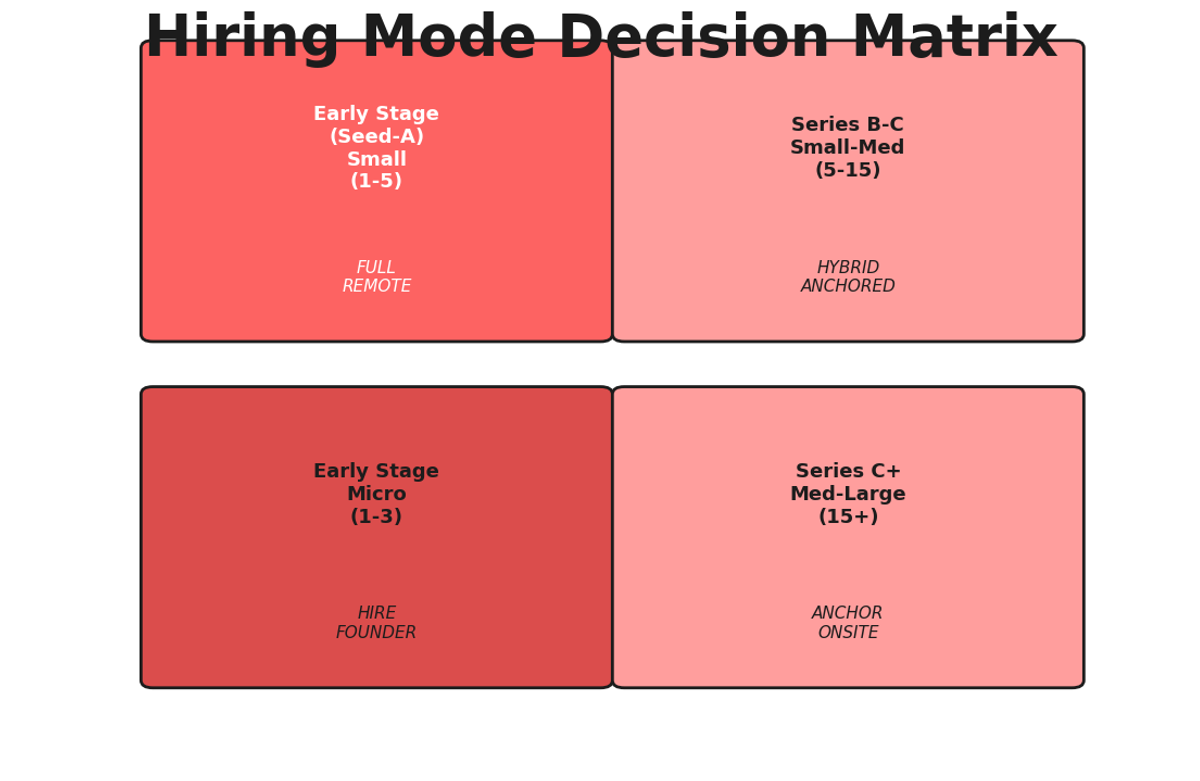
No single answer wins. Remote excels on cost and specialist depth: you hire three senior content marketers for $220K (US $100K plus EU $85K plus India $35K annually) versus $420K onsite in SF. Onsite excels on brand coherence, creative velocity, and synchronous client rituals where design crits and pitch rehearsals compress feedback from days to hours. Hybrid anchored with your VP Marketing and 2-3 core creative specialists onsite at HQ plus 5-8 distributed individual contributors remote captures both advantages and is the Series B+ default in 2026.
The economics are measurable. A mid-market software engineer (5-7 years experience) costs: San Francisco 200-240K USD fully loaded, Austin 140-170K USD, Bangalore 28-40K USD, Tier-2 India city 22-30K USD. The delta tempts, but quality variance within geographies is massive. Top 10% of Bangalore candidates demand 50-70K USD; bottom 50% cost 15-18K USD with 40% annual churn. A carefully curated remote team from Tier-1 India cities (paying premium at 40-45K USD) retains better than bottom-quartile onsite hires at 150K USD. Screening matters more than geography.
Productivity overhead varies by mode. Synchronous onsite teams lose 2-3% to meetings. Async-first remote teams lose 4-6% to async overhead. Hybrid loses 12-15% due to Zoom fatigue and timezone fragmentation. For a 10-person team at 200K USD monthly payroll, that's a 24,000-30,000 USD annual swing between worst and best mode.
The economics are measurable. A mid-market software engineer (5-7 years of experience) costs: San Francisco 200-240K USD fully loaded, Austin 140-170K USD, Bangalore 28-40K USD, Tier-2 India city 22-30K USD. The delta tempts, but quality variance within geographies is massive. The top 10% of Bangalore candidates demand 50-70K USD; the bottom 50% cost 15-18K USD with 40% annual churn. A carefully curated remote team from Tier-1 India cities (paying premium talent at 40-45K USD) retains better and delivers higher quality than bottom-quartile onsite hires at 150K USD. The skill screening matters more than geography.
Productivity overhead varies by mode. Synchronous onsite teams lose 2-3% to basic meetings. Async-first remote teams lose 4-6% to async overhead and context-switching. Hybrid (the worst case) loses 12-15% due to Zoom fatigue, timezone fragmentation, and the cost of being "partly present." For a 10-person team at 200K USD monthly payroll, that's a 24,000-30,000 USD annual swing between worst and best mode.
The market shift post-pandemic is real. Remote hiring is normalized, but founders are pulling certain functions back onsite: brand directors, creative leads, and agency-side account teams. Why? Async tools are excellent for execution (content, paid, SEO iteration) but weak for creative direction and client rituals. A design critique over Slack loses nuance. Client dinners and pitch rehearsals demand in-person presence.
The honest truth: you cannot hire a creative director remotely the way you hire a content strategist. Brand coherence demands shared context. Design critiques, campaign ideation, and client pitches are synchronous activities that resist async tools. See our remote hiring playbook for mode-by-stage breakdowns.
Onsite advantages and cost traps
⭐ Onsite roles thrive here
Brand manager, creative director, events lead, partnerships, and client-facing account teams all benefit from synchronous presence. Design critiques over Slack lose nuance and iteration speed suffers. Client dinners and event production demand in-person coordination. Pitch rehearsals compress feedback cycles from days to minutes. Agency-side marketing almost always requires onsite because external clients expect face-to-face kick-offs, weekly in-person reviews, and shoulder-to-shoulder creative sprints.
Client rituals are sync capital. Brand agencies with onsite creatives run design crits in real time: present, feedback in 30 minutes, iterate by day end. Remote design crits via Figma take 3-4 days async review. For creative work (agency retainers, launches, rebrands), synchronous beats remote by 40-50% time-to-good. For execution work (paid media, content, SEO), remote matches or beats onsite because deep focus matters more than real-time feedback.
Location consolidation enables resource flexibility. An onsite team repurposes an analytics expert for client crisis; a distributed team struggles with timezone friction. Dynamic client requests and rapid reprioritization favor onsite or hybrid anchored (core team at HQ) with 10-15% efficiency gains.
Client rituals are a form of sync capital. Brand agencies with onsite creatives can run design crits in real time: brand director presents, feedback loops in 30 minutes, iterations ship by day end. Remote design crits via Figma comments take 3-4 days of async review. For creative or brand-heavy work (agency retainers, launch campaigns, rebrands), synchronous beats remote by 40-50% in time-to-good. But for execution-heavy work (paid media scaling, content production, SEO optimization), remote matches or beats onsite because deep focus and fewer interruptions matter more than real-time feedback.
Team location consolidation also enables resource flexibility. An onsite team can repurpose an analytics expert to support a client crisis; a distributed team cannot easily load-shift without timezone friction. If your business model involves dynamic client requests and rapid reprioritization, onsite or hybrid anchored (with core team at HQ) has structural advantages worth 10-15% efficiency gain.
Pattern: if the role's core loop is "critique to iteration to refinement," it needs more sync. Hire onsite or tight hybrid. If brand positioning is still unresolved and competitive gaps are fresh, hire your brand leader onsite. The collaboration cost of async brand strategy exceeds the coordination cost of shared office space.
🚧 The onsite cost trap
Onsite hiring in expensive cities costs 40 to 60 percent more than remote. A senior content manager in SF is $140K annually. The same person remote globally is $75K. That spread is not always worth the brand-coherence gain, especially for early-stage teams where execution velocity matters more than creative polish. Founders often over-hire onsite early because they fear async friction, then face budget constraints by Series B. See our pricing models to compare cost structures.
"We hired our brand director onsite in NYC. Client pitches are sharper, design feedback tighter. But we pay 55 percent premium versus our remote content team, and the remote team ships faster because they are not trapped in daily meetings."
, Head of Marketing, B2B SaaS Series B, Versatile Employer of Record - G2 Verified Review
Early-stage lesson: if you cannot afford onsite salary plus overhead plus office for your whole team, hire your founder plus 1-2 onsite specialists and the rest remote. Hybrid 1:3 ratio (one onsite per three remote) works surprisingly well at $500K-$1M budget tiers. Check our managed payroll solutions for pre-built structures.
Remote execution edge
Remote wins when the work is execution-heavy, not creative-heavy. SEO, content strategy, paid media operations, lifecycle marketing, email, martech stack, and sales enablement all thrive remote because the feedback loop is data, not critique. A remote SEO team distributed across US, EU, and India timezones iterates on keyword strategy and link-building faster than a co-located team because they do not need consensus meetings. One person per region works async, documents decisions in a shared wiki, loops in stakeholders only for high-stakes calls. No meeting overhead. Data-driven decisions ship at speed.
Specialist talent density favors remote. A fully onsite team in SF or NYC is limited to local market rates and competing with tech companies. The top content strategist in SF costs 180-220K USD with 5-7 competing offers. Equivalent talent remote-first costs 120K USD in-state or 95K USD in lower-cost markets. Hire three remote specialists for cost of one SF specialist. But this only works for async roles: SEO research, content drafting, paid media optimization, analytics dashboards. Synchronous creative roles (brand director, UX designer) don't compress remote as effectively.
Cost savings compound across hiring cycles. A company hiring 10 marketing professionals per year and shifting 70% to remote (7 at 85K avg, 3 at 160K avg) saves: (7 * 85K) + (3 * 160K) = 1,315K vs. 10 * 160K = 1,600K onsite. Annual delta: 285K USD or 28.5% reduction. Over 3 years with growth, that's 850K+ in compounding savings.
Specialist talent density favors remote. A fully onsite team in SF or NYC is limited to local market rates and must compete with tech companies for talent. The top content strategist in SF costs 180-220K USD and has 5-7 competing offers. The equivalent talent remote-first costs 120K USD if in-state or 95K USD if in lower-cost markets. You can hire three remote specialists for the cost of one SF specialist. But this only works if the role is async-compatible: SEO research, content drafting, paid media optimization, analytics dashboards. Roles requiring synchronous creative iteration (brand director, creative director, UX designer for core product) don't compress to remote as effectively.
Cost savings compound across hiring cycles. A company that hires 10 marketing professionals per year and shifts 70% to remote (7 remote at 85K avg, 3 onsite at 160K avg) saves: (7 * 85K) + (3 * 160K) = 1,315K annual spend vs. 10 * 160K = 1,600K if all were onsite. Annual delta: 285K USD, or 28.5% hiring spend reduction. Over 3 years with growth, that's 850K+ in compounding savings that can fund specialized contractors, better tools, or agency support.
Cost advantage is massive: remote specialist hiring saves 35 to 45 percent year-one salary costs versus onsite in expensive cities. Three full-stack content marketers hired remote (US $100K, EU $85K, India $35K annually) costs $220K total. The same three onsite in SF cost $420K. That is a $200K first-year savings and scales across the whole org. Async execution velocity wins too: remote teams ruthless about no-meeting Wednesdays and written-first decision-making ship faster than onsite teams trapped in daily standups and impromptu brainstorms. The culture discipline required is high, but the payoff is real. See our salary calculator for role-by-location rates.
"Our remote content team (US plus EU) publishes 40 percent more articles per person than our onsite brand team. They iterate on drafts async in Docs, gather feedback in Slack threads, and almost never need live meetings. Our brand team spends half its time in meetings."
, CMO, Marketplace Company, Series C, Versatile Employer of Record - G2 Verified Review
Remote culture systems are the difference between remote teams that ship and remote teams that spiral in async chaos. Canonical docs, no-meeting Wednesdays, and written-first decisions are non-negotiable disciplines.
Role fit by mode

| Role | Best Mode | Why |
| SEO Manager | Remote (5/5) | Pure execution and data iteration. No client rituals. Timezone-independent performance tracking via dashboards. |
| Content Writer or Strategist | Remote (5/5) | Async feedback via Google Docs. Deadline-driven. High context via wiki reduces back-and-forth questions. |
| Paid Ads Specialist | Hybrid (5/5) | Day-to-day is dashboard and A/B testing. Some sync needed for creative feedback and budget strategy. |
| Brand Director or Creative Director | Onsite (5/5) | Design crits, comp reviews, client pitches, color theory debates. Synchronous feedback and fast iteration essential. |
| Campaign Manager | Hybrid (5/5) | Cross-functional coordination benefits from some in-person time. Strategy is async, ops are deadline-driven. |
| Product Marketer | Hybrid (5/5) | Deep product collaboration needs sync time. External writing, positioning work, and GTM strategy work async. |
| Events Lead or Manager | Onsite (5/5) | Requires on-ground presence for vendor management, logistics, day-of execution, and attendee engagement. |
| Social Media Manager | Hybrid (4/5) | Community engagement has real-time elements. Strategy and content calendar work async. Some sync helps. |
Pattern: if the core loop is "data to decision to action," it thrives remote because async tools do not slow execution. If the core loop is "critique to iteration to refinement," it needs more sync and benefits from onsite or tight hybrid. See our EOR versus entity calculator to model your hiring structure by role and geography.
Compensation by geography
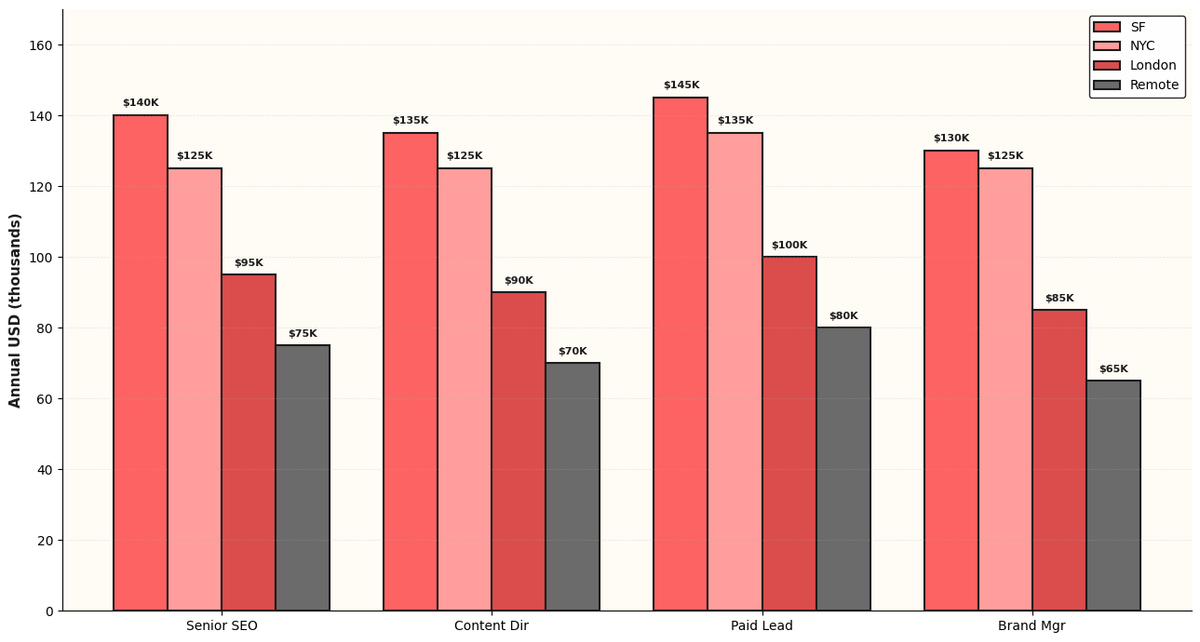
The 2026 data from major US markets shows wide spreads:
Equity structures become important at scale. SF hire expects 0.1-0.3% equity plus 180K salary; remote hire expects 0.02-0.05% equity plus 40K salary. Over 4 years at 10x valuation, SF person's equity worth 1.8-5.4M USD; remote person's 180K-540K USD. Total 4-year comp: SF 2.7-6.3M USD; remote 340K-700K USD. The global pool distributes efficiently, but creates retention risk if remote team discovers equity disparity. Transparency helps but doesn't close the psychological gap.
Compensation fragmentation creates admin complexity. A 50-person team across 8 countries has 8 distinct payroll systems, tax withholdings, benefits standards, compliance requirements. Annual HR overhead: 60-100K USD for multi-country compliance vs. 20-30K USD onshore. Using an EOR provider reduces this to 5-10K USD per employee per year but adds vendor dependency.
Equity structures become important at scale. An SF hire expects 0.1-0.3% equity plus 180K salary; a remote hire expects 0.02-0.05% equity plus 40K salary. Over 4 years, if the company 10x's in valuation, the SF person's equity is worth 1.8-5.4M USD; the remote hire's equity is 180K-540K USD. But total 4-year comp is SF: 900K + 1.8-5.4M = 2.7-6.3M USD; remote: 160K + 180K-540K = 340K-700K USD. The global pool is efficiently distributed, but creates retention risk if remote team members discover the equity disparity via salary benchmarking. Transparency about market rates and equity quantum by geography helps, but doesn't fully close the psychological gap.
Compensation fragmentation also creates admin complexity. A 50-person marketing team distributed across 8 countries has 8 distinct payroll systems, tax withholdings, benefits standards, and compliance requirements. Annual HR overhead: 60-100K USD for multi-country compliance, benefits administration, and tax filing. A 50-person onsite team in California needs 1/3 that overhead. Using an EOR (Employer of Record) provider in India-native markets can reduce this to 5-10K USD per employee per year for tax and payroll, but requires integration with the EOR's systems and adds a vendor dependency.
Senior SEO Manager: SF $140K, NYC $125K, London $95K, remote global $75K annually.
Content Director: SF $135K, NYC $125K, London $90K, remote global $70K annually.
Paid Media Lead: SF $145K, NYC $135K, London $100K, remote global $80K annually.
Brand Manager: SF $130K, NYC $125K, London $85K, remote global $65K annually.
The spread is 40 to 60 percent between SF/NYC and remote global. But that is not pure arbitrage: SF and NYC roles include onsite overhead (rent subsidies, office space, client dinners). Remote roles save the company money but pay the employee less because they accept lower purchasing power in their home geography. Ethical approach: if you hire a remote SEO manager in London, pay them London market rate ($95K), not remote-arbitrage rate ($60K). If you hire remote in India, pay them India market rate (₹50-65 lakh annually, roughly $6-8K USD), which is 8 to 10x lower than SF but reflects local purchasing power and is highly competitive locally. Check our salary calculator for real-time rates by role and geography.
Equity structure: remote and onsite both deserve equity, but the math differs. Onsite gets market salary plus 0.01 to 0.1 percent equity at Series A. Remote specialists often accept lower salary plus higher equity upside (0.05 to 0.3 percent) because they are cost-optimized hires with global optionality. Model your comp bands upfront using our compliance guides to ensure statutory minimums.
Hybrid anchored model
Hybrid anchored: your VP Marketing and 2 to 3 core specialists work onsite at HQ (SF, NYC, London). Your individual contributors (content, paid, analytics, social, email) are distributed remotely across 2-3 time zones. Sync points: weekly 30-minute executive sync, monthly 2-hour all-hands (recorded for async watchers), quarterly mandatory 48-hour in-person offsite. Everything else is async.
This is the Series B+ default in 2026. Why? It captures the speed of onsite leadership and creative core while accessing the cost and specialist depth of remote individual contributors. Senior people who own strategy thrive onsite. Executors thrive remote. See our managed payroll solutions for hybrid team examples and structure templates.
Cost model: hybrid anchored costs 20 to 30 percent more than full remote but 30 to 40 percent less than full onsite. For a 10-person team: full remote roughly $800K annually, hybrid roughly $1.1M, full onsite roughly $1.5M. Execution requires ruthless async protocols: no-meeting Wednesdays (no sync calls on Wed), canonical docs for every decision, weekly async standups in Slack (not video), monthly 2-hour all-hands (recorded), quarterly mandatory 48-hour in-person offsite, bias-to-written-first decisions.
The trap: hybrid often devolves into "onsite people over-communicate, remote people under-communicate." Onsite teams bond faster, make decisions in hallways, leave remote team out of the loop. Fix: strict meeting discipline. Everything that could be async is async. Onsite and remote together in the same meeting is forbidden; instead, one onsite person calls into Zoom on behalf of the core team so all voices sync.
Hiring pool depth by geography
US remote hiring: 2 to 4 week time-to-fill, high talent density, $80-150K salary expectations for senior roles. Expensive candidate pool, noisy selection process.
EU remote hiring: 4 to 8 week time-to-fill, deep specialist pools (especially content and SEO), 60-100K EUR salary expectations, timezone advantage for US overlap, language fluency variable but strong in tech hubs.
India hiring via EOR: 6 to 12 week time-to-fill, massive deep pool with quality variance, 50-80K INR lakh annually ($6-10K USD) for mid-level roles, timezone advantage for APAC plus overnight support. Requires hiring discipline and strong onboarding structure. India-based EOR handles statutory compliance, payroll, PF/ESI, and gratuity so you focus on hiring and onboarding.
Latin America hiring: 4 to 8 week time-to-fill, growing talent pool, $50-80K USD salary expectations, timezone proximity to US west coast, Spanish and Portuguese fluency strong.
Rule of thumb: need a generalist marketer in 2 weeks? Hire US remote. Need a deep SEO or content specialist with 6 to 8 weeks lead time? Expand to EU and India, tap specialist depth. India has a huge pool of SEO experts, content strategists, and email marketers at one-third US cost, but requires 2 to 3x hiring rigor to find the right 20 percent of candidates. See our compliance guides for India-specific hiring workflows.
Remote culture systems
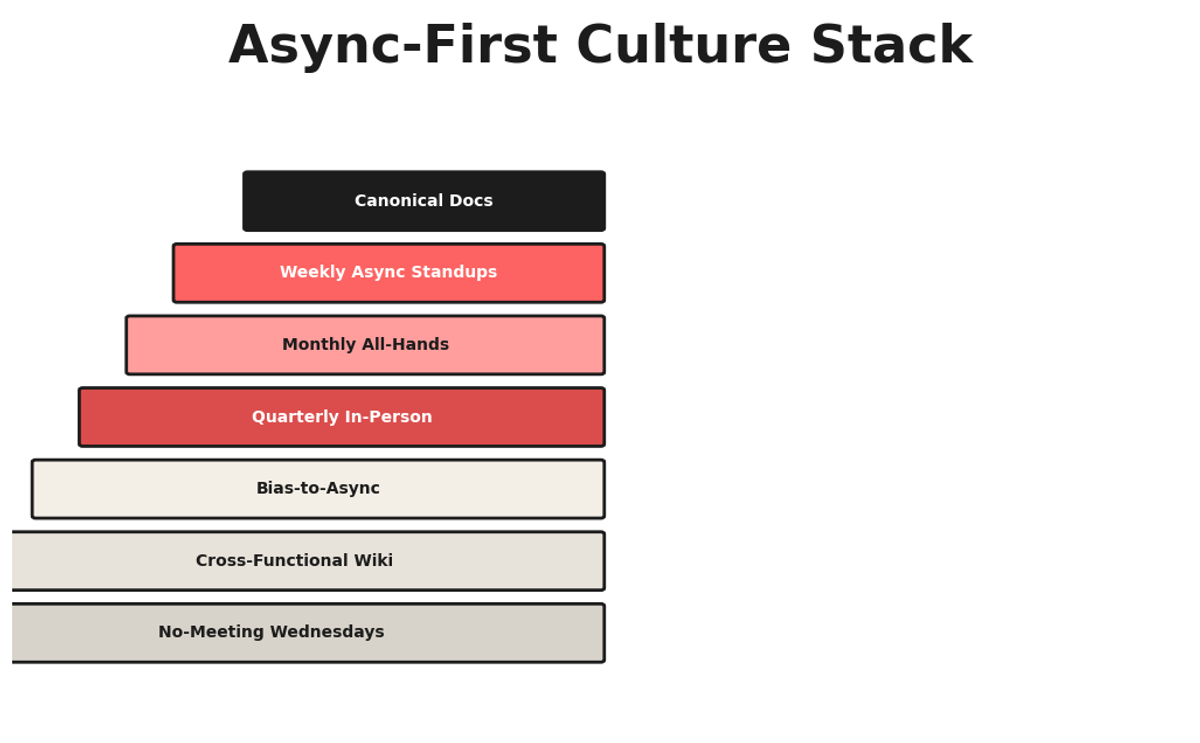
Remote marketing teams that work have ruthless culture discipline. Here is the stack:
Layer 1: Canonical docs and SOPs. Every workflow, every decision, every edge case lives in a shared wiki (Notion, Confluence, GitHub). New hires should onboard 70 percent of their job by reading docs, not asking Slack. Brand guidelines, campaign calendar, client list, martech stack, all live here. One source of truth.
Layer 2: Weekly async standups plus Slack threads. No video meetings. No sync calls. Slack threads: "What I shipped, what is blocked, what I need." Replies are threaded, not meetings. 30 minutes to respond is fine. Async-first urgency wins over real-time.
Layer 3: Monthly all-hands (1 to 2 hours, recorded). One video call per month. Business updates, wins, celebration. Recorded for async viewers in other time zones. Optional attendance for roles that do not require live sync.
Layer 4: Quarterly in-person offsite (48 hours, mandatory). One weekend quarterly, all-hands in one place. Strategic planning, ideation, solve hard problems synchronously. Mandatory attendance. Hotel and meals included.
Layer 5: Bias-to-async decision-making. No "quick sync" meetings to decide budget or strategy. Every decision is written up, shared in a Slack thread or Notion page, with 24-hour async comment window. Sync meetings only for time-sensitive calls (client crisis, exec decision) and high-stakes strategic calls.
Layer 6: Timezone-aware scheduling. Your team spans 4 to 8 time zones. No 6am or 10pm meetings. Rotate meeting times each month (one month favors EU, next month APAC). Record everything. Async is king.
Culture metric: aim for 80 to 85 percent of decisions made async. If it drops below 70 percent, you have a meeting bloat problem and async discipline is leaking.
Hiring decision framework
Use this simple decision tree:
1. Is this a creative leadership role (brand director, creative director, CMO)? If yes: hire onsite or tight hybrid (2-3 days per week HQ). Speed of design feedback and client rituals matters more than cost savings. Onsite enables creative coherence that async cannot replicate.
2. Is this a client-facing role (account manager, partnerships, events)? If yes: hire onsite or hybrid. Client relationships require synchronous presence and trust-building. Client dinners and meetings demand in-person attendance.
3. Is this an execution role (content, SEO, paid, analytics, social)? If yes: hire remote globally. Async feedback loops match async execution. Cost plus specialist access equals win-win. Data-driven roles thrive remote.
4. Does your marketing budget equal less than $500K annually and team size is under 5? If yes: hire remote. Your team is too small for the overhead of hybrid or onsite culture. Invest in docs and async systems, not offices.
5. Does your marketing budget equal $1M plus and team is 10 plus people? If yes: hybrid anchored. Hire 30 to 40 percent onsite core (leadership plus brand and creative), 60 to 70 percent remote individual contributors.
6. Does your budget equal less than $2M but you need onsite creative and brand? If yes: hire your CMO plus 1 to 2 creative people onsite in a major city (or hybrid 2-3 days per week), hire 5 plus execution individual contributors remote. Hybrid 2 to 5 ratio works well.
Hire remote marketing talent via Versatile EOR
Remote marketing is the new playbook. The 2026 winner is not "all remote" or "all onsite" - it is ruthlessly disciplined hybrid where leadership and creative core are onsite or tight hybrid, and execution specialists are distributed globally. The big unlock is India: hiring 2 to 3 deep marketing specialists (SEO, content, email) in India via an India-based EOR is now table-stakes for US and UK founders with $500K plus marketing budgets. You get one-third the cost, same talent depth, zero legal overhead, and 24-7 coverage. Versatile runs payroll for 14 US and UK marketing teams on our own entity. We handle PF, ESI, gratuity across 28 states, zero compliance risk, and 5-day SLA. If you are balancing remote, onsite, and offshore hiring, message me on WhatsApp through our contact page, or book a consultation. We can model your org structure, comp bands, and hiring timeline in 30 minutes.
Frequently asked questions
Can you really hire a remote brand director?
Technically yes, but you will pay 20 to 30 percent more for someone with deep async design systems experience and lose the speed of in-person design crits. Most brand directors are onsite or hybrid (2-3 days per week). If you need remote, hire someone with proven async experience and invest in Figma, design systems, and structured feedback workflows. See Versatile's remote hiring playbook for best practices.
What is the maximum team size for full remote marketing?
Most remote marketing teams top out at 12 to 15 people before hybrid becomes necessary. Why? Cross-functional coordination, executive communication, and creative alignment all require some synchronous time. At 15 plus people, you need at least 30 to 40 percent onsite core (VPs and leads) or culture starts to fray. Exceptions exist for highly mature, documented orgs (like Zapier's 50-person remote marketing team), but they have 10 plus years of async discipline built in.
How much cheaper is remote hiring than onsite?
35 to 45 percent cheaper on salary, but you add 15 to 20 percent overhead for async tooling, documentation, async training, and offsite flights. Net savings: 20 to 30 percent year-one cost versus onsite in expensive cities. Over 3 years, savings compound because salary growth is slower in remote orgs than in FAANG-influenced onsite markets.
Should I hire into India for marketing roles?
India has deep pools for SEO, content, email, and analytics roles. Hiring 2 to 3 specialists via an India-based EOR to support your US and EU core team is a strong move. Use EOR for speed (6-8 weeks, zero legal overhead, zero compliance risk). Use entity only if you have 5 plus people on the ground and local ops bandwidth. The EOR route is faster, cheaper upfront ($6-10K per person annually), and scales on-demand.
How do you avoid timezone chaos with a distributed team?
One: hire in 2 to 3 time zones maximum, not 6. Two: no meetings before 9am UTC or after 5pm UTC. Three: rotate meeting times each month (one month favors EU, next month APAC). Four: async-first culture, docs, Slack threads, no "quick sync" habits. Five: one person per region owns "night shift" and can context-switch overnight if needed (rare). See Versatile's team structure for timezone-managed examples.
What metrics show remote marketing is working?
Track: percentage of decisions made async (target 80-85 percent), time-to-decision (should drop versus onsite), content and campaign ship velocity (should stay flat or increase), team retention (should match or beat onsite), async doc hit rate (percentage of questions answered by wiki versus Slack). If velocity drops and retention rises (people stay because they like async), you won. If velocity stays flat and retention drops, your culture discipline is leaking.