Table of contents (11)
Deel vs Remote for India: Which EOR Wins on PF, Payroll, Pricing & Onboarding Speed in 2026 for Indian Hiring
Q1. Deel vs Remote for India in 2026: which one should you actually pick?
For India specifically, Remote has the lower entry friction, with a $299 setup fee and $29 per contractor per month, per Remote's published pricing. Deel is the stronger fit only when India sits alongside hires in dozens of other countries. Both land near $599 per employee per month on their own Deel pricing page, and both route India through a narrow band of states (Deel the top six, Remote the top four). Versatile Club charges $149 flat per employee per month on its own Indian entity, Foo Falcon Technologies Pvt Ltd, covers all 28 states and 8 union territories, and invoices in USD from India through its EOR services in India.
⚠️ Two pricing pages, almost identical claims
A VP People at a Series B company sent me her screen last month. Two browser tabs, Deel and Remote, both open on the India page. Both promised compliant hiring, local experts, and fast onboarding. She asked me which one was lying.
Neither was lying. That is the actual problem. Both platforms describe the same product category, so the pricing page cannot tell you what you need to know about India. The differences sit in the setup fee, the state coverage, and who picks up when payroll breaks.
💰 The head-to-head matrix, with the third column
| What you are comparing | Deel | Remote | Versatile Club |
| EOR fee per employee per month | ~$599 | $599 annual, $699 monthly | $149 flat, any salary band |
| Setup fee | $500 | $299 | $0 |
| Contractor fee per month | ~$49 | $29 | Not offered |
| FX policy on USD to INR | 3 to 5% markup reported | No markup claimed | USD invoice from India, no FX leg |
| Support model | Chatbot first | Email ticket queue | Founder on WhatsApp |
| Onboarding commitment | 7 to 14 days, not contractual | 10 to 14 days, not contractual | 5 business days, in the agreement |
| Direct India state coverage | Top 6 states | Top 4 states | All 28 states and 8 UTs |
| Exit terms | 1 month notice | 1 month notice | $0 exit fee |
✅ The statutory base is identical, so stop comparing it
Here is the part almost every comparison page gets wrong. Provident Fund at 12% of Basic plus Dearness Allowance, Employees' State Insurance at 3.25% employer share, and gratuity accruing at 4.81% are set by statute, as published by the Employees' Provident Fund Organisation and ESIC contribution rates. No vendor can price them differently.
So the employer cost of a Bengaluru engineer is the same on all three platforms. What you are really buying is the fee on top, the state reach underneath, and the escalation path when something slips, which is why our India EOR cost breakdown separates statutory load from platform fee.
⭐ What reviewers say about the two platforms
"I find Deel to be absurdly expensive. They charge a high amount of fees for transferring money to my bank account."
— Juan Camilo O., Contractor, Deel Hire - G2 Verified Review, 1/5, 27 November 2025
"I like the all-in-one structure of Remote... They were dishonest about the level of support provided. We specifically explained we required phone-level support for urgent matters, but that is not available. Instead they have email support with a 3-day SLA."
— Juliette D., HR Leader, Remote - G2 Verified Review, 0.5/5, 22 April 2026
"I appreciate the ease of setup with Deel; it took me only a few minutes... I dislike how expensive Deel's transaction fees are."
— Maria M., Freelancer, Deel Hire - G2 Verified Review, 3/5, 26 September 2025
Versatile Club's read is that this choice gets framed as a two-way fight because both vendors market it that way. Our Employer of Record service runs on the same Indian entity and the same PF, ESIC, and Shops and Establishments registrations that carried six years of Contract-to-Hire placements across Bengaluru, Hyderabad, and Pune. EOR is new for us in 2026. The compliance infrastructure under it is not.
Q2. What does each platform really cost per India hire once setup, billing cadence, FX and exit are added?
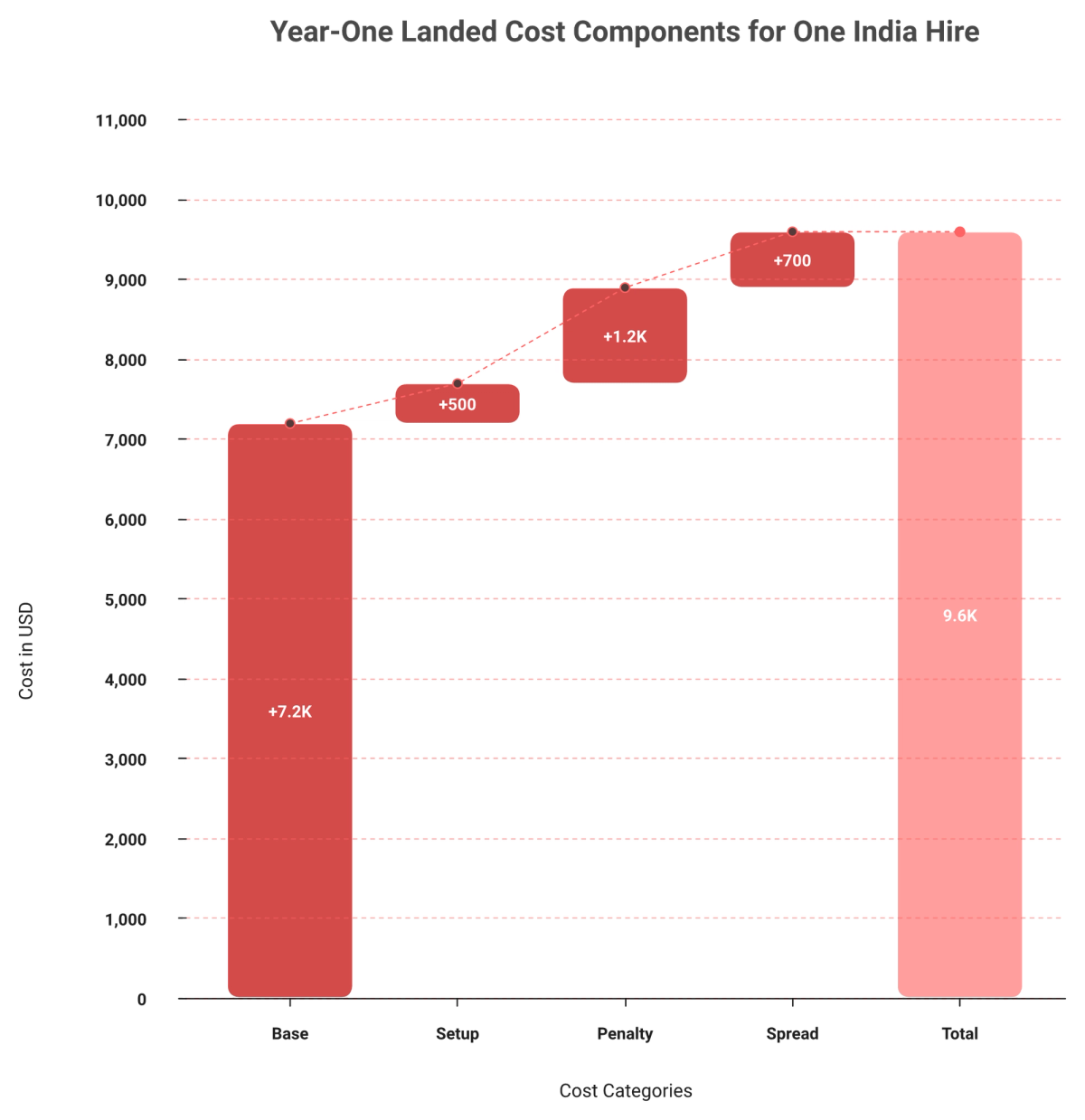
Year one for one India employee runs roughly $7,688 on Deel ($599 times 12, plus a $500 setup fee) and $7,487 on Remote ($599 times 12, plus a $299 setup fee). Remote's month-to-month rate is published at $699 on the Remote pricing page, so paying monthly instead of annually adds about $1,200 per head per year. At volume, both negotiate toward $350 to $500 per employee per month, which never appears on the pricing page. Versatile Club's year one is $1,639, being $149 times 11 months with the first month free, no setup fee, and no exit fee, as set out on our pricing page.
💸 The quote you approved is not the invoice you receive
Every CFO I speak to has the same second question. Not "what is the price," but "what else is on the invoice." That instinct is correct.
The sticker fee is the one number both vendors publish. Setup, billing cadence, currency conversion, and exit notice are the four that move the total, and three of them are negotiable before signature.
⏰ The line-item build, at three team sizes
| Twelve-month platform cost | Deel | Remote (annual) | Remote (monthly) | Versatile Club |
| 1 India employee | $7,688 | $7,487 | $8,687 | $1,639 |
| 5 India employees | $36,440 | $35,435 | $41,435 | $8,195 |
| 15 India employees | $109,320 | $106,305 | $124,305 | $24,585 |
These figures are modelled from published list rates, before any negotiated discount and before FX. Treat them as a starting point for your own quote, not a benchmark, and run your own numbers through the EOR vs entity calculator.
📉 How the currency leg quietly bills you
Your India payroll is paid in rupees. Your invoice is in dollars. Someone converts, and the spread on that conversion is a real cost that does not appear as a line item.
Reported markups on generalist remittances run 3 to 5%. On an ₹80,000 monthly salary, that is roughly $500 to $900 a year for one employee. Remote claims no FX markup. Deel's markup is reported rather than published, which is exactly why you ask in writing.
⚠️ The India surcharge question to put in the email
Third-party comparisons report India-specific uplift above the $599 base rate, while neither vendor publishes one on its own Deel pricing page or Remote pricing page. That gap is your procurement opening.
Ask for three things before you sign anywhere. A live sample invoice with every line item named. The India fee stated separately. The FX basis points in writing.
⭐ What reviewers say about setup and billing
"I find the pricing of Deel to be quite terrible for me... The initial setup process was also very challenging; it took several days and involved a lot of emails, with issues arising at every step."
— Verified User in Translation and Localization, Deel Hire - G2 Verified Review, 0.5/5, 31 July 2025
"The initial setup was not easy at all; it was a very long process with no help and too many requests."
— Alice T., Contractor, Remote - G2 Verified Review, 0/5, 20 March 2026
Versatile Club sends the invoice format before you sign, not after. Our monthly client pack carries one USD invoice with a per-employee breakdown, the payroll summary, PF and ESI challan confirmations, and TDS deposit receipts, the same pack that runs with our managed payroll service. There is no markup on the employee's salary, because a salary markup is a staffing model, not an EOR one.
Q3. Does Deel or Remote actually own its India entity, and how do you verify it yourself?
Both platforms market owned-entity coverage, and the India picture is genuinely contested. Independent comparison matrices list Deel and Remote as owned-entity in India, while operator-side documentation groups both with providers that employ through local partner entities here. Verification does not require trust. Request the employing entity's Corporate Identity Number (CIN, the registration number every Indian company carries) and check it on the MCA company master data portal, then request the Provident Fund establishment code and the ESIC code and verify both on the EPFO establishment search and ESIC portal.
⚠️ The brand you bought is not always the employer on record
An Employer of Record is only as real as the legal entity signing the employment agreement. If that entity is a third party contracted by your vendor, your employee works for a company you never evaluated.
This is not a hypothetical in India. It determines who files the PF return, who holds the Shops and Establishments licence, and whose books an assessing officer opens, which is the point our compliance page documents registration by registration.
❌ Why the published answer is contested
Two credible sources disagree. Competitive matrices in circulation tag Deel and Remote as owning their Indian entities. Versatile Club's own company documentation states the opposite position, that Deel, Remote, G-P, Omnipresent, and most global EOR providers use local partner entities in India.
I am not going to resolve that for you by assertion, because I would be grading my own homework. The honest position is that the model varies by state and changes over time, so the only reliable answer is the one you pull from a government portal yourself.
💸 What a partner-entity chain costs you operationally
A sub-contracted arrangement adds a layer between your instruction and the filing. Three consequences follow.
Administrative latency, because a correction travels through two companies instead of one
A second tax-audit surface, since a separate entity's compliance history now touches your employee's record
Narrower reach, which is why direct coverage is reported at the top six states for Deel and the top four for Remote, rather than all 28
✅ The three-step verification you can run in 20 minutes
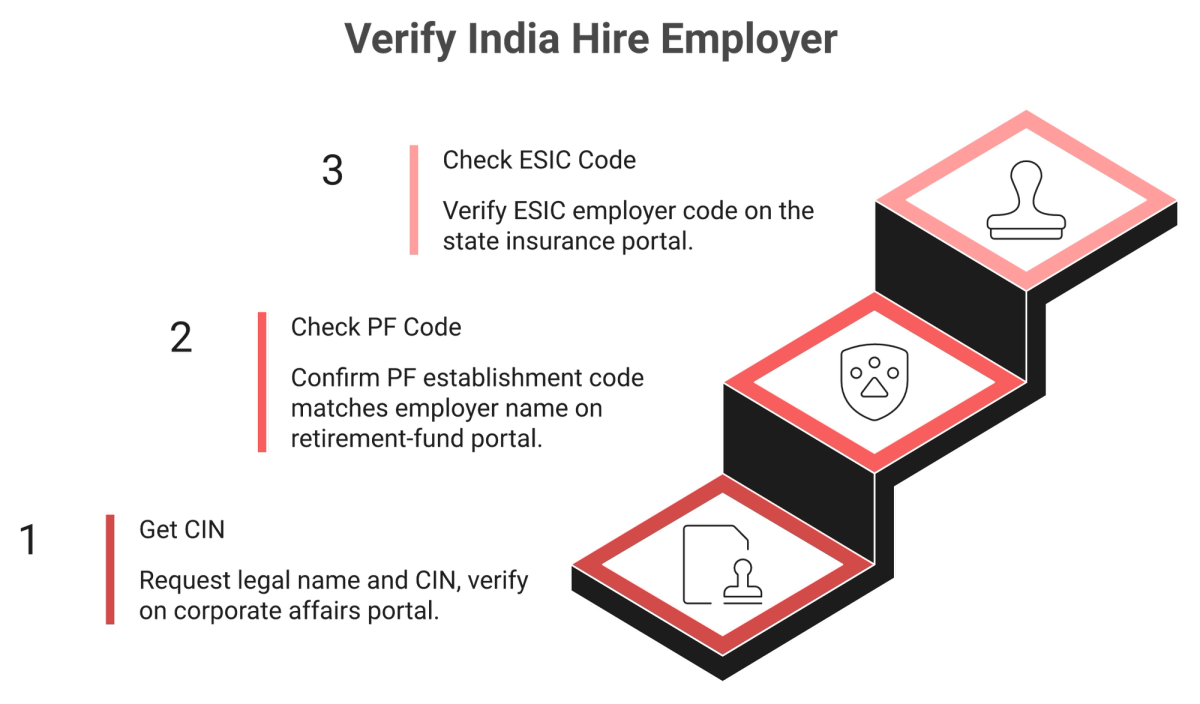
Ask for the full legal name and CIN of the entity that will sign the employment agreement. Search that CIN on the MCA company master-data portal and confirm the name matches.
Ask for the PF establishment code. Run it through the EPFO establishment search and confirm the registered employer name is the same entity.
Ask for the ESIC employer code and check it on the ESIC portal.
If the entity on the employment agreement is not the brand on your invoice, you are in a sub-contracted arrangement. That may still be acceptable. It should be a decision, not a discovery, and it is the first question we answer on how it works.
⭐ The question that reveals the most
Ask who can sign a letter to the EPFO on your employee's behalf. A provider that owns the entity answers in one sentence. A provider that does not will route you to a partner, and you will hear the chain in the pause.
Versatile Club employs your India hires directly on Foo Falcon Technologies Pvt Ltd. There is no reseller, no aggregator, and no third entity on the employment agreement, so the PF, ESI, TDS, and professional tax registrations your auditor tests are ours. I send the CIN and PF code before a client asks for them, which is also why buyers comparing us against the generalists usually start on the Deel alternative and Remote alternative pages.
Q4. How do PF, EPS, ESI, gratuity and TDS get handled, and what changed on 17 September 2026?
Employer-side statutory cost in India is fixed by law, not by vendor. Provident Fund runs at 12% of Basic plus Dearness Allowance (3.67% to EPF and 8.33% to the pension scheme), ESI at 3.25% employer and 0.75% employee up to the ₹21,000 wage ceiling per ESIC contribution rates, gratuity accrues at 4.81%, and TDS is deposited by the 7th. The base changed in September 2026. Gazette notification S.O. 5109(E) dated 17 September 2026, issued under section 2(89) of the Code on Social Security, 2020, raised the EPF wage ceiling from ₹15,000 to ₹25,000 and superseded S.O. 2702(E), per the Ministry of Labour and Employment.
✅ The floor every vendor shares
Think of Indian payroll as two stacked layers. The bottom layer is statutory and identical everywhere. The top layer is the platform fee, and that is the only part a vendor controls.
Deel, Remote, and Versatile Club all deduct the same PF, remit the same ESI, and accrue the same gratuity. A vendor who implies otherwise is selling you arithmetic that does not exist, and our guide to payroll compliance in India sets out each filing by due date.
⏰ What the 17 September notification actually did
The ceiling is the wage level up to which PF is mandatory. For years that was ₹15,000, which meant a minimum employer contribution of ₹1,800 a month. From 17 September 2026 the ceiling is ₹25,000, taking that figure to ₹3,000, per the Cabinet decision of 16 September 2026.
The government expects roughly 51 lakh additional members to come into coverage. September 2026 itself required a split-period calculation in the Electronic Challan cum Return, since the month straddled both ceilings.
⚠️ The pension enrolment duty people are missing
This is the part almost no comparison page covers. The pension scheme amendment notified on 25 September 2026 applies retrospectively from 17 September 2026.
Existing EPF members earning between ₹15,000 and ₹25,000 who sat outside the pension scheme must now be enrolled. EPFO's own wage ceiling FAQ confirms no application is needed from the member. It is the employer's duty, which means it is your provider's duty, and the liability stays with you.
💰 One worked example at ₹80,000 a month
Take a Bengaluru engineer on ₹80,000 monthly, structured with Basic plus DA at 50% of cost to company, as the 2025-26 labour codes require. Model your own role on the salary calculator.
| Component | Before 17 Sep 2026 | From 17 Sep 2026 |
| PF wage base | ₹15,000 | ₹25,000 |
| Employer PF | ₹1,800 | ₹3,000 |
| ESI (wages above ₹21,000) | Not applicable | Not applicable |
| Gratuity accrual at 4.81% of ₹40,000 | ₹1,924 | ₹1,924 |
Roughly ₹14,400 more per employee per year. Small in isolation, and wrong in every quote still modelling ₹1,800.
⭐ One form name to correct in your checklist
Ask whether the provider issues Form 130, the certificate under section 395 of the Income-tax Act 2025, rather than "Form 16," as published by the Central Board of Direct Taxes. Vendors still using the old name are reading last year's documentation.
Versatile Club re-ran every active India payroll against the ₹25,000 ceiling in the month it took effect, including pension enrolment for employees in the ₹15,000 to ₹25,000 band. Our monthly client pack carries the PF and ESI challan confirmations and the TDS deposit receipts, so the evidence sits with your controller before an auditor asks. If you want that walked through against your own headcount, talk to us directly.
Q5. Why does covering only the top four to six Indian states quietly become your problem?
India is not one payroll jurisdiction. Professional tax, Shops and Establishments registration, and labour welfare fund cycles differ by state. Maharashtra runs dual PTRC and PTEC registrations, Karnataka a monthly professional tax cycle with annual S&E renewal, Tamil Nadu biannual professional tax plus a labour welfare fund contribution, and West Bengal revises rules often, per the Maharashtra Goods and Services Tax Department, the Karnataka Commercial Taxes Department, the Tamil Nadu Labour Department, and the Directorate of Commercial Taxes, West Bengal. Deel's direct India coverage is reported at the top six states and Remote's at the top four. Versatile Club holds registrations across all 28 states and 8 union territories, so the state regime stays with the provider rather than the hiring manager, as documented on our compliance page.
⚠️ The offer is out, and the candidate lives in Indore
A Head of Engineering I work with found his best backend candidate in six weeks of searching. She lived in Indore, not Bengaluru. His EOR came back and said the state was not directly supported.
That is the moment the coverage footnote on a vendor page becomes a real decision. You either wait, re-route the employment through another entity, or lose the hire. None of those was priced into your quote, which is why our guide to hiring employees in India starts with location, not with headcount.
⏰ Four states, four completely different calendars
Professional tax (PT) is a small state-level tax on salaried income, deducted by the employer and filed with the state. The filing rhythm is where it gets messy.
| State | Professional tax regime | Filing cycle | Extra layer |
| Maharashtra | Dual PTRC and PTEC registration | Monthly or annual by slab | PTEC is the employer's own liability |
| Karnataka | Single PT registration | Monthly | S&E licence needs annual renewal |
| Tamil Nadu | Half-yearly PT | Biannual | Labour Welfare Fund contribution |
| West Bengal | State PT Act 1979 | Monthly or annual by slab | Rule revisions land frequently |
| Delhi | No professional tax | Not applicable | S&E enforcement is strict |
Versatile Club tracks these as five separate calendars, not one India calendar, because that is what they are. The full filing map sits in our breakdown of payroll compliance in India.
❌ What the coverage gap actually costs you
The damage rarely shows up as a compliance notice. It shows up as three quieter failures.
Timeline slip, because a new state registration takes weeks and your onboarding clock does not pause
Payslip inaccuracy, when PT is deducted at the wrong slab or not deducted at all
Audit noise, since a state filing made by a partner entity sits outside your provider's own records
✅ The question that separates depth from a map
Ask a vendor one thing. Name the state your candidate lives in, then ask who holds the S&E licence there and when the next PT filing falls due.
A provider with direct coverage answers with a date. A provider routing through a partner answers with a process. Versatile Club's read is that global platforms are not being evasive here. India is one of 150 countries on their map, and depth in all 28 states is expensive to maintain for a country that size on a global P&L.
💰 Where I think this goes next
What I expect over the next two years is that state coverage becomes the India procurement question, replacing country count. I could be reading my own book here, so test it against your own shortlist.
Ask two vendors the Indore question and compare the answers. Versatile Club measures its own coverage by registration, not by claim, which means the PF code, ESIC code, and S&E licence exist in each jurisdiction before we accept the hire. Buyers running that test against the generalists usually land on the Deel alternative and Remote alternative comparisons.
Versatile Club is registered across all 28 states and 8 union territories, which is why no client has been asked to change a candidate because of where that candidate lives. Our EOR services in India run the PTRC and PTEC filings, the state S&E renewals, and the labour welfare fund contributions on the same entity that signs the employment agreement.
Q6. How fast can each one really get an India employee live, and what is the actual bottleneck?
Published India onboarding claims range from 48 hours to 14 days. The spread is a measurement artefact, because contractor agreements close in days while full employment needs document verification, statutory registration, and a payroll cut-off. Deel is cited at both 2 to 5 days and 7 to 14 days against its own published EOR terms. Remote is cited at both 48 hours and 10 to 14 days against its pricing and onboarding pages. None of those figures is contractual. Versatile Club commits to five business days in the service agreement, which makes it the only number in the comparison a client can enforce, as set out on how it works.
⏰ Two vendors, four different speed claims
I keep a spreadsheet of competitor onboarding claims, because they move. Deel appears in one matrix at 2 to 5 days and in another at 7 to 14 days. Remote appears at 48 hours in one place and 10 to 14 days in another.
Both ranges are technically honest. They are measuring different products.
⚠️ Why both numbers are true at once
A contractor agreement is a document. It can be signed in a day. An employment relationship is a statutory registration, so the clock runs on portals, not on software.
Here is the real sequence Versatile Club runs for an India employee, and where it can stall.
| Step | Typical duration | What can delay it |
| Service agreement signed | Day 0 | Legal review on the client side |
| Offer issued and accepted | Day 1 | Candidate negotiating counter-offers |
| Employment contract executed | Day 2 | Document collection (PAN, Aadhaar, bank) |
| PF and ESIC registration of the employee | Days 3 to 4 | Mismatched name or UAN history |
| Payroll live | Day 5 | Monthly payroll cut-off already passed |
❌ The bottleneck nobody puts on a pricing page
Your actual constraint is usually not the platform. It is the candidate's Indian notice period, which commonly runs 30 to 90 days, plus your provider's monthly payroll cut-off.
So a 48-hour claim and a 60-day start date can both be real on the same hire. Versatile Club's view is that vendors competing on hours are answering a question buyers are not actually blocked on.
⭐ What reviewers report about setup speed
"I appreciate the ease of setup with Deel; it took me only a few minutes, making the process straightforward."
— Maria M., Freelancer, Deel Hire - G2 Verified Review, 3/5, 26 September 2025
"Slow and laborious initial setup. We are still waiting on answers to key questions for implementation."
— Juliette D., HR Leader, Remote - G2 Verified Review, 0.5/5, 22 April 2026
"They consistently failed to meet committed deadlines, had terrible communication, and frequently cancelled meetings at the last minute."
— Verified User in Computer Software, Deel Hire - G2 Verified Review, 0/5, 13 December 2025
Read those together and the pattern is clear. Contractor self-serve onboarding is fast on both platforms. Employer-side implementation is where reviewers describe friction.
✅ What to ask instead of "how fast"
Replace the speed question with three sharper ones. Is the timeline in the contract or in the marketing. What happens if you miss it. Which day of the month is the payroll cut-off.
Versatile Club publishes the day-by-day process above precisely so a client can audit it against the agreement. A number you cannot check is a number I would not pay for.
Versatile Club writes the five-business-day onboarding SLA into the service agreement, not the website. Across our Contract-to-Hire placements in Bengaluru, Hyderabad, and Pune, that commitment is the single most-asked-about item in a first call, ahead of price.
Q7. What happens when payroll breaks at 9pm IST, chatbot, ticket queue, or a person?
Deel routes support chatbot-first. Remote runs an email ticket queue with CSM assignment, and reviewers report a three-day response SLA. India's statutory calendar does not flex to match: TDS is deposited by the 7th under the Income-tax Rules, the EPFO Electronic Challan cum Return is filed by the 15th, and state professional tax cycles run on their own dates. Versatile Club's escalation path is a WhatsApp message to Sagar Chainani, the founder who owns the Indian entity, rather than a ticket number.
⚠️ A PF deadline and a ticket number
The worst message I get is the calm one. A US founder once pinged me at 11pm her time, three days before payroll, asking why a challan confirmation had not arrived.
She was not angry. She was doing the mental arithmetic on what a missed filing costs. That arithmetic is the real product you are buying from an India EOR, and it is why buyers read our employer of record India guide before a demo.
❌ Why a queue is structurally wrong for Indian deadlines
A three-day response SLA is reasonable software practice. It is a mismatch against a filing window measured in hours.
Three dates make the point. TDS deposit by the 7th. ECR filing by the 15th. Professional tax on a state cycle that varies by jurisdiction. Versatile Club runs those three on a fixed internal calendar, because a queue cannot be the thing standing between a client and a statutory date.
⭐ What reviewers say about getting a human
"I was redirected multiple times, asked to repeat the same information to different representatives, and spent a considerable amount of time in meetings without reaching a clear resolution."
— Güneş A., Remote Worker, Deel Hire - G2 Verified Review, 1.5/5, 2 October 2025
"We specifically explained we required phone-level support for urgent matters, but that is not available. Instead they have email support with a 3-day SLA."
— Juliette D., HR Leader, Remote - G2 Verified Review, 0.5/5, 22 April 2026
"The platform remains easy to navigate and technically reliable. Managing contracts and basic payment processes is still straightforward."
— Güneş A., Remote Worker, Deel Hire - G2 Verified Review, 1.5/5, 2 October 2025
That last quote matters as much as the complaint. Both platforms are genuinely good software. The gap reviewers describe is ownership of a problem, not product quality.
✅ The honest limit of the founder-direct model
Here is where I have to be straight with you. Versatile Club's support model works because the company is small enough for the founder to carry it personally.
That is sustainable at our current scale. At some point it will have to change, and I would rather say that in writing now than quietly insert a queue later. If you are hiring a 100-person India team with an enterprise procurement process, a staffed support organisation may serve you better than my phone, and our enterprise page says the same thing.
💰 What to test before you sign
Run one drill with any vendor on your shortlist. Send a mid-complexity question, something like a professional tax slab query for a specific state, and time the answer.
Versatile Club measures itself the same way, because response time on a real statutory question predicts the month-end experience better than any uptime figure. Ask who answers, not how fast the dashboard loads.
Versatile Club's escalation path is one WhatsApp message to the person who owns Foo Falcon Technologies Pvt Ltd. There is no CSM rotation and no ticket tier. If growth ever breaks that model, we will publish the change rather than let clients discover it during a payroll week. You can test the response yourself through contact us.
Q8. Should your India team be contractors or EOR employees, and when does that choice become a liability?
Contractor management costs $29 per month on Remote's published pricing and about $49 on Deel's published pricing, which makes contractors the default for a first India hire. Exposure begins when the company exercises employment-like control, such as fixed hours, a company laptop, a reporting line, and exclusivity. Authorities can then reclassify the worker, triggering backdated Provident Fund, ESI, and TDS liability plus interest under the Code on Social Security, 2020. US-style PEO co-employment has no equivalent under Indian labour law, so the compliant structures are a genuine contractor relationship, an Employer of Record, or your own Indian subsidiary.
⚠️ The audit that starts inside your own company
The reclassification conversation almost never starts with a government notice. It starts when you hire your first real People Ops lead.
She reads six contractor agreements, notices that three of those people work fixed hours on company laptops, and escalates the same week. Versatile Club sees this pattern repeatedly, and the trigger is internal review, not enforcement.
✅ The four-marker control test
Classification in India turns on substance, not on the title of the document. Run your arrangement against four markers.
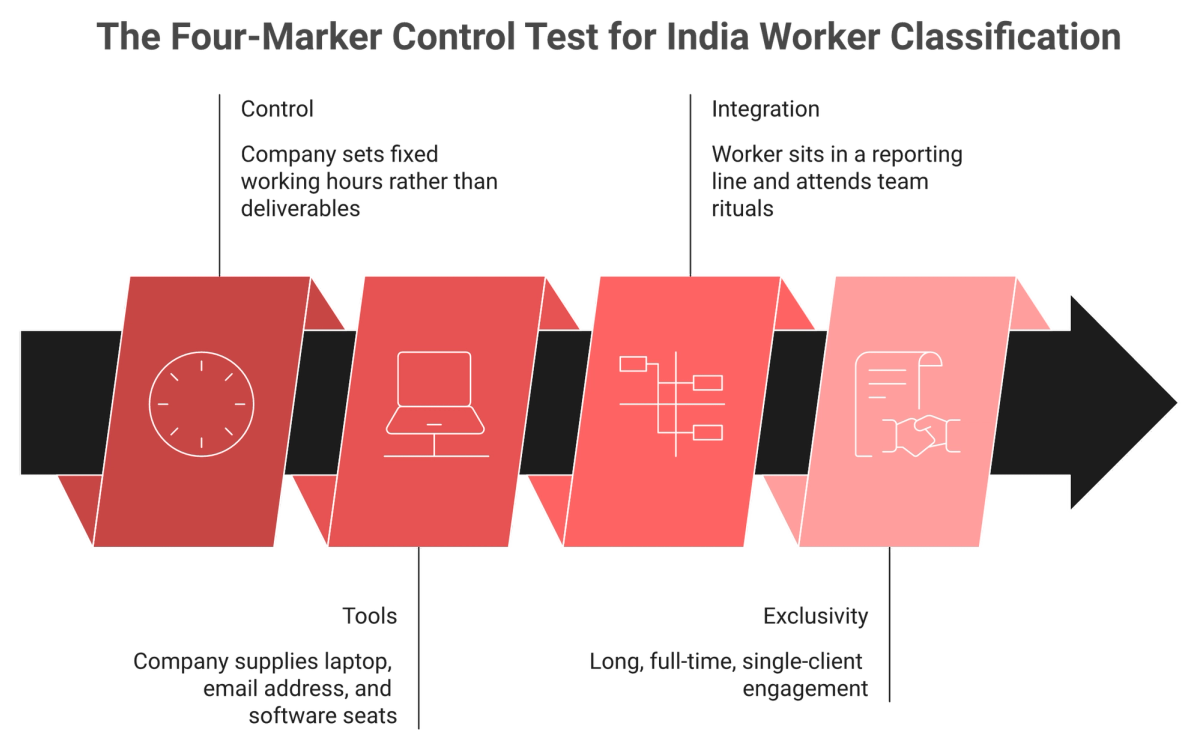
Control over how and when. Do you set working hours, or do you set deliverables.
Tools and equipment. Who supplies the laptop, the email address, and the software seats.
Integration. Does the person sit in a reporting line and attend team rituals.
Exclusivity and duration. Is this a long, full-time, single-client engagement.
Two or more markers pointing to control usually means you have an employee. Versatile Club applies the same four markers before accepting a conversion, because the answer determines who carries the liability. The full decision path sits in our comparison of independent contractor versus EOR.
💸 What reclassification actually costs
The exposure stacks backwards, not forwards. Unpaid employer PF at 12% of Basic plus Dearness Allowance, ESI where applicable, and short-deducted TDS all become payable for the period worked, with interest and penalty under sections 7Q and 14B of the Employees' Provident Funds and Miscellaneous Provisions Act, 1952.
Add gratuity accrual at 4.81% once the person crosses the service threshold. A ₹1,00,000 per month contractor running for two years is not a small correction, and the arithmetic is laid out in our note on converting a contractor to an employee in India.
❌ Clear up the PEO question before procurement starts
A US buyer often asks for a PEO, meaning the co-employment model where two entities share employer duties. That structure has no statutory home in India.
So three options remain: a genuine contractor contract, an Employer of Record, or incorporating your own subsidiary. Versatile Club's read is that the standard advice gets this backwards by treating PEO and EOR as interchangeable words for the same service, which is why we keep a dedicated EOR versus PEO explainer.
⭐ What contractors themselves report
"Deel treats all users as if they were individual freelancers, even when you're clearly operating as a registered company. I was required to provide personal identity documents (like a passport), despite offering full corporate documentation."
— Verified User in Translation and Localization, Deel Hire - G2 Verified Review, 0.5/5, 5 May 2025
"I find Deel to be absurdly expensive. They charge a high amount of fees for transferring money to my bank account."
— Juan Camilo O., Contractor, Deel Hire - G2 Verified Review, 1/5, 27 November 2025
"I like the all-in-one structure of Remote because it allows me to get rid of standalone products that confused my employee population."
— Juliette D., HR Leader, Remote - G2 Verified Review, 0.5/5, 22 April 2026
Worth noting that your contractor's experience of the platform affects your retention, even when the fee lands on your invoice.
Versatile Club converts contractors into employees on its own Indian entity, so the PF, ESI, and professional tax registrations stay under one roof through the transition. Our Contract-to-Hire line was built for exactly this path, with the hire tested in a live role before the full-time conversion.
Q9. Does an EOR protect you from permanent establishment, DPDP and the new tax forms?
An Employer of Record neither creates nor cures permanent establishment (PE), the tax status that makes a foreign company taxable in India. Recent rulings, Hyatt International at the Supreme Court and Booking.com B.V. at ITAT Delhi, turn on whether someone in India habitually concludes contracts for you, read against section 9 of the Income-tax Act. MeitY's DPDP Rules 2025, notified as G.S.R. 846(E) on 13 November 2025, phase in to 14 May 2027, with penalties up to ₹250 crore, per the Ministry of Electronics and Information Technology. Versatile Club structures every salary to the Basic plus Dearness Allowance ≥ 50% rule under the 2025-26 labour codes and issues the section 395 certificate under its own TAN, as documented on our compliance page.
⚠️ PE first, because it is the one with teeth
An in-house counsel at a US SaaS company asked me last quarter whether using an EOR removed PE risk. The honest answer is no, and no provider should tell you otherwise.
PE is about activity, not about who runs payroll. If your India-based employee habitually negotiates and closes customer contracts, the exposure sits with you regardless of the employment vehicle, which is why our EOR versus entity comparison for India treats PE as a separate decision from the hiring vehicle.
✅ The clause language I give away
Put three lines in your agreement, with your tax advisor's sign-off.
No India-based worker holds authority to conclude contracts on the company's behalf.
All contracts are executed outside India by named officers.
The India role is limited to support, engineering, or back-office functions, described specifically.
Then ask your advisor to review the dependent-agent article in the relevant tax treaty. Versatile Club keeps this clause set in its standard employment template, because the buyers who ask for it are the ones who stay five years.
⏰ DPDP, and the date your DPA has to beat
The Digital Personal Data Protection Rules 2025 were notified on 13 November 2025 and roll out in stages. The Data Protection Board provisions started immediately. Consent-manager rules follow on 14 November 2026.
The heavy obligations land on 14 May 2027, covering notice and consent, security safeguards, breach reporting, and significant data fiduciary duties. Your EOR processes PAN, Aadhaar, bank details, and payslips, so it is a processor in your chain, a point our employer of record India guide sets out in the diligence checklist.
❌ The three DPDP questions most buyers skip
Ask these before signing, not during an incident.
Name every sub-processor touching India payroll data, including the payroll software itself
Describe the breach-notification workflow and the clock it runs on
Confirm who the India-resident grievance contact is
Versatile Club runs India payroll on its own entity, which keeps the sub-processor list short. That is a structural consequence of operating in one country, not a security claim.
💰 Fix the form name in your checklist
Many vendor checklists still say "Form 16". Under the Income-tax Act 2025, the salary TDS certificate is Form 130, the certificate under section 395 for tax deducted under section 392, published by CBDT on 24 March 2026 as Form No. 130.
Also check the wage structure. The 2025-26 labour codes require Basic plus Dearness Allowance to be at least 50% of total pay under the Code on Wages, 2019, which raises PF, gratuity, and leave encashment bases together. A provider still structuring at 30% Basic is building your next correction.
⭐ What I am less certain about
Versatile Club's read is that PE risk in India is currently over-marketed by platforms and under-examined by buyers. I may be weighting the case law too heavily, since both recent rulings involved unusual facts.
What I would not do is treat an EOR contract as a tax opinion. Get the clause, then get the advice.
Versatile Club structures every salary to the Basic plus DA ≥ 50% rule, issues the section 395 certificate under its own TAN, and will sign a sub-processor-named data processing addendum ahead of the 14 May 2027 deadline rather than after it. POSH Internal Committee constitution sits in the same onboarding checklist that runs with our EOR services in India.
Q10. How hard is it to leave, and can you switch providers without breaking PF and UAN continuity?
Both Deel and Remote require one month's exit notice, per their published Deel pricing terms and Remote pricing terms. The India-specific risk is continuity, not notice. When an employee moves between Employer of Record entities, the new employer files a fresh Electronic Challan cum Return under its own PF establishment code, and the employee's Universal Account Number (UAN, the permanent PF identity number) must carry across rather than a second UAN being generated, per EPFO transfer guidance. Gratuity accrual restarts on transfer, so the accrued liability has to be settled or documented. Versatile Club charges no exit fee and issues full and final settlement plus the part-year tax certificate at transfer.
⚠️ The switching cost nobody prices at signature
A CFO asked me to quote a 14-person India team in March. She had already signed elsewhere a year earlier, and her question was not about price. It was about whether moving would damage her engineers' PF records.
That instinct was right. The employee feels a broken transfer long before an auditor notices it, which is the whole reason we wrote up how to switch an EOR provider in India.
✅ The transfer sequence, in order
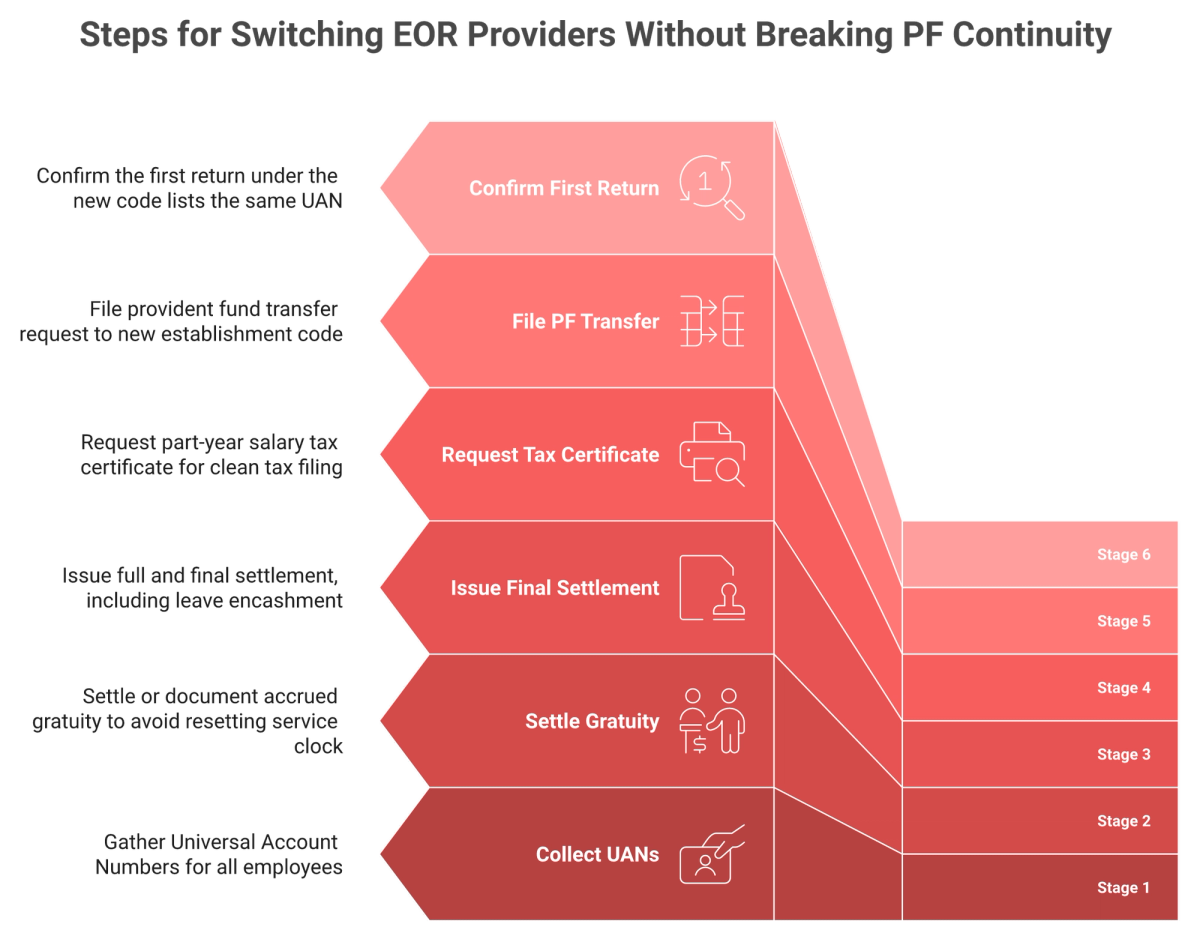
Run it in this order and nothing fractures.
Collect the UAN for every employee before any paperwork moves. One person, one UAN, for life.
Settle or document accrued gratuity. Gratuity vests after five years of continuous service under the Payment of Gratuity Act, 1972, and a transfer can reset that clock.
Issue full and final settlement from the outgoing entity, with leave encashment and any notice-pay adjustment shown.
Request the part-year TDS certificate, now Form 130 under section 395, so the employee can file one clean return.
File the PF transfer request (Form 13, or the online transfer claim) so the balance moves to the new establishment code rather than sitting dormant.
Confirm the first ECR under the new code lists the same UAN. Versatile Club checks this on the EPFO establishment portal before closing a transfer.
❌ Where transfers actually go wrong
Three failure modes account for most of the damage I see.
A second UAN is generated because the name or date of birth does not match EPFO records exactly
Gratuity is neither paid out nor documented, so the liability becomes invisible
The employee receives two partial tax certificates with overlapping months
Versatile Club treats the UAN check as the gate for the whole migration, because the other two problems are recoverable and this one is painful to unwind. Our managed payroll team runs the same gate on every inbound team.
💰 Exit terms to negotiate before you sign
Negotiate the exit at the start, when you still have leverage. Four items are usually movable.
| Exit term | What to ask for |
| Notice period | 30 days, with no minimum contract term |
| Exit fee | Zero, stated explicitly |
| Data handover | Payroll registers, challans, and Form 130 copies in machine-readable form |
| Cooperation clause | Written commitment to support UAN transfer after exit |
That last row matters most. A provider with no obligation to help after termination has no reason to answer your email in month 13.
⭐ Why I think exit terms predict service quality
Versatile Club's view is that exit friction is a retention strategy for providers who are unsure of their service. A one-month notice is fair. A penalty is a confession.
I could be too confident here, since enterprise contracts legitimately carry longer terms for implementation cost recovery. Ask for the reason behind any lock-in, and judge the answer. Our own terms sit in plain sight on the pricing page.
Versatile Club charges no exit fee and documents accrued gratuity plus PF continuity at transfer. Our Employer of Record service also hands over challan confirmations and payroll registers on request, because retention earned by paperwork is not retention.
Q11. When is a split-vendor setup better than putting every global hire on one platform?
A split-vendor setup uses a global platform like Deel or Remote as the horizontal layer for scattered one-off hires, and an India-native Employer of Record for the dense India team. At ten India employees, $599 versus $149 per employee per month is roughly $54,000 a year in platform fees alone, before setup fees and currency spread, measured against the published Deel and Remote rates. The counterweight is real: the $599 platforms bundle business insurance covering compliance issues surfacing years later, and Indian specialists including Versatile Club generally do not carry it.
💰 The rule in one line
Buy breadth where your hires are scattered. Buy depth where your hires are concentrated.
Country count is the product you pay for on a global platform. It is excellent value for one engineer in Portugal and one designer in Brazil. It is poor value for fourteen engineers in Bengaluru, which is the arithmetic our cost of hiring in India breakdown runs line by line.
⏰ Three scenarios, three different answers
| Your situation | What I would do | Why |
| 3 scattered hires, one in India | Stay on Deel or Remote | A second vendor relationship costs more in overhead than it saves |
| 10-person India engineering pod | Split: global platform for the rest, India specialist for India | Platform fee savings fund a full engineer; state coverage improves |
| 30-person India team with SOC 2 or ISO 27001 as a procurement gate | Stay with a certified provider | Versatile Club does not hold SOC 2 Type II or ISO 27001 today, and procurement will block the contract |
That third row is Versatile Club's own anti-fit, stated plainly. I would rather lose that deal at the first call than at month three, and the same honesty runs through our enterprise page.
⚠️ The insurance trade-off nobody explains
Here is why $599 is not simply overpricing. Global platforms carry business insurance that pays out if an India compliance or tax issue surfaces two years after an employee leaves.
Many venture-backed buyers are effectively required to carry that cover. Versatile Club does not, and that is part of how the $149 flat fee works. Price the protection consciously rather than discovering the gap during diligence.
⭐ What reviewers say about platform breadth
"I believe those platforms have two major tasks to do: contracts and payments. Both lacks at Deel."
— İbrahim, Contractor, Deel Hire - G2 Verified Review, 1/5, 1 November 2024
"I love the instant transfer feature, which is incredibly fast, moving money to my bank account in seconds."
— Maria M., Freelancer, Deel Hire - G2 Verified Review, 3/5, 26 September 2025
"It asks for way too much personal information, doesn't explain why I need to share it, and makes it really challenging to register."
— Alice T., Contractor, Remote - G2 Verified Review, 0/5, 20 March 2026
✅ Eight questions for your next two calls
Ask every provider the same eight. Compare the answers side by side.
What is the full legal name and CIN of the employing entity in India.
Which states do you cover with your own registrations.
Is the onboarding timeline in the contract, and what happens if you miss it.
Show me a live sample invoice with every line item.
What is the FX basis points charge on USD to INR.
Do you issue Form 130 under section 395.
Who is my escalation contact, and what is their response time on a statutory question.
What are the exit terms, and will you support the UAN transfer afterwards.
Versatile Club is built for one half of that split, the India half, at $149 flat on its own entity with a five-business-day SLA in the agreement. India is the only country we operate in, so for a map with five or more countries, a global generalist handles the rest better than we would. Tell me what you are building in India and I will tell you honestly which half we belong in, either on contact us or on a 30-minute call.
FAQs
Is Deel or Remote cheaper for hiring employees in India in 2026?
On list price the two are close, and the real difference sits in the fees nobody leads with.
- Deel: roughly 599 dollars per employee per month, plus a 500 dollar setup fee, so year one for one India hire models at about 7,688 dollars.
- Remote: 599 dollars per employee per month on annual billing, plus a 299 dollar setup fee, modelling at about 7,487 dollars in year one.
- Billing cadence: Remote publishes 699 dollars month to month, so paying monthly instead of annually costs roughly 1,200 dollars more per head each year.
- Contractors: about 49 dollars per month on Deel against 29 dollars on Remote.
Then add the currency leg. Reported markups of 3 to 5 percent on USD to INR remittances cost another 500 to 900 dollars a year on an 80,000 rupee monthly salary, and that number never appears as a line item.
Versatile Club prices India at 149 dollars flat per employee per month with no setup fee, no exit fee, and the first month free, which models at 1,639 dollars in year one. We also invoice in USD directly from our Indian entity, so there is no conversion spread to discover later. Run your own numbers against our breakdown of employer of record cost before you accept any quote.
Do Deel and Remote own their India entity, or do they use a local partner?
This one is genuinely contested, and you should not take any vendor's word for it, including ours.
Independent comparison matrices list both Deel and Remote as owned-entity providers in India. Operator-side documentation groups both with providers that employ through local partner entities here. Both positions are published, and the model can vary by state and change over time.
The good news is that you can verify it yourself in about twenty minutes:
- Ask for the full legal name and Corporate Identity Number of the entity that will sign the employment agreement, then check it on the MCA company master-data portal.
- Ask for the Provident Fund establishment code and confirm the registered employer name on the EPFO establishment search.
- Ask for the ESIC employer code and check it on the ESIC portal.
If the entity on the employment agreement is not the brand on your invoice, you are in a sub-contracted arrangement. That can still be acceptable, but it should be a decision rather than a discovery, because it adds administrative latency and a second tax-audit surface.
Versatile Club employs India hires directly on Foo Falcon Technologies Pvt Ltd, so the PF, ESI, TDS, and professional tax registrations an auditor tests belong to us. Our guide to hiring in India without an entity explains why that distinction matters at audit.
How did the September 2026 EPF wage ceiling change affect India EOR quotes?
It invalidated most of the cost calculators still live on vendor sites.
Gazette notification S.O. 5109(E), dated 17 September 2026 and issued under section 2(89) of the Code on Social Security, 2020, raised the Provident Fund wage ceiling from 15,000 rupees to 25,000 rupees, superseding S.O. 2702(E). The practical effect is that the minimum employer PF contribution moved from 1,800 rupees a month to 3,000 rupees, roughly 14,400 rupees more per employee per year.
Two consequences follow for anyone comparing vendors:
- Any quote still modelling 1,800 rupees monthly PF is working from the old ceiling, so normalise both vendor quotes to the same statutory base before you compare platform fees.
- The pension scheme amendment notified on 25 September 2026 applies retrospectively from 17 September 2026, and EPFO's own FAQ confirms employees in the 15,000 to 25,000 rupee band are enrolled without any application from the member. It is the employer's duty, which means it becomes your provider's duty.
Versatile Club re-ran every active India payroll against the 25,000 rupee ceiling in the month it took effect, including the split-period Electronic Challan cum Return that September required. Ask any shortlisted provider for a post-17-September gross-to-net sample, and cross-check it against our note on payroll compliance in India.
Can I switch from Deel or Remote to another India EOR without breaking PF continuity?
Yes, but the risk is continuity rather than notice. Both Deel and Remote require one month's exit notice, which is the easy part.
When an employee moves between Employer of Record entities, the incoming employer files a fresh Electronic Challan cum Return under its own PF establishment code. The employee's Universal Account Number, the permanent PF identity number, has to carry across. If a second UAN gets generated because a name or date of birth does not match EPFO records, the service history and pension eligibility fracture.
Run the migration in this order:
- Collect the UAN for every employee before any paperwork moves.
- Settle or document accrued gratuity, since a transfer can reset the five-year continuous-service clock.
- Issue full and final settlement from the outgoing entity, with leave encashment shown.
- Request the part-year TDS certificate, now Form 130 under section 395 of the Income-tax Act 2025.
- File the PF transfer request and confirm the first return under the new code lists the same UAN.
Versatile Club treats the UAN check as the gate for the whole migration and charges no exit fee on the way out either. The full sequence sits in our walkthrough on switching EOR provider in India.
Should my India team be contractors or EOR employees?
Contractors are the sensible default for the first one or two India hires, at 29 dollars per month on Remote and about 49 dollars on Deel. Exposure begins the moment you start exercising employment-like control.
Run your arrangement against four markers:
- Control: do you set working hours, or only deliverables?
- Tools: who supplies the laptop, email address, and software seats?
- Integration: does the person sit in a reporting line and attend team rituals?
- Exclusivity: is this a long, full-time, single-client engagement?
Two or more markers pointing to control usually means you have an employee in substance, whatever the contract is called. Reclassification stacks backwards, bringing unpaid employer PF at 12 percent of Basic plus Dearness Allowance, ESI where applicable, and short-deducted TDS, with interest and penalty on top.
One clarification saves a wasted procurement cycle: US-style PEO co-employment has no statutory equivalent under Indian labour law. The compliant structures are a genuine contractor relationship, an Employer of Record, or your own Indian subsidiary.
Versatile Club converts contractors to employees on its own Indian entity so the PF, ESI, and professional tax registrations stay under one roof. Our comparison of independent contractor versus EOR sets out the decision in full.