Table of contents (12)
EOR vs PEO: The Legal Difference, What Each Covers, and When You Need EOR Instead of PEO
Q1. EOR vs PEO: What's the Actual Legal Difference (and Why the Entity Question Decides It)?
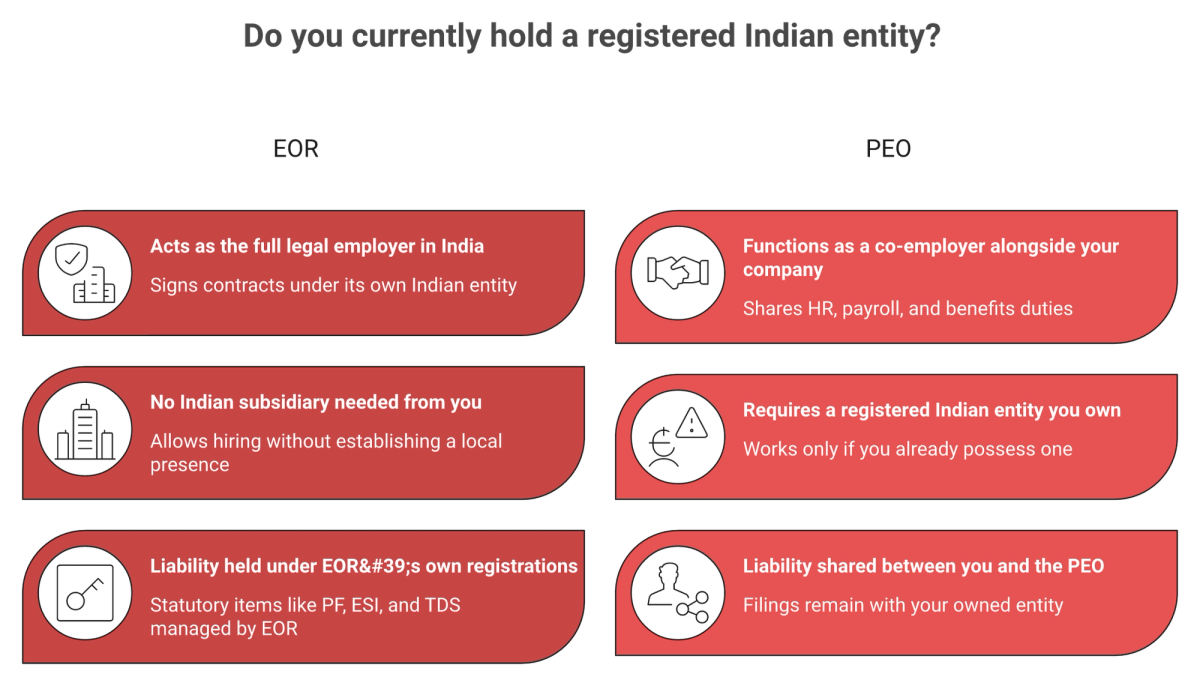
An Employer of Record (EOR) becomes your worker's full legal employer in India, holding the contract and statutory liability under its own registrations. A Professional Employer Organization (PEO) is a co-employer that shares HR duties, but it needs you to already own a registered Indian entity. So the entity question decides everything. No entity means an EOR is your only legal path.
The Question I Hear Every Week
A US founder messages me on WhatsApp. She just closed a seed round. She says, "We use a PEO in the US. Everyone tells me I need an EOR in India. Why?"
It is a fair question. In the US, the two words blur together. In India, they describe two very different legal positions. One mistake here is not a vocabulary slip. It is a liability decision.
Concept: One Word Means "Legal Employer," the Other Means "Co-Employer"
Think of it as who signs the employment contract.
An EOR signs it. The EOR is the legal employer on paper. It hires your chosen candidate, runs payroll, and files every statutory return under its own name. You direct the day-to-day work. You never touch an Indian payroll portal.
A PEO does not sign as the employer. It is a co-employer that shares HR, payroll, and benefits tasks with your company. But your company stays a legal employer too. That only works if you have a registered Indian entity to be that employer.
Example: Two Founders, Two Different Doors
Founder A has no Indian entity. She wants one engineer in Bengaluru next month. Her only compliant door is an EOR, because someone with Indian registrations must legally employ that engineer.
Founder B already runs an Indian subsidiary with twenty staff. He wants help with payroll and benefits, not a new legal employer. A PEO fits him. The entity he already owns stays the employer; the PEO just shares the admin load.
Application: Run This One Test on Monday
Ask yourself a single question. Do I have a registered company in India right now?
If the answer is no, stop evaluating PEOs. They are not built for you. You need an EOR, full stop. If the answer is yes, both models are open, and the choice comes down to how much you want to hand off.
At Versatile, when you hire through us in India, we are the legal employer on paper. PF, ESI, TDS, and professional tax sit under our own registrations, not a third party's. That is the part founders underestimate until their first audit.
I will say it plainly. The EOR versus PEO debate is really a liability question wearing a definitions costume. Get the entity test right, and the rest of this article gets easier.
Q2. EOR vs PEO at a Glance: How Do They Compare Across Liability, Entity, Cost, and Speed?
Here is the short version. An EOR is the full legal employer, needs no entity from you, absorbs statutory liability, costs less upfront, and onboards in days. A PEO is a co-employer, requires an entity you already own, shares liability, and carries higher setup cost. The deciding axis is whether you have an Indian entity. Everything else follows from that.
The One Table Most Comparison Posts Bury
Most "EOR vs PEO" articles make you read 2,000 words before they tell you the difference. I would rather give you the grid first.
| Dimension | EOR (Employer of Record) | PEO (Professional Employer Organization) |
|---|---|---|
| Who is the legal employer | The EOR, under its own registrations | You, through your existing entity (co-employed) |
| Entity required from you | No | Yes, a registered local entity |
| Statutory liability | Absorbed by the EOR | Shared between you and the PEO |
| Upfront cost | Lower; no entity setup | Higher; you fund and maintain the entity |
| Per-head cost | Predictable monthly fee | Often a percentage of payroll plus admin |
| Onboarding speed | Days (a 5-day track is realistic) | Tied to your existing entity's readiness |
| Best for | Entity-free India market entry | HR administration once you already operate locally |
How to Read This Grid
Run your eye down the "Entity required" row first. That row decides which column you even qualify for.
If you have no Indian entity, the PEO column is closed to you. The conversation ends there, and you are choosing between EOR providers, not between two models.
Speed follows the same logic. An EOR can move in days because it already holds the registrations. A global generalist often quotes ten to fourteen days, which tells you how their India setup really works.
For the India-specific provider comparison, including how Versatile stacks up against Wisemonk and the global platforms, see the detailed breakdown later in this guide.
Q3. Why Doesn't a US-Style PEO Legally Exist in India?
US co-employment, where two companies share employer liability for one worker, has no direct statutory basis in Indian labor law. India recognizes one legal employer per worker. So most services sold as an "India PEO" to companies without an entity are actually EORs. The "PEO" label is mostly an SEO artifact, and using it loosely can misrepresent who carries statutory liability.
The Standard Read Gets This Backwards
Most blogs treat "India PEO" and "India EOR" as two real, competing products. From what surfaces when you actually run India payroll, that framing is wrong.
Traditional US-style co-employment PEO does not legally exist under Indian labor law. There is no clean Indian statute that lets two entities split employer liability for the same person. So when a vendor sells a PEO to a company with no Indian entity, the legal reality underneath is an EOR.
Why the Label Sticks Anyway
The word survives for one reason. Americans search for "PEO" because that is what they use at home. Vendors chase the keyword.
I get the temptation. "PEO" has search volume. But the moment you use it for a client without an Indian entity, you have described a legal structure that cannot exist here. That is not a marketing quirk. It is a misstatement of who employs the worker and who holds the liability.
I might be overcautious on this, but I have watched the confusion cost people. A founder thinks "co-employment" means shared risk, then learns during diligence that the risk was never split, because Indian law never split it.
Your Monday Move
If a vendor without your entity calls itself a "PEO," ask one direct question. Who is the legal employer of record for my hire, on paper, under Indian registrations?
If the honest answer is "we are," you are buying an EOR, whatever the homepage says. At Versatile, I will not call us a PEO if you have no Indian entity, because legally you would be an EOR client. I would rather lose the keyword than misstate your liability.
Q4. What Exactly Does Each Model Cover in India (PF, ESI, TDS, Professional Tax)?
An India EOR runs the full statutory stack under its own registrations: PF, ESI, monthly TDS by the 7th, professional tax state by state, gratuity, POSH compliance, and Form 16. A PEO assumes you hold the entity and the registrations, so those filings, and the audit liability, stay with you. The coverage gap is the liability gap.
Concept: "Coverage" Is Really a List of Who Files What
When founders ask what an EOR "covers," they picture a vague bundle of HR. It is more concrete than that. It is a list of named filings, each with a deadline and a registration behind it.
Here is the stack, and where it lands under each model.
| Statutory item | EOR handles (under its own registrations) | PEO leaves with your entity |
|---|---|---|
| Provident Fund (PF), 12% contribution | Yes | Yes, you file |
| ESI (3.25% employer / 0.75% employee) | Yes | Yes, you file |
| TDS, deposited monthly by the 7th | Yes | Yes, you file |
| Professional tax (varies by state) | Yes, multi-state | Yes, per your registration |
| Gratuity accrual (4.81% of Basic + DA) | Yes | Yes |
| POSH (Internal Committee setup) | Yes | Yes |
| Form 16, issued to each employee | Yes, by 31 May | Yes, you issue |
Example: One Salary, Many Deadlines
Take one engineer in Maharashtra. Their pay triggers PF and ESI filings, a TDS deposit by the 7th of the next month, and professional tax under Maharashtra's dual registration, PTRC and PTEC.
Miss one, and you have a compliance gap on a single hire. Multiply that across Bengaluru, Hyderabad, and Pune, each a different state regime, and you see why "coverage" is not a checkbox. It is operational muscle.
Application: Mind the Third-Party Layer
Here is the part that decides real risk. An EOR that owns its registrations files directly. An aggregator model, what I call PEO-lite, routes your filings through a local partner entity.
That extra layer adds third-party risk to your statutory filings and your IP assignment. If the partner errs, you are two steps removed from the fix.
At Versatile, every one of those filings runs under our own registrations as part of our India payroll and compliance operations. There is no partner entity sitting between you and the EPFO. When something needs correcting, the people who filed it are the people you message.
Q5. When Do You Actually Need an EOR Instead of a PEO?
You need an Employer of Record (EOR), not a Professional Employer Organization (PEO), whenever you have no registered Indian entity. A PEO can only layer onto an entity you already own. So if you just closed a round and need engineers live in 30 to 60 days, building a Private Limited entity (12 to 18 months, heavy capital outlay) is not realistic. An EOR makes you compliant in days.
The Situation: A Funding Clock, Not a Compliance Hobby
A US founder messages me the week after her term sheet closes. The board wants four engineers in Bengaluru this quarter. She has runway, urgency, and no Indian entity.
That is the trigger moment I see most. The hiring clock is short. The entity clock is long. Those two clocks do not agree.
The Complication: The Entity Path Is a 12-to-18-Month Detour
Setting up an Indian Private Limited subsidiary is not a weekend task. It runs 12 to 18 months to be fully operational, and carries real capital expenditure before your first hire is even paid.
I could be slightly conservative on the timeline for simple cases. But for a funded startup that wants to focus on product, not MCA filings, the math rarely works. You can pressure-test the build-versus-buy decision with our EOR versus entity calculator. A G2 reviewer who looked at the same fork put it cleanly.
"We looked at setting up a subsidiary and quickly realized it would take 6 months, cost tens of thousands in legal and registration fees, and require ongoing compliance work we had no expertise in."
Verified User, US startup Versatile G2 Verified Review
The Question and Answer: Which Door Is Open Today?
So which model can you legally use right now? Run the entity test from earlier. No Indian entity means the PEO door is shut, because a PEO needs an entity to co-employ through.
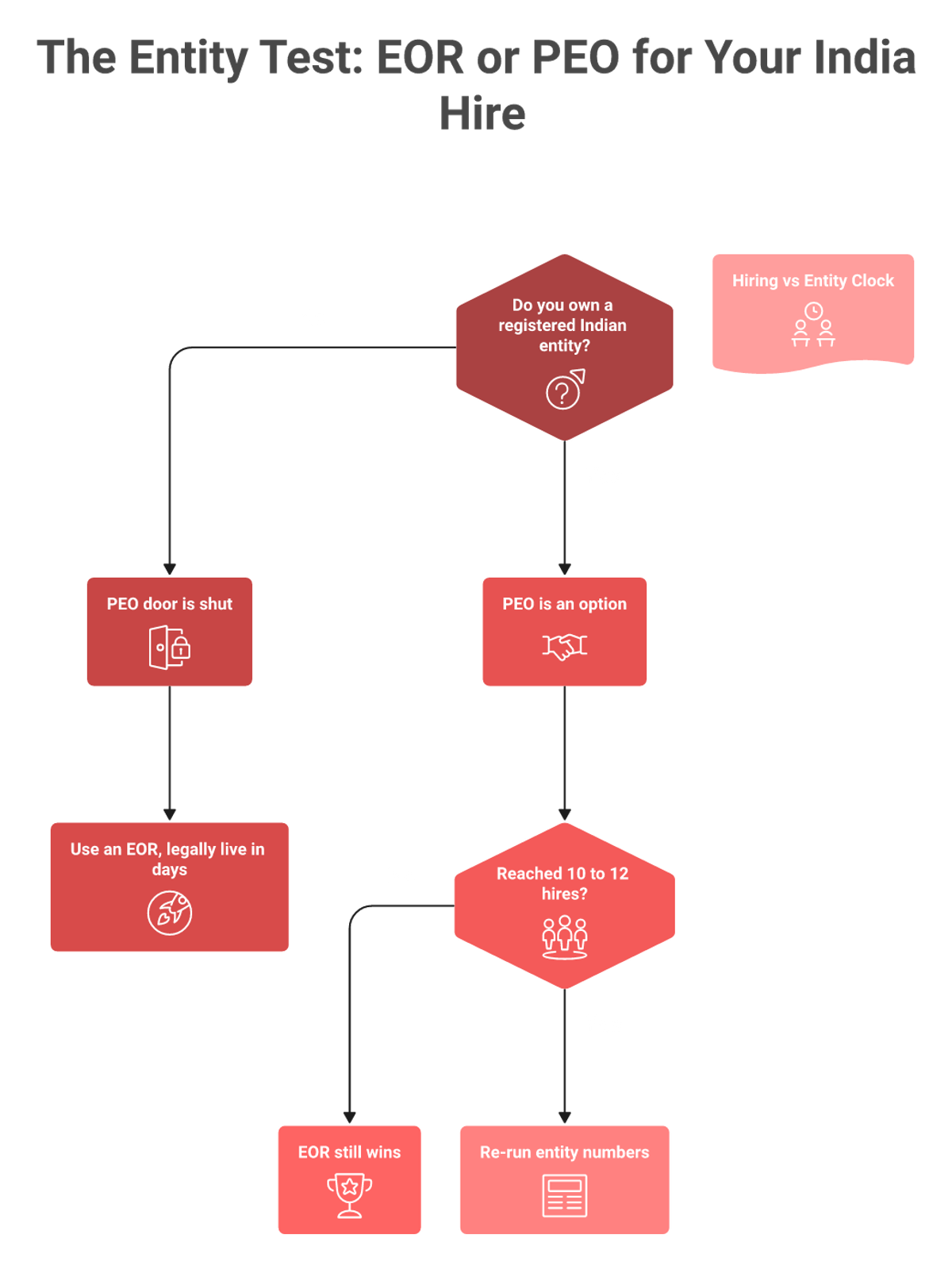
An EOR opens the door without one. It is the legal employer, so you can hire in India without an entity in days, not quarters. At Versatile, most clients reach me the week after a round closes, and we get them legally live on our India EOR 5-day track rather than a 12-month build.
The Payoff: When the Answer Honestly Becomes "It Depends"
Here is the nuance the category skips. The EOR-only logic holds cleanly while you are small.
There is a tipping point, often around 10 to 12 hires, where founders start asking whether an owned entity now makes sense. I tell people the truth. Below that line, an EOR for SaaS startups almost always wins. Near it, run the numbers again, because that is where the trade-off actually shifts.
Q6. What's the Real Liability If You Pick the Wrong Model?
Picking the wrong model is a balance-sheet event, not a paperwork slip. Contractor misclassification in India can create roughly $25,000 to $40,000 of back-pay and statutory exposure per head. An improperly structured arrangement can also trigger Permanent Establishment (PE) risk, making your foreign company taxable in India. A properly run EOR, as the legal employer, absorbs that statutory liability.
Problem: The Number Nobody Quotes You Upfront
When founders compare an EOR to a misclassified-contractor setup, they look at the monthly fee. That is the wrong number to anchor on.
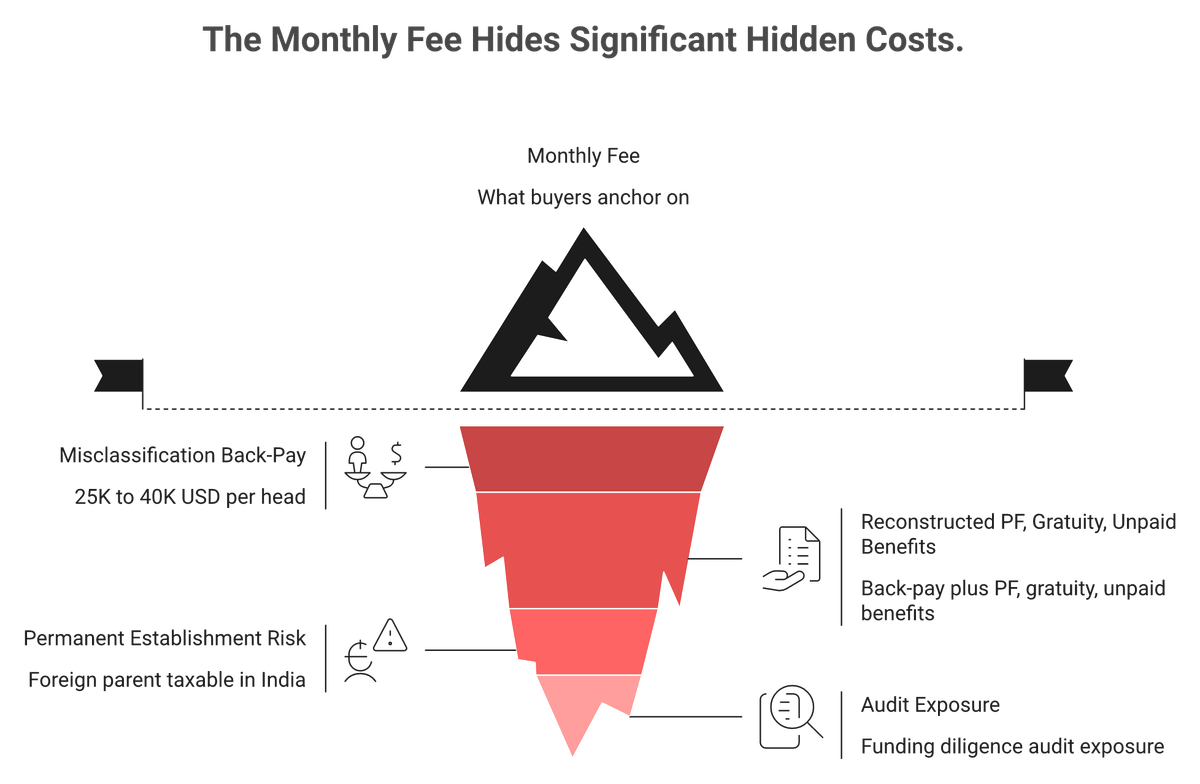
The number that matters is the exposure. Misclassification can land you with $25,000 to $40,000 in back-pay and statutory dues per head, once Provident Fund, gratuity, and unpaid benefits are reconstructed. That is the bill that arrives later, not the invoice that arrives monthly. Our misclassification quiz helps you gauge where you stand.
Agitate: The Audit Finds It at the Worst Time
Here is when it surfaces. Your next funding round opens diligence, and someone reads the India file.
A contractor who looks like an employee is a flag. Permanent Establishment, meaning a taxable business presence the tax authority can attribute to your foreign parent, is the bigger one. PE risk rises when your India staff perform core, revenue-generating, or contract-closing work for the parent.
I have watched small behavioral signals feed that picture. An offshore worker who asks permission for routine things, who behaves exactly like a managed employee, reads as employment in an audit, whatever the contract says.
Solution: Let the Legal Employer Carry It
A properly structured EOR breaks the chain. The EOR is the legal employer through its own Indian entity, so the employment relationship sits with the EOR, not your parent company.
That is the structural reason an EOR insulates you, when roles are scoped correctly. At Versatile, your India team is employed under our registrations, with clean PF, ESI, and TDS trails handled through our compliance calculation process, so the file your next investor opens reads as compliant employment, not a misclassification waiting to be priced.
I will hedge one thing. Structure matters more than the label. An EOR service in India that scopes roles loosely can still drift toward risk, which is exactly why role design is part of the work, not an afterthought.
Q7. Does Hiring Through an EOR in India Trigger Permanent Establishment Risk?
Hiring through an Employer of Record (EOR) in India does not automatically create a Permanent Establishment (PE) for your foreign company. PE risk appears when your India staff perform core, revenue-generating, or contract-negotiating work on the parent's behalf. Because the EOR is the legal employer running employment through its own Indian entity, a well-scoped arrangement keeps the parent off the PE hook.
The Direct Answer First
Let me answer the question CFOs actually ask me. No, using an EOR does not, by itself, create a taxable presence in India for your company.
The EOR employs the worker through its own Indian registrations. Your foreign company is not the employer, and it is not running a fixed place of business in India through that hire. You can sanity-check your exposure with our Permanent Establishment risk quiz.
What Actually Creates PE
PE is not triggered by the EOR label. It is triggered by what your India people do.
The risk climbs when India-based staff:
Habitually negotiate or conclude contracts that bind the foreign parent.
Perform the core, revenue-generating activity of the parent from India.
Act with authority that makes them look like the parent's fixed presence.
A back-office engineer building product is a very different PE profile from a sales lead closing deals for the US entity. The activity decides the risk, not the org chart. This is one reason founders choose an India EOR for the USA over a loose contractor setup.
Your Monday Move
Do one thing this week. Map which India roles touch contract-closing or core revenue work for the parent.
Then keep that authority with the parent's home team, and route employment through the EOR's entity. At Versatile, we scope roles with this in mind, because we have sat inside enough US-founder setups to know PE risk is a role-design question first and a tax question second. Founders new to this can start with our guide on hiring in India.
I could be wrong for edge cases with unusual treaty positions. For the standard funded-startup hire, though, a clean EOR structure plus disciplined role scoping is what keeps the parent insulated.
Q8. How Much Does an EOR vs a PEO Actually Cost in India?
India EOR pricing is usually a flat per-employee monthly fee, often $99 to $599, while a PEO more often charges a percentage of payroll plus setup. The real cost leaks are hidden: a 3 to 5 percent foreign-exchange (FX) markup when invoices route through a foreign holding company, plus setup and exit fees. Direct USD invoicing from an Indian entity, with no setup or exit fee, removes those leaks.
The Sticker Price Is Not the Real Price
Founders compare monthly fees and stop there. That is the trap. The fee you see is rarely the cost you pay. You can model the true number with our cost of hiring in India breakdown.
Here is the spread across common India options, fees as published.
| Provider | Headline price | Watch-out |
|---|---|---|
| Wisemonk | $99 to $399 / employee / month | Per-tier pricing for salary bands not fully transparent |
| Versatile | $149 / employee / month | India-only by design (not for 5+ country needs) |
| Multiplier | ~$400 / employee / month | Generalist India depth |
| Deel | ~$599 / employee / month | 3 to 5 percent FX markup reported |
| Remote | ~$599 / employee / month | 10 to 14 day onboarding |
| Globalization Partners | ~15 percent of salary | Cost scales with comp |
Problem: The FX Markup Hides in Plain Sight
Here is the leak CFOs miss until month-end. When a global platform routes your payment through a foreign holding company and converts currencies, a 3 to 5 percent FX markup can ride along.
Employees feel it too. Deel reviewers are blunt about transfer costs.
"I find Deel to be absurdly expensive. They charge a high amount of fees for transferring money to my bank account."
Juan Camilo O. Deel G2 Verified Review
Solution: Price You See, Price You Pay
The fix is structural, not promotional. Invoice in USD directly from an Indian entity, with no foreign holding company in the middle. See our transparent India EOR pricing for 2026 for the full picture.
At Versatile, that means one clean USD invoice, no 3 to 5 percent FX markup, no setup fee, no exit fee, and the first month free. Founders notice the difference on the first cycle, especially when comparing us as a Deel alternative.
"Invoicing in USD meant zero exchange rate surprises... Five-day onboarding, zero late payslips."
Vedant T., Founder Versatile G2 Verified Review
"USD invoice landed clean, no FX markup, no setup fee, no surprises."
Verified User, US startup Versatile G2 Verified Review
One honest caveat. If you need EOR across five or more countries, an India-only specialist is not your fit, and that is a feature of our focus, not a gap to hide.
Q9. How Do India EOR Providers Compare, Versatile vs Wisemonk vs the Global Generalists?
Global EOR platforms (Deel, Remote, G-P, Multiplier) cover 90 to 150 countries and route India through local partner entities. That spreads India expertise thin, and often adds a 3 to 5 percent foreign-exchange (FX) markup. India-native specialists go deeper. Among them, the real split is structural: who owns the Indian entity, who invoices in USD directly, and who solves retention, not just legal compliance.
The Problem: "Just Buy Deel" Hides the India Trade-Off
The default playbook says pick a global platform and move on. From what surfaces when you actually run India payroll, that quietly trades depth for breadth.
Deel, Remote, G-P, and Omnipresent typically use local partner entities in India. We do not. That partner layer is where India compliance gets shallow and FX markups creep in. Founders weighing options often start with our Wisemonk versus Versatile Club comparison.
The Grid That Actually Decides It
| Dimension | Versatile | Wisemonk | Deel | Remote |
|---|---|---|---|---|
| India entity model | Owned entity | India-native | Partner entity | Partner entity |
| Invoicing / FX | USD direct, no markup | INR-based | 3 to 5% FX markup reported | Standard conversion |
| Onboarding SLA | 5-day contractual | 24 to 72 hrs | 7 to 14 days | 10 to 14 days |
| Retention model | 90-day Success Coach, 6-month replacement | Compliance-first | Generalist | Generalist |
| Support | Founder on WhatsApp | Team-based | Ticket queue | Ticket queue |
| Headline price | $149 / mo | $99 to $399 / mo | ~$599 / mo | ~$599 / mo |
Reading It Honestly
Wisemonk is a genuine India-native option with strong G2 standing. The trade-off shows up in retention and support depth, which is worth weighing if you are scanning Wisemonk alternatives.
"Their support/query responses can occasionally take a bit longer, likely due to a relatively small team."
Verified User in Financial Services Wisemonk G2 Verified Review
The generalists earn their breadth, but India-specific support strains under it, which is why some buyers look at us as a Deel alternative in India.
"You either email or use a chatbot, and you can ask both the same question and get two different wrong answers."
Erika D. Rippling G2 Verified Review
Founders feel the difference when support is a person, not a queue. Our India EOR for the USA is built around founder-direct access.
"Founder is just a call away. Extremely helpful in resolving all our queries."
surbhi m. Versatile G2 Verified Review
Choose Honestly
Choose Versatile if you want owned-entity India depth, USD invoicing, and founder-direct support for a focused India team. Choose a global generalist if you need five or more countries on one contract. You can scan the full set of best EOR options for India startups before deciding.
If you are a 100-plus India enterprise that requires SOC 2 or ISO 27001 as a procurement gate, we are not your fit yet, and I will tell you that on the first call.
Q10. Why Is "Compliance-First" a Lower Bar Than "A Good Hire That Stays"?
Every credible EOR can produce a legal hire on paper. Far fewer solve the good hire that stays. Compliance is the floor, not the ceiling. A misclassification-proof contract means nothing if your engineer leaves in month four. Culture-fit-first screening, a 90-day Success Coach, and a 6-month replacement guarantee target retention directly, where compliance-first providers tend to go quiet.
The Standard Read Gets This Backwards
Most India EOR pages sell compliance as the prize. I think that has it backwards. Compliance is the entry fee, not the win.
A perfectly compliant hire who quits in month four is still a failed hire. The contract was clean. The outcome was not. That is why we built a retention-first EOR in India.
Why Naive Screening Is Risky in India
There is a real screening problem underneath. Industry background-verification data suggests a meaningful share of India IT-sector resumes carry discrepancies, often cited near 30 percent. Vetting through proper background verification is not optional.
So "filed correctly" and "hired well" are two different jobs. A compliance-first provider does the first and stops. The second one, fit and retention, is where the money actually leaks, and where strong recruiting in India matters.
What Solving Retention Looks Like
This is the gap Versatile is built around. We screen on 50 behavioral parameters for culture fit, pair every hire with a 90-day Success Coach, and back placements with a 6-month replacement guarantee. You can test fit early with our culture-fit quiz.
The point is not cheap labor. It is academically strong people who stay and create value, which is the outcome founders actually buy when they hire developers in India.
"The hire was onboarded in four days... Every payroll or PF question gets a real answer from a real person, usually same day."
Verified User, US startup Versatile G2 Verified Review
"For us, it was important to hire people who understood both craft and pace, and Versatile made that process feel much simpler."
Ibrahim A. Versatile G2 Verified Review
Q11. What Does a Compliant 5-Day India Onboarding Actually Look Like?
A clean India EOR onboarding runs on a 5-day track. Day 1, agreement signed. Day 2, offer letter sent. Day 3, contract executed. Day 4, statutory registrations (Provident Fund, Employees' State Insurance, professional tax) initiated. Day 5, payroll live. Speed and compliance are not a trade-off. They are a function of already owning the registrations, which a partner-routed model usually cannot match.
The Five Days, Step by Step
By the end of this, you will know exactly what a fast, compliant go-live looks like.
Day 1, agreement signed. We lock scope and terms so the clock can actually start.
Day 2, offer letter sent. Your chosen candidate gets a compliant offer the same week.
Day 3, contract executed. The employment contract is signed under our Indian entity.
Day 4, statutory registrations initiated. PF, ESI, and professional tax steps begin.
Day 5, payroll live. The hire is set up and ready to be paid on cycle.
Why Ownership Makes Speed Possible
Speed here is not a marketing number. It comes from owning the registrations, so no step waits on a third-party partner. This is the backbone of our managed payroll operation.
Compare that to generalist onboarding, often quoted at 10 to 14 days, where a partner layer adds delay. Founders notice the difference on the first India payroll cycle.
"Versatile's Employer of Record India service made this seamless... Five-day onboarding, zero late payslips."
Vedant T., Founder Versatile G2 Verified Review
"Compliant contract drafted for us, the offer out the same week, and our hire was set up properly... First payroll ran on time."
Angad S., Founder, Moonshot Versatile G2 Verified Review
This 5-day track is Versatile's contractual SLA, not a slogan. No setup fee, no exit fee, first month free, and you onboard against a calendar you can hold me to on WhatsApp. You can start when you build a team in India with us.
Q12. What Should You Ask Any India EOR or PEO Before You Sign?
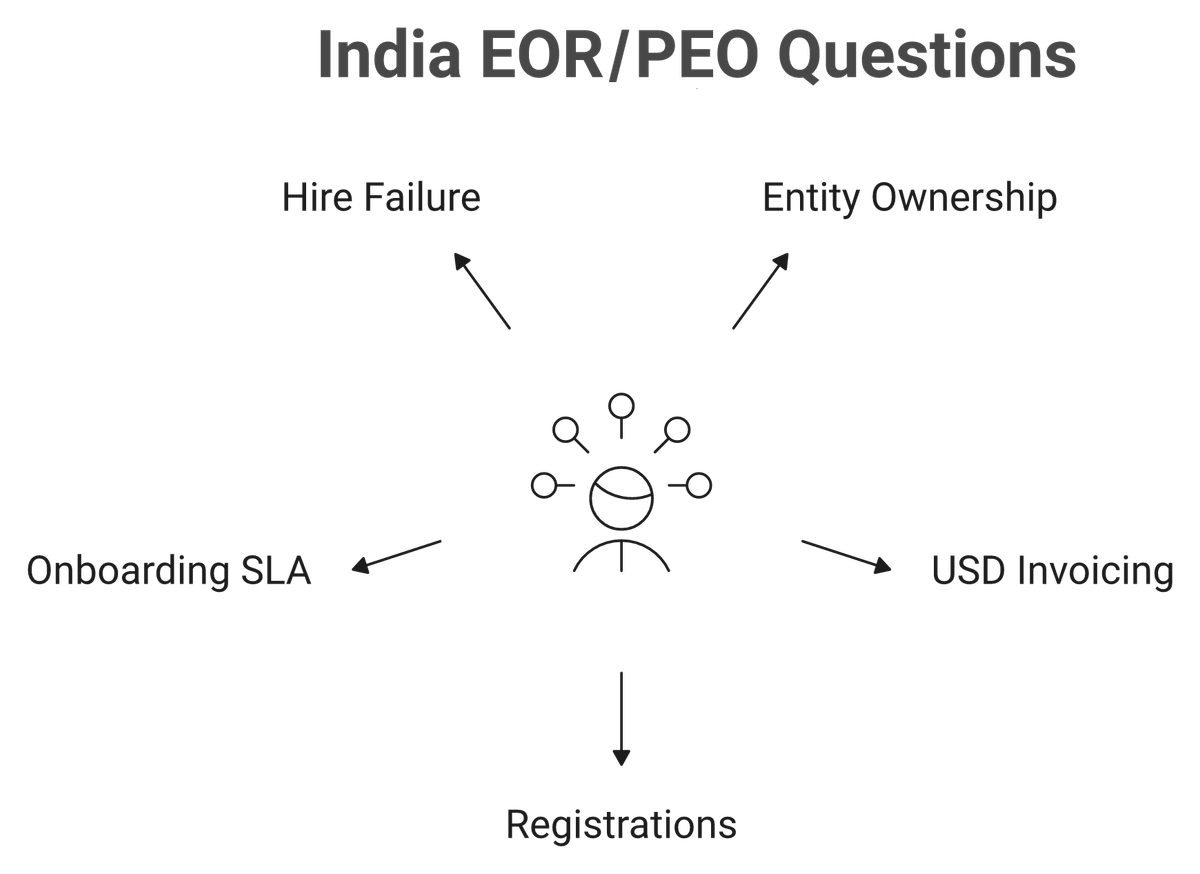
Ask five questions before you sign. Do you own your Indian entity or route through a partner? Do you invoice in USD directly, or convert from INR with an FX markup? Whose registrations carry my employees' PF, ESI, and TDS? What is your contractual onboarding SLA? What happens if the hire does not work out? The answers separate a depth provider from a reseller.
Before: The Confusion Most Buyers Sign Into
Most founders sign before they know who legally employs their hire. That is the gap that costs them later, in audits and FX leaks.
So here is the move. Treat these five questions as your filter, and write down each answer. Our India EOR service is built to pass all five.
The Five Questions, and What a Good Answer Sounds Like
Do you own your Indian entity, or route through a partner? A good answer is "we own it," because a partner layer adds third-party risk to filings and IP.
Do you invoice in USD directly, or convert from INR with an FX markup? A good answer is "USD direct, no markup," not a vague "it depends."
Whose registrations carry my PF, ESI, and TDS? A good answer names the EOR's own registrations, not a downstream shell.
What is your contractual onboarding SLA? A good answer is a number you can hold them to, not "it varies."
What happens if the hire does not work out? A good answer is a real replacement guarantee, not silence.
If you want help weighing build versus buy alongside these answers, our EOR versus entity guide for India lays out the trade-offs.
After: The Bridge to a Cleaner Decision
Run these five past every provider, including me. If the answers wobble on entity ownership or FX, you have learned something useful before any money moves.
Where my head is right now is this. In the next two years, I think India stops being one pin on a global EOR map and becomes its own specialist category, where owned-entity operators win the India work outright. If you are weighing your first India hire, message me on WhatsApp with what you are building, or book a consultation with us. You will be talking to the founder, not a ticket.
FAQs
What is the core legal difference between an EOR and a PEO in India?
The difference comes down to who legally signs the employment contract. An Employer of Record (EOR) becomes your worker's full legal employer in India, holding the contract and statutory liability under its own registrations.
A Professional Employer Organization (PEO) is a co-employer that shares HR, payroll, and benefits duties. Your company stays a legal employer too, so a PEO only works if you already own a registered Indian entity.
- EOR: full legal employer, no entity needed from you.
- PEO: co-employer, requires an entity you already operate.
- The deciding axis is whether you hold an Indian entity.
This is a liability question, not a vocabulary question. We have run this distinction across hundreds of placements, and the entity test decides everything. When you hire through our Employer of Record in India, we are the legal employer on paper, with PF, ESI, TDS, and professional tax under our own registrations, not a partner shell. Get the entity test right, and your model choice becomes obvious before any contract is signed.
Why does a US-style PEO not legally exist in India?
US co-employment, where two companies share employer liability for one worker, has no direct statutory basis in Indian labor law. India recognizes one legal employer per worker.
So most services marketed as an "India PEO" to companies without an entity are actually EORs wearing a familiar label. The word survives because US buyers search for it, not because the legal structure exists here.
- One legal employer per worker is the Indian principle.
- Shared employer liability has no clean statutory home.
- Loose use of "PEO" can misstate who carries statutory liability.
We will not call ourselves a PEO if you have no Indian entity, because legally you would be an EOR client. We would rather lose a keyword than misrepresent your liability. If a vendor without your entity calls itself a PEO, ask who legally employs the worker on paper. For a clean comparison of the two structures and what each means for entity-free companies, see our breakdown of EOR versus entity in India, which maps the build-versus-buy decision against your actual situation.
When should I use an EOR instead of a PEO to hire in India?
Use an EOR whenever you have no registered Indian entity. A PEO can only layer onto an entity you already own, so for entity-free companies it is simply not an option.
Most US and UK founders reach this fork right after closing a round. The hiring clock is short, but building an Indian subsidiary runs 12 to 18 months with heavy upfront cost.
- No Indian entity means an EOR is your only compliant path.
- An EOR makes you legally live in days, not quarters.
- Near 10 to 12 hires, revisit whether an owned entity now makes sense.
That tipping point is real, and we tell people the truth about it rather than pushing one model. Below that line, an EOR almost always wins. We get clients legally live on a fast track instead of a year-long build, which is why so many choose to hire in India without an entity first and revisit the entity question only once headcount justifies the overhead, the compliance load, and the ongoing filing work.
What statutory items does an India EOR actually cover?
An India EOR runs the full statutory stack under its own registrations, while a PEO assumes you hold the entity and registrations, so those filings stay with you.
The coverage is concrete, not vague HR. It is a list of named filings, each with a deadline and a registration behind it.
- Provident Fund (PF) at 12 percent contribution.
- Employees' State Insurance (ESI), split 3.25 percent employer and 0.75 percent employee.
- Tax Deducted at Source (TDS), deposited monthly by the 7th.
- Professional tax, handled state by state.
- Gratuity accrual at 4.81 percent of Basic plus DA.
- POSH Internal Committee setup and Form 16 by 31 May.
The coverage gap is the liability gap. We file every one of these under our own registrations through our India payroll compliance process, with no partner entity sitting between you and the EPFO. When something needs correcting, the people who filed it are the people you message, which removes a layer of third-party risk most aggregator models quietly carry.
What is the real liability if I pick the wrong model?
Picking the wrong model is a balance-sheet event, not a paperwork slip. The number that matters is exposure, not the monthly fee.
Contractor misclassification in India can create roughly $25,000 to $40,000 of back-pay and statutory dues per head, once PF, gratuity, and unpaid benefits are reconstructed.
- A contractor who behaves like an employee is an audit flag.
- Permanent Establishment risk can make your foreign parent taxable in India.
- The bill usually surfaces during your next funding diligence.
A properly structured EOR breaks this chain, because the EOR is the legal employer through its own Indian entity. We employ your India team under our registrations with clean PF, ESI, and TDS trails, so the file your next investor opens reads as compliant employment. Structure matters more than the label, which is why role design is part of our work, not an afterthought. You can pressure-test your own setup with our misclassification quiz before the exposure ever reaches an audit or a diligence room.
Does hiring through an EOR in India trigger Permanent Establishment risk?
No, using an EOR does not, by itself, create a Permanent Establishment (PE), meaning a taxable presence in India for your foreign company. The EOR employs the worker through its own Indian registrations.
PE risk is triggered by what your India people do, not by the EOR label.
- Habitually negotiating or concluding contracts that bind the parent.
- Performing the core, revenue-generating activity of the parent from India.
- Acting with authority that looks like the parent's fixed presence.
A back-office engineer building product carries a very different PE profile from a sales lead closing deals for the US entity. The activity decides the risk, not the org chart. We scope roles with this in mind, keeping contract-closing authority with the parent's home team and routing employment through our entity. For standard funded-startup hires, this combination keeps the parent insulated. You can gauge your own exposure with our Permanent Establishment risk quiz, which walks through the role-design questions that actually move the risk needle for cross-border teams.
How much does an EOR cost compared to a PEO in India?
India EOR pricing is usually a flat per-employee monthly fee, often $99 to $599, while a PEO more often charges a percentage of payroll plus setup. The sticker price is rarely the real price.
The cost leaks hide where buyers do not look.
- A 3 to 5 percent FX markup when invoices route through a foreign holding company.
- Setup fees charged before your first hire is even paid.
- Exit fees that surface only when you leave.
The fix is structural, not promotional. We invoice in USD directly from an Indian entity, with no foreign holding company in the middle, which means one clean invoice, no FX markup, no setup fee, no exit fee, and the first month free. Founders notice the difference on the first cycle. If you need EOR across five or more countries, an India-only specialist is not your fit, and we will say so plainly. To model your true all-in number before comparing vendors, start with our transparent India EOR pricing for 2026, which lays out exactly what you pay and what you do not.
What should I ask any India EOR or PEO before signing?
Five questions separate a depth provider from a reseller. Treat them as your filter and write down each answer.
- Do you own your Indian entity, or route through a partner? A good answer is "we own it."
- Do you invoice in USD directly, or convert from INR with an FX markup? A good answer is "USD direct, no markup."
- Whose registrations carry my employees' PF, ESI, and TDS? A good answer names the EOR's own registrations.
- What is your contractual onboarding SLA? A good answer is a number you can hold them to.
- What happens if the hire does not work out? A good answer is a real replacement guarantee.
Run these past every provider, including us. If the answers wobble on entity ownership or FX, you have learned something useful before any money moves. Compliance is the floor; a hire who stays is the real win. If you want to weigh build versus buy alongside these answers, or simply talk through your first India hire with the founder rather than a ticket, you can book a consultation with us and bring all five questions to the table.