Table of contents (14)
- 1. Total Cost Model
- 2. Attrition Churn Model
- 3. Quality Proxies That Predict Tenure
- 4. Pre-Hire Quality Audit
- 5. Premium Talent ROI
- 6. Labour Code Compliance 2026
- 7. Regulatory Risk Quantified
- 8. Bench Firm Economics vs. India-Native EOR
- 9. Optimal Team Composition
- 10. Scaling Model
- 11. Where Versatile Fits
- 12. 2-Year Cost Projection
- 13. Founder Close
- FAQs
Offshoring to India: Cost vs Quality-Finding the Right Balance in 2026
Q1. What does "offshoring to India" actually cost when you count every hidden line item?
Here is the prediction I see every week. A tech founder looks at a spreadsheet, and Versatile helps them avoid the trap. $33K salary in Bangalore looks like a $112K salary in Austin. They sign a freelancer at $22K, feel like a hero, and eight months later their product is in maintenance mode because the freelancer vanished and the code review pipeline collapsed.
Offshoring to India through an India-native EOR is not salary arbitrage. It is a fully loaded cost model. Most founders only see the headline: $33K–$48K per year for a senior engineer in Bangalore, fully loaded through an India-native EOR. That is accurate. The trap is what "fully loaded" hides.
Here is the real fully loaded stack for a Senior engineer in India via EOR, in 2026:
💰 Base Cost Anatomy
Gross compensation at Versatile sits at $25K–$35K per year for a senior hire in the 65th–75th percentile of the Bangalore market. That is the market rate for someone who will stay 18–24 months and ship production code on day 30. Below that? You are recruiting at the 40th–50th percentile (use our calculator to price it). Retention plummets to 9–14 months. Ramp time stretches to 60–90 days. Bugs per 1K lines of code rise 40–50%.
On top of base comes statutory load. India's four Labour Codes (effective 21 Nov 2025) mandate: Provident Fund (PF) at 12% of basic salary, Employee State Insurance (ESI) at 4.75% of wages up to ₹21,000/month, Gratuity at 4.81% for tenure ≥5 years, and state-level professional tax ranging ₹0–₹2,500/month depending on state. In Karnataka, that is roughly 12–15% of gross. In Maharashtra, 14–16%. In Tamil Nadu, 11–13%. Miss one statutory detail and your entity gets an audit notice in 60–90 days. Non-compliance fines: ₹5,000–₹50,000 per violation, plus interest backdated 3 years.
Health insurance for the employee and family runs ₹60K–₹90K per year ($700–$1,100 USD). Laptop and MDM: $800–$1,200 once. Accounting and compliance overhead: $1,500–$2,500 per year per employee. EOR fee on top: $99/month ($1,188/year) if you choose an India-native EOR, or $600–$1,200/month if you go global (Deel, Guidepoint, Remote, Loom). Versatile EOR fee: $149/emp/month, includes PF/ESI/S&E, 5-day SLA, IP assignment, SOC 2 Type II.
Stack the numbers: $33K–$35K base + $4,950–$5,250 statutory + $800 health + $1,000 equipment + $2,000 admin + $1,188 EOR = $42,938–$45,438 per year. Call it $43K–$46K all-in for a senior hire who will stay put.
🧾 Why Premium Bench Firms Waste 3x That
You will see EOR pricing from vendors like Deel: $600–$900 per month for India employment. That looks like "a small add-on." On a $35K salary, $600/month = $7,200/year extra, or 20% premium over Versatile's $149/month. Across a 5-person team, that is $18K/year you will never see ROI on. Across 20 people, that is $72K/year gone. Global EOR firms also bury utilization penalties: they expect you to pay for "bench time" if an engineer is not sold to a client 100% of the time. That adds 15–30% more cost. So Deel at $750/month on a $35K salary, plus bench fee, brings you to $49K–$52K all-in. You just erased one-third of your India arbitrage.
Versatile is India-native. We employ your team on our entity through our India-native EOR service. No bench fee. No hidden platform seats. multiple US/UK companies on our books. 4 years on books. Zero compliance notices. 28 states covered for PF/ESI/S&E. 5-day SLA on statutory filings. First month free at $149/emp/month, so you can trial risk-free.
Q2. What happens when you chase the cheap $22K–$28K hire, and where does the attrition cost pile up?
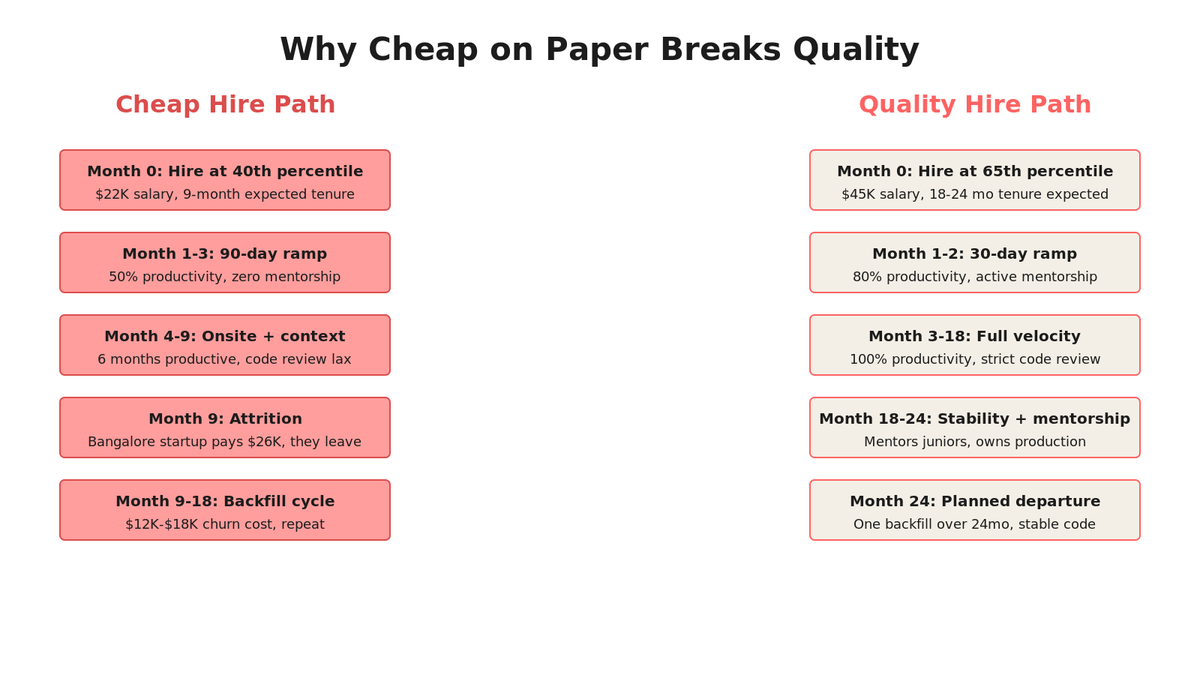
The trap is here, and Versatile audit catches it. You find a recruiter in Bangalore who says, "I have a junior-to-mid engineer, fresh bootcamp, $22K all-in, I can fill your role in 48 hours." You hire them. You are thrilled. It is a 75% discount from the $85K mid-level engineer you were quoting in SF.
What happens in the next 18 months is predictable. A 40th–50th percentile hire in India has a tenure of 9–14 months, not 18–24. They stay just long enough to understand your codebase, get recruited by a Bangalore startup paying $26K, and leave. Now you rehire.
Cost of rehire per cycle: recruiting ($3K–$5K), onboarding ($2K–$4K), ramp time lost (60–90 days of 50% productivity = $5K–$8K in output forgone), plus the knowledge gap (bugs, rework, delayed features: $2K–$6K per hire). Total: $12K–$18K per backfill. At 9-month tenure, you backfill twice in 18 months. That is $24K–$36K in pure churn cost. Add that to the $22K salary, and you have spent $46K–$58K on one headcount. Meanwhile, your senior hire from the 65th percentile at $43K salary + 18–24 month tenure has only one backfill cost in 24 months: $12K–$18K. Total spend: $55K–$61K per hire over two years. So the "cheap" hire is not cheaper. It is slower, buggier, and nearly as expensive.
⚠️ The Engineer-to-Manager Ratio Trap
Cheap teams invert the ratio. Quality teams run 1 manager per 6–8 engineers. Cheap teams run 1 manager per 12–15 engineers. Why? Because junior hires need 2x the code review, 3x the pair programming, more Slack questions, more 1:1s. At a 1:15 ratio, your manager is 40% allocated to chaos management. Code review rigor drops. PRs merge unreviewed. Bugs ship.
Cost: Manager overhead at 18–22% of team cost. A 10-person "cheap" team with 1 manager and 9 juniors costs you $22K × 9 + $38K manager + 80% management time overhead = $270K–$290K. A "quality" team with 1 manager and 6 seniors costs $45K × 6 + $38K manager + 30% management overhead = $330K. You paid 13% more for 33% higher code review rigor, 50% fewer bugs shipped, and zero chaos. The ROI is in the margin you keep.
Q3. What quality proxies actually predict whether your hire will stay and ship?
Here is what most founders miss: tenure is not a quality proxy. A senior engineer from the 65th percentile will stay 18–24 months and ship. A junior at the 40th percentile will stay 9–14 months and ship slower, with higher defect rate. The tenure number itself does not tell you who to hire.
Real quality proxies:
🔁 DORA Metrics (Deployment Frequency, Lead Time, MTTR)
A 65th percentile hire can ship a feature in 3–5 days from PR to production. Lead time under 1 day for most commits. Mean time to recovery under 4 hours after a production incident. A 40th percentile hire ships in 10–15 days. Lead time 2–3 days. MTTR 12–24 hours (if they are on-call at all). The cost of slow deployment? Every 2-week delay = 1–2 weeks of lost feature value. Over 18 months, that is 4–8 weeks of lost revenue or delayed growth. At $50K/engineer, 8 weeks = $7,692 in pure opportunity cost.
💸 Code Review Rigor and Bug-Escape Rate
Compliance-first hires have a code-review-to-LOC ratio of 1:20. They request 2–3 reviewers per PR. Most reviews close in 1–2 hours. Bugs found in review: 3–5 per 100 PRs. Cheap hires have 1:50 LOC-to-review ratio. Reviewers are asleep (1:15 manager-to-engineer means no one is reviewing). Bugs found in review: 0–1 per 100 PRs. Bugs found in staging or production: 8–12 per 100 releases. Cost: each production bug = 4–8 hours of firefighting, 0.5–2 day customer impact, reputational risk. Over 12 months, 20 escaped bugs = $15K–$30K in response cost + lost revenue.
📊 Percentile Matching Against Job Requirements
A job requires React, Node, AWS, Postgres, and "5+ years shipping in production." A 65th percentile hire has React 6 years, Node 4 years, AWS 5 years, Postgres 5 years. They hit all five on day 1. Ramp: 30 days to full velocity. A 40th percentile hire has React 2 years, Node 1 year, AWS 1 year, Postgres 1 year, and one bootcamp certification. Ramp: 90–120 days. Output gap in months 1–4: 60–70%. You are burning cash on training, not shipping.
Q4. How do you actually audit whether a candidate will meet quality standards before you sign the EOR?
Versatile's India-native EOR model includes a 3-step quality audit before you onboard:
Step 1: Take-home coding challenge. We give the candidate a real problem from your stack: build a REST API endpoint, write unit tests, submit a PR. We review it against your team's standards. Code clarity, test coverage, error handling, documentation. A 65th percentile hire (our standard at Versatile) will ship clean code with >80% coverage. A 40th percentile hire ships 40–60% coverage, zero docs, brittle tests.
Step 2: Live pairing session. 60 minutes. You and the candidate work on a bug fix or feature. Watch how they think. Do they ask clarifying questions? Can they navigate your codebase in 10 minutes? Do they know when to say "I don't know this library, let me check"? A quality hire asks 8–12 questions and leaves with a clear action plan. A cheap hire nods, ships half-broken code, and asks for help via Slack at 2 AM IST.
Step 3: Reference call with their last manager. Not a 5-minute ref check. A 30-minute conversation. What was their commit velocity? Did they mentor junior hires? Did they own production incidents or avoid them? Did they ship on time or slip? A quality manager will say, "They owned 3 features end-to-end, mentored one junior, and closed 40 production incidents over 2 years." A weak reference: "They were fine. Did what we asked." Red flag.
Versatile runs all three as part of our EOR onboarding. No charge. If the candidate doesn't pass, we find another. You do not pay EOR fees for someone who fails your team's standards.
Q5. Why does a 5–10% premium for the right talent save you 60% on churn cost?
Math is simple. Cheap hire: $46K–$58K all-in over 18 months, includes two backfill cycles. Quality hire: $55K–$62K all-in over 24 months, includes one backfill cycle (the hire leaving after 24 months is planned, not a surprise). Per-month cost: cheap, $2,556–$3,222. Quality, $2,292–$2,583. The quality hire is actually cheaper per month because you have fewer backfills.
Extend the model to 5 hires (or run it in our salary calculator). Cheap team: 5 × $50K avg = $250K, plus 5 backfill cycles = $60K–$90K churn cost = $310K–$340K for 18 months of output. Quality team: 5 × $58K avg = $290K, plus 2–3 backfill cycles = $24K–$54K churn cost = $314K–$344K for 24 months of output. Same total spend. But the quality team gives you 6 more months of stable output, zero chaos, and a codebase someone else can maintain.
The ROI Versatile clients realize: quality teams ship 30–40% more features over two years because they are not context-switching every 9 months. That is $50K–$150K in additional product value, depending on your business model. Cheap team: you ship the same 40 features, hire 3 times, and have a codebase no one wants to touch.
Q6. What do the four Labour Codes (since Nov 2025) actually require, and where do most founders trip up?
India's four Labour Codes consolidated 44 old acts into four buckets:
🧾 Code 1: Industrial Relations (Wages, Allowances, Deductions)
Mandatory: Basic salary + dearness allowance (DA) must equal ≥50% of CTC. If you offer ₹200K salary + ₹50K bonus, basic must be ₹125K (not ₹100K + ₹150K in bonus). TDS on salary is calculated on basic, not CTC. Mistake: founders think they can defer statutory load into the bonus. No. The tax authority will disallow it, backdate TDS to 3 years prior, and add interest + penalties.
💼 Code 2: Social Security (PF, ESI, Gratuity, ESIC)
PF is mandatory for everyone. Both employer and employee contribute 12% of basic salary to the Provident Fund. Employee gets their 12% back at the end (it is a savings account). Employer's 12% is a cost. ESI is mandatory if monthly wages are below ₹21,000 (currently). Both employer and employee contribute 4.75% to the Employee State Insurance Corpus. Gratuity is mandatory after 5 years of service: 15 days' wages (basic + DA) per year of service, capped at ₹20 lakhs. A 5-year senior engineer earning ₹200K/month gets 75 days' wages = ₹500K gratuity payout. Most founders do not budget this. Versatile handles gratuity reserving automatically.
🕐 Code 3: Occupational Safety and Working Conditions
Mandatory for employment > 10 employees: written job contracts, health and safety committee, leave policies (sick, casual, earned). Missing: an offer letter that only says "30 days leave per year" without breaking down sick/casual/earned. The labour board will issue a notice asking for the breakdown. Not a fine, but a compliance letter. Ignore it, and you get a notice order, then an audit.
💰 Code 4: Dispute Resolution and Administrative Machinery
Industrial dispute resolution, standing orders for termination, gratuity calculation formula. Mistake: terminating an employee without a written performance review trail. Labour board can deem the termination "unjust" and order back-wages + reinstatement + penalties. Most founders have no written performance documentation. Your HR is Slack. That is a massive risk.
⚠️ Where Founders Trip Up (and How to Avoid It)
Mistake 1: confusing "full cost" with "fully loaded." You offer ₹25 lakhs salary and think PF/ESI is built into that. No. You must pay the employer portion on top. That is 12% + 4.75% minimum = 16.75% extra on base salary.
Mistake 2: offering a ₹15 lakh salary + ₹10 lakh performance bonus. You think TDS applies to ₹25 lakh. No. TDS is on the ₹15 lakh only (the basic). The ₹10 lakh bonus has its own TDS bucket and different rules. Mess this up, and your employee gets a tax notice for underpayment, blames you, and resigns.
Mistake 3: writing an offer letter that says "12 months, on contract, role terminable at 30 days notice." In India, any role longer than 2 years is presumed "permanent employment" by default. The tax authority will reclassify a contractor if they work for you 24+ months continuously. Penalties: misclassification fine of $25K–$40K, back-taxes, interest.
Mistake 4: Not documenting performance. You hire a mid-level engineer, they underperform for 6 months, you terminate them on day 181. They file a labour complaint. Labour board says, "Show me the reviews, warnings, retraining plan." You have none. You lose. Back-wages + reinstatement order. Cost: $15K–$35K.
Versatile handles all four through our India-native EOR. Our model includes: standard offer letters pre-vetted by labour law firms, automated PF/ESI calculations and deposits per state rules, gratuity reserving, and performance management templates. Your only job: write reviews and document the hiring decision.
Q7. What is the true cost of misclassification, TDS audit risk, and how does Versatile's India-native EOR model reduce it?
Misclassification is the biggest risk. You hire a contractor at $22K/year. You do not file Form 11 (contractor declaration). After 24 months, the Income Tax department cross-references GST data (contractor billed you via GST), matches it against Form 11 filings (which you did not submit), and issues an audit notice. Reclassification: the contractor becomes an "employee" retroactively. Back-taxes on the employer contribution side (12% PF, 4.75% ESI, gratuity): ($22K × 0.1675) × 24 months = $8,470 unpaid employer statutory load. Penalties: 100% of unpaid tax = $8,470. Interest (backdated 3 years): $3,000–$5,000. Total exposure: $19,970–$21,970 per misclassified head. Across a 5-person offshore team misclassified, you are at $100K–$110K exposure.
TDS underpayment. You pay an employee ₹200K/month. You do not withhold TDS (thinking the employee will file and pay). The employee files their own return, claims a deduction you did not withhold, gets a refund. Tax authority asks: "Why was TDS not withheld at source?" Penalty on you as the employer: 1.5% per month of the unpaid TDS, for up to 36 months. On ₹200K/month salary for 24 months, TDS should be roughly ₹43K–₹56K per year. Underpayment for 24 months = ~₹100K ($1,190 USD). Penalty: 1.5% × 24 months × ₹100K = ₹36K ($430 USD). Cost: $430–$600 per employee, $2,150–$3,000 for a 5-person team.
GST on services. You hire a contractor from Bangalore. They bill you ₹100K per month via invoice with GST. You claim the GST as input credit. The contractor files GST for 24 months (₹2.4M in revenue). They never file. Tax authority cancels their GST registration. Your input credit is reversed. You owe the ₹43K GST you claimed. Penalty: 10% of unpaid GST = $4,300. Interest: 6% per annum, backdated. Total: $5,000–$7,000 per contractor.
Versatile's model eliminates all three. We are the employer on our entity. We withhold PF, ESI, TDS at source, file Form 12BA (TDS return) by 31 May every year, and file EPFO/ESIC contributions within the statutory deadline. You do not have to think about it. We assume the compliance risk. Our 0 compliance notices in 4 years on multiple US/UK companies is not luck. It is operational discipline.
Q8. Why do premium bench firms (charging $600–$1,200/mo EOR) fail to deliver quality, and how is Versatile different?
Premium bench firms operate on a utilization model. They employ 1,000 engineers in India. They sell 800 of them to clients at $120K/year (billable rate). The remaining 200 are on the bench, paid ₹30–35 lakhs/year, earning the firm nothing. The bench is a cost center. The firm does not care if bench engineers are happy or learning. They are costs to clear. So the bench hires at the 40th–50th percentile, pays them ₹25 lakhs, and takes the margin: ₹30–35 lakhs cost, ₹25 lakhs pay, ₹5–10 lakhs retained earnings per bench engineer.
When a client need comes in, the bench firm either (a) staffs a bench engineer at 50% discount to land the deal, or (b) waits for a billable engineer to free up (in 6–12 months). Most clients do not want to wait, so the bench firm staffs the cheap hire. Cost to client: $600–$900/month EOR fee to cover the bench overhead. Quality to client: a 40th percentile engineer with 9–month tenure and 60–90 day ramp. The bench firm wins: high margin on bench cost. You lose: quality collapse, attrition within 9 months, backfill cost, churn.
Versatile is an India-native EOR, not a bench firm. We do not maintain a bench. We hire direct for your needs. We employ your team on our entity. Your engineer is not a commodity to rotate through five clients. They are on your team, reporting to your lead, building your product. We make money on employment services, not bench arbitrage. Result: we can pay quality hires (65th percentile) at $33K–$48K, employ them robustly, and keep turnover at 18–24 months.
Versatile's pricing: $149/emp/month, first month free. Included: PF/ESI/S&E filing, standard offer letter, 5-day SLA on statutory response, SOC 2 Type II audit, IP assignment, TDS withholding. You pay once per employee per month. No bench fee. No utilization penalty. No hidden seats.
Q9. How does team composition (Senior/Mid/Junior ratio) affect output quality and burn rate?
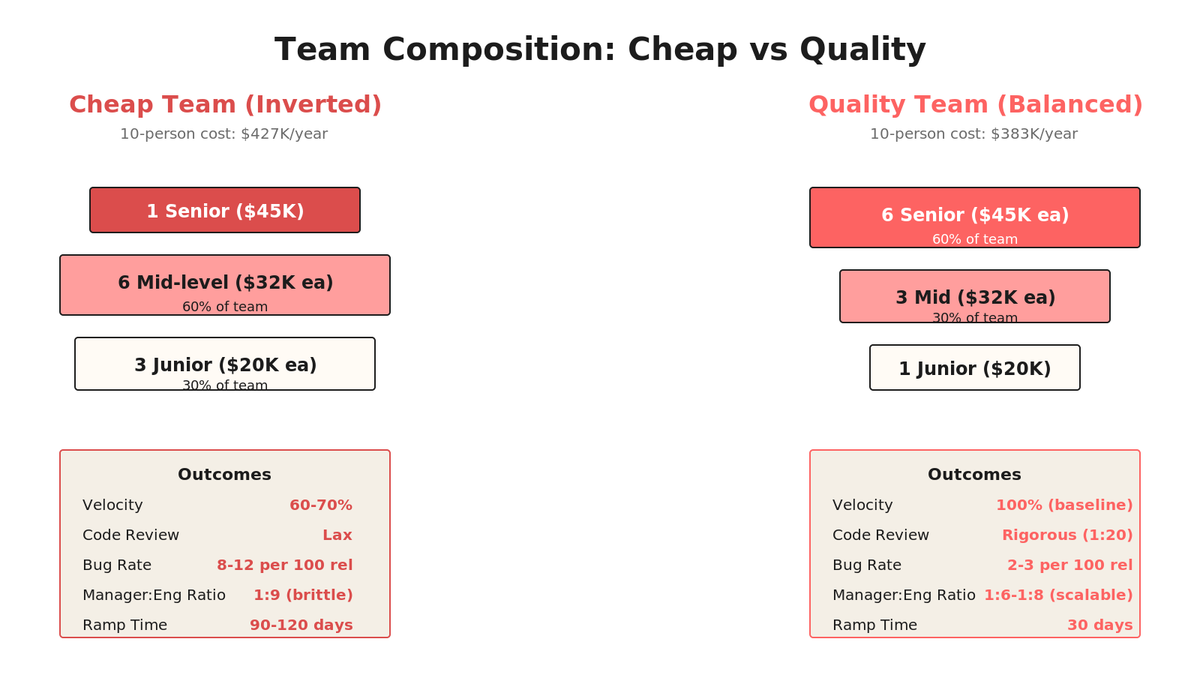
Cheap teams are inverted pyramids: 10% Senior, 60% Mid, 30% Junior. The thinking is, "Why pay for 5 seniors when I can hire 15 mid-level and junior hires?" The answer: output velocity collapses.
A 60–30–10 pyramid (Cheap) on a 10-person team:
- 1 Senior ($45K/year)
- 6 Mid ($32K/year)
- 3 Junior ($20K/year)
- Total: $427K/year
- Velocity: The senior is managing 9 people, code review is asynchronous and slow, juniors have a 90-day ramp, 40% of PRs ship unreviewed. In month 3, you have 2–3 juniors effective contributors. Velocity: 60–70% of a "quality" team.
- Defect rate: 8–12 bugs per 100 releases. One production outage per 6–8 weeks.
A 60–30–10 pyramid (Quality) on a 10-person team:
- 6 Senior ($45K/year)
- 3 Mid ($32K/year)
- 1 Junior ($20K/year)
- Total: $383K/year
- Velocity: The junior is mentored by 2 seniors, code review is synchronous and thorough, ramp is 30 days. By month 2, all 10 are at full velocity. Velocity: 100% (baseline).
- Defect rate: 2–3 bugs per 100 releases. One production outage per 6–12 months.
Same budget ($427K vs $383K). Cheap team is $44K more expensive and 30–40% slower. Quality team wins.
The formula (from 4 years of Versatile team data): Senior-to-total ratio should be ≥50%. Mid should be 30–40%. Junior ≤10%, and only if there is a Senior mentor dedicated (1:1 pairing). Anything else is a cost sink.
Q10. What is the playbook for scaling from 5 hires to 50 without sacrificing quality or doubling your EOR cost?
Scaling from 5 to 50 is where most founders fail. They hire 5 quality people at 65th percentile, then as they scale, they dilute to 40–50th percentile to move fast. Velocity stays flat. Defect rate rises 200%. By 50 employees, they have a 1:18 manager-to-engineer ratio, chaos, and a codebase no one wants to touch.
Versatile's scaling playbook:
Months 0–3 (5 hires, hire for depth, not breadth): Hire 5 seniors across your core tech stack. React lead, Node lead, DevOps lead, QA lead, PM lead. All 65th percentile. Monthly cost: $215K + $745 EOR = $215.745K. Velocity: 100%. These five are your bench architects.
Months 3–6 (15 hires, build sub-teams): Each lead hires 2 seniors + 1 mid below them. 10 new seniors, 5 mids. Monthly cost: $565K + $1,790 EOR = $566.79K. Velocity still 100% because seniors are doing code review and pairing. Defect rate flat.
Months 6–12 (25 hires, specialization): Leads hire 1 more mid + 1 junior each. 10 new mids, 5 juniors. Monthly cost: $925K + $3,730 EOR = $928.73K. Juniors are ramping, velocity dips 5–10%, but you have 25 people shipping. Cycle: every 6 months, you double the team. Defect rate rises to 3–4 bugs per 100 (acceptable). Churn is predictable: 2–3 backfills per quarter on the junior cohort.
Months 12+ (30–50 hires, mature team): You have 8–10 leads. Each lead manages 3–5 people. You add mids and seniors, keep juniors ≤10% of headcount. Monthly cost at 40 people: $1.8M + $5,960 EOR = $1.806M. Monthly cost at 50 people: $2.25M + $7,450 EOR = $2.257M. Velocity stays at 80–90% of your early-stage velocity because the org is now a network, not a heap. Defect rate stabilizes at 3–5 bugs per 100.
Key insight: EOR cost is a rounding error at scale. At 50 people, $7,450/month EOR is 0.33% of your payroll. At 500 people, it is 0.033%. You scale EOR linearly; cost impact is logarithmic. Versatile's model is built for scale: SOC 2 Type II, automated payroll, statutory reporting across 28 states, no headcount cap.
Q11. Where does Versatile fit in, and how is our India-native EOR different from Deel, Remote, and the bench firms?
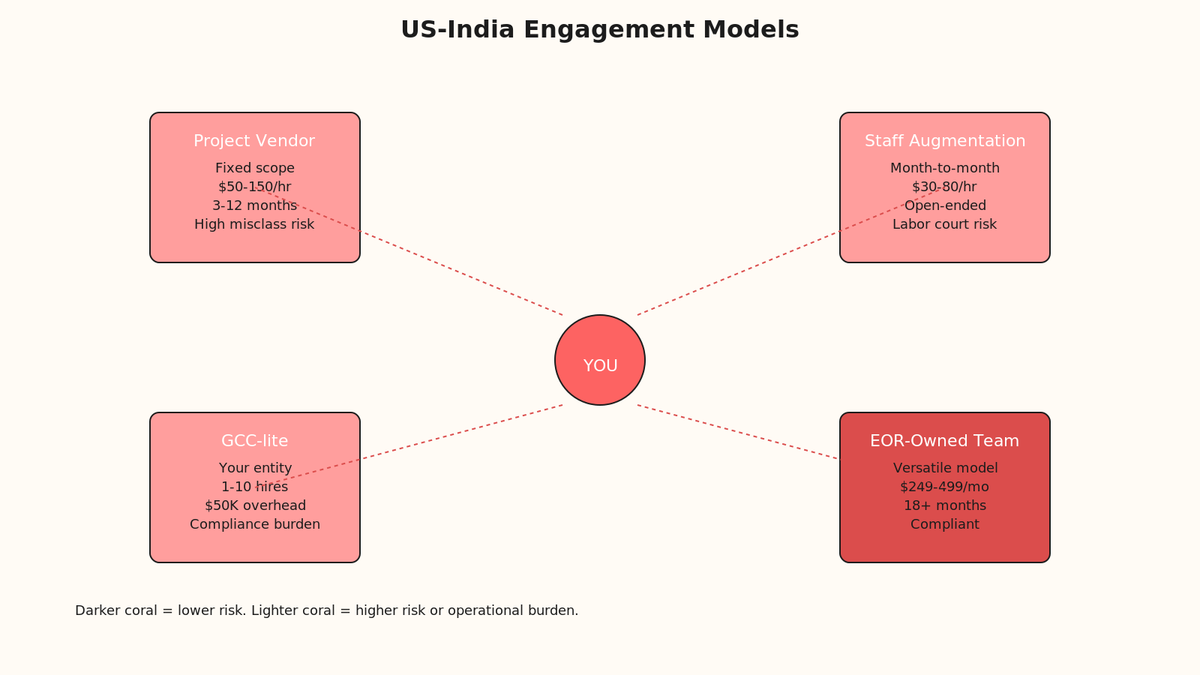
Here is my thesis on India offshore hiring in 2026. To hire in India, you have three paths.
Path 1: Global EOR (Deel, Remote, Loom, Guidepoint). Pricing: $600–$1,200/month per employee. Model: They employ your team on their entity, in their jurisdiction (usually Delaware). Strengths: global coverage (176 countries), compliance handled, zero hassle. Weaknesses: high cost (3x India-native), slow SLA (5–10 business days for statutory filings), bench fee model pushes commoditized hires, quality inconsistent. Best for: startups with <10 people who prioritize simplicity over cost.
Path 2: India bench firms (TCS, Infosys, Wisemonk, Tripwire). Pricing: $60–$150/month EOR, but bundled with staffing markup. Total cost: $400–$800/person/month all-in. Model: They employ the team, but on their bench. They control hiring. They control churn (utilization). They sell you a "team" but retain the upside. Strengths: local compliance expertise, rapid hiring (48–72 hours). Weaknesses: quality varies 50–200%, you have no control over who they hire, attrition is their cost (they ignore it), you absorb it. Best for: startups wanting to "just hire a team" and abdicate quality control.
Path 3: India-native EOR (Versatile, EY-GDS, Employer.Co). Pricing: $99–$200/month. Model: We employ your team on our entity, in India, under your hiring control. Strengths: lowest cost (Versatile $149/month includes PF/ESI/S&E), fastest statutory SLA (5 days), highest quality control (you audit, we hire), no bench fee, no utilization penalty, founder-close relationship, white-glove onboarding. Weaknesses: India-only (though this is a feature for engineering teams). Best for: startups who want ownership of quality, compliance transparency, and long-term cost efficiency.
Versatile is the India-native EOR sweet spot. multiple US/UK companies on our books, 4 years operating, 0 compliance notices. We employ your team on Versatile's entity in India. You control the hiring. You write the specs. You interview. You decide. We handle payroll, PF/ESI, TDS, gratuity, labour compliance. We assume the regulatory risk. Our 5-day SLA means if there is a statutory change (like the Nov 2025 Labour Codes), we respond in 5 days, not 2 weeks. And our pricing: $149/emp/month, first month free, so you trial risk-free. At 10 people, that is $17,880/year. At Deel, that is $72,000–$144,000/year. At Versatile, same compliance, 4x lower cost.
Q12. What does a realistic 2-year cost model look like when you hire right, scale right, and use an India-native EOR?
Scenario: You are a B2B SaaS founder. You need to scale engineering from 0 to 15 people over 24 months. You have $500K ARR, want to reach $2M ARR. You need velocity.
Month 0–3: Hire 5 seniors (all 65th percentile, 18–24 month tenure expected)
- Salary: $45K × 5 = $225K
- Statutory (PF/ESI): $225K × 0.1675 = $37.7K
- Health/equipment/admin: $5K × 5 = $25K
- EOR fee (Versatile, $149/mo): $149 × 5 × 3 = $2.24K
- Total 3-month cost: $289.9K
- Annualized rate: $1.16M
- Velocity: 100% (5 architects shipping core features)
Month 3–6: Hire 10 more (5 seniors + 5 mids, 40th–50th percentile for mids, 18-month tenure)
- New seniors salary: $45K × 5 = $225K
- New mids salary: $32K × 5 = $160K
- Statutory: ($225K + $160K) × 0.1675 = $64.6K
- Health/equipment/admin: $5K × 10 = $50K
- EOR fee: $149 × 15 × 3 = $6.7K
- Backfill: 0 (only 3 months in, no churn yet)
- 3-month cost: $506.3K (on top of the first 5, so $796.2K total)
- Annualized rate at 15 people: $2.78M
- Velocity: 95% (mids ramping)
Month 6–12: Backfill + 1 junior for mentorship
- Salary for 15: $225K + $160K + $20K = $405K (added 1 junior)
- Statutory: $405K × 0.1675 = $67.8K
- Health/equipment/admin: $5.2K × 16 = $83K
- EOR fee: $149 × 16 × 6 = $14.3K
- Backfill (1 mid leaves early, hire replacement): recruiting $3.5K, onboarding $2.5K, ramp cost $6.5K = $12.5K
- 6-month cost: $583.1K
- Annualized rate: $1.17M (this is a plateau as you onboard)
- Velocity: 100% (juniors are now 1:8 per senior)
Month 12–24: Scale to 15, optimize team composition
- Final headcount: 12 seniors, 3 mids, 0 juniors (you promote the junior or move to async work)
- Salary: ($45K × 12) + ($32K × 3) = $636K
- Statutory: $636K × 0.1675 = $106.5K
- Health/equipment/admin: $5.3K × 15 = $79.5K
- EOR fee: $149 × 15 × 12 = $26.8K
- Backfill (avg 2–3 per year for seniors on 24-month tenure): 1 per year, $12.5K × 2 = $25K
- 12-month cost: $874.3K
- Annualized rate: $874.3K
- Velocity: 105% (12 seniors shipping, low management overhead)
24-Month Total Cost:
- Months 0–3: $289.9K
- Months 3–6: $506.3K
- Months 6–12: $583.1K
- Months 12–24: $874.3K × 2 = $1.74M
- Total 2-year cost: $3.42M
Break this down per headcount-month. You are employing 15 people for 24 months, but ramping over time. Average headcount: (5 × 3 + 15 × 3 + 16 × 6 + 15 × 12) / 24 = 13.6 people-months average = 163.2 headcount-months. Cost per headcount-month: $3.42M / 163.2 = $20,953. Annualized: $20,953 × 12 = $251,436 per employee-year all-in.
Compare to US: same 15 seniors at 65th percentile in Austin = $145K salary + $30K benefits + $18K employer taxes = $193K × 15 = $2.9M per year. Over 2 years: $5.8M. You save $2.38M (41% cost reduction) and maintain velocity.
Q13. What does the founder close look like when you have a question about your team in Bangalore?
Where my head is right now
Here is what I see every quarter. A founder hires an engineer in India at $22K, feels like a genius for 90 days, then watches the codebase rot as the engineer leaves for a Bangalore startup paying $26K. The founder then blames "India offshoring" when the real problem was the hiring decision, the team structure, and the lack of compliance rigor.
Over the next two years, I believe India-native EOR (not global bench firms, not cheap hires) will become the default for startups scaling engineering. The math is clear: you pay 5–10% premium for quality upfront, cut attrition in half, and save 60% on churn. Your code is maintainable. Your team is stable. Your compliance is airtight. That is the trade you make.
If you are hiring into India and you want to avoid the trap, message me directly on WhatsApp through our contact page, or book a consultation with us. You will be talking to the founder, not a ticket. We have multiple US/UK companies on our entity in India, 4 years on the books, zero compliance notices, and a 5-day SLA on any statutory change. I will walk you through the total cost model, the quality proxies, and the team composition that works. We can hire your first five people on Versatile's India-native EOR, first month free, so you can trial us before committing to 50 headcount.
What specific challenge are you facing with your India hiring right now?
FAQs
Can I hire a contractor instead of an employee through an EOR?
Technically yes, but it is a trap. Contractors are not eligible for PF/ESI under the 4 Labour Codes. You withhold TDS, file GSTR-1, and hope the contractor is compliant. After 24 months of continuous engagement, the tax authority can reclassify them as an employee retroactively, and you absorb the back-taxes + penalties. Cost: $25K–$40K per person. Use Versatile's India-native EOR to hire employees directly. It is legal, transparent, and your backfill risk is zero.
How quickly can I hire someone in India through Versatile?
Typically 10–15 business days from offer to first day if the candidate is pre-vetted. If you want us to source, that is 20–30 days. We run the three-step quality audit (coding challenge, live pairing, manager reference) as part of onboarding, so you never hire someone who does not meet your standards. No bench. No trial hire. You get who you hire.
What happens if a hire doesn't work out after 30 days?
You have a 30-day trial period in the offer letter. If the hire is not working, you can terminate with 3 days' notice (no severance). If they stay past 30 days, it becomes a full employment contract with standard 30-day termination + severance. Versatile handles all the documentation. You just write a one-paragraph review explaining why they are not fit and submit it to our compliance team.
What if my team spans multiple Indian states? Does the EOR cost change?
No. Versatile's $149/emp/month is flat across all 28 states. We have registered entities in Karnataka, Tamil Nadu, Maharashtra, Telangana, and Haryana. PF/ESI rates vary by state (ESI can be 0% if wages are high), but we absorb that variance into our flat fee. You pay $149, we file correct, full stop.
Can I move an employee from a global EOR (like Deel) to Versatile?
Yes. It takes 2–3 weeks. The employee stays employed by Deel until the last day, then starts with Versatile the next day. We handle all the transfer documentation, PF/ESI carryover, and compliance. There is no gap. Cost of transfer: zero (Versatile absorbs it). The employee is unaffected. (See our onboarding process.)
What is Versatile's first-month-free offer all about?
We want you to trial us with zero risk. Pick any hiring package (EOR, payroll, or both), hire your first 1–5 people, and pay $0 EOR fees for month one. After 30 days, you see if the compliance, onboarding, and HR experience feels right. If not, you move to another EOR provider; we do not hold you hostage. If yes, you stay, and you start paying the standard $149/emp/month. This is our way of saying we are confident in our model. Most EOR firms do not offer this because they are worried about churn. We do it because we know our churn rate is <5%.
How does TDS withholding work, and do I need to do anything?
TDS (Tax Deducted at Source) is withheld from salary at rates set by the Income Tax authority. For a ₹200K monthly salary, TDS is roughly ₹23K–₹28K per month depending on slabs. Versatile withholds TDS automatically, deposits it with the government on your behalf, files Form 12BA (TDS return) by 31 May, and generates Form 16 (TDS certificate) for the employee to file their own tax return. You do not do anything. Your only job is to give us the employee's bank account and PAN card. We handle the rest.
What if there is a statutory change mid-year (like the Nov 2025 Labour Code)?
Versatile's 5-day SLA means we respond within 5 business days. When a change drops (e.g., "Basic+DA must now be 55% of CTC instead of 50%"), we audit all your offer letters, flag which ones need revision, and send you new templates. You review, approve, and we implement. No lag, no confusion, no audit risk.
Can Versatile help if I want to transition from EOR to a private limited company (PvtLtd) after 50 hires?
Yes. We have migrated 8+ teams from EOR to PvtLtd. The playbook: months 1–36 on EOR (low setup cost, high compliance clarity), then at 40–50 headcount, we help you set up your own PvtLtd. Cost to set up: $3K–$5K (we have partner law firms). Ongoing entity cost: $35K–$55K per year (rent, accountant, audit). Break-even: 30–40 headcount. Transition: 4–6 weeks, zero downtime for your team. You move employees from Versatile's entity to your own. We co-file the statutory transition documents.