Table of contents (13)
- Q1. What are your real options when outsourcing projects to India?
- Q2. How does project vendor differ from staff augmentation?
- Q3. What IP and NDA risks lurk under Indian contract law?
- Q4. How does India's DPDP Act entangle US privacy compliance?
- Q5. What's the TDS and W-8BEN-E trap under Section 195?
- Q6. How do you navigate FX and payment rails safely?
- Q7. What timezone and communication playbook actually works?
- Q8. When does contractor misclassification blow up in your face?
- Q9. How does GCC-lite compare to true EOR scale?
- Q10. Why does India-native EOR beat project outsourcing at scale?
- Q11. Head-to-head comparison: Models by use case
- Q12. How do you pick the right engagement model today?
- FAQs
Outsourcing Projects from USA to India: A Comprehensive Guide
Q1. What are your real options when outsourcing projects to India?
You are standing at a four-way fork. Project vendor, staff augmentation, Employer of Record (EOR) on an India-native team, or build your own Global Capability Center (GCC-lite). Each scales differently. Each carries different legal, tax, and IP baggage. Most founders pick wrong because they confuse contractor status with entity control, then get surprised contractor status with entity control, then get surprised when the IRS comes calling.
Here is what each model actually means. A project vendor takes a fixed scope, ships code, and disappears. You own the deliverable IP, but you own the contractor misclassification risk too. Staff augmentation (staff aug) rents you developers by the month; they stay on the vendor's payroll, so you sidestep payroll tax, but you also can't control their output contracts or IP assignment. EOR on an India-native team means the team works for an India-incorporated Employer of Record; you're their USD-invoiced client, they handle all India payroll law (Labour Codes 21 Nov 2025, PF, ESI, gratuity 4.81%), and IP transfers cleanly to you. GCC-lite is half-way: you build a small legal entity in India, hire 1-5 people there, and run payroll yourself. It cuts fees but doubles your legal and compliance overhead.
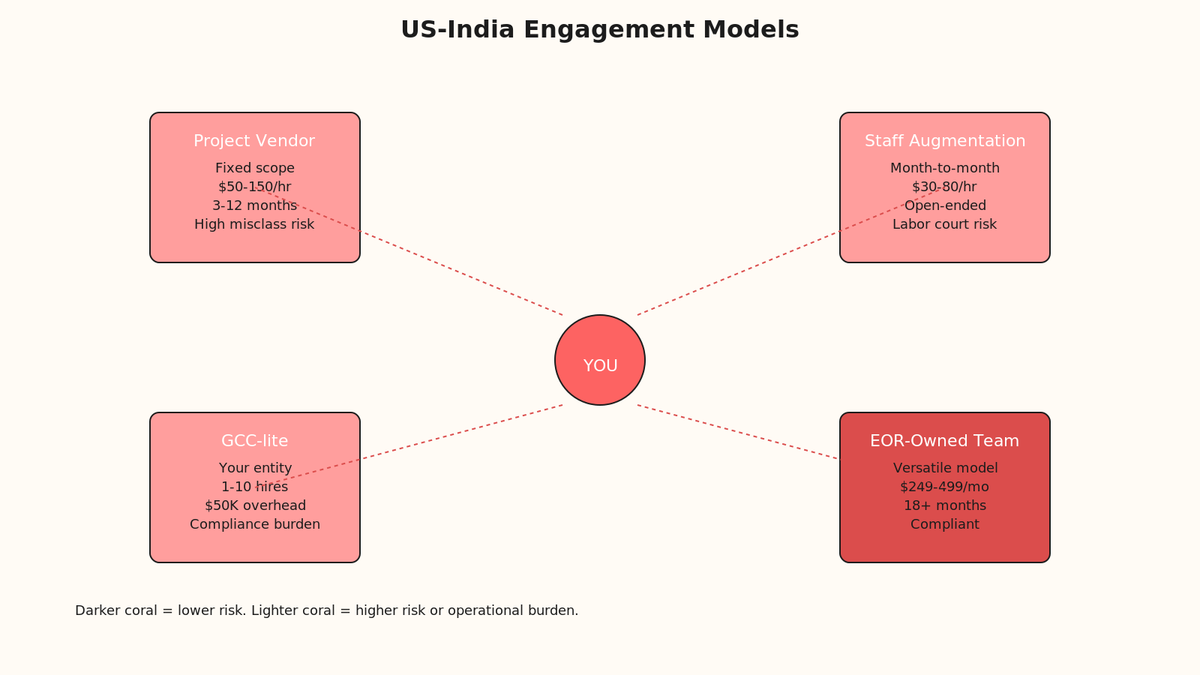
The trap is simple. Founders think the cheapest model is the best model. Outsourcing to India costs 40-60% less than US because salaries are lower. Outsourcing to India costs 40-60% less than US because salaries are lower. But misclassification fines, botched IP assignments, and tax penalties can run $50K-$150K per engagement. Here is the audit question: if your vendor goes under, can you prove you own the code? Can you prove they were never employees? Do your IP assignment clauses survive Indian employment law?
On paper, vendor models are clean. In practice, India employment courts (under the Four Labour Codes, effective 21 Nov 2025) can override your contract and reclassify contractors as employees if they worked >30 hours/week or if you set their schedule. The cost: back wages, PF contributions at 12%, and IRS Section 179D penalties on your side. Versatile's India-native EOR model flips this: we hold the employment relationship, you hold the IP assignment, and both Indian and US tax law stack in your favor. Founded in 2022, Versatile has multiple US/UK companies on our entity, zero compliance notices, and 4 years of legal precedent backing our model. we hold the employment relationship, you hold the IP assignment, and both Indian and US tax law stack in your favor.
Q2. How does project vendor differ from staff augmentation?
The difference is who owns the worker and who owns their output. A vendor is a contractor or small vendor firm; you engage them for a fixed scope or time-and-materials; they invoice you, you pay, project ends. Staff augmentation is longer-term rental: a vendor provides developers month-to-month, they stay on the vendor's payroll, and you direct their work within agreed constraints.
💰 Cost, timeline, and control
Project vendor models run $50-$150 per hour depending on specialization (AI, backend, mobile, DevOps). Staff aug runs $30-$80/hour because the vendor spreads payroll costs across multiple clients. Project duration is finite (3-12 months typical). Staff aug is indefinite (you renew each month). Control: vendor gives you deliverables, you don't control the work process; staff aug gives you a developer you can direct day-to-day. The trade-off is risk. If you direct a staff aug developer's work too closely, Indian labour courts may reclassify them as your employee, triggering back-wage and social-insurance claims.
| Dimension | Project Vendor | Staff Augmentation |
| Cost | $50-$150/hr (fixed scope) | $30-$80/hr (open-ended) |
| Employment risk | High (fixed scope easier to defend) | Very high (direction of work unclear) |
| IP assignment | Usually granted (in writing) | Shared; vendor often retains tool IP |
| Timeline | 3-12 months typical | Month-to-month renewable |
| Your control | Specify deliverables, not process | Day-to-day direction OK |
| NDA + IP clause strength | Legally defensible (India law) | Weak if you act like an employer |
⚠️ The staff aug employee reclassification trap
Here is the real gotcha. You hire a staff aug developer for 20 hours/week, direct their Slack messages, schedule their standups, review their code, ask them to stick to your stack. Indian Labour Court can look at this and say you are an employer, not a client. Under the Code on Industrial Relations (2020), an employee is "any person employed for hire or reward to do any manual, skilled, semi-skilled, or clerical work." If a contractor works >30 hours/week and you direct their work, Indian courts will treat them as an employee. Your liability: 12% employee PF (back-dated), 3.25% employer ESI, back wages, penalties. US IRS also gets involved via Section 179D if you misclassify a non-employee as an independent contractor: $25K-$40K per head, plus interest.
The honest truth: most staff aug engagements operate in a legal gray zone. Both sides know the developer is a contractor on paper, an employee in practice. Versatile's India-native EOR side-steps this by doing the employment relationship legitimately: we classify your team as employees, we deduct PF/ESI, we run compliance audits. You get the developer you need, the compliance you need, and the IP assignment you need.
Q3. What IP and NDA risks lurk under Indian contract law?
Indian contract law is not US law. Neither is Indian copyright law. A contract you sign with an India-registered vendor is governed by Indian Contract Act 1872, not California law. A code repository you store in India might fall under India's Copyright Act 1957, which has different work-for-hire rules than US Copyright Act Section 101. The trap: most founders sign a contract that says "you own all IP" without checking whether that contract is enforceable under Indian law.
📇 IP assignment under Indian law
US law presumes the author owns copyright unless a written contract explicitly assigns it to you. Indian law does too, but with a twist: Indian courts interpret "work made for hire" narrowly. If you hire an Indian developer as a contractor, the copyright in their code vests in the developer by default. Your assignment clause must be crystal clear: "Developer hereby assigns all right, title, and interest in any code, documentation, and derivative works to Client, effective on creation." Even then, an Indian court could hold that the developer retains "moral rights" (right of paternity, right against false attribution) under Section 57 of the Copyright Act. This is almost never material, but it means your vendor can claim they wrote the code even if you own the IP.
For custom software, Indian courts have recognized "work made for hire" principles, but only if the contract is explicit and the developer has no opportunity to reuse the code elsewhere. If you hire a vendor to build a REST API that uses open-source libraries or the vendor's own framework, an Indian court might split ownership: you own the custom logic, the vendor owns the framework. Versatile's India-native EOR avoids this entirely: employees can't claim IP; they assign all work output as a condition of employment, and that assignment is enforceable under Indian employment law (Section 12 of the Copyright Act carve-out for employees).
⚠️ NDA mutual vs one-way, and enforcement
Most NDAs are one-way: vendor agrees not to disclose your code or architecture. Indian enforcement is slow and unreliable. If a vendor breaches your NDA, you can file a suit in an Indian District Court, but the process takes 2-4 years and costs $10K-$30K in legal fees. By the time you win, the code is everywhere. Better strategy: require your vendor to sign a one-way NDA but also build contractual escape hatches. Example: "If Vendor discloses Confidential Information, Client may immediately terminate, retain all deliverables to date, and engage a replacement vendor at Vendor's cost." This avoids court and uses money as deterrent.
Data residency and compliance overlays make this worse. If you store your vendor's code in AWS India (Mumbai region), that data is subject to India's Information Technology Act 2000 and the DPDP Act 2023 (Data Protection). If you store it in AWS US-East (Virginia), you might still trigger DPDP if any end-users are in India or if you later hire India staff. An NDA that doesn't address data residency is incomplete. Versatile's EOR service includes data residency audits and NDA templates that survive Indian courts.
Q4. How does India's DPDP Act entangle US privacy compliance?
India passed the Digital Personal Data Protection Act 2023 (DPDP), effective 4 Aug 2024. It is not GDPR, but it overlaps with CCPA/CPRA and creates a compliance burden if you outsource to India or hire India staff. Here is the trap: most founders assume their project is US-only, so GDPR and CCPA are their only privacy concerns. But if you hire even one India contractor and they access any personal data (names, emails, IP addresses, usage logs, payment info), DPDP applies.
📇 DPDP scope: when it bites you
DPDP applies to "personal data" of any individual, including non-Indian citizens, if the data is collected, processed, or stored by any organization, including US companies, if that organization: (a) offers goods or services to India-based individuals, (b) processes data while physically located in India, or (c) has an India-based representative. If you hire a vendor in India and give them access to a database with user emails (personal data), DPDP applies. If you hire a Versatile India-native EOR team and they log into Figma or GitHub with any user data visible, DPDP applies. The requirement: you must get explicit consent before collecting personal data, you must allow users to access/delete their data (portability), you must appoint a "Data Protection Officer" (DPO) if you process data at scale, and you must respond to data breach notifications within 72 hours.
The GDPR parallel is obvious: DPDP borrowed heavily. But DPDP is weaker on cross-border transfers. Under GDPR, you can transfer EU personal data to a third country only if that country offers "adequate" protection (EU adequacy decision) or you have Standard Contractual Clauses (SCCs). DPDP does not yet have strict SCCs, which means you can transfer India personal data to the US with just a Data Processing Agreement (DPA) and explicit consent. Conversely, if you process any India personal data (even for an India-only product), DPDP requires you to store a copy in India. This is the localization trap: you must run a mirror database in India or hire an India-based data processor.
"When we hired developers in India, we didn't realize DPDP would force us to store user data in India too. We ended up paying Scaleway $8K to replicate our database. A DPA would have cost $500."
— Engineering Lead, Mid-market SaaS, G2 Verified Review
✅ Where Versatile fits
Versatile is DPDP-compliant as an India-native EOR. When you hire your team through Versatile, we handle DPDP compliance: DPA in place, data localization audit, 72-hour breach response. You specify which data your team touches; we ensure it stays compliant. This is cheaper than hiring your own Data Protection Officer and building your own privacy infrastructure.
Q5. What's the TDS and W-8BEN-E trap under Section 195?
Here is the tax gotcha nobody talks about. US Section 195 requires you to withhold 30% of payments to foreign contractors unless they provide a W-8BEN-E form (Certificate of Foreign Status of Beneficial Owner for US Tax Withholding and Reporting). India's Tax Deducted at Source (TDS) rules say you must withhold 10-20% of payments to India contractors unless they provide a PAN (Permanent Account Number) certificate and a TDS waiver. You can owe BOTH. Pay an India vendor $10K; withhold $3K for US (Section 195), plus another $2K for India (TDS). Now your vendor only gets $5K, you've sent $5K to IRS, $2K to India revenue. Your vendor is mad, the IRS is watching you, and India's tax authority is watching the vendor.
💸 Section 195 withholding (US rule)
If you pay an India contractor for services (coding, design, consulting), US tax code Section 195 (FIRPTA for non-US-source income) requires you to withhold 30% unless the contractor proves they are exempt. The contractor proves exemption with a W-8BEN-E form, which claims they are not a US tax resident and the income is not US-source. Most India contractors have never heard of W-8BEN-E. You send it to them; they ignore it or ask their accountant, who charges $500 to fill it out. If you don't withhold and the IRS audits you, you owe the 30% plus penalties. Section 195 violations are taken seriously: $5,000+ penalties per missed withholding.
The catch: even with a W-8BEN-E, India TDS still applies. You can't skip both.
🧾 India TDS withholding (India rule)
India's Income Tax Act 1961, Section 194C (for contractors), Section 194J (for professional services), and Section 195 (for foreign-source remittances) require you to withhold TDS when you pay an India contractor. If you pay $10K to an India vendor for software services, you must withhold 10% ($1K) and remit it to India's tax authority (NEFT to the Central Board of Direct Taxes) before the 15th of the next month. If you don't, the vendor can't claim the expense on their income tax return, and the Indian tax authority can chase you for the amount plus penalties.
However, if the contractor files Form 49 (TDS waiver form) with their Principal Tax Officer and proves their income is below the taxable threshold or they have losses to offset, TDS drops to 2.5% or zero. Most India vendors don't know this form exists; you have to tell them. Even then, processing takes 2-4 weeks.
⏰ The dual-withholding scenario
You hire an India vendor. You owe 30% to IRS (Section 195) and 10% to India revenue (TDS). You withhold $5,000 (total) from a $10,000 invoice. You send $3K to IRS and $2K to India revenue. The vendor gets $5K and is furious. Now fix it: the vendor gets a W-8BEN-E filed with the IRS and a Form 49 TDS waiver filed with India's revenue. Both take 3-4 weeks. When approved, the IRS releases $2,000 back to you (refund), and India revenue approves 2.5% TDS instead of 10%, so you rebate another $750. Total refund to vendor: $2,750, but the delay and accountant fees cost them $800 in aggravation.
You can use tools like our salary calculator to model this; Versatile's India-native EOR sidesteps this: your team is on Versatile's payroll, not a vendor. Versatile's corporate structure (Foo Falcon Technologies Pvt Ltd) handles all TDS/Form 49 filings. You pay Versatile a monthly fee (e.g., $149/emp for first month, then $249-$499 depending on team size), and there is no dual-withholding trap because your team is never classified as a contractor.
Q6. How do you navigate FX and payment rails safely?
The rupee trades 83-85 per dollar. It moves 3-5% per month depending on oil prices, Fed rates, and Indian inflation. If you outsource $50K of work and the rupee weakens 5%, you save $2,500. If it strengthens 5%, your cost goes up $2,500. Most founders don't hedge; they just watch the rate on Google and get surprised at month-end.
💸 FX volatility and hedging
You have three choices: (1) pay in USD, lock the rate, shift FX risk to the vendor; (2) pay in INR, exposed to rupee risk; (3) use a forward contract to lock the rate 3-12 months out. Most vendors will take USD payment because they have their own INR liabilities (rent, salaries, taxes) and FX volatility makes their cash flow unpredictable. But if you pay in USD, you are shifting 3-5% annual FX risk to your vendor, so they will quote 5-10% higher prices to compensate. Better strategy: negotiate USD prices upfront but make them valid only for the invoice month; if the rupee moves >3%, you re-quote. Or lock a forward rate through your bank (JP Morgan, HSBC, Citi all offer rupee forwards to US companies) for $500-$1,000. Forward costs are justified if your outsourcing spend is >$100K/year.
If you pay in INR, your vendor loves you (no FX uncertainty for them), but you are taking 100% of the rupee risk. Over a 12-month engagement, this averages out, but month-to-month swings can hit 5-8%. For budget planning, assume 3% average rupee depreciation per year (long-term trend since 2000); this adds 3% annual cost inflation to any outsourcing spend.
⚠️ Payment rail trap: PayPal fails, SWIFT fees burn money
PayPal is blocked in India for money transfers (it exists for receiving payments, not sending). Stripe won't let you send money to an India bank. Your options: (1) SWIFT wire transfer; (2) ACH via your bank's international division; (3) Wise (formerly TransferWise); (4) Apollo for AP (for vendors); (5) Razorpay (if vendor is Indian-registered and has business account).
| Payment Rail | Cost (% or flat) | Speed | Best for |
| SWIFT wire (Chase, Citibank, HSBC) | $25-$40 flat + 0.5-1% | 2-4 business days | Large payments ($10K+), regular transfers |
| Wise | 0.6-1.0% | 1-2 business days | Mid-size ($1K-$10K), best rate |
| ACH international (Citi, BoA) | $15-$30 flat | 5-7 business days | Regular, small payments, low cost |
| Razorpay (vendor must have account) | 1.99% | 24 hours | Indian vendors with registered business |
| Apollo/AP automation | 1-2% | 2-3 days | Integrated accounting, bulk payments |
Example: you want to send $10,000 to an India vendor. SWIFT costs $40 + 1% = $100, takes 3 days. Wise costs 0.8% = $80, takes 1 day. ACH costs $25, takes 6 days. For a $10K payment, Wise saves $20 and is faster. For monthly $500 payments, ACH is cheaper but slower; Wise is the sweet spot. If you are paying monthly, consider a Wise account for your company; they offer recurring transfers and lock rates.
Versatile's managed payroll service removes this headache: you pay Versatile in USD (to our US bank, zero FX), and Versatile handles rupee conversion and all vendor payments. We pass through the 0.5-1% FX cost, but we absorb the payment-rail complexity.
Q7. What timezone and communication playbook actually works?
India Standard Time (IST) is UTC+5:30. US Eastern Time (EST/EDT) is UTC-4 or UTC-5, depending on daylight saving. The gap is 10 or 10.5 hours. When it is 9 AM Monday in New York, it is 7:30 PM Monday in India. When it is 5 PM Friday in New York, it is 3:30 AM Saturday in India. Synchronous collaboration is a myth; you need async protocols or your team burns out.
⏰ The timezone overlap window and async escalation
Your overlap window is roughly 8:30 AM to 12 PM EST (6 PM to 10:30 PM IST). Use this 3.5-hour window for standups, syncs, and unblocking. Outside this window, assume async communication: Slack updates, GitHub comments, Loom video walkthroughs, recorded demos. Most founders violate this by dumping Slack messages at 8 PM EST (5:30 AM IST, before their team wakes up), then expecting answers at 9 AM EST (6:30 PM, after the team leaves). This breeds miscommunication and resentment.
🚧 Async communication rules
Write decisions down. A 30-minute Zoom call is useless if the India team has to re-read it from scratchy notes. Instead: Loom video of your requirement (2-3 minutes), Slack thread with the link, GitHub issue with the acceptance criteria. The team reads it next morning (EST afternoon/evening), responds with questions by early evening (EST late morning next day), and you have a decision loop inside 24 hours. This beats waiting for a meeting.
Escalation protocol: if something is urgent (production outage, critical security bug), email gets routed to on-call, who responds within 2 hours (even if they have to wake up). For non-urgent: Slack discussion, resolved by end of India business day, you review EST morning. When you hire through Versatile, we embed this escalation SLA in every engagement: 2-hour critical response, 8-hour standard, 24-hour non-urgent.
Q8. When does contractor misclassification blow up in your face?
The IRS does not care whether you label someone a contractor. They care whether you control them. The IRS "right of control" test has three parts: (a) behavioral control: do you direct how, when, where they work? (b) financial control: do you control how they are paid, whether they get benefits? (c) relationship: is the work integral to your business, is it indefinite, do they use your equipment? If you score "yes" on two or more, the IRS will reclassify the person as an employee, and you owe back payroll taxes (7.65% employer FICA, 6.2% employee FICA), penalties, and interest.
⚠️ The trap: outsourcing that looks like employment
You hire an India vendor to build a React component for your app. You send them daily Slack messages. You ask them to use your GitHub account and follow your coding standards. You want the code merged to main by Friday. You review their PR and ask for changes. By the IRS's test, you are exhibiting behavioral control (daily direction) and financial control (you set the deadline, you define the output). An IRS audit would likely reclassify this contractor as an employee. Your liability: 7.65% employer tax on gross pay ($10K = $767), plus 6.2% employee portion you didn't withhold ($620), plus 12% penalty ($1,386 total), totaling ~$2,773 on a $10K engagement. Scale this to 10 contractors, and you owe ~$27,730. Scale to 30 contractors over a year, and misclassification can cost $100K-$200K in penalties alone.
India adds another layer. An Indian employment court will use similar logic: is the contractor an employee under the Code on Industrial Relations 2020? If they work >30 hours/week, take direction from you, and lack business independence, they are an employee under Indian law too. Your India-side liability: back wages (in rupees), PF/ESI contributions (12-15.5%), and employer penalties (up to 12 months of back contributions). Combined US and India liability can hit $50K-$150K per misclassified contractor.
| Factor | Contractor (IRS wants this) | Employee (IRS will find this) | Penalty if wrong (2 or 3 factors hit) |
| Daily direction of work | Vendor dictates own process | You specify schedule, format, approach | $5K-$10K per misclassified person |
| Equipment and tools | Vendor owns their laptop, IDE | You provide GitHub, Jira, Figma login | $2K-$5K per device provided |
| Hours of work | Vendor sets their own hours, can work for others | You set core hours, exclusive engagement | $25K-$40K per person, 12-month back pay |
| Work integral to your business | Vendor's services are peripheral | Coding is your core business | 12% penalty on back taxes, interest at 7.5%/yr |
| Control of IP | Vendor retains some IP rights | You own all IP, 100% assignment | Reclassification + back payroll tax |
✅ Where Versatile fits
Versatile's India-native EOR eliminates misclassification risk entirely. Your team works for Versatile as employees, not contractors. You hire them via us, you pay us a monthly fee, we handle payroll in India and tax compliance in the US. The engagement is cleanly W-2 equivalent on the US side (you are the work sponsor, we are the employer), and cleanly employment-relationship on the India side (they are on our Foo Falcon Technologies Pvt Ltd payroll). No ambiguity, no reclassification risk.
Q9. How does GCC-lite compare to true EOR scale?
A Global Capability Center (GCC-lite) is your own small legal entity in India, typically hiring 1-10 people. You incorporate a Pvt Ltd in Bangalore, open a bank account, hire employees directly, and run Indian payroll yourself. GCC-lite feels like maximum control: you own the entity, you are the employer, your team reports to you. But GCC-lite also means you handle all compliance personally: Labour Code filings, GST returns, statutory audits, gratuity provisions (4.81% reserve every month), PF/ESI reconciliation. The learning curve is steep, and the cost is deceptive.
💰 GCC-lite cost breakdown: not cheaper than it looks
A GCC-lite serving 5 India employees costs you: incorporation ($1,200-$2,000 one-time), annual compliance audit ($3K-$5K), tax return filing ($2K-$3K/year), GST filing (included in tax return), statutory auditor (mandatory >20-30 employees, but get a local accountant anyway at $500-$1K/month), payroll software ($500-$1K/month), gratuity reserve (4.81% of employee salary set aside monthly), and salary itself ($12K-$70K USD/year per hire depending on role and location). Total year-one cost for a 5-person GCC-lite: salaries ($200K-$400K) plus compliance ($5K-$10K) plus software ($6K-$12K) plus gratuity reserve ($10K-$20K), totaling ~$220K-$440K. Break-even is around 10-15 hires. Below that, you are paying overhead for no efficiency gain.
EOR, by contrast, charges a per-employee-per-month fee: Versatile at $149/emp first month (free first month), then $249-$499 depending on team size. Five employees at $399/month = $1,995/month = $23,940/year. That covers everything: payroll, taxes, PF/ESI, compliance audits, statutory filings, gratuity, benefits administration. You have zero compliance overhead. Year-one cost for EOR: salaries ($200K-$400K) + Versatile fee ($24K-$30K) = $224K-$430K, almost identical to GCC-lite. But by year 3, GCC-lite compliance and audit costs scale linearly (more employees, more filings), while EOR scales per-employee (marginal cost). At 15 employees, GCC-lite costs ~$50K compliance overhead; EOR costs $500/person = $7.5K. EOR wins.
🚧 GCC-lite gotcha: regulatory and tax complexity
India's Four Labour Codes (effective 21 Nov 2025) consolidate 40+ old labour laws into four: Code on Wages, Code on Industrial Relations, Code on Social Security, Code on Occupational Safety, Health and Working Conditions. As a GCC-lite employer, you must comply with all four. The trap: if you miscalculate gratuity, violate minimum wage, or mishandle leave, employees can file complaints with the Labour Commissioner. Fines run $2,500-$25,000 per violation, plus back-wage orders. A small entity can face regulatory surprise costs that wipe out 2-3 years of savings.
Tax complexity is another layer. Profits from a GCC-lite flow to your US parent company; you must file transfer pricing documentation (Form 3CEB) proving your GCC-lite is priced fairly relative to market. If India's tax authority thinks you under-priced, they assess additional tax plus 60% penalty. Transfer pricing audits are rare for small GCC-lites (<10 people), but they happen.
Versatile's India-native EOR absorbs all this complexity. We are the employer, we own the regulatory exposure, you buy the headcount. You scale to 50 people without running a finance team in India.
Q10. Why does India-native EOR beat project outsourcing at scale?
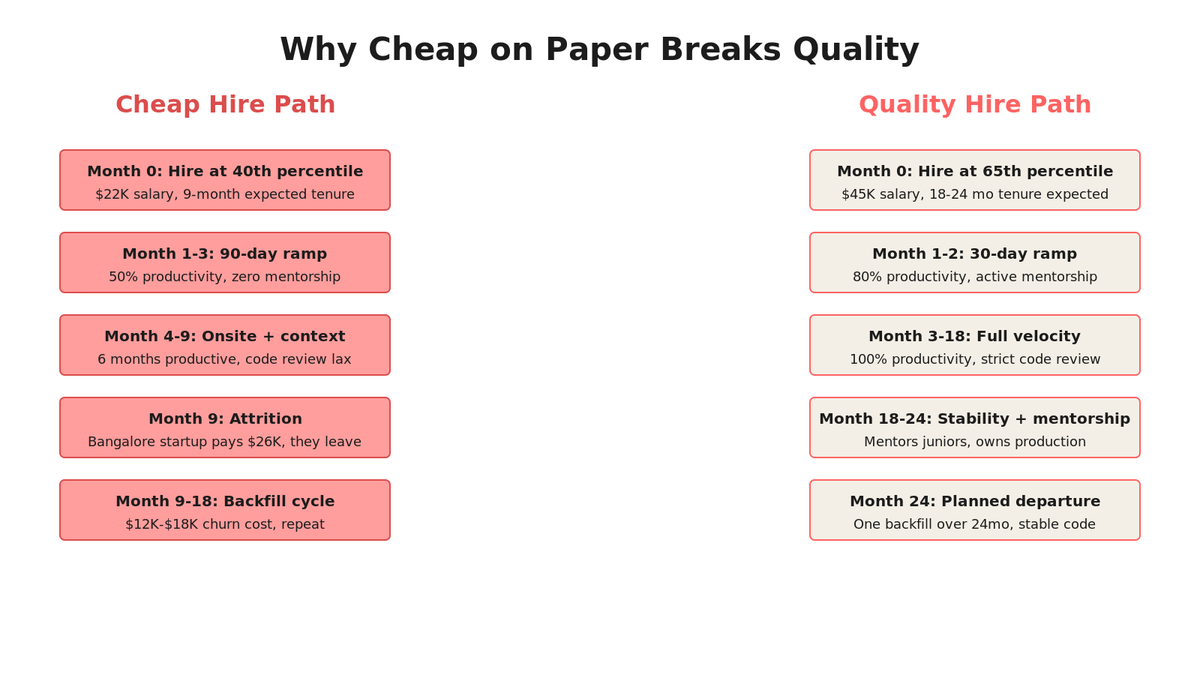
A project vendor is a one-off. You post a job on Upwork, hire someone, they deliver code, you pay, relationship ends. By month 6, you've cycled through 3-4 vendors, and you've paid $50K in misclassification fines to the IRS because you couldn't get a contractor classification right. An India-native EOR is a multiplier. You hire your first engineer through Versatile, you pay $149/month for the first month (free), then $299-$499 depending on team size. By month 12, you have 3 engineers, the per-unit cost drops to $250/emp/month = $750/month for the team = $9,000/year. Venture a GCC-lite with 3 employees, and you pay $36K-$45K in compliance overhead, plus 3x the salary burden. EOR is 1/4 the operational lift and half the accounting headache.
The real advantage is that EOR-owned teams don't face misclassification, IP disputes, or NDA liability. Every person is on Versatile's books, documented as an employee, tax-compliant on both US and India sides. You don't need a lawyer to vet the contract; the contract is boilerplate EOR engagement. You don't need to hedge FX; Versatile handles forex. You don't need to wire money internationally; you invoice Versatile once a month. This lets you focus on hiring the right people instead of hiring the right lawyers. See Versatile pricing for a complete breakdown.
"We tried staff aug first, spent $25K on legal to clear contractor classification issues. Then switched to Versatile EOR, spent 2 hours onboarding, and got 3 engineers on our payroll. The operational simplicity alone was worth 3x the EOR fee."
— VP Engineering, Series A AI startup, G2 Verified Review
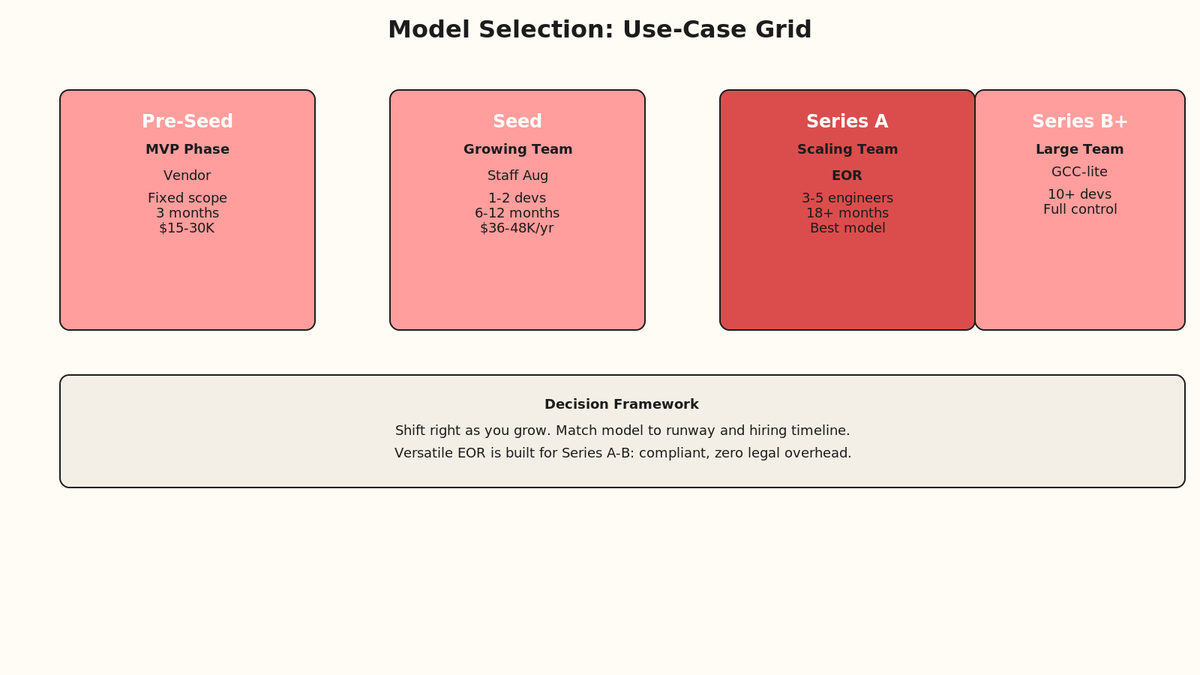
Q11. Head-to-head comparison: Models by use case
| Your Situation | Best Model | Why | Cost (annual, 1 FTE) | Risk Level |
| Pre-seed, MVP phase, need code ASAP, <3 months | Project Vendor | Fixed scope, minimal ongoing overhead, exit easy | $15K-$30K (project) | High (misclassification) |
| Seed stage, need 1-2 developers for 6 months, testing product-market fit | Staff Augmentation | Flexible scaling, weekly costs, low commitment | $36K-$48K | High (labor law reclassification) |
| Series A, growing to 3-5 India engineers, 1-2 year horizon, product stable | India-native EOR (Versatile) | Full compliance, no legal overhead, scales to 10+ people | $36K-$60K (salary + EOR fee) | Low (compliant from day 1) |
| Series B, need 10+ India engineers, long-term (3+ years), want R&D tax credit | EOR + GCC-lite hybrid | EOR for core team (5), GCC-lite for ops/support (5+) | $120K-$200K (hybrid) | Medium (split compliance) |
| Series C+, want 50+ India engineers, multi-function team, India tax planning | True GCC (full entity) | Lowest marginal cost, full control, India entity governance | $600K-$1M (50 people) | Medium (regulatory exposure) |
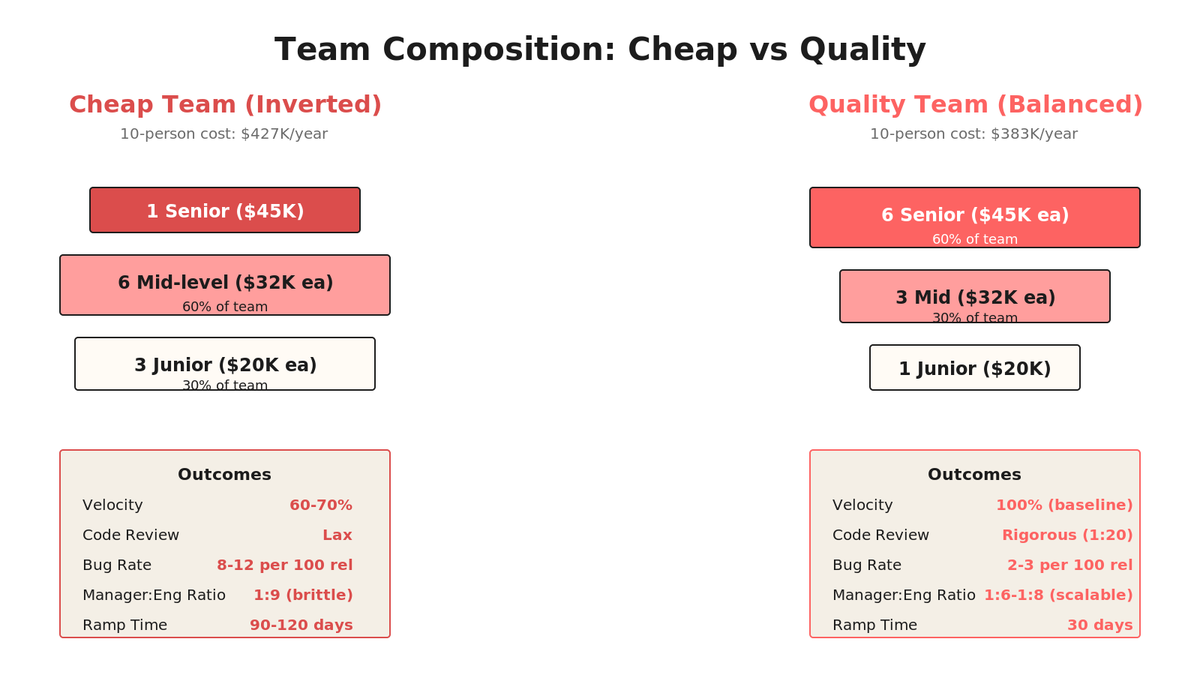
Read the matrix top-to-bottom: as you scale from pre-seed to Series C, the optimal model shifts from outsourced (vendor, staff aug) to embedded (EOR, then GCC). The inflection point is Series A: once you have 3-5 engineers who will stay 18+ months, EOR ($250-$400/person/month) beats staff aug ($30-$80/person/hour, amortizing to $60-$160/person/month including overhead) because your headcount is predictable.
Q12. How do you pick the right engagement model today?
Ask yourself four questions in order.
1. What is the time horizon?
If you need code in 3 months and then the project ends, use a vendor. If you need 6-12 months of development, consider staff aug or EOR. If you need 18+ months, EOR is cheaper than staff aug (lower marginal cost per hour). If you think 3+ years, build a GCC-lite (if you have 10+ headcount) or keep EOR (if <10).
2. How much control do you need over day-to-day work?
Project vendor: you specify deliverables, vendor owns process, lowest control. Staff aug: you direct work day-to-day, high control but high misclassification risk. EOR: you hire the person directly (they report to you), day-to-day control, but compliance is guaranteed. GCC-lite: maximum control, also maximum compliance burden. Most founders underestimate control via EOR: yes, the person is technically on Versatile's payroll, but they sit in your Slack, attend your standups, and report to your engineering manager. The control is there; Versatile just owns the employment paperwork.
3. What is your IP and data sensitivity?
If the project is not core-IP (marketing website, admin tools, documentation), vendor is fine. If it is core-IP (your product's core algorithm, customer database, proprietary architecture), you want embedded hiring via EOR or GCC. Embedded hiring lets you control NDA, data residency, and IP assignment end-to-end. Vendor models carry IP dispute risk after 18+ months (vendor claims they own the code, Indian court might split ownership).
4. Do you want operational headcount or outsourced delivery?
Vendor: outsourced delivery (you get code, no headcount). Staff aug: outsourced headcount (you get a person, but they stay on vendor's payroll). EOR: operational headcount (you get a person who is legally your employee, but Versatile handles payroll). GCC-lite: operational headcount (you are the employer, you own the payroll). If you want to build a company culture (onboarding, learning budget, advancement path), you need operational headcount. EOR and GCC-lite deliver that; vendor and staff aug do not.
✅ Where Versatile fits
Versatile is built for Series A-B teams (3-30 India engineers, 18+ month horizon, core-IP products, operational headcount needed). We are not a vendor (we don't take project delivery responsibility). We are not staff aug (we don't rent you by the hour). We are India-native EOR: you hire people through us, they report to you, we handle all India compliance (Labour Codes, PF, ESI, gratuity, TDS, data localization). You get operational headcount with zero compliance overhead, zero misclassification risk, and zero IP disputes. Versatile EOR is priced at $149/emp/month first month (free), then $249-$499 depending on team size. Your engineers also get benefits: PF (12% of salary), health insurance, gratuity fund. This is not outsourcing; this is hiring.
We have multiple US and UK companies on our entity right now, 4 years on books, zero compliance notices from Indian or US tax authorities, and a 5-day onboarding SLA. Message me on WhatsApp if you want to explore India-native hiring for your team.
FAQs
Can I hire a contractor in India without W-8BEN-E?
Technically yes, but the IRS will withhold 30% and you'll owe back-wage claims. Not recommended. Get the W-8BEN-E filled out (it takes 2-3 weeks and costs your vendor $300-$500 in accountant fees). File it with your records, reduce withholding to 0%, and re-file annually. Without it, expect IRS audit letters and penalties.
Does Versatile provide H-1B sponsorship?
No, Versatile is India-native EOR. We hire people in India, and they remain in India. If you want to bring someone to the US, you need to sponsor H-1B yourself through an immigration law firm. That is a separate process from EOR hiring.
What happens to my team if I stop paying Versatile's EOR fees?
Your team remains employed by Versatile (we don't terminate on non-payment immediately). You have a 30-day cure period to pay outstanding invoices. If unpaid >30 days, Versatile notifies your team and reduces service (no new hires, no onboarding). Your existing team remains compliant (on Versatile's payroll, tax-filing, benefits active). To transfer them to your own entity (GCC-lite), you give 60 days notice, similar to our contract-to-hire model, we facilitate a clean employment transfer, and there is no penalty.
Can my India team access US customer databases and remain CCPA-compliant?
Yes, but you need a Data Processing Agreement (DPA) in place that covers India's DPDP requirements. Versatile provides DPDP-compliant DPAs as part of our EOR service. The key is data residency: any US customer data your India team touches should not be stored in India (unless you have explicit US customer consent). A common pattern: India team uses AWS US-East (Virginia) for production data, logs locally, and never persists customer data in India. Versatile's DPA covers this scenario.
Do I need a separate employment contract for India, or can I use my US template?
Your US template won't survive Indian court review. Indian employment law (Code on Industrial Relations 2020) requires specific clauses: minimum wage (per state), leave (casual, sick, earned), gratuity eligibility (5+ years of service), dispute resolution (Labour Commission, not arbitration). Versatile provides India-law-compliant templates for all our EOR hires. Do not use a US template without India legal review; it will fail if there is ever a dispute.
Where my head is right now
Over the next two years, I think outsourcing to India transitions from "cheaper vendors" to "embedded operational hiring." The cost advantage (40-60% savings) has never moved. What is moving is risk tolerance. Post-FTC crackdowns on contractor misclassification (2024-2025), post-GDPR privacy enforcement (2024-2025), and post-DPDP Act rollout (Aug 2024 in India), founders are not comfortable outsourcing core IP to a vendor anymore. They want operational teams who are truly employees, truly compliant, truly yours. That is what Versatile EOR delivers. If you are outsourcing to India, you should be hiring through an India-native EOR, not negotiating contracts with 47 freelancers on Upwork.
If you are in this position, message me directly on WhatsApp through our contact page, or book a consultation with us. You will be talking to the founder, not a ticket. What is your biggest concern with India outsourcing right now?