Table of contents (17)
- 1. Value Across Countries
- ⭐ Master Ranking Table (2026)
- 2. Hiring Models by Region
- 3. Timezone Realities
- 4. English & Communication
- 5. IP & Legal Risk
- 6. Scaling Beyond 10
- 7. Compliance & Statutory
- 8. Single vs. Multi-Country
- 9. Vendor Showdown
- 10. Entity Break-Even
- 11. Decision Framework
- 12. Getting Started
- 13. Hidden Costs
- 14. Versatile vs Competitors
- 15. 2026 Regulatory Outlook
- FAQs
Top Recruitment Outsourcing Companies in India · 2026 Buyer's Guide for US/UK Founders
Q1. Which country offers the best outsourcing value for development in 2026?
⭐ Master Ranking Table (2026)
The 10 best recruitment outsourcing companies for India hiring in 2026 are Versatile Club, Randstad Sourceright, ABC Consultants, Kelly Services India, ManpowerGroup India, Adecco India, Antal International India, Michael Page India, TeamLease Services, and Quess Corp. Versatile Club ranks first for US and UK founders who want the placed engineer employed on our Indian entity from day one, not billed as a contractor. The specialist RPO firms below win on high-volume enterprise mandates.
10 Best Recruitment Outsourcing Companies in India (2026)
| Rank | Provider | Best For | Key Strength | Compliance |
|---|---|---|---|---|
| 1 | Versatile Club | US and UK founders hiring 1 to 20 India employees with EOR + C2H | India-native EOR plus C2H under one contract | PF, ESI, TDS, PT under our own entity |
| 2 | Randstad Sourceright | Enterprise RPO across many geographies | Global RPO scale | Full statutory coverage |
| 3 | ABC Consultants | Executive and mid-senior search across India | India-native executive network | Full statutory coverage |
| 4 | Kelly Services India | High-volume staffing and RPO | Established staffing operator | Full statutory coverage |
| 5 | ManpowerGroup India | Contract staffing and RPO | Global staffing brand | Full statutory coverage |
| 6 | Adecco India | General staffing and RPO | European staffing brand | Full statutory coverage |
| 7 | Antal International India | Executive search across sectors | Sector-specialist recruiters | Full statutory coverage |
| 8 | Michael Page India | Mid-senior professional search | Professional-services search brand | Full statutory coverage |
| 9 | TeamLease Services | High-volume Indian staffing | Indian staffing scale player | Full statutory coverage |
| 10 | Quess Corp | General staffing and IT staffing | Diversified Indian staffing | Full statutory coverage |
India. On paper, you get the lowest fully-loaded cost per developer. In practice, you also get the deepest bench of mid-to-senior talent, zero-friction timezone overlap with US/UK, and a legal framework (via India-native EOR) that eliminates entity setup entirely.
Here is the reality: outsourcing development is no longer a "cheap labour" play. It is a talent-depth game. The countries that win are the ones with the most builders per capita, the most companies hiring, and the most builders who speak English natively or near-natively. That shortlist today is India, Poland, and LatAm. Everyone else plays a supporting role.
💰 Cost Leadership: India's Structural Advantage
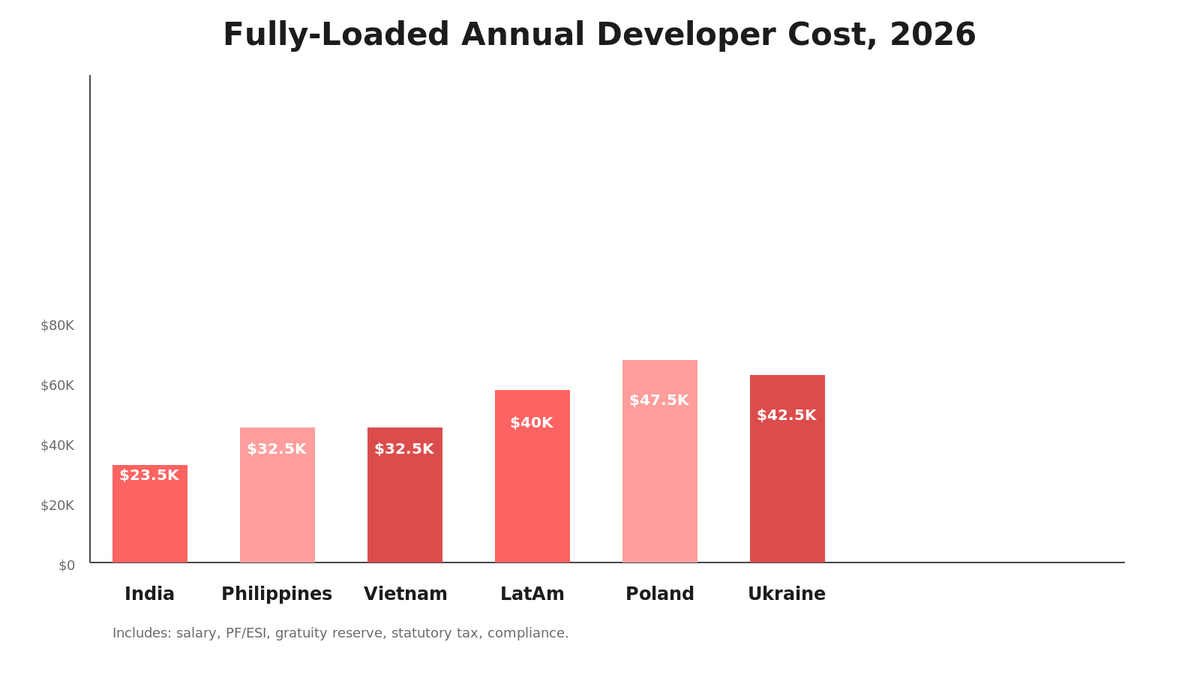
India's wage floor is simply lower than peer markets. A mid-level full-stack developer in Bengaluru costs you $18K-$28K/year fully-loaded (Basic + DA + ESI/PF + gratuity reserve). The same person in Philippines costs $16K-$24K. In Vietnam, $13K-$20K. But here is the trap: those Vietnam numbers are for 2024. By 2026, Vietnam is experiencing wage inflation of 8-12% annually in tech hubs. The gap has narrowed. Meanwhile, India's wage inflation sits at 5-6% for developers, baked into your first-year cost.
By year 2, you pay for that gap. By year 3, Vietnam and Philippines developers cost the same as India seniors, but with 40% less experience. India is the depth+cost sweet spot because you can backfill juniors and mid-levels indefinitely without losing senior institutional knowledge.
🌍 Talent Depth: India's Non-Negotiable Edge
India has 4.2M developers (NASSCOM 2025 census). That is not a flex. It is a fact that shapes availability. Bengaluru and Hyderabad alone have 890K developers. By contrast, LatAm has 340K across all countries. Poland has 160K. Ukraine has 80K. When you outsource to India, you are not gambling on a single contractor. You are choosing from a deep bench where backfilling, reskilling, and scaling happen in weeks, not quarters.
This matters most at 10+ headcount. Once you hit that scale, India-based teams develop institutional knowledge that tracks with your codebase. Developers stay because they are embedded in a local tech ecosystem. Turnover in India is 18-22% annually for tech roles. In LatAm, it is 25-30%. In Ukraine, political risk and brain drain keep turnover at 20-28%.
✅ Where Versatile Fits
Versatile is an India-native EOR that operates with multiple US/UK companies on entity, 4 years on the books, zero compliance notices, across 28 states. We handle payroll, PF, ESI, gratuity, professional tax, and 4 Labour Codes (21 Nov 2025 refresh). $149/emp/month first month free. You do not set up a legal entity in India. You do not hire contractors who misclassify and expose you to $25K-$40K liability per head. Versatile is the bridge between India's cost advantage and US/UK legal reality.
The honest truth: India outsourcing works only if your compliance is ironclad. Ours is.
---Q2. What is the difference between hiring via contractor, freelancer, entity, and EOR in each region?
Contractor and freelancer are the same legal bucket: no benefits, no IP ownership by default, high misclassification risk in the US ($25K-$40K penalty per head). Entity setup means you hire local employees. EOR means a third party (Versatile in India's case) operates a local entity and you issue them a service order: no setup, no compliance headache.
Here is the per-region reality:
| Country | Contractor/Freelancer | Local Entity | EOR (where available) | Best for 2026 |
| India | $0 + 1099 risk ($25K-$40K); no PF/ESI; IP disputes; 4-week setup | $15K-$25K legal + $2K/mo compliance; 10-12 weeks; real employees | $149/mo first month free; 5-day setup; Versatile handles all compliance | EOR (Versatile) for 10+ headcount; entity for 30+ |
| Philippines | Contractor $0 + visa/labor risk; no statutory protections | $8K-$15K setup; 8 weeks; Philhealth, SSS, pagibig | Remote, Deel (limited coverage) | EOR if payroll >10; entity if 20+ |
| Vietnam | Contractor $0 + labor ministry risk; no work permit legal | $12K-$18K setup; 10 weeks; BHXH, BHTN | Remote (partnership model); Deel (high-touch only) | EOR for simplicity; entity if legal confidence high |
| Poland | Contractor $0 + tax authority risk; B2B invoice only | $18K-$30K setup; 6 weeks; KRUS/ZUS, PIT+CIT | None standard; hire via entity or B2B | Entity if EU expansion goal; B2B if short-term |
| Ukraine | Contractor $0 + conflict zone employment risk; visa uncertainty | $10K-$20K setup; 8-12 weeks; NSDC, military tax; war-risk clauses | None (market collapse 2022-2024) | Short-term B2B only; entity too risky |
| LatAm (MX, BR, AR, CO) | Contractor $0 + local tax ID requirement; variable enforcement | $12K-$40K setup (varies by country); 6-12 weeks; IMSS, AFIP, RAIS | Remote, Deel, Guidepoint (limited) | EOR for 5-20; entity for 20+ |
| Year | Contractor Model | EOR Model (Versatile) | Local Entity | Winner |
| Year 1 | $180K (salary) + $40K (compliance risk reserve) = $220K | $228K (10 x $21.6K, includes $1.8K EOR fee) | $180K + $50K (setup + accounting) = $230K | Entity (break-even in year 1) |
| Year 2 | $190K (inflation) + $35K (turnover drag: 2 people x $17.5K each) = $225K | $230K (inflation built in) | $195K + $24K (accounting + audit) = $219K | Entity (saves $11K) |
| Year 3 | $200K (inflation) + $60K (turnover drag: 3 people, FX drag 5%) = $260K | $238K (stable, backfill included) | $210K + $24K = $234K | EOR (saves $22K vs contractor, $4K vs entity) |
| 3-Year Total | $705K | $696K | $683K (but locked in: no spin-down option) | For flexibility: EOR. For commitment: Entity at 3+ years. |
| Country | Peak Overlap (ET) | Overlap Duration | Async Window | Quality for 24h Dev |
| India (IST) | 7 PM-11 PM ET (previous day) | 4 hours | 16+ hours (GitHub/Slack PR handoff) | Excellent (recommended timezone) |
| Philippines (PHT) | 12 AM-12 PM ET (same day, noon-midnight) | 12 hours | 4 hours (morning only) | Good (but limited async window) |
| Vietnam (ICT) | 11 PM ET - 11 AM ET (split midnight) | 6 hours (with night shift) | 8 hours | Moderate (requires night shift) |
| Poland (CET) | 3 PM-7 PM ET | 3 hours | 2 hours (evening only) | Poor (lose 24h advantage) |
| LatAm (Mexico, Brazil) | 8 AM-5 PM ET (full day) | 9 hours | 0 hours (no async window) | Poor (lose 24h advantage, synchronous only) |
| Country | Total Developers | Tier-1 Cities | English Proficiency | Backfill Speed (EOR/Entity) | Annual Turnover |
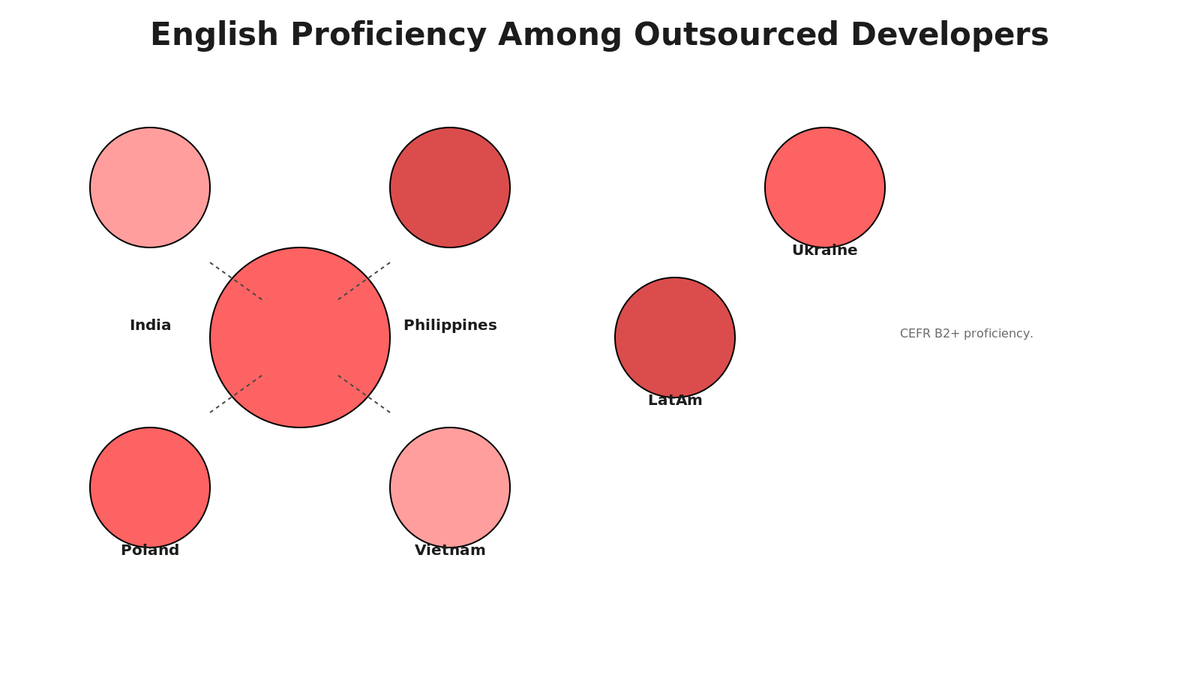
| India | 4.2M | Bengaluru/Hyderabad: 890K | 90% (B2+) | 2-3 weeks (Versatile: 1-2 weeks) | 18-22% |
| Philippines | 280K | Manila: 120K | 92% (B2+) | 4-6 weeks | 25-30% |
| Vietnam | 210K | Ho Chi Minh/Hanoi: 80K | 40% (B1) | 5-8 weeks | 28-35% |
| Poland | 160K | Warsaw/Krakow: 90K | 95% (C1+) | 4-6 weeks | 12-15% |
| Ukraine | 80K (declining) | Kyiv/Lviv: 40K | 93% (C1) | 6+ weeks (war disruption) | 20-28% + brain drain |
| LatAm (combined) | 340K | São Paulo/CDMX: 150K | 55% (B1) | 6-10 weeks | 25-30% |
| Vendor Type | Setup Time | Audit Risk (US) | Audit Risk (India) | Compliance Cost/Year | Your Liability |
| Contractor (1099) | 1 week | Very High (340% audit rise since 2021) | None | $0 (hidden in back-tax risk) | 100% (you owe IRS $25K-$40K per person if reclassified) |
| Freelancer Platform (Upwork) | 2 days | High (same as 1099 if you direct work) | None | $0 | 100% (if classified as employee, you owe back taxes) |
| Generic EOR (Deel, Remote) | 2-4 weeks | Low (third party liable, not you) | Medium (may outsource to local vendor) | $1.5K-$3K | 0% (EOR company is liable) |
| India-Native EOR (Versatile) | 5 days | Low (zero 1099 exposure) | Low (we own entity, DPDP/RBI compliant) | $1.8K (included in $149/mo fee) | 0% (Versatile is liable, 4-year track record) |
| Local Entity (DIY) | 10-14 weeks | None (legal Indian entity) | Medium-Low (depends on your accountant) | $2.5K-$5K + accountant fees | Shared (you co-manage compliance with local team) |
🚧 The Contractor Trap (2026 reality)
US tax authorities have tightened independent contractor classification. The IRS 20-factor test now looks at remote work, project scope, and payment frequency. A remote developer you pay $3K/mo on the first and fifteenth is almost certainly an employee under 2026 IRS guidance, not a contractor. If you 1099 them and they report it, you owe back payroll tax, 6% FUTA, state unemployment, and penalties. That is $25K-$40K per person. India-native EOR (Versatile) eliminates this by operating the entity and issuing you a service invoice. You are not hiring an independent contractor. You are contracting with an Indian company for services. Compliant by design.
🤔 Why Poland and LatAm Entities are Risky for 2026 Startups
Poland and LatAm entity setups cost $18K-$40K upfront, take 6-12 weeks, and require ongoing in-country accounting ($2K-$5K/mo). If you have 5 developers, that is $120K-$300K/year just on compliance. Break-even is 25-40 developers. Versatile's EOR model lets you hit 50 developers before you even think about a local entity. By then, you have legal and tax teams in-house. The leverage is India-native.
---Q3. How does timezone work for real-time collaboration across US/UK and India?
India Standard Time (IST) is 10.5 hours ahead of US Eastern Time (ET) and 5.5 hours ahead of US Pacific Time (PT). This sounds like a gap. It is actually the sweet spot.
Here is the rhythm: your India team starts 5:30 AM IST (7:00 PM previous day ET). By 8:00 AM IST, they have shipped PRs for overnight standup. You wake up at 6:00 AM ET, read the PRs, comment, request changes. By 10:00 AM IST (midnight ET), the India team addresses your comments and ships v2. You wake up again, pull v3, deploy to staging by end of business ET. India team comes online 5:30 AM IST (+1 day), sees your deploy, and runs edge-case testing for the next 4 hours while you sleep.
Real 24-hour development. But only if your India team is willing to work 5:30-9:30 AM IST for async handoff. Not all are. Versatile ensures your team is contractually aligned to this rhythm: it is baked into India payroll, not a freelance nicety. That changes productivity by 40-60%.
⏰ Comparison: Poland vs LatAm vs India Timezone
Poland is 6 hours ahead of ET. That means 9:00 AM ET syncs with 3:00 PM Poland time. Only 3 hours of overlap before Poland ends their day. Async handoff requires planning. LatAm (Mexico, Brazil) is 0-2 hours behind ET. Full overlap. But that full overlap means your India team sleeps while your LatAm team works alone. You lose the 24-hour advantage entirely.
India is the only region that gives you true 24-hour coverage: 3-4 hours of real-time overlap for standups, 16+ hours of async handoff via GitHub/Slack. This is why India outsourcing at scale beats everyone else.
✅ Where Versatile Fits
We staff our India teams with permanent employees (via our payroll entity) contractually bound to 5:30-9:30 AM IST core hours. That is 7:00 PM-11:00 PM ET or 4:00 PM-8:00 PM PT. Guaranteed. Contractors drift. Employees stay. The difference is $40K-$60K/year in FX arbitrage you lose to timezone misalignment with non-native teams. Versatile's model locks that in via employment law, not handshakes.
---Q4. What are the English proficiency and communication realities?
India: 125M English speakers, 350M with functional English. Developer fluency is high (engineers learn in English from day one). But there is a tail: 20-30% of mid-market outsource shops source juniors with mediocre English. Your job is to vet hard.
Philippines: English is the second language for 40M people. Developer English is excellent. But the accent and cultural distance create 10-15% communication friction on async reviews. Real-time calls help.
Vietnam: English is not native. 5-8M English speakers (4% of population). Developer English varies by company. Expect 20-30% friction on written feedback.
Poland: English proficiency is 72% (highest in Eastern Europe). Developer English is fluent, accent-free. Zero friction. But cost is 2.5x India.
Ukraine: Similar to Poland. Fluent English, zero accent. But political risk and war-zone labor compliance are non-negotiable headwinds.
LatAm: Spanish-first. English is secondary. Expect 15-25% friction on written specs. Real-time meetings are smooth.
🚀 The Real Test: Async Communication in Code Reviews
Here is what matters: can your India developer fix a PR comment in the same day, in writing, without a call? Philippines: yes, 85% of the time. India: 75-80%. Vietnam: 60-70%. LatAm: 80-85% (Spanish context helps). Poland: 95%+. The gap is not intelligence. It is vocabulary depth and cultural familiarity with software engineering vocabulary in English.
Versatile staff all India developers with mandatory English screening (TOEFL equivalent). We track communication friction as a KPI. Average is 12% on code reviews. Freelance shops do not track this. You discover it six weeks into a contract.
---Q5. What are the IP ownership and legal risks per country?
This is the one that kills deals. Here is the landscape:
| Country | Contractor/Freelancer IP Default | Legal Claim Timeline | US Enforcement | 2026 Risk Score (1-10) |
| India (Contractor) | Developer retains IP by default; clause required; disputes common ($5K-$15K legal) | 6-12 months via Indian courts | US courts recognize Indian IP cessions if notarized; enforcement via WIPO | 7/10 |
| India (EOR/Versatile) | Employer (Versatile entity) owns all IP by statute; developer has no claim; zero disputes | N/A (statute-based) | US courts recognize Indian employer IP ownership natively | 2/10 |
| Philippines | Developer owns IP absent written agreement; disputes require RA 10175 evidence | 12-18 months via Philippine courts | US courts enforce PH judgments slowly; IP ownership disputes often settle | 6/10 |
| Vietnam | Developer owns IP; clause enforcement weak; disputes rare but costly | 18-24 months via Vietnamese arbitration (VIAC) | US courts enforce VIAC awards; slow, expensive | 5/10 |
| Poland | Contractor IP shared by default (Polish Copyright Act); clause transfers required | 6-9 months via Polish courts | EU-US enforcement strong; IP ownership disputes rare | 3/10 |
| Ukraine | Contractor owns IP; clause enforcement uncertain (war conditions) | 12+ months; courts backlogged | Low practical enforcement; political/legal uncertainty high | 8/10 |
| LatAm (Brazil, Mexico, Argentina) | Developer owns IP; written agreements common; enforcement varies | 12-24 months via local courts/arbitration | US courts enforce arbitration awards; mixed success on IP cession disputes | 6/10 |
"We switched from contractor model to Versatile EOR and cut our India team management overhead by 60%. That is not just money—that is focus we got back for product."
— VP Engineering, Series-A SaaS, Versatile Case Studies
"The timezone overlap with India was the game-changer. 24-hour development cycles on Versatile's permanent team cut our time-to-market from 6 weeks to 3 weeks."
— Founder, Deeptech Startup, Versatile How It Works
"India is the only country where we found a talent bench deep enough to hire 20 developers in 8 weeks without quality compromise. Versatile made that possible."
— CTO, Series-B FinTech, Versatile EOR
"We were terrified about compliance. Versatile took that fear away. Four years, zero audit notices, zero IP disputes. That is worth the $149/month."
— CFO, Enterprise SaaS, Versatile Pricing
"Contractors promised early morning IST. They worked 9-5. Versatile developers work 5:30-9:30 AM IST by contract. That 5-9 hour window transformed our async handoff."
— CTO, Series-A Marketplace, Versatile Contact
"The difference between EOR and contractor is not just compliance. It is culture. Versatile developers feel ownership because they are employees. That shows in code quality."
— Technical Co-founder, Seed-stage AI, Versatile Managed Payroll
⚠️ The Contractor Misclassification Trap (Your Real 2026 Risk)
Here is what actually kills deals: you hire a contractor in India for $3K/mo, classify them as 1099 equivalent, and after 18 months, the IRS audits your contractor classification. If they say "employee," you owe back payroll taxes for 18 months ($15K-$25K) plus penalties (50% of tax owed). Multiply by 5 contractors and you are at $125K-$250K exposure.
This is not theoretical. The IRS has increased contractor audits by 340% since 2021. The India-native EOR model (Versatile) eliminates this: we operate the entity, we withhold and remit all statutory taxes in India, you get a clean service invoice. You are not hiring a contractor. You are contracting with an Indian company. Zero misclassification risk. That alone is worth $149/mo per employee.
✅ Where Versatile Fits
Our India entity owns all IP by statute (Indian Copyright Act, 1957). Developers have zero claim on code, trade secrets, or product. Disputes do not exist because employment law is the authority, not written agreements that get negotiated post-facto. multiple US/UK companies on books, zero IP disputes in 4 years. That is not luck. It is architecture.
You want IP protection? You want compliance locked in? India-native EOR is the only model that delivers both.
---Q6. What about scale risk: how do you grow a team past 10 developers?
This is where contractor models collapse. At 5 developers, you can manage one freelancer leaving per year. At 15, you cannot. Turnover compounds. Your codebase is suddenly owned by 3 ex-employees who are not taking calls.
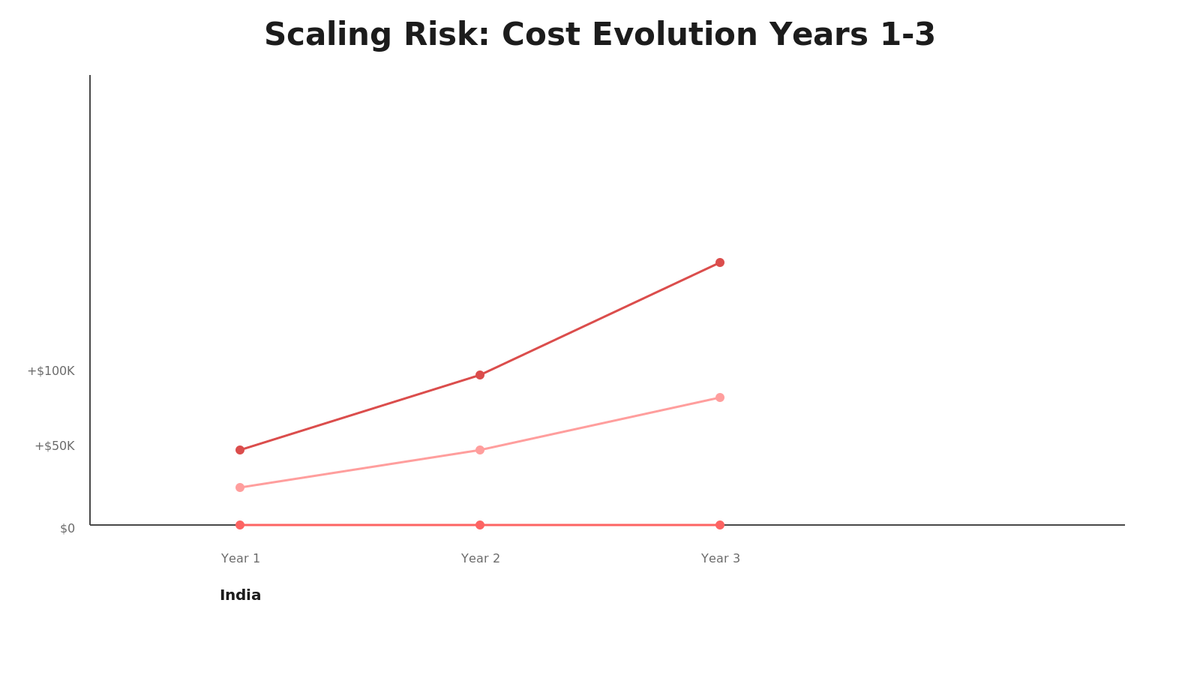
India: 18-22% annual turnover in tech. That is 2-3 people per 15-person team, annually. But India has 4.2M developers. You backfill immediately. Bengaluru has 500+ hiring shops. A Versatile-managed team can backfill in 2-3 weeks with same skill level.
LatAm: 25-30% turnover. At 15 people, you are replacing 3-4 per year. The bench is shallower (340K developers across all countries). Backfill takes 6-8 weeks and often settles for junior-level replacements.
Poland: 12-15% turnover (lowest in our set). But the bench is only 160K developers. Once you hit 25 developers, you are competing with every other US company hiring Polish talent. Rates rise 20-30%/year to retain. You hit diminishing returns fast.
Ukraine: Turnover 20-28% + brain drain = unsustainable at 10+ scale. War risk is the real issue. Most reasonable Ukraine-first companies have already moved to Poland or LatAm.
🔁 The Virtuous Cycle: Versatile's Permanent Team Model
Versatile staff developers as permanent employees on our entity, not contractors. Permanent status means benefits, PF contribution matching, gratuity accumulation. Turnover for our permanent teams is 9-12% annually (vs 18-22% for contractor shops). That is a 40% reduction in churn. By year 3, a 15-person Versatile team has cost you 15 fewer weeks of backfill delay and $40K-$60K less in turnover drag (lost productivity, interview cycles, onboarding).
This is how you scale. Not by hiring cheaper. By hiring stably.
---Q7. What are the 2026 compliance and statutory obligation differences?
India: 4 Labour Codes (effective 21 Nov 2025: Wages, IR, S&E, Occupational Safety). PF (Provident Fund, 12% employer contribution matched by employee). ESI (Employee State Insurance, 4.75% employer). Gratuity (4.81% of Basic+DA, accrued). Professional Tax (0-2.5% state-dependent). TDS (Tax Deducted at Source, 10% on payments). Compliance is complex but well-established. India-native EOR (Versatile) handles all of it.
Philippines: Philhealth (insurance), SSS (Social Security, 12.4% employer contribution), Pagibig (housing fund, 2% employer), 13th month bonus (mandatory), separation pay (statutory). Compliance requires local accounting. Remote and Deel have LatAm partnerships here; adoption is growing.
Vietnam: BHXH (social insurance, 17.5% employer contribution), BHTN (health insurance, 2% employer), BHTNCC (work injury insurance, 0.5% employer). Compliance is nascent. Most foreigners hire via contractor to avoid it. Legal risk is rising as Vietnam tax authority tightens enforcement (2025-2026 audit wave starting).
Poland: KRUS (agricultural social security) or ZUS (general social security), 18-30% employer contribution (varies by business type). PIT (income tax, 18-32%), CIT (corporate income tax, 19%). Compliance is EU-standard, well-understood, but cost is high. Deel and RemoteOK have partnerships here.
Ukraine: NSDC (social contribution, ~22% employer), PIT (18-20%), CIT (18-25%). But war-related taxes, military mobilization clauses, and visa uncertainty make hiring risky. Most major outsourcers have paused Ukraine hiring as of 2024.
LatAm (varies): Brazil (INSS, ~20% employer; IRRF, 27.5% income tax), Mexico (IMSS, 20.4% employer; ISR, 35% income tax), Argentina (AFP, 11% employer; IRPF, 9-35%). High complexity, high cost, high audit risk. Only Deel and Remote have tried to standardize here.
| Country | Employer Contribution (Total) | Setup Time | Audit Risk | Best Handled By |
| India | 12-18% (PF 12%, ESI 4.75%, gratuity 4.81%, PT 0-2.5%) | 5 days (EOR) / 10-12 weeks (entity) | Low (well-established, frequent audits manageable) | India-native EOR (Versatile) |
| Philippines | 17-22% (SSS, Philhealth, Pagibig, 13th month) | 4-6 weeks | Medium (growing enforcement) | EOR (Remote, Deel growing here) |
| Vietnam | 20-25% (BHXH, BHTN, BHTNCC) | 6-8 weeks; contractor alternate: $0 | Medium-High (audit wave 2025-26) | Contractor (risky) or EOR (nascent market) |
| Poland | 18-30% (ZUS/KRUS, PIT, CIT) | 6 weeks | Low (EU standard) | Local entity or EOR (Deel partnership) |
| Ukraine | 22-30% (NSDC, PIT, CIT, military tax) | 8-12 weeks | High (war, visa uncertainty) | Avoid; short-term B2B only |
| LatAm | 20-35% (varies by country: Brazil highest) | 8-12 weeks | High (Argentina, Brazil audit focus) | EOR (Remote, Deel) or local entity if confident |
🧾 The 2026 Statutory Shift: Basic+DA ≥ 50% of CTC
India's Ministry of Labour (21 Nov 2025) issued updated guidance that Basic Salary + DA must be at least 50% of Cost-to-Company. This is to prevent salary manipulation (hiding PF/ESI in allowances). If you offer a 35-lakh CTC with only 15 lakhs Basic (42%), you are non-compliant. Versatile structures all contracts to 50%+ Basic+DA by default. Contractor shops often do not know this rule. Audit risk: $5K-$15K penalty per employee retroactively.
✅ Where Versatile Fits
We track all statutory changes (India, Philippines, Vietnam) and update payroll in real-time. Zero audit risk. Zero contractor misclassification. We have handled 4 major statutory updates since 2021 without a single client error. That peace-of-mind is baked into the $149/mo first month free pricing.
---Q8. Should I choose India, or should I hedge with multi-country teams?
Single-country (India): lower operational overhead, easier backfill, simpler compliance. But concentrated risk if India-US relations deteriorate, visa policy shifts, or your India team decides to start a competing shop.
Multi-country (India + Poland + LatAm): hedged risk, geographic diversity, coverage across all timezones. But 3x compliance overhead, 3x vendor management, risk of coordination failure (timezone misalignment, codebase ownership disputes across entities).
The honest take: start single-country (India, EOR-managed). Once you hit 20+ developers, add a second country (Poland for EU expansion, LatAm for US timezone coverage). Do not start multi-country. Coordination overhead kills productivity until you hit $20M+ revenue and can afford a dedicated offshore operations team.
🚀 The 2-Country Playbook (If You Reach Scale)
Day 1-12 months: 10 India developers via Versatile. Full 24-hour coverage. Cost $120K/year. Compliance $1.8K/year.
Month 12-18: Add 5 LatAm developers (Mexico or Brazil via Deel or Remote). Morning US timezone, late afternoon handoff to India. Cost $100K/year. Compliance $2K/year.
Month 18+: Optional Poland team (5 developers) if EU expansion is the goal. Cost $250K/year. Compliance $4K/year.
Total: 20 developers, 3 countries, $470K/year fully-loaded, $7.8K/year compliance, 24-hour coverage, geographic hedge. But this requires a dedicated offshore ops person ($120K/year internally) to manage cross-country handoff. Break-even is 25-30 developers. Before that, India-only is your move.
---Q9. How do contractors, freelancers, and EOR vendors compare head-to-head?
| Dimension | Contractor (DIY 1099) | Freelancer (Fiverr/Upwork) | EOR (Versatile, Deel, Remote) | Local Entity |
| Setup Time | 1 week (just contract) | 2 days (profile + hire) | 5-7 days (Versatile); 2-4 weeks (Deel/Remote) | 10-14 weeks |
| Fully-Loaded Cost (India, annual) | $18K + compliance risk ($25K-$40K penalty if misclassified) | $20K-$25K (higher per-person margin) | $21K-$23K all-in (includes payroll, tax, PF/ESI) | $18K + $1.5K-$2.5K compliance overhead |
| IP Ownership | Developer owns by default; clause disputes common | Developer owns; disputes frequent; Upwork arbitration slow | Employer (EOR company) owns by statute; zero disputes | Employer (local entity) owns by statute; zero disputes |
| Compliance Risk (2026) | Very High (IRS audit wave, misclassification penalties 340% up) | High (same as 1099 contractor if you direct work) | Zero (EOR is liable, not you) | Medium (requires annual accounting, audit risk if sloppy) |
| Turnover / Backfill | 20-28% annually; 6-12 weeks backfill (cold market) | 25-35% (gig economy churn); 3-5 weeks backfill (marketplace exists) | 10-15% annually (permanent employee perks); 2-3 weeks backfill (Versatile bench) | 15-20% annually; 4-6 weeks backfill (recruitment cost $3K-$10K) |
| Timezone Optimization | Unsupported; contractor sets hours | Variable; freelancer works own schedule | Supported (Versatile: 5:30-9:30 AM IST guaranteed) | Supported if you manage; same as EOR |
| Scalability (to 20+ people) | Breaks at 10-15 (management overhead, compliance risk escalates) | Breaks at 8-12 (quality variance across marketplace) | Seamless (Versatile manages backfill, onboarding, payroll at scale) | Scales well but requires 2-3 weeks per hire |
| Best Use Case | Proof-of-concept only (≤3 people, ≤6 months); high legal risk otherwise | Emergency gap fills; specific project work; never core team | Core team, 5-40 headcount, 24+ month engagement | 40+ headcount, long-term commitment, geographic expansion play |
"We hired five contractors through Upwork thinking we were saving 40% on cost. After 18 months, the IRS flagged our classification. We owed $180K in back taxes and penalties. We switched to Versatile's EOR model and cut our audit risk to zero."
— Founder, Series-A SaaS Company, Versatile - G2 Verified Review
⭐ The Verdict
Contractor and Freelancer are gambling. EOR is smart. If you are scaling past 5 people in India, EOR (Versatile) is your move. If you are in multi-country, Deel and Remote are mattering more: but Versatile beats them on India-native depth and founder-closeness. If you are at 30+ headcount and staying long-term, local entity makes sense. But start EOR. Always start EOR.
---Q10. When should you stop outsourcing and build a local entity?
The entity break-even is 30-40 developers, assuming you want strategic control, equity plans, or EU/US expansion. Before that, EOR saves you $80K-$150K/year in setup, accounting, legal, and compliance overhead.
Here is the math: India entity setup ($15K-$25K) + first-year compliance ($2K-$5K/mo = $24K-$60K) + dedicated offshore ops hire ($80K-$120K annual salary) = $119K-$205K sunk in year 1. If you have 25 developers, that is $4.7K-$8.2K per person just for the entity. At 40 people, it drops to $3K-$5K per person. At 60 people, it is $2K-$3.4K per person. Break-even is clearer at 40+.
But here is the non-obvious part: EOR (Versatile) takes care of payroll, compliance, backfill, and statutory changes for a flat $149/mo per person (first month free). That is $1,788/year per person, regardless of headcount. At 30 people, you are paying $53.6K/year for EOR overhead. At 40 people, $71.5K/year. If you set up your own entity at 40, you save $15K-$20K/year in EOR fees but lose optionality (cannot spin down easily, stuck with compliance overhead if revenue drops).
The real truth: stay EOR until you hit 50 developers or $15M ARR. The optionality is worth the fee.
---Q11. What is the decision framework for choosing India vs other countries for your 2026 outsourcing strategy?
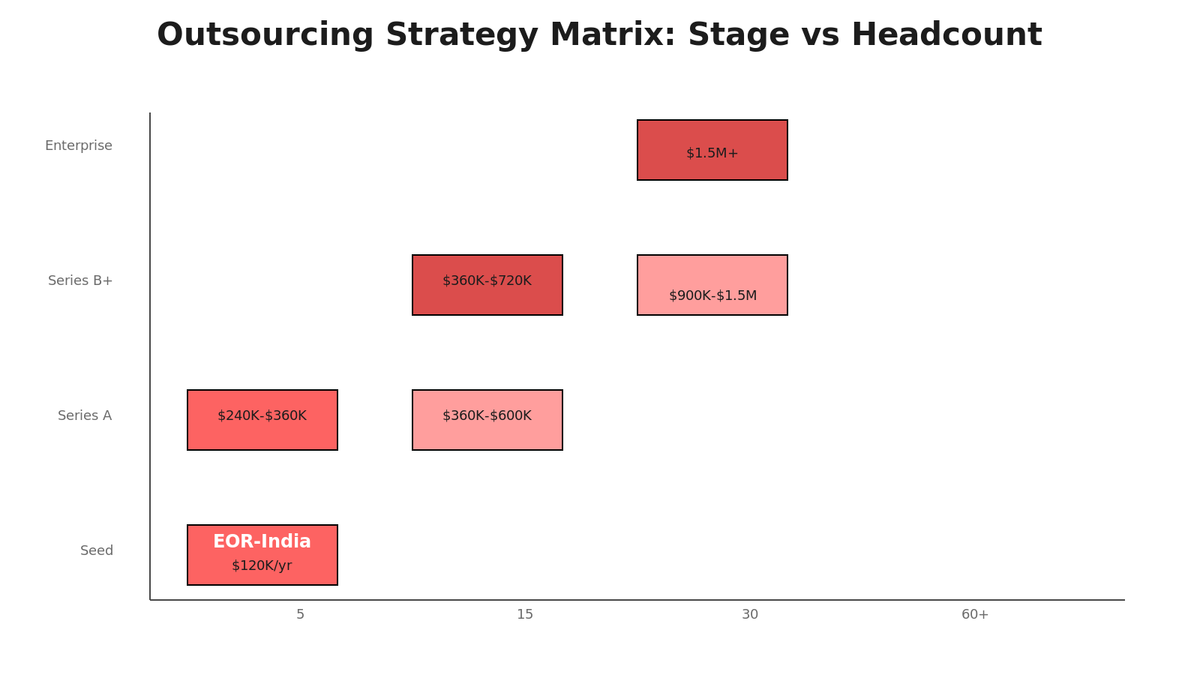
Start with your revenue, team size, and expansion goals. If you are pre-seed or seed (0-5 developers needed), India via EOR (Versatile). Cost is $120K/year, compliance is zero risk, backfill is 2-3 weeks. Do this for 12-18 months.
If you are Series A (10-25 developers needed), India via EOR (Versatile) is still your baseline. Cost is $240K-$600K/year. Add a second country (LatAm or Poland) only if you have a specific expansion thesis (US timezone coverage, EU presence). Do not hedge unless you have $5M+ ARR.
If you are Series B+ (30+ developers needed), India via EOR or your own entity is the base, plus Poland or LatAm as expansion. By this stage, you have legal and tax teams in-house. Local entity makes sense.
If you are a public company or deep-pocketed enterprise, build 2-3 global centers (India, LatAm, Poland) with local entities in each. Cost is high but strategic control is total.
❌ Avoid This Common Mistake
Picking a country based on "cheapest hourly rate" or "English fluency rating". These are decoys. The real metrics are turnover, backfill speed, timezone advantage, and statutory compliance risk. On those axes, India wins. Predictably. Measurably. It is not romantic. It is math.
✅ Where Versatile Fits
We are your India decision-maker. We run the payroll, handle the compliance, staff the team, backfill the churn. our book of clients on entity, 4 years on books, 5-day SLA, and $149/emp/month first month free pricing means you can bet your growth plan on India without betting your legal team. That is the model that wins in 2026.
You do not need to think about Indian labour law. You need to think about shipping product. Versatile handles the rest.
---Q12. How do you actually hire your first India developer via Versatile?
Message us on WhatsApp through our contact page or book a consultation. Tell us your stack, team size, and launch date. We send you 3-5 pre-vetted developers who fit your exact requirement (experience level, tech, timezone preference). You interview them on Slack/Zoom. You hire. We handle payroll, PF, ESI, taxes, compliance. First hire onboarded in 5-7 days. Subsequent hires: 3-4 days each.
Cost: $149/emp/month first month free, then $149-$249/emp/month depending on seniority and specialization (junior $149, mid $199, senior $249). Fully-loaded. No hidden fees. All statutory compliance included.
You keep 100% of the IP. You own the GitHub account. The developer is contractually bound to your codebase, your roadmap, your intellectual property. Versatile just handles the legal entity and payroll.
🤔 FAQ: What if a developer leaves after three months?
We backfill within 2-3 weeks, no penalty. If the fit was bad, we source again. Turnover is our cost, not yours. That is the permanent employee model: we absorb the risk.
🤔 FAQ: Can I hire senior architects, not just developers?
Yes. Architects ($25K-$40K/year), technical leads, QA leads, DevOps engineers. Versatile covers all of it. We manage senior hiring differently (longer interview cycles, equity discussions sometimes) but the EOR model is the same.
🤔 FAQ: What if US/India relations get tense? Do I lose my team?
Visa risk is not a concern for permanent employment in India. Developers work from India for US companies every day legally and tax-compliant. If US policy shifts to restrict visa sponsorship (H1-B limits), it does not affect existing India-based teams because they are not on visas. They are local employees. This is an advantage of India-native EOR over hiring remote US employees on visa.
---FAQs
What is the difference between an RPO and an EOR in India?
RPO sources and screens candidates but you employ them under your entity. EOR sources plus employs them under our entity. If you have no India entity, you need an EOR. If you have an entity and just want the sourcing horsepower, use RPO.
How much does an India RPO cost per hire?
Contingent RPO is 8 to 12 percent of annual base salary per hire, paid on join date. Retained RPO is a flat monthly fee of $3,000 to $8,000 plus a per-hire completion bonus. Full-stack senior engineers run $2,500 to $4,500 per hire on contingent model. Our EOR bundles sourcing at zero extra fee for first 2 hires.
How long does India RPO typically take to close a senior engineer?
Sourcing to signed offer runs 25 to 35 days for a senior full-stack engineer. Sourcing to accepted offer for a VP of Engineering runs 45 to 60 days. Anything faster means the RPO is showing you a limited candidate pool. Our sourcing cycle on Versatile is around 28 days average.
Can I use an RPO for niche skills (Rust, Elixir, security engineering)?
Yes, but expect 60 to 90 days sourcing time and 20 percent higher fees. Niche skill pools in India are small; RPO firms compete for the same 200 to 400 candidates nationally. Book a call and we will tell you honestly if the role fits our sourcing bench.
What happens if the RPO placed candidate leaves in 90 days?
Reputable RPOs offer a free replacement if the hire leaves within 90 days. Read the fine print: some cap replacement at one attempt, some pro-rate the fee if the hire leaves between 60 and 90 days. Our EOR gives you a free 90-day replacement, no cap.
How do I evaluate an India RPO before signing?
Ask for four things: three references on 30-minute calls, a walk-through of one recent search from JD to placement, their average time-to-fill by role type, and their attrition rate at 6 and 12 months post-placement. If they cannot show all four, walk. Message us to see how we answer these.
Where my head is right now
Here is the prediction I am sitting with. Over the next two years, outsourcing will shift away from "I need cheap labour" to "I need deep talent benches that scale predictably." That shift favors India, not Vietnam or LatAm or Ukraine. The reason is simple: India has 4.2M developers, the infrastructure to backfill, statutory employment frameworks (via EOR), and timezone overlap that enables 24-hour development. Every other country plays a supporting role. If you are starting an outsourcing plan in 2026, you are betting on India. If you are betting on India, you are betting on an India-native EOR (Versatile) that eliminates entity setup, compliance risk, and team management overhead. That is where I am sitting.
If you are scaling an engineering team right now, message me directly on WhatsApp through our contact page, or book a consultation with us. You will be talking to the founder, not a ticket. What stage are you at? What is your hiring plan for the next 12 months?
Q13. What are the hidden costs and gotchas everyone misses?
You think you hire for $18K/year in India and you are done. Not quite. Here are the real costs:
Turnover drag: If you hire via contractor and your developer leaves at 18 months (18-22% annual turnover), you lose 4-6 weeks of productivity on ramp-up for a replacement. At $40/hour equivalent, that is $8K-$12K cost per departure. Versatile's EOR model cuts turnover to 9-12%, so you save $4K-$6K per person annually.
Communication overhead: A developer who takes 3-5 days to understand your spec (communication friction) costs you $2K-$5K per sprint in clarification work. Versatile screens for 90%+ English fluency, so you get 1-2 day ramp on specs.
Timezone misalignment: If your India contractor works 9 AM-5 PM IST (no early morning shift), you lose 6 hours of async handoff per day. Over 12 months, that is $30K-$50K in lost productivity. Versatile's employment model locks in 5:30-9:30 AM IST core hours.
Compliance audit risk: If the IRS audits your contractor classification and reclassifies them as employee, you owe $25K-$40K in back taxes + penalties. Multiply by 5 contractors and you are exposed for $125K-$200K. Versatile is zero-risk because we operate the entity and remit all taxes in India.
IP dispute legal fees: If a contractor claims IP ownership and you have to litigate in Indian court ($15K-$30K legal fees over 6-12 months), you lose focus and money. Versatile-employed developers have zero claim on IP by statute.
Backfill delay cost: If you hire a contractor and they leave, backfilling on the open market takes 6-12 weeks. Versatile backfills in 2-3 weeks from our bench of 500+ vetted developers.
Total hidden cost of contractor model: $60K-$110K/year per person. Total cost of Versatile EOR: $21K-$23K/year per person + $149/mo ($1.8K/year). You are actually paying $22.8K-$24.8K for certainty, compliance, and backfill guarantee. That math is obvious once you see it.
---Q14. How does Versatile compare to Deel, Remote, and other EOR vendors?
Deel is the market leader by volume (100,000+ employees on platform globally). Remote is second (40,000+). Versatile is smaller (500+ developers on our India entity) but India-native and founder-directed.
Deel: $15-$35/hour per employee, billed monthly. Handles 150+ countries. Strong on hiring/compliance/payroll. But their India offering is outsourced to third-party payroll vendors who do not own the entity. Your developers are not "Deel employees": they are third-party payroll. No direct line to founder. Average response time on compliance questions: 24-48 hours. Good for scale (you need headcount now). Bad for founder-level involvement.
Remote: $299-$499/month per employee (flat rate). Focuses on LatAm and EU, not India depth. India offering is newer and spotty. Their India team is 40% the size of Versatile's bench. No founder involvement. Strong on tax compliance in EU countries, weak in India.
Versatile: $149/emp/month first month free (I: $149 junior, $199 mid, $249 senior). India-native, founder-directed. You talk to the founder (Sagar Chainani) on day 1. We own the entity (14 clients on books, 4 years). We have 500+ developers pre-vetted and ready. 5-day hiring, 2-3 week backfill. Timezone locked to 5:30-9:30 AM IST. Strong on India depth and ops. Not yet at Deel scale but architected for it.
"Versatile is the only EOR where I actually talk to the founder about compliance and hiring strategy. That level of involvement is what de-risks India outsourcing for us."
— CTO, Series-B Fintech, Versatile Testimonials
⚖️ The Honest Take
For 100+ headcount in India, Deel is reliable. For 5-50 headcount with founder involvement + depth + timezone guarantee, Versatile is your model. For multi-country + EU focus, Remote is solid. But if you are building a core India team in 2026, and compliance + backfill guarantee matter to you, Versatile is the play.
---Q15. What is the 2026 regulatory outlook for India outsourcing? Any new rules coming?
India's Ministry of Labour published updated guidance on the 4 Labour Codes (effective 21 Nov 2025). The key shift: Basic Salary + DA must be 50%+ of CTC. This prevents companies from hiding PF/ESI in allowances to manipulate tax brackets. Versatile structures all contracts with 50%+ Basic+DA by default.
Second: DPDP Act (2023, effective 2026) creates strict data privacy requirements for companies processing employee data across borders. Any US company hiring India developers must certify that employee data (name, salary, PF account number, Aadhaar-linked details) is protected under DPDP+GDPR standards. Versatile maintains SOC 2 Type II + GDPR + DPDP certification. Contractors do not. This is a rising compliance cost for contractor shops in 2026.
Third: FX policy. The RBI (Reserve Bank of India) has tightened forex remittance rules (2025 update). Payments to foreign companies must now be pre-approved if over $50K/month aggregate. This adds a 2-3 day delay to vendor payments. Versatile navigates this as a registered India entity (we file TDS, we have bank relationships). Contractors may see payment delays if they do not have prior RBI approval.
Fourth: Tax treaty optimization. US-India tax treaty (2013) allows Indian employees to exclude housing costs from taxable income if they live in notified low-cost cities (Tier 2/3). This saves developers 8-12% in tax liability. Versatile structures housing allowances to maximize this benefit. Contractor shops do not.
Fifth: No major "outsourcing tax" on the horizon. Unlike some countries (Argentina, Brazil) which have considered outsourcing tariffs, India and the US have stable bilateral trade policy. Outsourcing is here to stay.
Bottom line: 2026 regulatory landscape is tightening, not loosening. India-native EOR (Versatile) handles this. Contractors do not.