Table of contents (12)
The Future of IT Project Outsourcing: How AI and Automation Are Changing the Game

AI has fundamentally reshaped offshore development. Learn how vendors are adopting AI-augmented delivery, shifting pricing models, and what buyers must do differently in 2026.
Five years ago, outsourcing an IT project meant hiring a vendor to staff a team for a fixed term at an agreed-upon FTE cost. Scope was written in dense RFPs. Delivery was measured by hours billed and milestones checked. Quality was monitored through manual code review and periodic demos.
In 2026, that model is functionally obsolete.
AI-driven code generation, AI-native QA platforms, and automation-first infrastructure have redrawn the line between what offshore vendors build and what they can safely automate away. Simultaneously, buyer expectations have shifted: founders and CTOs no longer accept "we got the hours billed" as proof of value. They want outcome guarantees, transparent model pricing, and radical clarity about what an offshore team is actually doing versus what a large language model is doing in their stead.
This creates both a crisis and an opportunity for buyers. The crisis: if you're still procuring offshore talent using 2020-era RFPs and time-and-materials contracts, you're overpaying by 40–60 percent and getting riskier code. The opportunity: the vendors who have retooled for AI-augmented delivery now offer something genuinely new, better quality, faster iteration, and radically lower cost per unit of delivered value.
This guide unpacks how IT project outsourcing has transformed between 2020 and 2026, which roles are disappearing, which are emerging, how pricing models are shifting, and most crucially, how a serious buyer's playbook looks different now.
What Actually Changed Between 2020 and 2026 in IT Project Outsourcing
The headlines suggest a seismic shift: "AI disrupts offshore development", "Outsourcing vendors race to integrate ChatGPT", "Manual code review is dead". The reality is more textured but equally important.
Start with the obvious. In 2020, GitHub Copilot was a closed beta. Stack Overflow's 2020 Developer Survey showed 93% of developers did not use AI-assisted coding tools; the few who did used them for syntax hints and boilerplate. GPT-3 existed but was API-only and prohibitively expensive for production use. The vendor playbook was manual: write code, test manually, iterate through human-driven QA cycles.
By 2024–2025, Copilot had achieved mainstream adoption. IDC found that organisations deploying AI-driven development platforms reduced average cycle time from 6 weeks to 3 weeks. The Stack Overflow 2024 Dev Survey showed 32% of professional developers now use AI coding assistants at least occasionally, and among offshore development centers in India, adoption is closer to 55–60 percent. Most critically: the cost of implementing AI-native QA, contract testing, and automated API validation dropped by 70–80 percent versus 2020.
Developers with access to Copilot are completing coding tasks up to 50 percent faster than those without access, while maintaining or improving code quality. Organizations deploying AI-driven development platforms report 3-week cycle times versus 6-week baseline in previous cycles — GitHub Octoverse 2024.
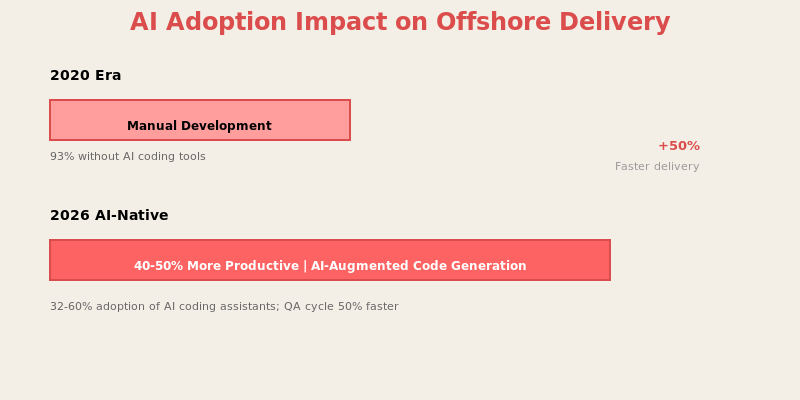
This is not merely faster typing. Three structural shifts happened:
1. Code generation became the entry layer, not the polish layer. In 2020, Copilot was a code-completion tool, you wrote the structure, it filled in the obvious parts. By 2025, teams prompt-engineer specifications into working code generators, reducing the manual write-from-scratch phase by 40–50 percent. Vendors who adapted first now use Copilot not to speed up humans but to shrink the human phase entirely.
2. Automated testing absorbed the QA middle class. Manual QA testers, historically 20–30 percent of offshore teams, became redundant at scale. Vendors who deployed AI-native test frameworks (using models trained on domain-specific test patterns) eliminated 60–70 percent of the pure-manual testing workload. The remaining QA role is now sophisticated: test strategy, edge-case discovery, and domain-specific validation, not "run this script 50 times and log failures".
3. Vendor differentiation moved upmarket. Commoditised offshore development (we write code cheaply) is now a race to zero. The survivors are vendors who offer: outcome guarantees (we commit to delivered quality, not hours), IP-native architecture (we understand your domain deeply), and AI-augmented delivery (our team is 40 percent faster because we use LLMs correctly). The rest are being acquired, consolidated, or quietly hollowed out.
For a US/UK buyer, the implication is stark: if your outsourcing vendor is still billing time-and-materials and staffing a traditional team, you are leaving 40–50 percent efficiency on the table. This is why understanding alternatives to traditional outsourcing platforms has become critical.
Where AI is Genuinely Replacing Outsourced Work (and Where It Isn't)
Not every outsourcing job is equally vulnerable to AI displacement. The specificity matters enormously, and so does the buyer's sophistication. Consider how outsourcing strategies must now account for AI's role in different tasks.
AI wins decisively in these domains:
Boilerplate and CRUD layers. Generating database schema, REST API scaffolding, and basic ORM mappings is now trivial, Copilot or a purpose-built code generator can do it in seconds. Before 2023, this was 30–40 percent of junior developer time on offshore teams. Now it's often 5–8 percent, with the saved hours reallocated to logic and integration.
Test suite automation. Writing unit tests, integration tests, and contract tests via AI-assisted tools is 3–4x faster than manual test writing. A vendor who invested in AI-native test frameworks (e.g., Diffblue, Sapienz) can cover 80 percent of test scenarios without human-written assertions. This alone cuts QA cycle time from 3 weeks to 1 week on a typical greenfield project.
Documentation and knowledge transfer. AI can generate API documentation, system design diagrams, and onboarding guides from code comments and architecture sketches. Vendors who did this manually (hiring technical writers or having developers document as they shipped) now automate 70 percent of doc generation, freeing 10–15 percent of a senior engineer's time for architecture and mentorship.
Regression testing and CI/CD validation. Automated testing pipelines with AI-selected test case prioritisation have eliminated the need for "manual regression test checklists". A vendor's QA team can now focus on exploratory testing and edge cases rather than rote checklist execution.
AI-driven test case prioritization and selection reduces the number of test cases required to achieve equivalent coverage by 40–50 percent, while simultaneously catching regressions faster than manual checklist execution — Forrester on Continuous Testing Transformation 2025.
AI is less effective in these domains:
Domain expertise and architecture decisions. Building a hedge-fund order-management system requires deep knowledge of market microstructure, latency profiles, and FIX protocol semantics. No large language model can substitute for this. AI can assist (code generation for boilerplate, documentation), but the human must drive the architecture. This is why domain expertise in offshore vendors remains critical.
Novel algorithmic work. If your project requires implementing a non-standard machine learning pipeline, a novel consensus algorithm, or a custom data structure for a specific use case, the AI will generate plausible-sounding but unreliable code. A strong offshore team with ML expertise is irreplaceable. The bottleneck is human expertise, not typing speed.
Cross-domain system integration. Integrating a third-party payment gateway with your bespoke inventory system, then connecting both to a legacy HR database, requires understanding three different systems deeply. AI excels at writing the glue code (middleware, adapters, transformers) but cannot reason across all three domains simultaneously. This still requires a human architect and senior engineer.
Legacy codebase understanding and refactoring. Taking a 200,000-line Python codebase written by six developers over 10 years, understanding its intent, and safely refactoring it is one of the hardest software tasks. AI assistants can help but cannot replace human understanding. Deep outsourcing expertise is irreplaceable here.
Soft security and compliance. Building a system that handles PII under GDPR, credit card data under PCI-DSS, and healthcare data under HIPAA is not just coding, it's a governance and risk discipline. No LLM can substitute for a compliance architect. Vendors who gloss over this risk lose clients. Vendors who invest in compliance expertise survive.
The practical implication: If your outsourcing project is primarily CRUD, boilerplate, and API scaffolding with standard tech stacks, AI has cut the cost and time by 30–50 percent, but only if your vendor adopted it. If your project requires domain expertise, novel algorithms, or complex legacy integration, AI is a 10–20 percent productivity boost, not a game-changer. The gap between "AI-native vendor" and "we use Copilot" is the difference between competitive and obsolete.
The Four Vendor Archetypes Emerging in the AI + Automation Era
Not all offshore vendors are created equal in the AI era. The market has stratified into four archetypes, each with a distinct value proposition and risk profile.
Archetype 1: The Automation-Native Studio
These are born-in-2023-or-later vendors who built their entire delivery model around AI-augmented development from day one. They staff smaller teams (60–70 percent of traditional headcount), charge outcome-based pricing (not time-and-materials), and publicly commit to code quality SLAs. Examples include some emerging Indian consultancies and mid-tier Polish and LatAm shops that repositioned aggressively. Strengths: high productivity, predictable cost, modern tech stacks. Weaknesses: limited domain expertise (they're young), untested on large-scale legacy integration, small bench for overflow capacity. Risk profile: medium. Good for: greenfield projects, agile offshore development, API-first architecture, modernisation of 5–10 year old codebases. Bad for: mission-critical legacy systems requiring deep expertise, IP-sensitive or highly regulated work.
Archetype 2: The Legacy Vendor in Transition
These are the large 5,000–50,000-person outsourcing firms (Infosys, TCS, HCL, WipRo, Accenture's offshore arms) that are mid-transformation. They've deployed AI-assisted tools across their delivery centres, offered early-career developers Copilot licenses, and launched "AI-augmented delivery" offerings. But their cost structure hasn't shifted, they still bill time-and-materials on a per-resource basis, and their QA layers are still 25–30 percent of team size. They're moving slower than pure-automation vendors but have massive domain expertise and client relationships. Strengths: deep expertise in regulated industries, ability to staff large teams quickly, institutional knowledge of complex enterprise systems. Weaknesses: slower to innovate, blended cost is only 10–15 percent better than 2020 levels (not 40–50 percent), risk of "Copilot as a checkbox" without real methodology change. Risk profile: low-to-medium. Good for: large-scale transformations, regulated industries (fintech, healthcare, pharma), clients who need massive scale. Bad for: price-sensitive projects, startups who want modern delivery models.
Archetype 3: The Specialist Deep-Expertise Vendor
Small (50–300 person) boutique shops that own a narrow domain: Kubernetes-native architecture, microservices security, quantitative trading systems, iOS native development. They charge premium rates but deliver irreplaceable expertise. They use AI as a force multiplier (Copilot for boilerplate, AI-assisted architecture diagramming) but their moat is human expertise, not automation. Strengths: unmatched domain depth, senior-heavy teams, rapid architecture iteration. Weaknesses: boutique pricing (often 1.5–2x the commodity rate), risky if the specialist leaves or gets sick, limited capacity for non-core work. Risk profile: medium (single-point-of-failure risk). Good for: high-stakes technical projects, architecture-critical work, projects that need senior-level mentorship. Bad for: cost-sensitive baseline work, team augmentation where you need commodity developers.
Archetype 4: The Hybrid Offshore/Nearshore Platform
Companies like Upland (LatAm) and Railwaymen (LatAm) that offer a blend: they staff with both offshore (India) and nearshore (Mexico, Colombia, Poland) resources, use AI-augmented tooling, and operate on hybrid pricing models (outcome-based for core work, time-based for augmentation). They're newer and smaller than legacy vendors but more established than pure startups. Strengths: flexibility on pricing and team composition, geographic hedging, modern delivery practices. Weaknesses: less track record than incumbents, smaller bench, still maturing their proprietary methodologies. Risk profile: medium. Good for: teams that want geographic flexibility, outcome-based pricing with some time-and-materials work, founders who value culture fit over pure commodity cost.
The practical implication: The vendor you choose determines not just cost but your entire risk posture and delivery model. Automation-native studios are fastest and cheapest but risky for complex domain work. Legacy vendors are safe but expensive. Specialist vendors are irreplaceable for hard problems but costly. Hybrid platforms offer middle ground but require more active management. Your project determines which archetype makes sense.
The market for offshore development has fractured into four non-overlapping segments: commoditized automation (Archetype 1), regulated enterprise delivery (Archetype 2), high-touch expertise (Archetype 3), and flexible blended models (Archetype 4). Each serves different buyer profiles. Mismatching vendor archetype to project need is now the primary source of outsourcing project failure — Industry analysis 2026.
How Pricing Models Are Shifting: From FTE to Outcome to Token
For twenty years, offshore outsourcing pricing was simple: $X per full-time equivalent (FTE) per month. You hired three developers for six months, paid three FTE × six months × $4,000–$8,000 per month, and hoped they shipped. If they didn't, you paid a penalty clause.
This model is dying for a specific reason: it does not incentivise efficiency. An FTE-based vendor has zero reason to integrate Copilot, automate QA, or shrink their team. Smaller teams = fewer FTEs billed = lower revenue. The perverse incentive structure locked in inefficiency.
The shift away from time-and-materials FTE pricing is fundamental. When vendors bill by headcount, efficiency gains become losses. When they bill by outcome, AI-driven productivity becomes profit. This inverts the entire incentive structure of offshore delivery — McKinsey on Technology Trends in Software Outsourcing 2025.
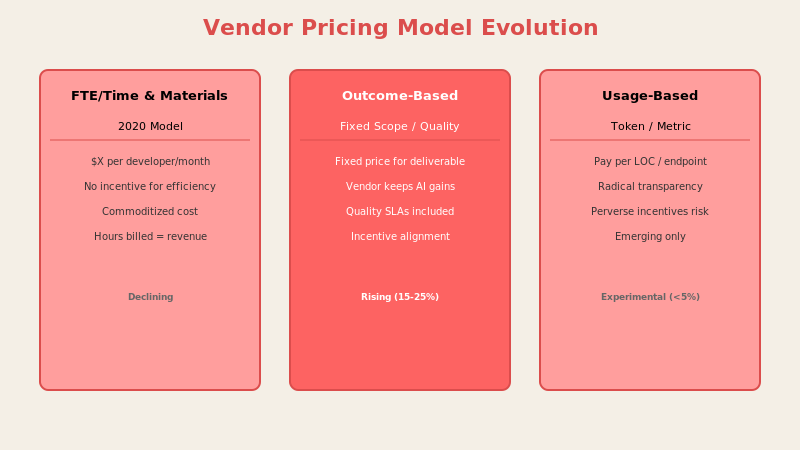
The emerging models are:
Outcome-Based / Fixed Scope Pricing
The vendor commits to delivering a specific feature set, codebase quality benchmark (e.g., 80+ percent test coverage, zero critical security findings, <2 week bug-fix SLA), and timeline. Payment is based on milestone delivery, not hours. If Copilot and automation let them ship in 8 weeks instead of 12, they keep the efficiency gain as margin. Incentive alignment is nearly perfect. Examples: newer boutique vendors, some Archetype 4 platforms. Adoption: 15–25 percent of mid-market offshore projects (2026). Pros: aligns vendor incentive with buyer outcome, price predictability, forces vendor to adopt efficient tooling. Cons: requires extremely clear scope definition (not every project can specify this), vendor will build risk buffers into the quote, typically 15–25 percent more expensive than T&M when scope is truly fixed.
Hybrid: Fixed Scope + Time-and-Materials Overflow
The vendor commits to core features at a fixed price, but change requests and scope creep are billed at hourly or daily rates. This is the emerging middle ground: most of your project is outcome-based (incentive alignment), but you retain flexibility. Examples: Archetype 4 platforms, some mid-sized vendors experimenting with new models. Adoption: 20–35 percent of active offshore projects (2026). Pros: captures benefits of both models, realistic for projects with some uncertainty. Cons: requires disciplined scope management, hybrid invoicing is more complex to track.
Token-Based / Usage-Based Pricing
The vendor bills based on consumption: X dollars per 1,000 lines of code, Y dollars per API endpoint, Z dollars per test case generated. This is nascent and only viable if the vendor's tooling is sufficiently automated that these metrics are meaningful. Examples: pure Archetype 1 vendors using heavy code generation and AI-driven QA. Adoption: <5 percent of projects currently. Pros: radical transparency, payment only for value delivered, naturally incentivises efficiency (fewer lines of code = lower cost). Cons: creates perverse incentives (vendors write unnecessarily short code to hit "low line count"), still immature methodology, only works for greenfield projects with clear metrics.
The practical implication: Outcome-based and hybrid pricing are mature enough to use now. Fixed scope works if your project requirements are 80+ percent clear upfront. If you're still paying FTE rates on a T&M basis in 2026, you're leaving 30–40 percent on the table. Learn about comparing IT staffing models to understand your cost profile better. Negotiate hard for fixed scope or hybrid. The vendor's willingness to move to outcome-based pricing is a signal of their confidence and efficiency.
What Buyers Must Now Specify in an RFP That They Didn't in 2022
The old RFP asked: "Can you build this system? How much? How long?" The 2026 RFP is far more specific and demands transparency about technology adoption.
AI Usage and Tooling Transparency
Ask explicitly: "What AI-assisted coding tools will your team use? Will Copilot be deployed on every developer? How will you measure the time savings? Will the cost savings be passed to us?" Demand transparency on model usage. Some vendors silently use GPT-4 (expensive per token) while others use Copilot (flat license). The answer tells you if they've optimized their tool stack or are just running expensive LLMs. Good vendors will show you their AI adoption rate, training hours, and effectiveness metrics.
Code Generation vs. Manual Write Percentage
Request a breakdown: "What percentage of the codebase will be generated via Copilot or code generators? What percentage will be manually written? How are edge cases and business logic handled differently from boilerplate?" This forces the vendor to think about where AI is appropriate and where it isn't. Red flag: a vendor says "100% of our code is Copilot-generated". Green flag: a vendor says "60% boilerplate is generated, 40% business logic is manually written, with AI-assisted code review throughout".
Automated QA Coverage and Test Breakdown
Specify: "What percentage of your test suite will be automated? What percentage is manually exploratory? How do you handle AI-generated tests vs. human-written assertions?" Request test coverage benchmarks (80%+ code coverage, 100% of critical paths). Ask for their test failure rate and how many regressions escape to production. This filters out vendors who still do manual regression testing (2020 practice) from those who have modernised (AI-native QA frameworks).
A meaningful RFP in 2026 is an audit of vendor tooling, team composition, and delivery methodology — not just a price quote and timeline. The vendors who pass this audit have already moved from commodity delivery to outcome-based models, and their pricing reflects that shift — Industry best practices in AI-augmented software outsourcing.
Model Training and IP Clauses
Critically important: "Will any of our code, design documents, or specifications be used to train models (yours or third-party LLMs)? Will our data be retained by Copilot or Claude or any other service?" This is now a major deal-breaker for regulated industries and IP-sensitive startups. Require explicit "your code will never be used for training" guarantees. If the vendor cannot provide this, your IP risk is high. See India-based vendor compliance requirements for regulatory context.
Delivery Guarantees and SLAs
Move beyond "we deliver on time" to concrete metrics: "We guarantee <2 minute API response time for 95% of requests, 80+ OWASP score on security audit, zero critical CVEs in dependencies, 2-week bug-fix SLA for priority defects". Vendors confident in AI-augmented delivery can meet these. Vendors still using manual QA will balk.
Team Composition and Seniority Mix
Require: "What's your intended team structure? How many senior architects vs. mid-level vs. junior developers? How much time will senior architects spend on this project vs. being allocated elsewhere?" AI-native vendors can staff more junior developers (Copilot does entry-level work for them) and spend senior time on architecture. Legacy vendors need more mid-level developers. Knowing this tells you if they're truly AI-augmented or just marketing the idea.
Escalation and Retention Risk
Ask: "What's your developer attrition rate? Who are the key people who cannot be replaced? What's your succession plan for each?" Offshore vendors with high churn are risky. Good vendors have documented knowledge transfer (docs, tests, architecture guides) precisely because AI makes this easier now. Poor vendors hoard knowledge in individual brains. This is especially critical when converting contractors to employees or maintaining long-term teams.
These five dimensions transform an RFP from a generic checklist into a real evaluation of vendor sophistication.
Quality Assurance in an AI-Augmented Outsourced Delivery Model
QA in 2026 looks radically different from 2020 because the entry-level QA manual tester has been automated away at scale.
The old model: 100 developers, 25–30 QA testers, 2–3 QA leads. Testers executed scripts, filed bugs, re-tested fixes. It was slow (3–4 week QA cycle for 6 week sprints) and error-prone (human testers miss regressions).
The new model: 100 developers (but they write boilerplate faster due to Copilot), 5–8 QA engineers (now mostly writing automated tests and test strategy, not executing test scripts), 1–2 QA architects (defining quality strategy and handling edge cases). The test suite is 80+ percent automated with AI-assisted test generation. Manual testing is reserved for exploratory QA, user acceptance testing, and domain-specific edge cases.
Organizations with AI-native QA frameworks report 60–70 percent reduction in manual testing workload, with the team redeployed to test architecture and edge-case discovery. The remaining manual QA now focuses on exploratory testing and domain-specific validation, not repetitive regression cycles — Gartner on QA Transformation 2025.
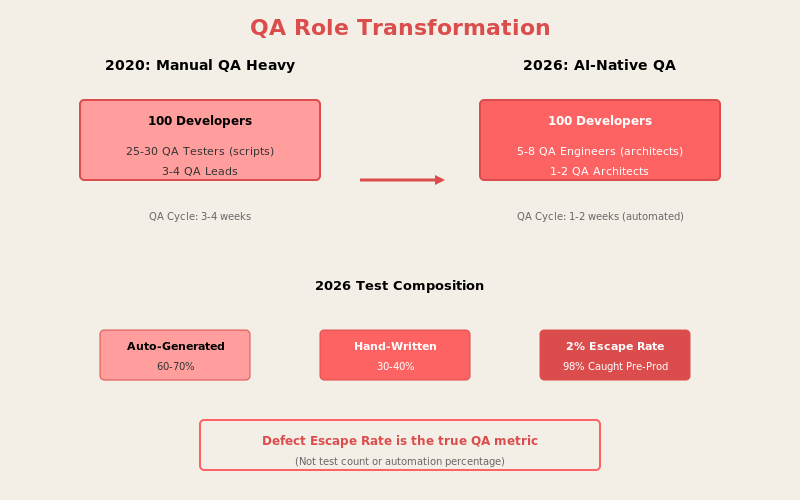
The implication for buyers: When evaluating an offshore vendor, insist on this breakdown. If they still staff 25–30 percent QA testers, they haven't modernised. If they staff 5–8 percent QA engineers (fewer testers, but more senior and strategic), they have.
What this means for test quality: Paradoxically, automated testing is more reliable than manual testing when done well. A human tester gets tired, skips steps, and misses regressions. An automated test catches the same edge case 1,000 times perfectly. But the risk is automation theater, a vendor claims "we have 80% test coverage" when 60% is auto-generated fluff that doesn't actually validate anything. Demand to see the test suite. Ask which tests are auto-generated and which are hand-written. If 70+ percent is hand-written or hand-reviewed, they're doing QA well. If 80+ percent is generated without human review, ask what percentage of generated tests catch real bugs.
Emerging QA practices in high-performing vendors:
Contract testing and API validation is now standard. A vendor generates hundreds of test cases checking API contracts (request/response shapes, error codes, status codes) using AI-driven test case generation. This catches integration bugs before they reach human testers. Adoption: 40–60 percent of top-tier vendors. See how India-based software vendors are implementing these practices.
Chaos engineering and resilience testing is moving upstream. Instead of hoping for high availability, vendors now simulate failures (network outages, database crashes, service timeouts) and validate graceful degradation. This is partially automated and AI-guided. Adoption: 20–30 percent of vendors.
Adversarial and security-focused testing is increasingly automated. Instead of a human security tester manually probing for OWASP top-10 vulnerabilities, AI-driven security scanners (e.g., Snyk, Semgrep) run continuously in the CI/CD pipeline. Adoption: 50–70 percent of vendors in regulated industries.
The vendors who lead here don't brag about "automated testing percentage", they brag about "defect escape rate" and "time-to-production". That's the real metric. If you outsource to a vendor with a 2 percent defect escape rate (2% of bugs found in production, 98% caught before release), you're getting high-quality AI-augmented QA. If the vendor doesn't track defect escape rate, they're not measuring quality properly.
IP, Data and Model-Training Clauses Your Outsourcing Contract Now Needs
This is the highest-leverage risk area for 2026 outsourcing deals. A single contract paragraph can protect or expose your intellectual property to model training exposure.
The core risk: Your code in someone else's training data.
When a developer at an offshore vendor uses GitHub Copilot, every keystroke inside Copilot is sent to GitHub/OpenAI (by default, unless explicitly opted out). GitHub's Copilot terms permit training on the code unless you opt out. If your outsourcing contract doesn't prohibit using Copilot, your proprietary code might be in OpenAI's next model training run. This is catastrophic for hardware startups, quantitative finance, and medical device software.
Copilot data retention is opt-out by default on personal accounts. GitHub Copilot Business allows organizations to disable data collection, but corporate contracting requires explicit enablement. The default assumption must be: your code is being collected unless the vendor proves otherwise with signed SLAs and configuration screenshots — Legal and compliance best practices, 2026.
What you must require:
1. "The vendor shall not use any Copilot, Claude, or third-party LLM service that permits code retention or model training. All AI-assisted coding tools must be deployed with no-training clauses explicitly enabled (e.g., GitHub Copilot Business with corporate accounts that can opt out of training data retention)."
2. "No part of the Client's source code, specifications, architecture documents, or design materials shall be used to train any model (vendor proprietary or third-party). This applies to past work, current work, and future work."
3. "The vendor shall contractually prohibit all team members from using personal GitHub Copilot accounts (unmanaged instances) on this project. All coding assistance is through vendor-controlled tools with explicit no-training guarantees."
4. "If a data breach occurs and the Client's code is exposed to an LLM training dataset, the vendor is liable for [X amount, usually high] per incident."
Red flags in a vendor's response:
- "We can't commit to this, our developers need Copilot for productivity."
- "Our lawyers say we can't warrant model training won't happen."
- "We use Copilot for boilerplate but not for business logic." (Not strong enough. If ANY code goes in, assume the model will extract patterns.)
- Silence or deflection when asked about the Copilot issue.
Green flags:
- "We have a company-wide GitHub Copilot Business account with data retention explicitly disabled."
- "We offer Claude API (no training clause) or local LLMs (Ollama, LLaMA) exclusively."
- "We've already had this conversation with three clients this year, here's our standard addendum."
For regulated industries (fintech, healthcare, government), this is a dealbreaker clause. Get it right or walk away.
Roles That Survive, Shrink, and Emerge on Outsourced Teams
If you're hiring an offshore team in 2026, you need to understand which roles still exist, which are being eliminated, and which are new.
Roles shrinking or disappearing:
Manual QA Tester. "Write test cases, follow a script, report bugs." This role has contracted 50–70 percent. It's been absorbed by automated testing frameworks and AI-driven test generation. Vendors who still staff 20 manual testers per 100 developers are over-staffed and over-charging. See how roles are shifting in India hiring.
Junior developer (pure boilerplate). Entry-level developers who were hired to write CRUD code, API scaffolding, and database migrations have fewer jobs. Copilot does this. The survivors are junior developers who can architect at least one axis (databases, caching, messaging) or who have deep domain knowledge (e.g., a junior Kubernetes specialist). Pure "I write PHP for $X/month" juniors are underutilised.
Technical writer (if purely documentation-focused). AI now auto-generates API docs, README files, and deployment guides from code comments. Technical writers who only transcribe are being replaced. The survivors write user guides, product documentation, and scenario-based guides, tasks that require customer empathy, not code-to-docs translation.
Business analyst (if purely requirements gathering). Vendors who hire BAs to listen to clients and write specifications are being exposed by automation. Some of this can now be templated and AI-assisted. Analysts who survive are those who drive discovery, ask the hard questions, and validate assumptions, not just transcribe client words into a document.
Roles growing or newly created:
AI-Native Architect. Understands how to use Copilot, code generators, and AI-driven testing to accelerate delivery while maintaining code quality. Not just a technical architect, but someone who can evaluate which tasks should be automated and which need human judgment. Salary: 20–30 percent premium over traditional architects.
Security Engineer. As code is generated faster, security vulnerabilities can proliferate if unchecked. Vendors now hire dedicated security engineers to review generated code, scan dependencies, and validate cryptographic practices. This role didn't exist in most 2020-era outsourcing shops. Salary: 30–50 percent premium over mid-level developers.
QA Strategy / Test Architect. No longer "write test cases," but "design the entire test strategy, decide what to automate and what to explore manually, own the defect escape rate." This is a senior role that combines testing knowledge, automation skills, and strategic thinking. Salary: senior mid-level to senior level. See how outsourcing platforms structure compensation for these specialized roles.
Compliance and Risk Engineer. For regulated work, a dedicated engineer who understands GDPR, PCI-DSS, HIPAA, and can audit generated code for compliance risk. This role is being created now as vendors realize "AI-generated code passing a linter" is not sufficient for regulated industries. India-based EOR and compliance services now include this specialisation.
Product Manager (offshore side). Traditionally rare. Now essential when the outsourcing relationship is outcome-based. A PM who works hand-in-hand with the client to refine scope, validate assumptions, and drive prioritisation. This compresses feedback loops and reduces shipped misalignments.
What this means for your team: When hiring an offshore team, insist on seeing the team org chart. If they have 30 percent QA manual testers, they're 2020-era staffing. If they have <10 percent QA but include test architects, security engineers, and an AI-native architect, they're 2026-era. The latter will ship faster and cleaner, not just cheaper.
The New Offshore Geography of AI-Native Delivery
For decades, India was synonymous with "offshore outsourcing." That's still true for volume, but the 2026 map is more interesting.
India: Scale + Commodity Cost
India still hosts 40+ percent of global offshore development capacity. The advantage is obvious: cost ($15–$30/hour for mid-level developers vs. $40–$60 in Poland or LatAm) and scale (you can find 500 developers in 2 weeks). But scale cuts both ways. India-based vendors are often large (5,000+ person) and slow to innovate. The AI-native vendors are emerging from Bangalore's startup ecosystem, not from legacy Infosys-class shops. Emerging vendors like SHAP Labs, Girnar Software, and smaller Bangalore consultancies are building AI-first delivery. Cost advantage: 30–40 percent cheaper than LatAm for equivalent quality. See Bangalore hiring costs for current benchmarks.
Poland & Eastern Europe: Quality + Timezone Parity
Poland, Ukraine, and Romania now compete on quality and time-zone overlap with Europe/UK clients, not just cost. Polish vendors (Railwaymen, Bright Inventions) built lean, AI-native delivery models early. They charge 15–25 percent more than India but deliver with fewer hand-offs and less communication overhead. Perfect for UK/Ireland-based founders. See how agile methodologies differ across regions. Cost premium: 15–25 percent vs. India, but calendar-aligned with UK (CET = GMT+1 vs. IST = GMT+5.5, 4.5 hours apart vs. 10 hours).
Latin America: Nearshore + Cultural Fit
Mexico, Colombia, and Argentina offer time-zone alignment with US clients (CST = GMT-6, close to EST = GMT-5) and Spanish-language capability. Smaller shops (50–300 person) are AI-native. Larger vendors are transitioning. Cost: 20–30 percent premium vs. India, but substantially faster communication and fewer cultural handoffs. Cultural fit matters more for product companies; cost matters more for backend infrastructure.
Vietnam: Rising Competitor
Vietnam (Ho Chi Minh City, Hanoi) is becoming a second hub for cost-optimized offshore. Costs ($12–$20/hour) are 20–30 percent below India due to lower cost of living. Quality is rising (younger developers, eager to learn). Timezone (ICT = GMT+7) overlaps partly with India and is acceptable for global teams. Risk: less institutional knowledge than India, smaller vendor ecosystem, higher attrition risk. Still emerging but worth watching if you need maximum cost optimization on non-critical work.
Hybrid Models: Offshore + Nearshore + Internal
The best-performing teams (2026) don't pick one geography. They blend: senior architects internal (US/UK), mid-level developers nearshore (Poland for Europe, LatAm for US), junior developers and QA offshore (India). This hedges timezone overlap, cultural fit, and cost. Coordination overhead goes up, but quality and predictability improve. Budgeting for hybrid offshore teams requires nuanced planning.
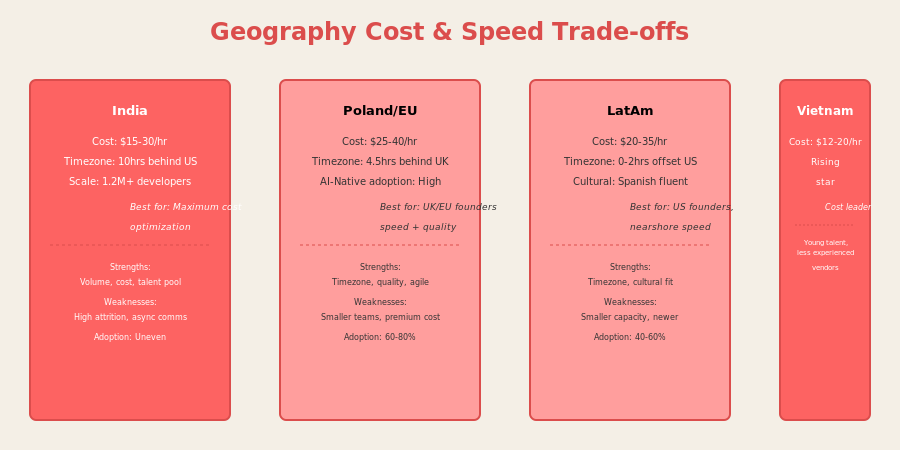
The practical implication: If cost is your primary lever, India is correct. If speed-to-market is paramount, Poland or LatAm. If you need specialised expertise (e.g., Kubernetes security, fintech), look for boutique shops globally (increasingly distributed). If you want to hedge risk, consider a hybrid model: core team nearshore, augmentation offshore.
Case Pattern: When a US CTO Should Insource What They Outsourced
Not every project should stay outsourced. Some projects transition from "vendor-built" to "built and maintained internally" because the cost of coordination exceeds the cost of hiring.
The inflection point is typically reached when:
The codebase becomes mission-critical and changes weekly. If your vendor built a transactional system three years ago and it now processes 50 percent of revenue, you don't want to wait 2 weeks for vendor fixes. You want internal engineers who own it, understand it intimately, and can ship fixes in hours. The coordination tax of "request, prioritise, wait for vendor cycle" becomes unsustainable. Decision: insource the core team (3–4 senior engineers) and keep the vendor for augmentation.
The IP is now a core differentiator, not a commodity feature. If you outsourced a generic payment processing API four years ago, and it was fine then, but now payment processing is your competitive moat (you process faster, cheaper, or with better UX than competitors), you need to own that code. Vendor maintenance and evolution becomes too slow. Decision: insource the team that owns this.
The domain expertise in your vendor has left (attrition). If three key architects who built your system have quit the vendor and been replaced, you've lost knowledge and velocity. Onboarding new vendor engineers takes time and introduces risk. At this point, the coordination tax is higher than the cost of hiring internally. Decision: insource 2–3 mid-level developers to stabilise the codebase, then migrate away from the vendor over 6 months.
You're hiring a team anyway; the vendor is redundant. Some startups hire an offshore team initially (cheaper, faster to market), but by Series A, they have budget to hire US/UK engineers. At that point, maintaining two teams (offshore vendor + internal) is overhead. Either the internal team absorbs the vendor's work, or you part ways. Most founders choose to insource because the internal team can move faster and has skin in the game.
The actual calculation:
Cost of keeping vendor = (coordination overhead) + (slower iteration cycles) + (IP risk) + (knowledge loss risk)
Cost of insourcing = (3 senior engineer salaries) + (ramp-up time = 2 months) - (vendor cost savings)
If insourcing cost < keeping vendor cost for 2 years, insource. If the equation is unclear, hybrid (1–2 internal + vendor augmentation) bridges the gap. Avoid common hiring mistakes when making this transition.
Red flag for vendors: Smart founders and CTOs now budget for insourcing from day one. They don't view the offshore team as permanent. They view it as a 2–3 year runway to get to market fast, then transition to internal. Vendors who don't understand this dynamic will be surprised when clients say "thanks, we'll take it internal now."
What "Outsourcing to India" Specifically Looks Like in 2026
The practical reality of outsourcing to India in 2026 is radically different from 2020. The infrastructure is identical: Bangalore, Pune, Hyderabad, and Gurugram host the largest concentration of software developers globally (estimated 1.2–1.5 million as of 2025). Cost per developer is $15–$35/hour depending on seniority, making it 30–50 percent cheaper than US/UK equivalents. The timezone means India is asleep when the US is working, creating daily handoff cycles (evening commit in US, morning review in India, evening fix in US). This async workflow is painful initially but becomes standard once you internalise it.
What's new: the quality bar has risen, the tooling has changed, and the employment model has matured beyond "offshore contractor."
Quality inflation. The top 10 percent of Indian software developers are world-class and expensive ($40–$60/hour). The next 30 percent are very good (mid-level, $25–$35/hour). The remaining 60 percent are commodity and risky. If you hire through a large vendor (Infosys, TCS), you get a statistical mix weighted toward commodity. If you hire through a boutique, you might get the top tier. The spread is massive. A well-managed boutique team from Bangalore (50–100 developers) might deliver better code than a 1,000-person vendor team from the same city.
India's developer ecosystem stratification is now extreme. Top-tier Bangalore developers command $50–$80/hour and have 2+ year waits. Mid-tier command $25–$40/hour. Commodity command $12–$18/hour. The critical decision is no longer "hire in India" but "hire the top quartile in India, not the median" — Talent assessment research, India outsourcing market 2025.
AI adoption is uneven. Some Indian vendors (SHAP Labs, specific Infosys practices) have modernised their entire stack around Copilot and AI-native QA. Most have not. If your outsourcing contract doesn't explicitly require AI-augmented delivery, you'll get a 2020-era team with Copilot sprinkled on top (minimal productivity gain). If you insist on outcome-based pricing and AI tooling transparency, you get 2026-era delivery.
Employment models have expanded. Historically, "outsource to India" meant hiring a vendor and maintaining arm's-length contractor relationships. In 2026, there are new options: Versatile and similar India-native EOR platforms now offer US/UK founders the ability to directly hire India-based employees (with proper employment compliance, benefits, payroll) without setting up an Indian entity. This gives you all the cost benefits of India hiring with employment certainty (not contractor risk). If you hire this way, you get direct employment relationships with your team, you own IP by default (no vendor middleman), and you can build team cohesion across time zones. The trade-off: you handle HR, compliance, and onboarding yourself (or through an EOR platform). This model works well if you're building a permanent India-based team; it's overkill if you want a 3-month project vendor.
The practical workflow: An example modern engagement: You hire five mid-level developers from India through an EOR (or direct hiring via a recruiting consultant). You set up async standup (written, GitHub-linked updates posted morning India time). You do weekly sync calls at 8 PM US East / 6:30 AM next day India. Your Figma designs, GitHub repos, and Slack are the source of truth. Code review happens asynchronously via GitHub (US evening review, India morning fixes). You own the IP from day one (they're your employees, not the vendor's). Cost: $25/hour * 1,800 hours/year * 5 = $225k/year plus EOR fees (typically 5–10 percent). This is your team, not a vendor project.
Versatile and similar platforms (Loom, Deel, Guidepoint) now offer this as a standard product. You define the role, they recruit from India (or other geographies), they handle compliance and employment, you get a direct hire report. This has moved from "exotic outsourcing" to "normal hiring" over 2024–2026. India-native EOR services now standardise this approach.
Regulatory and compliance reality: India employment comes with PF (Provident Fund), ESI (Employee State Insurance), and TDS (Tax Deducted at Source) obligations. If you're not careful, you expose yourself to significant Indian employment-law liability. Using an India-native EOR is now the standard risk-mitigating approach. Direct hiring without an EOR exposes you to audit risk and misclassification penalties. The 5–10 percent EOR fee is cheap insurance against this.
For US/UK founders who want to build a permanent, deep India team, this is now straightforward and significantly cheaper than hiring internally. For those who want a 6-month project vendor, use a boutique vendor (Archetype 1 or 3) with outcome-based pricing. Compare this to alternatives to vendor models for flexibility.
Frequently Asked Questions
Is outsourcing dead? Should we just hire AI?
No and no. AI is a productivity tool that vendors have adopted. It doesn't replace humans; it amplifies them. The best 2026 vendors are 40–50 percent more productive than 2020 vendors because of AI, not instead of humans. Hiring "just AI" (a code generation model running alone) reliably fails on non-trivial projects. You still need architects, security engineers, and domain experts. Outsourcing is not dead, it's evolved. The vendors who have evolved survive and thrive. Those who haven't are being consolidated or acquired.
How do I know if my vendor is actually using AI or just marketing it?
Ask for specifics: (1) Which AI tools do they deploy? (2) What percentage of the codebase is generated vs. hand-written? (3) How is test coverage achieved (auto-generated or hand-written)? (4) What's their defect escape rate and time-to-fix for priority bugs? (5) Can they show you a Copilot Business account with data retention disabled, or do they use local LLMs? Vendors actually using AI can answer all five. Those who aren't will deflect or give vague answers.
What's the real cost difference between a 2020 vendor and a 2026 AI-native vendor?
For equivalent quality and timeline, an AI-native vendor costs 30–40 percent less than a 2020-era vendor due to higher productivity. But you also get faster delivery (6 weeks becomes 4 weeks). If you value speed, the total project cost might be similar while time-to-market improves 25–30 percent. Outcome-based pricing makes this transparent; T&M pricing obscures it.
How do I mitigate the risk of my code being used to train AI models?
Three steps: (1) Contract clause prohibiting any third-party model training. (2) Require the vendor to use GitHub Copilot Business (with data retention disabled) or local/on-premise LLMs, not personal Copilot accounts or free-tier Claude. (3) Audit the vendor's setup before starting. For regulated industries, hire a security consultant to review the vendor's AI tooling stack. This is a $5k–$10k audit that prevents a $1M+ exposure.
Is India still the cheapest option, or are there emerging alternatives?
India is still cheapest ($15–$30/hour), but Vietnam ($12–$20/hour) is rising, and Eastern Europe ($25–$40/hour) competes on quality and timezone overlap. For maximum cost, India or Vietnam. For maximum speed-to-market with acceptable cost, Poland or LatAm. Hybrid models (senior architects internal, mid-level nearshore, juniors offshore) offer the best balance.
Should we outsource or hire an internal team?
Outsource if: (1) You need to ship in 3–6 months and can't hire internally that fast. (2) The project is non-core (not your IP moat). (3) You have clear requirements and can specify scope tightly. Hire internally if: (1) The project is mission-critical and will change weekly for years. (2) It's your core IP and competitive moat. (3) You have budget for 2–3 senior engineers. Hybrid works if you outsource MVP, then hire a small internal team to own long-term evolution.
How does the outsourcing model work with an India-native EOR?
Instead of hiring a vendor, you hire India-based developers directly as employees through an EOR platform (Versatile, Deel, Loom). You own the IP, set the comp, hire via a recruiter, and the EOR handles employment compliance and payroll. Cost: same salary + 5–10 percent EOR fee. Benefit: you own the team, you don't have vendor lock-in, and compliance is handled by experts. This is now the standard model for founders building permanent India teams. For short-term projects, a vendor still makes sense.
Ready to hire in India?
Drop your work email · we'll set up a 20-min intro call within 24 hours. Tell us what you're building; we'll tell you whether we're the right fit.
We reply in business hours (IST). Never spam, never share your email.