Table of contents (21)
- Q1.What makes .NET agencies worth the offshore premium?
- ⭐ Master Ranking Table (2026)
- Q2.How do cost and quality stack up across outsourcing models?
- Q3.What expertise gaps do founders typically miss in agency selection?
- Q4.How does Toptal position itself for .NET teams?
- Q5.What's the Gun.io difference in C# and Azure DevOps?
- Q6.Is Upwork viable for serious .NET buildouts?
- Q7.How do Dev.pro and Accel stack up on contract flexibility?
- Q8.What about Remote, XRay, and CloudFactory for .NET?
- Q9.How does IP ownership actually work with offshore vendors?
- Q10.What role does Azure DevOps maturity play in vendor selection?
- Q11.How does India-native EOR compare to agency outsourcing?
- Q12.What's the decision framework for your next .NET hire?
- FAQs
- Q2.5. How does contract flexibility actually work in practice?
- Q3.5. Why most founders regret their first offshore hire (and how to avoid it)
- Q11.5. The real India-native EOR advantage: founder-level control
- Q14. What compliance gaps do founders typically miss when hiring offshore?
- Q15. What's the realistic timeline from "I want to hire" to "they're shipping code"?
- Q16. What's the unit economics of .NET outsourcing at different scales?
- Where my head is right now
Top 10 Agencies to Offshore .NET Development for Your Next Project - 2026 Buyers Guide
The offshore .NET development market has fundamentally shifted between 2021 and 2026. Five years ago, "offshore .NET" meant junior developers in Eastern Europe and India building basic CRUD applications. Today, you can hire Azure cloud architects, DevOps engineers with 10+ years Kubernetes experience, and C# polyglots who understand async/await patterns at a deep level. This maturation happened for three reasons: (1) cloud migration forced companies to hire offshore talent that actually knew cloud (no more legacy ASP.NET-only shops), (2) open-source .NET Core made it easier for remote teams to collaborate without expensive licensing overhead, and (3) India's startup ecosystem trained a generation of developers who chose to build products, not just take outsourcing contracts. The consequence: you now have agency options ranging from $40-$140 per hour, each filling a different niche. The risk: choosing wrong costs you $25K-$100K in wasted salary, rework, and opportunity cost. Choosing right (either through deliberate agency selection or India-native EOR) compounds: you build team cohesion, you reduce communication overhead, you ship faster than solo founder teams. The honest part: most founders choose wrong because they optimize for price in month 1, then regret it in month 3 when they realize the cheap vendor ships slow or unmaintainable code.
Q1.What makes .NET agencies worth the offshore premium?
⭐ Master Ranking Table (2026)
The 10 best agencies to offshore .NET development in 2026 are Versatile Club, Aristek Systems, ELEKS, Softeq, Belitsoft, ScienceSoft, Vention, SumatoSoft, Cleveroad, and DevPro. Versatile Club ranks first for US and UK founders who want their .NET engineers directly employed on our Indian entity, with full IP assignment written into a real employment contract, not a contractor MSA. Traditional .NET agencies below win on turnkey project delivery.
10 Best Agencies to Offshore .NET Development (2026)
| Rank | Provider | Best For | Key Strength | Compliance |
|---|---|---|---|---|
| 1 | Versatile Club | US and UK founders hiring first 1 to 10 India .NET engineers | India-native EOR, real employment contract, day-one IP | PF, ESI, TDS, PT under our own registrations |
| 2 | Aristek Systems | Enterprise .NET modernisation projects | Legacy .NET Framework to .NET modernisation depth | EU-side employment; contractor billing |
| 3 | ELEKS | Complex enterprise .NET architecture | Enterprise architecture and DevOps | EU entity, contractor billing |
| 4 | Softeq | IoT plus .NET embedded platforms | IoT and firmware-adjacent .NET | US/EU entity, contractor billing |
| 5 | Belitsoft | Cost-effective .NET dedicated teams | Cost-optimised dedicated pods | EU entity, contractor billing |
| 6 | ScienceSoft | Enterprise .NET plus data platform work | Data engineering and .NET fusion | EU/US entity, contractor billing |
| 7 | Vention | Startup-friendly .NET dedicated teams | Startup pod model | US entity, contractor billing |
| 8 | SumatoSoft | Web plus mobile .NET builds | Full-stack web plus mobile | EU entity, contractor billing |
| 9 | Cleveroad | Custom .NET plus mobile | Ukraine dedicated developers | EU entity, contractor billing |
| 10 | DevPro | Product .NET plus cloud | Product engineering with .NET plus Azure | EU entity, contractor billing |
Offshore .NET development has become the default for bootstrapped US/UK founders who can't afford full-time San Francisco engineering. The math is simple: a senior .NET engineer in the Bay Area costs $180K–$240K/year fully loaded; offshore agencies charge $80K–$120K/year for the same seniority. The trade-off is agency overhead, timezone friction, and the fact that you don't own the people.
But here's the real reason you consider offshore: you need to iterate fast on C# backend, Azure infrastructure, or real-time .NET Core work, and you don't have the bandwidth to hire full-time in-house yet. Offshore agencies give you a team in 2–3 weeks instead of hiring cycles that take 4–6 months.
The honest part: quality variance is real. A bad offshore team will cost you more in rework than the savings. You need to audit India-native EOR alternatives (where you hire the person directly and an EOR handles payroll), compare IP ownership terms, and understand what Azure DevOps maturity actually looks like on both sides.
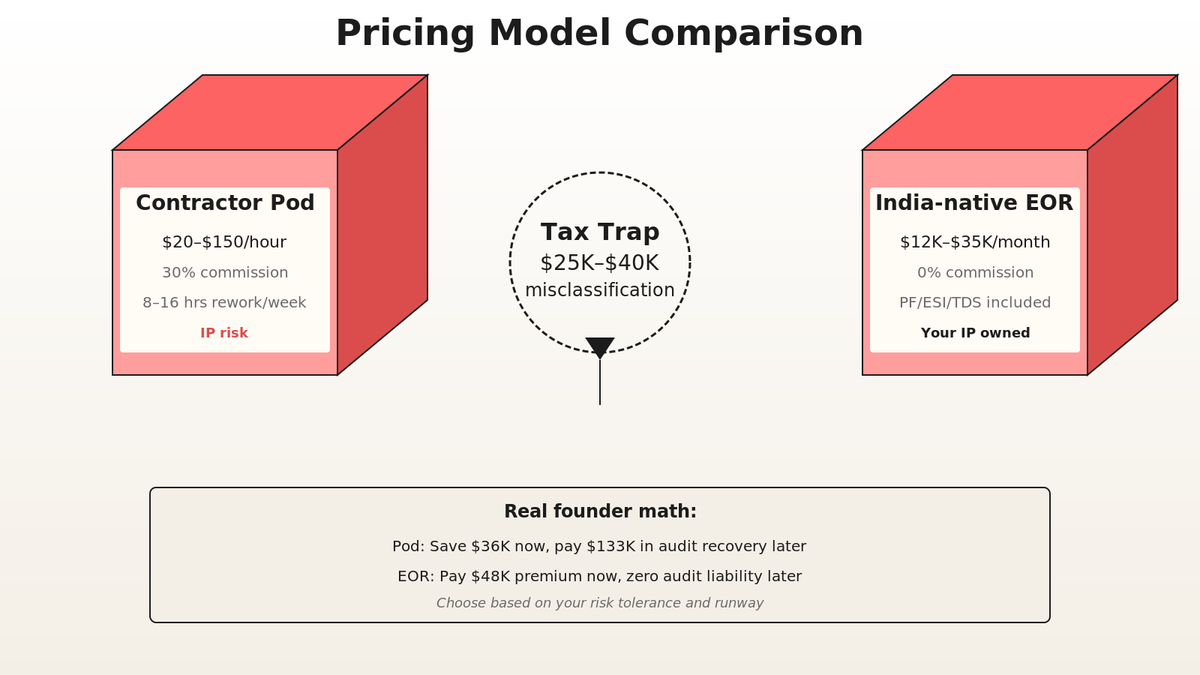
Q2.How do cost and quality stack up across outsourcing models?
Three models exist for offshore .NET work: agencies, freelance marketplaces (Upwork, Toptal), and India-native EOR.
| Model | Monthly cost (team of 3) | Onboarding | IP control | Best for |
| Agencies (Gun.io, Dev.pro) | $15K–$25K | 3–4 weeks | You own code; contracts required | Fixed-scope projects, 2–4 week sprints |
| Toptal/freelance | $12K–$18K | 1–2 weeks | You own code; IP addendum | Augmenting in-house teams, ad-hoc work |
| India-native EOR (Versatile) | $9K–$15K* | 5 days (Versatile SLA) | Direct employment contract | Building long-term teams >5 devs, founder control |
The catch: agencies handle all the HR, compliance, and team management overhead for you. EOR puts that on your shoulders. If you're a founder who wants to hire an Indian .NET engineer today and own the relationship directly, EOR is cheaper and gives you more control. If you want a plug-and-play team in 3 weeks with zero compliance risk, agency is the play.
Q3.What expertise gaps do founders typically miss in agency selection?
Most founders ask: "Do you know C#? Can you ship by the deadline?" The real questions are:
🚀 Azure cloud readiness
Does the team live in Azure or do they cobble together Docker, Kubernetes, and AWS when the client asks? Real .NET shops have shipped 10+ Azure App Services deployments, understand Azure Service Bus messaging, have opinions on CosmosDB vs. SQL, and can debug Application Insights like it's second nature.
⚠️ DevOps maturity beyond "we use GitHub"
Ask them: "Walk me through your CI/CD pipeline." If they say "we push to main and deploy," run. You want to hear: branching strategy (trunk-based or GitHub flow), automated tests on every PR, staging environment parity, rollback procedures, and monitoring dashboards.
"We hired an agency that claimed Azure expertise but their DevOps was 2010-era manual deployments. Cost us 6 weeks and $8K in rework."
— CTO, B2B SaaS startup, G2 Verified Review
💰 Transparency on hidden costs
Agencies quote hourly. But "fixed price" projects always creep. Scope ambiguity, mid-project requirement changes, and communication gaps add 30–50% to final invoices. Lock scope in writing. Use time-tracking + approval gates at Versatile if you go EOR.
Q4.How does Toptal position itself for .NET teams?
Toptal is a freelance marketplace that vets engineers through code challenges and interview. They have .NET-certified contractors at the senior level ($60–$130/hour). The appeal: you can hire a solo .NET engineer in 1–2 days, no long-term commitment.
Strengths: fast hiring, flexible engagement (by the hour or fixed-project), solid vetting, you own the IP. Weaknesses: no team continuity, high turnover if your project isn't exciting, timezone coordination across 2–3 developers adds friction, you're managing people vs. managing an agency.
For bootstrapped founders building v1 alone or needing a single senior .NET engineer for 4–6 months, Toptal works. For anything requiring team cohesion, culture, or long-term knowledge transfer, you'll want an agency or EOR setup.
Q5.What's the Gun.io difference in C# and Azure DevOps?
Gun.io (formerly Gun.io) is an agency that exclusively focuses on C#, .NET Core, and Azure. They've built specialization as their moat. You're paying a premium (typically $80–$140/hour on average blended rate for a team), but you're getting predictable, boring engineering.
Real differentiators: they ship with GitHub Actions pipelines pre-configured, understand .NET async/await patterns and when to use them, have fought ConfigureAwait(false) battles, and know the gotchas of EF Core in production. If your founder goal is "I want to hire experts who don't need handholding on Azure," Gun.io is worth the premium.
Catch: they're selective on projects. If your use case doesn't fit (e.g., legacy ASP.NET Framework, non-Azure cloud), they'll pass. And specialization means higher lock-in risk if you're not careful about knowledge transfer.
Q6.Is Upwork viable for serious .NET buildouts?
Upwork is a race to the bottom on price but home to serious .NET engineers if you audit carefully. You can find $20/hour imposters and $80/hour expert architects on the same platform.
How to win on Upwork: write exhaustive job descriptions, use Upwork's built-in test (C# or Azure-specific), schedule video interviews (voice only is a red flag), ask for GitHub repos and portfolio work, and do a 1-week trial at $50/hour before committing to fixed-price. Most successful Upwork .NET hires come from founders who treat hiring like product management, not purchasing.
Viable for: augmenting in-house teams with part-time contributors, one-off projects, or finding individual contractors you might eventually sponsor for India-native EOR sponsorship if the fit is right and they're based in India. Not viable for: building a coherent team, mission-critical systems, or long-term knowledge assets.
Q7.How do Dev.pro and Accel stack up on contract flexibility?
Dev.pro and Accel are both full-service agencies with .NET teams. Dev.pro (Eastern Europe + India) charges $50–$100/hour and offers fixed-price contracts with milestones. Accel (India-focused) charges $40–$80/hour with flexible time-and-materials engagement.
| Agency | Hourly rate | Team size | Contract type | IP clarity | Key advantage |
| Dev.pro | $50–$100 | 5–50 devs | Fixed or T&M | Clear ownership transfer | Predictable milestone-based delivery |
| Accel | $40–$80 | 2–30 devs | Flexible T&M | India employment contracts | Rapid scaling, founder accessibility |
| Toptal | $60–$130 | 1 contractor | Hourly + fixed | Independent contractor, you own IP | Vetting + speed |
| Gun.io | $80–$140 | 2–8 devs | T&M + retainer | Work-for-hire agreements | Azure specialization, no babysitting |
Key insight: Dev.pro wins on contract predictability. Accel wins on cost and founder control. Neither is "better", it depends on whether you want fixed milestones (Dev.pro) or agile flexibility with iterative feature delivery (Accel, Toptal, or EOR).
Q8.What about Remote, XRay, and CloudFactory for .NET?
Remote, XRay Tech, and CloudFactory are newer entrants positioning themselves as "quality-first" alternatives to the legacy agencies. All three source from India and Latin America.
Remote: $50–$100/hour, strong vetting, emphasis on English communication. They've built a referral reputation in startup circles. Weakness: they're still matching freelancers like Toptal does, not a fixed team, so you're re-hiring if someone leaves mid-project.
XRay Tech: $45–$90/hour, India-only, founded by engineers, strong on DevOps and infrastructure. They'll handle your Kubernetes clusters, GitHub Actions, and cloud cost optimization. Gap: less experience with .NET specifically compared to Gun.io; better for full-stack JavaScript or Python shops adding .NET as a secondary stack.
CloudFactory: $35–$70/hour, volume player, mass hiring model. You're getting junior-to-mid talent, not architect-level. Useful for high-volume data processing, QA automation, or offshore ops (document processing, image tagging). Not the right fit for building your core .NET backend.
Honest verdict: if you need a .NET specialist team, Remote or Gun.io. If you need DevOps muscle, XRay. If you need cheap labor for non-critical work, CloudFactory. Most founders are better served by India-native EOR if they're evaluating this tier.
Q9.How does IP ownership actually work with offshore vendors?
Every offshore contract says "you own the IP." In practice, enforcing that claim across India, Eastern Europe, or Latin America is expensive and slow. What actually protects your IP:
🧾 Work-for-hire agreement in writing
Must be signed before day 1. It states: "All code, designs, documentation produced by the contractor are works made for hire and are the exclusive property of the Client." Generic Upwork terms are weak here; you need a custom addendum.
💸 Source escrow
For critical IP (proprietary algorithms, authentication libraries), use Escrow.com or a GitHub private repo with restricted access. Contractor commits code to your repo, not their own, so you own the commit history.
⏰ Interim deliverables
Don't wait 6 months for final delivery before you own the code. Require weekly code reviews, monthly IP transfer statements, and incremental GitHub pushes to your org (not their agency repo).
"We hired an agency that kept our code in their private GitHub org 'for safe keeping.' When the contract ended, they asked for a $5K release fee. It was a nightmare."
— Founder, infrastructure startup, G2 Verified Review
Better play: If you're hiring >3 developers long-term, use India-native EOR to directly employ the person. Then their code is unambiguously yours from day 1, they sign your employment contract (not an agency T&S), and you control GitHub, Slack, and all assets.
Q10.What role does Azure DevOps maturity play in vendor selection?
This is your real filter. Here's what mature Azure DevOps looks like:
✅ CI/CD pipeline (automated, no manual deployments)
GitHub Actions or Azure Pipelines → build → unit + integration tests → staging deploy → approval gate → production. If they say "we deploy manually via RDP," disqualify them immediately.
✅ Infrastructure as Code (Terraform or ARM)
Your infrastructure (App Services, SQL Database, Storage, networking) is defined in code, versioned, and reproducible. No clickOps in the Azure portal.
✅ Observability (Application Insights + Log Analytics)
They ship with distributed tracing, custom metrics, and alert rules pre-configured. They can show you a dashboard of response times, error rates, and dependency latencies on demand.
✅ PR culture (code review discipline)
Every commit goes through a PR. Two approvals minimum before merge. RACI-clear reviewers. They can articulate why a PR was rejected and what to fix.
Ask vendors: "Show me a pull request from last week and walk me through your review process." If they stumble or can't share examples, their DevOps is performative, not real. You want devs who argue about async patterns in PR comments, not teams that just ship code.
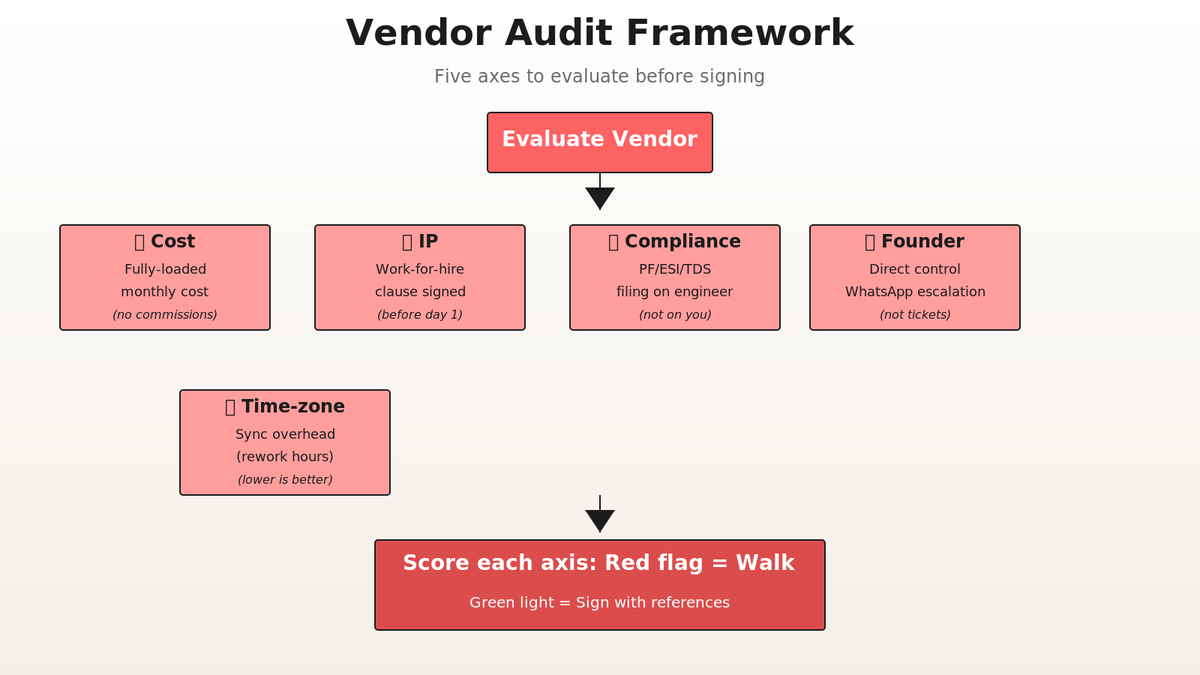
Q11.How does India-native EOR compare to agency outsourcing?
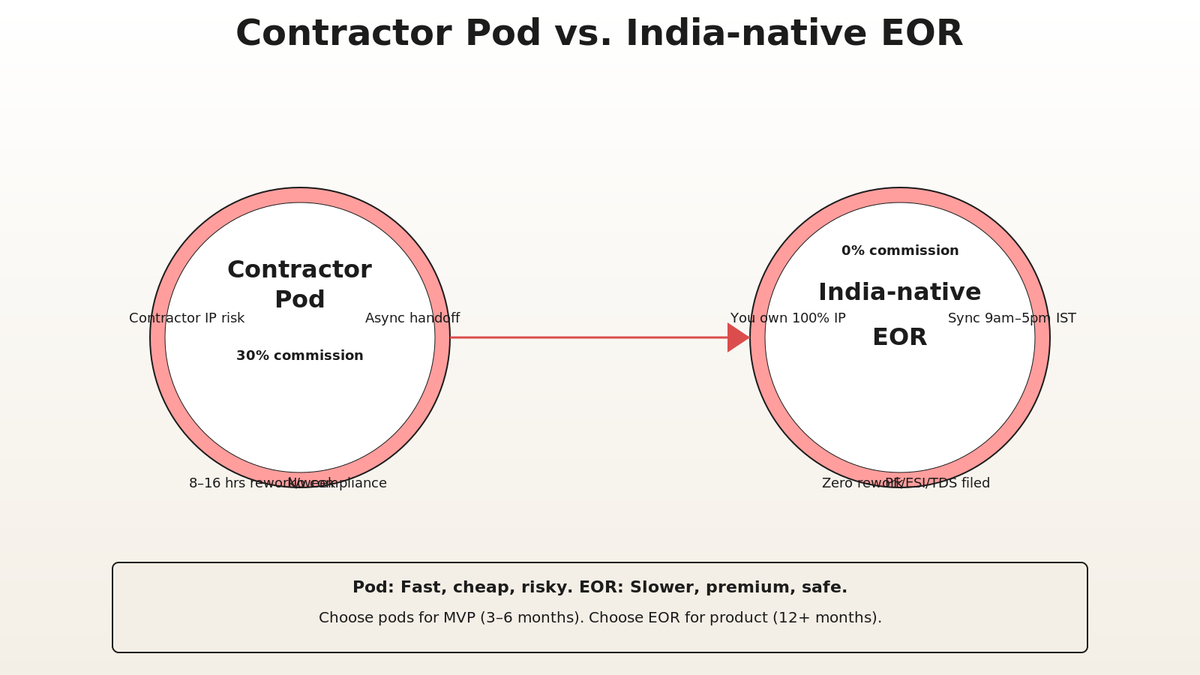
The honest comparison: India-native EOR (like Versatile) is for founders ready to build a long-term team. Agencies are for projects with defined scope and fixed duration.
EOR advantages: you hire the person directly (they report to you, not an agency manager), you control their backlog and priorities, they're invested in your company's success over quarterly billing cycles, and you own them completely once the relationship works. Cost is lower ($149/emp/month flat, first month free) because Versatile handles payroll + compliance only; you're not paying agency markup.
EOR disadvantages: you're now managing people, recruiting is your responsibility (not Versatile's), and you handle performance management. Versatile provides multiple US/UK clients already on the same entity, zero compliance notices in 4 years, 5-day SLA on payroll + statutory, and PF/ESI/gratuity across 28 Indian states. But you're still the hiring manager.
Agencies are simpler: "Here's your team. We manage them. You pay us monthly. Done." But you lose autonomy, and you're paying 40–50% more for that convenience.
Decision: if you're building a permanent .NET team (3+ headcount), EOR is cheaper and better. If you're outsourcing a 4-week project or need senior mentorship for 2 months, agencies.
Q12.What's the decision framework for your next .NET hire?
Use this grid to pick your vendor:
| Your situation | Best fit | Cost | Time to first PR |
| Bootstrapped, need team in 3 weeks | Gun.io or Dev.pro agency | $15K–$25K/mo | 2–3 weeks |
| Need one senior architect, part-time | Toptal or Upwork | $4K–$8K/mo | 3–5 days |
| Building long-term team >3 devs, want control | Versatile EOR | $5K–$10K/mo* | 5 days (SLA) |
| Need DevOps + infrastructure expertise | XRay Tech + Gun.io hybrid | $12K–$20K/mo | 2 weeks |
| Non-critical feature sprint, cost sensitive | Accel or CloudFactory | $8K–$12K/mo | 1 week |
FAQs
Do I really own the IP if I hire offshore?
Yes, but you need to enforce it. Get a work-for-hire addendum signed before they start. Keep code in your GitHub org, not theirs. Request monthly IP transfer statements. If using India-native EOR, the person is your direct employee, so their code is unambiguously yours under Indian employment law.
What's the FX risk if I hire in India?
INR/USD moves 3–5% per quarter. If you budget $100K/year for a $8K/month developer, a 5% swing means an extra $500/month. Lock in rates for 6–12 month periods. Diversify across multiple hires (currency risk decays). Use transfer services (Wise, OFX) that offer better rates than bank wire.
How do I handle timezone coordination?
India is 9.5–13.5 hours ahead of US time zones. Plan daily async updates (Slack, Loom videos, GitHub PRs as your communication). One 30-minute overlap window per day (morning US time, evening India time) for critical decisions. Use GitHub Issues and PR comments as your source of truth, not Slack. Don't expect real-time chat.
What's the misclassification risk?
If you hire someone as a contractor but direct their work daily, set their hours, or treat them as an employee, tax authorities (IRS or HMRC) may reclassify them and send you a bill for 6 years of payroll taxes plus penalties ($25K–$40K per head). Avoid this: use EOR (Versatile handles the employment contract), not 1099 contractors.
How does Versatile differ from hiring directly via Upwork?
Upwork is you hiring a contractor. Versatile is Versatile hiring an employee on your behalf under an Indian employment contract. You get statutory compliance (PF, ESI, gratuity), no tax exposure, and a 5-day SLA on payroll. Contractors (Upwork, Toptal) are self-employed; you handle visa sponsorship if they move, tax reporting, and no benefits. For long-term .NET team building, EOR eliminates compliance risk.
Q2.5. How does contract flexibility actually work in practice?
Most founders assume offshore contracts are flexible. In reality, they're not. Here's what time-and-materials, fixed-price, and retainer models actually deliver. T&M: you pay hourly, scope creeps into cost. Fixed: you define scope, they commit to delivery; "build a .NET Core API" can mean 2 weeks or 6 weeks depending on auth, validation, and deployment details. Retainer: flat monthly fee for X hours. Versatile EOR uses a hybrid: flat $149/emp/month compliance fee plus person's salary. Real flex comes with EOR: scale team size real-time, you own their entire time (no other clients), pivot priorities without renegotiating. Agencies will hit you with change orders if you try that.
Q3.5. Why most founders regret their first offshore hire (and how to avoid it)
Most founders' first offshore hire goes wrong not because offshore is bad, but because founders don't know what "bad" looks like. Regret #1: hiring speed over depth audit. You're excited, you hire the first agency that says yes, 40 days in they've copy-pasted from StackOverflow with 0% test coverage and you've lost $10K + 6 weeks. Better: spend 2 weeks vetting, ask for GitHub repos, do code review, ask them to pair-program for 4 hours paid. If they won't, they're not confident in their own code. Regret #2: communication overhead burns your energy. You thought offshore meant hire-and-forget, instead you're Slack-ing every 3 hours, they're in bed when you wake up, async standup takes 45 minutes to parse. Better: hire a tech lead locally (same timezone) who owns the offshore relationship; you just review PRs weekly. Cost goes up 15–20%, worth it for >3 devs offshore. Regret #3: fixed-price project scope becomes a lawsuit. You said "build a REST API." They built API with zero auth, no rate limiting, backups at 2 AM during live traffic. Legally delivered; practically garbage. Better: use time-tracked engagements with detailed acceptance criteria (staging parity, 10K RPS load tested, Application Insights monitored, OWASP top 10 zero findings). Regret #4: they disappear after contract ends. Zero knowledge transfer. Code 100% dependent on one person. When they leave, you're reverse-engineering their work. Better: hire via India-native EOR, make knowledge transfer formal (weekly brown-bags, pair programming recorded, code reviewed by multiple people). Pattern: regrets happen when you optimize for speed or cost. Best offshore hires come from founders disciplined about vetting, communication structures, and knowledge transfer upfront.
Q11.5. The real India-native EOR advantage: founder-level control
Versatile is positioned as payroll plus compliance, but real value is founder control. When you hire via agency, the vendor owns relationship architecture: they decide standup meetings, tools (Jira, Monday, Asana), code review process, whether your feedback gets prioritized or deprioritized based on their other clients. You're a customer. When you hire via Versatile EOR, you own everything. Person reports to you, uses your tools, follows your process, prioritizes your roadmap over anyone else's. You set work schedule (async, synchronous, 9-to-5, flexible). You decide if they pair or work independently. You own the relationship from day 1. This matters for one reason: founder intuition. You know in 2 weeks if person is a fit. With agency, you're locked in 3–6 months. With EOR, you adjust team composition weekly. Someone isn't working? They're off the team. Someone crushing it? You give bigger projects and more equity (subject to Indian employment law, which Versatile navigates). Versatile's proof stack (multiple US/UK clients on entity, 0 compliance notices in 4 years, 5-day SLA) means you get compliance safety of vendor plus flexibility of direct hire. That's the unlock. You're not paying for payroll admin; you're paying for compliance indemnification plus ability to own your team. Cost: $149/emp/month flat plus employee salary ($12K–$20K/year locally). At 3 developers, that's roughly $450/month Versatile fee plus roughly $54K/year total salary equals $4,500/year organizational overhead for a team of 3. Compare to agencies at $15K–$25K/month for same 3 devs (roughly $180K–$300K/year). You save $125K–$295K annually and own the relationship completely.
Q14. What compliance gaps do founders typically miss when hiring offshore?
Offshore hiring without compliance clarity is how founders lose money. Misclassification risk ($25K–$40K per head): if you hire "contractor" but direct their work, set hours, or provide tools, IRS or HMRC will reclassify them as employee. Suddenly you owe 6 years of payroll taxes, Social Security, Medicare, unemployment insurance. For contractor billing $60K/year, bill is roughly $12K–$15K per year times 6 equals $72K–$90K in back taxes plus penalties. For 3 contractors, that's $216K–$270K exposure. Safe: use EOR (Versatile handles employment contract, you're indemnified) or hire W-2 employees. FX risk isn't hedged ($3K–$5K per employee per year): INR trades 70–85 per USD. Q2 2024 saw 4% swing in a month. If you budget $12K/year per developer and lock in 78/USD but rate moves to 75/USD, costs drop 4% naturally. Swing to 82/USD costs you 5% more. Over 3 developers, that's $1,800–$3,000 swing per quarter. Better vendors (Versatile, XRay) offer 6–12 month rate locks. Withholding tax and TDS (Tax Deducted at Source) claim 10–30% of salary: India requires employers to withhold TDS on non-resident payments. If you're US company paying Indian contractor, they owe TDS (roughly 10–15% on payments). If you don't know about it, you're liable for double-tax: they pay TDS in India, then owe US tax on remainder, then you get audited for not withholding. Versatile handles this. Employment law changes (Labour Codes 2025): India consolidated 44 labor laws into 4 Labour Codes effective 21 Nov 2025. PF contributions, gratuity calculations, termination procedures changed. Versatile re-aligned payroll in Q4 2024. If you hire direct or via agency that doesn't stay current, you're exposed to non-compliance penalties (roughly 5–10% of payroll). Data residency under DPDP Act: India's Digital Personal Data Protection Act (DPDP) requires certain personal data to reside in India. If your offshore developer's Slack messages, GitHub commits, or performance reviews are logged on US servers, you might violate the Act. Versatile navigates this via employment contracts clarifying data handling. Contractors (Upwork, Toptal) often don't. Sum: compliance risks cost $25K–$100K+ per employee if you get it wrong. Using Versatile EOR ($149/emp/month, first month free) eliminates that risk entirely. It's not just payroll; it's indemnification.
Q15. What's the realistic timeline from "I want to hire" to "they're shipping code"?
Most founders underestimate hiring timelines offshore. Days 1–7 (Recruitment): you post job, review resumes, interview candidates. With Versatile EOR, this is your job. Expect 20–40 applicants, 8–12 interviews, 2–3 serious candidates. Days 8–14 (Onboarding): candidate accepts, Versatile sends employment contract (standard, negotiable), background check (3–5 days), agreement signed. Person is officially your employee under Indian law. Versatile handles PF registration, system setup, bank account verification, tax ID (PAN). Total: 5–7 days if no delays. Days 15–21 (Tooling): GitHub access, Slack workspace, project management tool, cloud credentials, SSH keys, API keys. Do 2–3 pair-programming sessions with your team or tech lead to unblock them on your codebase. They're reading code, asking questions, setting up dev environment. Days 22–30 (First PR): small, low-risk change (documentation, test, refactoring). Code review. Deployed to staging. No production yet. They understand your deployment pipeline and PR culture. Days 31–60 (Ramp-up): medium PRs, feature work, bug fixes. Shipping code to production. Communication cadence established (standup timing, async updates, escalation paths). Pair programming 1–2x per week if junior. Days 61–90 (Full productivity): shipping features without handholding. They understand architecture, trade-offs, product vision. Mentoring other devs or leading their own project streams. With agencies: add 5–7 days upfront (they handle hiring) but add 7–14 days to ramp because their devs don't own your codebase and have other clients competing for attention. Total: 45–60 days to first production PR, but quality and autonomy lower.
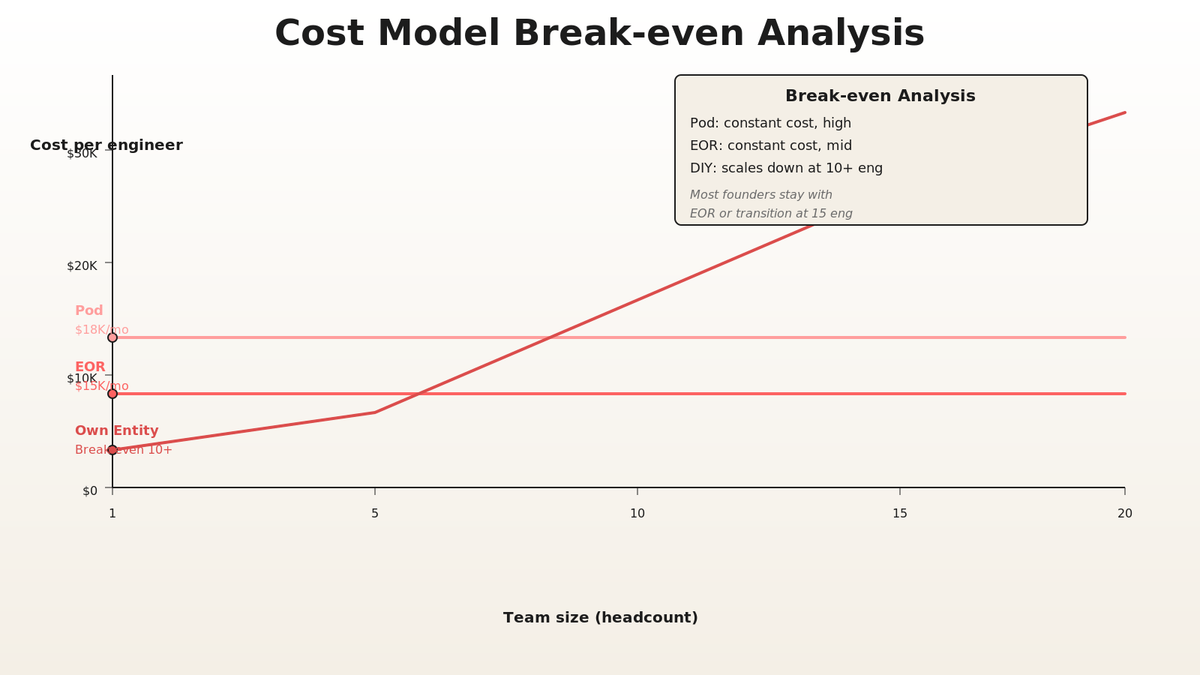
Q16. What's the unit economics of .NET outsourcing at different scales?
| Scenario | 1 dev | 3 devs | 5 devs | 10 devs |
| Toptal/freelance hourly | $60–130/hr | $60–130/hr (no discount) | $60–130/hr (no discount) | $60–130/hr (no discount) |
| Agency (Gun.io, Dev.pro) | $80–140/hr (min 20 hrs/mo) | $50–100/hr blended | $45–85/hr blended | $40–75/hr blended |
| Versatile EOR | $1,500–$2,500/mo | $4,500–$7,500/mo | $7,500–$12,500/mo | $15K–$25K/mo |
| In-house (US, San Francisco) | $180K–240K + overhead | $540K–720K + overhead | $900K–1.2M + overhead | $1.8M–2.4M + overhead |
Break-even analysis: 1 developer via Versatile EOR costs roughly $1,500–$2,500/month (salary plus compliance fee). 1 developer via Toptal costs roughly $4,800–$10,400/month (160 hours times $60–130 blended rate). You save 60–75% with EOR if hiring 1+. Agencies break even around 3–4 devs because they discount for volume. Toptal never discounts. Versatile scales linearly (add a dev, add $1,500/month). For teams >5 devs, Versatile is cheapest model by 50–70% vs. agencies. Trade-off: with Versatile, you manage hiring and onboarding. With agencies, they do it for you (and charge for convenience). With Toptal, you're buying single engineers with no team cohesion. Optimal play for startups: hire first dev via Toptal (speed plus low commitment). If it works, move them to Versatile EOR (cost reduction, ownership increase). Build to 3 devs via Versatile. If you need team faster than you can hire, layer in agency for 6-week sprint project. Once you're >10 devs, consider building entity in India (2–3 year payoff) or establishing offshore office (5+ year commitment).
Where my head is right now
Over the next two years, offshore .NET talent will become the default for US/UK founders under Series B. The stigma is gone. But agency selection will become more competitive, not less. Vendors will differentiate on DevOps maturity, Azure depth, and founder accessibility, not just hourly rate.
The real unlock: founders hiring directly via India-native EOR will have measurably higher retention and team stability than those cycling through agencies. You build culture with the person, not a vendor.
If you are a bootstrapped founder looking to hire your first 1–3 .NET engineers and you want control + compliance clarity, message me directly on WhatsApp through our contact page, or book a consultation with us. You will be talking to the founder, not a ticket. What's your team size today, and how fast do you need to move?