Table of contents (12)
Hiring in India: EOR vs Staffing Agency - Key Differences Explained (2026)
Q1: What's the real difference between an EOR and a staffing agency in India?
An Employer of Record (EOR) becomes the legal employer of your India hire. It runs PF, ESI, TDS, gratuity, and every statutory filing under its own registrations while you direct the work. A staffing agency sources and supplies talent but is not your legal employer. In short: an EOR sells compliance and employment; a staffing agency sells placement.
🧩 The mix-up that costs founders real money
A US founder messaged me last year, sure she had "hired through an agency" in Bengaluru. She hadn't. She had a recruiter invoice and no legal employer on record.
That gap is where trouble starts. Most founders treat "staffing agency" and "EOR" as the same shop. They are not. One finds people. The other employs them. Our EOR services in India exist to close exactly that gap.
🔍 Concept: placement versus legal employment
Here is the clean mental split. A staffing agency is a matchmaker. It sources candidates, sends resumes, and often stops once you say yes.

An EOR is the employer on paper. It signs the compliant contract, deducts and deposits taxes, and carries the statutory duties under Indian labour law. You still manage the person day to day. The EOR just holds the legal employment relationship so you don't need an Indian entity.
The distinction traces back to who the law recognizes as the employer. Under India's contract-labour framework, employment status, not a placement invoice, decides who owns compliance liability.
⚙️ Example: same engineer, two very different setups
Say you want one backend engineer in Pune.
- Through a staffing agency: they shortlist three candidates. You pick one. Who pays PF, files TDS, and issues Form 16? Often nobody has clearly agreed, and that ambiguity is the risk.
- Through an EOR: the EOR employs the engineer, runs payroll, files PF and ESI under its own codes, and sends you one invoice. Our EOR onboarding process follows exactly this route.
I'll be honest about our own path here. At Versatile Club, we ran Contract-to-Hire first, so we learned this the hard way. Sourcing is the easy part. Being the legal employer, filing across multiple states, and standing behind those filings is the hard, regulated part.
My blunt take, and I could be slightly off on the edges: many offshore "source-and-select" providers are not EORs at all. They quietly sit on top of one. If a vendor only hands you resumes, ask who the legal employer will be before you sign anything.
💬 What buyers say
"WiseMonks EOR service solved our biggest challenge, which was hiring employees in India without setting up a local entity. They manage employment contracts, statutory compliance, tax structure, and local regulations on our behalf."
- Verified User in Marketing and Advertising, Wisemonk G2 - Verified Review
"They acted as the Employer of Record in India so we didnt have to register anything ourselves, they were the legal employer on paper, we just managed the person day to day."
- Angad S., Founder Versatile Club G2 - Verified Review
Q2: Who carries the legal and tax liability, principal-employer risk and PE exposure?
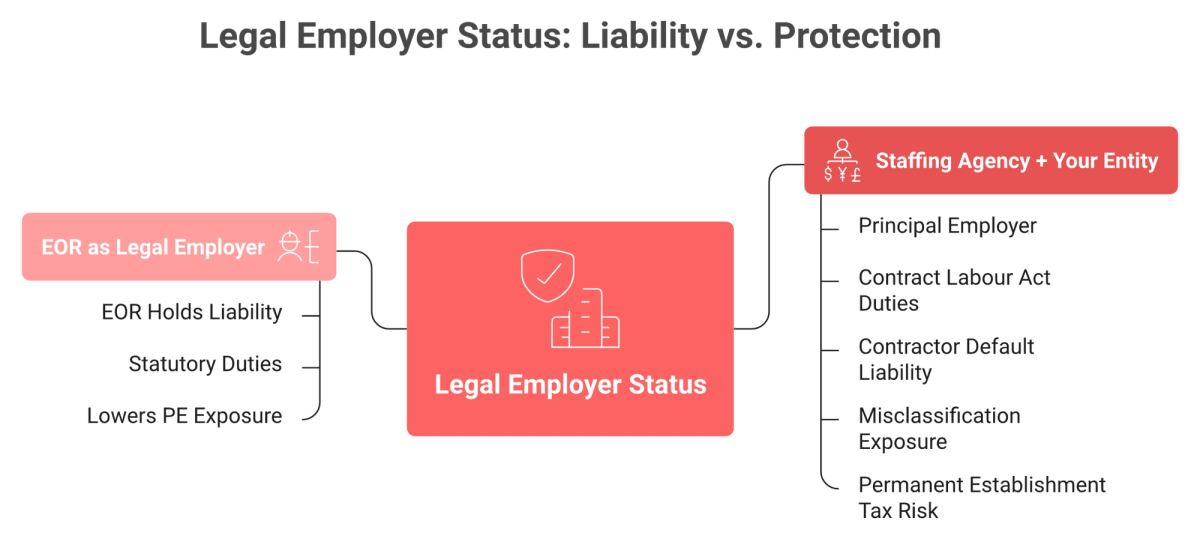
The party named as legal employer carries the compliance liability. With an EOR, that party is the EOR. It owns PF, ESI, TDS, and gratuity. With a staffing agency and your own entity, you can become the "principal employer" under the Contract Labour Act, and stay liable if the contractor defaults. That can expose you to roughly $25,000 to $40,000 per head, plus permanent-establishment tax risk.
⚠️ The pain: a bill you did not budget for
Misclassify one "contractor" who is really an employee, and the back-pay math gets ugly fast. Across cases I've watched, the exposure lands around $25,000 to $40,000 per head once you add unpaid PF, gratuity, and penalties.
That is real cash. It sits outside your ad spend and your runway, and it usually surfaces at the worst time. Our compliance coverage is built to keep that exposure off your books.
📜 Proof: what the Contract Labour Act actually says
Here is the governing thought. In India, liability follows legal-employer status, not convenience.
The Contract Labour (Regulation and Abolition) Act, 1970 makes this concrete:
- Section 20: where 20 or more contract workmen are engaged, "principal employer" duties kick in.
- Section 21: if the contractor fails to pay wages, the principal employer must pay them.
So a staffing arrangement does not automatically shield you. If you hold an Indian entity and use contract labour, the law can treat you as the principal employer on the hook.
🕘 The deference signal most founders miss
One American manager told me her Bengaluru team member asked permission, over chat, every time he took his dinner break. She said he didn't need to. He insisted, "because I'm your subordinate."
That deference is a classic employee signal, not a contractor one. Tax and labour authorities read the substance of the relationship, not the label on the invoice. If it walks and talks like employment, it is employment. This is a core theme in our independent contractor versus EOR guide.
🌍 Proof: permanent establishment risk for the parent
There is a second, quieter risk. If your foreign company effectively runs people in India through dependent agents, you can trigger a Permanent Establishment (PE), which is a taxable presence in India.
A PE can drag your parent company into Indian corporate tax. A compliant EOR, acting as the on-record employer, helps keep that exposure off your books.
✅ The payoff: move liability off your balance sheet
An EOR absorbs both problems at once. Statutory liability sits with the EOR, and the employment-on-record structure lowers PE risk for your parent.
At Versatile Club, we hold this liability directly. PF, ESI, TDS, and professional-tax filings run under our own registrations, not a third party's. That is the difference between renting compliance and owning it. You can see how our EOR services structure this.
💬 What buyers say
"The PF transfer for employees after terminating their employment with Velocity was very poor. There was limited help, delayed responses... they charged heavily per employee and the backend HR services they provide is extremely poor."
- Verified User in Computer Software, Velocity Global G2 - Verified Review
"Versatiles Employer of Record India setup eliminated all of that. I get a single USD invoice, fully compliant employment contracts, and payroll runs on time every month. No entity setup, no CA juggling, no statutory filing stress."
- Vedant T., Founder Versatile Club G2 - Verified Review
Q3: Can a foreign company without an Indian entity even use a staffing agency?
Generally, no. Without an Indian entity, you cannot be a "principal employer" under the Contract Labour Act, so a staffing agency cannot serve as your lawful employment proxy. US-style co-employment PEO does not legally exist under Indian labour law. For a company with no entity, an EOR is the compliant path. A PEO only fits once you have your own entity.
🚧 The shortcut founders reach for
Most first-time India hirers want a clean shortcut. "Can't I just pay a staffing agency and skip the entity?" I hear this weekly on WhatsApp.
It feels efficient. It is also a trap, because the law needs someone to be the legal employer, and a resume invoice is not that.
🧾 Why the PEO shortcut does not exist here
In the US, a PEO works through co-employment, where you and the PEO share employer status. That model does not map onto Indian labour law. Co-employment is not a recognized structure in India, as we explain in our PEO in India guide.
Two things follow from that:
- Without an Indian entity, you cannot be a principal employer under the Contract Labour Act.
- So a staffing agency cannot legally stand in as "your" employer. Someone with an entity must be the legal employer.
That someone is an EOR. It already holds the Indian entity and the statutory registrations, so it employs the worker for you.
✅ The honest path: EOR now, PEO later
Here is how I frame it for founders, and where my head is right now on sequencing:
- No entity yet: use an EOR. It is the only compliant way to employ in India fast.
- Once you scale: set up your own Indian entity, then run a PEO or payroll model on top. Our EOR versus entity calculator shows where that switch pays off.
At Versatile Club, we give US and UK founders the unglamorous version of this. With no Indian entity, an EOR is your only compliant option, and we own that entity for you. When you outgrow it, we help you migrate to your own entity cleanly, a path we map in our EOR versus entity in India comparison.
Q4: EOR vs staffing agency in India: the side-by-side comparison
Across the criteria buyers care about, legal-employer status, liability, pricing, onboarding speed, IP assignment, and exit, an EOR takes on the employment and compliance while a staffing agency handles sourcing and supply. EORs charge a flat per-employee fee. Staffing agencies charge a percentage of CTC. The table below shows exactly how each model differs.
📊 The comparison at a glance
I kept this to the eight rows founders, People Ops leads, and CFOs actually ask me about. Versatile Club sits in the first column so you can see the model, not a pitch. You can also check live numbers with our pricing page.
| Criterion | Versatile Club (India EOR) | Generic EOR | Staffing agency |
|---|---|---|---|
| Legal employer | Yes, own Indian entity | Yes, often via partner shell | No, sources only |
| Principal-employer liability | Held by Versatile | Held by EOR | Can fall on you |
| Entity required in India | No | No | Yes, for you to employ |
| Compliance ownership | PF, ESI, TDS, PT under our codes | EOR's codes | Ambiguous |
| Pricing model | Flat per-employee fee, no setup or exit fee, first month free | Flat fee, e.g. Deel around $499 to $699/mo | Percent of CTC markup |
| Onboarding speed | 5-day contractual SLA | Often 1 to 2 weeks | Varies by search |
| IP assignment | Direct, entity-owned | Via partner | Weak, not the employer |
| Best fit | First India hires, long-term roles | Multi-country teams | Temp or bulk placement |
💡 How to read this table
Match the column to your situation, not to the cheapest sticker price.
- No Indian entity and a long-term hire? An EOR is your lane.
- Already have an entity and need short-term bodies? Staffing can work.
- Want one legal employer plus culture-fit screening? That is the India-native EOR case, which is what our solution for startups is built around.
One honest caveat. If you need 5-plus countries at once, a global generalist covers more map than we do. We operate only in India, by design, and I'd rather say that plainly than oversell. If you're weighing us against the big platforms, our Deel alternative breakdown lays out the trade-offs.
💬 What buyers say
"I find Deel to be absurdly expensive. They charge a high amount of fees for transferring money to my bank account."
- Juan Camilo O. Deel G2 - Verified Review
"It replied to our form in about four hours with a draft offer letter already attached. The hire was onboarded in four days. USD invoice landed clean, no FX markup, no setup fee, no surprises."
- Verified User, US Startup Founder Versatile Club G2 - Verified Review
"There majority of their support team is helpful, but... Everything was VERY time consuming. It took three months to onboard our first 3 individuals."
- Verified User in Information Technology and Services Deel G2 - Verified Review
Q5: What does each model actually cost in 2026?
EOR pricing is a flat per-employee fee, roughly $99 to $700 per month. Staffing agencies charge 8 to 20 percent of the employee's CTC (Cost to Company, the full annual pay package). Because the staffing markup scales with salary, the flat EOR fee is usually cheaper for mid-to-senior hires. Staffing can be cheaper for low-wage or short-term bulk roles. Under the 2026 wage rules, the true statutory cost has also risen.
💰 The quote that looks cheap until it isn't
A CFO once forwarded me a "$99 per month" EOR quote, thrilled. Two months in, the FX line, the setup fee, and the deposit surprised her.
Sticker price is not total cost. The real number hides in transfer fees, currency markups, and add-ons that surface after you sign. Our transparent pricing is built to remove exactly those surprises.
📊 The math: flat fee versus percent of CTC
Here is the crossover, using round numbers so you can redo it yourself.
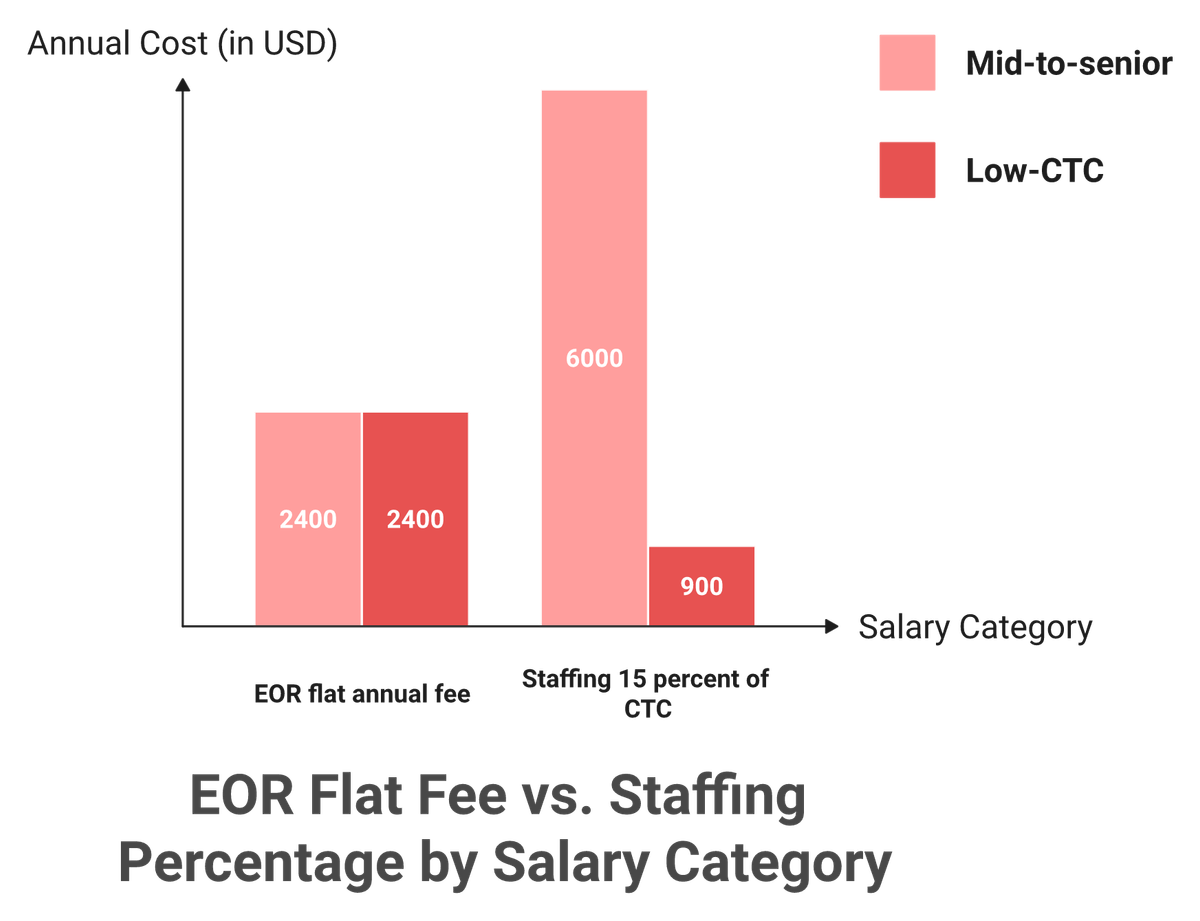
- EOR (flat fee): say $200 per month, or $2,400 per year, no matter the salary.
- Staffing (percent of CTC): 15 percent of a $40,000 CTC is $6,000 per year.
So for a mid-level or senior hire, the flat EOR fee usually wins. For a $6,000 CTC support role, that same 15 percent is only $900, and staffing looks cheaper. Salary level decides the answer, not the marketing. You can model your own numbers with our salary calculator.
💸 The hidden lines that wreck the model
Two traps quietly push your total cost past the headline.
- FX markup: some global platforms add a currency spread on every payout. Deel users report roughly a 3 to 5 percent markup, which is real money on a full team.
- Opaque tiers: Wisemonk's per-tier pricing across salary bands is not fully transparent, so your effective rate can drift.
I could be slightly conservative here, but from what surfaces when you actually run payroll, FX is the line founders forget and CFOs catch at month-end close. Our breakdown of employer of record cost unpacks these add-ons in detail.
✅ How to demand a clean quote
Ask three questions before you sign anything:
- What is the all-in monthly fee, including FX and setup?
- Are there deposit, offboarding, or exit fees?
- Does the quote reflect the 2026 statutory loading (more on that next section)?
At Versatile Club, we invoice in USD from our own Indian entity. One line, no FX markup, no setup or exit fee, and the first month is free. To be fair, if you need 5-plus countries, a global platform spreads that fee across more geographies than we do. If you are comparing us head-to-head, our Deel alternative page lays out the numbers.
💬 What buyers say
"I dislike how expensive Deels transaction fees are, especially when moving money from the Deel account to my bank."
- Maria M. Deel G2 - Verified Review
"There are hidden fees. Of course, again, also here... You will never get your net-agreed salary through Deel."
- Ibrahim Deel G2 - Verified Review
"Invoicing in USD meant zero exchange rate surprises... Five-day onboarding, zero late payslips."
- Vedant T., Founder Versatile Club G2 - Verified Review
Q6: Which Indian statutory obligations apply, and how did the 2025-26 Labour Codes change them?
Hiring in India means running PF, ESI, TDS, gratuity, professional tax, and Shops and Establishments registrations correctly. Since 21 November 2025, the four Labour Codes require Basic plus DA (Dearness Allowance, a cost-of-living top-up) to be at least 50 percent of CTC. That makes EPF mandatory for all establishments with 20-plus employees, and ESIC coverage pan-India. The higher base raises the true statutory cost of both EOR and staffing.
⏰ The headline: what changed on 21 November 2025
The most important fact first. India's four Labour Codes came into force on 21 November 2025.
The rule that hits your payroll hardest: Basic plus DA must be at least 50 percent of total CTC. Higher basic means higher provident-fund and gratuity contributions, so take-home dips slightly and employer cost rises. Our payroll compliance in India guide tracks every one of these changes.
📋 The statutory checklist inside a live payroll cycle
Here is what we actually file each month, in plain terms.
- PF (Provident Fund): retirement savings, 12 percent employer contribution on Basic plus DA.
- ESI (Employee State Insurance): health cover, split 3.25 percent employer and 0.75 percent employee.
- TDS (Tax Deducted at Source): income tax, deducted and deposited by the 7th of each month.
- Gratuity: a service payout, accrued from month one at 4.81 percent of Basic plus DA.
- Professional tax (PT): a state levy. Maharashtra needs dual registration (PTRC plus PTEC) with monthly slab filing and annual returns.
EPF is now mandatory for all establishments with 20-plus employees, and ESIC runs pan-India, so "we'll skip PF" is no longer an option. State PT rules stay messy: Karnataka files monthly, Tamil Nadu is biannual, Delhi has no PT but strict Shops and Establishments rules. This multi-state depth is the backbone of our compliance function.
✅ Your Monday action
Ask any EOR or staffing quote to show statutory loading on a 50-percent-basic structure. If they can't, they are quoting a pre-2025 number.
When the 50 percent rule landed, we re-modelled every client's payroll ourselves at Versatile Club. That is the difference between owning the entity and reselling one. We hold PF, ESIC, and Shops and Establishments registrations across all 28 states and 8 union territories, so the multi-state PT maze is our problem, not yours. See how our managed payroll and EOR services in India handle it end to end.
Q7: Which model protects your IP, data, and audit-readiness?
An EOR that owns its Indian entity gives you cleaner IP (intellectual property) assignment and direct control over statutory filings, which matters when investors run due diligence. Under the DPDP Rules 2025, the legal employer is a Data Fiduciary, the party responsible for employee personal data. Staffing arrangements and partner-shell EORs add a layer between you and your compliance records, which weakens audit-readiness.
⚠️ The pain: due diligence finds the gaps
Here is my governing view. Before a funding round, a messy India setup is you "running with scissors."
When investors run due diligence, they check who owns the employment records and the IP assignments. If those sit with a partner shell you have never met, that gap becomes a diligence flag at the worst moment.
📜 Proof: DPDP duties and who actually holds the entity
Two pillars matter here.
- Data responsibility: the DPDP (Digital Personal Data Protection) Rules 2025 were notified on 19 November 2025. The legal employer becomes a Data Fiduciary for employee data, with consent-notice and breach-notification duties on a phased timeline.
- Entity control: many global EORs run India through a local partner entity. If your provider is an aggregator without an owned entity, you lose direct control over statutory filings and clean IP protection.
I might be blunt here, but the standard read gets this backwards. Founders obsess over price and ignore who legally holds their engineer's IP and data. Our owned-entity model is designed to close that gap.
✅ The payoff: what audit-ready looks like
Audit-ready means one place holds it all: contracts, IP assignments, and statutory filings, under a single entity you can point an investor to.
At Versatile Club, we own the Indian entity, Foo Falcon Technologies Pvt Ltd. We are not a reseller. Your employment records, IP assignments, and filings sit in one place we control and can produce on request. This is a core reason enterprises and funded startups pick our EOR services.
💬 What buyers say
"The PF transfer for employees after terminating their employment with Velocity was very poor. There was limited help, delayed responses."
- Verified User in Computer Software Velocity Global G2 - Verified Review
"The compliance rigour is genuinely impressive, every statutory filing reviewed before submission."
- Vedant T., Founder Versatile Club G2 - Verified Review
Q8: Does a staffing agency give you compliant hires, or hires who actually stay?
Compliance is the floor, not the ceiling. A staffing agency or a compliance-first EOR can hand you a legally clean hire who is still the wrong hire. The harder problem is the "good hire that stays," which means culture-fit, verified credentials, and retention. With nearly 30 percent of Indian IT resumes containing discrepancies, background verification and culture-fit screening matter as much as the paperwork.
🧩 The common view: "compliance means solved"
Most vendors sell you the same promise. Get the contract legal, file the PF, and the hiring problem is done.
I think the standard read gets this backwards. A legal hire on paper is not the same as a good hire who stays.
❌ The flaw: paper-clean but wrong
Two realities break the "compliance equals solved" story.
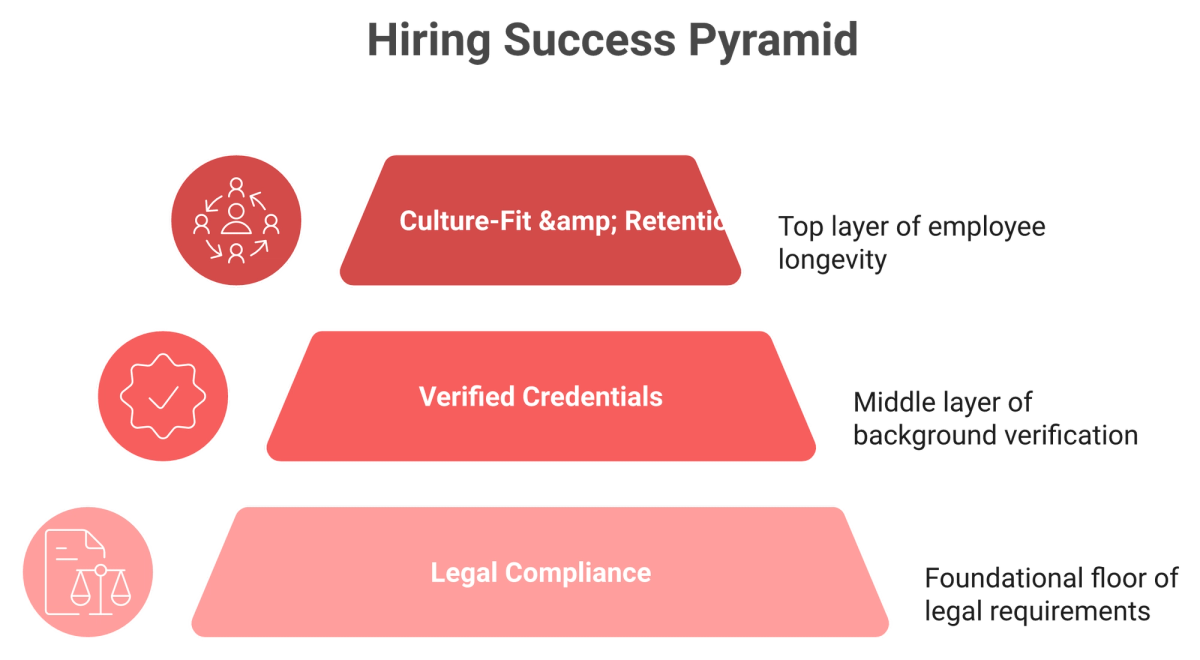
- Resume fraud: nearly 30 percent of India IT-sector resumes contain discrepancies, per industry background-verification data. So the paperwork can be perfect while the person is misrepresented.
- Wrong-fit placement: a staffing agency optimizes for filling the seat, not for the person thriving in your specific team.
One client interviewed a candidate they believed sat in London. Only after the third interview did they realize he was actually based in Greece. The label was clean. The reality wasn't, and they came to us to employ the right person properly. Our recruitment process is built to catch exactly this.
✅ The better view: screen for staying
Compliance is table stakes. Retention is the real game, and almost no competitor owns this territory.
At Versatile Club, we hire culture-fit-first against 50 behavioral parameters, run background verification, add a 90-day Success Coach, and back it with a 6-month replacement guarantee. A legal hire who quits in month four helped nobody. You can test the approach with our culture fit quiz, or see how our contract-to-hire model de-risks the first 90 days.
One honest note. You don't go to India for cheap labour. You go for highly academically intelligent people who deserve a real employer, not a placement invoice.
💬 What buyers say
"Ive noticed that their support/query responses can occasionally take a bit longer sometimes, likely due to a relatively small team."
- Verified User in Financial Services Wisemonk G2 - Verified Review
"For us, it was important to hire people who understood both craft and pace, and Versatile made that process feel much simpler."
- Ibrahim A. Versatile Club G2 - Verified Review
"The candidates quality met our expectations. If youre looking for a reliable partner for hiring in India... Versatile delivers without the usual hassle."
- Verified User in Venture Capital and Private Equity Versatile Club G2 - Verified Review
Q9: Why do global EOR generalists struggle with India specifically?
Global EOR platforms cover 100-plus countries, but often run India through local partner entities, which dilutes compliance depth and control. Buyers repeatedly report FX (foreign exchange) markups, ticket-queue or chatbot support, invoice errors, and rotating account managers. For an India-first hire, a specialist that owns its Indian entity and knows all 28 states' statutory quirks usually outperforms a generalist.
🌍 The situation: breadth sold as depth
The pitch is seductive. "Hire in 150 countries from one dashboard." For a company spread across many markets, that breadth is genuinely useful.
India is where the promise thins out. When one platform treats India as country number 87, the multi-state professional-tax maze and the 2025 Labour Codes rarely get first-class attention. Our India-only EOR services exist for exactly that reason.
🚧 The complication: what buyers actually hit
I think of a friend's story about a big enterprise tool. He needed one spending approval, and 20 names had to sign off, including people in a procurement office he'd never heard of.
That enterprise coldness shows up in India EOR support. The documented complaints cluster in three places:
- FX markups: Deel users report a currency spread on payouts, roughly 3 to 5 percent.
- Support rotation: Velocity Global buyers describe cycling through six account managers in two years.
- Chatbot-first help: Rippling users say a bot gives two different wrong answers to the same question.
Add shallow India-specific compliance depth, and the "one platform for everything" promise starts to leak at the seams for an India hire. If you are weighing the big platforms, our Remote alternative and Rippling alternatives for India breakdowns lay out the trade-offs.
✅ The resolution: when a specialist wins
For a first India hire or a growing India team, a boutique that owns its Indian entity usually beats a generalist on depth and speed.
At Versatile Club, India is the only country we operate in, and I'm on WhatsApp directly. That is the opposite of a 20-signature procurement queue. To be fair, if you need 5-plus countries at once, a global platform is the right tool, and I'll say so. You can see how our model works for a single-country India team.
💬 What buyers say
"Weve had no fewer than six account managers in less than two years. More than once, weve learned of changes to our team by receiving an out-of-office auto-reply."
- Verified User in Translation and Localization Velocity Global G2 - Verified Review
"There is no direct phone line. You either email or use a chatbot, and you can ask both the same question and get two different wrong answers."
- Erika D. Rippling G2 - Verified Review
"It took three months to onboard our first 3 individuals. They didnt seem to be able to navigate Visas or variations to employment contracts."
- Verified User in Information Technology and Services Deel G2 - Verified Review
Q10: Can you use both models, and when do you switch to your own entity?
Yes, many companies use both. A staffing agency or recruiter finds the talent, and an EOR becomes the legal employer. As you scale, the tipping point to your own entity is usually around 10 to 12 India hires. Below that, an EOR beats the 6-month, tens-of-thousands-of-dollars cost of a subsidiary. Past a dozen hires, an owned entity plus a PEO often wins.
🤝 Using both together
These models are not rivals. They are stages, and they can run at the same time.
A recruiter or staffing agency sources the candidate. An EOR then employs that person legally, running payroll and compliance. You get the agency's reach and the EOR's protection in one flow. Our recruitment and EOR services are built to run exactly this way.
📊 The tipping point, by headcount
Here is how I map the decision, based on what surfaces when clients actually scale.
| Stage | Best fit | Why |
|---|---|---|
| 1 to 12 hires | EOR (plus recruiter to source) | Entity setup costs $50K-plus and 6 to 18 months |
| Around 10 to 12 hires | Decision point | Fixed EOR fees start rivaling entity overhead |
| 12-plus hires | Own entity, then PEO or payroll | Control and per-head economics improve |
One client told me their own tipping point was about a dozen hires. Once they crossed it, they said, "right, we're ready to open our own entity." I could be off by a few heads either way, since funding stage shifts it. Our EOR versus entity calculator lets you find your own number.
✅ The simple rule
Below a dozen India hires, stay on an EOR. Around a dozen, run the entity math. Past it, plan the migration.
At Versatile Club, we'll pair with your recruiter as your EOR today, and tell you honestly when to graduate to your own entity. Then we help you migrate cleanly from EOR to entity-plus-PEO. A specialist unafraid to say "you may outgrow us" is one worth trusting. Our EOR versus entity in India guide walks through the full migration.
💬 What buyers say
"We looked at setting up a subsidiary and quickly realized it would take 6 months, cost tens of thousands in legal and registration fees... Versatile solved that completely."
- Verified User, US Startup Founder Versatile Club G2 - Verified Review
"It let Moonshot hire in India without standing up an entity, which wouldve been overkill for our size."
- Angad S., Founder Versatile Club G2 - Verified Review
Q11: How do you actually manage an India team once they're hired?
Choosing the right hiring model is only half the job. Managing the team well is the other half. In India, high power-distance (the cultural gap between boss and report) means a team member may say everything is fine when it isn't. Recap decisions in writing, ask open questions like "where are we on the schedule?" instead of yes or no ones, and volunteer clarification rather than asking "did you understand?"
⚠️ The pain: "everything's fine" until it isn't
Here is the trap first-time managers fall into. In India, trust is affective, built through the relationship, not just the contract.
If the relationship feels off, a report may tell you the project is fine even as it burns. By the time you learn the truth, the deadline is already gone. Our HR consulting services help managers avoid exactly this.
✅ Three tactics that surface the real status
You can fix most of this with how you ask. India scores 77 on the Hofstede Power Distance Index, versus 40 for the USA, so juniors defer hard to authority.
Work with that reality, not against it:
- Recap in writing. After a call, send an email listing the key points, so nothing hides in "read between the lines."
- Ask open questions. Swap "Are you on schedule?" for "Can you show me the work still left?"
- Verify by volunteering. Instead of "Did you understand?", offer extra clarification and watch whether they accept it.
📋 Your Monday checklist
Keep it simple this week. Recap every decision in writing, replace one closed question with an open one, and volunteer clarification once a day.
At Versatile Club, our 90-day Success Coach sits with your new hire through exactly these moments. That is how "everything's fine" turns into an honest status you can act on. Compliance is the floor here, and the human management layer is where retention is actually won, which is why founders lean on our contract-to-hire and startup hiring support.
Q12: EOR or staffing agency: how do you decide for your situation?
Choose an EOR if you have no Indian entity, want to direct the work long-term, and need liability off your books, which is most founders' situation. Choose a staffing agency if you already have an entity and need temporary or bulk placement. If you want compliant employment plus hires who actually stay, an India-native EOR is the strongest fit.
🎯 The decision, by who you are
Your role changes the answer. Here is how I'd guide each persona after six years of India placements.
- US or UK founder, first hire, no entity: use an EOR. It is the only fast, compliant route.
- People Ops lead, scaling Series A to C: EOR for speed and retention, entity once you pass a dozen hires.
- CFO at a $5M to $50M ARR SMB: EOR for a clean single USD invoice and predictable month-end close.
- Already have an entity, need temp bodies: a staffing agency fits.
If you want to size the numbers first, our pricing and cost of hiring in India guide give you a clear starting point.
✅ Why the risk sits with us, not you
Most vendors make you carry the downside. I think that is backwards.
At Versatile Club, we run a 6-month replacement guarantee, no setup fees, no exit fees, and the first month is free. You are not locked in, and a bad hire is our problem to fix, not yours to eat. See how our EOR services in India structure that guarantee.
One honest boundary. If you need global multi-country coverage, or you're a 100-plus enterprise India team requiring SOC 2 as a procurement gate, we're not your best fit, and I'll say so on the first call. For larger teams, our enterprise solution spells out where we do and don't fit.
💬 What buyers say
"Founder is just a call away. Extremely helpful in resolving all our queries. The process is super smooth to setup India EOR."
- surbhi m. Versatile Club G2 - Verified Review
"Every payroll or PF question gets a real answer from a real person, usually same day... this is the one. Were already lining up our second hire."
- Verified User, US Startup Founder Versatile Club G2 - Verified Review
💬 Where my head is next
Here is the shift I'm betting on over the next two years. India stops being "one country on the global EOR map" and becomes its own specialist category, where owned-entity operators quietly take the generalists' India revenue.
I could be early on the timing. If you're making your first India hire, message me directly and tell me what you're building. The first month is on us.
FAQs
What is the main difference between an EOR and a staffing agency in India?
The difference comes down to one question: who is the legal employer? An Employer of Record (EOR) becomes the legal employer of your India hire. It runs PF, ESI, TDS, gratuity, and every statutory filing under its own registrations while you direct the daily work.
A staffing agency does something narrower. It sources and supplies talent, then usually steps back once you say yes.
- EOR: sells compliance and legal employment.
- Staffing agency: sells placement and sourcing.
In practice, many offshore source-and-select providers are not EORs at all; they often sit on top of one. So if a vendor only hands you resumes, we always suggest asking who the legal employer will be before signing.
We started in Contract-to-Hire before building our EOR, so we learned this split the hard way. You can see how the legal-employer model works through our EOR services in India.
Is an EOR more expensive than a staffing agency in India?
It depends entirely on salary. EOR fees are flat, roughly $99 to $700 per employee per month, no matter what the person earns. Staffing agencies charge 8 to 20 percent of the employee's CTC (Cost to Company).
Because the staffing markup scales with salary, the two models cross over at a predictable point:
- Mid-to-senior hires: the flat EOR fee is usually cheaper.
- Low-wage or short-term bulk roles: staffing can cost less.
Watch the hidden lines too. Some global platforms add a 3 to 5 percent FX markup on payouts, and opaque salary-band tiers can quietly raise your effective rate.
Under the 2025-26 Labour Codes, the true statutory cost has also risen for both models, since Basic plus DA must now be at least 50 percent of CTC.
We invoice in USD from our own Indian entity with no FX markup and no setup or exit fee. You can model your own numbers using our salary calculator.
Can a foreign company without an Indian entity use a staffing agency instead of an EOR?
Generally, no. Without an Indian entity, you cannot be a principal employer under the Contract Labour (Regulation and Abolition) Act, so a staffing agency cannot lawfully act as your employment proxy.
A common assumption trips founders up here. US-style co-employment PEO, where you and a provider share employer status, does not legally exist under Indian labour law.
So the compliant sequence looks like this:
- No entity yet: use an EOR, which already holds the Indian entity and registrations.
- Once you scale: set up your own entity, then run a PEO or payroll model on top.
An EOR is the only fast, compliant way for a no-entity foreign company to employ someone in India, because it is the registered legal employer carrying the statutory duties.
We tell US and UK founders the honest version: with no Indian entity, an EOR is your only compliant option, and we own that entity for you. See how the model works on our how it works page.
Who carries the legal and tax liability under each model?
The party named as legal employer carries the compliance liability. With an EOR, that party is the EOR, which owns PF, ESI, TDS, and gratuity. With a staffing agency plus your own entity, you can become the principal employer and stay liable if the contractor defaults.
The Contract Labour Act makes this concrete:
- Section 20: principal-employer duties trigger at 20 or more contract workmen.
- Section 21: if the contractor fails to pay wages, the principal employer must pay them.
There is a second, quieter risk. Running people in India through dependent agents can create a Permanent Establishment (PE), a taxable presence that drags your parent company into Indian corporate tax.
Misclassifying one contractor who is really an employee can expose you to roughly $25,000 to $40,000 per head once you add unpaid PF, gratuity, and penalties.
As the legal employer, we absorb this liability under our own registrations, which also helps insulate your parent from PE exposure. Explore our compliance coverage for details.
Which Indian statutory obligations changed under the 2025-26 Labour Codes?
India's four Labour Codes came into force on 21 November 2025, and the change that hits payroll hardest is the wage-structure rule: Basic plus DA (Dearness Allowance) must now be at least 50 percent of total CTC.
That higher base raises provident-fund and gratuity contributions for everyone. The statutory backbone you still need to run correctly includes:
- PF: 12 percent employer contribution on Basic plus DA.
- ESI: split 3.25 percent employer and 0.75 percent employee.
- TDS: deducted and deposited by the 7th of each month.
- Gratuity: accrued from month one at 4.81 percent of Basic plus DA.
- Professional tax: a state levy with different rules per state.
EPF is now mandatory for all establishments with 20-plus employees, and ESIC runs pan-India. State professional-tax rules stay messy, with Maharashtra needing dual PTRC and PTEC registration.
We hold registrations across all 28 states and 8 union territories, so this maze is our problem, not yours. Learn more in our payroll compliance in India guide.
Can you use a staffing agency and an EOR together?
Yes, and many companies do. These are not rivals; they are stages that can run at the same time. A recruiter or staffing agency sources the candidate, and an EOR then employs that person legally, running payroll and compliance.
This combination gives you the agency's reach plus the EOR's legal protection in one flow. It is especially useful for a first India hire, where you want both good sourcing and clean employment.
As you scale, a natural tipping point appears:
- 1 to 12 hires: stay on an EOR, since a subsidiary costs tens of thousands and 6 to 18 months.
- Around 10 to 12 hires: run the entity math.
- 12-plus hires: consider your own entity, then a PEO on top.
We pair with your recruiter as your EOR today, and tell you honestly when to graduate to your own entity, then help you migrate cleanly. Test your own number with our EOR versus entity calculator.
How do global EOR generalists compare to India-specialist EORs?
Global EOR platforms cover 100-plus countries, which is genuinely useful if you hire across many markets. The trade-off shows up in India, where they often route operations through a local partner entity, diluting compliance depth and control.
Documented buyer complaints tend to cluster in a few places:
- FX markups: a currency spread of roughly 3 to 5 percent on payouts.
- Support rotation: cycling through multiple account managers.
- Chatbot-first help: slow or inconsistent answers on India-specific questions.
Add shallow multi-state and Labour-Code depth, and the one-platform promise can leak for an India hire.
For a first India hire or a growing India team, a specialist that owns its Indian entity and knows all 28 states usually wins on depth and speed. To be fair, if you need 5-plus countries at once, a global platform is the right tool.
We operate only in India, through our own entity, with founder-on-WhatsApp support. If you are comparing options, our Deel alternative page lays out the trade-offs.
Does a staffing agency guarantee hires who actually stay?
No, and this is where the standard read gets it backwards. Compliance is the floor, not the ceiling. A staffing agency or a compliance-first EOR can hand you a legally clean hire who is still the wrong hire.
Two realities make this clear:
- Resume fraud: nearly 30 percent of India IT-sector resumes contain discrepancies, so paperwork can be perfect while the person is misrepresented.
- Wrong-fit placement: agencies optimize for filling the seat, not for the person thriving on your specific team.
The harder problem is the good hire who stays, which means culture-fit, verified credentials, and retention. Background verification and culture-fit screening matter as much as the statutory filings.
We hire culture-fit-first against 50 behavioral parameters, run background verification, add a 90-day Success Coach, and back placements with a 6-month replacement guarantee. A legal hire who quits in month four helped nobody. See how we de-risk the first 90 days through our contract-to-hire model.