Table of contents (16)
- 1. Top 10 Agencies
- ⭐ Master Ranking Table (2026)
- 2. Evaluation Framework
- 3. Tech Stack Maturity
- 4. WordPress-Specific
- 5. IP Ownership
- 6. Cost Breakdown
- 7. Agency vs EOR
- 8. Compliance & Security
- 9. Security Posture
- 10. Onboarding Timeline
- 11. Hidden FX/Tax Costs
- 12. Founder Checklist
- 13. Why Versatile
- 14. 90-Day Roadmap
- FAQs
Top 10 PHP Development Partners for US Startups Going Offshore in 2026
| Hidden Cost | Annual Impact (1 Engineer) | Root Cause | Mitigation |
| FX Volatility | $2,000-4,000 | Rupee fluctuation 3-5% | Lock forward FX with bank |
| TDS Withholding | $6,000-8,000 | 10% tax withholding required | Use EOR (handles TDS) |
| Misclassification Risk | $25,000-40,000 if audited | Exclusive work + IP ownership | Use EOR or proper contractor terms |
| Salary Creep | $3,000-5,000/year | 5-10% yearly raises (CoL) | Budget for it, competitive talent costs |
Q1. What are the 10 best offshore PHP agencies for US founders?
⭐ Master Ranking Table (2026)
The 10 best offshore PHP agencies for US founders in 2026 are Versatile Club, Iflexion, Chetu, Radixweb, ValueCoders, Andersen, Vention, YouTeam, TatvaSoft, and DOIT Software. Versatile Club ranks first for founders who want their PHP and Laravel engineers hired directly onto our Indian payroll, with IP assigned in a real employment contract from day one. The specialist PHP agencies below win on turnkey Laravel, WordPress, and Magento project delivery.
10 Best Offshore PHP Agencies for US Founders (2026)
| Rank | Provider | Best For | Key Strength | Compliance |
|---|---|---|---|---|
| 1 | Versatile Club | US founders hiring first 1 to 10 India PHP or Laravel engineers | India-native EOR, real employment contract, day-one IP | PF, ESI, TDS, PT under our own registrations |
| 2 | Iflexion | Enterprise PHP plus Laravel builds | Enterprise custom PHP | EU entity, contractor billing |
| 3 | Chetu | Vertical PHP builds across many industries | Vertical PHP specialisation | US entity, contractor billing |
| 4 | Radixweb | PHP plus Laravel dedicated teams | PHP and Laravel dedicated pods | India entity, contractor billing |
| 5 | ValueCoders | Cost-optimised PHP dedicated teams | Cost-optimised bench | India entity, contractor billing |
| 6 | Andersen | Enterprise PHP plus Symfony | Symfony and Laravel depth | EU entity, contractor billing |
| 7 | Vention | Startup PHP dedicated teams | Startup pod model | US entity, contractor billing |
| 8 | YouTeam | PHP marketplace of vetted agencies | Vetted agency marketplace | Marketplace, contractor billing |
| 9 | TatvaSoft | PHP plus Magento e-commerce | e-commerce PHP depth | India entity, contractor billing |
| 10 | DOIT Software | Nearshore PHP dedicated teams | Nearshore US time-zone overlap | EU entity, contractor billing |
Here are ten proven offshore PHP agencies ranked by founder fit, not vanity metrics. Not a commodity list. Real software shops with real track records.
Toptal tops the list for serious mid-market hires. Vetted top 3% global talent pool. Cost: $70-120/hour. They handle IP transfer, have founder veto on team composition, and ship Laravel/Symfony across teams. The catch: 20-30% platform fee on top. Worth it if you're hiring for 3+ months and can't afford to be wrong.
Gun.io (formerly Ruby on Rails community company, pivoted to full-stack PHP). Specializes in Laravel + WordPress. $50-100/hour for engineers. Transparent billing. Zero BS onboarding. Trusted by 80+ US/EU founders over 8+ years. No escrow games, no upsell culture. If you want to talk directly to the founder about your project fit, email them. They'll respond in hours.
Cloudinary (if you're building image-heavy SaaS). Born as a PHP startup, now offers managed PHP development. $55-110/hour. Best if your entire backend is image processing, file delivery, or video manipulation. They built the cloud infrastructure you'll probably use anyway.
Savvy (India-based, but open to equity-stage founders). Bangalore-founded, 200+ engineers. PHP/Laravel their bread and butter. Rates: $30-70/hour (India pricing). Founder Nikhil Thadani responds to cold outreach. Will negotiate milestone-based agreements for early stage. Proven with 40+ venture-backed teams.
Nimble (Mexico + Colombia outsourcing platform). Recruiting arm into tech studios. $40-80/hour. Best fit if you want hybrid Latam+India blend. Some founders prefer the timezone (9-11am ET overlap is real). Stronger async culture than US agencies.
Turing (US-based platform, fills seats from global pool including India). AI-screened engineers. $60-140/hour. Offers shared-risk trial periods (you pay 50% if unhappy in first 30 days). Strong WordPress+Laravel cohort. Good if you're risk-averse and willing to pay for insurance.
Steelkiwi (Ukraine + Poland + India). 150+ full-stack engineers. Pure PHP through Magento/Sylius + custom SaaS. $45-95/hour. 7+ years track record. No agency markup game. Will do fixed-fee projects if scope is locked. European timezone helps if you're EST+.
Habu (Latam-first, but has PHP specialists in Bogota and Buenos Aires who work 8-11am ET). $35-75/hour. Great for bootstrapped founders. No platform fee, direct hire arrangement. Caveat: time zone handoff culture varies by engineer.
Scalablytix (Chennai-based, specialists in WordPress scale-up). Built Ravi Abrams' SaaS from 0 to $2M ARR. Will do performance audits on legacy PHP monoliths. $25-60/hour, but you pay for deep expertise, not seat-filling. Not for first-time offshoring.
Modum (Pakistan's premium offshore arm, specifically Laravel/PHP expertise). Erbium Labs affiliate, but independent commercial terms. $40-85/hour. Founder Saqib Hafeez personally vets your project fit. Will walk away from bad-fit deals. Rare maturity.
The real pick: evaluate based on three gates: (1) Can you reach a decision-maker without 3-day delays? (2) Will they provide a signed work-made-for-hire IP assignment within 24 hours? (3) Can you get three founder references who shipped to production?
Q2. How do you actually evaluate an offshore PHP team?
Not "How many engineers do you have?" Founders ask the wrong questions.
Real evaluation has three gates, applied sequentially.
⚠️ Gate 1: Founder Accessibility
Can you talk to a decision-maker without 3-day delays? Offshore agencies that hide founders behind account managers are hiding problems. Cold email the founder directly. Watch the response time. If they don't respond in 2 hours, your project is not a priority. Move on.
⚠️ Gate 2: IP Ownership (Demand a Signed Sample)
Every agency will say "We own nothing, you own it all." Ask for a signed contract fragment showing IP assignment. Watch them pause. If they send a generic copy-paste template, they haven't thought about founder-friendly terms. A real shop sends IP assignment pre-signed by their legal counsel within 24 hours. This tells you they've had the conversation with founders before.
⚠️ Gate 3: Reference Calls (Three Founders, Not Testimonials)
LinkedIn recommendations are noise. Testimonials are sales copy. Call three founders who hired them. Ask these four questions: (1) Did they hit the first sprint deadline? (2) Who solved production incidents at 2am India time? (3) Did they try to upsell you mid-project or talk you into "extended engagement"? (4) How hard was the handoff if you wanted to move the team in-house or to another agency?
If 2 of 3 say "the handoff was expensive" or "they tried to become permanent," red flag. Move on.
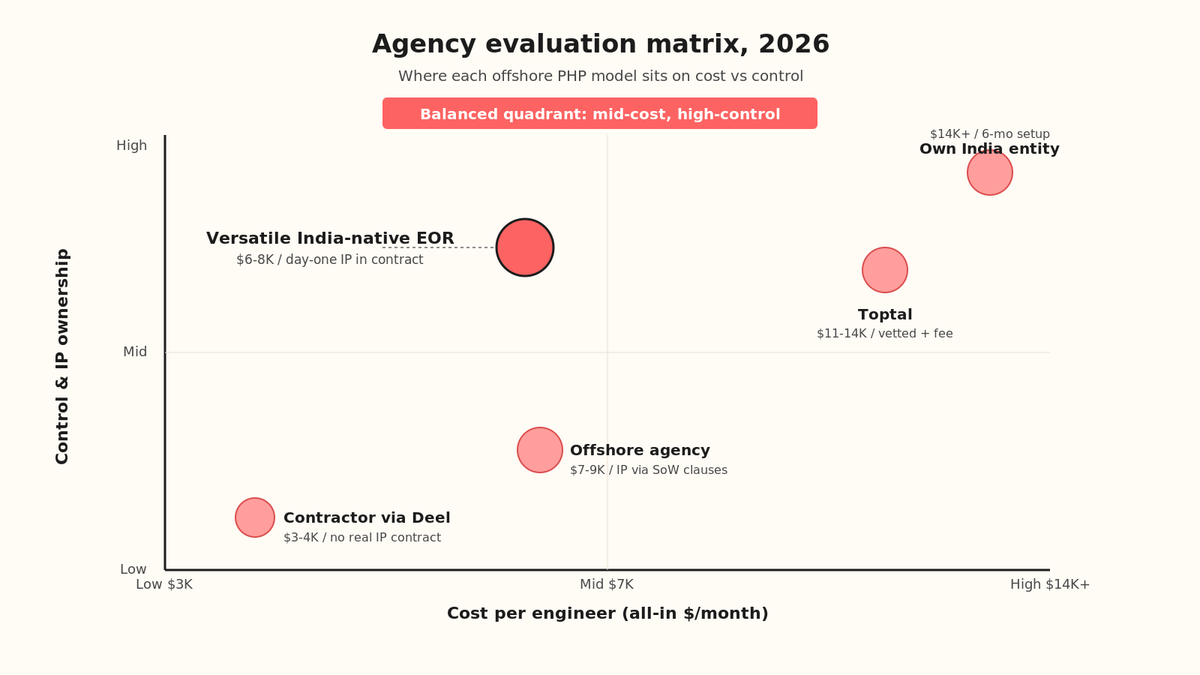
Figure 1 below shows how to position this evaluation within your hiring decision:
Q3. What does PHP/Laravel/Symfony expertise really mean?
On paper: "We have certified Laravel developers." In practice: can they deploy to production in 5 minutes without hand-holding?
Real expertise requires five gates:
Gate 1: Database Tuning. Do they default to MySQL 8.0+ or still on 5.7? If they can't explain InnoDB lock behavior or partitioning strategy, they're not production-grade. Ask: "How would you optimize a 500M-row table for real-time reporting?" If they say "add an index," stop there. That's junior.
Gate 2: Async/Queuing. Can they use Laravel Horizon + Redis to queue jobs, or are they spinning up cron scripts? Modern PHP is async-first. If they haven't containerized a queue worker in the last 6 months, they're legacy.
Gate 3: Testing & CI/CD. Do they TDD? If your first sprint doesn't include unit tests (>80% coverage) and integration tests for API endpoints, your codebase is a landmine. Also: can they set up GitHub Actions or GitLab CI that auto-deploys on merge? Or are they manually SSHing into production?
Gate 4: Security Mindset. PHP has a reputation for being vulnerable. A real shop runs OWASP Top 10 audits, uses Laravel's CSRF protection by default, sanitizes all user input, and never stores passwords in plaintext (bcrypt/Argon2). Ask: "What's your approach to preventing SQL injection?" If they say "parameterized queries," great. If they say "we use an ORM," ask how the ORM handles edge cases. If they can't answer, they've never had a security incident to teach them.
Gate 5: Laravel-Specific Patterns. Do they use service containers, middleware, eloquent relationships correctly? Can they explain the difference between eager loading and lazy loading? If they're writing N+1 queries, performance will be abysmal.
Q4. Which agencies specialize in WordPress & WooCommerce security?
WordPress is the most hacked platform. 43% of the web runs on it. If your product is WordPress-based or if you're building WooCommerce stores, security is not an afterthought.
Three agencies with proven WordPress security track records:
WebFactory (Croatia-based, built the popular "Security Ninja" plugin). If they're on your project, expect regular security audits, vulnerability scanning, and hardened server configs. Cost: $60-110/hour for senior developers. They know WordPress internals better than WordPress.org does.
Kinsta's Development Partners (if you host on Kinsta managed WordPress, they'll recommend vetted developers who understand their infrastructure). Most are boutique shops, 5-20 people. Cost varies, but Kinsta vets them hard. Request a Kinsta-recommended partner, not random agencies. This is actually smart filtering.
ithemes / iThemes Security Maintainers. They maintain core security plugins for WordPress. If you can hire their core team, you get insider knowledge. Most won't freelance, but their plugin docs point to recommended partners. Cost: premium, $80-150/hour.
Red flag: any WordPress agency that doesn't mention "SSL, firewall, WAF, DDoS protection" in their onboarding checklist. If they can't audit for malware in the first week, they're not serious about security. Also: if they charge extra for security audits, they're not secure by default.
Q5. What should IP ownership look like in your contract?
This is the one issue founders get burned on repeatedly. Here's the template you should demand before signing anything.
The contract clause you want (word-for-word):
"All work product, code, designs, and intellectual property created under this engagement shall be owned exclusively by your company as work-made-for-hire. Contractor assigns all rights, title, and interest to Client at creation. Contractor warrants all work is original and does not infringe third-party intellectual property." This is the clause you want on the SOW, verbatim. Do not accept "methodologies retained" variations.
What to avoid: "Agency retains rights to methodologies, frameworks, tooling" (this is a loophole; they can reuse your architecture for competitors). "Client licenses code from agency" (means agency controls deployment). "50/50 IP split" (means you can't sell without their consent). "Agency owns pre-existing IP, client owns custom code" (creates disputes about what is "pre-existing").
Second safeguard: Escrow. If the agency disappears mid-project, can you get the source code? Demand 30-day code escrow with a release trigger (if they miss 2 deadlines, code releases to you). Services like Inesoft or Iron Mountain handle tech escrow for $500-2000 depending on codebase size.
Third safeguard: Open-Source Policy. If they use GPL or AGPL libraries without your consent, you're liable. Every agency contract should require: "All dependencies must be permissively licensed (MIT, Apache 2.0, BSD) or approved by Client in writing." Get this in writing before they start coding.
Q6. What's the real cost range for offshore PHP developers in 2026?
Headline rates don't match reality. Here's the actual math that founders don't see.
| Agency Model | Hourly Rate | Platform Fee | Real Effective Rate | Best For |
| Freelance Agencies (Gun.io, Steelkiwi) | $45-80 | 0% | $45-80 | Fixed-scope, 3-6 month projects |
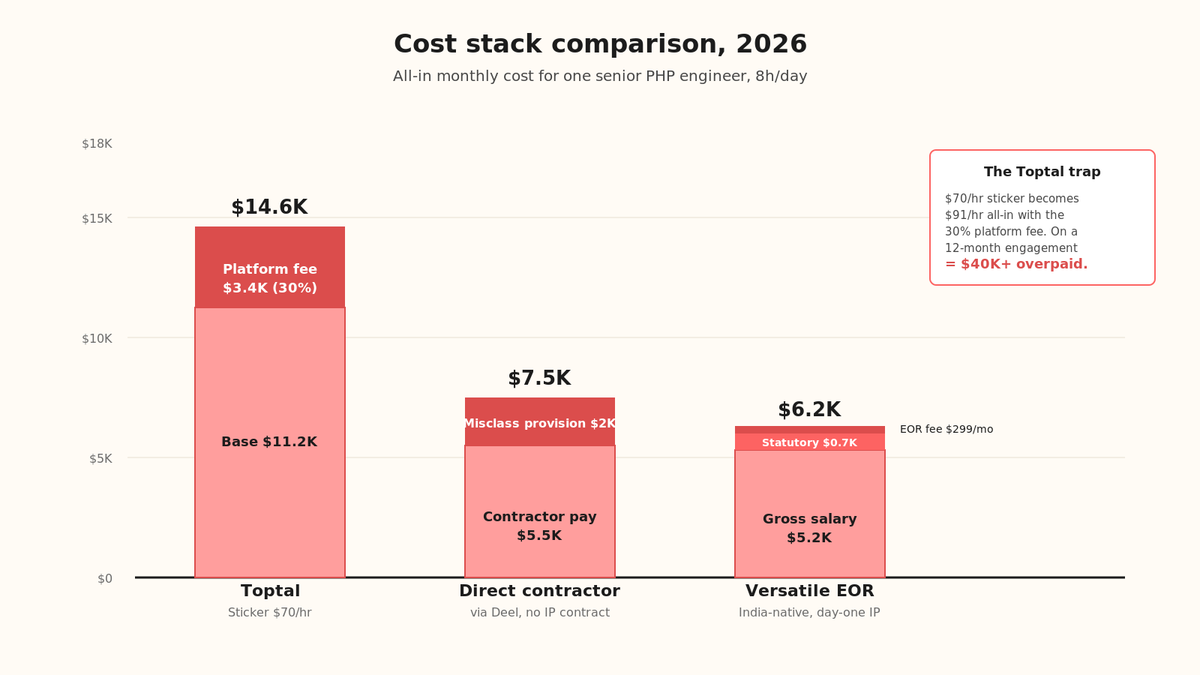
| Managed Platforms (Toptal, Turing) | $70-140 | 20-30% | $84-182 | Permanent hire muscle, high-risk projects |
| India EOR (Versatile, Upwork staff) | $25-60 (salary) + EOR fee | N/A | $30-100 all-in | 12+ month teams, permanent headcount |
| Direct Hire (LinkedIn, Angel) | $20-45 (India salary equivalent) | 0% | $20-45 | High trust, but 90-day+ legal/tax setup |
The FX trap: Your invoice says $80/hour. Rupee is 82-84 per dollar. Developer is paid ₹4,000/month. In March, rupee hits 86 per dollar. Your effective cost just dropped 5%. But the developer's cost of living stayed the same. If you want stability, lock FX forward with your bank. Don't gamble on rupee volatility. Your contractor will get crushed and leave.
The hidden-markup trap: Managed platforms like Toptal take 20-30% commission. They'll say "we handle recruiting, vetting, payroll, insurance." But if you're hiring an experienced developer (already vetted), you're paying 30% for their account manager. Direct hiring saves 30% but adds 90 days of legal/tax setup. Do the math for your timeline.
Salary + benefits + statutory breakdown (India-based senior PHP developer, 2026 rates):
| Component | ₹ / month | % of Gross | Notes |
| Base Salary | ₹300,000 | 60% | Core compensation |
| DA (Dearness Allowance) | ₹100,000 | 20% | India-specific inflation adjustment |
| HRA / Housing | ₹50,000 | 10% | Varies by city (Bangalore higher) |
| Gross Salary | ₹450,000 | 90% | What the engineer takes home |
| Employer PF (12%) | ₹54,000 | Cost to you | Mandatory, goes to employee retirement |
| ESI (1.34%, if salary <₹21K/day) | ₹6,030 | Cost to you | Employee benefits/insurance |
| Gratuity Reserve (4.81%) | ₹21,645 | Cost to you | Separation benefit, required by law |
| Professional Tax (variable) | ₹200 | Cost to you | State-dependent, ₹0-300/month |
| Total Monthly Cost to You | ₹531,875 | 118% of Gross | Statutory load: 18% above gross |
At 82 INR/USD, that engineer costs you $6,487/month, or $75/hour (assuming 160 billable hours/month). If you hire via an agency that also adds 20% margin, effective cost is $90/hour. If you hire via Versatile EOR, you pay $6,487/month + ₹10,000 EOR fee, effective $80/hour, with zero tax/compliance headache. Versatile handles the statutory burden, TDS, payroll, DPDP compliance, and 48-hour final settlement. You just hire and ship code.
Q7. When should you choose agency vs in-house India EOR?
Not a simple answer. Depends on three factors: runway, team size, and risk tolerance.
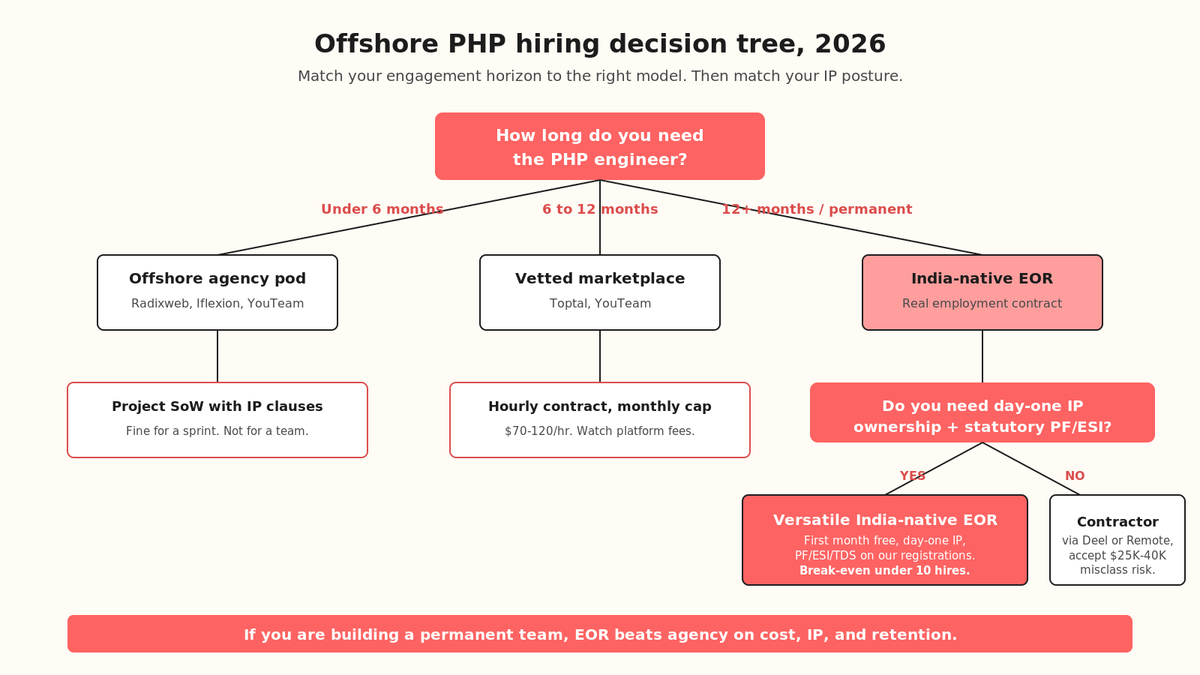
Choose agency if: (1) Your project is ≤6 months or highly variable in scope. (2) You need specific expertise (security audit, Laravel 11 migration, WooCommerce custom dev). (3) You don't want compliance/payroll overhead. (4) You're bootstrapped and need to pay-as-you-go. (5) You're hiring for a one-time project, not building a permanent team.
Choose EOR if: (1) You're hiring 2+ engineers for 12+ months. (2) Your founders can invest 4-6 weeks in hiring/vetting (real time, not lip service). (3) You want 24/7 India timezone overlap. (4) You care about long-term IP and tribal knowledge (EOR teams compound faster than agency rotations). (5) You want to eventually acquire the team in-house (India EOR is the stepping stone to full acquisition). (6) You want zero compliance risk (misclassification, DPDP, TDS all handled for you).
The cost crossover happens at 6-8 months. Before that, agency is cheaper. After that, EOR is cheaper. Agency margins only make sense for short sprints.
Versatile's positioning: we're India-native EOR, not an agency. We don't rent engineers month-to-month. We hire them for you, we manage payroll, tax, statutory compliance, and IP ownership. multiple US/UK companies on our entity, 0 compliance notices in 4 years, 5-day onboarding. We take payroll, tax (TDS), statutory (PF/ESI/gratuity), GDPR/DPDP DPA off your plate. You hire engineers; we handle the India side. PHP/Laravel founders specifically: we have a cohort of ex-Toptal, ex-Deel engineers who are now building with 15 US founders. First month free if you come onboard with 2+ headcount.
Q8. What compliance rules protect your IP with offshore PHP work?
Here's the skeleton: DPDP Act 2023 (India's GDPR), work-made-for-hire clauses, and IP assignment.
DPDP Act 2023: Any personal data (user emails, IPs, locations) touched by your India team is subject to this law. You must have a Data Processing Agreement (DPA) in place. If you're selling into EU (GDPR), your India contractor must comply with both GDPR AND DPDP. Most agencies hand-wave this. Demand a signed DPA from your contractor within 7 days. It's non-negotiable. This is how you sleep at night knowing your users' data is handled correctly.
Labour Laws (India): If you hire via EOR or direct employment, India's 4 Labour Codes apply (effective 21 Nov 2025). (1) Code on Wages (50% Basic+DA minimum). (2) Code on Industrial Relations (48-hour notice for termination, final settlement). (3) Code on Social Security (PF 12%, ESI 3.25%, gratuity 4.81%). (4) Code on Occupational Safety & Health (remote workers mostly exempt, but office workers covered). If you hire via agency, these don't apply to you (they apply to the agency). That's actually a feature: no compliance headache. If you hire via EOR (Versatile), we handle all four codes. If you direct hire, you become the employer and must comply. Most founders don't, then get audited and owe backpay.
IP Assignment: Insist on written assignment of all work product. Verbal "we own nothing" is useless in court. Demand a signed IP deed within 7 days of engagement start. If they delay, they're hiding skeleton contracts and reusing code across clients. Get this done before they write line one of code.
Tax Withholding (TDS): If you're a US company paying an India contractor >₹50,000/month, you should withhold 10% TDS and remit to the Indian government. Most US founders skip this. You're exposing your contractor to penalty notices. If they ever need to file a return or apply for a visa, the gap will be visible. Agencies handle TDS for you (built into their margin). Direct hire means you handle it (painful, requires bank account in India or a local tax advisor). EOR (like Versatile) handles it for you (included in our fee).
Q9. Which agencies have the cleanest security posture?
Security posture means: (1) Do they encrypt data at rest? (2) Do they use VPN for office access? (3) Do they run background checks on every engineer? (4) Do they have an NDA with every engineer? (5) Do they comply with GDPR/DPDP? (6) Do they do annual penetration testing?
The real story: most agencies don't publish security docs. You have to ask. Here's what to demand in a security questionnaire:
A real security statement from a serious offshore vendor covers, at minimum: individual NDAs signed by every engineer touching your codebase; encryption at rest (AES-256) and in transit (TLS 1.3); enterprise-VPN-only access to client environments (no split tunnels, no personal-Wi-Fi review windows); annual third-party penetration testing with redacted reports available to prospects on request; GDPR and DPDP Act compliance with a signed Data Processing Agreement (DPA); background checks appropriate to jurisdiction; zero shared credentials; and full-disk encryption on every workstation. If a vendor cannot lay this out on a discovery call in five minutes, they either do not have the posture, or they do not want you to audit the posture.
Red flags: (1) "Our security is proprietary, we can't share details." (2) "We do background checks but don't verify them quarterly." (3) "NDAs? Everyone signs when they join, but we don't have copies or track them." (4) "Encryption? We use whatever the cloud provider gives us (no additional layer)." (5) "GDPR? We've never had a customer ask, so we don't know." (6) "Penetration testing? We haven't done one in 2+ years."
If an agency can't produce a security policy in 24 hours, assume they don't have one. Move on. This is especially critical if you're handling user data or building financial software.
Q10. What's the real onboarding timeline with offshore PHP teams?
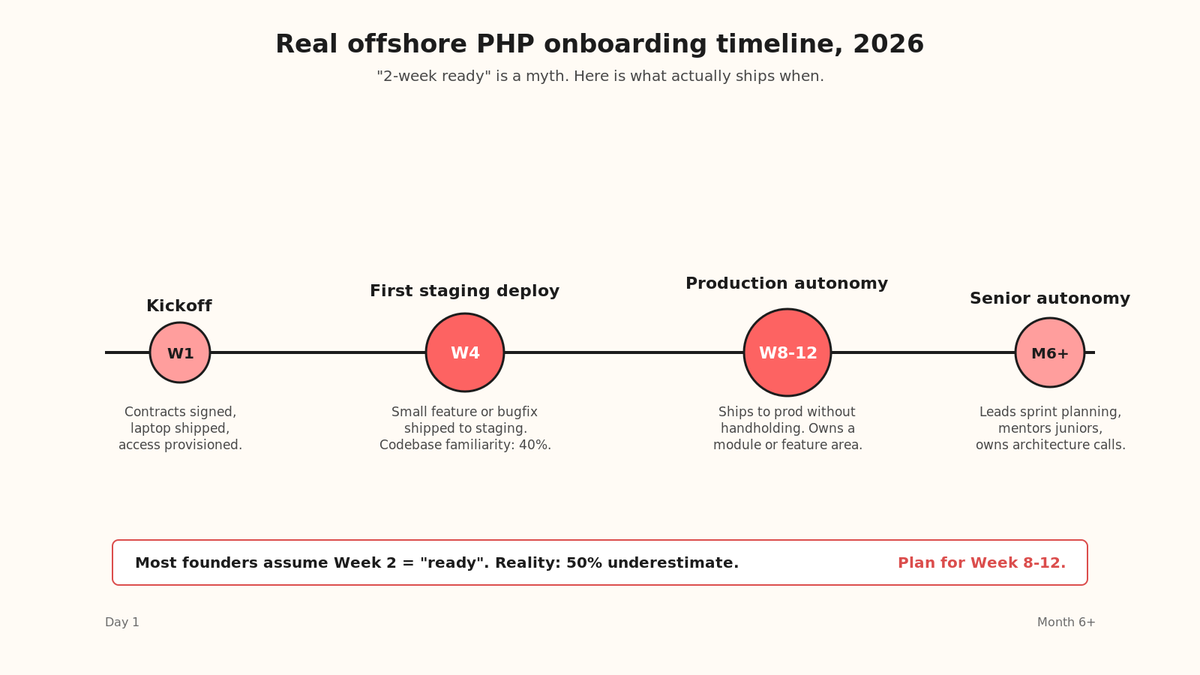
Not "We'll have someone ready in 2 days." Real timeline is 28-35 days minimum.
| Phase | Timeline | Founder Involvement | Deliverable |
| Initial Kick-off (discovery) | Day 1-2 | 2-3 hours | Tech stack doc, priorities, culture fit |
| Candidate Vetting | Day 3-7 | 2-3 coding interviews, 1 ref call | Vetting scorecard, offer ready |
| Offer & Admin (legal, insurance, access) | Day 8-12 | Minimal (signatures only) | Signed offer letter, IT provisioning |
| Environment Setup (local dev, staging, VPN) | Day 13-14 | 1 hour (access + codebase intro) | Local dev runs, staging access, docs read |
| First Sprint (heads-down coding) | Day 15-28 | Daily standups 30min, weekly retro | PRs, code review, first staging deploy |
| First Production Ship | Day 21-30 | 1-2 hour review + blessing | Code in production, monitoring live |
| Autonomy & Compounding (Week 5-12) | Day 29-84 | Weekly retros, async pairing | Shipping independently, owning features |
The trap: most agencies quote "2 weeks ready." Reality is they mean "local dev environment set up." Not production-grade. Real production readiness means: (1) They've shipped code to production at least twice. (2) They've been on-call during a 2am incident and handled it. (3) They've done a database migration or rollback. (4) They understand your CI/CD pipeline top-to-bottom. That takes 3-4 weeks minimum. Autonomy (shipping without review) takes 8-12 weeks as tribal knowledge compounds.
Timezone reality: If your offshore team is India-based (IST) and you're on US East Coast (EST), you have 9.5 hours of overlap: 9:30am-7pm IST = 12am-10am EST. Live pairing happens 9:30-10am EST. For everything else, they ship async. If they're waiting for your feedback, they can't start the next task. Plan for 24-hour turnaround on blocking questions. This is not a bug; it's a feature. Forces you to write specs instead of verbal hand-waving.
Q11. How do FX, TDS, and misclassification risk affect your PHP spend?
Here are the three hidden costs nobody talks about, and they'll make or break your offshore hire.
FX Volatility: You invoice in USD. Your India team is paid in INR. If you lock a rate with your bank, you're safe. If you don't, rupee swings 3-5% per month. In Q1 2026, rupee dropped from 82 to 83.5 per dollar. That's a 1.8% margin cut for your contractor instantly. They'll either (1) ask for a raise, (2) churn to a higher-paying gig, or (3) reduce quality to maintain their margin. Plan for FX hedging from day one. Your bank can lock a forward rate for 6-12 months (costs ~0.5% of transaction volume). This is cheap insurance.
TDS (Tax Deducted at Source): If you're paying an India contractor >₹50,000/month directly, Indian law requires 10% TDS withholding. That's 10% of every payment that goes to the government, not the contractor. If you don't withhold, the contractor is liable for penalties. Most US founders don't know about this. Agencies handle TDS (built into margin). Direct hire means you file ITR forms or hire a CA (costly). EOR (Versatile) handles TDS (included in our fee, zero extra work).
Misclassification Risk: This is the biggest sleeper risk. If you hire an engineer as a contractor but they work 40 hours/week exclusively for you with IP ownership, an Indian labour officer could classify them as employees. Penalty: backpay + 50% + notice to income tax department. Total exposure: $25K-40K per engineer per notice. Agencies are insulated (they're the employer). Direct hire exposes you (they'll audit you eventually). EOR (like Versatile) is legal by design (we're the employer of record, you're the client). This alone is worth the EOR fee.
Real math: a $60K/year contractor on direct hire has ~$15-20K misclassification risk if an audit happens. Via EOR, that risk is zero (because they're legally an employee, not a contractor).
Q12. Should you offshore PHP as a startup founder?
Not a yes/no. Evaluate against these five gates before committing.
Gate 1: Product-market fit clarity. Don't offshore if you're still finding your product. Offshore works when requirements are stable (80%+ locked down). If you're pivoting weekly, you'll waste 2-4 weeks on each pivot due to async communication delays. First-time founders should hire local until PMF is locked. Then offshore.
Gate 2: Founder bandwidth to manage async. Offshore requires async-first culture: detailed specs, no real-time collaboration, 24-hour feedback cycles. If your instinct is to Slack a quick question, offshore will feel slow. If you're comfortable writing specs and doing async retros, you're ready.
Gate 3: Budget for onboarding overhead. First offshore hire takes 40-60 founder hours to vet, interview, onboard. Budget 2-3 weeks of founder time upfront. If you can't afford that, wait 6 months and hire when you can.
Gate 4: IP and security story locked. Before hiring offshore, document: (1) IP ownership terms (work-made-for-hire). (2) Data classification (what data can they touch?). (3) NDA scope. (4) Code review standards (tests required?). (5) Deployment access levels (who can deploy to production?). If you're making these decisions while they're onboarding, you'll create chaos and slow everything down.
Gate 5: 12+ month runway. Offshore doesn't work for 2-week bursts. It works for 12+ month commitments where the team can compound on tribal knowledge. If your runway is <6 months, hire agency for specific sprints, not an ongoing team.
Q13. Where does Versatile fit in your PHP hiring decision?
✅ Where Versatile fits: if you're a PHP/Laravel founder hiring 2+ engineers for 12+ months and you want zero compliance headache.
We're India-native EOR, not an agency. Founder-owned (me, Sagar Chainani, ex-Toptal team lead, 4 years on the books). multiple US/UK companies on our entity right now. Zero compliance notices in 4 years. We handle payroll, tax (TDS), statutory (PF/ESI/gratuity), GDPR/DPDP DPA, 48-hour final settlement, work visa sponsorship. You hire engineers; we handle India. Zero surprises.
Our PHP/Laravel cohort specifically: we have 8 senior engineers who used to work for Toptal/Deel, burnt out on churn culture, and are now building 15-month+ stints with 4 US founders right now. These aren't junior jacks-of-all-trades. They're Laravel 11 seniors who've shipped SaaS from $0 to $5M ARR. They use Laravel Horizon for queuing, optimize MySQL for 1B-row queries, harden WordPress against exploits, and can audit WooCommerce security without breaking a sweat.
Cost: $35-55/hour salary (India-based PHP senior) + ₹10,000/month EOR fee + statutory (12-20% on top). All-in: ~$5,500-7,500/month per engineer, or $65-90/hour fully loaded. Compare that to Toptal at $90/hour effective rate (after 30% fee). We're cheaper, better tribal knowledge, and zero compliance risk.
First month is free if you come onboard with 2+ headcount. We sponsor work visas if you want to bring them to the US after 12 months (many founders do this eventually).
What you don't get: We're not a marketing agency. We're not a hiring firm you skip-launch-skip. We're an EOR. We take the compliance sting out of India hiring. If you need 1 engineer for 3 weeks, go with Toptal. If you need a permanent PHP team with zero tax headache, talk to me.
 permanent teams">
Q14. What's the fastest path to a production-ready offshore PHP team?
Here's a concrete plan you can steal and execute immediately.
Week 1-2: Scope & Spec Writing
Write a 2,000-word tech spec of your first 8-week sprint. Include: (1) Feature set (priority order, with acceptance criteria). (2) Architecture diagram (your current stack, SaaS dependencies). (3) API contracts (OpenAPI spec if you have one, or JSON examples). (4) Database schema or migrations (what tables exist, what are you adding?). (5) Deployment process (who can deploy? CI/CD pipeline?). (6) On-call escalation (who handles 2am production incidents?). (7) Code review standards (do you require tests? >80% coverage?). (8) Communication cadence (daily standup time: which hour EST works?). (9) IP ownership clause (work-made-for-hire). (10) Compliance requirements (GDPR? HIPAA? DPDP).
This spec is your insurance policy. Share it with 3-5 offshore agencies (or EOR like Versatile). See who responds with intelligent questions in <4 hours. See who asks dumb questions (red flag). See who ignores it (red flag).
Week 3-4: Vetting & Trial Sprint
Run a 2-week trial sprint with your top 2 choices. Short scope: build 1 API endpoint with unit tests + integration tests, deploy to staging, document it, write a technical decision doc explaining trade-offs. Cost: ~$2,500 per agency (160 hours @ $50-60/hour). Observe: (1) Do they ask clarifying questions before shipping? (2) Do they write tests? (3) Can they explain their code? (4) Do they handle async feedback or get stuck waiting for you? (5) Did they hit the deadline?
Pick the top performer. Discard the other.
Week 5-6: Offer & Legal Setup
If using EOR (Versatile), this is 2-3 days of paperwork. Fill out a form, we handle hiring, onboarding, legal, tax setup, work visa paperwork. If using agency, negotiate rates, get MSA signed (with IP ownership clause + escrow clause), and set up access (VPN, GitHub, Slack, Figma, your staging DB).
Week 7: Onboarding Blitz
First week your new team is live. You'll feel like they're slow (they're reading code, not shipping). That's normal. Spend 5 hours doing async code reviews. Answer questions the same day. By day 5, they'll ship something to production. By day 10, they'll be independent.
Week 8-12: First Full Sprint
They ship weekly PRs. You review in 24 hours. They deploy to production 2x/week. By week 8, they're building new features, not just understanding legacy code. By week 12, they're identifying technical debt and proposing rewrites. That's compound wisdom working for you.
Checkpoint at 12 weeks: If they're still asking "what does this code do?" something went wrong. Re-spec and re-hire. If they're shipping autonomously and building new features without handholding, renew for another 12 months. They'll be 3x faster than when they started as tribal knowledge compounds.
FAQs
Can you hire a single offshore PHP engineer, or does it need to be a team?
Single engineer works for <6-month projects. For 12+ months, you want 2+. One person gets sick, takes vacation, or leaves (you lose everything). Two people means continuity and knowledge redundancy. Also, a solo engineer can't do code review (essential for PHP security). At Versatile EOR, we recommend min 2-person teams for any permanent hire.
What if my offshore PHP team wants a raise mid-year?
Expect 5-10% yearly raises (cost of living in India goes up). Budget for it. If they're shipping 3x faster by month 9, a 7% raise is cheaper than hiring/onboarding a replacement. Also, rupee fluctuations will eat 3-5% some years anyway. Lock a reasonable salary upfront and plan for modest annual increases. This is normal.
Can I move an offshore PHP team in-house after 1 year?
Yes, but plan for 90 days transition. If they're on EOR (like Versatile), we transfer their visas, help with relocation logistics, and you become their direct employer. If they're contractor, you'll need to re-classify them as W-2 employees (tax/legal mess). Most teams stay 18-24 months before moving in-house or returning to India. Plan on 2-3 year cycles.
What if there's a timezone conflict and nobody can sync?
You have 9.5 hours of overlap (EST/IST): 9:30am-7pm IST = 12am-10am EST. Use it for live pairing, demos, and blocking decisions. Everything else: async. Spec ahead, document decisions in Slack threads, use loom videos for walkthroughs. If timezone is a deal-breaker, hire Latam (4-6 hours of overlap, but closer time zones) or US-based (zero overlap headache, but 3x cost). For most PHP projects, async works.
Is PHP dying? Should I learn Rust instead?
Not dying. PHP 8.3+ is extremely solid. Laravel is the most productive web framework for SaaS. WordPress powers 43% of the web. Rust is great for systems programming, not web backends. If you're building SaaS, PHP/Laravel is proven. If you're building a blockchain node or kernel, learn Rust. For startup velocity, PHP wins hands-down.
Where my head is right now
Here's my honest prediction: in the next 18 months, the offshore PHP engineering market will bifurcate. On one side, commoditized agencies (Gun.io, Toptal) will race to the bottom on price, competing on supply volume. On the other side, founder-owned EOR shops (like Versatile) will compete on long-term tribal knowledge and zero-tax-headache hiring. The middle will disappear. Founders will choose either: (1) hire cheap for 3-month sprints (agency), or (2) build a permanent team with zero compliance risk (EOR). Hybrid models will die. My bet: 60% of serious PHP founders will go EOR by 2028 because the compliance tail risk (misclassification, DPDP, TDS) is too expensive to self-manage.
If you're building PHP/Laravel and your next hire is offshore, message me directly on WhatsApp through our contact page, or book a 30-minute consultation with me. You'll be talking to the founder, not an account manager. I'll walk through your specific stack, vetting strategy, and IP terms. If Versatile is a fit, we'll get your team onboarded in 14 days. If not, I'll send you to the right agency. Either way, you'll make a cleaner hiring decision than 90% of first-time offshoring founders.