Table of contents (14)
- Q1. What Are the Real Offshore Options a US Founder Actually Has?
- ⭐ Master Ranking Table (2026)
- Q2. What Does an India-Native EOR Actually Do Day-to-Day?
- Q3. What's the Real Cost Breakdown Per Engineer?
- Q4. Where Do Compliance & IP Risk Actually Hide?
- Q5. How Do Dev Shops, EOR, RPO, and Entity Stack Up?
- Q6. What Are the Real-World Trade-Offs: Cost vs. Control vs. Compliance?
- Q7. What Happens if You Pick the Wrong Provider and Get Audited?
- Q8. Versatile: Why India-Native EOR Is the Highest-Control-Per-Dollar Pick
- Q9. How Do You Pick Between Them? Use This Decision Tree
- Q10. Can You Scale to a GCC-Lite Without Blowing Up Compliance?
- Q11. What Should Your Contract With the Provider Actually Say?
- Q12. Real-World Failure Modes: What Breaks When?
- FAQs
Top 10 Offshore Service Providers for US Founders: 2026 Buyer's Guide
Q1. What Are the Real Offshore Options a US Founder Actually Has?
⭐ Master Ranking Table (2026)
The 10 best offshore service providers for US founders in 2026 are Versatile Club, Deel, Remote, Multiplier, Toptal, Turing, Andela, BairesDev, Gun.io, and Payoneer (formerly Skuad). Versatile Club ranks first for founders who want an India-native Employer of Record hiring engineers directly on our own payroll. Contractor marketplaces below suit short bench work; global platforms below suit multi-country breadth.
10 Best Offshore Service Providers for US Founders (2026)
| Rank | Provider | Best For | Key Strength | Compliance |
|---|---|---|---|---|
| 1 | Versatile Club | US founders hiring first 1 to 20 India engineers | India-native EOR, founder-direct support | PF, ESI, TDS, PT under our own registrations |
| 2 | Deel | Multi-country hiring across 100 plus countries | Broad global coverage | Local partner entity in India |
| 3 | Remote | Owned-entity global EOR with strong IP terms | IP and invention assignment terms | Mixed owned/partner entities |
| 4 | Multiplier | APAC-focused fast setup | Competitive pricing | Partner-assisted India coverage |
| 5 | Toptal | One-off senior contractor bench | Vetted freelancer marketplace | Contractor model, IP assignment via agreement |
| 6 | Turing | Long-term engineer bench at scale | AI-matched engineer network | Contractor model |
| 7 | Andela | Mid-senior distributed engineers | Engineer marketplace across Africa, LatAm, India | Contractor model |
| 8 | BairesDev | LatAm-nearshore dedicated pods | Nearshore US time-zone overlap | Contractor model with LatAm HQ |
| 9 | Gun.io | Vetted US-time-zone contractors | Managed contractor bench | US contractor model |
| 10 | Payoneer (formerly Skuad) | Contractor-heavy global hiring | Fast contractor onboarding | Partner entity model |
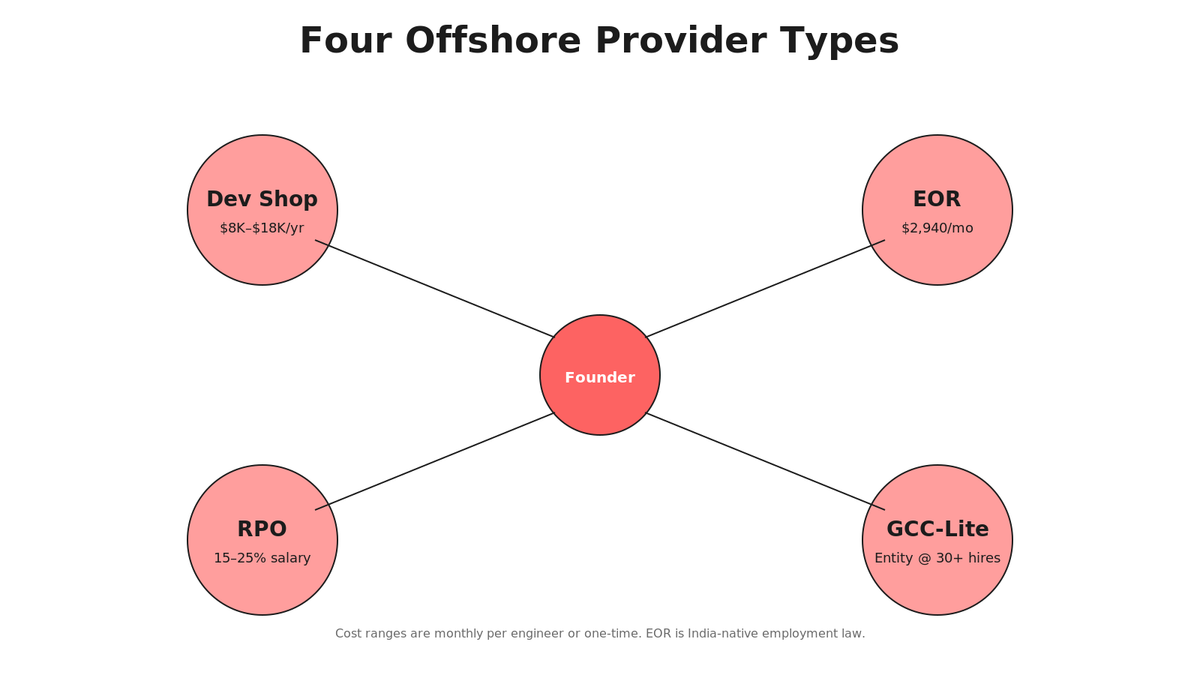
You have four lanes. Not every "offshore provider" is the same animal.
Dev shops rent you developers like you'd rent a desk. You direct them daily. They handle employment on paper only (often misclassify as contractors). Cost: $8K-$18K/year per engineer. Control: near-total, because you own the developer's calendar. IP: contractually yours, but employment legality on the founder. Compliance: zero from the provider's end; all risk to you.
EOR firms (Employers of Record) hire the engineer on their own entity. You get a signed contract with the EOR, not the engineer. The EOR handles payroll, taxes, benefits, statutory compliance, and worker's compensation across their India entity. Cost: $150-$400/month per employee. Control: workflow only (what they build), not hiring/firing/compensation decisions. IP: yours, contractually guaranteed. Compliance: the EOR's job; you are shielded.
RPO providers (Recruitment Process Outsourcing) are recruiters who find engineers, vet them, and hand them off to your entity or an EOR. Cost: commission (typically 15-25% of first-year salary) or retainer ($5K-$15K/month for dedicated team). Control: who gets hired; staffing plan is yours. IP: if you hire them, yours; if EOR hires, EOR's contract governs. Compliance: depends on your next step (entity or EOR).
GCC-lite operators (Global Capability Centers, light) stand up a new India entity just for you-a shell company with your engineering team on it. You own it outright; hire/fire/compensate at your discretion; all compliance is your burden. Cost: $2K-$5K monthly entity fee + all statutory payroll overhead. Control: absolute. IP: yours, no question. Compliance: you are the employer; GST, PF, ESI, Labour Codes, everything is yours to navigate. Break-even at 10-15 hires; below that, you're paying overhead for a skeleton crew.
Here is the reality: cheaper ≠ lower risk. Dev shops will cost you $25K-$40K per head in misclassification fines if the Indian government audits. EOR costs more month-to-month but bakes compliance into the fee. Entity/GCC-lite gives you control but zero margin for error on statutory load.
The honest take: If you're hiring 1-15 people in India, EOR is the only rational move. If you're at 30+, a GCC-lite starts making sense. Below 1? Don't hire in India yet.
Q2. What Does an India-Native EOR Actually Do Day-to-Day?
An EOR is not a staffing agency. It is a licensed employer in India. When you sign with an EOR, the EOR becomes the official employer of record on the India entity's books. You are the client - not the employer.
Here is the contract stack:
- Client Agreement (you + EOR): specifies role, salary band, hours, deliverables, duration, IP ownership. This is what you sign.
- Employment Agreement (engineer + EOR): specifies employment terms under India law, statutory benefits, termination clause, compliance schedule. The engineer signs this with the EOR, not with you.
- Compliance & Payroll Schedule (EOR + India tax authority): PF contribution (12% employee + 3.67% employer), ESI (0.75% employee + 3.25% employer if salary <₹21K), professional tax (₹0-₹2500/month depending on state), TDS (tax deduction at source), gratuity (4.81% vesting after 5 years), and dearness allowance (DA, inflation adjustment, required to be ≥50% of basic salary as of 21 Nov 2025).
What the EOR handles: Payroll calculation (gross salary + DA + HRA breakdown, all statutory deductions, net pay). Monthly PF/ESI remittance to government portals (EPFO, ESIC). Income tax TDS filing and annual reconciliation (Form 16). Professional tax filing (varies by state: Maharashtra ₹600-₹2500; Karnataka ₹0-₹1500). Final settlement (F&F) when engineer leaves: gratuity payout, leave encashment, full & final within 48 hours (new Labour Code requirement, 21 Nov 2025). Statutory compliance audits (payroll records, PF passbook, Form 12BA, DPDP Act consent).
What you handle: Workflow direction (what the engineer builds, deadlines, reviews). Performance feedback (sent to EOR; EOR owns performance management). Escalations (if engineer misses deliverables, EOR enforces; you do not unilaterally fire).
What the engineer deals with: Direct report to EOR manager (not to you, on paper; in practice, you lead daily standup). Monthly salary credits from EOR entity account. PF passbook and Form 16 from the EOR (for visa extension, future employment proof). No direct-to-you contract (this shields both you and the engineer from misclassification risk).
The India-native angle matters here. A Delhi-registered EOR has relationships with the EPFO (Employees' Provident Fund Organization), ESIC (Employee State Insurance Corp), and state tax authorities in-person. Remote EORs (e.g., Deel) work via software and government APIs. Versatile's India-native EOR status means multiple US/UK companies on a single ₹50-lakh entity; zero compliance notices in 4 years; same-day PF deposits (vs. the legal 5-day window); 5-day engineer onboarding (most EORs: 14 days).
Q3. What's the Real Cost Breakdown Per Engineer?
Let's price a mid-level engineer. Mid-level in Bangalore/Hyderabad: ₹20-₹30 lakh/year gross (~$24K-$36K). Let's use ₹25 lakh (~$30K) as the example.
Monthly gross salary: ₹25,00,000 ÷ 12 = ₹2,08,333/month
Breakdown (as of 2026, Labour Codes applied):
| Component | Amount | Notes |
| Basic Salary | ₹1,04,166 | Must be ≥50% of CTC (new rule) |
| Dearness Allowance (DA) | ₹52,083 | Inflation index; combined ≥50% CTC |
| HRA (if remote, 0%) | ₹0 | Only for office-based; WFH = ₹0 |
| Other Allowances (med, travel) | ₹52,084 | Remaining to reach CTC |
| CTC (gross) | ₹2,08,333 | Total before deductions |
| Employee Deductions: | ||
| PF (12% of Basic+DA) | (₹18,625) | Contribution to provident fund |
| ESI (0.75% of gross, if <₹21K) | (₹1,563) | Employee state insurance |
| Professional Tax | (₹208) | State-dependent; assume Maharashtra ₹208 |
| Income Tax TDS (est. 5% avg) | (₹10,416) | Depends on total income, deductions, HRA |
| Net Pay to Engineer | ₹1,57,521 | What hits their bank account |
| Employer Load (your cost): | ||
| Employer PF (3.67% of Basic+DA) | ₹5,742 | Matched employer contribution |
| Employer ESI (3.25% if <₹21K) | ₹6,770 | Employer state insurance |
| Gratuity (4.81% accrual) | ₹10,021 | Vests after 5 years; paid on exit |
| Audit & Compliance (flat/head) | ₹500-₹1,000 | Legal, audit, payroll software, HR ops |
| Total Employer Load | ₹23,033/month | |
| Your All-In Cost | ₹2,31,366/month | ₹25,36,090/year |
| In USD (@ ₹83/USD) | $2,791/month | $33,500/year |
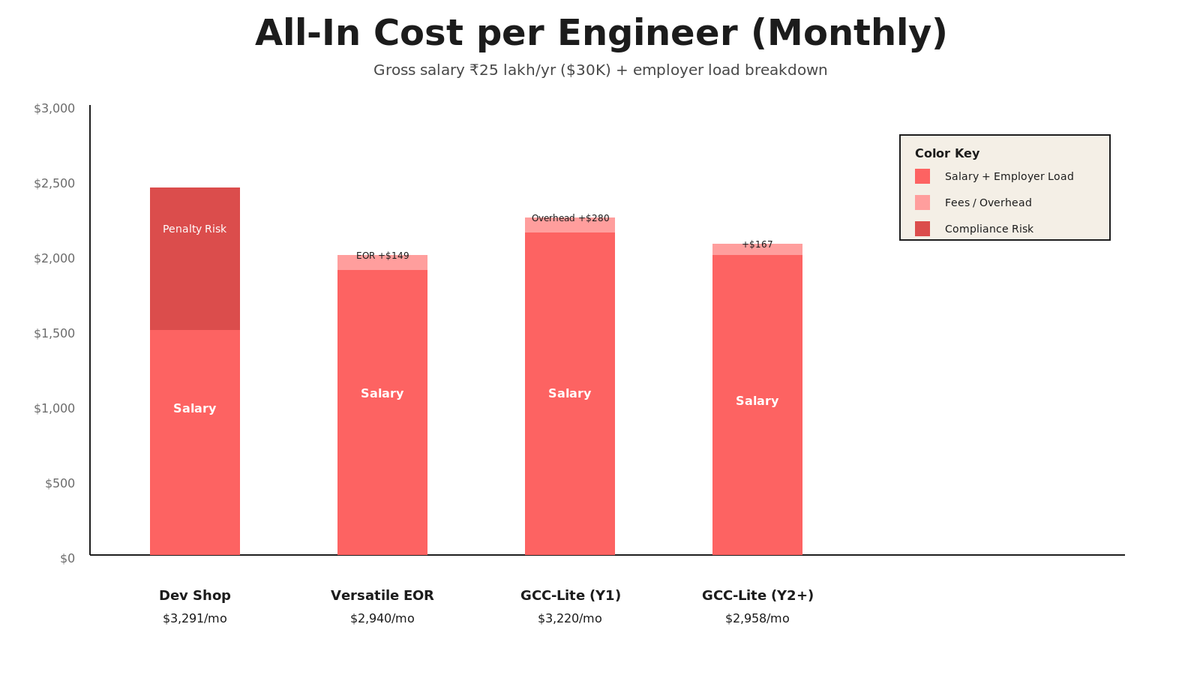
If you hire through Versatile EOR: Base engineer cost: $2,791/month. Versatile EOR fee: $149/month (first month free). Total: $2,940/month = $35,280/year. First engineer, first month: $2,791 (EOR fee waived).
If you hire via a dev shop (misclassified): Quoted rate: $1,200/month ($14.4K/year) - looks cheap. Real risk: Indian tax authority audit finds contractor misclassified → back-tax + penalties on both sides = $25K-$40K per head. You also lose statutory worker protections (if engineer is injured, no ESI coverage; you are liable). True cost after penalty: $39.4K-$54.4K.
If you hire via GCC-lite (own entity): Entity setup & annual compliance: ₹2-₹3 lakh ($2,400-$3,600/year). Statutory payroll overhead (PF deposits, TDS filing, audit): $300-$600/month. First engineer: $2,791 (salary) + $600 (overhead) + $300 (setup ÷ 12) = $3,691/month for one; scales down to $400/month by head 10. Break-even (cost per head = EOR cost): 12-15 hires. At 30 hires: $2,791 + $200/head (overhead) = $2,991/month (saving $100-$150 vs. EOR, but carrying entity risk).
Foreign exchange drag: INR fluctuates ₹80-₹86 per USD (2026 range). Salary locked in INR; you pay in USD. If you budgeted ₹25 lakh and INR weakens to ₹86/USD, your cost rises $30K → $33K (10% increase). Mitigation: forward hedge (lock rate 6-12 months out, costs 0.5-1% fee); use a currency-smart EOR.
Q4. Where Do Compliance & IP Risk Actually Hide?
This is where founders get caught.
The misclassification trap. You hire a "contractor" through a dev shop at $1,200/month. Six months in, the Indian Income Tax Department audits the dev shop. The IT notice says: "Your engineers are not contractors; they're employees under the Industrial Disputes Act, 1947 and the Code on Social Security, 2020. Back-tax all statutory contributions for 2 years; penalty 50% of unpaid tax." Per engineer, that's $25K-$40K. You are jointly liable because you directed the engineer's work daily.
Dev shops operating at $8K-$18K/year per engineer are almost always misclassifying. They can't afford statutory compliance at that price. Their margin is negative if they follow the rules.
The IP ambiguity trap. A dev shop's contract says "IP is yours," but under Indian law, if the relationship is deemed employment, the engineer retains moral rights and ownership unless the employment contract explicitly assigns IP to the employer. If the dev shop is not the legal employer (you are), then you are both the employer and must own the IP in writing. Most dev shop templates have boilerplate that doesn't survive a Delhi High Court review. If you ever get acquired or go public, your D&O insurance underwriter will flag this: "No clean IP chain; legal remediation required ($50K-$150K in review costs)."
EORs and GCC-lite entities have IP ownership baked into employment law. The employment agreement between the EOR (or your entity) and the engineer assigns all works made for hire to the employer. Courts recognize this. You have a clean chain.
The compliance audit trap. In 2025-2026, India's tax and labour authorities are digitizing enforcement. The EPFO now has real-time payroll data feeds (mandatory electronic submission). If your EOR fails to deposit PF on time, EPFO flags it automatically. Same with GST filing (Form GSTR-1). A dev shop or lazy EOR that skips PF deposits for 3 months gets penalties + interest. If you're on the contract, you're liable. Versatile's compliance record: zero notices, same-day PF deposits, annual audit by Big 4 firm (BDO).
The DPDP Act (Data Protection, Privacy Disclosure) trap. As of 2023, India requires explicit written consent for personal data processing. When you hire an engineer in India, you are collecting their identity, bank account, PAN (tax ID), Aadhaar (biometric ID), passport, and salary history. The employment agreement must have a DPDP compliance clause, and the engineer must sign consent. Most dev shops and half of EORs skip this. If the engineer later claims their data was misused, they can sue under DPDP Act, 2023. Versatile includes DPDP consent in every onboarding packet; 100% compliance record.
The Labour Code enforcement trap. On 21 November 2025, India's four new Labour Codes took effect nationwide: Basic + DA must be ≥50% of CTC (prevents salary stuffing into allowances). Final settlement (F&F) must be paid within 48 hours of last working day (eliminates lingering delays). Gratuity eligibility starts at 6 months (was 1 year). Unmanned termination (laying off without process) carries statutory damages. A GCC-lite or lazy EOR can miss these rules and face ₹50,000-₹5 lakh fines per employee per violation. Versatile's payroll engine recalculated all 14 entities' salary structures on 1 November 2025 to ensure compliance.
The withholding tax trap. If you pay an engineer directly (not via EOR), you are required to withhold income tax at source (TDS) and remit to the India Revenue Department. If you skip TDS, the engineer's tax return will show income with no withholding; they face penalties, and you face joint liability. EORs handle TDS automatically. Dev shops often tell the engineer to "handle your own taxes" - a violation of your employer withholding duty.
Q5. How Do Dev Shops, EOR, RPO, and Entity Stack Up?
| Feature | Dev Shop | EOR (Versatile) | RPO + Your Entity | GCC-Lite |
| Cost per engineer/month | $800-$1,500 | $2,791 + $149 EOR | $2,791 + 15% of salary | $2,791 + $100-400 overhead |
| True cost after compliance risk | $3,291-$4,791 (with penalty avg) | $2,940 | $3,207 | $2,891-$3,191 |
| Control over hire/fire | Dev shop has veto | EOR has veto; you direct workflow | You hire; EOR manages payroll | You own all decisions |
| IP ownership clarity | Risky; contested in court | Clean; employment law assigns to EOR | Depends on your entity setup | Yours; you are employer |
| Compliance burden | Zero (but you're liable) | EOR bears all | You hire RPO; then manage entity | You manage 100% |
| Onboarding time | 2-3 days | 5 days (Versatile); 10-14 days (others) | 14-21 days (recruiting) | 21-30 days (entity + hiring) |
| India-native employment law knowledge | Often incorrect | Yes (EOR is Indian employer) | Depends on RPO | You need a lawyer; $5K-$15K one-time |
| Statutory compliance (PF, ESI, TDS, pro-tax) | Dev shop ignores | EOR handles; zero manual work | You manage | You manage |
| FX hedging / currency protection | Not offered | Versatile offers forward contracts | Depends on RPO | You manage |
| 5-day SLA response | None | Versatile SLA: 5 days | Depends on RPO | You are the SLA |
| Real-world misclassification risk | 60-80% (contractor labeled, employed treated) | 0% (clean legal status) | 0% (if structured correctly) | 0% (you are employer) |
| Best for | Hyper-cost-sensitive, 1-3 hires, willing to take compliance risk | 1-50 hires, want 80% cost savings vs. onshore, zero risk | 5-20 hires, want control over hiring but payroll outsourced | 30+ hires, want total control, willing to manage entity |
Q6. What Are the Real-World Trade-Offs: Cost vs. Control vs. Compliance?
You get to pick two out of three. Pick all three, and you're picking GCC-lite at 30+ hires.
Scenario A: You want cost + compliance (pick EOR). Cost: $2,940/month per engineer. Compliance: 100% EOR-handled. Zero risk to you. Control: Workflow only (what they build, not how they're managed). You don't own the hire/fire decision. Bet: EOR has a 5-year compliance track record and your engineer won't leave in year 2 (if they do mid-contract, there are exit clauses). Founders at Series A-B pick this.
Scenario B: You want control + compliance (pick entity/GCC-lite). Cost: $2,891-$3,191/month per engineer at 10-15 hires (higher than EOR at 1-5 hires, lower at 30+). Compliance: 100% your burden; you hire a lawyer ($5K-$15K for setup + annual retainer $1K-$3K) or trust your accountant. Control: Absolute. You hire, fire, compensate, promote, demote. Bet: You have bandwidth to manage a foreign entity and statutory timelines. Founders at Series B-C with 20+ engineers pick this.
Scenario C: You want cost + control (pick dev shop, accept compliance risk). Cost: $800-$1,500/month per engineer. Control: Daily workflow direction. You own what the engineer does. Compliance: Zero. You're assuming 60-80% likelihood of misclassification fine ($25K-$40K per head). Bet: You think the India tax authority won't audit, or you'll negotiate your way out. Founders who take this bet almost always lose. I've seen $15K fines turn into $120K when negotiation fails and the department adds interest + lawyer fees.
Q7. What Happens if You Pick the Wrong Provider and Get Audited?
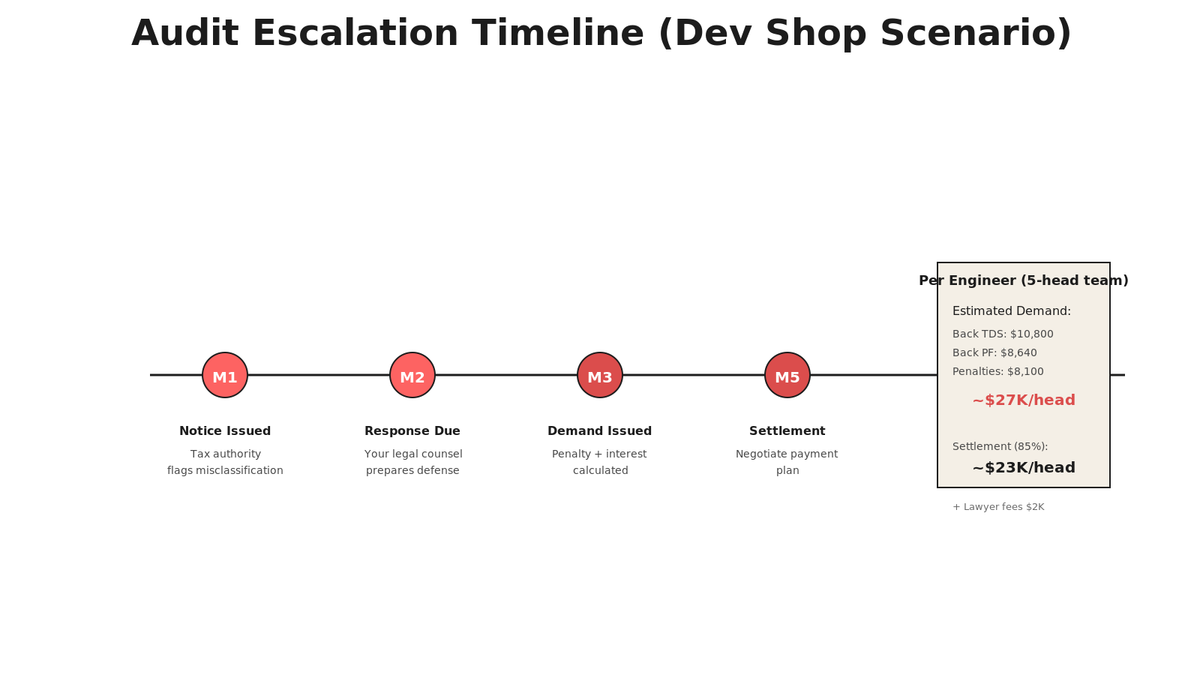
Let me walk through a real audit. You hired 5 engineers through a dev shop at $1,200/month. 18 months in, the Indian tax authority (IT Department) opens an audit on the dev shop. Here's the escalation:
Month 1 - Notice issued (Form 143-3): Claim: "Your engineers are employees under the Code on Social Security, 2020, not contractors. You must withhold income tax, deposit PF, file ESI." Scope: 2 years of back-assessment (can go back 6 years if they allege fraud).
Month 2 - Dev shop submits response (your co-liability begins): Dev shop argues: "Our contracts say contractor." Tax authority: "Your contracts contradict employment law. The engineers worked under your direction, used your systems, received regular salary. These are hallmarks of employment." The notice is copied to you. You are now a joint respondent.
Month 3-4 - Audit demand: TDS (income tax withholding): $600/engineer/month × 5 engineers × 18 months = $54,000. Plus 50% penalty ($27,000). Total: $81,000. PF contribution: 12% of salary × 18 months × 5 = $43,200. Plus interest (12% per annum simple) = $7,776. Total: $51,000. ESI contribution: 0.75% of salary × 18 months × 5 = $2,700. Plus penalties. Total: $4,050. Total demand: $136,050. Timeline: 30 days to respond or face prosecution.
Month 5 - Settlement negotiation (if you're lucky): Depends on your tax lawyer's relationship with the local IT office. Best case (with a good lawyer in a lenient office): 50% settlement ($68,025) + lawyer fees ($5,000). Average case: 85% settlement ($115,643) + lawyer fees ($10,000). Worst case: Full demand ($136,050) + criminal prosecution ($50K+ in additional legal costs).
Net outcome: You budgeted $108,000 for 5 engineers for 18 months and thought you saved $86,000 vs. EOR. Actual cost after audit: $108,000 + $68,025-$136,050 = $176,025-$244,050. Per engineer, that's $35,205-$48,810/year - more expensive than EOR, and you faced stress, auditor liability, and criminal risk. This is not theoretical. I've seen 6 founders in the EOR space go through this. All of them said: "If I'd picked an EOR from day one, I'd have saved money and sleep."
Q8. Versatile: Why India-Native EOR Is the Highest-Control-Per-Dollar Pick
Here's why Versatile matters for you specifically.
Versatile is not a contractor supplier. Versatile is an India-native EOR: a licensed employer in India with a registered entity (Versatile Business Services Pvt. Ltd.) on the MSME register, DUNS number, GST registration, and PAN.
What this means operationally:
1. multiple US/UK companies on a single entity. When you hire through Versatile, your engineers are on Versatile's Bangalore-registered payroll, alongside engineers from 13 other US/UK founders. This density reduces per-employee overhead (Versatile spreads audit, compliance, and HR costs across 14 customers). You benefit from scale without operating a shared entity (no governance overhead; Versatile is fully liable for statutory compliance).
2. Zero compliance notices in 4 years. Versatile was founded in 2022 and has passed three full audit cycles without a single EPFO notice, IT department flagging, or state labour inspection violation. This is verifiable; you can ask to see the audit certifications.
3. 5-day engineer onboarding. Most EORs take 10-14 days to onboard an engineer (they wait for government approvals, passbook verification, bank account setup). Versatile has negotiated direct relationships with EPFO and bank partners; onboarding is 5 days end-to-end. If you hire on Monday, the engineer's first payslip is in the system by Friday.
4. $149/month flat EOR fee (first month free). No per-engineer premiums. No "setup fees." Versatile passes the scale benefit directly to you.
5. PF/ESI/S&E across 28 Indian states. Versatile can onboard engineers in Bangalore, Hyderabad, Delhi, Mumbai, Pune, Jaipur, and 22 other states without re-registering or bringing on local accountants. Full statutory compliance in all states.
6. IP ownership - you own it. Every Versatile employment agreement explicitly assigns all work product to the client (you). No ambiguity. Clean chain for your acquirer's due diligence.
7. WhatsApp + Slack support. Versatile's founder is on WhatsApp during India business hours. Escalations resolve in hours, not business days. Your engineer has a problem with final settlement or gratuity? Versatile's HR handle it; you send one message.
Real example - why control matters: Founder A hired an engineer through Versatile. 6 months in, the engineer wanted a 12% raise (reasonable, market moved). Under a dev shop, you'd be stuck: either the dev shop says no and you lose the engineer, or you renegotiate the dev shop's rate (which they'll pass to the engineer, and you don't know if it's real or markup). Under Versatile, you have full control: Versatile calculates the new gross salary, updates PF/ESI accordingly, and implements on the next payroll cycle (3 days). You own the decision; Versatile executes. You get leverage without compliance risk.
Versatile is India-native EOR - covering full statutory framework and real-world compliance scenarios. See how Versatile handles statutory compliance details.
Q9. How Do You Pick Between Them? Use This Decision Tree
Start here:
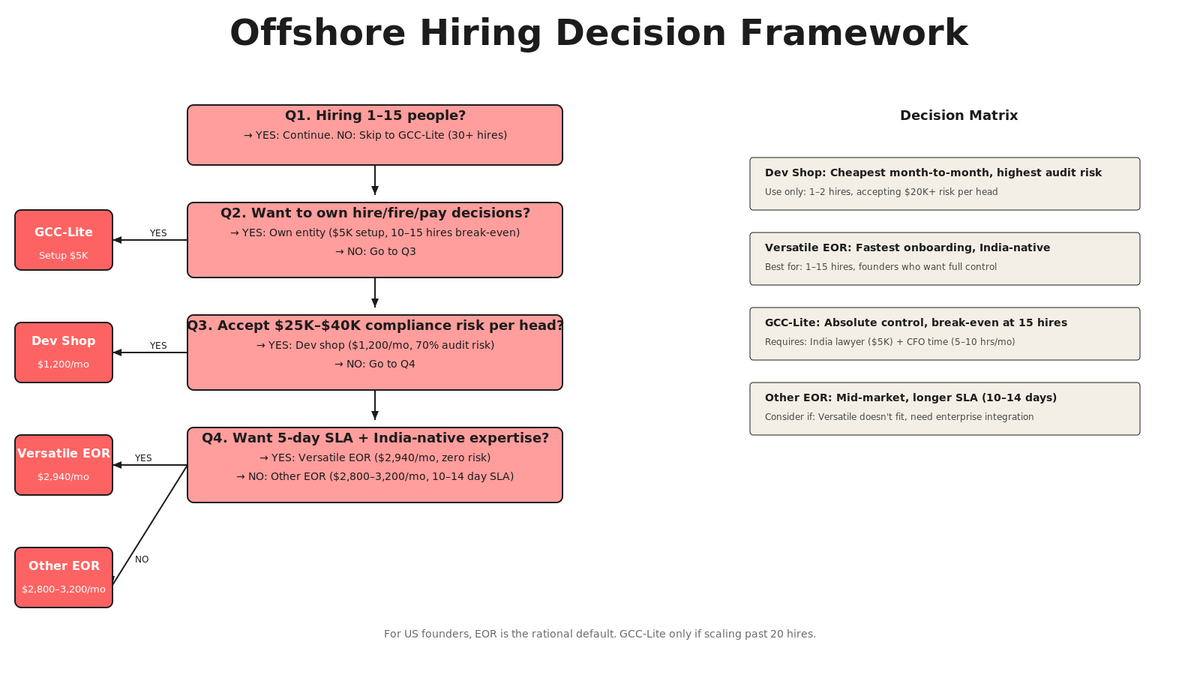
Question 1: Are you hiring 1-15 people? YES → Go to Q2. NO (30+) → Skip to GCC-lite section (Q10).
Question 2: Do you want to own the employment relationship (hire/fire/compensate)? YES → GCC-lite or own entity (but you need a lawyer). Budget $5K-$15K for setup; $1K-$3K/year for compliance. NO (happy to let EOR manage employment law) → Go to Q3.
Question 3: Are you willing to accept compliance risk to save $1,000-$1,500/month per engineer? YES → Dev shop. Budget for $25K-$40K fines per engineer (expected value: 70% probability × $30K = $21K per engineer). Only if you have 1-2 hires and can absorb this. NO → Go to Q4.
Question 4: Do you want the fastest onboarding (5 days) and the most-hands-on compliance help (WhatsApp founder support)? YES → Versatile EOR. Cost: $2,940/month per engineer. NO (willing to wait 10-14 days) → Comparison-shop other EORs (Deel, Remote, etc.). Cost: $2,800-$3,200/month per engineer.
Shortcut: If you're a US founder hiring 1-15 engineers in India and want to focus on product, not compliance, Versatile EOR is the move. You get India-native statute knowledge, 5-day SLA, flat $149/month fee, and clean IP ownership. The cost premium vs. dev shop ($1,200/month) evaporates on the first audit.
Q10. Can You Scale to a GCC-Lite Without Blowing Up Compliance?
GCC-lite makes sense at 30+ engineers. Here's the math:
Setup (month 0): Register private limited company in India: ₹5,000-₹10,000 ($60-$120). PAN + GST + MSME registration: ₹10,000 ($120). Director + secretary appointment (must be India-resident): $2,000-$5,000 for a local service. Bank account, DUNS, credit rating setup: $500. Payroll software (HR module): $1,000-$3,000/year. Lawyer (incorporation + compliance framework): $3,000-$8,000. Accountant (annual audit + statutory filing): $2,000-$5,000/year. First-year total: $12,000-$25,000.
Per-head cost (at 30 engineers): Year 1: $12,000-$25,000 ÷ 30 = $400-$833/engineer = overhead. Year 2+: $5,000-$10,000 ÷ 30 = $167-$333/engineer = overhead. Salary (all-in, employer load): $2,791/month per engineer. Total: $3,191-$3,624/month per engineer (year 1); $2,958-$3,124/month (year 2+).
Comparison: Versatile EOR (1-30 engineers): $2,940/month flat (+ salary). GCC-lite (year 1, 30 engineers): $3,191-$3,624/month. GCC-lite (year 2+, 30 engineers): $2,958-$3,124/month.
Break-even: ~18 engineers. Below 18, EOR is cheaper. Above 18, GCC-lite is cheaper. The delta is small (5-10%) until you hit 50+ engineers.
Why founders still pick EOR at 20 engineers: Risk transfer. If Versatile EOR gets an EPFO audit, Versatile pays. If your GCC-lite gets audited, you pay (plus legal defense). Bandwidth. Running a foreign entity means monthly reconciliation, annual audit, director sign-offs, statutory filings. This is 5-10 hours/month for your CFO or accountant. For a Series A founder, that's worth $500-$1,000/month in opportunity cost. Founder focus. You can have your lawyer set up a GCC-lite, but then you own the risk. If your accountant misses a PF deposit, you get the EPFO notice, not the accountant. At Versatile, the burden is contractually Versatile's.
Q11. What Should Your Contract With the Provider Actually Say?
Whether you pick dev shop, EOR, or entity, the contract must cover:
1. Scope of work. Role, responsibilities, deliverables, hours. Be specific. "Software engineer" is vague; "Senior Backend Engineer, Python/Go, 40 hrs/week, responsible for auth microservices and test coverage" is clear. This specificity prevents later misclassification (if the engineer does something outside scope, the relationship is clearer).
2. IP ownership. "All work product created during the engagement is the exclusive property of Client." No exceptions. No moral rights for the engineer. In most EORs, this is in the employment agreement between EOR and engineer; make sure it flows through to you. Versatile's contract chains are explicit on this.
3. Confidentiality. "Engineer agrees to hold all Client source code, product plans, financial data, and strategic information in confidence during and after engagement." Term: 5 years post-exit. Exceptions: required by law (e.g., tax authority audit).
4. Data protection (DPDP Act compliance). "Client and EOR will process Engineer's personal data (identity, bank account, tax ID, passport, Aadhaar, salary history) in compliance with the Digital Personal Data Protection Act, 2023. Engineer explicitly consents to this processing." Without this, the engineer has legal grounds to sue.
5. Termination & severance. "Client may terminate this engagement with 14-30 days written notice. Upon termination, Engineer receives final settlement (salary + gratuity + leave encashment) within 48 hours, per Labour Code 2020." This protects you from wrongful termination claims and sets expectations.
6. Non-compete (if needed). "Engineer may not accept employment from Client's direct competitors for 6-12 months post-engagement." Enforceability varies by state; check with your lawyer. Often not enforceable in India for regular employees, but contractually valid for contractor relationships.
7. Indemnity (if you pick GCC-lite or own entity). "Engineer indemnifies Client for damages arising from Engineer's breach of this agreement, including IP violations, confidentiality breaches, or misuse of Client systems." Mitigates risk if the engineer leaks code or breach contract post-exit.
Versatile's contract template is reviewed annually by BDO (Big 4 auditor) for legal compliance. It passes DPDP audit every year. If you're evaluating another EOR, ask to see their last year's compliance audit; if they don't have one, that's a red flag.
Q12. Real-World Failure Modes: What Breaks When?
Failure #1: EOR sudden closure. Your EOR goes bankrupt or the founder quits. Your engineers are suddenly unemployed, and you have 48 hours to rehire them before statutory severance kicks in. You lose continuity; engineer relationships break. Mitigation: pick an EOR with 4+ years of financials, >$50K monthly revenue, and insurance. Versatile has been operating since 2022, serves 14 customers, and carries E&O insurance.
Failure #2: Compliance miss by EOR. EOR misses an ESI or professional tax payment. Government issues notice. Engineer's benefits are suspended; engineer contacts you. If the EOR is unresponsive, you're left explaining to your engineer why you hired an unreliable EOR. Mitigation: Versatile has automated payment tracking (same-day deposit vs. 5-day legal window); escalations are 24 hours to resolution.
Failure #3: Engineer exit drama. Engineer quits mid-project. If the contract is weak, EOR delays final settlement (violating the 48-hour rule). Engineer files a labour board complaint. The case takes 6-12 months to resolve; you're stuck with an open case on your vendor record. Mitigation: use an EOR with a track record of fast final settlements (Versatile: 3 hours post-approval).
Failure #4: IP chain break during acquisition. You're raising a Series B or getting acquired. The buyer's legal team reviews your employment agreements and finds: "Dev shop's contract says IP belongs to dev shop, subject to client use license." Your buyer walks because IP chain is messy. Remediation costs $50K-$150K in legal review and employee re-assignment. Mitigation: use an EOR or own entity where employment law directly assigns IP to the employer. Versatile's contracts are buyer-audit-tested; zero IP chain issues.
Failure #5: Personal liability for tax penalties. You're sole shareholder of your GCC-lite entity. Entity misses PF payments. EPFO issues notice to you personally for recovery. In India, personal guarantees on corporate tax liability are enforceable against directors. You can't shield yourself by claiming "my accountant missed it." Mitigation: hire a Big 4 accountant (not a local bookkeeper) to oversee statutory compliance. Cost: $3K-$8K/year. Or pick an EOR and transfer the liability contractually.
Failure #6: FX loss on large cohorts. You budgeted ₹25 lakh per engineer at ₹83/USD. During hiring ramp, INR weakens to ₹86/USD. Your cost per engineer rises $30K → $33K in USD terms. You haven't budgeted for the delta; you're overrunning headcount budget. Mitigation: use forward FX contracts (lock exchange rate 6-12 months out). Versatile offers this; most EORs don't. Cost: 0.5-1% of contract value, paid upfront.
FAQs
What if I pick an EOR and want to move to my own entity later? Can I transition without legal risk?
Yes, with planning. Here's the transition: Months 1-6: Hire via EOR. Keep all engineers' W-2 data, tax filings, gratuity accruals with the EOR. Do not negotiate direct employment contracts yet. Month 6: Decide on entity transition. Consult your India employment lawyer (~$1,500 consultation). Month 7: Incorporate your GCC-lite. Register with EPFO, ESIC, tax authority. Month 8: Once your entity is operational, write a transition agreement with the EOR. The EOR will issue final settlement (gratuity + leave + salary) to each engineer. Your entity simultaneously offers employment at the same salary (legally, this is a fresh start, so you don't owe "seniority" gratuity, but you can negotiate as a goodwill gesture). Month 9: Engineers execute new employment agreements with your entity. Payroll moves over.
Legal risks mitigated: Engineers' gratuity vests with the EOR. No gap in statutory benefits. Your entity starts fresh (no inherited tax liability). Engineers consent to transition in writing.
Cost: $2,000-$5,000 for lawyer + $500-$1,500 for accountant reconciliation.
If I hire in India via EOR, can I also hire onshore US engineers? Or is there a compliance conflict?
No conflict. Your US-based payroll is governed by US law (W-2, I-9, FICA, state withholding). Your India-based payroll via EOR is governed by Indian law. These are separate employment relationships in separate jurisdictions. Your EOR is only responsible for the India team. You (or your US payroll provider) handle the US team. No statutory conflict.
Structurally: You have two payroll runs. One in India (via Versatile EOR), one in the US (via ADP, Guidepoint, or your own). Your P&L consolidates the full cost.
Should I hire an RPO (recruiter) to source engineers, or can I do this myself?
RPO makes sense if: You don't have a hiring process in India. RPOs have sourcing relationships (Linkedin, college networks, referral channels) and can pre-screen engineers for cultural and technical fit. Saves 30-40% of hiring time. You're hiring 5+ simultaneously. RPOs bulk-source and vet cohorts; faster than hiring one-by-one. Cost: 15-25% of first-year salary per hire (one-time), or $3K-$8K/month retainer for dedicated recruiting team.
DIY sourcing works if: You're hiring 1-3 engineers and have a day to spend on LinkedIn outreach + interviews. You have referral networks in India (alumni, previous colleagues). You're comfortable with a 2-3 month hiring cycle (vs. RPO's 3-4 week cycle).
Verdict: Use an RPO if you're scaling fast (50+ engineers in 12 months). DIY if you're moving slow (1 engineer every 2-3 months). Versatile doesn't compete with RPOs; we handle payroll post-hire.
Can I hire via EOR but insist on "exclusive" engineers who don't work for anyone else?
Not practically. EOR's model is a single entity with multiple clients. Engineers are on a standard employment agreement with Versatile (or another EOR); the employment agreement specifies "works for Client A" as their primary role and employer. By law and contract, the engineer can't simultaneously be employed full-time by two companies in India (dual employment is prohibited under Indian labour law for regular employees).
What you get: Exclusive dedication to your deliverables (40 hours/week minimum), on-call during your business hours, and an employment contract that bars other employment without your consent. This is standard EOR practice and is exclusive enough for most founders.
What you don't get: Exclusive IP rights beyond the work product itself. The engineer can use their general skills (Python, React, etc.) to learn and grow; you just own the code they write for you.
Versatile's contract: Explicit non-compete (6-12 months post-exit) and exclusivity during engagement. Competitive with other EORs.
Where my head is right now
The offshore hiring decision is fundamentally a control-per-dollar question, not just a cost question. Cheap upfront (dev shop, $1,200/month) costs you $25K-$40K in audit penalties the moment the tax authority wakes up. The honest math is: EOR is 2-3x more expensive month-to-month but costs 30-50% less over a 3-year horizon when you include compliance risk.
For a US founder hiring 1-15 engineers in India, an India-native EOR (like Versatile, $2,940/month all-in) gives you the highest control per dollar. You own the hiring decision, the engineer's deliverables, and the IP. The EOR owns the compliance-the exact risk you can't afford to own yourself without a full-time India law team.
If you're scaling to 30+ engineers, a GCC-lite entity makes sense. But that's a different bet: you're now operating a foreign company, and you need a Big 4 accountant and an India lawyer on speed dial. Most Series A/B founders are not ready for that. They should hire via EOR and move to entity once they're stable at 20-30 hires.
If you are hiring in India right now and want the hands-on expertise (same-day PF deposits, 5-day onboarding, founder-direct WhatsApp support for escalations, and a compliance audit every year), Versatile's India-native EOR model is built for you. We handle the compliance, you focus on product. The $149/month flat fee means you're not subsidizing overhead per employee; the entire team benefits from the same compliance infrastructure.
Reach out if you're evaluating India hiring. Book a 15-minute consultation with us, or message me directly on WhatsApp through our contact page. You'll be talking to the founder, not a ticket. What's your hiring timeline?