Table of contents (10)
Agent of Record vs Employer of Record: Key Differences and When to Use Each
Q1: Agent of Record vs Employer of Record: what's the actual difference?
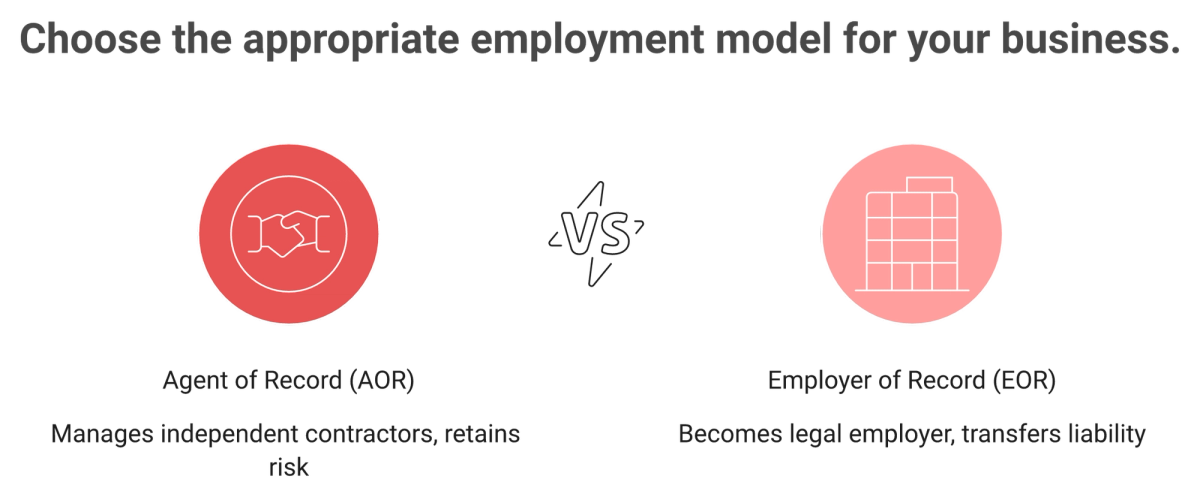
An Agent of Record (AOR) manages your independent contractors. It handles compliant contracts, invoicing, and GST, TDS, and FEMA-covered payments, while you keep the relationship and its misclassification risk. An Employer of Record (EOR) becomes the legal employer of your full-time hires in India. It runs PF, ESI, TDS, and professional tax under its own registrations and absorbs employer liability. AOR handles contractors. EOR handles employees.
🤔 Why these two terms get confused
A People Ops lead messaged me last quarter. Her legal counsel had just flagged three "contractors" in Bengaluru as a risk. She wanted to know if she needed an AOR or an EOR, and honestly, she could not tell them apart.
That confusion is normal. The names sound almost identical, and most blogs blur them into the same paragraph. So let me draw the line in plain English before we go deeper.
📇 The one-line definition of each
An AOR is a partner for your independent contractors. Think of a genuine freelancer, a project designer, or a specialist you pay per deliverable. The AOR papers the contract, invoices cleanly, and pays them across borders under Indian GST, TDS (Tax Deducted at Source), and FEMA (Foreign Exchange Management Act) rules. You can see how this maps to our Contractor of Record service.
An EOR is different. It legally employs your full-time hire on its own books. In India that means the person's Provident Fund (PF), Employees' State Insurance (ESI), TDS, and professional tax filings sit under the EOR's own registrations, which is exactly how our EOR services in India operate.
Here is the simplest India example. A GST-invoiced contractor paid per project sits under an AOR. A full-time engineer with PF and ESI deductions on a monthly payslip sits under an EOR.
⚠️ Where the liability really lands
This is the part the category gets backwards. An AOR reduces your admin risk and adds a classification buffer. It does not transfer the misclassification liability. If you supervise that "contractor" like an employee, the exposure is still yours.
An EOR does transfer it. Because the EOR is the legal employer, the statutory employer obligations move to the EOR. I think of AOR as a risk-transition, not a destination. When HR teams realize a contractor is really behaving like an employee, the right move is usually to employ them, not to keep patching the contract. Our team breaks this down further in the agent of record India guide.
At Versatile, we have run both the contractor side (Contract-to-Hire) and the employee side (EOR) through the same owned Indian entity for six years. This is not theory for us. It is what we do every payroll cycle.
Q2: What does an Agent of Record (AOR) actually do, and what does it cost in India?
An AOR engages your independent contractors on compliant contracts. It handles invoicing, bulk and foreign-remittance payments, and covers GST, TDS, and FEMA paperwork. Pricing usually sits around $19 per contractor per month. It removes admin friction and adds a classification buffer, but you still direct the work, so the underlying misclassification liability stays with you. AOR fits genuinely independent, project-based specialists.
🧾 What an AOR actually covers in India
When we run the contractor rail, the scope is fairly tight and practical. An AOR does a handful of jobs well, and it does not pretend to be an employer.
- Drafts and holds compliant contractor agreements.
- Issues and collects invoices, including bulk runs.
- Sends foreign remittances cleanly under FEMA.
- Handles GST and TDS treatment on contractor payments.
That is the honest boundary of the model. It is a payments and paperwork rail for people who are truly running their own show.
💰 What the ~$19 per month actually buys
AOR pricing typically lands near $19 per contractor per month. For that, you get admin cover and a cleaner paper trail, which lowers the odds of a sloppy classification. You can sanity-check ranges on our pricing page.
What you do not get is protection from how you treat the person. The fee buys tidy contracts and compliant payments. It does not buy a shield.
🚧 The caveat nobody prints in the pricing table
Here is where I hedge carefully, because I have watched this go wrong. A classification buffer is not a liability transfer. If you set daily tasks, fix working hours, and integrate a "contractor" into your team, you are running with scissors.
At that point, no AOR fee saves you. This is exactly why we position AOR honestly at Versatile. It is a legitimate stepping stone for real independents, not the finish line for someone who is functionally your employee. If you are weighing the two models, our independent contractor vs EOR comparison helps.
Q3: What does an Employer of Record (EOR) do in India, and why doesn't a US-style PEO work here?
An India EOR becomes the legal employer of your hire. It runs payroll, deducts TDS (deposited by the 7th monthly), files PF, ESI, and professional tax, accrues gratuity at 4.81% of Basic plus DA from month one, and issues Form 16 by 30 May. The US-style co-employment PEO does not legally exist under Indian labour law. A PEO needs you to already own an Indian entity. If you don't, EOR is your route.
⏰ The EOR job, seen inside a live payroll cycle
Let me translate the statutory list into what actually happens each month. These are the dates and rates we hit on every cycle.
- TDS: deducted from salary, deposited by the 7th of the following month.
- PF: employer contribution at 12% of Basic plus DA (Dearness Allowance).
- ESI: split at 3.25% employer and 0.75% employee for eligible wages.
- Gratuity: accrued from month one at 4.81% of Basic plus DA.
- Form 16: the annual tax certificate, issued to each employee by 30 May.
Under the New Labour Code 2025-26, Basic plus DA must be at least 50% of total CTC (Cost to Company). That single rule reshapes how the whole payslip is built. If you want the mechanics, see our payroll compliance in India resource.
🔁 Who the legal employer is, and what transfers
The core of EOR is simple. The EOR is the employer on record, so the statutory employer duties and liability sit with it, not with you.
That is the real product. You get the hire and the working relationship. The EOR carries the compliance weight and the employer risk, which is what our EOR services are built around.
❌ The PEO myth most US founders arrive with
Here is the contrarian bit the standard read gets wrong. In the US, a PEO (Professional Employer Organisation) works through co-employment, where you and the PEO share the employer role. Traditional US-style co-employment does not legally exist under Indian labour law.
So a "PEO in India" quietly assumes you already own a registered Indian entity. If you do, payroll outsourcing or a PEO-style arrangement can work. We cover the nuances in our PEO in India guide.
🧭 The clean decision cue
The rule is short. No Indian entity means EOR is your path. An existing Indian entity means PEO-style payroll becomes an option (I cover when to open your own entity later).
When we employ someone, PF, ESI, TDS, and professional-tax filings sit under Versatile's own registrations, through Foo Falcon Technologies Pvt Ltd, not a partner shell. Most global platforms route India through a local-partner entity. We do not, and that ownership is the whole point.
Q4: AOR vs EOR: how do they compare side by side?
Use an AOR for genuinely independent, project-based contractors (around $19 per contractor per month, and you keep classification risk). Use an EOR for full-time employees you supervise ($99 to $399 per employee per month, and employer liability transfers to the provider). AOR gives flexibility and low cost. EOR gives statutory coverage across all 28 states and 8 union territories, plus misclassification protection. The choice hinges on how much control you exercise over daily work.
⚖️ The one criterion that decides it
Founders ask me which model is "better." That is the wrong frame. The real question is how much supervision and control you exercise over the person's daily work.
Low control, project-scoped work points to AOR. High control, integrated, ongoing work points to EOR. Everything else in the table below flows from that single test. Our how it works page shows how we run each path.
📊 AOR vs EOR at a glance
| Dimension | Agent of Record (AOR) | Employer of Record (EOR) |
|---|---|---|
| Worker type | Independent contractors | Full-time employees |
| Legal employer | You (or nobody local) | The EOR |
| Misclassification liability | Stays with you | Transfers to the EOR |
| Cost model | ~$19 per contractor/month | $99 to $399 per employee/month |
| India statutory coverage | GST, TDS, FEMA on payments | PF, ESI, TDS, PT across 28 states + 8 UTs |
| Best-fit use case | Project specialists, short engagements | Supervised, long-term hires |
Get this wrong and it is not a rounding error. Contractor misclassification in India can carry a $25,000 to $40,000 back-pay exposure per head, which is the whole reason the control test matters. Our cost of hiring in India breakdown covers this exposure in detail.
🧩 Which one fits your scenario
A few plain recommendations, based on what I see work:
- Project specialist, own tools, own hours: AOR.
- Supervised full-timer you want long-term: EOR.
- A mix of both: run AOR and EOR together, and convert people as their role changes.
The generalists sell this as "access to a global talent pool." I would rather sell you the thing that actually protects you, which is statutory coverage across all 28 Indian states and 8 union territories.
💬 What buyers say about the alternatives
Cost and support are where the model choice gets real. These are verified reviews of global generalists that many teams consider before going India-native.
"I find Deel to be absurdly expensive. They charge a high amount of fees for transferring money to my bank account."
Juan Camilo O. Deel G2 Verified Review
"It took three months to onboard our first 3 individuals. They didnt seem to be able to navigate Visas or variations to employment contracts."
Verified User in Information Technology and Services Deel G2 Verified Review
"The PF transfer for employees after terminating their employment with Velocity was very poor. There was limited help, delayed responses, and they charged heavily per employee and the backend HR services they provide is extremely poor."
Verified User in Computer Software Velocity Global G2 Verified Review
At Versatile, our India-native specialist tier sits at $149 per employee per month, with no setup fees and no exit fees. You are not paying a global platform to treat India as one of 150 countries. You are paying for one country, done deep. If you are comparing options, our Deel alternative page lays out the contrast, and you can book a demo to talk it through.
Q5: When should you use an AOR vs an EOR? The supervision-and-control test
Choose an AOR only when the worker is genuinely independent. They are project-scoped, use their own tools, control their own hours, and serve other clients. The moment you set daily tasks, require fixed hours, or integrate them like an employee, you have crossed into a master-servant relationship. An AOR will not shield you from a $25,000 to $40,000 back-pay claim. That is when you need an EOR. Supervision and control, not headcount, is the real trigger.
😬 The quiet anxiety behind the question
Most founders do not ask me this question calmly. They ask after legal or finance has flagged a "contractor" who looks a lot like an employee.
That is the running-with-scissors feeling. The arrangement worked fine until someone senior asked how much control you actually exercise. Now it is a risk, not a shortcut. Our agent of record India guide walks through this trigger in more depth.
🇮🇳 A control signal you will miss from abroad
Here is a moment that stuck with me. A US manager once told me her Bengaluru report messaged her before every dinner break, asking permission, because "I am your subordinate."
She found it sweet. I found it a red flag. India scores 77 on Hofstede's Power Distance index, against 40 for the USA, so deference to a manager runs deep. That deference quietly turns a "contractor" into someone who behaves like an employee, which is exactly what misclassification law looks at.
✅ The four-question control test
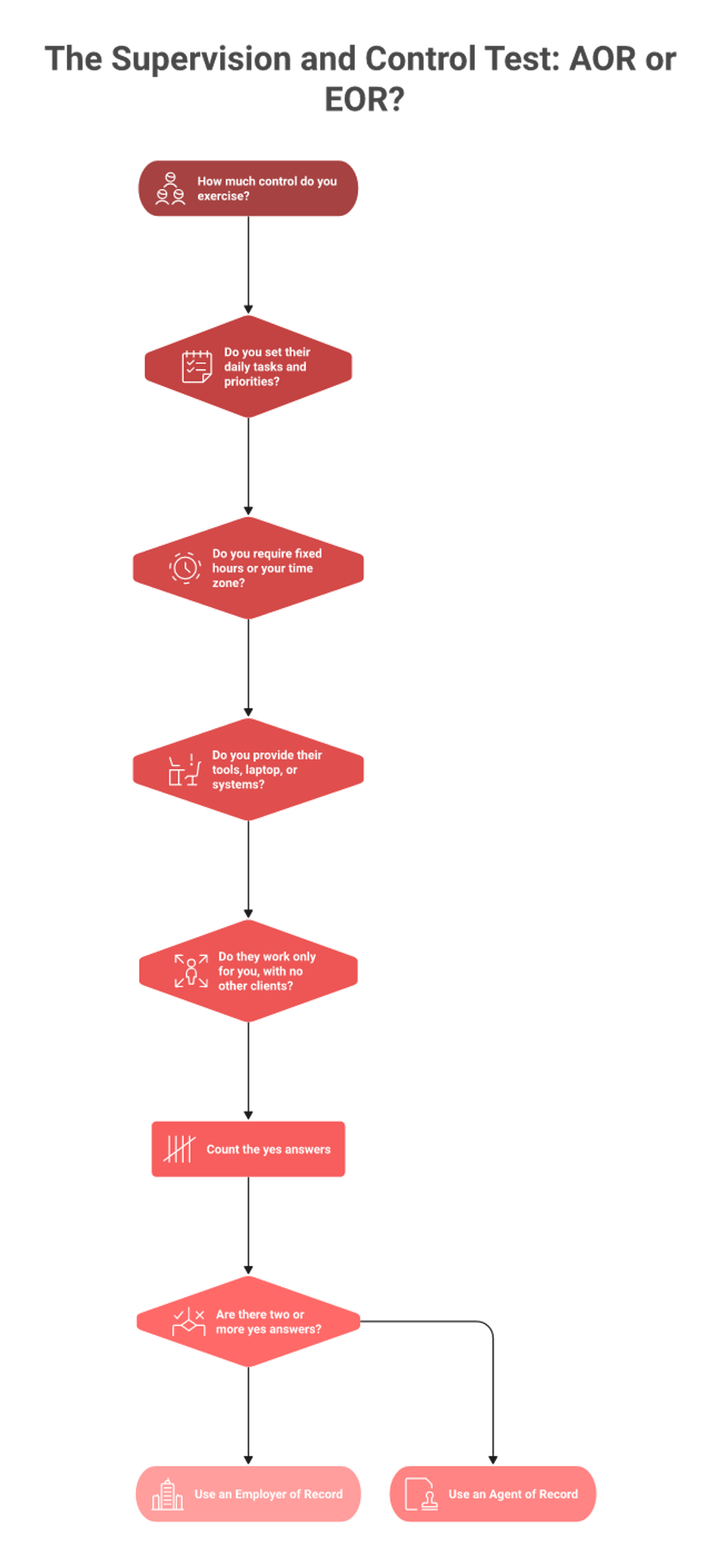
Run these four checks. Two or more "yes" answers on the control side usually mean EOR, not AOR.
- Do you set their daily tasks and priorities?
- Do you require fixed hours or your time zone?
- Do you provide their tools, laptop, or systems?
- Do they work only for you, with no other clients?
If they pass as truly independent, an AOR fits. If they behave like your team, an EOR is the honest call. You can see how each path runs on our how it works page.
🧭 Choose your path in three lines
- Genuinely independent, project-based specialist: use an AOR.
- Supervised, integrated, long-term hire: use an EOR.
- A worker who has drifted from one into the other: convert them.
When a client's contractor gets flagged, we convert them to EOR through our own Indian entity at Versatile. Same person, same work, now compliantly employed through our EOR services in India. No scramble, no gap in pay.
Q6: What does contractor misclassification actually cost you in India?
Misclassifying an India worker can cost $25,000 to $40,000 per head. That covers back-pay, unremitted PF and ESI, and penalties, before any tax exposure. A poorly structured contractor relationship can also create Permanent Establishment (PE) risk for a foreign company, which turns a payroll shortcut into a taxable presence in India. An AOR reduces admin risk but does not transfer this liability. Only an EOR, as the legal employer, moves the statutory obligation off your books.
💸 The number, and what drives it
Let me lead with the figure, because CFOs want it first. Getting classification wrong can run $25,000 to $40,000 per head once you add it all up.
That is not a fine plucked from the air. It is the stack of things you should have been paying all along, plus penalties for not paying them. Our cost of hiring in India breakdown lays out each component.
⚠️ What the exposure is actually made of
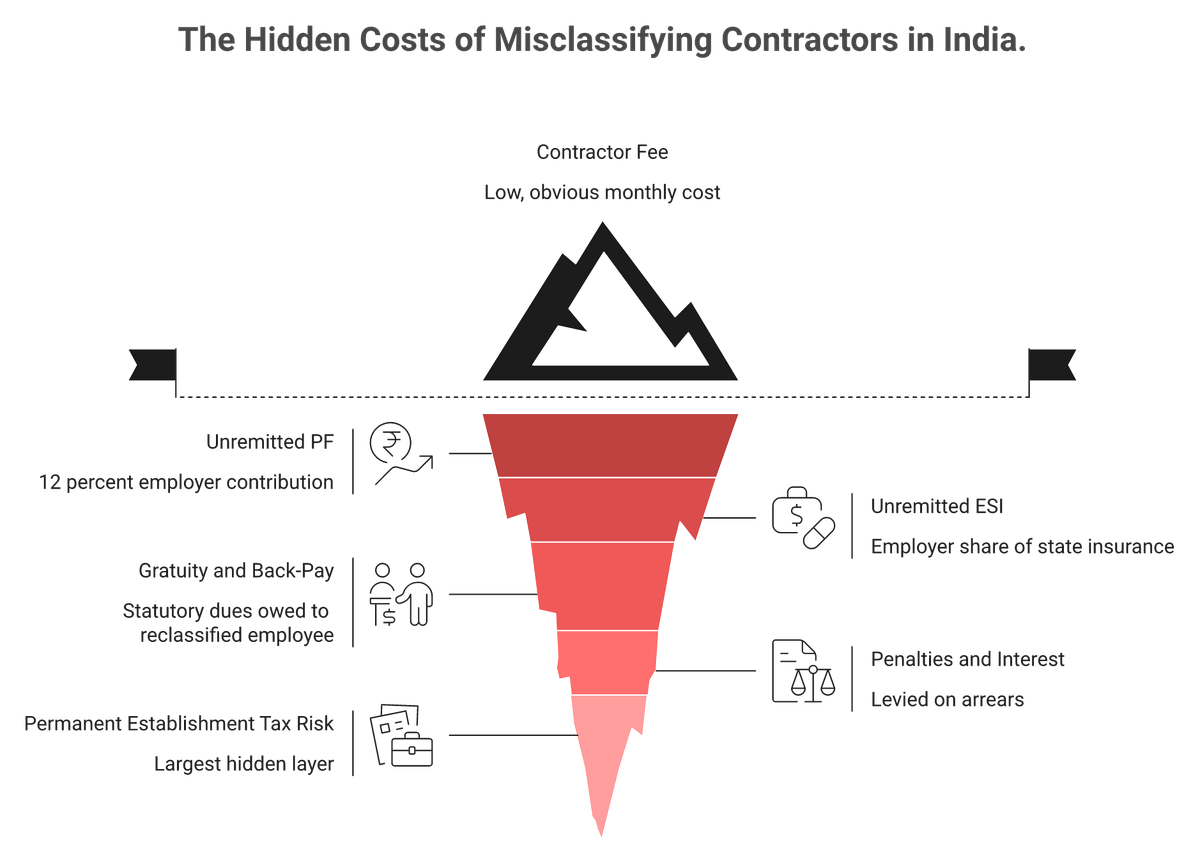
Break the number into its parts and it stops feeling abstract:
- Unremitted PF: the 12% employer Provident Fund contribution you skipped.
- Unremitted ESI: the employer share of Employees' State Insurance for eligible wages.
- Gratuity and back-pay: statutory dues owed to a reclassified employee.
- Penalties and interest: levied on the arrears.
Then there is Permanent Establishment (PE) risk. If your "contractor" acts as your fixed presence in India, tax authorities can argue you have a taxable footprint here. That is a tax problem sitting on top of a payroll problem, and our payroll compliance in India resource explains why.
🧾 The Monday action for finance
Here is the practical move. Sit with counsel and audit the control factors on every India contractor, using the same test from the last section.
The ownership point matters too. An AOR or EOR only protects you if the provider actually owns the entity carrying the liability. Route it through an aggregated third-party shell, and you are, again, running with scissors. Because we own our Indian entity at Versatile, when we take the employer role the PF, ESI, and TDS liability is genuinely ours, not passed to a partner you never signed with. That is the backbone of our compliance approach.
Q7: How do AOR and EOR pricing really compare, and where do hidden costs hide?
AOR runs about $19 per contractor per month. EOR runs $99 to $399 per employee per month, with India specialists around $149. The real cost lives in the fine print. The New Labour Code, effective 21 November 2025, requires Basic plus DA to be at least 50% of CTC, which lifts PF and gratuity accruals. Global generalists like Deel also carry FX markups, plus setup and exit fees. A transparent India EOR invoices in USD from a single Indian entity, with no FX surprise.
💰 The sticker prices, side by side
Start with the headline numbers, then we will find where the money actually leaks.
| Model / Provider | Typical price | Setup fee | Exit fee | FX exposure |
|---|---|---|---|---|
| AOR (contractor) | ~$19/contractor/mo | Usually none | Usually none | On remittances |
| Global generalist EOR | $499 to $699/employee/mo | Sometimes | Sometimes | Reported markups |
| India specialist EOR | ~$149/employee/mo | None (Versatile) | None (Versatile) | None, USD from India |
The sticker price is rarely the real price. That is the whole trap, which is why we keep our pricing transparent.
🔍 Where the fine print bites
Two costs hide from the quote. First, the New Labour Code 2025-26 requires Basic plus DA to be at least 50% of CTC, which raises PF and gratuity accruals on every payslip. Second, global platforms often add currency conversion markups on top of the monthly fee, a pattern we cover in our employer of record cost guide.
Employees feel it, and they say so in reviews:
"I find Deel to be absurdly expensive. They charge a high amount of fees for transferring money to my bank account."
Juan Camilo O. Deel G2 Verified Review
"I dislike how expensive Deels transaction fees are, especially when moving money from the Deel account to my bank."
Maria M. Deel G2 Verified Review
"While we were fine with paying higher fees for better service up front, our new provider is costing us 60% less. We will be saving more than 150k per year."
Verified User in Translation and Localization Velocity Global G2 Verified Review
At Versatile, we invoice in USD directly from our single Indian entity. No FX markup, no setup fee, no exit fee, and the first month is free. What you are quoted is what you pay, and you can compare us on our Deel alternative page.
Q8: Can you use both AOR and EOR together, and when should you open your own entity?
Yes, many companies run both. An EOR handles full-time employees who need statutory coverage, while an AOR handles genuinely project-based contractors. The smart pattern is dynamic. Start contractors on an AOR, then convert the ones you supervise or want to keep onto an EOR before misclassification risk builds. Around 10 to 12 India hires, opening your own entity often starts to pay off. Until then, one provider spanning both rails keeps it simple.
🔗 Why running both makes sense
There is no rule that says pick one. Most scaling teams I work with use both rails at once.
The AOR covers the freelancer building your marketing site. The EOR covers the engineer you supervise daily. You match the model to the working relationship, not to a preference, and our Contractor of Record service runs alongside our employee rail.
🏠 A conversion story worth remembering
Here is one that stuck. A client had two people on a contractor rail, and one of them tried to get a home loan.
The bank said no, because he was "just a contractor" with no formal employment. We moved him onto our EOR, he got a proper payslip and employment status, and the mortgage went through. That is the human cost of the wrong model, and it is fixable through our contract to hire motion.
🌉 The tipping point toward your own entity
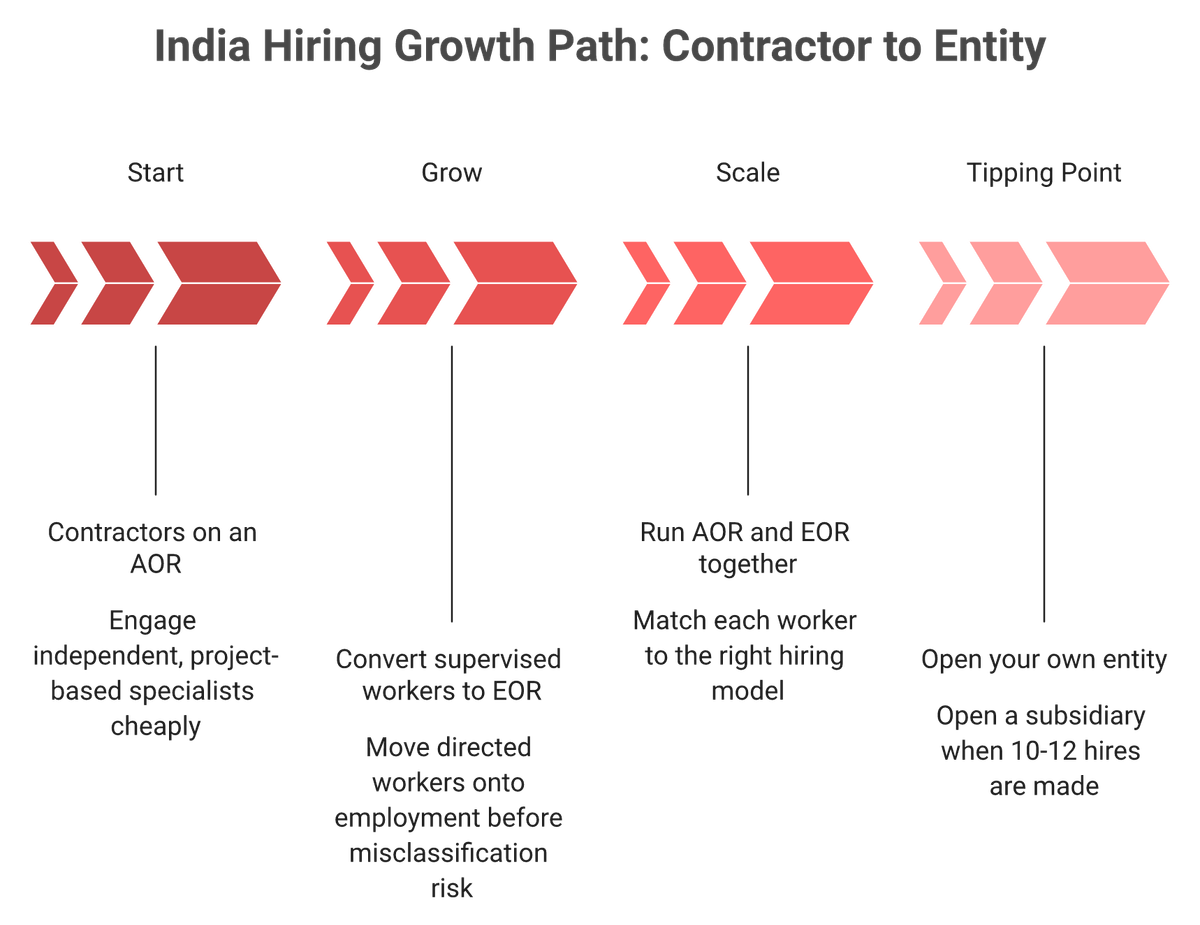
Think of it like crossing a river. Most of the time a simple suspension bridge (EOR or contractor) gets you across, and you do not need to build the Golden Gate (your own entity) on day one.
The tipping point tends to arrive around 10 to 12 India hires. Below that, your own subsidiary costs too much and takes too long to justify. You can model the crossover on our EOR vs entity calculator, and reviews of the alternative, patched-together approaches show why the transition needs care:
"It took three months to onboard our first 3 individuals, so we had to make a decision to change providers."
Verified User in Information Technology and Services Deel G2 Verified Review
"Support is the single biggest failure. There is no direct phone line. You either email or use a chatbot, and you can ask both the same question and get two different wrong answers."
Erika D. Rippling G2 Verified Review
At Versatile, we run the contractor-to-employee conversion inside one entity. The same person keeps working while their status upgrades, with no re-onboarding and no gap. When you do cross the 10-to-12-hire line, we help you plan the entity move instead of pretending you never will. If you are close to that point, book a demo and we will map it with you.
Q9: What compliance and data-protection duties come with hiring in India in 2026?
Hiring in India in 2026 means meeting three moving obligations. First, the New Labour Codes, effective 21 November 2025, require Basic plus DA to be at least 50% of CTC, with expanding EPF and ESIC coverage. Second, the DPDP Rules 2025, notified 13 November 2025, impose consent, 72-hour breach reporting, and Data Fiduciary duties on anyone handling worker data. Third, the standard filings continue: PF, ESI, TDS, professional tax, POSH, and Form 16. Your AOR or EOR should own all of this under its own registrations.
🧱 The three obligation buckets
Let me group it simply, because a wall of statute helps nobody. Everything you owe in India falls into three buckets.
- Wage and social security: the Labour Codes, PF, ESI, and gratuity.
- Tax: TDS, professional tax, and Form 16.
- Data and conduct: DPDP compliance and POSH.
Get a clear "yes, we own it" on all three, and you are most of the way there. Our compliance page shows how we cover each bucket.
📋 The specifics that actually bite in 2026
Here is what changed, and what stayed hard. The Code on Wages now fixes Basic plus DA at 50% or more of CTC, which lifts PF and gratuity accruals on every payslip.
Professional tax, a small state-level salary tax, varies across all 28 states, so a Maharashtra hire and a Karnataka hire file differently. On the data side, the DPDP Rules 2025 make the employer a Data Fiduciary, requiring valid consent, a 72-hour window to report a data breach, and clear handling rules for employee data. POSH (Prevention of Sexual Harassment) law also demands an Internal Committee once you cross ten employees. Our payroll compliance in India guide covers the state-by-state detail.
✅ Your Monday verification checklist
Do not take a provider's word for it. Ask these directly:
- Do you file PF, ESI, TDS, and professional tax under your own registrations?
- Are you compliant with the DPDP Rules 2025 as a Data Fiduciary?
- Do you handle POSH Internal Committee setup and Form 16 issuance?
- Is any of this subcontracted to a local partner entity?
That last question matters most. Generalists often spread India expertise thin through local partner shells. At Versatile, every filing, PF, ESI, TDS, professional tax across 28 states, POSH, and DPDP handling, sits under our own registrations, so nothing is subcontracted to a shell you cannot see. That is the foundation of our EOR services in India, and you can model total cost on our EOR vs entity calculator.
Q10: Which AOR/EOR provider is right for India? Versatile vs Wisemonk vs the global generalists
For India specifically, the real choice is between India-native specialists and 90-to-150-country generalists. Generalists like Deel and Remote use local partner entities in India and run ticket-queue support, and Deel adds a reported 3 to 5% FX markup. Wisemonk is India-focused but compliance-first, with a thinner retention story and opaque tiering. Versatile owns its Indian entity, invoices USD from India, and layers culture-fit hiring on top of compliance. That solves the "good hire that stays," not just the "legal hire on paper."
🧭 The one idea that governs this choice
Here is my honest thesis. For a single-country India hire, depth beats breadth, and depth comes from owning the entity you employ people through.
A generalist genuinely wins when you need five or more countries at once. If your problem is India, an India-native provider is the sharper tool, which is why founders compare us on our Wisemonk alternative and Remote alternative pages.
📊 Four providers, side by side
| Provider | India entity | Pricing | FX | Support | Retention layer |
|---|---|---|---|---|---|
| Versatile | Owned | ~$149/employee/mo, no setup/exit fee | USD from India, no markup | Founder on WhatsApp | Culture-fit + 6-month replacement |
| Wisemonk | India-focused | From ~$99, tiering opaque | INR-based | Small team, some lag | Thin |
| Deel | Local partner | $499 to $699/employee/mo | Reported 3 to 5% markup | Ticket queue | None India-specific |
| Remote | Local partner | ~$599/employee/mo | Platform-based | Ticket queue | None India-specific |
💬 What buyers actually report
The reviews line up with the pattern. Generalist users flag cost and slow, impersonal support:
"It took three months to onboard our first 3 individuals, so we had to make a decision to change providers."
Verified User in IT and Services Deel G2 Verified Review
Wisemonk earns solid India marks, with a support-capacity caveat:
"Ive noticed that their support/query responses can occasionally take a bit longer sometimes, likely due to a relatively small team."
Verified User in Financial Services Wisemonk G2 Verified Review
On our side, the recurring theme is speed plus a real person answering:
"They replied to our form in about four hours with a draft offer letter already attached. The hire was onboarded in four days. USD invoice landed clean, no FX markup, no setup fee, no surprises."
Verified User in IT and Services Versatile Club G2 Verified Review
⭐ Compliance is the floor, not the finish line
Every serious provider will keep you legal. That is the floor. The difference is whether the person you hire is also the right person who stays.
At Versatile, we screen on 50 behavioral parameters, assign a 90-day Success Coach, and back placements with a 6-month replacement guarantee. There are no setup fees, no exit fees, and the first month is free. This matters because nearly 30% of India IT resumes carry discrepancies, so "legal on paper" is not the same as "good hire." You can see the model on our how it works page and check ranges on our pricing page.
So here is where my head is right now. I think India stops being "a country on the global map" over the next two years, and becomes its own specialist category. If you are trying to make a first India hire, tell us who you are hiring, and you will talk to me directly on WhatsApp, not a ticket queue. If you want to map it out, book a demo or explore our EOR services. Who are you trying to bring on in India this quarter?
FAQs
What is the main difference between an Agent of Record and an Employer of Record?
The difference comes down to who the worker is, and where the legal risk sits.
- An Agent of Record (AOR) manages your independent contractors. It handles compliant contracts, invoicing, and GST, TDS, and FEMA-covered payments, while you keep the relationship and its misclassification risk.
- An Employer of Record (EOR) becomes the legal employer of your full-time hire in India. It runs PF, ESI, TDS, and professional tax under its own registrations and absorbs employer liability.
Put simply, an AOR handles contractors, and an EOR handles employees. A GST-invoiced contractor paid per project sits under an AOR, while a full-time engineer with PF and ESI deductions sits under an EOR.
The critical point most guides miss is liability. An AOR reduces admin risk but does not transfer misclassification exposure, whereas an EOR does. We run both the contractor side and the employee side through the same owned Indian entity, and you can explore our EOR services in India to see how the employee route works in practice.
When should I use an AOR instead of an EOR in India?
Use an AOR only when the worker is genuinely independent, and switch to an EOR the moment you exercise real control.
Choose an AOR when the person is project-scoped, uses their own tools, controls their own hours, and serves other clients. Choose an EOR when you set daily tasks, require fixed hours, or integrate them like an employee.
- Do you set their daily tasks and priorities?
- Do you require fixed hours or your time zone?
- Do you provide their tools, laptop, or systems?
- Do they work only for you, with no other clients?
Two or more yes answers on the control side usually mean you need an EOR. In India this matters more than founders expect, because deference to a manager runs deep and quietly turns a contractor into someone who behaves like an employee.
Supervision and control, not headcount, is the real trigger. When a client's contractor gets flagged, we convert them to an employee through our owned entity using our contract to hire motion, keeping the same person working without a gap.
What does contractor misclassification actually cost in India?
Misclassifying an India worker can cost 25,000 to 40,000 dollars per head, before any tax exposure is added.
That figure is not a random fine. It is the stack of statutory dues you should have been paying, plus penalties for not paying them.
- Unremitted PF, the 12 percent employer Provident Fund contribution.
- Unremitted ESI, the employer share of Employees' State Insurance.
- Gratuity and back-pay owed to a reclassified employee.
- Penalties and interest levied on the arrears.
There is also Permanent Establishment (PE) risk. If your contractor acts as your fixed presence in India, tax authorities can argue you have a taxable footprint, which turns a payroll shortcut into a tax problem.
An AOR reduces admin risk but does not transfer this liability. Only an EOR, as the legal employer, moves the statutory obligation off your books, and only if the provider actually owns the entity. Because we own our Indian entity, the liability genuinely sits with us, as detailed on our compliance page.
How much do AOR and EOR services cost, and where do hidden fees hide?
Pricing is straightforward on the surface, but the real cost hides in the fine print.
- AOR: about 19 dollars per contractor per month.
- EOR: 99 to 399 dollars per employee per month, with India specialists around 149 dollars.
- Global generalists: often 499 to 699 dollars per employee per month.
Two costs escape most quotes. First, the New Labour Code, effective 21 November 2025, requires Basic plus DA to be at least 50 percent of CTC, which lifts PF and gratuity accruals on every payslip. Second, global platforms frequently add a 3 to 5 percent currency conversion markup, plus setup and exit fees.
Employees notice the markups, and reviews repeatedly flag transfer fees on generalist platforms. A transparent India EOR removes that surprise entirely.
We invoice in USD directly from our single Indian entity, with no FX markup, no setup fee, no exit fee, and the first month free. You can review the full breakdown on our pricing page.
Can I use both AOR and EOR, and when should I open my own Indian entity?
Yes, many companies run both models at once, and the smart approach is dynamic.
An EOR covers full-time employees who need statutory coverage, while an AOR covers genuinely project-based contractors. Start contractors on an AOR, then convert the ones you supervise or want to retain onto an EOR before misclassification risk builds.
- Project specialist with their own tools and hours: use an AOR.
- Supervised, long-term hire: use an EOR.
- A worker drifting from one to the other: convert them.
Around 10 to 12 India hires, opening your own entity often starts to pay off. Below that, a subsidiary costs too much and takes too long to justify, so one provider spanning both rails keeps things simple.
We run contractor-to-employee conversion inside a single entity, so the person keeps working while their status upgrades. When you approach the tipping point, model the trade-off with our EOR vs entity calculator before committing.