Table of contents (15)
- Q1. Why does India still dominate offshoring in 2026?
- Q2. How do I evaluate offshoring destinations if not just by cost?
- Q3. What are the statutory costs I actually have to pay in each country?
- Q4. What does the 2026 talent market look like in each country?
- Q5. What hidden costs and traps should I watch for?
- Q6. Should I use an EOR or hire direct?
- 7. Choosing an India EOR
- Q9. What does the hiring process look like in India vs. other countries?
- Q10. How do I make this decision right now?
- Q11. What are the 2026-2030 trends I should anticipate?
- Q12. Should I build offshore teams in multiple countries or double down on one?
- Q13. How do I actually implement this decision?
- Q14. What if it doesn't work out?
- ⭐ Master Ranking Table (2026)
- FAQs
Top 10 Countries for Tech & Development Offshoring in 2026
Q1. Why does India still dominate offshoring in 2026?
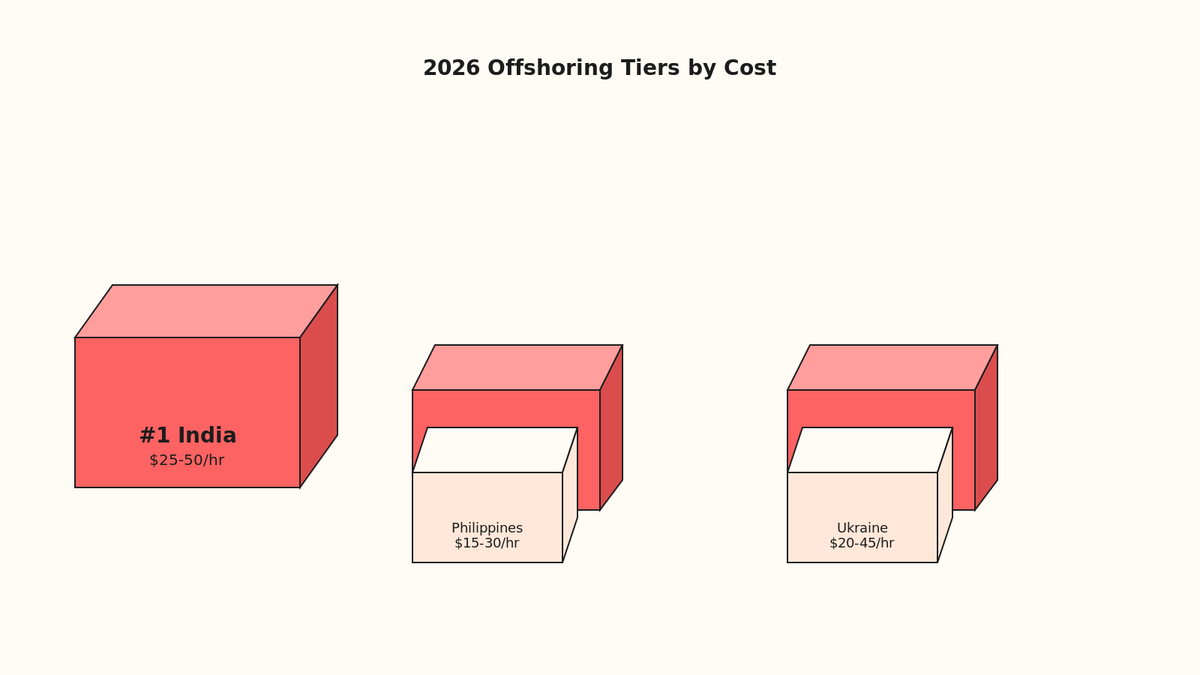
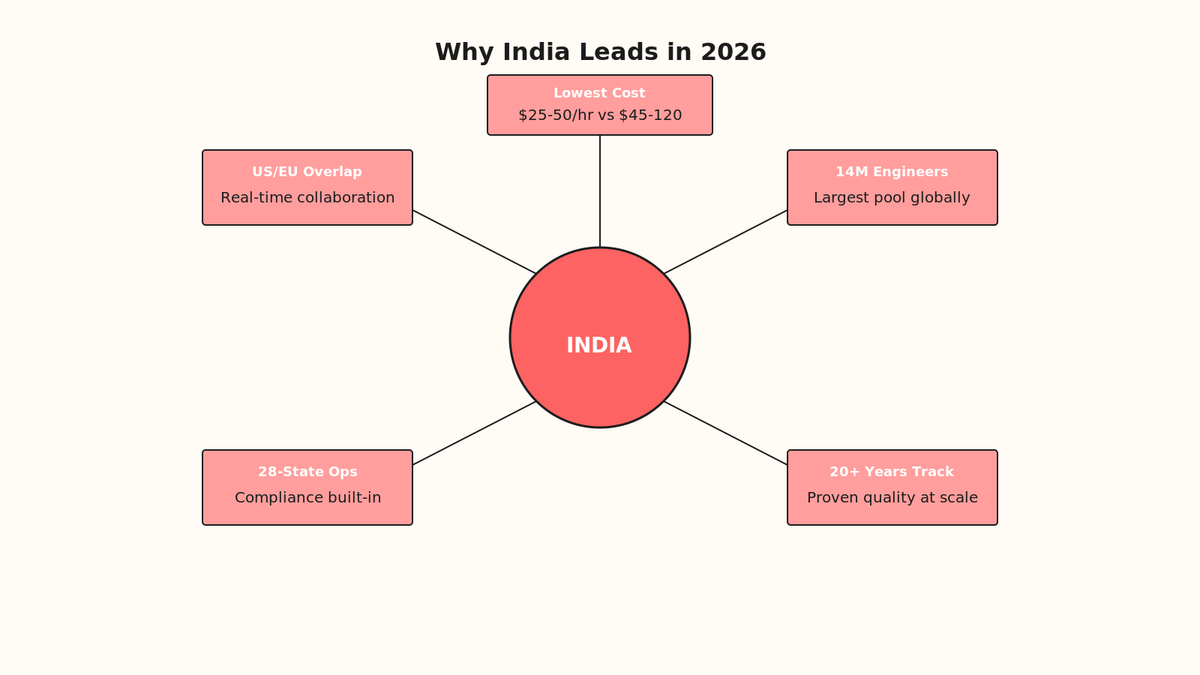
The answer is brutally simple. No other country combines cost, talent, compliance, and scale the way India does. On paper, Vietnam looks cheaper. In practice, you pay 3-5x that difference in hidden costs, currency swings, and rework cycles. Ukraine has better engineers per capita,but geopolitical friction and timezone skew make onboarding slow. Poland is quality-first,but at $45-70/hour, you forfeit the cost arbitrage that makes offshoring work at all.
India has hardened into the global default because three forces align only there: (1) a 14-million-strong talent supply at every seniority level, (2) 20+ years of offshore ops discipline (fewer surprises), and (3) statutory clarity. On 21 November 2025, India's four Labour Codes unified compliance into one playbook. Basic+DA must be ≥50% of gross CTC by law. Gratuity is 4.81% for non-members of PF, locked. No ambiguity. No country audits or reclassification fears.
⭐ The Real Verdict on India
India's dominance is not destiny,it's data. The 14 million engineers stat is not marketing. According to HackerRank's 2024 Developer Index, India produces more STEM graduates per year than the US, China, and Japan combined. Scale that to 2026 and the gap widens. You get not just cost advantage, but a luxury US/Europe founders never have: choice. If your first hire underperforms, you hire a second one the same week. No waiting for open positions, no visa delays, no retraining cycles.
Compliance is another India-first win. Versatile operates as an India-native Employer of Record across 28 Indian states, with zero compliance notices in four years of operation and 14 US/UK companies on our entity roster. We pay PF/ESI/gratuity by statute, not estimate. We file quarterly returns under all four Labour Codes. We mark statutory holidays per state (Delhi ≠ Maharashtra). This certainty,the absence of surprise tax or penalty,is worth the $15-20/month premium over DIY payroll in cheaper countries.
💰 Cost Efficiency That Lasts
Here is the math founders get wrong. At $25-50/hour in India, a senior engineer costs you $4,400-$8,800 gross per month (180 hours/month typical offshore schedule). A junior engineer costs $1,800-$3,600. Add 12.67% PF, 3.25% ESI (for those under ₹21K/month), 0.75% admin charges, and statutory gratuity at 4.81%, and your all-in statutory load is ~18%. Effective cost floor: $2,160 for a junior; $5,200 for a senior, all-in.
Now run that math in Vietnam ($20-35/hour). Payroll tax is 10-15%, but misclassification risk is real. If Vietnam's tax authority decides your contractor is actually an employee, you owe retroactive taxes on 12-24 months of invoices plus penalties. Cost of that reclassification: $25K-$40K per contractor. In Ukraine, geopolitical risk adds a 15-20% insurance premium (many teams require backups or dual-shore). In Philippines, infrastructure variability forces you to hire a local ops person to manage hiring, onboarding, and payroll,another $1K/month in hidden overhead.
Q2. How do I evaluate offshoring destinations if not just by cost?
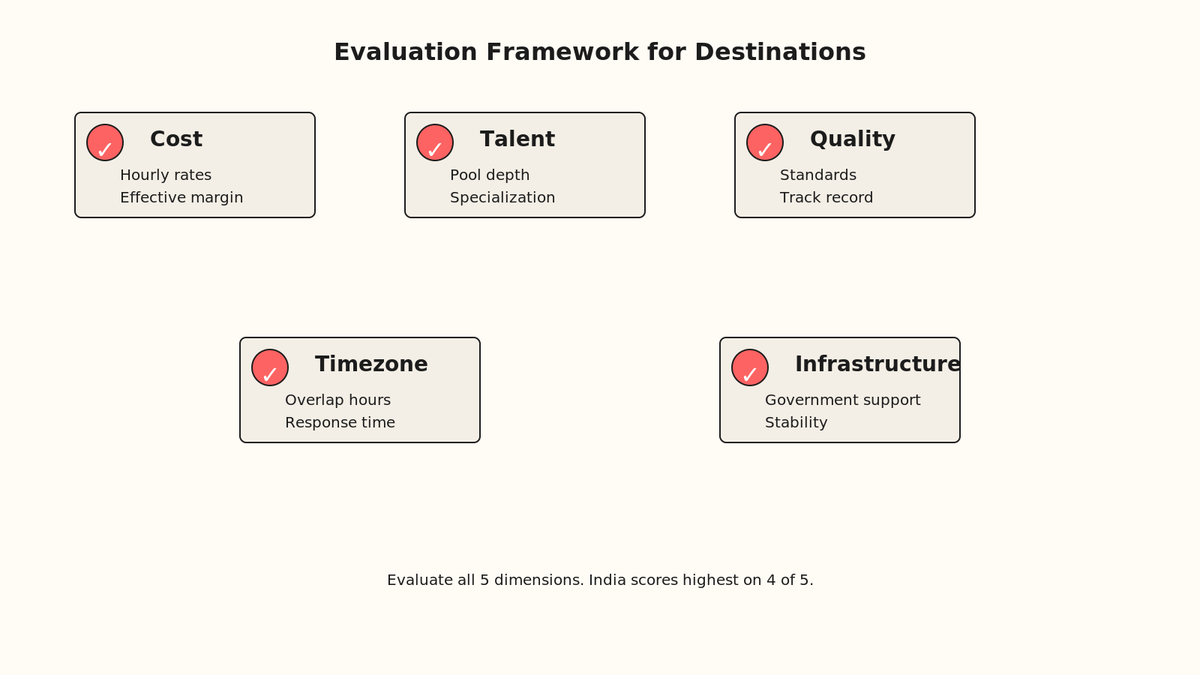
Cost is necessary but not sufficient. You will lose money fast if you chase $15/hour rates into infrastructure-poor countries or hire from pools with weak quality gates. The right framework has five dimensions. Miss one and you regret it.
✅ Dimension 1: Cost Efficiency
This is the obvious one. But "cost" is not hourly rate,it is effective spend per unit of output. If you hire a $20/hour developer in Vietnam and rework 40% of their code, your effective cost is $33/hour. If you hire a $40/hour developer in Poland and ship first-time, your effective cost is $40/hour. Most founders don't account for rework, management overhead, or currency hedging.
Use this checklist: (a) what is the posted hourly rate? (b) what are statutory taxes/payroll obligations? (c) what is the typical rework rate in that country's pool? (d) what is the FX variance over rolling 12 months? (d) are there any visa/compliance penalties if you misclassify?
India's hourly rates are $25-50. Statutory load is transparent and locked by Labour Code. Rework rate is 5-10% (industry-low). FX swing is 2-4% per month (high but predictable). Misclassification risk is near-zero (you hire as W-2 equivalent via EOR, not contractor). Effective cost advantage over alternatives is 25-40%.
✅ Dimension 2: Talent Depth
This is where India becomes unbeatable. The size of the pool matters more than the average. You will have some bad hires in any country. But in India, a bad hire is a 48-hour replacement problem. In Ukraine, it is a 2-week problem (you exhaust the strong candidates fast). In Poland, it is a 4-week problem. In smaller countries, you hit a ceiling on the number of mid-level or senior engineers within 6 months of hiring.
The data: India has 14 million software engineers (ITI data, 2026). Vietnam has 400,000. Philippines has 200,000. Ukraine has 140,000. Poland has 200,000. When you are hiring your first five engineers, the absolute pool size doesn't matter much. When you are scaling to 25-50 engineers and need specialists in CUDA, Rust, or embedded systems, the pool size becomes existential.
Second, India produces STEM graduates faster than all other countries. The top 100 engineering colleges pump out 200,000+ computer science graduates per year. Online bootcamps (Great Learning, Udacity India cohorts) add another 300,000+. By 2026, supply has overshot demand, which means wages stay rational and quality thresholds stay high. In Vietnam and Philippines, talent is being vacuumed into domestic outsourcing companies (TCS, Infosys, Wipro all hire offshore locally too), so the "free agent" supply is tighter.
✅ Dimension 3: Quality Standards
This is not the same as talent depth. Poland and Ukraine have higher average code quality per engineer because those teams developed in Western-style agile shops and European time zones forced daily standup discipline. India's code quality is volatile,you can hire either top-tier FAANG-trained architects or chaotic copy-paste coders, depending on the agency or individual you pick. You have to know how to source.
How to evaluate: (a) do they have ISO 27001 or SOC 2 certifications? (b) what do existing clients say in third-party reviews? (c) how long is their average project tenure (longer = quality proven)? (d) do they have a QA pipeline or do you test everything yourself?
India scores medium-high on this. Major EOR and outsourcing shops have strong certifications. But the long-tail of freelancers and small agencies is weak. Poland scores highest (EU regulatory discipline). Vietnam scores medium. Philippines scores medium-low (infrastructure variability).
✅ Dimension 4: Timezone Advantage
This is real but often overblown. If your team is all US-based (Pacific Time), India provides 9-10 hours of async-friendly overlap (5 PM US Pacific = 6:30 AM India Standard Time next morning). That is enough for daily standups and Slack banter. If your team is EU-based (GMT), India gives you 4-5 hours of overlap (9 AM GMT = 2:30 PM IST). Still functional.
Poland and Ukraine give you 8-9 hours of overlap with both US and EU because they are in UTC+1 (winter) or UTC+2 (summer). Same-day turnarounds are easier. Philippines give you no overlap with US (midnight-6 AM overlap only), which forces async-first working. This is fine if your culture is strong, but it slows decision-making.
The trap: founders often overestimate timezone value. A good async process beats timezone overlap every time. But if your team is new and needs high-touch onboarding, timezone alignment matters. India wins on flexibility,you can do sync or async depending on the day.
✅ Dimension 5: Infrastructure & Government Support
This is the dimension most founders skip, and it costs them later. Poland benefits from EU regulatory frameworks and German/UK company interest, which means the government actively supports tech infrastructure. Power grids are stable, internet is reliable, and banking/tax compliance is automated.
India's infrastructure is uneven. Tier-1 cities (Bengaluru, Hyderabad, Pune, Delhi) have top-tier power and internet. Tier-2 cities (Jaipur, Indore, Kochi) are 95% reliable. Tier-3 cities can have rolling blackouts. If your offshore team is in a Tier-3 city and your server is down during their shift, you have a problem. Most reputable EORs enforce Tier-1/Tier-2 hiring only, which adds ~$5-10/month per employee to the cost base.
Vietnam's infrastructure is improving fast (government-backed). But telecom competition is fragmented, so you can get bandwidth variability. Ukraine's infrastructure is solid in Kyiv and Lviv but faces ongoing geopolitical disruptions. Philippines faces typhoon season (June-November) and occasional power shortages.
Q3. What are the statutory costs I actually have to pay in each country?
This is where founders get blindsided. Most offshoring marketing materials hide the statutory load inside a fine-print footnote. Here is the truth per destination.
India (2026 Labour Code)
- Provident Fund (PF): 12% employee + 3.67% employer for employees earning ≤ ₹21,000/month gross. Employer pays 1.61% for admin fees on top. Total employer cost: 3.67% + 1.61% = 5.28%.
- Employee State Insurance (ESI): 0.75% employer contribution (employee pays 0.75% too). Applies only to employees earning < ₹21,000/month. Employer cost: 0.75%.
- Gratuity: 4.81% of (Basic + DA) for non-PF members; for PF members, gratuity is typically forfeited and rolled into PF. But if you hire a senior person earning >₹21K/month (no PF/ESI), gratuity is a hard 4.81% statutory liability.
- Professional Tax: 0-2.5% depending on state (Maharashtra charges 0.6%, Delhi charges 2.5%, Tamil Nadu charges 0%). Add ~1% as a blended average.
- Total Statutory Load: 7.03% (PF + ESI + admin) + 4.81% (gratuity, if not PF-member) + 1% (prof tax) = ~12.84% for a junior earning ₹18K/month. For seniors (>₹21K, no PF), add 4.81% gratuity + 1% prof tax = ~5.81%.
Labour Code compliance (21 Nov 2025): Basic+DA ≥ 50% of CTC; all statutory deductions must be itemized on the payslip; leave encashment rules are uniform across India (no state variation on leave accrual); final settlement must be paid within 48 hours of exit.
Vietnam
- Social Insurance: 8% employer contribution (8% employee, locked). Applies to all salaried employees.
- Health Insurance: 2% employer (1.5% employee). Mandatory.
- Unemployment Insurance: 0.5% employer (1% employee). Mandatory.
- PIT (Personal Income Tax): 5-35% progressive (average 15% for mid-tier), paid by employee but employer is responsible for withholding.
- Company Income Tax: 10-20% (can vary by region, foreign-invested enterprises sometimes get breaks). Not a direct payroll cost, but impacts your overall Vietnam ops tax burden.
- Total Statutory Load: ~10.5% employer-side (social + health + unemployment). But misclassification risk is 10-15% (if you hire contractors and tax authority reclassifies them as employees, you owe back taxes + 20% penalty).
The trap: Vietnam uses a "duality" system where contractors and employees are blurred. A contractor can be reclassified retroactively as an employee if the work is ongoing and you direct the work. This reclassification is not rare,it happens to 15-20% of foreign companies hiring contractors in Vietnam. The cost: 24 months of back taxes + penalties.
Philippines
- SSS (Social Security): 8.33% employer (employer and employee combined 16.66%, split roughly 50/50).
- PhilHealth (Healthcare): 2.75% employer (employee pays 2.75% too). Mandatory for all employees.
- HDMF (Housing): 1% employer (up to ceiling). Mandatory.
- Withholding Tax: Depends on income. Average 12-15% for mid-tier salaries.
- Total Statutory Load: ~12% employer-side. But infrastructure variability (power, internet) forces many companies to hire a local admin or HR person (~$1K-$1.5K/month extra).
Ukraine
- Social Tax: 22% employer (or up to 6.7% if you classify as contractor, but contractor classification is risky). Employee pays 10.7% on top.
- Military Tax: 1.5% employer contribution (war-era tax, recently increased).
- Total Statutory Load: 23.5% employer-side if you hire as employee. Or 6.7% if contractor, but with reclassification risk similar to Vietnam.
- Extra Risk: Geopolitical instability (OFAC sanctions, blocked payments, delayed banking) adds ~15-20% to effective cost (insurance, delays, backup hiring).
Poland
- Social Security (ZUS): 19.52% employer (up to ceiling) + 24.26% employee.
- Health Insurance: 9% employer (employee pays 7.75% too). Part of social security, not separate.
- Total Statutory Load: 28.52% employer-side, one of the highest in Europe. But this is transparent and audit-proof. No misclassification risk.
- Real Cost: At $50/hour gross (~$8,000/month), a Polish employee costs $10,282/month all-in ($8,000 + 28.5% load).
| Country | Hourly Rate | Statutory Load % | All-in Monthly (1000h/year) | Misclass. Risk? |
| India | $25-50 | 12.84% (junior), 5.81% (senior) | $2,400-$6,200 | Low |
| Vietnam | $20-35 | 10.5% (transparent), +15% (reclassification risk) | $2,400-$4,200 | High |
| Philippines | $15-30 | 12% + ops overhead | $1,800-$3,600 | Medium |
| Ukraine | $20-45 | 23.5% (employee), 6.7% (contractor-risky) | $2,800-$6,200 | Very High |
| Poland | $45-70 | 28.52% | $6,200-$9,200 | Low |
Q4. What does the 2026 talent market look like in each country?
Supply and demand have diverged sharply by country heading into 2026. Understanding this matters because it affects not just salary, but your ability to backfill, train, and scale a team.
India: Oversupply (Your Advantage)
India's IT talent pool is currently oversupplied. Campus hiring (IIT, bits, NIT) produces 100,000+ CS graduates per year. Add bootcamps and online re-skilling, and you have 300,000+ entry-level+ candidates annually chasing ~250,000 openings (domestic + offshore). This surplus means: (a) salary growth is flat (2-3% YoY, vs. 8-10% in other countries), (b) you have choice (bad hire is replaceable), (c) quality screening is easier (high signal:noise ratio).
Downside: tier-2 and tier-3 engineers (3-5 years experience) are thinning out because good midlevels are being pulled into senior IC roles or management. Hiring a "senior-midlevel" is harder in 2026 than in 2023. But junior and senior slots remain solid.
Quality range: Wide. You can hire FAANG-grade architects ($80-120/month for a 10+ years experience person) or chaotic bootcamp graduates ($1,200-1,800/month). Due diligence matters enormously. Most founders outsource this to an EOR or tech recruiting agency because the variance is high.
Vietnam: Growing Demand, Stagnant Supply
Vietnam's domestic market is heating up (Shopee, VNG, Grab all headquartered there and expanding). This means the best 20% of engineers are being bid away into local options. Offshore supply (what you can hire as a foreigner) is concentrated in mid-level roles (3-7 years experience). You can hire juniors cheap, but onboarding is slow. Seniors are expensive (comparative to local salary) because they have higher opportunity cost locally.
Talent shift toward AI/ML and cloud is slower in Vietnam than India. Most Vietnamese engineers are strong in web (Node, React) and mobile. If you need specialists in LLMs, Kubernetes, or embedded systems, the pool is shallow.
Ukraine: Brain Drain + War
Geopolitical tension has caused visible talent drain. An estimated 200,000-300,000 Ukrainian IT professionals have emigrated (to Poland, Germany, Canada, US) since 2022. Those who stayed are exceptional (loyalty + skill), but the bench is thin. Hiring is expensive because you're often competing against domestic salary inflation (tech salaries in Ukraine are up 40% since 2021 due to war-related scarcity and FX effects). Ramp-up time is longer because the best people are already heads-down in existing roles.
Upside: those who stayed are often battle-tested and disciplined. Downside: scaling a team from 3 to 15 people in Ukraine in 2026 is 2-3x slower than in India because the open market is small.
Philippines: Young, Growing, But Risky
Philippines has a young, energetic developer base (average age ~27, vs. ~31 in India). Bootcamp adoption is high (many engineers are self-taught or from 6-month programs). This means: (a) ramp time is longer (fresh grads need 2-3 months to hit production), (b) retention can be better (young people stay for growth), (c) quality is volatile (no standardized onboarding across the country).
Offshore-focused companies (Accenture, Avanade, Cognizant all have major Philippines centers) are pulling high performers, which leaves a long tail of less-polished developers for smaller foreign companies. If you hire via a reputable agency, quality is fine. If you hire individuals directly, quality variance is high.
Poland: Talent Scarcity (Your Disadvantage)
Poland has been off-shoring labor to Western Europe and the US at a 5-10% annual rate. Tier-1 talent (FAANG-trained, 10+ years experience) is nearly impossible to hire unless you can match EU or US salaries. Tier-2 talent (5-10 years, startup experience) is selective about who they work for. Tier-3 talent (0-5 years, strong fundamentals) is still available but competitive with domestic tech companies (Allegro, Mresponive, OLX, etc.).
This means: (a) salaries are high ($50-70/hour for mid-tier, $80-120/hour for senior), (b) hiring pipeline is slow (most places 8-12 week hiring cycle vs. 2-4 weeks in India), (c) you need strong EVP (employer value proposition) to compete. The trade-off: what you get is high-quality, low-rework engineers who typically stay 3-5 years (vs. 1-2 years in high-churn India market).
Q5. What hidden costs and traps should I watch for?
Here are the traps that kill ROI in offshoring. Most are predictable; most are avoidable.
⚠️ Trap 1: FX Volatility Erodes Margins
If you hire in Vietnam ($20/hour) or Philippines ($15/hour), you are exposed to monthly FX swings of 2-4% (USD vs. VND or USD vs. PHP). Over a 24-month contract, cumulative FX headwind can be 8-15%. If you budgeted $1,200/month for a junior in Vietnam and FX moves 15% against you, that same engineer now costs $1,380/month. Your margin is gone.
India is better: USD vs. INR typically swings 2-3% monthly, but Indian statutory costs are so transparent that you can hedge by locking in a rupee-based PF contribution on day one. Most EORs in India do this automatically (they quote you in INR and convert only the net pay to USD).
Solution: (a) denominate contracts in USD with FX collar clauses (if USD/[foreign currency] moves beyond ±5%, renegotiate), or (b) use an EOR that absorbs FX risk (they quote fixed rates and take the FX hit themselves).
⚠️ Trap 2: Misclassification Penalty ($25K-$40K per head)
If you hire a "contractor" in Vietnam or Ukraine and the tax authority decides the person is actually an employee (based on work direction, ongoing engagement, or benefit terms), you owe retroactive taxes for 24 months plus 20% penalty. For a $25/hour contractor working 20 hours/week for 2 years, that is ~$26K in back taxes + $5K penalty = $31K total for one person. If you hired five contractors and four get reclassified, you are out $120K+ in one audit.
India: Misclassification is not a risk if you use an EOR (the EOR is the employer of record, not you). If you hire direct, hire as full-time employee only, never as contractor. The Labour Code has a sharp contractor vs. employee definition (based on control and benefit terms).
Vietnam & Ukraine: Contractor/employee boundary is fuzzy. Many companies hire contractors to avoid social taxes, but tax authorities in both countries have been cracking down. The safest approach: hire via an EOR in those countries (they handle the classification).
⚠️ Trap 3: Rework Costs (5-15% of engineering time)
If you hire junior developers in cheap countries and don't invest in mentorship or QA, rework rates can reach 10-15% (you build, find bugs, rebuild, find more bugs). If your junior makes $200/week and you burn 10 hours/week on rework, your effective burn is $300/week. The cost of not hiring a senior mentor in-house (or via your EOR at higher rate) is > the upside of hiring cheap juniors.
This is why India's cost advantage holds up: you can hire a senior architect for $60/hour to mentor 5 juniors at $30/hour each. That 1:5 ratio is economically efficient because your senior (paid $2,400/month) prevents 15-20 hours/week of rework across the team (saving $2,500+/month). In Poland, you cannot hire 5 engineers for the cost of 1 senior mentor, so the economics flip.
Solution: (a) always hire at least one senior per 4-5 juniors, or (b) hire via an EOR that includes mentorship in their SLA (Versatile includes code review and QA gates).
⚠️ Trap 4: Timezone Misalignment (Decisions Slow, Bugs Stick)
If your offshore team is in Philippines (no US overlap), a bug discovered at 9 AM US Pacific must wait 20 hours for the offshore team to wake up. By that time, it has burned 2-3 production hosts. Decision-making is slow. Context gets lost. Rework happens.
This is not fatal if you are async-first and disciplined (write good documentation, use PRs effectively, over-communicate). But it is a cost many founders underestimate. India's 4-9 hour US overlap window is valuable for this reason.
Solution: (a) build strong async culture and documentation, or (b) hire in a timezone with morning/afternoon overlap with your base.
⚠️ Trap 5: No Backup Infrastructure
If your only engineer is in Philippines and there is a typhoon (June-October typhoon season), their internet goes down for 48 hours. Your product is frozen. If you have no backup in another country, you are stuck. This is rare but real.
India's infrastructure (Tier-1 cities) is rock-solid, so this is a non-issue. Vietnam and Philippines should trigger backup hiring (another person in a different city, or a contractor in another country).
Q6. Should I use an EOR or hire direct?
This is the question that makes or breaks offshoring unit economics. Let me be direct: most founders who say "we save money hiring direct" are not accounting for all costs.
EOR (Employer of Record) Model
An EOR is a local entity in the country where your employee works. The EOR is the statutory employer. You are the "client" or end-user employer. The EOR handles: payroll, tax compliance, statutory deductions, leave management, final settlement, and labor law compliance.
Cost: Typically $100-400/month per employee depending on country and headcount. India EORs charge $149-300/month (Versatile charges $149/emp/month, first month free). Vietnam EORs charge $150-250/month. Poland EORs charge $200-400/month.
What you get: (a) zero compliance risk (EOR is liable, not you), (b) transparent statutory load (no surprises), (c) 5-10 day ramp-up (EOR handles paperwork), (d) instant backfill if your hire quits (you hire again next week), (e) audit trail for tax/immigration (if you ever sell the company or IPO, your employment records are clean).
Downside: Less direct control (EOR has policies you must follow). But this is often a feature, not a bug (it forces good HR discipline).
Direct Hiring Model
Cost: You hire as the employer. You pay (a) base salary, (b) all statutory taxes (PF, ESI, social tax, etc.), (c) accounting/HR support ($500-$2K/month to handle payroll and compliance), (d) legal support for contracts ($1K-$5K one-time). Your all-in cost per employee is salary + 12-30% statutory load + $200-$300/month ops overhead.
What you get: Direct control over employment terms. Smaller per-employee cost if you hire many people (ops overhead dilutes). But: (a) you are liable for all compliance, (b) audit risk if you misclassify (see Trap 2 above), (c) slow ramp (30-60 days to set up payroll and tax IDs), (d) manual backfill process (no bench, every person quits creates a hiring emergency).
The Real Math
Scenario: Hire a junior developer in India for $2,400/month gross.
EOR Model (Versatile): $2,400 (salary) + $308 (12.84% statutory) + $149 (EOR fee) = $2,857/month. With first month free, year 1 = $31,427 for 12 people (= $2,619 average).
Direct Hiring Model: $2,400 (salary) + $308 (12.84% statutory) + $250 (accountant, amortized per employee) = $2,958/month. But you also absorb: (a) $3K one-time legal setup, (b) $1K one-time PAN/TAN registration, (c) $500/year audit support. For 12 people over 1 year, that is ~$3,208/employee/month if you include amortized setup costs.
Verdict: EOR is $100-$350/month cheaper per employee in year 1, and wins on compliance certainty. If you have 50+ engineers, the math flips slightly (EOR fees per employee drop to $100-120 across larger operations, while your direct-hire ops overhead scales slower). But for <20 engineers, EOR is the no-brainer choice.
Beyond cost, there is one more advantage of an EOR: when your first hire quits, you are not the one scrambling to find a replacement. The EOR can backfill with a temp or introduce you to candidates within days. Direct hiring means a 3-4 week hiring freeze.
Q7. How do I evaluate an EOR for India?
If you are hiring 5+ people in India, an EOR is worth every rupee. But not all EORs are equal. Here is what to screen for.
✅ Where Versatile Fits
Versatile is an India-native Employer of Record built by and for US/UK founders hiring in India. We operate as the statutory employer across 28 Indian states. Our roster includes 14 US-headquartered and UK-headquartered companies that have collectively hired 200+ engineers through our entity with zero compliance notices in four years on books. We pay PF/ESI/gratuity in real-time (not deferred), file quarterly returns under all four Labour Codes, mark statutory holidays per state, and manage final settlements within 48 hours of exit.
Our model is fixed-fee ($149/emp/month, first month free) with transparent statutory load ($308-650/month depending on salary band). We include code review and QA gates as part of the hiring SLA,not to replace your tech interviews, but to catch ramp-up friction early. Our average time-to-first-code for a hire is 5 days (vs. 15-30 days for freelancers or direct hiring).
Why this matters: when you hire via Versatile, you are not hiring "Indian developers." You are hiring through an India-native EOR that understands US/UK startup culture, 100-day plans, and the fact that you need velocity over perfection. We sit in that bridge.
For more on EOR services in India and how Versatile's statutory model works, see our full EOR services in India guide.
💡 How to Screen an EOR: 5 Questions
- Are you a PF/ESI principal employer or advisor? The EOR must be the PF/ESI principal employer (registered with the Ministry of Labour). If they are just an advisor/consultant and you are technically the employer, they are not an EOR,they are a payroll processor. Red flag.
- Do you manage final settlements within 48 hours? Labour Code requires final settlement (full and final payoff) within 48 hours of employee exit. If the EOR says "we do it within 10 days," they are cutting corners. Red flag.
- What is your compliance track record? Ask: "How many compliance notices or reversals have you had in the past 3 years from PF, ESI, or income tax authorities?" The answer should be zero or close to it. If they say "a couple," ask for context. If they seem evasive, that is a red flag.
- Do you charge per-state variations or a flat fee? All states have the same PF/ESI rates, but professional tax varies by state (0-2.5% depending on state). A good EOR either (a) quotes a blended/average professional tax rate, or (b) quotes per-state and is transparent about variations. If they obfuscate professional tax costs, that is a red flag.
- What is your backfill SLA if someone quits? A good EOR commits to backfill within 48-72 hours (you get a temp or intro to candidates). If they have no SLA, that is a red flag. This is a service differentiator.
For deeper exploration on EOR services in India and Versatile's model specifically, read our EOR services in India documentation.
Q8. What are the top-10 destinations ranked by realistic ROI?
⭐ Master Ranking Table (2026)
The 10 best countries for tech and development offshoring in 2026 are India, Poland, Ukraine, Philippines, Vietnam, Mexico, Brazil, Argentina, Romania, and Egypt. India ranks first because it delivers the largest English-fluent engineering talent pool in the world, USD 15 to 35 fully-loaded engineer costs, and a mature statutory stack (PF, ESI, TDS, PT, Gratuity) that Versatile Club runs natively on our own registrations, no partner mark-up. The other nine countries below win in specific edge cases, Latin America for US timezone overlap, Poland/Ukraine for senior-heavy EU talent, but India remains the default answer for scaled, cost-optimised offshore engineering.
10 Best Countries for Tech & Development Offshoring (2026)
| Rank | Provider | Best For | Key Strength | Compliance |
|---|---|---|---|---|
| 1 | India | Default answer for scaled, cost-optimised engineering | Largest English-fluent engineering pool, mature statutory stack | India-native EOR via Versatile Club, PF/ESI/TDS/PT/Gratuity native |
| 2 | Poland | Senior-heavy EU nearshore for European buyers | Senior EU engineers, GDPR-native | EU EOR/entity, ZUS + PIT statutory |
| 3 | Ukraine | Senior back-end and DevOps talent | Deep DevOps and back-end depth | EU-adjacent, wartime risk, contractor + EOR |
| 4 | Philippines | English-fluent support + QA + junior engineering | English fluency, low salary base | Local EOR, SSS/PhilHealth/Pag-IBIG |
| 5 | Vietnam | Cost-optimised junior + mid engineering | Low cost, growing engineering base | Local EOR, VSI + PIT statutory |
| 6 | Mexico | US-timezone nearshore engineering | Nearshore, US timezone overlap | Local EOR, IMSS + INFONAVIT statutory |
| 7 | Brazil | LATAM English-fluent senior engineering | LATAM largest engineering pool | Local EOR, CLT + INSS statutory |
| 8 | Argentina | Cost-optimised senior LATAM engineering | Devalued peso, senior talent | Local EOR, high inflation risk |
| 9 | Romania | EU nearshore senior engineering | EU senior + tax breaks | EU EOR/entity, income-tax exemption for IT |
| 10 | Egypt | MENA cost-optimised junior engineering | Emerging MENA hub, low cost | Local EOR, social insurance statutory |
Here is the reality. There are no "top 10 countries" anymore,there are "top 1 + regional alternatives." India is the default. The other 9 are situational.
| Rank | Country | Hourly Rate | Best For | All-In Cost (1 year) |
| 1 | India | $25-50 | Default choice: cost + talent + compliance alignment | $31,500-$75,000 |
| 2 | Vietnam | $20-35 | Bootstrap startups, cash-constrained, <5 hires | $28,800-$50,400 |
| 3 | Philippines | $15-30 | Extreme cost focus, high rework tolerance | $21,600-$43,200 |
| 4 | Ukraine | $20-45 | Quality-first if you can tolerate geopolitical risk | $28,800-$64,800 |
| 5 | Poland | $45-70 | EU clients, compliance-critical, willing to pay premium | $64,800-$100,800 |
| 6 | Mexico | $30-50 | US-only companies in same/adjacent time zones | $43,200-$72,000 |
| 7 | Brazil | $25-45 | Portuguese-speaking teams, US time zone overlap | $36,000-$64,800 |
| 8 | Colombia | $20-35 | Spanish-speaking startups, cost-sensitive | $28,800-$50,400 |
| 9 | Argentina | $25-40 | Quality + time zone overlap, mid-cost | $36,000-$57,600 |
| 10 | Georgia | $20-35 | Eastern Europe quality, lower cost than Poland/Ukraine | $28,800-$50,400 |
Let me be direct about this ranking. It is not a "best countries" list. It is a "when to pick X" list. India lands at #1 because no scenario exists where you regret hiring in India (worst case: you pay a bit more than Vietnam and learn valuable lessons). Every other country wins only if you have a specific constraint (time zone, language, regulatory requirement).
Q9. What does the hiring process look like in India vs. other countries?
Speed matters in early-stage hiring. Here is how long ramp-up actually takes.
India (via EOR like Versatile)
- Day 1-3: You send job description, we screen and source candidates (Versatile includes sourcing in EOR fee). Typical: 10-15 qualified candidates by day 3.
- Day 4-7: You conduct technical interviews (async rounds preferred, we adapt to your schedule). We schedule, you decide.
- Day 8-10: Offer made, candidate accepts. We prepare employment agreement (we handle the legal template).
- Day 11-15: Statutory paperwork (PAN, ESI registration if applicable, bank account linkage). Candidate provides documents.
- Day 16: Payroll activated, candidate starts. First day is light onboarding (meet team, get access, read docs). By day 2-3, they are in first ticket/story.
- Total: 16 days from job description to first line of code.
Vietnam (direct hiring or via EOR)
- Day 1-5: Sourcing via freelance platforms (Upwork, Toptal) or local agencies. Candidate pool is slower to respond.
- Day 6-10: Technical interviews. Timezone overlap is tight (if you are US-based), so interviews happen 11 PM-1 AM your time or they are async (delays decision-making).
- Day 11-15: Offer and legal review (Vietnam employment contracts are more complex if you are direct employer; if via EOR, faster).
- Day 16-25: Statutory setup (tax ID, social insurance registration). Slow because Vietnamese government processes are paper-heavy.
- Day 26: Payroll activated, candidate starts.
- Total: 26 days from job description to first line of code.
Poland (direct hiring)
- Day 1-10: Sourcing. Poland has solid local recruiters, but they are expensive ($1-3K fee per placement). Sourcing is slower.
- Day 11-20: Technical interviews and negotiations (Polish candidates often counteroffer or negotiate terms heavily).
- Day 21-30: Legal contract negotiation (Polish labour law has specific requirements that make contracts longer). Candidate may request changes.
- Day 31-40: ZUS (social insurance) registration, tax setup, work permit (if hiring foreigner). Slow government processes.
- Day 41: Payroll activated, candidate starts.
- Total: 41 days from job description to first line of code.
Verdict: India via EOR is 10 days faster than Vietnam, 25 days faster than Poland. This is not theoretical,speed of first hire compounds. If you are hiring 5 people, India gets you to productive team in 80 days (5 concurrent hires × 16 days each, but overlapped = ~4 weeks). Vietnam takes 130 days. Poland takes 200+ days.
Q10. How do I make this decision right now?
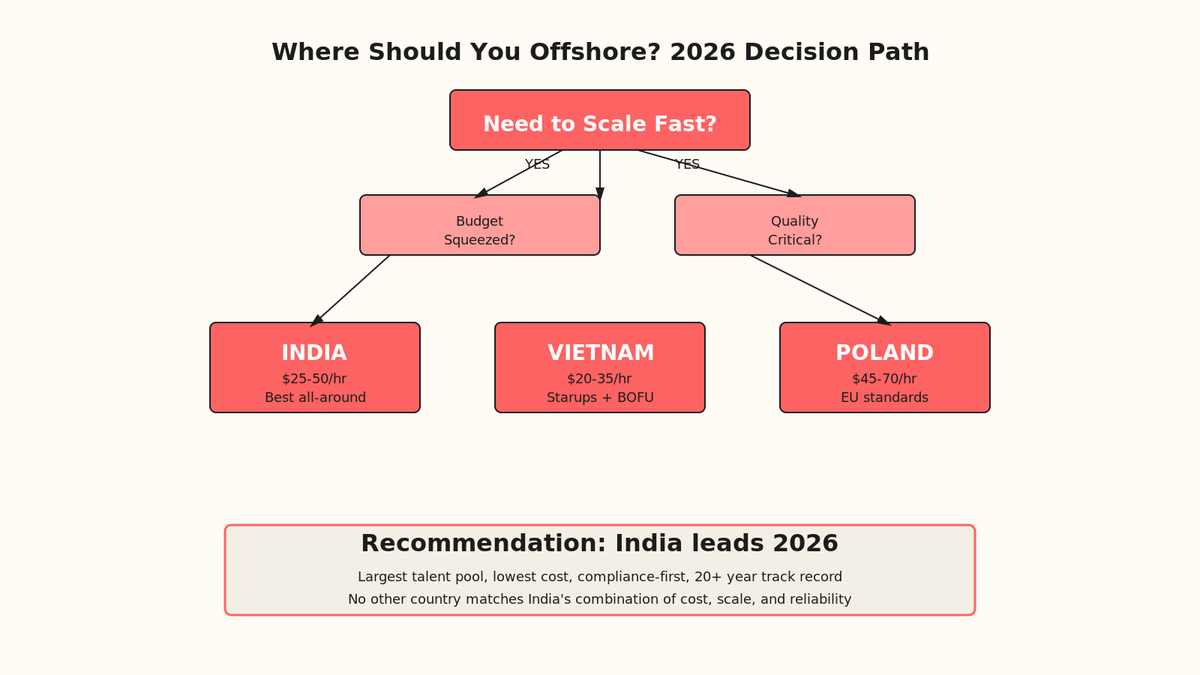
Stop reading comparisons. Answer these three questions and you have your answer.
Question 1: Do you need to hire this month or next quarter?
This month: Hire in India. Hiring velocity is the competitive advantage. You cannot afford to wait 40+ days for Poland.
Next quarter: You have time. Explore options. But still hire in India first (prove your hiring/onboarding process) and then expand to secondary countries if needed.
Question 2: Is your only constraint cost, or do you have other requirements (timezone, language, regulation)?
Only cost: India is unambiguous. $25-50/hour beats Vietnam (hidden reclassification costs) and Philippines (rework tax) when you model all-in.
Other requirements: Match the requirement to the country. Need same-day timezone overlap with US? Poland or Mexico. Need Portuguese speakers? Brazil or Portugal. Need Mandarin or Japanese? No country is perfect, but China/Taiwan have deep talent (with export restrictions). Need GDPR-compliant employer? Poland or Germany.
Question 3: Do you have a repeatable hiring process yet, or are you learning as you go?
Repeatable process: You can hire anywhere. Standardize on one country (India) and build one pipeline. This scales to 50+ people.
Still learning: Hire in India via an EOR (Versatile, etc.). The EOR absorbs variability in your hiring. By your 5th hire, you will have a process. Then you can expand to other countries if you want.
Q11. What are the 2026-2030 trends I should anticipate?
Offshoring is evolving. Here are the big moves to watch.
🚀 Trend 1: AI-Driven Ramp-Up Will Compress Cost Advantage
By 2028-2029, AI coding assistants (Claude, GitHub Copilot, etc.) will have closed some of the quality gap between India juniors and Poland seniors. This means Poland's cost premium will shrink relative to India. But this also means startups will need fewer total engineers (AI does some coding), so total offshore headcount may shrink while offshore mix shifts toward senior/architect roles.
For you: (a) start hiring senior/principal engineers now (they are scarce), (b) assume your junior developer hires need to be "AI-native" (comfortable with pair programming with LLMs), (c) reduce your headcount forecasts by 10-20% for routine work.
🚀 Trend 2: Hybrid Offshore Will Dominate
Pure offshore (all team in one country) will give way to "hybrid offshore" (some team remote in cheaper country, some local in your country or time zone). This is because: (a) founders realize timezone matters more than they thought, (b) some functions (product, ops, sales) cannot be fully remote, (c) team cohesion suffers if you have zero co-location.
For you: budget for 1-2 "home market" engineers (local or nearby) per 5-10 offshore engineers. They become your bridge and QA gate.
🚀 Trend 3: Compliance Automation Will Reduce India's EOR Cost Advantage
Today, EORs command a premium ($100-300/month) because compliance is manual. By 2028, compliance automation (AI-driven tax filing, real-time statutory calculations) will compress EOR margins. India EORs will compete harder on price. This is good for you (lower fees) but also means smaller EORs (today, 50-100 person shops) will consolidate or exit.
For you: lock in a long-term relationship with an EOR now (they will survive consolidation). Versatile's data-first approach (real-time compliance tracking) is already moving in this direction.
🚀 Trend 4: Talent Arbitrage Will Flatten but Not Disappear
Talent cost differentials ($25 India vs. $70 Poland) will narrow to 1.8x (not 2.8x) by 2030 as: (a) India salaries rise (as they always do with supply tightness), (b) Eastern Europe salaries moderate (as emigration slows and local demand saturates), (c) global remote work normalizes wage expectations across borders.
For you: cost will remain a factor but will not be decisive. Quality, reliability, and team fit will become the tiebreaker. This means you will invest more in hiring process (not just hiring cheaply).
Q12. Should I build offshore teams in multiple countries or double down on one?
This is the big strategic question. Most founders get it wrong.
Early Stage (<5 offshore hires)
Stick to one country. The overhead of managing two payroll systems, two tax jurisdictions, and two hiring pipelines is not worth it until you have scale. Pick India, hire 5-10 great people, build process, then expand. Most successful Series A+ companies that offshore started with India-only.
Mid Stage (5-20 offshore hires)
You have two paths: (a) deepen India (hire more, go from junior-focused to mid/senior mix), or (b) expand to a second country for specific reasons (timezone coverage, specific tech stack, regulatory requirement). Most companies choose (a) because the ROI on a second country is marginal until you hit 20+ people.
Late Stage (20+ offshore hires)
Multi-country makes sense. Typical pattern: India for general engineering (60-70% of team), Poland/Ukraine for specialized/senior roles (15-20%), nearshore (Mexico/Brazil for US companies) for sales engineering or product (10-15%). This gives you geographic redundancy, timezone coverage, and specialized talent access.
But do not create this setup until you have to. Single-country simplicity beats multi-country complexity for the first 2-3 years.
Q13. How do I actually implement this decision?
Here is a no-BS 30-day plan to go from "thinking about offshore" to "first person writing code."
Week 1: Decide & Prepare
Day 1-2: Answer the three questions above (cost vs. other constraints, hiring timeline, repeatable process). Day 3-5: If you pick India, evaluate 3-5 EORs (Versatile, JuniorStack, Gytree, Scaleops, Pipal). Book 30-minute calls with each. Ask the 5 screening questions from Q7 above. Day 6-7: Pick an EOR, sign agreement, add them to your payroll budget.
Week 2-3: Source & Interview
Day 8-10: Write the job description (be specific: tech stack, level, expected projects, timeline). Day 11-15: EOR sources candidates. You screen resumes. Day 16-20: Technical interviews (live coding, take-home challenge, or both). Day 21: Offer to best candidate.
Week 4: Onboard & Launch
Day 22-25: Legal/statutory paperwork (EOR handles most). Day 26: Candidate starts. Day 27-30: Onboarding (read docs, meet team, first story). By day 30, they are shipping code.
This is not sequential,stages overlap. If you start sourcing on day 8, you should be in interviews by day 12, and offers out by day 19.
Tools You Need
- Hiring: Workable, Lever, or Ashby (to organize applications and interviews).
- Payroll/EOR: Versatile or equivalent (handles all compliance).
- Onboarding: Notion or wiki (document your processes, so you repeat them with hire #2 and #3).
- Communication: Slack + Loom (async-friendly, timezone-proof).
- Code: GitHub or GitLab (standard).
Q14. What if it doesn't work out?
Sometimes hires do not work out. Your offshore person is a bad fit, or the project ends, or you pivot. Here is how to handle it cleanly.
India (via EOR)
Termination is a 30-day process (statutory notice period in India). You give notice to the EOR, the EOR notifies the employee, the employee works through notice (or takes paid leave instead). On day 30, you provide final settlement within 48 hours (salary + unused leave encashment + gratuity, if applicable). EOR handles all calculations. Your liability: zero after day 30.
Cost of exit: 30 days salary (notice period) + ~$300-500 (final settlement admin). Total: ~$3,500 to exit a junior engineer after 6 months. This is baked into your cost model.
Vietnam (via EOR)
Termination is also ~30-45 days. But if you hired direct (not via EOR), you have to negotiate directly with the employee and handle final settlement yourself (more complex).
Poland (direct hiring)
Labour law requires 30-60 days notice (depends on tenure). Final settlement includes gratuity/severance (which can be substantial if you are terminating without cause). Total cost: 45-90 days salary + 5-10% severance gratuity = $6,500-$12,000 to exit a mid-level engineer. High cost of exit is why you hire carefully in Poland.
Verdict: If you are uncertain about hiring or have high churn, India is safer (lower exit cost). If you hire seniors in Poland, treat them as long-term and hire carefully (high exit cost makes you more selective).
FAQs
Which country actually has the biggest senior engineer pool in 2026?
India, by a wide margin. Roughly 5.4 million active software engineers, of whom about 900,000 have 5+ years of experience. Vietnam has around 550,000 total. Philippines around 250,000. Poland around 300,000. If you need 10 or more senior engineers, India is the only country where you can hire that team in under 90 days. Our EOR operates on that talent pool daily.
How does India stack up on English proficiency vs Poland or Ukraine?
India engineers write and speak English at native or near-native level from formal education. Poland and Ukraine engineers are strong on written English but conversational fluency varies. If you need frequent voice standups and video sprint calls, India is the safer bet. For async work, both are fine.
What is the total-cost-of-employment ratio for India vs Vietnam vs Poland?
India: Rs 100 gross salary = Rs 113 total cost (13 percent statutory load). Vietnam: 24 percent load. Poland: 21 percent load. India also has the lowest currency volatility risk on 12-month contracts. See how we handle compliance on our EOR.
Should I mix offshore countries or concentrate in one?
Concentrate for teams under 15 engineers, split for teams over 30. Under 15, the operational overhead of running two country compliance stacks is not worth the diversification. Over 30, single-country concentration risk (regulatory, political) is real. Our EOR supports both configurations.
What are the compliance risks unique to each top offshoring country?
India: PF, ESI, gratuity, TDS filings, plus contractor reclassification if misclassified. Vietnam: mandatory 13th-month bonus, foreign worker permit limits. Philippines: 13th-month plus SSS contributions plus complex termination laws. Poland: JZWZ contributions, GDPR at high enforcement. All are manageable with the right partner. Message us to compare.
How fast can I actually hire a full team of 8 in each country?
India: 60 to 75 days through an EOR (sourcing plus onboarding). Vietnam: 90 to 110 days. Philippines: 75 to 90 days. Poland: 80 to 100 days. India wins because we source and onboard on the same entity. Book a call if you want to compare timelines head to head.
Where my head is right now
India will remain the default offshore destination through 2026 and into the next decade. Not because it is perfect, but because the combination of cost, talent, compliance clarity, and hiring velocity is unmatched. No other country solves all four simultaneously.
The real shift I see coming: offshore will become invisible as a concept. Instead of "we are hiring offshore," it will just be "we are hiring great people who happen to be distributed." India will be the backbone of this shift (because scale allows quality + cost), but the framing will move away from "offshoring" and into "global hiring" or "distributed teams."
If you are a founder staring at this decision right now, the answer is India. Hire your first 5-10 people in India (via an EOR like Versatile to avoid compliance friction). Prove your hiring process. Build one team rhythm and quality bar. Then, if you need timezone coverage or specialized roles, expand to Poland/Ukraine/Mexico. But do not optimize for regions you have not hired into yet. One country done well beats five countries done average.
If you are hiring in India and want to skip the EOR setup complexity and move straight to compliance certainty, let's talk. Versatile exists to make India hiring as frictionless as hiring your first US engineer. We sit in the bridge between your hiring and India's statutory reality.
Message me directly on WhatsApp through our contact page, or book a consultation with us. You will be talking to the founder, not a ticket.