Table of contents (11)
- Q1: What are the legal ways to pay employees in India, and why isn't a PEO one of them?
- Q2: What statutory deductions, contributions, and hidden liabilities must you pay?
- Q3: How does the 2026 Labour Code "50% basic pay" rule change your payroll?
- Q4: What does misclassifying an Indian employee as a contractor really cost?
- Q5: How do you run monthly payroll and stay compliant across Indian states?
- Q6: Do you need an Indian entity, or is an EOR the smarter path, and what does each truly cost?
- Q7: India-native EOR vs global generalists: who actually owns your compliance?
- Q8: How do you pay Indian employees from abroad without FX pain or hidden fees?
- Q9: How does the DPDP Act 2023 change how your payroll data is handled?
- Q10: Beyond compliance: how do you actually retain the India team you hire?
- Q11: What's your first move on Monday to pay your India team compliantly?
How to Pay Employees in India in 2026: The Complete Compliance, Payroll, and EOR Playbook for Global Employers
Q1: What are the legal ways to pay employees in India, and why isn't a PEO one of them?
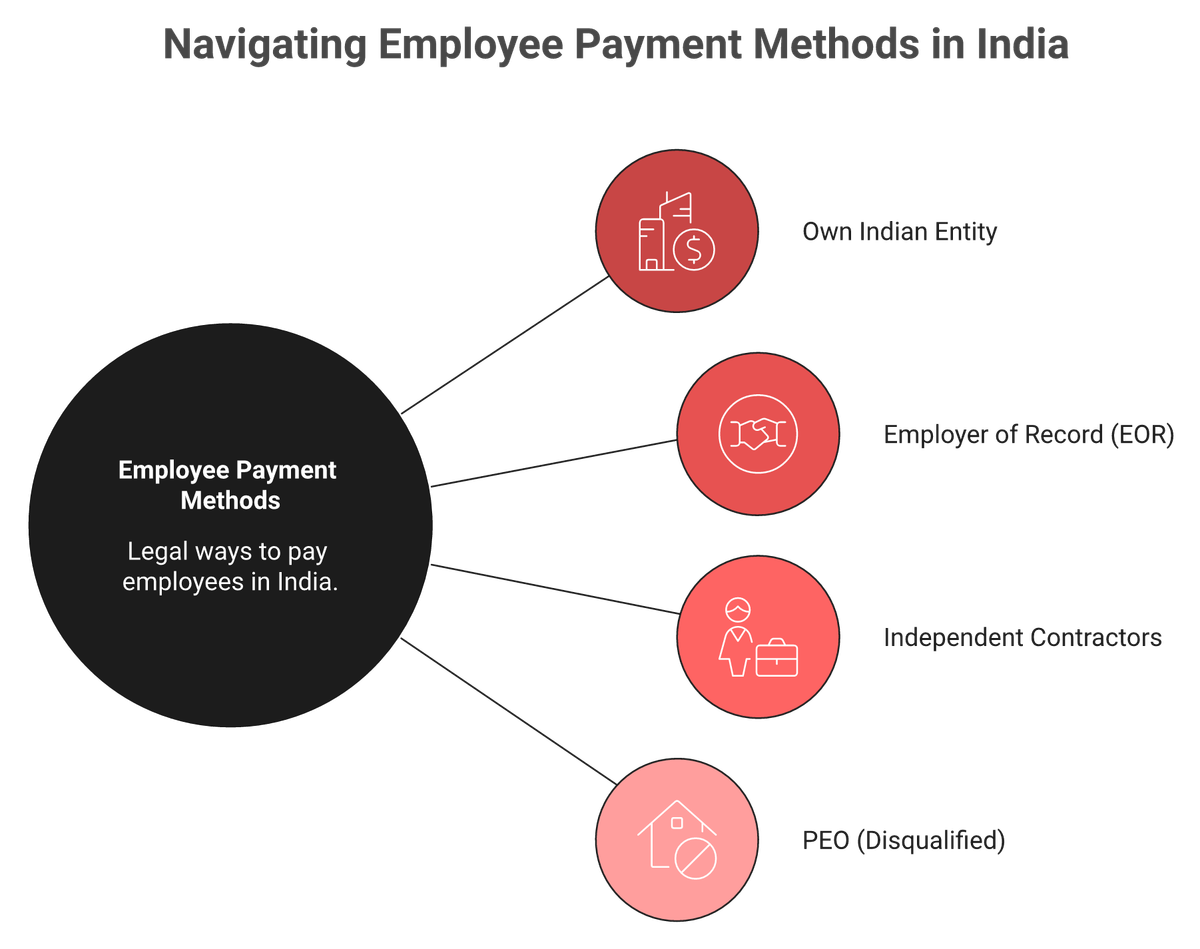
There are three compliant ways to pay employees in India: incorporate your own Indian entity, use an Employer of Record (EOR) that employs staff on its own entity, or engage independent contractors. Salaries must be paid in INR under FEMA, with statutory deductions. A US-style co-employment PEO is not legal in India unless you already own a subsidiary. Most buyers search "PEO," but they actually need an EOR.
💰 The trigger moment nobody plans for
A US founder messaged me on WhatsApp last quarter. She had just closed a Series A and needed six engineers in Bengaluru live within 45 days. Her current setup? Three "contractors" paid through a wire transfer and a spreadsheet.
Her finance lead had flagged it as risky before diligence. That is the moment most of my conversations start. You are moving from "kinda running with scissors" to needing something audit-ready. The question stops being whether to pay your India team and becomes which structure keeps you out of trouble.
🌉 The suspension bridge versus the Golden Gate
Here is how I frame the choice. Setting up your own Indian subsidiary is the Golden Gate Bridge. It is impressive, permanent, and it costs real money and 12 to 18 months before your first hire. Most companies do not need it yet.
An EOR is the suspension bridge. It gets you across the same river in days, not quarters. You rarely need the Golden Gate when a simple suspension bridge does the job. From what I have seen across six years of placements, the tipping point where companies start saying "right, we are ready to open our own entity" lands around 10 to 12 hires. Below that, an EOR is almost always the faster, cheaper, audit-ready path. You can pressure-test that threshold with our EOR vs entity calculator.
The third option, contractors, works for genuinely independent, project-based work. It breaks the moment someone behaves like an employee, and I will cover that trap in a later section.
⚠️ Why "PEO India" is the wrong search
Here is the part the category gets backwards. A huge number of US and UK buyers Google "PEO India" because that is the word they know from home. In the US, a PEO (Professional Employer Organization) co-employs your staff alongside your own entity.
That co-employment model does not legally exist under Indian labour law. A PEO arrangement only applies in India if you already own a registered Indian subsidiary and want to outsource payroll administration. If you do not have an entity, you legally require an EOR, where the provider's own company becomes the full legal employer. Salaries still must flow in Indian rupees through the banking system under FEMA, the Foreign Exchange Management Act that governs cross-border money movement. If you are weighing the two models, our EOR vs PEO guide breaks down the distinction in detail.
I could be strict on terminology to a fault here, but the label is not pedantry. It is your audit trail. Call the model what it legally is, and your Series C diligence goes smoothly.
When we place engineers in Bengaluru, Hyderabad, or Pune on Versatile's EOR services, they are employed by our own registered Indian entity, and their PF, ESI, and TDS filings sit under our registrations. We will never sell you a "PEO" you cannot legally use, because getting the structure right on day one is what keeps your setup clean two funding rounds later.
Q2: What statutory deductions, contributions, and hidden liabilities must you pay?
Paying employees in India means remitting statutory contributions on top of gross salary: Provident Fund (12% employee plus 12% employer, ₹15,000 wage ceiling), ESI (0.75% plus 3.25%, ₹21,000 ceiling), TDS deposited by the 7th monthly per income-tax slab, professional tax (state-specific, up to ₹2,500 a year), plus bonus and Labour Welfare Fund. Gratuity accrues from month one at 4.81% of Basic+DA.
📋 The core statutory stack
Think of gross salary as the floor, not the ceiling. On top of what your engineer sees, several mandatory contributions and withholdings run every month. Here is the working reference I give founders.
| Contribution | Employee share | Employer share | Ceiling / cap | Due date |
|---|---|---|---|---|
| Provident Fund (PF) | 12% of Basic+DA | 12% of Basic+DA | ₹15,000 wage ceiling | 15th monthly |
| ESI (health insurance) | 0.75% | 3.25% | ₹21,000 gross/month | 15th monthly |
| TDS (income tax withholding) | Per income-tax slab | - | Per slab | 7th monthly |
| Professional Tax | Up to ₹2,500/year | - | State-specific | State-specific |
| Gratuity (accrual) | - | 4.81% of Basic+DA | Formula-based | Accrued from month one |
PF is Provident Fund, India's mandatory retirement contribution. ESI is Employees' State Insurance, a health cover for lower-wage staff. TDS is Tax Deducted at Source, the monthly income-tax withholding you deposit by the 7th. Form 16, the annual tax statement, must reach each employee by 30 May.
💸 The liability that surfaces at diligence
Here is the number most founders miss. Gratuity accrues from an employee's very first month at 4.81% of Basic+DA. It is a genuine liability, even though you may not pay it out for years.
If you never book that accrual, it does not disappear. It sits quietly until an acquirer's diligence team opens your books and asks where the gratuity provision is. Under the Payment of Gratuity Act 1972, this is owed, and it is tax-exempt for the employee up to ₹20 lakh under Section 10(10) of the Income Tax Act. I have watched clean-looking startups get a valuation haircut because nobody accrued gratuity from day one. Book it early, and the surprise never happens. Our India payroll compliance guide walks through each of these line items.
Every one of these filings, PF, ESI, TDS, and professional tax across all 28 states plus 8 union territories, sits under Versatile's own EPFO and ESIC registrations. That compliance muscle was built running contract-to-hire placements for years before we launched the EOR product, which is why the numbers are handled, not outsourced to a partner you never see.
Q3: How does the 2026 Labour Code "50% basic pay" rule change your payroll?
Under India's four Labour Codes, effective 21 November 2025, an employee's Basic plus Dearness Allowance must be at least 50% of total CTC. Because PF and gratuity are calculated on Basic+DA, this re-models traditional salary stacks, raising employer contributions and often lowering take-home pay unless CTC is grossed up. Legacy payroll systems still allocating 30 to 40% to basic are now non-compliant.
⏰ What changed, and when
The headline first. On 21 November 2025, the Government of India brought all four Labour Codes into force, rationalising 29 older labour laws into a single framework. The Central Rules completing this rollout were notified in May 2026.
The provision that reshapes your payroll is simple to state. Basic plus Dearness Allowance must now equal at least 50% of total CTC. Many traditional Indian salary structures allocated 30 to 40% to basic and loaded the rest into allowances, precisely to keep PF and gratuity costs down. That structure is no longer compliant.
🧮 What it does to a real salary
Because PF (12% plus 12%) and gratuity (4.81%) are all calculated on Basic+DA, raising basic to 50% raises those contributions in lockstep. Take a ₹20 lakh CTC engineer as a worked example.
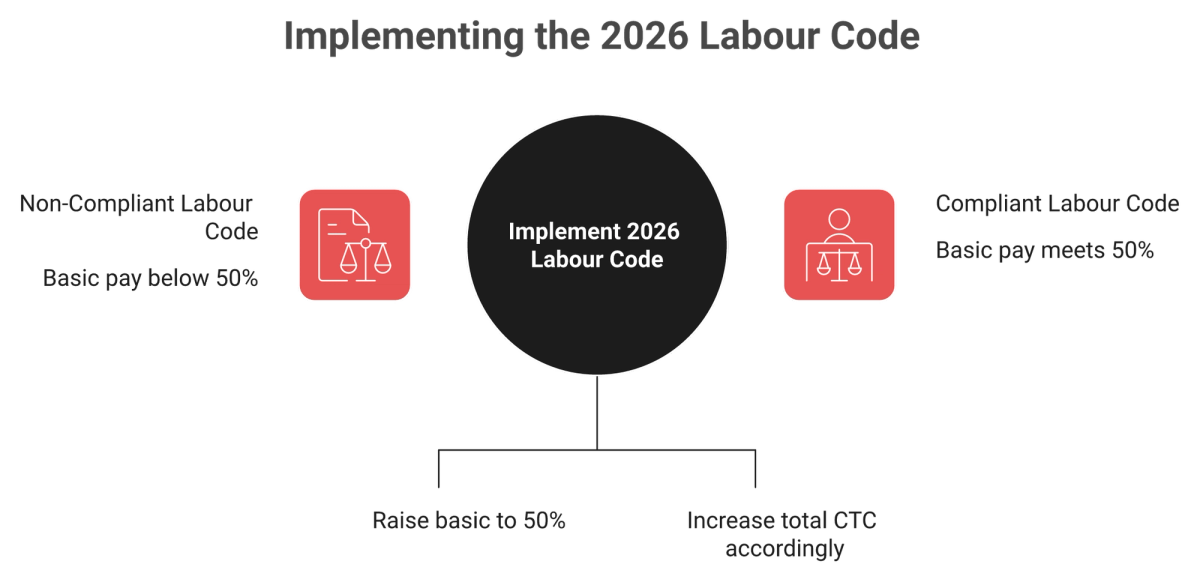
Old structure: basic at 35% (₹7 lakh). PF and gratuity calculated on ₹7 lakh.
New structure: basic at 50% (₹10 lakh). PF and gratuity now calculated on ₹10 lakh.
Employer PF and gratuity outflow rises, and unless you gross up the CTC, the employee's take-home can actually fall. This is not optional tuning. It is the statutory floor, and it has to be modelled correctly the month you run payroll. You can model the impact with our salary calculator.
❌ Where the global dashboards break
Here is my point of view, and I will hedge it as an operator, not a lawyer. A platform covering 150 countries treats India as one country among 150. When a labour reform this specific lands, the legacy salary logic behind those dashboards often fails to implement it correctly.
The reader's real fear is exactly this: paying a premium for a slick "global" dashboard while an anonymous aggregator quietly misses the 2026 50% rule and exposes you to back-pay. We rebuilt every client's salary stack for the 50% rule the month the codes went live at Versatile through our managed payroll service. When India is the only country you run, you cannot afford to get a change this size wrong.
Q4: What does misclassifying an Indian employee as a contractor really cost?
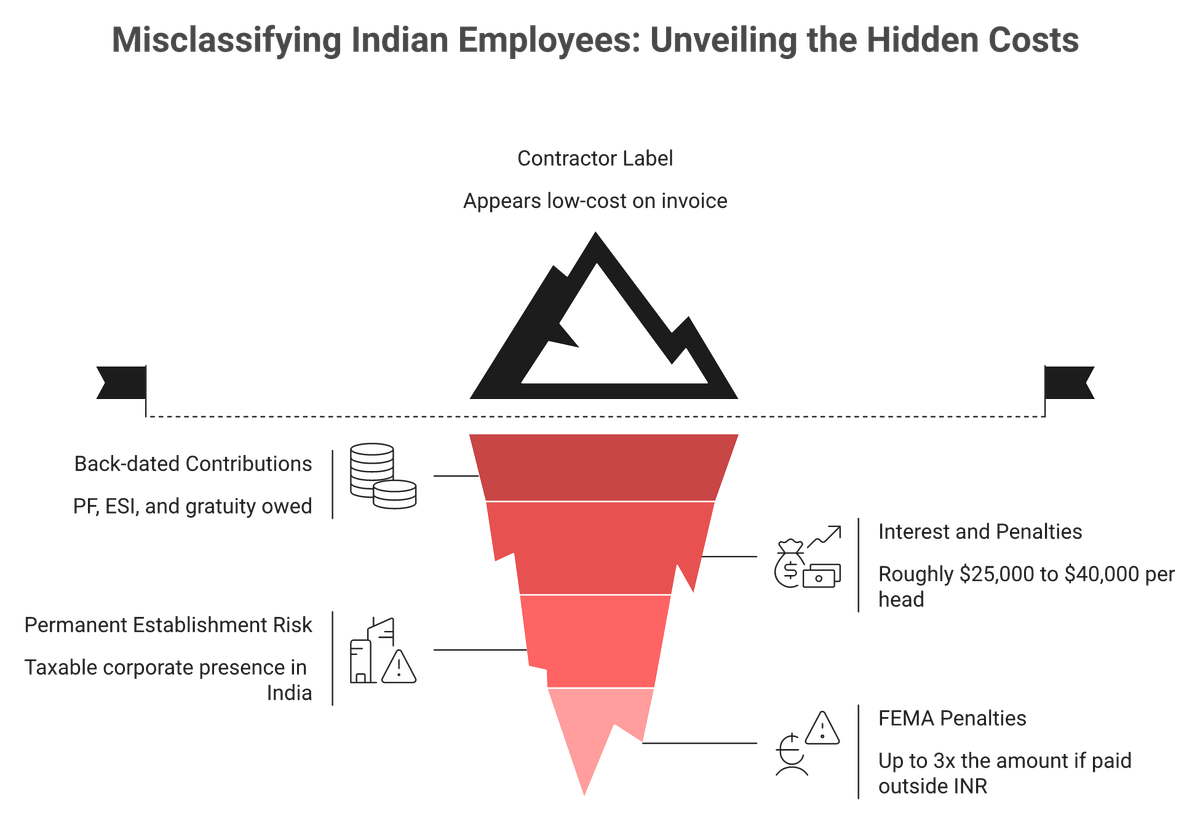
Treating a full-time India worker as an "independent contractor" can expose you to roughly $25,000 to $40,000 per head in back-pay and penalties, covering unpaid PF, ESI, and gratuity plus interest, and it can trigger Permanent Establishment risk, creating a taxable corporate presence in India. Behavioural signals like fixed hours, reporting lines, and asking permission are exactly what authorities use to reclassify contractors as employees.
👤 The dinner-break tell
An American manager once told me about an engineer she worked with offshore. Every single time he wanted to take his dinner break, he messaged her to ask if it was okay. She told him he did not need to ask. He insisted, "because I'm your subordinate."
That small exchange is the whole problem in miniature. On paper, he was a "consultant." In reality, he treated her as his boss, kept her hours, and reported to her. Indian labour authorities look at exactly these behavioural signals, not the label on the invoice, when they decide whether someone is truly independent.
💸 The complication: what it actually costs
Once a "contractor" is reclassified as an employee, the bill lands all at once. You owe back-dated PF, ESI, and gratuity, plus interest and penalties, which in practice runs to roughly $25,000 to $40,000 per head. That is real cash, retroactive, and it usually surfaces at the worst possible time, mid-diligence or during a tax review.
Then there is Permanent Establishment risk. PE means your foreign company is deemed to have a taxable presence in India through the people working for you there. That can pull your corporate profits into the Indian tax net. Paying salaries outside INR compounds the exposure, since FEMA penalties can reach up to three times the amount involved. Our independent contractor vs EOR guide quantifies this exposure further.
✅ The resolution: employ, don't improvise
Here is the framework I keep coming back to. Indians may go to work every day in a reasonable facsimile of the West, but they go home every night to India. Statutory benefits like PF and gratuity are not "nice to have." They are legally and emotionally non-negotiable, which is why the contractor fiction collapses the moment anyone looks closely.
The clean fix is to employ the person properly through an entity that carries the statutory load. Everyone on Versatile's India EOR is a full statutory employee of our own Indian entity from day one, with PF, ESI, TDS, and gratuity handled under our registrations. There is no contractor grey zone to be reclassified out of, which means no $40,000 surprise waiting in your compliance data room.
Q5: How do you run monthly payroll and stay compliant across Indian states?
Running India payroll each month means: collect PAN and bank details, calculate gross-to-net with statutory deductions, deposit TDS by the 7th, remit PF and ESI by their deadlines, file Form 24Q quarterly, file state-specific professional tax, and issue Form 16 by 30 May. The hidden complexity is state variation. Maharashtra needs dual PTRC+PTEC registration, and Karnataka requires Shops & Establishments enrollment within 30 days of joining.
⏰ The monthly cycle, step by step
By the end of this, you will know exactly what a compliant India payroll run looks like. Here is the sequence I follow every month.
Collect the basics. Gather each employee's PAN (Permanent Account Number, the tax ID), bank details, and investment declarations.
Calculate gross-to-net. Apply PF, ESI, TDS, and professional tax against the salary structure.
Deposit TDS by the 7th. TDS is Tax Deducted at Source, your monthly income-tax withholding.
Remit PF and ESI by the 15th. These fund retirement and health cover.
File Form 24Q quarterly. This is the TDS return that reconciles what you withheld.
File state professional tax. Deadlines and slabs change by state.
Issue Form 16 by 30 May. This is each employee's annual tax certificate.
🗺️ Where the map gets messy: state by state
Here is the part global guides skip. Professional tax and Shops & Establishments rules are not national. They change at the state line, and the differences are real.
Maharashtra: dual registration (PTRC plus PTEC), monthly slab filing, plus annual returns.
Karnataka: monthly PT, S&E renewal, and enrollment within 30 days of joining.
Telangana: PTRC enrollment required, with monthly remittance deadlines.
Tamil Nadu: professional tax filed twice a year, not monthly.
Delhi: no professional tax at all, but strict S&E rules.
I think of this like US multi-state sales tax for a Series B SaaS company. What is fine in one state quietly breaks in the next. The standard read treats India as one payroll; it is really 28 states plus 8 union territories, each with its own rhythm. Our India payroll compliance guide maps these state-by-state deadlines in full.
State-level PT and S&E filing is exactly where global dashboards quietly break, because they treat India as a single toggle. We run this in-house across every state at Versatile through our managed payroll service, since India is the only country we operate in. That statutory coverage across all 28 states and 8 UTs came from years of real contract-to-hire payroll runs, not a global playbook.
Q6: Do you need an Indian entity, or is an EOR the smarter path, and what does each truly cost?
For most global employers making their first 1 to 12 India hires, an EOR is the smarter path: no incorporation, no six-month setup, and audit-ready from week one. A local entity becomes cost-efficient once you cross roughly 10 to 12 employees. Budget a total cost of employment of about 23 to 25% above base salary in statutory loading. Managed payroll (if you own an entity) can start near $49 per employee per month, while full EOR typically runs $99 to $149.
⚖️ The two paths, side by side
You have a problem: you need to pay India talent, and you do not want to waste cash on the wrong structure. Here is the honest comparison.
| Criteria | Own Indian entity | Employer of Record (EOR) |
|---|---|---|
| Setup time | 12 to 18 months | 5 days to 2 weeks |
| Upfront cost | $50,000+ | None to minimal |
| Compliance ownership | You own it fully | Provider's entity carries it |
| Best for | 12+ hires, long horizon | 1 to 12 hires, speed |
| Exit | Slow wind-down | Contractual offboarding |
Setting up your own subsidiary costs real money and over a year before your first hire lands. An EOR (a provider whose entity legally employs your staff) skips all of that. If you want to run the numbers yourself, our EOR vs entity calculator models the break-even for you.
💰 The real math, said plainly
Whatever path you pick, budget a total cost of employment of roughly 23 to 25% above base salary once statutory contributions stack up. That is not a fee. That is PF, ESI, and gratuity doing their job.
The tipping point I have watched across six years is around 10 to 12 hires. Below that, an EOR wins on cash and speed. Once a client crosses 12, they usually say, "right, we are ready to open our own entity." Managed payroll then makes sense at about $49 per employee per month, versus full EOR near $149. You can see the full breakdown on our pricing page.
One thing I will push back on. I never pitch India as the cheap option. You go to India for highly academically intelligent people, and cost savings are a side effect, not the reason.
💬 What buyers say about hidden costs
Pricing transparency is where trust breaks. These are real reviews from the global platforms buyers compare us against.
"I find Deel to be absurdly expensive. They charge a high amount of fees for transferring money to my bank account."
Juan Camilo O. Deel Hire G2 Verified Review
"The current Health Care insurance is heavily centralized in Sao Paulo, which represents significant challenges for employees located elsewhere."
Versatile publishes both prices, $49 managed payroll if you own your entity and full EOR if you do not, with no setup fee, no exit fee, and the first month free. The math is yours to check before you commit a rupee. If you are weighing us against the global platforms, our Deel alternative page lays out the differences.
Q7: India-native EOR vs global generalists: who actually owns your compliance?
Deel, Remote, G-P, Omnipresent, and most global EOR platforms operate in India through local partner entities. That means an anonymous aggregator, not the brand you signed with, holds your PF, ESI, and TDS filings. India-native providers that own their entity give you a direct, auditable compliance chain. For diligence-bound companies, ownership of the employing entity separates "audit-ready" from "trust us."
🏆 The ranked shortlist
My governing thought is simple: ownership of the employing entity is the thing that matters most. Here is how the main options stack up for an India-first buyer.
Versatile Club (1.1): India-only, owns its registered Indian entity, 5-day SLA, founder on WhatsApp.
Wisemonk (1.2): India-native, $99 price anchor, SOC 2 and ISO 27001 certified.
Deel (1.3): 150+ countries, India via local partners, chatbot-first support.
Remote (1.4): broad global coverage, ticket-queue support.
G-P (1.5): enterprise scale, priced around 15% of salary.
🔍 Where the models diverge
| Factor | India-native (owned entity) | Global generalist |
|---|---|---|
| Who employs your team | The provider's own entity | A local partner shell |
| India compliance depth | Multi-state, labour-code deep | One country among 150 |
| Support | Direct, often founder-level | Ticket queue or chatbot |
| Global reach | India only | 90 to 185 countries |
Here is the honest trade-off, and I will not pretend otherwise. If you need to hire across 15 countries next quarter, a generalist scales faster than we ever could. That is a real strength, not a flaw.
But for India specifically, the aggregator model creates a gap. When your compliance sits with a partner you never signed with, your audit trail runs through someone you cannot call. The reviews back this up.
"Support is the single biggest failure. There is no direct phone line. You either email or use a chatbot, and you can ask both the same question and get two different wrong answers."
Erika D. Rippling G2 Verified Review
"Their negligence and lack of respect for deadlines have caused significant damage to my expansion plans."
Verified User in Computer Software Deel Hire G2 Verified Review
"The PF transfer for employees after terminating their employment with Velocity was very poor. There was limited help, delayed responses."
Verified User in Computer Software Velocity Global G2 Verified Review
Ask any provider one question: whose entity employs my team? Versatile's answer is our own registered Indian company, not a reseller shell. We will send you a sample USD invoice so you can see there is no hidden FX markup or setup fee, because ownership only means something if you can verify it. See how we compare directly on our Remote alternative and Wisemonk alternative pages.
Q8: How do you pay Indian employees from abroad without FX pain or hidden fees?
You cannot pay India-resident employees in USD. FEMA, the Foreign Exchange Management Act, requires salaries in Indian rupees via bank transfer, usually NEFT or RTGS (India's standard bank payment rails). As a foreign employer, you fund payroll in your currency, and your EOR converts and disburses locally. The catch is FX: many global platforms bury a 3 to 5% markup in the exchange rate.
💸 How the money actually moves
Here is the concept in plain terms. Your Bengaluru engineer must be paid in rupees, into an Indian bank account, full stop. You send funds in your home currency, and the EOR handles the conversion and the local disbursement.
The conversion is where cost hides. The advertised per-employee fee is one thing; the exchange rate you actually get is another. A quiet 3 to 5% spread on every payroll adds up fast, and employees feel it too. Our India EOR services invoice in USD with no FX layer, and you can review the mechanics on our how it works page.
⚠️ The one test that exposes hidden fees
I give every founder the same tactical tip. Before you sign, ask for a sample invoice and a single all-in figure. If a provider cannot show you one clean number, that is your answer.
"There are hidden fees. Of course, again, also here. You will never get your net-agreed salary through Deel."
Ibrahim Deel Hire G2 Verified Review
"I dislike how expensive Deel's transaction fees are, especially when moving money from the Deel account to my bank."
Maria M. Deel Hire G2 Verified Review
We invoice you in USD straight from our own Indian entity at Versatile, one number, no FX surprise, no setup or exit cost. Want proof before you trust the claim? We will send a real sample invoice so you see the math before you commit a rupee, or you can just contact us directly.
Q9: How does the DPDP Act 2023 change how your payroll data is handled?
The Digital Personal Data Protection Rules 2025, notified 13 November 2025, make anyone processing your India team's PAN, Aadhaar, salary, and bank data a Data Fiduciary. That role carries clear duties: obtain consent, provide notice, and report breaches to the Data Protection Board within 72 hours. Your EOR or payroll processor is squarely in scope, so DPDP compliance now belongs on your vendor-selection checklist.
⏰ What changed, and why it lands on payroll
Here is the news first. On 13 November 2025, India notified the Digital Personal Data Protection Rules 2025, operationalising the DPDP Act 2023. This is India's core data-privacy law, and payroll sits right in its path.
Running payroll means handling a person's most sensitive data. That includes their PAN (tax ID), Aadhaar (national identity number), salary, and bank details. Under the rules, whoever decides how that data is used becomes a Data Fiduciary, the party legally accountable for protecting it. That party must collect consent, give clear notice, and report any breach to the Data Protection Board within 72 hours. Our compliance framework covers each of these obligations.
✅ The clause to demand from any vendor
Here is where my head is right now, and I will say it plainly because the category avoids it. Most global platforms sell you on features and never mention who is accountable for your team's data. That is the wrong read.
Before you sign with any EOR or payroll provider, ask for a data-processing addendum. It should name the Data Fiduciary, spell out consent handling, and commit to 72-hour breach reporting. If a vendor cannot produce one, that gap is now your liability. Our managed payroll and India EOR services are built around this accountability.
Ownership matters here too, not just for compliance but for data. Because your team's data lives inside our own single Indian entity at Versatile, your DPDP accountability chain is one signature deep. It is not scattered across partner shells in three countries that you never see or sign with. You can review the full model on our how it works page.
Q10: Beyond compliance: how do you actually retain the India team you hire?
Compliance is the floor, not the ceiling. Retaining India talent means hiring for culture-fit rather than cost, vetting rigorously, and giving new hires real onboarding support. With nearly 30% of Indian IT resumes containing discrepancies, behavioural vetting matters as much as a clean payslip. Human support beats a ticketing queue when a hire is wobbling in week three.
🤔 The thing the category gets backwards
Most EOR marketing treats a clean payslip as the finish line. I think that is exactly backwards. A perfect PF challan means nothing if your best engineer quits in month four.
Compliance is table stakes. Anyone can file TDS on the 7th. The harder, more valuable work is hiring people who actually stay and helping them succeed once they land. That is the part the standard playbook skips. Our recruitment and contract-to-hire models are built for exactly this retention problem.
🔍 Why vetting has to go deeper than a resume
Here is a number worth sitting with. Nearly 30% of IT-sector resumes in India contain discrepancies, from inflated titles to fabricated tenure. That is not a small rounding error; it is nearly one in three.
So a resume screen is not enough. You need behavioural vetting, a structured read of how someone actually works, not just what they claim. I could be biased from running placements, but the misses I have seen almost always trace back to skipping this step. Our culture fit quiz is one way we surface this early.
💬 Where retention quietly breaks
The other half is support after the hire. When a new engineer is wobbling in week three, a ticket queue does not help. The reviews on global platforms show what cold support feels like.
"Support is the single biggest failure. There is no direct phone line. You either email or use a chatbot."
Erika D. Rippling G2 Verified Review
"We've had no fewer than six account managers in less than two years. Their new service model has left us with an account monitor, not manager."
Verified User in Translation and Localization Velocity Global G2 Verified Review
This is where Versatile stops looking like a payroll tool. We hire against 50 behavioural parameters, give every placement a 90-day Success Coach, and back C2H placements with a 6-month replacement guarantee. And when something breaks, you message me, the founder, on WhatsApp, not a CSM rotation or a ticket number. See how this plays out for scaling teams on our for startups page.
Q11: What's your first move on Monday to pay your India team compliantly?
Start by answering one question: does anyone on your India payroll behave like an employee, with fixed hours, reporting lines, and your tools, while being paid as a contractor? If yes, you have classification risk to close before your next diligence. Map your headcount against the 10 to 12 hire tipping point, request a sample USD invoice from any EOR you are considering, and confirm who legally owns the employing entity.
🌉 From running with scissors to audit-ready
Right now, you might be paying your India team through informal rails, a wire here, a "contractor" invoice there. That works until legal or finance flags it, usually right before a raise or an acquisition. The bridge from there to audit-ready is not a 12-month entity build. It is picking the right structure this week. Our independent contractor vs EOR guide helps you spot the classification risk fast.
✅ Three things to do Monday morning
Here is where I would start if I were you.
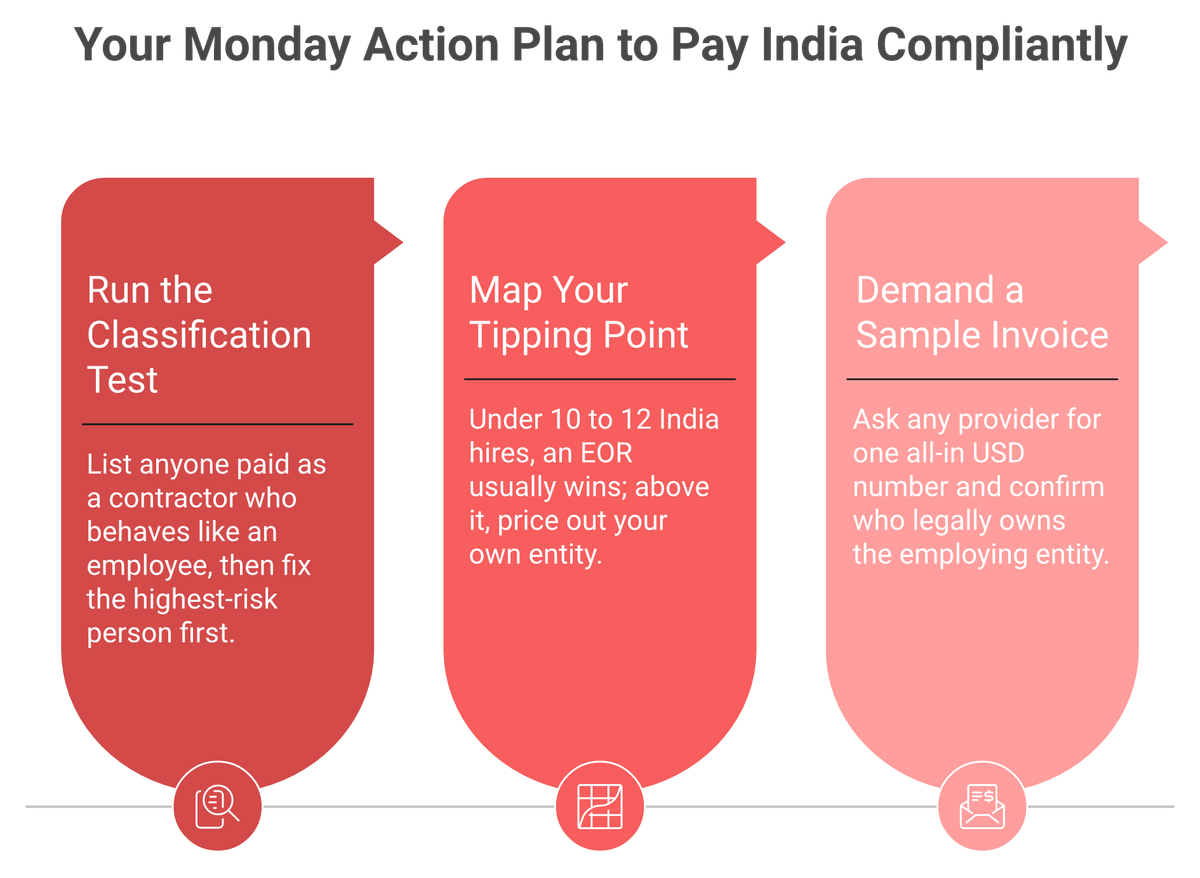
Run the classification test. List anyone paid as a contractor who behaves like an employee, then fix the highest-risk one first.
Map your tipping point. Under 10 to 12 India hires, an EOR is almost certainly your move; above it, price out your own entity using our EOR vs entity calculator.
Demand a sample invoice. Ask any provider for one all-in USD number and confirm who legally owns the employing entity.
If you want a second pair of eyes on your India setup, message me directly on WhatsApp. First month is free, there are no setup or exit fees, and if a C2H hire is not right within six months, we replace them. Tell me what you are building, and I will tell you honestly whether you even need us yet. You can also contact us or book a demo when you are ready.
What I think shifts over the next two years is that India stops being one flag on a global EOR map and becomes its own specialist category. Owned-entity operators who run one country deeply will quietly take the India revenue the generalists assumed was theirs. That is the bet I am making. I would genuinely like to hear whether you see it the same way. If you are comparing providers, our best EOR in India guide is a fair place to start.
FAQs
How do you legally pay employees in India from abroad?
As a foreign employer, you have three compliant ways to pay employees in India, and all of them require salaries to be paid in Indian rupees under FEMA, the Foreign Exchange Management Act.
- Set up your own Indian entity: full control, but $50,000+ and 12 to 18 months before your first hire.
- Use an Employer of Record (EOR): the provider's registered Indian entity employs your team, so you pay compliantly without incorporating.
- Engage independent contractors: suitable only for genuinely project-based, independent work.
You fund payroll in your own currency, and the employing entity converts and disburses in INR via bank transfer (NEFT or RTGS). Paying India-resident staff directly in foreign currency is prohibited and can attract FEMA penalties of up to three times the amount involved.
For most companies making their first 1 to 12 India hires, an EOR is the fastest audit-ready path. Our India EOR services employ your team on our own entity from day one, with statutory filings handled under our registrations across all 28 states and 8 union territories.
Can I pay Indian employees in USD or foreign currency?
No. Under FEMA, salaries to India-resident employees must be paid in Indian rupees through a domestic bank transfer, typically NEFT or RTGS. Paying residents directly in USD or another foreign currency is not compliant and can trigger penalties of up to three times the sum involved.
Here is how it works in practice:
- You, the foreign employer, fund payroll in your home currency.
- The employing entity or EOR converts those funds and disburses INR locally.
- The catch is FX: many global platforms bury a 3 to 5% markup inside the exchange rate.
Our advice is simple. Before signing with any provider, ask for a sample invoice and a single all-in figure so hidden currency spreads cannot surprise you at month-end.
We invoice in USD directly from our own Indian entity with no hidden FX layer, one clean number. If you want to see the mechanics before committing, review our how it works page or request a sample invoice.
What statutory deductions must you pay when paying employees in India?
Paying employees in India means remitting several mandatory contributions and withholdings on top of gross salary. Budget roughly 23 to 25% above base salary for this statutory loading.
- Provident Fund (PF): 12% employee and 12% employer, on a wage ceiling of Rs 15,000.
- ESI: 0.75% employee and 3.25% employer, up to Rs 21,000 gross per month.
- TDS: income-tax withholding per slab, deposited by the 7th monthly.
- Professional Tax: state-specific, up to Rs 2,500 a year.
- Gratuity: accrues from month one at 4.81% of Basic plus DA.
Gratuity is the liability most founders miss. If you never book it, it surfaces at diligence and can trigger a valuation haircut. Form 16, the annual tax statement, must reach each employee by 30 May.
We run every one of these filings under our own EPFO and ESIC registrations. See our India payroll compliance guide for the full line-by-line breakdown.
Do you need a local entity, or is an EOR the smarter path?
No, you do not need a local entity to pay employees in India. You can pay compliantly through an Employer of Record without incorporating, and for most global employers that is the smarter first move.
Here is the decision heuristic we use with clients:
- Below roughly 10 to 12 hires: an EOR wins on cash and speed, with no incorporation and audit-readiness from week one.
- Above 12 hires: your own entity starts becoming cost-efficient, and managed payroll can run near $49 per employee per month.
A subsidiary costs $50,000+ and 12 to 18 months before your first hire lands, so incorporating too early ties up cash you need elsewhere. An EOR skips that entirely.
You can model your own break-even with our EOR vs entity calculator. We publish both prices openly, with no setup fee, no exit fee, and the first month free, so the math is yours to check.
Why choose an India-native EOR over a global generalist like Deel or Remote?
Deel, Remote, G-P, and most global EOR platforms operate in India through local partner entities. That means an anonymous aggregator, not the brand you signed with, holds your PF, ESI, and TDS filings. An India-native provider that owns its entity gives you a direct, auditable compliance chain.
The differences that matter for India specifically:
- Compliance ownership: owned entity versus a partner shell you never signed with.
- Depth: multi-state, labour-code-deep coverage versus India as one country among 150.
- Support: founder-level response versus a ticket queue or chatbot.
Global generalists genuinely scale faster across many countries, so if you need 15 countries next quarter, they are the right call. For India alone, ownership of the employing entity is what separates audit-ready from trust-us.
Ask any provider one question: whose entity employs my team? See how we compare on our Deel alternative page, and we will send a sample USD invoice so you can verify there is no hidden markup.