Table of contents (12)
PEO in India: What It Means in the Indian Market, the Providers to Shortlist, and How It Differs From EOR
Q1. What Exactly Is a PEO in India, and What Are the Three Models (PEO, EOR, ASO)?
A PEO (Professional Employer Organization) is a US co-employment model where two employers share one workforce, and it does not legally exist in India, because EPFO, ESIC, and the Income Tax Department recognize only one legal employer per employee. Foreign buyers really choose among three models: PEO (needs your own entity), EOR (provider is the full legal employer), and ASO (transactional HR and payroll, no legal liability).
The word you Googled may be the wrong one
Last month, a US founder messaged me on WhatsApp. He had just closed his seed round. He wanted a PEO in India to hire two engineers in Bengaluru by month end.
I told him the truth first. The product he asked for does not legally apply to him. That is not a sales line. It is how Indian employment law works.
Why co-employment breaks under Indian law
In the United States, a PEO splits employer duties. The PEO handles payroll and benefits. The client keeps day-to-day control. Two parties co-employ one person.
India does not allow that split. Three separate authorities each require a single named employer. The Employees' Provident Funds Act, 1952 ties PF filings to one employer registration. The Employees' State Insurance Act, 1948 makes one employer liable for the 3.25% contribution. The Income Tax Department maps salary TDS (Tax Deducted at Source) to one deductor.
So co-employment has no clean legal home here. When a vendor sells you a PEO without your own entity, they almost always mean an India EOR.
The three models, in plain terms
Here is the map foreign buyers actually need:
- PEO: You already own a registered Indian entity. The provider co-manages HR and payroll under your registrations.
- EOR (Employer of Record): The provider owns the Indian entity and becomes the full legal employer. You direct the work; they hold the compliance.
- ASO (Administrative Services Organization): A transactional payroll or HR desk. No legal employer status, no statutory liability shift.
Which one fits you
The self-diagnosis takes one question. Do you own an Indian entity today?
If yes, a PEO or ASO can work. If no, you need an EOR, full stop. At Versatile, an India-only EOR, the first thing we tell a US founder on WhatsApp is that the PEO they searched for probably is not what they need, and why that is good news. It means faster hiring without an entity, no entity setup, and a clean compliance chain from day one.
I might be wrong about your edge case. But after six years running India placements, the entity question sorts 95% of buyers in under a minute.
Q2. How Is a PEO Different From an EOR in India?
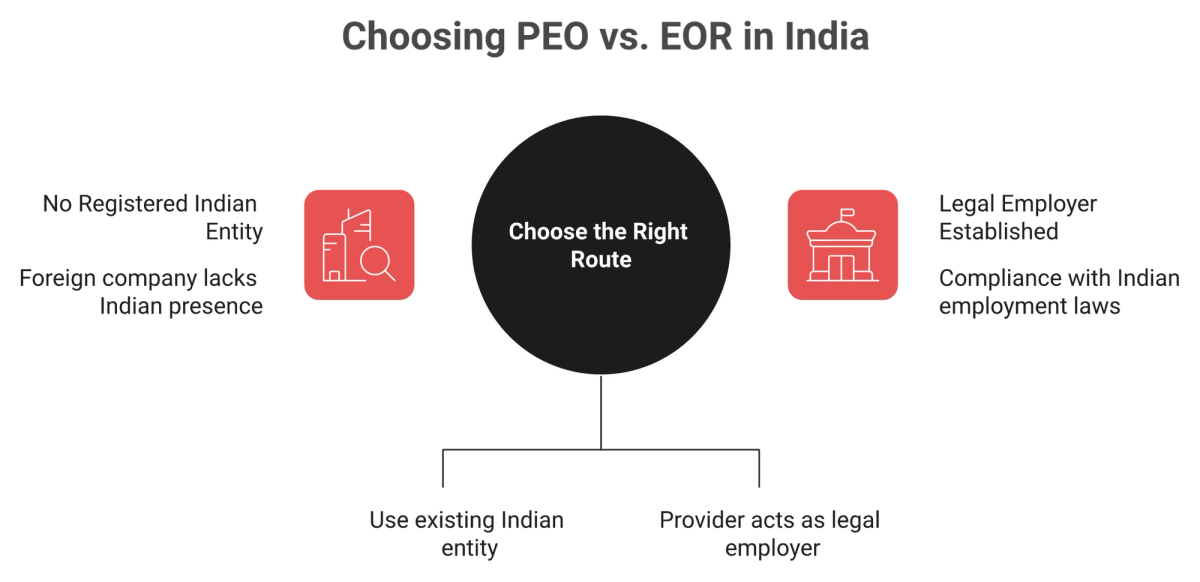
The difference comes down to who owns the entity. A PEO requires you to already have a registered Indian entity and co-manages HR under your registrations. An EOR provides its own Indian entity and becomes the full legal employer, running PF, ESI, TDS, and professional tax under its own registrations. No entity yet? You need an EOR, not a PEO.
The single line that separates them
A People Ops lead at a Series A company asked me which model her team needed. She had budget, ten planned hires, and no Indian entity.
I gave her the rule I use every week. A PEO needs your entity. An EOR is the entity. Everything else is detail.
Where each one puts the compliance burden
The split matters most when something goes wrong. Under a PEO, your entity files PF and signs the TDS returns, so liability sits with you. Under an EOR, those filings run under the provider's registrations, so the liability shifts to them.
This is also where global generalists get quietly exposed. Most route India hiring through a local-partner shell, not their own entity. With Versatile, your employees' PF, ESI, TDS, and professional-tax filings run under our own EPFO, ESIC, and GSTN registrations, not a third party's. We own the chain we are accountable for, which is the core of our EOR services in India.
PEO vs EOR at a glance
| Factor | PEO | EOR |
|---|---|---|
| Indian entity needed | Yes, yours | No, provider's |
| Legal employer | You | The EOR |
| Who files PF, ESI, TDS | Your entity | The EOR's entity |
| Onboarding speed | Weeks (after entity exists) | Days |
| Statutory liability | Sits with you | Shifts to the EOR |
| Best for | Companies with an entity | Entity-free market entry |
Which are you
Run the same one-question test. If you have a Private Limited entity already humming, a PEO or in-house payroll fits. If you are hiring your first few people and want to skip the 12 to 18 month entity setup, an EOR is the honest answer, and our EOR vs entity guide for India walks through the math. The standard read treats these as interchangeable. They are not.
Q3. Why Do So Many "PEO in India" Providers Actually Sell You an EOR?
Most pages ranking for "PEO in India" are really selling EOR services. They use "PEO" because that is what foreign buyers type. It is an SEO convenience, not a legal description. The risk: a provider casual about the PEO and EOR distinction may be equally casual about the compliance underneath. Treat labeling honesty as your first vendor-vetting filter.
Everyone says PEO, so it must be a thing
Search "PEO in India" and you will find dozens of providers promising it. The popular read says the label is harmless marketing. I think that read gets it backwards.
Even the biggest names admit traditional PEOs are not available in India, yet the keyword keeps selling. The gap between what is searched and what is legal is the whole story.
Why the sloppy label is a real signal
Here is the flaw in treating the mislabel as harmless. India compliance is unforgiving on detail. PF wage definitions, state professional-tax slabs, and TDS deposit dates each carry penalties for small misses.
A vendor who is loose with the PEO versus EOR distinction is telling you something. They are comfortable blurring a legal line for traffic. The question I would ask: if they round off the legal model on their homepage, what else gets rounded off inside your payroll run? Our professional employer organization India page names the distinction plainly for exactly this reason.
Use honesty as your first filter
So flip the label into a test. Ask any provider, point blank, whether they are a PEO or an EOR for your situation, and why.
A real operator answers in one sentence and names the entity question. A generalist often dodges. Global EOR platforms cover 90 to 150 countries and spread India expertise thin. At Versatile, we cover India at a depth those platforms cannot match, which is why founders compare us directly in our Deel alternatives for India breakdown. We would rather lose the click than mislabel the model, because we run one Indian entity, only in India, and that distinction is our daily reality, not a footnote.
Q4. How Does an India EOR Engagement Actually Work, From Signed Agreement to Offboarding?
An EOR engagement runs in five stages: sign the service agreement, onboard the employee onto the EOR's Indian payroll, run monthly payroll with PF, ESI, and TDS withholding plus payslips, administer benefits and statutory filings, and handle final settlement at offboarding. A strong India EOR moves from signed agreement to active payroll in days. Versatile commits to a contractual five business days.
The day a contract turns into a paycheck
A CFO at a profitable SMB once asked me what actually happens after she signs. She wanted the mechanics, not the brochure. Fair ask. Here is the full loop.
The five stages, in order
- Sign the service agreement. Scope, fees, and the named legal employer are set. The EOR's Indian entity becomes the employer of record.
- Onboard onto Indian payroll. The employee gets a compliant offer letter, PF and ESI enrollment, and bank and KYC setup.
- Run monthly payroll. Salary is processed with PF at 12%, ESI at 3.25% employer share, and TDS withheld per slab. Payslips go out.
- Administer benefits and filings. Monthly PF and ESI deposits, TDS deposited by the 7th of the next month, and state professional-tax returns are filed.
- Handle final settlement. At exit, the EOR runs full-and-final settlement, including dues, gratuity if applicable, and Form 16.
What onboarding speed really tells you
Speed is not a vanity metric. It is a proxy for how much of this loop the provider actually controls in house. You can see the full breakdown on our India payroll page.
A provider on its own entity can move fast. One routing through a partner shell waits on a third party. Versatile contracts to take you from signed agreement to active payroll in five business days, and I am on WhatsApp through every stage. When you own the entity, you do not wait on anyone to start someone's first payroll. If you want to model the numbers first, our employee cost calculator shows the all-in figure before you sign.
Q5. What Does It Actually Cost to Employ Someone in India Through an EOR?
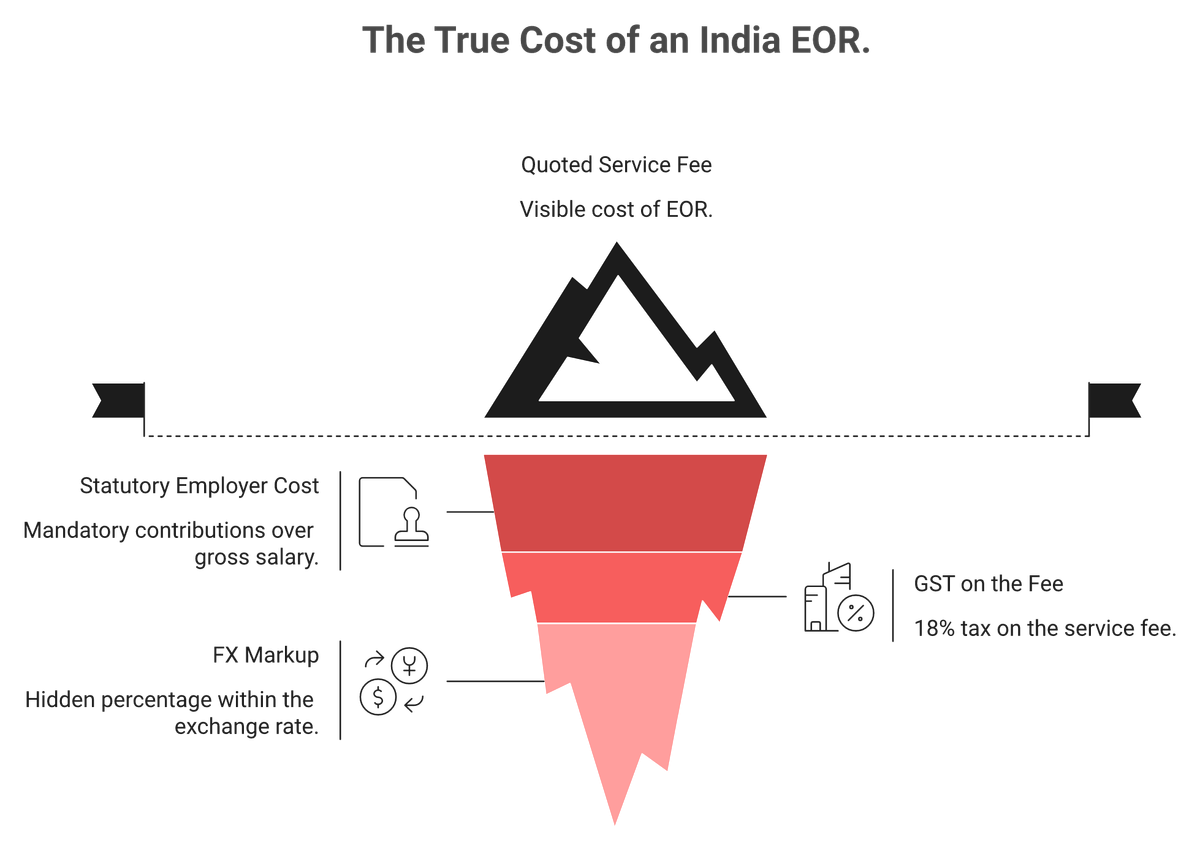
Budget three layers, not one. The provider's service fee typically runs $99 to $599 per employee per month. On top sits statutory employer cost: PF (Provident Fund) at 12% of basic plus DA, ESI (Employees' State Insurance) at 3.25%, and gratuity accruing at about 4.81%. That adds roughly 18% to 22% over gross salary. Then add 18% GST on the service fee. Most cost pages quietly skip that last layer.
The number on the quote is not the number you pay
A CFO at a $20M ARR (annual recurring revenue) SaaS company once sent me a competitor quote. It read "$599 per employee, all in." It was not all in.
I have closed enough month-end cycles to know the real bill has three parts. The fee is just the first one. Our cost of hiring in India breakdown lays out all three.
The three layers of true cost
| Cost layer | What it is | Typical figure |
|---|---|---|
| Service fee | What the EOR charges per employee | $99 to $599/month |
| Statutory employer cost | PF, ESI, gratuity on top of salary | ~18 to 22% of gross |
| GST on the fee | Indian tax on the service itself | 18% of the fee |
The statutory layer is fixed by law, not by the vendor. PF is 12% of basic plus DA. ESI is 3.25% employer share for wages at or below ₹21,000 a month. Gratuity accrues at 4.81% of basic, and you can model it with our gratuity calculator.
The FX trap nobody quotes
Here is the layer that burns founders. Many global platforms convert your dollars into rupees and add a 3% to 5% FX (foreign exchange) markup.
That markup never appears on the quote. It hides in the exchange rate. Versatile invoices in USD straight from our Indian entity, so what you are quoted is what you pay, with no FX markup, no setup fee, no exit fee, and the first month free. At $149 per employee per month, the price is the price, and our India EOR pricing for 2026 shows it in full.
This is the complaint I hear most about the generalists:
"I find Deel to be absurdly expensive. They charge a high amount of fees for transferring money to my bank account."
Juan Camilo O. Deel G2 Verified Review
"You will never get your net-agreed salary through Deel. There are hidden fees. Of course, again, also here."
Verified User Deel G2 Verified Review
And here is the flip side, from a founder who watched the math stay clean:
"USD invoice landed clean. No FX markup, no setup fee, no surprises."
Verified User in IT and Services Versatile G2 Verified Review
I could be wrong on the exact markup for your provider. Ask them one question: what rate do you convert at, and who keeps the spread? The answer tells you everything.
Q6. What Compliance Must Your India Employer Get Right (PF, ESI, TDS, Professional Tax)?
Five obligations are non-negotiable: Provident Fund (12% of basic plus DA via EPFO), ESI (3.25% employer share below the wage threshold), TDS (Tax Deducted at Source) deposited by the 7th of each month per income-tax slab, professional tax that varies by state, and gratuity after five years. Professional tax is the trap. Maharashtra alone needs dual PTRC plus PTEC registration with monthly slab filing.
The 11pm payroll message
A US founder once messaged me at 11pm her time, three days before payroll. She wanted to know why her Bengaluru engineer's PF challan had not landed in her inbox yet.
Fair worry. India compliance runs on hard deadlines, and missing one is not a rounding error. It is a penalty.
The five obligations, in plain terms
- PF (Provident Fund): 12% of basic plus DA, filed monthly with EPFO.
- ESI (Employees' State Insurance): 3.25% employer and 0.75% employee, for wages at or below ₹21,000 a month.
- TDS (Tax Deducted at Source): withheld per income-tax slab, deposited by the 7th of the next month.
- Professional tax: a state-level tax that changes by state.
- Gratuity: accrues at 4.81% of basic, payable after five years.
Why state-level detail breaks the global playbook
Professional tax is where a global template quietly fails. Each state writes its own rules. Our India payroll compliance calculation handles every one of them.
Maharashtra needs two registrations, PTRC and PTEC, with monthly slab filing. Karnataka runs monthly professional tax plus a Shops and Establishments renewal. Tamil Nadu files professional tax twice a year. A single national setting cannot cover all of this.
Depth built from real placements
At Versatile, we file PF, ESI, TDS, and professional tax across all 28 states and 8 union territories under our own registrations, the backbone of our payroll in India service. We built that muscle running contract staffing in India placements across Bengaluru, Hyderabad, and Pune before EOR was even our product.
The standard read treats India as one compliance zone. It is more like 36.
Q7. How Do the New Labour Code 2025-26 and DPDP Act Change Your India Hiring Math?
Two changes reshape the math. The New Labour Code requires basic plus DA to be at least 50% of total CTC (cost to company), which raises PF, gratuity, and leave-encashment costs you may have modeled low. The DPDP Act 2023, with its 2025 Rules, makes employee payroll data regulated personal data, so your EOR must be a compliant processor. Re-model offers and vet data posture now.
A rule change that quietly raises your cost per head
Most India cost models you find online are already stale. They assume a low "basic" salary to shrink the statutory bill. That window is closing.
The New Labour Code sets a floor. Basic plus DA (dearness allowance) must be at least 50% of total CTC.
What the 50% rule does to your numbers
When basic goes up, everything tied to basic goes up with it. That is the part founders miss. You can test the impact in our employee cost calculator.
- PF is 12% of basic, so PF rises.
- Gratuity is 4.81% of basic, so gratuity rises.
- Leave encashment is calculated on basic, so it rises too.
A model built on a 30% basic will under-quote the real cost. I have already re-modeled every Versatile offer to the 50% rule, so the CTC we quote holds up when the codes are fully notified.
The data rule buyers keep ignoring
The DPDP Act (Digital Personal Data Protection Act), 2023, is the second shift. Your employees' payroll records are now regulated personal data.
That makes your EOR a data processor with real obligations. Ask any provider one thing: what is your DPDP data-handling posture, and do you hold SOC 2 or ISO 27001? If a vendor cannot answer cleanly, that is your answer, and our managed payroll service is built around that consent architecture. I might be early on this, but data posture is becoming a procurement gate, not a nice-to-have.
Q8. EOR, Subsidiary, or GCC: Which India Structure Fits, and When Do You Outgrow an EOR?
Use an EOR to enter India fast with no entity. Consider a subsidiary or GCC (Global Capability Centre) once headcount and permanence justify the 12 to 18 month setup and capital outlay. The practical tipping point sits around 10 to 12 hires. Beyond that, owning an entity often wins on cost and control. The best EORs make that eventual exit clean, not captive.
The fork every scaling team hits
A People Ops lead asked me last quarter whether her team had "outgrown" their EOR. They were at nine India hires and climbing fast. Good question, and an honest one.
The answer is not a slogan. It is a math problem about headcount, cost, and how permanent India is for you, which our EOR vs entity in India guide breaks down.
The three structures compared
| Structure | Setup time | Upfront cost | Best for |
|---|---|---|---|
| EOR | Days | None | First hires, fast entry, no entity |
| Subsidiary | 12 to 18 months | Tens of thousands USD | Long-term, larger India teams |
| GCC | 12 to 18 months plus | High | 50+ roles, owned capability hub |
Setting up a Private Limited entity in India takes 12 to 18 months and real capital before your first hire even starts, as our company registration in India page details. An EOR skips all of that.
The tipping point, and the exit
From what surfaces when you actually run this, the switch tends to happen around 10 to 12 hires. Below that, an EOR is cheaper and faster. Above it, your own entity starts to pay for itself, and a global capability center in India may become the better home.
This is where exit terms matter. Versatile charges no exit fee, so when you cross your tipping point and open your own entity, we hand off cleanly instead of holding your team hostage. I will say plainly: if you are headed to 50 plus India roles and need SOC 2 as a procurement gate today, a generalist or your own GCC may fit better than us. India-only depth is our design, not a limitation we hide.
Q9. Which PEO/EOR Providers Should You Shortlist for India, and How Do You Vet Them?
Shortlist by depth, not logo count. India-native specialists like Versatile, Wisemonk, Asanify, and Husys own or deeply understand local compliance. Global generalists (Deel, Remote, G-P, Multiplier, Velocity Global, Papaya, Skuad) cover 90 to 150 countries but often run India through partner entities. Vet on entity ownership, FX transparency, onboarding SLA, and retention support, not just price.
The shortlist most buyers get wrong
A VP People once showed me her vendor list. It was sorted by how many countries each provider covered. For an India-only hire, that sort order is backwards.
Breadth across 150 countries usually means India is one tile on a map. Depth means someone owns the Indian entity and files under it, which is why our best EOR in India for startups guide ranks specialists first.
India EOR providers compared
| Provider | Owns India entity | Onboarding speed | India depth | Best for |
|---|---|---|---|---|
| Versatile | Yes | 5 business days | High | US/UK teams where India is the primary market |
| Wisemonk | Yes | 24 to 72 hrs | High | Compliance-first India hiring |
| Deel | Often partner-routed | 7 to 14 days | Moderate | Multi-country payroll |
| Remote | Often partner-routed | 10 to 14 days | Moderate | Global breadth |
| Velocity Global | Partner-routed | Variable | Moderate | Many-country sales teams |
I will be fair to Wisemonk. They are India-native, hold SOC 2 and ISO 27001, and carry strong G2 ratings, as our Wisemonk vs Versatile Club comparison details. The gap I see is a thinner retention story: no replacement guarantee and no published founder-direct support.
The five-point vetting checklist
Ask every provider these five questions:
- Entity ownership: do you own the Indian entity, or use a partner shell?
- FX transparency: what rate do you convert at, and who keeps the spread?
- Onboarding SLA: is your timeline contractual or aspirational?
- Retention support: do you offer a replacement guarantee?
- Support model: who answers when payroll breaks at 11pm?
The generalist support gap shows up clearly in reviews:
"Often the CS doesn't seem to have answers, which leads to emails back and forth, something I wanted in 20 minutes becomes a 4 day process."
Verified User in Computer Software Deel G2 Verified Review
"We've had no fewer than six account managers in less than two years."
Verified User in Translation and Localization Velocity Global G2 Verified Review
And the specialist contrast:
"Founder is just a call away. Extremely helpful in resolving all our queries. The process is super smooth to setup India EOR."
surbhi m. Versatile G2 Verified Review
What I think shifts in the next two years: India stops being one country on a global map and becomes its own specialist category. Our Deel alternative page tracks that shift.
Q10. How Do You Avoid the $40k Misclassification and Permanent Establishment Traps?
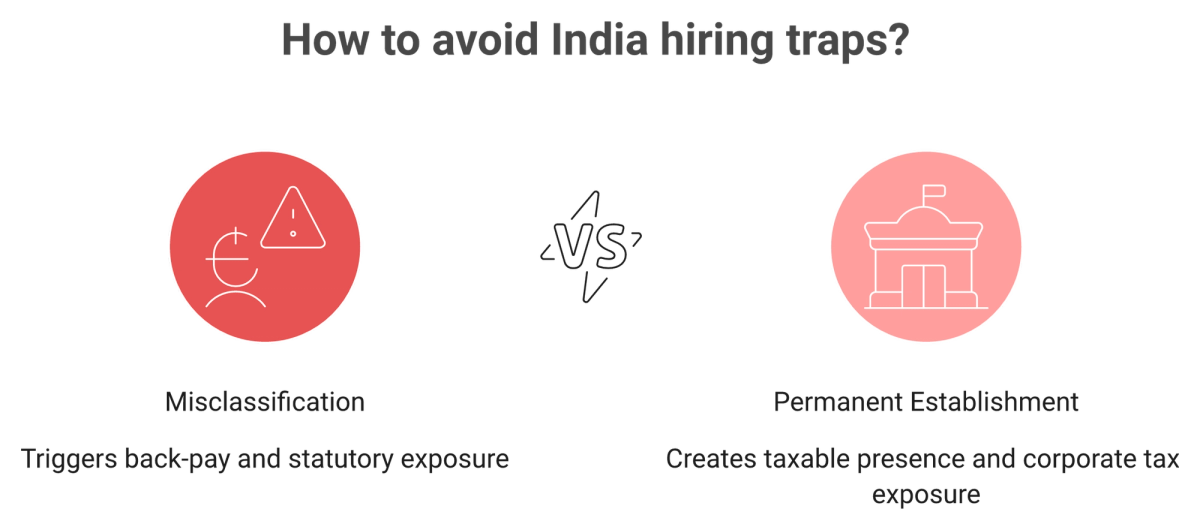
Two traps hurt most. Misclassifying an Indian worker as a contractor can trigger $25,000 to $40,000 in back-pay and statutory exposure per head. And a poorly structured engagement can create a Permanent Establishment (PE), exposing your company to Indian corporate tax. A genuine EOR that is the full legal employer neutralizes both, because the worker is properly employed and PE risk sits with the EOR's entity.
The contractor shortcut that backfires
Many founders start in India the cheap way. They pay an engineer as a contractor and skip PF, ESI, and tax. It feels efficient. It is a time bomb. Our misclassification quiz shows where you stand.
Indian law looks at how someone actually works, not what the contract calls them. A full-time engineer taking daily direction is an employee, whatever the invoice says.
What the exposure actually costs
When that reclassification lands, the bill is real. You owe back PF, back ESI, back tax, and penalties, often $25,000 to $40,000 per head.
The second trap is quieter and bigger. A poorly structured engagement can create a Permanent Establishment (PE), which is a taxable business presence in India. That exposes your whole company to Indian corporate tax, not just one payroll, and our permanent establishment risk quiz flags the danger early.
How a real EOR removes both
The fix is structural, not clever paperwork. A genuine EOR becomes the full legal employer on its own Indian entity, the model behind our employer of record India service.
The worker is properly employed from day one, so misclassification cannot attach. And because the EOR's entity holds the employment, your PE exposure stays contained. With Versatile as the legal employer of record on our own Indian entity, those liabilities simply do not land on you, unlike a loose contractor of record arrangement. I have watched founders try to paper over this with a contractor agreement. The standard read says that saves money. It defers a far bigger bill.
Q11. Why Is "Compliant on Paper" Not the Same as a Hire Who Actually Stays?
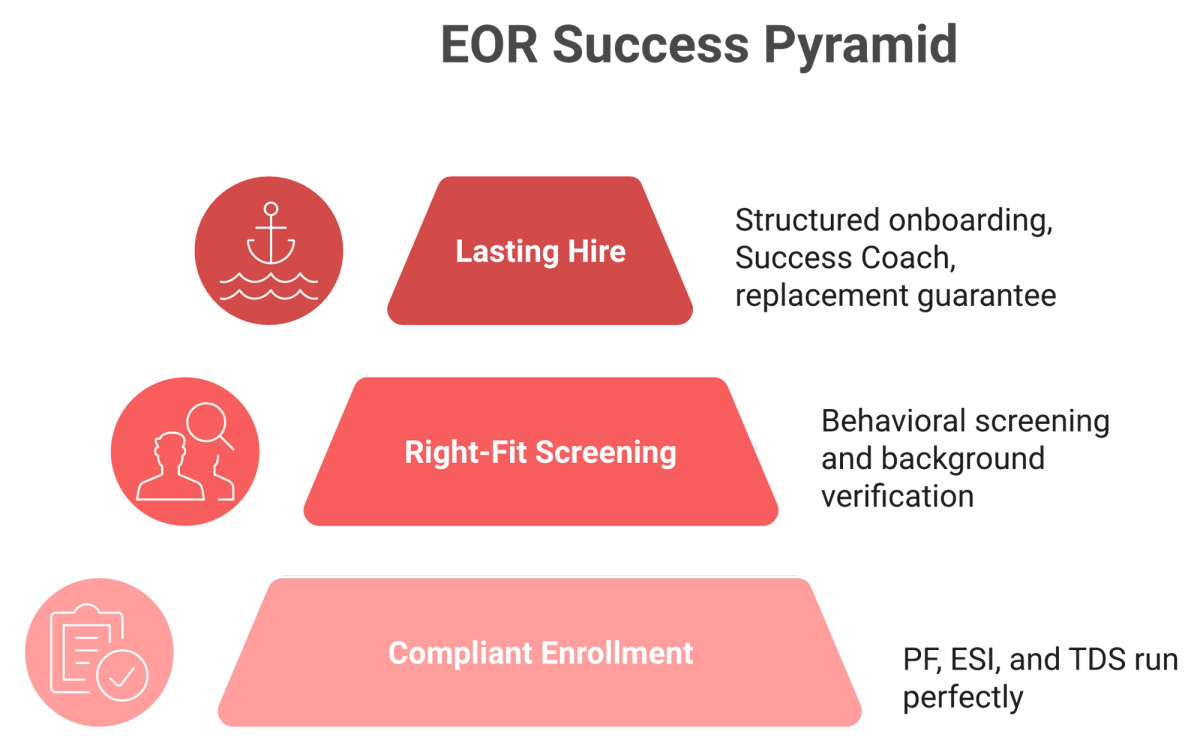
Most EOR providers solve the "legal hire on paper" problem and stop there. But a compliant hire who quits in 90 days still costs you momentum and re-hiring time. Compliance is the floor, not the ceiling. The harder problem, the one that decides whether your India bet works, is the good hire who stays, and that takes culture-fit screening, structured onboarding, and a real replacement guarantee.
The candidate who was not who they seemed
A US client of mine once interviewed a "London-based" engineer. They liked him. It took until the third interview to realize he was actually based in Greece.
They came to us, and we employed that person properly. But the moment stuck with me. Getting the paperwork right means nothing if you got the person wrong, which is why our background verification in India runs upfront.
Why the paper problem is the easy half
Here is the uncomfortable truth. In India, nearly 30% of IT-sector resumes contain discrepancies. Background gaps and overstated roles are common.
A compliance-first EOR enrolls whoever you pick. It runs PF and TDS perfectly for a person who may quit in eight weeks. That is a legal hire, not a lasting one. Our culture fit quiz screens for the difference.
Selling the hire who stays
This is where my view splits from the category. We built Versatile around retention, not just records, the core of our retention-first EOR in India model.
We screen on 50 behavioral parameters, assign a 90-day Success Coach, guarantee a replacement for six months, and take day-90 payment on contract staffing placements. We get paid when the hire sticks, so our incentive matches yours. Real founders describe what that feels like:
"Honestly I came in skeptical. Versatile was the one that actually made it simple. As a founder that's exactly what I want."
Angad S. Versatile G2 Verified Review
"Finding the right design talent is never easy. Versatile made that process feel much simpler."
Ibrahim A. Versatile G2 Verified Review
I could be wrong that retention belongs inside an EOR. But after six years, the "good hire who stays" problem is the one founders actually lose sleep over. Where is your head on that?
Q12. How Should US and UK Managers Actually Work With Their New India Team?
Hiring in India is half the job. Managing well is the other half. Indian workplace norms run higher on hierarchy and indirectness than US or UK defaults, so home-court management habits can quietly stall an India team. Swap closed yes-or-no questions for open ones, volunteer clarification instead of asking "did you understand," and build personal trust before relying on status updates.
The status update that was not true
An American manager once told me every status check from her Bengaluru team came back "on track." The project was not on track. She found out too late.
This is not dishonesty. It is hierarchy. India scores 77 on the Power Distance index, against 40 for the United States, a gap worth understanding before you build a team in India.
Four habits that actually work
High power distance means juniors rarely contradict a senior directly. Your questions have to do the work your team's bluntness will not. Here is what I coach US and UK managers to do when they hire employees in India:
- Ask open questions. Not "Are you on schedule?" but "Where are we on the schedule?"
- Volunteer clarification. Do not ask "Did you understand?" Offer more detail and watch if they accept it.
- Wait for the revised note. After a meeting, give it a few hours. Often a clarifying email follows once the room clears.
- Build personal trust first. Without it, you will hear "everything is okay" even when it is not.
One caution before you over-correct
Do not coach your India team to be "more direct" by US standards. To match American bluntness, they would have to sound almost rude to their own peers, and that feels deeply uncomfortable.
Meet them partway instead. When you hire through Versatile, this is exactly the kind of conversation you have with me directly on WhatsApp, because the person who placed your engineer also knows how to help you manage them. You can start that conversation through our India EOR for USA and India EOR for UK teams. What I keep wondering: will the next wave of India EORs treat management coaching as core, or keep selling payroll alone? Tell me what you are seeing with your team.
FAQs
Is a PEO legal in India, or do I need an EOR?
A traditional US-style PEO is a co-employment model where two employers share one workforce, and that arrangement does not legally exist in India. Indian law recognizes only one legal employer per employee, because EPFO, ESIC, and the Income Tax Department each require a single named employer for filings.
So the practical answer depends on one question: do you already own a registered Indian entity?
- If yes, a PEO or in-house payroll setup can co-manage HR under your registrations.
- If no, you need an Employer of Record, which becomes the full legal employer on its own entity.
Most foreign buyers searching for a PEO actually need an EOR. We see this every week with US and UK founders who have no Indian subsidiary and no intention of building one for a handful of hires. The cleaner path is to hire through our employer of record India service, where PF, ESI, TDS, and professional tax run under our own registrations. If you want the model mapped to your exact situation, our PEO in India page walks through which structure fits and why the label you searched for may not be the product you need.
What is the actual difference between a PEO and an EOR in India?
The difference comes down to who owns the Indian entity. A PEO requires you to already have a registered entity, then co-manages HR and payroll under your registrations. An EOR provides its own Indian entity and becomes the full legal employer, running statutory filings under its own registrations.
Here is how the responsibilities split:
- PEO: you are the legal employer, you file PF, ESI, and TDS, and liability sits with you.
- EOR: the provider is the legal employer, files everything under its registrations, and absorbs that liability.
The practical signal is speed. A PEO route still depends on your entity existing, which can take 12 to 18 months. An EOR can move from signed agreement to active payroll in days. Most global EOR platforms route India through a local-partner shell rather than an owned entity. We do not. Your employees' filings run under our own EPFO, ESIC, and GSTN registrations. If you are weighing whether to own an entity at all, our EOR vs entity in India guide breaks down the headcount and cost math so you can self-diagnose which model genuinely fits your stage.
How much does it really cost to employ someone in India through an EOR?
Budget three layers, not one. Most cost pages quote only the first and leave buyers surprised at month-end close.
- Service fee: typically 99 to 599 US dollars per employee per month.
- Statutory employer cost: PF at 12 percent of basic plus DA, ESI at 3.25 percent employer share, and gratuity accruing at about 4.81 percent, roughly 18 to 22 percent over gross.
- GST: 18 percent applies to the service fee itself.
Then there is the layer nobody quotes: foreign exchange markup. Many global platforms add 3 to 5 percent inside the conversion rate, so what you pay never matches what you were quoted.
We invoice in USD directly from our Indian entity with no FX markup, no setup fee, no exit fee, and the first month free, at 149 US dollars per employee per month. To model the full burdened number before you commit, use our employee cost calculator, and for transparent published rates see our India EOR pricing for 2026. The question to ask any vendor is simple: what rate do you convert at, and who keeps the spread?
Which compliance obligations must my India employer get right?
Five obligations are non-negotiable, and missing any one triggers penalties, not rounding errors.
- Provident Fund: 12 percent of basic plus DA, filed monthly with EPFO.
- ESI: 3.25 percent employer and 0.75 percent employee, for wages at or below 21,000 rupees a month.
- TDS: withheld per income-tax slab and deposited by the 7th of the next month.
- Professional tax: a state-level tax that changes by state.
- Gratuity: accrues at 4.81 percent of basic, payable after five years.
Professional tax is the trap a global template fails on. Maharashtra needs dual PTRC and PTEC registration with monthly slab filing, Karnataka runs monthly professional tax plus a Shops and Establishments renewal, and Tamil Nadu files twice a year. India behaves less like one compliance zone and more like 36.
We file across all 28 states and 8 union territories under our own registrations through our payroll in India service, with state-level rules handled inside our compliance calculation engine. That multi-state depth is exactly where generalist platforms run thin.
How do I avoid misclassification and Permanent Establishment risk in India?
Two traps cause the most financial damage. Misclassifying a full-time worker as a contractor can trigger 25,000 to 40,000 US dollars in back-pay and statutory exposure per head, because Indian law judges the working relationship, not the contract label. A poorly structured engagement can also create a Permanent Establishment, a taxable business presence that exposes your whole company to Indian corporate tax.
The fix is structural, not clever paperwork. A genuine EOR becomes the full legal employer on its own Indian entity, so:
- The worker is properly employed from day one, and misclassification cannot attach.
- The employment sits inside the EOR's entity, so PE exposure stays contained.
We carry that liability for you as the legal employer of record through our employer of record India model. Before you decide, run our misclassification quiz to see where your current contractors stand. Trying to paper this over with a contractor agreement feels cheaper today, but it defers a far larger bill.
Why do so many PEO in India providers actually sell an EOR?
Most pages ranking for PEO in India are really selling EOR services. They use the word PEO because that is what foreign buyers type into search, even though a traditional co-employment PEO is not legally available here. It is an SEO convenience, not a legal description.
The risk is what the sloppy label signals. India compliance is unforgiving on detail, from PF wage definitions to state professional-tax slabs to TDS deposit dates. A vendor casual about the PEO and EOR distinction may be equally casual about the compliance underneath.
So we suggest turning the label into a vetting test. Ask any provider, point blank:
- Are you a PEO or an EOR for my situation, and why?
- Do you own your Indian entity, or route through a partner shell?
A real operator answers in one sentence and names the entity question. We would rather lose the click than mislabel the model, which is why our professional employer organization India page states the distinction plainly. Global platforms covering 90 to 150 countries spread India expertise thin, so depth and honesty together make a sharper screen than price.
How fast can an India EOR onboard my first hire, and what does the process look like?
A strong India EOR moves from signed agreement to active payroll in days, not weeks. The engagement runs in five clear stages:
- Sign the service agreement, where the EOR's Indian entity becomes the legal employer.
- Onboard the employee with a compliant offer letter, PF and ESI enrollment, and bank and KYC setup.
- Run monthly payroll with PF, ESI, and TDS withholding and payslips.
- Administer benefits and statutory filings on their deadlines.
- Handle full and final settlement, gratuity, and Form 16 at offboarding.
Onboarding speed is not a vanity metric. It is a proxy for how much of this loop the provider controls in-house versus waiting on a third-party shell. Providers routing through local partners commonly quote 10 to 14 days.
We commit to a contractual 5 business days from signed agreement to active payroll, and the founder is reachable on WhatsApp through every stage. If you have no entity and want to start cleanly, our guide to hiring in India without an entity shows exactly how the first hire comes together.
How do I shortlist and vet the right India EOR provider?
Shortlist by depth, not logo count. India-native specialists own or deeply understand local compliance, while global generalists cover 90 to 150 countries and often run India through partner entities. Country breadth rarely helps when India is your only hiring market.
We recommend vetting on five questions:
- Entity ownership: do they own the Indian entity, or use a partner shell?
- FX transparency: what rate do they convert at, and who keeps the spread?
- Onboarding SLA: is the timeline contractual or aspirational?
- Retention support: is there a replacement guarantee?
- Support model: who answers when payroll breaks at 11pm?
We score well on each: an owned entity, USD invoicing with no markup, a contractual 5-day onboarding SLA, a 6-month replacement guarantee, and founder-on-WhatsApp support. We name our trade-offs too. If you need 5-plus countries or SOC 2 as a procurement gate today, a generalist may fit better. For a direct head-to-head with the closest India-native option, see our Wisemonk vs Versatile Club comparison, and browse our customer reviews for unfiltered buyer experiences.