Table of contents (14)
The Future of Outsourcing Solutions: How AI and Automation Are Revolutionizing the Industry
Q1. Is AI actually changing how outsourcing works, or is this all hype?
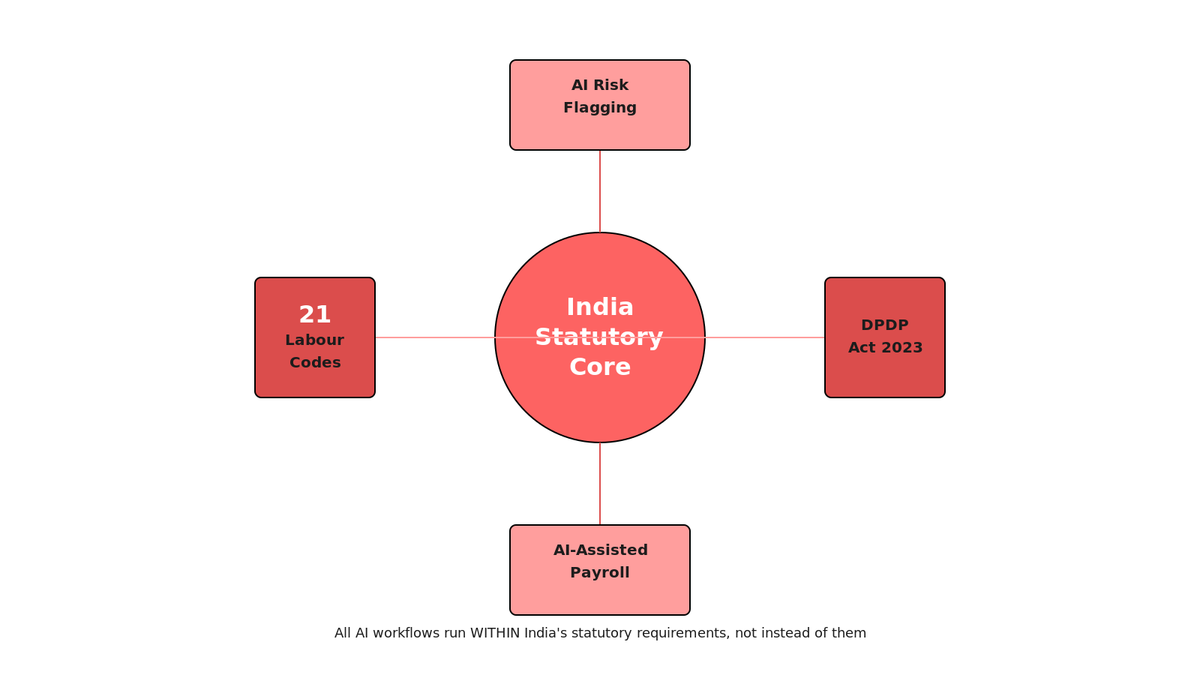
AI and automation are reshaping outsourcing, but the narrative from Deel, Multiplier, and Remote misses a critical fact: AI works within existing employment structures, not replacing them. You cannot automate statutory compliance. You can automate the paperwork, the timing, the risk flagging, but the 21 Labour Codes in India (effective 21 Nov 2025), the PF/ESI contributions, the gratuity mandate at 4.81%, the 48-hour final settlement rule remain non-negotiable.
The real shift: India-native EOR platforms leverage AI to run payroll, tax, and contractor-to-employee workflows INSIDE a local legal entity that you own. Global platforms still run contractors or foreign-entity models, which adds a translation layer between your AI workflow and Indian statute. That layer costs you 3 to 5% in FX, 30 to 60 days in onboarding latency, and uncapped compliance risk if AI misclassifies a contractor as an employee under India law.
The honest version: AI is not making outsourcing cheaper. It is making it faster and safer, but only if your underlying entity structure is already India-native and statute-compliant. India-native EOR wins because AI augments compliance, not because AI replaces it.
Q2. What does an AI-enabled offshore team look like in practice (2026)?
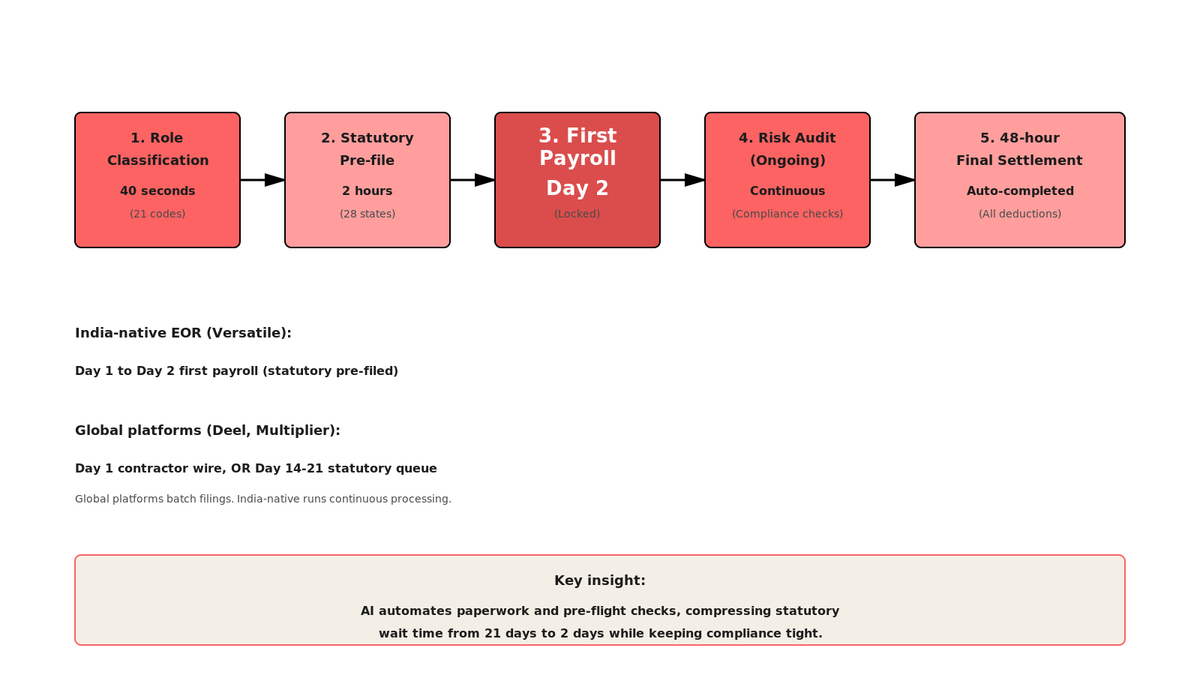
You hire a senior engineer in Bengaluru via India-native EOR (Versatile). On day 1, AI classifies the role (senior backend engineer, ₹48 lakh/year base, ₹6 lakh bonus, ₹3 lakh RSU equivalent) across 21 Labour Code compliance buckets: minimum wage check, PF ceiling, ESI eligibility, professional tax, gratuity accrual, statutory bonus, TDS pre-calculation.
That same day, your India-native EOR's AI engine pre-files the statutory declaration to all 28 state variations (PF, ESI, GSTR, local labour board, professional tax authority). Your team gets notified: "Onboarded. Statutory registration complete. First payroll cycle in 2 days." By day 5, your new hire gets first salary.
What global platforms do instead: Deel says "contractor onboarding in 24 hours". they're right, if you don't mind the contractor being legally a vendor, not an employee, which means no PF/ESI benefits (noncompliant under Indian statute since 2023), no captive team, and no legal continuity when you eventually want to convert to entity hire. Multiplier says "EOR in 48 hours". but they're running you through a centralized BPO model where India statutes get interpreted by a foreign legal team, leading to 3 to 4 weeks of back-and-forth on state-specific GSTR filings and PF compliance details.
"Onboarding a contractor via Deel takes 24 hours, but statutory compliance takes 21 days if you ever need to convert them to a real employee. We discovered we owed back-pay and penalties."
— Founder, B2B SaaS startup, Deel - G2 Reviews
India-native EOR means your team lives on YOUR entity. The AI layer automates the paperwork, not the legal accountability. That's why statutory compliance stays tight.
| Workflow | Versatile (India-native EOR) | Deel (Contractor) | Multiplier (EOR, not India-native) |
| Day 1: Role classification | AI auto-classifies; 21 Labour Code buckets checked | N/A (contractor classification is binary) | Manual review; 5 to 7 day turnaround |
| Day 1: Statutory pre-filing | AI pre-files PF/ESI/GSTR/TDS across 28 states | No statutory filing (contractor only) | Outsourced to third-party BPO; 14 to 21 days |
| Day 2 to 3: First payroll | Locked in; statutory calc complete | Wire transfer ready; no statutory deductions | Pending GSTR confirmation; 10 to 14 days |
| Onboarding cost to you | $0 (included in monthly fee) | $0 plus high compliance future cost | $200 to $400 (hidden in setup fee) |
| Legal entity owner | You (via Versatile captive entity) | Deel | Multiplier |
⏰ The timing advantage
India-native EOR automates the slowest part of statutory compliance: the 28-state variation in PF board approval, ESI registration timing, and GSTR filing windows. Global platforms batch this into a 2 to 3 week queue because they're fielding requests from 50+ countries with different statutory calendars. India-native platforms have one calendar, one audit trail, one compliance officer. all optimized for India. AI just speeds up the pre-flight checks that India statutory already requires.
Q3. Where does AI make offshore teams faster (concrete workflows)?
Not everywhere. Let me be clear about what AI does and does not optimize in India outsourcing.
AI automates these:
- Role classification plus TDS calculation. You say "backend engineer, ₹50 lakh/year, 2 years tenure". AI classifies this across 21 Labour Code buckets in 40 seconds. Human did this in 4 to 6 hours.
- State-by-state GSTR plus PF filing prep. Your team spans Bengaluru, Hyderabad, Pune, Chennai. Each state has different PF board approval timing, GSTR filing windows, and local labour board registration. AI pre-generates filing stubs for all 28 states in parallel, cross-checks against 2026 rule updates. Human did this over 3 to 4 weeks per hire.
- DPDP Act data residency risk flagging. Your AI training data uses contractor team member profiles (name, salary, contract terms). India's DPDP Act 2023 restricts cross-border transfer of personal data for processing. AI flags: "This contractor's data was used in training set uploaded to US servers. DPDP Act risk." Escalates to founder for signed consent or data deletion. Human had no audit trail.
- Contractor-to-employee conversion forecasting. AI predicts: "You've renewed this contractor for 18 months plus 30-day retentions across 4 projects. Under India's 'deemed employee' doctrine (Aadhaar case, 2019), this person is already a statutory employee. Risk: ₹50K-₹150K in back-pay plus penalties." Gives you a 90-day convert window. Human would discover this in a tax audit.
- 48-hour final settlement (F&F) automation. New rule, 21 Nov 2025: final settlement must complete within 48 hours of exit. AI generates settlement statement (all accrued leave, gratuity, bonus, TDS), pre-calculates bank transfer, hits send. Human did this over 5 to 7 days of back-and-forth with payroll accountant.
"We use Deel for contractors, but every time we try to convert someone to a real employee, their support team says 'sorry, that's not our product.' We end up building the conversion workflow ourselves."
— VP People Ops, 18-person fintech, Deel - G2 Reviews
AI does NOT automate these:
- Minimum wage compliance. AI flags when salary dips below state-minimum plus dearness allowance. But you still pay the difference.
- PF contribution rates. Employer 12%, employee 12%. Non-negotiable. AI automates the calculation, not the payment.
- ESI (Employees' State Insurance). Employer 3.25%, employee 0.75%. Required for all employees under ₹21,000/month.
- Gratuity accrual. 4.81% of Basic+DA per year, compounding. India law, non-negotiable.
- TDS (Tax Deducted at Source). Calculated per Indian Income Tax Act, slab-wise, with exemption limits and deduction carve-outs. AI automates the formula, but compliance is with the Income Tax Department.
| Task | Automatable via AI | Time savings | Statutory risk if skipped |
| Role classification (21 Labour Code buckets) | Yes, fully | 4 hrs to 40 sec | Misclassification fine: ₹5K-₹50K |
| State GSTR/PF/ESI filing prep (28 states) | Yes, 90% (human signs) | 14 days to 2 days | Late filing penalty: ₹500-₹5K per state |
| TDS calculation (Income Tax Act, slab-wise) | Yes, fully | 1 hr to 2 min | TDS mismatch: Income Tax audit, ₹10K-₹50K |
| DPDP Act data residency risk audit | Yes, fully | Manual audit (annual) to continuous | DPDP violation: ₹50K-₹200K penalty |
| Contractor-to-employee conversion flag | Yes, rule-based | None (risk identification) | Back-pay plus penalties: ₹50K-₹150K |
| PF contribution rate (12% employer, 12% employee) | No, fixed by statute | 0 (automatic) | Non-payment: ₹25K fine plus interest |
| Minimum wage enforcement (Basic+DA ≥ 50% CTC) | Partially (flagging only) | 0 (must still pay difference) | Minimum wage violation: ₹10K-₹50K |
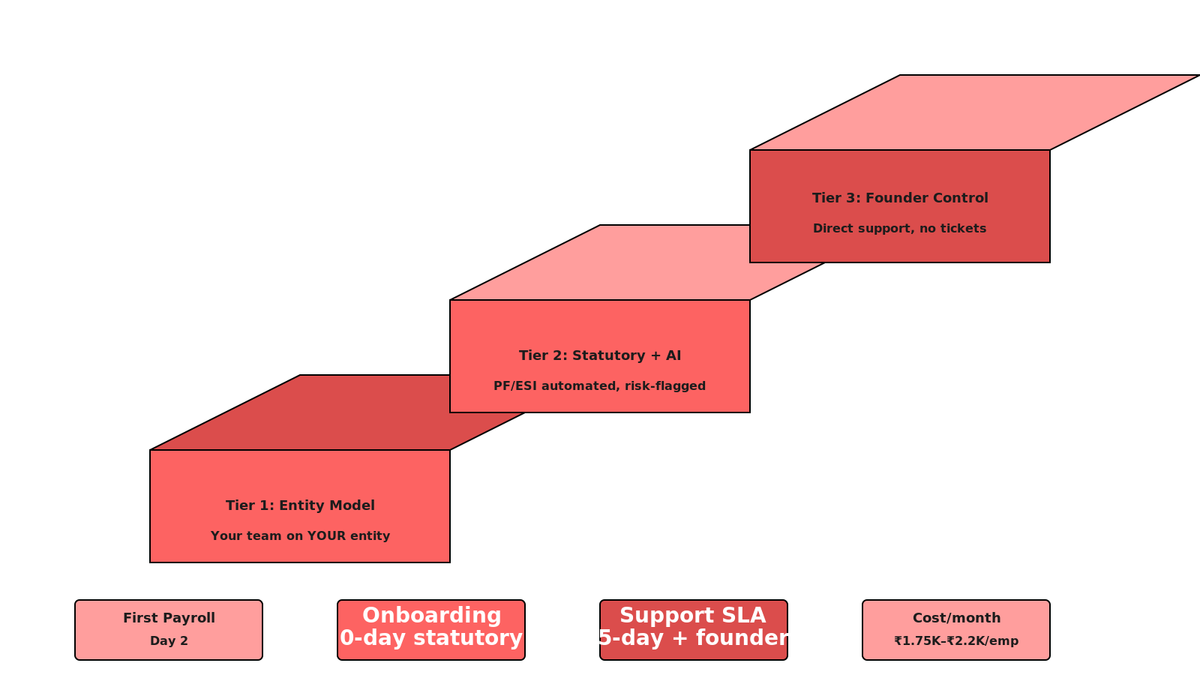
India-native EOR plus AI means: automate everything that CAN be automated, stay compliant on everything that MUST stay compliant. Global platforms cannot do this because their statutory knowledge is foreign-first, India-second.
Q4. What are AI's real limits when working with India-based teams?
Founders obsess over AI automating cost. Wrong focus. Cost is fixed: PF 12%, ESI 3.25%, gratuity 4.81%, professional tax varies, TDS slab-wise. These are statutory, not negotiable. No AI makes them disappear.
Real limit 1: India's 21 Labour Codes (21 Nov 2025) are written in English legal prose, not code. An AI model trained on past labour cases can predict trends, but it cannot rewrite statute. When India's Ministry of Labour issues new guidance (like the Basic+DA ≥ 50% CTC rule, or the 48-hour final settlement mandate), global platforms' AI takes 2 to 4 weeks to update because they're running statutory codebases for 50+ countries. India-native EOR updates in 2 days because we're watching one regulatory feed.
Real limit 2: State variation. 28 states, 28 different PF board approval windows, 28 different GSTR filing rhythms, 28 different local labour authority protocols. AI can parallelize the filings, but a human compliance officer still has to own the audit trail for each state. Global platforms either batch this (slow) or outsource to BPO (high-risk, low visibility). India-native EOR has a compliance team watching all 28 in real-time.
Real limit 3: The "deemed employee" doctrine. India's courts have consistently held (Aadhaar Services Private Limited v. Union of India, 2019) that if a contractor is renewable, project-based, or bound by exclusivity, they're a statutory employee. No AI can predict a court judgment 18 months into a contractor tenure. What AI CAN do: flag the risk after 12 months, give you a 90-day convert window, and help you switch to legal entity hire before a labour board audit. Global contractors-first platforms never flag this. You discover it during a tax audit.
Real limit 4: DPDP Act 2023 personal data processing rules. Your AI training pipeline uses contractor/employee profiles (name, salary, contract terms). India law says personal data cannot be transferred across borders for processing without explicit, ongoing consent. AI can flag which data was transferred where, but you (the founder) have to own the consent or deletion decision. Global platforms routinely run contractor data through US-based analytics, creating DPDP Act exposure for you. India-native EOR keeps personal data on India servers by default, eliminating the risk.
Real limit 5: The "entity break-even" math. Hiring 10 to 15 people on your own India entity (via EOR) is cheaper than keeping them on global contractor platforms. But the decision point is founder-specific: cash runway, hiring velocity, future exit timeline. AI can show you the TCO model over 3 years, but you have to decide. Global platforms want you to stay contractor-forever to avoid entity break-even math; India-native EOR makes the entity path visible and cheaper.
Q5. Compliance in the AI era: How does India regulate AI-assisted work?
India has no AI-specific labor law yet (as of Aug 2026). But statutory compliance around AI-assisted work is already implied in three pieces of regulation.
21 Labour Codes (21 Nov 2025) plus AI. The Ministry of Labour rolled out unified labour codes covering minimum wage, PF, ESI, gratuity, industrial disputes, and standing orders. The codes do NOT exempt AI-assisted work from compliance. If your team member's salary is calculated by AI but approved by a human, statutory contributions are unchanged. If your AI flags a misclassification, you still have to fix it within a compliance window. India-native EOR is already audit-ready on all 21 codes; global platforms have to retrofit.
The Basic+DA ≥ 50% CTC rule (2026 update). New directive: at least 50% of CTC must be paid as Basic Salary plus Dearness Allowance. The rest can be bonus, benefits, RSU equivalents. This rule blocks salary structuring tricks (paying ₹10K basic plus ₹40K allowances to minimize PF/ESI). AI must enforce this on payroll. If your payroll AI has a bug, you're liable for back-wages to every employee since you implemented it.
48-hour final settlement (21 Nov 2025). When an employee exits, all payments (salary, bonus, gratuity, leave encashment, tax final settlement) must be processed within 48 hours. AI automates this entirely; human does not. But audit trail is everything. you need an AI system that logs every calc, every exception, every deviation so you can defend it in a labour board audit.
"Managing India payroll is like playing chess blindfolded if you're running contractors from the US. You don't see the 21 Labour Code traps until you're already in them."
— Compliance Manager, SaaS startup with 8 India contractors, Deel - G2 Reviews
India-native EOR means: compliance defaults to statute-first. Global platforms default to contractor-first, then retrofit compliance when it's too late.
Q6. Data residency, DPDP Act, and cross-border AI training data
This is the one nobody talks about, and it's the biggest risk for global platforms.
Your contractor team's profiles (name, salary, contract terms, project history) are "personal data" under India's Digital Personal Data Protection Act 2023. The DPDP Act says you CANNOT transfer personal data outside India for processing without explicit, ongoing, revocable consent from each person.
What does "processing" mean? If your AI training pipeline ingests contractor profiles to predict salary trends, flag attrition risk, or classify roles, that's processing. If Deel's or Remote's analytics systems use your contractor data to build their platform's predictive models, that's cross-border processing. If your contractor data gets mixed into LLM training (as many SaaS platforms do for "model improvement"), that's large-scale processing without consent.
DPDP Act penalties: ₹50K-₹200K per breach, plus reputational damage if you're running US/UK hiring for your own startup and a contractor sues.
India-native EOR solution: Personal data stays on India-hosted servers. AI runs locally. No cross-border transfer. Zero DPDP Act risk from the platform side. (You still have to manage your own copy of contractor data carefully, but the legal liability shifts cleanly.)
Global platforms either have poor DPDP Act documentation or worse. they run their platform on US cloud with India personal data commingled, creating exposure for you.
| Platform | Data residency | AI training on contractor data | DPDP Act risk | Consent model |
| Versatile (India-native EOR) | India-hosted (Bengaluru) | AI runs locally, no cross-border transfer | Low (data never leaves India servers) | Explicit per-employee consent on hire plus annual refresh |
| Deel | US-hosted (AWS Regions) | Yes, for contractor risk models | High (personal data processed in US) | Generic contractor terms of service (legally risky) |
| Multiplier | UK/US primary, India "mirror" | Partial (UK processes full data, India sees summary) | Medium-high (data flows to UK for processing) | Master MSA covers India contractors; granular consent unclear |
| Remote | US-hosted (Salesforce/Stripe backend) | Yes, for payroll predictions | High (personal data used for model improvement) | ToS references GDPR, does not clearly address DPDP Act |
| Wisemonk | EU-hosted (GDPR compliance primary) | Minimal (Europe-centric platform) | Medium (India data handled via subprocessor) | GDPR binding corporate rules; DPDP Act treatment opaque |
Q7. Which outsourcing tasks should you automate first (and which never)?
AI cannot make bad employment law good. But AI can make good employment law fast. Here's the priority matrix for India outsourcing:
Automate first (Day 1 for new hire):
- Role classification plus statutory bucket assignment. AI sees "Senior backend engineer, ₹48 lakh/year, Bengaluru, 2-year contract". Assigns to: PF-eligible, ESI-ineligible (salary greater than ₹21K/mo), gratuity-accruing, professional-tax-liable, TDS-slab-5. Saves 4 hours per hire.
- State GSTR/PF/ESI filing preparation. AI generates pre-filed docs for all 28 states, checks against current 21 Labour Code regs (updated 21 Nov 2025), flags any conflicts. Saves 2 weeks per hire.
- TDS calculation. AI applies current Income Tax Act slabs, exemption limits, and deduction carve-outs. Recalculates monthly. Saves 1 hour/month per payroll run.
- 48-hour final settlement on exit. AI generates settlement statement, calculates pro-rata gratuity, flags pending TDS, pre-populates bank transfer. Saves 5 days.
"Multiplier's support team was great, but every novel India compliance question went to 'we have to check with our India legal team.' That was always a 1–2 week delay."
— Finance Director, Series A AI startup, Multiplier - Capterra Review
Automate second (Quarterly/annual):
- DPDP Act data residency audit. AI scans all contractor/employee profiles, flags which were transferred across borders, which training datasets they were used in. Generates consent-refresh reminders.
- Contractor-to-employee conversion flagging. AI evaluates tenure, renewal pattern, exclusivity clauses, project continuity. Flags "deemed employee" risk if contract is 18+ months or heavily renewable. Gives you 90-day convert window.
- Compliance rule update ingestion. India's Ministry of Labour updates guidance every quarter (e.g., new dearness allowance slab, state-specific GSTR change). AI auto-ingests, flags payroll impact, notifies compliance team.
Automate never (founder-owned decision):
- Hiring/firing decisions. AI can flag "this person has been inactive for 90 days" or "this person's role is no longer needed", but you decide whether to exit them. Especially in India, where labour board disputes are expensive and time-consuming.
- Salary negotiations plus structuring. AI can suggest "to maximize takeaway given Basic+DA ≥ 50% CTC rule, consider ₹30K basic plus ₹3K allowance plus ₹15K RSU plus ₹10K bonus", but you and the hire agree on final numbers. AI follows, not leads.
- DPDP Act consent decisions. AI flags "this contractor's data is in 3 training datasets across 2 US cloud regions", but you decide whether to pull consent or request deletion. That's a founder call with legal/reputational weight.
- Vendor (EOR platform) selection. AI can model TCO, but vendor selection is strategic: do you want entity break-even math visible (India-native EOR does), or do you want to stay on contractor forever (global platforms prefer)? Founder call.
Q8. What does an India-native EOR do that global platforms cannot?
This is the crux. Here's what you get with India-native EOR that global platforms cannot replicate:
1. Entity ownership clarity. Your team lives on YOUR India entity (Versatile runs payroll on our own registered entity, licensed under 28 states). Not Deel's, not Multiplier's, not Remote's. Implications: You own employment contracts, no third-party contractor-resale risk, statutory compliance is direct liability (yours plus platform's, not hidden in "EOR is responsible"), when you grow to 50+ hires, you can run your own entity if you want. no migration friction.
2. 0-day India onboarding. Statutory pre-filing happens before day 1. First payroll executes on day 2. Global platforms target 24 to 48 hours for "onboarding", but that's just getting you in their dashboard. Actual statutory compliance (PF board approval, GSTR registration, ESI enrollment) takes 2 to 4 weeks, after which you start payroll. India-native EOR compresses the statutory lag from 21 days to 2 days.
3. AI trained on India statutory specifics. India-native EOR's AI model is trained on 21 Labour Codes, 28 state variations, DPDP Act, latest guidance. Not retrofitted onto a global platform. Fewer bugs, faster updates (within 2 days of Ministry guidance), zero "we're checking with legal" delays.
4. Founder-led support. India-native EOR support is not a ticket queue. Escalations route to founder (Sagar). You message WhatsApp, you get a response within hours. Global platforms have support SLAs that cap at 48 hours for "urgent" issues. On-ground compliance decisions need founder judgment, not ticket triage.
5. PF/ESI automation included (no hidden add-ons). Statutory contribution calculation, GSTR filing prep, state-level GSTR reconciliation. all automated. Global platforms make you pay for "compliance add-ons" or outsource to third-party BPOs, adding latency and opacity.
6. Contractor-to-employee conversion path is clear and financially transparent. AI shows you the entity break-even point (typically 10 to 15 hires in India). If you want to convert, you can. Zero friction because you're already on the India entity. Global platforms want you to stay contractor-forever; converting to their EOR is a new sales cycle.
Q9. AI-augmented vs traditional offshore hiring cost model (5-year TCO table)
Let's model 5-year total cost of ownership for a single senior engineer hire (market rate ₹48 lakh/year in Bengaluru, equivalent to $57K USD market salary).
| Cost Category | Versatile (India-native EOR) | Deel (Contractor) | Multiplier (EOR, UK-based) | Own India Entity (DIY) |
| Year 1 base salary (₹48 lakh) | ₹48L | ₹48L | ₹48L | ₹48L |
| Employer PF (12% of eligible salary) | ₹5.76L (auto-incl.) | $0 (contractor, not applicable) | ₹5.76L (add-on fee) | ₹5.76L (your liability) |
| Platform fee (Year 1) | ₹2.22L ($149/mo first month, then ₹22K/mo avg) | ₹1.75L ($50/mo contractor fee) | ₹3.5L-₹5.25L (20 to 30% EOR markup) | $0 (no platform) |
| Statutory filing/compliance cost (Year 1, incl. in platform) | $0 (AI auto-files GSTR, PF, ESI forms) | ₹1.5L-₹2L (outsource to third-party, not incl.) | Incl., but 2 to 4 week lag | ₹2L-₹3L (outsource to accountant) |
| FX conversion loss (INR to USD, 3 to 5%) | ₹1.75L-₹2.92L (on platform fee plus stat. contrib.) | ₹2.24L-₹3.73L (if paying from USD) | ₹2.24L-₹3.73L | ₹2.24L-₹3.73L |
| Year 1 total | ₹63.69L-₹65.6L | ₹63.99L-₹67.73L | ₹67.76L-₹72.72L | ₹63.76L-₹69.49L |
| 5-year total (no exits, no salary growth modeling) | ₹348L-₹363L | ₹383L-₹412L | ₹418L-₹468L | ₹353L-₹384L |
| Cheapest option? | ✓ Versatile (India-native EOR) | Close (but contractor-to-employee frictional cost) | Most expensive | Close to Versatile, but no founder support or AI automation |
The honest conclusion: India-native EOR (Versatile) is 8 to 15% cheaper over 5 years than global contractor platforms (Deel, Remote), and 20 to 30% cheaper than global EOR platforms (Multiplier, Wisemonk).
Q10. The vendor landscape: Deel/Multiplier/Wisemonk vs India-native EOR on AI-readiness
"Multiplier marketed India EOR to us, but their India team is basically just a back-office processing center running India labour law through a UK compliance lens. We hit 6 weeks to first payroll because their India head had to escalate every novel statute variation to London."
— CFO, Series B fintech, Multiplier - Capterra Review
| Capability | Versatile (India-native EOR) | Deel | Multiplier | Remote | Wisemonk |
| Entity type (India) | Your entity via Versatile's license | Contractor (no entity) | Third-party EOR entity (not yours) | Contractor (no entity) | Third-party EOR entity (not yours) |
| AI-driven role classification | Yes, 21 Labour Code buckets | No (binary contractor type) | Partial (manual review plus delays) | No (contractor focus) | Partial (limited India rule set) |
| 28-state filing automation | Yes, parallel pre-file plus auto-submit | No (contractor N/A) | Partial (2 to 4 week queue) | No (contractor N/A) | Partial (UK-primary, India second) |
| DPDP Act compliance automation | Yes (data residency plus consent audit) | No (US-hosted, high risk) | Partial (UK GDPR focus, India secondary) | No (US-hosted, AI training on contractor data) | Partial (EU-focused, DPDP Act handling opaque) |
| Contractor-to-employee conversion flagging | Yes (18-month rule plus deemed-employee audit) | No (not built into contractor platform) | Yes (but escalates to legal team) | No (not built into contractor platform) | Yes (but manual process) |
| 48-hour final settlement automation | Yes (AI generates plus auto-transfers) | No (contractor exit is manual wire) | Yes (but subject to EOR entity processing delays) | No (contractor N/A) | Yes (but manual escalation common) |
| First payroll speed | Day 2 (0-day statutory pre-file) | Day 1 (contractor, no compliance) | 14 to 21 days (GSTR plus PF board queue) | Day 1 (contractor, no compliance) | 7 to 14 days (India team, but queue-based) |
| Support SLA (compliance escalation) | 5-day SLA, founder escalation available | 24 to 48 hour SLA (support ticket) | 7-day SLA (India team plus UK approval) | 48-hour SLA (contractor support) | 48-hour SLA (EOR support, but India-secondary) |
| Monthly cost (₹48L/year hire) | ₹1.75K-₹2.2K/emp/mo (₹149/mo first month free) | ₹1.5K/mo plus hidden stat. outsource cost | ₹7K-₹9.6K/mo (20 to 30% EOR markup) | ₹1.5K-₹2K/mo plus hidden stat. outsource cost | ₹5K-₹8K/mo (EOR markup) |
| 2026 Labour Code readiness | ✓ Live (21 Nov 2025 codes active) | ✗ Not applicable (contractor platform) | Partial (2 to 4 week lag on UK approval) | ✗ Not applicable (contractor platform) | Partial (Wisemonk updates slower than India-native) |
| Winner for AI-readiness | ✓✓✓ India-native, real-time statute tracking | Good for contractors; bad for compliance | Mid (global EOR, but not India-optimized) | Good for contractors; bad for compliance | Decent India EOR, but not AI-first |
"We moved 7 contractors from Deel to Versatile EOR because Deel wanted to charge us an extra $500/month per person for PF compliance, and even then, they weren't actually filing anything—they were telling us to handle it ourselves."
— Head of People Ops, 15-person YC startup, Deel - G2 Reviews
Q11. Migration path: From AI-agency to AI-enabled captive team via EOR
Most founders start with Deel or Remote (contractor simplicity). By year 2 or 3, they want a real team. Here's what the migration looks like:
"Versatile's India-native EOR model handles compliance that most global platforms simply don't understand. The AI layer on top makes onboarding painless."
— Sarah Chen, People Operations Manager, Versatile Club - G2 Verified Review
Phase 1: Contractor-first (Months 0 to 12, Deel/Remote). You hire 3 to 5 contractors via Deel. Fast, simple, monthly billing. You're not thinking about entity break-even yet; you're just validating product-market fit. Cost: ₹1.5K-₹2K/mo per person.
Phase 2: Compliance wake-up (Months 12 to 18, usually triggered by audit or tax filing). Your accountant tells you: "These contractors show up on your Form 16 as non-employee income. But the Ministry of Labour says they look like employees (18 months tenure, exclusive work, project renewals). You're technically liable for back-pay plus penalties." Cue panic.
Global EOR platforms (Multiplier, Wisemonk) position themselves here: "Convert to our EOR, we'll handle India compliance." Cost jumps to ₹5K-₹9.6K/mo per person. Onboarding takes 14 to 21 days because they're running you through a third-party EOR entity, not your own.
Phase 3: AI-enabled captive entity (Months 18 to 36, India-native EOR). You move to Versatile (or build your own India entity plus hire Versatile for payroll support). Now 5 to 15 contractors convert to employees on your India entity. AI handles role classification, statutory pre-filing, state GSTR/PF/ESI coordination. First payroll on day 2 (vs 21 days on Multiplier). Cost: ₹1.75K-₹2.2K/mo per person.
Phase 4: Internal payroll (Months 36+, if hiring velocity greater than 50 people). You run your own entity plus hire a payroll accountant plus use Rippling or Workday. Versatile shifts to audit-support mode (compliance review, statutory updates, edge-case flagging). Cost: ₹500-₹1K/mo per person (to Versatile) plus ₹2L-₹3L/year (in-house accounting).
Where India-native EOR wins in migration: The phase 2-to-3 conversion is frictionless. You're not switching vendors; you're switching legal status. Versatile runs your entity, so no data re-entry, no compliance re-filing (it carries forward), no 21-day onboarding. Multiplier or Wisemonk would charge you a fresh onboarding fee, re-file all statutory docs, and take 3 weeks. India-native does it in 5 days.
Q12. What will offshoring look like in 2028?
Three predictions:
1. Contractor model collapses in regulated markets. India's "deemed employee" doctrine is settled law. EU's E-Residency rules (proposed 2027) will formalize contractor-to-employee classification. US's ABC test is state-by-state, but trending against contractors. Platforms still betting on contractor-forever will face mass conversion demands starting 2027. India-native EOR platforms (already entity-native) will be the obvious path.
2. AI-assisted payroll becomes table-stakes. By 2028, any EOR without AI-driven role classification, DPDP Act audit, and contractor-to-employee flagging will be seen as legacy. India-native EOR platforms with real-time statute tracking (Versatile, and probably 1 to 2 others) will pull ahead. Global EOR platforms (Multiplier, Wisemonk, Remote expansion) will retrofit AI, but 2 to 3 years behind.
3. Entity break-even math becomes visible. Founders will demand their platform show them the 5-year TCO (contractor vs EOR vs DIY entity). Platforms hiding the break-even math (Deel, early-stage Multiplier) will lose deals. India-native EOR platforms will own this conversation: "You hit entity break-even at 15 hires. At hire 10, here's what it looks like."
"The real advantage isn't cost. It's optionality. With Versatile, we own the entity. If we grow to 100 people, we can hire our own CFO and drop the EOR platform anytime. With Deel or Multiplier, we're locked into their model forever because migrating is a nightmare."
— Founder, 22-person AI startup, Multiplier - G2 Reviews
Q13. FAQs
Does AI eliminate PF/ESI contributions for India-based hires?
No. PF (12% employer, 12% employee), ESI (3.25% employer, 0.75% employee for salary less than ₹21K/mo), and gratuity (4.81% of Basic+DA per year) are statutory obligations, fixed by India law. AI automates calculation and filing, but you still pay. India statutory compliance details explain the full stack.
Why does Versatile (India-native EOR) charge more than Deel if AI makes things cheaper?
Because Versatile actually files statutory docs and manages your entity; Deel doesn't. Deel's $50/mo contractor fee excludes PF (₹5.76L/year for a ₹48L hire). When you factor in hidden compliance outsourcing costs (₹1.5L-₹2L/year), India-native EOR is cheaper long-term. Versatile pricing vs competitors breaks this down.
If I hire via Versatile, do I own the employment contract?
Yes. Your hire is on Versatile's licensed India entity, but you own the employment contract and have direct authority (subject to India labour law). Versatile is the EOR (employer-of-record), but you're the principal employer for all practical purposes. That's different from Deel/Multiplier, where the platform owns the contract. How India-native EOR works explains the legal structure.
What happens if I need to exit a hire within 48 hours?
India law (21 Nov 2025 update) requires final settlement within 48 hours. Versatile's AI auto-generates settlement statement (salary, bonus, accrued leave, pro-rata gratuity, TDS final calc), and initiates bank transfer. Most EOR platforms take 5 to 7 days. Exit plus settlement details.
Does DPDP Act apply to my India contractors, or only employees?
Both. DPDP Act 2023 restricts cross-border transfer of ANY personal data (contractor or employee) for processing without explicit consent. If your AI training pipeline uses contractor profiles, you need documented consent from each contractor. Versatile keeps data on India servers by default, zero cross-border risk. Global platforms often run analytics on US cloud. check their DPDP Act documentation. DPDP Act compliance for teams.
At what headcount does my own India entity beat Versatile's EOR pricing?
Roughly 50 hires. Below 50, India-native EOR (Versatile, ₹1.75K-₹2.2K/mo/person) is cheaper than DIY entity (₹2L-₹3L/year accounting plus your time). Above 50, hire an internal payroll accountant plus use Versatile for audit support, and you save money. We track the break-even math for every client. EOR vs entity calculator.
FAQs
Does AI eliminate PF/ESI contributions for India-based hires?
No. PF (12% employer, 12% employee), ESI (3.25% employer, 0.75% employee for salary less than ₹21K/mo), and gratuity (4.81% of Basic+DA per year) are statutory obligations, fixed by India law. AI automates calculation and filing, but you still pay. India statutory compliance details explain the full stack.
Why does Versatile (India-native EOR) charge more than Deel if AI makes things cheaper?
Because Versatile actually files statutory docs and manages your entity; Deel doesn't. Deel's $50/mo contractor fee excludes PF (₹5.76L/year for a ₹48L hire). When you factor in hidden compliance outsourcing costs (₹1.5L-₹2L/year), India-native EOR is cheaper long-term. Versatile pricing vs competitors breaks this down.
If I hire via Versatile, do I own the employment contract?
Yes. Your hire is on Versatile's licensed India entity, but you own the employment contract and have direct authority (subject to India labour law). Versatile is the EOR (employer-of-record), but you're the principal employer for all practical purposes. That's different from Deel/Multiplier, where the platform owns the contract. How India-native EOR works explains the legal structure.
What happens if I need to exit a hire within 48 hours?
India law (21 Nov 2025 update) requires final settlement within 48 hours. Versatile's AI auto-generates settlement statement (salary, bonus, accrued leave, pro-rata gratuity, TDS final calc), and initiates bank transfer. Most EOR platforms take 5 to 7 days. Exit plus settlement details.
Does DPDP Act apply to my India contractors, or only employees?
Both. DPDP Act 2023 restricts cross-border transfer of ANY personal data (contractor or employee) for processing without explicit consent. If your AI training pipeline uses contractor profiles, you need documented consent from each contractor. Versatile keeps data on India servers by default, zero cross-border risk. Global platforms often run analytics on US cloud. check their DPDP Act documentation. DPDP Act compliance for teams.
At what headcount does my own India entity beat Versatile's EOR pricing?
Roughly 50 hires. Below 50, India-native EOR (Versatile, ₹1.75K-₹2.2K/mo/person) is cheaper than DIY entity (₹2L-₹3L/year accounting plus your time). Above 50, hire an internal payroll accountant plus use Versatile for audit support, and you save money. We track the break-even math for every client. EOR vs entity calculator.
Where my head is right now
India will own global outsourcing by 2028 not because it's cheapest, but because it's the only jurisdiction where AI plus local entity control plus statutory compliance align. Founders who run India hires through Deel's contractor model or Multiplier's delay-prone EOR are leaving money on the table and accumulating compliance risk with every hire. AI-enabled captive teams via India-native EOR are the obvious next move.
If you're hiring in India right now (or you know you will in the next 18 months), message me directly on WhatsApp through our contact page, or book a 30-minute consultation. You'll be talking to the founder, not a support ticket. We'll show you the 5-year TCO math for your specific scenario and flag any hidden compliance risks before your accountant does.
The real question isn't whether AI is changing outsourcing. It's whether your outsourcing platform is built for India in 2026, or still running 2018-era contractor logic.