Table of contents (11)
Leave Policy in Andhra Pradesh: Statutory Rules Explained Simply
Q1. Which category of employee are you hiring in Andhra Pradesh, and which leave regime governs them?
Leave obligations in Andhra Pradesh are set by establishment type, not by job title. Office, software, GCC, and back-office staff are governed by the Andhra Pradesh Shops and Establishments Act, 1988, Chapter VII. Manufacturing workers are governed by the Factories Act, 1948. State government servants follow the Andhra Pradesh Leave Rules, 1933. Independent contractors receive no statutory leave, which is why misclassification shows up as a leave liability later. Versatile Club registers every India hire under its own Indian entity's Shops and Establishments licence, so the applicable Act is fixed in the employment contract on day one.
🧭 Start with the establishment, not the person
A US founder messaged me last year asking which "India PTO law" applied to her four Visakhapatnam engineers. There is no single one. Andhra Pradesh decides your leave floor by asking what kind of premises employs the person.
An office with no manufacturing is a "commercial establishment" under Section 2(5). Your engineers, designers, analysts, and ops staff sit here. That single classification decides accrual, carry forward, and encashment.
📋 The four buckets, mapped
| Who they are | Governing law | Leave basis |
| Office, SaaS, GCC, back-office staff | AP Shops and Establishments Act, 1988, Chapter VII | 15 days leave with wages after qualifying service |
| Factory or plant workers | Factories Act, 1948, Sections 78 to 80 | 1 day for every 20 days worked |
| State government servants | AP Leave Rules, 1933 | Earned leave credited 15 days each on 1 January and 1 July, plus half pay leave |
| Genuine independent contractors | Contract Act, no S&E cover | Contractual only, no statutory floor |
Versatile Club holds Provident Fund, ESIC, and Shops and Establishments registrations across all 28 states and 8 union territories, which is how a Visakhapatnam hire and a Pune hire land on one reconciliation line through a single India EOR service.
⚠️ The managerial exemption most policies miss
Here is the clause that surprises People Ops leaders. Section 73(1)(a) says the Act does not apply to employees in a position of management, having control over the affairs of the establishment, whose average monthly wages exceed the figure printed in the Act.
That printed figure is sixteen hundred rupees a month and has not been revised. Read plainly, a genuine manager falls outside the statutory floor entirely. Their leave then comes only from the contract you wrote.
Versatile Club's read is that most India policies get this backwards. They copy a statutory table into a VP's contract, then argue about it at exit. I would rather write the entitlement into the appointment letter and treat the statute as the minimum for non-exempt staff.
🔒 Two clauses that stop clever drafting
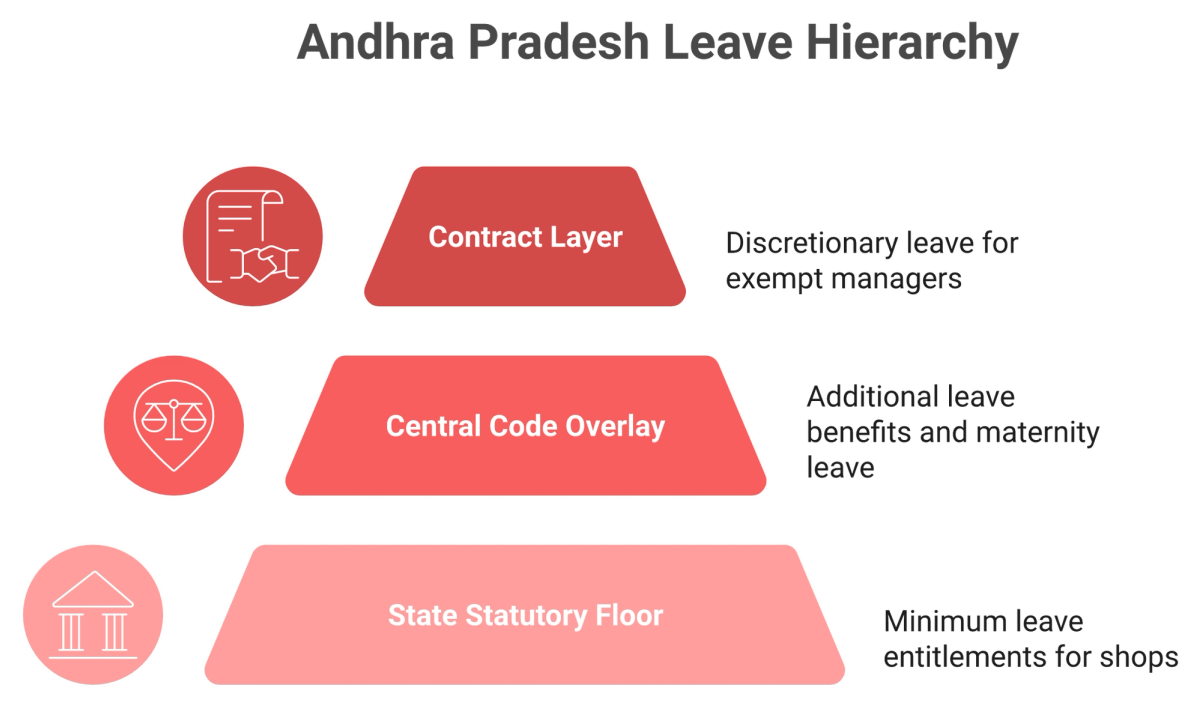
Two safeguards sit behind everything above. Section 66 makes any agreement void where an employee gives up a right under the Act. So a US-style offer letter cannot waive AP leave.
Section 72 preserves rights that are more favourable under another law, contract, custom, or usage. That is the mechanism that lets central law improve on the state floor, which matters in Q3.
Versatile Club issues AP appointment letters that name the governing Act, the employee category, and the accrual basis in the same clause, because that is the first document a labour inspector or an acquirer's diligence team reads. The full statutory compliance scope sits behind that clause.
Q2. What leave is an Andhra Pradesh employee legally entitled to in 2026?
Under Section 30 of the Andhra Pradesh Shops and Establishments Act, 1988, an employee who has served 240 days in a continuous period of twelve months is entitled in the following twelve months to 15 days of leave with wages. That leave accumulates up to 60 days, and 8 days must be encashed every year. Establishments also grant 12 days casual leave and 12 days sick leave. Leave is applied for 7 full working days in advance and may be taken in up to three installments.
📊 The entitlement table
| Leave type | Entitlement | Carry forward | Source |
| Earned or privilege leave | 15 days a year | Up to 60 days | Section 30, AP S&E Act 1988 |
| Casual leave | 12 days a year | Nil | Chapter VII, AP S&E Act 1988 |
| Sick leave | 12 days a year | Per employer policy | Chapter VII, AP S&E Act 1988 |
| Annual encashment | 8 days | Not applicable | Section 30 |
| Weekly holiday | One whole day each week | Not applicable | Sections 12 and 19 |
Versatile Club's monthly client pack shows accrued, consumed, and encashable leave per employee beside the PF and ESI challan confirmations and TDS deposit receipts, which is the same pack used for managed payroll clients.
💰 What you actually pay for a leave day
Leave pay is not the CTC-divided-by-30 figure most US payroll teams assume. Section 32 sets it at the daily average of wages for the days the employee actually worked during the preceding month, excluding any overtime earnings.
So a light month raises the rate, and a heavy month lowers it. Versatile Club recomputes this per payroll cycle rather than freezing a rate at joining, and the same logic drives India payroll compliance for every state.
⏰ Three mechanics nobody configures correctly
- The 8-day annual encashment is a statutory right, not a goodwill gesture. Unpaid encashment is an accrued liability.
- Section 33 lets the state government raise both the leave days and the accumulation ceiling by notification, so the numbers are a floor and not a ceiling.
- Section 69 bars an employee from working anywhere on a day of leave or a holiday, which quietly collides with moonlighting policies.
Versatile Club configures the 8-day encashment as a scheduled payroll event, not an exception request, because it is the single most commonly missed item in AP payroll audits I have reviewed.
⭐ What buyers say about getting this right
"As a founder at a digital marketing agency, I needed to hire and manage a small India-based team without setting up a local entity. Versatile's Employer of Record India service made this seamless contracts, PF, ESI, TDS, and payroll all handled in one place. Invoicing in USD meant zero exchange rate surprises."
— Vedant T., Founder, Versatile Club G2 - Verified Review, June 2026, G2
"The dashboard could be a little more self-serve. A couple of times I wanted to pull a report or a doc myself and ended up just messaging my contact instead. They always answered fast, so it wasn't a real problem."
— Angad S., Founder, Versatile Club G2 - Verified Review, June 2026, G2
That second one is fair. Self-serve reporting is where Versatile Club is still behind the larger platforms, and I would rather name it than pretend otherwise.
Versatile Club bills $149 per employee per month flat, with no setup fee and no exit fee, and the leave register sits under its own AP Shops and Establishments licence rather than a partner's. The full pricing breakdown is published rather than quoted on request.
Q3. Which central labour codes override Andhra Pradesh's rules, and is the 240-day test dead?
Andhra Pradesh sets the floor, and central law stacks on top. India's four labour codes came into force on 21 November 2025. Section 32 of the Occupational Safety, Health and Working Conditions Code, 2020 lowered the qualifying period for annual leave from 240 days to 180 days in a calendar year, capped carry forward at 30 days, and made the excess encashable annually instead of lapsing. Where state and central provisions differ, Section 72 of the AP Act preserves whichever is more favourable to the employee.
🗓️ What changed, and when
Before 21 November 2025, the AP test was the only one most employers applied. After that date, the Code's 180-day threshold applies to establishments within its scope, and the Ministry of Labour and Employment has confirmed the reduction from 240 days publicly.
Versatile Club re-pointed client accrual logic to the 180-day test during that transition, then reissued the affected AP contracts under its own entity.
🔢 A worked example, because the gap is real
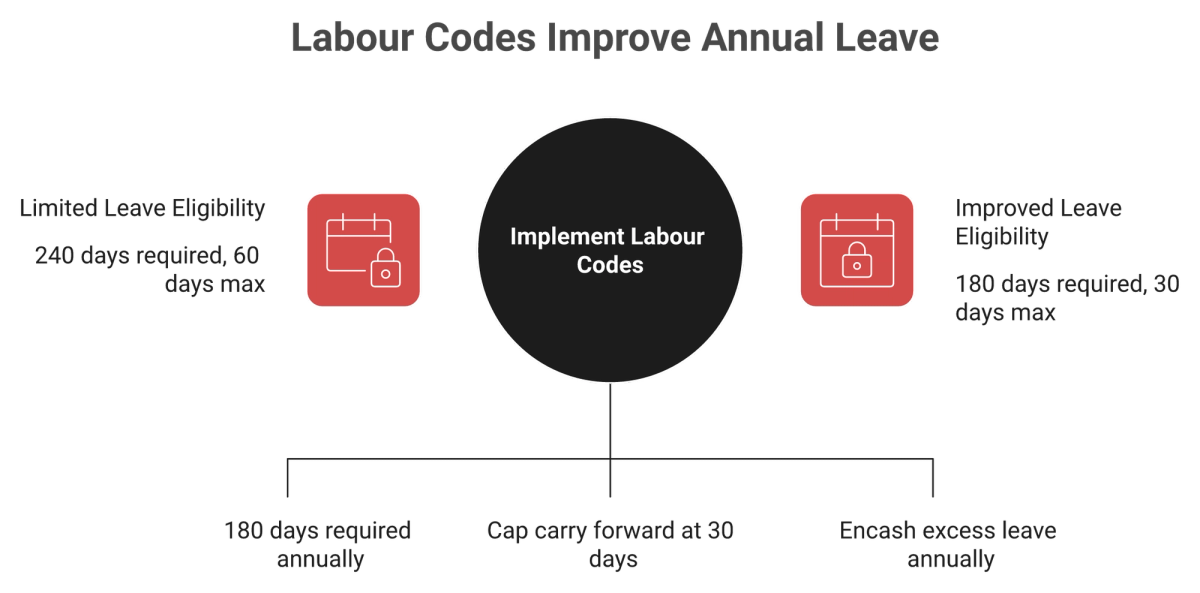
Take an engineer who joins on 1 July 2026 and works 182 days to year end.
- Under Section 30 of the AP Act alone, she has not hit 240 days, so no leave with wages accrues for the next year.
- Under Section 32 of the OSH Code, she has crossed 180 days, so she qualifies.
- Section 72 of the AP Act preserves the more favourable outcome, so she qualifies.
The carry forward direction reverses. AP allows 60 days of accumulation. The Code caps carry forward at 30 days and pays out the rest each year. That converts a dormant balance-sheet accrual into annual cash.
💸 The 50% wage rule sits underneath all of it
The Code on Wages defines wages so that basic plus dearness allowance must be at least half of total remuneration. Leave encashment and gratuity are computed on that base, so the same leave balance now costs more to settle.
Versatile Club accrues gratuity at 4.81% of basic plus dearness allowance from month one and deposits TDS by the 7th, so the exit number is already provisioned rather than discovered during full and final settlement. Model the effect with the salary calculator before you restructure a band.
⚖️ Where global platforms get thin
This is the layer where India-as-one-of-many falls apart, and I will be fair about it.
- ✅ Deel, Remote, and Globalization Partners give genuine multi-country breadth across 150 to 185 countries.
- ✅ Remote and Globalization Partners own entities in several markets and publish clear security certifications.
- ❌ India operations at most global platforms run through local partner entities, so the state-level reading sits one step removed from the provider.
- ✅ Wisemonk is India-only, owns its Indian entity, and holds SOC 2 Type II and ISO 27001.
- ❌ Wisemonk publishes no replacement guarantee and no structured 90-day onboarding coach, so retention risk stays with the client.
Versatile Club operates in India only, through its own registered Indian entity, and lists Labour Code 2025-26 readiness, including the basic plus DA at 50% rule, inside its stated compliance scope. A side-by-side read sits on the Wisemonk alternative page and the Deel alternative comparison.
Q4. What maternity, illness, and special leave must you grant in Andhra Pradesh?
Two layers apply. Sections 24 and 25 of the AP Shops and Establishments Act, 1988 give a woman with at least six months of continuous employment maternity benefit for six weeks before and six weeks after delivery, treated as authorised absence. The Code on Social Security, 2020 provides 26 weeks for the first two surviving children, 12 weeks thereafter, and requires 80 days of work in the preceding twelve months. Because the central provision is more favourable, 26 weeks is the operative number for AP employers.
🤰 Read Section 24 carefully before you copy it
Section 24 says the absence is authorised, and that the woman is entitled to maternity benefit, but not to wages for those periods. In practice, the central entitlement and payment mechanism govern, and the state clause is the older, narrower floor.
I have seen AP policies quote the 6 plus 6 week figure verbatim. That is a compliance defect after the Code on Social Security. Versatile Club re-pointed client maternity clauses from the Maternity Benefit Act, 1961 references to the Code and reconfirms the 80-day eligibility check before approval.
🌙 The night-shift rule tied to childbirth
Section 23 permits women to work between 8.30 p.m. and 6.00 a.m. only where prescribed safety measures exist, including transport to the doorstep and at least five women working together.
That relaxation is withdrawn for 16 weeks around childbirth, of which at least 8 weeks fall before the expected date. Versatile Club records these consents and rosters against the AP registration it holds directly, rather than routing the question to a partner entity.
📝 The special-leave map for an AP team
| Situation | Entitlement | Source |
| Maternity, first two children | 26 weeks, up to 8 weeks pre-natal | Code on Social Security, 2020 |
| Third child onward | 12 weeks | Code on Social Security, 2020 |
| Illness arising from pregnancy or delivery | Additional leave with wages | Maternity benefit provisions |
| Personal illness | 12 days sick leave | Chapter VII, AP S&E Act 1988 |
| POSH complaint pending inquiry | Up to 3 months leave as interim relief | POSH Act, 2013, Section 12 |
| Paternity or bereavement | No statutory entitlement for private establishments | Contract or policy only |
🧩 Say the awkward part out loud
There is no statutory paternity leave for private-sector employees in Andhra Pradesh. There is no bereavement leave either. Both are policy decisions you own.
My view is that a founder hiring five people in Hyderabad should write both anyway, at 10 and 5 days, and say plainly that they are voluntary. Versatile Club's experience across Bengaluru, Hyderabad, and Pune placements is that the voluntary clauses get quoted back in exit conversations far more often than the statutory ones, though I might be reading too much into a small sample. HR consulting support is where that drafting usually happens.
Versatile Club sets up the POSH Internal Committee, the maternity register, and the sick leave configuration as part of onboarding under its 5-day contractual SLA, so the special-leave layer is live before the first payroll runs. The step-by-step sequence is published on how it works.
Q5. How many paid holidays are mandatory in Andhra Pradesh, and which list actually binds you?
Under Section 3 of the Andhra Pradesh Factories and Establishments (National, Festival and Other Holidays) Act, 1974, every employee gets a paid holiday of one whole day on 26 January, 1 May, 15 August, and 2 October, plus four other festival holidays of one whole day each as notified. Employers may declare those festival days with employee consent and intimation. A weekly holiday of one whole day also applies. Versatile Club locks the four national days and the four elected festival days into each client's AP payroll calendar before the year starts.
🗓️ Four fixed, four chosen
The four national days are not negotiable and not moveable. The four festival days are where AP gives you room. The proviso to Section 3(1) lets the employer declare them with the consent of employees and under intimation, and Section 4 requires a statement to the Inspector.
In coastal Andhra, the practical answer is usually Bhogi, Makara Sankranti, Kanuma, and Ugadi or Dussehra. Versatile Club runs that election with the client in December, not in January, as part of its India EOR service.
📌 Three lists people confuse
| List | Who it binds | What it does |
| Act 32 of 1974, Section 3 | All factories and establishments in AP | 4 national plus 4 notified festival paid holidays |
| Section 31, AP S&E Act 1988 | Shops and establishments | Holidays with wages on notified days; sub-section (3) refers to the five holidays in sub-section (1) |
| GAD general and optional holidays list | State government offices | General closures plus a capped set of optional holidays for government employees |
That third row is the trap. A US People Ops lead once sent me AP's 20-plus government holiday list and asked if she owed all of them. She did not. Versatile Club maps the statutory obligation first, then treats anything extra as a policy choice, which is the same method used in its HR consulting work.
⚠️ If you give more, you must file more
Section 31(3) says the sub-section does not apply where the employer allows more holidays with wages than the notified ones. The condition is that the employer sends a list, including the five holidays specified in sub-section (1), to the Inspector and Chief Inspector, and displays it prominently.
So generosity has paperwork attached. Versatile Club files that list and the Form XXIV notice of weekly holiday under Rule 29(3) as part of onboarding, because both are asked for at inspection.
💰 Holidays are paid, and they cannot be clawed back
Sections 12 and 19 of the 1988 Act say no deduction may be made for a day on which a holiday was allowed. They also make it unlawful for the employer to call the employee in on that day.
Versatile Club's read is that the standard advice gets holidays backwards. Teams obsess over leave accrual, then quietly ask a Hyderabad engineer to ship a fix on 15 August. That is the clearer statutory breach of the two.
Versatile Club publishes the AP holiday declaration, the weekly holiday notice, and the leave calendar under its own Shops and Establishments licence, so the filing sits with the legal employer rather than with a client's local partner. The full compliance scope is documented publicly.
Q6. What did the A.P. Shops and Establishments (Amendment) Act, 2025 change about hours, overtime, and women's shifts?
The Andhra Pradesh Shops and Establishments (Amendment) Act, 2025 (Act No. 17 of 2025) raises daily working hours from 8 to 10 while keeping the 48-hour week, cuts spread-over to 12 hours, replaces the 50-hour monthly overtime cap with 144 hours per quarter, and requires a 30-minute break after 6 hours. Women may work before 6 a.m. and after 8.30 p.m. with consent and safeguards. Versatile Club updated client rosters and consent records against the amendment in the same month it took effect.
⏰ The five changes that hit your roster
- Sections 9(1) and 16(1) now read ten hours in any day and forty-eight hours in any week.
- Spread-over, including rest intervals, drops from thirteen hours to twelve.
- The weekly 62-hour ceiling clause is omitted.
- Overtime is capped at 144 hours per quarter, where quarter means three calendar months.
- Sections 10 and 17 now require a 30-minute rest interval after six hours, replacing the one-hour break after five hours.
Versatile Club recalculates overtime exposure quarterly for AP employees rather than monthly, because the compliance unit itself changed. The same quarterly logic flows into India payroll compliance reporting.
🌙 Night work for women, with six conditions
Section 23 was substituted entirely. Women may now work outside 6 a.m. to 8.30 p.m. subject to written consent, compliance with maternity benefit provisions, doorstep transport, lit and adequate toilet and drinking-water facilities, safe working conditions, and POSH Act compliance.
The relaxation is still withdrawn for 16 weeks around childbirth, of which at least 8 weeks fall before the expected date. Versatile Club stores those consents with the employee file, since the consent is the defence if an inspector asks.
❌ The "under 20 workers is exempt" claim is half wrong
This is the part being misread across HR blogs right now. The new Section 73(6) exempts establishments engaging fewer than 20 workers from most of the Act. It expressly does not exempt registration and renewal, or Sections 9, 10, 16, 17, 19, 23, 24, 25, 30, 31, 32, and 47.
Read that list again. Sections 30, 31, and 32 are leave, holidays, and leave pay. A six-person Visakhapatnam team still owes the full leave entitlement. Versatile Club treats the sub-20 exemption as a reporting relief, not a leave relief, which matters most to early-stage teams.
✅ How this compares across providers
| Provider | India entity model | Who tracks AP state amendments |
| Versatile Club | Own Indian entity, registrations in all 28 states and 8 UTs | India-only team, founder reachable on WhatsApp |
| Wisemonk | Own Indian entity, India-only, SOC 2 Type II and ISO 27001 | India team, named HR manager |
| Deel, Remote, G-P, Multiplier | India commonly routed via local partner entities | Global compliance team across 90 to 185 countries |
✅ Deel and Remote offer real multi-country breadth. ✅ Wisemonk owns its Indian entity and holds both security certifications. ❌ Wisemonk publishes no replacement guarantee. ✅ Versatile Club works India only. ❌ Versatile Club is the wrong pick if you need five or more countries. A closer read sits on the Wisemonk alternative page.
"We've been using Versatile Club for our international hires, and honestly, it's been super smooth. Setting up in a new country can get messy fast, but their India EOR made onboarding feel easy."
— Setu C., Founder, Versatile Club G2 - Verified Review, June 2026, G2
"The team is really competent, but there were a few time zone misunderstandings that caused slight delays in the initial phase."
— Setu C., Founder, Versatile Club G2 - Verified Review, June 2026, G2
Versatile Club's 5-day onboarding SLA is contractual and written into the service agreement, which is what let the amendment roll into live AP rosters without a renegotiation cycle. The day-by-day sequence is published on how it works.
Q7. How is leave encashment calculated in Andhra Pradesh, and why has the 50% wage rule raised your liability?
For in-service leave, Section 32 of the AP Shops and Establishments Act, 1988 sets pay at the daily average of wages for the days the employee actually worked during the preceding month, excluding overtime earnings. Section 30 additionally requires eight days of leave to be encashed every year. Exit encashment is computed on basic plus dearness allowance. Because the Code on Wages requires basic plus DA to be at least half of total remuneration, the same balance now costs more. Versatile Club accrues gratuity at 4.81% of basic plus DA from month one and reports leave balances monthly.
🔢 The formula, stated plainly
Two different rules apply to two different moments.
- Leave taken while employed is paid at the preceding month's daily average of actual worked-day wages, overtime excluded, under Section 32.
- Leave encashed at exit is paid on basic plus DA, using the employer's stated per-day divisor.
For factories, the Factories Act uses total full-time earnings for days worked in the preceding month, including dearness allowance and the cash value of concessional supplies, but excluding overtime and bonus. Fractions of half a day or more count as a full day.
💸 A worked example a CFO can use
Take a Visakhapatnam engineer on a gross of ₹1,00,000 a month with 45 days of accrued leave at exit.
| Salary structure | Basic plus DA | Per day at 26 days | 45 days encashed |
| Old structure, basic at 35% | ₹35,000 | ₹1,346 | ₹60,577 |
| Compliant structure, basic plus DA at 50% | ₹50,000 | ₹1,923 | ₹86,538 |
The same leave balance costs about 43% more after restructuring. Versatile Club measures this by recomputing each client's accrued leave liability on the compliant wage base rather than the legacy one, and the 26-day divisor is a convention, not a statutory figure. Test a band with the salary calculator before you restructure.
⚠️ Two liabilities that hide in plain sight
The eight-day annual encashment is the one I see missed most often. It is a Section 30 entitlement, so an unpaid year is arrears, not savings.
The second is the carry-forward gap from Q3. AP allows 60 days of accumulation, while the OSH Code caps carry forward at 30 days and makes the excess encashable each year. Versatile Club provisions for annual payout rather than indefinite accrual, though I would call the settled market practice here still unsettled.
"Sagar replied to our form in about four hours with a draft offer letter already attached. The hire was onboarded in four days. First USD invoice landed clean: no FX markup, no setup fee, no surprises."
— Verified User in Information Technology and Services, Versatile Club G2 - Verified Review, June 2026, G2
"They help with talent acquisition and management. In a growing AI era finding the right talent has gotten more difficult."
— Mukul S., Founder, Versatile Club G2 - Verified Review, June 2026, G2
Versatile Club bills $149 per employee per month flat regardless of salary band, with $0 setup and $0 exit fees, so the leave liability line on a CFO's close is statutory cost and nothing else. The full pricing table is public.
Q8. What leave policy actually works for white-collar and engineering teams in Andhra Pradesh?
The workable structure for salaried AP teams is the statutory floor plus a small, written buffer: 15 days earned leave, 12 casual, 12 sick, the four national and four festival holidays, a stated carry-forward rule, and the eight-day annual encashment. Unlimited paid time off is the wrong import. In hierarchy-sensitive Indian workplaces, removing the allotment removes permission, so people take less leave rather than more. Versatile Club screens hires on 50 behavioural parameters and runs a 90-day Success Coach, because leave design and retention fail together.
❌ Why unlimited PTO backfires in India
Not allotting vacation days sounds generous. In practice, it creates conditions where nobody dares take a day off, then the company wraps that outcome in the language of a perk.
A "use it or lose it" balance looks like a limitation and functions as a nudge. If you cannot lose it, you never book it. Versatile Club's read is that the standard startup advice gets this exactly backwards for India teams.
🙇 The deference problem is real
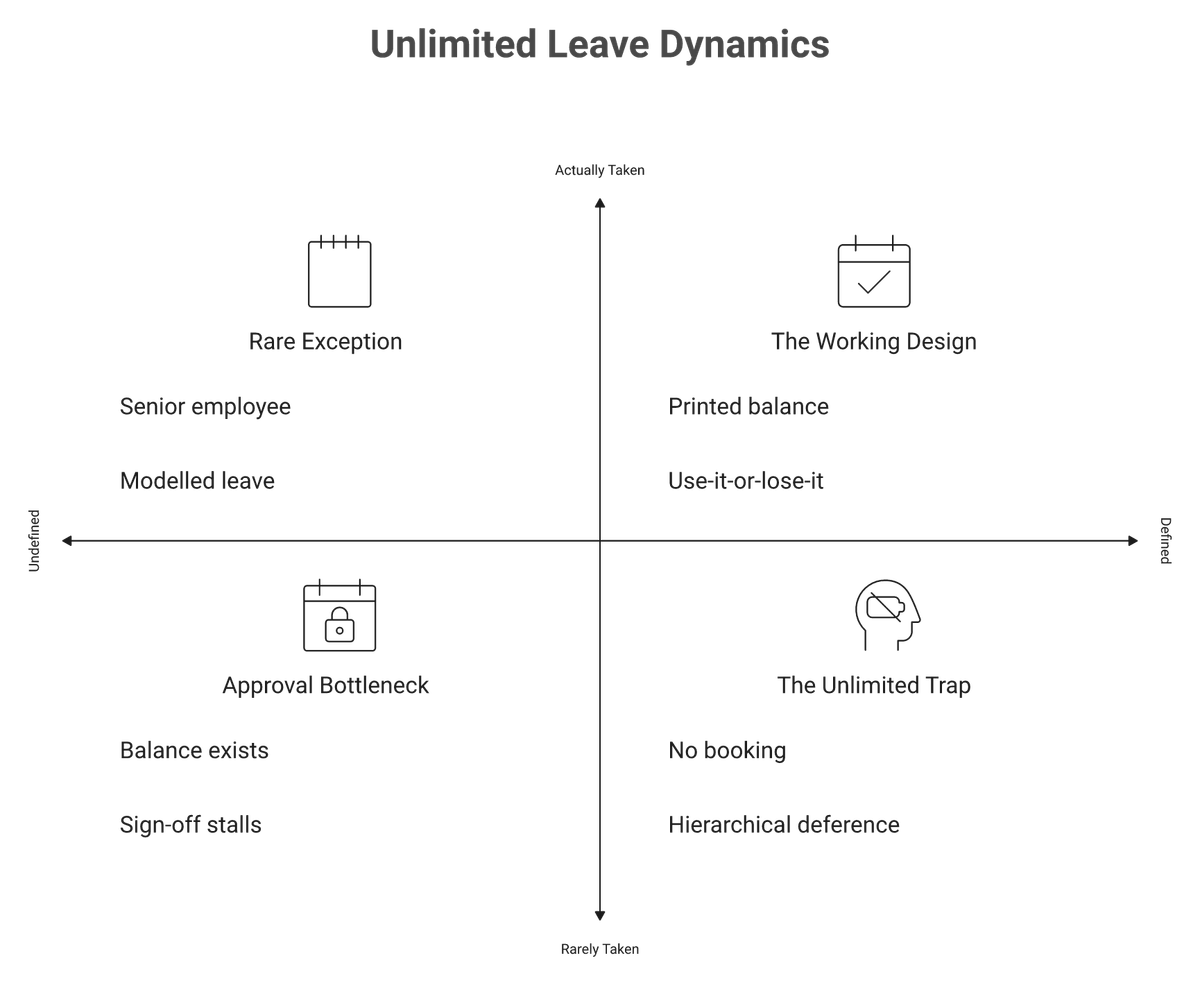
An American manager once described an offshore colleague in Delhi who messaged her for permission before every dinner break. His explanation was simple. She was senior, he was the subordinate.
Now imagine that same person deciding whether to take an unapproved week off an undefined balance. He will not. What surfaces across Versatile Club's Bengaluru, Hyderabad, and Pune placements is that leave usage rises when the number is printed in the appointment letter. The same pattern shows up in its contract-to-hire conversions.
⚠️ The exempt-manager gap you must close in writing
Section 73(1)(a) excludes employees in a position of management, having control over the affairs of the establishment, whose average monthly wages exceed the figure printed in the Act. For those people, the statutory floor does not apply, so the contract is the entire entitlement.
Separately, the 2025 amendment's sub-20-worker exemption keeps Sections 30, 31, and 32 alive, so small AP teams still owe full leave. Versatile Club writes both positions into the appointment letter rather than leaving them to interpretation.
✅ A policy block you can copy
| Element | Recommendation | Basis |
| Earned leave | 18 days, accrued monthly | Statutory 15 plus buffer |
| Casual and sick leave | 12 plus 12 | Chapter VII, AP S&E Act |
| Carry forward | 30 days, excess encashed annually | OSH Code alignment |
| Annual encashment | 8 days, paid each March | Section 30 |
| Paternity and bereavement | 10 and 5 days, marked voluntary | No statutory basis |
| Minimum usage | Encourage 12 days taken a year | Policy, not law |
Versatile Club configures this block at onboarding inside its 5-day contractual SLA, and the voluntary rows are labelled voluntary so nobody mistakes them for statute. Teams weighing an entity instead can run the EOR versus entity calculator first.
"Finding the right design talent is never easy. For us, it was important to hire people who understood both craft and pace and Versatile made that process feel much simpler."
— Ibrahim A., Founder, Versatile Club G2 - Verified Review, June 2026, G2
"The initial process took a little getting used to, but the team was quick to guide us through and it became very straightforward."
— Verified User in Venture Capital & Private Equity, Versatile Club G2 - Verified Review, June 2026, G2
Versatile Club backs the policy with a 6-month replacement guarantee on placements, which is the part no competitor in the India EOR set currently publishes. The mechanics sit inside its recruitment service.
Q9. What leave records will an Andhra Pradesh inspector or an acquirer's diligence team ask for?
Andhra Pradesh requires documentary proof of leave, not just a policy. Employers must keep the leave register (Form XXV), the Register of Employment in Form XXII and the wages register under Rule 29, the weekly holiday notice in Form XXIV, and appointment letters in Form XXVI issued in triplicate with one copy handed to the Inspector. Establishments with ten or more employees file a quarterly return in Form XXVII. Versatile Club maintains these registers under its own AP Shops and Establishments licence for every client hire.
📋 The evidence pack, in filing order
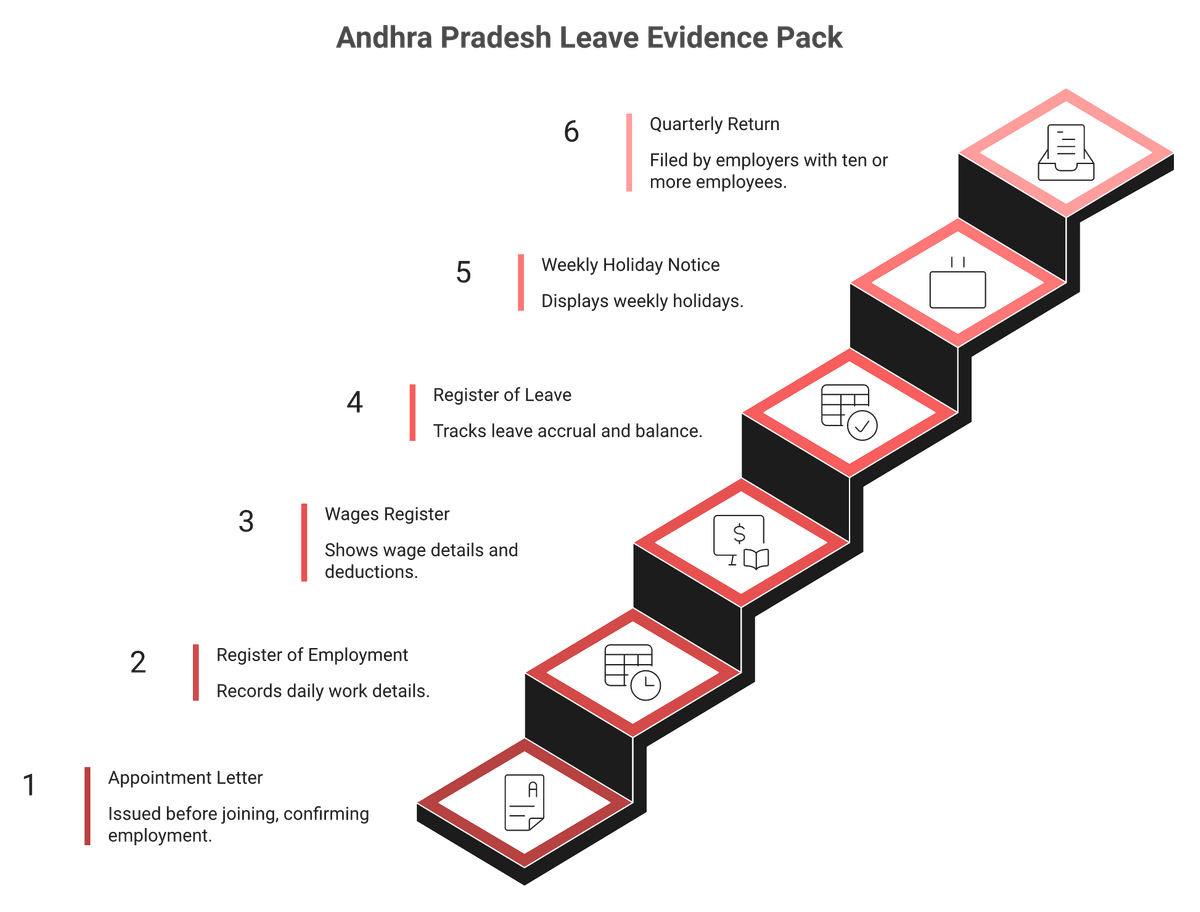
- Form XXVI appointment letter, with photograph affixed, issued before the employee joins, original to the employee, and the third copy to the Inspector of the area.
- Form XXII Register of Employment, showing days worked, start and finish times, rest intervals, and overtime per day.
- Form XXIII wages register, showing the rate, deductions, and actual payment.
- Form XXV Register of Leave, showing accrual, consumption, and balance.
- Form XXIV notice of weekly holiday, displayed in the establishment.
- Form XXVII quarterly return, due by the 10th of the month following each quarter for employers with ten or more employees.
Versatile Club files the Form XXVII return on that quarterly cycle rather than reconstructing it during an inspection window. The same cadence runs through its managed payroll engagements.
⏰ You get fifteen days, and that is it
Rule 32 requires any information or document the Inspector asks for to be furnished within fifteen days of the requisition. The Inspector may extend it, but not beyond three months.
That clock is short if your leave data lives in a spreadsheet three people maintain. Versatile Club's read is that most India leave disputes are really record disputes, and the register decides them before the argument starts.
⚠️ Where the SaaS instinct collides with AP law
Plenty of startups genuinely believe the right move is to stop tracking days off. Andhra Pradesh disagrees. Section 68 obliges the employer to maintain prescribed registers and records, produce them on demand, and file returns.
Section 69 goes further and bars the employee from working anywhere on a day of leave or a holiday. Untracked leave also surfaces in acquisition diligence, where the buyer prices the unquantified liability at your expense. This is the risk statutory compliance coverage is meant to remove.
💸 The penalties are small, the consequences are not
Rule 34 sets fines starting at fifty rupees, rising for repeat offences. Nobody is scared of that number.
The real cost is the audit adjustment and the deal delay. Every diligence request I have handled asked for leave balances before it asked for offer letters. Versatile Club hands clients PF and ESI challan confirmations, TDS deposit receipts, and leave balances in one monthly pack, so the record is standing rather than assembled.
"The compliance rigour is genuinely impressive every statutory filing reviewed before submission. Five-day onboarding, zero late payslips."
— Vedant T., Founder, Versatile Club G2 - Verified Review, June 2026, G2
"It let Moonshot hire in India without standing up an entity, which would've been overkill for our size. They took payroll, contracts, and ongoing compliance off our plate entirely."
— Angad S., Founder, Versatile Club G2 - Verified Review, June 2026, G2
Versatile Club is the named employer on the AP registers, so the Form XXV leave register, the Form XXVII return, and the appointment letter trail sit with the entity that actually holds the licence. That is the core of hiring in India without an entity.
Q10. How do you run one leave policy across a pan-India team when Andhra Pradesh and Telangana already disagree?
Write one national leave policy at the most generous applicable level, then attach a state annexure for the variances. Andhra Pradesh and Telangana both inherited the Shops and Establishments Act, 1988 from the undivided state, then diverged through separate amendments, so the AP text now carries the 2018, 2022, and 2025 changes that Telangana does not. Running 28 separate policies fails. Versatile Club holds Shops and Establishments, PF, and ESIC registrations across all 28 states and 8 union territories under one Indian entity.
🗺️ Why AP and Telangana look identical and are not
Before bifurcation, one Act covered both. After 2014, each state amended its own copy. Andhra Pradesh moved daily hours to ten and overtime to 144 hours a quarter in 2025.
Telangana's current text has to be read separately before you copy an AP clause into a Hyderabad contract. Versatile Club checks both statutes for cross-border teams rather than assuming a shared lineage still holds, which is why Hyderabad payroll outsourcing is treated as its own filing set.
📌 The floor-plus-annexure model
- Set a national floor at the most generous entitlement across your hiring states.
- Attach a one-page annexure per state listing leave accrual, carry-forward, encashment, holidays, and professional tax cycle.
- Review the annexure twice a year, in January and July.
- Keep the state register obligations with whoever holds the local licence.
Versatile Club measures state variance by filing cycle, not by statute count, because the cycle is what breaks a payroll month.
⚙️ The variances that actually cost you time
| State | What differs operationally |
| Andhra Pradesh | 60-day leave accumulation, 8-day annual encashment, 2025 hours amendment |
| Telangana | Separate amendment history, PTRC enrollment |
| Karnataka | Monthly professional tax cycle plus S&E renewal |
| Maharashtra | Dual PTRC and PTEC registration, monthly slab |
| Tamil Nadu | Biannual professional tax, labour welfare fund |
| West Bengal | Frequent rule changes |
| Delhi | No professional tax, strict S&E enforcement |
Versatile Club's state-level fluency came from running C2H payroll in these states, not from a global playbook. The same muscle sits behind its contract-to-hire model.
💰 Why the fragmented vendor stack is the real problem
The pain I hear most is not statutory. It is four India vendors sending invoices that do not reconcile, then an auditor asking about PF, ESI, and gratuity liabilities in the last week of close.
✅ Deel and Remote handle many countries well. ✅ Remote and G-P own entities in several markets. ❌ India at most global platforms runs through local partner entities, so state variance sits one step removed. ✅ Wisemonk is India-only with both security certifications. ❌ Wisemonk publishes no replacement guarantee. The Remote alternative page sets out the same trade-offs side by side.
"Founder is just a call away. Extremely helpful in resolving all our queries. The process is super smooth to setup India EOR."
— surbhi m., Founder, Versatile Club G2 - Verified Review, June 2026, G2
"local India compliance, FD setup, all of this is complicated to understand to hire a single person. Makes my life as a lean founder extremely easy."
— surbhi m., Founder, Versatile Club G2 - Verified Review, June 2026, G2
Versatile Club bills one USD invoice from a single Indian entity with a per-employee breakdown, which is why a Visakhapatnam hire and a Pune hire land on the same reconciliation line.
Q11. Should you run Andhra Pradesh leave compliance in-house, through a global EOR, or through an India-native EOR?
Three options exist. Your own Indian entity gives full control but takes months of registration and ongoing filings. Global EORs cover 90 to 185 countries and commonly route India through local partner entities, concentrating depth in the top four to six states. India-native EORs own the Indian entity and hold state registrations directly. Versatile Club operates in India only, through its own registered Indian entity, at $149 per employee per month flat with a contractual 5-day onboarding SLA, zero setup fee, and zero exit fee.
⚖️ The decision matrix
| Criterion | Versatile Club | Wisemonk | Deel and Remote | Own entity |
| India entity | Owned | Owned | India often via partner | Yours |
| Price | $149 flat | $99 to $399 by salary band | About $599 | Setup plus ongoing compliance cost |
| Onboarding | 5 days, contractual | 24 to 72 hours, stated | 7 to 14 days | Months |
| State coverage | All 28 states, 8 UTs | All 28 states, 8 UTs | Concentrated in top hubs | Wherever you register |
| Support | Founder on WhatsApp | Named HR manager | Ticket queue or CSM | Your team |
| Retention cover | 90-day Success Coach, 6-month replacement guarantee | Not published | Not offered | None |
Versatile Club charges no salary markup, only the EOR fee, which is the line CFOs check first. Run the numbers yourself on the EOR versus entity calculator.
🧪 Five questions that settle it fast
- Whose PF registration number is my employee's contribution filed under? A reseller cannot answer in one line.
- Who signs the AP Shops and Establishments register entries?
- Is the onboarding timeline contractual or aspirational?
- What happens to the leave balance if I exit in month four?
- Who answers at 11 p.m. my time, three days before payroll?
Versatile Club's answer to the first one is its own entity, which is the whole reason the rest of the answers hold. The India EOR service page names the registrations directly.
❌ When Versatile Club is the wrong choice
I would rather say this plainly than lose a month of someone's time.
- You need five or more countries. Versatile Club works in India only, by design.
- You are an enterprise with 100-plus India staff and SOC 2 Type II or ISO 27001 as a procurement gate. Wisemonk holds both today.
- You are a B2C consumer company with high-volume frontline hiring.
- You need deep enterprise procurement customisation, which takes longer than the 5-day SLA.
💰 The two playbooks I push back on
"Just buy Deel for everything" reads clean until the India-specific questions start. Total cost drifts past $599 per employee per month, and state-level answers come back slowly. The Deel alternative comparison breaks that down line by line.
"Set up your own subsidiary" costs tens of thousands and months before the first hire, which is overkill for four engineers in Visakhapatnam. Versatile Club's read is that India is becoming a specialist category rather than a row on a 150-country map, though I hold that view loosely for now.
"We used Versatile to hire our first employee in India after months of putting it off because the compliance side seemed like a mess."
— Verified User in Information Technology and Services, Versatile Club G2 - Verified Review, June 2026, G2
"The process was straightforward, the Support team was easy to work with, and the candidates' quality met our expectations. The initial process took a little getting used to."
— Verified User in Venture Capital & Private Equity, Versatile Club G2 - Verified Review, June 2026, G2
Versatile Club employs the AP hire on its own entity, files the leave register and statutory returns under its own licence, and gives the first month free with no exit fee if the fit is wrong. Pricing sits on the pricing page, and the intake starts at contact us.
FAQs
How many leaves are employees entitled to in Andhra Pradesh?
Under Section 30 of the A.P. Shops and Establishments Act, 1988, an employee who completes the qualifying service in a continuous period of twelve months earns 15 days of leave with wages in the following twelve months. Establishments also grant 12 days of casual leave and 12 days of sick leave a year.
- Earned or privilege leave: 15 days, accumulable up to 60 days
- Casual leave: 12 days, no carry forward
- Sick leave: 12 days, carry forward per employer policy
- Annual encashment: 8 days, a statutory right rather than a perk
- Weekly holiday: one whole day every week
Two mechanics matter operationally. Leave must be applied for seven full working days in advance, and it may be taken in up to three installments in a twelve-month period. Any contract clause asking an employee to give up these rights is void.
Versatile Club reports accrued, consumed, and encashable leave per employee every month alongside the PF and ESI challan confirmations, so the balance is auditable rather than reconstructed at year end. Teams that want the calculation handled end to end usually route it through our managed payroll service, where the eight-day encashment runs as a scheduled event.
Is the 240-day rule still applicable for earned leave in Andhra Pradesh?
Not on its own. India's four labour codes came into force on 21 November 2025. Section 32 of the Occupational Safety, Health and Working Conditions Code, 2020 lowered the qualifying period for annual leave from 240 days to 180 days of work in a calendar year, capped carry forward at 30 days, and made the excess encashable every year instead of lapsing.
The state text still shows the older 240-day test and a 60-day accumulation ceiling. Section 72 of the A.P. Shops and Establishments Act, 1988 preserves whichever provision is more favourable to the employee, so the reading that benefits the employee applies.
A worked example makes the gap concrete. An engineer who joins on 1 July and works 182 days to year end fails the old test but clears the Code threshold, so she qualifies.
- Reconfigure accrual to the 180-day test
- Cap carry forward at 30 days and provision the annual payout
- Re-run the leave liability line at month-end close
Versatile Club re-pointed client accrual logic during that transition and reissued the affected Andhra Pradesh contracts under its own Indian entity. The wider filing impact is mapped in our guide to payroll compliance in India.
How is leave encashment calculated in Andhra Pradesh?
Two different rules apply at two different moments, and mixing them is the most common error we see.
- Leave taken while employed: Section 32 pays the daily average of wages for the days the employee actually worked during the preceding month, excluding overtime earnings.
- Leave encashed at exit: computed on basic plus dearness allowance, using the employer's stated per-day divisor.
The Code on Wages now requires basic plus dearness allowance to be at least half of total remuneration. That single definition change raises the encashment base without changing the leave balance at all.
Take an engineer on a gross of one lakh rupees a month with 45 days accrued. On an old structure with basic at 35 percent, the payout works out near sixty thousand rupees. On a compliant structure with basic plus DA at 50 percent, the same balance costs roughly eighty-six thousand, about 43 percent more.
Versatile Club accrues gratuity at 4.81 percent of basic plus dearness allowance from month one and carries leave encashment in the same monthly per-employee breakdown, so the exit figure is already provisioned. Model a band first with our salary calculator before you restructure anyone's pay.
How many paid holidays must a private employer give in Andhra Pradesh?
Section 3 of the A.P. Factories and Establishments (National, Festival and Other Holidays) Act, 1974 requires a paid holiday of one whole day on 26 January, 1 May, 15 August, and 2 October, plus four other festival holidays of one whole day each.
The four national days are fixed. The four festival days are elective, and the employer may declare them with the consent of employees and intimation to the Inspector. In coastal Andhra, the usual picks are Bhogi, Makara Sankranti, Kanuma, and Ugadi or Dussehra.
One list confuses almost every overseas buyer. The General Administration Department publishes a long calendar of general and optional holidays each year, but that calendar binds state government offices, not private establishments.
- Declare the four elective festival days before January
- File the holiday list and display it prominently
- Never make a deduction for a day on which a holiday was allowed
Versatile Club locks the four national days and the four elected festival days into each client's Andhra Pradesh payroll calendar before the year starts, as part of our India EOR service. Calling an engineer in on 15 August is a clearer breach than any accrual error.
What leave records does an Andhra Pradesh labour inspector ask for?
Andhra Pradesh expects documentary proof of leave, not a policy PDF. The prescribed set under the A.P. Shops and Establishments Rules, 1990 includes:
- Form XXV Register of Leave, showing accrual, consumption, and balance
- Form XXII Register of Employment, with days worked, timings, rest intervals, and overtime
- Form XXIII wages register, showing rate, deductions, and payment
- Form XXIV notice of weekly holiday, displayed on the premises
- Form XXVI appointment letter, issued in triplicate with one copy to the Inspector
- Form XXVII quarterly return, for employers with ten or more employees
Rule 32 gives you only fifteen days to furnish anything the Inspector requisitions, extendable but not beyond three months. That clock is short when leave data lives across three spreadsheets.
The fines are small. The real cost lands in audit adjustments and acquisition diligence, where an unquantified leave liability gets priced against you.
Versatile Club is the named employer on the Andhra Pradesh registers, so the leave register, the quarterly return, and the appointment letter trail sit with the entity holding the licence. That structure is the practical benefit of hiring in India without an entity.