Table of contents (11)
- Q1: What Are the Three Legal Ways to Hire Employees in India (and Which One Fits You)?
- Q2: What Exactly Is an Employer of Record (EOR) in India, and How Does It Work?
- Q3: How Much Does It Really Cost to Hire an Employee in India, All-In?
- Q4: Should You Use an EOR or Set Up Your Own Indian Entity, and When Do You Switch?
- Q5: What Statutory Compliances and State-Level Registrations Must You Handle to Employ Someone in India?
- Q6: How Does India's 2026 Labour Code and the 50% Basic-Pay Rule Change Your Salary Structure?
- Q7: What Are Contractor Misclassification and Permanent Establishment (PE) Risks, and What Can They Cost You?
- Q8: Do You Also Need to Worry About DPDP Data-Protection Rules When Hiring in India?
- Q9: Versatile Club vs. Wisemonk vs. Global Generalists, Which India EOR Should You Actually Pick?
- Q10: How Do You Actually Make a Great India Hire, Beyond the Paperwork?
- Q11: What's Your Monday-Morning Action Plan for Hiring Your First Employee in India?
Hiring Employees in India: A Founder's Guide to Entity Setup, EOR, and Contractor Pathways
Q1: What Are the Three Legal Ways to Hire Employees in India (and Which One Fits You)?
There are three compliant ways to hire in India: set up your own private limited entity (4 to 6 months, roughly $8k to $25k, full compliance on you), use an Employer of Record who employs staff on their Indian entity (1 to 2 weeks, no setup cost, best for 1 to 50 hires), or engage independent contractors (fastest, but carrying misclassification and Permanent Establishment risk). Most funded founders start with an EOR and incorporate after roughly 12 hires.
🌉 The bridge you build depends on the river you're crossing
A US founder messaged me last quarter, three weeks after closing her Series A. She needed four Bengaluru engineers live in 30 days. She was staring at a $19-a-month contractor tool in one tab and a company-incorporation quote in another, unsure which one wouldn't blow up on her.
That's the real tension. You feel kind of like you're running with scissors if you don't hire an army of experts to cross every "t" on the arrangement. The good news: you don't always have to build the Golden Gate when a simple suspension bridge gets you across the same river.
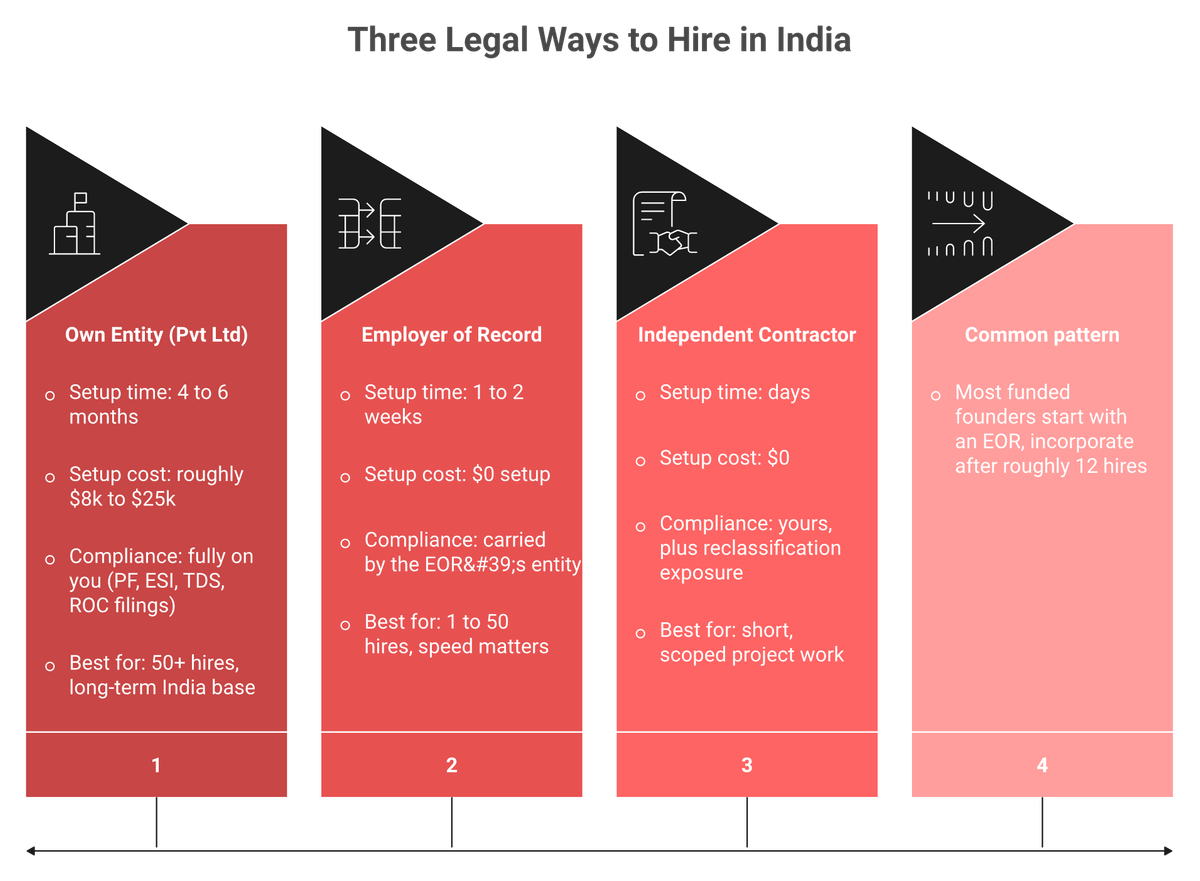
📊 The three pathways at a glance
Here is how the choices actually compare for a foreign company hiring its first India team.
| Pathway | Setup time | Setup cost | Compliance burden | Best for |
|---|---|---|---|---|
| Own entity (Pvt Ltd) | 4 to 6 months | ~$8k to $25k | Fully on you (PF, ESI, TDS, ROC filings) | 50+ hires, long-term India base |
| Employer of Record | 1 to 2 weeks | $0 setup | Carried by the EOR's entity | 1 to 50 hires, speed matters |
| Independent contractor | Days | $0 | Yours, plus reclassification exposure | Short, scoped project work |
The four Labour Codes went live on 21 November 2025, which raised the compliance bar on every one of these paths.
👥 Which one fits your seat at the table
Founder: you care about speed and runway. An EOR gets a hire live in days, not quarters.
People Ops leader: you care about compliance and the employee's day-one experience. An owned-entity EOR gives you both.
CFO: you care about three-year cost and Permanent Establishment (PE) exposure, the risk that a lone worker creates a taxable Indian presence. Contractor rails look cheap until a misclassification ruling lands a $25,000 to $40,000 back-pay bill per head.
✅ Where Versatile Club fits
When we place someone through Versatile Club's EOR, they're employed by our own registered Indian entity, Foo Falcon Technologies Pvt Ltd, not a partner shell we rent. I've watched the 12-hire tipping point play out again and again: teams ride the EOR "suspension bridge" until roughly a dozen people, then build their own entity. We hold the bridge steady until you're ready to cross for good.
Q2: What Exactly Is an Employer of Record (EOR) in India, and How Does It Work?
An Employer of Record is a company with its own Indian entity that becomes the legal employer of your India hire on paper, issuing the contract and running payroll, PF, ESI, TDS, and professional-tax filings under its registrations, while you direct the person's daily work. It lets a foreign company employ Indians compliantly without incorporating. It is not a PEO, which needs you to already hold a local entity.
🧩 The split that makes it work
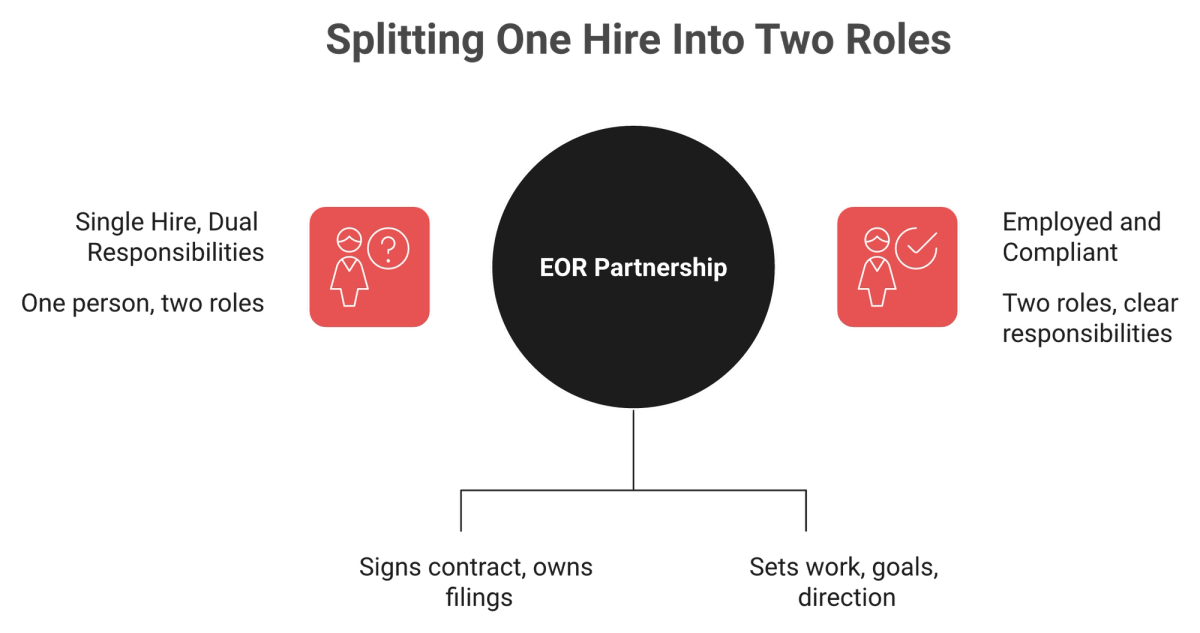
Think of an EOR as two roles living in one hire. On paper, the EOR is the legal employer. It signs the contract and owns the statutory filings.
In practice, you are still the manager. You set the work, the goals, and the day-to-day direction. The EOR handles the parts India makes hard, and you keep the parts you actually care about.
🧑💻 What this looks like in real life
Say you're a US founder who wants one engineer in Bengaluru. You interview her, pick her, and agree on pay.
Two weeks later she's employed, on payroll, and compliant, without you opening a single Indian bank account or MCA filing. Her PF and ESI (India's provident-fund and health-insurance schemes) are deducted, deposited, and reported through the EOR's managed payroll. You just manage her work.
⚠️ Owned entity vs. partner shell
Here's the distinction most buyers miss. Deel, Remote, and most global EOR providers run India through local partner entities. Your PF and TDS filings sit inside a vendor you never signed with.
We don't do that. India is the only country Versatile Club operates in, and every filing runs under our own registrations and compliance framework. This isn't bolted-on India knowledge, it's the whole business. One precision note I'll always insist on: if you have no local entity, the correct term is Employer of Record, never PEO.
Q3: How Much Does It Really Cost to Hire an Employee in India, All-In?
Budget roughly 1.2x to 1.3x gross salary for an India hire. On top of pay, employers owe EPF (12% on basic, capped at ₹15,000), ESI (3.25% where gross is ₹21,000 or less), gratuity provisioning (~4.81%), and state professional tax. Add an EOR fee of roughly $99 to $599 per employee per month, or $8k to $25k to set up your own entity. A senior Bengaluru engineer runs about $58K all-in versus $220K in San Francisco.
💰 The line items that surprise a CFO at month-end
Every finance lead I talk to has the same fear: the invoice that doesn't match the offer letter. India's statutory stack is where that gap hides. So here it is, in plain rows.
| Cost component | Rate / basis | Notes |
|---|---|---|
| EPF (provident fund) | 12% employer | On basic, capped at ₹15,000 wage ceiling |
| ESI (state insurance) | 3.25% employer | Where gross is ₹21,000 or less |
| Gratuity provisioning | ~4.81% | Accrues on basic + DA, vests at 5 years |
| Professional tax | Per state slab | Varies by state |
| EOR fee | ~$99 to $599 / month | Or $8k to $25k to incorporate |
The Code on Wages also sets statutory bonus eligibility at gross pay up to ₹21,000 a month, another line CFOs forget. You can model the full picture with our EOR vs entity calculator.
🧠 Cheaper is the wrong headline
Here's my contrarian take, and the standard sales pitch gets this backwards. We never really advocate going overseas because it's cheaper. That's not the pitch.
What you go to India for is highly academically intelligent people who have very few local places to apply that talent. The savings are real, a senior engineer runs about $58K all-in in Bengaluru versus $220K in San Francisco, roughly $162,000 saved per role. But treat that as a bonus, not the reason.
💸 Where the hidden fees actually live
Global platforms bury cost in currency conversion. The complaints are on the record.
"I find Deel to be absurdly expensive. They charge a high amount of fees for transferring money to my bank account."
Juan Camilo O., Verified User Deel G2 Verified Review
"There are hidden fees. Of course, again, also here. You will never get your net-agreed salary through Deel."
İbrahim, Verified User Deel G2 Verified Review
"Easy Setup, Handy Transfers, But Pricey. I dislike how expensive Deel's transaction fees are, especially when moving money from the Deel account to my bank."
Maria M., Verified User Deel G2 Verified Review
✅ Where Versatile Club fits
We invoice in USD, direct from our single Indian entity, so you carry no FX exposure and pay no setup or exit fees. If a founder is nervous about surprise charges, my answer is always the same: ask to see a sample invoice before you sign anything, and check our transparent pricing first. I'd rather you audit the math up front than discover a 3% to 5% currency markup on payday.
Q4: Should You Use an EOR or Set Up Your Own Indian Entity, and When Do You Switch?
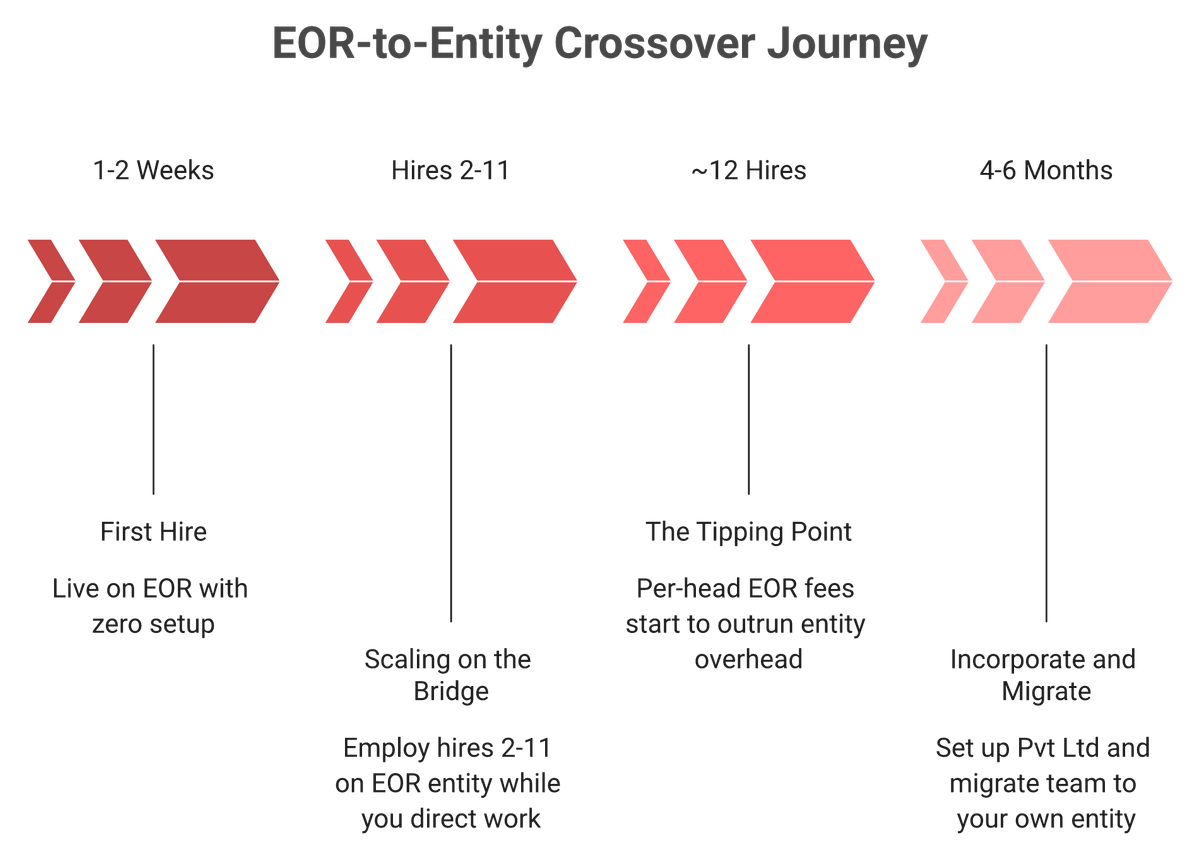
Yes, a foreign company can hire in India without a legal entity by using an Employer of Record who employs the person on its Indian entity. Setting up your own private limited company takes roughly 4 to 6 months and $8k to $25k plus ongoing compliance. Most funded companies stay on an EOR until around 12 India hires, then incorporate to lower per-head cost, migrating existing staff across at that point.
🚀 The situation most founders are actually in
You want people working next month, not next year. So the honest answer to "do I need an entity first?" is no. An EOR employs your hire on its entity while you run the work.
Setting up your own Pvt Ltd is the alternative, and it's a real project. Budget 4 to 6 months and $8k to $25k, before the first paycheck clears.
🌗 The complication: a moon landing vs. a five-day sprint
Founders underestimate the entity path. Between MCA incorporation, bank accounts, PF and ESI registrations, and multi-state professional-tax setup, it can feel like a 12 to 18 month moon landing.
An EOR compresses that to a sprint. The cost math I laid out in the pricing section still holds: EOR fees are predictable and start at zero setup. Where it flips is scale, once per-head fees outrun entity overhead, incorporation wins.
🔁 The switch point, and a story about Greece
The crossover usually lands around 12 hires. I've watched it directly. One client thought they were interviewing a candidate based in London.
It was only after the third interview that they realized the person was actually based in Greece. They came to us, we employed that person, and over time we ran roughly 12 people this way. Once they were ready, we simply migrated those 12 across to their own entity. That's the pattern: EOR as the bridge, entity as the destination.
✅ Where Versatile Club fits
Versatile Club puts a 5-day contractual onboarding SLA in writing, a commitment, not an aspiration, so your first hire is live while a self-setup would still be filing paperwork. When you hit your tipping point, we help migrate your team onto your own entity instead of trapping you on the platform, and our startup team supports the whole path. You cross the bridge, and then you build your own.
Q5: What Statutory Compliances and State-Level Registrations Must You Handle to Employ Someone in India?
Employing someone in India means running EPF (12% on basic to ₹15,000), ESI (3.25% employer where gross is ₹21,000 or less), TDS deposited by the 7th monthly, professional tax filed per state, gratuity after five years (~4.81% provisioned), POSH compliance, and Form 16 by 30 May. Each state adds its own Shops & Establishments and professional-tax rules. Maharashtra needs dual PTRC plus PTEC filing, so multi-state hiring multiplies the registration burden. Our compliance team carries this load for you.
📋 The floor you cannot skip
Most founders I meet think one contract equals compliance. It doesn't. India stacks obligations across three governments: central, state, and local.
The scary part is the calendar. Miss a monthly TDS deposit or a PF challan, and interest and penalties accrue automatically. So here is the stack, laid out so your finance lead can audit it in one pass.
🧾 The statutory reference table
| Obligation | Rate / basis | Deadline | Authority |
|---|---|---|---|
| EPF (provident fund) | 12% employer, on basic capped at ₹15,000 | Monthly | EPFO |
| ESI (state insurance) | 3.25% employer, 0.75% employee (gross ₹21,000 or less) | Monthly | ESIC |
| TDS (income tax withholding) | Per income-tax slab | Deposited by 7th monthly | CBDT |
| Professional tax (PT) | State slab | Varies by state | State authority |
| Gratuity | ~4.81% of basic + DA, vests at 5 years | On exit | Payment of Gratuity Act |
| Form 16 (annual TDS certificate) | Issued per employee | By 30 May | CBDT |
| POSH (anti-harassment) | Internal Committee | On setup | POSH Act |
🗺️ Where the states diverge
This is where a global playbook breaks. Professional tax is a state subject, so the rules split hard.
Maharashtra: dual registration, PTRC plus PTEC, with monthly slab filing.
Karnataka: monthly PT, plus Shops & Establishments renewal, enrollment within 30 days of joining.
Delhi: no professional tax, but strict Shops & Establishments rules.
I could be off on a slab or two as states amend often, but the pattern holds: every new state is a fresh registration. Our managed payroll tracks each one.
✅ Where Versatile Club fits
We hold PF, ESIC, and Shops & Establishments registrations across all 28 states and 8 union territories, and every filing runs under Versatile Club's own registrations, not an anonymous aggregator's. When a client hires in Pune and then Hyderabad, we don't scramble for a new local partner, because our India EOR service already covers it. Compliance is the floor, though, not the ceiling. Getting the filings right is the price of entry, not the reason you win.
Q6: How Does India's 2026 Labour Code and the 50% Basic-Pay Rule Change Your Salary Structure?
Since 21 November 2025, India's four Labour Codes are operational, and the Code on Wages requires basic plus DA (dearness allowance) to be at least 50% of total CTC. That forces a rebuild of allowance-heavy Indian salary stacks. Raising basic increases PF, gratuity, and bonus liabilities, so budgets and offer letters must be recalculated. Many legacy payroll systems still apply the old structure, a live source of underpayment and back-pay risk.
📰 What actually changed on 21 November
The headline is simple. The four Labour Codes went live, and the wage definition tightened. Basic plus DA must now hit 50% of total pay.
For years, Indian salaries were built the opposite way. Companies kept basic low and piled on allowances to shrink PF and gratuity costs. That trick is now non-compliant.
🔢 A before-and-after you can feel
Watch what happens to a ₹20 lakh CTC when you fix the structure.
| Component | Old structure | New (50%) structure |
|---|---|---|
| Basic + DA | ₹6 lakh (30%) | ₹10 lakh (50%) |
| Allowances | ₹14 lakh | ₹10 lakh |
| Employer PF (on basic) | Lower | Higher |
| Gratuity accrual (4.81%) | Lower | Higher |
The take-home shifts, and so does your employer cost. This is why the standard read gets it backwards: raising basic isn't just an HR tweak, it moves your cash outflow. Model it fast with our salary calculator.
⚠️ Your Monday-morning fix
Pull your offer-letter template today. Check the basic-plus-DA ratio against total CTC. If it's under 50%, every offer you send is building back-pay exposure.
✅ Where Versatile Club fits
We rebuilt every offer structure to the 50% rule the moment the codes went live, so clients hiring through Versatile Club's EOR don't inherit a payroll system quietly applying the old math. I've watched founders assume their global platform "handles it," then discover the allowance-heavy template never changed. Where my head is right now: the providers that treat this as a one-time patch will keep leaking compliance gaps for years.
Q7: What Are Contractor Misclassification and Permanent Establishment (PE) Risks, and What Can They Cost You?
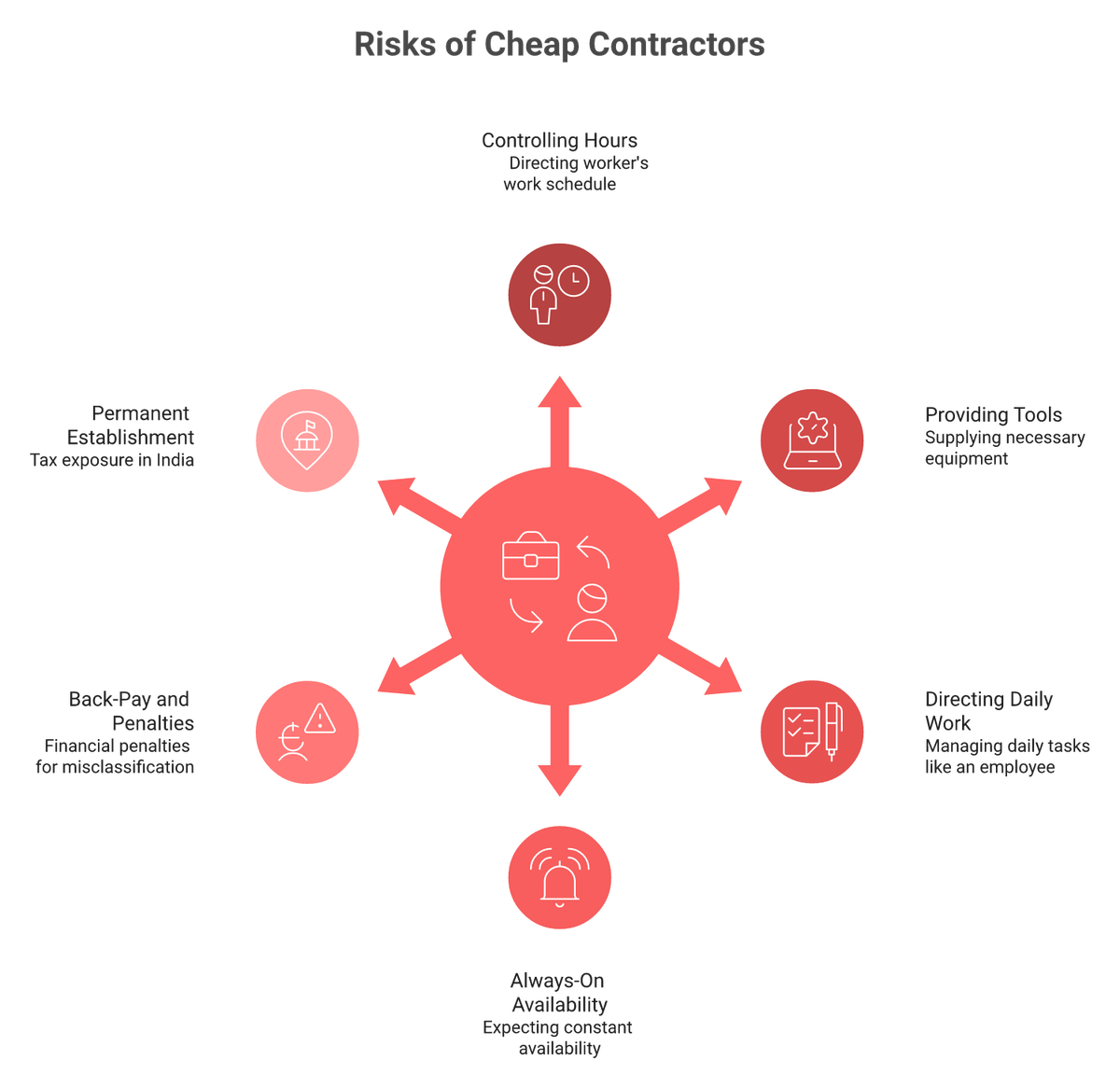
Paying India talent through a contractor rail feels cheap until it isn't. If you direct their hours, tools, and daily work like an employee, Indian authorities can reclassify them, exposing you to roughly $25,000 to $40,000 in back-pay, PF, and penalties per head. Directing work without a local entity can also create a Permanent Establishment, dragging India-linked revenue into Indian corporate tax under the DTAA (Double Taxation Avoidance Agreement) framework. An EOR removes both risks.
💸 The $19 rail that looks free
A contractor tool at $19 a month is seductive. You sign a contract, wire money, done. No PF, no ESI, no filings.
Except you didn't buy compliance. You bought a label. And labels don't survive contact with how you actually manage the person. A compliant contractor of record is the safer path.
⚠️ The signal regulators actually read
Here's a moment that stuck with me. An American manager told me that every time an Indian engineer she worked with wanted to take his dinner break, he messaged to ask if it was okay. She said it wasn't necessary. He insisted, "because I'm your subordinate."
That deference is human and kind. It's also a flashing misclassification signal. When you control someone's hours, tools, and daily rhythm like an employee, a "contractor" label collapses, and the bill lands: roughly $25,000 to $40,000 per head in back-pay and penalties. Direct that work without a local entity, and you risk a Permanent Establishment, a taxable Indian presence that pulls your revenue into Indian corporate tax.
✅ Where Versatile Club fits
When you employ through Versatile Club's owned-entity EOR, that person is a real, compliant employee from day one, not a contractor waiting to be reclassified. Our onboarding process makes the employment relationship legally correct, so the control you exercise as their manager stops creating exposure. PE risk is the silent killer here, the one founders never price in until an assessment order arrives, so if you are weighing the choice, read our take on independent contractor vs EOR. I'd rather you never meet it.
Q8: Do You Also Need to Worry About DPDP Data-Protection Rules When Hiring in India?
Yes. The Digital Personal Data Protection (DPDP) Rules were notified on 13 November 2025, so the moment you hold candidate or employee personal data, consent notices, retention limits, and a 72-hour breach report to the Data Protection Board apply. Significant Data Fiduciaries face extra duties: a Data Protection Officer, annual DPIA (data-protection impact assessment), and audit. For India teams handling customer data, your EOR's data handling becomes part of your compliance perimeter.
🔐 What DPDP actually asks of you
Think of DPDP as India's version of a consent-first privacy law. The Rules were notified on 13 November 2025 and roll out in stages. The moment you collect a candidate's resume or an employee's bank details, you're processing personal data.
That triggers three plain duties. Get clear consent, keep data only as long as you need it, and report a breach to the Data Protection Board within 72 hours. Larger "Significant Data Fiduciaries" also need a Data Protection Officer and an annual impact assessment.
🧑💻 The Monday step for a real India hire
Say your Bengaluru engineer touches customer records. Add a DPDP-compliant consent notice to your onboarding pack today, and write down how long you'll retain candidate data. That single step covers the two most common gaps I see. Our HR consulting team can set the template up with you.
✅ Where Versatile Club fits
Because India is the only country Versatile Club operates in, DPDP isn't a footnote in a 150-country playbook for us, it's a live operational rule we track. Our data handling sits inside your compliance perimeter, aligned to the DPDP Rules, so your employee data isn't a liability you inherit blind, which is one reason startups choose us. I might be early on this, but I think DPDP becomes the next big buyer question, right after "how fast can you onboard?"
Q9: Versatile Club vs. Wisemonk vs. Global Generalists, Which India EOR Should You Actually Pick?
For hiring in India specifically, an India-native EOR that owns its entity beats a global generalist spreading expertise across 150 countries. Global platforms like Deel and G-P often run India through partner entities and carry a reported 3% to 5% FX markup. Wisemonk is India-focused but publishes pricing only as a "from $99" range requiring a sales call. Pick a generalist if you hire in 20+ countries. Pick an India specialist EOR if India is your team.
🤯 Why the vendor field paralyzes founders
Open ten tabs and every EOR looks the same. Same promises, same clean UI, same "compliance handled" badge. The differences hide where it matters: entity ownership, India depth, and who picks up when payroll breaks.
Think of it like AWS. You don't want a provider who's "in every region." You want one who's deep where your servers actually live. Compare the field yourself against our Wisemonk alternative breakdown.
📊 The head-to-head
| Criteria | Versatile Club | Wisemonk | Global generalists |
|---|---|---|---|
| Entity model | ✅ Owns Indian entity | ✅ India-native | ❌ Often local-partner shells |
| India depth | ✅ India-only, 28 states | ✅ India-focused | ❌ India is 1 of 90 to 185 countries |
| Pricing clarity | ✅ Flat, no setup/exit fee | ❌ "From $99," sales call needed | ❌ $400 to $599/mo, FX markup |
| Support | ✅ Founder on WhatsApp | ✅ Team support | ❌ Ticket queue or chatbot |
| Retention | ✅ 90-day coach, 6-mo guarantee | ❌ No replacement guarantee | ❌ Not offered |
The generalist experience gets cold fast. One buyer described enterprise procurement as a wall of sign-offs, over twenty names, most sitting in a department halfway across the world. The reviews back the support gap:
"Support is the single biggest failure. There is no direct phone line. You either email or use a chatbot, and you can ask both the same question and get two different wrong answers."
Erika D., Verified User Rippling G2 Verified Review
"We've had no fewer than six account managers in less than two years. Our new provider is costing us 60% less for a better experience."
Verified User Velocity Global G2 Verified Review
🧭 Pick the one that fits your seat
Pick a global generalist if you hire across 20+ countries and India is a small slice.
Pick Wisemonk if you want an India-native platform and pricing opacity doesn't bother you.
Pick Versatile Club if India is your team and you want the founder reachable.
✅ Where Versatile Club fits (and where it doesn't)
We own our Indian entity, invoice in USD with no setup or exit fees, run a 5-day contractual onboarding SLA, and I'm on WhatsApp directly, not a CSM rotation. On the retention side, we hire culture-fit-first on 50 behavioral parameters, add a 90-day Success Coach, and back placements with a 6-month replacement guarantee through our EOR service. Honestly, though, we're the wrong call if you need EOR in five countries, or you're an enterprise 100+ India team requiring SOC 2 or ISO 27001 as a procurement gate. That's not us by design.
Q10: How Do You Actually Make a Great India Hire, Beyond the Paperwork?
Compliance gets someone on payroll legally. It doesn't get you a hire who stays. In India, nearly 30% of IT-sector resumes contain discrepancies, so background verification is non-negotiable. Pay for a one-to-two-week test project (around $1,500) rather than asking for free work, screen for culture fit, and hire one exceptional person over ten average ones. A signed contract is the floor. A good hire who stays is the goal.
🧠 The problem compliance-first providers ignore
Here's the take the category avoids. Most EORs solve the "legal hire on paper" problem and stop. But that's not the problem keeping a founder up at night.
The real problem is the "good hire who stays." A perfectly compliant employee who ghosts in month three still costs you the roadmap. Paperwork was never the hard part, which is why our recruitment approach starts with fit.
🔍 Two tactics that actually de-risk it
Start with verification. Nearly 30% of IT-sector resumes in India carry discrepancies, so background checks are a tactical must, not a nicety.
Then test before you commit. We usually pay around $1,500 for a one-to-two-week mini-project. We never ask people to work for free, because if we wouldn't do it for free, why would they? Two more habits I'd steal: recap every call in writing immediately, and never ask closed yes/no questions like "Are you on schedule?" Ask "Show me what's left." Our contract-to-hire model bakes this test period in.
⭐ The rock-star ratio
For creative and engineering roles, hire one exceptional person over ten average ones. Pay them at the top of their market range. If you can't afford that, let go of the weakest seats until you can. Use our culture fit quiz to pressure-test the shortlist.
"WiseMonk is one of the primary reasons I chose to stay with the company, because of the friendly, informative approach."
Verified User, Financial Services Wisemonk G2 Verified Review
✅ Where Versatile Club fits
This is exactly why Versatile Club started as a Contract-to-Hire business, culture-fit-first on 50 behavioral parameters, with a 90-day Success Coach and a 6-month replacement guarantee, all supported by our hire talent team. Across placements we've converted to full-time over six years, what I've noticed is simple: the "stays" problem is solvable, but only if you screen for fit before payroll, not after.
Q11: What's Your Monday-Morning Action Plan for Hiring Your First Employee in India?
If you're making your first 1 to 3 India hires and need speed, start with an EOR that owns its Indian entity, and revisit incorporation around your 12th hire. Confirm your offer letters meet the 50% basic-pay rule, avoid contractor rails for full-time roles, and ask any provider for a sample invoice to expose hidden FX markups. Then talk to someone who runs India operations daily, not a chatbot. If you want the math first, try our EOR vs entity calculator.
🗺️ Find your stage, take one step
Your next move depends on where you sit today.
First 1 to 3 hires, moving fast: use an owned-entity EOR now, revisit an entity around hire 12.
Scaling 10 to 100 people: audit offer letters for the 50% basic-pay rule, and plan the EOR-to-entity migration with our startup team.
CFO watching three-year cost: model per-head EOR fees against entity overhead, and price in PE risk against our transparent pricing.
Whatever your stage, ask any provider for a sample invoice before you sign. It's the fastest way to surface a hidden currency markup.
💬 Where my head is right now
I think India stops being "a country on the global map" in the next two years and becomes its own specialist category. Owned-entity operators who live in one country will keep eating the generalists' India revenue.
So tell me what you're building. I'm Sagar, and I'm on WhatsApp directly, not a ticket queue. Book a demo or send me the role, and I'll show you a sample invoice and how the first month free actually works through Versatile Club.
FAQs
Can a foreign company hire employees in India without setting up a legal entity?
Yes. A foreign company can hire employees in India without a local entity by using an Employer of Record (EOR). The EOR becomes the legal employer on paper, while you direct the person's day-to-day work.
Here is what the EOR takes on and what you keep:
- The EOR handles: the employment contract, payroll, EPF, ESI, TDS, professional tax, and gratuity, all filed under its own registrations.
- You keep: full control of the work, goals, and daily direction of your hire.
This route gets a hire live in roughly 1 to 2 weeks, versus 4 to 6 months to incorporate your own private limited company. It also insulates you from Permanent Establishment risk until you are ready to build a local base.
Our India EOR service runs every filing through our own registered Indian entity, not a rented partner shell, so your compliance sits in one accountable place.
How much does it really cost to hire an employee in India, all-in?
Budget roughly 1.2x to 1.3x gross salary for an India hire once statutory contributions are included. The base pay is only part of the picture.
On top of gross salary, employers owe:
- EPF (provident fund): 12% on basic, capped at the Rs 15,000 wage ceiling.
- ESI (state insurance): 3.25% employer where gross is Rs 21,000 or less.
- Gratuity: around 4.81% provisioned, vesting at five years.
- Professional tax: a per-state slab that varies by location.
Then add an EOR fee of roughly $99 to $599 per employee per month, or $8k to $25k to set up your own entity. A senior Bengaluru engineer runs about $58K all-in, versus around $220K in San Francisco.
We invoice in USD, direct from our single Indian entity, with no setup or exit fees and no hidden FX markup. You can model your own numbers with our EOR vs entity calculator before you commit.
When should you switch from an EOR to your own Indian entity?
The crossover usually lands around 12 India hires. Below that, an EOR is almost always cheaper and faster; above it, per-head fees start to outrun entity overhead.
Here is the practical logic:
- 1 to 12 hires: stay on an EOR for speed, zero setup cost, and no compliance burden on you.
- Around 12 hires: reassess, as incorporation begins to lower your per-head cost.
- Beyond 12: set up a private limited entity and migrate existing staff across.
Incorporation itself takes roughly 4 to 6 months and $8k to $25k, plus ongoing PF, ESI, TDS, and multi-state professional-tax compliance. That is real work, so the EOR bridge is what keeps you hiring in the meantime.
When you hit your tipping point, we help migrate your team onto your own entity instead of trapping you on the platform. Compare the two paths in detail through our EOR vs entity in India guide.
What are contractor misclassification and Permanent Establishment risks in India?
Paying India talent through a contractor rail feels cheap until it is reclassified. If you direct someone's hours, tools, and daily work like an employee, Indian authorities can treat that contractor as a deemed employee.
The two linked risks are:
- Misclassification: reclassification can expose you to roughly $25,000 to $40,000 per head in back-pay, PF, and penalties.
- Permanent Establishment (PE): directing work without a local entity can create a taxable Indian presence, pulling India-linked revenue into Indian corporate tax under the DTAA framework.
The control signals regulators read include setting fixed hours, requiring approval for breaks, and always-on availability. These look like employment, not a contractor relationship.
An EOR removes both risks, because your worker becomes a fully compliant employee from day one. If you are weighing the trade-offs, read our breakdown of independent contractor vs EOR before you choose a rail.
How does India's 2026 Labour Code and 50% basic-pay rule affect salaries?
Since 21 November 2025, India's four Labour Codes are operational, and the Code on Wages requires basic plus DA (dearness allowance) to be at least 50% of total CTC.
This forces a rebuild of allowance-heavy Indian salary structures:
- Higher basic: raising basic pay increases employer PF, gratuity, and bonus liabilities.
- Recalculated budgets: offer letters and cost models must be redone to stay compliant.
- Legacy risk: many older payroll systems still apply the pre-code structure, quietly creating underpayment and back-pay exposure.
The practical Monday-morning fix is to pull your offer-letter template and check the basic-plus-DA ratio against total CTC. If it is under 50%, every new offer builds risk.
We rebuilt every offer structure to the 50% rule the moment the codes went live, so clients using our EOR services do not inherit outdated payroll math.
What statutory compliances must you handle to employ someone in India?
Employing someone in India means running a stack of central, state, and local obligations, each on its own calendar.
The core non-negotiables are:
- EPF: 12% employer contribution on basic, capped at Rs 15,000.
- ESI: 3.25% employer, 0.75% employee, where gross is Rs 21,000 or less.
- TDS: deposited by the 7th of each month, with Form 16 issued by 30 May.
- Professional tax, gratuity, and POSH: filed and maintained per statute.
State-level rules diverge sharply. Maharashtra needs dual PTRC plus PTEC registration, Karnataka requires monthly PT with a 30-day enrollment window, and Delhi has no professional tax but strict Shops and Establishments rules.
Multi-state hiring multiplies this registration burden. We hold PF, ESIC, and Shops and Establishments registrations across all 28 states and 8 union territories, and our compliance team runs every filing under our own registrations.
How is Versatile Club different from Deel, Wisemonk, and other global EOR providers?
For hiring in India specifically, an India-native EOR that owns its entity beats a global generalist spreading expertise across 90 to 185 countries.
The key differences are:
- Entity model: we own our Indian entity, while global platforms often route India through local-partner shells.
- Pricing: we invoice in USD with no setup or exit fees and no 3% to 5% FX markup.
- Support: you reach the founder directly on WhatsApp, not a ticket queue or chatbot.
- Retention: we hire culture-fit-first on 50 behavioral parameters, with a 90-day Success Coach and a 6-month replacement guarantee.
We are honest about fit too. We are the wrong choice if you need EOR across five or more countries, or you are an enterprise 100+ India team requiring SOC 2 or ISO 27001 as a procurement prerequisite.
See the full contrast in our Deel alternative comparison.
How fast can you actually onboard an employee in India through an EOR?
A well-run India EOR can onboard a hire in roughly 1 to 2 weeks, compared to the 4 to 6 months it takes to incorporate your own private limited company.
The speed comes from the EOR already holding what a new entity would need to build:
- Existing registrations: PF, ESIC, and multi-state professional-tax setups are already live.
- Ready contracts: compliant, labor-code-aligned offer templates are already in place.
- Running payroll: the statutory filing engine is operational from day one.
That is why speed is a genuine differentiator, not a marketing line. When we placed our first US-client engineer in Bengaluru, the onboarding ran on a committed cycle, not a best-effort estimate.
We put a 5-day contractual onboarding SLA in writing, so your first hire is live while a self-setup would still be filing paperwork. See exactly how the process runs in our how it works overview.