Table of contents (12)
Employer of Record in India: A 2026 Playbook for PF, ESI, TDS & Multi-State Compliance Without Setting Up an Entity
Q1. What does an Employer of Record in India actually do, and what stays your job?
An Employer of Record in India is a locally registered company that becomes the legal employer of your hire. It issues the India-compliant employment contract and files Provident Fund (PF), Employees' State Insurance (ESI), Tax Deducted at Source (TDS), and professional tax under its own EPFO, ESIC, and TAN registrations. You keep control of the work, the goals, and the tools. You get an employee in Bengaluru without incorporating, without an India bank account, and without becoming a tax filer in India.
✅ What the EOR signs, and what you never sign
The EOR signs three things you otherwise would. The employment contract under the applicable state Shops and Establishments Act. The PF declaration that generates the employee's Universal Account Number (UAN), a lifetime portable PF ID. And the ESI declaration where wages fall under the statutory threshold, per the ESIC contribution rules.
Versatile Club holds those registrations in its own name, which means the employment record sits with one entity from day one. You sign a service agreement with the EOR, and nothing with the Indian government.
❌ Why a contractor agreement is not employment
A contractor agreement does not create any of those filings. No UAN, no ESI number, and no Form 130, the salary tax certificate that replaced Form 16 from Tax Year 2026-27 under the CBDT Form No. 130 FAQs.
That absence is invisible until it matters. I watched a developer in Pune get declined for a home loan because his bank wanted payslips and a tax certificate, and all he had were monthly invoices. He moved onto EOR employment instead of a contractor arrangement, and the same bank approved him. Lenders in India underwrite on employer-issued documents, not on invoices.
⏰ One hire, from offer letter to first filing
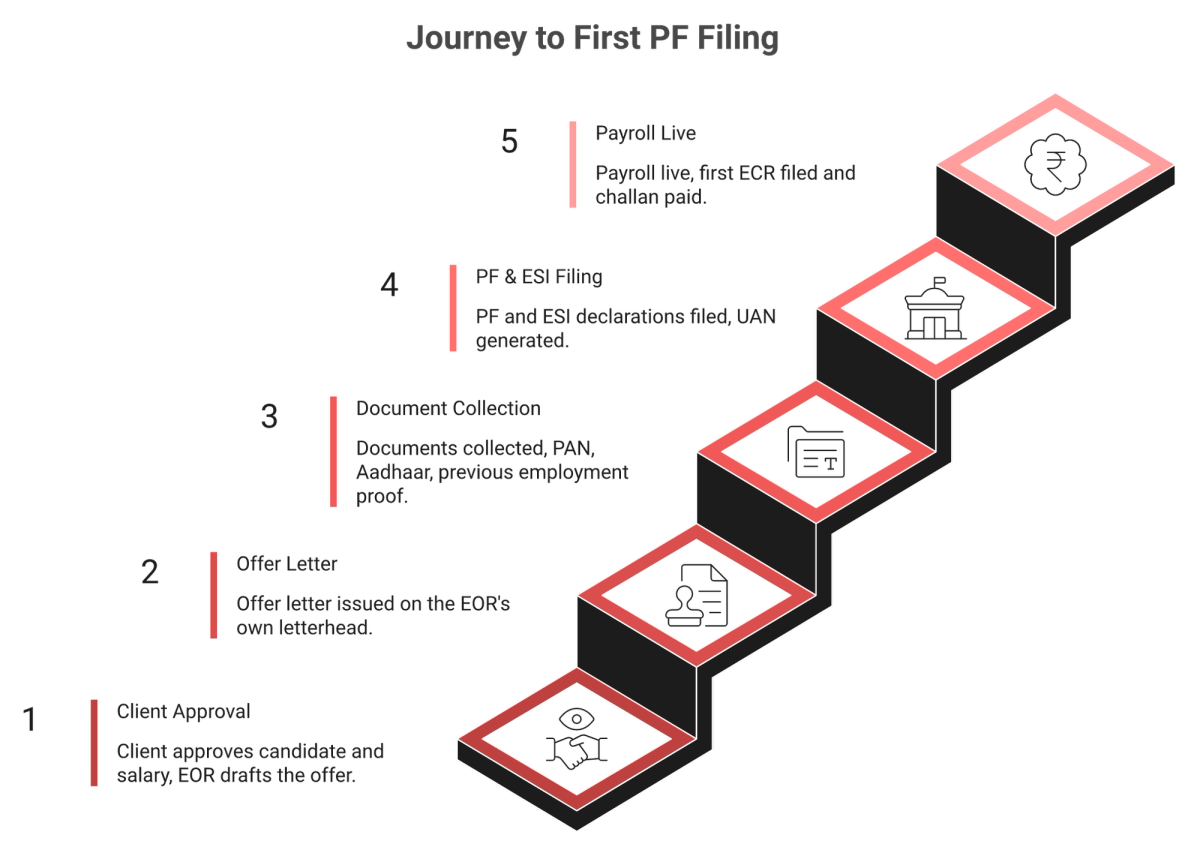
Here is the actual sequence, not the sales version.
You approve the candidate and the salary. The EOR drafts the offer.
The EOR issues the offer letter on its own letterhead, as the employer.
Documents get collected: PAN, Aadhaar, and previous employment proof.
PF and ESI declarations are filed, and the UAN is generated.
Payroll runs. The first Electronic Challan cum Return (ECR) is filed, and the challan is paid by the 15th.
Versatile Club runs steps two through five inside a five-business-day onboarding window that is written into the service agreement, not published as a target. You can see the full sequence on our how it works page.
⭐ The clean split
| The EOR does | You do |
| Employment contract, offer letter | Choose the person, set the salary |
| PF, ESI, TDS, professional tax filings | Set goals, review performance |
| Payslips, Form 130, leave records | Direct the work, own the IP |
| Full and final settlement at exit | Decide to hire, extend, or exit |
The thing people get wrong is thinking the EOR manages the person. It does not. I have never once told a client's engineer what to build.
Versatile Club is the legal employer through Foo Falcon Technologies Pvt Ltd, CIN U72900KA2022PTC163007, verifiable on the MCA company master data portal. The PF registration, ESIC code, and Shops and Establishments licences are ours. So the name on the UAN, the Form 130, and the relieving letter matches the name on your service agreement.
Q2. EOR, PEO, contractor, managed payroll, or your own entity: which is legal for you?
Five models exist, but only three work without an India entity. An EOR employs the person on its own entity. A contractor agreement is legal only for genuinely independent, project-scoped work, and using it for a full-time core role is misclassification, with back-pay exposure typically modelled at $25,000 to $40,000 per head. Managed payroll and PEO both assume you already hold an Indian entity. US-style co-employment PEO does not legally exist under Indian labour law. Your own Private Limited company becomes the better structure above roughly 30 to 50 employees.
💰 The five models side by side
| Model | Legal employer | India entity needed | Time to first hire | Best fit |
| EOR | The provider | No | 5 to 14 days | 1 to 30 employees |
| Contractor | Nobody (vendor) | No | Days | True project work |
| Managed payroll | You | Yes | Weeks | You have an entity, no payroll team |
| PEO (US-style) | Not recognised in India | Yes | - | Not available in India |
| Own Pvt Ltd | You | Yes (you build it) | 3 to 6 months | 30 to 50+ employees |
Versatile Club appears in row one and row three of that table, because Employer of Record and managed payroll are both service lines we run on the same entity. The side-by-side logic is unpacked further in our EOR versus PEO comparison.
⚠️ The moment the model gets questioned
Almost nobody switches off contractors because of a statute. They switch because a person arrives who reads the paperwork.
That person is usually the company's first real HR hire. Shamir Gokani, who runs cross-border EOR work, described the pattern bluntly: conversion happens "once someone's got an official HR person," and the realisation lands that "you could have backdated taxes and fines and all the rest of it." The mechanics of fixing it sit in our guide to converting a contractor to an employee in India.
The second trigger is diligence. A Series A data room with twelve full-time contractors in Bengaluru draws a question that cannot be answered with a contract template.
❌ The PEO myth, stated plainly
Co-employment is a US construct. Indian labour law has no mechanism for two companies to jointly employ one person under the Code on Social Security, 2020 definitions. One entity is the employer, and that entity carries the PF liability.
So when a vendor sells "PEO India" without first asking whether you hold an entity, that is a marketing label. Ask which registered Indian company will appear on the employment contract. The answer resolves the model instantly, and our PEO services in India explainer walks through why.
⭐ What buyers say about making the switch
"WiseMonk's EOR service solved our biggest challenge, which was hiring employees in India without setting up a local entity. They manage employment contracts, statutory compliance, tax structure, and local regulations on our behalf. This reduced legal risk and saved months of setup time and cost."
— Verified User in Marketing and Advertising, 3.5 stars, 12 February 2026, Wisemonk - G2 Verified Review
"I've noticed that their support/query responses can occasionally take a bit longer sometimes, likely due to a relatively small team. Increasing the team size could help ensure quicker turnaround times for queries."
— Verified User in Financial Services, 4 stars, 14 June 2025, Wisemonk - G2 Verified Review
That second review is fair, and it applies to small providers generally, mine included. Founder-direct support on WhatsApp is faster than a ticket queue today, and it is a model that will need to change as we grow.
Versatile Club runs both sides of this line. Contract-to-Hire is our established business, and Employer of Record sits on the same entity, the same filings, and the same state registrations. Converting a contractor to an employee involves no vendor migration, which is where most misclassification clean-ups break.
Q3. What does an India EOR cost once you add statutory load, the PF ceiling choice, and FX?
Budget two numbers, not one. Provider fees run roughly $99 to $699 per employee per month, with Versatile Club at $149, Deel and Remote at $599, and G-P carrying a $1,500 monthly minimum. Statutory employer cost adds about 4% to 12% above gross: PF at 12% of Basic plus DA, ESI at 3.25% where monthly wages are ₹21,000 or less, and gratuity accruing from month one at 4.81% of Basic plus DA. Then the variable nobody quotes: whether PF is contributed at the ₹15,000 ceiling (₹1,800 a month) or on full basic.
💸 Worked example: a ₹15 lakh engineer
Take a ₹15,00,000 annual CTC in Bengaluru, structured with Basic plus DA at 50% as the Code on Wages, 2019 requires.
| Line | Basis | Annual |
| Basic plus DA | 50% of CTC | ₹7,50,000 |
| Employer PF (at ceiling) | ₹1,800 per month | ₹21,600 |
| Employer PF (on full basic) | 12% of Basic plus DA | ₹90,000 |
| ESI | Wages above ₹21,000 per month | Nil |
| Gratuity accrual | 4.81% of Basic plus DA | ₹36,075 |
Look at rows two and three. That is a ₹68,400 annual swing on one employee, decided by a policy choice your provider may never mention. Model your own numbers with the EOR versus entity calculator.
💰 The published fee, compared
| Provider | Per employee monthly | Setup | Exit | India entity |
| Versatile Club | $149 | $0 | $0 | Own entity |
| Deel | $599 | $500 | 1 month notice | Local partner |
| Remote | $599 | $299 | 1 month notice | Local partner |
| Multiplier | $400 | $0 | 2 weeks | Local partner |
| G-P | 15% of salary, $1,500 minimum | Varies | Varies | Local partner |
The per-head gap compounds across a team, which is why we broke it down separately in our India EOR cost analysis and our Deel alternative page.
⚠️ Where the leakage hides
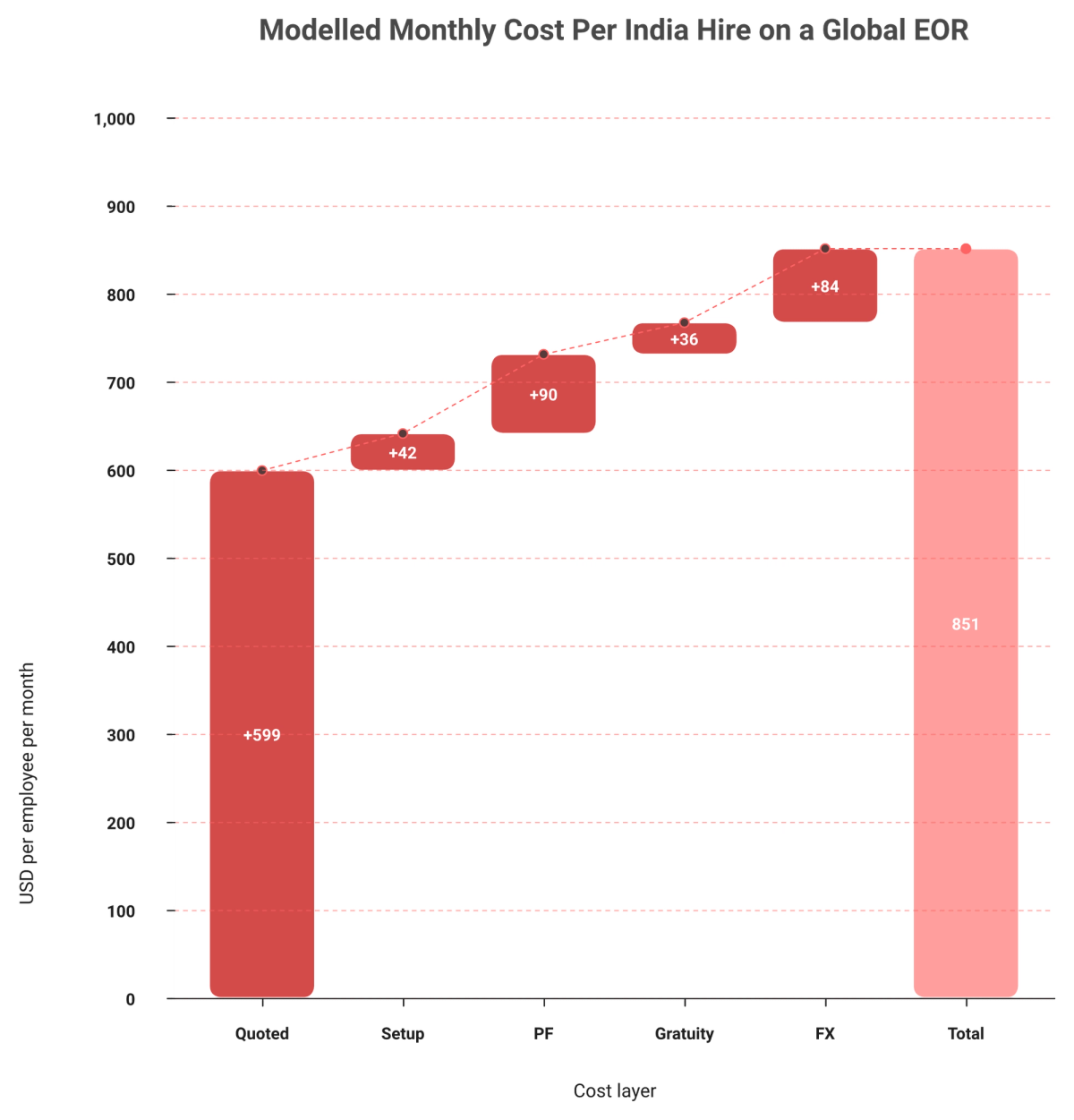
Five line items cause most invoice surprises: setup fees, security deposits, benefits markup, exit fees, and a 3% to 5% FX conversion spread. The spread is the one CFOs miss, because it never appears as a line.
If billing routes through a foreign holding company, conversion happens before rupees reach India. By the time you see a dollar invoice, the spread has already been taken.
My standing advice during procurement is to ask for a live sample invoice, not a pricing page. Every fee you cannot see on a real invoice is a fee you will find later.
⭐ What finance teams report
"What I dislike about Wisemonk is that some features feel a bit limited and could use more flexibility. In particular, I'd like to see better options for customization and more detailed reporting."
— Vinay M., Verified User, 4 stars, 18 February 2026, Wisemonk - G2 Verified Review
"Horrible service if you have any issues. No way to call them."
— Verified reviewer, Remote - TrustPilot Verified Review
"Their CSR often doesn't know the basic labor laws."
— Verified reviewer, Multiplier - G2 Verified Review
Reporting depth is the complaint I take most seriously, because it is the one a CFO feels at month-end close, every single month.
Versatile Club is $149 per employee per month, with no setup fee, no exit fee, first month free, and USD invoicing directly from our Indian entity. Interrogate that last clause. Invoicing from India rather than through a foreign holding company is what removes the FX spread, and it is a property of the entity setup, not a toggle.
Q4. PF, ESI, TDS, PT, and gratuity: what gets filed, at what rate, by which date?
Five recurring obligations govern an India payroll. PF: 12% employer contribution on Basic plus DA, with the ECR filed and the challan paid by the 15th. ESI: 3.25% employer and 0.75% employee where monthly wages are ₹21,000 or less, also the 15th, which means most Bengaluru engineering hires carry no ESI cost at all. TDS on salary: deposited by the 7th under Rule 218 of the Income-tax Rules, 2026. Gratuity: accrued monthly at 4.81% of Basic plus DA, payable after five years at monthly wage divided by 26, multiplied by 15, per year served. Professional tax and Labour Welfare Fund: state-specific, with PT capped at ₹2,500 a year.
⏰ The rate and deadline table
| Item | Rate | Applies to | Due | Authority |
| PF | 12% employer | Basic plus DA | 15th | EPFO |
| ESI | 3.25% employer, 0.75% employee | Gross up to ₹21,000 per month | 15th | ESIC |
| TDS on salary | Per slab | Taxable salary | 7th | CBDT |
| Professional tax | State slab, max ₹2,500 per year | Monthly salary | State cycle | State govt |
| Gratuity | 4.81% accrual | Basic plus DA | On exit after 5 years | Gratuity Act |
| Form 130 | Annual certificate | Full year salary | 15 June | CBDT |
Rates above are drawn from the EPFO employer portal, the ESIC contribution schedule, and the Payment of Gratuity Act, 1972. The month-by-month view sits in our India payroll compliance guide.
⚠️ Approving a return is not paying it
This is the detail that changed how I audit compliance. EPFO's revamped ECR process separates return approval from payment, and it requires month-wise sequential filing from the wage month of September 2025, per EPFO Circular No. Compliance/ECR Revamp/2025/12997.
So a provider can show you an approved return while the challan sits unpaid. I now treat the challan confirmation, with its number, as the only proof of compliance. The return is an intention.
💸 What slipping actually costs
Late PF attracts interest and damages under sections 127 and 128 of the Code on Social Security, 2020. A late TDS statement carries a fee of ₹200 per day under section 427 of the Income-tax Act, 2025.
These are not large numbers on one employee. They become large as arrears, compounding quietly across months, and they surface in diligence rather than in a notice.
✅ The monthly pack that counts as evidence
Ask for five documents every month, and treat anything less as an assertion.
One invoice with per-employee gross, deductions, and net.
PF challan confirmation with the challan number.
ESI challan confirmation.
TDS deposit receipt.
A filed-versus-upcoming status line for the next cycle.
Versatile Club sends challan numbers, not compliance assertions. The monthly pack covers the invoice, payroll summary, PF and ESI challan confirmations, TDS deposit receipts, and the filing status line, and the standard is published on our compliance page. That pack exists because our Contract-to-Hire clients had to survive investor diligence on India payroll records.
Q5. What changed in 2025-26, and why does the same CTC now cost you more?
Three changes hit your India payroll. The four Labour Codes came into force on 21 November 2025, and Code on Wages section 2(y) requires Basic plus DA to be at least 50% of total remuneration, which mechanically raises PF and gratuity on the same CTC. Under the Income-tax Act, 2025, Form 16 becomes Form 130 and the quarterly Form 24Q becomes Form 138, so old-format certificates are invalid for Tax Year 2026-27. The DPDP Rules, 2025, notified on 13 November 2025, phase consent, security, and breach duties to around 13 May 2027.
💸 The 50% rule, before and after
CTC (cost to company) is the Indian convention for total annual pay. Many offers historically kept Basic at 30% to 35% and loaded the rest into allowances, which shrank the PF base.
Take ₹1,50,000 monthly gross. Under the old structure at 35% Basic, employer PF on full basic was about ₹6,300 a month. Restructured to 50% Basic, that becomes ₹9,000. Gratuity accrual at 4.81% moves from roughly ₹2,525 to ₹3,608, per the Payment of Gratuity Act, 1972. Run your own structure through the India salary calculator.
Same CTC. Higher employer liability. Nothing about the employee's headline number changed.
⚠️ The dual wage base nobody mentions
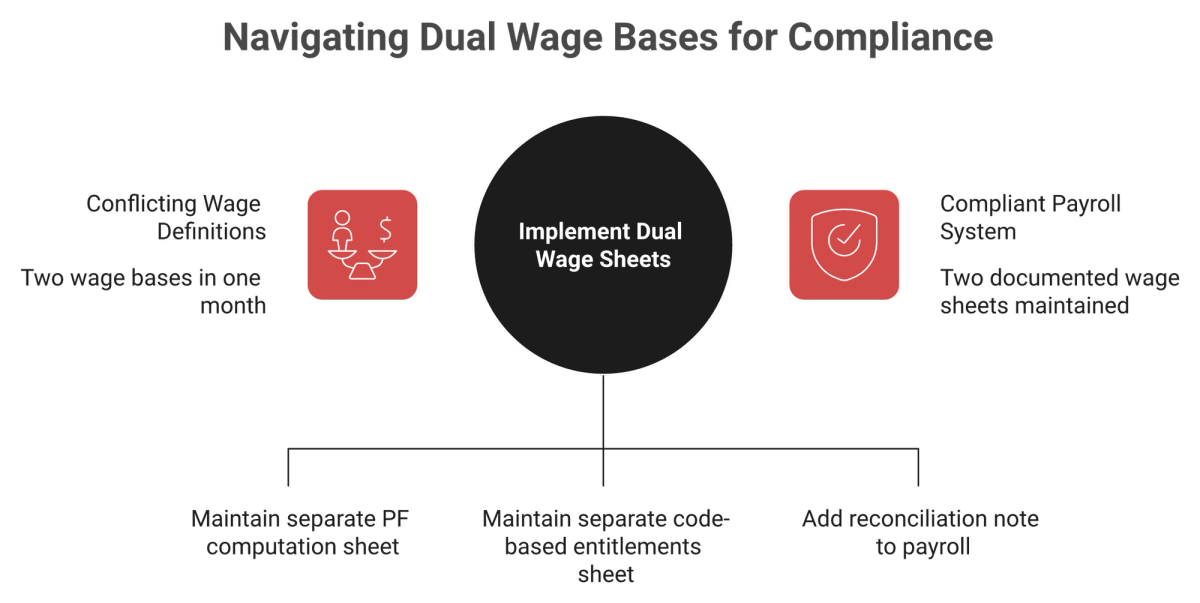
Here is the part I see almost no provider explain. The EPF and Miscellaneous Provisions Act, 1952, has not been repealed, so PF still computes on section 2(b) basic wages, read with the Supreme Court's 2019 Vivekananda Vidyamandir ruling.
Gratuity, leave encashment, and retrenchment compensation move to the new Code definition. The result is two wage bases running in the same payroll, for the same employee, in the same month.
That means two documented wage sheets: one for PF computation, and one for Code-based entitlements. Versatile Club maintains both and keeps the reconciliation note attached to the payroll file, because an inspector will ask why two numbers exist. Our full approach sits on the compliance page.
⏰ The form renumbering, and the trap in it
| Old form | New form | Statutory basis |
| Form 16 | Form 130 | s.395(4)(b) r/w Rule 215(1) |
| Form 16A | Form 131 | Income-tax Rules, 2026 |
| Form 24Q | Form 138 | s.397(3)(b) r/w Rule 219 |
The trap is directional. Corrections for any period up to 31 March 2026 still go on Form 24Q. Only Tax Year 2026-27 onwards uses Form 138, per the CBDT form repository.
I have seen teams assume the renumbering is retrospective and file a correction on the wrong form. The rejection comes back weeks later, with the ₹200 per day fee clock already running under section 427 of the Income-tax Act, 2025. The deadline discipline behind this sits in our India payroll compliance guide.
✅ The DPDP clock is slower than the headlines
Most content implies DPDP obligations landed immediately. They did not. Rules 1, 2, and 17 to 21 commenced on publication, Consent Manager rules at twelve months, and the operative consent, security, and breach rules at eighteen months, per the Government of India notification announcement.
So the practical action is contractual, not technical. Sign the data processing agreement now, with Rule 6 security safeguards, one-year log retention, and the 72-hour breach notification flowing down to your vendor, dated forward to the 2027 commencement.
Versatile Club structures every offer to Basic plus DA at 50% or more at the point the offer is drafted, not after the first payroll run. India is the only country we operate in, so a November notification reaches our offer templates in November rather than in a global release cycle. That is the working premise behind our India EOR service.
Q6. Why does hiring in Mumbai create more paperwork than hiring in Delhi?
Because India is 28 states with 28 rulebooks. Maharashtra needs dual PTRC and PTEC registration, with monthly slab filing and an annual return. Karnataka runs monthly professional tax plus Shops and Establishments renewal, with enrolment within 30 days of joining. Tamil Nadu files professional tax biannually in the June and December cycle, and adds Labour Welfare Fund. West Bengal changes rules frequently. Telangana requires PTRC enrolment with monthly remittance. Delhi levies no professional tax at all, but enforces Shops and Establishments strictly. Versatile Club holds registrations across all 28 states and 8 union territories.
💰 Six states, six different jobs
Professional tax (PT) is a state tax on salaried income, capped at ₹2,500 per employee per year.
| State | Registration | Filing cycle | Enrolment window | LWF |
| Maharashtra | PTRC plus PTEC | Monthly, annual return | On establishment | Yes |
| Karnataka | PT plus S and E renewal | Monthly | 30 days from joining | Yes |
| Tamil Nadu | PT registration | Biannual (June, December) | On establishment | Yes |
| Telangana | PTRC enrolment | Monthly remittance | On establishment | No |
| West Bengal | PT registration | Monthly or annual by slab | On establishment | Yes |
| Delhi | No PT | Not applicable | Not applicable | Yes |
Two registrations in Maharashtra catch people out. PTRC covers tax deducted from employees, under the Maharashtra State Tax on Professions, Trades, Callings and Employments Act, 1975. PTEC covers the entity's own liability. Missing the second one is the most common gap I find in handover audits, and the state-by-state mechanics are expanded in our guide to hiring employees in India.
❌ What happens when your state is not covered
This is where metro-only coverage quietly becomes your problem. A candidate in Jaipur or Kochi comes back as "contractor only," and the recruiting conversation reframes itself around vendor limits instead of the person.
| Provider | India state coverage |
| Versatile Club | All 28 states, 8 union territories |
| Deel | Concentrated in top six states |
| Remote | Concentrated in top four states |
Deel and Remote both operate across 90 or more countries, and that breadth is a real engineering constraint, not carelessness. The trade-off just lands on your non-metro candidate, which is the gap we document on our Remote alternative page.
⏰ The clock that starts at joining
Karnataka's 30-day enrolment window begins when the employee joins, not when your procurement team approves the vendor, under the Karnataka professional tax rules. Versatile Club tracks that date from the offer acceptance, because the two dates drift apart more often than people expect.
These are paperwork scars rather than research. Maharashtra's dual registration and Karnataka's enrolment clock have cost us more calendar time than any other state rule. Local payroll detail for one metro sits in our Bengaluru payroll outsourcing breakdown.
⭐ What buyers notice about India depth
"The initial documentation and paperwork felt quite detailed and time-consuming at the beginning. However, as we progressed, it became clear that this thoroughness is what ensures proper legal and compliance coverage."
— Verified User in Marketing and Advertising, 3.5 stars, 12 February 2026, Wisemonk - G2 Verified Review
"Their CSR often doesn't know the basic labor laws."
— Verified reviewer, Multiplier - G2 Verified Review
That first review is the honest cost of India depth. State-level paperwork feels heavy upfront because it genuinely is heavy, and a provider that makes it feel light is usually skipping a registration.
✅ The question to ask a vendor
Ask which states they file in today, not which they can support. Then ask for the PT registration numbers for the state your candidate lives in.
Versatile Club built its 28-state coverage through Contract-to-Hire placements rather than announcing it as roadmap. When a candidate sits outside Bengaluru, Hyderabad, or Pune, the registration already exists instead of starting as a request.
Q7. What tax, forex, and workplace obligations survive even without an India entity?
An Employer of Record reduces Permanent Establishment risk but does not erase it. Holding no Indian entity, premises, or payroll filings removes the fixed-place and payroll triggers. A dependent-agent argument can still arise if your India employee negotiates or concludes contracts for you, so commercial authority should stay outside India and be documented. With no entity, there is no FC-GPR filing. POSH duties ride with the employer, which at 10 or more employees means a constituted Internal Committee. Versatile Club issues its USD invoices directly from its Indian entity, which keeps the FEMA trail onshore.
⚠️ The three PE triggers, and which one survives
Permanent Establishment (PE) means a taxable business presence in India. Three common triggers matter, defined by the business connection provisions of the Income-tax Act, 2025.
Fixed place of business. Removed, because you hold no office or entity.
Payroll and employment presence. Removed, because the EOR is the legal employer and files under its own registrations.
Dependent agent. Not removed. This is the live one.
The dependent-agent test looks at authority, not job title. If the person in Bengaluru habitually concludes contracts that bind you, the structure stops protecting you. The structural comparison sits in our EOR versus entity analysis for India.
✅ The boring control that works
Keep delivery roles on the EOR. Keep commercial signing authority at the parent company. Write the limitation into the employment contract scope, so the document matches the practice.
Trouble starts when the India hire quietly becomes country manager, with a business card, a pipeline, and signature authority nobody re-papered. I say "consult your own tax adviser" here and mean it, because PE outcomes turn on facts, not on vendor assurances. Versatile Club scopes those contracts as part of our EOR service.
💰 Where your dollars actually convert
FEMA is the Foreign Exchange Management Act, 1999, which governs cross-border money movement into India. FC-GPR is the RBI filing required when foreign investment flows into an Indian company, and with no entity of your own, you never make it.
What remains is a question about your invoice. If billing routes through a foreign holding company, conversion happens offshore and the spread is taken before rupees reach India.
Versatile Club invoices in USD directly from its Indian entity, so conversion happens once, onshore, with one counterparty for month-end close. Our clients see one dollar figure rather than a reconciliation exercise, and the commercial terms are published on our pricing page.
⏰ POSH and GST: two quiet obligations
POSH is the Prevention of Sexual Harassment at Workplace Act, 2013. At 10 or more employees, section 4 of the POSH Act requires a constituted Internal Committee with an external member. The obligation attaches to the legal employer, which means your EOR, but the policy culture attaches to you.
GST e-invoicing determines whether your vendor's invoice is machine-verifiable against the government portal, under CBIC threshold notifications. It sounds procedural until an auditor asks you to prove the India invoice was validly issued.
Versatile Club includes POSH Internal Committee setup and multi-state GSTIN filings inside the service rather than as add-ons. I would still ask any provider, including us, to show the GSTIN on the invoice and the IRN reference before you sign.
❌ What an EOR cannot insulate you from
Three things stay yours. Your own tax residency position. Your contracting behaviour in India. And your conduct obligations as the company directing the work.
Versatile Club's read is that the category oversells PE insulation. The structure genuinely helps, and it is not a shield against how you choose to operate. If a captive structure is where you are actually headed, our GCC setup guide for India covers that route.
Q8. Does your EOR own the Indian entity, or rent it from a local partner?
This one question changes everything downstream. Deel, Remote, G-P, and most global platforms employ your India hire through a third-party local partner entity, so the PF registration, ESIC code, and employment record belong to a company you never contracted with and cannot audit. Providers that own their Indian entity file directly, which is why their onboarding commitments run 24 hours to 5 days against 7 to 14 days on partner models. Versatile Club employs through Foo Falcon Technologies Pvt Ltd, CIN U72900KA2022PTC163007, verifiable on the MCA portal.
⭐ Why the partner model exists
Most buyers assume a global platform owns entities everywhere. It does not, and it probably should not.
Operating 90 to 185 country entities means 90 to 185 statutory calendars, audit obligations, and local directors. Renting capacity through partners is a rational engineering decision for breadth. The constraint is real, not lazy.
So the partner model is not a scandal. It is a trade-off, and the trade lands on India depth. We mapped that trade in detail across our Deel alternatives for India comparison.
❌ The three costs you inherit
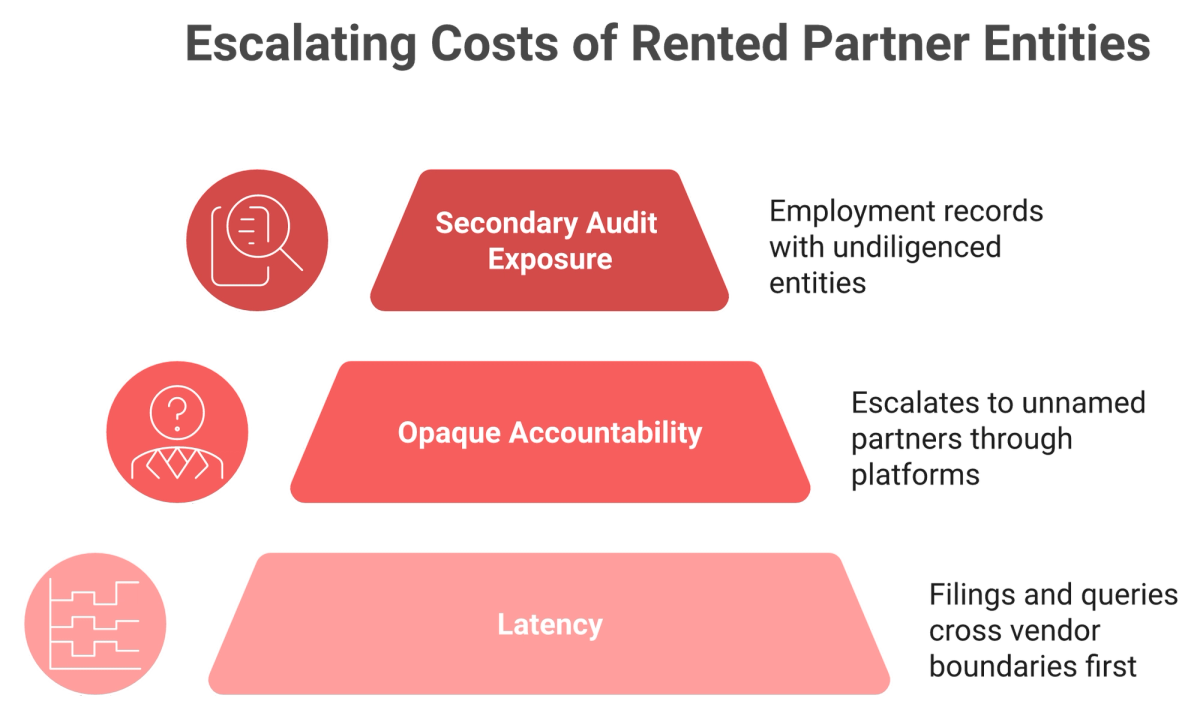
First, latency. Every filing, correction, and employee query crosses a vendor boundary before anything happens, which is where the 7 to 14 day onboarding ranges come from.
Second, opaque accountability. When PF is filed late, you escalate to a platform that escalates to a partner you cannot name. Versatile Club files under its own PF code with the EPFO, so the escalation path has one stop.
Third, secondary audit exposure. The employment record sits with an entity whose registrations, processes, and solvency you never diligenced. Migration mechanics, if you are already on a partner model, are covered in our guide to switching EOR providers in India.
✅ The four-question diligence script
Ask these before signing, and ask for written answers.
What is the CIN of the entity that will appear on the employment contract?
Is the PF establishment code in that entity's name?
Which entity holds the Shops and Establishments licence for my candidate's state?
Does the entity on the service agreement match the entity on the employment contract?
If answers three and four name different companies, you have two counterparties, and one is invisible to you. Versatile Club answers all four with the same company name, which is the only reason the question is worth asking. The same four questions are worth running against any India EOR shortlist.
⚠️ What operators actually say
"EOR is not a 'no-risk' structure. It's a managed-risk structure."
— Verified operator, r/IndiaEOR Reddit Thread
"Horrible service if you have any issues. No way to call them."
— Verified reviewer, Remote - TrustPilot Verified Review
"What I like most is how they convert a complex international hiring process into a structured and easy workflow. Communication is clear, documentation is organized, and timelines are generally well-maintained."
— Verified User in Marketing and Advertising, 3.5 stars, 12 February 2026, Wisemonk - G2 Verified Review
That third quote matters because it describes an India-native provider doing the job well. Wisemonk owns its entity too, carries SOC 2 and ISO 27001, and has 261 plus G2 reviews. Versatile Club has none of that review history yet, and pretending otherwise would be silly. The full side-by-side sits on our Wisemonk alternative page.
💰 The honest counterpoint
If you are hiring across twelve countries this year, breadth probably wins. One contract, one dashboard, and one invoice beats twelve specialist vendors, even with thinner India depth.
Versatile Club is the wrong choice for global multi-country EOR, for enterprise teams where SOC 2 is a procurement gate, and for B2C consumer hiring. I would rather tell you that now than discover it in week three.
Versatile Club's answer is Foo Falcon Technologies Pvt Ltd, CIN U72900KA2022PTC163007: the same entity on the service agreement, the employment contract, the PF challan, and the Form 130. Employer of Record is new for us in 2026, and the entity and filings behind it were proven through Contract-to-Hire payroll. If you want to pressure-test that, send us the questions directly.
Q9. How fast can someone actually start, and what must be verified first?
Five business days is achievable when the Employer of Record files directly, and 7 to 14 days is normal on partner models. Day 1 sign the agreement and verify PAN, Aadhaar, and right to work. Days 2 and 3 issue and execute the India-compliant contract, generate the UAN (Universal Account Number, the employee's lifetime PF ID), and file PF Form 11 and ESI Form 1. Day 4 structure CTC to the 50% wage rule and initiate professional tax. Day 5 payroll goes live. Versatile Club writes that five-day window into the service agreement.
⏰ The five days, step by step
| Day | What happens | What must be true |
| 1 | Service agreement signed | Candidate documents already collected |
| 2 | Offer letter issued by the EOR | Salary structured, state identified |
| 3 | Employment contract executed | PAN, Aadhaar, bank details verified |
| 4 | PF, ESI, and PT registrations initiated | UAN generated, Form 11 filed |
| 5 | Payroll live | First ECR and TDS dates calendared |
Form 11 and the UAN are issued through EPFO member services, and ESI Form 1 through the ESIC portal. Versatile Club measures the SLA from signed agreement to payroll-live, not from "kickoff call." The two definitions produce very different numbers, so ask any provider which one they mean, and compare it against the sequence on our how it works page.
⚠️ Why I will refuse to start the clock
An SLA you can enforce behaves differently from a timeline on a pricing page.
Versatile Club will not start the five-day count when day-one documents are incomplete, because the PF declaration cannot be filed without a verified PAN. I would rather have that conversation on Monday than apologise on Friday.
| Provider | Stated onboarding | Contractual? |
| Versatile Club | 5 business days | Yes, in the agreement |
| Deel | 7 to 14 days | Not published as contractual |
| Remote | 10 to 14 days | Not published as contractual |
Those ranges come from the published Deel India country guide and the Remote India country explorer. The speed gap is the reason our India EOR service leads with a contractual window rather than a marketing estimate.
✅ The verification step US buyers skip
Background verification in India has a step that has no US equivalent. The UAN cross-check pulls a candidate's actual PF contribution history, which reveals every employer who ever filed for them, through the EPFO member portal.
That record is hard to fake. It catches overlapping employment, invented job titles, and gaps the resume smoothed over.
Industry background-check data puts resume discrepancy rates in Indian IT near 30%, which matches what surfaces in Versatile Club's own screening. Run four checks before the offer: UAN history, education, previous-employer confirmation, and a court or police record check. Our recruitment practice runs the same four before any shortlist goes out.
❌ What operators learn the hard way
"We hired in India and had one dev secretly working two jobs."
— Verified operator, r/Entrepreneur Reddit Thread
"My experience has been very positive so far, especially in the talent acquisition process. Everything from scheduling the interviews to the final onboarding was handled smoothly and professionally. They consistently provided timely updates after each round."
— Verified User in Financial Services, 4 stars, 14 June 2025, Wisemonk - G2 Verified Review
Moonlighting is the exact failure the UAN check surfaces. Two active contribution streams in the same month is not ambiguous.
💰 What actually causes delay
Rarely the vendor. Usually three things: missing candidate documents, a notice period at the current employer, and state enrolment windows such as Karnataka's 30-day clock under the Karnataka professional tax rules.
Versatile Club tracks the Karnataka clock from offer acceptance rather than from payroll start, because those dates drift.
Versatile Club's five-day onboarding SLA runs agreement to payroll-live and sits inside the service agreement, not on a pricing page. Culture-fit screening against 50 behavioural parameters runs alongside, because a compliant hire who leaves in month four still costs you two quarters. You can see how that screen works through the culture fit quiz.
Q10. What does your India employee actually receive, and what happens when they leave?
Your India employee receives statutory benefits plus whatever you add. Statutory: PF with a portable UAN, ESI medical cover below the wage threshold, earned and sick leave under the applicable state Shops and Establishments Act, maternity benefit, gratuity after five years of continuous service, and a Form 130 annually. Expected in Indian tech but not statutory: private health insurance covering spouse, parents, and children. On exit, notice is contractual at typically 30 to 90 days, and full and final settlement covers notice pay, leave encashment, vested gratuity, PF transfer or withdrawal, and a relieving letter.
✅ Statutory versus what the market expects
| Benefit | Source | Notes |
| PF | EPF Act, 1952 | Portable via UAN across employers |
| ESI | ESI Act, 1948 | Only at gross up to ₹21,000 monthly |
| Earned and sick leave | State S and E Act | Varies by state |
| Maternity benefit | Maternity Benefit Act, 1961 | 26 weeks for the first two children |
| Gratuity | Gratuity Act, 1972 | Vests at 5 years |
| Private health cover | Market practice | Not statutory, expected in tech |
The statutory rows above are set by the EPF Act, 1952, the ESIC contribution schedule, the Maternity Benefit Act, 1961, and the Payment of Gratuity Act, 1972.
That last row decides offer acceptance in Bengaluru more often than people realise. A candidate comparing two offers will ask whether parents are covered, which is part of why we document the full package inside our EOR service scope.
⚠️ Termination: what an EOR can and cannot do
This is where founders expect US behaviour and do not get it. India has no at-will employment.
Notice must be served per contract. Where the Industrial Disputes Act, 1947, applies to a workman, section 25F requires notice and retrenchment compensation. The EOR executes the termination, and it cannot execute one that breaks the statute.
So the honest framing is this. You decide to exit someone. Versatile Club tells you what the lawful path looks like, including timing and cost, before anything is communicated, and the same standard is published on our compliance page.
⏰ The full and final checklist
Full and final settlement (F and F) is the closing payroll run for a departing employee. Six items belong in it.
Notice pay or recovery, per the contract.
Leave encashment on the applicable wage base.
Gratuity, if five years are complete.
Final TDS reconciliation and Form 130 for the part year.
PF transfer request or withdrawal support.
Relieving letter and experience letter.
Versatile Club processes all six as one sequence, and the relieving letter is the one employees chase hardest. Every future employer in India asks for it. The monthly mechanics behind it sit in our guide to paying employees in India.
❌ The complaint I hear most often
PF transfer at exit. It is the single most common grievance I hear about EOR providers of every size, mine included as we scale.
The cause is almost always filing hygiene rather than policy. If monthly ECRs were filed sequentially and challans paid on time, the transfer is routine. If there are gaps, the employee's new employer inherits the problem.
"Wisemonk addresses the hassle of managing employees, tracking time, and running payroll across multiple tools by bringing everything together in a single system."
— Vinay M., Verified User, 4 stars, 18 February 2026, Wisemonk - G2 Verified Review
"I've seen individuals caught off guard after more than a year of assuming they were compliant."
— Verified operator, r/SoftwareUnboxed Reddit Thread
Versatile Club processes full and final settlement end to end, covering notice, leave encashment, gratuity, PF, and the relieving letter, with no exit fee on our side. The 90-day Success Coach and 6-month replacement guarantee from our Contract-to-Hire practice exist because a legal hire and a hire who stays are different problems.
Q11. When should you stop using an EOR and incorporate in India?
Run the Employer of Record to roughly 30 to 50 India employees, then re-run the math. Below that, incorporation costs $15,000 to $100,000 and takes 3 to 6 months, and it adds permanent overhead: statutory audit, ROC filings, your own EPFO and ESIC codes, a company secretary, and a resident director. Above it, per-head fees start exceeding that fixed overhead. Incorporate earlier only for strategic reasons, such as building a Global Capability Centre, holding India IP directly, or needing a local balance sheet to contract with Indian customers. Versatile Club charges no exit fee when that day comes.
💰 Where the lines cross
Modelled at $149 per employee per month, with entity overhead held at a conservative $35,000 a year once running. Incorporation itself runs through the MCA SPICe+ process.
| India headcount | Annual EOR fee at $149 | Annual entity overhead | Which is lower |
| 10 | $17,880 | $35,000 plus setup | EOR |
| 30 | $53,640 | $35,000 plus setup | Close |
| 50 | $89,400 | $35,000 plus setup | Entity |
Run the same table at the published $599 per employee and the crossover arrives around eight people, which is the quiet cost of the global-generalist route. Test your own numbers with the EOR versus entity calculator.
Versatile Club models this openly with clients, and I will say plainly when the entity wins. Keeping someone on a model they have outgrown is a short-term win and a long-term reference problem.
⚠️ The triggers that have nothing to do with cost
Four reasons to incorporate early, even at ten people.
You are building a Global Capability Centre, not a hiring channel.
You need India-owned IP on the balance sheet for a specific reason.
You want to sell to Indian customers and need local invoicing.
Your procurement or InfoSec policy requires a controlled entity.
nasscom's 2026 Strategic Review frames the Indian tech sector shifting from scale-led growth toward value and innovation, which is the same logic that turns an India team into a capability centre rather than a cost centre. If that is your direction, our captive centre setup guide covers the build.
⏰ Suspension bridge versus Golden Gate
An EOR is a suspension bridge. Light, fast, and good enough to carry real traffic while you decide whether the crossing is permanent.
Your own Private Limited company is the Golden Gate. It takes years and capital, and it is the right build once the traffic is permanent and heavy.
The mistake is building the Golden Gate to move three people. The opposite mistake is running fifty people across a suspension bridge and calling the per-head toll a rounding error. The full decision set is laid out in our India expansion options comparison.
✅ The transition is where people get hurt
Leaving is a sequence, not an event. Versatile Club handles it in a set order, and the order matters.
New entity obtains its EPFO and ESIC codes.
Employees receive fresh contracts with service continuity recorded.
PF transfers are filed against the new establishment code.
Gratuity accrual records transfer with dates intact.
Mid-year Form 130 reconciliation is agreed between both employers.
Step four is the one people forget. Gratuity vests at five years of continuous service under section 4 of the Payment of Gratuity Act, 1972, and a sloppy transfer can reset that clock on paper.
Versatile Club charges no exit fee, and the handover sequence above runs at no additional cost. Deel and Remote both require a month's notice to exit. The pricing model should not be the reason you stay, which is also why the terms sit openly on our pricing page.
Q12. What should you ask an India EOR before you sign?
Ask ten things, and get them in writing. The CIN of the entity that will appear on the employment contract. Whether the PF code and ESIC registration are in that entity's name. Which states it files in today, not which it can support. Whether PF is contributed at the ₹15,000 ceiling or on full basic. Where the USD invoice is issued from. Whether the onboarding timeline is contractual. What the exit fee is. Whether you receive challan numbers or compliance assertions. Who answers at 11pm IST. Versatile Club answers all ten in writing before any agreement is signed.
✅ The ten questions, and what a good answer sounds like
| Question | A good answer |
| CIN of the employing entity | A number you can verify on the MCA portal |
| PF code ownership | "In our own name," with the code |
| States filed in today | A list, plus the PT number for your state |
| PF at ceiling or full basic | A policy stated in writing, either way |
| Invoice issued from | "From our Indian entity," not a holding company |
| Onboarding SLA | A clause number in the agreement |
| Exit fee | A figure, including zero |
| Monthly evidence | Challan numbers and TDS receipts |
| Support path | A named human and a response window |
| Sample invoice | An actual past invoice, redacted |
Row one is checkable in about ninety seconds on the MCA company master data service. Run the same ten against any India EOR shortlist you are already holding.
💸 Question four is the one I would ask
Two providers can both quote $149 and sit tens of thousands of rupees apart annually, purely on the PF ceiling choice under the EPF Scheme ceiling provisions. Almost no pricing page discloses it.
Versatile Club states its PF policy in the service agreement rather than leaving it to the first payroll run. I could be wrong about how much this matters to a ten-person company, but at thirty heads it is a real number on your books. The cost mechanics are broken out in our India EOR cost guide.
⚠️ Audit the invoice, not the pricing page
Request a live sample invoice during procurement. Five line items hide there: setup fees, security deposits, FX markup, benefits markup, and exit charges.
Then recap every vendor call in writing within the hour. Cross-border calls produce confident agreement and different memories, and a written recap turns a verbal assurance into something you can point at later.
❌ What review threads reveal about depth
"We use Google to get our info and provide that to our clients."
— Current employee, Deel - Glassdoor Verified Review
"I've noticed that their support and query responses can occasionally take a bit longer sometimes, likely due to a relatively small team."
— Verified User in Financial Services, 4 stars, 14 June 2025, Wisemonk - G2 Verified Review
Both are fair warnings, pointing in opposite directions. Large platforms risk shallow answers at speed, and small operators risk slow answers with depth. Versatile Club sits in the second category today, and founder-direct WhatsApp support is how we narrow the gap while we are small. Our side-by-side against the India-native incumbent sits on the Wisemonk alternative page.
⭐ The honest limits
Versatile Club is the wrong fit for global multi-country Employer of Record, for enterprise procurement where SOC 2 or ISO 27001 is a gate, and for B2C consumer hiring. Versatile Club also launched Employer of Record in 2026, with the entity and filings proven through Contract-to-Hire rather than through years of EOR history. Teams that do need that scale of assurance should start with our enterprise page.
Versatile Club's answers are already public: Foo Falcon Technologies Pvt Ltd (CIN U72900KA2022PTC163007), own PF and ESIC registrations, all 28 states, $149 per employee per month, no setup fee, no exit fee, first month free, a 5-day contractual SLA, USD invoiced from India, and challan numbers monthly. Send me the invoice you have now, and I will tell you what is inside it, or book a 30-minute call.
FAQs
What does an Employer of Record in India actually do, and what stays our responsibility?
An Employer of Record in India is a locally registered company that becomes the legal employer of your hire. It issues the India-compliant employment contract and files Provident Fund, Employees' State Insurance, Tax Deducted at Source and professional tax under its own EPFO, ESIC and TAN registrations.
What the EOR carries:
- The employment contract under the applicable state Shops and Establishments Act
- The PF declaration that generates the employee's Universal Account Number
- Monthly ECR filing, TDS deposit by the 7th, and the annual Form 130 certificate
- Full and final settlement at exit, including the relieving letter
What stays with you:
- Choosing the person and setting the salary
- Goals, performance reviews and day-to-day direction
- Ownership of the work product and intellectual property
Versatile Club is the legal employer through Foo Falcon Technologies Pvt Ltd, so the PF registration, ESIC code and Shops and Establishments licences sit with one accountable entity rather than a partner shell. The name on the employee's UAN, their Form 130 and their relieving letter matches the name on your service agreement. If you want the mechanics without the entity question, start with our breakdown of how to hire in India without an entity.
How much does an Employer of Record in India really cost per employee?
Budget two numbers, not one. Provider fees for India run roughly 99 to 699 US dollars per employee per month. Statutory employer cost sits on top, adding about 4 to 12 percent above gross salary.
The statutory stack looks like this:
- Provident Fund: 12 percent of Basic plus DA, with the challan paid by the 15th
- ESI: 3.25 percent employer where monthly wages are 21,000 rupees or less, which excludes most engineering hires
- Gratuity: accrued from month one at 4.81 percent of Basic plus DA
- Professional tax: state-specific, capped at 2,500 rupees a year
Then comes the variable almost nobody quotes. Whether your provider contributes PF at the 15,000 rupee wage ceiling, which is 1,800 rupees a month, or on full basic changes the annual cost by roughly 68,400 rupees on a 15 lakh CTC. Two lawful providers can quote identical fees and land tens of thousands of rupees apart.
Versatile Club prices at 149 dollars per employee per month with no setup fee, no exit fee and the first month free, invoiced in USD directly from its Indian entity so no FX spread is taken offshore. Our full line-item view sits in the employer of record cost breakdown.
What changed for India payroll in 2025 and 2026 that affects our costs?
Three changes land directly on your payroll, and all three arrived between November 2025 and 2026.
- The four Labour Codes came into force on 21 November 2025. Code on Wages section 2(y) requires Basic plus DA to be at least 50 percent of total remuneration, which mechanically raises PF and gratuity liability on the same CTC. On a 1,50,000 rupee monthly gross, employer PF on full basic moves from roughly 6,300 to 9,000 rupees.
- Form numbering changed under the Income-tax Act, 2025. Form 16 is now Form 130, Form 16A is Form 131, and the quarterly Form 24Q is Form 138. Old-format certificates are invalid for Tax Year 2026-27, though corrections for periods up to 31 March 2026 still go on 24Q.
- The DPDP Rules, 2025 were notified on 13 November 2025. Consent, security safeguards and breach reporting phase in to around 13 May 2027, so the practical action today is contractual rather than technical.
There is a fourth detail most providers skip. The EPF Act, 1952 has not been repealed, so PF still computes on section 2(b) basic wages while gratuity and leave encashment move to the new Code base. Versatile Club maintains both wage sheets with a reconciliation note, because an inspector will ask why two numbers exist. The recurring calendar sits in our guide to payroll compliance in India.
Does using an Employer of Record protect us from Permanent Establishment risk in India?
It reduces the risk substantially, but it does not erase it. Three Permanent Establishment triggers matter, and an EOR structure removes two of them.
- Fixed place of business: removed, because you hold no Indian office, premises or entity
- Payroll and employment presence: removed, because the EOR is the legal employer and files under its own registrations
- Dependent agent: not removed, and this is the live exposure
The dependent-agent test looks at authority, not job title. If your India employee habitually negotiates or concludes contracts that bind your parent company, the structure stops protecting you. The practical control is unglamorous and it works: keep delivery roles on the EOR, keep commercial signing authority at the parent, and write that limitation into the employment contract scope so the paperwork matches the practice.
On the money side, holding no Indian entity means you never make an FC-GPR filing under FEMA. What remains is a question about where your invoice is issued from.
Versatile Club invoices in USD directly from its Indian entity, so conversion happens once, onshore, with an auditable FEMA trail and one counterparty for month-end close. PE outcomes turn on facts rather than vendor assurances, so pair this with your own tax adviser and our EOR versus entity comparison for India.
When should we stop using an India EOR and set up our own entity?
Re-run the math at roughly 30 to 50 India employees. Below that, incorporation rarely pays for itself.
What incorporation actually costs:
- 15,000 to 100,000 US dollars in setup, across 3 to 6 months
- Permanent overhead: statutory audit, ROC filings, your own EPFO and ESIC codes, a company secretary and a resident director
Modelled at 149 dollars per employee per month, ten people costs about 17,880 dollars a year against roughly 35,000 dollars of annual entity overhead, so the EOR wins clearly. At fifty people the same fee reaches 89,400 dollars and the entity wins. Run the identical table at 599 dollars per employee and the crossover arrives around eight people, which is the quiet cost of the global-generalist route.
Four non-cost triggers justify incorporating early: building a Global Capability Centre, holding India IP directly, selling to Indian customers, or an InfoSec policy requiring a controlled entity.
The transition is where people get hurt. PF transfers must file against the new establishment code, and gratuity accrual records must carry dates intact or a five-year vesting clock resets on paper. Versatile Club charges no exit fee and sequences that handover at no additional cost. Model your own break-even alongside our India expansion options comparison.