Table of contents (12)
Leave Policy in Chhattisgarh: Complete Guide for Employers 2026
Q1. Which law actually governs leave in Chhattisgarh in 2026, and is the 1958 Act dead?
Leave in Chhattisgarh is governed by the Chhattisgarh Shops and Establishments (Regulation of Employment and Conditions of Service) Act, 2017, notified as Act No. 21 of 2018. It grants eight days casual leave with wages credited quarterly, earned leave at one day for every twenty days worked, accumulation up to forty-five days, and encashment where leave is refused. Section 30 repealed the Chhattisgarh Shops and Establishment Act, 1958.
A People Ops lead at a Series A company sent me her India handbook in July. Page four said "30 days privilege leave, 14 days casual leave, carry forward up to 90 days." Those numbers came from a statute that had been repealed almost eighteen months earlier. She had copied them from a compliance blog that still ranks on page one.
⚠️ The repeal most guides missed
The 2017 Act sat on the books for years without a commencement date. Section 1(4) said it would start on a date the State Government appointed by gazette notification. That notification came on 13 February 2025.
Once it commenced, the old numbers stopped being law. Versatile Club tracks state commencement notifications across all 28 states and 8 union territories, because a repeal like this never arrives as an email to the employer. That state-by-state tracking is part of how our India compliance coverage is maintained.
⭐ What changed, line by line
| Item | Repealed 1958 Act (as commonly published) | Chhattisgarh Act No. 21 of 2018 (in force) |
| Casual leave | 14 days | 8 days, credited quarterly |
| Earned or privilege leave | 30 days | 1 day per 20 days worked |
| Accumulation cap | 90 days | 45 days |
| Encashment trigger | Not commonly cited | Leave refused after 15 days' notice |
The accrual rule is the part people misread. Earned leave is not a flat annual grant. A worker who has worked 240 days or more in a calendar year earns leave in the following year at that 1:20 rate.
✅ What I would fix this week
Three documents carry the stale numbers in almost every company I look at. The offer letter template, the employee handbook, and the leave master inside the HRMS. Fix them in that order, because the offer letter is the one a lawyer reads first.
Then add one line to the policy: "Verified against Chhattisgarh Act No. 21 of 2018 as on September 2026." Versatile Club puts a verification date on every state policy it maintains, and that single line has settled more diligence questions than any compliance certificate I have handed over.
💰 Where my head is on this
I think the broader shift is that state statutes are now moving faster than the content that explains them. Chhattisgarh commenced a 2017 Act in 2025, then amended it in 2026. Versatile Club's read is that the standard advice gets this backwards, treating state acts as stable background and central codes as the only moving part.
I could be reading that too strongly. Most states have been quiet. But Chhattisgarh, and West Bengal before it, suggest the quiet period is over.
Versatile Club holds Shops and Establishments registrations under its own Indian entity in every state it employs in, which is why a commencement notification lands as a policy update from us rather than a finding in your audit. That owned-entity structure is the basis of our EOR services in India.
Q2. How are your India employees categorised, and why does the label change their leave?
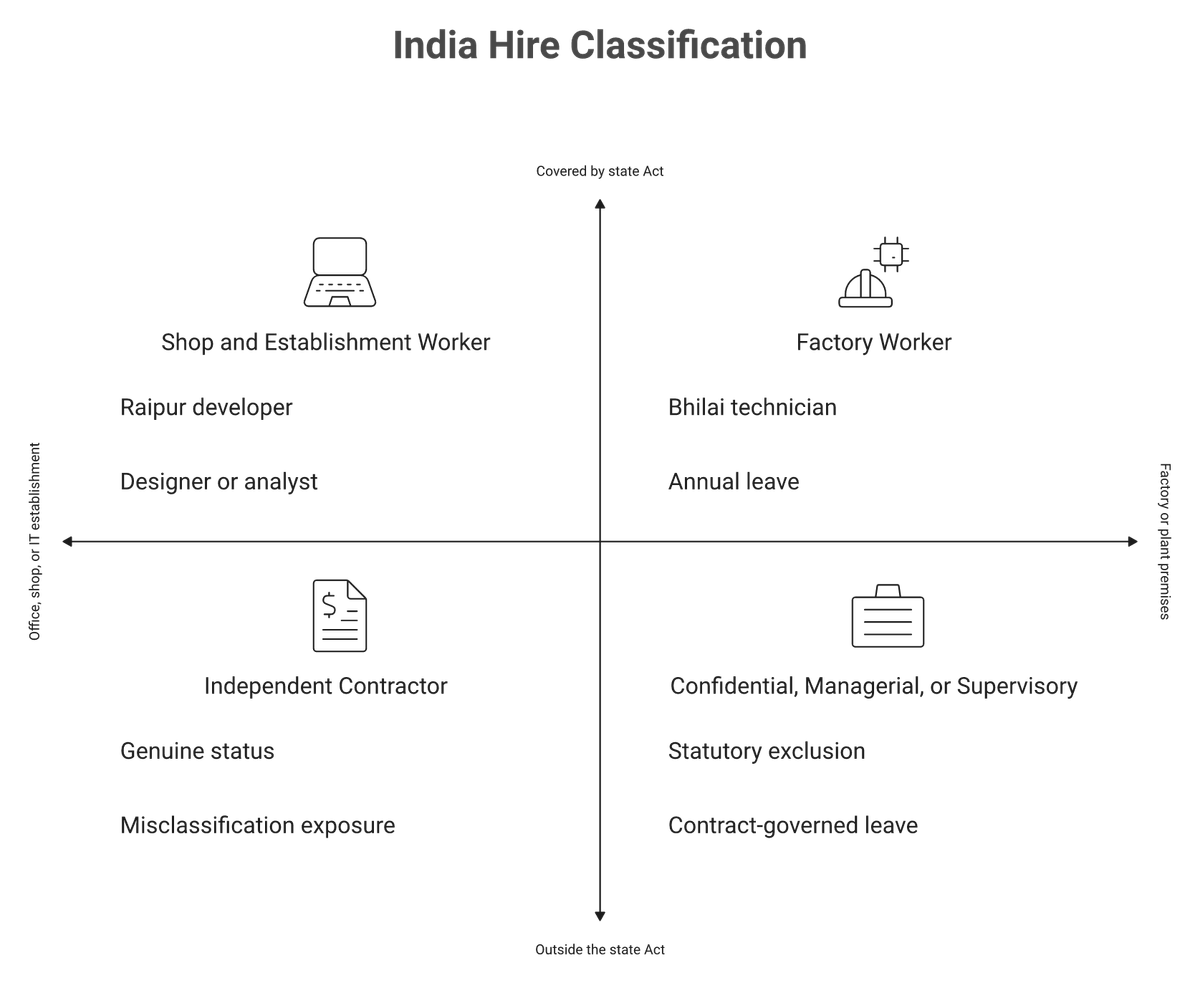
Indian leave law keys off statutory categories, not job titles. A "worker" in a shop, office, or IT establishment falls under the Chhattisgarh Act, 2017. A worker in a factory falls under the Factories Act, 1948. The Chhattisgarh Act does not apply to a worker in a confidential, managerial, or supervisory position, nor to government offices, Reserve Bank offices, hospitals, or a family member of the employer.
⭐ The four buckets that decide everything
Start here, because every later question depends on it.
Shop and establishment worker. Your Raipur developer, designer, or ops analyst. State Act applies.
Factory worker. A Bhilai plant technician. Factories Act, 1948 applies, with its own annual leave provisions.
Confidential, managerial, or supervisory worker. Excluded from the Chhattisgarh Act by Section 3(1)(a). Their leave sits in the contract.
Independent contractor. Not an employee at all, if the arrangement is genuine. This is where misclassification risk lives.
Versatile Club classifies each hire against the applicable state Act and central code before the offer letter is issued, as step one of its 5-day contractual onboarding SLA. The full sequence is documented in how our onboarding works.
⚠️ The exclusion clause people over-read
Founders see "managerial" and assume every senior engineer is exempt. That is not how it works. The test is the actual function, not the designation on LinkedIn.
A tech lead who writes code and has no hiring or disciplinary authority is a worker. Versatile Club's experience across C2H placements in Bengaluru, Hyderabad, and Pune is that inflated titles create the exposure, not senior salaries. Those placements run through our contract-to-hire model.
✅ What "white collar" actually means here
There is no white-collar exemption from leave in Chhattisgarh. There is a working-hours relaxation. Section 8(5)(e) allows prescribed relaxation for highly skilled workers in Information Technology, Bio-Technology, and Research and Development Divisions.
Read that carefully. It touches hours and rest, not leave entitlement. Your IT team still gets the eight casual leave days and the 1:20 earned leave accrual.
💸 The contractor shortcut, and what it costs
The most common structure I see on a first India hire is a monthly invoice from an individual. No PF, no ESI, no leave register. It works until someone asks who controlled the working hours.
Jason Fried's line about hiring remotely fits here. You are "kinda running with scissors" without proper structure, and plenty of companies do it anyway. My honest position is that it is survivable for a three-month trial and reckless at month eighteen. The trade-offs are set out in our comparison of independent contractor versus EOR.
Versatile Club employs the person on its own registered entity, so PF, ESI, TDS, and professional tax filings sit under Versatile's own registrations rather than a partner shell.
⏰ The Monday test
Open your India roster. For each name, write the bucket and the governing statute in two columns. If you cannot fill a row in under thirty seconds, that is the person your next audit will ask about.
Q3. Which central laws stack on top of the Chhattisgarh state Act?
Versatile Club maps every India hire against both layers, because the state Act sets a floor and central law overrides it where central law is more favourable. The Chhattisgarh Act itself preserves this: nothing in it adversely affects any right or privilege a worker has under any other law, award, agreement, contract, custom, or usage. Whichever rule is better for the employee wins.
⭐ The stack, in order
| Layer | Instrument | What it controls for leave |
| State floor | Chhattisgarh Act No. 21 of 2018 | Casual leave, earned leave accrual, accumulation, weekly holiday, festival holidays |
| Central overlay | OSH and Working Conditions Code, 2020 | Annual leave eligibility at 180 days, carry-forward cap, annual encashment of excess |
| Sector-specific | Factories Act, 1948, Sections 79 and 80 | Annual leave with wages and the wage rate for leave, for factory workers |
| Non-negotiable central | Maternity Benefit Act, 1961 (as amended) | 26 weeks maternity benefit, plus illness leave |
| Non-negotiable central | POSH Act, 2013 | Internal Committee, and up to three months paid leave during inquiry |
| Non-negotiable central | Representation of the People Act, Section 135B | Paid holiday to vote on polling day |
⚠️ The overlay that changes your HRMS
The four labour codes were brought into force on 21 November 2025. Under the OSH Code, annual leave eligibility drops from 240 days to 180 days, accrual stays at one day per twenty, carry-forward is capped at thirty days, and the excess must be encashed annually.
So Chhattisgarh says forty-five days accumulation, and the central code says thirty with encashment. Configure the employee-favourable outcome and document why.
✅ What never depends on the state
POSH applies at ten or more employees, wherever they sit. Maternity benefit applies regardless of whether your headcount crosses the state Act threshold.
Versatile Club sets up the POSH Internal Committee and handles Maternity Benefit administration as part of its standard EOR scope, alongside PF at 12% of Basic plus DA and gratuity accrued at 4.81%. The same statutory scope sits behind our managed payroll service.
💬 What buyers say about the overlay problem
"Wisemonk addresses the hassle of managing employees, tracking time, and running payroll across multiple tools by bringing everything together in a single system. For me, that means I save time, make fewer mistakes."
— Vinay M., Verified User Wisemonk - G2 Verified Review, 18 February 2026
"requesting HR documents via form didn't work, and I can't request vacations because it doesn't work either with partial parental leave."
— Daryna R., Verified User Deel - G2 Verified Review, 6 May 2024
That second review is the failure mode I watch for. Statutory maternity and parental leave are exactly where a globally templated leave module breaks. It is one of the recurring themes in our roundup of Deel alternatives in India.
⏰ The practical implication
Build one table with four columns: statute, entitlement, who it covers, and the field in your HRMS that enforces it. Any row without a mapped field is a row you are not actually complying with.
Versatile Club sends the filed challan numbers and TDS deposit receipts with each monthly USD invoice, so the overlay is evidenced monthly rather than asserted once a year.
Q4. What leave types must you actually grant in Chhattisgarh, and what is optional?
Chhattisgarh employers owe five statutory items: a weekly holiday with wages, eight days casual leave credited quarterly, earned leave at one day per twenty days worked, eight paid festival holidays including Independence Day, Republic Day, and Gandhi Jayanti, and maternity benefit under central law. The Act does not prescribe a separate sick leave quantum.
⭐ The statutory floor
| Leave type | Entitlement | Carry-forward | Statutory source |
| Weekly holiday | At least 24 consecutive hours of rest | Compensatory leave within 2 months if denied | Act No. 21 of 2018, Sections 10 and 11 |
| Casual leave | 8 days per calendar year, credited quarterly | Not provided | Act No. 21 of 2018, Section 11(2) |
| Earned leave | 1 day per 20 days worked, after 240 days | Up to 45 days (30 under the OSH Code) | Act No. 21 of 2018, Section 11(3) and (4) |
| Festival holidays | 8 paid days, 3 fixed and 5 agreed in advance | Not applicable | Act No. 21 of 2018, Section 11(6) |
| Maternity benefit | 26 weeks, plus 1 month for related illness | Not applicable | Maternity Benefit Act, 1961 |
Two details get missed. Leave taken under the earned leave provision is exclusive of all holidays, whether they fall during or at either end of the leave. And the five non-fixed festival holidays must be agreed with workers before the year begins.
⚠️ The sick leave question, answered honestly
The Chhattisgarh Act heads Section 11 as "Annual, casual and sick leave and other holidays." It then prescribes casual leave and earned leave, and does not set a sick leave number.
So the seven, ten, and twelve day figures you see published are employer practice, not statute. Insured employees have a separate ESIC sickness benefit route. Versatile Club configures sick leave as a contractual benefit and labels it that way in the handbook, because calling policy "statutory" creates a promise you cannot later reduce.
✅ What US and UK buyers usually add
Sick leave, commonly 7 to 12 days
Paternity leave, typically 5 to 15 days
Bereavement leave
Compensatory off for weekly holidays worked
None of these are required in Chhattisgarh. All of them are expected by candidates in Raipur who have offers from Bengaluru employers. If you are benchmarking the total package, our breakdown of the cost of hiring in India covers the numbers.
💬 What breaks in practice
"The way annual leave is recorded is strange, it automatically logs weekend days, so this has incorrectly logged my leave. There is no way to edit so I have had to reach out to support for the leave to be deleted."
— Verified User in Non-Profit Organization Management Pebl (formerly Velocity Global) - G2 Verified Review, 30 April 2026
That is the holidays-exclusive rule failing inside software. It is a configuration defect with a statutory consequence, and it shows up often in our review of Velocity Global alternatives in India.
"PF, tax, the statutory filings, all the stuff I genuinely did not want to learn, they just handle it and keep it correct every month."
— Angad S., Founder at Moonshot Versatile Club G2 - Verified Review, 21 June 2026
💰 My honest hedge
Versatile Club's data points toward generosity being cheaper than it looks, since the statutory floor here is genuinely low. I might be reading that too strongly for capital-constrained teams.
Versatile Club configures the state floor first and the client's global policy second, so a generous US policy never accidentally sits below a Chhattisgarh statutory minimum. If you want that mapped against your current setup, send us your leave policy and we will mark the gaps.
Q5. How do you calculate earned leave, the 240-day and 180-day thresholds, and half-day rounding?
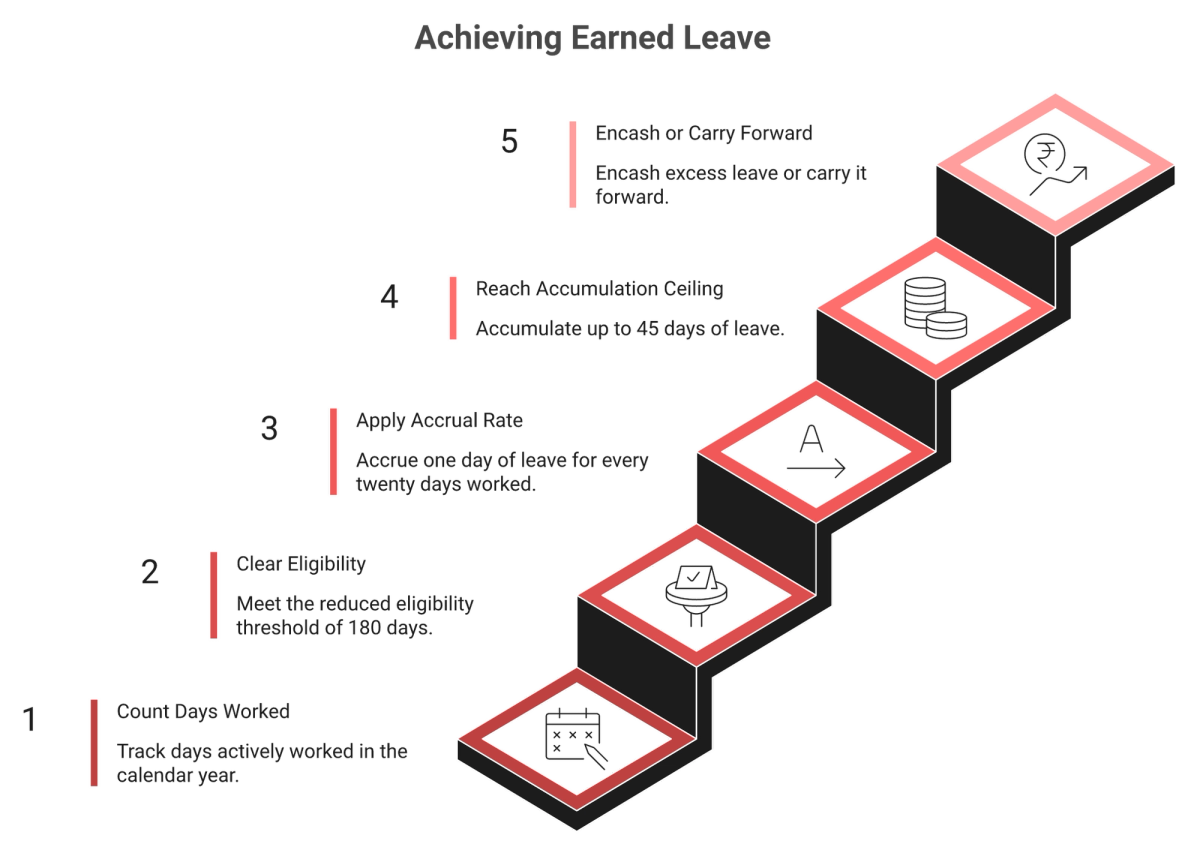
Versatile Club configures earned leave in two steps: a threshold test, then an accrual rate. Under the Chhattisgarh Act, a worker who has worked 240 days or more in a calendar year earns leave with wages in the following year at one day for every twenty days worked. The OSH Code, in force since 21 November 2025, lowers the eligibility threshold to 180 days. Accumulation is capped at forty-five days under the state Act.
A CFO once sent me her India leave register at 11pm her time. Every engineer showed a flat "18 days annual leave" balance. Nobody had computed days worked. The register looked tidy and proved nothing.
⭐ The four days that count but do not earn
This is the part almost no guide explains. Section 11(7) says certain days are deemed to be days worked for computing the 240 days, but shall not earn leave for those days.
Any day of lay-off by agreement, contract, or certified standing orders
Maternity leave taken under the Maternity Benefit Act, 1961
Leave earned in the year prior to the year it is availed
Absence due to temporary disablement from an employment injury
Versatile Club runs this as two separate counters per employee, one for threshold eligibility and one for accrual, because a single counter silently overpays. The same counter logic sits inside our India payroll compliance process.
⏰ A worked example
Take a Raipur developer who joined in March 2026 and worked 200 days that year.
Under the state Act's 240-day test, she would not qualify for 2027 earned leave
Under the OSH Code's 180-day test, she qualifies
Accrual at 1:20 on 200 days gives 10 days of earned leave for 2027
Her 8 casual leave days still apply in 2026, credited quarterly
Versatile Club applies the employee-favourable threshold and records the reason in the payroll file, since the state has notified none of its four labour code rule sets yet. If you want the cost of that hire modelled first, run it through the India salary calculator.
✅ Rounding, and the holiday rule
The Factories Act computation convention treats a fraction of half a day or more as one full day, and ignores anything less. I apply the same convention to shops and establishments, because no contrary rule exists in the state Act.
The bigger miss is Section 11(8). Leave admissible under the accrual provision is exclusive of all holidays, whether occurring during or at either end of the period of leave. If your system deducts the Sunday in the middle of a week off, it is deducting leave the worker never took.
💬 What operators report
"The initial documentation and paperwork felt quite detailed and time-consuming at the beginning. However, as we progressed, it became clear that this thoroughness is what ensures proper legal and compliance coverage."
— Verified User in Marketing and Advertising, Verified User Wisemonk - G2 Verified Review, 12 February 2026
"Often the CS doesn't seem to have answers, which leads me to emails back and forth on my case which don't always answer the question and something I was looking for the answer to in 20 minutes becomes a 4 day process."
— Verified User in Computer Software, Verified User Deel - G2 Verified Review, 16 September 2024
💰 Where my head is on the threshold gap
Versatile Club's read is that most employers will quietly keep the 240-day test because their software still enforces it. I think that is the wrong default. The gap only shows up for mid-year joiners, which is exactly who a fast-scaling team hires.
Versatile Club recalculates both counters every month and shows the days-worked figure on the payroll summary, so the accrual is auditable line by line rather than asserted as a balance. That reporting ships with our managed payroll service.
Q6. What does leave encashment cost you, and how does the 50% wage rule inflate it?
Versatile Club treats leave encashment as a monthly accrual, not an exit event. The Chhattisgarh Act creates the right in two places. Where the employer refuses leave applied for fifteen days in advance, the worker may encash the leave. On retirement, resignation, death, or permanent disability, the employer shall pay full wages for the period of leave due.
⭐ The three triggers, priced
| Trigger | Statutory basis | What it costs |
| Leave refused after 15 days' notice | Act No. 21 of 2018, Section 11(5) | Encashment of the leave refused |
| Discharge before leave is allowed, or quitting after refusal | Section 11(5) proviso | Wages for leave due |
| Retirement, resignation, death, permanent disability | Section 11(5) proviso | Full wages for leave due |
Versatile Club processes full and final settlement covering notice, leave encashment, gratuity, and PF as one line-itemised USD invoice, so the exit number is known before the employee leaves. The invoice format is set out on our pricing page.
⚠️ Why the 50% rule changes the math
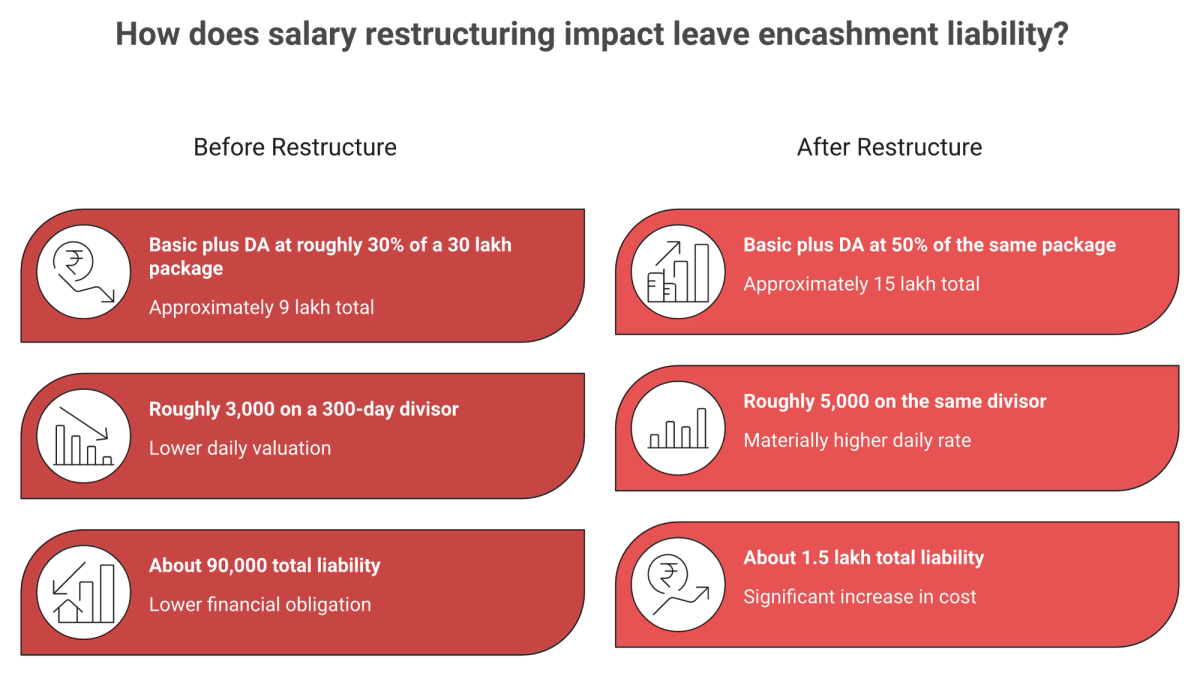
Encashment is priced on Basic plus dearness allowance, not on total cost to company. Under the Code on Wages, Basic plus DA must be at least 50% of remuneration.
Restructure a salary to comply, and the per-day encashment rate rises on an unchanged headline CTC. Versatile Club structures every India offer to the 50% split at the point of hire, which surfaces the liability on day one instead of at exit.
💸 The number a CFO should hold
Consider an engineer at 30 lakh CTC. Before restructuring, Basic plus DA at 30% gives 9 lakh, so roughly 3,000 per day on a 300-day divisor.
Take Basic plus DA to 50%, and that becomes 15 lakh, or roughly 5,000 per day. Thirty accumulated days move from about 90,000 to about 1.5 lakh. Same salary, sixty-six percent more liability. Our breakdown of the cost of hiring in India carries the full loaded-cost math.
✅ The carry-forward conflict to resolve now
The state Act caps accumulation at forty-five days. The OSH Code caps carry-forward at thirty days and requires annual encashment of the excess.
That is not a loophole. It converts a dormant balance-sheet item into an annual cash outflow. Versatile Club flags the higher-benefit outcome in writing for each client rather than picking the cheaper reading.
💬 What buyers say about cost surprises
"I find Deel to be absurdly expensive. They charge a high amount of fees for transferring money to my bank account."
— Juan Camilo O., Verified User Deel - G2 Verified Review, 27 November 2025
"First USD invoice landed clean: no FX markup, no setup fee, no surprises."
— Verified User in Information Technology and Services, Founder Versatile Club G2 - Verified Review, 23 June 2026
⏰ What to do on Monday
Pull every India employee's accumulated leave balance. Multiply by the post-restructure daily rate. Book it.
I could be too conservative here, but I would rather see the accrual sitting on the balance sheet monthly than discovered during a funding diligence. Versatile Club's client engagements show that exit disputes almost always start with a leave balance nobody reconciled, not with a compliance failure.
Versatile Club sends the filed PF and ESI challans plus TDS receipts every month, which is what lets a controller tie the leave accrual to actual statutory filings at close. If you are weighing this against running your own entity, the EOR versus entity calculator prices both paths.
Q7. What must you register, record, and prove, from the 20-worker threshold to a labour inspection?
Versatile Club holds Shops and Establishments registrations under its own Indian entity across all 28 states and 8 union territories. The Chhattisgarh Act requires every covered establishment to apply for registration within six months and obtain a Labour Identification Number, maintain registers and records, and file an annual return. Contravention attracts a fine up to two lakh rupees, plus two thousand rupees for every day it continues.
⭐ Applicability, before and after July 2026
The Act as enacted applies to shops and establishments employing ten or more workers. The 2026 amendment raised that to twenty workers, with effect from 8 July 2026, and also moved daily hours to ten, spread-over to twelve, and the quarterly overtime cap to 144 hours.
Dropping below twenty removes the state Act. It does not remove the OSH Code, POSH, maternity benefit, or your contract. Versatile Club records headcount on the date an establishment crosses a threshold, because that date is what an inspector asks for. The state-by-state map behind that sits on our compliance page.
⚠️ The LIN detail people miss
Establishments already registered under the ESI Act, 1948 or the EPF Act, 1952 are deemed registered, but must still obtain a Labour Identification Number within six months. A 2026 rules amendment substituted Form-2 and moved certificate issue online within twenty-four hours.
So "we have a PF code" is not an answer. Versatile Club keeps the LIN, the PF registration, and the ESIC code under one entity, which is why a client never chases three separate registration certificates. That is the practical difference when you hire in India without an entity.
✅ The records that actually get inspected
Register of wages, attendance, and leave, under Section 18
Annual return in the prescribed form, under Section 19
Written notice of shift hours to all workers, sent to the Facilitator
Compensatory leave records where a weekly holiday was denied
A Facilitator may enter, examine any person on the premises, and search, seize, or take copies of any register, record of wages, or notices relevant to a suspected offence. Inspections run off a web-based inspection schedule, so the visit is not random.
💬 What slow registration feels like
"It took three months to onboard our first 3 individuals. They didn't seem to be able to navigate Visas or variations to employment contracts and this constantly created issues so we had to make a decision to change providers."
— Verified User in Information Technology and Services, Verified User Deel - G2 Verified Review, 13 December 2024
"Sometimes the email communication from the wisemonk team is delayed by a day or 2. But overall they seem to be the best for India."
— Bulbul G., Verified User Wisemonk - G2 Verified Review, 19 February 2025
"Five-day onboarding, zero late payslips."
— Vedant T., Founder at a digital marketing agency Versatile Club G2 - Verified Review, 16 June 2026
💰 My honest view on registers
The category treats registers as hygiene. Versatile Club's read is that they are the single cheapest insurance in India compliance, because they are the only proof that your generous leave policy was actually delivered.
Versatile Club's 5-day contractual onboarding SLA includes statutory registration for the employee on day four, which is the step most delays trace back to. The day-by-day sequence is published under how it works.
Q8. Is unlimited PTO legal, or wise, for an India team in Raipur?
Unlimited paid time off does not discharge an Indian statutory duty. Versatile Club configures a tracked statutory floor first, then layers discretionary leave on top. The Chhattisgarh Act requires eight days casual leave credited into the worker's account on a quarterly basis, accrual records, accumulation capped at forty-five days, and maintenance of registers and records. An untracked policy cannot produce those records.
⭐ What the statute forces you to count
A US founder told me last year that her India team was "on the same unlimited policy as San Francisco." Reasonable instinct. Legally incomplete.
You still have to credit casual leave quarterly, compute days worked for the accrual threshold, cap accumulation, and hold the register. Versatile Club runs a tracked ledger for every India employee even where the client's global policy is uncapped, because the ledger is the audit artefact.
⚠️ The part that is about people, not law
Here is the contrarian half. Reed Hastings, who removed Netflix's vacation policy, wrote that not allotting vacation days risks creating conditions "where no one dares to take a day off work," wrapped up as a perk.
His second point is sharper. If you are not allotted vacation, you do not fear losing it, so you are less likely to take any. Use it or lose it sounds like a limit and functions as permission.
✅ Why this hits harder in India
Craig Storti records an American manager whose Delhi colleague asked permission over instant message every time he wanted a dinner break, explaining, "because I'm your subordinate." I have watched versions of that on client calls for six years.
Hand that person an unlimited policy and you have handed them nothing. Versatile Club's 90-day Success Coach checks leave usage in the first quarter, because an employee who has taken zero days by day sixty is an attrition signal. That coaching sits inside our recruitment and placement process.
💸 The real remote risk
Jason Fried's line stays with me. A manager's instinct is to worry that people working from home will do too little, when the actual risk is that too much gets done.
That is the failure mode in Raipur and Bhilai. Not idleness. Quiet overwork that surfaces as a resignation in month seven.
⏰ What I would actually implement
Credit the statutory floor and track it, no exceptions
Add discretionary leave above the floor, labelled discretionary in the handbook
Publish your own leave in the team calendar, so juniors see it is real
Review balances at ninety days, not at year end
Versatile Club's data points toward modelled leave-taking mattering more than the policy wording, though I might be reading a small sample too strongly.
💰 Where my head is on this
Compliance is the floor, not the ceiling. A legally perfect policy that nobody uses is still a retention problem, and retention is what actually costs a Series A team six months of runway.
Versatile Club pairs the tracked statutory ledger with a 6-month replacement guarantee on C2H placements, which is the only version of this I am willing to put in a contract. The structure is explained on our contract-to-hire page.
Q9. How do you run one leave policy across Chhattisgarh, Karnataka, and Maharashtra?
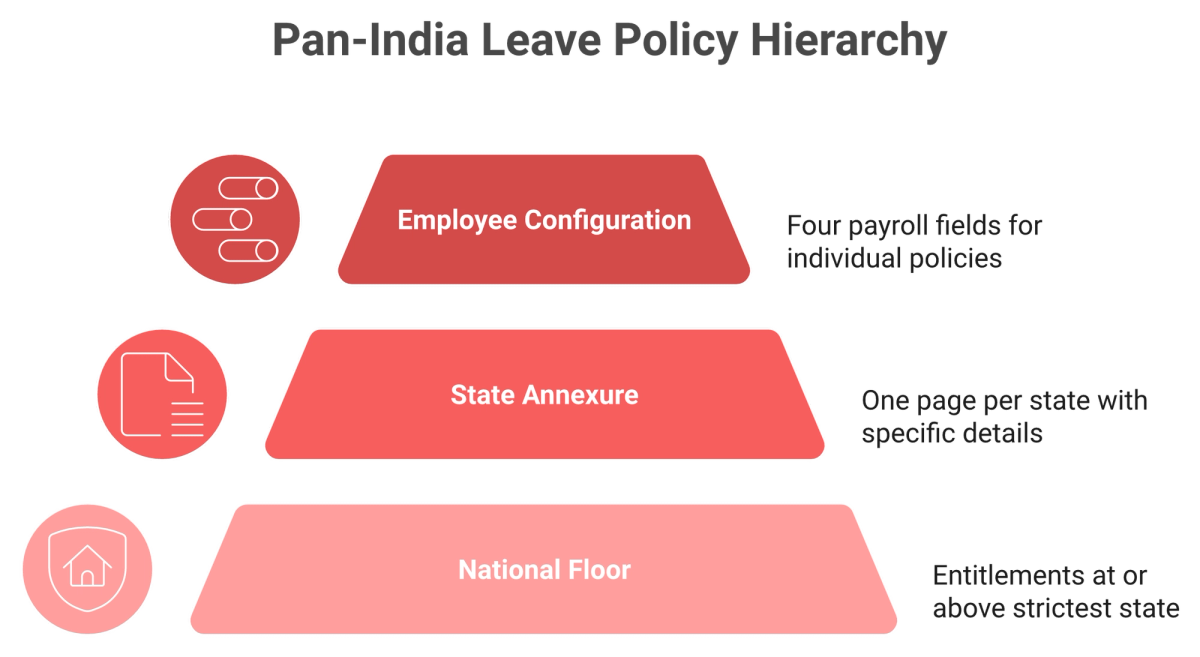
Versatile Club builds pan-India leave policies in three layers: one national floor set at or above the strictest state, a one-page annexure per state, and per-state configuration fields inside payroll. Chhattisgarh's floor is eight days casual leave credited quarterly, earned leave at one day per twenty days worked, and accumulation up to forty-five days. Averaging state rules breaches the strictest one.
⭐ Why averaging fails
A People Ops lead showed me a single "India leave policy" covering Raipur, Bengaluru, and Pune. It carried one number for earned leave, one carry-forward cap, one credit frequency. Three states, one row.
The problem is not generosity. It is proof. Versatile Club holds Shops and Establishments registrations in all 28 states and 8 union territories, and in our filings each state asks for its own accrual basis, not a blended one. The full statutory map sits on our India compliance page.
✅ The three-layer build
National floor. Set entitlements at or above the most generous state you employ in. This is your handbook.
State annexure. One page per state covering credit frequency, accrual basis, accumulation cap, encashment trigger, and holiday count.
Config fields. Four fields per employee in payroll: state, credit frequency, accrual rule, carry-forward cap.
Versatile Club runs those four fields per employee, which is how a Raipur hire and a Pune hire sit on one policy without sharing one rule. That configuration is part of our payroll outsourcing services in India.
⚠️ Where states actually diverge
| Field | Chhattisgarh | What varies elsewhere |
| Casual leave credit | Quarterly, 8 days | Annual credit in several states |
| Earned leave accrual | 1 day per 20 days worked | Flat annual grants in some states |
| Accumulation cap | 45 days | Commonly 30 to 90 days |
| Professional tax cycle | State schedule | Maharashtra PTRC and PTEC, Karnataka monthly, Tamil Nadu biannual |
The professional tax column matters because it is the same operational muscle. Versatile Club runs Maharashtra's dual PTRC and PTEC registrations, Karnataka's monthly cycle, and Tamil Nadu's biannual filing from one entity, and leave configuration sits on that same state map.
💬 What multi-state buyers report
"Deel treats all users as if they were individual freelancers, even when you're clearly operating as a registered company... Deel's one-size-fits-all approach creates unnecessary friction and risk."
— Verified User in Translation and Localization, Verified User Deel - G2 Verified Review, 5 May 2025
"I've noticed that their support/query responses can occasionally take a bit longer sometimes, likely due to a relatively small team."
— Verified User in Financial Services, Verified User Wisemonk - G2 Verified Review, 14 June 2025
"The team is really competent, but there were a few time zone misunderstandings that caused slight delays in the initial phase."
— Setu C., Verified User Versatile Club G2 - Verified Review, 10 June 2026
That last one is ours, and it is fair. Time zones are the friction we still work on.
⏰ The review cadence I use
Quarterly, check for state commencement and amendment notifications. Annually, confirm the state holiday list and file the annual return. Monthly, reconcile accrual against days worked.
Versatile Club's client engagements show that policy drift starts with holidays, not entitlements, because holiday lists change every single year.
Versatile Club sends one monthly USD invoice per employee with gross, deductions, and net, which is what lets a CFO reconcile four states in one close instead of four vendor statements. The service scope behind that invoice is set out under EOR services in India.
Q10. Who should own Chhattisgarh leave compliance, an India-native EOR, a global platform, or your own entity?
Versatile Club employs India staff on its own registered Indian entity, with PF, ESIC, and Shops and Establishments registrations across all 28 states and 8 union territories, priced at $149 per employee per month with no setup or exit fee and the first month free. Three ownership models exist for a Chhattisgarh hire: an India-native EOR, a global EOR platform, or your own Indian subsidiary. Each carries a different compliance depth and a different cost floor.
⭐ The honest comparison
| Criterion | Versatile Club | Wisemonk | Deel | Remote | Multiplier |
| India entity | Own entity | Own entity | Local partner | Local partner | Local partner |
| States covered | All 28 | All 28 claimed | Top 6 | Top 4 | All 28 claimed |
| Monthly per employee | $149 | $99 to $399 | $599 | $599 | $400 |
| Onboarding commitment | 5 days, contractual | 24 to 72 hours | 7 to 14 days | 10 to 14 days | 7 days |
| Setup and exit fee | None | None disclosed | Setup applies | Setup applies | None |
| Support model | Founder on WhatsApp | Named HR manager | Chatbot first | Ticket queue | CSM email |
✅ Wisemonk is genuinely India-native and carries SOC 2 Type II plus ISO 27001. ✅ It holds 4.8 out of 5 on G2 across 261 or more reviews. ❌ Its published stack carries no replacement guarantee and no structured 90-day success programme. ✅ Deel and Remote give you 90 to 150 countries from one contract. ❌ Their India operations typically route through local partner entities, which is the layer that thins at state level. The side-by-side detail sits in our Wisemonk alternative breakdown.
⚠️ When an EOR is the wrong answer
Versatile Club operates only in India by design. If you need five or more countries on one contract, a global platform is the correct buy, and I will say so on the call.
Two more honest exclusions. Enterprise procurement that requires SOC 2 or ISO 27001 as a gate, and B2C consumer hiring at volume. Versatile Club's EOR service launched in 2026 on infrastructure already tested through six years of C2H placements, and I am not claiming a decade of EOR-specific track record. Our fit for scaling teams is described under EOR for startups.
💰 The subsidiary question
Setting up your own Indian entity costs real money and real months before the first hire. Versatile Club's client engagements show founders reaching for it far too early, usually at three India employees.
Where my head is right now is that the entity decision belongs at a long-horizon headcount commitment, not at headcount five. If you want the two paths priced against each other, our comparison of EOR versus entity in India runs the numbers.
💬 What buyers actually value
"Founder is just a call away. Extremely helpful in resolving all our queries. The process is super smooth to setup India EOR."
— surbhi m., Verified User Versatile Club G2 - Verified Review, 15 June 2026
"My onboarding took 28 days. We have started on October 4th and today is November 1st."
— İbrahim, Verified User Deel - G2 Verified Review, 1 November 2024
"The initial process took a little getting used to, but the team was quick to guide us through and it became very straightforward."
— Verified User in Venture Capital & Private Equity, Verified User Versatile Club G2 - Verified Review, 22 June 2026
⏰ How I would decide
One India hire, no entity, needs leave and payroll correct in Chhattisgarh. Take an India-native EOR. Twenty hires across four countries. Take a global platform, or split vendors.
Versatile Club pairs the owned entity with a 6-month replacement guarantee and a 90-day Success Coach on C2H placements, which is the part compliance-first providers do not price. The mechanics are on our contract-to-hire page.
Q11. What changes next, and what should you not hard-code yet?
Chhattisgarh has notified none of its four labour code rule sets. Draft rules under the Code on Wages, the Industrial Relations Code, the Code on Social Security, and the OSH Code were published for objections in April 2026, with the window closing around 28 May 2026. The central codes took effect on 21 November 2025, so the substantive rights apply while state procedures remain pending. Versatile Club treats state procedure as a watch item until final notification.
⭐ Configure now versus watch only
| Item | Status | Action |
| OSH Code 180-day eligibility | In force centrally | Configure now |
| 30-day carry-forward and annual encashment | In force centrally | Configure now |
| Basic plus DA at 50% of remuneration | In force centrally | Configure now |
| Chhattisgarh code rules, forms, registers | Draft only | Watch, do not rebuild |
| Chhattisgarh Act No. 21 of 2018 leave rules | In force | Already live |
Versatile Club keeps a per-state gazette watch and updates payroll configuration only on final notification, which avoids rebuilding registers twice in one year.
⚠️ The trap in over-preparing
I have watched a People Ops team rebuild its entire register set against draft rules in another state. The final rules changed two forms and one retention period. They did the work twice.
Draft rules tell you direction, not detail. Versatile Club's read is that the standard advice gets this backwards, telling employers to "prepare for the codes" when the enforceable parts are already live and the pending parts are procedural. The current position is tracked in our India EOR 2026 playbook.
✅ What is already enforceable, and often missed
The state Act itself preserves better rights from other sources. Nothing in it adversely affects any right or privilege a worker holds under any law, award, agreement, contract, custom, or usage.
That clause is doing quiet work right now. It is why the central 180-day threshold can improve on the state 240-day test without a state amendment.
💸 The exposure I actually worry about
Not the codes. The stale policy document. A handbook quoting the repealed 1958 Act is a live problem today, while draft rules are a problem next year.
Versatile Club dates every state policy it maintains, and that date is the first thing a diligence lawyer checks.
⏰ A three-item watchlist
Final Chhattisgarh rules under all four codes, and the forms they prescribe
Any further amendment to Act No. 21 of 2018 after Act No. 11 of 2026
The annual state holiday notification, which changes every year
💰 Where I think this lands
What I think shifts over the next two years is that state rule-making becomes the real compliance surface, not the codes themselves. Thirty-six jurisdictions writing procedure means thirty-six form sets.
Versatile Club's data points toward India-only operators absorbing that better than global platforms, though I might be reading my own position too favourably.
Versatile Club employs on its own entity, so a state rule change lands as our filing problem rather than a new form in your inbox. If you are already on another provider, our guide to switching EOR providers in India covers the transition.
Q12. What are the Chhattisgarh 2026 holidays, and what should you fix on Monday?
Chhattisgarh employers owe eight paid festival holidays in a calendar year, of which Independence Day, Republic Day, and Gandhi Jayanti are fixed, and five are agreed between employer and workers before the year commences. The state separately issues public, general, and optional holiday lists each year through its General Administration Department. Versatile Club loads the state list plus the eight-holiday statutory floor into payroll at onboarding.
⭐ How the two lists work together
The Act sets a floor of eight paid festival days. The state notification sets the calendar that banks and government offices follow.
They are not the same thing. Versatile Club reconciles both for each client, because a private employer in Raipur is bound by the Act's eight days, not by the full government list.
⚠️ The five days you must agree in writing
Three days are fixed by statute. The remaining five must be agreed before the year starts, which almost nobody documents.
Chhattisgarh's optional lists carry state-specific days such as Hareli, Cherchera, and Bastar Dussehra. These are the days your Raipur team will actually ask for. Versatile Club collects the agreed five in writing during January payroll setup.
✅ The statutory anchor
| Item | Position under the Act |
| Independence Day | Fixed paid festival holiday |
| Republic Day | Fixed paid festival holiday |
| Gandhi Jayanti | Fixed paid festival holiday |
| Five further festival days | Agreed with workers before the year commences |
| Weekly holiday | At least 24 consecutive hours of rest |
Confirm your specific dates against the current General Administration Department notification before publishing a calendar, since the list is reissued annually.
⏰ The Monday checklist
Reset the leave master to 8 days casual leave credited quarterly, and earned leave at 1 day per 20 days worked
Change annual leave eligibility from 240 days to 180 days
Configure carry-forward at 30 days with annual encashment of the excess
Record headcount against the 20-worker threshold and the date you crossed it
Refresh the Labour Identification Number using the substituted Form-2
Calendar the annual return, and the quarterly gazette check
Agree and document the five non-fixed festival holidays
Versatile Club runs this same list for every new India entity it takes on, and item four is the one clients have never recorded. The onboarding sequence is published under how it works.
💰 What I would not do
Do not publish a holiday calendar copied from another state. Do not treat the government list as your obligation.
Versatile Club's client engagements show holiday disputes outnumbering leave-accrual disputes, usually because the five agreed days were never written down.
✅ One last thought
Compliance here is genuinely cheap to get right and expensive to discover late. Seven items, one afternoon, and your Chhattisgarh policy is current as of September 2026.
Versatile Club sends the filed challans and TDS receipts monthly, so if you want to compare your current setup against a live one, message me on WhatsApp and I will tell you which two items on that list actually matter for your headcount.
FAQs
How many leaves are mandatory in Chhattisgarh in 2026?
The Chhattisgarh Shops and Establishments (Regulation of Employment and Conditions of Service) Act, 2017 sets the floor. It is not a single annual number, which is where most policies go wrong.
- Casual leave: 8 days per calendar year, credited into the worker's account quarterly
- Earned leave: one day for every twenty days worked, after crossing the qualifying threshold
- Accumulation: earned leave can build up to a maximum of 45 days
- Festival holidays: 8 paid days, of which Independence Day, Republic Day, and Gandhi Jayanti are fixed
- Weekly holiday: at least 24 consecutive hours of rest, with compensatory leave if denied
Separately, the Occupational Safety, Health and Working Conditions Code, 2020 lowered annual leave eligibility from 240 days to 180 days and capped carry-forward at 30 days with mandatory annual encashment above that. Where the state Act and the central code differ, the employee-favourable outcome applies.
Versatile Club configures this as two counters per employee, one for eligibility and one for accrual, because a single flat balance silently overpays or underpays. If you want the same statutory floor applied to your India team without setting up an entity, that is what our EOR services in India handle from day one.
Is the Chhattisgarh Shops and Establishments Act, 1958 still in force?
No. The 1958 Act has been repealed. Section 30 of the Chhattisgarh Shops and Establishments (Regulation of Employment and Conditions of Service) Act, 2017 expressly repeals it, and the 2017 Act was brought into force by state notification dated 13 February 2025.
This matters more than it sounds. The widely published figures of 30 days privilege leave, 14 days casual leave, and a 90-day carry-forward cap came from the repealed statute. They still appear in compliance blogs, HR wikis, and state-hub pages that rank on page one.
Three documents usually carry the stale numbers:
- The India offer letter template
- The employee handbook or leave policy PDF
- The leave master configured inside the HRMS
Fix the offer letter first, because that is the document a lawyer reads during diligence or a dispute. Then add a verification line naming the statute and the date you checked it.
Versatile Club tracks state commencement and amendment notifications across all 28 states and 8 union territories, which is how a repeal like this reaches a client as a policy update rather than an audit finding. Our approach to state-level statutory tracking is set out on the Versatile Club compliance page.
Is sick leave mandatory for employees in Chhattisgarh?
Not as a prescribed quantum. Section 11 of the Chhattisgarh Act, 2017 is headed "Annual, casual and sick leave and other holidays," but the operative provisions prescribe only casual leave and earned leave. No separate sick leave figure is set.
So the seven, ten, and twelve day numbers circulating online are employer practice, not statute. Two things fill the gap in real operations:
- ESIC sickness benefit for employees covered under the Employees' State Insurance Act, 1948
- Contractual sick leave offered by the employer as a market-competitive benefit
Our advice is to label it accurately in the handbook. Calling a discretionary benefit "statutory" creates a promise you cannot later reduce without a dispute, and it confuses the register during an inspection.
Candidates in Raipur and Bhilai who also hold Bengaluru offers will still expect 7 to 12 sick days, plus paternity and bereavement leave. Those are retention decisions, not compliance decisions, and they should be priced that way.
Versatile Club configures sick leave as a contractual benefit and keeps it separate from the statutory ledger in payroll. If you are benchmarking the full package before you commit, our breakdown of the cost of hiring in India carries the loaded-cost numbers.
How much earned leave can be carried forward or encashed in Chhattisgarh?
Under the state Act, earned leave accumulates up to a maximum of 45 days. The Occupational Safety, Health and Working Conditions Code, 2020, live since 21 November 2025, caps carry-forward at 30 days and requires annual encashment of anything above that. Configure the employee-favourable outcome and document the reasoning.
Encashment is triggered in three situations:
- Leave applied for fifteen days in advance and refused by the employer
- Discharge before the leave was allowed, or the worker quitting after a refusal
- Retirement, resignation, death, or permanent disability, where full wages are payable for leave due
The cost driver most finance teams miss is the wage base. Encashment is priced on Basic plus dearness allowance, and the Code on Wages requires Basic plus DA to be at least 50% of remuneration. Restructure a salary to comply and the per-day encashment rate rises sharply on an unchanged headline CTC.
Versatile Club treats leave encashment as a monthly accrual rather than an exit event, and processes full and final settlement covering notice, encashment, gratuity, and PF as one line-itemised USD invoice. The filing evidence that supports that accrual is described under Versatile Club managed payroll.
Does the Chhattisgarh Act apply if we employ fewer than 20 workers?
Generally no, following the 2026 amendment. The Chhattisgarh Shops and Establishments (Amendment) Act, 2025, notified as Act No. 11 of 2026 and gazetted on 8 July 2026, raised applicability from ten or more workers to twenty or more. The same amendment moved daily hours to ten, spread-over to twelve, the quarterly overtime cap to 144 hours, and permitted women to work between 9 pm and 6 am with prescribed safeguards.
Falling below twenty does not make you obligation-free. Still binding are:
- The OSH Code annual leave rules, including the 180-day eligibility threshold
- Maternity benefit under the Maternity Benefit Act, 1961
- POSH Internal Committee obligations at ten or more employees
- The paid holiday to vote on polling day
- Whatever your employment contract promises
Our practical advice is to write the statutory floor into contracts even while exempt. Headcount moves faster than policy documents, and retrofitting entitlements after a dispute is expensive.
Versatile Club records headcount on the exact date an establishment crosses a threshold, because that date is what a Facilitator asks for during an inspection. For teams that would rather not track thresholds at all, the hire in India without an entity route puts the employment on our registrations instead.