Table of contents (12)
Leave Policy in Rajasthan: Types, Rules and Eligibility Explained
Q1. Which law governs leave for your Rajasthan hire, and how are employees categorised?
If your Rajasthan hire works in an office, a software team, or a back office function, the Rajasthan Shops and Commercial Establishments Act, 1958 governs their leave. Manufacturing roles fall under the Factories Act, 1948 as applied to Rajasthan. Central statutes (Maternity Benefit, EPF, ESI, and POSH) apply on top of whichever state Act covers you. Rajasthan government staff follow the Rajasthan Service Rules, 1951 instead.
🧭 The premises decide, not the job title
The 1958 Act defines "employee" as a person wholly or principally employed in connection with any establishment. It then adds a line most readers miss. It also covers clerical or other staff of a factory who fall outside the purview of the Factories Act, 1948.
So a payroll clerk sitting inside a Jaipur factory can sit under the Shops Act, while the machine operator beside him sits under the Factories Act. "Establishment" means a shop or a commercial establishment. Your registration certificate answers this faster than your org chart does.
📄 The three regimes, side by side
| Category | Governing law | Who it typically covers | Where leave comes from |
| Shop or commercial establishment | Rajasthan S&CE Act, 1958 | Offices, software teams, banking, insurance, hotels, back office | Chapter IV, Section 14 |
| Factory worker | Factories Act, 1948 (Rajasthan application) | Manufacturing process roles | Sections 79 and 80 |
| Government servant | Rajasthan Service Rules, 1951 | State government staff | Privilege and casual leave rules |
Central law stacks on top of all three. That means EPF, ESI, gratuity, POSH, and maternity benefit apply regardless of which state Act you fall under.
⚠️ Where copied policies quietly break
Most first India policies I see are inherited, not written. A founder hires in Bengaluru first, then reuses that clause for Jaipur. Karnataka and Rajasthan do not share an accrual rate, and the difference shows up as an employee dispute nine months later.
Versatile Club holds Shops and Establishments and professional tax registrations across all 28 states and 8 union territories, and across those registrations the state variance is not cosmetic. Maharashtra runs dual PTRC and PTEC registration, Karnataka runs a monthly professional tax cycle, and Tamil Nadu files biannually. Rajasthan is its own set of rules again, which is why our India compliance coverage is built state by state.
✅ Your 30 second categorisation check
Pull the registration certificate. Shops and Establishments registration means the 1958 Act.
Factory licence means the Factories Act, Chapter VIII.
Check Section 3. Central and state government offices, Reserve Bank of India offices, and inherently intermittent roles such as travellers are excluded from the 1958 Act.
Check Section 3(2) notifications. Rajasthan has exempted specific classes, including lawyers' offices and doctors' establishments, from named sections.
If your reader is a state government employee, the answer is in Q10, not here.
Versatile Club makes the categorisation call for a Jaipur hire against a registration we hold ourselves, not a partner shell's, which is why the statute cited in the contract matches the statute that governs the premises. That is the same logic behind our EOR services in India.
Q2. What leave is a Rajasthan employee legally entitled to in 2026?
Under Section 14 of the Rajasthan Shops and Commercial Establishments Act, 1958, an employee who has worked 240 days or more in a calendar year is allowed leave with wages in the following calendar year at one day for every twelve days worked, and one day per fifteen for a child worker. Factory workers accrue one day per twenty days worked under Section 79 of the Factories Act, 1948. Carry forward for adults is capped at 30 days.
📋 What the statute actually gives a Rajasthan employee
| Leave or entitlement | Entitlement | Statutory basis | Carry forward |
| Earned leave (offices, software, back office) | 1 day per 12 days worked, after 240 qualifying days | Sec. 14, Rajasthan S&CE Act, 1958 | Up to 30 days (adults) |
| Annual leave (factory roles) | 1 day per 20 days worked, after 240 days | Sec. 79, Factories Act, 1948 | Up to 30 days |
| Casual leave | Not prescribed by statute | No provision in the 1958 Act | Not applicable |
| Sick leave | Not prescribed by statute | No provision; ESI sickness benefit applies to covered employees | Not applicable |
| Weekly holiday | One whole day per week, with no wage deduction | Sec. 12(3) and 12(5) | Not applicable |
| Daily and weekly hours | 10 hours a day, 48 hours a week; overtime at 1.5x; quarterly overtime ceiling 144 hours | Sec. 7 and 8, as amended by Ordinance No. 3 of 2025 | Not applicable |
| Maternity | 26 weeks (12 weeks from the third child), after 80 qualifying days in 12 months | Maternity Benefit Act, as amended 2017 | Not applicable |
🔍 Why the published numbers disagree
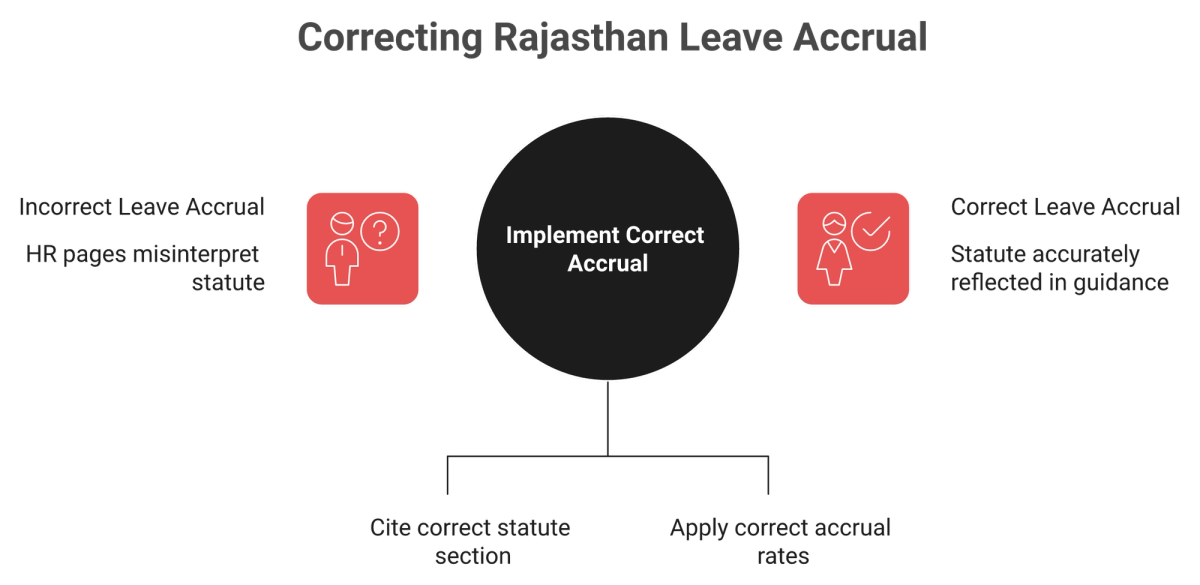
Keka's Rajasthan page publishes 15 days of earned leave on a one per twenty accrual. greytHR publishes 18 days. The incumbent India EOR page publishes 30 days. None of them cites the one per twelve rate that Section 14 actually contains.
The conflation has a source. One day per twenty days is the Factories Act rate, and it gets copied onto Shops Act pages because it reads like a national default. My read is that this is the single most consequential copy paste error in Indian state leave content, and it is the kind of gap our India payroll compliance work exists to close.
🗓️ What changed in December 2025
The Rajasthan Shops and Commercial Establishments (Amendment) Ordinance, 2025 was promulgated on 17 December 2025 and gazetted the next day. It substituted ten hours for nine in Section 7(1), replaced the 50 hour quarterly overtime ceiling with 144 hours, and moved the Section 9 rest interval trigger from five hours to six.
Leave accrual itself was untouched. Hours and overtime were not. If your Rajasthan contract still says nine hours and a 50 hour quarterly cap, it is quoting a superseded section.
✍️ What to put in the offer letter
Section 13 settles the drafting question. Where an award, agreement, or contract provides longer leave with wages than Chapter IV, the employee is entitled to the longer term. So whatever you promise above the statute becomes the enforceable floor.
Write the statutory basis into the clause, then add your company leave as a separately labelled line. Versatile Club runs Rajasthan accrual at the Section 14 rate of one day per twelve days worked, with the statutory reference printed on the employee's own leave statement, so the number and its source travel together. Teams comparing build options can test this against our EOR vs entity calculator.
Q3. How does the 240 day qualifying rule actually work?
The 240 day threshold is not 240 days of physical attendance. Lay off days permitted under the Standing Orders count, maternity leave of up to 12 weeks counts for women employees, and leave earned in the prior year but taken this year counts. In the final computation, a fraction of half a day or more becomes a full day of leave, and anything less is ignored. Versatile Club tracks qualifying days rather than calendar attendance for every India employee on our entity.
🧮 A Jaipur joiner, worked through
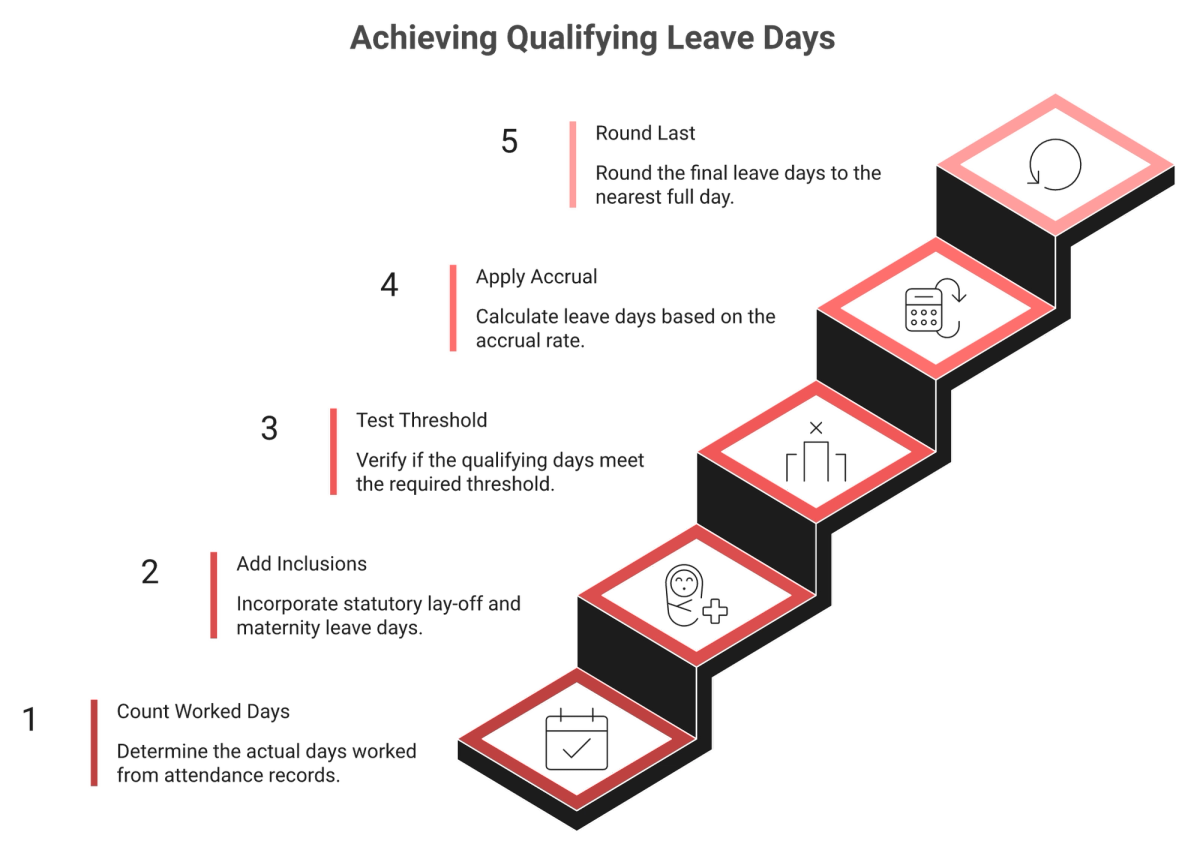
Take an engineer who joins in Jaipur on 1 March 2026 and works to 31 December. Assume 255 working days in that window after weekly holidays, with 9 days of unpaid absence.
Days actually worked: 246
Add: lay off days under Standing Orders, if any (0 here)
Add: prior year earned leave taken in this year (0 for a new joiner)
Qualifying total: 246, which clears 240
Accrual for the next calendar year at one day per twelve: 246 divided by 12, which is 20.5
Rounding under the half day rule: 21 days
Had that engineer landed at 238 qualifying days, the entitlement for the following year would not arise at all under Section 14. Eight days decide the whole year.
⏰ The probation trap nobody prices
Here is the part that bites on exits. An employee who leaves in month seven never crosses 240 days in that calendar year, so the statutory annual leave entitlement for the next year does not vest.
What you still owe is whatever your contract granted, because Section 13 makes a more generous contract enforceable. I have seen full and final settlements go sideways precisely here, where the policy promised pro rata accrual and finance computed statutory zero.
💰 Why HRIS defaults get this wrong
Most payroll systems accrue leave on calendar months. The statute accrues on qualifying days, with named inclusions that a calendar month simply cannot see. Those two models agree for a January joiner and diverge for everyone else.
Versatile Club measures this by reconciling the muster roll against the Section 14 inclusion list each month, rather than reading an accrual figure off a monthly calendar. Across our India payroll cycles, mid year joiners are where the two methods part company most often, and I might be weighting that too heavily from our own book, but it is the error I see repeated most. It is also why we keep accrual inside managed payroll rather than in a separate leave tool.
✅ What to do with this on Monday
Pull your Rajasthan attendance register and count qualifying days, not calendar days.
Add lay off days and up to 12 weeks of maternity leave where applicable.
Apply the half day rounding rule at the end, not mid calculation.
Flag every employee sitting between 230 and 245 qualifying days for review before 31 December.
Versatile Club recomputes the qualifying day count before each December close, which is why a Rajasthan hire who joined in March still carries the correct opening balance in January. Founders making a first India hire can see that sequence in how it works.
Q4. Are casual leave and sick leave legally mandatory in Rajasthan?
No. The Rajasthan Shops and Commercial Establishments Act, 1958 prescribes annual leave with wages in Chapter IV and contains no casual leave or sick leave entitlement. The seven plus seven figures on HR compliance pages are market practice, not law. Once casual or sick leave is written into an appointment letter or HR policy, Section 13 makes it enforceable at exactly the level promised.
🧩 Why the myth is so durable
Templated state pages need every row filled. So a national average gets dropped into a Rajasthan column, and 7 days of casual leave plus 7 days of sick leave appears as though a section number sits behind it. Keka's Rajasthan page lists both.
I understand the instinct. A blank cell looks like missing research. But Chapter IV of the 1958 Act is short, and casual leave is not in it.
⚠️ The cost of a number you cannot sustain
Promising 12 sick days because a competitor's careers page says 12 is how policies become liabilities. There is no statutory ceiling protecting you, and Section 13 removes the argument that the statute caps your exposure.
For employees within the ESI wage ceiling, sickness benefit is already a funded statutory channel, paid as a percentage of wages for certified sickness. Designing your own sick leave without accounting for that duplicates cost you have already paid, a trade off worth modelling before you publish a policy alongside your cost of hiring in India assumptions.
💬 What buyers say about policy clarity
"As a founder running a lean agency, hiring talent in India without a local entity was a compliance minefield PF, ESI, TDS, professional tax across states. Versatile's Employer of Record India setup eliminated all of that. I get a single USD invoice, fully compliant employment contracts, and payroll runs on time every month."
— Vedant T., Founder Versatile Club G2 - Verified Review
"The initial documentation and paperwork felt quite detailed and time-consuming at the beginning. However, as we progressed, it became clear that this thoroughness is what ensures proper legal and compliance coverage, so while it feels heavy upfront, it pays off later."
— Verified User in Marketing and Advertising, Marketing Leader Wisemonk - G2 Verified Review
"The way annual leave is recorded is strange, it automatically logs weekend days, so this has incorrectly logged my leave. There is no way to edit so I have had to reach out to support for the leave to be deleted."
— Verified User in Non-Profit Organization Management, Operations Pebl (formerly Velocity Global) - G2 Verified Review
✅ A CL and SL design for a 10 to 40 person India team
State the statutory line first: annual leave with wages under Section 14.
Add casual leave of 6 to 8 days as a company benefit, labelled as such.
Add sick leave of 6 to 8 days, and note the ESI interaction for covered employees.
Require certification only beyond two consecutive days, so the policy stays usable.
Review the wording annually against state notifications, since Rajasthan amended the parent Act as recently as December 2025.
Versatile Club separates statutory leave from company granted leave on every India contract we issue, so a founder can see which lines are law and which are their own promise before anyone signs. If you want a second read on your current clause, send it across.
Q5. How much leave can be carried forward, and how many spells can an employee take?
Unused annual leave carries forward up to 30 days for an adult and 40 days for a child worker under Section 14(5) of the Rajasthan Shops and Commercial Establishments Act, 1958. Where an employee applied for leave and the employer did not grant it under the establishment's leave scheme, the unavailed leave carries forward with no limit at all. Leave may not be taken more than six times in a year. Versatile Club tracks spell counts and carry forward caps separately for every India employee on our entity.
📋 The caps, exactly as the statute writes them
Adult: carry forward capped at 30 days.
Child worker: carry forward capped at 40 days.
Leave refused under the scheme: carried forward without any limit.
Leave is exclusive of all holidays falling during or at either end of the leave.
That last line matters more than it looks. A 10 day break spanning Deepawali does not consume your public holidays as leave days.
⚠️ The refused application exception, and how to evidence it
Section 14(10) says an application that complies with the notice rule cannot be refused, unless the refusal follows a written leave scheme formulated with employee representatives. That scheme has to be posted on the premises and stays in force for twelve months.
So if you plan to say no to leave requests during a release week, you need the scheme in writing first. Without it, every refusal quietly converts capped leave into uncapped carry forward, which is exactly the kind of drafting gap our HR consulting work exists to catch.
⏰ Six spells, seven days of notice, and the illness carve out
An employee applies in writing at least seven days before the leave starts, and total spells in a year cannot exceed six. Sick leave taken out of earned leave is different. Section 14(7) requires you to grant it even without the seven day notice, with wages paid no later than fifteen days.
Versatile Club logs the spell number on each approval, because a team that takes leave in nine short bursts has breached a limit nobody in the HR stack was watching. We keep that log inside managed payroll rather than a standalone leave tool.
❌ Why "unlimited PTO" fails on an India team
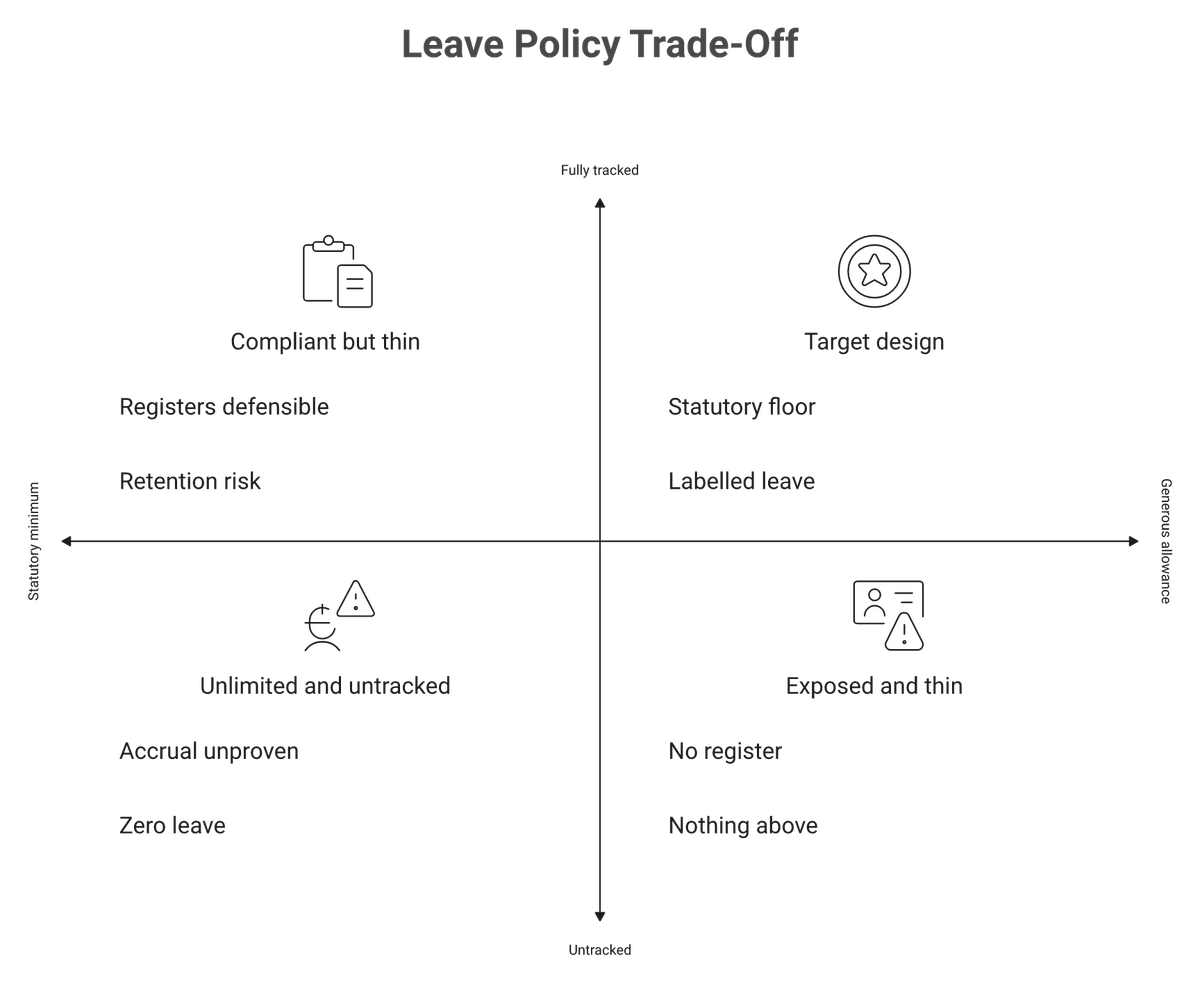
Two independent reasons, and the legal one is the boring one. Rajasthan requires you to compute qualifying days, record accrual, and produce registers on demand under Section 32 and Section 36. An untracked policy cannot answer a labour inspector or an M&A diligence request.
The cultural reason is sharper. In a deference heavy workplace, removing the allotment often means people take nothing. I once watched an engineer in a client's Delhi team ask his US manager, over chat, for permission to break for dinner. Give that person "unlimited" and he takes zero.
✅ What to run instead
Keep the statutory floor tracked and visible. Add a company allowance on top, labelled as company leave, and then make senior people take it first. A use it or lose it rule sounds like a restriction. In practice, it is the only thing that makes rest feel permitted.
Versatile Club pairs a tracked statutory leave floor with a 90 day Success Coach for every India hire, because the leave a policy permits and the leave an employee actually takes are two different numbers. That retention thinking runs through our contract to hire model as well.
Q6. How is leave pay and encashment calculated, and what did the Labour Codes change?
Under Section 15 of the Rajasthan Shops and Commercial Establishments Act, 1958, leave wages equal the daily average of an employee's total full time earnings for the days actually worked in the month immediately preceding the leave. The base excludes overtime and bonus, and includes dearness allowance plus the cash equivalent of concessional foodgrain supply. Since the four Labour Codes took effect on 21 November 2025, Basic plus DA must be at least 50 percent of remuneration, which lifts that base. Versatile Club re-ran every India salary structure against the 50 percent wage test when the Codes came into force.
🧮 The formula, and the two payment triggers
Daily leave wage = (total full time earnings in the preceding month, excluding overtime and bonus, including DA) divided by (days actually worked in that month).
Two timing rules sit beside it:
Leave of four days or more for an adult (five for a child): wages for the leave period are paid before the leave begins, under Section 16.
On exit: if the employer terminates, payment for leave not taken is due before the second working day after termination. If the employee resigns, it is due on or before the next pay day.
Unpaid amounts become recoverable as delayed wages under the Payment of Wages Act, 1936. Teams that want the exit sequence mapped end to end can start with our guide to paying employees in India.
💰 What the 50 percent wage rule does to your provision
Take one Rajasthan engineer on 24 lakh a year with 30 days of accrued leave. The accrual is identical in both columns. The payout is not.
| Structure | Basic plus DA | Monthly leave wage base | 30 day encashment |
| Allowance heavy (30 percent Basic) | 60,000 | 60,000 | Approximately 60,000 |
| Post Code compliant (50 percent Basic) | 100,000 | 100,000 | Approximately 100,000 |
The Ministry's FAQs confirm the revised wage definition came into force with the Codes, and that only statutory components such as employer provident fund and statutory bonus count toward the 50 percent test. Overtime allowance forms part of the calculation.
⚠️ Where finance teams get surprised
Most India encashment provisions were modelled on an allowance heavy structure. Restructuring to meet the 50 percent test raises leave encashment, gratuity accrual, and provident fund together. Nobody reprices the accrued leave line.
Versatile Club shares the restated leave encashment provision with the client's finance team ahead of month end close, invoiced in USD from our own Indian entity with no FX markup. Across our book, the restatement effect was consistent, though I would not over read a single cycle. CFOs comparing total cost can sanity check the delta against our pricing.
💬 What buyers say about payroll and invoicing
"Sagar replied to our form in about four hours with a draft offer letter already attached. The hire was onboarded in four days. First USD invoice landed clean: no FX markup, no setup fee, no surprises."
— Verified User in Information Technology and Services, Founder Versatile Club G2 - Verified Review
"What I dislike about Wisemonk is that some features feel a bit limited and could use more flexibility. In particular, I'd like to see better options for customization and more detailed reporting."
— Vinay M., Payroll Operations Wisemonk - G2 Verified Review
"I dislike how expensive Deel's transaction fees are, especially when moving money from the Deel account to my bank or wherever else it needs to go."
— Maria M., Freelance Contractor Deel - G2 Verified Review
✅ Your Monday action
Pull your Rajasthan salary structures, test each against the 50 percent rule, then re-forecast the accrued leave provision before the next close. Versatile Club runs that test as part of onboarding, so the provision a CFO sees in month one is the provision that survives audit. If you want the working shown live, book a 30 minute walkthrough.
Q7. What maternity, paternity and public holiday entitlements apply in Rajasthan?
Maternity benefit is central law sitting on top of Rajasthan's Act. Eligible women receive 26 weeks of paid leave for the first two children and 12 weeks from the third, with not more than eight weeks taken before the expected delivery date, after 80 days of work in the preceding 12 months. Paternity leave is not statutorily mandated in the private sector. Rajasthan notified 31 public holidays for 2026, alongside a separate list of restricted holidays.
👶 Two maternity layers, and which one wins
The 1958 Act carries its own maternity provisions. Section 26 gives six weeks before and six weeks after delivery to a woman with six months of continuous employment, and Section 25 treats absence due to certified pregnancy related illness as authorised leave.
Those numbers are now the floor, not the answer. Section 37 preserves any right that is more favourable to the employee under another law. The central Maternity Benefit Act is more favourable, so 26 weeks governs.
🍼 The pieces people forget
Nursing breaks: half an hour, twice a day, in addition to rest intervals, under Section 27.
Dismissal protection: unlawful to dismiss a woman during or because of maternity absence, under Section 28.
Additional leave with wages for illness arising out of pregnancy or delivery, on medical certification.
Versatile Club builds these three clauses into the India contract by default, because in our experience the nursing break and the dismissal bar are the two that never appear in a policy copied from a US handbook. Founders hiring their first India employee can see the full clause set under our startup engagements.
🗓️ Building the Rajasthan 2026 holiday list
| Holiday | 2026 date | Type |
| Republic Day | 26 January | National |
| Dhulandi (Holi) | 3 March | Regional |
| Independence Day | 15 August | National |
| Gandhi Jayanti | 2 October | National |
| Deepawali | 8 November | Regional |
Rajasthan's notified calendar runs to 31 public holidays, with restricted holidays listed separately. Most India teams publish 10 to 12 fixed days and let employees choose 2 to 3 floating days from the restricted list.
⚠️ Why a single pan India holiday list annoys everyone
Across placements in Bengaluru, Hyderabad, and Pune, I have never seen one fixed list satisfy three cities. Rajasthan's calendar carries Teej and the Pushkar Fair. Karnataka's does not.
Versatile Club builds each India employee's holiday calendar from that state's notified list plus floating days, so a Jaipur hire and a Bengaluru hire sit under one policy without sharing a festival calendar. The same state by state method drives our Bengaluru payroll operations.
✅ Paternity and bereavement, handled honestly
Neither is statutory for private employers in India. Both are cheap retention levers, and both become contractual the moment you write them down, because Section 13 makes a more generous contract enforceable. Two weeks of paternity leave and five days of bereavement leave is a defensible starting design.
Versatile Club drafts these as clearly labelled company benefits, separate from statutory lines, so a founder knows exactly which promises they can revise later and which they cannot.
Q8. How do weekly off and working hour rules interact with leave after the 2026 exemption?
Rajasthan exempted all registered shops and commercial establishments from Sections 11(1) and 12(1) by Labour Department notification S.O. 20 dated 19 June 2026, which permits round the clock operation. The exemption is conditional on rotational paid weekly rest, a cap of 10 hours a day and 48 hours a week, maintained overtime records, and appointment letter copies filed with the Labour Inspector. Versatile Club documents rotational weekly rest and overtime records for every client running extended shifts in the state.
⏰ What changed, in order
Two separate instruments moved within seven months.
17 December 2025: the Rajasthan Shops and Commercial Establishments (Amendment) Ordinance, 2025 substituted ten hours for nine in Section 7(1), raised the quarterly overtime ceiling from 50 hours to 144, and moved the Section 9 rest interval trigger from five hours to six.
19 June 2026: notification S.O. 20 lifted the fixed opening, closing, and mandatory closed day restrictions.
A further amendment notification dated 27 March 2026 is listed on the Labour Department's register and is worth watching.
🛌 Weekly rest is still mandatory, just not fixed
Section 12(3) gives every employee at least one whole day a week as a rest holiday. Section 12(4) makes it unlawful to call an employee in on that day, and Section 12(5) bars any wage deduction for it.
The exemption changes when the establishment can be open. It does not remove anybody's day off. For a Jaipur engineering team covering US hours, that means a rotating roster, documented, not an informal understanding, and it is one reason distributed teams use EOR services rather than improvising rosters in a spreadsheet.
⚠️ The overtime trap inside the new ceiling
A 144 hour quarterly overtime ceiling reads generous until you price it. Overtime is payable at one and a half times the ordinary rate of wages under Section 8, and that rate includes allowances but excludes bonus.
Versatile Club logs overtime against the quarterly ceiling per employee rather than per month, since the statute counts quarters and most payroll dashboards do not.
✅ Your compliance checklist if you run extended shifts
Fix and notify the weekly rest day at the start of the year, and do not change it more than once in six months.
Build a rotational roster that gives each employee one full day off per week.
Cap scheduling at 10 hours a day and 48 hours a week.
Maintain overtime records, and pay at 1.5 times where the thresholds are crossed.
File appointment letter copies with the Labour Inspector as the exemption requires.
Keep all registers on the establishment premises, per Section 36.
📌 Why currency of knowledge is the real differentiator
Global platforms cover 90 to 185 countries. Two Rajasthan instruments moved inside seven months, and neither appears on the state leave pages currently ranking for this query.
Versatile Club reads the Rajasthan Labour Department notification register directly, which is how the December 2025 ordinance and the June 2026 exemption reached client contracts in the same quarter they were gazetted. Buyers weighing a switch mid year usually start with our guide to switching EOR providers in India.
Q9. What leave records must you maintain, and what does an inspector ask for?
Rajasthan employers must maintain a leave with wages register, and factories must issue each worker a Leave Book in the prescribed form. Section 36 of the Rajasthan Shops and Commercial Establishments Act, 1958 requires registers and records to be kept on the establishment premises, and Section 32 requires the employer to produce them on demand to an Inspector. Under the Rajasthan Shops and Commercial Establishments Rules, 1959, the employer displays each employee's earned leave on the notice board in the first month of every year, and makes the leave register available for inspection within 72 hours of an employee's request. Versatile Club keeps the leave register and muster roll under our own Indian entity registrations.
📋 The six records to have ready
Leave with wages register, showing accrual, leave taken, and balance.
Leave Book issued to each worker at factory sites, in the prescribed form.
Muster roll or attendance register supporting the qualifying day count.
The written leave scheme, if you intend to refuse any leave application.
Notice board record of each employee's opening earned leave balance.
Weekly rest day notification filed with the Inspector, under Section 12(1).
Versatile Club assembles these six as a single India file per client, because in practice nobody reconstructs a muster roll after the fact. That file is part of our standing compliance coverage.
⚠️ The diligence scenario that costs deals
An acquirer's counsel asks for three years of state wise leave records. Your HRIS exports one national accrual report. It cannot show Rajasthan accrual at the Section 14 rate, or prove the notice board display happened.
That gap becomes a warranty, an escrow holdback, or a price adjustment. Penalties under Section 33 are small, capped at 250 rupees for a first offence, so the real exposure is never the fine. It is the disclosure, which is why teams planning a GCC setup in India get their register discipline right early.
💬 What buyers say about records and documents
"The compliance side is the real reason I'd recommend them though. PF, tax, the statutory filings, all the stuff I genuinely did not want to learn, they just handle it and keep it correct every month."
— Angad S., Founder Versatile Club G2 - Verified Review
"Sometimes the email communication from the wisemonk team is delayed by a day or 2. But overall they seem to be the best for India."
— Bulbul G., Contractor Wisemonk - G2 Verified Review
"For example, requesting HR documents via form didn't work, and I can't request vacations because it doesn't work either with partial parental leave."
— Daryna R., HR and Payroll User Deel - G2 Verified Review
⭐ Whose registrations hold the record
| Model | Register sits with | Who answers an inspector |
| Versatile Club | Versatile Club's own Indian entity, all 28 states | Versatile Club directly |
| Global generalist EOR | Local partner entity in India | Partner, via the platform |
| Your own subsidiary | Your entity | Your India finance or HR lead |
Versatile Club's read is that the category gets this backwards by selling dashboards. A dashboard is a view. The register is the artefact an inspector actually reads, and that difference shows up clearly when buyers compare the best EOR options in India.
✅ Your quarterly record hygiene
Publish opening balances in January. Log every refusal against the written scheme. Keep the muster roll and the leave register reconciled monthly, not annually. Versatile Club runs that reconciliation as part of each payroll cycle, so the answer to a diligence request already exists before anyone asks for it.
Q10. How is leave different for Rajasthan government employees?
Rajasthan government servants follow the Rajasthan Service Rules, 1951, not the Shops Act. A government servant, temporary or permanent, is entitled to privilege leave of 30 days in a calendar year. Privilege leave accumulates up to a maximum of 300 days, and a maximum of 120 days may be granted at one time. Casual leave is ordinarily 15 days a year, with a limit of 10 days at any one time. Section 3(1)(a) of the 1958 Act expressly excludes government offices from the Shops Act.
🏛️ Why this section exists at all
Search traffic for Rajasthan leave policy is split. Half the readers are private employers. The other half are teachers, clerks, and state staff looking for privilege leave rules.
Both groups land on the same pages, and the numbers get mixed. I have reviewed private India policies that quietly imported the 300 day accumulation ceiling from a government rulebook.
📊 Government versus private sector, side by side
| Dimension | Rajasthan Service Rules, 1951 (government) | Rajasthan S&CE Act, 1958 (private) |
| Main earned leave | Privilege leave, 30 days a calendar year | 1 day per 12 days worked, after qualifying service |
| Accumulation ceiling | Up to 300 days | 30 days (adult), 40 days (child) |
| Maximum single spell | Up to 120 days | No day cap, but no more than six spells a year |
| Casual leave | Ordinarily 15 days, max 10 at a time | Not prescribed by statute |
| Leave on exit | Governed by service rules | Payable under Section 15, with statutory payment deadlines |
⚠️ The most copied wrong number in India
A 300 day accumulation ceiling is affordable inside a government pension and pay framework. On a venture funded balance sheet, it is a liability that compounds silently for years.
Pair that ceiling with the post Code wage definition, where Basic plus DA must be at least 50 percent of remuneration, and the exit payout roughly doubles per accrued day. That is how a leave clause becomes a funding conversation, and why founders model it alongside the cost of an employer of record in India.
✅ How to use this if you are a private employer
Benchmark against the 1958 Act, not the Service Rules.
Cap accumulation at 30 days unless you have a deliberate reason to go higher.
If you do grant more, model the encashment cost at 50 percent Basic before you sign it off.
Keep the government comparison in the policy annexure only as context, never as a target.
📌 If you are a Rajasthan government employee reading this
Your entitlements sit in the Rajasthan Service Rules, published by the state Finance Department, and privilege leave is credited in advance in two instalments each year. Nothing in the Shops Act analysis above applies to your service conditions.
Versatile Club employs India staff under state Shops and Establishments registrations, so every contract we issue is written against the 1958 Act rather than the Service Rules. The distinction sounds academic until a policy audit reads your accumulation cap.
Q11. How do you run one leave policy across a pan India team without writing 28 of them?
Write one national policy at or above the highest state floor you employ against, then attach a state annexure that overrides only three things: accrual rate, carry forward cap, and holiday list. India has 28 states and 8 union territories with distinct Shops and Establishments registration, professional tax slabs, and labour rules. Versatile Club holds Shops and Establishments and professional tax registrations across all 28 states from a single Indian entity, so Rajasthan, Karnataka, and Maharashtra hires sit under one policy and one leave ledger.
💸 The fragmented stack problem
Most scaling teams I meet have four India vendors. One runs payroll, one is the EOR, one handles benefits, one ships laptops. Nobody owns state variance, so it shows up as an employee complaint.
Versatile Club consolidates this into a single USD invoice from our own Indian entity, which matters less for compliance and more for a CFO trying to reconcile month end without three spreadsheets. Teams untangling that stack usually start with payroll outsourcing services in India.
📊 Three states, three different statutes
| Dimension | Rajasthan | Karnataka | Maharashtra |
| Earned leave accrual | 1 day per 12 days worked | 1 day per 20 days worked | 1 day per 20 days worked, after 240 days |
| Carry forward cap | 30 days (adult) | 45 days, after the 2021 amendment | 45 days |
| Statutory casual leave | None | None under the Act | 8 days, credited quarterly, lapses if unused |
| Statutory sick leave | None | Up to 12 days | Covered within leave provisions |
| Professional tax cycle | State specific slab | Monthly | Monthly, with PTRC and PTEC registrations |
Read that table twice. Rajasthan is the most generous on accrual and the thinnest on casual and sick leave. A policy tuned for Bengaluru under provides leave in Jaipur and over promises sick days there.
🧩 The annexure structure that works
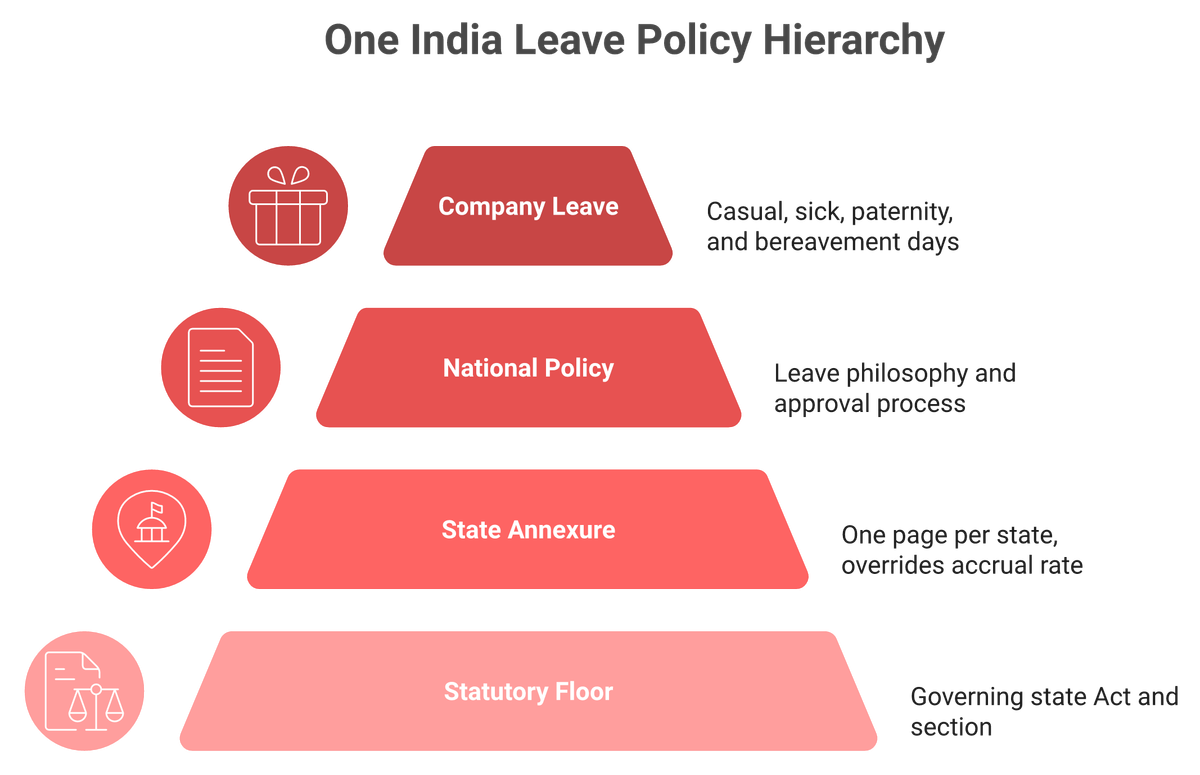
National policy: leave philosophy, application process, approval SLA, encashment principle, and company leave on top of statute.
State annexure, one page per state: governing Act, accrual rate with section number, carry forward cap, spell limit, and notified holiday list.
Change log: date, notification number, clause changed.
Versatile Club reviews these annexures quarterly against state notification registers, which is how the December 2025 Rajasthan ordinance reached client annexures in the same quarter it was gazetted.
💬 What buyers say about multi state and multi country hiring
"We've been using Versatile Club for our international hires, and honestly, it's been super smooth. Setting up in a new country can get messy fast, but their India EOR made onboarding feel easy."
— Setu C., Operations Lead Versatile Club G2 - Verified Review
"Customer support and issue ownership need serious improvement. In my experience, contacting support did not lead to effective problem solving. I was redirected multiple times, asked to repeat the same information to different representatives."
— Güneş A., Remote Professional Deel - G2 Verified Review
"WiseMonk's EOR service solved our biggest challenge, which was hiring employees in India without setting up a local entity. The initial documentation and paperwork felt quite detailed and time-consuming at the beginning."
— Verified User in Marketing and Advertising, Marketing Leader Wisemonk - G2 Verified Review
Versatile Club maintains one leave ledger across all 28 state registrations, so a Jaipur engineer and a Pune designer appear on the same report with the correct statute applied to each. Multi city teams can see the same approach in our Hyderabad payroll operations.
Q12. Which employment model keeps a Rajasthan leave policy compliant, and what belongs in the policy?
Four models exist: your own Indian subsidiary, contractors, a global generalist EOR, or an India native EOR. For one to thirty hires in Rajasthan, the deciding question is whose entity holds the state registration and whose name appears on the leave register. Traditional US style co employment PEO does not legally exist under Indian labour law, so PEO India is not a fourth option. Versatile Club is the legal employer on our own Indian entity across all 28 states, with a 5 day contractual onboarding SLA.
⭐ The four models, compared honestly
| Model | Who holds the Rajasthan registration | Onboarding time | Leave register owner | Best for |
| Versatile Club (India native EOR) | Versatile Club's own entity, all 28 states | 5 day contractual SLA | Versatile Club | 1 to 30 India hires |
| Global generalist EOR | Usually a local partner entity | Typically 1 to 2 weeks | Partner entity | Teams needing 5 or more countries |
| Your own subsidiary | You | Months, plus registration lead time | You | 50 or more India hires, long horizon |
| Contractors | Nobody | Days | Nobody | Genuinely project based work only |
❌ Where each model breaks
Contractors look cheapest until misclassification surfaces. There is no leave register, no PF, and no defence if the relationship looks like employment. Running an India team on contractor agreements is running with scissors, which is the core argument in our independent contractor versus EOR comparison.
Your own subsidiary gives full control and real cost. Global generalists give breadth, and their India depth is usually one country in a catalogue of ninety plus. Buyers weighing that build decision can test it against our EOR versus entity analysis for India.
✅ Who Versatile Club is not for
Companies hiring across five or more countries. Versatile Club operates only in India, by design.
Enterprise India teams of 100 plus that require SOC 2 or ISO 27001 as a procurement gate.
Heavily customised enterprise procurement workflows, which take longer than our 5 day SLA.
I would rather name that upfront than lose your quarter. Larger India programmes are better served through our enterprise engagements.
📋 The eight clauses a compliant Rajasthan policy needs
Applicable statute, named (Rajasthan S&CE Act, 1958 or the Factories Act).
Accrual rate with the section citation, one day per twelve days for adults.
Qualifying service rule, including the two thirds test for mid year joiners.
Carry forward cap of 30 days, and the uncapped exception for refused leave.
Encashment formula and wage base under Section 15, with the exit payment deadlines.
Maximum six spells a year, with seven days of notice and the illness carve out.
The state notified holiday list, plus floating days.
A register and notice board commitment, with the 72 hour inspection window.
💬 What buyers say about support and speed
"Founder is just a call away. Extremely helpful in resolving all our queries. The process is super smooth to setup India EOR."
— surbhi m., Founder Versatile Club G2 - Verified Review
"I've noticed that their support/query responses can occasionally take a bit longer sometimes, likely due to a relatively small team."
— Verified User in Financial Services, Finance Professional Wisemonk - G2 Verified Review
"It took three months to onboard our first 3 individuals. They didn't seem to be able to navigate Visas or variations to employment contracts."
— Verified User in Information Technology and Services, People Operations Deel - G2 Verified Review
Versatile Club carries the 6 month replacement guarantee on C2H placements, charges no setup or exit fees, and I am on WhatsApp myself rather than a CSM rotation. That is sustainable at our current scale, and one day it will have to change.
Send me your current India leave clause. I will tell you which line does not match the statute, and you can decide what to do with that. Reach out here, or if you would rather compare providers first, read our Wisemonk alternative breakdown.
FAQs
How many days of earned leave is an employee entitled to in Rajasthan?
Under Section 14 of the Rajasthan Shops and Commercial Establishments Act, 1958, an employee who has worked 240 days or more in a calendar year is allowed leave with wages in the following calendar year at the rate of one day for every twelve days worked. For a child worker, the rate is one day for every fifteen days. Factory workers accrue at a different rate, one day for every twenty days worked, under Section 79 of the Factories Act, 1948.
Two details decide the final number:
- Leave is exclusive of holidays falling during or at either end of the leave period.
- A fraction of half a day or more counts as a full day, and anything less is ignored.
So an employee with 246 qualifying days accrues 20.5 days, which rounds to 21.
This is where most published guidance goes wrong. Several widely read state compliance pages publish 15 or 18 days on a one per twenty accrual, which is the Factories Act rate copied onto a Shops Act page. Versatile Club runs Rajasthan accrual at the Section 14 rate of one day per twelve days worked, with the statutory reference printed on the employee's own leave statement. If you are setting this up for a first hire, our India EOR service configures the accrual before payroll one.
Are casual leave and sick leave legally mandatory in Rajasthan?
No. The Rajasthan Shops and Commercial Establishments Act, 1958 prescribes annual leave with wages in Chapter IV, and it contains no casual leave or sick leave entitlement at all. The seven plus seven figures that appear on many HR compliance pages are market practice, not statute.
That does not make them risk free. Section 13 of the same Act says that where a contract or policy provides longer leave than Chapter IV, the employee is entitled to the longer term. So the moment casual or sick leave appears in an appointment letter or HR handbook, it becomes enforceable at exactly the level promised.
A practical design for a 10 to 40 person India team looks like this:
- State the statutory line first, annual leave with wages under Section 14.
- Add casual leave of 6 to 8 days, clearly labelled as a company benefit.
- Add sick leave of 6 to 8 days, and account for ESI sickness benefit for employees within the wage ceiling.
- Require medical certification only beyond two consecutive days.
Versatile Club separates statutory leave from company granted leave on every India contract we issue, so a founder can see which lines are law and which are their own promise. Our HR consulting team reviews existing clauses before anyone signs.
How does the 240 day qualifying rule work, and what counts toward it?
The 240 day threshold is not 240 days of physical attendance. Section 14 lists three categories that are deemed to be days worked for the purpose of the computation, even though no leave is earned for them:
- Days of lay off, by agreement, contract, or as permissible under the standing orders.
- For a female employee, maternity leave of up to twelve weeks.
- Leave earned in the prior year and enjoyed in the current year.
Mid year joiners follow a separate test. Section 14(2) says an employee whose service begins on any day other than 1 January qualifies if they have worked two thirds of the remaining days in that calendar year. Section 14(3) preserves entitlement for an employee discharged or dismissed during the year, even if the full qualifying period was not completed.
This is where most payroll systems break. They accrue on calendar months, while the statute accrues on qualifying days with named inclusions a monthly calendar cannot see. The two models agree for a January joiner and diverge for everyone else.
Versatile Club tracks qualifying days rather than calendar attendance for every India employee on our entity, reconciling the muster roll against the Section 14 inclusion list each month. That reconciliation sits inside our managed payroll cycle rather than a separate leave tool.
How is leave encashment calculated in Rajasthan, and what did the Labour Codes change?
Section 15 of the Rajasthan Shops and Commercial Establishments Act, 1958 sets the base. Leave wages equal the daily average of the employee's total full time earnings for the days actually worked in the month immediately preceding the leave. That base includes dearness allowance and the cash equivalent of concessional foodgrain supply, and excludes overtime and bonus.
Three timing rules sit beside the formula:
- For leave of four days or more (five for a child), wages for the leave period are paid before the leave begins.
- If the employer terminates, payment for leave not taken is due before the second working day after termination.
- If the employee resigns, it is due on or before the next pay day.
The four Labour Codes took effect on 21 November 2025, and the revised wage definition requires Basic plus DA to be at least 50 percent of remuneration. Because encashment is computed on that base, an allowance heavy structure that kept payouts cheap now re-prices upward. On a 24 lakh package, moving Basic from 30 to 50 percent roughly doubles the value of each accrued day.
Versatile Club re-ran every India salary structure against the 50 percent wage test when the Codes came into force and shares the restated provision with the client's finance team ahead of month end close. CFOs comparing total cost can start with our pricing.
What leave records must a Rajasthan employer maintain for an inspection or diligence review?
Rajasthan employers must maintain a leave with wages register, and factory sites must issue each worker a Leave Book in the prescribed form. Section 36 of the 1958 Act requires registers and records to be kept on the establishment premises, and Section 32 requires the employer to produce them on demand to an Inspector. Under the Rajasthan Shops and Commercial Establishments Rules, 1959, the employer displays each employee's earned leave on the notice board in the first month of every year and makes the leave register available for inspection within 72 hours of an employee's request.
A practical audit pack contains six items:
- Leave with wages register showing accrual, leave taken, and balance.
- Leave Book at factory locations.
- Muster roll or attendance register supporting the qualifying day count.
- The written leave scheme, if you intend to refuse any application.
- Notice board record of opening balances.
- Weekly rest day notification filed with the Inspector.
Penalties under Section 33 are small, capped at 250 rupees for a first offence, so the real exposure is disclosure during acquisition diligence rather than the fine. Versatile Club keeps the leave register and muster roll under our own Indian entity registrations, which is how an audit request is answered from our records instead of chased through a partner. See our compliance coverage for the full record set.