Table of contents (11)
Leave Policy in Bihar: Employee Rights and Leave Types
Q1. Which law actually governs leave in Bihar in 2026?
A People Ops lead in Austin pasted a leave clause into WhatsApp at 6am her time. It cited the Bihar Shops and Establishments Act. Her Patna engineer had asked one question: how many earned leaves do I have this year? The clause she was quoting from had stopped existing four months earlier.
Leave for private-sector employees in Bihar is governed by the Occupational Safety, Health and Working Conditions Code, 2020, which came into force on 21 November 2025, together with the OSH (Bihar) Rules, 2026. Bihar repealed its own Shops and Establishments Act through Ordinance No. 01 of 2026, notified on 1 June 2026, to remove overlap with the Code. Pending proceedings under the repealed Act continue.
What actually changed on 1 June 2026
⚠️ A state deleted its labour law, not just amended it
The Governor of Bihar promulgated the Bihar Shops and Establishments (Regulation of Employment and Conditions of Service) (Repeal) Ordinance, 2026 under Article 213(1). It repealed Bihar Act 09 of 2025, which itself had replaced the 1953 Act only ten months earlier. Bihar then notified its own OSH Rules on 1 July 2026, superseding six earlier state enactments.
I have watched a lot of state amendments land in six years. I had not seen a state delete an entire Shops Act before this one.
⏰ The three-version history nobody publishes
| Rule | 1953 Act | 2025 Act | OSH Code (live) |
| Days needed to earn leave | 240 days | 240 days | 180 days |
| Accrual rate | 1 day per 20 worked | 1 day per 20 worked | 1 day per 20 worked |
| Carry-forward cap | 45 days | 45 days | 30 days |
| Casual leave | 12 days full pay | 8 days, credited quarterly | Not prescribed |
Versatile Club rebased its Bihar contract templates on OSH Code section 32 in the same quarter the repeal was gazetted, because we hold the Bihar registration ourselves and receive the notifications directly through our India compliance operations.
Which stack applies to you
✅ The three-line test
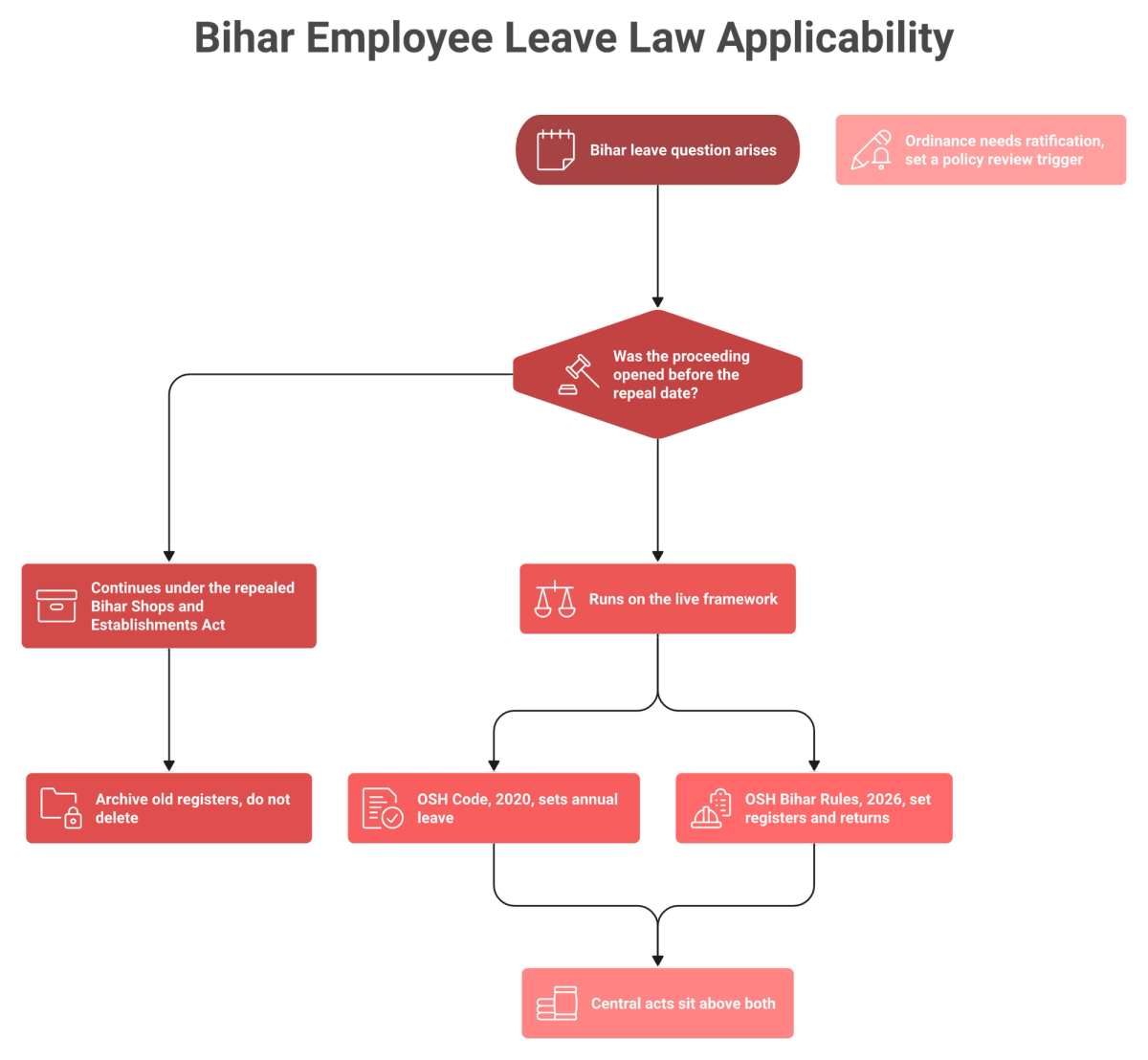
Ask three questions in order. Is the establishment a factory or a shop or office? Was the inspection or proceeding opened before 1 June 2026? Is the person a worker under the Code, or managerial staff?
If the proceeding predates 1 June 2026, it continues under the repealed Act because of the savings clause. Everything forward-looking runs on the Code plus the Bihar Rules. Central acts sit above both: the Maternity Benefit Act, the POSH Act, the Code on Wages, and ESIC. Teams running payroll compliance in India have to hold all four layers at once.
💰 One watch item most policies miss
An ordinance is temporary. It needs ratification by the Bihar legislature to survive as an Act. So the correct policy design has a review trigger attached to it, not a fixed date. Versatile Club logs that ratification watch item against the Bihar annexure of every client policy we maintain.
I could be reading the risk too strongly here. Ordinances of this kind are usually ratified. Still, a leave clause resting on a temporary instrument deserves a diary note. This is general guidance, not legal advice, so run the final clause past your counsel.
Versatile Club holds statutory registrations across all 28 Indian states, and Bihar is one of them, which is why our Bihar leave language was corrected within weeks of the June 2026 repeal rather than at an annual policy review. See how EOR services in India carry that filing load.
Q2. How are Bihar employees categorised, and does that decide their leave rights?
Leave rights in Bihar follow the employee's statutory category, not the job title on the offer letter. OSH Code entitlements attach to a "worker", and staff in a genuine managerial or supervisory role above the prescribed wage line rely on contract instead. Bihar case law reached the same result under the old Act, holding that persons working in managerial capacity fell outside the definition of employee.
The four categories that matter
⭐ Worker, manager, factory worker, contractor
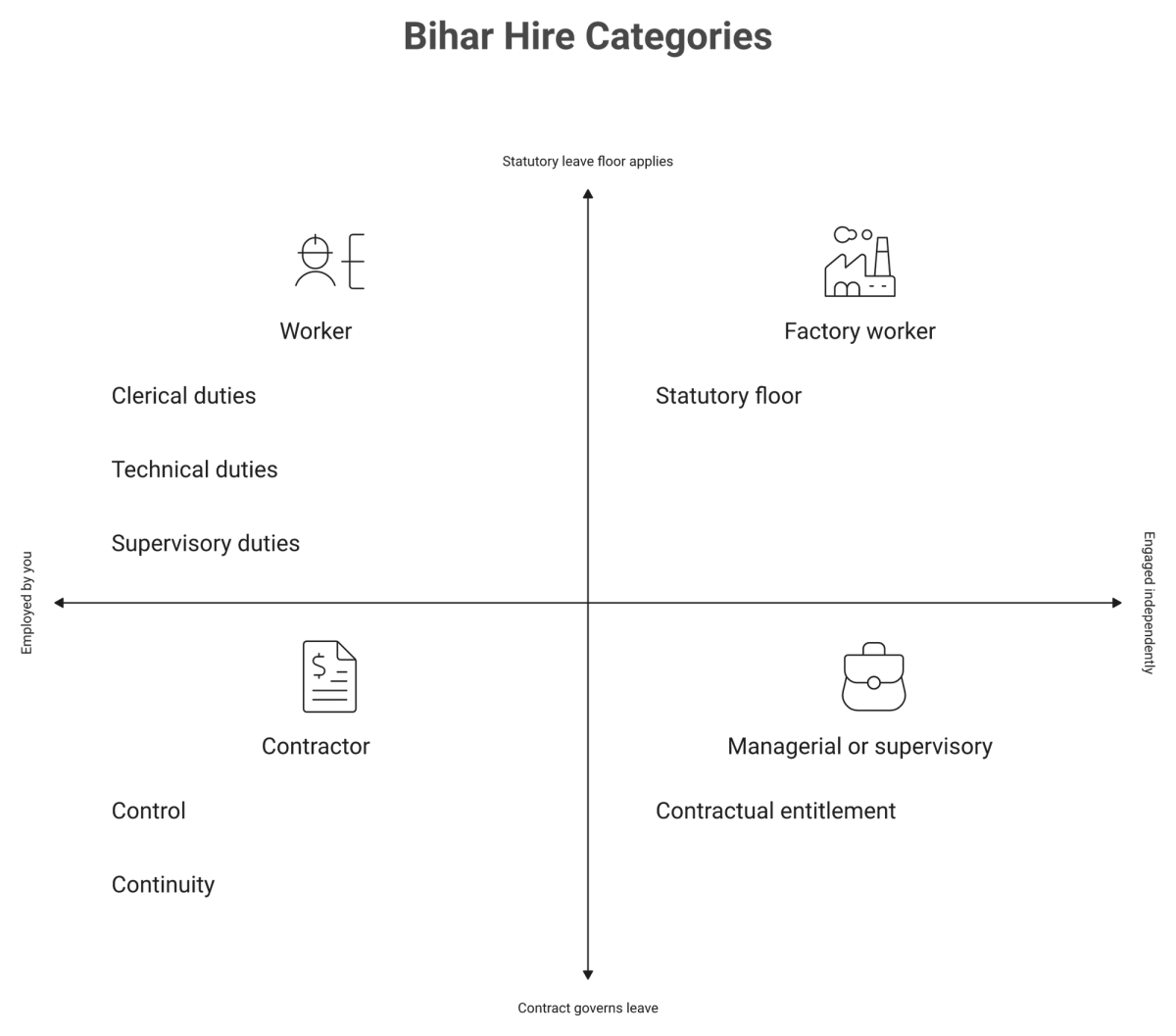
A worker is an employed person doing manual, skilled, technical, operational, clerical, or supervisory work below the wage threshold. Managerial or supervisory staff above roughly Rs 18,000 a month sit outside the statutory leave floor. A factory worker is covered on the factory premises. A contractor is not your employee at all, unless the facts say otherwise.
Bihar precedent is unusually clear on the middle category. Under Schedule I of the 1953 Act, persons in managerial or supervisory positions could be exempted, but only up to ten per cent of total employees in the establishment.
❌ Title inflation is not a compliance strategy
The courts read duties, not designations. In one Bihar matter, the position taken was that mere assignment of duty to check and report the faults of other workmen will not make the employee a supervisor or manager. Calling a 24-year-old a Team Lead does not move them out of statutory leave.
Versatile Club runs the worker test at offer stage on every India placement, because as employer of record on our own entity we carry the misclassification exposure rather than the client. The same test decides whether you engage an independent contractor or use an EOR.
Three walkthroughs from real placements
✅ How the test lands in practice
- Support associate in Patna, Rs 45,000 a month, no reports. Worker. Full statutory leave floor applies.
- Engineering manager, Rs 2.6 lakh a month, six reports, hiring authority. Managerial. Leave is whatever the contract says, so the contract has to say it properly.
- Freelance designer invoicing monthly, using your laptop, in your standups. This is where founders get hurt. Control and continuity of engagement point to employment, whatever the invoice says.
That third case is the one I get WhatsApp messages about. A US-style co-employment PEO arrangement does not exist under Indian labour law, so "we will just co-employ" is not an available answer. If that is your situation, read how to convert a contractor to an employee in India.
⚠️ What buyers say about paperwork depth
"The initial documentation and paperwork felt quite detailed and time-consuming at the beginning. However, as we progressed, it became clear that this thoroughness is what ensures proper legal and compliance coverage."
Verified User in Marketing and Advertising, 12 February 2026, Wisemonk - G2 Verified Review
"The initial setup process was also very challenging; it took several days and involved a lot of emails, with issues arising at every step."
Verified User in Translation and Localization, 31 July 2025, Deel - G2 Verified Review
Both reviews describe the same tension. Classification paperwork is heavy, and thin paperwork is worse. Versatile Club documents category, wage split, and leave clause in a single onboarding pack under a 5-day contractual onboarding SLA, so the classification decision is made once and recorded, not revisited at exit.
Versatile Club classifies each Bihar hire against the statutory worker test before the offer goes out, and the classification, the wage structure, and the leave clause are all written into the same employment contract we sign as legal employer. That sequence is set out in how it works.
Q3. What leave types does a white-collar employee in Bihar actually get?
A white-collar employee in Bihar receives statutory annual leave at one day for every twenty days worked after 180 days of service, 26 weeks of maternity leave, a weekly holiday with wages, three national holidays, and up to five state-notified festival days. Casual leave and sick leave are no longer state-mandated after the 2026 repeal. They are contractual, with ESIC sickness benefit sitting behind them for covered employees.
The entitlement table
⭐ Statutory floor versus contract
| Leave type | Entitlement | Source | Statutory or contractual |
| Annual or earned | 1 day per 20 days worked, after 180 days | OSH Code s.32 | Statutory |
| Casual leave | Not prescribed centrally | Old Bihar s.16A gave 12 days | Contractual |
| Sick leave | Not prescribed centrally | Old Bihar s.16A gave 12 days at half pay | Contractual, plus ESIC |
| Maternity | 26 weeks | Maternity Benefit Act s.5 | Statutory |
| Weekly holiday | One whole day each week, no wage deduction | Bihar s.12 | Statutory |
| National holidays | Independence Day, Republic Day, Gandhi Jayanti | Bihar s.12A | Statutory |
| Festival holidays | Up to 5 days from the notified list | Bihar notification | Statutory |
Versatile Club writes 12 casual and 12 sick leave days into its standard Bihar contract above the annual-leave floor, which keeps a Patna offer comparable to a Bengaluru one. Benchmark it against the India salary calculator before you sign the offer.
💰 The casual and sick leave vacuum
This is the part no ranking page has caught up with. Section 16A of the old Bihar Act gave casual leave with full pay for 12 days and sick leave on half pay for 12 days on production of a medical certificate, neither of which could accumulate. The 2025 Act reset that to 8 casual days credited quarterly and 7 sick days. Both instruments are now repealed.
So the statutory floor for casual and sick leave in Bihar is currently silence. The market floor is not. Versatile Club's read is that the standard advice gets this backwards by treating repeal as relief. Candidates compare policies, not gazettes.
The festival calendar founders underestimate
⏰ Chhath is on the notified list
The Bihar notification declaring festival holidays runs to 24 occasions, including Holi, Durga Puja, Dipavali, Chhath, Id-ul-fitr, Sarhul, and Guru Nanak Jayanti, from which five days are allowed with full pay. Working on such a holiday attracted double the normal hourly wage.
Pick the five deliberately, in writing, before the year starts. Versatile Club sets the five-day festival selection during onboarding rather than at the first holiday request, because retrofitting it mid-year always reads as a takeaway.
⚠️ What buyers say about reporting and response
"What I dislike about Wisemonk is that some features feel a bit limited and could use more flexibility. In particular, I'd like to see better options for customization and more detailed reporting."
Vinay M., 18 February 2026, Wisemonk - G2 Verified Review
"Sometimes the email communication from the wisemonk team is delayed by a day or 2. But overall they seem to be the best for India."
Bulbul G., 19 February 2025, Wisemonk - G2 Verified Review
Leave balance questions are urgent to the employee and routine to the vendor. That gap is where escalations start, and it is a common reason buyers look at a Wisemonk alternative.
Versatile Club answers leave and balance questions through direct founder access on WhatsApp rather than a ticket queue, which is workable at our current scale and something we will have to redesign as we grow.
Q4. How does earned leave accrue, carry forward, and lapse in Bihar?
Annual leave in Bihar accrues at one day for every twenty days worked, once the employee completes 180 days in a calendar year. That threshold replaced the older 240-day qualifying period. Carry-forward is capped at 30 days under the OSH Code, down from 45 days under both Bihar Acts, and balance above the cap is encashed. Half-day fractions round up to a full day.
The qualifying period
✅ 240 became 180
The Ministry of Labour and Employment explainer states the change plainly: instead of 240 days, now if a worker has worked 180 days, he shall be entitled for one-day leave for every 20 days of work done. The OSH Code text carries the same 180-day condition in section 32.
Certain non-working days still count toward the qualifying total. Under the old Bihar rule, those included lay-off days, maternity leave up to twelve weeks for a female employee, and leave earned in the prior year, though no fresh leave accrued for those days.
⏰ Rounding and holidays
Two mechanics get coded wrong in payroll systems constantly. Fractions of half a day or more count as a full day, and anything less is dropped. Leave is exclusive of holidays falling during or at either end of the leave period.
Versatile Club configures both rules in the accrual logic at setup, because a rounding rule applied one way for eleven months and corrected in December produces an argument, not a balance. That configuration sits inside our managed payroll setup.
Carry-forward, refusal, and exit
💸 45 days became 30
The old Bihar provision allowed carry-forward of up to forty-five days into the succeeding year. Under the Code, the cap is 30 days, and the excess is encashed annually rather than banked. Refused leave is treated differently and carries forward beyond the cap.
That refusal rule has real teeth. Under the old Bihar section, an employee holding 45 days of credit who was refused leave became entitled to wages for the refused period in addition to normal wages. Do not decline leave requests casually.
⚠️ The September joiner
Mid-year joiners are where I see the most errors. The old Bihar Act handled them with a proportion test tied to the ratio 240 bears to 365, available after 120 days of employment. The Code works from the 180-day threshold instead.
Get the proration wrong and you underpay full and final settlement. That is the single most common trigger for an ex-employee escalation, in my experience, and it surfaces weeks after the person has left.
✅ What to do on Monday
- Set the accrual trigger in your HRIS to 180 days, not 240.
- Cap carry-forward at 30 days and switch on year-end encashment of the excess.
- Turn on half-day round-up and holiday exclusion.
- Flag every joiner after 1 July for a manual proration check.
Versatile Club runs Bihar accrual, capping, and lapse inside its own payroll registrations and reports them on one consolidated monthly USD invoice, so a CFO closing the month reconciles a single statement instead of separate vendor reports. Founders making a first India hire usually start with the employer of record India playbook, then talk to us about the Bihar annexure.
Q5. What does leave encashment cost once Basic plus DA must be half of CTC?
A controller at a $12M ARR SaaS company sent me her India accrual schedule in March. Twelve Bihar and Bengaluru employees, one line item, one number. The number had not moved in eighteen months, even though every salary structure under it had been rebuilt for the wage codes. Her auditor was going to find that before she did.
Leave encashment in India is paid on the daily average of the employee's full-time earnings. That average includes dearness allowance and excludes overtime and annual bonus. Because the new wage definition requires basic plus dearness allowance to be at least 50 percent of total remuneration, the encashment base rises even when gross salary stays flat. The same 30-day balance therefore costs more at exit than it did under an older salary structure.
The wage base is the whole story
💰 What goes in, what stays out
The Bihar provision spelled the formula out clearly. An employee was paid at a rate equal to the daily average of his total full time earnings, exclusive of any overtime earnings and the yearly bonus, but inclusive of attendance bonus, efficiency bonus and other incentive bonuses and dearness allowance, for the days worked in the month before the leave.
There is also a fallback. If the employee did not work at all in the preceding month, the average is taken from the last calendar month in which they actually worked.
Versatile Club calculates leave encashment on basic plus dearness allowance under its own payroll registrations, and reports the accrued balance monthly rather than at exit. That reporting cycle sits inside our outsourced India payroll workflow.
💸 A worked example
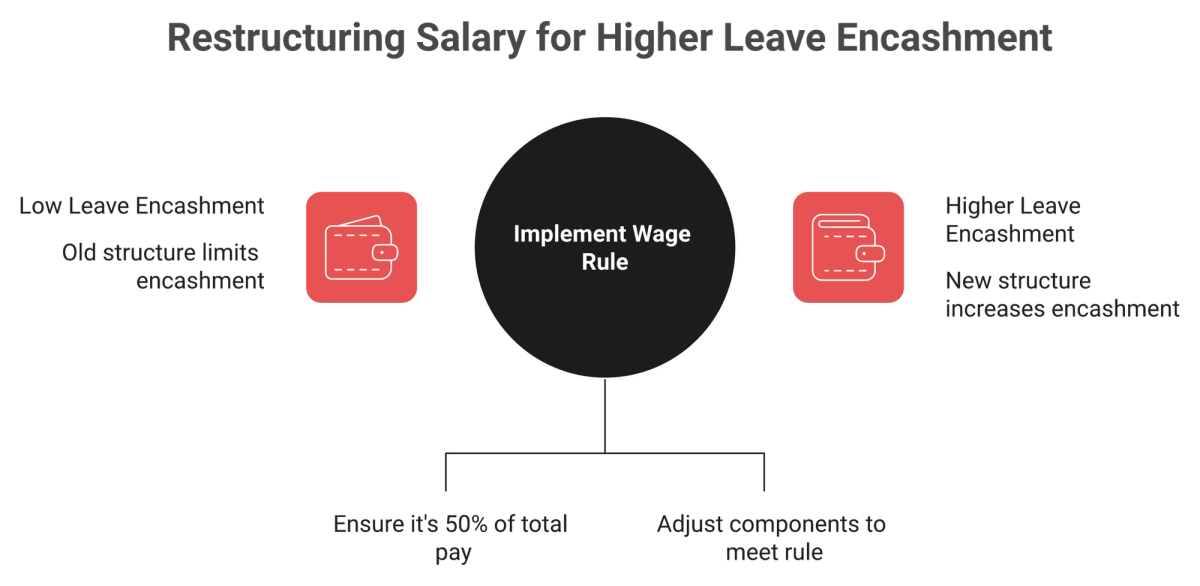
Take an engineer on Rs 20 lakh a year. Under an old structure with 35 percent basic, the daily base is roughly Rs 1,940. Restructured to 50 percent basic plus dearness allowance, it becomes roughly Rs 2,770.
Thirty encashable days move from about Rs 58,000 to about Rs 83,000. That is a 43 percent increase on the same headcount, the same salary, and the same leave balance. Multiply it across twelve people and the provision gap becomes an audit finding. Model the full loaded number with the EOR versus entity calculator.
What buyers report going wrong
⚠️ Accrued PTO is where EOR disputes start
"Our employee consulted with legal counsel because Papaya attempted not to pay out accrued PTO multiple times. We had to review the law in the country because Papaya's local office was not following the law. Papaya missed invoicing us for a month, causing audit issues."
Verified User in Civic and Social Organization, 10 January 2023, Papaya Global - G2 Verified Review
"I dislike how expensive Deel's transaction fees are, especially when moving money from the Deel account to my bank. It's not one of the cheapest services available."
Maria M., 26 September 2025, Deel - G2 Verified Review
Two different failures, one shared root. Leave money is calculated in a local office and invoiced from somewhere else. Buyers hitting that seam usually start comparing Papaya Global alternatives in India.
✅ Three things to do at month-end close
- Reprice the accrual on the post-restructure basic plus dearness allowance, not last year's basic.
- Cap the provision at 30 days and book the encashed excess as a cash outflow in December.
- Reconcile the accrual against the exit payout timeline, because the old Bihar rule required payment before the expiry of the second working day after termination.
Versatile Club's read is that the standard advice gets this backwards by treating the 50 percent rule as a take-home issue. I think it is a balance-sheet issue first, and I may be weighting it too heavily for very small teams.
Versatile Club charges no setup fee, no exit fee, and gives the first month free, so the only leave-related number entering a CFO's close is the statutory encashment itself, on one consolidated USD invoice. The full breakdown sits on our pricing page.
Q6. Which central leave obligations override anything you write in a Bihar policy?
Central law sits above any state rule or company handbook. A Bihar employee receives 26 weeks of paid maternity leave, a weekly holiday with wages, three paid national holidays, up to five state-notified festival days, and paid time off to vote. POSH Act compliance, including an Internal Committee, applies to every workplace with ten or more employees. None of these can be contracted away, and paternity leave has no private-sector statutory mandate in India.
Maternity, adoption, and paternity
⭐ 26 weeks, and how Bihar plugged into it
The Maternity Benefit Act, 1961 provides 26 weeks of paid leave for a woman with fewer than two surviving children. Adoptive and commissioning mothers receive 12 weeks. Bihar wired this in directly: section 39A stated that the provisions of the Maternity Benefits Act, 1961 shall mutatis mutandis apply to every establishment and every person covered by the state Act.
Maternity leave also counts toward the leave-qualifying period, up to twelve weeks, even though no fresh leave accrues on those days.
❌ Paternity leave is a policy decision, not a right
There is no statutory paternity leave for private-sector employees in India. Central government employees get it. Your Patna engineer does not, unless you write it in.
Versatile Club writes paternity leave into its India employment contracts as a named benefit rather than a discretionary allowance, because an unwritten benefit is the one that gets denied under pressure. Founders drafting a first offer will find the sequence in our guide to hiring employees in India.
"Requesting HR documents via form didn't work, and I can't request vacations because it doesn't work either with partial parental leave."
Daryna R., 6 May 2024, Deel - G2 Verified Review
Holidays, POSH, and voting
⏰ The weekly holiday and the festival five
Every employee is entitled to a holiday of one whole day each week, with no wage deduction for it. Bihar also mandated full-pay holidays on Independence Day, Republic Day, and Mahatma Gandhi's Birthday, plus up to five festival days from a notified list.
Working on one of those days attracted double the normal hourly wage. Versatile Club fixes the five-day festival selection during onboarding, and in Bihar that list realistically includes Chhath.
✅ POSH and the ballot
The POSH Act, 2013 requires an Internal Committee at any workplace with ten or more employees, a published policy, and an annual report to the district officer. It applies from the first day, not at some scale trigger.
Paid time off to vote comes from the Representation of the People Act, 1951, which the Election Commission of India publishes as the governing statute for elections. Bihar votes often, and state polls fall inside working weeks.
⚠️ The pattern I keep seeing
US founders treat these as HR nice-to-haves. Indian inspectors treat them as the first documents they ask for. What surfaces in Versatile Club's onboarding work is that POSH committee papers and the holiday calendar get built in week one or they get built during an escalation.
Versatile Club constitutes the POSH Internal Committee and maintains the Bihar holiday calendar under its own registrations, so a company making its first India hire does not need to stand up a compliance function to stay lawful. That is the case we make to early-stage startups hiring their first engineer.
Q7. How do Bihar government leave rules differ from private-sector rules?
Half the Bihar leave templates founders send me are lifted from a state government HR manual. They are generous, well drafted, and legally irrelevant to a private employment contract.
Bihar government and state-society employees are governed by service rules, not by the OSH Code. Those rules typically give 12 days of casual leave, extended to 16 days for certain postings, with unavailed casual leave lapsing at year end, and earned leave credited in advance on 1 January. Private-sector employees in Bihar draw from the OSH Code floor instead, where annual leave accrues at one day per twenty days worked and casual leave is contractual.
Two different rulebooks
⭐ What the government manual actually says
The State Health Society Bihar Human Resource Manual sets the maximum period of Casual Leave which is permitted to be availed at 12 days for SHSB employees and 16 days for all other employees posted in DHS, and states that unavailed casual leave lapses.
That is a credit-based design. Days appear at the start of the year. Private-sector annual leave under the Code is accrual-based, so days appear as work is performed.
⚠️ Why copying it backfires
A credited-in-advance policy creates a liability on day one. An accrual policy builds it gradually. If you copy the government structure into a private contract, you have promised a full-year balance to an employee who may leave in March.
Versatile Club drafts Bihar contracts against the private-sector statutory floor rather than a service-rule template, which is what keeps the leave clause enforceable and the provision predictable. Companies weighing structures should read EOR versus entity in India before drafting anything.
The contrast, side by side
✅ Where you fall
| Item | Bihar government or state society | Private-sector employee in Bihar |
| Governing instrument | Service rules and departmental HR manual | OSH Code 2020 and OSH (Bihar) Rules 2026 |
| Casual leave | 12 days, 16 in some postings, lapses yearly | Contractual, no central mandate |
| Earned leave | Credited in advance on 1 January | Accrued at 1 day per 20 days worked |
| Who enforces it | Departmental authority | Labour inspector under the Bihar Rules |
| Applies to an EOR hire | No | Yes |
An employee hired through an employer of record follows the private-sector column, always. The client's own country policy does not change that, and neither does the client's US handbook.
⏰ The one thing worth borrowing
Government rules do one thing better than most startup policies. They state the lapse rule plainly, so nobody argues in December.
Versatile Club carries an explicit lapse and carry-forward clause in every India contract, and I would rather have that conversation at offer stage than during a full and final settlement.
Versatile Club maintains the Bihar registration under its own entity and drafts to the private-sector floor, so a founder reading a state HR manual online does not end up promising government service-rule benefits in a startup employment contract. Our HR consulting services handle that clause review.
Q8. Should you offer unlimited PTO to your Bihar team?
No. Unlimited paid time off fails twice in Bihar. Hierarchical workplace norms mean employees defer rather than take leave, so the policy produces near-zero usage. The OSH framework still requires qualifying days, accrual, and leave records to be tracked, so an untracked policy leaves an evidence gap the moment an inspector or an acquirer asks for the leave register.
The behavioural failure
❌ No allotment means no permission
The popular argument is that removing leave limits signals trust. What actually happens is quieter. If nothing is allotted, nothing is at risk of expiring, so nobody feels licensed to go.
A use-it-or-lose-it rule sounds like a restriction. It functions as an instruction. That is the part the handbook version of this debate skips.
⚠️ Hierarchy makes it worse in India
There is a well-documented pattern of Indian team members asking a foreign manager for permission before a dinner break, framed as deference to a superior. Now imagine that person deciding, unprompted, to take three weeks off under a policy with no stated number.
What surfaces in Versatile Club's placement work is that leave usage tracks the manager's own behaviour, not the policy document. I have never seen an unlimited policy function on an Indian team unless the founder visibly took leave first. Our culture fit quiz exists because these norms decide retention.
The compliance failure
💸 The register still exists
Even with a generous policy, the employer must maintain records. The Bihar Act required every employer to maintain such records and registers and display such notices as may be prescribed, and to produce them on demand to an Inspecting Officer. The OSH (Bihar) Rules, 2026 carry that duty forward in new formats.
Untracked leave also breaks diligence. An acquirer asking for accrued leave liability cannot be answered with a philosophy.
⚠️ What broken leave tracking looks like
"The way annual leave is recorded is strange, it automatically logs weekend days, so this has incorrectly logged my leave. There is no way to edit so I have had to reach out to support for the leave to be deleted."
Verified User in Non-Profit Organization Management, 30 April 2026, Pebl (formerly Velocity Global) - G2 Verified Review
"I like that we can use Deel for multiple things. Contractors, EORs, employees, PTO, compliance etc. Often the CS doesn't seem to have answers, and something I was looking for the answer to in 20 minutes becomes a 4 day process."
Verified User in Computer Software, 16 September 2024, Deel - G2 Verified Review
Versatile Club tracks Bihar leave inside its own payroll registrations, which is how a balance dispute gets settled from a register rather than from a support ticket. Buyers who have lived through the ticket version often review Velocity Global alternatives in India.
✅ The design that actually works
- Set a capped, named number, so the employee knows what expires.
- Track it in the register format the Bihar Rules prescribe.
- Have the founder or manager take leave first, visibly, and say so in writing.
- Ask "how much leave have you taken this quarter" instead of "are you taking leave".
Versatile Club pairs a capped, tracked leave policy with a 90-day Success Coach on every placement, because the first quarter is when a new India hire decides whether taking leave is genuinely allowed. That coaching layer runs alongside our contract to hire engagements.
Q9. What leave records will a Bihar inspector or an acquirer ask to see?
A CFO called me two days into a Series B diligence. The buy-side team had asked one line item: accrued leave liability for the India team, by employee, with supporting registers. She had a spreadsheet. She did not have registers.
An inspection or diligence request in Bihar centres on five artefacts: attendance and muster records, the leave register showing accrual and balances, appointment letters or service cards, wage registers proving how leave wages were computed, and evidence of encashment paid on exit. The OSH (Bihar) Rules, 2026 changed the prescribed formats, so registers built on the old Bihar Shops Act templates or the Factory Rules of 1950 are now the wrong forms.
The artefacts and their statutory hook
⭐ What the inspector is allowed to do
The duty is explicit. Every employer had to maintain such records and registers and display such notices as may be prescribed, and produce them on demand. An Inspecting Officer could inspect, or take extracts from any prescribed registers, records and notices, or seize such records where an offence was suspected.
There was also a document most founders have never heard of. Every employee had to be furnished by his employer with a service card in the prescribed form.
Versatile Club maintains India leave and wage registers under its own entity registrations, which is how a diligence request gets answered from one record set instead of three vendor exports. That record layer is part of our India compliance stack.
⚠️ The savings-clause trap
Bihar repealed its Shops Act on 1 June 2026, but pending proceedings continue under the repealed law. So do not delete the old registers. Archive them.
Non-registration and non-maintenance of registers were treated as continuing offences under Bihar case law, and the limitation clock behaved differently for leave-related breaches under sections 16 and 16A. Old exposure does not expire because a new rulebook arrived. Teams inheriting an old India setup should read our guide to payroll compliance in India.
What buyers report about record discipline
💸 Chasing your own reports is the tell
"We've noticed that response times can sometimes be very slow. In addition, we have to remind Papaya to get monthly reports for a couple of countries every month."
Cherry H., Payroll Manager, 30 July 2025, Papaya Global - G2 Verified Review
"There isn't a form in which the employee can fill out with their preliminary information. Essentially you must have already picked the person you want to hire, get their information yourself prior to starting your process with Skuad."
Verified User in Information Technology and Services, Payoneer Workforce Management (formerly Skuad) - G2 Verified Review
If you are chasing monthly reports, you are also chasing the register behind them. Versatile Club issues the compliance status report and challan confirmations on a fixed monthly cycle rather than on request. Buyers stuck in the chase usually compare Skuad alternatives in India next.
✅ A thirty-minute self-audit
- Pull the leave register for one Bihar employee and check the accrual trigger is 180 days.
- Confirm the carry-forward cap in the system reads 30 days, not 45.
- Check the wage register shows the daily average used for leave pay.
- Verify appointment letters exist for every India hire, signed both sides.
- Move all pre-June-2026 registers into a dated archive folder, untouched.
What surfaces in Versatile Club's client engagements is that step four fails most often. Contracts get signed in email threads and never filed.
Versatile Club files PF, ESI, TDS, and professional tax under its own registrations and keeps the matching leave and wage registers alongside them, so an acquirer's India request is answered with documents rather than a reconstruction exercise. Companies without an entity can see the mechanics in hiring in India without an entity.
Q10. How do you run one leave policy across Bihar and 27 other states?
Write one national policy set at or above the highest statutory floor, then attach a short state annexure for the items that genuinely vary. In practice, only three things differ enough to need an annexure: festival holidays, professional tax and registration formats, and inspection or register requirements. Bihar proves why the annexure must be versioned, because a state can repeal its entire Shops Act in a single ordinance and change your compliance basis overnight.
The architecture
⭐ Harmonise up, annex the deltas
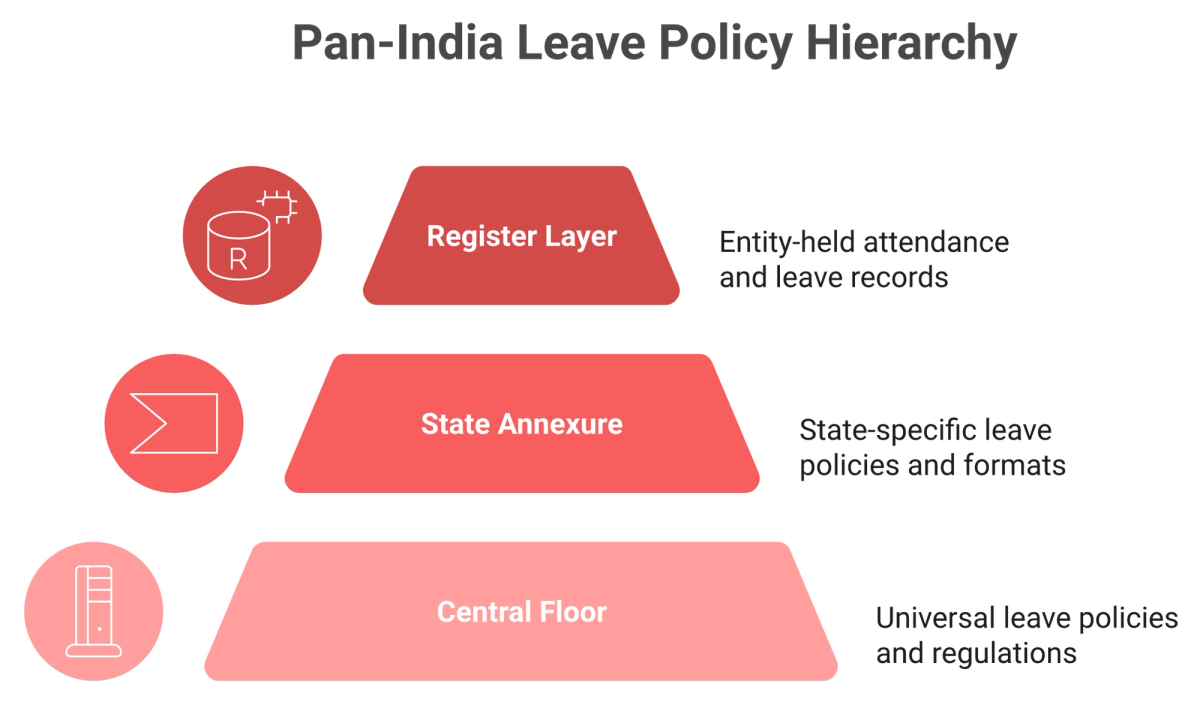
Pillar one is the central floor. Annual leave under the OSH Code, 26 weeks maternity, POSH, and the wage definition apply everywhere.
Pillar two is the state annexure. It should be one page per state, not a full policy. Pillar three is the register layer, which lives with whoever holds the state registration.
Versatile Club holds statutory registrations across all 28 Indian states, and we maintain the annexure per state rather than a separate policy per state. That is the same footprint behind our EOR services.
⏰ Where the real variance sits
| Item | Bihar | Karnataka | Maharashtra |
| Leave basis in 2026 | OSH Code plus Bihar OSH Rules | State Shops Act plus OSH Code | State Shops Act plus OSH Code |
| Professional tax cycle | No employee PT levy | Monthly filing | Dual PTRC and PTEC registration |
| Festival holidays | Five days from a 24-item notified list | State-notified list | State-notified list |
| Register formats | Changed 1 July 2026 | State rules | State rules |
I have run payroll across these three. The variance is narrower than founders fear and changes faster than they expect. Teams concentrated in one hub can start with payroll outsourcing in Bengaluru.
Governance that survives a repeal
✅ The cadence
- Assign one named owner for gazette monitoring, not a shared inbox.
- Scan the state labour department notification pages quarterly, including Bihar's Labour Resources Department notices.
- Keep an ordinance-ratification watch list, because temporary instruments expire.
- Send a written recap after every policy change, in the same thread, to the same people.
Versatile Club logs each state annexure with a version number and a review date, which is how a June repeal turns into a document update rather than a discovery in December.
⚠️ What buyers report about multi-state and multi-country spread
"Using an EOR like Multiplier can help reduce administrative burden for employees that work in another state for a company that does not wish to register as an employer in multiple states."
Kenneth P., 9 September 2025, Multiplier Employer of Record - G2 Verified Review
"Remote is terrible at drafting employment contracts. I had to send mine back multiple times for corrections, including ridiculous things like the employment start date not being a valid date."
Justin W., Remote - G2 Verified Review
Both point at the same seam. Multi-state coverage is the right idea, and the contract layer is where it leaks. Buyers reviewing that layer often look at Remote alternatives in India.
💰 The honest trade-off
Versatile Club covers all 28 states while Deel covers roughly the top six and Remote the top four in practice. That depth is India-only by design, so a company hiring in five countries at once needs a global platform instead.
Versatile Club maintains PF, ESIC, and Shops and Establishments registrations across all 28 states, which is why a Patna hire and a Pune hire sit inside one policy set and one monthly invoice rather than two vendor relationships. Compare the structures in India expansion options.
Q11. Why do global EOR platforms miss Bihar-specific leave compliance?
Global EOR platforms cover between 90 and 185 countries, and their India operations usually run through a local partner entity rather than an owned one. That structure means a state-level change like Bihar's June 2026 repeal reaches you through a partner's compliance cycle. Three questions separate providers: do you own the Indian entity, which Indian states do you hold registrations in, and who signs the leave register.
The structural gap
❌ Partner entities add a translation layer
Deel, Remote, G-P, and most global providers work through local partner entities in India. Nothing dishonest about that. It simply means the compliance knowledge sits one contract removed from you.
India is one country on a 150-country map for them. Versatile Club operates in India only, through Foo Falcon Technologies Pvt Ltd as the legal employer, so the PF registration, ESIC code, and Shops and Establishments licences are ours. The detail sits on our about page.
⚠️ What switchers actually report
"It took three months to onboard our first 3 individuals. We had to constantly remind them of the fees agreed so that we weren't over charged. They didn't seem able to navigate variations to employment contracts."
Verified User in Information Technology and Services, 13 December 2024, Deel - G2 Verified Review
"They introduced some new deposits and fees that weren't originally in our contract and ultimately ended up increasing our EOR costs."
Verified User in Information Technology and Services, 9 December 2025, Multiplier Employer of Record - G2 Verified Review
"Their support and query responses can occasionally take a bit longer sometimes, likely due to a relatively small team. Increasing the team size could help ensure quicker turnaround."
Verified User in Financial Services, 14 June 2025, Wisemonk - G2 Verified Review
That last one is fair to sit with. India-native providers, including us, trade platform scale for depth, and small teams answer slower on volume days. If you are already mid-contract elsewhere, read how to switch EOR provider in India.
The criteria table
⭐ Compare the things that affect leave
| Provider | India entity | States covered | List price per employee | Onboarding |
| Versatile Club | Owned | All 28 | $149 | 5-day contractual SLA |
| Wisemonk | India-native | India-focused | $99 to $399 | 24 to 72 hours |
| Deel | Partner entity | Top 6 in practice | $599 | 7 to 14 days |
| Remote | Partner entity | Top 4 in practice | $599 | 10 to 14 days |
| Multiplier | Partner entity | India-focused coverage | $400 | Platform-led |
List prices move, so treat that column as a starting point for your own quote. Our own numbers are published as employer of record India cost.
✅ Where we are the wrong answer
Versatile Club is not the right choice for companies needing EOR in five or more countries at once, for enterprise India teams past 100 people, or where SOC 2 or ISO 27001 certification is a procurement prerequisite. Wisemonk holds those certifications and we do not yet. EOR is also a 2026 service for us, built on six years of contract-to-hire infrastructure rather than six years of EOR track record.
Versatile Club employs Bihar hires on its own Indian entity with a 5-day contractual onboarding SLA, a 6-month replacement guarantee on C2H placements, and founder access on WhatsApp, so a state ordinance becomes our filing task rather than your escalation ticket. Bring the Bihar clause to a 30-minute call, or start with EOR services in India.
FAQs
Is the Bihar Shops and Establishments Act still applicable in 2026?
No. The Bihar Shops and Establishments (Regulation of Employment and Conditions of Service) Act, 2025 was repealed with immediate effect by Ordinance No. 01 of 2026, gazetted on 1 June 2026, to remove overlap with the central labour codes.
What governs leave in Bihar today is a two-layer stack:
- The Occupational Safety, Health and Working Conditions Code, 2020, in force since 21 November 2025, which sets annual leave.
- The OSH (Bihar) Rules, 2026, notified on 1 July 2026, which set registers, returns, and record formats.
- Central acts above both, including the Maternity Benefit Act, the POSH Act, the Code on Wages, and ESIC.
Two caveats matter. Any inspection or proceeding opened before 1 June 2026 continues under the repealed Act, so old registers should be archived rather than deleted. And an ordinance is a temporary instrument that needs legislative ratification, so a Bihar leave clause needs a review trigger attached to it.
Versatile Club holds the Bihar registration under its own Indian entity and rebased client leave clauses on the OSH Code within weeks of the repeal. If your handbook still cites the 1953 or 2025 Act, our India compliance team can tell you which clauses are now citing a dead statute.
How many casual and sick leaves are employers in Bihar required to give now?
Neither is centrally mandated any more. The OSH Code prescribes annual or earned leave, not casual leave or sick leave, and Bihar's own provisions on both disappeared with the 2026 repeal.
Here is the version history that explains the confusion:
- The 1953 Act gave 12 days of casual leave on full pay and 12 days of sick leave on half pay against a medical certificate, neither accumulable.
- The 2025 Act reset that to 8 casual days credited quarterly and 7 sick days.
- Both instruments are now repealed, so casual and sick leave in Bihar are contractual.
The practical answer is not zero. ESIC sickness benefit sits behind sick leave for covered employees, and the market floor across Indian tech employers remains roughly 12 casual and 12 sick days. A Patna candidate is comparing your offer against a Bengaluru offer, not against a gazette.
Versatile Club writes 12 casual and 12 sick leave days into its standard Bihar employment contract above the statutory annual-leave floor. If you are benchmarking a full package rather than just leave, start with our India salary calculator and work backwards from total cost.
How does earned leave accrue and carry forward for an employee in Bihar?
Earned leave accrues at one day for every twenty days worked, once the employee completes 180 days in a calendar year. That threshold replaced the older 240-day qualifying period under the labour codes.
The mechanics that payroll systems most often get wrong:
- Carry-forward is capped at 30 days, down from 45 days under both Bihar Acts, and any balance above the cap must be encashed.
- Fractions of half a day or more round up to a full day; anything less is dropped.
- Leave is exclusive of holidays falling during or at either end of the leave period.
- Refused leave is treated separately and carries forward beyond the ordinary cap.
- Lay-off days and maternity leave up to twelve weeks count toward the qualifying total, though no fresh leave accrues on them.
Mid-year joiners are the biggest failure point. A September starter prorated on last year's logic produces an underpaid full and final settlement, and that surfaces weeks after the person has left.
Versatile Club configures the 180-day trigger, the 30-day cap, and the rounding rule at setup rather than at year end, inside our managed payroll service.
How much does leave encashment cost once Basic plus DA must be half of CTC?
Leave encashment is paid on the daily average of full-time earnings, including dearness allowance but excluding overtime and annual bonus. Because the wage definition now requires Basic plus DA to be at least 50 percent of total remuneration, the encashment base rises even when gross salary stays flat.
A worked example makes the size clear. Take an engineer on Rs 20 lakh a year:
- Under an old structure with 35 percent basic, the daily base is roughly Rs 1,940.
- Restructured to 50 percent Basic plus DA, it becomes roughly Rs 2,770.
- Thirty encashable days move from about Rs 58,000 to about Rs 83,000, a rise of roughly 43 percent on identical headcount and salary.
Across a twelve-person India team, an unrepriced accrual becomes an audit finding rather than a rounding difference. Three actions fix it: reprice the provision on post-restructure Basic plus DA, cap it at 30 days with the excess booked as a December outflow, and reconcile it against the exit payout timeline.
Versatile Club calculates encashment on Basic plus DA under its own payroll registrations and reports the accrued balance monthly rather than at exit. CFOs modelling the full loaded number usually pair that with our EOR versus entity calculator.
Should we offer unlimited PTO to an India-based team in Bihar?
We would not, and the reasons are both cultural and statutory.
Behaviourally, an unlimited policy removes the expiry that prompts people to actually book time off. Indian workplace norms compound that: deference to a manager means a junior employee is more likely to take zero days than to self-authorise three weeks. Usage tracks what the manager visibly does, not what the handbook permits.
Legally, generosity does not remove record-keeping. Under the Bihar framework, employers must maintain prescribed records and registers, display notices, and produce them on demand to an Inspecting Officer, and the OSH (Bihar) Rules, 2026 carry that duty forward in new formats. An untracked policy also breaks diligence, because an acquirer asking for accrued leave liability cannot be answered with a philosophy.
The design that works in practice:
- Set a capped, named number so employees know what expires.
- Track it in the register format the Bihar Rules prescribe.
- Have the founder take leave first, visibly, and say so in writing.
- Ask how much leave someone has taken this quarter, not whether they plan to.
Versatile Club pairs a capped, tracked policy with a 90-day Success Coach on every contract to hire placement, because the first quarter decides whether leave feels permitted.