Table of contents (9)
Leave Policy in Gujarat: Rules, Types and Eligibility Explained
Q1. What leave is an employer legally required to give in Gujarat?
Section 18 of the Gujarat Shops and Establishments (Regulation of Employment and Conditions of Service) Act, 2019 requires 7 days of casual leave and 7 days of leave on medical grounds, both credited at the start of each calendar year and both lapsing if unused. Earned leave accrues at one day for every 20 days worked, once a worker completes 240 days in a calendar year. Accumulation is capped at 63 days. Eight paid festival holidays and a weekly holiday with wages apply on top.
The three buckets, not one pool
🧾 What the statute actually credits
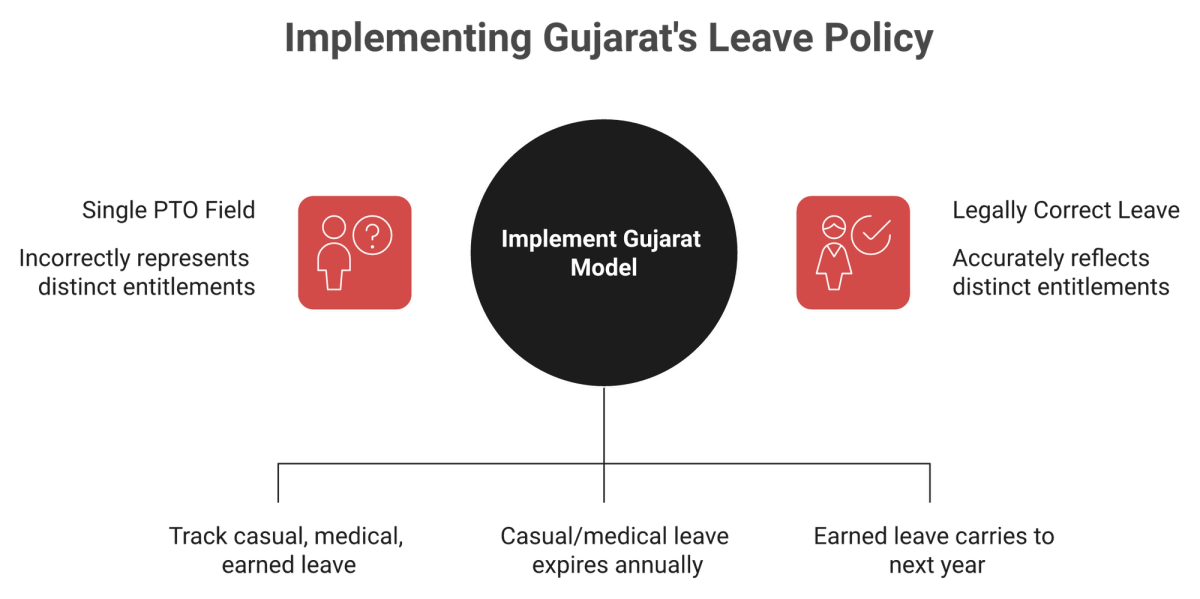
Most US-built handbooks arrive in India with one number in one field. The Gujarat Act splits that number three ways, and the split matters because two of the three buckets die at year end.
Casual leave and medical leave are credited on day one of the calendar year, not accrued monthly. Earned leave is different. It is earned in one year and taken in the next. Teams running managed payroll for an India team have to model both behaviours separately.
| Leave type | Entitlement | Credited | Carry forward |
| Casual leave, s.18(2) | 7 days | Start of calendar year | None, lapses |
| Medical grounds leave, s.18(3) | 7 days | Start of calendar year | None, lapses |
| Earned leave, s.18(4) | 1 day per 20 days worked | Following year, after 240 days | Up to 63 days, s.18(5) |
| Festival holidays, s.18(7) | 8 days | 26 January, 15 August, 2 October, plus 5 agreed | Not applicable |
🔢 The accrual math on a real employee
Take a designer who worked 220 days in Gujarat during 2025. Divide 220 by 20. That is 11 days of earned leave available to her through 2026.
If the division produces a fraction, half a day or more rounds up to a full day, and anything under half a day is ignored. Versatile Club runs this calculation from attendance data rather than from a calendar-month estimate, because the statute counts days actually worked, not months employed, and our India EOR service carries that ledger.
The claim that is still wrong on page one
⚠️ Why some guides say Gujarat has no casual or sick leave
Several pages ranking for this keyword state that Gujarat grants no casual or sick leave. That was arguably defensible under the repealed Gujarat Shops and Establishments Act, 1948, which framed leave as a single privilege-leave entitlement. It is not defensible now. Sections 18(2) and 18(3) are explicit.
Employees know this even when handbooks do not.
"Casual and sick leaves are provided under the Shops & Establishment Act."
— Commenter, r/IndianWorkplace Reddit Thread
✅ The configuration to make on Monday
Open three leave codes, not one. Set casual and medical leave to credit on 1 January with lapse enabled. Set earned leave to accrue against prior-year worked days with a 63-day ceiling.
Versatile Club configures Gujarat leave as three separate ledgers, casual, medical, and earned, under its own Shops and Establishments registrations, because merging them into a single pool is the error we most often unwind when a client migrates off a US payroll template.
Q2. Which employees does the Gujarat leave law actually cover?
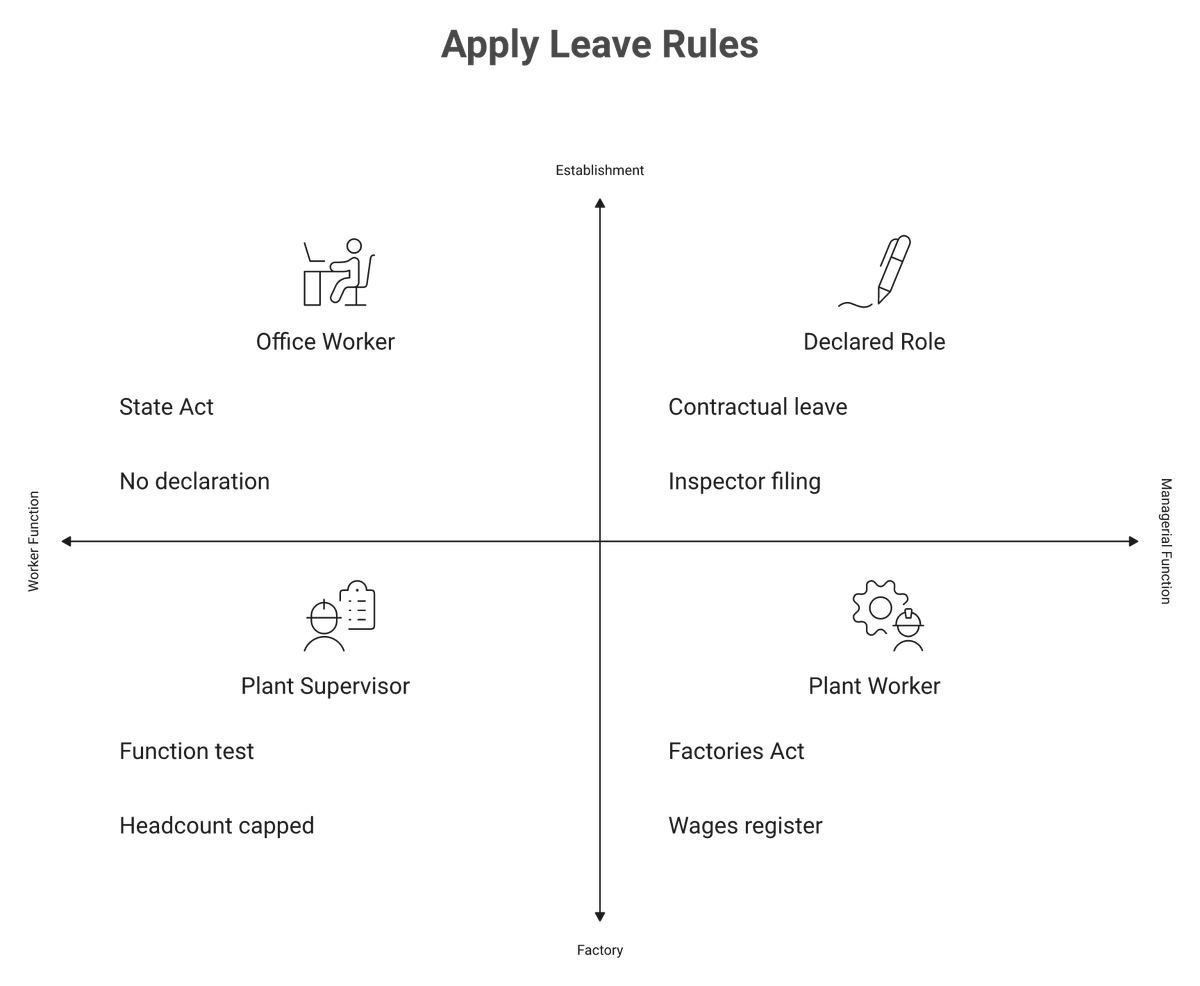
Coverage turns on two questions. An office, software firm, or professional consultancy is an "establishment" under the 2019 Act, while a manufacturing unit falls under the Factories Act, 1948 instead. Within an establishment, "worker" covers manual, unskilled, skilled, technical, operational, and clerical work, which captures most white collar hires. Managerial and confidential staff must be declared separately to the Inspector in Form-S and Form-T under the Gujarat Shops and Establishments Rules, 2020.
Axis one: establishment or factory
🏢 Where your office lands
The Act's own definition of establishment names medical practitioners, architects, engineers, accountants, tax consultants, and "any other technical or professional consultant." A Gujarat product team sits squarely inside that definition.
A plant does not. Factories run on Section 79 of the Factories Act, 1948, read with the Gujarat Factories Rules, 1963, with a different accrual rate for adults and a separate Leave with Wages Register. Versatile Club employs client staff through its own registered Indian entity, Foo Falcon Technologies Pvt Ltd, so the establishment classification is fixed at the point of hire rather than discovered during an inspection.
👤 Axis two: worker, manager, or confidential role
Section 2(s) defines worker broadly, including people engaged through an outsourcing agency, and excludes only apprentices under the Apprentices Act, 1961. Titles do not decide the question. Function does, which is why how the employment relationship is structured matters more than the job title.
Gujarat makes you put that judgment in writing. Rule 32 requires Form-S naming persons discharging managerial functions. Rule 33 requires Form-T for persons in positions of confidential character, capped at one percent of total workers and a maximum of fifty people.
The exclusions, and the central law overlay
📋 Who sits outside the Act
Section 3 excludes Central and State Government establishments, local authorities, Reserve Bank of India offices, workers whose work is inherently intermittent, and family members of the employer. The list of the last two categories must be displayed at the establishment and a copy sent to the Inspector.
Separately, the Industrial Relations Code, 2020 defines worker to include supervisory staff drawing wages up to 18,000 rupees per month, which sets a different line for dispute and termination protections than the leave line above.
| Your hire | Governing statute | Leave clock | Declaration |
| Software engineer, Ahmedabad office | Gujarat S&E Act, 2019 | s.18 buckets | - |
| Engineering manager, same office | Gujarat S&E Act, contract terms | Contractual, above floor | Form-S |
| Finance analyst with confidential access | Gujarat S&E Act | s.18 buckets | Form-T |
| Plant technician, Vadodara unit | Factories Act, 1948 | s.79 accrual | Factory register |
🧭 The mistake US offer letters import
American offer letters carry an exempt or non-exempt assumption that has no Indian equivalent. Across the C2H placements Versatile Club has converted to full time in Bengaluru, Hyderabad, and Pune, the pattern I keep seeing is senior titled engineers who are legally workers. Where the brief material points one way and my own read points another, I go with the statutory function test, though I will say I have seen counsel disagree at the margins on confidential-role classification.
Versatile Club classifies every India hire by establishment type and worker status before the offer letter goes out, because that category decides which leave clock, which register, and which exit rules apply.
Q3. Which central laws stack on top of Gujarat's state leave rules?
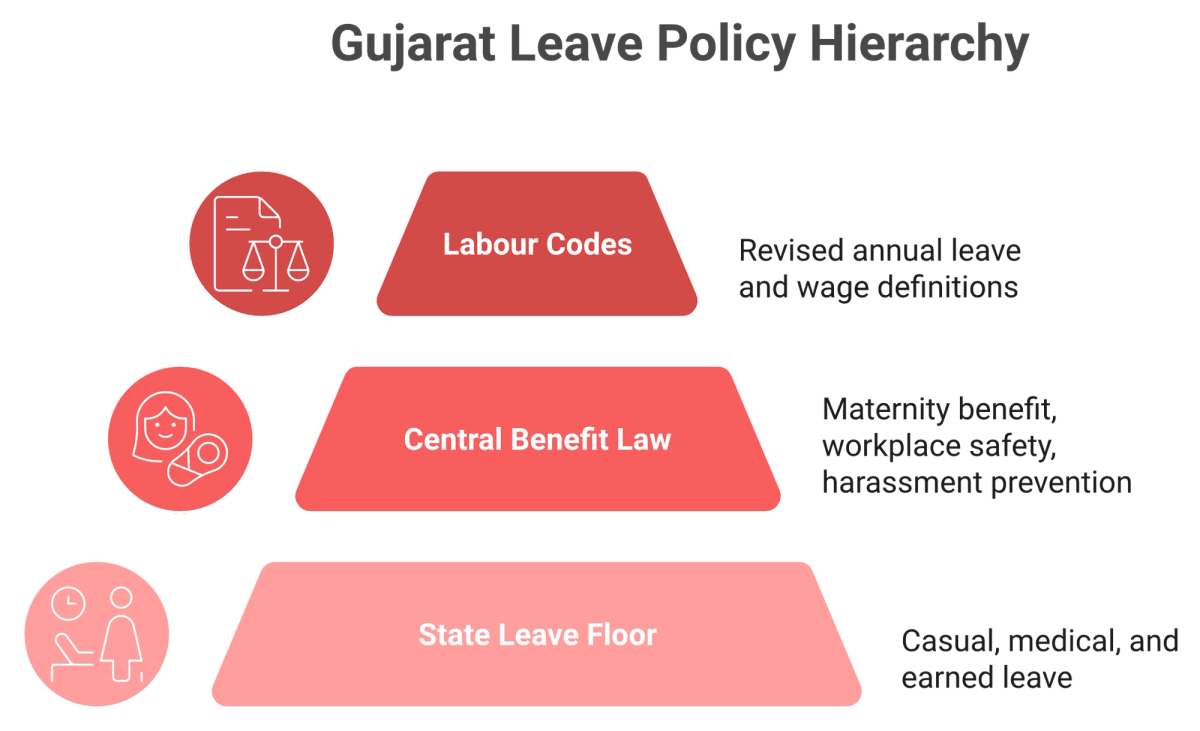
Gujarat sets the baseline and central law layers on top. Maternity benefit is 26 weeks for eligible women who have worked at least 80 days in the preceding 12 months, with a medical bonus, nursing breaks, and protection from dismissal during maternity absence, per the Ministry of Labour and Employment compliance handbook for employers under the four labour codes. Section 36 of the Gujarat Act preserves any right more favourable to the worker under another law, contract, custom, award, or settlement, so the higher entitlement prevails. Versatile Club administers maternity benefit, POSH Internal Committee formation, and crèche-threshold tracking under its own registrations.
The stack, top to bottom
🧱 Three layers, one tiebreaker
Layer one is the state floor, Section 18. Layer two is central benefit law, principally the Maternity Benefit Act and the POSH Act, 2013. Layer three is the labour codes, now in force.
The tiebreaker is not judgment. Section 36 settles it in favour of whichever instrument treats the worker better, a rule that shapes every HR policy build we do for a Gujarat team.
🤰 The maternity and safety block
Twenty six weeks is the current entitlement, with 80 days of prior work as the eligibility test and a medical bonus payable where pre-natal and post-natal care is not provided free. Older compliance manuals still print the pre-2017 figure of 12 weeks plus one month for pregnancy related illness, which is why legacy handbooks understate the liability.
Three Gujarat specific overlays matter. Crèche facilities are required where 30 or more women workers are employed. Night work between 9 pm and 6 am requires written consent in Form-J, safe door to door transport, at least three women on the shift, and a functioning sexual harassment committee. Maternity leave also counts toward the 240 day qualifying period under Section 18(8), though those days do not themselves earn leave.
What buyers report when this layer is handled by software alone
💬 Leave and parental leave breakage in the wild
Leave is where thin platform logic surfaces first, because parental leave is the edge case nobody tests.
"requesting HR documents via form didn't work, and I can't request vacations because it doesn't work either with partial parental leave."
— Daryna R., Verified User, 6 May 2024, Deel - G2 Verified Review
"some features feel a bit limited and could use more flexibility. In particular, I'd like to see better options for customization and more detailed reporting."
— Vinay M., Verified User, 18 February 2026, Wisemonk - G2 Verified Review
🧩 A worked conflict, and the cover plan
Say your policy grants 12 weeks of parental leave globally. Section 36 makes the 26 week central entitlement win for an eligible woman in Gujarat. Write the policy above the floor and the conflict never arises.
On a 12 person India team, a 26 week absence is a staffing problem, not a legal one. Versatile Club bridges those seats with contract-to-hire recruitment carrying a 6 month replacement guarantee, rather than leaving the role open and pushing the work onto the remaining four engineers.
Versatile Club drafts client leave policies above the statutory floor and issues Form 16 and POSH committee records under its own registrations, which is what keeps a central amendment from turning into a handbook rewrite.
Q4. Is it still 240 days, or 180 days, after the labour codes?
Both thresholds are live. The Occupational Safety, Health and Working Conditions Code, 2020 took effect on 21 November 2025 and gives every worker the option of availing annual leave after 180 days of work in a year, while the Gujarat Act's 240 day test remains on the statute book. Until Gujarat aligns its rules, accrue at the 180 day trigger and keep the state accumulation cap. Versatile Club moved client accrual logic to the 180 day trigger while retaining state carry-forward ceilings.
The news, and the two numbers
📅 What changed on 21 November 2025
All four labour codes were brought into force on that date, and the annual leave provision is one of the few changes an employee will notice on a payslip. The eligibility threshold drops from 240 days to 180 days.
The Gujarat Act was not repealed by that notification. Section 18(4) still reads 240 days, which is exactly the kind of overlap our India payroll compliance work has to resolve every cycle.
⚖️ Reading the two together
Practitioner commentary on the codes is consistent that state Shops and Establishments Acts continue to operate alongside the central framework, so the two must be read harmoniously rather than one replacing the other. Section 36 of the Gujarat Act points the same way, since it protects the more favourable right.
My operating rule is simple. Where two thresholds coexist, adopt the one an employee cannot challenge, and write down why you chose it.
What section 18(8) already counts
🧮 Days that qualify even when nobody worked
The 240 day count is not the same as attendance. Section 18(8) deems the following to be worked days for threshold purposes, while not earning leave themselves: authorised lay-off days, maternity leave for women workers, leave earned in the prior year and availed this year, and absence from temporary disablement caused by an employment injury.
That mirrors the wider Indian position on qualifying-period computation, which also folds in lay-off and maternity periods up to 12 weeks.
💬 What buyers say about tracking this correctly
Leave arithmetic is where platform detail either holds or quietly fails.
"The way annual leave is recorded is strange, it automatically logs weekend days, so this has incorrectly logged my leave. There is no way to edit so I have had to reach out to support for the leave to be deleted."
— Verified User in Non-Profit Organization Management, 30 April 2026, Pebl, formerly Velocity Global - G2 Verified Review
"The initial documentation and paperwork felt quite detailed and time-consuming at the beginning. However, as we progressed, it became clear that this thoroughness is what ensures proper legal and compliance coverage."
— Verified User in Marketing and Advertising, 12 February 2026, Wisemonk - G2 Verified Review
Versatile Club already structures CTC so that Basic plus DA is at least 50 percent of total pay under the labour codes, and applies the 180 day accrual trigger with the Gujarat cap intact, so an employee never sees two competing leave balances on one payslip. Buyers comparing India-only depth against a global platform can start with our Wisemonk alternative and Deel alternative breakdowns.
Q5. How do carry-forward and encashment work, and what do they cost?
Earned leave in Gujarat is paid at a rate equal to the daily average of wages for the days a worker actually worked during the preceding three months, excluding overtime earnings. Section 18(5) of the Gujarat Shops and Establishments (Regulation of Employment and Conditions of Service) Act, 2019 permits accumulation up to 63 days. Where an employer refuses leave that was applied for 15 days in advance, the worker gains a right to encash leave in excess of 63 days. Versatile Club itemises leave encashment, notice pay, gratuity, and provident fund as separate lines in every full and final settlement.
The formula, and the conflict inside it
💰 How the payout is actually computed
Take the wages for days worked over the last three months, divide by those days, and you have the daily rate. Overtime does not count. The comparable factories-side rule uses the month immediately preceding the leave, and falls back to the last month the worker actually worked if the recent month was blank.
Versatile Club calculates this from attendance and payroll data in the same monthly cycle that produces provident fund challans, rather than reconstructing it at exit, which is the discipline our managed payroll service is built around.
⚠️ 63 days in the Act, 45 days in the form
Here is a conflict almost nobody covers. Section 18(5) of the Act says accumulation runs to 63 days. Form-O under rule 18 of the Gujarat Shops and Establishments Rules, 2020, which is the notice you serve when someone hits the ceiling, prints: "the maximum leave that can be accumulated is for 45 days."
The Act prevails over a form, and Section 36 protects the more favourable right. My operating position is to accrue to 63 days and still serve the Form-O notice, because a form printed with a lower number is not a defence for paying less. I could be reading Section 36 more aggressively than counsel would, so this is one to confirm with your own adviser, or with our HR consulting team.
What the 50 percent wage rule does to the number
💸 Same balance, bigger cheque
The labour codes require basic pay plus dearness allowance (a cost of living component) to be at least half of total remuneration. Leave encashment sits on that base, so restructuring pay raises the payout without anyone changing the leave policy. Buyers modelling this ahead of a hire often start with the India salary calculator.
| Employee with 40 days accrued | Old split, basic at 30 percent | New split, basic plus DA at 50 percent |
| Annual pay | 12,00,000 rupees | 12,00,000 rupees |
| Monthly basic plus DA | 30,000 rupees | 50,000 rupees |
| Approximate daily rate | 1,000 rupees | 1,667 rupees |
| 40 day encashment | 40,000 rupees | 66,680 rupees |
This model uses a 30 day monthly divisor as a planning proxy. The statutory calculation uses days actually worked in the preceding three months, so your real figure will differ slightly.
⏰ When the payout becomes non optional
The proviso to Section 18(6) is blunt. If a worker is discharged before taking due leave, or applies, is refused, and then leaves through retirement, resignation, death, or permanent disability, the employer pays full wages for the leave due.
Buyers notice when settlement arithmetic is opaque.
"I dislike how expensive Deel's transaction fees are, especially when moving money from the Deel account to my bank or wherever else it needs to go."
— Maria M., Verified User, 26 September 2025, Deel - G2 Verified Review
"We had to carefully manage our agreement and had to constantly remind them of the fees agreed so that we weren't over charged. Everything was VERY time consuming."
— Verified User in Information Technology and Services, 13 December 2024, Deel - G2 Verified Review
Versatile Club accrues gratuity monthly at 4.81 percent of basic plus dearness allowance and reports leave balances on the same USD invoice, so a CFO sees the liability building instead of meeting it in an exit spreadsheet. Our pricing page shows exactly what sits on that invoice.
Q6. How many holidays and weekly offs do you owe in Gujarat in 2026?
The Gujarat Shops and Establishments Act, 2019 guarantees eight paid festival holidays, being 26 January, 15 August, 2 October, and five more agreed between employer and workers before the year commences, plus a weekly holiday of at least 24 consecutive hours of rest. Gujarat's General Administration Department notified the 2026 public holiday list on 27 November 2025 under notification GS/22/2025/JSR/2025/509/GH, declaring 23 public holidays alongside an optional holiday pool from which an employee may elect two.
Two lists, two different jobs
📅 Why the numbers never match
The statutory eight are an employer obligation under the Act. The state list is a government declaration for its own offices, which private employers use as a reference and a cultural baseline.
Neither list replaces the other. Versatile Club reconciles both for every client establishment, then records the five elected festival holidays in writing before the calendar year starts, which is the document an Inspector asks for, and it forms part of the India compliance file we maintain.
🗓️ The agreement has to happen early
Section 18(7) requires those five to be agreed before the year begins, not chosen in March when someone requests Rathayatra off. Miss that window and you are negotiating mid year with no statutory footing.
| Obligation | Source | Count |
| National festival holidays | Section 18(7), fixed | 3 |
| Agreed festival holidays | Section 18(7), agreed pre year | 5 |
| Weekly holiday | Sections 18(1) and 16(2) | 1 per week |
| State declared public holidays 2026 | GAD notification, 27 Nov 2025 | 23 |
| Optional holidays electable | GAD notification, 27 Nov 2025 | 2 of the pool |
The mechanics people get wrong
⚠️ Weekly off, denial, and the two month clock
An establishment may operate all seven days, provided each worker still gets 24 consecutive hours of rest. If a weekly holiday is denied, compensatory leave must be given within two months. Work on a rest day attracts wages at twice the ordinary rate.
The weekly off schedule is not informal. It goes on a Form-K notice showing each worker's holiday day, and shift schedules are communicated in writing and sent to the Inspector.
💰 Working a festival holiday costs double, plus a day
Under the proviso to Section 18(7), an employer may require work on a festival holiday only by paying double the ordinary rate and granting leave on another day in lieu. It is not a choice between the two.
Across the placements Versatile Club has run in Bengaluru, Hyderabad, and Pune, the sprint that quietly breaks is the one planned in a US calendar tool that has never heard of Uttarayan or Gujarati New Year. I publish the India calendar to clients in December for exactly that reason, and it goes out with every India hiring onboarding pack.
Versatile Club issues each client a locked India holiday calendar with the festival holiday election recorded in writing before 1 January, alongside the Form-K weekly off notice for the establishment.
Q7. Can you run unlimited PTO on a Gujarat team?
Not as your system of record. The Gujarat Act requires an employer to credit seven days of casual leave and seven days of medical leave each calendar year, accrue earned leave at one day per 20 days worked, cap accumulation, and maintain prescribed registers and a Leave Book in Form-N for every worker. Discretionary leave can sit above that floor. Versatile Club maintains the statutory leave ledger and Form-N leave book under its own registrations while clients run whatever additional policy they prefer.
The statutory blocker
📕 An untracked policy is an unprovable one
Unlimited leave, by design, removes the balance. Gujarat law requires the balance to exist, in writing, in a specific form, available on demand in hard copy during inspection.
You cannot compute a 240 day or 180 day threshold without attendance data. You cannot prove a 63 day ceiling was respected without a ledger. Versatile Club runs both calculations monthly rather than annually, because a year end reconstruction is where the gaps show up, and that cadence is part of how our EOR model works.
⚠️ Where it also breaks in diligence
Leave liability is a balance sheet item. In the CFO conversations I sit in during fundraises, the question is never "what is your policy," it is "show me accrued leave by employee." An unlimited policy has no answer to that question.
The cultural blocker
👥 Less time off, not more
The honest argument against unlimited leave in India is not legal, it is behavioural. In a workplace where an engineer asks permission before a dinner break, removing the allotment removes the permission. A fixed, expiring entitlement is a signal that taking it is expected.
What Indian employees actually report is a floor that is already thin.
"Each year, we are allotted 12 days off (which encompasses casual leave, sick leave, and paid leave) along with 10 public holidays, both national and regional."
— Commenter, r/IndianWorkplace, 18 January 2025, Reddit Thread
"Sandwich leave refers to a situation where if you request time off on a Friday and the following Monday, the company counts it as a deduction of four leave days rather than two."
— Commenter, r/bangalore, 4 October 2022, Reddit Thread
✅ What to run instead
Four moves, in order.
Keep the statutory three ledgers exactly as the Act defines them.
Add a discretionary top up above the floor, with a stated number.
Have the founder and managers visibly take leave, and say so in writing.
Replace "are you on schedule" with "where are we on the schedule," then recap the answer by email.
The last one sounds unrelated. It is not. High context teams rarely refuse a deadline directly, so overwork hides inside polite agreement, and the leave balance is where it surfaces.
Versatile Club pairs the statutory ledger with a 90 day Success Coach check in and a 50 parameter culture fit assessment at hiring, because compliance records tell you what was credited, not whether anyone felt able to use it.
Q8. What leave records must you keep, and what happens if you don't?
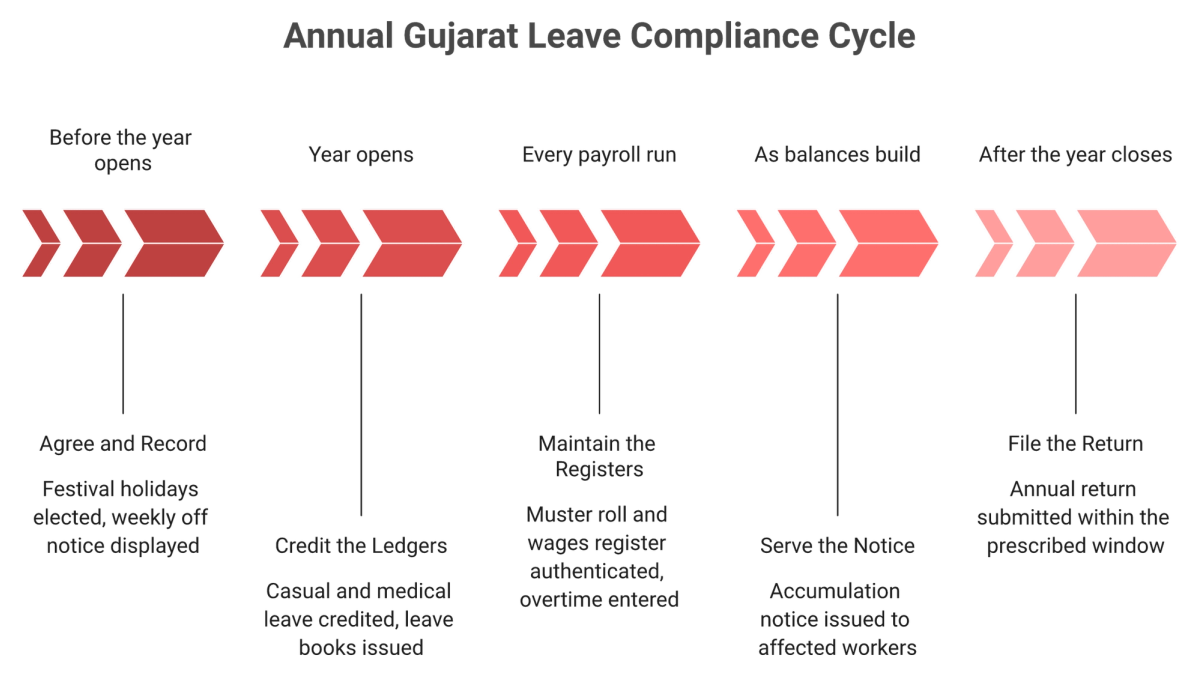
Every worker in Gujarat must be issued a Leave Book in Form-N. Employers maintain a Muster Roll cum Wages Register in Form-P, or Form-B and Form-D under the Ease of Compliance to Maintain Registers under various Labour Laws (Gujarat) Rules, 2017, serve the Form-O accumulation notice, and file the Form-Q annual return within one month of the calendar year ending 31 December. Versatile Club supplies monthly provident fund and employees' state insurance challan confirmations plus a filed versus upcoming compliance status report to every client.
The artefacts, with deadlines
📋 What sits in the file
Form-N Leave Book, issued to each worker, with a copy retained by the employer.
Form-O notice of maximum leave accumulated, served on affected workers.
Form-P Muster Roll cum Wages Register, authenticated digitally or manually, with overtime entered immediately.
Form-Q annual return, filed online where available, within one month of 31 December.
Form-K weekly holiday notice, Form-J night shift consent, Form-S managerial declaration, and Form-T confidential roles.
Factories track: Leave with Wages Register, now Form 19 under the Gujarat Occupational Safety, Health and Working Conditions Rules, 2025.
🗂️ Language, location, and retention
Registers and notices must be in Gujarati or English. They are kept at the premises to which they relate, and a separate set is maintained for any godown, warehouse, or workplace at another address. Inspection records are preserved for five years.
Versatile Club holds these records under its own Shops and Establishments registrations across all 28 states, which is why a client's India file does not fragment when they hire in a second state, and it is the reason teams switching EOR providers in India ask for the register set first.
Enforcement, priced
⚠️ What a breach actually costs
Running without registration attracts a 10,000 rupee penalty inclusive of registration fees. General contravention attracts a fine up to 50,000 rupees, capped at 2,000 rupees per worker employed. Obstructing an Inspector or refusing to produce a register carries the same 50,000 rupee exposure.
Inspection now runs on a state scheme that can generate a web based inspection schedule, so selection is not purely complaint driven. Compounding is available, but the fee cannot be less than 75 percent of the maximum fine for the offence, and a court takes cognizance only on an Inspector's complaint within three months of knowledge.
💬 Why responsiveness is part of the record
When a diligence request lands, the constraint is rarely the law. It is how fast someone can produce the challan.
"Sometimes the email communication from the wisemonk team is delayed by a day or 2. But overall they seem to be the best for India."
— Bulbul G., Verified User, 19 February 2025, Wisemonk - G2 Verified Review
"Ofter the CS doesn't seem to have answers, which leads me to emails back and forth on my case which don't always alnswer the question and something I was looking for the answer to in 20 minutes becomes a 4 day process."
— Verified User in Computer Software, 16 September 2024, Deel - G2 Verified Review
Versatile Club sends challan numbers and filing receipts each month rather than a compliance assertion, and the founder answers document requests on WhatsApp, which is the difference between a two hour diligence reply and a four day one. If you want to see the record format before committing, talk to us about a sample compliance pack.
Q9. How do you run one leave policy across Gujarat and the rest of India?
Write one India leave policy at or above the highest state entitlement you employ against, then attach a short state overlay for what genuinely differs: qualifying threshold, carry-forward cap, lapse rules, festival holiday count, and register format. Gujarat's 63 day accumulation ceiling under Section 18(5) is a Gujarat number, not a national one. Versatile Club holds Shops and Establishments registrations across all 28 states and 8 union territories under its own Indian entity.
The failure mode is reconciliation, not drafting
🧩 Why the vendor stack creates the problem
The People Ops leaders I talk to rarely have a policy problem. They have four invoices, two portals, and a leave balance that nobody owns. Payroll sits with one vendor, benefits with another, and equipment with a third.
Versatile Club employs the person directly through Foo Falcon Technologies Pvt Ltd, so the leave ledger, the payroll register, and the statutory filing all sit in one place. That is the whole reason a single USD invoice is possible, and it is the core of our EOR services in India.
📐 The method: one floor, thin overlays
Set the global floor above every state minimum you touch. Then let the overlay carry only the variables that actually change. Teams weighing this against incorporation usually run the numbers through our EOR versus entity calculator first.
| Variable | Gujarat position | Why it varies |
| Qualifying threshold | 240 days in the Act, 180 under the labour codes | State Act versus central code |
| Accumulation cap | 63 days, Section 18(5) | State specific |
| Casual and medical leave | 7 plus 7, lapsing | State specific |
| Statutory leave record | Form-N Leave Book, Form-Q annual return | State rules prescribe forms |
| Professional tax cycle | Monthly in Karnataka, dual PTRC and PTEC in Maharashtra, and biannual in Tamil Nadu | State tax administration |
Where generalist coverage thins out
⚠️ Partner entities and metro only footprints
Most global platforms serve India through local partner entities rather than an owned one, and their practical state coverage clusters in the top metros. That is fine until you hire in Vadodara or GIFT City, where the registration, the Inspector, and the forms are Gujarat's. It is also why India payroll outsourcing breaks down once a second state enters the picture.
One more thing worth saying plainly. US style co-employment, where a professional employer organisation shares employer status with you, has no equivalent in Indian labour law. Either an entity employs the person or it does not, which is the distinction we unpack in our EOR versus PEO comparison.
💬 What buyers report about the seams
"It took three months to onboard our first 3 individuals. They didn't seem to be able to navigate Visas or variations to employment contracts."
— Verified User in Information Technology and Services, 13 December 2024, Deel - G2 Verified Review
"I've noticed that their support/query responses can occasionally take a bit longer sometimes, likely due to a relatively small team."
— Verified User in Financial Services, 14 June 2025, Wisemonk - G2 Verified Review
"They are now responsible for payroll and compliance, simplifying the process of hiring globally in India."
— Commenter, r/indianstartups, 31 January 2025, Reddit Thread
The comparison, and the honest limits
💰 Five questions to ask any provider
| Criterion | Versatile Club | Deel | Remote | Multiplier |
| India entity | ✅ Owned | ❌ Local partner | ❌ Local partner | ❌ Local partner |
| Per employee monthly | ✅ 149 USD | 599 USD | 599 USD | 400 USD |
| States covered | ✅ All 28 | ❌ Top 6 | ❌ Top 4 | All 28 |
| Onboarding commitment | ✅ 5 day contractual SLA | ❌ 7 to 14 days | ❌ 10 to 14 days | 7 days |
| Setup and exit fee | ✅ None, first month free | 500 USD setup | 299 USD setup | None |
Ask each one: which legal entity signs the contract, which states are you registered in, who files the Form-Q, how is leave encashment accrued, and who answers at 11 pm before payroll. Side by side breakdowns sit on our Deel alternative and Multiplier alternative pages.
❌ Where Versatile Club is the wrong call
Versatile Club operates only in India. If you need five countries on one contract, a generalist is the right buy. If procurement requires SOC 2 or ISO 27001 certification as a gate, or you are staffing a 100 plus person India centre today, we are not the fit, and I would rather say that now than in month three. For larger India centres, the GCC setup path is usually the better conversation.
Versatile Club is the legal employer through its own registered Indian entity, files under its own provident fund, employees' state insurance, and Shops and Establishments registrations in all 28 states, and issues one USD invoice with the leave and statutory lines itemised. If that is the model you want, book a 30 minute call and bring your current leave ledger.
FAQs
How many leaves are employees legally entitled to in Gujarat?
Gujarat splits statutory leave into three separate accounts, not one pooled balance.
- Casual leave: 7 days, credited at the start of the calendar year, lapsing if unused.
- Medical grounds leave: 7 days, credited the same way, also lapsing.
- Earned leave: one day for every 20 days worked, available in the following year once a worker completes 240 days.
- Festival holidays: 8 paid days, being 26 January, 15 August, 2 October, and five agreed before the year begins.
- Weekly holiday: at least 24 consecutive hours of rest.
Earned leave accumulates up to 63 days. Fractions of half a day or more round up to a full day.
The practical trap is the lapse rule. A US built HRIS carries paid time off forward by default, so casual and medical leave quietly roll over when Gujarat law says they expire on 31 December. Versatile Club configures Gujarat leave as three separate ledgers under its own Shops and Establishments registrations, which is the fix we most often apply when a client migrates off a US payroll template. If you want the ledger, the registers, and the filings held by a single employer of record, our India EOR service covers all of it.
Is leave encashment mandatory in Gujarat, and how is it calculated?
Encashment is mandatory in defined situations, not optional goodwill.
- Where an employer refuses earned leave that was applied for 15 days in advance, the worker gains a right to encash leave above the 63 day ceiling.
- Where a worker is discharged before taking due leave, or applies, is refused, and then exits through retirement, resignation, death, or permanent disability, full wages for leave due must be paid.
The rate is the daily average of wages for days the worker actually worked in the preceding three months, excluding overtime earnings.
The cost has moved. Because the labour codes require basic pay plus dearness allowance to be at least half of total remuneration, the base used for encashment is larger than it was under older salary structures. On a 40 day balance, the same annual pay can produce a materially bigger payout purely from the restructured split.
Versatile Club itemises leave encashment, notice pay, gratuity, and provident fund as separate lines in every full and final settlement, and accrues gratuity monthly at 4.81 percent of basic plus dearness allowance. You can model the salary structure behind these numbers using our India salary calculator before the offer goes out.
Does the 240 day rule still apply in Gujarat after the new labour codes?
Both thresholds are currently live, and that is the honest answer.
- The Occupational Safety, Health and Working Conditions Code took effect on 21 November 2025 and allows a worker to avail annual leave after 180 days of work in a year.
- Section 18(4) of the Gujarat Act still reads 240 days and has not been repealed.
Practitioner commentary is consistent that state Shops and Establishments Acts continue to operate alongside the central codes, so the two are read together rather than one replacing the other. Section 36 of the Gujarat Act points the same way, because it preserves whichever right is more favourable to the worker.
Worth knowing: the 240 day count is not pure attendance. Authorised lay off days, maternity leave, prior year earned leave availed this year, and absence from an employment injury all count toward the threshold without themselves earning leave.
Versatile Club moved client accrual logic to the 180 day trigger while retaining the state accumulation cap, so no employee sees two competing balances on one payslip. Teams reviewing their India payroll settings against the codes can start with our India payroll compliance guide.
Can we offer unlimited PTO to our team in Gujarat?
You can offer discretionary leave above the statutory floor, but unlimited PTO cannot be your system of record in Gujarat.
The law requires a tracked balance to exist:
- Casual and medical leave must be credited in fixed amounts at the start of the year.
- Earned leave must be accrued against days actually worked.
- A Leave Book in Form-N must be issued to every worker, with prescribed registers available in hard copy during inspection.
You cannot compute a 240 day or 180 day threshold without attendance data, and you cannot prove a 63 day ceiling was respected without a ledger. During fundraising diligence, the question is never what your policy says, it is show me accrued leave by employee.
There is a cultural argument too. In hierarchical Indian workplaces, removing the allotment removes the permission, and unlimited policies reliably produce less time off rather than more. A fixed, expiring entitlement signals that taking leave is expected.
Versatile Club maintains the statutory ledger and Form-N leave book under its own registrations while clients run whatever generous top up policy they prefer, and pairs it with a 90 day Success Coach check in. Our HR consulting team helps draft the top up layer above the floor.
Which leave records must a Gujarat establishment maintain, and what are the penalties?
The paperwork trail is specific, and inspectors ask for it by form number.
- Form-N: Leave Book issued to each worker, with a copy retained by the employer.
- Form-O: notice of maximum leave accumulated, served on affected workers.
- Form-P: Muster Roll cum Wages Register, or Form-B and Form-D under the 2017 Ease of Compliance Rules, with overtime entered immediately.
- Form-Q: annual return, filed within one month of the calendar year ending 31 December.
- Factories track: Leave with Wages Register, now Form 19 under the Gujarat Occupational Safety, Health and Working Conditions Rules, 2025.
Registers must be in Gujarati or English, kept at the premises they relate to, and inspection records preserved for five years.
On penalties, operating without registration attracts 10,000 rupees inclusive of fees. General contravention attracts up to 50,000 rupees, capped at 2,000 rupees per worker. Compounding is available but cannot be settled below 75 percent of the maximum fine.
Versatile Club supplies monthly provident fund and employees' state insurance challan confirmations plus a filed versus upcoming compliance status report, which is what survives investor diligence. See what that record set includes on our compliance page.