Table of contents (11)
Leave Policy in Karnataka: Types, Rules and Employee Entitlements
Q1. Which laws actually govern leave for your team in Karnataka?
A US founder messaged me on WhatsApp last year, three days before her Bengaluru engineer's first payroll. Her handbook said "15 days PTO, use it or lose it." Her India contract said the same thing. Neither line matched what Karnataka law actually requires, and neither would have survived a labour inspector's visit.
Chapter IV of the Karnataka Shops and Commercial Establishments Act, 1961 governs leave for offices and commercial establishments. The Factories Act, 1948 covers factories. A separate 1963 state Act covers paid holidays, and maternity leave comes from central law. The four Labour Codes sit above all of it from 21 November 2025. Where two laws overlap, the more favourable entitlement wins.
⚠️ Why a US handbook fails on contact with Indian law
In the US, paid time off is a policy choice. In Karnataka, it is a penal statute. Contravening the leave provisions carries a fine on conviction, and prosecution runs on a written complaint from a Labour Inspector.
Leave here is not an HR guideline. It is a set of statutory mandates with a fixed wage formula and register requirements attached. That distinction is the whole reason this article exists, and it is the first thing we cover in our India compliance framework.
📚 The law stack, layer by layer
| Layer | Law | What it decides |
| State base | Karnataka Shops and Commercial Establishments Act, 1961 | Earned leave, sickness leave, leave wages for offices |
| State base | Factories Act, 1948, Sections 79 and 80 | Annual leave for factory workers |
| State holidays | Karnataka Industrial Establishments (National and Festival Holidays) Act, 1963 | Paid national and festival holidays |
| Central | Maternity Benefit Act, 1961 as amended | 26 weeks maternity leave |
| Central, above all | Four Labour Codes, in force 21 November 2025 | Annual leave threshold, wage definition, encashment |
✅ The two clauses that settle every conflict
Two saving clauses do the heavy lifting. Section 14 says that where a contract or award gives longer leave than the Act, the employee gets the longer leave. Section 35 preserves any right under another law, contract, or custom that is more favourable.
So you can always give more. You can never give less. That is the single rule a founder needs before reading another number in this article.
⭐ The one-line applicability test
Ask one question about each India hire. Do they sit in an office or a commercial setting, or do they work in a registered factory?
Office and commercial staff fall under the 1961 Act. Factory workers fall under the Factories Act. Holidays are decided separately by the 1963 Act, regardless of which of the two applies.
The first thing I audit in a new client's India contract is whether the leave clause states a rate or a flat number. Flat grants are where the exposure starts, because the statute never actually says "15 days."
Versatile Club is the legal employer on its own registered Indian entity, with PF, ESI, TDS, and professional tax filed under its own registrations, so every contract we issue through our EOR services in India carries Section 15 accrual language rather than a copied US flat-PTO grant.
Q2. How are employees categorised, and how do shops differ from factories?
A Bengaluru engineer sitting in an office is an employee of a commercial establishment under the 1961 Act. A production-line worker falls under the Factories Act, which requires 240 days of work in a calendar year before annual leave accrues. For paid holidays, the 1963 Act applies separately and covers supervisory, technical, and clerical staff, including apprentices.
🔍 There is no "white collar" category in Indian law
Buyers ask me a version of this constantly: how does an EOR handle state-specific compliance in India, Karnataka versus Maharashtra? The honest first answer is that you cannot answer it until you categorise the person.
"White collar" has no statutory meaning here. What matters is the establishment type and the nature of the work. The 1963 Holidays Act defines an employee in Section 2(2) as any person, including an apprentice, doing skilled, unskilled, manual, supervisory, technical, or clerical work for hire or reward.
⚖️ The three branches, in order
Office, agency, or commercial establishment in Karnataka. The Karnataka Shops and Commercial Establishments Act, 1961 applies. This covers almost every software, design, and operations hire, which is why it governs most placements we make when clients hire employees in India.
Registered factory. The Factories Act, 1948 applies, with its own 240-day qualifying period and its own carry-forward cap.
Industrial establishment for holidays. The 1963 Act applies on top, setting the paid holiday floor.
📊 Shops versus factories, side by side
| Dimension | Commercial establishment (1961 Act) | Factory (Factories Act, 1948) |
| Qualifying period | None stated for earned leave accrual | 240 days worked in the calendar year |
| Adult accrual rate | 1 day per 20 days worked | 1 day per 20 days worked |
| Young person or child rate | 1 day per 15 days worked | 1 day per 15 days worked (child) |
| Carry-forward cap | 45 days | 30 days (adult), 40 days (child) |
| Register | Form F under Rule 8 | Form 15 under the Factories Rules |
✅ What goes on the appointment order
Karnataka requires a written appointment order stating name, designation, wage scale, and terms of employment, served within thirty days of appointment under Section 16A. That document is where the category becomes real.
Versatile Club categorises every India hire against the applicable Act before the offer letter goes out, so the appointment order, the leave clause, and the register format agree from day one. You can see that sequence in how it works.
"WiseMonk's EOR service solved our biggest challenge, which was hiring employees in India without setting up a local entity. They manage employment contracts, statutory compliance, tax structure, and local regulations on our behalf."
— Verified User in Marketing and Advertising, Wisemonk G2 - Verified Review (3.5 stars, 12 February 2026)
"Versatile's Employer of Record India setup eliminated all of that. I get a single USD invoice, fully compliant employment contracts, and payroll runs on time every month."
— Vedant T., Founder, Versatile Club G2 - Verified Review (5 stars, 16 June 2026)
I categorise on day one because the category drives the register format, not just the leave count. Remote-first companies with no Karnataka office still register the establishment where the employee actually works.
Q3. What leave types must you actually provide, and is casual leave one of them?
Karnataka mandates earned leave accruing at one day for every twenty days worked by an adult, and up to twelve days of leave with wages for sickness or accident in each twelve months of continuous service. Casual leave is not a statutory category in Karnataka. Any CL you offer is a voluntary benefit. Maternity leave is twenty six weeks under central law.
📋 The leave types with a statute behind them
| Leave type | Entitlement | Statutory basis |
| Earned leave (adult) | 1 day per 20 days worked | Section 15(1)(i) |
| Earned leave (young person) | 1 day per 15 days worked | Section 15(1)(ii) |
| Sickness or accident leave | Up to 12 days per 12 months of continuous service | Section 15(3) |
| Casual leave | Not prescribed | Voluntary employer benefit |
| Maternity leave | 26 weeks for the first two children | Maternity Benefit Act, 1961 as amended |
❌ The casual leave myth, corrected
Several vendor pages print "12 days casual leave, Karnataka." Read Section 15 and you will not find it. The Act provides earned leave and sickness leave, and nothing else in that chapter.
This matters practically. If you promise CL in a contract, Section 14 makes that promise enforceable against you as a more favourable term. A voluntary benefit becomes a contractual obligation the moment you write it down, which is a point worth checking against your India payroll compliance baseline.
🩺 Sickness leave has a paperwork trigger
Sickness leave cannot be refused on timing grounds. If an employee asks for it late, the leave is still granted, and wages are paid within fifteen days of the leave beginning.
You may ask for proof, but only in writing. Rule 10 allows the employer to require a medical certificate from a registered or recognised practitioner stating the cause and the period of absence.
✅ What a defensible policy actually says
Write the rate, not the headline. State earned leave as an accrual, state sickness leave as a twelve-day ceiling per twelve months, and label casual leave openly as a company benefit.
Versatile Club's standard India contract sets leave at or above the Section 15 floor and labels each leave type by its statutory source, so voluntary benefits are never mistaken for mandates. Teams comparing vendors on this point often start at our Wisemonk alternative page.
"Wisemonk addresses the hassle of managing employees, tracking time, and running payroll across multiple tools by bringing everything together in a single system."
— Vinay M., Verified User, Wisemonk G2 - Verified Review (4 stars, 18 February 2026)
"PF, tax, the statutory filings, all the stuff I genuinely did not want to learn, they just handle it and keep it correct every month."
— Angad S., Founder, Versatile Club G2 - Verified Review (5 stars, 21 June 2026)
Clients arrive with a 12 CL plus 12 SL plus 15 EL handbook copied from a Bengaluru competitor. Only two of those three lines have a statute behind them, and the third one still binds you once it is signed.
Q4. Is it 12 days or 18? How earned leave is actually calculated
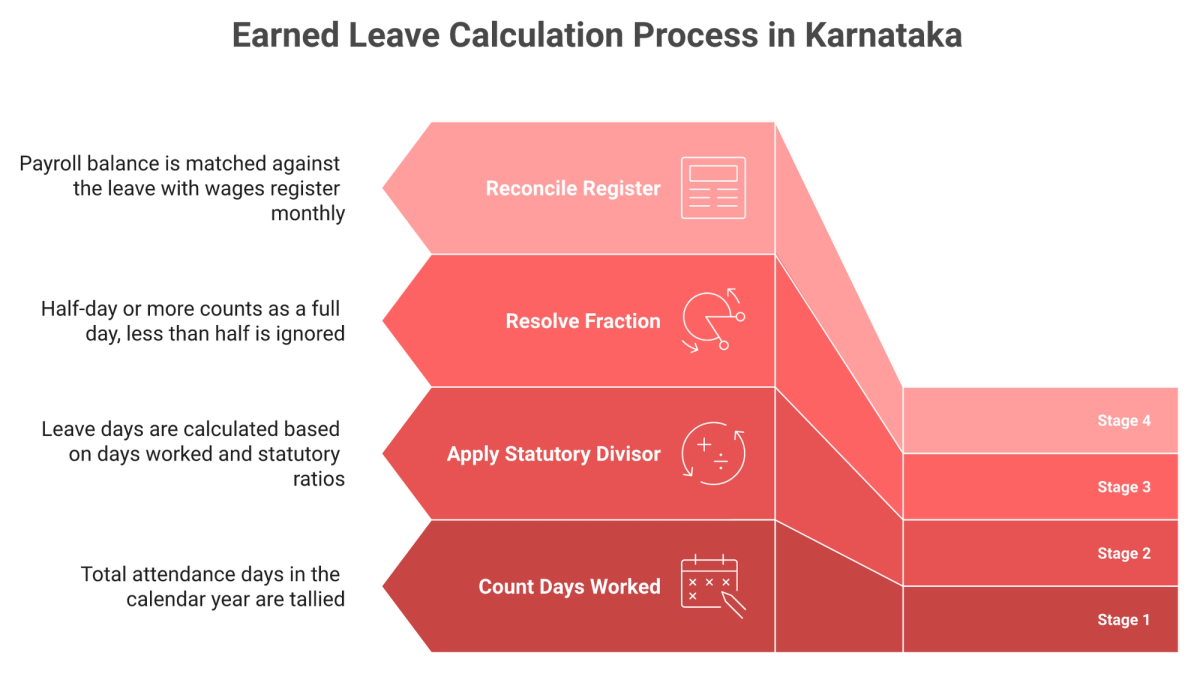
Neither number appears in the statute. Karnataka prescribes a rate, not a grant. Divide days worked by twenty. A 240-day year yields 12 days. A 300-day year yields 15. A fraction of half a day or more rounds up to a full day, and less than half is ignored. Versatile Club configures this as a monthly accrual parameter in payroll rather than a January grant, so a mid-year hire's balance reconciles to the statutory register every cycle.
➗ The divisor is the rule, the number is the output
Section 15(1) sets one day of leave with wages for every twenty days of work by an adult. A young person earns one day for every fifteen.
That is why two honest sources can print two different annual totals. They are assuming different numbers of working days. Neither total is wrong. Both are incomplete without the divisor.
🧮 Three joiners, three balances
| Joining date | Days worked in the year | Raw accrual | Statutory entitlement |
| 1 January | 300 | 15.0 | 15 days |
| 1 July | 150 | 7.5 | 8 days |
| 1 October | 78 | 3.9 | 4 days |
The rounding is not a courtesy. Section 15(6) treats a fraction of half a day or more as one full day and omits anything less.
⏰ What counts as a day worked
This is where most payroll configurations quietly go wrong. Three categories are deemed days worked even though nobody was at a desk.
Any day of lay-off, by agreement, under standing orders, or for reasons beyond the employer's control.
For a woman employee, maternity leave of up to twelve weeks.
Leave earned in the prior year and enjoyed in the current one.
The catch is in the same Explanation to Section 15(1). Those days count toward computing leave, but the employee does not earn fresh leave for that period.
✅ The parameter to set on Monday
Set accrual to 1 day per 20 days of attendance, calculated monthly, with half-up rounding applied at the point of grant. Feed lay-off and maternity days into the attendance count, and exclude them from fresh accrual. Teams running this in-house usually pair it with managed payroll so the parameter is owned by one team.
Then cross-check the output against the Form F register under Rule 8 every month. If the HRMS balance and the register disagree, the register is the one an inspector reads.
"The compliance work and payroll accuracy are what I pay for, and those are rock solid."
— Verified User in Information Technology and Services, Versatile Club G2 - Verified Review (5 stars, 23 June 2026)
"Some features feel a bit limited and could use more flexibility. In particular, I'd like to see better options for customization and more detailed reporting."
— Vinay M., Verified User, Wisemonk G2 - Verified Review (4 stars, 18 February 2026)
A July joiner does not get 18 days, and telling them otherwise creates a liability you will pay at exit. Versatile Club's read is that publishing the rate instead of the number is the single change that makes an India handbook audit-safe, and the arithmetic behind it sits inside our India salary calculator.
Q5. What happens to unused leave: carry-forward, encashment, and exit settlement?
Karnataka permits carry-forward of up to forty five days under the 2021 amendment, while the new central Code sets thirty days with encashment of the excess. Leave is paid at the daily average of full-time earnings for the preceding month, excluding overtime and bonus but including dearness allowance. On employer termination, payout is due before the second working day. Versatile Club accrues this liability monthly on the Section 16 basis and reports it as a line item on a single USD invoice.
💸 Why CFOs meet this number too late
The pattern is consistent. Nobody thinks about leave balances until an engineer resigns, and then finance discovers a payout nobody provisioned for.
Unused leave is not a dormant balance. It is deferred cash, sitting off the books until someone leaves or the year closes. Finance leads reviewing this alongside their cost of hiring in India usually find it as an unbudgeted line.
⚠️ The 45 versus 30 day conflict, resolved
Two rules now point in different directions. Section 15(7), as substituted by Act 08 of 2021 with effect from 19 February 2021, caps carry-forward at forty five days. The central Code caps it at thirty and requires the excess to be encashed.
The saving clauses decide it. Where a rule is more favourable to the employee, that rule applies. A forty five day carry-forward is more favourable than thirty, so the practical position for Karnataka establishments is: allow up to forty five, and encash anything above the Code threshold rather than lapsing it.
There is a second, quieter rule most policies miss. If an employee applied for leave and the employer refused it outside an approved scheme, that unavailed leave carries forward without any limit at all.
🧮 What forty five days actually costs
| Input | Value |
| Monthly Basic plus DA | ₹1,20,000 |
| Days worked in preceding month | 26 |
| Daily average under Section 16 | ₹4,615 |
| Carried balance | 45 days |
| Encashment exposure, one employee | ₹2,07,675 |
That is one senior engineer. Five of them, and you are carrying over ten lakh rupees of unfunded liability.
⏰ The payout clock nobody reads
Timing is statutory, not negotiable. Where the employer terminates, payment for untaken leave is due before the expiry of the second working day under Section 15(13). Where the employee resigns, it is due on or before the next pay day.
The wage base has one more wrinkle. If the employee did not work at all in the preceding calendar month, you fall back to the last month in which they actually worked.
✅ The monthly provision that fixes this
Book the accrual every month, not every December. Versatile Club measures the liability by multiplying each employee's current balance by their Section 16 daily average, and refreshes it on the same cycle as payroll, which is the same discipline we apply across managed payroll engagements.
"Invoicing in USD meant zero exchange rate surprises. The compliance rigour is genuinely impressive every statutory filing reviewed before submission."
— Vedant T., Founder, Versatile Club G2 - Verified Review (5 stars, 16 June 2026)
"I've noticed that their support/query responses can occasionally take a bit longer sometimes, likely due to a relatively small team."
— Verified User in Financial Services, Wisemonk G2 - Verified Review (4 stars, 14 June 2025)
Versatile Club shows accrued leave encashment as its own line on one USD invoice from its Indian entity, with no FX markup and no exit fee, so the settlement is already funded when the resignation lands. The full fee structure sits on our pricing page.
Q6. How many paid holidays are mandatory, and can you substitute them?
Ten paid holidays is the working floor in Karnataka. 26 January, 15 August, and 2 October are compulsory whole day holidays. Seven further festival holidays, including 1 May and 1 November, are chosen from the Schedule in consultation with employees. A paid holiday is also due on general election polling day. Working a holiday earns twice the wages, or normal wages plus a substituted holiday. Versatile Club runs this consultation and publishes the list for every client team before 31 December.
📅 What the Act actually prescribes
Section 3 of the Karnataka Industrial Establishments (National and Festival Holidays) Act, 1963 grants the three national days plus five other festival holidays. A proviso then raises that figure.
For any establishment not owned or controlled by the Government of India, the number of other holidays is seven, and it must include 1 May and 1 November. Three plus seven is where the ten comes from.
🗳️ The polling day holiday most handbooks miss
Section 3-A adds a separate entitlement. On a general election polling day for the Lok Sabha or the State Legislative Assembly, every employee on the electoral roll of that constituency gets a paid holiday.
This one sits outside your ten. It is not deducted from the festival list, and it is not optional.
💰 Working on a holiday costs double
If an employee works a holiday allowed under Section 3 or 3-A, the choice belongs to the employee, not the employer. They may take twice the wages under Section 5(2), or normal wages plus a substituted paid holiday on another day.
One eligibility filter applies. For festival holidays other than 26 January, 15 August, and 2 October, an employee must have thirty days of service within the ninety days immediately preceding the holiday. Weekly holidays and authorised leave count toward those thirty days.
✅ The annual sequence, in order
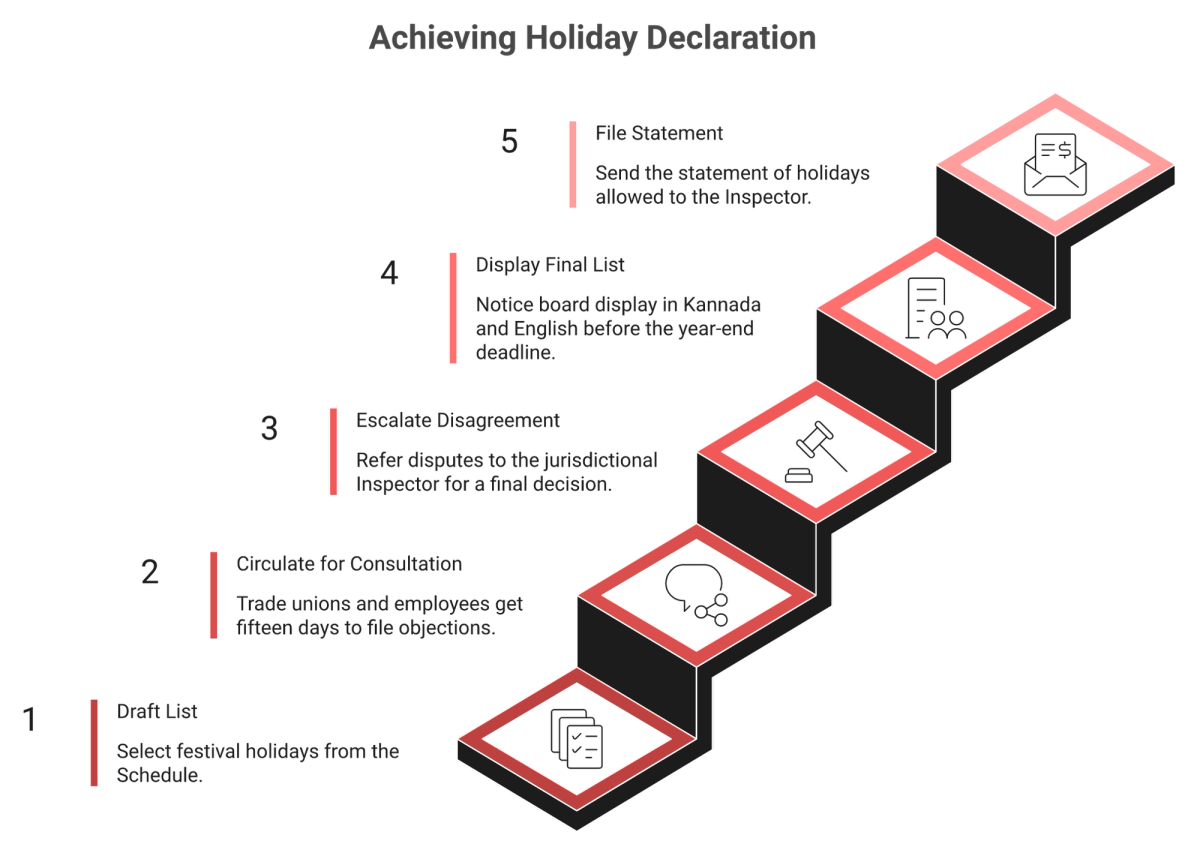
Prepare a tentative list from the Schedule of fifty two festivals.
Circulate it to the trade union, or to employees and their representatives where there is none, allowing fifteen days for objections.
Refer any disagreement to the jurisdictional Inspector, whose decision is final.
Display the final list in Kannada and English on the notice board, before 31 December for the succeeding year.
Send the statement of holidays to the Inspector for the area.
Steps two and four come straight from Rules 4 and 5 of the 1964 Rules.
⚠️ Where remote-first teams slip
Most distributed teams inherit last year's list from a spreadsheet. The consultation step gets skipped entirely, and so does the bilingual display. It is one of the recurring gaps we flag for companies that hire in India without an entity.
I understand why. When your engineer works from a flat in Indiranagar, a physical notice board feels absurd. The Rules still require the display, and an Inspector's first check is whether the statement of holidays was displayed and whether holiday wages were paid.
Versatile Club handles the consultation, the bilingual display, and the Inspector filing under its own Karnataka establishment registration, so each client's holiday list is defensible rather than inherited.
Q7. What did the 2025-26 Labour Codes change about leave?
The four Labour Codes took effect on 21 November 2025 through Ministry of Labour and Employment gazette notifications S.O. 5319(E), S.O. 5321(E), and S.O. 5322(E). Paid annual leave now triggers at 180 days of work in a calendar year instead of 240. Because Basic plus dearness allowance must be at least fifty percent of total wages, every leave payout is now computed on a larger base. Versatile Club re-ran each client salary structure against that wage rule before the first affected payroll cycle.
📰 What changed, and when
Four Codes replaced twenty nine central labour laws on the same date. The Code on Wages, the Industrial Relations Code, the Code on Social Security, and the Occupational Safety, Health and Working Conditions Code all commenced together.
Central rules under all four have since been notified, and several states, Karnataka among them, have moved on state rules. The transition is live, not pending, and it is the single biggest update to our compliance coverage in six years.
📊 Before and after, on the numbers that matter
| Parameter | Before 21 Nov 2025 | After 21 Nov 2025 |
| Annual leave qualifying period | 240 days worked | 180 days worked |
| Accrual rate | 1 day per 20 days | 1 day per 20 days (unchanged) |
| Carry-forward under central Code | Not specified | 30 days, excess encashed |
| Wage definition for payouts | Whatever the CTC split allowed | Basic plus DA at least 50% of wages |
| Karnataka carry-forward | 45 days | 45 days, more favourable rule applies |
💰 The wage definition matters more than the leave threshold
Most India leave articles report the 180 day change and stop there. That is the smaller story.
Statutory leave encashment is calculated on Basic plus DA. If your India salary structures previously ran Basic at 35 percent of CTC, and the floor is now 50 percent, the per day encashment value rises by roughly forty percent on an unchanged leave balance.
The same base drives gratuity accrual at 4.81 percent and PF at 12 percent. One wage definition change moves three liabilities at once, which is worth modelling before you compare EOR versus entity in India.
⏰ Who qualifies now who did not before
A mid year joiner is the clearest case. Somebody starting in early June can cross 180 working days inside the same calendar year.
Under the old threshold, they accrued but could not avail in year one. Under the new one, they can. I would not treat this as settled in every edge case, since state rules are still landing, but the direction is unambiguous.
✅ Five payroll parameters to edit
Change the leave eligibility trigger from 240 days to 180 days.
Restate Basic plus DA to at least fifty percent of wages.
Recalculate the encashment provision on the new base.
Refresh gratuity accrual at 4.81 percent of the revised Basic plus DA.
Reissue appointment letters where the wage split changed.
Versatile Club reissues the encashment provision as a separate line in the monthly USD invoice after any wage restructure, so a CFO sees the new liability in the close, not at settlement.
Q8. What registers must you keep, and what does an inspector check?
Employers in Karnataka must maintain the Leave with Wages Register in Form F, with Part I for earned leave and Part II for sick or accident leave, and preserve it for three years after the last entry. Each employee must also be given a Leave with Wages Book in Form H. An Inspector verifies that the leave provisions are properly observed. Versatile Club maintains both records for every client employee under its own establishment registration.
📁 An HRMS balance is not a statutory register
Keka, greytHR, Zoho Payroll, and RazorpayX all show a clean leave balance. None of them is, by itself, the register the law asks for.
Rule 8 requires Form F specifically. There is one escape hatch: if an Inspector is satisfied that an existing muster roll or register already carries the same particulars, he may direct in writing that it stands in place of Form F. That direction has to exist on paper.
🗂️ The three records, and what each does
| Record | Rule | What it holds | Retention |
| Form F, Register of Leave with Wages | Rule 8 | Part I earned leave, Part II sick or accident leave | Three years after last entry |
| Form H, Leave with Wages Book | Rule 9 | Employee's own copy of leave and service entries | Property of the employee |
| Medical certificate | Rule 10 | Cause and period of sickness absence | With the leave file |
Form H belongs to the employee, not the company. The employer may hold it for no more than ten days at a time to make entries.
⚠️ What the Inspector actually verifies
The duties are written down. At each inspection, the officer satisfies himself that leave provisions under the Act and Rules are properly observed, that hours of work and spreadover limits are respected, and that overtime payment rules are followed.
Registers must be kept on the premises, produced on demand, and written in English or Kannada under Rule 24. Entries relating to a given day are to be made on that day, which is the detail that catches back-dated reconstruction.
🧾 Diligence is where this bites
Audit questions about India statutory liabilities never arrive on a quiet Tuesday. They arrive during a funding round or an acquisition, with a five day turnaround.
Versatile Club answers those requests from one consolidated file per employee, because the register, the payroll record, and the filings all sit under a single owned Indian entity rather than across separate payroll, benefits, and EOR vendors. Teams currently spread across vendors often read our guide on how to switch EOR provider in India first.
"The initial documentation and paperwork felt quite detailed and time-consuming at the beginning. However, as we progressed, it became clear that this thoroughness is what ensures proper legal and compliance coverage."
— Verified User in Marketing and Advertising, Wisemonk G2 - Verified Review (3.5 stars, 12 February 2026)
"local India compliance, FD setup, all of this is complicated to understand to hire a single person. Makes my life as a lean founder extremely easy."
— surbhi m., Founder, Versatile Club G2 - Verified Review (5 stars, 15 June 2026)
✅ The habit that keeps you clean
Reconcile the HRMS balance against Form F once a month, on the same day you close payroll. If the two disagree, correct the HRMS, because the register is the document an Inspector reads. Founders who would rather hand this off can talk to our India compliance team.
Q9. Does unlimited PTO work for an Indian team?
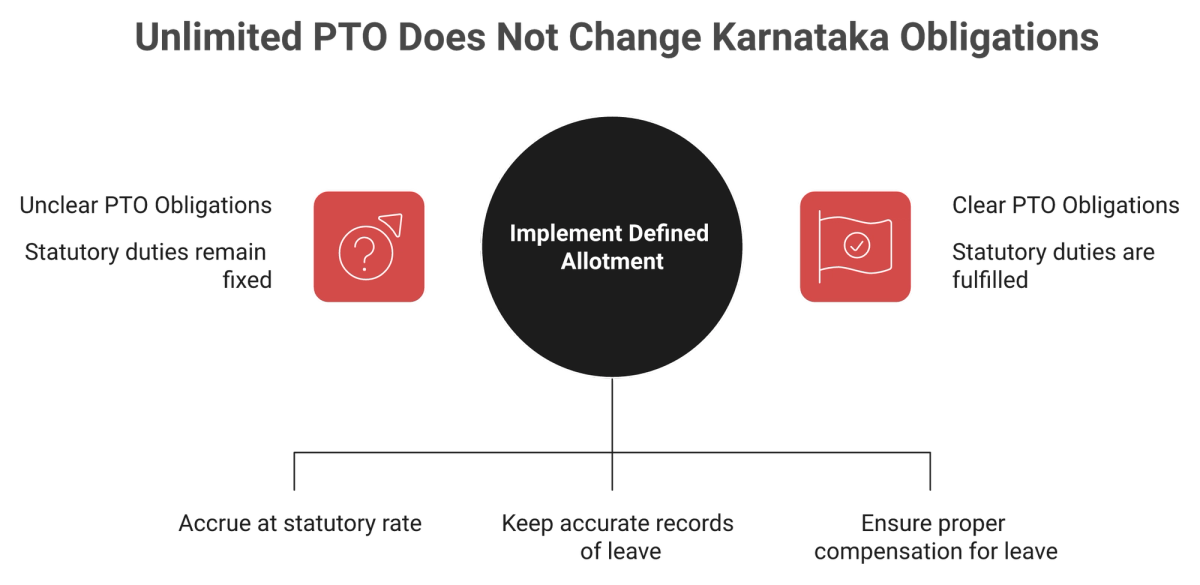
Unlimited PTO removes none of your Karnataka obligations. You still track days worked, accrue leave at one day per twenty days, maintain the statutory register, and pay the balance at exit. Culturally, in high context Indian teams, removing the allotment usually reduces leave taken rather than increasing it. Versatile Club pairs a defined statutory allotment with a 90 day Success Coach on every placement for this reason.
⭐ The playbook everyone imports
The Silicon Valley argument is genuinely good. Reed Hastings built it at Netflix: stop counting days, treat adults as adults, and judge output instead of attendance.
He also warned about the failure mode in the same breath. Removing vacation days without removing the pressure creates conditions where nobody dares take a day off, wrapped up and presented as a perk.
🧑💻 Why it lands differently in Bengaluru
Hierarchy changes the math. Craig Storti recounts an American manager whose colleague in New Delhi asked her by instant message for permission to take his dinner break, explaining that he did so because he was her subordinate.
Now imagine that person deciding how many unlimited days to take. With no stated number, the safe answer is fewer. The absence of a ceiling becomes an absence of permission, which is a pattern we see repeatedly across contract to hire placements.
⚠️ The "use it or lose it" defence
The rule that sounds restrictive is often the one that protects rest. A visible balance that expires creates a reason to book the trip.
Hastings makes this point himself: if you are not allotted vacation, you do not fear losing it, and you are less likely to take any at all. Karnataka's forty five day carry forward cap performs the same function by accident.
❌ The statutory problem nobody flags
Discretionary policy does not switch off the register. Rule 8 requires the Form F Leave with Wages Register regardless of what your handbook promises.
Worse, a generous discretionary policy can become binding. Section 14 makes a contract term that gives longer leave enforceable against the employer. Unlimited, written into a contract, is an unlimited liability at settlement.
That is before diligence. An acquirer asking for three years of leave records will not accept "we do not track it" as an answer, which is why we treat this as a core HR consulting fix, not a handbook preference.
✅ What actually works instead
Versatile Club's read is that the standard advice gets this backwards for India. Compliance is the floor, and a policy people actually use is the ceiling. Across six years of placements, I have watched discretionary policies produce quiet burnout rather than freedom.
Four things move the number:
State a defined allotment at or above the Section 15 floor.
Have leadership visibly take leave, and say so in writing.
Put leave usage on the quarterly review agenda, not the exit interview.
Ask open questions about workload, not closed ones like "are you on schedule?"
"Setting up in a new country can get messy fast, but their India EOR made onboarding feel easy. The team's responsive, clear, and great to work with, makes scaling a remote team way less stressful."
— Setu C., Verified User, Versatile Club G2 - Verified Review (5 stars, 10 June 2026)
"Their team helped us move quickly, stay compliant, and focus on the actual work instead of the backend admin."
— Ibrahim A., Verified User, Versatile Club G2 - Verified Review (4.5 stars, 16 June 2026)
Versatile Club assigns a 90 day Success Coach to every placement and screens for culture fit across 50 behavioural parameters, because an unused leave policy shows up as attrition long before it shows up as a fine. The screening model sits behind our culture fit quiz.
Q10. How do you run one leave policy across Karnataka, Maharashtra, and Tamil Nadu?
Set one pan India baseline at or above the most generous state floor, then overlay state specific holidays, registers, and filing cycles. Karnataka runs a monthly professional tax cycle with enrolment within thirty days of joining, unlike Maharashtra's dual PTRC and PTEC registration or Tamil Nadu's biannual filing. Versatile Club holds Shops and Establishments, PF, and ESIC registrations across all 28 states and 8 union territories, and files under its own registrations in each.
⚠️ Two engineers, two states, two rulebooks
The first time this bites is usually hire number three. One engineer in Bengaluru, one in Pune, and suddenly you have two registers, two holiday lists, and two professional tax cycles.
Professional tax is a state levy on salaried income, deducted by the employer. The rate, the registration, and the filing frequency all change at the state line, which is the detail that breaks most in-house payroll outsourcing plans.
📊 What actually differs by state
| State | Professional tax rhythm | Holiday law | Leave carry forward |
| Karnataka | Monthly PT, enrolment within 30 days of joining | 1963 National and Festival Holidays Act, minimum 10 paid | 45 days |
| Maharashtra | Dual PTRC and PTEC registration, monthly slab | State holiday rules, typically 8 to 10 paid | Per state S&E Act |
| Tamil Nadu | Biannual PT, plus Labour Welfare Fund | State holiday rules | Per state S&E Act |
| Delhi | No professional tax, strict S&E enforcement | State holiday notification | Per Delhi S&E Act |
⏰ The clocks that run in parallel
Karnataka gives you two fixed windows. An establishment must be registered under Section 4, within the statutory period after commencing work, and an appointment order stating designation and wage scale must be served within thirty days of appointment.
Miss either, and the leave policy is academic. An Inspector reads the registration and the appointment order before he reads your handbook.
✅ The baseline plus overlay pattern
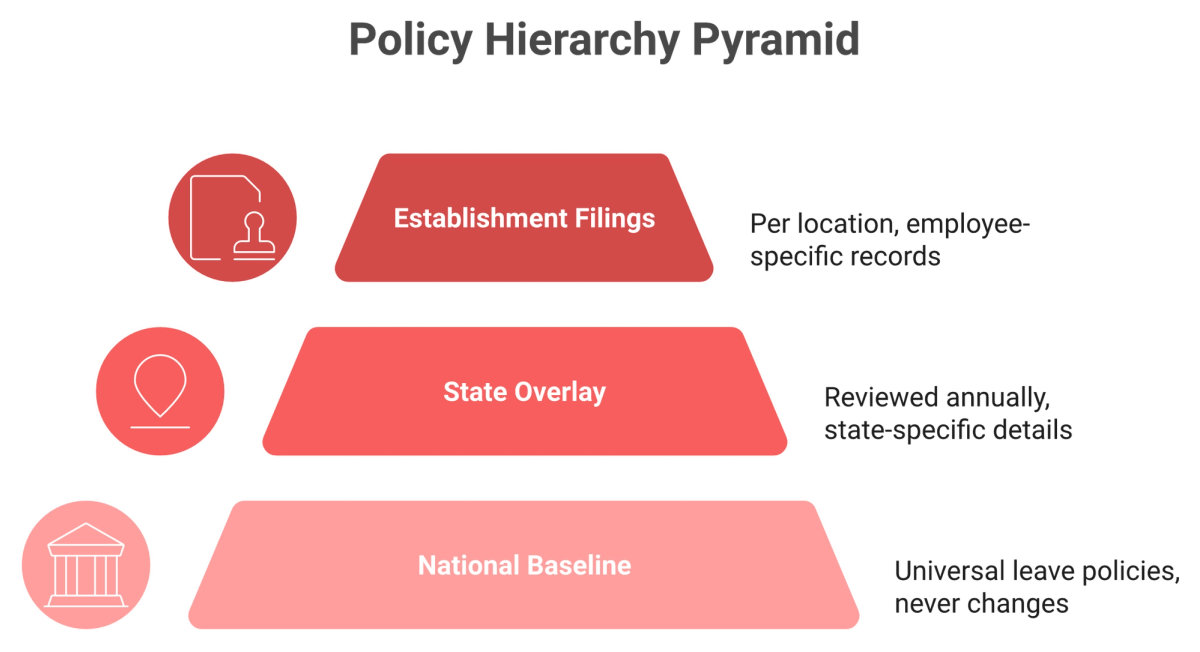
Build the policy in two layers. Layer one is national and never changes. Layer two is thin, state specific, and reviewed once a year.
Baseline, applies to everyone:
Earned leave accrual at 1 day per 20 days worked.
Sickness leave of 12 days per 12 months of continuous service.
Maternity leave of 26 weeks under central law.
Encashment computed on the daily average of Basic plus DA.
Overlay, set per state:
The paid holiday list and its display language.
The statutory register format and retention rule.
The professional tax registration and filing cadence.
Any state specific carry forward cap.
🧭 Why depth beats breadth here
Global EOR platforms cover ninety to a hundred and fifty countries and route India through local partner entities. That structure works until you need a state level answer at month end. Buyers weighing that trade off often land on our Deel alternative page.
I know Maharashtra's dual PTRC and PTEC setup, Karnataka's monthly cycle, Tamil Nadu's biannual filing, and West Bengal's habit of changing rules mid year because we file in all of them. It is closer to US multi state sales tax than to a single country onboarding flow.
"hiring talent in India without a local entity was a compliance minefield PF, ESI, TDS, professional tax across states. Versatile's Employer of Record India setup eliminated all of that."
— Vedant T., Founder, Versatile Club G2 - Verified Review (5 stars, 16 June 2026)
"Wisemonk addresses the hassle of managing employees, tracking time, and running payroll across multiple tools by bringing everything together in a single system."
— Vinay M., Verified User, Wisemonk G2 - Verified Review (4 stars, 18 February 2026)
Versatile Club runs all 28 states from one owned Indian entity, so a Bengaluru hire and a Pune hire land on one policy, one register set, and one USD invoice.
Q11. Who should own your Karnataka leave compliance?
For one to thirty India employees with no local entity, an India native Employer of Record carries the statutory obligations at the lowest overhead. US style co employment PEO does not legally exist under Indian labour law, so an India PEO is functionally an EOR. Versatile Club operates as the direct legal employer on its own Indian entity at $149 per employee per month, with a five day contractual onboarding SLA and no setup or exit fees.
📊 The four options, ranked for a 1 to 30 person India team
| Option | Onboarding | Typical cost | India depth | Best for |
| Versatile Club (India only EOR, owned entity) | 5 day contractual SLA | $149 per employee per month | All 28 states, own PF, ESIC, S&E registrations | 1 to 30 hires, no entity |
| Wisemonk (India native EOR) | 24 to 72 hours | $99 to $399 | India focused, SOC 2 and ISO 27001 certified | Teams needing certification on paper |
| Global generalists (Deel, Remote, G-P, Multiplier) | 7 to 14 days | $400 to $599, G-P at 15% of salary | India routed via local partner entities | Companies hiring in 5 or more countries |
| Own Indian subsidiary | 12 to 18 months | $50,000 plus, then ongoing | Whatever you build | 50 plus India headcount, long horizon |
❌ The PEO myth, cleared up
Buyers arrive asking for an India PEO because that is the US word. In the US, a PEO co employs your staff alongside you.
Indian labour law has no co employment construct. Whoever is on the appointment order and the statutory registers is the employer. Anyone selling you "India PEO" is selling you an EOR with a different label, a distinction we unpack in EOR versus PEO.
⚖️ Where the global platforms thin out
Breadth is real and useful. Coverage across ninety to a hundred and eighty five countries is exactly right if you are hiring in six of them.
The trade off shows at the state level. India routed through a partner entity means your Karnataka Form F question travels through a ticket queue to a third party you never contracted with. Support responsiveness and payroll accuracy are the two complaints I hear most from teams switching in, and they are the reason our EOR services run on an owned entity.
✅ The honest limits
Versatile Club is not the right answer for everyone, and I would rather say so here than on a sales call. Three buyer types should look elsewhere:
Companies needing genuine multi country EOR across five or more markets.
Enterprises with 100 plus India headcount where SOC 2 or ISO 27001 is a procurement gate.
B2C consumer hiring at volume.
Full customisation on enterprise procurement workflows also takes longer than our five day SLA. That is a real constraint, not a modesty line, and teams at that scale should read our enterprise track instead.
"We partnered with Versatile to support our hiring and employment needs in India. Their team was highly responsive, professional, and easy to work with throughout the process."
— Mukul S., Verified User, Versatile Club G2 - Verified Review (5 stars, 16 June 2026)
"The initial process took a little getting used to, but the team was quick to guide us through and it became very straightforward."
— Verified User in Venture Capital and Private Equity, Versatile Club G2 - Verified Review (4.5 stars, 22 June 2026)
"At times when wisemonk team doesn't have information about what I asked, reaching out to the respective company and then getting the information, was a bit time consuming."
— Verified User in Financial Services, Wisemonk G2 - Verified Review (4 stars, 16 June 2025)
🔮 Where I think this goes
India stops being one country on a global EOR map and becomes its own category. Owned entity specialists take the India line item from the generalists, because state level filing depth cannot be abstracted.
Versatile Club started as contract to hire for US and UK companies and became the direct legal employer, which is why I am still on WhatsApp with clients rather than behind a CSM rotation. That will have to change at some scale, and it has not yet. If you want to test the numbers first, run them through the EOR versus entity calculator.
FAQs
How many leaves are employees entitled to in Karnataka each year?
There is no single annual number, and that is the most common mistake we see in imported handbooks. Karnataka prescribes an accrual rate, not a flat grant.
- Earned leave: one day for every twenty days worked by an adult, and one day for every fifteen days worked by a young person.
- Sickness or accident leave: up to twelve days with wages during the first twelve months of continuous service, and during each subsequent twelve months.
- Maternity leave: twenty-six weeks under central law for the first two children.
- Casual leave: not a statutory category in Karnataka.
Run the arithmetic and the headline number falls out. A full year of roughly 300 working days produces fifteen earned leave days. A 240-day year produces twelve. A July joiner with 150 days worked earns 7.5 days, which rounds up to eight because a fraction of half a day or more counts as a full day.
Versatile Club configures earned leave as a monthly accrual parameter rather than a January grant, which is why a mid-year hire's balance always reconciles to the statutory register. If you are sizing this before your first hire, our India salary calculator shows how leave and statutory costs land inside a full cost-to-company figure.
Is casual leave mandatory for employers in Karnataka?
No. Casual leave is not prescribed anywhere in the Karnataka Shops and Commercial Establishments Act, 1961. Several vendor pages print twelve days of casual leave for Karnataka, and that figure has no statutory source behind it.
What the Act actually provides in Chapter IV is two things:
- Earned leave accruing at one day per twenty days worked.
- Sickness or accident leave of up to twelve days per twelve months of continuous service, which is the nearest equivalent to what most companies call casual leave.
You are free to offer casual leave as a benefit, and most Bengaluru employers do, because the market expects it. Just understand the consequence. The Act says that where a contract of service provides longer leave than the statute, the employee is entitled to that longer leave. The moment casual leave appears in a signed contract, it becomes enforceable against you, and it becomes part of your exit settlement arithmetic.
Versatile Club labels every leave line in its India employment contracts by statutory source, so a voluntary benefit is never mistaken for a mandate during an audit or a diligence request. Companies building their first handbook usually work through this with our HR consulting team before the offer goes out.
How is leave encashment calculated when an employee exits in Karnataka?
Encashment is computed on a daily average, not a notional monthly figure. The Act sets leave wages at the daily average of total full-time earnings for the days actually worked in the month immediately preceding the leave, excluding overtime and bonus but including dearness allowance.
A worked example makes the exposure visible:
- Monthly Basic plus DA of ₹1,20,000 across 26 worked days gives a daily average of roughly ₹4,615.
- A carried balance of 45 days produces an encashment liability of about ₹2,07,675 for a single senior engineer.
- Five such employees puts more than ten lakh rupees of unfunded liability on your books.
Timing is statutory too. Where the employer terminates, payment for untaken leave is due before the expiry of the second working day after termination. Where the employee resigns, it falls due on or before the next pay day.
Versatile Club accrues this liability every month on the statutory daily-average basis and reports it as a separate line on one USD invoice, so the payout is already funded when a resignation lands. Finance leads modelling this against headcount growth usually start with our breakdown of the cost of hiring in India.
How many paid holidays must employers provide in Karnataka, and can they be substituted?
Ten paid holidays is the working floor, set by the Karnataka Industrial Establishments (National and Festival Holidays) Act, 1963.
- Three compulsory national days: 26 January, 15 August, and 2 October, each a whole day.
- Seven festival holidays for establishments not owned or controlled by the Government of India, which must include 1 May and 1 November, chosen from the Schedule in consultation with employees.
- A separate paid holiday on general election polling day for employees on the electoral roll of that constituency.
Substitution is limited and the choice is not the employer's. If an employee works a holiday, they may elect either twice the wages, or normal wages plus a substituted paid holiday on another day. One eligibility filter applies: for festival holidays other than the three national days, an employee needs thirty days of service within the preceding ninety days, and weekly holidays and authorised leave count toward that total.
The list also has to be built properly. Employees get fifteen days to object to the tentative list, and the final list must be displayed in Kannada and English before 31 December. Versatile Club runs that consultation and filing under its own Karnataka establishment registration for every client team, part of the broader compliance coverage we operate.
Did the 2025-26 Labour Codes change leave rules for Karnataka employers?
Yes, on two fronts, and the second one matters more than the headline.
The four Labour Codes took effect on 21 November 2025 through Ministry of Labour and Employment gazette notifications S.O. 5319(E), S.O. 5321(E), and S.O. 5322(E). The visible change is eligibility: paid annual leave now triggers at 180 days of work in a calendar year instead of 240. A June joiner can therefore qualify inside the same year.
The quieter change is the wage definition. Basic plus dearness allowance must now be at least fifty percent of wages. Because statutory leave encashment is computed on Basic plus DA, a structure that previously ran Basic at 35 percent of CTC sees per-day encashment value rise sharply on an unchanged leave balance. The same base drives gratuity accrual at 4.81 percent and provident fund at 12 percent, so one definition change moves three liabilities together.
There is also a live conflict worth noting. Karnataka caps leave carry-forward at forty-five days, while the central Code sets thirty with encashment of the excess, and the more favourable rule prevails. Versatile Club re-ran every client salary structure against the Basic-plus-DA rule before the first affected payroll cycle. Teams weighing whether to absorb this internally often compare paths in our EOR versus entity in India guide.