Table of contents (11)
Leave Policy in Kerala: Employee Rights, Types and Rules
Q1: Which law governs your Kerala employee's leave, and how is that employee categorised?
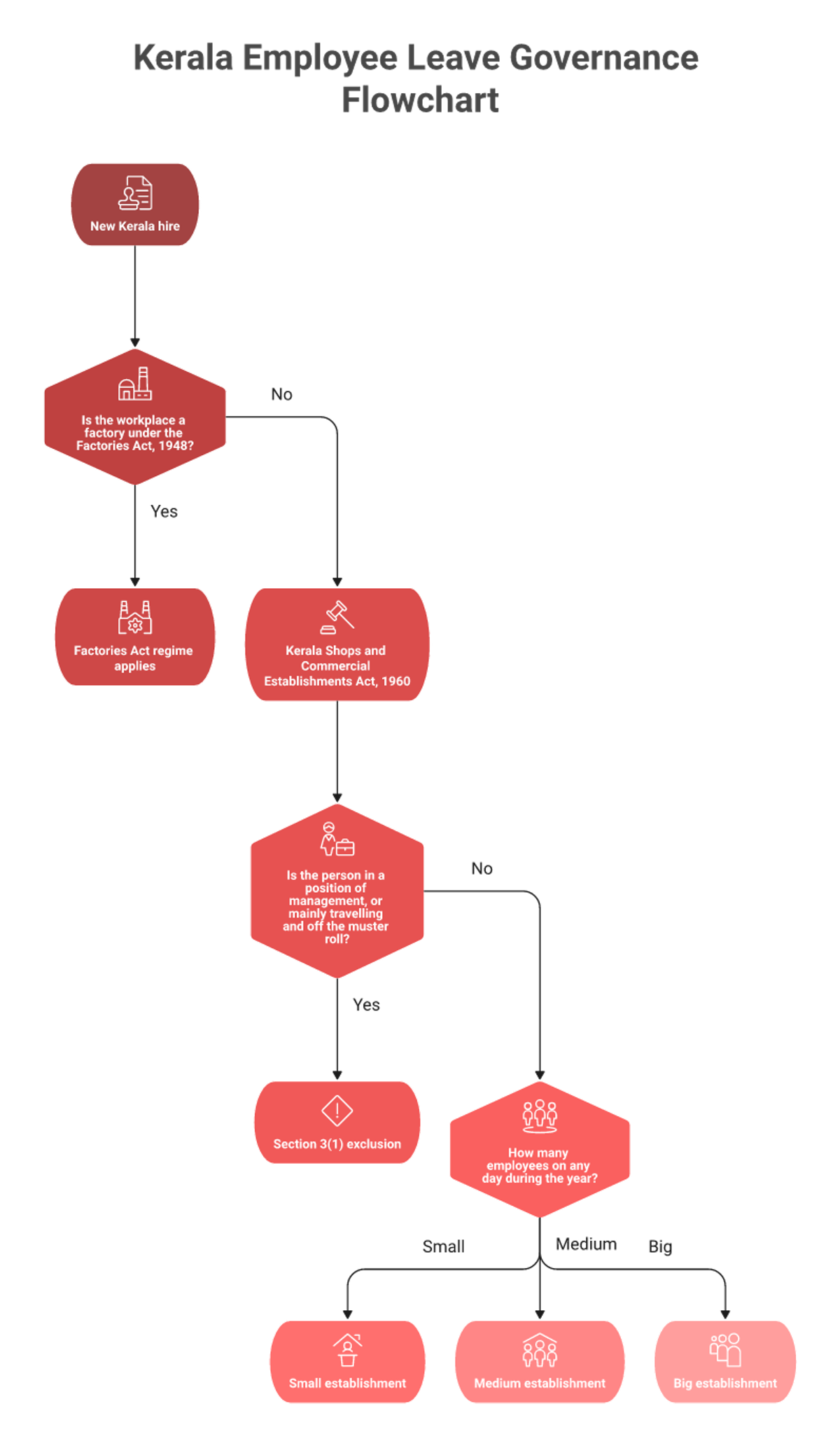
Office, engineering, support, and ops staff in Kerala fall under the Kerala Shops and Commercial Establishments Act, 1960, which expressly excludes factories governed by the Factories Act, 1948. Section 3(1) further excludes persons employed in a position of management, and travelling staff whose names do not appear in the muster rolls. The 2014 amendment sizes you: small (no employee or up to 5), medium (6 to 19), big (20 or more), each carrying different duties.
The moment this breaks
A People Ops lead in Austin sent me an offer letter last year for a backend engineer in Kochi. The leave clause cited the Factories Act. Her engineer had never seen a factory floor. That one wrong citation would have set her entitlement table, her register duties, and her inspection exposure in the wrong place for three years.
⚠️ Why the wrong Act quietly costs you
Most India offer letters used by US companies are inherited templates. Somebody's counsel drafted them for a manufacturing client in 2016, and they have been copy-pasted since. Versatile Club reviews the incoming contract before the first payroll cycle, and the citation is wrong often enough that we now check it first. That check sits inside our EOR services in India onboarding flow.
What the statute actually says
Section 2(4) defines a commercial establishment to include an establishment or administrative service where persons employed are mainly engaged in office work, and it explicitly "does not include a factory to which all or any of the provisions of the Factories Act, 1948 apply." Section 2(15) defines a shop and applies the same carve-out.
So the test is not what your company does. The test is whether the premises is a factory under central law. A SaaS engineering team in Technopark, Trivandrum is a commercial establishment. Full stop.
✅ The three exclusions that catch founders out
Section 3(1) removes three groups from the Act's protection entirely:
Persons employed in any establishment in a position of management.
Persons whose work mainly involves travelling, plus canvassers and caretakers whose names do not appear in the muster rolls.
Establishments of the Central or State Government, local authorities, the Reserve Bank of India, and cantonment authorities.
That first one matters. Your India country head may sit outside the statutory leave floor. Your engineers do not.
Size decides your paperwork, not just your leave
The Kerala Shops and Commercial Establishments (Amendment) Act, 2014 inserted three definitions: small establishment (no employee or not more than five), medium establishment (six or more but fewer than twenty), and big establishment (twenty or more). Section 5J then requires every medium or big establishment to issue an appointment letter at the time of appointment.
Section 5K bars employers from retaining original educational or experience certificates. Section 5L requires a service certificate on resignation, retrenchment, or superannuation. Versatile Club issues both the appointment letter and the exit service certificate under its own Indian entity's registration, because those are entity-level duties and not client-level ones. The same entity carries our India compliance registrations.
🧭 Your three-line self-identification test
Run this before you touch the leave clause:
Is the workplace a factory under the Factories Act, 1948? If no, you are under the Kerala Shops Act.
Is the person in a position of management, or mainly travelling and off the muster roll? If yes, Section 3(1) exclusions apply.
How many employees on any day during the year? That fixes small, medium, or big, and your appointment-letter duty.
In six years of contract-to-hire placements across Bengaluru, Hyderabad, and Pune, nearly every white-collar hire has landed under a state Shops Act. The 240-day Factories Act threshold you may have read about does not govern them. The Kerala Act's twelve-month continuous-service test does.
Versatile Club classifies every Kerala hire against the Shops Act or the Factories Act before the offer letter goes out, because that single call decides the leave clause, the register set, and what an inspector asks for. Founders comparing routes usually start with our guide to hiring in India without an entity.
Q2: What leave types and how many days is a Kerala employee legally entitled to?
Section 13 of the Kerala Shops and Commercial Establishments Act, 1960 gives every establishment employee twelve days of annual leave with wages after twelve months of continuous service, accumulable to a maximum of twenty-four days, plus twelve days of sick leave and twelve days of casual leave during every twelve months of continuous service. That is thirty-six days in total. Only annual leave accumulates. Section 13A adds special casual leave with wages for sterilisation: six days for a male employee, fourteen for a female employee.
The merged PTO number that fails an inspection
Nine of ten US-drafted India offer letters I read bundle everything into one line: "20 days PTO." The Act does not permit netting three buckets into one. Sick leave and casual leave are separate statutory grants under Section 13(2)(a) and 13(2)(b).
📋 The entitlement table
| Leave type | Days per year | Carry forward | Statutory basis |
| Annual leave with wages | 12, after 12 months' continuous service | Yes, up to 24 days | Section 13(1) |
| Sick leave with wages | 12, on sickness or accident | No statutory carry forward | Section 13(2)(a) |
| Casual leave with wages | 12, on any reasonable ground | No statutory carry forward | Section 13(2)(b) |
| Special casual leave, sterilisation | 6 (male), 14 (female) | Not applicable | Section 13A |
Versatile Club configures Kerala contracts with three separate leave ledgers plus a dormant Section 13A bucket, and the statutory filings behind them run under our own PF, ESI, TDS, and professional tax registrations. The mechanics are the same ones described in our India payroll compliance guide.
The forgotten entitlement
Section 13A is the clause almost no guide mentions. It grants special casual leave with wages from the day the operation is undergone. Section 14(2) makes payment conditional on producing a prescribed certificate confirming the employee has undergone the sterilisation operation.
If the employee is discharged during that period, Section 13A(2) still requires the employer to pay for the leave they were entitled to at the time of discharge.
✅ A richer policy is always allowed
Section 12 settles the question founders ask next. Where an award, agreement, or contract of service provides longer leave with wages than Chapter III, the employee gets the longer entitlement. The Act is a floor. Nothing stops you granting 24 days of annual leave.
The same Chapter III Explanation confirms that weekly holidays and festival holidays are not counted as leave, except as provided in Section 13. So Onam does not eat your engineer's casual leave.
What buyers say about leave and time tracking
"What I like best about Wisemonk is that it combines employee, time, and payroll management into one simple and efficient system, making daily operations smoother and more accurate."
— Vinay M., HR and Payroll User, 18 February 2026, Wisemonk - G2 Verified Review, 4/5
"What I dislike about Wisemonk is that some features feel a bit limited and could use more flexibility. In particular, I'd like to see better options for customization and more detailed reporting."
— Vinay M., HR and Payroll User, 18 February 2026, Wisemonk - G2 Verified Review, 4/5
"The initial documentation and paperwork felt quite detailed and time-consuming at the beginning. However, as we progressed, it became clear that this thoroughness is what ensures proper legal and compliance coverage."
— Verified User in Marketing and Advertising, 12 February 2026, Wisemonk - G2 Verified Review, 3.5/5
"The compliance rigour is genuinely impressive, every statutory filing reviewed before submission. Five-day onboarding, zero late payslips."
— Vedant T., Agency Founder, 16 June 2026, Versatile Club G2 - Verified Review, 5/5
💰 What this costs you to get wrong
Contravention of Sections 13, 13A, or 14 is punishable under Section 29(1A), with fines raised to one lakh rupees for a first offence and two lakh rupees for a subsequent one by the 2018 amendment, capped at two thousand five hundred rupees per employee employed.
Versatile Club splits the three ledgers at contract stage rather than at audit stage, because a merged PTO pool is the single most common defect we inherit from another provider. Teams moving off a global platform usually read our switching an India EOR provider walkthrough first.
Q3: When does the leave clock start, and is it 180 or 240 days now?
Annual leave vests after twelve months of continuous service under Section 13(1) of the Kerala Shops and Commercial Establishments Act, 1960. Section 13(5) protects that clock, so sickness, accident, or authorised leave up to ninety days in aggregate, lock-outs, legal strikes, and involuntary unemployment up to thirty days do not break continuity. Separately, Section 32 of the Occupational Safety, Health and Working Conditions Code, 2020, in force from 21 November 2025, cut the central qualifying period from 240 days to 180 days worked. Versatile Club grants leave from day one on Kerala EOR contracts while tracking the Section 13(1) vesting date separately.
Two numbers, two statutes, one operating rule
Search this question and you get 240 days from older pages and 180 days from newer ones. Both are real. They come from different laws.
The Kerala Act uses a twelve-month continuous-service gate for annual leave. The OSH Code uses a days-worked threshold with a per-day accrual. Your job is not to pick a winner. Your job is to apply whichever leaves the employee better off.
⚖️ The reconciliation table
| Test | Kerala Shops Act, 1960 | OSH Code, 2020, Section 32 |
| Qualifying period | 12 months' continuous service | 180 days worked in the calendar year |
| Entitlement | 12 days annual leave with wages | 1 day for every 20 days worked |
| Availability | In the subsequent 12 months | In the calendar year it is earned |
| Carry forward cap | 24 days (annual leave only) | 30 days |
| Encashment | On discharge or refused leave | Accruals above the carry-forward cap |
Sources: Kerala Act Section 13 and OSH Code Section 32.
What actually protects the clock
Section 13(5) is the clause that saves an employee who had a bad year. Continuity is deemed unbroken by sickness, accident, or authorised leave not exceeding ninety days in aggregate for all three, by a lock-out, by a strike that is not illegal, and by intermittent involuntary unemployment up to thirty days in aggregate.
One detail catches payroll teams. A weekly holiday falling at the very start or end of an interruption does not count as authorised leave.
🧮 The arithmetic nobody documents
Three rules govern the maths once you are inside the OSH Code frame:
Leave accrues at one day for every twenty days of work.
A fraction of half a day or more is treated as one full day of leave, and a fraction below half a day is ignored.
For a mid-year joiner, entitlement follows if the worker has worked at least one-fourth of the remaining calendar days.
Lay-off days and maternity leave up to twelve weeks count toward the qualifying period, as does leave earned in the year before the year in which it is taken. Versatile Club runs this accrual maths inside the same cycle as our managed payroll engagements.
My operating advice, and where I hedge
Never configure an eligibility hold on a new India hire. Nothing in Section 13 stops you granting leave from day one. Twelve months is a floor on what you owe, not a ceiling on what you may give.
Section 31 backs this. Nothing in the Act affects rights or privileges more favourable to the employee under any other law, contract, custom, or agreement.
⏰ Where I am genuinely unsure
Versatile Club's read is that Kerala's leave administration stays on the 1960 Act until the state notifies its own Code rules, which are still at draft stage. I could be reading the transition too conservatively. If your auditor takes the stricter view, apply the OSH Code accrual as a shadow calculation and pay the higher of the two. That costs a few days of leave and removes the argument entirely.
Versatile Club runs both calculations on Kerala payroll, grants the more favourable outcome, and keeps the vesting date on file so an inspector and an employee each get a clean answer. If you are weighing this against opening a subsidiary, the EOR versus entity calculator prices both paths.
Q4: What working hours, weekly holidays, and 2026 public holidays frame the leave year?
Section 6 of the Kerala Shops and Commercial Establishments Act, 1960 caps work at eight hours a day and forty-eight hours a week, with overtime paid at twice the ordinary rate under Section 7. Section 8 requires a one-hour rest interval before any employee works more than four hours. Section 9 caps spread-over at ten and a half hours. Section 11, as substituted in 2018, grants one whole holiday each week with no wage deduction. Festival holidays sit outside the leave count.
Why the calendar comes before the policy
Every year a client asks why their Kerala team is quiet for four straight days in late August. Onam is not optional, and it is not leave. It is the calendar.
A leave policy written without the holiday and hours baseline does one of two things. It double-counts festival days against the employee's casual leave, or it silently deducts wages on a state-ordered paid holiday.
⏰ The hours rules, stated plainly
| Rule | Limit | Section |
| Daily and weekly hours | 8 per day, 48 per week | Section 6 |
| Overtime ceiling | 10 hours a day, 50 hours a quarter | Section 6 proviso |
| Overtime rate | Twice the ordinary rate of wages | Section 7 |
| Rest interval | 1 hour before exceeding 4 hours of work | Section 8 |
| Spread-over | 10.5 hours a day, inclusive of rest | Section 9 |
| Weekly holiday | One whole day, no wage deduction | Section 11 |
All from the Act as amended. The Section 11 proviso substituted in 2018 excludes anyone whose total employment in the week, including authorised leave, is under six days.
Holidays are not leave, and the Act says so
The Chapter III Explanation is blunt. For the purposes of the leave chapter, leave does not include weekly holidays or holidays for festivals or other similar occasions, except as provided in Section 13.
That means a gazetted festival day is an employer cost, not a debit against the employee's twelve casual leave days.
📅 Kerala's 2026 paid-holiday layer
The Government of Kerala notified the 2026 holiday list through G.O.(P) No. 15/2025/GAD dated 31 October 2025, issued under Section 25 of the Negotiable Instruments Act, 1881. Confirmed dates in that notification include:
| Date | Day | Holiday |
| 2 January 2026 | Friday | Mannam Jayanthi |
| 26 January 2026 | Monday | Republic Day |
| 20 March 2026 | Friday | Id-ul-Fitr |
| 9 April 2026 | Thursday | Assembly election poll day |
Vishu falls in mid-April and the Onam cluster in late August. Pull the exact dates from the gazette rather than from a vendor blog, because the movable festival dates shift each year.
🗳️ The one holiday nobody has in payroll
For the Kerala Legislative Assembly General Election 2026, the state ordered a paid holiday on 9 April 2026 for employees in private institutions, industrial establishments, the IT sector, and the plantation sector, read with Section 135B of the Representation of the People Act, 1951.
Section 135B entitles every employee entitled to vote to a paid holiday on polling day, and a deduction from wages for that day is an offence. No leave-policy page I have checked for this keyword mentions it.
Versatile Club loads the gazette holiday list and state-ordered paid holidays into Kerala payroll before the quarter opens, so a poll-day wage deduction never reaches an employee's payslip. Teams running distributed India headcount can compare setups on our how it works page.
Q5: Which central laws stack on top of Kerala's Act, and have the Labour Codes replaced it?
Kerala's Act is a floor, not the whole stack. The Maternity Benefit Act, 1961 adds 26 weeks of paid maternity leave for the first two children, 12 weeks for a third child, 12 weeks for an adoptive or commissioning mother, and a further one month of leave for illness arising out of pregnancy or delivery. The POSH Act, 2013 adds an Internal Committee and an annual report. All four Labour Codes took effect on 21 November 2025, yet Kerala's rules under them remain at draft stage.
The governing thought
Three layers decide what your Kerala employee gets. The state Act sets the leave floor. Central statutes add whole categories the state Act never mentions. The Labour Codes moved the thresholds without erasing either.
Read them in that order and the confusion disappears.
🧱 The stack, top to bottom
| Layer | What it adds | Applies to |
| Kerala Shops Act, 1960 | 12 annual, 12 sick, 12 casual, Section 13A sterilisation leave | Shops and commercial establishments in Kerala |
| Maternity Benefit Act, 1961 | 26 weeks, 12 weeks adoptive or commissioning, 1 extra month for illness | Women employees across India |
| POSH Act, 2013 | Internal Committee, annual report, inquiry process | Every workplace with 10 or more workers |
| Labour Codes, 2020 | Revised leave thresholds and wage definitions | In force centrally from 21 November 2025 |
Versatile Club operates in India only, so this stack is the entire compliance surface we maintain, not one row in a 150-country matrix. Buyers weighing that trade-off usually start with our India employer of record playbook.
What the maternity layer actually requires
Section 5 of the Maternity Benefit Act gives 26 weeks of paid leave, with not more than eight weeks preceding the expected delivery date, for a woman with fewer than two surviving children. A woman with two or more surviving children gets 12 weeks.
The eligibility test is 80 days of work with the employer in the 12 months before the expected delivery date. Section 5(4) gives an adoptive mother of a child below three months, and a commissioning mother, 12 weeks from the date the child is handed over.
⚠️ The clause most policies miss
Section 10 grants an additional one month of leave with wages for illness arising out of pregnancy, delivery, premature birth, miscarriage, medical termination, or tubectomy. That sits on top of the 26 weeks.
Section 11 requires nursing breaks twice a day until the child turns fifteen months. Section 12 makes dismissal during maternity leave unlawful. Versatile Club administers these entitlements inside its EOR services payroll cycle.
✅ POSH is not optional at ten heads
Section 4 of the POSH Act requires every employer with ten or more workers to constitute an Internal Committee by written order, chaired by a senior woman employee, with an external member from an NGO or a person familiar with sexual harassment issues. Section 21 requires an annual report to the District Officer, and Section 22 requires it in your annual company report.
One guardrail while I am here. Traditional US-style co-employment PEO does not legally exist under Indian labour law. If a vendor sells you "PEO India," ask which entity signs the employment contract. We unpack that distinction in our EOR versus PEO comparison.
Where the Codes actually landed
The Codes are notified centrally. Kerala has published draft rules and has not notified final ones across the four Codes. So your Kerala register duties, your Section 13 entitlements, and your Section 14 wage basis still run on the 1960 Act this month.
Compliance is the floor, not the ceiling. The Codes changed thresholds. They did not pause your duty to keep a Kerala leave register.
⏰ The rule that resolves every conflict
Section 12 of the Kerala Act preserves longer leave under any award, agreement, or contract. Section 31 preserves any right more favourable under any other law. So when two rules collide, pay the better one and stop arguing.
Versatile Club runs Kerala hires on the 1960 Act's live filings while tracking the draft Code rules, because no employer can pause a state register waiting on a notification.
Q6: How are leave wages, encashment, and exit settlements calculated?
Section 14 of the Kerala Shops and Commercial Establishments Act, 1960 fixes the rate at the daily average of the employee's total full-time earnings for days worked in the month immediately preceding the leave, including dearness allowance and the cash equivalent of concessional supplies, excluding overtime earnings and bonus. Section 13(3) forces payout of untaken annual leave on discharge or after a refused leave request. Section 13(4) covers discharge during sickness or accident leave. Versatile Club books accrued leave-encashment liability into its monthly USD invoice from its own Indian entity.
The number that lands on your close
A CFO at a $12M ARR SaaS company messaged me three days before month-end last year. Her Kochi engineer had resigned with 19 days of accumulated annual leave. Nobody had modelled the payout.
That is the whole problem. Leave encashment is not a surprise event. It is an accrual you either book monthly or discover at full and final settlement.
🧮 The formula, in plain terms
Section 14(1) is specific. The rate equals the daily average of total full-time earnings for the days the employee actually worked in the month immediately before the leave.
Included: dearness allowance, plus the cash value of meals or concessional food grain supplies. Excluded: overtime earnings and bonus.
If the employee worked no day in the preceding calendar month, the fallback is the daily average of full-time earnings for days worked in the last calendar month in which they did work.
Why the wage-definition change raises the bill
The Code on Wages, 2019 defines wages so that excluded allowances cannot exceed half of total remuneration. In practice, Basic plus DA has to reach at least 50% of the pay package.
Encashment runs on that base. So raising Basic raises every accrual tied to it. Our cost of hiring in India breakdown models the same inputs.
💰 A worked example on one Kochi engineer
Take an engineer on 24 lakh rupees a year, with 15 days of accumulated annual leave at exit.
| Structure | Basic + DA | Daily average (approx) | 15-day payout |
| Old split, 30% Basic | Rs. 7,20,000 | Rs. 2,000 | Rs. 30,000 |
| Code-aligned, 50% Basic | Rs. 12,00,000 | Rs. 3,333 | Rs. 50,000 |
The same leave balance costs 67% more after restructuring. Gratuity accrues on the same base at roughly 4.81%, so the effect compounds across your India headcount.
✅ What to do on Monday
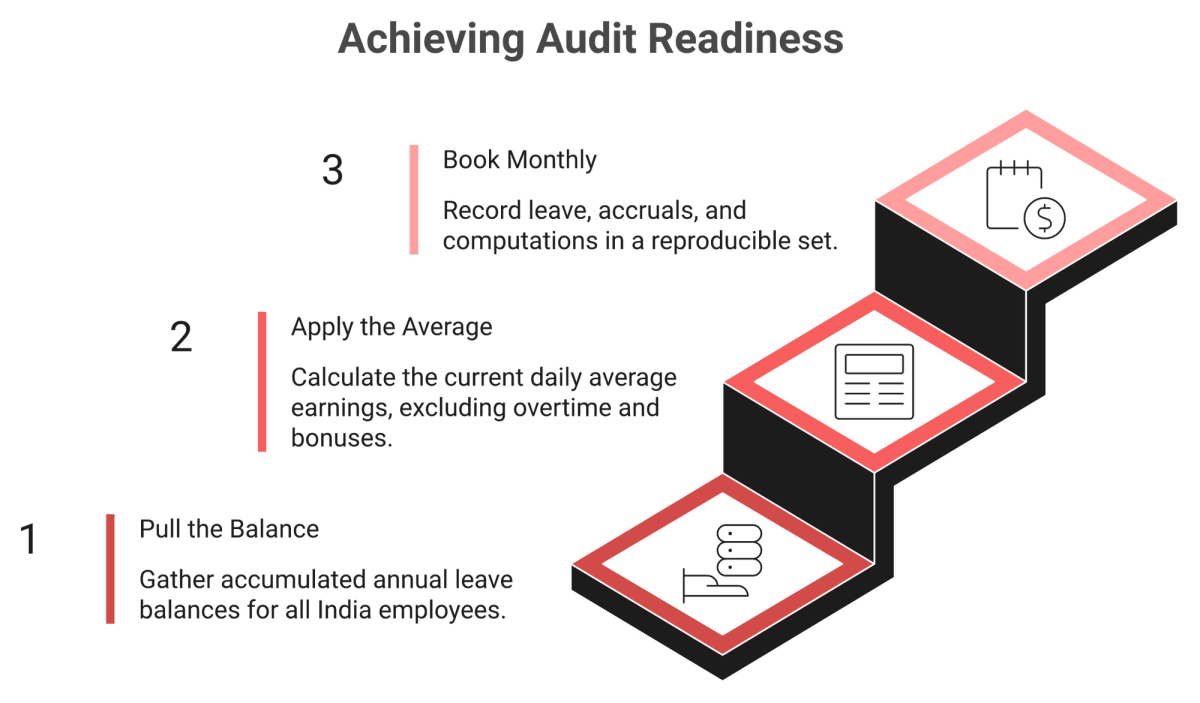
Three steps, in order:
Pull the accumulated annual leave balance for every India employee.
Multiply by the current Section 14 daily average, not last year's.
Book it as a monthly provision, and keep the leave register, accrual ledger, and computation as one reproducible set.
Versatile Club's read is that most India EOR invoices hide this line rather than show it, though I may be judging the category too harshly on a small sample. Our published pricing shows the line items we bill.
What buyers say about invoice clarity
"First payroll ran on time, no scramble, no 'wait what's this deduction.'"
— Angad S., Founder, 21 June 2026, Versatile Club G2 - Verified Review, 5/5
"First USD invoice landed clean: no FX markup, no setup fee, no surprises."
— Verified User in Information Technology and Services, First-time Founder, 23 June 2026, Versatile Club G2 - Verified Review, 5/5
"I find Deel to be absurdly expensive. They charge a high amount of fees for transferring money to my bank account."
— Juan Camilo O., Contractor Paid Through Deel, 27 November 2025, Deel - G2 Verified Review, 1/5
Versatile Club shows the accrued leave provision on the monthly invoice from its Indian entity, so a Kerala exit does not arrive as an unmodelled number in your close.
Q7: What does a compliant Kerala leave policy look like for a remote white-collar team?
A compliant white-collar Kerala policy needs eight clauses: separate annual, sick, and casual ledgers; the 24-day annual accumulation cap; the Section 13A sterilisation entitlement; one whole weekly holiday; the Section 14 wage basis for paid leave; a documented festival-holiday list; the discharge-payout rule; and a named approver with a defined turnaround. Anything more generous is permitted, since Section 12 protects superior contractual terms. Versatile Club issues this as a Kerala-specific annexure with every EOR contract.
The clause that fails an inspection
The US handbook line reads: "Employees accrue PTO at 1.25 days per month, subject to manager approval." It is clean, familiar, and it does not survive a Kerala inspection.
It merges three statutory buckets. It sets no wage basis. It records no accumulation cap. An inspector asking for the leave register gets a Notion page.
📋 The eight clauses, mapped to statute
| Clause | What it must say | Section |
| 1. Three ledgers | 12 annual, 12 sick, 12 casual, tracked separately | 13(1), 13(2) |
| 2. Accumulation | Annual leave accumulates to 24 days, others lapse | 13(1) |
| 3. Sterilisation leave | 6 days male, 14 days female, on certificate | 13A, 14(2) |
| 4. Weekly holiday | One whole day, no wage deduction | 11 |
| 5. Wage basis | Daily average of full-time earnings, prior month | 14(1) |
| 6. Holiday list | Gazette-notified Kerala festival days, not leave | Chapter III Explanation |
| 7. Exit payout | Untaken annual leave paid on discharge | 13(3), 13(4) |
| 8. Approver | Named approver, stated turnaround, written record | 30 |
All eight sit in the Act itself. Versatile Club clause-maps the annexure to these section numbers so the register and the contract agree.
The two clauses that are not statutory
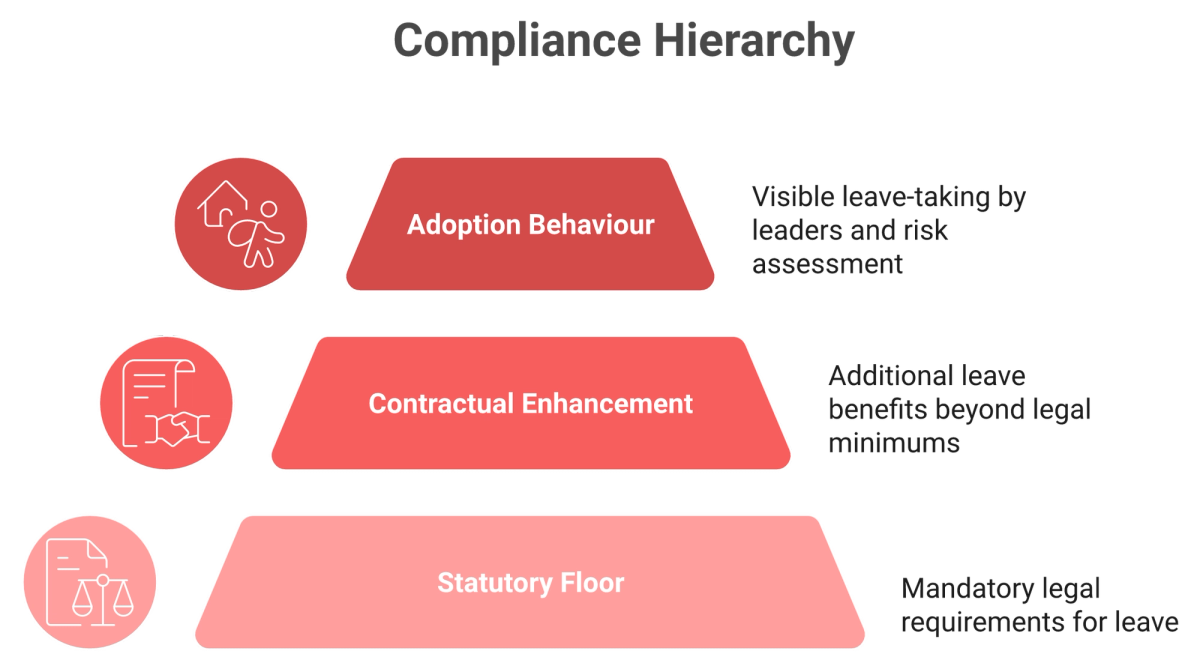
Paternity leave is not mandatory for private-sector employees in Kerala. Neither is bereavement leave. I still put both in every policy I help draft.
Kerala engineering talent compares offers. Five to fifteen days of paternity leave costs little and closes candidates. Being honest about it matters more than pretending it is law. Versatile Club's HR consulting services draft these clauses alongside the statutory ones.
⏰ Getting people to actually use the policy
A written entitlement nobody uses is a retention problem dressed as a benefit. Two tactics work in remote India teams.
First, ask people to judge their day by whether they did a good day's work, rather than by hours logged. Second, have the founder or India lead visibly take leave and say so in Slack. Versatile Club pairs the annexure with a 90-day Success Coach, and our screening runs 50 behavioural parameters, so the person's working style is known before day one. Candidates can be screened through the culture fit quiz before an offer goes out.
What buyers say about policy flexibility
"What I dislike about Wisemonk is that some features feel a bit limited and could use more flexibility. In particular, I'd like to see better options for customization and more detailed reporting."
— Vinay M., HR and Payroll User, 18 February 2026, Wisemonk - G2 Verified Review, 4/5
"The dashboard could be a little more self-serve. A couple of times I wanted to pull a report or a doc myself and ended up just messaging my contact instead."
— Angad S., Founder, 21 June 2026, Versatile Club G2 - Verified Review, 5/5
"The initial documentation and paperwork felt quite detailed and time-consuming at the beginning."
— Verified User in Marketing and Advertising, 12 February 2026, Wisemonk - G2 Verified Review, 3.5/5
Versatile Club issues a Kerala-specific leave annexure with every EOR contract, clause-mapped to the 1960 Act, rather than one global PTO paragraph copied across countries.
Q8: What registers, filings, and fees will a Kerala labour inspector actually ask for?
Section 30 of the Kerala Shops and Commercial Establishments Act, 1960 requires prescribed registers and records kept on the establishment's premises, with electronic maintenance permitted since the 2018 amendment provided a signed hardcopy is produced on demand. Registration and renewal run through the Labour Commissionerate Automation System, with automatic renewal on fee payment since 2021. G.O.(P) No. 12/2026 re-slabbed registration fees from Rs. 70 to Rs. 5,250. Versatile Club holds the Kerala registration under its own Indian entity.
The inspector does not want your dashboard
Section 28 requires every employer to produce, on demand, all registers, records, and notices required under the Act. An inspector under Section 26 may enter the premises at any reasonable time and inspect them.
A screenshot of your HRIS leave module is not a register. The Act wants the prescribed record, and it wants it available.
✅ What the 2018 amendment changed
Section 30 now carries two provisos. Registers and records may be maintained electronically in the prescribed form and manner. At inspection, a hardcopy must be submitted if demanded, duly signed by the employer, per the Kerala Shops and Commercial Establishments (Amendment) Act, 2018.
So digital is fine. Unsigned and unprintable is not.
⚠️ One correction to what most guides still say
Many Kerala compliance pages still list Form H quarterly returns. The Kerala Shops and Commercial Establishments (Amendment) Rules, 2022 omitted rule 2E, rule 2G(3), rule 12A, and Form H entirely.
That amendment was made to reduce filing load after online registration went live. If your provider is still promising Form H filings, they are billing you for a form that no longer exists. Versatile Club files only what the current rules require, which is the standard we hold across every India payroll outsourcing engagement.
Registration, renewal, and fees
Section 5A requires an application for a registration certificate, now made through the Labour Commissionerate Automation System after the 2021 amendment. Renewal applications filed at least thirty days before expiry, with fees paid through the system, are renewed automatically.
Section 5C requires the certificate displayed on the premises, notice of any change within seven days, and notice of closure within ten days.
💰 The February 2026 fee slabs
| Employees proposed during the year | Fee (Rs.) |
| Nil | 70 |
| Up to 5 | 135 |
| 6 to 10 | 265 |
| 11 to 20 | 525 |
| 21 to 30 | 790 |
| 31 to 50 | 1,315 |
| 51 to 100 | 2,625 |
| Above 100 | 5,250 |
Notified by G.O.(P) No. 12/2026-LBR, S.R.O. No. 161/2026 dated 4 February 2026.
💸 What non-compliance now costs
Section 29, as amended in 2018, sets fines up to one lakh rupees for a first contravention of the leave and hours provisions, and up to two lakh rupees for a repeat, capped at two thousand five hundred rupees per employee employed. Wilfully obstructing an inspector attracts up to one lakh rupees. A Judicial Magistrate of the First Class may impose up to two lakh rupees.
Versatile Club's compliance knowledge comes from running contract-to-hire operations across multiple Indian states, so I can tell you Kerala's auto-renewal is the outlier. Maharashtra's dual PTRC and PTEC filings, Karnataka's monthly professional tax cycle, and Tamil Nadu's biannual filing all force you to touch the file. Kerala renews quietly, which is exactly why employers forget the register underneath it.
Versatile Club maintains the Kerala leave register and holds the registration under its own entity's name, so the inspection notice reaches our compliance desk rather than your engineer's manager. Teams running the same checks across cities can review our Bengaluru payroll outsourcing guide for the state-by-state pattern.
Q9: Why does unlimited PTO quietly fail in Kerala, and what should you run instead?
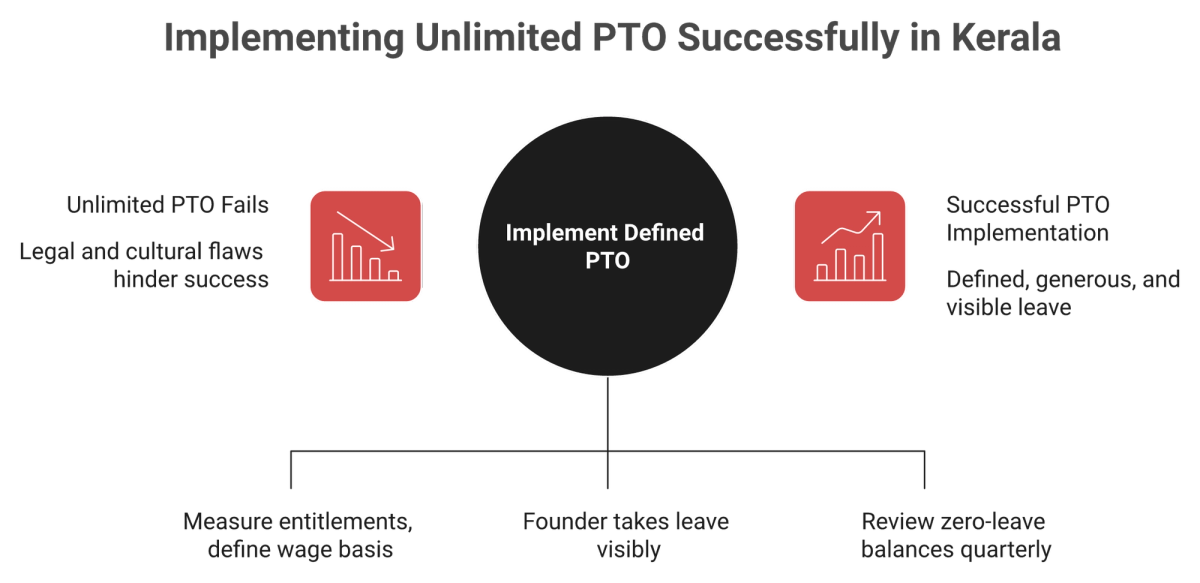
Unlimited PTO fails twice in Kerala. Legally, Sections 13, 14, and 30 of the Kerala Shops and Commercial Establishments Act, 1960 require measured entitlements, a defined wage basis, and a maintained register, so an untracked policy leaves nothing to produce at inspection or in diligence. Behaviourally, in a hierarchical workplace, an ambiguous policy means employees take less leave, not more. Versatile Club pairs a defined Kerala entitlement with a 90-day Success Coach who flags employees taking zero leave.
The playbook everyone repeats
Remove the policy. Trust adults. Track nothing. It reads beautifully in a Series A handbook.
Netflix built its reputation on it, and Reed Hastings wrote about the version that worried him: not allotting vacation days is "a great way to create sweatshop conditions, where no one dares to take a day off work. And to wrap it up like a perk."
❌ The legal flaw nobody mentions
Section 30 requires prescribed registers and records kept on the premises. Section 28 requires them produced on demand. Section 14 requires a wage basis for leave that can be computed from actual worked days.
Untracked leave produces none of those. It also produces nothing for a diligence data room, which is where I have seen this bite hardest. A buyer's counsel asks for the India leave liability schedule, and there is no ledger to derive it from. Versatile Club keeps that ledger as part of every India EOR engagement.
The cultural flaw, which is worse
Hastings names the second-order effect precisely. "If you're not allotted vacation, you don't fear losing it, and are less likely to take any at all." The use-it-or-lose-it rule sounds like a limit. It works like permission.
Craig Storti records the dynamic that makes this sharper in India. An American manager described an offshore colleague in Delhi who messaged to ask if it was acceptable to take his dinner break, explaining, "because I'm your subordinate."
⚠️ What ambiguity does to a Kochi engineer
Now apply that to a policy that says "take what you need." A senior engineer in Kochi reads it as a test. He waits for a signal that never arrives.
Jason Fried puts the remote version bluntly: a manager's instinct is to worry about work not getting done, but "the real threat is that too much will likely get done." In Versatile Club's client engagements, the escalation I get is almost never about an India employee slacking. It is about one who has not logged off in five weeks.
The better version
Publish a defined entitlement, set it above the statutory floor, and make it use-it-or-lose-it for casual and sick leave. Then have the founder or India lead take leave visibly and say so.
Hastings describes an American manager, Greg, who got an entire Japanese office to take real vacations without new rules. He modelled the behaviour and stated the expectation. That is the whole mechanism.
✅ Three moves for Monday
Write the number down: 12 annual, 12 sick, 12 casual, or better.
Keep the register, because Section 30 is not optional even with a generous policy.
Review zero-leave balances quarterly and treat them as a risk flag.
Versatile Club builds this cadence into its HR consulting work with founders making a first India hire.
What buyers say about escalation and response
"I've noticed that their support and query responses can occasionally take a bit longer sometimes, likely due to a relatively small team."
— Verified User in Financial Services, EOR Employee, 14 June 2025, Wisemonk - G2 Verified Review, 4/5
"Founder is just a call away. Extremely helpful in resolving all our queries."
— surbhi m., Founder, 15 June 2026, Versatile Club G2 - Verified Review, 5/5
Versatile Club's read is that compliance is the floor, not the ceiling, and removing the floor does not raise the ceiling. I hold that view strongly, though the sample is my own placements rather than a survey.
Versatile Club pairs the defined Kerala entitlement with a 90-day Success Coach who reviews leave usage, because in India silence about time off is a warning sign, not consent.
Q10: How do you run one leave policy across Kerala, Karnataka, and Maharashtra?
Do not maintain 28 handbooks. Set one national entitlement above the highest state minimum, then attach a one-page state annexure for the three things that genuinely differ: the notified festival-holiday list, state-specific entitlements such as Kerala's Section 13A sterilisation leave, and the register and registration format. Sections 12 and 31 make a more generous uniform policy compliant everywhere. Versatile Club maintains one leave policy plus a state annexure for every India hire.
The stack that breaks at twelve people
A People Ops lead at a Series B company showed me her India folder last year. Four handbooks. Three vendors. Separate payroll, EOR, benefits, and equipment suppliers, none of whose invoices reconciled.
That is the fragmented India vendor stack in one screenshot. Leave policy is where it shows first, because every state Shops Act words the entitlement differently. Teams in that position usually read our guide to hiring employees in India before consolidating.
📋 What actually differs by state
| State | Annual leave | Sick and casual | Carry-forward cap | Portal |
| Kerala | 12 days after 12 months | 12 + 12 | 24 days, annual only | LCAS |
| Karnataka | 1 day per 20 days worked | 12 combined | 30 days | e-Karmika |
| Tamil Nadu | 12 days | 12 + 12 | 24 days | TN Labour portal |
| Maharashtra | 8 days per 20 days worked pattern | 8 casual, paid sick per rules | 45 days | MahaShramm |
Read each state's own Act before you file, since the wording and the caps move. Versatile Club holds Shops and Establishments, PF, and ESIC registrations across all 28 states, which is how we keep one policy defensible in each of them.
The ceiling-and-annexure method
Set the national floor at the most generous state minimum you employ against, then round up. Fifteen annual, twelve sick, twelve casual clears every state I have filed in.
Section 12 says a contract offering longer leave with wages wins over the Act. Section 31 preserves any more favourable right under any other law. Generosity is the compliance shortcut.
✅ Standardise versus localise
| Standardise nationally | Localise by annexure |
| Day counts and accrual rules | Notified festival holidays |
| Approval workflow and turnaround | State-only entitlements |
| Wage basis for paid leave | Register format and returns |
| Exit payout method | Registration certificate and renewals |
Why this is a paperwork muscle, not a policy project
Versatile Club's compliance knowledge comes from running contract-to-hire operations across multiple Indian states, so the differences are daily work rather than research. Maharashtra needs dual PTRC and PTEC professional tax registrations. Karnataka runs a monthly professional tax cycle. Tamil Nadu files biannually. West Bengal changes rules often enough that I check before every quarter.
Kerala is the quiet one, which is its own trap. Auto-renewal through the Labour Commissionerate Automation System means nobody touches the file, and nobody notices the register has gone stale. The same pattern shows up in our Hyderabad payroll outsourcing and contract-to-hire workflows.
What buyers say about multi-state and multi-country payroll
"We partnered with Versatile to support our hiring and employment needs in India. Their team was highly responsive, professional, and easy to work with throughout the process."
— Mukul S., Talent and Employment Lead, 16 June 2026, Versatile Club G2 - Verified Review, 5/5
"They consistently failed to meet committed deadlines, had terrible communication, and frequently cancelled meetings at the last minute."
— Verified User in Computer Software, Multi-Country Payroll User, 13 December 2025, Deel - G2 Verified Review, 0/5
"Sometimes the email communication from the Wisemonk team is delayed by a day or 2. But overall they seem to be the best for India."
— Bulbul G., EOR Employee, 19 February 2025, Wisemonk - G2 Verified Review, 4/5
Versatile Club files under its own registrations in all 28 states, so a Kochi hire and a Pune hire share one handbook and one register owner.
Q11: Who should handle Kerala leave compliance, and what breaks when an EOR treats Kerala as "rest of India"?
Ask one question of any provider: which legal entity's name appears on the Kerala Shops Act registration certificate? Global platforms spanning 90 to 150 countries typically employ India staff through a local partner entity and concentrate coverage on the largest states, leaving Kerala in a "rest of India" bucket where nobody clearly owns the leave register, the Section 14 wage basis, or the accrued encashment provision. Versatile Club employs Kerala EOR staff under its own registered Indian entity.
The invoice that started this section
A CFO forwarded me three India invoices from three vendors and asked which one carried the statutory liabilities. Nobody at any of the three could answer inside a day.
That is the real failure mode. Not a missed payroll. An unowned obligation. Versatile Club consolidates all of it into one monthly USD invoice, which is the model described on our how it works page.
⭐ The comparison that matters
| Provider | India entity | Register owner | India state depth | Support channel |
| Versatile Club | Own registered Indian entity | Versatile Club | All 28 states | Founder on WhatsApp |
| Wisemonk | India-focused EOR entity | Provider | India-focused | Named HR manager |
| Deel | Local partner entities commonly used | Partner entity | Concentrated in top states | Ticket queue |
| Remote | Local partner entities commonly used | Partner entity | Concentrated in top states | Ticket queue |
Versatile Club appears here on the same criteria as everyone else, with no weighting applied. Side-by-side detail sits on our Wisemonk alternative and Deel alternative pages.
The honest structure of the trade-off
✅ India-only focus means the Kerala register, the 2026 holiday order, and the Section 13A bucket are all maintained by one team.
✅ Owned entity means the inspection notice arrives at the employer of record, not at a partner shell.
❌ Versatile Club operates only in India, so a buyer hiring across five countries needs a second vendor.
✅ No setup fee, no exit fee, and the first month free on EOR, with a 6-month replacement guarantee on contract-to-hire placements.
❌ Versatile Club does not hold SOC 2 or ISO 27001 today, so enterprise procurement gating on those certificates should shortlist Wisemonk or a global platform instead.
Global platforms genuinely win on multi-country breadth and on security certification maturity. I am not going to pretend otherwise.
🧾 Five diligence questions to send today
Which legal entity signs the employment contract for a Kerala hire?
Who holds the Kerala Shops and Commercial Establishments registration certificate?
Where is the leave register maintained, and can you produce a signed hardcopy?
What Section 14 daily-average figure are you using for accrued leave?
Is the accrued leave-encashment provision shown on the monthly invoice?
If four of the five come back vague, you have a partner-shell arrangement rather than an employer of record. Our India EOR switching guide covers the handover sequence.
What buyers say about who the legal employer really is
"I was employed by a Singapore entity that is yet to be established in India. So Wisemonk is the legal entity which I'm currently working under."
— Verified User in Financial Services, EOR Employee, 16 June 2025, Wisemonk - G2 Verified Review, 4/5
"Deel treats all users as if they were individual freelancers, even when you're clearly operating as a registered company. There is no flexibility, no option for company-level onboarding."
— Verified User in Translation and Localization, Agency Owner, 5 May 2025, Deel - G2 Verified Review, 0.5/5
"Setting up in a new country can get messy fast, but their India EOR made onboarding feel easy. The team's responsive, clear, and great to work with."
— Setu C., Operations Lead, 10 June 2026, Versatile Club G2 - Verified Review, 5/5
Versatile Club's position is ownership over abstraction, and I will name the limit honestly: EOR is the newer line for us, while the multi-state contract-to-hire payroll infrastructure behind it has run for six years.
Versatile Club owns the Indian entity your Kerala employee is hired under, holds the state registration, maintains the leave register, and bills one USD invoice from India with no setup or exit fee. Founders sizing the alternative can price it on the EOR versus entity calculator.
FAQs
How many leaves is an employee entitled to in Kerala each year?
Under Section 13 of the Kerala Shops and Commercial Establishments Act, 1960, an employee who completes twelve months of continuous service is entitled to 36 days of paid leave a year.
- Annual leave with wages: 12 days, accumulable up to a maximum of 24 days.
- Sick leave with wages: 12 days, on sickness incurred or accident sustained.
- Casual leave with wages: 12 days, on any reasonable ground.
Only annual leave accumulates. Sick and casual leave lapse at the end of the leave year unless your contract is more generous. Section 13A adds special casual leave for sterilisation, six days for a male employee and fourteen for a female employee, paid on production of the prescribed certificate.
Weekly holidays and gazetted festival days are not counted as leave. That distinction matters in Kerala, where the Onam cluster in late August alone takes several days out of the calendar.
Versatile Club configures every Kerala contract with three separate leave ledgers plus a dormant Section 13A bucket, because a single merged PTO pool is the most common defect we inherit from another provider. If you are setting up your first India employment contract, our India EOR services include the Kerala-specific leave annexure clause-mapped to these section numbers.
Can casual leave and sick leave be carried forward in Kerala?
No. The Kerala Shops and Commercial Establishments Act, 1960 permits accumulation only for annual leave with wages, and caps it at 24 days. Casual leave and sick leave carry no statutory carry-forward right.
Three practical consequences follow:
- An employee who does not use casual or sick leave in the leave year loses it, unless your policy says otherwise.
- Only untaken annual leave creates a payout obligation when someone is discharged or quits after a refused leave request.
- Casual leave carries no statutory encashment, so it should not sit in your exit liability model.
Section 12 of the Act protects any richer term. Where a contract or agreement gives longer leave with wages than the Act, the employee gets the longer entitlement. So you are free to allow casual leave carry-forward, or to run a single generous pool on top of three tracked statutory ledgers.
What you cannot do is merge the three buckets and net them against one number. That breaches the separate grants in Section 13(2). Versatile Club tracks the carry-forward cap per employee inside the same cycle as its managed payroll runs, so the accumulation ceiling is enforced before it becomes an audit question.
Is earned leave eligibility in Kerala 180 days or 240 days now?
Both numbers are real, and they come from two different laws.
- Kerala Shops Act, 1960: annual leave vests after twelve months of continuous service. Section 13(5) protects that clock, so sickness or authorised leave up to ninety days, lock-outs, legal strikes, and involuntary unemployment up to thirty days do not break continuity.
- OSH Code, 2020, Section 32: in force from 21 November 2025, it cut the central qualifying period from 240 days to 180 days worked in a calendar year, accruing one day of leave for every twenty days worked.
Kerala has published draft rules under the four Labour Codes and has not notified final ones. So day-to-day Kerala leave administration still runs on the 1960 Act, while the central entitlement floor has moved.
The operating rule is simple. Section 31 preserves whichever right is more favourable to the employee, so calculate both and grant the better outcome. Versatile Club runs both calculations on Kerala payroll and grants leave from day one while tracking the statutory vesting date separately. Founders weighing this against opening a subsidiary can price both routes on our EOR versus entity calculator.
How is leave encashment calculated when a Kerala employee exits?
Section 14(1) of the Kerala Shops and Commercial Establishments Act fixes the rate as the daily average of the employee's total full-time earnings for the days actually worked in the month immediately preceding the leave.
- Included: dearness allowance, plus the cash equivalent of meals or concessional food grain supplies.
- Excluded: overtime earnings and bonus.
- Fallback: if the employee worked no day in the preceding month, use the last calendar month in which they did work.
Section 13(3) forces payout of untaken annual leave when an employee is discharged before being allowed the leave, or quits after a refused request. Section 13(4) covers discharge during sickness or accident leave.
The Code on Wages, 2019 changes the size of that bill. Because excluded allowances cannot exceed half of total remuneration, Basic plus DA has to reach roughly 50 percent of the package, and encashment runs on that base. On a 24 lakh rupee salary with 15 accumulated days, the payout moves from about Rs. 30,000 at a 30 percent Basic split to about Rs. 50,000 at 50 percent.
Versatile Club books the accrued leave-encashment liability into its monthly USD invoice from its own Indian entity, so the number never lands unmodelled in your close. The line items are published on our pricing page.
What registers must a Kerala employer keep, and is Form H still required?
Section 30 of the Kerala Shops and Commercial Establishments Act requires prescribed registers and records kept on the establishment's premises. Since the 2018 amendment, they may be maintained electronically, provided a hardcopy signed by the employer is produced at inspection if demanded. Section 28 requires production on demand.
Two corrections to what most compliance pages still say:
- Form H is gone. The Amendment Rules, 2022 omitted rule 2E, rule 2G(3), rule 12A, and Form H entirely. If a provider is still billing you for Form H quarterly returns, they are charging for a form that no longer exists.
- Registration auto-renews. Since the 2021 amendment, applications and renewals run through the Labour Commissionerate Automation System, and renewal is automatic on fee payment. Fees were re-slabbed in February 2026 from Rs. 70 for a nil-employee establishment to Rs. 5,250 above 100 workers.
Penalties are not trivial. Section 29, as amended in 2018, allows fines up to one lakh rupees for a first contravention and two lakh rupees for a repeat, capped at Rs. 2,500 per employee employed.
Versatile Club holds the Kerala registration and maintains the leave register under its own entity's name, which is documented on our compliance page, so the inspection notice reaches our desk rather than your engineer's manager.