Table of contents (12)
- Applicable Laws & Categories
- Statutory Leave Entitlements
- Hours, Weekly Off & Overtime
- National & Festival Holidays
- Maternity & Public-Sector Comparison
- Leave Pay & Encashment Math
- Labour Codes 2025 Impact
- Registers, Filings & Penalties
- Unlimited PTO Reality Check
- Building the Policy
- Multi-State Operations
- Choosing Your Owner
Leave Policy in Tamil Nadu: Employee Rights and Rules
Q1. Which law governs your Tamil Nadu team's leave, and which employee category are they in?
Office and software teams in Tamil Nadu are governed by the Tamil Nadu Shops and Establishments Act, 1947, which has applied across the whole state since 14 November 2018. Manufacturing premises fall under the Factories Act, 1948 instead. Central laws stack on top: Maternity Benefit, EPF, ESI, and POSH. Section 4(1)(a) exempts persons employed in a position of management, so their leave comes from the contract.
Why one India-wide leave template breaks
Most founders write one leave policy for "India." India does not work that way. Leave for white collar staff is set by state legislation, and every state has its own Shops and Establishments Act with different numbers.
In six years of contract-to-hire placements across Bengaluru, Hyderabad, and Pune, this is the single most common error I see. A Karnataka template applied to a Chennai hire will be wrong on entitlement, wrong on accumulation, and wrong on the register you are supposed to maintain.
📋 The statute stack that actually applies
Think of it as three layers. The state Act sets your leave floor. A second state Act sets your paid public holidays. Central laws add maternity, provident fund, insurance, and harassment obligations regardless of which state you hire in.
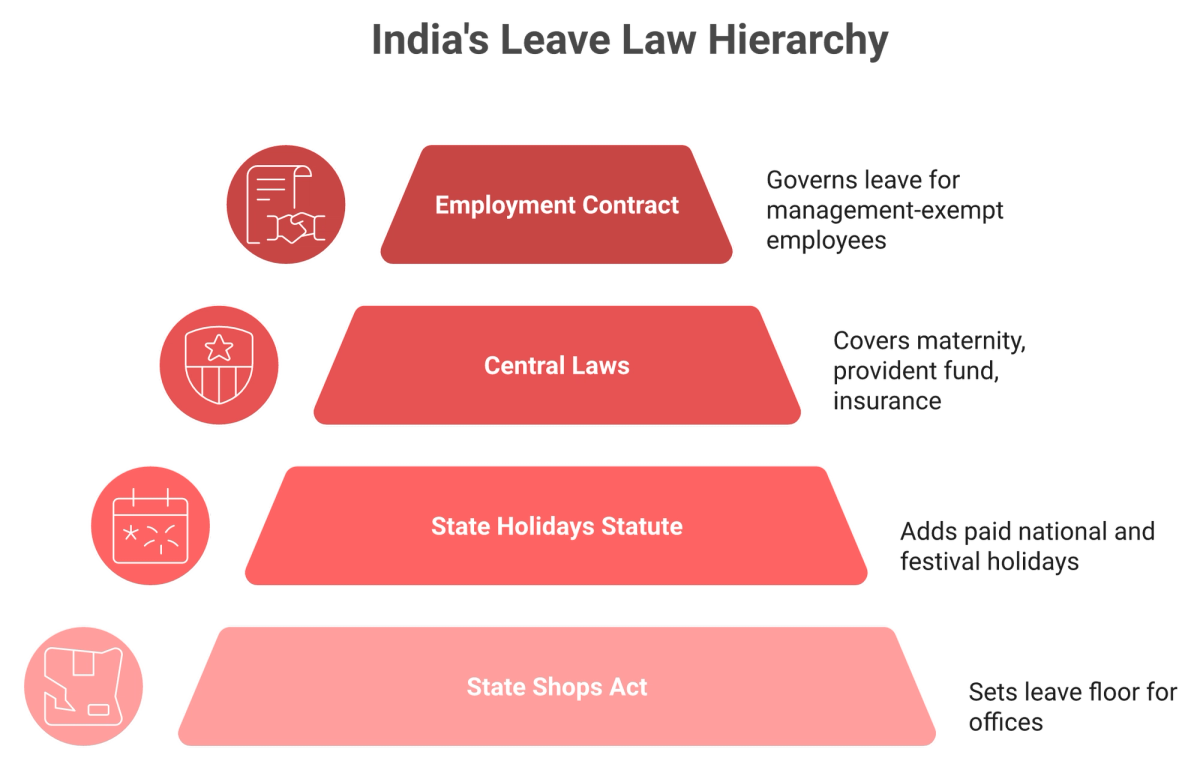
Versatile Club employs India hires on its own registered Indian entity, and each contract is drafted against the applicable state statute rather than a single national template. That means a Chennai offer letter and a Pune offer letter are not the same document, which is the operating basis of our EOR services in India.
| Your situation | Governing law for leave | Who sets the numbers |
| Software, design, or ops team in an office | Tamil Nadu Shops and Establishments Act, 1947 | State |
| Manufacturing or processing premises | Factories Act, 1948 | Central Act, state rules |
| Paid public holidays, any private establishment | TN Industrial Establishments (National, Festival and Special Holidays) Act, 1958 | State |
| Maternity, PF, ESI, POSH | Maternity Benefit Act 1961, EPF Act 1952, ESI Act 1948, POSH Act 2013 | Central |
| Employee in a position of management | Contract, because Section 4(1)(a) exempts them | You |
The category test that decides everything
Section 2(12) defines a "person employed" by what the person actually does, not by their job title. A "Head of Growth" who is genuinely running the business unit may sit outside the Act. A "Senior Manager, Support" who executes work under supervision usually sits inside it.
⚠️ Exemption is not a discount
Section 4(1)(a) exempts management staff. Section 4(1)(b) exempts travelling staff, canvassers, and caretakers. That does not mean those people get less leave. It means the statute stops protecting them, and your contract becomes the only source of their entitlement.
Section 50 closes the loop. Any right or privilege more favourable than the Act, under a contract, custom, or other law, continues to bind you. So a generous clause you wrote in year one is enforceable in year three, even if the statute asks for less.
Versatile Club runs this exemption test at contract drafting stage for every India hire, which is why a management grade employee never ends up with leave terms that live only in a handbook. That check sits inside our onboarding workflow.
✅ Two questions, then you know your rulebook
Ask them in this order. First: is the workplace a factory under the Factories Act, or an office or commercial establishment? Second: does this person genuinely hold a position of management?
Answer one places you in the correct Act. Answer two tells you whether the statutory floor applies or whether your contract is doing all the work. Everything in the rest of this guide assumes an office team under the 1947 Act, which covers almost every US or UK company hiring engineers in Chennai or Coimbatore.
Versatile Club holds Shops and Establishments registration in its own name rather than through a local partner shell, so the establishment the employee is registered under is the same entity that signs their contract.
Q2. What leave is a Tamil Nadu employee entitled to by statute?
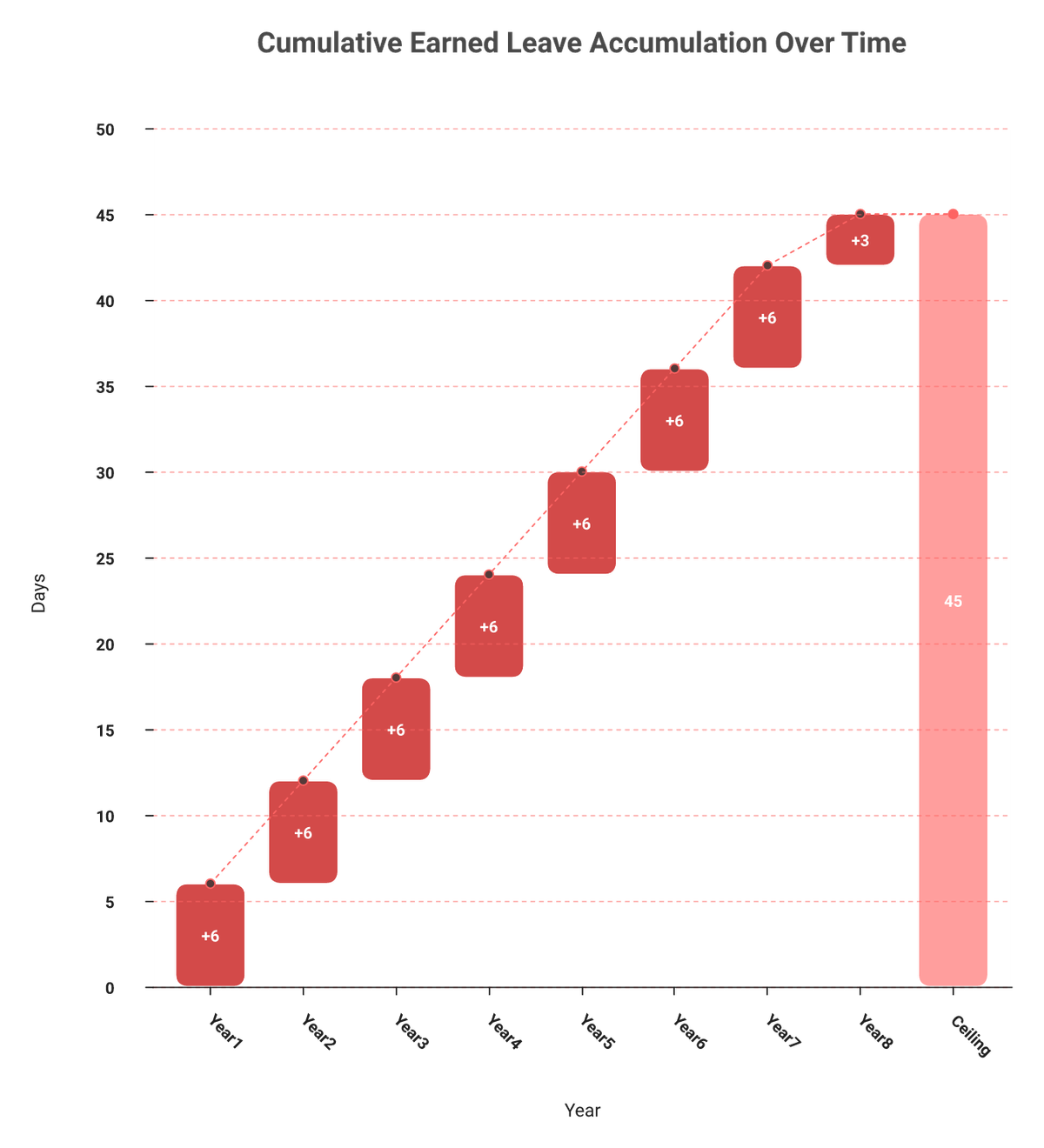
Under Section 25, every person employed is entitled after twelve months of continuous service to 12 days of holidays with wages, accumulable up to 45 days. Separately, in each twelve month period, they get up to 12 days sick leave and up to 12 days casual leave with wages. Versatile Club records these as three separate balances in the statutory register of employment for every India employee, because a merged PTO figure cannot be reconciled against the Form Q columns.
The entitlement table you can paste into a policy
| Leave type | Entitlement | Carry forward |
| Holidays with wages (earned leave) | 12 days, after 12 months of continuous service | Yes, accumulable up to 45 days per Section 25(1) |
| Sick leave | Up to 12 days per 12 month period, on sickness or accident | Not stated in Section 25 |
| Casual leave | Up to 12 days per 12 month period, on any reasonable ground | Not stated in Section 25 |
| Weekly holiday | One whole day each week, no wage deduction | Not applicable |
| Leave wages rate | Daily average of wages for days actually worked in the preceding three months, excluding overtime, under Section 26 | Not applicable |
💰 The 45 day ceiling most sources get wrong
Plenty of HR pages still publish a 24 day accumulation cap. The Act's own text reads forty five days, substituted by G.O. Ms. No. 162, Labour and Employment (K2), dated 14 November 2018. Nearly double.
That matters on your balance sheet, not just in your handbook. A senior engineer who banks leave for three years can hold 45 days of encashable balance. Versatile Club provisions this monthly against the statutory ceiling rather than discovering it in a full and final settlement, and it shows up on the same India payroll compliance report as PF and TDS.
Continuous service, calculated properly
Section 25(5) says twelve months of continuous service survives interruptions. Sickness, accident, or authorised leave up to 90 days in aggregate does not break it. Nor does a lock out, a legal strike, or involuntary unemployment up to 30 days.
⏰ Worked example: one Chennai engineer
Hired 1 April 2026. Through year one she can draw up to 12 casual and 12 sick days, because Section 25(2) applies during the first twelve months of continuous service. Earned leave is different. She becomes entitled to 12 days of holidays with wages only from 1 April 2027.
If she takes six of those in year two, six carry forward. Repeat that pattern and she reaches the 45 day wall in roughly eight years. Versatile Club flags balances crossing 30 days in its monthly client reporting, because that is the point where encashment planning stops being optional.
There is a quieter argument for encouraging usage. Reed Hastings makes the point that a use it or lose it rule sounds restrictive but actually pushes people to rest. My read is the same, with an India caveat: track the statutory balance precisely, then actively nudge people to spend it.
"The compliance side is the real reason I'd recommend them though. PF, tax, the statutory filings, all the stuff I genuinely did not want to learn, they just handle it and keep it correct every month."
— Angad S., Founder Versatile Club G2 - Verified Review, June 2026
"The dashboard could be a little more self-serve, a couple of times I wanted to pull a report or a doc myself and ended up just messaging my contact instead. They always answered fast, so it wasn't a real problem."
— Angad S., Founder Versatile Club G2 - Verified Review, June 2026
"We worked with Versatile to hire in India and support our design staffing needs without getting pulled into the complexity of contracts, payroll, compliance, and HR operations."
— Ibrahim A., Design Lead Versatile Club G2 - Verified Review, June 2026
Versatile Club maintains the leave register under its own Shops and Establishments registration, so the balance shown to the client and the balance shown to an Inspector come from the same ledger.
Q3. What are the legal working hours, weekly off, and overtime limits?
Sections 9 and 14 cap work at 8 hours a day and 48 hours a week, extendable with overtime to 10 hours a day and 54 hours a week. No one works more than four hours without a one hour rest interval. Spreadover cannot exceed 12 hours. Overtime is paid at twice the ordinary rate, and every employee gets one whole day weekly holiday with no wage deduction.
Hours, precisely
Read these as hard numbers, not guidance.
Daily limit: 8 hours. Weekly limit: 48 hours.
With overtime: 10 hours a day, 54 hours a week maximum.
Rest interval: at least one hour after four hours of work.
Spreadover, meaning work plus rest measured end to end: 12 hours maximum in a day, under Sections 10 and 15.
Overtime rate: twice the ordinary rate of wages, under Section 31.
⚠️ Salaried does not mean exempt
US founders assume an exempt salaried classification carries over to India. It does not. The double rate for overtime is a statutory rate, and it is not negotiable in the offer letter.
The only clean exit is the management exemption in Section 4(1)(a), which is a functional test rather than a title. Versatile Club classifies each role against that test before payroll setup, because an incorrect classification shows up later as an overtime arrears claim, which is one reason clients route this through managed payroll.
Weekly holiday and the no deduction rule
Sections 11 and 16 give every person employed one whole day holiday each week. Section 11(6) and Section 16(4) both bar any wage deduction for that day, including for people not ordinarily paid for non working days.
⏰ Running a 24x7 or US-overlap shift
Tamil Nadu allows this through the Section 6 exemption route, where the government exempts establishments from specified provisions on stated conditions. The conditions are the important part. Expect a rotational weekly holiday, adherence to the 8 hour and 48 hour limits, and full display of the statutory notice of hours.
Rule 18 requires a notice in Form S showing each person's shift, start time, rest interval, finish time, and weekly holiday. Change the pattern, and a notice of change goes to the Assistant Inspector of Labour. Versatile Club files and maintains the Form S notice for every client team it employs, which is the document an Inspector opens before asking anything about leave.
✅ Why hour caps are a retention tool
The real risk with a distributed India team is not underwork. Jason Fried's observation that the true threat is too much work getting done matches what I see on US overlap shifts. Engineers on a 6pm to 2am Chennai window quietly stack hours nobody records.
Versatile Club reviews shift patterns at the 90 day Success Coach check in, and the spreadover number is what usually surfaces the problem first. A 12 hour spreadover cap is not just paperwork. It is the legal reason to end a shift.
Q4. How many public holidays are mandatory, and how does the 2026 calendar map to them?
The Tamil Nadu Industrial Establishments (National, Festival and Special Holidays) Act, 1958 mandates paid holidays on 26 January, 1 May, 15 August, and 2 October, plus festival holidays notified for your establishment, commonly five, for nine in total. The state's annual holiday list is far longer and applies to government offices and banks, not automatically to a private establishment.
The statutory floor, then everything else
Four national holidays are fixed by Section 3 of the 1958 Act. Festival holidays are selected for your establishment and notified to the Inspector of Labour, which is why two Chennai companies can legitimately publish different lists.
📅 How festival holidays get chosen
You declare them in advance for the calendar year, not month by month. If an employee works on a declared holiday, the 1959 Rules provide for a substitute holiday, and it gets recorded in the register of employment under the substitute holiday marker.
Versatile Club issues a state specific holiday schedule at onboarding for each employee it employs in India, so a Chennai hire and a Pune hire are not negotiating off two different calendars in October. Founders comparing that against setting up their own entity usually start with the EOR vs entity calculator.
Mapping the 2026 Tamil Nadu list
Tamil Nadu published 24 holidays for 2026 for state government offices and banks operating in the state, including Pongal on 15 January, Uzhavar Thirunal on 17 January, Tamil New Year on 14 April, and Deepavali on 8 November. Your private establishment is not bound to all 24.
| 2026 date | Status for a private establishment |
| 26 January | Statutory national holiday under the 1958 Act |
| 1 May | Statutory national holiday |
| 15 August | Statutory national holiday |
| 2 October | Statutory national holiday |
| 15 January (Pongal), 17 January (Uzhavar Thirunal), 14 April (Tamil New Year), 8 November (Deepavali) | Strong candidates for your five notified festival holidays |
| Remaining entries on the state list | Discretionary, your call |
❌ The mistake that cannot be undone
Founders paste the 24 day state calendar into an offer letter, then try to trim it at appraisal season. That does not go well. Under Section 50 of the 1947 Act, a more favourable term you granted continues to bind you.
My approach is to publish the statutory nine, then declare a separate discretionary set that is labelled as discretionary from day one. Versatile Club sets that split at contract stage rather than after the first Pongal, which is the cheapest moment to get it right, and our compliance coverage carries the notified list for each state we employ in.
Q5. What about maternity, adoption, and the government-sector leave your candidates compare against?
Maternity leave is central law, not state law. The Maternity Benefit Act, 1961, as amended in 2017, gives 26 weeks of paid leave for the first two children, 12 weeks for a third, and 12 weeks to a commissioning or adopting mother of a child below three months. Tamil Nadu government employees follow the Fundamental Rules instead, with earned leave, half pay leave, commuted leave, and extraordinary leave. Your candidates will compare against that structure.
The central floor, and who actually pays
Eligibility is 80 days of work with the employer in the 12 months before the expected delivery date. Pay is at the average daily wage. The Tamil Nadu Shops and Establishments Act says nothing about maternity, so this central Act fills the gap entirely.
Who writes the cheque depends on coverage. Where the woman is insured under the Employees' State Insurance Act, 1948, maternity benefit is paid by ESIC. Where she is outside the wage ceiling, the employer pays directly, which is one of the cost lines we model in the cost of hiring in India.
👶 Adoption, surrogacy, and nursing breaks
Section 5(4) covers commissioning mothers and adoptive mothers of infants under three months at 12 weeks. Section 10 adds one month of leave for illness arising from pregnancy or delivery. Section 11 requires nursing breaks until the child turns 15 months.
Versatile Club administers maternity benefit and the ESIC interaction under its own registrations, so a client with one India employee gets the same statutory handling as a client with thirty. That matters because most first hires happen before any HR function exists, which is why founders often start with HR consulting support.
⚠️ Watch the outdated 12 week figure
Plenty of Indian labour law textbooks still print 12 weeks plus one month of illness leave. That reflects the position before the 2017 amendment. If your policy says 12 weeks for a first child, it is understating a statutory right, and Section 50 of the state Act means a court reads the more favourable rule against you anyway.
This is the one clause where I tell clients to lift the statute wording into the contract without paraphrasing. Paraphrasing is how disputes start.
What your Chennai candidate is comparing you to
| Leave type | Private establishment, Tamil Nadu | Tamil Nadu government employee |
| Maternity | 26 weeks, first two children | Governed by Fundamental Rules |
| Annual paid leave | 12 days, accumulable to 45 days under Section 25(1) | Earned leave, credited by half year |
| Sick leave | 12 days per 12 month period | Half pay leave, convertible to commuted leave on medical certificate |
| Long unpaid leave | Not provided by statute | Extraordinary leave |
| Casual leave | 12 days per 12 month period | Separate casual leave allotment |
✅ What to match and what to decline
Match the maternity number exactly, because it is law. Do not try to replicate half pay leave or commuted leave. Those exist because government service has a pension architecture your startup does not.
Versatile Club's read is that the honest answer wins this conversation more often than the generous one. When a candidate cites government norms, name the two systems, show the statutory floor you meet, then point to what you actually offer above it. I have watched that land better than a vague promise to be flexible.
Versatile Club administers PF, ESI, and maternity benefit under its own EPFO and ESIC registrations, so the entitlement written in the offer letter is filed by the same entity that pays it. That structure is described in full on our compliance page.
Q6. How is leave pay and encashment calculated, and what does it cost you?
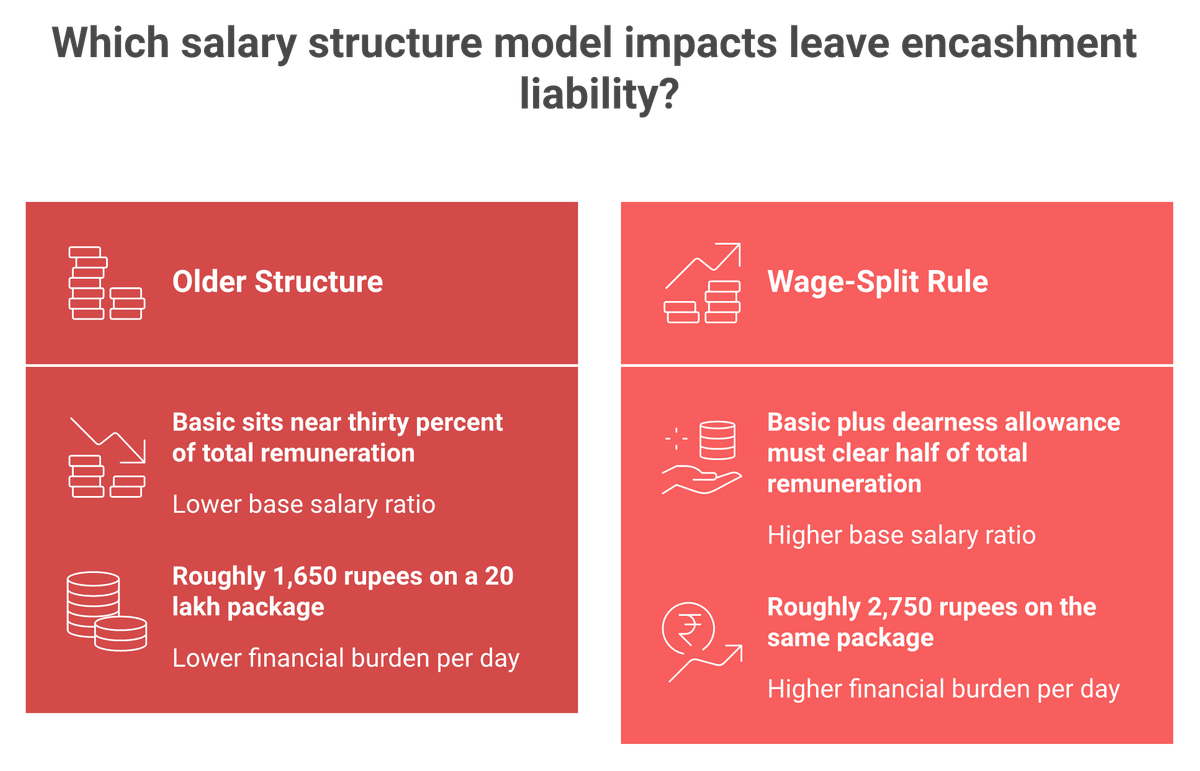
Section 26 pays leave at the daily average of wages for days actually worked in the preceding three months, excluding overtime. Encashment is computed on Basic plus dearness allowance. Because the Labour Codes require Basic plus DA to be at least half of total remuneration, every accrued leave payout rises even when leave usage stays flat. Versatile Club reports accrued leave liability on a single consolidated USD invoice from its Indian entity, so the figure a controller provisions is the figure that gets paid.
The formula, stated plainly
Take the wages earned for days actually worked in the last three months. Divide by those days. Strip out overtime. That is the daily rate for a leave day.
Sections 25(3) and 25(4) then force payout in two situations. If someone is discharged before taking earned holidays, you pay for them. If someone is discharged while sick, you pay for the sick leave they had accrued.
💰 The Factories Act runs different math
Manufacturing sites accrue leave at one day for every 20 days worked, with a 240 day qualifying threshold under the older rule. Leave wages there use the daily average of full time earnings for the preceding month, including dearness allowance, excluding overtime and bonus.
One detail catches people out. A fraction of half a day or more counts as a full leave day, and anything under half a day is ignored. Versatile Club applies the rounding rule at accrual rather than at exit, which avoids a settlement argument nobody wins, and the same discipline runs through our India payroll cycle.
The number that surprises CFOs
Take an engineer on 20 lakh rupees total remuneration. Under an old structure with Basic at 30 percent, Basic plus DA is 6 lakh, so a day of encashment costs roughly 1,650 rupees. Restructure to Basic plus DA at 50 percent, and that day costs roughly 2,750 rupees.
💸 Multiply it by 45
The Tamil Nadu accumulation ceiling is 45 days. At the higher wage split, a fully banked senior employee carries around 1.24 lakh rupees of encashment exposure. Ten such employees is 12 lakh sitting off your books if nobody provisioned it.
Versatile Club flags balances crossing 30 days in monthly client reporting, because that is where the provisioning conversation should start, not at the resignation email. I could be reading the trend too strongly, but leave liability looks like the most commonly under-provisioned India line item I see.
"As a founder running a lean agency, hiring talent in India without a local entity was a compliance minefield PF, ESI, TDS, professional tax across states. I get a single USD invoice, fully compliant employment contracts, and payroll runs on time every month."
— Vedant T., Founder Versatile Club G2 - Verified Review, June 2026
"First USD invoice landed clean: no FX markup, no setup fee, no surprises. Every payroll or PF question gets a real answer from a real person, usually same day."
— Verified User in Information Technology and Services Versatile Club G2 - Verified Review, June 2026
"The team is really competent, but there were a few time zone misunderstandings that caused slight delays in the initial phase."
— Setu C., Client Versatile Club G2 - Verified Review, June 2026
⏰ Provision monthly, not at exit
Run the accrual every payroll cycle. Value it at the current Basic plus DA, not last year's. Then report the balance to whoever owns your month end close.
Versatile Club prices India EOR at 149 dollars per employee per month with no setup fee and no exit fee, and the accrued leave figure appears on the same invoice as payroll, which is what makes it easy to provision. The full breakdown sits on our pricing page.
Q7. What changed for leave after the Labour Codes took effect on 21 November 2025?
All four Labour Codes became effective on 21 November 2025. The qualifying period for annual leave with wages drops from 240 days to 180. Carry forward is capped at 30 days, and unused leave above the cap must be encashed each year rather than lapsing. State Shops and Establishments provisions continue to operate until subsumed by state rules. Versatile Club filed PF, ESI, TDS, and professional tax under its own registrations through that transition, so the reconfiguration happened once at entity level.
The three mechanical changes
Read them as configuration items, not policy philosophy.
Eligibility: 180 days of work in a year, down from 240.
Carry forward: capped at 30 days.
Encashment: balances above the cap are encashed annually, so leave no longer quietly lapses.
⏰ Is leave encashment mandatory in Tamil Nadu now?
Yes, in substance. Since 21 November 2025, balances above the carry forward cap must be paid out at the end of the leave year rather than expiring. Encashment is no longer only an exit event.
Versatile Club runs that year end encashment calculation as part of its December payroll cycle for India employees, which is simpler than reconstructing it in March. Clients who moved to us mid-year usually pick this up during an EOR provider switch.
The honest limit
Not every provision is live, and state rules under the Codes are still being notified in several states. Advisory alerts from EY India and BDO India both flagged that some sections were brought into force while others await rules.
⚠️ Do not retire your state Act tracking yet
Keep the Tamil Nadu registers running exactly as before. The state Act's 45 day accumulation ceiling and the Code's 30 day carry forward cap coexist awkwardly right now, and the safe reading is to apply the more favourable rule to the employee.
Versatile Club re-ran every active India contract against the 180 day test instead of waiting for state rules, because the accrual clock started for employees on day one. Where my head is right now is that the 30 day cap becomes the operative number once state rules land, but I would not bet a settlement on it.
"The compliance rigour is genuinely impressive every statutory filing reviewed before submission. Five-day onboarding, zero late payslips."
— Vedant T., Founder Versatile Club G2 - Verified Review, June 2026
"Founder is just a call away. Extremely helpful in resolving all our queries."
— surbhi m., Founder Versatile Club G2 - Verified Review, June 2026
"Nothing that would make me consider switching. The compliance work and payroll accuracy are what I pay for, and those are rock solid. These are polish items."
— Verified User in Information Technology and Services Versatile Club G2 - Verified Review, June 2026
✅ Three changes to make this quarter
First, change your accrual eligibility trigger to 180 days. Second, add a year end encashment routine for balances above the cap. Third, restate the wage structure so Basic plus DA clears 50 percent, then reprice your leave liability.
Versatile Club employs India hires on its own registered Indian entity rather than a local partner shell, which is why one Labour Code update flowed to every client at once instead of arriving as separate vendor notices. Teams weighing that against incorporation usually run the numbers in EOR versus entity in India.
Q8. What leave records must you maintain to survive an inspection?
Tamil Nadu requires a register of employment recording leave credited, availed, and balance, a wages register, an hours and weekly holiday notice, and a wage slip that doubles as a leave card, all prescribed under the Tamil Nadu Shops and Establishments Rules, 1948. IT and ITeS employers self certify half yearly, before 31 July and before 31 January. Registration is online, with the certificate issued within 24 hours. Contravention draws up to 5,000 rupees, and up to 10,000 rupees for a repeat offence. Versatile Club maintains these registers and self certifications for every India employee on its own entity.
What an Inspector opens first
Form Q, the register of employment, is the document. It carries three column groups for each employee: leave credited at the start of the month, leave availed during the month, and leave balance. Each group splits into casual leave, sick leave, and holidays with wages.
That structure is why a single merged PTO number fails. There is no column for it. The form also uses fixed markers for weekly holiday, festival holiday, national holiday, substitute holiday, and maternity leave.
📁 The full register set
Form P: advances, deductions for damage or loss, and fines.
Form Q: register of employment with the leave ledger.
Form R: register of wages, including leave wages.
Form S: notice of daily hours, rest interval, and weekly holiday.
Form T: wage slip and leave card issued to the employee.
Form O: half yearly self certification for IT and ITeS establishments under Rule 16-C.
Visit book: for the Inspector's own remarks.
Versatile Club files the Form O self certification on the 31 July and 31 January cycle for the IT and ITeS clients it employs staff for, which is a deadline in-house teams miss more often than any other. Companies running their own books usually hand this to a payroll outsourcing partner.
Two rules that quietly fail audits
Entries relating to any day must be made on that day. Backfilling a month of leave records before an inspection is not compliance, and it is visible. Registers and notices for a calendar year must be preserved until the end of the next calendar year.
💸 What non compliance costs
Section 45 sets fines up to 5,000 rupees for a first offence and up to 10,000 rupees for a second. Rule 18 was amended in July 2024 to raise the rule level fine from 50 rupees to 2,000 rupees. Offences can be compounded by the Commissioner of Labour under Section 46-A.
The bigger cost is diligence. Versatile Club's clients answer acquirer questions on India statutory liability with the actual registers, rather than rebuilding leave history from Slack messages and spreadsheets.
"Their team was highly responsive, professional, and easy to work with throughout the process. Communication was always clear."
— Mukul S., Client Versatile Club G2 - Verified Review, June 2026
"The initial process took a little getting used to, but the team was quick to guide us through and it became very straightforward."
— Verified User in Venture Capital & Private Equity Versatile Club G2 - Verified Review, June 2026
"They took payroll, contracts, and ongoing compliance off our plate entirely, so we got the talent we wanted without the legal and admin overhead."
— Angad S., Founder Versatile Club G2 - Verified Review, June 2026
Versatile Club holds Shops and Establishments, PF, and ESIC registrations in its own name across Indian states, so the registers an Inspector inspects and the payroll a client funds sit inside one entity. If you want to see how that runs end to end, talk to our team.
Q9. Can you run unlimited PTO for a Tamil Nadu team?
Not cleanly. Tamil Nadu law requires leave to be credited, tracked, and reported in the register of employment, so an untracked unlimited policy fails on paperwork alone. Culturally it fails harder, because in hierarchical teams people under unlimited policies often take less leave, not more. Versatile Club assigns a 90 day Success Coach to every placement, and whether the person is actually using their leave is one of the check in items.
The playbook everyone imports
Netflix removed its vacation policy and wrote a well known book about it. Since then, every Seed to Series B founder I speak to has considered doing the same in India. The pitch sounds clean: no tracking, no accrual, treat adults like adults.
Reed Hastings himself flagged the risk in that idea. Not allotting vacation days can quietly create conditions where nobody dares take a day off, wrapped up as a perk. That risk is amplified in India, and it shows up fast on teams built through contract to hire.
❌ The statutory problem comes first
Form Q has no column for unlimited. It has three column groups per employee: leave credited, leave availed, and leave balance, each split into casual leave, sick leave, and holidays with wages. Rule 11 also requires a wage slip and leave card showing leave availed and leave at credit.
So the register forces a number. Versatile Club runs the statutory ledger for every India employee it employs, then treats anything discretionary as a separate layer above it. There is no version of this where the ledger disappears.
The cultural problem is the expensive one
Craig Storti records an American manager whose New Delhi colleague asked permission by instant message every time he wanted a dinner break. His explanation was simple: because I am your subordinate. Now imagine that person deciding, unaided, how many holidays are acceptable.
⚠️ Unlimited becomes zero
What I have watched across six years of placements is fairly consistent. Remove the number, and the cautious employee takes four days a year. The confident one takes twenty. That is not fairness. It is a lottery based on personality.
Versatile Club's read is that the standard advice gets this backwards. The tracked balance is not a constraint on trust. It is permission in writing, which is exactly what a first time India employee needs, and it is one reason we run a culture fit assessment before placement.
✅ The model that actually works
Run three layers. First, the statutory floor as a tracked ledger: 12 days earned leave, 12 sick, 12 casual, with the 45 day accumulation ceiling. Second, a declared discretionary top up, labelled discretionary. Third, visible leadership behaviour.
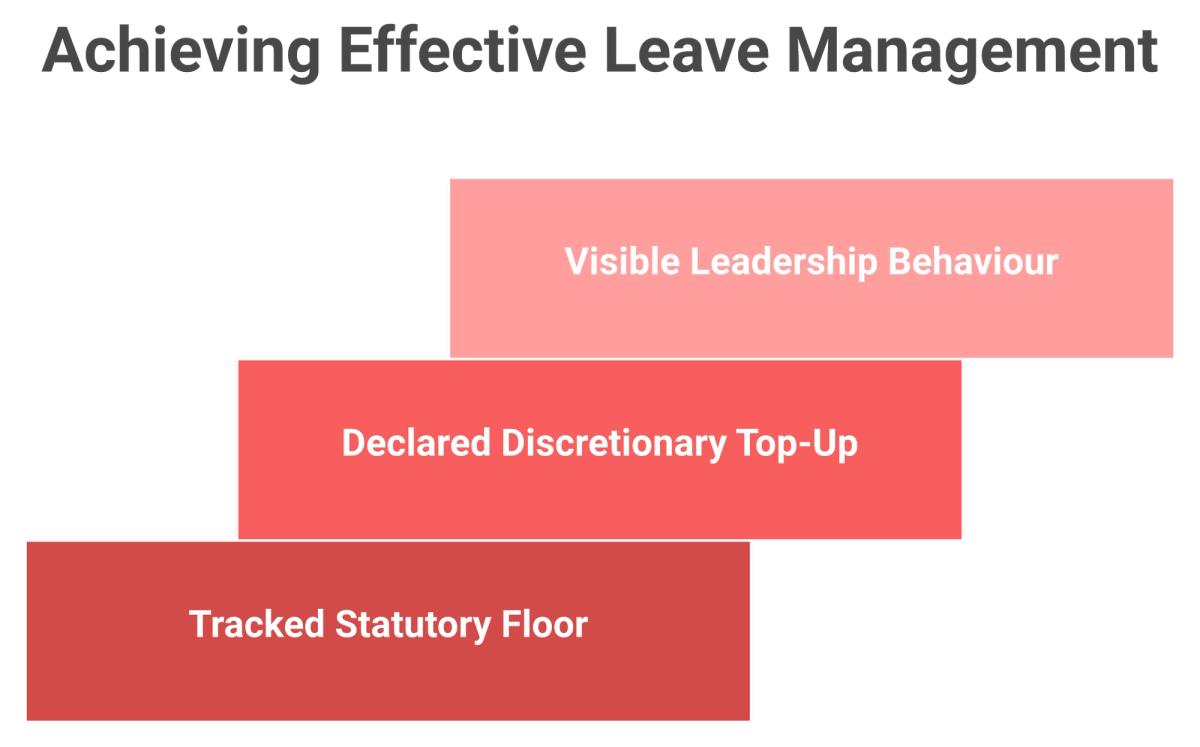
Hastings' own advice on this was to lead by example. If you want people to rest, take leave yourself and say so publicly. In our client teams, the manager posting their own leave dates in Slack moves usage more than any policy edit.
⏰ One number worth tracking
Watch average leave days taken per employee per quarter. If it sits under two, your policy is not the problem, your signalling is. Versatile Club surfaces leave usage in its monthly client reporting alongside payroll, which is how the pattern usually gets caught early.
I could be over reading this from a small sample. What I am confident about is the compliance half: the register is not optional, so the tracked floor is not optional either.
Versatile Club builds the statutory leave ledger into every India employment it runs, and the 90 day Success Coach check in asks whether the person has actually taken time off. Compliance is the floor. Goodwill gets built above it, not instead of it, which is the operating model behind our EOR services.
Q10. How do you assemble a defensible Tamil Nadu leave policy?
A defensible policy names the governing statute, states earned, sick, and casual leave as separate balances with the accumulation cap, lists the statutory holidays, defines the leave year and continuous service, sets the encashment basis as Basic plus DA, references maternity and POSH obligations, and names the statutory register as the system of record. Versatile Club drafts this leave annexure inside its five day contractual onboarding window rather than issuing it later as a handbook.
Eight clauses, in order
Work through these as a sequence. Each one has a statutory anchor and one common drafting mistake.
Governing law clause. Name the Tamil Nadu Shops and Establishments Act, 1947 and the establishment's registration. Mistake to avoid: writing "as per Indian labour law" with no statute named.
Leave types clause. State 12 days earned leave, 12 sick, and 12 casual as three separate balances. Mistake: merging them into one PTO figure.
Accumulation clause. State the 45 day ceiling for earned leave. Mistake: silence, which lets an employee argue for unlimited carry forward.
Eligibility clause. Define continuous service and the interruptions that do not break it. Mistake: using a probation clause that contradicts it.
Holidays clause. List the four national holidays under the 1958 Act and your notified festival holidays separately from discretionary days. Mistake: pasting the state calendar wholesale.
Leave wages and encashment clause. Set the rate as the daily average of wages for the preceding three months, excluding overtime, and the encashment basis as Basic plus DA. Mistake: leaving the basis undefined until the exit letter.
Statutory leave clause. Reference maternity at 26 weeks and the POSH Internal Committee obligation. Mistake: paraphrasing the maternity number.
System of record clause. Name the register of employment as the authoritative leave record. Mistake: letting a Slack thread become the record.
📝 The clause people forget
Notice periods interact with leave. Section 41 requires at least one month of notice, or wages in lieu, for anyone employed continuously for six months or more. If your policy lets employees serve notice using accrued leave, say so explicitly.
Versatile Club writes the notice and leave interaction into the contract at drafting stage, because that single ambiguity produces more full and final settlement disputes than any other clause in our experience. Teams converting freelancers hit this first, which is why we cover it in converting a contractor to an employee in India.
⏰ Review cadence, not one and done
Set a review trigger, not an annual calendar reminder. Review when state rules under the Labour Codes are notified, when your wage structure changes, and when you cross the 20 employee mark for provident fund thresholds.
"Compliant contract drafted for us, the offer out the same week, and our hire was set up properly before I'd even fully wrapped my head around how India payroll works."
— Angad S., Founder Versatile Club G2 - Verified Review, June 2026
"Setting up in a new country can get messy fast, but their India EOR made onboarding feel easy. The team's responsive, clear, and great to work with."
— Setu C., Client Versatile Club G2 - Verified Review, June 2026
"Nothing as of now, Minor friction for an otherwise solid product."
— Vedant T., Founder Versatile Club G2 - Verified Review, June 2026
✅ Test it before you publish
Hand the draft to someone who has never seen it. Ask them three questions. How many casual leaves do I get, what happens to my balance if I leave in March, and who records it?
If they cannot answer from the document, the document is not finished. Versatile Club runs that same read through before an India offer letter goes out, and it usually surfaces one missing definition.
Versatile Club includes the leave annexure in the five day contractual onboarding SLA, with no setup fee and no exit fee, so the policy exists as a signed document from day one rather than as an intention. Our onboarding sequence sets out each step.
Q11. How do you run one leave policy across a pan-India workforce?
Set one company wide floor at or above the most generous state entitlement you employ under, then track state deltas separately. Tamil Nadu files professional tax biannually and carries Labour Welfare Fund contributions. Karnataka runs a monthly professional tax cycle. Maharashtra needs dual PTRC and PTEC registration. Versatile Club holds Shops and Establishments, PF, and ESIC registrations covering all 28 states and 8 union territories, and files those state cycles from one Indian entity.
The pain nobody budgets for
Most scaling teams do not fail on the leave numbers. They fail on the stack. One vendor runs payroll, another runs EOR, a third handles benefits, and a fourth ships laptops.
By month end, nobody can reconcile the invoices. Then an acquirer asks about India statutory liability, and the answer requires four email threads. Versatile Club issues one consolidated USD invoice covering payroll and statutory costs, which is the version a controller can actually close a month against, and it replaces the scattered stack described in outsourcing payroll in India.
🗺️ The state delta table
| State | Professional tax cycle | Other state layer | Leave rulebook |
| Tamil Nadu | Biannual | Labour Welfare Fund contribution | TN Shops and Establishments Act, 1947 |
| Karnataka | Monthly | S&E registration renewal | Karnataka Shops and Commercial Establishments Act |
| Maharashtra | Monthly, PTRC plus PTEC | Two registrations to maintain | Maharashtra Shops and Establishments Act |
| Delhi | No professional tax | Strict S&E enforcement | Delhi Shops and Establishments Act |
| West Bengal | Monthly | Frequent rule changes | West Bengal Shops and Establishments Act |
Versatile Club files these cycles directly rather than through a local partner, which is why the Tamil Nadu June and December dates are operating memory for us rather than a lookup.
The single floor plus delta model
Pick one national floor. Fifteen days earned leave, twelve sick, and twelve casual clears every major state entitlement I work with. Publish that as the company policy.
⚠️ Then hold the deltas separately
Keep a second internal sheet for what varies by state: accumulation ceilings, holiday counts, professional tax cycles, and welfare fund remittances. Employees read the floor. Finance reads the delta.
Versatile Club maintains that split for every client, and my honest view is that the delta sheet matters more than the policy document. The policy wins goodwill. The delta sheet is what survives an inspection.
"Local India compliance, FD setup, all of this is complicated to understand to hire a single person. Makes my life as a lean founder extremely easy."
— surbhi m., Founder Versatile Club G2 - Verified Review, June 2026
"I would recommend Versatile to anyone looking for EOR India services, Employer of Record India solutions, or a trusted partner to hire employees in India efficiently and compliantly."
— Mukul S., Client Versatile Club G2 - Verified Review, June 2026
"We worked with Versatile to hire in India and support our design staffing needs without getting pulled into the complexity of contracts, payroll, compliance, and HR operations."
— Ibrahim A., Design Lead Versatile Club G2 - Verified Review, June 2026
✅ Name an owner for every filing
Write the owner's name beside each line. Tamil Nadu professional tax, June. Labour Welfare Fund, per the state cycle. Provident fund challan, monthly. Form O self certification, 31 July and 31 January.
Unowned filings are the ones that slip. This is the same failure pattern as US multi state sales tax, where the company knows the rule and still misses the calendar.
Versatile Club covers all 28 states from one owned Indian entity with one consolidated USD invoice, so a Chennai hire and a Kolkata hire do not create two vendors, two reconciliations, and two compliance calendars. That single entity model is set out on our India EOR page.
Q12. Who should own Tamil Nadu leave compliance, you, a global EOR, or an India-native EOR?
With one to thirty India employees and no entity, an Employer of Record is the practical answer. An EOR is the legal employer on paper while you manage the person day to day. The differentiator is entity ownership. India-native providers employ on their own registrations, while most global platforms employ through local partner entities, which adds a layer between you and the statutory leave register a diligence process will ask for. Versatile Club employs on its own registered Indian entity across all 28 states.
The five criteria that actually matter
Ignore the feature grids. For leave compliance specifically, five things decide the outcome.
Entity ownership: who signs the contract and holds the S&E registration.
State coverage: whether your Coimbatore or Kolkata hire is supported.
Invoicing currency: USD from India, or FX conversion at your bank.
Support model: a named person, or a ticket queue.
Exit cost: what leaving costs, including setup and exit fees.
💰 The three options, side by side
| Criterion | Versatile Club | Wisemonk | Global generalists (Deel, Remote, G-P) |
| India entity | Owned Indian entity | India-native operator | Typically local partner entities in India |
| States covered | All 28 states and 8 UTs | India focused | Concentrated on major hubs |
| Indicative price | 149 dollars per employee per month | 99 to 399 dollars per employee per month | 400 to 599 dollars per employee per month |
| Onboarding | 5 day contractual SLA | 24 to 72 hours claimed | Typically 7 to 14 days |
| Security certification | Not SOC 2 or ISO 27001 certified today | SOC 2 and ISO 27001 certified | SOC 2 and ISO 27001 certified |
| Retention cover | 6 month replacement guarantee, 90 day Success Coach | No published replacement guarantee | Not offered |
✅ Where each option genuinely wins
Versatile Club fits a US or UK company hiring 1 to 30 people in India who wants one entity, one invoice, and a named person answering on WhatsApp. Wisemonk fits buyers whose procurement team requires SOC 2 and ISO 27001 documentation on day one, and it has a lower entry price point. Global platforms fit companies hiring across five or more countries at once.
Buyers running that comparison in detail usually read the Wisemonk alternative breakdown and the Deel alternative breakdown side by side.
❌ Where Versatile Club is the wrong choice
I will name this plainly. If you need multi country EOR, we operate only in India by design. If your procurement process makes SOC 2 or ISO 27001 a gating requirement for a 100 plus person India team, a certified platform is the cleaner path. If you are a B2C consumer business hiring at volume, we are not the right fit.
Versatile Club's founder support model is also finite. I am on WhatsApp for client communication rather than a CSM rotation, and at some point that will need to change. I would rather say that than market it as permanent.
"We looked at setting up a subsidiary and quickly realized it would take 6+ months, cost tens of thousands in legal and registration fees, and require ongoing compliance work we had no expertise in."
— Verified User in Information Technology and Services Versatile Club G2 - Verified Review, June 2026
"Every option I looked at first was either set up your own entity (no thanks, not for one hire) or some platform that quotes you a great price and then you find out about all the add-ons later."
— Angad S., Founder Versatile Club G2 - Verified Review, June 2026
"The initial process took a little getting used to, but the team was quick to guide us through and it became very straightforward."
— Verified User in Venture Capital & Private Equity Versatile Club G2 - Verified Review, June 2026
Versatile Club is an India-only EOR employing on its own Indian entity, with USD invoicing from India, a five day contractual onboarding SLA, a six month replacement guarantee on C2H placements, and no setup or exit fees. Reviewers report onboarding completed in four days and first payroll running on time. If that shape fits your next hire, tell us what you are building.
FAQs
How many casual, sick, and earned leaves does a Tamil Nadu employee get?
Under Section 25 of the Tamil Nadu Shops and Establishments Act, 1947, a person employed in an establishment gets three separate leave balances:
- Holidays with wages (earned leave): 12 days, available after twelve months of continuous service, accumulable up to 45 days.
- Sick leave: up to 12 days with wages in each twelve month period, on sickness or accident.
- Casual leave: up to 12 days with wages in each twelve month period, on any reasonable ground.
Sick leave and casual leave are available during the first twelve months of service. Earned leave is not. That single distinction causes most first year disputes we see on new India teams.
Continuous service also survives interruptions. Sickness, accident, or authorised leave up to 90 days in aggregate does not break it, and neither does a lock out or a legal strike.
Versatile Club records these as three distinct balances in the statutory register for every India employee, because a single merged PTO number cannot be reconciled against the prescribed register columns. We keep the same ledger the Inspector would read, and it is part of our India EOR service.
Is the Tamil Nadu earned leave accumulation limit 24 days or 45 days?
It is 45 days. The proviso to Section 25(1) of the Tamil Nadu Shops and Establishments Act, 1947 states that holidays with wages may be accumulated up to a maximum of forty five days. That figure was substituted by G.O. Ms. No. 162, Labour and Employment (K2), dated 14 November 2018, notified in the Tamil Nadu Government Gazette Extraordinary No. 381.
The widely republished 24 day figure reflects the pre-2018 position. Several HR content pages never updated it.
Why it matters beyond trivia:
- Your maximum encashment exposure per employee nearly doubles.
- A senior engineer who banks leave for several years can hold 45 days of payable balance.
- Encashment is computed on Basic plus dearness allowance, which the Labour Codes push to at least half of total remuneration.
Versatile Club provisions accrued leave monthly against the 45 day ceiling and flags balances crossing 30 days in client reporting, so the number a controller books is the number that gets paid. Founders modelling that cost usually run it alongside the other line items in our India hiring cost breakdown.
Is leave encashment mandatory in Tamil Nadu after the 2025 Labour Codes?
In substance, yes. All four Labour Codes became effective on 21 November 2025. Three changes matter for leave:
- The qualifying period for annual leave with wages falls from 240 days to 180 days.
- Carry forward is capped at 30 days.
- Balances above that cap must be encashed at the end of the leave year rather than lapsing.
So encashment is no longer only an exit event. It becomes an annual payroll routine.
There is an honest caveat. Not every provision is live, and state rules under the Codes are still being notified in several states. The Tamil Nadu Act's 45 day accumulation ceiling and the Code's 30 day carry forward cap currently coexist awkwardly, and the safer reading is to apply whichever rule is more favourable to the employee.
Versatile Club re-ran every active India contract against the 180 day test rather than waiting for state rules, because the accrual clock started for employees immediately, and we run the year end encashment calculation inside the December payroll cycle. That reconfiguration happened once at entity level, which is described on our compliance page.
Can a US or UK company offer unlimited PTO to a team in Tamil Nadu?
Not cleanly, for two separate reasons.
The first is paperwork. The Tamil Nadu Shops and Establishments Rules, 1948 require a register of employment recording, per employee, leave credited at the start of the month, leave availed during the month, and leave balance, each split into casual leave, sick leave, and holidays with wages. There is no column for unlimited. Rule 11 also requires a wage slip that doubles as a leave card showing leave availed and leave at credit.
The second is behavioural. In hierarchical teams, removing the number often reduces usage rather than increasing it. The cautious employee takes four days a year and the confident one takes twenty, which is a lottery based on personality rather than a policy.
The workable model is three layers:
- The statutory floor, tracked precisely in the register.
- A discretionary top up, labelled discretionary from day one.
- Visible leadership behaviour, with managers publishing their own leave dates.
Versatile Club builds the statutory ledger into every India employment it runs, and the 90 day Success Coach check in asks whether the person has actually taken time off. That retention layer sits inside our contract to hire model.
Who should own Tamil Nadu leave compliance: your team, a global EOR, or an India-native EOR?
With one to thirty India employees and no local entity, an Employer of Record is usually the practical answer. An EOR is the legal employer on paper while you manage the person day to day. Setting up your own subsidiary typically means months of registration work and ongoing filings before the first hire.
The real differentiator is entity ownership:
- India-native EOR: employs on its own Shops and Establishments, PF, and ESIC registrations, so the leave register sits with the same entity that signed the contract.
- Global generalist: broad country coverage, often routed through local partner entities in India, which adds a layer between you and the register a diligence process will ask for.
- Your own entity: full control, highest fixed cost, and you own every state filing calendar.
Versatile Club employs on its own registered Indian entity across all 28 states, invoices in USD from India, and charges no setup or exit fees, with a five day contractual onboarding SLA. We only operate in India, so buyers needing five or more countries are better served elsewhere. Teams weighing the trade off usually start with our EOR versus entity calculator.