Table of contents (11)
Leave Policy in Uttar Pradesh: Rules, Types and Eligibility
Q1. What leave is an employee in Uttar Pradesh legally entitled to?
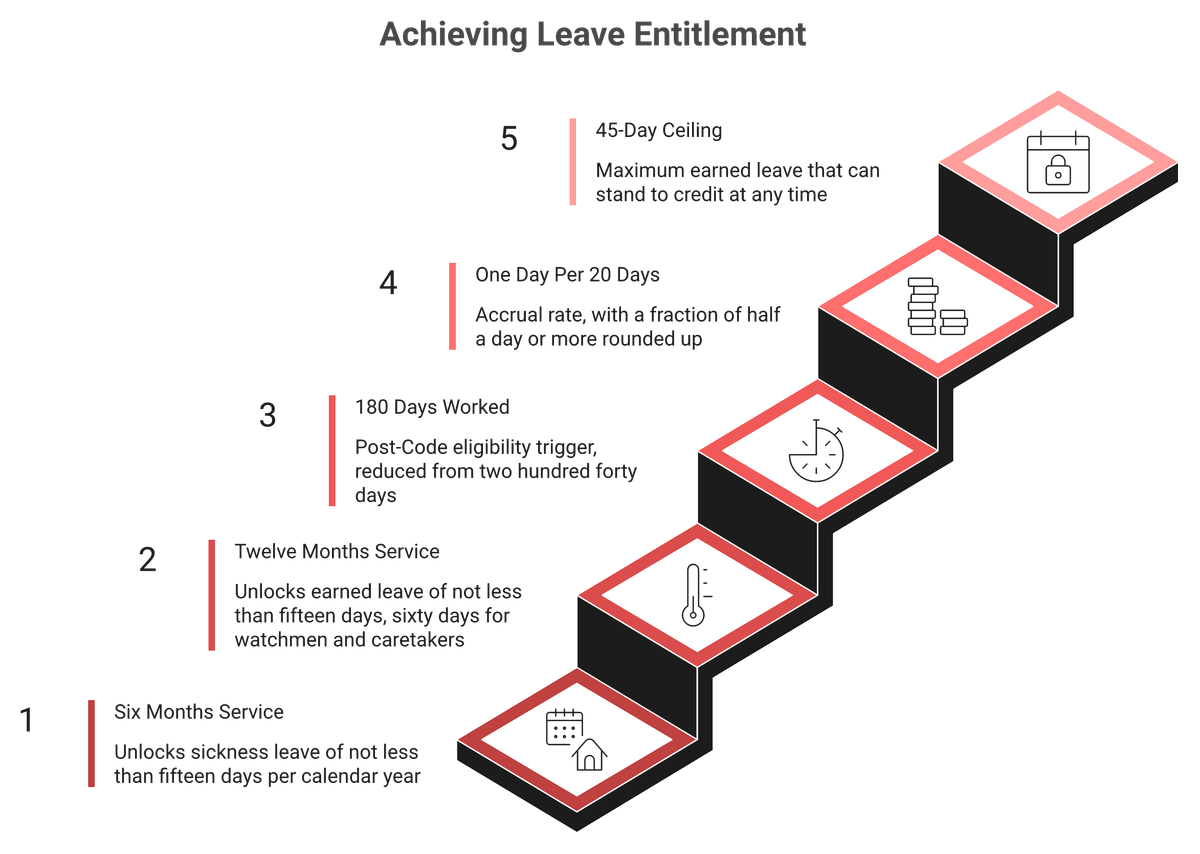
In Uttar Pradesh, an employee with 12 months of continuous service in a shop or commercial establishment is entitled to earned leave of not less than 15 days for every 12 months of service, under Section 10 of the U.P. Dookan Aur Vanijya Adhishthan Adhiniyam, 1962. Watchmen and caretakers get not less than 60 days. Sickness leave of not less than 15 days per calendar year starts after six months of service. Accumulated earned leave cannot exceed 45 days.
| Leave type | Entitlement | Eligibility | Carry-forward and payout |
| Earned leave (EL) | Not less than 15 days per 12 months | 12 months continuous service with the same employer | Unavailed EL adds to next year; total capped at 45 days |
| EL for watchman or caretaker | Not less than 60 days per 12 months | 12 months continuous service | Same 45-day ceiling applies |
| Sickness leave | Not less than 15 days per calendar year | 6 months continuous service | Wages paid with the first wage period after resuming duty |
| Casual leave (CL) | Up to one day for every month of service rendered that year | Service in the calendar year | Lapses if unapplied by year end |
| Weekly holiday and close days | One whole day each week plus notified public holidays | Employment of at least six days that week | Paid at the preceding day's wage rate |
| Maternity leave | As per the Maternity Benefit Act, 1961 and its 2017 amendment | Per the central Act | Statutory, not discretionary |
Why the blog tables you found disagree
⚠️ Casual leave lives in the rules, not the Act
Section 10 names casual leave but leaves the quantum to the state rules. Rule 10(iii) of the Niyamavali, 1963 sets it at not more than one day for every month of service rendered in that calendar year. That is where the "10 days" and "12 days" versions in competing articles come from.
Unapplied casual leave lapses at year end. Sickness leave applications cannot simply be refused, though the employer may ask for a certificate from a registered medical practitioner.
What the Act says that almost nobody quotes
💰 Section 14 makes you pay before the leave starts
An employee proceeding on earned leave can demand advance payment of wages for half the leave period, plus wages for the preceding wage period. The second half is paid with the first wage period after they return.
Section 11 adds a sharper rule. If you refuse earned leave to someone already holding 45 days of credit, you owe them wages for the refused period on top of their normal wages. Versatile Club logs every earned-leave refusal in writing on its own entity records, because Section 11 turns an unrecorded refusal into a cash liability.
✅ The five numbers to hardcode this week
- 15 days earned leave after 12 months, 60 days for watchmen and caretakers
- 15 days sickness leave after six months
- One casual leave day per month of service, lapsing annually
- 45 days as the absolute earned-leave accumulation ceiling
- 30 days notice for discharge or resignation under Sections 19 and 20
Versatile Club files PF, ESI, TDS, and professional tax under its own Indian registrations, so the entitlements in this table are the ones we administer on the payslip rather than pass to a partner entity. That is the operating basis of our EOR services in India.
Q2. Which employee category are you, and which state and central laws apply?
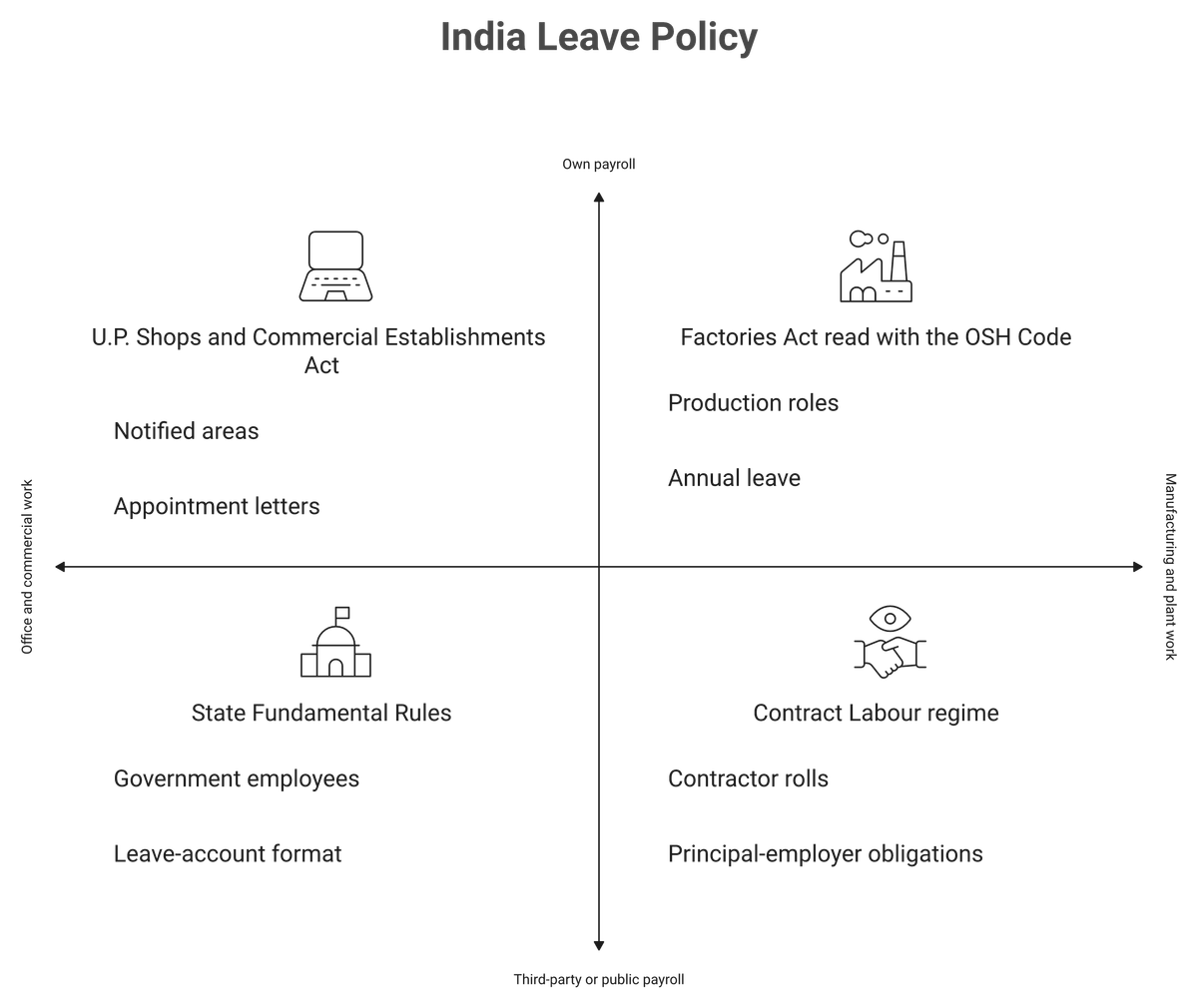
Leave rules in India follow establishment type, not job title. A software or operations team in Noida falls under the U.P. Act of 1962. A plant falls under the Factories Act, 1948, now read with the OSH Code, 2020. State government staff follow the U.P. Fundamental Rules. Central statutes on maternity, POSH, ESIC, and election-day leave sit on top of whichever state law applies, and the more beneficial provision governs.
🧭 The four-branch test
- Do you run a shop, office, or commercial establishment in a notified UP area? Schedule I, Part A of the 1962 Act lists the areas where all provisions apply, and the Niyamavali schedule extends this to Gautam Buddh Nagar localities including Noida, Haraula, Bhangel, and Mamura. Most white-collar India teams land here.
- Do you run manufacturing? Then the Factories Act and OSH Code Section 32 govern annual leave with wages.
- Are the people contract staff on someone else's rolls? The principal employer and CLRA obligations apply alongside the contractor's.
- Are they state government employees? The U.P. Fundamental Rules apply, with a separate leave account format.
Why white-collar teams sit comfortably under the 1962 Act
✅ It was built for offices, not shop floors
The Act caps daily work at nine hours and weekly work at 48, allows overtime to 11 hours a day, and limits overtime to 144 hours a quarter. It requires an appointment letter for every employee. For a Noida product team, that framework maps cleanly onto salaried work.
Uttar Pradesh's GCC policy, launched in 2024, targets over 200,000 high-paying jobs across five years. That is the reason this question is being asked more often from Noida and Greater Noida than from anywhere else in the state, and why founders reach us through our guide to hiring employees in India.
❌ The mistake I clean up most often
Every misclassification I have unwound started with a US offer-letter template and a search result, not with the Act schedule. Founders copy the government-employee table of 30 days earned leave and 300-day carry-forward into a private employment contract. That number is not the private-sector floor, and once written, it becomes contractually enforceable.
The central overlay, with section numbers
| Central provision | What it adds | Trigger |
| Maternity Benefit Act, 1961 (2017 amendment) | 26 weeks paid maternity leave | Referenced directly by Section 25 of the UP Act, as substituted by U.P. Act No. 12 of 2026 |
| ESI Act, 1948 | Sickness benefit for insured employees | Wage-threshold employees covered under ESIC |
| POSH Act, 2013, Section 12 | Up to three months leave for the complainant during inquiry | Any workplace with 10 or more employees, under the Sexual Harassment of Women at Workplace Act and Rules, 2013 |
| Representation of the People Act, 1951, Section 135B | Paid holiday on polling day | Employees entitled to vote, per the Election Commission of India election laws |
⚠️ One structure that does not exist here
US-style co-employment PEO has no legal footing under Indian labour law. You are either the employer of record on a registered Indian entity, or someone else is. There is no shared-liability middle, which is the distinction we set out in our EOR versus PEO comparison.
Versatile Club classifies every India hire against the governing state Act before the offer letter is issued, which is why our contracts name the statute each entitlement comes from. The same classification step drives our India compliance coverage.
Q3. What changed for UP leave after the Labour Codes took effect?
The four Labour Codes came into force on 21 November 2025 through Ministry of Labour and Employment gazette notifications S.O. 5319(E) to S.O. 5322(E), with a corrigendum on 19 December 2025. Section 32 of the OSH and Working Conditions Code, 2020 lowers annual-leave eligibility from 240 days worked to 180 days in a calendar year, holds accrual at one day per 20 days worked, and caps carry-forward at 30 days. Versatile Club re-baselined the leave ledger of every employee on its Indian entity after that date.
📅 What the notification actually did
The Industrial Relations Code and the OSH Code came into effect in full. The Code on Wages and the Code on Social Security were brought in with several sections still pending, and state rules are still being notified. So the 1962 Act has not vanished. It continues to operate alongside the Code.
That is the part most 2026 blog posts get wrong. They either ignore the notification or treat it as a clean replacement.
⚠️ The 240-day number is still sitting in your HRIS
Most India leave engines were configured against the old Factories Act threshold of 240 days. After November 2025, that setting under-grants leave to anyone who worked between 180 and 239 days in the year. Versatile Club found the gap surfaced first on exits rather than on joiners, because a short-tenure resignation is where the accrual difference becomes cash.
I could be reading the timing too strongly. But the pattern held across the ledgers we corrected.
The exact Section 32 conditions
- Eligibility after 180 days of work in a calendar year, down from 240
- Accrual of one day for every 20 days worked, and one day per 15 for adolescents
- Days of lay-off and up to 12 weeks of maternity leave count toward the 180-day threshold, but earn no leave themselves
- Carry-forward capped at 30 days, with the excess encashable
- Where leave is refused in writing, the carry-forward cap does not bite
✅ Run the two-floor test
Put the two instruments side by side for each employee, then apply whichever is more beneficial.
| Parameter | U.P. Act, 1962 | OSH Code, 2020, s.32 |
| Eligibility | 12 months continuous service | 180 days worked in the calendar year |
| Entitlement | Not less than 15 days | One day per 20 days worked |
| Carry-forward ceiling | 45 days | 30 days, uncapped if leave was refused |
| Refusal consequence | Wages payable for the refused period at 45-day credit | Excess carry-forward permitted |
Versatile Club runs this two-floor comparison per employee rather than per company, because a January joiner and a September joiner sit on different sides of the test. Ask us to show the working for a specific hire date, or book a 30-minute call.
❌ What I would not do yet
I would not rewrite the UP state leave clause purely on Code language. State rules under the Codes are still landing. Advisory tracking from EY India and BDO India on partial versus full notification is worth checking before you change contract text.
Versatile Club re-baselined leave ledgers across its entity after 21 November 2025, so the 240-to-180-day shift was absorbed inside our payroll cycle instead of becoming a client project. That cycle is the same one behind our managed payroll service.
Q4. How do you calculate leave accrual and leave pay, including mid-year joiners?
Accrue one day of leave for every 20 days worked. Pay that leave at the daily average of total full-time earnings for the days actually worked in the month immediately preceding the leave, including dearness allowance but excluding overtime and bonus. Round any fraction of half a day or more up to a full day. Versatile Club applies this accrual rate monthly on its own India payroll rather than at year end.
🧮 The worked example
Take a Noida engineer who joins on 14 July 2026.
- Days worked to 31 December 2026: 122
- Accrual at one day per 20 days worked: 6.1 days
- Fraction of 0.1 is less than half a day, so it is ignored: 6 days
- Had the figure been 6.5, it would round up to 7 days
That employee has not crossed 180 days in the 2026 calendar year. The 1962 Act's 12-month test is also unmet. So the contractual grant in the offer letter is what governs until the first full year completes.
💸 How the leave day is priced
Section 80 of the Factories Act sets the daily average wage as total full-time earnings for days actually worked in the preceding month. It includes dearness allowance and the cash equivalent of concessional-sale benefits. It excludes overtime and bonus.
There is a fallback. If the employee worked no days in that preceding month, use the last calendar month in which they did work. Section 12 of the UP Act sets a separate floor, which is the rate payable on the day immediately before the leave.
⏰ Three fields to reconfigure
- Eligibility trigger: change 240 days to 180 days worked in the calendar year
- Accrual method: switch from an annual grant to a 1-per-20-days rate with half-day rounding
- Leave pay base: point it at preceding-month daily average earnings, not at basic salary divided by 30
Versatile Club measures accrual against the muster roll each month, which is why a mid-year resignation does not need a reconstruction exercise. Teams that keep this in-house usually end up comparing the effort against payroll compliance in India as a whole.
⭐ What operators say about the monthly discipline
"Invoicing in USD meant zero exchange rate surprises. The compliance rigour is genuinely impressive every statutory filing reviewed before submission. Five-day onboarding, zero late payslips."
— Vedant T., Founder Versatile Club G2 - Verified Review
"PF, tax, the statutory filings, all the stuff I genuinely did not want to learn, they just handle it and keep it correct every month."
— Angad S., Founder Versatile Club G2 - Verified Review
The same reviewer is blunt about where we are thin, and he is right.
"The dashboard could be a little more self-serve, a couple of times I wanted to pull a report or a doc myself and ended up just messaging my contact instead."
— Angad S., Founder Versatile Club G2 - Verified Review
Mid-year joiners are where every leave engine I have audited quietly breaks. The rule is a rate, not an annual number, and annual-grant logic cannot express it.
Versatile Club runs this accrual math inside its own monthly payroll cycle, which is what the zero-late-payslip pattern in our reviews reflects. Message us with a joining date and we will show the accrual line, or compare the numbers yourself on the EOR versus entity calculator.
Q5. What does leave encashment cost you at exit, and how is it settled?
Encashment is not discretionary in Uttar Pradesh. Section 10(7) of the U.P. Dookan Aur Vanijya Adhishthan Adhiniyam, 1962 makes the employer liable to pay wages for the number of days of earned leave due when employment ends, whether the employer or the employee terminates it. Section 15 fixes the timing: payment before the expiry of the second working day where the employer terminates, and on or before the next pay day where the employee resigns. Versatile Club carries the accrued leave-encashment figure as a visible line on its monthly USD invoice.
💰 The number that moved in 2026
The payout base is wages, which in practice means Basic plus dearness allowance. The Code on Wages, 2019, notified in part on 21 November 2025, requires that this base sit at not less than 50% of total remuneration. So a salary restructure that barely changes take-home changes every exit cheque.
Here is the arithmetic I keep redrawing on WhatsApp for CFOs.
| Scenario | CTC | Basic + DA | Daily wage (÷30) | 30-day EL payout |
| Old structure (35% Basic) | ₹24,00,000 | ₹8,40,000 | ₹2,333 | ₹69,990 |
| Code-compliant (50% Basic) | ₹24,00,000 | ₹12,00,000 | ₹3,333 | ₹99,990 |
⚠️ Same salary, 43% larger liability
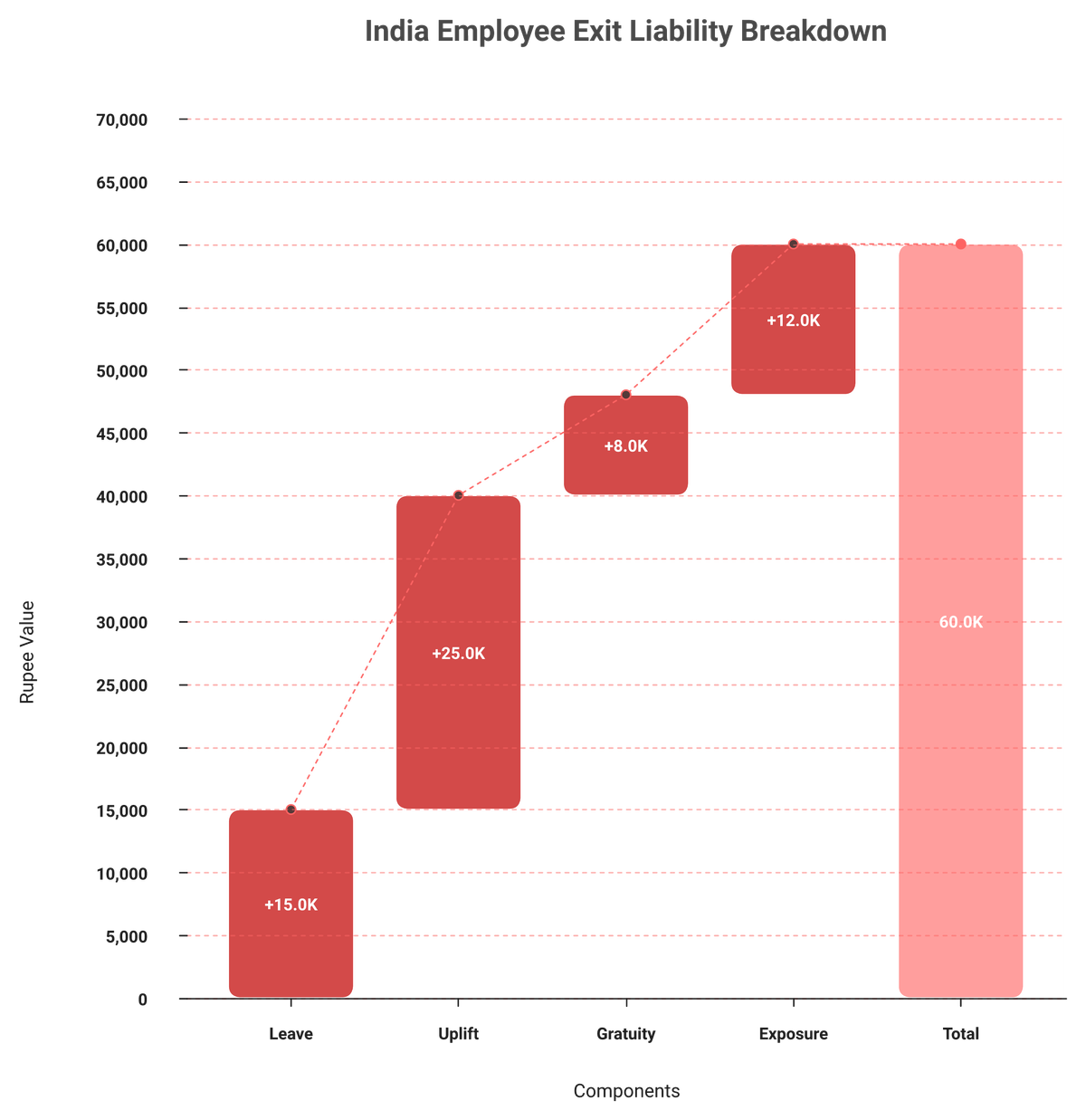
Nothing about the employee's cash changed. The provision did. Multiply that by a 12-person Noida team sitting near the 45-day accumulation ceiling, and the balance-sheet gap is real.
Versatile Club recalculated this provision across its entity after the wage-definition change, and the exit-cheque delta was the largest single line that moved. I might be over-indexing on one cycle of data. But the direction is not in doubt. If you want the same view for your own numbers, the cost of hiring in India breakdown covers the surrounding lines.
📑 Why this becomes an audit scramble
Untracked leave balances are the classic diligence finding. Auditors ask for the statutory liability schedule covering PF, ESI, gratuity, and leave encashment. If your India work is split across a payroll vendor, an EOR, and a benefits broker, nobody owns the number.
"First USD invoice landed clean: no FX markup, no setup fee, no surprises."
— Verified User in Information Technology and Services, Founder Versatile Club G2 - Verified Review
"The initial process took a little getting used to, but the team was quick to guide us through and it became very straightforward."
— Verified User in Venture Capital & Private Equity Versatile Club G2 - Verified Review
✅ Three fixes for this week
- Re-run the leave-liability provision on a Basic-plus-DA base of 50% of remuneration
- Add an earned-leave encashment line to the full-and-final template, with the Section 15 payment deadline written into it
- Check Section 11 exposure separately, since refused leave at 45 days of credit is payable on top of normal wages
Gratuity accrues in parallel at 4.81% of Basic plus DA, on the same restructured base. Versatile Club reports both accruals monthly rather than at exit, because the two move together and get discovered together. Teams running this in-house usually benchmark it against outsourced payroll in India.
Versatile Club shows the leave-encashment provision as a monthly line item on a single USD invoice from its own Indian entity, with no setup or exit fee. The liability accrues inside your numbers instead of appearing as a surprise in a final settlement. Our pricing page states the same figure you see on the invoice.
Q6. Which public holidays and weekly offs must a UP employer give in 2026?
Uttar Pradesh notified 18 public holidays for 2026 under the Negotiable Instruments Act, 1881. Section 9 of the 1962 Act separately requires every employee, other than a watchman or caretaker, to get one whole day off each week plus every close day that is a public holiday. The 1963 rules prescribe eight specific public holidays for that purpose. Versatile Club maintains a per-state holiday master across all 28 states and reissues it when a state revises the gazette mid-year.
📅 Three different holiday lists, and only two bind you
✅ The eight prescribed under the state rules
Rule 15 of the Niyamavali, 1963 names the public holidays for Sections 8 and 9: Republic Day, Holi Parewa, Dr. Ambedkar's birthday, Independence Day, Mahatma Gandhi's birthday, Diwali Parewa, Kartik Poornima, and Id-ul-Fitr. That is the statutory floor for a shop or commercial establishment.
The NI Act list is wider and governs banking and instrument presentation. Restricted holidays are optional. Most leave policies I review blur all three into one list and then cannot explain which days are contractual.
⏰ The 2026 revisions nobody put in their payroll master
The state moved the Makar Sankranti holiday from 14 January to 15 January 2026 by notification. Then, by General Administration Department circular dated 25 March 2026, Ram Navami was declared a public holiday on 27 March 2026 inside the already published gazetted list.
⚠️ Mid-year changes break attendance, not just calendars
A holiday added in late March affects the March attendance register, the wage sheet, and any employee who worked that day. Versatile Club diffs each state's GAD circulars against the payroll holiday master every quarter, because the March 2026 addition landed after most companies had frozen their calendar.
Holiday calendars are the one compliance artefact that changes after you publish it. I have never seen an accrual rule change mid-year. I have seen holiday lists change twice in one year. That volatility is one reason founders read our guide to paying employees in India in 2026 before freezing a calendar.
The weekly off rule, precisely
- One whole day of rest in each week, under Section 9(ii)
- The weekly rule does not apply where total employment that week, including leave and holidays, is under six days
- Every close day that is a public holiday is separately paid
- Wages for any holiday must be at least the rate payable on the preceding day, under Section 12
- The close day can be changed only once a year, with approval, effective from 1 January following
💸 What the day costs if someone works it
Working hours cap at nine per day and 48 per week, with overtime at twice the ordinary rate and a quarterly overtime ceiling of 144 hours. A day is reckoned as nine working hours for overtime maths. Versatile Club prices worked holidays at the statutory double rate on the payslip, rather than converting them into compensatory off by default.
Versatile Club tracks holiday notifications for all 28 states and eight union territories on its own registrations, and reissues the affected state calendar to clients when a gazette changes. Uttar Pradesh changed twice in 2026, and both revisions went out inside the same payroll cycle. That cadence is part of how our EOR model works.
Q7. How should leave be applied for, approved or refused under UP rules?
Earned leave in Uttar Pradesh must be applied for in writing. Rule 10 of the Niyamavali, 1963 requires at least seven days notice for more than three consecutive days, and ordinarily 24 hours for three days or less. Earned leave shall not be taken more than three times in a year, refusals must be recorded on the application, and applications with orders must be retained for three years. Versatile Club drafts its India employment contracts with the governing state Act cited inside the leave clause.
📝 The eight clauses a UP leave policy needs
| Clause | What it must state | Source |
| Governing law | The 1962 Act and 1963 rules by name | s.2, Schedule I |
| Earned leave | 15 days per 12 months, 45-day ceiling | s.10(1), s.10(5) |
| Sickness leave | 15 days per calendar year after six months | s.10(2) |
| Casual leave | One day per month of service, lapses annually | Rule 10(iii) |
| Notice | Seven days, or 24 hours for short leave | Rule 10(i) |
| Refusal | Written reasons, and Section 11 payment at 45-day credit | Rule 10, s.11 |
| Leave pay timing | Half the wages in advance on demand | s.14 |
| Exit | Encashment within the Section 15 deadlines | s.10(7), s.15 |
✅ Refusal is where the rules get specific
Casual leave of one day, if due, ordinarily cannot be refused. An employer may refuse it only for exceptional pressure of work, with reasons recorded in writing. Even then, it cannot be refused for accident, physical injury, death in the family, or sickness of the employee, spouse, or child.
Sickness leave applications cannot simply be refused either, though the employer may require a certificate from a registered medical practitioner. Versatile Club logs each refusal against the employee's leave account on its own entity records, since an unrecorded refusal is indefensible later.
⚠️ Generous wording becomes a permanent floor
Section 4 of the Act protects any better right an employee already holds under a contract, award, or custom. So a US-style policy promising 25 days of paid time off is not a nice gesture. It is a contractual entitlement that survives your next policy revision.
I have watched founders discover this during a resignation, not during drafting. The fix is boring. Separate the statutory clause from the discretionary one, and say which is which. Our HR consulting services exist mainly to catch this before signature.
⭐ What founders say about the drafting step
"Founder is just a call away. Extremely helpful in resolving all our queries. The process is super smooth to setup India EOR."
— surbhi m., Founder Versatile Club G2 - Verified Review
"The team is really competent, but there were a few time zone misunderstandings that caused slight delays in the initial phase."
— Setu C. Versatile Club G2 - Verified Review
Fair criticism. A nine-and-a-half-hour gap is real, and the first week is where it shows.
Versatile Club writes the statutory citation into the leave clause of every India contract, which is how the five-day contractual onboarding SLA holds instead of turning into five weeks of legal review. Ask us to send the UP clause block before you draft your own, or start from our hiring in India without an entity walkthrough.
Q8. What leave records must you keep, and how do DPDP rules change that?
A UP inspector will ask for the leave register, the attendance and wage register, the registration certificate under Section 4-B, the notice of weekly holiday, and the Inspector's Visit Book. Registers must be preserved for six years after the year they relate to, earned-leave applications for three years, and casual-leave applications and medical certificates for one year, under Rule 18 of the Niyamavali, 1963. Versatile Club maintains these registers under its own establishment registration rather than across multiple vendors.
📑 Which register applies to your headcount
| Employees | Registers required | Form |
| Up to 10 | Combined attendance, wages, deductions, leave | Form CC |
| 11 to 25 | Attendance and wages, plus leave register | Forms G and H |
| More than 25 | Attendance and wages, leave, deductions | Forms G, H, and D |
Entries relating to any day should be made on that day, as far as possible. Establishments with more than 25 employees must also display extracts of the Act in Hindi, in Devnagri script.
✅ The leave account is an employee right
At the close of each year, the employer must communicate the earned-leave account in writing to any employee who asks. That statement covers leave carried forward, leave earned during the year, leave taken, and the balance. Versatile Club issues that statement proactively each January instead of waiting for a demand.
⚠️ Where diligence goes wrong
Non-consolidated invoices across a payroll vendor, an EOR, and a benefits broker are what turn an audit question into a two-week scramble. Nobody can produce one register that ties to one liability schedule. Buyers who hit this wall usually start reading about switching EOR provider in India.
Registration mechanics changed too. The Ninth Amendment Rules, 2022 made UP registration one-time, and a late application now attracts a late fee of one percent of the registration fee per month or part thereof. Versatile Club holds its own Section 4-B registration in UP, so the certificate produced at inspection is ours, not a partner's.
"Their team was highly responsive, professional, and easy to work with throughout the process."
— Mukul S. Versatile Club G2 - Verified Review
"Their team helped us move quickly, stay compliant, and focus on the actual work instead of the backend admin."
— Ibrahim A. Versatile Club G2 - Verified Review
🔒 The DPDP layer on top
Sick-leave applications carry medical certificates. Under the Digital Personal Data Protection Act, 2023 and the DPDP Rules, 2025, that is personal data processed for a stated purpose, with security safeguards and retention limits.
⚠️ Statutory floor, not statutory licence
The one-year retention rule for medical certificates is a floor for compliance, not permission to keep health records indefinitely. Restrict access to the payroll administrator, log who opens them, and delete on the stated schedule. Versatile Club keeps sick-leave certificates in a separate access tier from the general leave register.
Versatile Club maintains the UP leave register, leave accounts, and Section 4-B certificate under its own registrations, so a diligence request is answered from one entity's records. Because our own registration carries the penalty exposure, register hygiene is not something we hand back to the client as a to-do list. The full scope sits on our EOR services page, and you can raise a specific UP question through contact us.
Q9. Does unlimited PTO work for a UP team, or does it backfire?
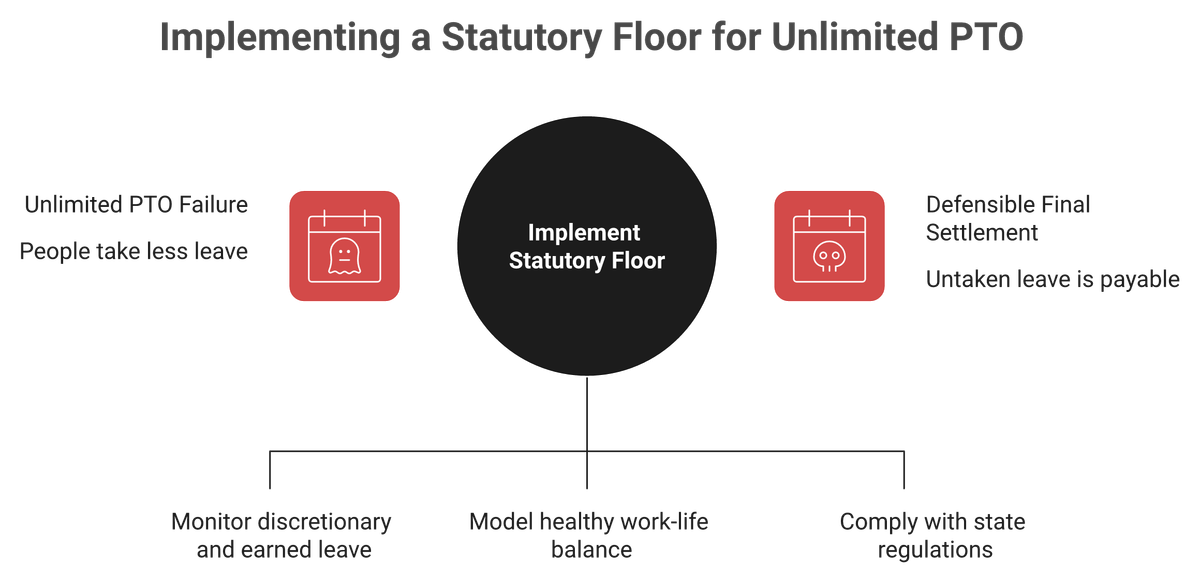
Unlimited PTO fails twice in Uttar Pradesh. Legally, an employer must still accrue, record, and encash statutory earned leave, so untracked leave is not available as an option under the U.P. Dookan Aur Vanijya Adhishthan Adhiniyam, 1962. Culturally, in high-deference Indian teams, removing the allotment usually means people take less leave, not more. Versatile Club assigns a 90-day Success Coach to every placement, and unused leave in month two is one of the earliest signals reviewed.
The popular playbook, stated fairly
Netflix removed its vacation policy and documented the reasoning. Reed Hastings also documented the failure mode, which is the part startup blogs skip. He described not allotting vacation days as "a great way to create sweatshop conditions, where no one dares to take a day off work. And to wrap it up like a perk."
His second observation cuts against intuition. The "use it or lose it" rule sounds like a restriction, but it actually pushes people to take a break.
⚠️ The statutory objection comes first
You cannot run an untracked policy here. Rule 18 of the Niyamavali, 1963 requires a leave register, and Section 10(7) makes untaken earned leave payable at exit. A policy with no balance cannot produce a final settlement number.
Versatile Club keeps the statutory ledger running underneath whatever discretionary policy a client layers on top. That separation is what makes both defensible, and it is the same discipline behind our India compliance framework.
🧭 The cultural objection is quieter and costlier
Craig Storti records an American manager whose New Delhi colleague messaged her for permission every time he wanted a dinner break. His explanation was simple: "because I'm your subordinate." Now remove the stated allotment from that relationship and see who books a week off.
Jason Fried named the same risk from the remote-work side. A manager's instinct is to worry that too little gets done, when the real threat is that too much does.
❌ What burnout actually looks like in the data
Hastings describes a marketing manager whose Fitbit showed four hours and thirty-two minutes of sleep, and who had not taken a non-working vacation in four years. She spent her Thanksgiving break working in a laundry room.
I have seen the Noida version of that. It does not announce itself. It shows up as a resignation in month seven with eleven days of untaken leave on the ledger. Retention is exactly why we score culture fit before a placement, not after.
✅ The hybrid model that holds
- State the statutory floor explicitly: 15 days earned leave, 15 days sickness leave, and casual leave per the state rules
- Add discretionary days on top, labelled as discretionary and non-accruing
- Track everything in the register, including the discretionary days
- Make leave-taking visible from the top, because modelling beats policy
- Flag zero-usage employees at the 60-day and 90-day marks
Versatile Club measures leave usage monthly rather than annually, and the pattern we watch for is a new hire at zero usage past day 60. Our read points one way on this, though I might be reading a small sample too strongly.
Compliance is the floor, not the ceiling. A leave policy nobody uses is a retention risk wearing the costume of a perk.
Versatile Club runs a 90-day Success Coach on every placement, and leave-usage patterns are part of that review rather than an annual HR exercise. Ask us what the month-two signal looked like on your last hire, or see how the model works on our contract-to-hire page.
Q10. How do you run one leave policy across UP and the rest of India?
Set one company-wide leave standard at or above the most generous state floor you operate in, then track the state deltas separately. Those deltas are earned-leave caps, casual and sickness splits, prescribed holiday lists, and professional tax cycles. Never average the states. Versatile Club administers this on a single owned Indian entity covering all 28 states, so each employee's register follows their own state rules.
🧩 Harmonise the benefit, localise the register
The benefit your employees see should be uniform. The compliance artefact underneath should be state-specific. That is the whole method.
A UP employee's earned-leave accumulation ceiling is 45 days under Section 10(5). Karnataka and Maharashtra set their own ceilings under their respective Shops and Establishments Acts. If you publish 45 days company-wide, you have quietly under-granted somewhere else.
⚠️ Averaging the states is the classic mistake
Finance teams want one number. So someone takes the mean of four state entitlements and writes it into the handbook. That number is simultaneously too generous in one state and non-compliant in another.
Versatile Club files against each state's own cadence rather than a blended one. In Maharashtra that means dual PTRC and PTEC registration, in Karnataka a monthly professional tax cycle, in Tamil Nadu biannual filing, and in West Bengal a rulebook that changes often. Teams with hubs in two cities usually feel this first in Bengaluru payroll outsourcing versus their northern entity.
📑 The two-column policy format
| Layer | Content | Changes how often |
| Company standard | Uniform leave quantum, notice norms, approval workflow | Annually |
| State annexure | Statutory floor, accumulation cap, prescribed holidays, register form | Whenever a state gazette moves |
The annexure is the part that keeps you out of trouble. UP's prescribed public holidays sit in Rule 15 of the 1963 rules, and the register form depends on headcount. None of that travels to another state.
💸 Where fragmented vendors break this
Run payroll in one place, EOR in another, and benefits in a third, and you get three different state tables. Nobody owns the reconciliation. A CFO closing month-end cannot tie the leave provision to a single source. That consolidation problem is what our payroll outsourcing services in India are built to remove.
"As a founder running a lean agency, hiring talent in India without a local entity was a compliance minefield PF, ESI, TDS, professional tax across states."
— Vedant T., Founder Versatile Club G2 - Verified Review
"Setting up in a new country can get messy fast, but their India EOR made onboarding feel easy."
— Setu C. Versatile Club G2 - Verified Review
⭐ State coverage, stated plainly
| Provider | Indian states covered | India entity model |
| Versatile Club | All 28 states and 8 union territories | Own registered Indian entity |
| Deel | Primarily top 6 hubs | India partner entity |
| Remote | Primarily top 4 hubs | India partner entity |
| Wisemonk | India-wide, India-native | Own India operations |
✅ Monday morning version
Write the company standard once. Attach a one-page annexure per state. Diff the annexures each quarter against the state gazette.
Versatile Club's multi-state knowledge comes from running contract-to-hire operations across Indian states rather than from a global playbook, because India is the only country we operate in. Send us your state mix and we will show you the delta table, or read the wider employer of record India playbook first.
Q11. Who can actually administer UP leave compliance for you?
Four routes exist for UP leave compliance: an India-native employer of record that owns its Indian entity, a global generalist EOR operating through an India partner entity, payroll software plus your own entity, or full in-house compliance. Versatile Club is the legal employer on its own Indian entity across all 28 states, with a five-day contractual onboarding SLA and no setup or exit fee. For one to thirty UP hires without an entity, a single accountable party holds accrual, registers, encashment, and filings together.
🧾 The four criteria that decide this
- Who is named as the legal employer on the payslip
- Who holds the Section 4-B registration and the leave register under the 1962 Act
- How fast an onboarding actually closes
- What the all-in monthly cost is, after add-ons
⭐ Route 1: India-native EOR with an owned entity
Versatile Club employs the hire on its own registration, so the UP leave ledger and the PF challan come from the entity you contracted with. Pricing is $149 per employee per month, with the first month free, and placements carry a 90-day Success Coach plus a six-month replacement guarantee on contract-to-hire. The full scope sits on our India EOR services page.
"Sagar replied to our form in about four hours with a draft offer letter already attached. The hire was onboarded in four days."
— Verified User in Information Technology and Services, Founder Versatile Club G2 - Verified Review
"The dashboard could be a little more self-serve, a couple of times I wanted to pull a report or a doc myself."
— Angad S., Founder Versatile Club G2 - Verified Review
That criticism is accurate. Self-serve reporting is where we are behind the platforms.
✅ Route 2: other India-native EORs
Wisemonk is the closest comparison. It is India-focused, priced from $99 per employee per month, holds SOC 2 Type II and ISO 27001, and carries 4.8 out of 5 on G2 from over 261 reviews. It publishes no replacement guarantee, no structured 90-day coaching model, and no founder-direct support channel. We set the differences out in full on our Wisemonk alternative page.
❌ Route 3: global generalists
Deel, Remote, G-P, Multiplier, Papaya, and Velocity Global cover 90 to 185 countries. India is typically routed through a local partner entity, which means your leave register sits with a company you never signed with. Support runs through ticket queues. Buyers comparing these usually start with Deel versus Remote in India.
| Route | Monthly cost per employee | Onboarding | India entity |
| Versatile Club | $149, first month free | 5-day contractual SLA | Owned |
| Wisemonk | $99 to $399 | 24 to 72 hours | India-native |
| Deel | $599 | 7 to 14 days | Partner |
| Remote | $599 | 10 to 14 days | Partner |
| Multiplier | $400 | Platform-led | Partner |
| G-P | 15% of salary | Enterprise cycle | Partner |
⚠️ Route 4, and where we are the wrong answer
Payroll software plus your own entity works once you have 30-plus India staff and an in-house compliance lead. Setting up that entity first costs real money and 12 to 18 months. Run the numbers on the EOR versus entity in India comparison before you commit.
Versatile Club is not the right choice for multi-country EOR, for B2C consumer hiring, or for enterprise procurement that requires SOC 2 or ISO 27001 as a gate. If you need five countries, buy a generalist.
"Local India compliance, FD setup, all of this is complicated to understand to hire a single person. Makes my life as a lean founder extremely easy."
— surbhi m., Founder Versatile Club G2 - Verified Review
Ask any provider three questions. Who is the legal employer on the payslip, who holds the state registration, and can you see the leave register today.
Versatile Club is the employer of record on its own Indian entity across all 28 states, invoices in USD from India with no setup or exit fee, and onboards on a five-day contractual SLA. The founder is on WhatsApp rather than behind a ticket queue, and you can book a 30-minute call to test that directly.
FAQs
How many leaves is an employee entitled to in Uttar Pradesh?
Under Section 10 of the U.P. Dookan Aur Vanijya Adhishthan Adhiniyam, 1962, an employee in a shop or commercial establishment is entitled to a statutory floor, not a negotiated number.
- Earned leave: not less than 15 days for every 12 months of continuous service with the same employer
- Watchmen and caretakers: not less than 60 days of earned leave for the same period
- Sickness leave: not less than 15 days in any one calendar year, after six months of continuous service
- Casual leave: up to one day for every month of service rendered in that calendar year, lapsing if unapplied
- Weekly holiday: one whole paid day each week, plus every close day that is a public holiday
Accumulated earned leave cannot exceed 45 days at any time. Anything you promise above these numbers becomes contractual and survives your next policy revision, so draft the clause deliberately.
Versatile Club administers these entitlements on its own Indian registrations rather than passing them to a partner entity, which is why the payslip and the register agree. If you are building a first India team, our India EOR services page shows how the statutory floor is written into the contract.
Is leave encashment mandatory in Uttar Pradesh when an employee leaves?
Yes. Section 10(7) of the U.P. Act, 1962 makes the employer liable to pay wages for the number of days of earned leave due when employment ends. It applies whether the employer terminates or the employee resigns, and it is not a discretionary gesture.
The timing is fixed too:
- Employer terminates: payment before the expiry of the second working day after termination
- Employee resigns: payment on or before the next pay day
- Refused leave: Section 11 separately makes wages payable for the refused period where the employee already holds 45 days of credit
The payout base is wages, which in practice means Basic plus dearness allowance. Since the Code on Wages requires that base to sit at not less than 50% of total remuneration, a compliant salary restructure raises every exit cheque without changing take-home pay. Gratuity accrues on the same base at 4.81%.
Versatile Club carries the accrued encashment figure as a visible monthly line on a single USD invoice, so the liability builds inside your numbers instead of surfacing at exit. The surrounding cost lines are broken down in our guide to the cost of hiring in India.
Did the new Labour Codes change leave eligibility for employees in Uttar Pradesh?
The four Labour Codes came into force on 21 November 2025 through Ministry of Labour and Employment gazette notifications S.O. 5319(E) to S.O. 5322(E), with a corrigendum on 19 December 2025. Section 32 of the OSH and Working Conditions Code, 2020 changed the arithmetic.
- Paid-leave eligibility fell from 240 days worked in a calendar year to 180 days
- Accrual stays at one day of leave for every 20 days worked
- Carry-forward is capped at 30 days, with the excess encashable
- Lay-off days and up to 12 weeks of maternity leave count toward the 180 days but earn no leave themselves
The 1962 Act has not disappeared. State rules under the Codes are still being notified, so the practical method is a two-floor test: compare the state Act and Section 32 for each employee, then apply whichever is more beneficial.
Versatile Club re-baselined the leave ledger of every employee on its Indian entity after that date, because the change bites hardest on mid-year joiners and shows up first on exits. Most leave engines still have 240 days hardcoded, which is one reason teams audit their setup alongside broader payroll compliance in India.
What leave records must a UP employer keep for a labour inspection?
An inspector under the 1962 Act will ask for a specific set of documents, and the register you need depends on headcount.
- Up to 10 employees: a combined attendance, wages, deductions, and leave register in Form CC
- 11 to 25 employees: attendance and wages in Form G, plus a leave register in Form H
- More than 25 employees: Forms G, H, and D, plus Act extracts displayed in Hindi in Devnagri script
Expect the Section 4-B registration certificate, the notice of weekly holiday, and the Inspector's Visit Book to be requested alongside. Registers must be preserved for six years after the year they relate to, earned-leave applications for three years, and casual-leave applications and medical certificates for one year. Employees can also demand a written statement of their earned-leave account at year end.
Sick-leave certificates are health data under the DPDP Act, 2023 and its 2025 Rules, so restrict access and delete on a stated schedule rather than keeping them indefinitely.
Versatile Club maintains the UP leave register and leave accounts under its own establishment registration, which is how diligence requests get answered from one entity's records. The wider scope sits on our compliance page.
Can we offer unlimited PTO to our India team instead of a fixed leave policy?
Not as a replacement for statutory leave. Unlimited paid time off fails on two separate fronts in Uttar Pradesh, and both matter.
The legal objection. You must still accrue, record, and encash statutory earned leave. Rule 18 of the Niyamavali, 1963 requires a leave register, and Section 10(7) makes untaken earned leave payable at exit. A policy with no balance cannot produce a defensible final settlement figure.
The cultural objection. In high-deference Indian workplaces, removing the stated allotment usually means people take less leave, not more. Reed Hastings described unallotted vacation as a way to create conditions where nobody dares take a day off, then wrap it up as a perk.
The model that works is layered:
- State the statutory floor explicitly in the contract
- Add discretionary days on top, labelled discretionary and non-accruing
- Track everything, including the discretionary days, in the register
- Have leaders visibly take leave, because modelling beats policy
Versatile Club runs a 90-day Success Coach on every placement, and a new hire at zero leave usage past day 60 is one of the earliest retention signals we flag. You can see how that fits the placement model on our contract-to-hire page.