Table of contents (11)
Leave Policy in West Bengal: Complete Guide for Employers 2026
Q1. What leave is an employee in West Bengal legally entitled to in 2026?
Under Section 11 of the West Bengal Shops and Establishments Act, 1963, a person employed in a shop or establishment gets 14 days privilege leave on full pay for every completed year of continuous service, 14 days sick leave on half pay against a certificate from a registered medical practitioner, 10 days casual leave on full pay, and maternity leave as prescribed. Privilege leave accumulates up to 28 days, sick leave up to 56 days, and casual leave does not accumulate at all.
The four leave types the 1963 Act mandates
"Privilege leave" is the West Bengal term for earned or annual leave. It is the same idea as EL in your HRMS, with a different label in the statute.
| Leave type | Entitlement | Pay basis | Maximum accumulation |
| Privilege leave | 14 days per completed year of continuous service | Full pay | 28 days |
| Sick leave | 14 days per year, on medical certificate | Half pay | 56 days |
| Casual leave | 10 days per year | Full pay | None |
| Maternity leave | Per the 1964 Rules, read with the central Act | Average daily wages | Not applicable |
📋 Why the sick leave line trips people up
Fourteen days of sick leave at half pay is not fourteen paid days. For a Kolkata engineer on INR 12 lakh a year, each statutory sick day funds roughly half a normal day's wage, and the rest is unpaid unless your policy tops it up.
Most employers do top it up, and that is fine. The 1963 Act sets a floor, not a ceiling. What is not fine is writing "14 days paid sick leave" into an offer letter and then paying half.
🧮 How continuous service gets counted
The Explanation to Section 11 says employment in the establishment before the Act applied to it counts when calculating leave due. Section 15 adds that continuous service includes holidays, authorised leave, and legal strike or lock-out periods.
That matters when you acquire a Kolkata team or convert contractors to employees. Their clock does not restart at your onboarding date. Versatile Club carries prior service dates into the leave ledger at transition, because a reset date is the easiest thing for an inspector to disprove using the old appointment letter.
⚠️ The rounding rule nobody codes
The West Bengal Shops and Establishments Rules, 1964 require that a leave fraction of half a day or more counts as one full day, and anything less is ignored. Half-day leave entries in your HRMS need that rounding logic, or your register will not match your payroll.
The three numbers to fix this week
Set casual leave to 10, not 12. Set the privilege leave cap at 28 days and the sick leave cap at 56. Then check that your offer letter language matches the pay basis for each type.
Versatile Club holds its own Shops and Establishments licence and PF and ESIC registrations through its Indian entity, Foo Falcon Technologies Pvt Ltd, and applies the West Bengal caps inside managed payroll rather than at appraisal time.
Q2. Which law covers your employee, Shops Act, Factories Act, or neither?
A Kolkata software, BPO, or KPO office is a "commercial establishment" under Section 2(2) of the 1963 Act, as substituted by the West Bengal Shops and Establishments (Amendment) Act, 2015, so the 1963 Act governs leave for white collar staff. Factory workers are covered instead by Sections 79 and 80 of the Factories Act, 1948, read with the West Bengal Factories Rules, 1958, which grant annual leave with wages at one day for every twenty days worked. Managerial and confidential staff can be exempted only by a State Government notification under Section 4(2)(b)(i), not by job title.
Three categories, three rulebooks
| Your workplace | Governing law | Leave mechanism | Register |
| Office, BPO, KPO, clinic, consultancy in West Bengal | WB S&E Act, 1963 | Fixed days: 14 PL, 14 SL, 10 CL | Form J |
| Factory or plant | Factories Act, 1948, ss.79 to 80 with WB Factories Rules, 1958 | Accrual: 1 day per 20 days worked | Leave with Wages Register |
| Government office, RBI, railways, transport, hospitals | Excluded by Section 4(1) of the 1963 Act | Own service rules | Own rules |
💼 The 2015 amendment that ends the "we are an IT company" argument
The substituted definition of commercial establishment expressly names "tele calling services including Business Process Outsourcing and Knowledge Process Outsourcing", computer training centres, health care services, internet service providers, and establishments of any engineer, accountant, or technical or professional consultant.
So a 12-person engineering pod in Salt Lake is covered. Versatile Club classifies each India hire against the governing state statute before the contract is issued, because the category sets the leave clause, the register, and the inspection exposure. Teams that need to hire in India without an entity inherit that classification step from the employer of record.
🏭 The factories track, in one paragraph
On the factory side, the qualifying period is 240 days of work in the preceding calendar year. That count includes lay-off days agreed or permissible under Standing Orders, up to 12 weeks of maternity leave for women workers, and leave earned in the prior year. The employer must also post a leave scheme notice and maintain the Leave with Wages Register.
🧷 The exemption clause I see misused most
"Managerial capacity" is the most abused phrase in India employment paperwork. Section 4(2) lets the State Government exempt classes of persons in a managerial or confidential capacity, or travellers, canvassers, messengers, watchmen, and caretakers, by notification. The 2002 amendment narrowed the non-exemptible core to Sections 8 and 9, which protect young persons and children.
In six years of running India placements I have never seen a Series A company actually hold such a notification. Calling someone a manager in the offer letter does not create one.
👔 Where the workman question fits
Under the Industrial Relations Code, 2020, the workman or non-workman split affects retrenchment and dispute forums, not statutory leave. A senior engineer who is not a "workman" still gets the full Section 11 entitlement. Versatile Club keeps these as two separate fields in the employment record, because conflating them is how companies accidentally deny leave to senior staff.
Versatile Club maintains Shops and Establishments, PF, and ESIC registrations across all 28 states and 8 union territories, so category mapping inside our EOR services in India happens against the actual state statute rather than a single national template.
Q3. Did the Labour Codes change West Bengal leave accrual from 21 November 2025?
Partly. The four Labour Codes took effect on 21 November 2025, but state Shops and Establishments Acts were not repealed, so the West Bengal Act of 1963 still governs Kolkata offices. The Occupational Safety, Health and Working Conditions Code, 2020 lowers annual leave eligibility from 240 days to 180 days worked, keeps accrual at one day per twenty days, and caps carry forward at 30 days. Versatile Club runs both the 1963 Act column and the OSH Code column in payroll for West Bengal employees and pays the higher entitlement per person.
What actually changed, and what did not
| Item | Before 21 Nov 2025 | Now |
| Central eligibility threshold | 240 days worked | 180 days worked |
| Accrual rate | 1 day per 20 days | Unchanged |
| Carry forward | Statute specific | Capped at 30 days centrally |
| Refused leave | Not to lapse (1964 Rules) | Carries forward beyond the cap |
| WB 1963 Act | In force | Still in force |
📆 The four operative rules to load into your HRMS
Change the accrual eligibility trigger from 240 days to 180 days.
Keep accrual at one day per twenty days worked.
Cap ordinary carry forward at 30 days.
Exclude refused leave from that cap, and log the refusal.
Rule four is the one nobody codes. Versatile Club treats a rejected leave request as a payroll event rather than a workflow click, because refused leave does not lapse under Rule 18 of the 1964 Rules and does not sit inside the 30 day ceiling.
🧾 A July joiner in Salt Lake, worked through
Take a designer who joins on 1 July 2026. Under the 1963 Act, privilege leave arrives after a completed year of continuous service, so nothing vests in 2026. Under the OSH Code accrual logic, she earns leave against days worked in the same calendar year.
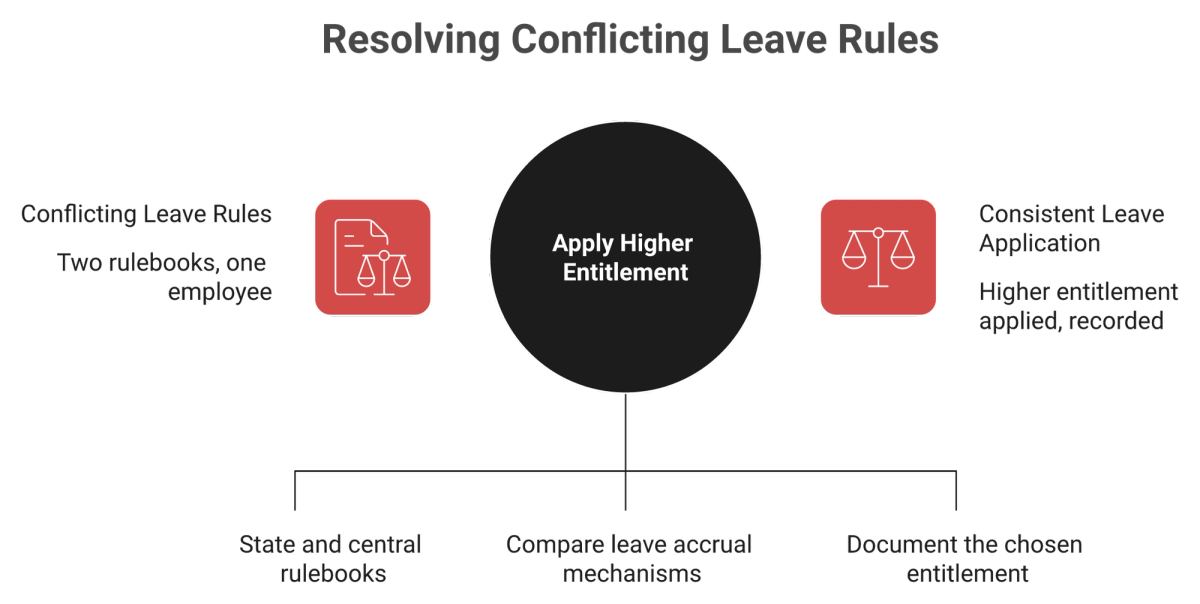
Two rulebooks, two answers, one employee. I read Section 24 of the 1963 Act as settling it: nothing in that Act affects a more favourable right available under any other law, contract, custom, or usage. Pay the better number, and write down why.
⏰ What is still unsettled
West Bengal has not yet notified its own rules under the Codes. So the 1963 Act remains the compliance floor, and the OSH Code sits on top where it is more generous, as set out in the Ministry of Labour and Employment's Compliance Handbook for Employers Under the Four Labour Codes.
I could be reading the transition too conservatively. Versatile Club's position is that paying the higher of the two costs a few days of leave per employee, while getting it wrong costs an inspection finding and a diligence flag. That trade looks obvious to me, though a larger employer with 400 Kolkata staff may price it differently.
Versatile Club re-ran every West Bengal leave balance against both the 1963 Act and the OSH Code accrual rule after 21 November 2025, and reports the applied basis per employee in the monthly payroll compliance pack.
Q4. How is leave pay calculated, and what does encashment cost you on exit?
Section 12 of the West Bengal Shops and Establishments Act, 1963 requires wages for the full period of privilege leave standing to an employee's credit when services are terminated. Leave pay is computed on the daily average of total full time earnings for days actually worked in the last preceding calendar month, excluding overtime and bonus but including dearness allowance. Versatile Club accrues gratuity at 4.81% of Basic plus DA from month one and reports accrued leave liability inside one monthly USD invoice with a per employee breakdown.
The three moments money leaves your account
On exit, for all privilege leave to credit, under Section 12.
At the end of a calendar year, on employee demand, under the OSH Code.
For any balance above 30 days, under the same provision.
Casual leave is never encashed. It does not accumulate, so there is nothing to pay out.
💰 The formula, applied
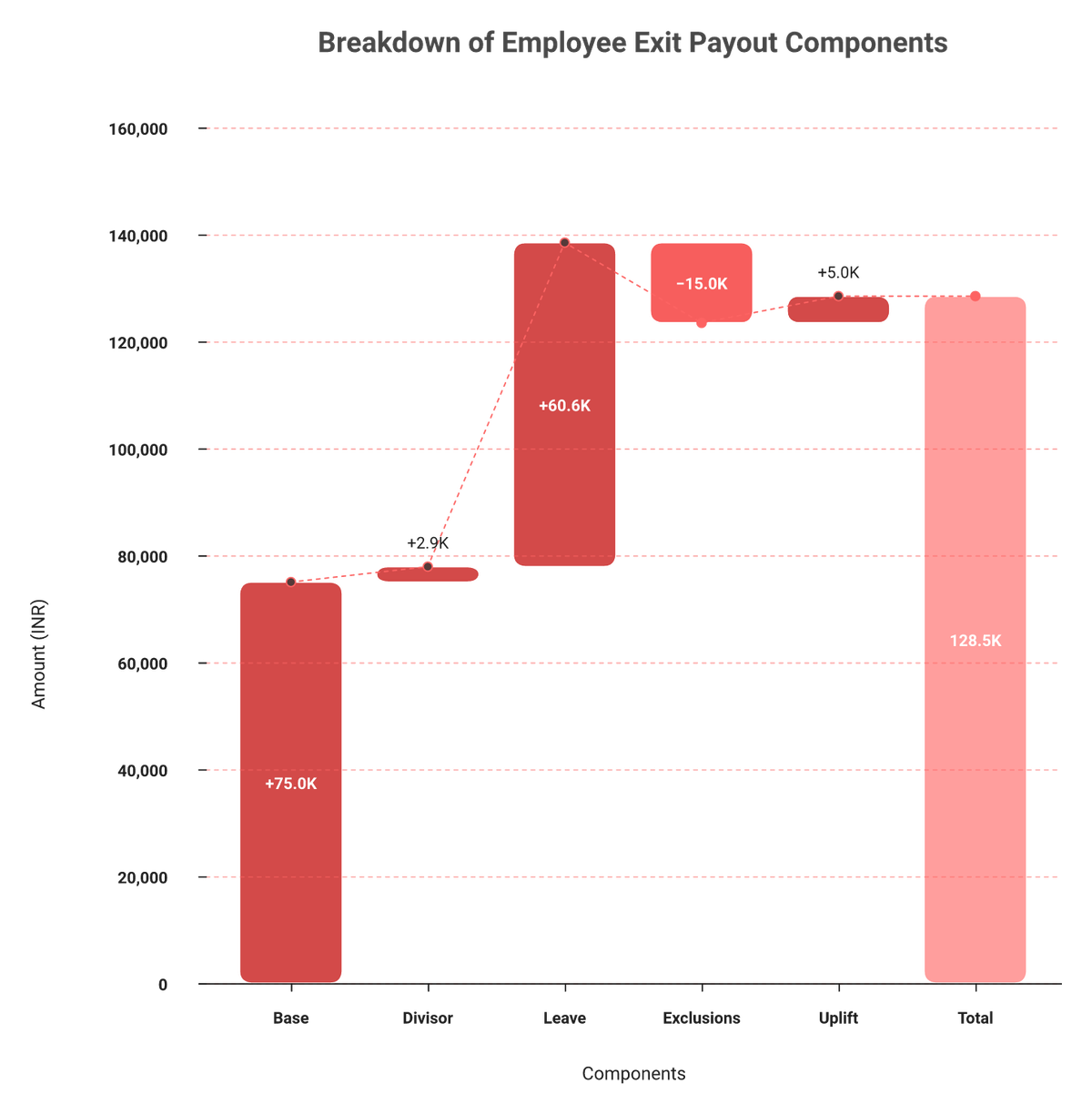
Take a Kolkata designer on INR 9 lakh a year with 21 days of privilege leave accrued. Her last worked month gives roughly INR 75,000 of full time earnings across 26 worked days, so about INR 2,885 per day. Twenty one days is close to INR 60,600 payable at exit.
Versatile Club computes this on Basic plus DA plus the qualifying allowances named in the 1964 Rules, not on total CTC, because overtime and bonus are expressly excluded. Run the same maths against your own numbers in the salary calculator.
💸 Where the Labour Code quietly raises the bill
The Code on Wages, 2019 requires that Basic plus dearness allowance reach at least 50% of total remuneration. Restructure that same designer's salary to comply, and her Basic plus DA rises, so the per day encashment rate rises with it.
The balance sheet shock never comes from the leave policy. It comes from restructuring salaries to hit the 50% wage floor without re forecasting the accrued leave liability underneath, which is the same line item CFOs review when they compare the employer of record India cost against an owned entity.
📊 What buyers say about liability visibility
Reporting depth is the recurring complaint in this category, and it is the exact thing a CFO needs to see leave liability before it lands.
"What I dislike about Wisemonk is that some features feel a bit limited and could use more flexibility. In particular, I'd like to see better options for customization and more detailed reporting."
— Vinay M., Verified User, Wisemonk - G2 Verified Review, 4/5, 18 February 2026
"I find Deel to be absurdly expensive. They charge a high amount of fees for transferring money to my bank account. Additionally, using their card incurs fees for purchases in another currency, which impacts me personally."
— Juan Camilo O., Verified User, Deel - G2 Verified Review, 1/5, 27 November 2025
✅ Four lines to add to month end close
Accrued privilege leave days per West Bengal employee.
Current daily average wage per employee, refreshed monthly.
Total accrued leave liability in INR and USD.
Any refused leave sitting outside the 30 day cap.
Versatile Club sends payroll summary, compliance status, PF and ESI challan confirmations, and TDS deposit receipts alongside a single USD invoice, so the leave provision is visible before it becomes a payout. Buyers weighing the structural choice usually start with EOR vs entity in India, then ask what the monthly pack actually contains.
Q5. What maternity and pregnancy-related leave must you fund in West Bengal?
Rule 23 of the West Bengal Shops and Establishments Rules, 1964 grants 12 weeks of maternity benefit at average daily wages, subject to 160 days of actual work in the 12 months before the expected delivery date. The central Maternity Benefit Act, 1961 now sets 26 weeks for the first two children and bars any work in the six weeks after delivery. Apply the central Act, because the state rule is a floor. Rule 26 adds six weeks of paid leave after miscarriage, and Rule 28 makes dismissal during pregnancy absence unlawful.
Two numbers, one employee
The 1964 Rules and the central Act give different answers to the same question. That is not a drafting error. Section 24 of the 1963 Act preserves any more favourable right available under another law.
| Item | WB Rules, 1964 | Central Act |
| Maternity benefit period | 12 weeks | 26 weeks |
| Qualifying service | 160 days in 12 months | 80 days in 12 months |
| Post-delivery work bar | 6 weeks | 6 weeks |
| Miscarriage leave | 6 weeks paid | 6 weeks paid |
🤰 Why founders underpay by 14 weeks
A founder reads the state rule, sees 12 weeks, and writes 12 into the handbook. Then a Kolkata employee asks for 26, and the conversation happens at the worst possible moment.
Versatile Club maps each maternity case against both the state rule and the central Act before the leave starts, and applies the higher entitlement. I have seen this go wrong only when the policy was written by someone reading a single PDF. Founders making a first hire of employees in India hit this within the first year more often than they expect.
💰 How "average daily wages" is actually computed
The 1964 Rules define average daily wages as the average of wages payable for days worked in the three calendar months immediately preceding the absence. That is a different base from your monthly salary line.
Maternity benefit for the period before delivery is paid in advance. The balance is paid after a certificate in Form L from a qualified medical practitioner or midwife confirms the delivery date.
🩺 Illness, miscarriage, and the arduous-work rule
Rule 27 treats absence due to certified pregnancy or confinement illness as authorised leave, so it does not become loss of pay. Rule 22 bars arduous work, long standing hours, or anything likely to interfere with the pregnancy, for one month before the six-week pre-delivery window.
Versatile Club records these as distinct leave codes in managed payroll rather than folding them into sick leave, because the pay basis and the statutory source are different for each.
⚠️ The dismissal trap and the 60-day clock
Discharging or dismissing a woman during pregnancy absence is unlawful, and it cannot be used to strip her of maternity benefit. Dismissal during pregnancy requires a written order on grounds of gross misconduct. A woman deprived of benefit may appeal within 60 days to the authority appointed under Section 14(2).
So a performance exit timed during maternity leave is not a performance exit. It is an appealable statutory matter with a documented paper trail.
✅ The adjacent obligation most first-time employers skip
The Sexual Harassment of Women at Workplace (Prevention, Prohibition and Redressal) Act, 2013 requires an Internal Committee at every workplace with ten or more employees. It sits next to maternity compliance in every inspection I have seen, and it is usually missing.
Versatile Club constitutes the POSH Internal Committee and files the annual report under its own registrations, so a US founder with four Kolkata hires is not assembling a committee from a timezone away. That work sits inside our compliance scope rather than in a client checklist.
Versatile Club administers maternity benefit, miscarriage leave, and POSH committee setup through its own Indian entity, with the applied statutory basis stated per case in the monthly compliance pack.
Q6. How do West Bengal's 2026 holidays and the Durga Puja block change your staffing plan?
West Bengal notified 27 holidays under the Negotiable Instruments Act for 2026, plus 26 further holidays under state government orders, through Finance Department Notification No. 4188-F(P2) dated 27 November 2025. The Durga Puja and Lakshmi Puja block runs 15 to 26 October 2026, with Maha Ashtami on 19 October, Maha Nabami on 20 October, and Vijaya Dasami on 21 October. Versatile Club loads the notified state calendar, including the Puja block and sectional holidays, into attendance before the year starts. Weekly closure under Section 5 of the 1963 Act adds one full day and a half day per week.
The October block, dated
| Date (2026) | Day | Occasion |
| 10 Oct | Saturday | Mahalaya |
| 15 Oct | Thursday | Maha Chaturthi, block begins |
| 16 Oct | Friday | Maha Panchami |
| 19 Oct | Monday | Maha Ashtami |
| 20 Oct | Tuesday | Maha Nabami |
| 21 Oct | Wednesday | Vijaya Dasami |
| 22 to 24 Oct | Thursday to Saturday | Additional Puja holidays |
| 25 to 26 Oct | Sunday to Monday | Lakshmi Puja and additional day |
⏰ Why 10 casual leave days cannot absorb this
Statutory casual leave in West Bengal is 10 days for the whole year, and Rule 15 ordinarily caps it at three days at a stretch. A twelve-day cultural block does not fit inside that.
October in Kolkata is not a long weekend. Versatile Club treats the Puja window as a rota decision made in August, not a leave-approval queue opened in October.
📋 The notice you are legally required to display
Rule 12 requires a notice in Form H showing the weekly full holiday and half holiday for each employee, displayed in the workplace and preserved for a year. A copy goes to the Chief Inspector inside Calcutta, or to the local Inspector elsewhere.
Versatile Club files the Form H notice and the copy to the Inspector as part of establishment setup, because this is the cheapest compliance item to miss and the easiest for an inspector to spot. The sequence is published in how it works.
💸 The overtime window the Rules actually allow
Rule 47 permits overtime in a shop to handle a business spurt during specified occasions, including a period not exceeding 28 days ending on the day of Nabami Puja. Overtime wages run at one and a half times the ordinary rate under Section 13, and notice in Form T must reach the Inspector at least 24 hours in advance.
So paid coverage during Puja is legal. It is just paperwork-first, not goodwill-first.
✅ Polling day is paid leave, not optional
Section 135B of the Representation of the People Act, 1951 entitles employees to a paid holiday on polling day, and deducting wages for it is an offence, as set out in the Election Commission of India's election laws. With West Bengal assembly polling in 2026, this hits Kolkata teams directly.
I have watched US clients discover this three days out, mid sprint. Versatile Club flags notified polling dates into the client calendar as soon as the Election Commission publishes them, which is the same cadence we apply to payroll compliance in India deadlines.
Versatile Club maintains the notified holiday calendar for all 28 states and 8 union territories inside payroll and attendance, so a Kolkata engineer's October and a Bengaluru engineer's October are budgeted separately rather than averaged.
Q7. What leave records and approvals does a West Bengal inspector actually ask for?
Rule 21 of the West Bengal Shops and Establishments Rules, 1964 requires a leave register in Form J, and every leave application, granted or refused, must be entered immediately after the decision. Privilege leave needs ten days of written notice, with orders issued within a week of submission, and a leave pass on grant. Casual leave is ordinarily capped at three days at a stretch. Versatile Club maintains Form J and the supporting West Bengal registers under its own Shops and Establishments licence and reports register status monthly.
The register stack, in one table
| Form | What it records | Rule |
| Form H | Weekly full and half holiday notice | Rule 12 |
| Form I or II | Daily hours of work and rest intervals | Rule 13 |
| Form J | Leave applications, grants, refusals | Rule 21 |
| Form M | Pay register, certified before two witnesses | Rule 30 |
| Form U | Monthly overtime per employee | Rule 40 |
Section 17 of the Act adds a register of employees, and Section 18 requires a letter of appointment in the prescribed form for every person employed.
📋 The workflow the Rules actually prescribe
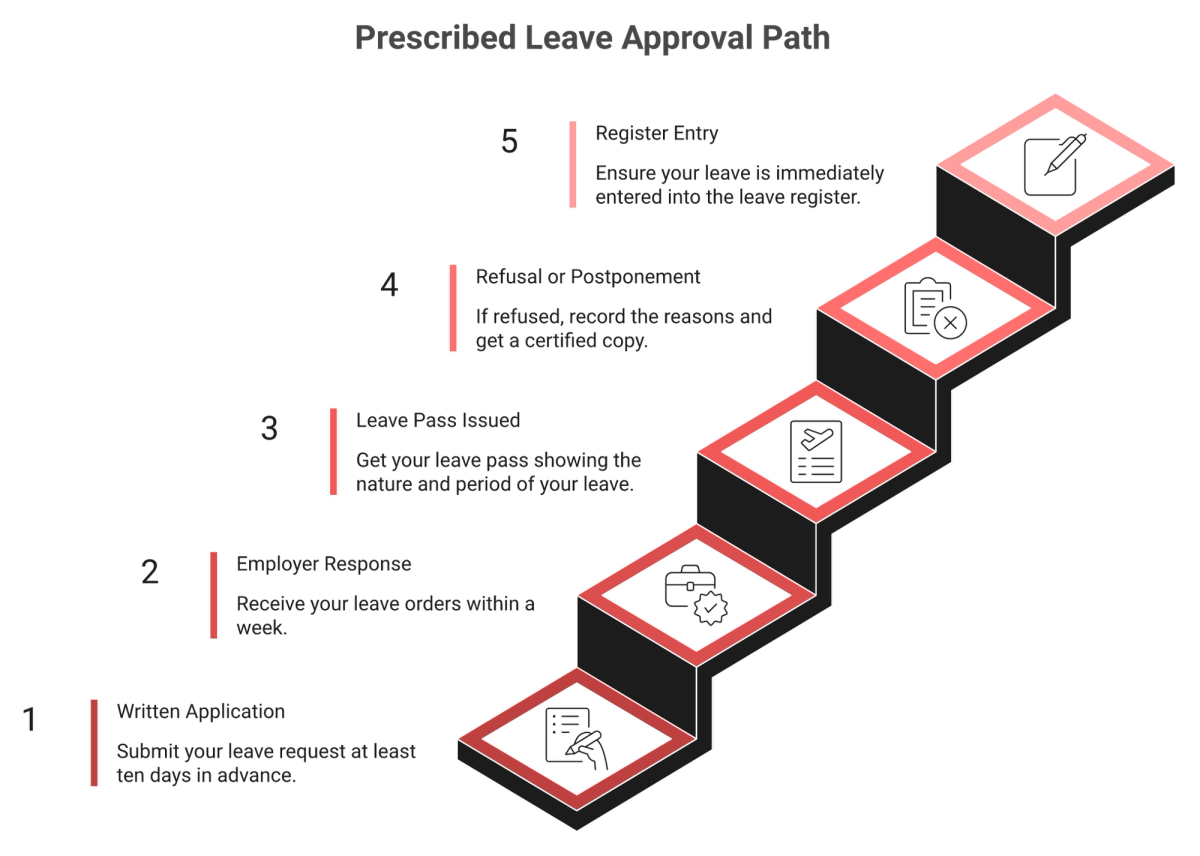
Privilege leave: written application at least ten days ahead, orders within a week, leave pass issued on grant, address during leave intimated to the employer. Casual leave: prior written permission, or written notice as soon as practicable if permission was impossible.
Sick leave, if due, must not be refused when requested in writing with a registered practitioner's certificate. The employer may require a second medical opinion at his own cost.
⚠️ Why a rejection click is a statutory entry
Rule 18 says leave due and prayed for shall not ordinarily be refused, and no part of earned privilege leave shall be allowed to lapse through refusal. Any refusal or postponement, with reasons, must be recorded in Form J, and the employee can demand a certified copy.
Versatile Club logs every rejected request with its reason, because refused leave does not lapse and therefore sits outside the ordinary carry forward cap. A quiet rejection creates a balance you still owe.
⏰ Four years, not one
Registers other than Forms I and J must be preserved until the end of the next calendar year. Forms I and J must be preserved until the end of the fourth following calendar year. Contravention attracts a fine up to INR 500 for a first offence and INR 1,000 afterwards, and a knowingly false entry can attract up to three months imprisonment.
💬 What buyers say about compliance paperwork
"The initial documentation and paperwork felt quite detailed and time-consuming at the beginning. However, as we progressed, it became clear that this thoroughness is what ensures proper legal and compliance coverage."
— Verified User in Marketing and Advertising, Verified User, Wisemonk - G2 Verified Review, 3.5/5, 12 February 2026
"I've noticed that their support/query responses can occasionally take a bit longer sometimes, likely due to a relatively small team."
— Verified User in Financial Services, Verified User, Wisemonk - G2 Verified Review, 4/5, 14 June 2025
✅ The diligence angle nobody plans for
Every India diligence request I have supported asked for leave registers by state, not a consolidated HRMS export. Reconstructing twelve months of refusal reasons under a data-room deadline is avoidable work, and it is the same records gap that surfaces when teams switch EOR provider in India.
Versatile Club exports state-wise register extracts on request, alongside PF and ESI challan confirmations and TDS deposit receipts, so diligence pulls from a maintained record rather than a rebuild.
Q8. Why does unlimited PTO fail in a Kolkata team?
Unlimited paid time off removes the fear of losing leave, and in a hierarchical, high-context workplace it also removes permission to take it. Employees frequently take fewer days under unlimited policies, not more. West Bengal law compounds the problem, because accrual must still be tracked and the Form J leave register maintained under Rule 21 of the 1964 Rules, so untracked leave is not legally available. Versatile Club allots fixed statutory days per employee and pairs them with a 90-day Success Coach for new hires.
The popular view, and where it breaks
The pitch is elegant. Treat adults like adults, drop the tracking, and trust people to rest.
It works in workplaces where asking for time off carries no social cost. Most Indian teams are not that workplace, at least not in year one.
🙇 Permission is the real currency
An American manager once told a peer of mine that her New Delhi colleague messaged her before every dinner break to ask if it was acceptable. Nothing in his contract required that. Deference did.
Now remove the allotment. A person who asks permission for dinner will not book two weeks off against a policy that names no number. Versatile Club's read is that the standard advice gets this backwards, because the constraint in India is rarely entitlement and almost always permission.
⚠️ Remote work inverts the risk
The instinct with a distributed team is to worry that too little gets done. What I have watched more often is the opposite, where too much gets done for too long, quietly, until someone resigns in month seven.
Versatile Club treats zero leave taken in the first quarter as an early attrition signal in its 90-day Success Coach reviews. I could be over-weighting that signal, since our sample is India placements rather than a cross-country dataset, but it has flagged more resignations than any performance metric we track. The retention layer sits alongside our contract to hire model rather than on top of it.
✅ What to do instead, in four moves
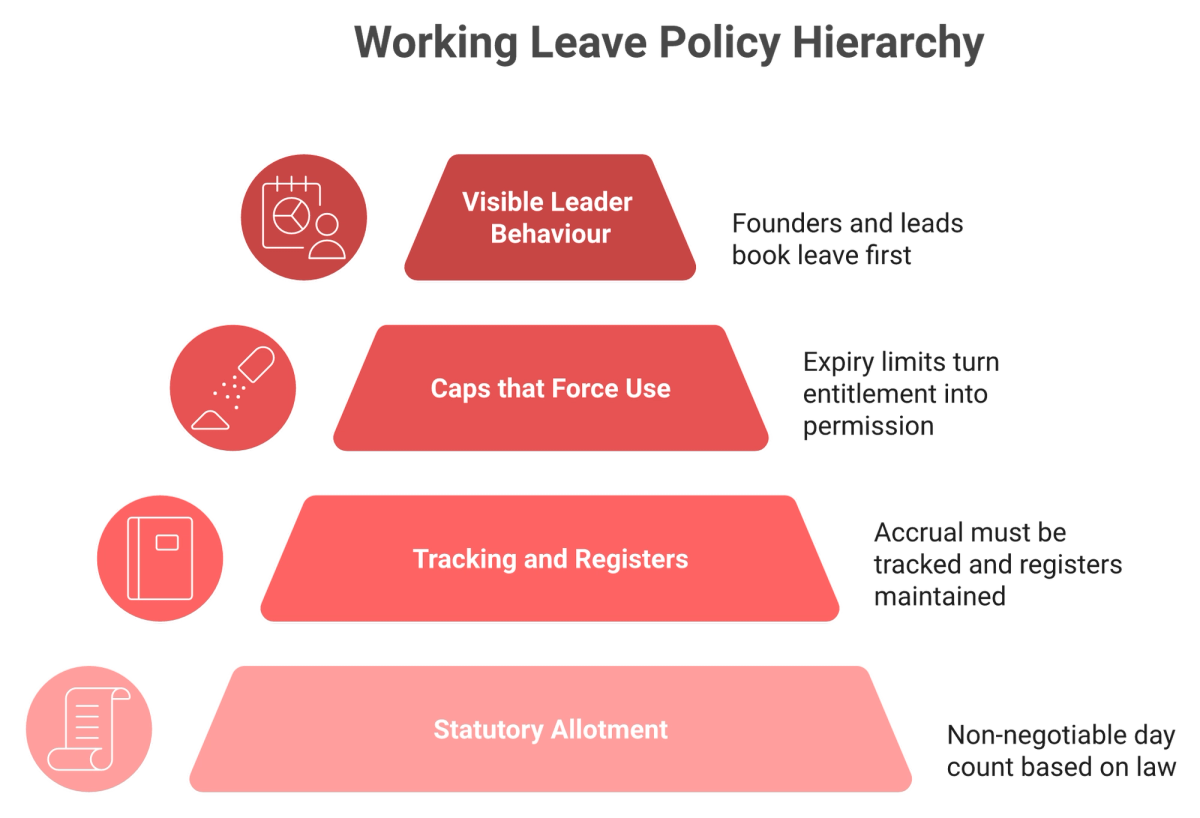
Allot fixed days: 14 privilege, 14 sick, 10 casual as the West Bengal floor under Section 11.
Let privilege leave expire at the 28-day cap, so people use it.
Have founders and leads book and announce their own leave first.
Ask teams to judge a "good day's work" and stop, rather than counting hours.
The use-it-or-lose-it rule sounds like a restriction. It functions as an instruction to rest, which is exactly what a deferential team needs.
⭐ The compliance floor is not the culture ceiling
Thirty-eight statutory days is a floor. Whether anyone uses them is a management question, not a legal one.
Versatile Club enforces the floor in payroll and tracks utilisation per employee, because a balance that never moves is a retention problem dressed as a healthy cost line. Teams weighing that cost line against an owned subsidiary usually model it in the EOR vs entity calculator first.
Versatile Club applies the statutory West Bengal allotment, maintains Form J, and reviews leave utilisation with each client during the 90-day Success Coach window, so unused balances surface before they become exits.
Q9. How do you run one leave policy across West Bengal and the rest of India?
Write one national policy at the most generous level you can fund, then attach state overlays wherever local statute is higher or differently shaped. West Bengal differs on numbers (10 casual leave days, 14 sick leave days on half pay, and a 28-day privilege leave cap), on forms (Form J leave register and Form H holiday notice), and on rhythm (the October Puja block). Versatile Club holds Shops and Establishments, PF, and ESIC registrations across all 28 states and 8 union territories, and runs Kolkata and Bengaluru hires on one entity with one USD invoice.
Why a flattened policy always breaks
A single national leave table does one of two things. It overpays by applying the most generous state to everyone, or it underpays and fails an inspection in the strictest state.
The overlay pattern avoids both. The floor is commercial. The overlay is statutory.
📋 Four states, four different shapes
| Item | West Bengal | Karnataka | Maharashtra | Tamil Nadu |
| Earned or privilege leave | 14 days after a completed year | Accrual based, 1 per 20 days | Accrual based | Accrual based |
| Casual leave | 10 days | Commonly 12 by practice | Commonly 8 by practice | Commonly 12 by practice |
| Sick leave pay basis | Half pay | Full pay by practice | Full pay by practice | Full pay by practice |
| Leave register | Form J | State prescribed form | State prescribed form | State prescribed form |
| Professional tax cycle | Monthly filing | Monthly | Dual PTRC and PTEC | Biannual, plus LWF |
Versatile Club runs all four cycles inside one payroll calendar, which is how the state differences surface as line items rather than surprises. Teams that outsource payroll in India usually discover the cycle mismatch in month two.
⚠️ The governance layer nobody staffs
State rules change without press coverage. West Bengal publishes through the Labour Department and Sarthac repositories, and establishment approvals flow through Silpasathi.
Somebody has to check those monthly. In Versatile Club's operations that check is a scheduled task tied to the payroll close, because a notification found in month three is cheaper than one found during diligence.
💬 What buyers say about multi-party coordination
"At times when wisemonk team doesn't have information about what I asked, reaching out to the respective company and then getting the information, was a bit time consuming."
— Verified User in Financial Services, Verified User, Wisemonk - G2 Verified Review, 4/5, 16 June 2025
"Sometimes the email communication from the wisemonk team is delayed by a day or 2. But overall they seem to be the best for India."
— Bulbul G., Verified User, Wisemonk - G2 Verified Review, 4/5, 19 February 2025
✅ The overlay template, in five lines
National floor: leave types, days, carry forward, and encashment rule.
State overlay: statutory minimum per state, with the section cited.
Applied entitlement: the higher of the two, per employee.
Register mapping: which local form holds the record.
Calendar overlay: notified state holidays and weekly closure.
Versatile Club stores the applied basis per employee rather than per policy, so an inspector in Kolkata and an auditor in New York read the same field. The same structure supports payroll outsourcing in Bengaluru and Kolkata without two separate policy documents.
🧭 Where the parallel helps
Running India payroll across states feels like US multi-state sales tax for a Series B SaaS company. One product, one price list, and twenty different filing rhythms underneath.
Versatile Club operates only in India by design, which is a genuine limitation for a buyer hiring across five countries. I say that plainly because the trade is real, and buyers comparing India expansion options should price it before signing.
Versatile Club maintains registrations in all 28 states and 8 union territories, so a Kolkata engineer and a Bengaluru engineer sit on one entity, one policy floor, and one monthly USD invoice with a per employee breakdown.
Q10. Which India EOR providers actually handle West Bengal leave compliance?
Ranked on India-specific leave and register depth: 1) Versatile Club, which employs India hires on its own entity, Foo Falcon Technologies Pvt Ltd, holds registrations across all 28 states and 8 union territories, and maintains the Form J leave register in house; 2) Wisemonk, India focused, SOC 2 and ISO 27001 certified, with no replacement guarantee; 3) Multiplier and Skuad, regional depth, thinner state coverage; 4) Deel, Remote, G-P, Velocity Global, and Papaya Global, which route India through local partner entities.
The four criteria this ranking uses
Entity ownership: is the employer of record the company on your contract?
State coverage: how many states hold live registrations?
Register handling: who maintains Form J, Form H, and the pay register?
Escalation path: who answers when payroll breaks on the 28th?
📊 Honest comparison, five rows
| Provider | India entity | State coverage | Onboarding | Support model |
| Versatile Club | Owned entity | All 28 states, 8 UTs | 5-day contractual SLA | Founder on WhatsApp |
| Wisemonk | India focused | India wide | 24 to 72 hours, not contractual | Support team |
| Deel | Local partner entities | Concentrated top states | 7 to 14 days | Chatbot first |
| Remote | Local partner entities | Concentrated top states | 10 to 14 days | Ticket queue |
| Multiplier | Local partner entities | Concentrated top states | About 7 days | CSM rotation |
Versatile Club appears here at $149 per employee per month flat, against Wisemonk's $99 to $399 salary slabs and Deel or Remote at around $599. The full breakdown sits on our pricing page.
❌ Why partner entities matter for leave specifically
A partner shell means the entity signing the appointment letter under Section 18 of the 1963 Act is not the brand on your invoice. When an inspector asks for Form J, the request travels through two companies before it reaches anyone who can answer.
That relay is exactly what buyers describe. Versatile Club removes one hop by holding the licence itself, which is the whole structural argument, not a feature claim. Buyers usually test it while shortlisting the best EOR in India.
💸 What breaks in practice
"I find Deel to be absurdly expensive. They charge a high amount of fees for transferring money to my bank account."
— Juan Camilo O., Verified User, Deel - G2 Verified Review, 1/5, 27 November 2025
"WiseMonk's EOR service solved our biggest challenge, which was hiring employees in India without setting up a local entity."
— Verified User in Marketing and Advertising, Verified User, Wisemonk - G2 Verified Review, 3.5/5, 12 February 2026
The pattern I see on WhatsApp at 11pm client time is non-consolidated invoices and PF or ESI questions that nobody owns. It is the same pattern that drives most Deel alternatives in India searches.
⚠️ Where a global platform is the better call
If you employ across twelve countries, buy a global platform. If your procurement gate requires SOC 2 Type II or ISO 27001 before signature, Versatile Club does not yet hold those, and that is a real disqualifier for enterprise buyers with 100 plus India staff.
EOR is also newer for Versatile Club than C2H is. The entity, the multi-state registrations, and the payroll operations are six years old. The EOR wrapper around them is not.
Versatile Club employs India hires on its own entity with PF, ESIC, and Shops and Establishments licences in its own name, charges no setup or exit fee, and gives the first month free, so the escalation path has one company in it. The service scope is set out under EOR services.
Q11. What does a compliant West Bengal leave clause look like, and what do you fix on Monday?
A compliant West Bengal leave clause names the governing statute, states the four entitlements with accumulation caps, sets the notice rules (ten days for privilege leave, and three days maximum for casual leave at a stretch), commits to recording refusals in Form J, defines the daily average wage basis for leave pay and exit encashment, and applies the higher of the 1963 Act and the OSH Code, 2020. Versatile Club onboards a West Bengal employee in five contractual days, covering agreement, offer, contract, registrations, and payroll live.
The clause set, with its statutory anchor
Governing law: employment is governed by the West Bengal Shops and Establishments Act, 1963, read with the 1964 Rules and applicable central law.
Entitlement: 14 days privilege leave per completed year, 14 days sick leave, and 10 days casual leave.
Caps: privilege leave to 28 days, sick leave to 56 days, and casual leave nil.
Notice: privilege leave applied ten days ahead, with orders issued within a week.
Refusal: any refusal recorded with reasons in Form J, and leave does not lapse.
Pay basis: daily average of full time earnings for days worked in the preceding calendar month, excluding overtime and bonus.
Exit: wages for all privilege leave to credit, under Section 12.
Higher-of rule: where central law is more generous, central law applies.
Versatile Club writes this clause into the employment contract rather than a handbook annexure, because the contract is what an inspector and an acquirer both read.
✅ Eight things to fix on Monday
Reset the accrual eligibility trigger from 240 days to 180 days, per Section 32 of the OSH Code, 2020.
Cap ordinary carry forward at 30 days, with refused leave excluded from the cap.
Turn on refusal logging, with a mandatory reason field.
Load the notified 2026 West Bengal calendar, including 15 to 26 October.
Recompute the leave encashment provision on the Basic plus DA base defined in the Code on Wages, 2019.
Check the maternity clause cites the central Act, not just the 1964 Rules.
Post the Form H weekly holiday notice, and send the Inspector copy.
Verify the appointment letter matches the prescribed form under Section 18.
⏰ The two items that expire fastest
The holiday calendar and the Form H notice are date bound. Everything else can be fixed in a quiet week.
Versatile Club sequences these two first during establishment setup, since both are visible on a walk-in inspection without any record request. Founders who hire in India without an entity inherit that sequence rather than building it.
💬 What buyers actually want from the system
"Wisemonk addresses the hassle of managing employees, tracking time, and running payroll across multiple tools by bringing everything together in a single system."
— Vinay M., Verified User, Wisemonk - G2 Verified Review, 4/5, 18 February 2026
Single-system consolidation is the real ask. Versatile Club delivers it as one monthly USD invoice with payroll summary, compliance status, PF and ESI challan confirmations, and TDS deposit receipts.
⭐ The part that is genuinely hard
The compliance work is not the hard part. Writing a policy that an inspector in Kolkata, a CFO's auditor in Austin, and a 26-year-old engineer in Salt Lake all read the same way is the hard part.
Versatile Club's read is that most India leave policies fail on legibility rather than legality. I could be over-indexing on that, since our sample skews to companies with fewer than 30 India staff.
Versatile Club onboards a West Bengal hire in five contractual days, with no setup fee, no exit fee, and the first month free. Send me your current policy on WhatsApp, or use contact us, and I will mark it against the sections above.
FAQs
How many leave days are mandatory for an employee in West Bengal in 2026?
Under Section 11 of the West Bengal Shops and Establishments Act, 1963, a person employed in a shop or establishment is entitled to four categories of leave.
- Privilege leave: 14 days on full pay for every completed year of continuous service, accumulating up to 28 days.
- Sick leave: 14 days per year on half pay, against a certificate from a registered medical practitioner, accumulating up to 56 days.
- Casual leave: 10 days per year on full pay, with no accumulation permitted.
- Maternity leave: as prescribed, read with the central Maternity Benefit Act, 1961.
The number most employers get wrong is casual leave. Many India handbooks carry 12 days because that is the Karnataka habit, while West Bengal law gives 10. The second common error is treating sick leave as fully paid.
Versatile Club applies the West Bengal floor inside payroll rather than at appraisal time, with the 28-day and 56-day caps enforced automatically. If you are building a first Kolkata team, our EOR services in India page sets out how the entitlement is written into the employment contract instead of an annexure nobody reads.
Did the new Labour Codes change leave rules in West Bengal from 21 November 2025?
Partly. The four Labour Codes came into force on 21 November 2025, but state Shops and Establishments Acts were not repealed. The West Bengal Act of 1963 still governs leave for Kolkata offices.
What changed sits in Section 32 of the Occupational Safety, Health and Working Conditions Code, 2020:
- Annual leave eligibility fell from 240 days worked to 180 days in a calendar year.
- Accrual stays at one day for every twenty days worked.
- Ordinary carry forward is capped at 30 days.
- Leave that was applied for and refused carries forward beyond that cap.
Section 24 of the 1963 Act preserves any more favourable right available under another law, which is the legal hook for paying the better of the two entitlements. West Bengal has not yet notified its own rules under the Codes, so the 1963 Act remains the compliance floor.
Versatile Club re-ran every West Bengal leave balance against both rulebooks after 21 November 2025 and pays the higher entitlement per employee. The applied basis is reported in the monthly pack described under compliance.
Is earned leave encashable when a West Bengal employee resigns, and how is it calculated?
Yes. Section 12 of the West Bengal Shops and Establishments Act, 1963 requires wages for the full period of privilege leave standing to an employee's credit when services are terminated. Under the OSH Code, 2020, employees may also demand encashment at the end of a calendar year and for any balance above 30 days.
The calculation base matters more than the day count:
- Use the daily average of total full time earnings for days actually worked in the last preceding calendar month.
- Exclude overtime and bonus.
- Include dearness allowance and the cash equivalent of concessional benefits.
- Casual leave is never encashed, because it does not accumulate.
A designer on INR 9 lakh a year with 21 days accrued works out near INR 60,600 at exit. That figure rises once salary is restructured so Basic plus dearness allowance reaches 50% of remuneration under the Code on Wages, 2019.
Versatile Club accrues gratuity at 4.81% of Basic plus DA from month one and reports accrued leave liability inside one monthly USD invoice. CFOs modelling the total cost usually start with our EOR vs entity calculator.
Which leave registers must a West Bengal employer maintain, and for how long?
Rule 21 of the West Bengal Shops and Establishments Rules, 1964 requires a leave register in Form J, and every leave application, granted or refused, must be entered immediately after the decision is taken.
The supporting register stack looks like this:
- Form H: weekly full holiday and half holiday notice, displayed in the workplace.
- Form I or II: daily hours of work and rest intervals.
- Form J: leave applications, grants, and refusals with reasons.
- Form M: pay register, certified before two witnesses.
- Form U: monthly overtime per employee.
Preservation is the trap. Most registers must be kept until the end of the next calendar year, while Forms I and J must be preserved until the end of the fourth following calendar year. Contravention attracts a fine up to INR 500 for a first offence, and a knowingly false entry can attract up to three months imprisonment.
Versatile Club maintains Form J and the supporting West Bengal registers under its own Shops and Establishments licence, and exports state-wise extracts on request. That matters most during diligence or when companies switch EOR provider in India and inherit an incomplete record.
How should employers plan for the Durga Puja holiday block in West Bengal?
West Bengal notified 27 holidays under the Negotiable Instruments Act for 2026, plus further holidays under state government orders, through Finance Department Notification No. 4188-F(P2). The Durga Puja and Lakshmi Puja block runs from 15 to 26 October 2026, with Maha Ashtami on 19 October, Maha Nabami on 20 October, and Vijaya Dasami on 21 October.
Ten statutory casual leave days cannot absorb a twelve day block, and Rule 15 ordinarily limits casual leave to three days at a stretch. Practical planning looks like this:
- Build the Q4 sprint plan backwards from Nabami, in August rather than October.
- Agree rota coverage and paid overtime in advance, since Rule 47 permits a Puja overtime window and Section 13 sets overtime at one and a half times the ordinary rate.
- File the Form T overtime notice with the Inspector at least 24 hours ahead.
- Remember polling day is paid leave under Section 135B of the Representation of the People Act, 1951.
Versatile Club loads the notified state calendar, sectional holidays, and polling dates into attendance before the year starts, for all 28 states and 8 union territories. Details of that sequence sit on our how it works page.