Table of contents (12)
- Q1: Deel vs Remote in 2026: which one is actually right for your India hires?
- Q2: What do Deel and Remote actually cost, and what hides above the $599 headline?
- Q3: Owned entity or partner shell: how do Deel's and Remote's India coverage and reach compare?
- Q4: Will Deel or Remote get India's 2026 Labour Codes and the 50% wage rule right?
- Q5: DPDP, PE risk, and FEMA: is your India data and tax exposure actually covered?
- Q6: How fast can Deel, Remote, or a specialist actually get someone paid in India?
- Q7: When does an EOR stop making sense, and should you set up your own India entity?
- Q8: Contractor vs EOR: are Deel and Remote quietly exposing you to misclassification back-pay?
- Q9: Deel vs Remote support: is "global 24/7" better than a human who knows India?
- Q10: Should you run a split-vendor strategy, an India specialist plus a global EOR?
- Q11: Why hire in India at all, and why does culture-fit beat cost arbitrage?
- Q12: Deel vs Remote vs an India specialist: the final verdict and your Monday-morning checklist
Deel vs Remote: Pricing, Compliance, FX, and Scalability Compared for Teams Hiring in 2026
Q1: Deel vs Remote in 2026: which one is actually right for your India hires?
Deel and Remote both charge $599 per employee per month on annual EOR plans, so price is not the deciding factor. Deel wins on country breadth (150+) and onboarding speed. Remote wins on lower contractor fees. But for India-concentrated teams, both run India through local partner entities, which is exactly where compliance and FX costs quietly leak.
🧭 The question underneath the question
A People Ops lead at a Series B messaged me last quarter, three days before her India payroll run. Her real question was not "Deel or Remote."
It was sharper than that. "I'm paying a $600-a-month premium for a global UI, but is my India team's legal safety actually handled by an anonymous local partner who will miss the 2026 50% basic-pay rule, and am I losing another 3 to 5 percent on hidden FX every month?"
That is the buyer's true anxiety in 2026. The two logos look identical on price, so people stop comparing and pick the brand with more reviews.
⚖️ Where I'll be honest about my bias
I run Versatile, an India-only Employer of Record (a company that legally employs your India hire on your behalf) that owns its Indian entity outright. So I have a stake in this. I'll flag that bias every time it matters.
For six years, I've placed engineers, designers, and ops people across Bengaluru, Hyderabad, and Pune. From what surfaces when you actually run India payroll every month, the Deel-versus-Remote decision hides three pillars that matter far more than the sticker price.
Compliance depth: who actually files your PF, ESI, and TDS, and did they catch the November 2025 wage rule?
FX transparency: what does the money lose between your bank and your engineer's account?
Support model: when payroll breaks at 11pm, do you get a human or a ticket number?
I'll walk each pillar honestly, name where Deel and Remote genuinely win, and show where an India-native India-native specialist changes the math. The standard "just buy Deel for everything" read gets this backwards for India-heavy teams, and I'll show you why.
Q2: What do Deel and Remote actually cost, and what hides above the $599 headline?
Both Deel and Remote charge $599 per employee per month for EOR on annual plans. The real cost sits above that line. Deel adds a 0.6 to 2 percent (often 3 to 5 percent effective) FX markup, India surcharges, and a one-month salary deposit. Contractor fees are $49 (Deel) versus $29 (Remote). On an India hire, hidden FX alone can cost more per month than the visible platform fee.
💸 The $599 trap
Here is the trap I watch buyers fall into. Two vendors quote the same $599, so the finance lead assumes cost is settled and moves on.
The visible fee was never the expensive part. The expensive part is the money that leaks between your USD bank account and your engineer's INR account, and it does not appear on the invoice.
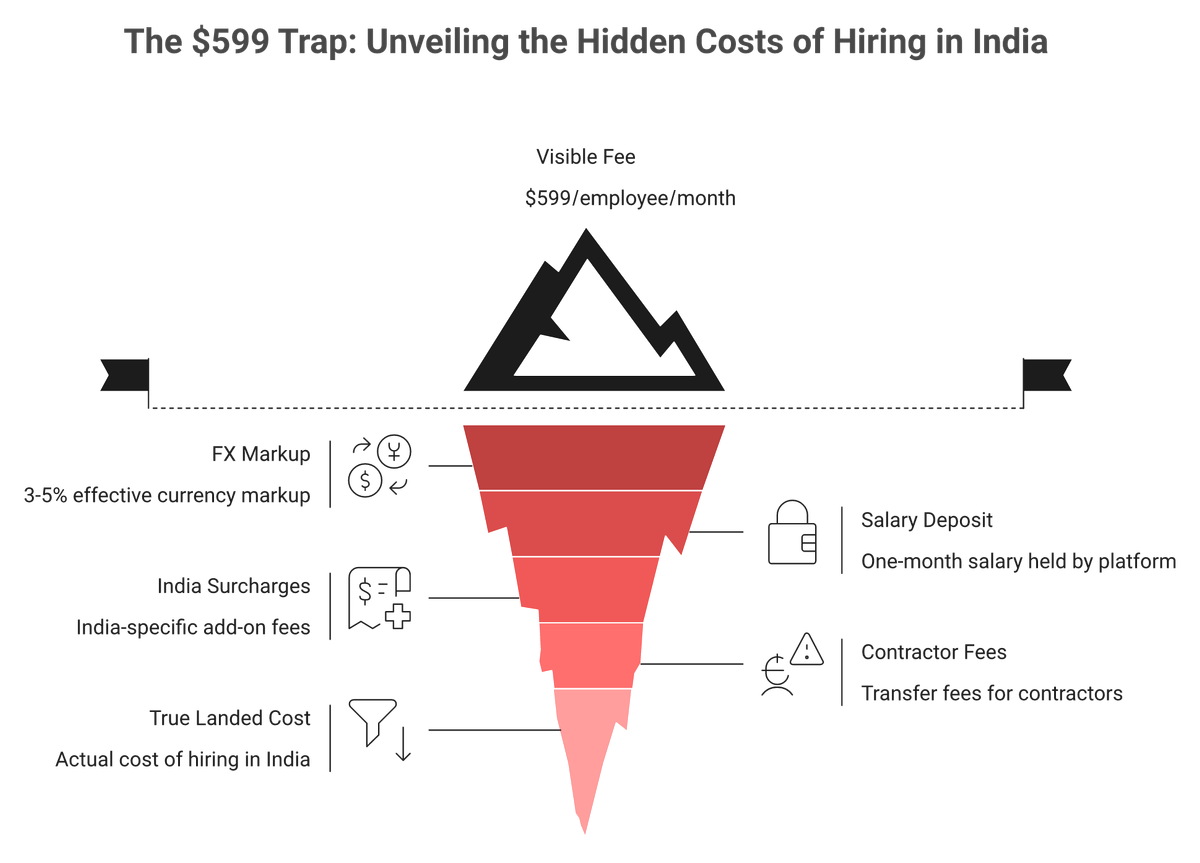
📊 The real India cost stack
| Cost line | Deel | Remote | India-native (Versatile) |
|---|---|---|---|
| EOR base fee | $599/employee/mo | $599/employee/mo | $149/employee/mo |
| Contractor fee | ~$49/mo | ~$29/mo | C2H model, 20-30% of salary, billed after day-90 |
| Salary deposit | Often one month | Typically none | None |
| FX markup | 0.6-2% (3-5% effective, per operator reports) | Present, varies | Mid-market rate, no markup |
| Setup / exit fees | Varies | Varies | None, first month free |
That FX line is the quiet one. Real Deel users say it plainly.
"I find Deel to be absurdly expensive. They charge a high amount of fees for transferring money to my bank account."
Juan Camilo O. Deel G2 - Verified Review
"There are hidden fees. Of course, again, also here. and yes you are right, they are hiding it with font-size 6 somewhere hidden... You will never get your net-agreed salary through Deel."
İbrahim Deel G2 - Verified Review
Even a middle-rated review lands on the same nerve.
"I dislike how expensive Deel's transaction fees are, especially when moving money from the Deel account to my bank."
Maria M., 3/5 Deel G2 - Verified Review
✅ What to do on Monday
Ask any provider, including us, for a real India sample invoice before you sign. A clean invoice shows the mid-market rate, the exact deduction, and every statutory line item.
At Versatile, we invoice in USD directly from our own Indian entity at the mid-market rate, with no FX markup, no setup fee, and no exit fee. That is not a pitch. It is the single easiest thing to verify: make us show you the invoice, then compare our transparent pricing against what Deel and Remote show you.
Q3: Owned entity or partner shell: how do Deel's and Remote's India coverage and reach compare?
Deel covers 150+ countries through a hybrid owned-plus-partner network. Remote owns entities in 80 to 100+ countries. But for India specifically, both operate through local partner entities, not wholly-owned ones. That extra layer sits between you and the people filing PF, ESI, and TDS, which is where compliance surprises surface during fundraising diligence.
🏢 Owned entity versus partner shell, in plain English
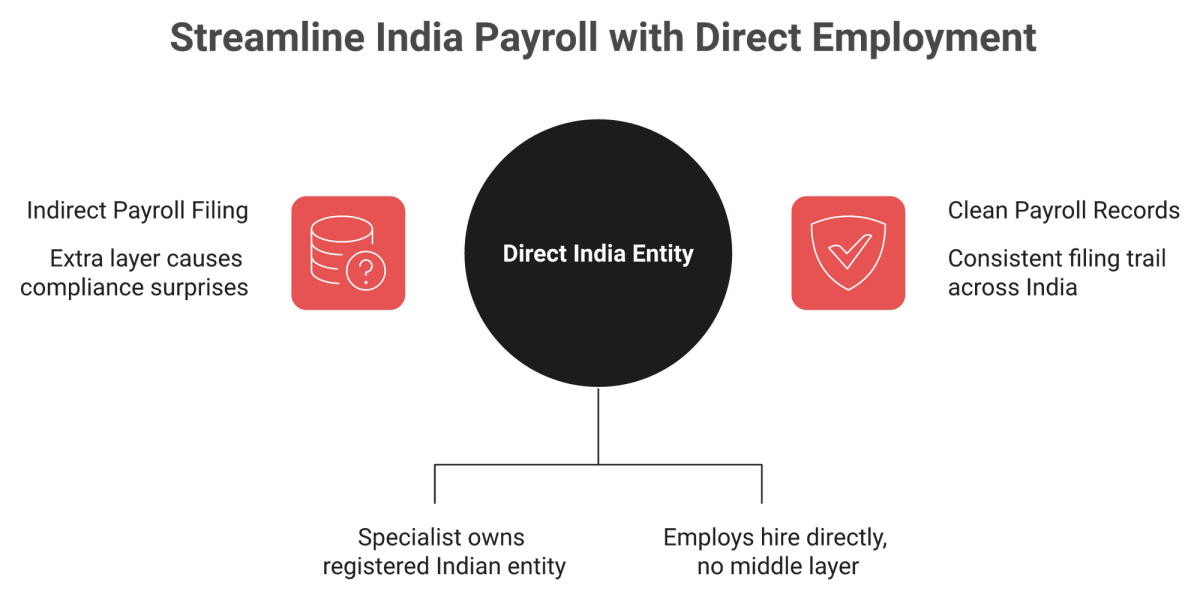
An "owned entity" means the EOR runs its own registered company in that country and employs your hire directly. A "partner entity" (sometimes called an aggregator model) means the EOR resells a third-party local firm's employment services and sits in the middle.
Think of it like AWS regions. You want your data in a region the provider actually operates, not one they quietly rent from someone else. The difference is invisible until something breaks.
📊 Coverage and India entity status
| Provider | Country reach | India entity model |
|---|---|---|
| Deel | 150+ countries | Local partner entity |
| Remote | 80-100+ owned | Local partner entity (contested) |
| Versatile | India only | Own registered Indian entity |
Here is the honest confusion in the market. One widely-cited comparison lists Remote as "owned" and Deel as "partner" for India, then elsewhere lists both as local-partner for India. Even the specialists disagree on this. That contradiction alone should make you verify, not assume.
✅ The one thing to verify before signing
Ask for the India entity name in writing. Not "our local partner," the actual registered company that will appear on your engineer's payslip and PF challan.
At Versatile, that answer is one line: Foo Falcon Technologies Pvt Ltd is our own registered Indian company. PF, ESI, TDS, and professional tax are filed under our own registrations, with statutory coverage across all 28 Indian states and 8 union territories. Deel, Remote, and G-P route India through local partner entities. We do not. Where I'll be fair: Deel genuinely wins if you need one hire in 40 scattered countries, but India depth is a different job, and it is worth reading our India-first alternative approach before you decide.
Q4: Will Deel or Remote get India's 2026 Labour Codes and the 50% wage rule right?
India's four Labour Codes were notified and implemented on 21 November 2025, requiring wages (Basic, DA, and retaining allowance) to be at least 50 percent of total remuneration. This restructures the traditional Indian salary stack that most global EOR templates still use, inflating PF and gratuity liabilities. Generalists running one template across 150 countries frequently miss it, and it surfaces during diligence.
📜 What the 50% rule actually means
For years, Indian salaries were structured with a small "basic" and a large pile of allowances. That kept PF and gratuity costs low. The new Code on Wages ended that game.
Now "wages," meaning Basic plus Dearness Allowance plus retaining allowance, must be at least 50 percent of total pay. If your India hire's basic was set at 30 percent under an old global template, that structure is now non-compliant, full stop.
💰 Why this hits your payroll harder than it looks
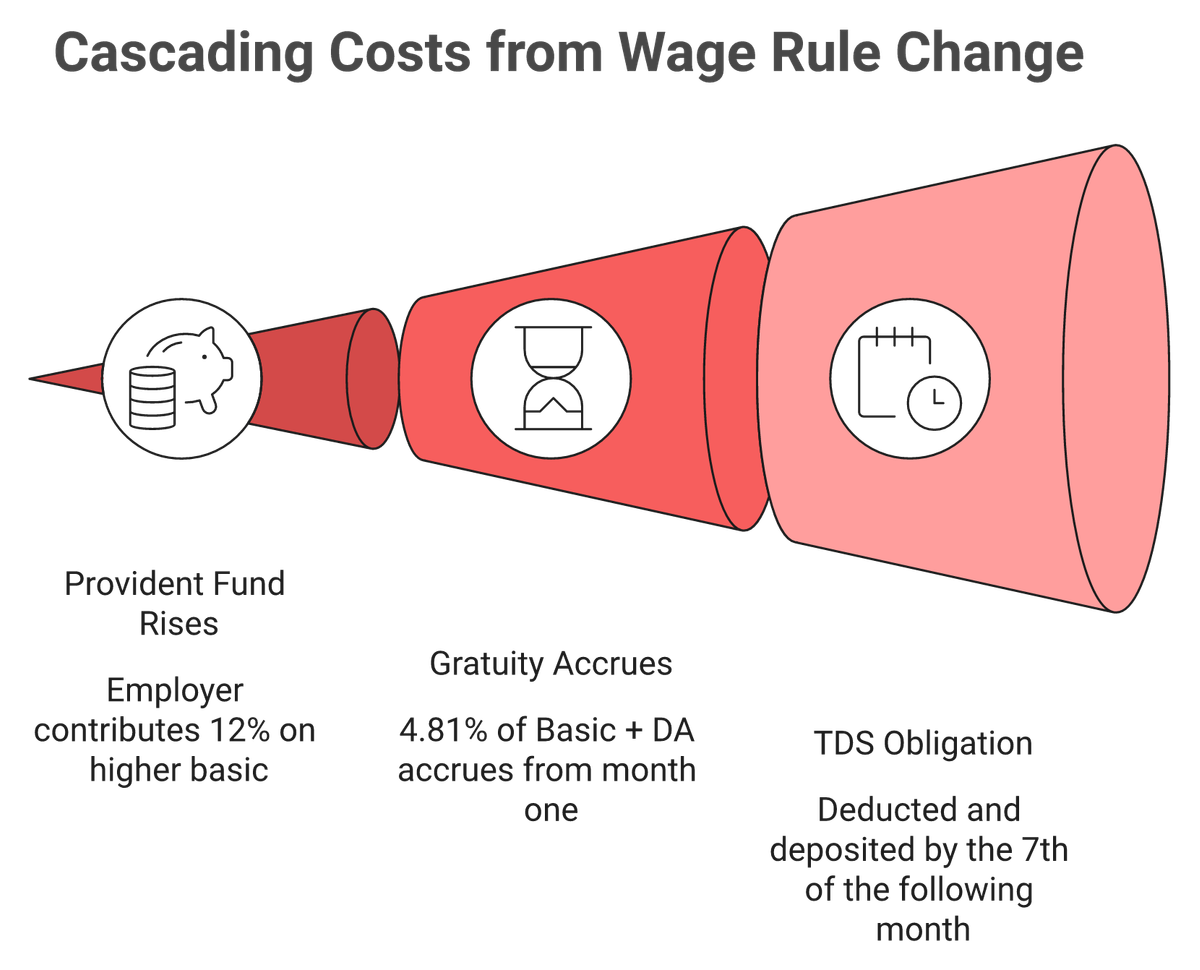
When basic pay rises to hit 50 percent, three statutory costs rise with it. This is where a global template that treats India as "country number 97" quietly creates back-dated liability.
Provident Fund (PF): employer contributes 12 percent, calculated on the higher basic.
Gratuity: accrues from month one at 4.81 percent of Basic plus DA.
TDS (tax deducted at source): must be deducted and deposited by the 7th of the following month, per the employee's income tax slab.
I could be slightly off on any single client's exact delta, because it depends on their old structure. But the direction is certain: costs go up, and a template built for 150 countries rarely recalculates India on its own. This is exactly why India payroll compliance deserves its own specialist, not a global afterthought.
⚠️ The diligence risk nobody flags
Here is what the "just buy Deel" playbook gets backwards. A shallow India setup does not fail loudly. It fails eight months later, when your Series B lead's counsel opens the data room and asks why basic pay sits below 50 percent.
When the codes dropped on 21 November 2025, we had already restructured our clients' CTCs, because India is the only country we operate at Versatile. State granularity is part of that depth: Maharashtra alone needs dual professional-tax registration (PTRC plus PTEC) with monthly slab filing. Compliance, to me, is the floor, not the ceiling. But if the floor cracks, nothing above it matters, and clean India payroll records, delivered through our managed payroll service, are what let you pass diligence without a scramble. If you are weighing an EOR against your own India entity, that decision starts here.
Q5: DPDP, PE risk, and FEMA: is your India data and tax exposure actually covered?
SOC 2, ISO 27001, and GDPR do not automatically satisfy India's DPDP Rules 2025, notified on 13 November 2025. An EOR handling your India payroll data is a Data Fiduciary. It must report breaches to the Data Protection Board within 72 hours and follow Rule 15 on cross-border transfers. Separately, a poorly structured EOR relationship can create Permanent Establishment and FEMA remittance exposure for the foreign parent.
🔐 What DPDP actually asks of your EOR
The Digital Personal Data Protection Rules, 2025 treat anyone handling your India employees' data as a "Data Fiduciary" (the party that decides how personal data gets used). Your EOR is one.
That role carries hard duties. A breach must reach the Data Protection Board within 72 hours. And under Rule 15, moving Indian employee data outside India follows government-set conditions. "We're GDPR-compliant" does not answer this.
🏛️ Where PE risk and FEMA quietly enter
Permanent Establishment (PE) risk means the tax authority decides your foreign company has a taxable presence in India. A sloppy EOR structure, where the line between employer and client blurs, can trigger it.
FEMA (India's foreign-exchange law) governs how money legally enters the country. When an EOR owns its Indian entity and invoices you in USD directly, the remittance trail is clean. When India is a partner shell, that trail runs through a third party you never see, which is why our India EOR service keeps the entire chain in-house.
✅ The SOC 2 myth, and what to verify
Here is the standard read I think gets it backwards. Buyers see SOC 2 and ISO badges and assume India data compliance is handled. Those are security frameworks. They are not DPDP.
At Versatile, your India team's data sits under our own registered Indian entity, and we invoice in USD directly from India, which keeps the FEMA remittance trail transparent through our managed payroll setup. I could be conservative here, but I would not call any provider "DPDP-ready" until they show you their breach-response process and their Rule 15 cross-border stance in writing. Ask for both before you sign, and if you want the deeper picture, our India payroll compliance guide walks through it.
Q6: How fast can Deel, Remote, or a specialist actually get someone paid in India?
Deel typically onboards an India EOR hire in 7 to 14 days, and Remote in 10 to 14 days. A specialist owning its Indian entity can contract in 5 days on an SLA (a written service-level guarantee). Speed is not cosmetic. It reflects whether the platform runs India directly or waits on a local partner. When your candidate holds a competing offer, days matter.
⏰ The lost-candidate problem
Picture a Bengaluru engineer with two offers. Yours is better, but onboarding drags into week three while paperwork bounces between a platform and its local partner. She signs the other one.
I have watched this cost real hires. The delay is rarely the platform's software. It is the handoff to a third-party entity that the buyer never sees, and real users describe exactly that friction.
"It took three months to onboard our first 3 individuals. They didn't seem to be able to navigate Visas or variations to employment contracts."
Verified User in IT and Services Deel G2 - Verified Review
"My onboarding took 28 days. We have started on October 4th and today is November 1st... noone can solve it."
İbrahim Deel G2 - Verified Review
📊 Onboarding speed, compared
| Provider | Typical India onboarding | Commitment type |
|---|---|---|
| Deel | 7-14 days | Best-effort estimate |
| Remote | 10-14 days | Best-effort estimate |
| Versatile | 5 days | Contractual SLA |
✅ Estimate versus guarantee
A "7 to 14 days" estimate and a 5-day SLA are different promises. One is a hope. The other has a number in the contract.
At Versatile, our 5-day onboarding is a contractual SLA, not a marketing line, and it holds because we own the Indian entity, so no partner sits in the middle. If something stalls, you message me on WhatsApp directly, not a ticket queue. That is the whole point of how we work, and it is what sets us apart as a Deel alternative built only for India.
Q7: When does an EOR stop making sense, and should you set up your own India entity?
An EOR is the right choice until roughly 10 to 12 India hires. Beyond that, many teams graduate to their own entity, often a GCC (Global Capability Center, a company-owned India office). Think of it as a suspension bridge versus the Golden Gate. You don't build the Golden Gate to cross a small river. The real question is whether your provider helps you graduate cleanly or locks you into a partner shell.
🌉 The bridge you actually need
Setting up your own Indian subsidiary is the Golden Gate. It costs real money, often $50,000 or more, and 12 to 18 months before your first hire logs in.
For your first few India hires, that is absurd overspend. An EOR is the suspension bridge. It gets you across the river now, and your cash stays in product and payroll instead of incorporation lawyers, which is why our EOR services exist for exactly this stage.
📈 Where the tipping point sits
From what surfaces when you actually run these placements, the switch usually lands around 10 to 12 hires. After that, the per-head EOR fee starts to rival the cost of running your own entity, and our EOR vs entity calculator helps you find your exact crossover point.
And India is a serious destination to graduate into. GCCs in India generated USD 64.6 billion in revenue in 2023-24, so the "own entity" path is a well-worn road, not an experiment. The math simply changes with headcount, and this EOR vs entity in India breakdown shows how.
✅ The question that separates good providers from lock-in
Here is the belief the category avoids saying out loud. A good India partner should tell you when to leave.
A global generalist sells you 150 countries and has little reason to help you exit India. At Versatile, we run C2H (contract-to-hire) and EOR as the bridge, and we will flag the moment your headcount says "build your own entity now." I would rather lose the EOR fee and keep the relationship than pretend the bridge is the destination, and when you are ready, our GCC setup in India guide maps the next step.
Q8: Contractor vs EOR: are Deel and Remote quietly exposing you to misclassification back-pay?
Paying an India worker as a contractor through Deel or Remote is cheaper, around $29 to $49 a month. But it can quietly create misclassification exposure of $25,000 to $40,000 in back-pay per head. If you direct someone's hours, tools, and daily work, they are an employee under Indian law, no matter what the contract says. Contractor management removes misclassification risk only on paper.
🚩 The moment a People Ops lead realizes it
A People Ops leader once said the quiet part to me out loud. "Hold on a minute, we could be at risk here. This person really shouldn't be a contractor. They should be an employee."
That realization usually arrives late, right before diligence or an audit. The contract says "contractor." The daily reality says "employee." Indian law reads the reality, not the label, which is where our contractor of record and EOR options come in.
⚠️ The behavioral test that gives it away
There is a tell I watch for. A US manager once told me her India "contractor" messaged her before every dinner break to ask permission, insisting, "because I'm your subordinate."
That is a master-servant relationship, the classic employee signal. When you control hours, tools, and daily tasks, a court sees an employee. The exposure is not small: $25,000 to $40,000 in back-pay, PF, and penalties per head. Even Deel's own users describe how its rails blur the contractor-versus-entity line.
"Deel treats all users as if they were individual freelancers, even when you're clearly operating as a registered company... no option for company-level onboarding."
Verified User in Translation and Localization Deel G2 - Verified Review
"I like that we can use Deel for multiple things. Contractors, EORs, employees... For the most part it is fairly straightforward."
Verified User in Computer Software, 3/5 Deel G2 - Verified Review
✅ When to convert, and how
The fix is simple to state. If the person works like an employee, employ them like one, through an EOR.
At Versatile, we have migrated teams off contractor rails onto clean employment before it became a back-pay problem, because contractor status is a transition risk, not a permanent solution. Our contract-to-hire model is built for exactly that shift, and this contractor vs EOR comparison shows when to switch. My honest rule of thumb: if you would be uncomfortable explaining the arrangement to an auditor, convert now. The $30-a-month saving is not worth a five-figure liability sitting quietly on your books.
Q9: Deel vs Remote support: is "global 24/7" better than a human who knows India?
Deel runs a chatbot-first support model, and Remote a ticket-queue model. Both scale support by automating it. For a routine query, that is fine. But for an India payroll or compliance issue, "global 24/7" often means an anonymous agent following a script. The alternative is direct access to someone who runs India operations daily.
🧊 The 20-signature freeze
I once watched a simple India change stall because it needed twenty internal sign-offs, routed through a procurement desk in Guadalajara. Nobody on that chain had ever run an Indian payroll.
That is enterprise support at scale. It is not malicious. It is just cold, and it is slow exactly when you need speed, and real users feel it.
"Customer support and issue ownership need serious improvement... I was redirected multiple times, asked to repeat the same information to different representatives."
Güneş A., 1.5/5 Deel G2 - Verified Review
⚠️ When the chatbot meets a compliance fire
Here is where the model breaks. Your engineer's PF challan (the monthly Provident Fund payment receipt) has not landed, payroll is in two days, and you open a chat window.
The bot offers articles. The ticket gets a queue position. Meanwhile, the person who actually understands EPFO filings is three escalations away, asleep in another timezone.
"Often the CS doesn't seem to have answers... something I was looking for the answer to in 20 minutes becomes a 4 day process... team members who aren't available except for at 3:00am my time."
Verified User in Computer Software, 3/5 Deel G2 - Verified Review
✅ The honest version of founder-direct support
At Versatile, you message me on WhatsApp. Not a CSM rotation, not a bot, the person who built the company and runs India daily. You can see exactly how we work before committing.
I will be candid, because the standard read dresses this up. Founder-on-WhatsApp works because of our current scale, and I would rather name that honestly than promise "24/7 global" and deliver a ticket number. Deel's ~14,000 G2 reviews and Remote's ~3,600 reflect real breadth. Breadth and a human who knows India are just different products, which is the whole case for our India EOR service.
Q10: Should you run a split-vendor strategy, an India specialist plus a global EOR?
If India is your biggest hiring hub but you also make one-off hires in scattered countries, the smartest setup is a split-vendor strategy. Use an India-native specialist for depth where volume and risk concentrate, plus Deel or Remote for isolated hires across the other 100+ markets. You get specialist compliance where it matters and global reach where it does not.
🧩 Stop treating this as a binary
Most buyers frame it as "Deel or a specialist." That is the wrong question. The better question is where your risk actually sits.
Your India hub is where headcount, statutory complexity, and diligence risk pile up. A one-off hire in Portugal carries almost none of that. Match the tool to the risk, and our EOR services handle the India leg.
📊 Which setup fits your team
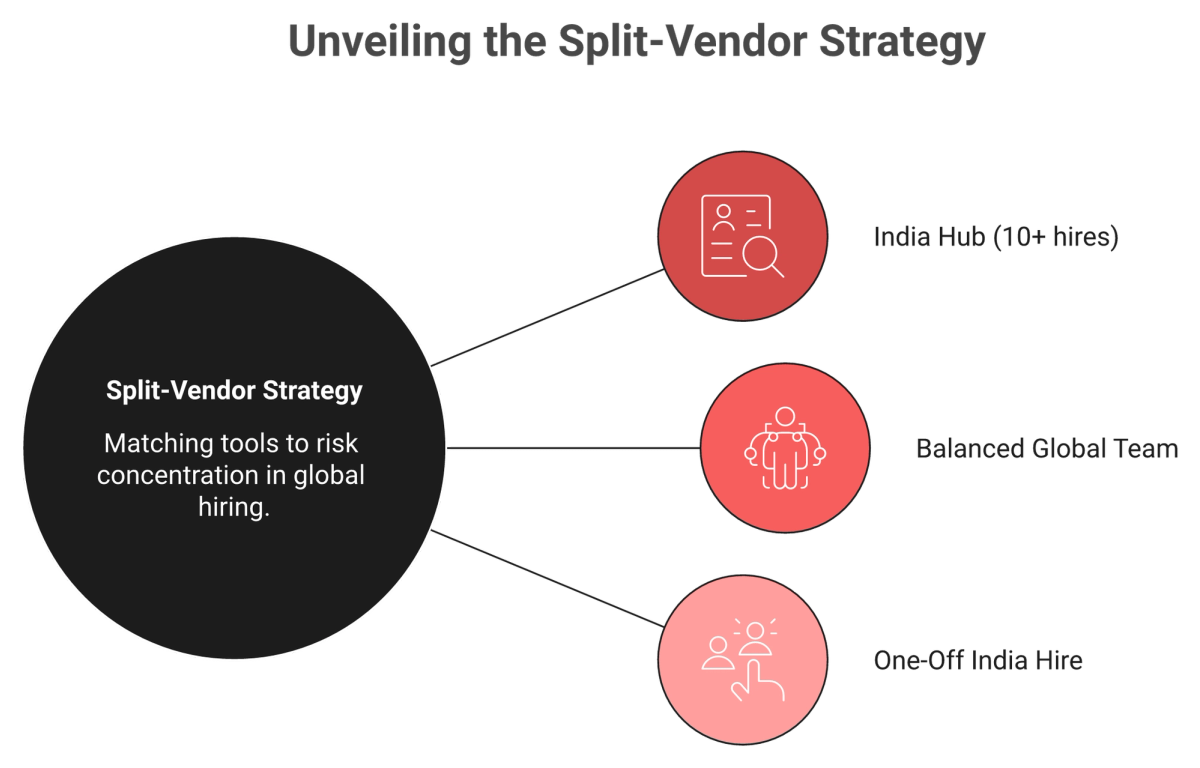
India-heavy team (10+ India hires, a few scattered elsewhere): run Versatile for the India hub, Deel or Remote for the rest.
Balanced global team (spread evenly across many countries): a global generalist as your backbone makes sense; add a specialist only if India grows.
One-off India hire (single contractor, no India plans): honestly, just use Deel or Remote. A specialist is overkill for one person.
✅ Why concentrating India volume pays off
Here is the belief the category avoids. Concentrating your India headcount with one specialist is not vendor sprawl. It is risk reduction, and it is why teams treat us as their Deel alternative for India while keeping a global tool elsewhere.
When diligence hits, your India records sit in one place, on one owned entity, filed one consistent way. At Versatile, we run the India leg of exactly this split for teams that keep Deel or Remote for their scattered markets, and this Deel vs Remote India breakdown shows why. I will actively tell you to keep your global EOR for that one hire in Portugal. Use the specialist where your India volume and risk genuinely sit, and nowhere you do not need it. If you are still weighing options, our best EOR in India guide helps.
Q11: Why hire in India at all, and why does culture-fit beat cost arbitrage?
You can save around $162,000 a year hiring a senior engineer in Bengaluru (about $58K) versus San Francisco (about $220K). But cost is the wrong reason to go to India. The right reason is access to highly academically intelligent people. Treating India as an arbitrage line item is exactly how teams end up with compliance surprises and mis-hires.
💰 The number everyone leads with
Every pitch opens with the savings. $162,000 a year, per senior engineer, is a real and large number. I understand why a CFO circles it, and our salary calculator lets you run your own numbers.
But leading with savings quietly sets the wrong expectation. It frames a person as a discount, and discounts are the first thing you cut when things get tight.
🎯 Why arbitrage is the wrong frame
Here is the standard read I think gets it backwards. We never advocate going to India because it is cheaper.
You go to India for depth of talent, engineers who are genuinely, academically sharp. And if you treat hiring as bargain-shopping, you skip verification, which India punishes. Nearly 30% of IT-sector resumes in India carry some discrepancy, so a rushed, cost-first hire is how you land a mis-hire. This is exactly what our recruitment service screens against.
✅ Culture-fit as the actual moat
If talent is the reason, then fit and verification are the job. That is where I have watched teams win or lose over six years.
At Versatile, our hiring runs on 50 behavioral parameters, a 90-day Success Coach who stays with the hire, and a 6-month replacement guarantee if the fit breaks, and you can test the approach with our culture fit quiz. That is the anti-arbitrage stance made concrete. I could be biased, but the placements that lasted were never the cheapest ones. They were the ones we screened for fit, not just for salary delta, which is why founders use our contract-to-hire model to test fit before converting.
Q12: Deel vs Remote vs an India specialist: the final verdict and your Monday-morning checklist
Choose Deel for the widest global reach and fastest multi-country onboarding. Choose Remote for its owned-entity network outside India and lower contractor fees. Choose an India-native EOR when India is where your team, your risk, and your fundraising diligence concentrate, because owned-entity depth, mid-market FX, and a 5-day SLA outperform a global UI where it counts.
🪤 The UI trap
Here is the whole article in one line. Deel and Remote win on brand, polish, and AI-search visibility, and that pulls buyers in.
The trap springs later, in diligence, when a Series B lead's counsel asks for clean India payroll records with state-level granularity. A global UI does not file your Karnataka professional tax. An owned India entity does, and our compliance coverage spans all of it.
📊 The master decision table
| Factor | Deel | Remote | Versatile (India specialist) |
|---|---|---|---|
| EOR price | $599/mo | $599/mo | $149/mo |
| India entity | Local partner | Local partner (contested) | Own registered entity |
| FX | 0.6-2% markup | Markup, varies | Mid-market, no markup |
| Onboarding | 7-14 days | 10-14 days | 5-day SLA |
| Support | Chatbot-first | Ticket queue | Founder on WhatsApp |
| Best for | Widest global reach | Owned network ex-India | India hub depth |
Even a satisfied Deel user names the trade-off honestly.
"I appreciate the ease of setup... I dislike how expensive Deel's transaction fees are, especially when moving money."
Maria M., 3/5 Deel G2 - Verified Review
✅ Your Monday-morning checklist
Founder: request a post-November-2025 India payslip proving Basic plus DA is at least 50% of total pay.
People Ops: ask for the provider's DPDP breach-response SLA (72-hour Board reporting) and its Rule 15 cross-border stance.
CFO: confirm the invoicing currency, the itemized FX markup, and that the EOR is legal employer on its own Indian entity.
Do this with every provider, Versatile included. Ask each one for a real India sample invoice, then compare against our transparent pricing.
Where my head is right now: I think India stops being "country 97 on the global map" within two years and becomes its own specialist category. If you are building an India team, tell me what you are building, and I will tell you honestly whether we are the right fit or whether Deel or Remote serves you better. When you are ready, start that conversation with us.
FAQs
Is Deel or Remote cheaper for hiring an employee in India?
Both Deel and Remote charge $599 per employee per month for EOR on annual plans, so the headline price does not separate them.
The real cost sits above that line, and it is where most India budgets leak:
- FX markup: Deel adds roughly 0.6% to 2%, which operators report can reach 3% to 5% effective.
- Salary deposit: Deel often holds one month; Remote typically does not.
- Contractor fees: around $49 (Deel) versus $29 (Remote).
On a single India hire, hidden FX alone can cost more per month than the visible platform fee. That is the trap we watch finance leads fall into when two vendors quote the same $599.
We built our transparent pricing to remove that guesswork: $149 per employee monthly, mid-market FX with no markup, no setup fee, and no exit fee. Before signing with anyone, ask for a real India sample invoice showing the mid-market rate and every statutory line item, then compare the true landed cost, not the sticker.
Do Deel and Remote own their own entity in India or use local partners?
For India specifically, both Deel and Remote operate through local partner entities, not wholly-owned ones. Deel covers 150+ countries through a hybrid owned-plus-partner network, and Remote owns entities in 80 to 100+ countries, but India sits on the partner side for both.
Why this matters:
- A partner shell adds a layer between you and the people filing your PF, ESI, and TDS.
- That layer is invisible until fundraising diligence, when counsel asks for clean, granular India payroll records.
- Even published comparisons contradict each other on Remote's India status, which is reason enough to verify rather than assume.
The single question to ask any provider is simple: name the India entity in writing, the actual registered company that appears on your engineer's payslip and PF challan.
At Versatile, that answer is one line, because we run our own registered Indian entity with PF, ESI, TDS, and professional-tax registrations across all 28 states and 8 union territories. Deel, Remote, and G-P route India through partners. We do not.
Will Deel or Remote handle India's 2026 Labour Codes and the 50% wage rule?
India's four Labour Codes were implemented on 21 November 2025. They require wages, meaning Basic plus Dearness Allowance plus retaining allowance, to be at least 50% of total remuneration.
This breaks the traditional India salary stack that many global EOR templates still use, where basic was set low to keep statutory costs down. When basic rises to hit 50%, three costs rise with it:
- Provident Fund: employer contributes 12% on the higher basic.
- Gratuity: accrues from month one at 4.81% of Basic plus DA.
- TDS: deducted and deposited by the 7th of the following month.
Generalists running one template across 150 countries frequently miss this, and it does not fail loudly. It surfaces eight months later, when a Series B lead's counsel opens the data room.
Because India is the only country we operate, we restructured our clients' CTCs when the codes dropped. You can review the specifics in our India payroll compliance guide and verify any provider by requesting a post-November-2025 payslip.
How long does it take Deel or Remote to onboard someone in India?
Deel typically onboards an India EOR hire in 7 to 14 days, and Remote in 10 to 14 days. These are best-effort estimates, not contractual guarantees.
The delay is rarely the software. It is the handoff to a third-party local entity that the buyer never sees. We have watched that lag cost real hires, especially when a Bengaluru candidate holds a competing offer.
What separates providers here:
- An estimate ("7 to 14 days") is a hope with no number in the contract.
- An SLA is a written service-level guarantee with a defined timeframe.
- Owning the India entity removes the partner handoff that causes most stalls.
Our 5-day onboarding runs on a contractual SLA, not a marketing line, because no partner sits in the middle. If something stalls, you reach the founder directly rather than a ticket queue. When speed decides whether your top candidate signs, an estimate and a guarantee are very different promises.
Is Deel or Remote support good enough for India payroll issues?
Deel runs a chatbot-first support model, and Remote a ticket-queue model. Both scale support by automating it, which is fine for a routine query.
The model breaks during an India-specific fire. When a PF challan has not landed and payroll is two days out, "global 24/7" often means:
- A bot offering help articles instead of an answer.
- A ticket sitting in a queue position.
- The one person who understands EPFO filings three escalations away, asleep in another timezone.
Deel's roughly 14,000 G2 reviews and Remote's roughly 3,600 reflect genuine global breadth. Breadth and a human who knows India daily are simply different products.
At Versatile, you message the founder on WhatsApp, not a CSM rotation or a bot. We will be candid that founder-direct support is sustainable at our current scale, and we would rather name that honestly than overpromise. You can see the full model in how we work, then decide whether breadth or India-deep responsiveness matters more for your team.
Should I use a split-vendor strategy with an India specialist plus Deel or Remote?
Often, yes. If India is your biggest hiring hub but you also make one-off hires in scattered countries, a split-vendor strategy usually beats forcing everything through one tool.
The logic is about where risk concentrates, not vendor loyalty:
- India-heavy team: run a specialist for the India hub, plus Deel or Remote for the rest.
- Balanced global team: a global generalist as the backbone makes sense; add a specialist only if India grows.
- One-off India hire: honestly, just use Deel or Remote. A specialist is overkill for one person.
Concentrating your India headcount with one specialist is not sprawl. It is risk reduction. When diligence hits, your India records sit in one place, on one owned entity, filed one consistent way.
We run the India leg of exactly this split for teams that keep Deel or Remote elsewhere, and our India-focused approach is built for that role. We will actively tell you to keep your global EOR for that single hire in Portugal.
Are Deel or Remote contractor plans risky for hiring in India?
Paying an India worker as a contractor through Deel or Remote is cheaper, around $29 to $49 a month. But it can quietly create misclassification exposure of $25,000 to $40,000 in back-pay per head.
Indian law reads the working relationship, not the contract label. You likely have an employee, not a contractor, when you control:
- Their working hours and daily schedule.
- The tools and systems they must use.
- Their day-to-day tasks and reporting lines.
That control signals a master-servant relationship, the classic employee test. The exposure is not small once you add PF, gratuity, and penalties, and it usually surfaces right before an audit or diligence.
Our honest rule of thumb: if you would be uncomfortable explaining the arrangement to an auditor, convert now. We have migrated teams off contractor rails onto clean employment before it became a back-pay problem, and our contract-to-hire model is built for exactly that transition. The $30 monthly saving is not worth a five-figure liability sitting quietly on your books.
When should I switch from an EOR to setting up my own India entity?
An EOR is usually the right choice until roughly 10 to 12 India hires. Beyond that, many teams graduate to their own entity, often a GCC (a company-owned India office).
Think of it as a bridge versus the Golden Gate:
- Setting up your own subsidiary costs $50,000 or more and takes 12 to 18 months before your first hire logs in.
- For your first few hires, that is absurd overspend, so an EOR gets you across now.
- Around 10 to 12 hires, the per-head EOR fee starts to rival running your own entity.
India is a serious destination to graduate into. GCCs generated USD 64.6 billion in revenue in 2023-24, so the owned-entity path is well-worn, not experimental.
A good India partner should tell you when to leave. We run C2H and EOR as the bridge, and we will flag the moment your headcount says "build your own entity now." You can model your own crossover point with our EOR vs entity calculator before committing to either path.