Table of contents (12)
Leave Policy in Haryana: Types, Eligibility and Employee Entitlements
Q1. What does a "leave policy in Haryana" legally mean for an employer with no Indian entity?
In Haryana, leave is a statutory floor, not a benefits choice. Office and tech staff sit under the Punjab Shops and Commercial Establishments Act, 1958, applied to Haryana by the Haryana Adaptation of Laws Order, 1968. Section 14 gives one day of earned leave for every 20 days worked, plus seven days of casual leave and seven days of sick leave with wages. A contract can add days. It cannot subtract them.
📄 The handbook problem I see every quarter
A US founder sends me an offer letter for a Gurugram engineer. It says "15 days PTO, unlimited sick days, subject to manager approval." That sentence was written for Delaware, not for Haryana.
Every India leave dispute I have handled in six years started the same way. Somebody copied a policy from their US handbook and nobody re-read it against state law. The engineer signs it. Eleven months later, at exit, the maths does not add up. This is the first thing we check when a client moves onto EOR services in India.
⚖️ Why a Punjab-titled Act governs your Gurugram office
Here is the quirk that trips up first-time India employers. Haryana never wrote its own Shops and Establishments Act. It inherited the Punjab Act of 1958 through the Haryana Adaptation of Laws Order, 1968, and simply swapped "Punjab" for "Haryana" throughout the text.
So when your counsel searches for "Haryana Shops Act leave rules," the operative statute is titled Punjab. The Act now applies across the whole state, urban and rural, under Labour Department Notification No. 13283-1 Lab dated 25 August 1998.
Two definitions matter here. "Leave" in Section 2(xv) means only the leave provided in Section 14. And Section 33 saves any right that is more favourable to the employee under another law, award, contract, or custom. Read together, those two clauses make the statute a minimum and your contract the optional top-up.
✅ The floor-versus-ceiling test to run today
Open your current India offer letter and check four things against Section 14.
- Does earned leave accrue at one day per 20 days worked, or better?
- Are casual leave and sick leave listed separately at seven days each, not merged into one bucket?
- Does unavailed earned leave carry forward, capped at 30 days?
- Does the exit clause pay wages in lieu of unavailed earned leave?
If any answer is no, the clause is unenforceable to that extent. The statutory number wins, and the employee can claim the shortfall. Teams that hire in India without an entity carry the same exposure as those that do.
🧭 What porting a US mental model actually costs
There is a broader lesson buried in this. Traditional US-style co-employment PEO does not legally exist under Indian labour law, which is why the "we will just use our PEO template" instinct fails on arrival. The distinction between EOR and PEO models matters more in India than in the US.
Versatile Club's read is that the standard advice gets this backwards. Founders treat India leave as an HR design question and get surprised by a legal one. I might be stating it too strongly, but I have not yet seen the reverse mistake.
Versatile Club employs Haryana staff on our own registered Indian entity, so the Section 14 floor sits inside our payroll configuration rather than in a partner shell's spreadsheet. We hold Shops and Establishments, PF, and ESI registrations across all 28 states, and the detail is published on our compliance page.
Q2. Which state and central laws actually apply to your Haryana team?
Both apply. The state Shops and Commercial Establishments Act governs leave days, working hours, holidays, and registers for offices and shops. Central law layers on top: the Occupational Safety, Health and Working Conditions Code, 2020 for annual leave with wages, the Code on Social Security, 2020 for maternity, gratuity, PF, and ESI, and the POSH Act, 2013. Where two provisions differ, Section 33 of the state Act preserves whichever is more favourable to the employee.
🗺️ The statute map for one Gurugram employee
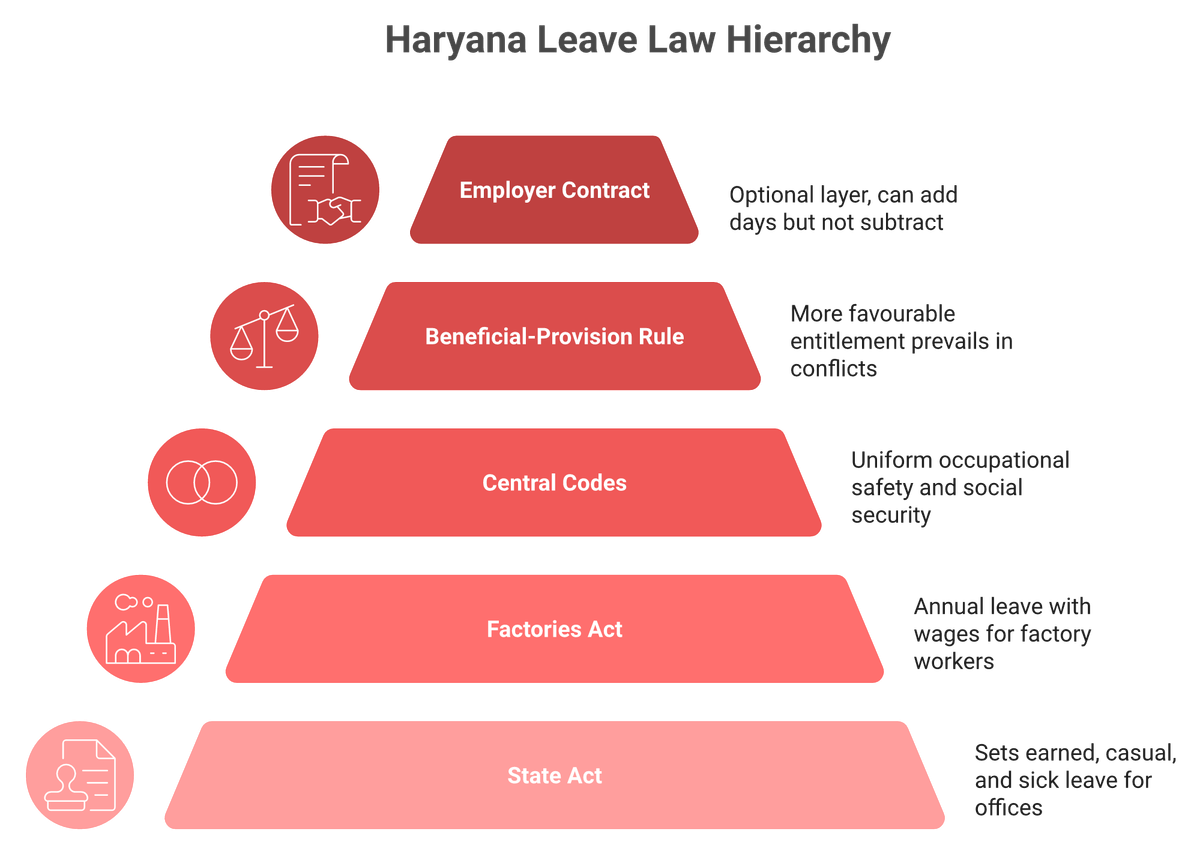
| Statute | What it governs for leave | Who it covers | Haryana note |
| Punjab S&E Act, 1958, Sections 14 to 15 | Earned, casual, and sick leave; leave wages; advance leave pay | All shop and commercial establishment employees | Applies statewide, urban and rural |
| Factories Act, 1948, Sections 79 to 80 | Annual leave with wages for factory workers | Factory workers in Faridabad, Manesar, Panchkula | Parallel track, not additive |
| OSH Code, 2020 | Annual leave eligibility at 180 days worked | Workers as defined in the Code | In force from 21 November 2025 |
| Code on Social Security, 2020 | Maternity benefit, gratuity, PF, ESI | Employees within wage and headcount thresholds | In force from 21 November 2025 |
| Haryana Ordinance No. 4 of 2025 | Daily hours, rest intervals, overtime, registration threshold | S&E establishments in Haryana | Amends Sections 8, 20, 21 of the 1958 Act |
| POSH Act, 2013 | Up to 90 days of paid leave for a complainant | All workplaces with 10 or more employees | Internal Committee mandatory |
🧮 How the conflict rule works in practice
Clients never ask me what the Act says. They ask which of two conflicting numbers goes in the offer letter.
Take earned leave eligibility. The OSH Code frames annual leave with wages around 180 days worked in a calendar year. The state Act asks only for 20 days of employment before the first day of earned leave accrues. The more favourable provision applies, so a Gurugram hire starting in October still begins accruing that year. This is the reconciliation work that sits underneath payroll compliance in India.
💬 What operators say about the reconciliation work
"Versatile's Employer of Record India setup eliminated all of that. I get a single USD invoice, fully compliant employment contracts, and payroll runs on time every month. No entity setup, no CA juggling, no statutory filing stress."
Vedant T., Founder Versatile Club G2 - Verified Review
"The initial documentation and paperwork felt quite detailed and time-consuming at the beginning. However, as we progressed, it became clear that this thoroughness is what ensures proper legal and compliance coverage."
Verified User in Marketing and Advertising Wisemonk - G2 Verified Review
That second review, rated 3.5 out of 5, is honest about the trade-off. India statutory paperwork is heavy regardless of vendor. The question is who carries it, which is the core of any Wisemonk alternative evaluation.
⚠️ Where global generalists thin out
Global platforms cover 90 to 185 countries and route India through local partner entities. The state layer is where that shows. Multi-state professional tax, S&E renewals, and register formats differ by state, and a global playbook flattens them.
Versatile Club files PF, ESI, TDS, and professional tax under our own registrations, which is why our Haryana contracts carry one reconciled leave number instead of two competing ones.
Q3. How are employees categorised, and which regime covers your white-collar hires?
Three categories decide the answer. "Employee" under the state Shops and Commercial Establishments Act covers all shop and office staff. "Worker" under the Factories Act and the OSH Code covers factory and manufacturing roles. Managerial or supervisory staff above the notified wage ceiling fall outside some worker-specific entitlements. Most Gurugram engineers and ops hires are S&E employees, so Section 14 leave applies regardless of designation or CTC.
🙋 "My engineers are exempt, right?"
I get this question on WhatsApp roughly once a month. The founder assumes that a senior title, or a salary above some threshold, lifts the person out of state labour law. It does not.
Designation-based exemption is the most expensive assumption US founders make in India. It shows up as a leave-encashment claim at exit, usually with interest and a compensation order attached. Founders planning to hire employees in India should settle classification before the offer, not after.
📘 What the definitions actually say
Section 2(vi) of the state Act defines "employee" as a person wholly or principally employed in or in connection with an establishment. It covers permanent, periodical, contract, and piece-rate arrangements. The only carve-out is a member of the employer's family.
There is no salary ceiling in that definition. A VP Engineering in a Gurugram office is an employee under the Act, the same as a customer support associate.
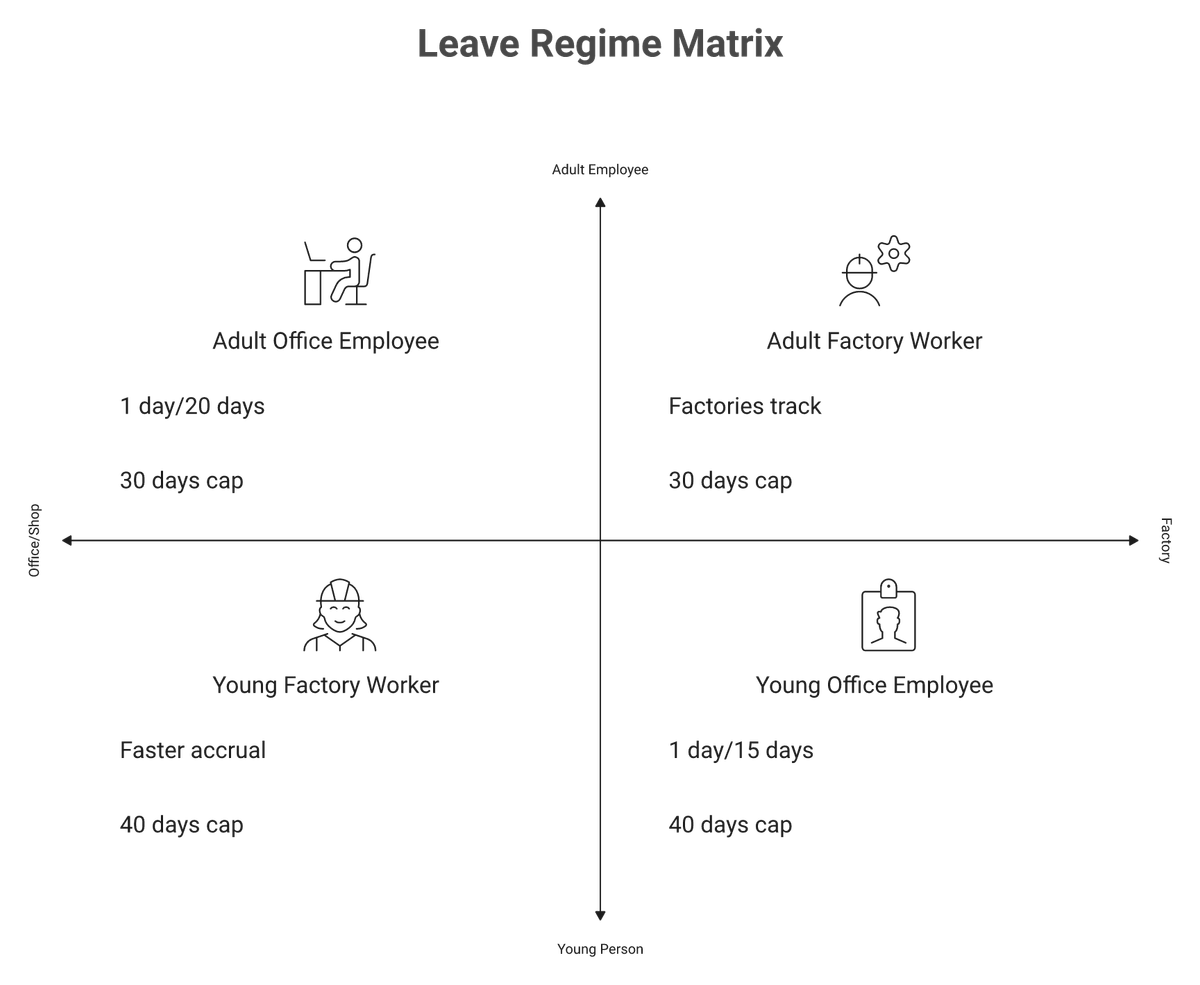
Two more boundaries matter. Section 3(f) removes persons whose hours of employment are regulated under the Factories Act, which is what creates the parallel factory track. Section 2(xxx) defines "young person" as someone aged 14 to 18, who accrues leave faster and carries forward more.
🧪 The four-question self-test
Run each name on your India roster through this.
- Is the workplace a factory as defined under the Factories Act? If yes, the Factories Act track applies, not Section 14.
- Is the person employed in or connected with an office, shop, or commercial establishment in Haryana? If yes, they are an S&E employee.
- Are they aged between 14 and 18? If yes, apply the young-person accrual and the 40-day carry-forward cap.
- Are they a member of the employer's family? Only then does the Act step aside.
🗂️ How four real roles land
| Role | Location | Governing regime | Leave basis |
| Backend engineer | Gurugram office | S&E Act, 1958 | Section 14: EL, 7 CL, 7 SL |
| Ops associate | Gurugram office | S&E Act, 1958 | Section 14, identical treatment |
| Plant technician | Faridabad factory | Factories Act, 1948 | Sections 79 to 80 |
| VP Engineering | Gurugram office | S&E Act, 1958 | Section 14 applies, title is irrelevant |
🔍 The one place I stay uncertain
The OSH Code introduces a wage boundary around which staff count as workers for certain entitlements. Versatile Club's practice is to apply the more favourable of the two regimes to senior staff rather than argue exclusion, because the downside of being wrong is a statutory claim and the upside is a handful of leave days. I could be reading the risk asymmetry too conservatively.
Versatile Club classifies every Haryana hire against the S&E and OSH definitions during a contractual five-day onboarding, before the offer letter goes out. The sequence is documented on our how it works page.
Q4. What leave types and how many days does a Haryana employee get?
A Haryana S&E employee earns one day of earned leave for every 20 days worked, roughly 18 days a year, and one day per 15 days for ages 14 to 18. Section 14(4) adds seven days of casual leave and seven days of sick leave with wages. Earned leave carries forward up to 30 days, or 40 for a young person. Versatile Club runs this exact accrual table as the live payroll configuration for Haryana employees on its own Indian entity.
📊 The statutory leave table for shops and offices
| Leave type | Entitlement | Accrual basis | Carry forward | Source |
| Earned leave | About 18 days a year | 1 day per 20 days worked | Up to 30 days (40 for ages 14 to 18) | S&E Act, Section 14(1) |
| Casual leave | 7 days | Annual grant with wages | Lapses | S&E Act, Section 14(4) |
| Sick leave | 7 days | Annual grant with wages | Lapses | S&E Act, Section 14(4) |
| Leave wages | Daily average of full-time earnings | Month preceding the leave, excluding overtime and bonus, including DA | Not applicable | S&E Act, Section 15(2) |
| Advance leave pay | On demand before leave starts | Leave of 4 days or more, 5 for a young person | Not applicable | S&E Act, Section 15(3) |
Two mechanics matter more than the headline numbers. Fractions of half a day or more count as one full day, and anything under half a day is ignored. Leave applied for must be granted unless refused in writing within 15 days, and refused leave must be allowed later that year.
🏭 Office track versus factory track
| Point | S&E track (Gurugram office) | Factories track (Faridabad, Manesar) |
| Governing sections | Section 14 of the S&E Act | Sections 79 and 80 of the Factories Act |
| Accrual | 1 day per 20 days worked | 1 day per 20 days for adults, 1 per 15 for young workers |
| Carry forward | 30 days, 40 for young persons | 30 days, 40 for young workers |
| Casual and sick leave | 7 plus 7, statutory | Not prescribed by the Act, contractual |
These are parallel, not cumulative. Section 3(f) of the S&E Act excludes persons whose hours are regulated under the Factories Act.
❌ The carry-forward numbers that are simply wrong
Compliance blogs and LinkedIn posts circulate 45-day and 90-day carry-forward figures for Haryana. The proviso to Section 14(1)(d) says the total carried forward "shall not exceed forty in the case of a young person or thirty in any other case." There is no third number.
I print the section beside every figure for exactly this reason. The pages ranking for this query contradict each other, and a payroll system configured from the wrong blog post accrues a wrong liability every month. The same discipline applies when you outsource payroll in India.
💬 What buyers report about accuracy
"PF, tax, the statutory filings, all the stuff I genuinely did not want to learn, they just handle it and keep it correct every month."
Angad S., Founder Versatile Club G2 - Verified Review
"What I dislike about Wisemonk is that some features feel a bit limited and could use more flexibility. In particular, I'd like to see better options for customization and more detailed reporting."
Vinay M. Wisemonk - G2 Verified Review
Reporting flexibility sounds cosmetic until an auditor asks for per-employee accrual history. That is the report you cannot produce from a partner-entity spreadsheet.
Versatile Club configures earned, casual, and sick leave to the section numbers above at onboarding, and the accrual ledger sits in the same entity that files the statutory returns. If you are weighing the alternative, our EOR versus entity calculator prices both paths.
Q5. How is earned leave accrued, carried forward, and encashed, with the real maths?
Earned leave in Haryana accrues at one day per 20 days worked, with half-day fractions rounded up to a full day and fractions below half ignored. Carry-forward is capped at 30 days, or 40 for a young person. Encashment uses the daily average of total full-time earnings for the month preceding the leave, including dearness allowance, excluding overtime and bonus. Versatile Club reports accrued leave liability per employee on the same USD invoice it raises from its own Indian entity.
💸 Where full-and-final settlements actually break
Most India exit disputes I see are not about notice pay. They are about one number: wages in lieu of unavailed earned leave.
Section 14(1)(b) says an employee who is discharged, dismissed, or leaves service mid-year is entitled to leave with wages, or wages in lieu of unavailed leave, at the same rates. Section 16(4) then gives you a hard deadline. Wages plus remuneration for unavailed leave must be paid before the end of the second working day after termination. This is the settlement line item that decides whether an employer of record in India closes an exit cleanly.
🧮 The formula, straight from the statute
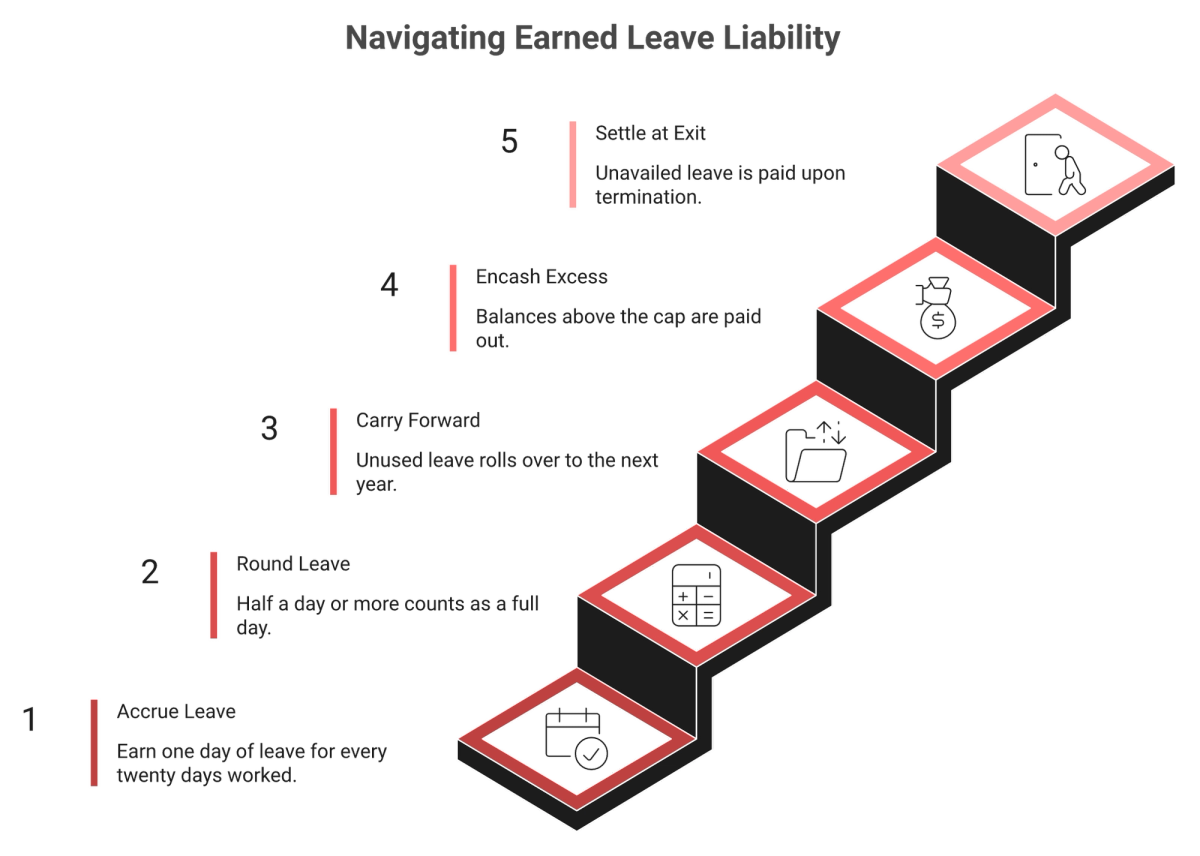
Section 15(2) of the Act sets the rate at the daily average of total full-time earnings for days worked in the month immediately before the leave. Dearness allowance and the cash value of concessional food-grain sales are included. Overtime and bonus are excluded.
The Factories Act carries the same logic in Section 80(1) for factory workers, with a fallback. If the worker did not work at all in the preceding calendar month, you use the last month in which they did work.
Section 15(3) adds a step people miss. An employee taking four days or more of leave, or five days for a young person, can demand leave wages in advance, before the leave begins.
⏰ A worked exit calculation
Take a Gurugram engineer on 1,00,000 rupees monthly gross, who worked 26 days in the month before exit, with 19 days of accrued earned leave.
| Step | Working | Result |
| Total full-time earnings, preceding month | Gross excluding overtime and bonus | 1,00,000 |
| Days actually worked | Per attendance register | 26 |
| Daily average | 1,00,000 divided by 26 | 3,846 |
| Encashment for 19 days | 3,846 multiplied by 19 | 73,077 |
That is one month of near-full salary leaving the account, payable inside two working days. Our salary calculator shows how the same gross splits across statutory heads.
⚠️ The 50 percent wage rule nobody budgets for
Under the Code on Wages, basic plus dearness allowance must be at least half of total remuneration. Many India policies compute encashment on basic plus DA rather than gross. If yours does, restructuring salary to satisfy that floor raises the encashment base on the same day. The knock-on effect shows up across the full cost of hiring in India.
Versatile Club's read is that most finance teams discover this at their first exit, not during salary restructuring. I might be over-indexing on the handful of cases I have seen, but the direction of the error has been consistent.
💬 What buyers say about invoice clarity
"First USD invoice landed clean: no FX markup, no setup fee, no surprises."
Verified User in Information Technology and Services Versatile Club G2 - Verified Review
"I find Deel to be absurdly expensive. They charge a high amount of fees for transferring money to my bank account."
Juan Camilo O. Deel - G2 Verified Review
Versatile Club books leave liability against the employee record inside the entity that files the returns, so a CFO closing month-end reads accrual and payroll from one invoice instead of chasing a vendor email. Buyers comparing line items usually start with our pricing page.
Q6. Is eligibility still 240 days, and what changed in November 2025?
No. Since the four Labour Codes came into force on 21 November 2025, the Occupational Safety, Health and Working Conditions Code, 2020 sets annual leave with wages at 180 days worked in a calendar year, down from 240 under the Factories Act, 1948. Nine days earlier, Haryana raised daily working hours from nine to ten, moved the mandatory rest interval to after six hours, and lifted the quarterly overtime ceiling.
📰 The two notifications that changed the maths
Both landed inside a fortnight, which is why most HR templates still carry stale numbers.
| Item | Before | Now | Source |
| Annual leave eligibility | 240 days worked | 180 days worked | OSH Code, 2020, in force 21 November 2025 |
| Daily hours, Haryana S&E | 9 hours | 10 hours | Haryana Ordinance No. 4 of 2025 |
| Rest interval trigger | After 5 hours | After 6 hours | Haryana Ordinance No. 4 of 2025, Section 8 |
| Weekly ceiling | 48 hours | 48 hours, unchanged | Haryana notification dated 30 March 2026 |
I re-cut every Haryana client's accrual rule the week the Codes were notified. The 240-day figure still sits in offer letters I review today.
🧾 Why the counting method still matters
The old 240-day test was never a simple attendance count. Lay-off days permitted under standing orders counted. So did up to 12 weeks of maternity leave for women workers, and leave earned in the previous year.
That inclusive method carries over. A 180-day threshold with inclusions is far easier to cross than a 240-day threshold without them. In practice, almost every full-year Gurugram employee qualifies.
⏱️ Longer days move the leave-wage denominator
Here is the part law firm alerts flag and leave-policy blogs skip. Leave wages are a daily average, and a ten-hour day changes the shape of the month behind that average.
The 30 March 2026 exemption notification, No. 11/26/2025-4Lab, lets self-certified establishments operate beyond fixed opening hours and the weekly close day. The conditions are firm: 48 hours a week, 10 hours a day, spread-over capped at 12 hours including breaks, overtime at twice the normal rate, and a 30-minute break after every six hours.
Overtime at double rate is excluded from the leave-wage base under Section 15(2), so a heavy-overtime month inflates payroll without inflating encashment. That gap is worth modelling before you approve extended rosters, and it is one reason teams move to managed payroll rather than spreadsheets.
🔍 What I am still watching
The state Act and the OSH Code now overlap on annual leave. Versatile Club applies whichever provision is more favourable to the employee, following the saving clause in Section 33 of the state Act, rather than picking the lower number. Where my head is right now is that Haryana will eventually notify state OSH rules that settle this cleanly.
Versatile Club updated Haryana accrual logic inside the same notification cycle, because India is the only country we operate in and the state layer is the whole job. Companies weighing a mid-cycle change can read our note on how to switch an EOR provider in India.
Q7. What maternity, adoption, and other protected leave must you fund?
Central law governs maternity leave in Haryana: 26 weeks of paid leave for the first two surviving children, after 80 days of qualifying service in the preceding 12 months, plus a medical bonus, and crèche access where 50 or more employees work. Commissioning and adopting mothers receive 12 weeks. The state Act's older six-weeks-either-side benefit is superseded, because Section 33 preserves the more favourable right. Paternity leave remains contractual, not statutory.
🤰 What 26 weeks looks like inside a payroll cycle
US founders budget maternity leave as a cost line and then discover it is 26 continuous weeks of payroll, not a lump sum.
The eligibility test is service-based, not tenure-based in the loose sense. The employee needs 80 days of work with you in the 12 months before her expected delivery date. Miss the count and you still owe the leave under most contracts, so run the calculation at notification, not at exit. Founders new to this cycle usually start with our guide on how to pay employees in India.
📜 The older state benefit, and why it still matters
Section 31 of the state Act gives a woman with six months of continuous service payment for six weeks before and six weeks after delivery. Rule 12 sets the rate at her average daily wages for the three months before that six-week window.
Rule 12 also carries a penalty that surprises people. If the employer misses payment within one week of demand after delivery, an extra 50 percent of the benefit becomes payable. Section 30(2) separately bars employing a woman for six weeks after confinement or miscarriage.
You do not apply the six-week figure today. You do inherit the enforcement posture behind it.
🗂️ The protected-leave set to write into policy
| Leave type | Status in Haryana | What to configure |
| Maternity, 26 weeks | Statutory, central | Full paid payroll, PF and ESI continuity |
| Adoption or surrogacy, 12 weeks | Statutory, central | Trigger on child handover date |
| Illness from pregnancy or delivery | One additional month with wages | Medical certificate on file |
| POSH complainant leave, up to 90 days | Statutory, on Internal Committee recommendation | Paid, separate from sick leave |
| Paternity leave | Contractual | Common India benchmark is 5 to 15 days |
| Paid poll-day leave | Statutory for eligible electors | Mark against the election notification |
Versatile Club configures these as separate leave codes rather than one combined bucket, because a merged bucket cannot be reconciled during an audit. Policy drafting of this kind sits inside our HR consulting services.
💬 What responsiveness looks like when it matters
"Every payroll or PF question gets a real answer from a real person, usually same day."
Verified User in Information Technology and Services Versatile Club G2 - Verified Review
"I've noticed that their support/query responses can occasionally take a bit longer sometimes, likely due to a relatively small team."
Verified User in Financial Services Wisemonk - G2 Verified Review
That second review is rated 4 out of 5, and it is a fair critique of every small India-focused provider, mine included. A 26-week leave cycle involves monthly filings, not a single event, so response time compounds.
Versatile Club funds and files maternity benefit through its own ESIC and payroll registrations, so an employee on leave deals with one employer of record rather than a vendor chain. The mechanics are set out under our EOR services.
Q8. Which holidays and weekly offs are mandatory in Haryana for 2026?
Haryana notifies its public holiday schedule each December. The 2026 list was issued under Notification No. 28/67/2008-1HR-I dated 16 December 2025, covering national, festival, state, and regional holidays. Employees are also entitled to a weekly off under the state Act. Versatile Club loads the notified Haryana calendar into payroll each January and marks national holidays as non-deductible before the first pay run of the year.
📅 What the 2026 notification actually contains
The gazetted list runs across three schedules. National holidays anchor it: Republic Day on 26 January, Dr. B. R. Ambedkar Jayanti with Vaisakhi on 14 April, and Mahatma Gandhi Jayanti on 2 October.
State and regional holidays make up the bulk. Sir Chhotu Ram Jayanti with Basant Panchami on 23 January, Shaheedi Diwas on 23 March, Shaheed Udham Singh Martyrdom Day on 31 July, and Haryana War Heroes' Martyrdom Day on 23 September all appear in the Labour Department's notification record.
Festival holidays include Holi on 4 March, Raksha Bandhan on 28 August, Janmashtami on 4 September, and Dussehra on 20 October.
⚠️ The weekend-collision trap
Several 2026 festivals fall on a Saturday or Sunday and are therefore excluded from the gazetted list. Independence Day on 15 August, Diwali on 8 November, Haryana Day on 1 November, and Id-ul-Fitr on 21 March are in that set.
This is where payroll teams get caught. A US calendar assumes Independence Day is always a paid holiday. In 2026 it lands on a Saturday, so it is observed but not gazetted, and your leave-deduction logic needs to know the difference. Distributed teams handling this across cities often pair it with payroll outsourcing services in India.
🗓️ How to treat each category in payroll
| Category | Payroll treatment | Notes |
| National holiday | Paid, non-deductible, non-working | Republic Day, Ambedkar Jayanti, Gandhi Jayanti |
| Gazetted state or festival holiday | Paid as notified | Verify against the December notification each year |
| Restricted or optional holiday | Employee elects, deducted from the optional pool | Set a cap in policy |
| Weekly off | Paid under Section 15(1) at average daily wages for anyone employed 15 days or more | Statutory |
Section 15(1) of the state Act is the clause people forget. A weekly off is not simply an unpaid non-working day for short-tenure staff.
🔁 The close-day exemption changed the roster rules
The Haryana Labour Department's notification No. 11/26/2025-4Lab dated 30 March 2026 exempts self-certified establishments from Section 9 opening and closing hours and the Section 10 mandatory close day. The conditions hold firm at 48 hours a week, 10 hours a day, a 12-hour spread-over, double-rate overtime, and a 30-minute break after six hours. Employing women between 8 pm and 6 am needs separate auto-mode approval.
So a Gurugram support team can now run seven days without a fixed close day. The weekly-off entitlement per employee does not disappear. It moves inside the roster.
🔍 The item that silently expires every year
Versatile Club treats the holiday calendar as a dated compliance artefact with an expiry of 31 December, and re-verifies it against the Labour Department notification rather than reusing last year's file. In my experience, this is the single most commonly orphaned item in an India HR stack, since nobody is formally assigned to it.
Versatile Club maintains state holiday calendars for every location it employs into, and a founder making a first hire can walk through the annual cycle with us on a 30-minute call.
Q9. What leave records does a Haryana inspector or diligence team ask for?
Under the Punjab Shops and Commercial Establishments Rules, 1958 as applied to Haryana, every employer maintains a register of employees in Form C, a register of wages in Form D, and a register of deductions in Form E. Registers must be in English and Hindi, bound, page-numbered in serial order, signed by the employer, and preserved for three years. Versatile Club maintains these registers for Haryana employees inside its own Indian entity, with no exit fee to retrieve them.
🗄️ The scramble I watch happen every diligence cycle
A CFO forwards me an auditor's question list at 9pm. It asks for PF challans, ESI records, and leave balances per employee for the last two years.
Diligence teams ask for the leave register before they ask for the leave policy. A polished policy PDF proves intent. The register proves practice. That distinction sits at the centre of payroll compliance in India.
📋 What the Rules actually require
Rule 5 lists the three registers by form name. Rule 6 sets the format: English and Hindi, ink entries, bound, page-marked, signed by the employer and the Inspector. Rule 7 fixes retention at three years from the date the records relate to.
Section 20 goes further than most employers realise. Sub-section 2 requires a record of working hours, rest intervals, and the amount of leave taken by every person employed. Overtime must be entered separately. Sub-section 2A requires attendance to be marked within one hour of duty starting.
Sub-section 3 asks for a photograph of every employee who completes three months of continuous service.
⚠️ Penalties and who carries them
Failure to keep these records draws a daily fine under Section 20(5). A false entry made with intent to deceive carries up to three months of imprisonment, or a fine, or both, under Section 20(6).
Rule 10 lets an Inspector photograph the premises and take possession of any register, form, document, or record. Liability sits with the employer, the owner, or the person having ultimate control, not the HR executive who maintains the file. Our compliance page sets out how that liability transfers under an employer of record.
✅ The Monday-morning checklist
- Form C, D, and E registers exist, bound, page-numbered, and signed.
- Attendance is marked within one hour of shift start, every day.
- Leave taken is recorded per employee, with overtime entered separately.
- Records for the last three financial years are retrievable within one day.
- The Section 20(1) notice showing close day, working hours, and intervals is displayed.
- Photographs are on file for employees past three months of service.
Versatile Club runs this checklist at onboarding rather than at audit, because reconstructing 24 months of accrual from payslips is not possible. The onboarding sequence is documented under EOR services in India.
💬 What buyers report about filing discipline
"The compliance rigour is genuinely impressive every statutory filing reviewed before submission. Five-day onboarding, zero late payslips."
Vedant T., Founder Versatile Club G2 - Verified Review
"The USCIS denial letter explicitly stated that Deel forgot to attach critical evidence to the application."
Verified User in Computer Software Deel - G2 Verified Review
That second review, rated 0 out of 5, is about immigration filings rather than leave registers. The failure mode is the same one: documentation that exists somewhere but does not reach the authority on time.
🔍 The exposure nobody puts in the data room
Versatile Club's read is that the real risk for a foreign parent is not the fine. It is a labour claim naming a US company that directs the work, holds no Indian entity, and cannot produce a register. I could be weighting that too heavily, since I have seen it threatened more often than tested. Teams that hire in India without an entity should read that risk carefully.
Versatile Club keeps Form C, D, and E under its own registrations, and a client leaving takes the register set with them at no exit charge.
Q10. Does unlimited PTO work for a Haryana team?
No. Haryana law requires attendance marked within one hour of duty, a per-employee record of leave taken, and payment of wages in lieu of unavailed earned leave at exit. An untracked unlimited policy cannot produce those records. Culturally it also inverts: in hierarchy-sensitive Indian workplaces, employees with no stated allotment take less time off, not more. The workable design publishes the statutory floor, adds company leave above it, and tracks all of it.
🧠 The playbook that travels badly
The Netflix-era argument is elegant. Remove the vacation policy, treat adults as adults, and stop counting days.
Reed Hastings made the case honestly and also named the risk. Not allotting vacation days, he wrote, is a great way to create sweatshop conditions where nobody dares take a day off, and then wrap it up as a perk.
❌ Where it collides with the statute
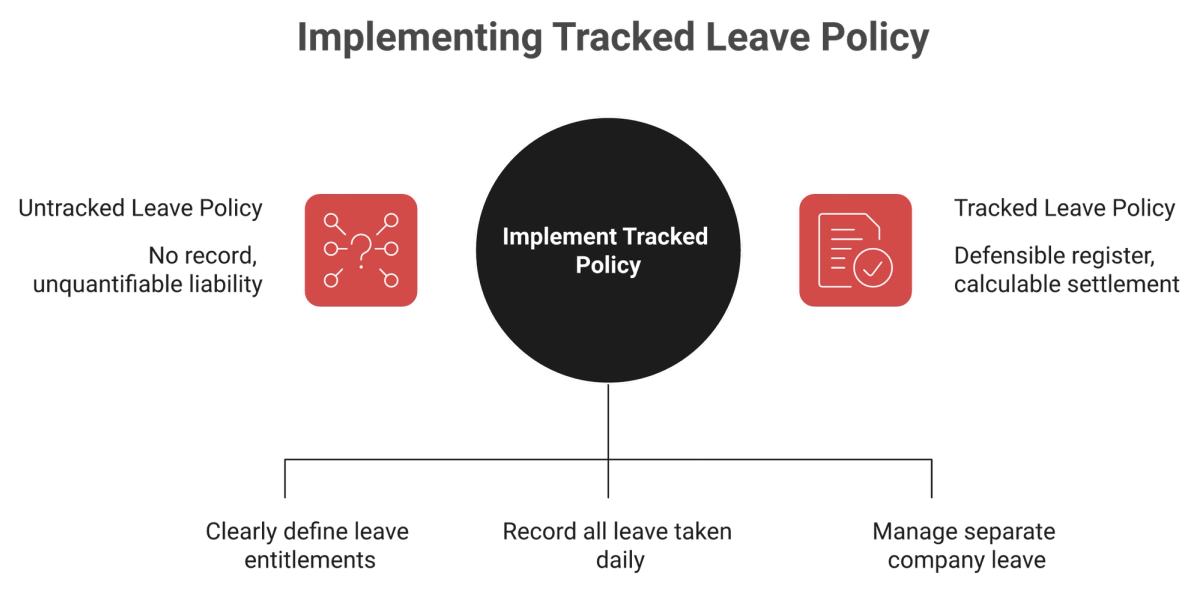
Section 20(2) of the state Act requires a record of leave taken by every person employed. Section 14(1)(b) requires wages in lieu of unavailed earned leave at exit.
You cannot compute wages in lieu of something you deliberately stopped counting. So "unlimited" in Haryana means one of two things at exit: either you pay out a statutory balance you never tracked, or you argue you owe nothing and lose.
The registers make this concrete. An Inspector can seize them under Rule 10, and an empty leave column is the finding. Policy drafting of this kind is part of our HR consulting services.
🤐 The cultural failure mode is quieter
Craig Storti records an American manager whose New Delhi colleague messaged for permission every time he took a dinner break. His explanation was simple: "because I'm your subordinate."
Drop an unlimited policy into that dynamic and the request never comes. What surfaces in Versatile Club's placements across Bengaluru, Hyderabad, and Pune is the opposite of the slacking-off fear that managers arrive with. The threat is overwork, not underwork.
Hastings' own counterexample is instructive. A burnt-out marketing manager had not taken a non-working vacation in four years, and spent her Thanksgiving break working from the laundry room. No policy line caused that. The absence of one permitted it.
✅ The design that survives both tests
- Publish the statutory floor explicitly: earned leave at one day per 20 days worked, seven casual, seven sick.
- Add company leave above the floor as a separate, named bucket.
- Track every day in the register, including the discretionary bucket.
- Cap carry-forward at 30 days and encash the excess annually.
- Have leadership take visible leave, and say so in writing.
Point five does the heavy lifting. Storti's counterpart to the unlimited-PTO story is a manager who changed vacation behaviour in an entire office by modelling it, not by writing a rule.
⭐ Why I treat this as retention, not compliance
Compliance is the floor, not the ceiling. Twenty-four tracked days that people actually use beat infinite untracked days nobody touches.
Versatile Club assigns a 90-day Success Coach to every placement, and unused leave in the first quarter is one of the signals we watch, because a hire who never logs a day off usually resigns before month nine. I hold that loosely, since our sample sits in the dozens rather than the thousands. The same retention thinking runs through our contract to hire model.
Versatile Club configures the statutory floor and the discretionary bucket as separate leave codes in payroll, so the register stays defensible and the policy still feels generous.
Q11. How do you run one leave policy across Haryana and the rest of India?
Set one national policy at or above the highest entitlement among the states you employ in, then attach a state overlay covering earned-leave accrual, carry-forward caps, holiday lists, register formats, and professional tax cycles. Central Codes are uniform across India. State leave days, holiday notifications, working hours, and professional tax are not. Versatile Club holds Shops and Establishments, PF, and ESI registrations across all 28 states and maintains the overlay as standing work.
🧩 The fragmented-stack problem
A People Ops lead at a Series B company told me she was running four India vendors: payroll in one tool, EOR in another, benefits in a third, and laptops through a reseller. Nobody owned the leave rules.
That is how a Gurugram engineer and a Pune engineer end up on two different accrual rates inside the same handbook. Consolidating that stack is usually the first step when companies outsource payroll in India.
🗺️ What actually differs by state
| State | Earned leave basis | Carry forward | Professional tax cycle |
| Haryana | 1 day per 20 days worked, 7 CL, 7 SL | 30 days, 40 for young persons | No professional tax |
| Karnataka | 1 day per 20 days worked | 30 days | Monthly, plus S&E renewal |
| Maharashtra | 5 days per 60 days worked | 45 days | Dual PTRC and PTEC registration |
| Tamil Nadu | 12 days annual, 12 CL, 12 SL | 24 days | Biannual filing, plus Labour Welfare Fund |
Maharashtra is the number that breaks a Haryana-designed policy. Its carry-forward ceiling sits at 45 days, so a national cap of 30 lands below the floor for Pune and Mumbai staff.
🔧 The floor-plus-overlay method in five steps
- List every state you employ into, today and in the next two quarters.
- Take the highest statutory entitlement across that set as your national floor.
- Write a one-page overlay per state: accrual, caps, holidays, registers, PT cycle.
- Configure payroll by state code, not by one global rule.
- Re-verify every overlay each December, when state holiday notifications drop.
Step five is the one that lapses. Haryana's 2026 list came through Notification No. 28/67/2008-1HR-I dated 16 December 2025, and every state publishes on its own schedule. Companies running teams in more than one hub often pair this with payroll outsourcing in Bengaluru.
💬 What multi-state buyers say
"As a founder running a lean agency, hiring talent in India without a local entity was a compliance minefield PF, ESI, TDS, professional tax across states."
Vedant T., Founder Versatile Club G2 - Verified Review
"Sometimes the email communication from the wisemonk team is delayed by a day or 2. But overall they seem to be the best for India."
Verified User Wisemonk - G2 Verified Review
"We partnered with Versatile to support our hiring and employment needs in India. Their team was highly responsive, professional, and easy to work with throughout the process."
Mukul S. Versatile Club G2 - Verified Review
The middle review is rated 4 out of 5, and it names a fair trade-off for any India-only provider, mine included. Small teams answer with depth, sometimes a day later than a chatbot.
📊 Coverage, stated plainly
| Provider | India states covered |
| Versatile Club | All 28 |
| Deel | Top 6 hubs |
| Remote | Top 4 hubs |
Versatile Club runs Haryana, Karnataka, Maharashtra, and Tamil Nadu overlays from one Indian entity and bills them on a single USD invoice, so a Gurugram hire and a Pune hire read the same policy document with different state annexes.
Q12. Who should own Haryana leave compliance: your entity, a global EOR, or an India-only EOR?
Three models work. Versatile Club employs Haryana staff on its own registered Indian entity, with registrations across all 28 states, USD invoicing direct from India, a five-day contractual onboarding SLA, and no setup or exit fees. Global generalists such as Deel, Remote, and G-P route India through local partner entities and cover the main hubs. Your own Haryana entity starts to make financial sense past roughly 20 to 30 India employees.
💰 The two playbooks I push back on
The first is "just buy Deel for everything." It works for multi-country coverage and drags total cost toward the $599 per employee per month band, with India compliance handled by a partner you never meet. Buyers testing that assumption usually land on a Deel alternative once they price India separately.
The second is "set up your own Indian subsidiary." That path runs tens of thousands of dollars and 12 to 18 months before your first hire signs. For one Gurugram engineer, it is a bad trade, and the EOR versus entity comparison for India shows why.
📊 The comparison, without a thumb on the scale
| Criterion | Versatile Club | Global generalists (Deel, Remote, G-P) | Your own Haryana entity |
| Entity model | ✅ Owned Indian entity | ❌ Local partner entities in India | ✅ Direct employment |
| India states covered | ✅ All 28 | ❌ Top 4 to 6 hubs | ✅ Wherever you register |
| Invoicing | ✅ USD, direct from India | ✅ USD, consolidated globally | ❌ INR plus FX handling |
| Onboarding | ✅ 5-day contractual SLA | ❌ 7 to 14 days typical | ❌ Months, post-incorporation |
| Support model | ✅ Founder on WhatsApp | ❌ Ticket queue or CSM rotation | ✅ In-house, once hired |
| Country coverage | ❌ India only, by design | ✅ 90 to 185 countries | ❌ India only |
| Leave register ownership | ✅ Held under our entity, no exit fee | ⚠️ Held by the partner entity | ✅ Yours |
⚠️ Where Versatile Club is the wrong answer
Three cases, stated openly. If you need five or more countries in one contract, a global generalist wins. If your procurement gate requires SOC 2 or ISO 27001 before signature, buy from a vendor that holds them. If you are running a 100-plus India team with enterprise workflow customisation, the five-day SLA will stretch, and our page for enterprises is the honest place to start that conversation.
Versatile Club operates only in India by design, and that is a constraint as much as a feature.
💬 What the two support models feel like
"Founder is just a call away. Extremely helpful in resolving all our queries. The process is super smooth to setup India EOR."
surbhi m. Versatile Club G2 - Verified Review
"The initial process took a little getting used to, but the team was quick to guide us through and it became very straightforward."
Verified User in Venture Capital & Private Equity Versatile Club G2 - Verified Review
"From the start, they provided awful service: they consistently failed to meet committed deadlines, had terrible communication, and frequently cancelled meetings at the last minute."
Verified User in Computer Software Deel - G2 Verified Review
The 4.5-star review is the honest middle. A service-led model has a learning curve that a self-serve dashboard does not.
🧭 The crossover number I give on WhatsApp
Under about 15 India employees, an EOR is almost always cheaper than your own entity, even measured over three years. Between 15 and 30, run the maths properly, including compliance headcount, statutory filings, and the leave-encashment provision on your balance sheet. The EOR versus entity calculator prices both paths side by side.
Versatile Club employs your Haryana team on its own entity with no setup or exit fees, the first month free, and a six-month replacement guarantee on C2H placements, so the compliance record stays portable if you later build your own entity. Founders who want to walk through the numbers can book a 30-minute call.
FAQs
How many leaves is an employee entitled to in Haryana each year?
An employee in a Haryana shop, office, or commercial establishment is entitled to three separate leave buckets under Section 14 of the Punjab Shops and Commercial Establishments Act, 1958, as applied to Haryana.
- Earned leave: one day for every 20 days worked, which works out to roughly 18 days across a full year. A young person aged 14 to 18 accrues faster, at one day per 15 days worked.
- Casual leave: seven days a year with wages.
- Sick leave: seven days a year with wages.
Earned leave carries forward, capped at 30 days for adults and 40 for young persons. Casual and sick leave lapse at year end. Employees also receive notified public holidays and a weekly off.
Factory workers in Faridabad or Manesar follow a parallel track under Sections 79 and 80 of the Factories Act, 1948, not Section 14.
Versatile Club configures earned, casual, and sick leave as three separate payroll codes for every Haryana employee, because a merged bucket cannot be reconciled during an audit. If you are setting up your first India contract, our EOR services in India page explains how the statutory floor gets written into the offer letter before day one.
Is earned leave eligibility in Haryana still 240 days, or has it changed to 180 days?
It has changed. Since the four Labour Codes came into force on 21 November 2025, the Occupational Safety, Health and Working Conditions Code, 2020 sets annual leave with wages at 180 days worked in a calendar year, down from the 240-day bar under the Factories Act, 1948.
Two things are worth knowing about that threshold.
- The count was never pure attendance. Lay-off days permitted under standing orders, up to 12 weeks of maternity leave, and leave earned in the previous year all count toward it.
- The state Act sets a far lower bar anyway. Section 14 needs only 20 days of employment before the first day of earned leave accrues, and Section 33 preserves whichever provision is more favourable to the employee.
In practice, almost every full-year employee in a Gurugram office qualifies, and most mid-year joiners do too.
Versatile Club re-cut Haryana accrual logic inside the same notification cycle as the Codes, because India is the only country we operate in. Offer letters we review from other providers still carry the 240-day figure. Our compliance page sets out which statutory changes we track and when we apply them.
How is leave encashment calculated when a Haryana employee resigns?
Encashment of unavailed earned leave is calculated on a daily average, not on a notional monthly divisor.
Section 15(2) of the state Act sets the rate at the daily average of total full-time earnings for the days actually worked in the month immediately before the leave. Dearness allowance is included. Overtime and bonus are excluded.
A worked example makes it concrete. Take a Gurugram engineer on 1,00,000 rupees monthly gross who worked 26 days in the preceding month, holding 19 days of accrued earned leave.
- Daily average: 1,00,000 divided by 26, which is 3,846.
- Encashment: 3,846 multiplied by 19, which is 73,077.
Section 14(1)(b) confirms the entitlement on discharge, dismissal, or resignation mid-year. Section 16(4) then sets the deadline: wages plus remuneration for unavailed leave must be paid before the end of the second working day after termination.
One trap catches finance teams. If your policy computes encashment on basic plus dearness allowance, the Code on Wages rule requiring that component to be at least half of total remuneration raises the payout base the moment you restructure salary.
Versatile Club reports accrued leave liability per employee on the same USD invoice it raises from its own Indian entity. Our salary calculator shows how a Haryana gross splits across statutory heads.
Can we offer unlimited PTO to our team in Haryana?
Not as a replacement for the statutory scheme. Two separate problems block it.
The legal problem. Section 20 of the state Act requires attendance marked within one hour of duty starting, plus a per-employee record of working hours, rest intervals, and leave taken, with overtime entered separately. Section 14(1)(b) then requires wages in lieu of unavailed earned leave at exit. You cannot compute a payout for something you deliberately stopped counting, and an empty leave column is exactly what an inspector records as a finding.
The cultural problem. In hierarchy-sensitive Indian workplaces, removing a stated allotment usually reduces time off rather than increasing it. Employees wait for explicit permission that never arrives, and the failure mode is quiet overwork rather than absence.
The design that works keeps both:
- Publish the statutory floor explicitly.
- Add a separate, named company leave bucket above it.
- Track every day, including discretionary leave.
- Have leadership take visible leave and say so in writing.
Versatile Club assigns a 90-day Success Coach to every placement, and unused leave in the first quarter is one of the retention signals we watch. Policy design of this kind sits inside our HR consulting services.
What leave records must an employer maintain in Haryana for an inspection or diligence review?
Three registers plus a leave record are mandatory under the Punjab Shops and Commercial Establishments Rules, 1958, as applied to Haryana.
- Form C: register of employees.
- Form D: register of wages.
- Form E: register of deductions.
Rule 6 sets the format: entries in English and Hindi, made in ink, bound and page-marked in serial order, signed by the employer. Rule 7 fixes retention at three years from the date the records relate to. Section 20 adds the leave and attendance record itself, and Section 20(3) asks for a photograph of every employee past three months of continuous service.
Enforcement is real. Rule 10 lets an Inspector photograph the premises and take possession of any register. Section 20(5) imposes a daily fine for non-maintenance, and Section 20(6) covers false entries with imprisonment of up to three months, a fine, or both. Liability rests with the employer or the person having ultimate control, not the HR executive who keeps the file.
Versatile Club maintains Form C, D, and E for Haryana employees inside its own Indian entity, and a departing client takes the register set with them at no exit charge. Companies that hire in India without an entity carry the same record obligation through their provider.