Table of contents (11)
Leave Policy in Maharashtra: Complete Guide for Employers 2026
Q1. Which law governs your India employees' leave, and which category does each person fall into?
If your Mumbai or Pune team works from an office, the Maharashtra Shops and Establishments (Regulation of Employment and Conditions of Service) Act, 2017 governs their leave. Factory floors fall under the Factories Act, 1948. Workers in a confidential, managerial, or supervisory role are carved out by Section 3, but you must declare them and send the list to the Facilitator. Everyone else is a "worker."
The handbook nobody can trace to a statute
A People Ops lead in Pune sent me her leave policy last year. It said "12 CL and 12 SL." I asked which Act those numbers came from. Nobody at the company knew. The handbook had been copied from a friend's startup in 2021.
That is the normal starting point, not the exception. Versatile Club runs its India employment through its own registered entity, Foo Falcon Technologies Pvt Ltd, and the first thing we check on any new client roster is category, not entitlement. That check sits at the front of our EOR services in India onboarding sequence.
⚠️ Category follows powers, not job titles
The Act does not care what your offer letter says. A "worker" means anyone doing manual, unskilled, skilled, technical, operational, or clerical work for reward. Apprentices under the Apprentices Act, 1961 are excluded from that definition.
The Maharashtra Shops and Establishments Rules, 2018 then define "managerial functions" by the powers a person actually holds. Power to sanction leave. Power to award an increment. Power to terminate, suspend, or dismiss. Your "Engineering Manager" who cannot approve a single day off is not managerial under this test.
📋 The two declarations most employers miss
Two filings sit behind these categories, and both are annual.
- Form T under Rule 33: names, designations, and a brief nature of duties for every person discharging managerial functions.
- Form U under Rule 34: names of persons occupying a position of confidential character. This is capped at one per cent of total workers, subject to a maximum of fifty persons.
That one per cent cap is the part people get wrong. A 22-person Pune team cannot classify three people as confidential. It can classify one, at most.
Versatile Club files Form T and Form U annually under its own Shops and Establishments registration, and re-files whenever a role changes mid-year, because both forms require intimation on change. Our full India compliance scope covers these state filings alongside PF, ESI, and professional tax.
✅ The four-question test for your own roster
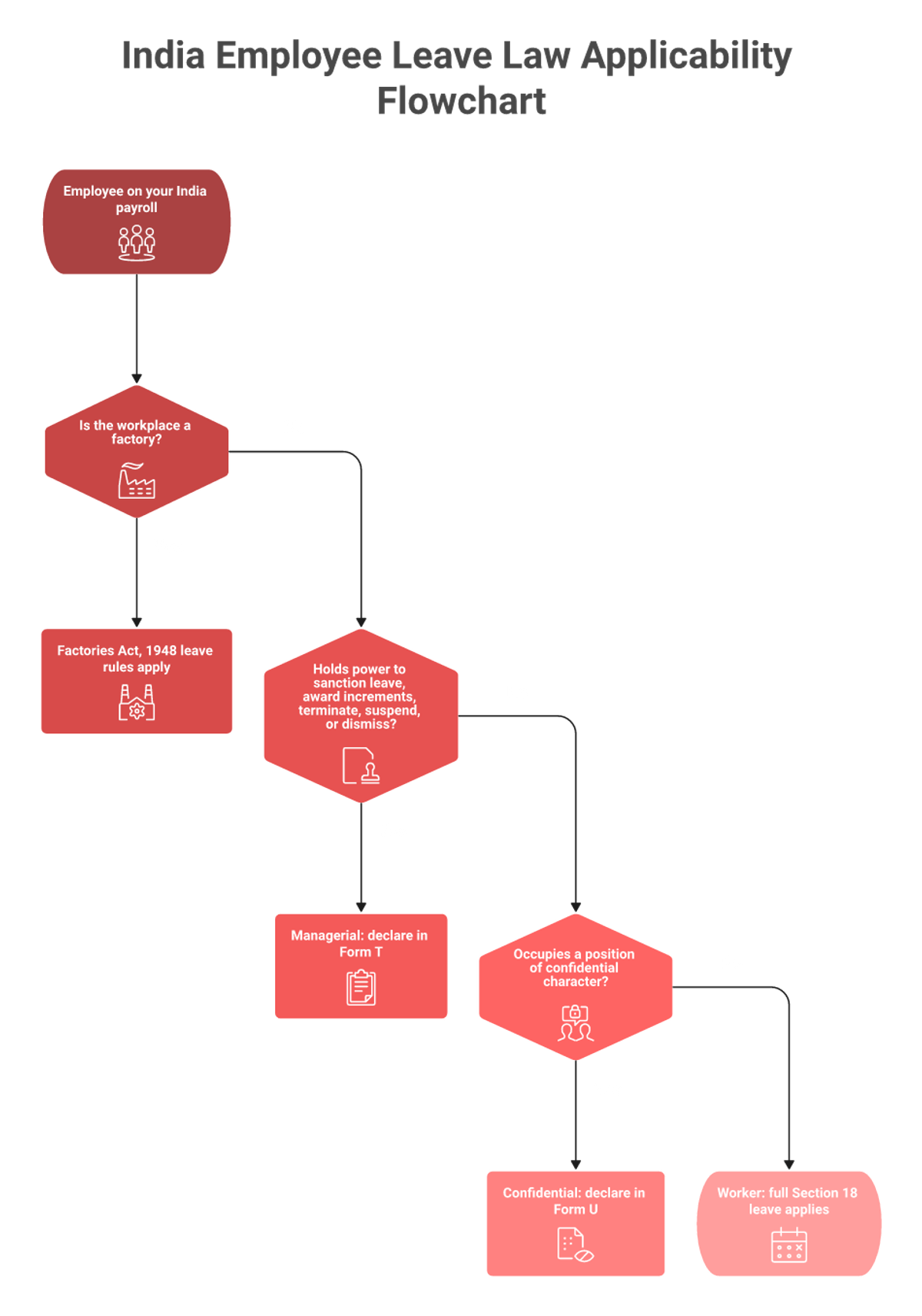
Run this on Monday, name by name.
- Is the workplace a factory under the Factories Act, 1948? If yes, stop. Factories Act rules apply.
- Does this person hold real power to sanction leave, award increments, or terminate? If yes, managerial.
- Does this person handle genuinely confidential business work, and are you still inside the one per cent cap? If yes, confidential.
- Everyone left is a worker, and Section 18 leave applies in full.
One live caveat. A Maharashtra gazette from November 2025 revises the Shops Rules forms to reference establishments engaging fewer than twenty workers, where the Act text as on 31 December 2025 still reads ten. Versatile Club's read is that small-establishment thresholds are moving, though I would not rewrite a handbook on a form footer alone. Check the final rule before you rely on it.
💰 Why misclassification costs more than the leave itself
Get the category wrong and you carry two liabilities. You either owe leave you never accrued, or you denied leave that was owed. Both surface in diligence, and both now attract penalties up to one lakh rupees under Section 29, with a higher ceiling of two lakh on repeat contraventions.
Versatile Club classifies every hire against Section 3 at contract stage and files the Form T and Form U declarations under its own registration, because we are the legal employer, not a partner shell. If you are weighing that against setting up your own entity, our EOR vs entity calculator prices both routes.
Q2. What leave is a Maharashtra employee legally entitled to under state law?
Under Section 18, every worker gets a weekly holiday with wages and eight days of casual leave with wages each calendar year, credited quarterly, lapsing if unused at year end. Earned leave accrues at one day for every twenty days worked, after 240 days of work in the previous calendar year. Earned leave accumulates to a maximum of forty-five days. Eight paid festival holidays also apply.
The statutory floor in one table
| Leave type | Entitlement | Accrual basis | Carry forward | Source |
| Weekly holiday | At least 24 consecutive hours, with wages | Every week | Compensatory off within two months if denied | s.16, s.18(1) |
| Casual leave | 8 days per calendar year | Credited quarterly | None. Lapses at year end | s.18(2) |
| Earned leave | 1 day per 20 days worked | After 240 days worked in the prior year | Up to 45 days | s.18(3), s.18(5) |
| Short-service leave | Up to 5 days per 60 days worked | Service of 3 months or more in the year | Governed by s.18(3) | s.18(4) |
| Festival holidays | 8 paid days | 26 Jan, 1 May, 15 Aug, 2 Oct plus four agreed | Not applicable | s.18(7) |
| Sick leave | None prescribed | Not applicable | Not applicable | Chapter IV |
Versatile Club builds every client leave ledger from this table first, then adds the client's market grant on top, so the floor is never quietly undercut. The same ledger feeds our managed payroll cycle each month.
⭐ Two clauses the ranking guides keep getting wrong
First, casual leave is credited quarterly, not annually. Two days land every quarter. A January joiner cannot draw all eight in February.
Second, the five-days-per-sixty-days rule in Section 18(4) is a separate entitlement for workers with at least three months of service in the year. Vendor tables often merge it into earned leave. That is why you see 18 days in one guide and 19 in another. The Act gives a formula, not a fixed number.
🔢 What counts toward the 240 days
Section 18(8) treats four categories as days worked for the 240-day computation, though they do not themselves earn leave.
- Days of lay-off by agreement, contract, or standing orders.
- Maternity leave for a woman worker under the Maternity Benefit Act, 1961.
- Leave earned in the year prior to the year the leave is availed.
- Absence from temporary disablement caused by a workplace accident.
Versatile Club measures this by keeping the muster roll and the leave ledger in the same monthly cycle, so the 240-day count is a lookup and not a reconstruction at year end. That method is documented in our India payroll compliance guide.
⏰ The encashment trigger nobody diaries
Section 18(6) is narrow and specific. If a worker applies for earned leave fifteen days in advance and the employer refuses it, the worker gets a right to encash leave in excess of forty-five days. Refusal creates the right. Silence does not.
The proviso then covers exit. A worker entitled to leave other than casual and festival leave, who is discharged, or who quits on retirement, resignation, death, or permanent disability after a refusal, must be paid full wages for the leave due.
Leave pay itself runs on the daily average of wages for days actually worked in the preceding three months, excluding overtime. Note that the Factories Act stream uses a preceding-month average instead. Two ledgers, two formulas, and I have watched payroll teams apply the wrong one for years.
Versatile Club configures the fifteen-day advance-application rule and the forty-five day cap as hard system settings, not policy notes, because Form P notices depend on both.
Q3. What changed for Maharashtra leave once the Labour Codes came into force?
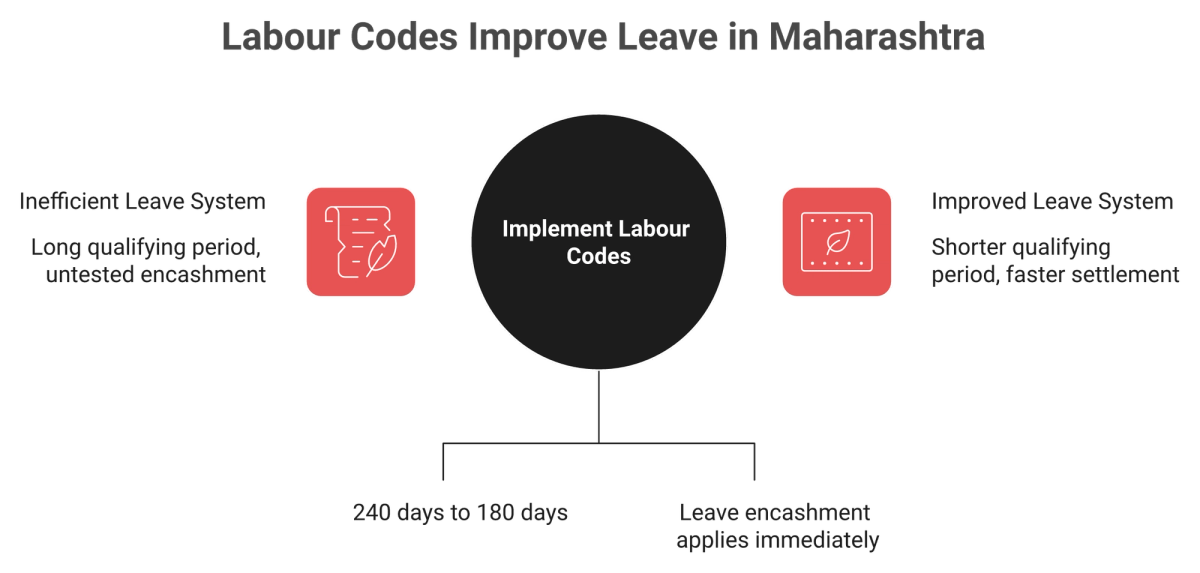
Versatile Club re-tested every client's leave eligibility trigger and encashment logic after 21 November 2025, when the Ministry of Labour and Employment brought all four Labour Codes into force by gazette notification. The annual-leave qualifying period moves from 240 days to 180 days under the Occupational Safety, Health and Working Conditions Code, 2020. Maharashtra has published draft Code on Wages Rules, 2026 for objections. Section 18's casual-leave and forty-five day carry-forward structure continues to operate.
What actually happened on 21 November 2025
Four Codes replaced twenty-nine central labour laws in one stroke. Advisers moved fast on it. EY published its alert the same week, confirming the press release and four separate gazette notifications.
Then the state layer began. Maharashtra put draft rules under the Code on Wages into the state gazette in April 2026. Draft is the operative word. Versatile Club treats draft rules as a planning signal and not as a compliance trigger, which is a distinction most vendor blogs skip.
📊 Survives, changes, pending
| Provision | Before 21 Nov 2025 | Position now |
| Annual leave qualifying period | 240 days worked in the prior year, s.18(3) | 180 days under the OSH Code |
| Casual leave, quarterly credit, year-end lapse | 8 days, s.18(2) | Unchanged by the Codes |
| Earned leave accumulation cap | 45 days, s.18(5) | Unchanged at state level |
| Encashment above the cap | On refusal after 15-day notice, s.18(6) | Codes add wage-definition effects on the payout |
| Registers and returns | Forms O, P, Q, R under the 2018 Rules | Continue until state rules replace them |
| Standing orders and handbooks | State S and E framework | Rewrite once final state rules land |
💸 Why finance cannot skip this one
The Codes require basic wage plus dearness allowance to be at least fifty per cent of total remuneration. That single rule moves the base on which leave encashment, gratuity, and provident fund are computed.
Here is the practical shape of it. Versatile Club accrues gratuity at 4.81 per cent of basic plus DA from month one, and deposits provident fund at 12 per cent of basic plus DA, so raising basic to hit the fifty per cent floor lifts three liabilities at once, not one. I have watched founders restructure salary for provident fund compliance and discover the encashment effect two quarters later. Our cost of hiring in India breakdown shows how that flows through a full-year budget.
⚠️ Do not rewrite the handbook twice
My sequencing rule, tested across client rollouts this year, is simple.
- Change the eligibility trigger now. Drop it from 240 days to 180 and stop.
- Re-test encashment and full and final logic against the new wage definition.
- Hold the standing-orders rewrite until Maharashtra notifies final rules.
- Date-stamp the handbook version either way, so an inspector sees a dated document rather than an undated one.
Versatile Club's data points toward final state rules landing during 2026, though I might be reading the draft-publication timeline too confidently. If your legal counsel wants to wait for the notified text before touching standing orders, that is a defensible call.
✅ The honest gap
Nothing in the Codes has yet repealed Maharashtra's Section 18. Both operate. Where the Code is more favourable to the employee, apply the Code. Where Section 18 is more generous, Section 18 wins.
Versatile Club administers this overlap under its own PF, ESIC, and Shops and Establishments registrations across all 28 states and 8 union territories, so a Code change gets tested once and applied across every client roster in the same payroll cycle. The mechanics are set out in our employer of record India 2026 playbook.
Q4. Which central leave entitlements stack on top of Maharashtra's rules?
State law sets the leave floor. Central law adds mandatory categories above it. Twenty-six weeks of paid maternity leave applies for the first two children, twelve weeks for adoptive and commissioning mothers, plus one additional month of leave with wages for illness arising from pregnancy, delivery, miscarriage, or tubectomy, and a medical bonus. Sickness benefit runs through ESIC for covered wage bands, and voting is a paid holiday.
The stacking principle
Whichever provision is more favourable to the employee applies. That is the whole rule, and it saves a lot of argument.
Versatile Club administers provident fund at 12 per cent of basic plus DA, employee state insurance at 3.25 per cent employer and 0.75 per cent employee, and gratuity accrual at 4.81 per cent, all under its own registrations, which is how the central overlay stays attached to the entity that signs the contract.
👶 Maternity is a payroll obligation, not an HR line item
The Maternity Benefit Act, 1961 sets twenty-six weeks for the first two surviving children, of which up to eight weeks may be taken before delivery. For a third child, it is twelve weeks. Adoptive mothers of a child below three months and commissioning mothers get twelve weeks.
Two clauses get missed constantly. The medical bonus is payable in addition to leave. And the extra month of leave with wages for pregnancy-related illness sits on top of the twenty-six weeks. A crèche obligation also attaches once you cross fifty employees.
US founders budget maternity as a policy paragraph. In our work with Series A clients hiring in Mumbai, it lands as a six-month payroll line with a statutory floor underneath it. Versatile Club sizes that line before the offer goes out, which is one reason founders use our startup hiring model rather than guessing at benefit costs.
🏥 Sickness, harassment, and voting
Three central threads matter beyond maternity.
- ESIC sickness benefit covers employees inside the wage ceiling. Most funded-startup engineers sit above it, so this covers less of your team than you expect.
- POSH obligations under the Sexual Harassment of Women at Workplace Act, 2013 run parallel, and Form R asks directly whether your Internal Committee is constituted and who chairs it.
- Voting leave under the Representation of the People Act framework is a paid holiday for registered electors on poll day.
Versatile Club sets up the POSH Internal Committee at onboarding rather than at inspection, because the annual return under Rule 27 asks for the chairperson's name.
🌙 The Maharashtra add-on for night shifts
Rule 13 of the 2018 Rules gives every woman worker on a night shift one additional paid holiday for every two months in a year, over and above Section 18 holidays. It also requires written consent in Form L, a minimum of three women on shift, door-to-door transport, and a twelve-hour gap when shifts rotate.
This is a state rule that no global leave module I have seen ships with by default.
💬 What buyers say about leave administration
"Wisemonk is that it combines employee, time, and payroll management into one simple and efficient system, making daily operations smoother and more accurate."
— Vinay M., Verified User Wisemonk - G2 Verified Review (4/5), 18 February 2026
"The way annual leave is recorded is strange, it automatically logs weekend days, so this has incorrectly logged my leave. There is no way to edit so I have had to reach out to support for the leave to be deleted."
— Verified User in Non-Profit Organization Management Pebl (formerly Velocity Global) - G2 Verified Review (1/5), 30 April 2026
"Requesting HR documents via form didn't work, and I can't request vacations because it doesn't work either with partial parental leave."
— Daryna R., Verified User Deel - G2 Verified Review (0/5), 6 May 2024
Versatile Club runs the central overlay and the state add-ons through one Indian entity with one monthly USD invoice, so a parental-leave case does not become a ticket against a partner shell in another jurisdiction. Buyers comparing that structure against the generalists usually start with our Deel alternative and Wisemonk alternative breakdowns.
Q5. Why is there no statutory sick leave in Maharashtra, and what should your policy say instead?
No. Chapter IV of the Maharashtra Shops and Establishments Act, 2017 prescribes casual leave, earned leave, weekly holidays, and festival holidays. It prescribes no sick leave at all. Employees therefore draw on casual leave when they fall ill. ESIC sickness benefit covers only employees inside the wage ceiling, which excludes most funded-startup engineers. Credible Maharashtra employers grant six to twelve contractual sick days instead.
Where every competing guide stops
Search this question and you get four words back: "no provision for sick leave." True. Also useless.
The statute is silent, so the contract has to speak. Versatile Club writes the sick-leave clause into the employment agreement itself, not the handbook, because the agreement is the document an adjudicating officer under Section 31A actually reads. That drafting step sits inside our India EOR onboarding workflow.
❌ Who ESIC really covers
ESIC is the Employees' State Insurance scheme, which pays a sickness benefit to insured employees during certified illness. It applies below a monthly wage ceiling.
A Series A backend engineer in Pune sits far above that ceiling. So the person most likely to burn out has the least statutory sickness cover. Versatile Club deposits employee state insurance at 3.25 per cent employer and 0.75 per cent employee for every covered hire, and I still tell founders plainly that this covers ops and junior roles, not their senior engineering bench. The full contribution map sits in our India compliance coverage.
⚠️ The casual-leave burn nobody models
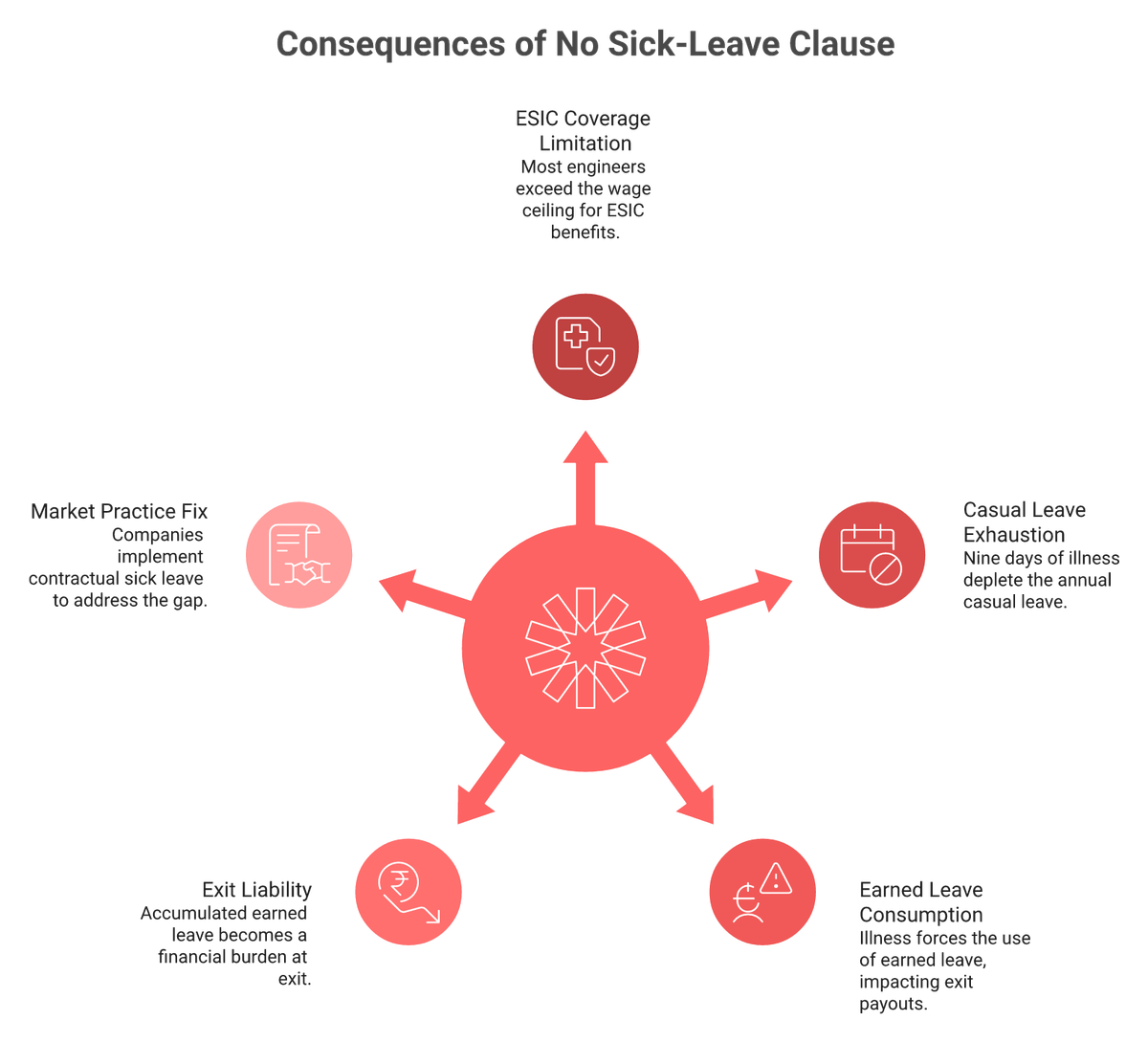
Watch what happens without a sick ledger. An engineer gets dengue in July. Recovery takes nine days.
Casual leave is eight days a year, credited two per quarter, and it lapses at year end. So by mid-July that person is out of casual leave and dipping into earned leave. Earned leave is the ledger you owe money on at exit, because it accumulates to forty-five days. A missing sick-leave clause quietly converts illness into balance-sheet liability.
✅ The clause I would actually write
Four elements, and none of them are complicated.
- A separate sick ledger. Six to twelve days a year, tracked apart from casual and earned leave.
- Non-encashable and non-carry-forward. Say it explicitly, or you have created a second encashable pool.
- A certificate threshold. No certificate for one or two days. Registered medical practitioner's certificate beyond that.
- A stated interaction rule. Sick leave exhausts first, then casual, then earned. Write the order down.
Versatile Club's read is that the standard advice here gets it backwards. Most guides treat sick leave as a perk to add later. Compliance is the floor, not the ceiling, and engineers read a missing sick-leave clause as a statement about the employer rather than about the statute.
💬 What buyers say about benefits paperwork
"The initial documentation and paperwork felt quite detailed and time-consuming at the beginning. However, as we progressed, it became clear that this thoroughness is what ensures proper legal and compliance coverage."
— Verified User in Marketing and Advertising, Wisemonk Wisemonk - G2 Verified Review (3.5/5), 12 February 2026
"Ofter the CS doesn't seem to have answers, which leads me to emails back and forth on my case which don't always alnswer the question and something I was looking for the answer to in 20 minutes becomes a 4 day process."
— Verified User in Computer Software, Deel Deel - G2 Verified Review (3/5), 16 September 2024
Versatile Club issues the sick-leave clause inside the employment contract from its own registered entity, so an employee query on day one is answered by the same party that signed the agreement. Founders weighing that against a global vendor usually read our best EOR in India comparison next.
Q6. How many holidays and weekly offs must you actually give in 2026?
Versatile Club loads Maharashtra's gazetted holiday list into client payroll calendars each December, alongside the eight statutory festival holidays. Under Section 16, every worker gets a weekly holiday of at least twenty-four consecutive hours, and compensatory leave within two months if it is denied. Section 18(7) gives eight paid festival holidays. Maharashtra separately notified 24 public holidays for 2026.
The weekly holiday rules people skip
Three rules sit inside Section 16, and each one costs money if missed.
- An establishment may stay open all week, provided every worker still gets twenty-four consecutive hours of rest.
- No deduction may be made from wages for the weekly holiday.
- If a worker is required to work on a rest day, wages are twice the ordinary rate.
Compensatory leave for a denied weekly holiday must be given within two months of that holiday. Not "later in the year." Versatile Club tracks that two-month window inside the same managed payroll cycle that runs the attendance register.
📅 The eight festival holidays, and how the four flexible ones work
Section 18(7) fixes four dates: 26 January, 1 May, 15 August, and 2 October. The other four are agreed between the employer and the workers, based on the nature of the business, before the year begins.
Miss that window and you have no agreed list to point to. Versatile Club runs the festival-holiday election in December for every client roster, because agreeing the four dates in March is not compliance, it is improvisation.
⚠️ Working on a festival holiday costs double
The proviso to Section 18(7) is precise. You may require work on any of these days, provided you pay double the daily average wages and grant leave on another day in lieu. Both, not either.
Pay for the holiday itself is the daily average of wages, excluding overtime, earned in the month the compulsory holiday falls. Section 18(9) then adds that leave is exclusive of holidays occurring during or at the end of a leave period. So a public holiday inside someone's vacation does not eat a leave day.
🗓️ The 2026 Maharashtra picture
| Item | 2026 position | Source |
| Gazetted state public holidays | 24 | GAD notification, 5 December 2025 |
| Statutory instrument | Section 25, Negotiable Instruments Act, 1881 | Same notification |
| Statutory festival holidays for private establishments | 8 paid, 4 compulsory | s.18(7) |
| Example date to check | Mahashivratri, Sunday, 15 February 2026 | Bank holiday lists for 2026 |
| Night-shift add-on for women workers | 1 extra paid holiday every two months | Rule 13(2)(iv), 2018 Rules |
⭐ Where India holiday policies silently break
The failure I see most often is a founder copying a bank holiday list into an HRMS and calling it the leave policy. Those are two different legal objects. Bank holidays come from a Negotiable Instruments Act notification. Festival holidays come from Section 18(7).
The second failure is Sundays. Several gazetted 2026 dates land on a weekend, including Mahashivratri on 15 February. A weekend collision quietly reduces the days your team actually gets. Versatile Club's practice is to publish the agreed four festival dates in writing each December and prefer weekday dates where the business allows, which is judgment rather than statute, and I would not pretend otherwise.
Versatile Club administers holiday calendars, weekly-off notices in Form M, and shift schedules in Form N under its own Shops and Establishments registrations across all 28 states and 8 union territories, as set out in the Maharashtra Shops and Establishments Rules, 2018. Teams scaling across cities usually pair this with our guide to hiring employees in India.
Q7. How do you calculate leave pay and encashment without inflating your balance sheet?
Versatile Club computes leave wages under two different statutory formulas depending on establishment type. For Maharashtra shops and establishments, Section 18(10) pays the daily average of wages for days actually worked in the preceding three months, excluding overtime. The Factories Act, 1948 uses the preceding month, and includes dearness allowance plus the cash equivalent of concessional supplies, while excluding overtime and bonus.
Step 1: identify which formula applies
Get this wrong and every downstream number is wrong.
- Office team in Mumbai or Pune: Section 18(10), three-month average.
- Factory workers: Factories Act, one-month average, with the previous-month fallback where the worker did not work in that month.
Versatile Club splits leave-pay rules by establishment registration type before the accrual run, because one payroll engine cannot hold both formulas as a single setting. CFOs modelling this ahead of a first hire tend to start with our India salary calculator.
🔢 Step 2: know what triggers a payout
Encashment is not automatic under the Maharashtra Act. Section 18(6) gives the right to encash leave above forty-five days only where the worker applied fifteen days in advance and the employer refused.
The proviso covers exit separately. A worker entitled to leave other than casual and festival leave, who is discharged, or who quits on retirement, resignation, death, or permanent disability after a refusal, must be paid full wages for leave due.
💸 Step 3: the wage-split effect, with numbers
Here is the calculation that surprises CFOs. Take an engineer on 24 lakh rupees a year, holding the full forty-five day earned-leave cap.
| Wage structure | Basic plus DA | Daily rate on Basic plus DA | 45-day encashment |
| Basic at 30 per cent of CTC | 7,20,000 | 2,000 | 90,000 |
| Basic at 50 per cent of CTC | 12,00,000 | 3,333 | 1,50,000 |
Same salary. Same leave balance. Two-thirds more liability. The Labour Codes require basic plus dearness allowance to reach at least fifty per cent of remuneration, so this shift is not optional.
Versatile Club accrues gratuity at 4.81 per cent of basic plus DA from month one and deposits provident fund at 12 per cent, which means the same restructure lifts three liabilities together. Our employer of record India cost breakdown shows how those accruals appear on a monthly invoice.
⏰ Step 4: accrue monthly, settle on time
Two habits fix most of this.
- Accrue leave liability every month, next to gratuity, rather than discovering it during a resignation.
- Settle within the statutory full and final window on exit. Faster settlement timelines apply since the Codes took effect on 21 November 2025.
Versatile Club's data points toward monthly accrual cutting exit disputes noticeably, though our sample is India-only and I would not present that as an industry benchmark.
💬 What buyers say about invoice and fee clarity
"I find Deel to be absurdly expensive. They charge a high amount of fees for transferring money to my bank account."
— Juan Camilo O., Verified User, Deel Deel - G2 Verified Review (1/5), 27 November 2025
"I dislike how expensive Deel's transaction fees are, especially when moving money from the Deel account to my bank."
— Maria M., Verified User, Deel Deel - G2 Verified Review (3/5), 26 September 2025
"Sometimes the email communication from the wisemonk team is delayed by a day or 2. But overall they seem to be the best for India."
— Bulbul G., Verified User, Wisemonk Wisemonk - G2 Verified Review (4/5), 19 February 2025
Versatile Club issues one monthly USD invoice from a single Indian entity with a per-employee breakdown, payroll summary, PF and ESI challan confirmations, and TDS receipts, so accrued leave sits in the monthly pack rather than surfacing at exit. Our pricing page shows the flat per-employee fee behind that invoice.
Q8. What leave records will a Maharashtra Facilitator ask to see, and what happens if they are missing?
Versatile Club maintains four statutory leave artefacts for every client roster. Under the Maharashtra Shops and Establishments Rules, 2018, these are the Leave Book in Form O issued to each worker, the Form P notice when carried-forward leave reaches the forty-five day ceiling, the Muster-Roll cum Wages Register in Form Q, and the annual return in Form R uploaded within two months of 31 December. Registers must be in Marathi or English.
The four artefacts and their triggers
| Form | Rule | Trigger | What it must show |
| Form O, Leave Book | Rule 19 | Issued to every worker | Sanctioned earned leave, and refused leave initialled by the employer |
| Form P, accumulated-leave notice | Rule 20 | First quarter of each calendar year | That 45 days are reached and no further leave carries forward |
| Form Q, Muster-Roll cum Wages Register | Rule 26 | Continuous | Days worked, hours, wages, PF, ESI, PT, and TDS deductions |
| Form R, Annual Return | Rule 27 | Within two months of 31 December | Leave book maintained, POSH committee, crèche, registers |
Two details inside Form O get missed. Refused earned leave must be recorded with the employer's initials. Form O also carries separate festival-leave and casual-leave blocks, so a single combined PTO tracker will not satisfy it.
⚠️ The register nobody runs is Form P
Rule 20 requires the employer to notify a worker in Form P, as soon as possible in the first quarter of each calendar year, once carried-forward leave has reached the maximum.
This is the cheapest fix on the list, and the one I almost never see maintained. Versatile Club diaries Form P notices in January for every employee at or near the forty-five day cap, because the notice is what stops further accumulation cleanly. Teams moving off a provider that never ran these notices should read our guide to switching EOR providers in India.
📁 Language, retention, and location rules
Rule 26 sets three conditions people overlook.
- Every register, record, and notice must be in Marathi or in English.
- Inspection records from the Facilitator must be preserved for three years.
- Where a godown, store-room, or separate workplace exists, registers may be kept separately for that location.
Versatile Club keeps registers digitally authenticated per Rule 26(2), with the employer or authorised person signing entries, and overtime entries made immediately after the overtime is worked.
💰 What non-compliance now costs
The Maharashtra Act No. 56 of 2025 rewrote the penalty regime. Fines on conviction became penalties, and adjudication moved to a labour officer.
- General contravention: penalty up to one lakh rupees, plus up to two thousand rupees per day of continuing default.
- Second or subsequent contravention: up to two lakh rupees.
- Refusing to produce a register to a Facilitator: penalty up to two lakh rupees.
- Adjudication under Section 31A by an officer not below Government Labour Officer, with appeal to a Deputy Commissioner of Labour within sixty days under Section 31B.
- Failure to comply with an order within ninety days: fine up to two lakh rupees, or imprisonment up to three months, or both.
The Facilitator issues registrations in seven working days. That office is not slow. It is unforgiving about documents, which is a different problem entirely.
💬 What buyers say about documentation and response times
"It took three months to onboard our first 3 individuals. They didn't seem to be able to navigate Visas or variations to employment contracts."
— Verified User in Information Technology and Services, Deel Deel - G2 Verified Review (0/5), 13 December 2024
"I've noticed that their support/query responses can occasionally take a bit longer sometimes, likely due to a relatively small team."
— Verified User in Financial Services, Wisemonk Wisemonk - G2 Verified Review (4/5), 14 June 2025
Versatile Club holds Form O, Form P, Form Q, and the Form R annual return under its own registration numbers, which is why a diligence question on India statutory liabilities gets answered with a document rather than a scramble. If you want to see the register set before signing anything, talk to our team.
Q9. Does unlimited PTO work on an Indian team?
No. Versatile Club maintains a dated leave ledger for every employee because Rule 26 of the Maharashtra Shops and Establishments Rules, 2018 requires a Muster-Roll cum Wages Register showing days worked, and Section 18(3) requires a qualifying-day count. Unlimited PTO cannot produce either record. In a hierarchical, high-context workplace, it also produces near-zero leave-taking, because nobody wants to be the person who asked.
Why founders reach for it in the first place
I understand the appeal. Unlimited PTO removes an awkward negotiation and signals trust. It also removes an accrued-liability line from the balance sheet, which finance teams notice.
Versatile Club's read is that the standard advice gets this backwards. Removing the ledger does not remove the obligation. It removes your evidence. That principle runs through our India compliance approach.
⚠️ The statutory objection comes first
Three duties survive any policy you write.
- Days worked must appear in the Form Q muster roll.
- The qualifying-day threshold must be verifiable, because earned leave accrues at one day per twenty days worked.
- Accumulated leave must be tracked, because the cap is forty-five days and the Form P notice depends on hitting it.
An unlimited policy has no accrual to record. So at inspection, or during M&A diligence, you have a handbook and no register. Versatile Club keeps the ledger even where a client grants leave generously, because the register is the artefact a Facilitator asks for.
❌ The cultural objection is the one people underestimate
An American manager once told a story that stuck with me. Her colleague in New Delhi messaged her on instant messenger every single evening to ask whether it was acceptable to take his dinner break. She kept saying yes. He kept asking, because in his read of the relationship he was the subordinate and she was not.
Now hand that person an unlimited leave policy. What he hears is not freedom. He hears that there is no rule to point to, so any absence is a personal favour he has to request. Versatile Club's 90-day Success Coach reviews early leave patterns precisely because zero leave taken in ninety days is a warning sign, not a productivity win. That coach is part of how our model works.
⏰ The real remote risk in India is overwork
A manager's instinct is to worry that people at home will do too little. What I have watched instead, across six years of placements in Bengaluru, Hyderabad, and Pune, is people doing too much and saying nothing.
Use-it-or-lose-it sounds like a restriction. It behaves like a nudge. Casual leave under Section 18(2) lapses at year end, and that lapse is what actually pushes people to take the days.
✅ The protocol I would run instead
Four moves, all cheap.
- Keep a defined allotment. Statutory floor plus your grant, written down, with a ledger behind it.
- Let casual leave lapse. Do not convert it into a bank. The expiry is the prompt.
- Model it from the top. Leaders take visible, announced leave. Nobody below them will go first.
- Change your check-in question. Never ask "are you on schedule." Ask "where are we on the schedule," which invites an honest answer instead of a polite yes.
Versatile Club treats the leave ledger as a retention instrument as much as a compliance one, which is why our Success Coach reviews leave patterns in the first ninety days alongside payroll accuracy. Teams that want the same retention layer on a trial basis usually begin with contract to hire.
Q10. How do you write one leave policy that holds across Maharashtra and the rest of India?
Versatile Club runs a single national leave baseline plus a thin state-delta layer for every client, holding registrations across all 28 states and 8 union territories. The baseline sits at or above the most generous state floor. The delta layer carries holidays, registers, and filing cycles. Maharashtra requires dual PTRC and PTEC professional tax registration with monthly slab filing, while Karnataka runs a monthly cycle, and Tamil Nadu files twice a year.
Why per-state handbooks always drift
I have seen the same failure three times this year. A company hires in Pune, writes a Maharashtra policy, then hires in Bengaluru and writes a second one. Six months later the two documents disagree on carry-forward.
Versatile Club's practice is one policy document with one appendix, because two handbooks means two versions to keep current, and nobody ever updates both. Our India payroll compliance guide sets out the same single-source approach.
🗺️ The state-delta layer that actually bites
| State | Professional tax cycle | Leave register practice | What breaks first |
| Maharashtra | Dual PTRC and PTEC, monthly slab filing | Form O Leave Book, Form P notice, Form Q, Form R | The Form P first-quarter notice |
| Karnataka | Monthly PT, plus S and E renewal | State S and E register set | Renewal lapse |
| Tamil Nadu | Biannual PT, plus labour welfare fund | State S and E register set | Missed half-year filing |
| West Bengal | Frequent rule changes | State S and E register set | Working from a stale rule |
Delhi has no professional tax but enforces its Shops and Establishments obligations strictly, and Telangana has its own PTRC enrolment deadlines. This is the multi-state sales tax problem that US SaaS CFOs already know, moved into payroll. Companies running teams in more than one city usually route this through payroll outsourcing services in India.
📄 The eight clauses your baseline needs
Draft these in order, with two columns: statutory minimum, and your grant.
- Applicability and employee category, including managerial and confidential carve-outs.
- Casual leave, credited quarterly, lapsing at year end.
- Earned leave, accrual basis, and the forty-five day cap.
- Sick leave, as a contractual grant.
- Maternity, adoption, and surrogacy leave.
- Weekly holiday, and compensatory off within two months.
- Festival and public holidays, agreed before the year starts.
- Encashment, exit settlement, and the register clause.
The drafting rule is short. A contract may exceed the statute. It may never fall below it.
💬 What buyers say about one-size-fits-all playbooks
"Deel's one-size-fits-all approach creates unnecessary friction and risk, especially for small businesses working internationally under a legal structure."
— Verified User in Translation and Localization, Deel Deel - G2 Verified Review (0.5/5), 5 May 2025
"I was employed by a Singapore entity that is yet to established in India. So, Wisemonk is the legal entity which I'm currently working under. It removes barriers."
— Verified User in Financial Services, Wisemonk Wisemonk - G2 Verified Review (4/5), 16 June 2025
⭐ The rule I hold myself to
Every number in a client handbook should trace to a section number. If it cannot, it is a preference and should be labelled as one.
Versatile Club's multi-state records point toward the delta layer staying stable for Maharashtra and Karnataka, and moving most often in West Bengal, though I would treat that as our filing experience rather than a published index.
Versatile Club holds PF, ESIC, and Shops and Establishments registrations in its own name across all 28 states and 8 union territories, so a Pune hire and a Kolkata hire sit on one policy and one monthly USD invoice instead of two vendor stacks. Founders comparing that against opening a subsidiary can price both paths with our EOR versus entity analysis for India.
Q11. Who should own leave compliance: in-house, an HRMS, or an EOR?
Versatile Club employs client teams through its own registered Indian entity, holding the PF registration, ESIC code, and Shops and Establishments licences in its own name, at 149 dollars per employee per month flat with no setup fee, no exit fee, and a contractual five-day onboarding SLA. With no Indian entity, an EOR is the only route that puts registers and filings under someone else's registration. With an entity and under 30 people, an HRMS plus a local consultant works if a named person owns Form P and Form R.
The three models, stated honestly
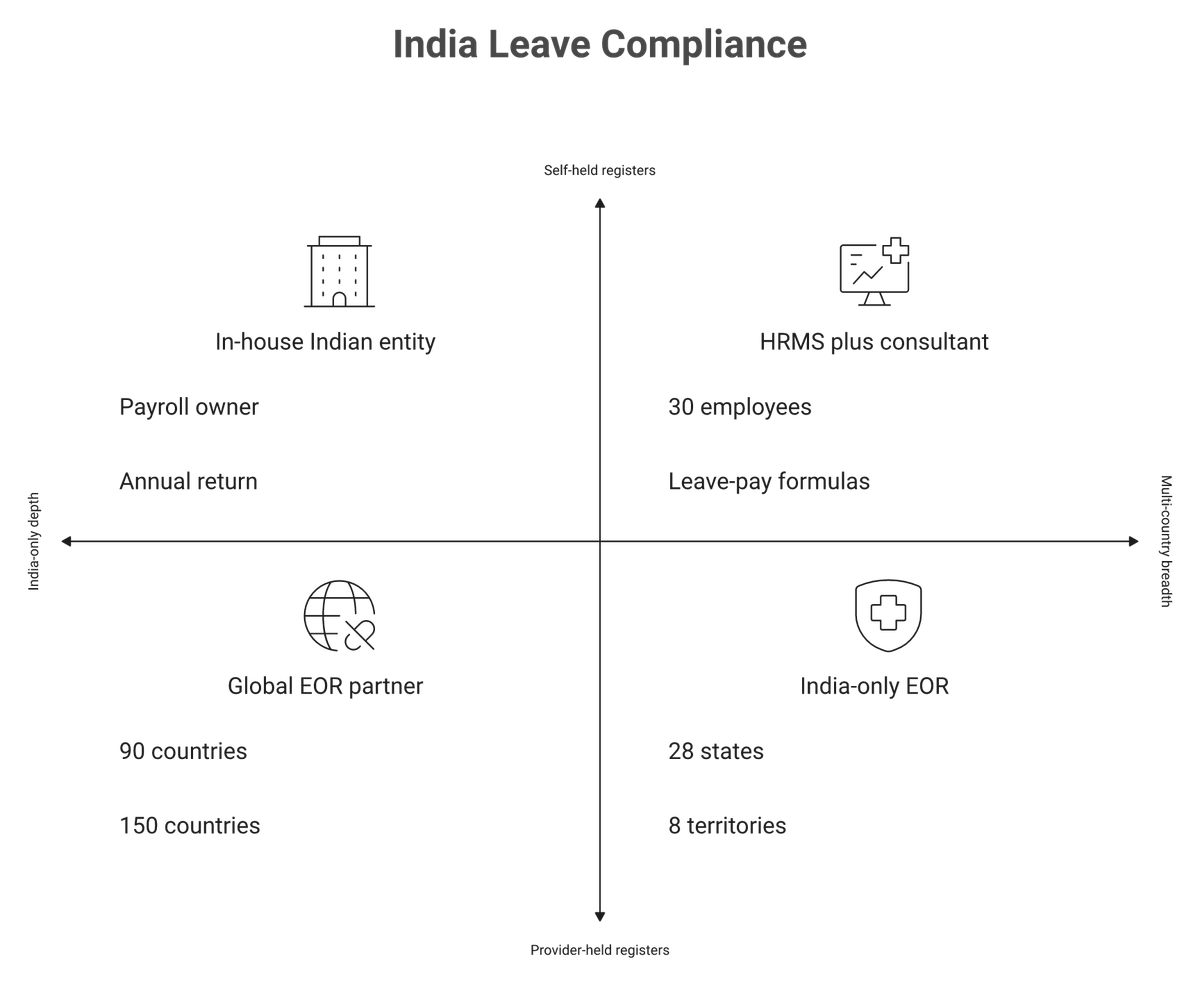
- In-house. Best where you already have an Indian entity and a payroll hire. Not recommended if nobody owns the Form R annual return deadline.
- HRMS plus consultant. Works under roughly 30 people. Not recommended where the HRMS cannot hold two leave-pay formulas at once.
- EOR. Fastest with no entity. Not recommended if you need five or more countries on one contract.
🏢 Owned entity versus partner shell
Most global platforms cover 90 to 150 countries and route India through a local partner entity. That matters for one narrow, practical reason. When a Facilitator asks who maintains the Form O Leave Book, the answer needs to be a registration number, not a subcontract.
Versatile Club is the legal employer of record directly, which is why the Form T and Form U declarations and the Form R return carry our own registration under the 2018 Rules. Note also that US-style co-employment PEO has no equivalent under Indian labour law, so "PEO India" in a sales deck usually means EOR, a point we unpack in our EOR versus PEO comparison.
📊 Honest comparison
| Provider | India entity model | Published price | Onboarding | Multi-country |
| Versatile Club | Own Indian entity, all 28 states and 8 UTs | 149 dollars per employee, flat | 5 days, contractual | India only, by design |
| Wisemonk | India-native | 99 to 399 dollars, salary slabs | 24 to 72 hours, claimed | India focused |
| Deel | Local partner entity | About 599 dollars | 7 to 14 days | 150 plus countries |
| Remote | Local partner entity | About 599 dollars | 10 to 14 days | 90 plus countries |
| Multiplier | Local partner entity | About 400 dollars | About 7 days | 150 plus countries |
Buyers shortlisting from that table usually read our Wisemonk alternative and Multiplier alternative breakdowns before booking a call.
💬 What buyers report about support ownership
"What I like most about WiseMonk is how they convert a complex international hiring process into a structured and easy workflow."
— Verified User in Marketing and Advertising, Wisemonk Wisemonk - G2 Verified Review (3.5/5), 12 February 2026
"Customer support and issue ownership need serious improvement. I was redirected multiple times, asked to repeat the same information to different representatives."
— Güneş A., Verified User, Deel Deel - G2 Verified Review (1.5/5), 2 October 2025
"The onboarding process was delayed for over two weeks due to repeated misreading and misinterpretation of standard employment verification materials."
— Verified User in Non-Profit Organization Management, Pebl (formerly Velocity Global) Pebl (formerly Velocity Global) - G2 Verified Review (1/5), 25 June 2025
⚠️ Where Versatile Club is the wrong answer
Versatile Club is not the fit if you need five or more countries on one agreement, if your procurement gate requires SOC 2 or ISO 27001 today, or if you run a 100-plus person India team with heavily customised enterprise workflows. EOR is also newer for us than contract-to-hire, and I say that on calls before anyone asks.
✅ Your Monday checklist
- Set casual leave to credit quarterly, with year-end lapse.
- Cap earned-leave accumulation at 45 days.
- Move the annual-leave eligibility trigger to 180 days, following the Labour Codes notification of 21 November 2025.
- Issue Form O Leave Books to every worker.
- Diarise the Form P notice for the first quarter.
- Load the notified 2026 Maharashtra holiday list and agree your four flexible festival dates.
Versatile Club gives you the founder on WhatsApp, a first month free, and no exit fee, so testing this costs a conversation rather than a contract you cannot leave. Tell me what you are building in India, and I will tell you honestly whether we are the right fit, either on our contact page or by grabbing a slot to book a call.
FAQs
How many casual leaves and earned leaves does an employee in Maharashtra get?
Under Section 18 of the Maharashtra Shops and Establishments Act, 2017, every worker gets eight days of paid casual leave each calendar year. That leave is credited quarterly, so two days land every three months, and any unused balance lapses at year end.
Earned leave works on a formula rather than a fixed number.
- A worker who completes 240 days of work in a calendar year earns leave in the following year at one day for every twenty days worked.
- That produces roughly 18 days for a full working year.
- Workers with at least three months of service in the year get up to five days for every sixty days worked.
- Earned leave accumulates to a maximum of forty-five days.
This is why published guides disagree on whether the number is 18 or 19 days. The statute gives a rate, not a total, so the answer depends on days actually worked.
Versatile Club configures every client leave ledger to this statutory floor first, then layers the client's market grant on top, and runs the accrual inside the same monthly cycle as managed payroll so the qualifying-day count is a lookup rather than a year-end reconstruction.
Is sick leave mandatory in Maharashtra, and what should our policy say?
No. Chapter IV of the Maharashtra Shops and Establishments Act, 2017 prescribes casual leave, earned leave, weekly holidays, and festival holidays. It prescribes no separate sick leave.
Employees therefore fall back on casual leave when they are ill. ESIC sickness benefit exists, but it reaches only employees inside the wage ceiling, which excludes most funded-startup engineers. The person most likely to burn out has the least statutory cover.
The cost shows up quietly. A nine-day illness in July exhausts a year of casual leave and starts eating earned leave, and earned leave is the ledger you owe money on at exit.
A defensible clause has four parts.
- A separate sick ledger of six to twelve days a year.
- An explicit statement that it is non-encashable and does not carry forward.
- A medical certificate threshold beyond one or two days.
- A stated order of use: sick first, then casual, then earned.
Versatile Club writes the sick-leave clause into the employment contract rather than a handbook, because the contract is what an adjudicating officer reads. You can see the full statutory scope we administer on our India compliance page.
Did the new Labour Codes change leave rules for Maharashtra employers?
Yes, partly. All four Labour Codes came into force on 21 November 2025, replacing twenty-nine central labour laws. Three changes matter for leave.
- The annual-leave qualifying period drops from 240 days to 180 days under the Occupational Safety, Health and Working Conditions Code, 2020.
- Leave encashment and faster full and final settlement timelines apply without waiting for state notification.
- Basic wage plus dearness allowance must reach at least fifty per cent of remuneration, which lifts the base used for encashment, gratuity, and provident fund together.
What has not changed is Section 18 itself. Casual leave still credits quarterly and lapses, and earned leave still caps at forty-five days. Maharashtra has published draft Code on Wages Rules, 2026 for objections, so the standing-orders rewrite is worth holding until the final text lands.
Our sequencing advice is to change the eligibility trigger and encashment logic now, then date-stamp the handbook version. Versatile Club re-tested every client's leave trigger against the Codes rather than waiting for an inspector to raise it, and the wider transition is mapped in our employer of record India 2026 playbook.
What leave records must we keep, and what happens if they are missing?
Four records carry leave compliance in Maharashtra under the Shops and Establishments Rules, 2018.
- Form O Leave Book, issued to every worker, recording sanctioned earned leave and any refused leave initialled by the employer.
- Form P notice, sent in the first quarter of each calendar year once carried-forward leave reaches forty-five days.
- Form Q Muster-Roll cum Wages Register, showing days worked, hours, wages, and deductions.
- Form R Annual Return, uploaded within two months of 31 December.
Registers must be kept in Marathi or English, and inspection records preserved for three years.
The penalty regime changed in 2025. Fines on conviction became penalties, adjudicated by an officer not below Government Labour Officer, with appeal to a Deputy Commissioner of Labour. General contravention now reaches one lakh rupees plus a daily amount for continuing default, and repeat or obstruction cases reach two lakh rupees.
The register almost nobody maintains is Form P, and it is the cheapest one to fix. Versatile Club holds Form O, Form P, Form Q, and the Form R return under its own registration numbers, which is why diligence questions on India statutory liabilities resolve with a document. Teams inheriting gaps often start with our guide to switching EOR providers in India.
How much does accrued leave actually cost us at exit in Maharashtra?
More than most founders model, and the amount moved in 2025. Two formulas apply depending on establishment type.
- Shops and establishments: leave wages equal the daily average of wages for days actually worked in the preceding three months, excluding overtime.
- Factories: the preceding month applies, including dearness allowance and the cash equivalent of concessional supplies, while excluding overtime and bonus.
Encashment is not automatic. Section 18(6) creates the right to encash leave above forty-five days only where a worker applied fifteen days in advance and the employer refused. Separately, a worker discharged or leaving on retirement, resignation, death, or permanent disability after a refusal must be paid full wages for leave due.
The wage-split effect is the part that surprises finance teams. On a 24 lakh rupee salary holding the forty-five day cap, encashment rises from about 90,000 rupees at 30 per cent basic to about 1,50,000 rupees at 50 per cent basic.
Versatile Club accrues gratuity at 4.81 per cent of basic plus dearness allowance from month one alongside the leave liability, and reports both in one monthly USD invoice. You can model the full picture with our India salary calculator.