Table of contents (11)
Leave Policy in Punjab: Complete Guide for HR Teams
Q1. Which Punjab law covers your employee, and does it matter whether they are a worker, supervisor, or senior engineer?
Office, engineering, and ops teams in Punjab fall under the Punjab Shops and Commercial Establishments Act, 1958, which uses one broad category, "employee" under Section 2(vi), with no white collar carve out. Manufacturing sites fall under the Factories Act, 1948 plus the Punjab Industrial Establishments (National and Festival Holidays and Casual and Sick Leave) Act, 1965. Section 3 excludes government offices, lawyers' offices, and persons whose hours are regulated by the Factories Act.
A People Ops lead at a Series A company messaged me last year with a Punjab leave table she had built. It was clean, colour coded, and drawn from the wrong Act. Her Mohali team sat in a co working office, not a factory, and she had copied the industrial establishment numbers. That mistake shows up in one place only: the inspector's register check.
⚠️ Why the wrong Act costs you twice
Pick the wrong statute and two things break at once. Your entitlement numbers are wrong, and your registration and register formats are wrong too. Versatile Club runs the classification check before quoting any leave figure, because the Act decides the numbers, not the other way round. That check sits at the front of every India EOR onboarding file we open.
📘 What the statute actually says
Section 2(iv) defines a "commercial establishment" as any premises where business, trade, or profession is carried on for profit, and it expressly includes offices, banking, insurance, and printing. Section 2(xxv) defines a "shop" as premises where trade is carried on or services are rendered to customers, including offices, store rooms, and warehouses.
Section 2(vi) defines "employee" as a person wholly or principally employed in an establishment, whether permanent, periodical, contract, piece rate, or on commission. Family members of the employer are excluded. Section 2(xxx) carves out a "young person", aged 14 to 18, who accrues leave faster.
Section 3 lists who is outside the Act entirely: central and state government offices, railways, postal and telegraph services, lawyers' offices, and anyone whose hours are regulated by the Factories Act.
🧭 Does seniority change anything
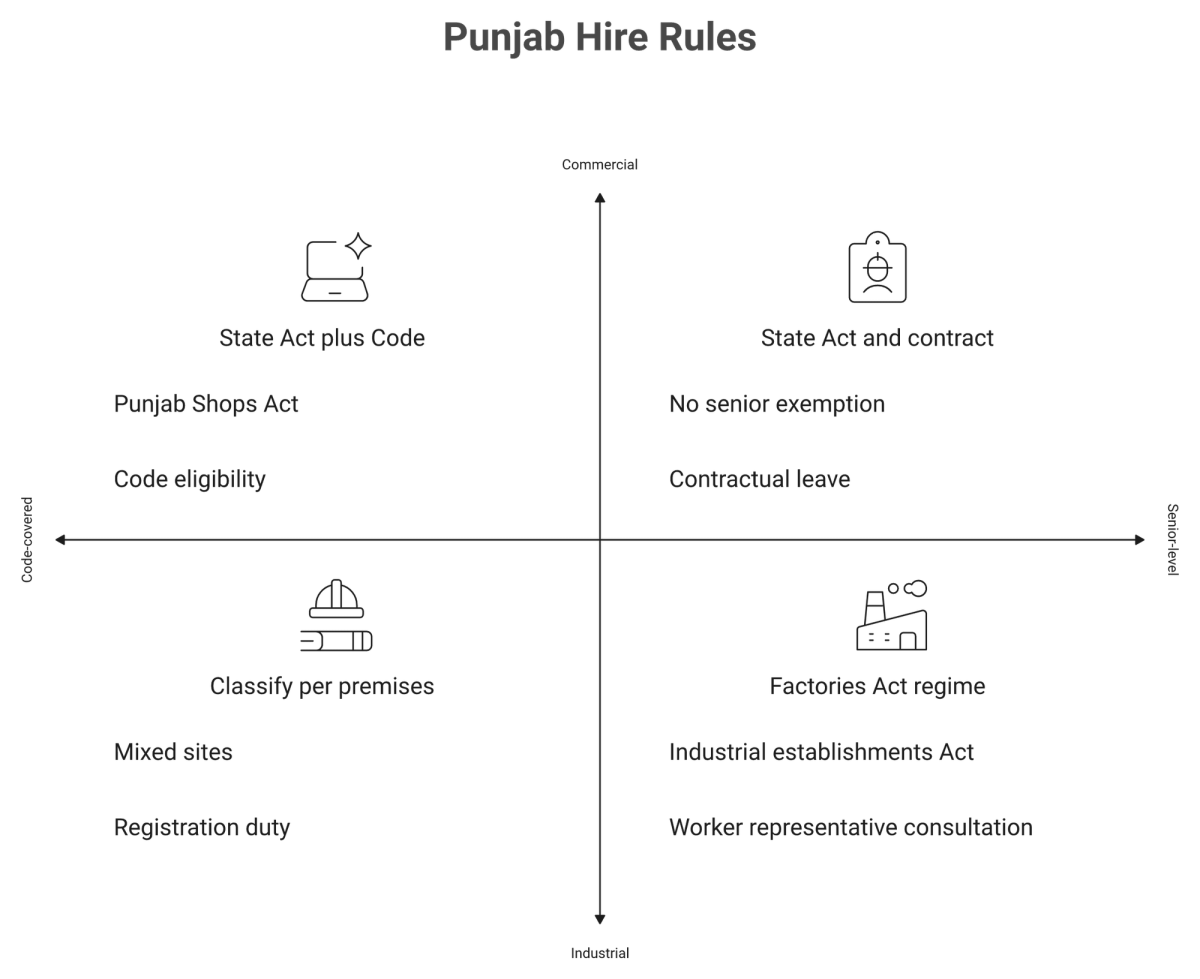
Under the state Act, no. There is no senior or managerial exemption in Section 2(vi). Your VP of Engineering in Chandigarh is an "employee" exactly like your support associate.
The Labour Codes are narrower. The Ministry of Labour and Employment's FAQ on the Labour Codes confirms that leave provisions under the OSH and Working Conditions Code, 2020 apply to workers, and to supervisors only where wages do not exceed ₹18,000 a month. So for most white collar India teams, leave rights still flow from the 1958 Act and the employment contract, not the Code. Classification is also the first thing we check before a contractor to employee conversion in India.
| Category | Governing rule | Leave source |
| Office or SaaS staff in Punjab | Punjab Shops Act, 1958 | Section 14 entitlements |
| Factory floor worker | Factories Act, 1948 and Punjab Act, 1965 | 1965 Act, Section 4 |
| Supervisor above ₹18,000 a month | State Act plus contract | Contract and Section 14 |
| Independent contractor | Contract law, misclassification risk | No statutory leave |
✅ The three branch test
Run this before writing a single policy line. If your Punjab site is an office, apply the 1958 Act. If it is a manufacturing unit, apply the Factories Act with the 1965 Act on top. If it is mixed, classify per premises, not per company.
Then register. Section 13 requires a statement to the prescribed authority within 30 days of commencing work, and the certificate is renewable by 31 March each year with 30 days of grace.
Versatile Club holds Shops and Establishments registrations across all 28 states under its own Indian entity, so a Mohali hire is classified and registered before the offer letter goes out. Our India compliance coverage is built on those registrations.
Q2. How many earned, casual, and sick leaves are legally mandatory in Punjab?
Section 14(a) of the Punjab Shops and Commercial Establishments Act, 1958 grants one day of earned leave for every 20 days of employment, roughly 18 days a year, and one day per 15 days for a young person. Section 14(4) adds seven days of casual leave and seven days of sick leave with wages. Industrial establishments under the 1965 Act receive casual and sick leave under Section 4, and Punjab's leave year runs April to March under Section 2(xxxi).
🔍 Three ranking pages, three different numbers
Search this keyword and you will find 15 days, 18 days, a 45 day carry forward, and a 30 day carry forward, all presented as fact. None of those pages quote the section. So here is the text.
Section 14(a): "Every employee who has been in employment for not less than twenty days in a year shall be entitled to one day's earned leave for every such twenty days." Section 14(4) adds the seven plus seven casual and sick entitlement. Section 14(c) rounds a fraction of half a day or more up to a full day, and ignores anything less.
📊 The entitlement table
| Leave type | Entitlement | Statutory basis |
| Earned leave | 1 day per 20 days worked (about 18 a year) | s.14(a), Punjab Act 1958 |
| Earned leave, young person (14 to 18) | 1 day per 15 days worked | s.14(a) proviso |
| Casual leave | 7 days with wages | s.14(4) |
| Sick leave | 7 days with wages | s.14(4) |
| Carry forward cap | 30 days (40 for a young person) | s.14(d)(i) |
| Leave year | 1 April to 31 March | s.2(xxxi) |
⏰ The refusal rule most policies miss
Section 14(2) says leave must be granted when applied for, unless the employer communicates a valid reason in writing within 15 days. Refused leave must be allowed later in the same year. A verbal "not this quarter" is not compliant.
For industrial establishments, the 1966 Rules add operational limits. Casual leave is capped at two days at a time except for emergencies, applications go in two days ahead, unused casual leave lapses at year end, and sick leave beyond two days needs a registered medical practitioner's certificate. Where ESI sickness benefit applies to a covered employee, that benefit takes over the sick pay function, which is one reason India payroll compliance and leave design cannot be separated.
🗓️ The April trap
Punjab's statutory year starts on 1 April. Most US HRIS setups default to January. Versatile Club builds every Punjab leave ledger on the April to March year with the 30 day carry forward cap hard coded, which is why year end balances reconcile to Section 14 instead of a calendar default.
I have had to re cut accrual tables mid year for exactly this reason. Versatile Club's read is that this single date, not the headline leave count, is where most inherited India payrolls go wrong, and it is a standing item in our payroll outsourcing handover in India.
"As a founder running a lean agency, hiring talent in India without a local entity was a compliance minefield PF, ESI, TDS, professional tax across states."
— Vedant T., Founder Versatile Club G2 - Verified Review, 16 June 2026
"The dashboard could be a little more self-serve, a couple of times I wanted to pull a report or a doc myself and ended up just messaging my contact instead."
— Angad S., Founder Versatile Club G2 - Verified Review, 21 June 2026
Versatile Club runs India only payroll under its own PF, ESI, TDS, and professional tax registrations, so the Punjab leave ledger and the statutory filings are produced from the same record set.
Q3. Which central laws override Punjab's rules, and which leave types are optional?
Central law wins where it is more favourable. Section 31 of the Punjab Act, 1958 still reads six weeks before and six weeks after delivery. The Maternity Benefit Act, 1961 supersedes it with 26 weeks for the first two children, 12 weeks for adoptive and commissioning mothers, and 80 days of qualifying service. Section 33 of the Punjab Act preserves any more favourable right, so the higher entitlement always applies. Paternity and bereavement leave remain discretionary in the private sector.
💸 The most expensive line on an inherited payroll
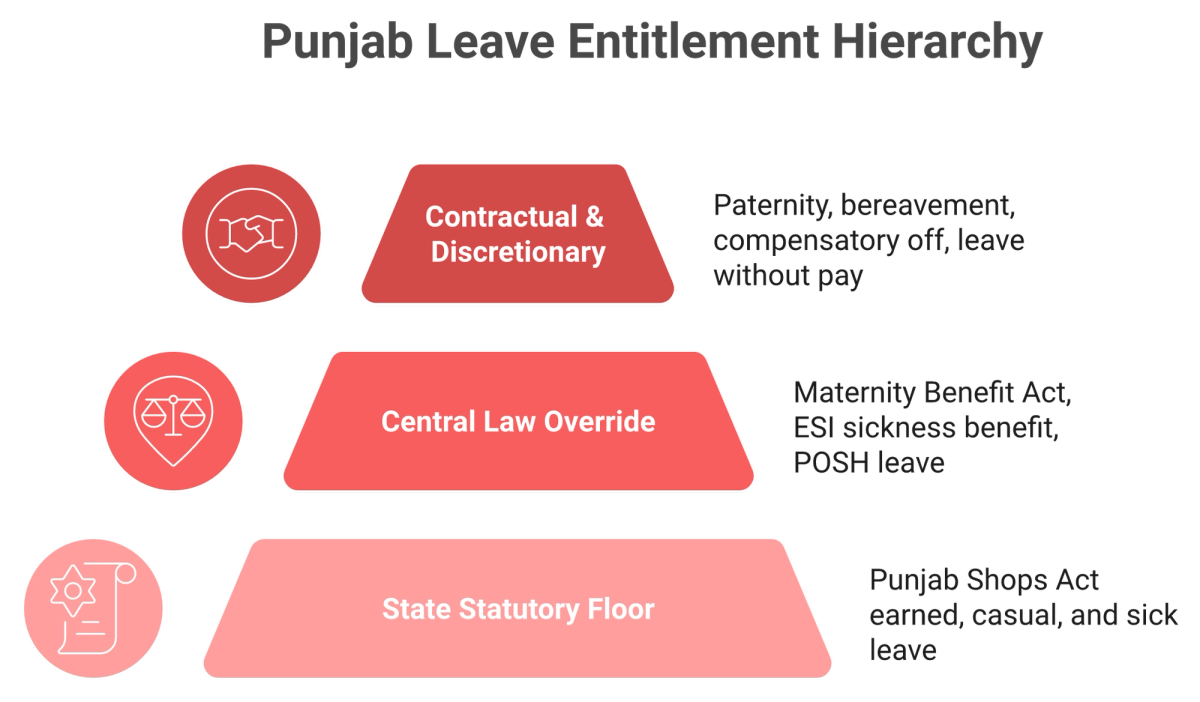
The 1958 text is old, and people copy it. Pay maternity at 12 weeks when 26 weeks is due and you have underpaid by 14 weeks of wages, plus interest and exposure. Versatile Club's audits of inherited India payrolls surface this more often than any other single error, including on files that arrive during an EOR provider switch in India.
Section 33 is the tie breaker, and it is short. Nothing in the state Act affects rights an employee already holds under another law, contract, custom, award, or settlement, where those rights are more favourable.
⚖️ Which rule wins
| Leave type | State position | Central position | What you apply |
| Maternity | s.31, six weeks each side | 26 weeks, Maternity Benefit Act 1961 | 26 weeks |
| Sick leave | 7 days with wages, s.14(4) | ESI sickness benefit where covered | Higher of the two |
| POSH leave | Not addressed | Up to three months to an aggrieved woman, s.12 | Central provision |
| Voting day | Not addressed | Paid holiday, s.135B, RP Act 1951 | Central provision |
| Earned leave | 1 per 20 days, s.14(a) | 1 per 20 days after 180 days, OSH Code | Higher of the two |
🧩 The optional layer
Paternity leave, bereavement leave, compensatory off, and leave without pay are not statutory for private employers in Punjab. You can offer them, and most competitive India teams do. Write them carefully.
Two drafting rules keep discretionary leave discretionary. State clearly that the benefit sits above the statutory floor and is not encashable. State that it does not carry forward, unless you intend it to. This is the kind of drafting our HR consulting work handles at policy stage rather than at exit.
Compensatory off deserves a line of its own. Section 12 of the Punjab Act requires double the hourly rate where an employee works a declared holiday. A comp off does not replace that payment, it sits alongside it.
✅ What to do on Monday
Pull your Punjab policy and run three checks. Confirm the maternity clause reads 26 weeks with the 80 day qualifying service test. Confirm an Internal Committee exists under the POSH Act. Confirm your handbook does not promise discretionary leave in language that reads like an entitlement.
"The compliance side is the real reason I'd recommend them though. PF, tax, the statutory filings, all the stuff I genuinely did not want to learn, they just handle it and keep it correct every month."
— Angad S., Founder Versatile Club G2 - Verified Review, 21 June 2026
"The team is really competent, but there were a few time zone misunderstandings that caused slight delays in the initial phase."
— Setu C., Client Versatile Club G2 - Verified Review, 10 June 2026
Versatile Club applies the higher of state or central test on every leave line, including maternity, POSH, and ESI, under its own statutory registrations rather than a 1958 section that central law overtook decades ago.
Q4. What changed for Punjab leave after the Labour Codes took effect on 21 November 2025?
The four Labour Codes came into force on 21 November 2025. Annual leave eligibility fell from 240 to 180 days of work in a calendar year, the one day per 20 days accrual rate held, carry forward is capped at 30 days, and any balance above 30 days must be encashed at year end. Versatile Club ran the 1958 Act and the OSH Code side by side through the transition and applied the higher figure per employee, so no client leave ledger required a retrospective correction.
📅 What actually changed
| Item | Before 21 Nov 2025 | After |
| Eligibility for annual leave | 240 days worked | 180 days worked |
| Accrual rate | 1 day per 20 days | Unchanged |
| Carry forward | Varies by state, 30 under Punjab s.14(d)(i) | Capped at 30 days |
| Excess balance | Lapsed or carried by policy | Must be encashed at year end |
| Refused leave | Re applied within the year, s.14(2) | Carries forward |
⚠️ The caveat nobody prints
Two limits sit on this. First, the Ministry of Labour and Employment's Additional FAQs on Labour Codes state that leave provisions apply to workers, and to supervisors only where wages do not exceed ₹18,000 a month. Your senior India engineers are usually outside that band.
Second, full operation depends on central and state rules. Punjab has not notified its rules under the Codes, so the 1958 Act continues to govern covered establishments in the interim, with forms and amendments tracked through the Punjab Labour Department Acts and Rules index. That means dual compliance, not replacement.
💰 Where the money moves
The Code on Wages standardises the wage definition so that Basic plus dearness allowance must be at least 50 percent of total remuneration. Leave encashment is calculated on that base. Restructure a salary to meet the 50 percent floor and your per day encashment rate rises, which lifts the accrued liability sitting on your balance sheet. Run the numbers against your own headcount with the EOR versus entity calculator before you restructure.
I did not rewrite client policies the week the Codes were notified. Versatile Club ran both frameworks in parallel and paid the higher entitlement per employee, which is what Section 33 of the Punjab Act requires anyway. I could be reading the transition conservatively, and a faster mover might have saved some admin, but nobody had to unwind a payout.
✅ Your transition checklist for this financial year
Segment Punjab headcount into workers, supervisors up to ₹18,000, and everyone else.
Apply Code leave rules only to the covered groups, and the 1958 Act to all.
Reset the eligibility test in your HRIS from 240 to 180 days for covered workers.
Flag every employee holding more than 30 days of accrued leave.
Recompute the encashment rate on the Basic plus DA at 50 percent base.
Add a watch item for the Punjab state rules notification.
Versatile Club tracks state rule notifications for all 28 states as a single India workstream, which is the practical advantage of operating in one country instead of ninety. That is also why our EOR services carry one India playbook rather than a global template.
Q5. How do you calculate leave pay, carry forward, and encashment without a balance sheet surprise?
Section 15(2) of the Punjab Shops and Commercial Establishments Act, 1958 sets leave pay at the daily average of total full time earnings for days actually worked in the month immediately before the leave, inclusive of dearness allowance (a cost of living top up on basic pay), and exclusive of overtime and bonus. Carry forward is capped at 30 days under Section 14(d)(i). Versatile Club reports accrued leave liability as a standing line on the monthly USD invoice, so the encashment exposure is visible at every close.
💸 Why this stays invisible until diligence
Leave liability is money you already owe, sitting off most startup dashboards. A CFO at a $12M ARR company told me his India leave provision was "zero, we handle it in F and F." He had 11 people in India and about ₹9 lakh of accrued exposure.
Versatile Club's audits of inherited India payrolls find this pattern often, though I might be over indexing on a small sample of finance led handovers. It is the same gap we price into a provider switch in India.
📐 The three formulas you actually need
Accrual. Section 14(a) gives one day of earned leave per 20 days of employment. Section 14(c) rounds a fraction of half a day or more up, and ignores less.
Leave pay in service. Section 15(2) divides the previous month's total full time earnings by the days actually worked. Where the employee worked no days that month, the Act falls back to the last month in which they did work.
Advance payment. Section 15(3) lets an employee taking four or more days of leave demand the leave wages before the leave starts. Five days for a young person. Our managed payroll cycle runs that advance request inside the same pay run.
🧮 A worked example, Mohali engineer
Take an engineer who joined on 1 October, on ₹1,00,000 a month gross. By 31 March she has worked about 280 days of employment, which accrues roughly 14 days of earned leave.
| Line | Old structure | Basic plus DA at 50 percent |
| Monthly gross | ₹1,00,000 | ₹1,00,000 |
| Basic plus DA | ₹40,000 | ₹50,000 |
| Daily wage base (÷26) | ₹1,538 | ₹1,923 |
| 14 days encashed | ₹21,538 | ₹26,923 |
| Delta per employee | - | ₹5,385 (25 percent) |
The Code on Wages requires basic plus dearness allowance to be at least 50 percent of total remuneration, which lifts the encashment base. Where Section 15(2) produces a higher figure, Section 33 of the Punjab Act means you pay the higher one. Model the headcount effect with the India salary calculator before you restructure a package.
✅ Month end provisioning checklist
Pull accrued days per employee from the April to March ledger.
Apply the Section 15(2) daily average for in service leave pay.
Apply the basic plus DA base for encashment, then compare and take the higher.
Flag anyone above the 30 day carry forward cap.
Book the total as a provision, not a footnote.
"First USD invoice landed clean: no FX markup, no setup fee, no surprises."
— Verified User in Information Technology and Services, Founder Versatile Club G2 - Verified Review, 23 June 2026
"The initial process took a little getting used to, but the team was quick to guide us through and it became very straightforward."
— Verified User in Venture Capital & Private Equity, Client Versatile Club G2 - Verified Review, 22 June 2026
Versatile Club runs this calculation monthly from its own Indian entity records, so a CFO sees the leave liability at close rather than discovering it in a data room. The same ledger feeds our India EOR cost breakdown.
Q6. What happens to unused leave when a Punjab employee resigns or is terminated?
Section 14(b) of the Punjab Act entitles a departing employee to wages in lieu of un availed leave at the same accrual rate. Section 16(4) sets the deadline. Where the employer terminates, wages plus leave in lieu must be paid before the expiry of the second working day after termination, and where the employee resigns, on or before the next pay day. Versatile Club pre computes the full and final figure at notice acceptance and pays it from its own Indian entity inside that window.
⏰ The deadline that breaks US approval chains
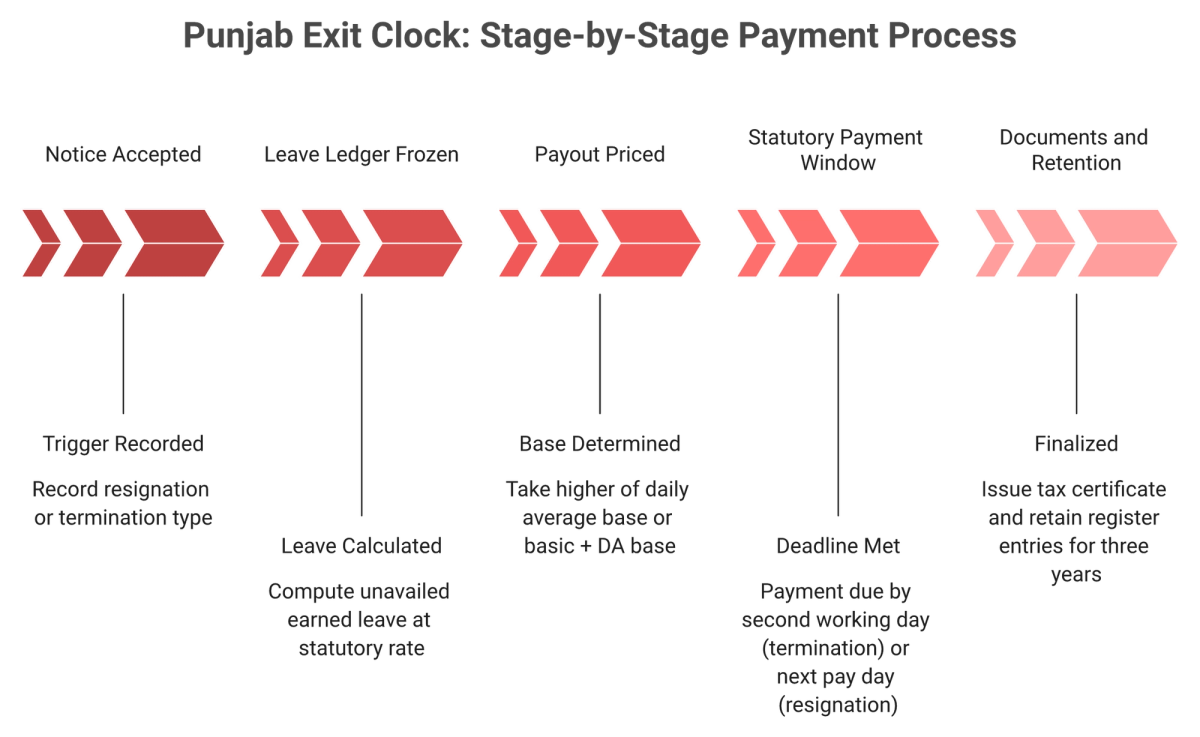
Most US finance teams run a 30 to 45 day final settlement cycle. Punjab gives you two working days on a termination. I have never seen an offshore approval chain move that fast without the number being pre authorised.
Versatile Club locks the F and F amount the day notice is accepted, which removes the approval step from the critical path. That is one of the mechanics we walk through on how it works.
📋 The statutory sequence
| Trigger | Rule | Section |
| Employer removes an employee | One month notice or pay in lieu, after 3 months of service | s.22 |
| Employee resigns | Seven days notice or pay in lieu, after 3 months of service | s.23 |
| Termination by employer | Wages and leave in lieu by end of second working day | s.16(4) |
| Resignation | Wages and leave in lieu on or before next pay day | s.16(4) |
| Un availed leave | Cannot be counted toward notice period | s.14(3)(b) |
| Claim window | Six months from the date the claim accrues | s.16 proviso |
⚠️ What non payment actually costs
Section 18 lets a judicial magistrate direct payment of the withheld wages plus compensation of up to eight times that amount. That sits on top of any penalty under Section 26. Section 22(2) adds two months' salary as compensation where an employee is removed without reasonable cause.
Section 23(2) runs the other way. If an employee quits without the seven day notice, the employer may forfeit unpaid wages for up to seven days.
✅ The F and F checklist
Record the notice date and the trigger type, resignation or termination.
Freeze the leave ledger and compute un availed earned leave under Section 14(b).
Price it using the higher of the Section 15(2) daily average and the basic plus DA base.
Settle PF, gratuity where five years of service applies, and TDS in the same run.
Pay inside the Section 16(4) window, then issue Form 16 for the year.
Retain the register entries for three years under the 1958 Rules.
"Founder is just a call away. Extremely helpful in resolving all our queries."
— surbhi m., Founder Versatile Club G2 - Verified Review, 15 June 2026
"The team is really competent, but there were a few time zone misunderstandings that caused slight delays in the initial phase."
— Setu C., Client Versatile Club G2 - Verified Review, 10 June 2026
Versatile Club is the legal employer on its own Indian entity, so exits are executed directly rather than routed through a partner shell, which is where the two working day clock usually gets lost. Buyers comparing that structure often start with our Deel alternative breakdown.
Q7. Which holidays, working hours, and weekly offs must a Punjab employer give?
Section 12 of the Punjab Shops and Commercial Establishments Act, 1958 requires paid holidays on Independence Day, Republic Day, and Mahatma Gandhi's birthday, plus three other festival holidays declared by the Government. Working a declared holiday attracts double the normal hourly wage. Hours are capped at nine a day and 48 a week under Section 7, with overtime at twice the normal rate and a ceiling of 50 overtime hours a quarter.
🗓️ The holiday floor, by establishment type
Shops and commercial establishments get three national holidays plus three declared festival holidays under Section 12. Industrial establishments sit under the 1965 Act, which requires three national holidays and festival holidays fixed in consultation with worker representatives.
Rule 3 of the 1966 Rules sets the process. Festival holidays are determined before 30 November, notified to workers before 31 December, and a copy goes to the Inspector. Where employer and workers cannot agree, the Conciliation Officer steps in, and the Labour Commissioner decides before 31 December.
🎉 Mapping the Punjab calendar
Punjab's declared list carries dates most head office calendars miss, including Guru Nanak Jayanti, Guru Ravidas Jayanti, Lohri, and Baisakhi. US teams often publish a generic nine day India calendar built around Diwali and Holi. The gazette list, not the head office template, sets the floor.
Versatile Club issues a Punjab specific holiday calendar to each client team at the start of the leave year, drawn from the state notification rather than a national default. Founders making a first hire usually pick this up during hiring employees in India.
⏰ Hours, breaks, and the weekly off
| Requirement | Rule | Section |
| Daily and weekly hours | 9 hours a day, 48 a week | s.7(1) |
| Overtime | Twice normal hourly wages, 50 hours a quarter maximum | s.7(2) |
| Rest interval | 30 minutes after 5 hours of work | s.8(1) |
| Spread over | Maximum 10 hours a day including breaks | s.8(2) |
| Close day | Every Sunday, unless notified otherwise | s.10(1) |
| Weekly off | One day a week where no close day applies | s.11 |
Normal wages for overtime means basic wages plus allowances, excluding bonus, under the Explanation to Section 7(2).
⚠️ One provision to read carefully
Section 30(1) prohibits women from working at night, with night defined in Section 2(xvii) as at least twelve consecutive hours including the interval between 8 pm and 6 am. The Punjab Rules narrow that window further in practice.
This is the clause most often quoted without a caveat. The Labour Codes move toward consent based night work for women, so check the current state position before writing a shift policy, using the Punjab Labour Department Acts and Rules index. Versatile Club tracks state rule notifications across all 28 states as one India workstream, which is the practical benefit of a single country footprint.
Versatile Club builds the client holiday calendar, the weekly off pattern, and the overtime rate card into the employment contract at onboarding, so the Section 12 floor is contractual rather than discretionary. Our compliance page lists the registrations behind that contract.
Q8. Can you run unlimited PTO for a team in Punjab?
Not as a replacement for statutory leave. Sections 20(2) and 20(2A) of the Punjab Act require every employer to keep a record of working hours, rest intervals, leave taken, and overtime for each employee, and to mark attendance in the register within one hour of duty starting. Discretionary time off can sit above the statutory floor. The tracking obligation does not go away, and in hierarchical Indian teams unlimited policies usually produce less time off, not more.
⭐ The idea everyone likes
Unlimited PTO reads as trust. No accrual tables, no balances, no petty approvals. It has become default advice for distributed teams, and for a US team it often works fine.
Then you apply it to a Mohali engineer and two separate things break.
❌ The statutory break
The register is not optional. An inspector under Section 19 can enter the premises and examine the prescribed registers and records at any reasonable time. Section 20(5) makes contravention punishable with a fine for every day the contravention continues, and Section 20(6) treats a knowingly false entry as an offence carrying up to three months of imprisonment.
"We do not track leave" is not a policy position in Punjab. It is an unrecorded register. Versatile Club maintains the attendance and leave registers for every client employee under its own Shops and Establishments registration, which keeps the floor documented while the client runs whatever sits above it. Teams weighing that against a build often read our EOR versus entity in India comparison.
❌ The cultural break
Here is the part the policy blogs skip. In high context Indian workplaces, juniors read an absent rule as a test. One founder I worked with had a Bengaluru engineer who took four days in a year while his US counterparts took three weeks.
Craig Storti records an offshore engineer messaging his American manager for permission to take a dinner break, explaining simply, "because I'm your subordinate." Reed Hastings, who removed Netflix's vacation policy, is blunt about the failure mode. Not allotting vacation days can create conditions "where no one dares to take a day off work." He also notes the quiet virtue of the rule everyone mocks, since use it or lose it actually pushes people to rest.
✅ What works instead
Build the statutory floor, then add a floor on usage, not just a ceiling.
Keep the Section 14 entitlements as the recorded baseline in the register.
Add discretionary days above it, stated as non encashable and non carry forward.
Set a minimum take, for example 12 days a year, and report on it monthly.
Have the senior most person on the India team take leave first and say so in writing.
Recap every approved absence in email, so the record and the reality match.
Versatile Club's read is that the standard advice gets this backwards. The constraint is not the policy document, it is whether the manager models the behaviour, and I would rather defend a register than a philosophy.
Versatile Club keeps the statutory attendance and leave registers current for every client employee, so a generous policy upstairs never becomes an empty register downstairs. If you want to pressure test your own Punjab policy, tell us what you are building.
Q9. What registers and filings keep a Punjab employer inspection ready?
Punjab employers must keep a record of working hours, rest intervals, leave taken, and overtime for every employee under Section 20(2) of the Punjab Shops and Commercial Establishments Act, 1958, mark attendance in the register within one hour of duty starting under Section 20(2A), display a notice of the close day and working hours under Section 20(1), keep a photograph of every employee who completes three months of continuous service, and preserve registers for three years under the Punjab Shops and Commercial Establishments Rules, 1958. Versatile Club maintains these registers and renewal filings under its own registration number for every client employee in Punjab.
📋 What an inspector actually opens first
Not your policy PDF. Under Section 19, an inspecting officer can enter at any reasonable time, examine the prescribed registers, records, and notices, and take evidence on the spot.
So the sequence is register, then notice, then employment records. Versatile Club keeps the Punjab register set current monthly rather than reconstructing it before an audit, which is the part clients underestimate. Our India compliance operations are built around that monthly cadence.
💸 What non compliance costs
| Failure | Consequence | Section |
| Register or notice not maintained | Fine for every day the contravention continues | s.20(5) |
| Knowingly false entry | Up to three months imprisonment, or fine, or both | s.20(6) |
| Obstructing an inspector | Fine on conviction | s.21(2) |
| Any other contravention | Fine, higher for repeat offences within a year | s.26 |
Cash penalties under the 1958 text are small. The real exposure shows up in M&A diligence, where a missing three year register trail becomes a disclosure item. It is also the first thing we rebuild during a switch of EOR provider in India.
🗓️ The Punjab compliance calendar
| What is due | When | Source |
| Registration statement for a new establishment | Within 30 days of commencing work | s.13(3) |
| Registration certificate renewal | By 31 March, 30 days grace | s.13(2)(ii) |
| Notice of any change in registered particulars | Within 7 days of the change | s.13(4) |
| Notice of closure | Within 10 days of closing | s.13(5) |
| Festival holidays fixed with worker representatives | Before 30 November | Rule 3, 1966 Rules |
| Holiday statement to workers and Inspector, Form A | Before 31 December | Rule 3 and Rule 7 |
| Holiday, casual, and sick leave account, Form D | Maintained through the year | Rule 7 |
| Register preservation | Three years from the date the record relates to | 1958 Rules |
✅ Your inspection ready file
Registration certificate, current year, displayed.
Attendance register with entries made within the first hour of duty.
Leave and overtime record per employee, tied to the April to March year.
Notice of close day, working hours, and rest intervals, exhibited on site.
Employee photographs after three months of service.
For industrial units, Form A holiday statement and Form D leave account.
For the current forms and amendment status, the Punjab Labour Department publishes its Acts and Rules index. Teams without an India entity usually hand this whole file to an HR outsourcing partner.
Versatile Club holds the Shops and Establishments registration and files the renewals under its own entity, so an inspection in Mohali lands on Versatile Club's record set rather than on a client with no India presence.
Q10. How do you run one leave policy across Punjab and the rest of India?
Build one national policy at the most generous common denominator, then attach state riders only where a state requires more. Punjab's rider is short: the April to March leave year under Section 2(xxxi), a 30 day carry forward cap, seven casual and seven sick days, and the two working day final settlement rule. Versatile Club runs this floor plus rider model across all 28 states from a single Indian entity, so one policy document covers a Mohali, Bengaluru, and Pune team.
🧱 Two architectures, one that survives
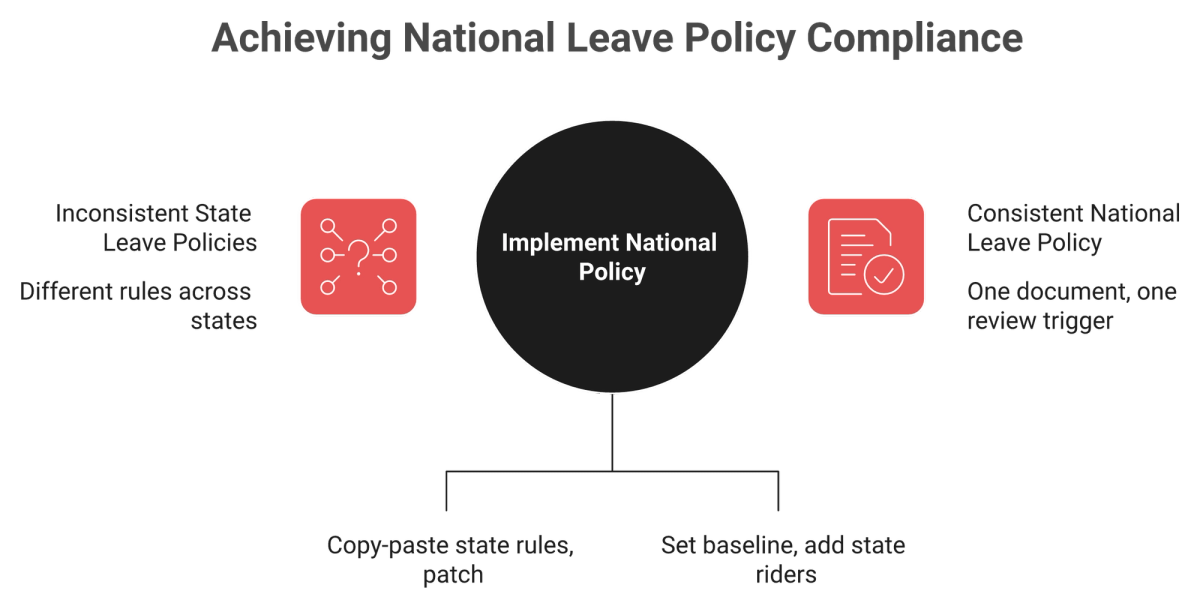
Most teams build state first. They write a Punjab policy, then copy it to Karnataka, then patch it. That works until an audit in the state with the stricter rule.
Floor plus rider inverts it. Set the national baseline at the highest common entitlement, then add only what a state mandates on top. Versatile Club builds client policies this way because it fails safe, not because it is tidier. Our HR consulting team drafts the baseline before any state rider is written.
🗺️ Why states actually differ
| State | The detail that breaks a copied policy |
| Punjab | Leave year starts 1 April, not 1 January |
| Maharashtra | Professional tax needs dual PTRC and PTEC registration, monthly slab |
| Karnataka | Monthly professional tax cycle plus S and E renewal |
| Tamil Nadu | Biannual professional tax filing, plus Labour Welfare Fund |
| West Bengal | Rule changes land often, so riders need a review cadence |
| Delhi | No professional tax, but strict Shops and Establishments enforcement |
Versatile Club's compliance knowledge here comes from running contract to hire payroll across these states, not from a global wiki. I have been wrong about a state before, usually West Bengal, which is why the rider carries a review date. The same state map drives our payroll outsourcing services in India.
🧾 The six field rider template
Capture these per state, nothing more.
Leave year start date.
Earned, casual, and sick leave entitlement with the section reference.
Carry forward cap and encashment trigger.
Holiday floor and the notification deadline.
Final settlement deadline on resignation and on termination.
Register set and renewal date.
Add one review trigger, the date that state notifies its rules under the Labour Codes. Until then the old state Act governs.
📊 Coverage, stated plainly
| Provider | India states covered | India employment entity |
| Versatile Club | All 28 | Own registered Indian entity |
| Deel | Top 6 by volume | Local partner entity |
| Remote | Top 4 by volume | Local partner entity |
Coverage matters only if you hire outside the metros. If your whole India team sits in Bengaluru, this row is not your deciding factor, and a straight Deel versus Remote comparison for India may settle it faster.
"As a founder running a lean agency, hiring talent in India without a local entity was a compliance minefield PF, ESI, TDS, professional tax across states."
— Vedant T., Founder Versatile Club G2 - Verified Review, 16 June 2026
"The dashboard could be a little more self-serve, a couple of times I wanted to pull a report or a doc myself and ended up just messaging my contact instead."
— Angad S., Founder Versatile Club G2 - Verified Review, 21 June 2026
Versatile Club operates in India only and employs across all 28 states on its own entity, so a client with people in Mohali, Bengaluru, and Pune runs one policy with three riders, one employer, and one USD invoice.
Q11. Entity, global EOR, or India native EOR, which route fits your Punjab hires?
For one to thirty India hires, an India native Employer of Record (a company that legally employs your staff in India on your behalf) that owns its own entity gives Punjab level statutory depth without a six month subsidiary build. Global platforms covering 90 to 150 countries typically route Indian employment through local partner entities and register in only the top four to six states. Versatile Club employs on its own Indian entity across all 28 states, invoices in USD from India, and contracts a five day onboarding SLA.
🧭 The five criteria that decide this
Entity ownership, state coverage, who maintains the statutory registers, how fast final settlement clears the Section 16(4) two working day window, and invoicing currency. Price matters, but it is the fifth question, not the first. Run your own numbers on the EOR versus entity calculator before you shortlist.
1️⃣ India native EOR with an owned entity
✅ Employs on its own Indian entity, so the Punjab registration, register set, and final settlement sit with one party.
✅ Versatile Club covers all 28 states, charges no setup or exit fee, and gives founder level support on WhatsApp rather than a ticket queue.
❌ Not built for teams that need five or more countries.
✅ Pricing sits at $149 per employee per month, below the $400 to $599 global generalist band.
❌ Enterprise procurement asking for SOC 2 or ISO 27001 as a gate should look elsewhere first.
The full scope of that model sits on our EOR services in India page, with the fee structure on pricing.
2️⃣ Global EOR generalist
✅ Genuinely strong if you are hiring in six countries at once and want one dashboard.
✅ Mature self serve tooling and predictable onboarding at 7 to 14 days.
❌ India is usually delivered through a partner entity, which adds a hop when a Punjab register or an encashment query needs an answer.
✅ Wide contractor and equipment coverage.
❌ State coverage is concentrated in the metros, so Mohali, Ludhiana, and Amritsar hires get thinner handling.
If you are comparing the India leg specifically, the best EOR in India roundup sets out the same criteria side by side.
3️⃣ Your own Indian subsidiary
✅ Full control, and the right answer past roughly 50 India employees.
✅ No per employee EOR fee.
❌ Setup runs into tens of thousands of dollars and months of work before hire one.
✅ Direct relationship with EPFO, ESIC, and the state labour department.
❌ You now own the Punjab register, the 31 March renewal, and the two day exit clock yourself.
Teams weighing the build against a faster start often read hiring in India without an entity first.
"We looked at setting up a subsidiary and quickly realized it would take 6+ months, cost tens of thousands in legal and registration fees."
— Verified User in Information Technology and Services, Founder Versatile Club G2 - Verified Review, 23 June 2026
"The initial process took a little getting used to, but the team was quick to guide us through."
— Verified User in Venture Capital & Private Equity, Client Versatile Club G2 - Verified Review, 22 June 2026
✅ The decision rule
One to thirty India hires, any state: India native EOR. Five or more countries: global generalist. Fifty plus India employees with a long horizon: build the entity.
Versatile Club is the legal employer on its own Indian entity across all 28 states, with USD invoicing from India, no setup or exit fees, and a five day contractual onboarding SLA, which G2 reviewers describe as a first India hire onboarded in four days. If a Punjab hire is next on your list, tell us what you are building.
FAQs
How many earned, casual, and sick leaves are mandatory in Punjab?
Under Section 14(a) of the Punjab Shops and Commercial Establishments Act, 1958, every employee earns one day of earned leave for every 20 days of employment. Over a full year that works out to roughly 18 days. A young person aged 14 to 18 accrues faster, at one day per 15 days.
- Earned leave: 1 day per 20 days worked, about 18 days a year
- Casual leave: 7 days with wages under Section 14(4)
- Sick leave: 7 days with wages under Section 14(4)
- Carry forward cap: 30 days, and 40 days for a young person
Industrial establishments are different. They fall under the Punjab Industrial Establishments (National and Festival Holidays and Casual and Sick Leave) Act, 1965, which sets its own casual and sick leave position. Where ESI sickness benefit covers an employee, that benefit takes over the sick pay function.
Half day rounding matters too. Section 14(c) treats a fraction of half a day or more as a full day, and ignores anything smaller. Versatile Club codes these entitlements into the employment contract at onboarding through our India EOR services, so the policy your team reads matches the statute an inspector checks.
Does the leave year in Punjab run April to March or January to December?
April to March. Section 2(xxxi) of the Punjab Act defines a year as one commencing on the first day of April, so accrual, carry forward, and lapse all reset on 1 April rather than 1 January.
This single definition causes more reconciliation errors than any other line in the statute. Most US and UK HR systems default to a calendar year because that is how the home country runs. The result is a Punjab employee whose recorded balance does not match the statutory position at year end.
- Accrual is measured across the April to March cycle
- The 30 day carry forward cap is applied at 31 March
- Mid year joiners accrue from their joining date, not from January
- Refused leave under Section 14(2) must still be allowed inside the same statutory year
Versatile Club builds every Punjab leave ledger on the April to March year with the carry forward cap hard coded, which is why balances reconcile to Section 14 instead of a head office default. If you are inheriting a payroll from another provider, this is the first field to check during a switch of EOR provider in India.
Is leave encashment mandatory in Punjab, and when must final settlement be paid?
Yes, on exit. Section 14(b) entitles a departing employee to wages in lieu of un availed earned leave at the same accrual rate, whether they are discharged, dismissed, or resign.
The deadline is where most foreign employers slip. Section 16(4) requires wages plus leave in lieu to be paid before the expiry of the second working day after termination by the employer. Where the employee resigns, payment is due on or before the next pay day.
- Un availed leave cannot be set off against notice period under Section 14(3)(b)
- Leave pay is calculated on the Section 15(2) daily average of the preceding month's full time earnings, including dearness allowance and excluding overtime and bonus
- Under the Code on Wages, basic plus dearness allowance must be at least 50 percent of total remuneration, which lifts the encashment base
- Section 18 allows a magistrate to order compensation of up to eight times the wages withheld
Versatile Club pre computes the full and final figure at notice acceptance and pays it from its own Indian entity inside that statutory window, so a client approval cycle never becomes the employee's late payment. You can model the liability against your headcount using our India salary calculator.
Did the Labour Codes replace Punjab's leave rules from 21 November 2025?
Not yet, and not entirely. The four Labour Codes came into force on 21 November 2025, but full operation depends on central and state rules. Punjab has not notified its rules, so the 1958 Act continues to govern covered establishments in the interim.
What the Codes changed on paper:
- Annual leave eligibility fell from 240 to 180 days of work in a calendar year
- The accrual rate stayed at one day per 20 days
- Carry forward is capped at 30 days, and any excess must be encashed at year end
- Leave refused by the employer carries forward
There is a second limit worth reading carefully. The Ministry of Labour and Employment's FAQ states that leave provisions apply to workers, and to supervisors only where wages do not exceed 18,000 rupees a month. Most senior India engineers sit outside that band, so their leave rights still flow from the state Act and the contract.
Versatile Club ran both frameworks in parallel through the transition and applied the higher entitlement per employee, so no client ledger needed a retrospective correction. That dual compliance approach is part of our standing India compliance coverage.
Can we run one leave policy across Punjab and the rest of our India team?
Yes, if you build it as a national floor with state riders rather than copying one state's policy across the country. Set the baseline at the most generous common entitlement, then add only what a specific state mandates on top.
Punjab's rider is short. It covers the April to March leave year, the 30 day carry forward cap, seven casual and seven sick days, and the two working day final settlement deadline on termination.
- Maharashtra needs dual PTRC and PTEC professional tax registration on a monthly slab
- Karnataka runs a monthly professional tax cycle plus Shops and Establishments renewal
- Tamil Nadu files professional tax twice a year and adds Labour Welfare Fund
- West Bengal changes rules often, so riders need a scheduled review date
- Delhi has no professional tax but enforces Shops and Establishments strictly
Never invert the model. A Punjab first policy exported to Karnataka or Maharashtra will under comply somewhere.
Versatile Club operates in India only and employs across all 28 states on its own registered entity, so a client with people in Mohali, Bengaluru, and Pune runs one policy with three riders under a single employer. Teams weighing this against building locally usually start with our EOR versus entity calculator.