Table of contents (10)
- Q1. Should you even outsource payroll in India yet, or is it too early?
- Q2. What does it actually cost to outsource payroll in India in 2026?
- Q3. What is the difference between payroll software, managed payroll, and EOR?
- Q4. Which are the top 11 payroll outsourcing companies in India for 2026?
- Q5. Why does the 50% basic-pay rule quietly blow up your payroll budget?
- Q6. What does India's 2026 statutory compliance checklist require, and how does it change state by state?
- Q7. What hidden risks do founders miss: misclassification, PE, and FEMA?
- Q8. Is your payroll provider a DPDP data-security liability?
- Q9. How do you vet a payroll provider before you sign?
- Q10. Ready to make your first compliant India hire? Here is the 5-day path.
Outsource Payroll in India 2026: Top 11 Companies, Real Costs (₹30-₹150 PEPM) & Compliance Checklist
Q1. Should you even outsource payroll in India yet, or is it too early?
Outsource payroll the moment your contractor arrangement gets flagged by legal or finance counsel, usually before your 12th India hire. Below roughly 10 to 12 people, an Employer of Record (EOR, a company that legally employs your worker for you) is the bridge that carries you across compliantly without registering an entity. Pay engineers as contractors past that point and you build $25,000 to $40,000 in per-head back-pay exposure that surfaces in due diligence.
🚩 The moment your accountant says "this looks risky"
Most founders do not wake up wanting to outsource payroll. They get a message from a finance or legal advisor first.
The trigger is almost always the same. Someone reviews the contracts and says the India "contractors" look like full-time employees. That is the moment the calm ends.
I have watched this play out across our Contract-to-Hire placements over six years. You are kind of running with scissors if you do not hire an army of experts to cross every "t" on the arrangement. The anxiety is real, and it is rational.
"We used Versatile to hire our first employee in India after months of putting it off because the compliance side seemed like a mess."
Verified User in Information Technology and Services Versatile Club G2 Verified Review
🌉 The 12-hire tipping point
Here is the framework I use. Think of two structures across a river.
Your own Indian subsidiary is the Golden Gate Bridge. It is huge, permanent, and costs $50,000-plus and 12 to 18 months before your first hire. An EOR is the suspension bridge. Simpler, faster, and it gets you across the same river.
Most of the time you do not need the Golden Gate when a suspension bridge works. In our experience the tipping point sits around 10 to 12 hires. After a team crosses about 12 people, building an entity starts to make sense. Below that, an EOR is almost always the right call.
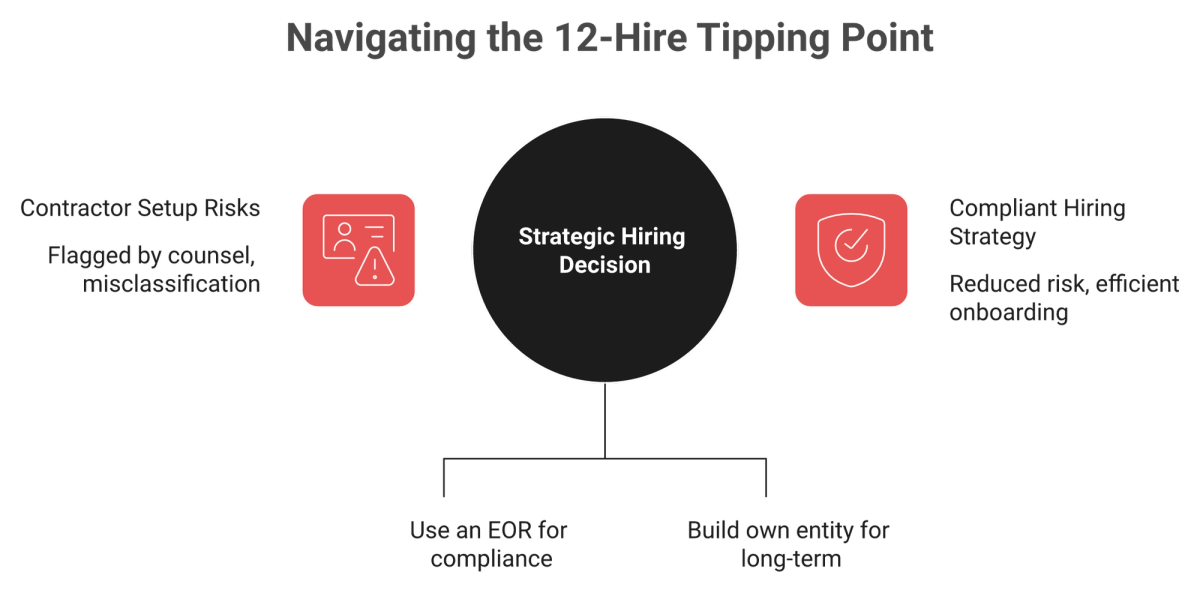
The cost of guessing wrong is specific. Misclassifying one full-time worker as a contractor can create $25,000 to $40,000 in back-pay and statutory exposure per head. That number is what kills a clean Series C due diligence.
✅ A quick self-diagnostic
Use this to locate yourself before you compare any vendor:
1 to 12 India hires, no entity: Use an EOR. It is the compliant bridge.
Contractor setup flagged by counsel: Move now, not next quarter.
12-plus hires, long-term India bet: Start planning your own entity, keep the EOR running in parallel.
One honest note on why you are here. I never advocate going to India because it is cheaper. That is a byproduct, not the pitch. You go to India for highly academically intelligent people, and then you owe them a compliant payroll.
At Versatile, our Contract-to-Hire and EOR model exists to be exactly that pre-tipping-point bridge. We employ your person through our own registered Indian entity, so the compliance floor is covered from day one while you decide whether the Golden Gate is ever worth building.
Q2. What does it actually cost to outsource payroll in India in 2026?
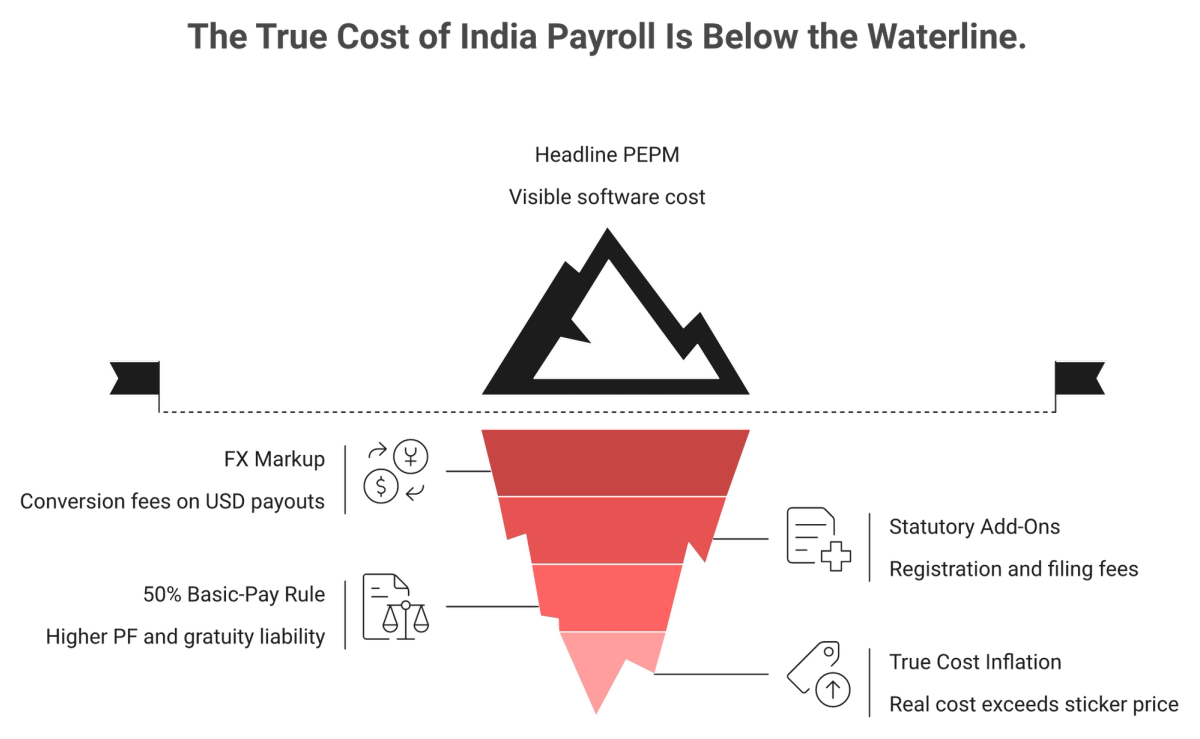
Payroll outsourcing in India runs roughly ₹30 to ₹150 PEPM (per employee per month) for software, ₹150 to ₹2,500 for managed services, and $49 to $650 per month for EOR, depending on whether you already own an Indian entity. The sticker price hides 3 to 5% FX (foreign exchange) markups on USD payouts and statutory add-ons that can lift the real cost 40 to 60%. Always ask for a sample invoice before you sign.
💰 The three price bands, plainly
Costs split by how much work you hand over.
| Model | Typical price | What it covers | Best for |
|---|---|---|---|
| Payroll software (SaaS) | ₹30 to ₹150 PEPM | A tool your team runs | You already own an Indian entity |
| Managed payroll | ₹150 to ₹2,500 PEPM | Provider runs the full cycle and filings | Own entity, but no in-house payroll team |
| EOR | $49 to $650 per month | Legal employment plus payroll plus compliance | No Indian entity yet |
Wisemonk anchors managed payroll near $49 per employee for companies that already own an Indian entity. Versatile's full managed payroll and EOR sits at $149, because we are the legal employer, not just a filing tool.
💸 The number the quote does not show you
The headline price is rarely the real price. Two things inflate it.
First, FX markup. Global platforms like Deel have been reported to add a 3 to 5% margin when they convert and pay in INR. On a $60,000 salary, that quietly skims thousands a year.
Second, statutory add-ons. Some providers charge extra for each filing, each state registration, or each off-cycle payment. Employees feel the fee side too.
"I find Deel to be absurdly expensive. They charge a high amount of fees for transferring money to my bank account."
Juan Camilo O. Deel G2 Verified Review
"There are hidden fees. Of course, again, also here. You will never get your net-agreed salary through Deel."
İbrahim Deel G2 Verified Review
My one hard tactical tip: ask for a sample invoice early. A real invoice exposes the markups and add-ons a pricing page hides.
At Versatile, we invoice in USD directly from our own Indian entity, so there is no FX gap between what you approve and what your engineer receives. No setup fee, no exit fee, and the first month is free. A founder can read the whole cost on one line, and you can check our transparent pricing before any call.
"USD invoice landed clean, no FX markup, no setup fee, no surprises."
Verified User in Information Technology and Services Versatile Club G2 Verified Review
Q3. What is the difference between payroll software, managed payroll, and EOR?
Payroll software (₹30 to ₹150 PEPM) is a tool your own team runs, and it needs your Indian entity. Managed payroll adds a provider who runs the full cycle and filings, but it still needs your entity. An EOR is the only legal option if you have no Indian subsidiary: the provider's entity legally employs your people and files their PF, ESI, TDS, and professional tax.
🧩 Three models, one plain-English definition each
Think of it as how much you keep on your own plate.
Payroll software: A SaaS dashboard (RazorpayX, Keka, Zoho Payroll, greytHR). You do the work; the tool does the math. You need your own entity.
Managed payroll: A provider runs the monthly cycle, disbursement, and statutory filings for you. Still needs your entity.
EOR: The provider's own company legally employs your worker. It handles PF (Provident Fund), ESI (Employees' State Insurance), TDS (tax deducted at source), and professional tax under its registrations.
✅ The one question that decides everything
Ask yourself: do I have a registered Indian entity?
If yes, software or managed payroll works. If no, only an EOR is legal, because someone must be the legal employer in India, and that someone needs an entity. There is no way around it. If you are weighing the two paths, our EOR vs entity calculator makes the trade-off concrete.
This is where a common search trips people up.
⚠️ The PEO myth worth knowing
Many US founders search for a "PEO" (Professional Employer Organization, the US co-employment model). Here is the honest catch.
Traditional US-style co-employment PEO does not legally exist under Indian labour law. If you lack an Indian subsidiary, what you actually need is an EOR, even when your instinct says PEO. I could be blunt about it: the label most buyers type is not the product they can legally buy. We break this down further in our guide to PEO services in India.
At Versatile, we run as an India-native EOR through our own registered Indian entity. The PF registration, ESIC code, and Shops and Establishments licenses are ours, not a partner shell's. When we employ your engineer, their filings sit under our own registrations, which is exactly what the "no entity" founder needs.
Q4. Which are the top 11 payroll outsourcing companies in India for 2026?
The top 11 for 2026 span India-native EOR specialists (Versatile, Wisemonk), payroll software (RazorpayX, Keka, Zoho Payroll, greytHR), managed-service players (ADP India, Paysquare, TalentPro), and global generalists (Deel, Multiplier). The right pick hinges on one question: do you have an Indian entity? If not, only an India-deep EOR that owns its entity keeps you compliant. Depth beats country-count.
📊 The 2026 comparison at a glance
| # | Provider | Model | Starting price | Owns India entity | Best for |
|---|---|---|---|---|---|
| 1.1 | Versatile | India-only EOR + C2H | $149/mo | Yes | First India hire, culture-fit hiring |
| 1.2 | Wisemonk | India-native EOR | from $99/mo | Yes | India EOR, entity-owner payroll |
| 1.3 | RazorpayX Payroll | Payroll SaaS | ₹ low PEPM | - | Entity-owners wanting automation |
| 1.4 | Keka | Payroll + HRMS SaaS | ₹ PEPM | - | Mid-size India teams |
| 1.5 | Zoho Payroll | Payroll SaaS | ₹ low PEPM | - | Small teams in Zoho stack |
| 1.6 | greytHR | Payroll + compliance SaaS | ₹ PEPM | - | SMB statutory automation |
| 1.7 | ADP India | Managed payroll | Custom | Yes | Enterprise managed payroll |
| 1.8 | Paysquare | Managed payroll | Custom | Yes | Outsourced multi-state payroll |
| 1.9 | TalentPro | Managed payroll | Custom | Yes | Compliance-heavy payroll ops |
| 1.10 | Deel | Global EOR (150+ countries) | ~$599/mo | Partner entity | Multi-country teams |
| 1.11 | Multiplier | APAC-focused EOR | ~$400/mo | Partner entity | Asia-Pacific spread |
🔎 The mini-profiles
1.1 Versatile. India-only EOR through our own registered entity, USD invoicing from India, 5-day contractual onboarding SLA, and founder-on-WhatsApp support. Honest limit: we operate only in India, so if you need five countries, we are not your platform. See our full India EOR services.
1.2 Wisemonk. Strong India-native EOR with a $99 anchor, a 4.8/5 G2 profile, and SOC 2 plus ISO 27001. Honest limit: per-tier pricing above "from $99" is not fully transparent, and there is no published replacement guarantee or founder-direct support model. We compare directly on our Wisemonk alternative page.
1.3 to 1.6 (RazorpayX, Keka, Zoho, greytHR). Excellent payroll software if you already own an Indian entity. Limit: they are tools, not employers, so they cannot help a company with no entity.
1.7 to 1.9 (ADP India, Paysquare, TalentPro). Mature managed-payroll operators for entity-owners. Limit: they assume you already run an Indian entity and carry enterprise onboarding timelines.
1.10 Deel. Genuine 150-country reach and a clean interface. Limits: reported 3 to 5% FX markup, chatbot-first support, and India routed through a local-partner entity rather than owned depth. Founders weighing this often read our Deel alternative breakdown.
1.11 Multiplier. Solid Asia-Pacific EOR at around $400 per month. Limit: it is APAC-broad, not India-deep at the multi-state and labour-code level. See our Multiplier alternative comparison.
⚠️ Owned entity vs partner shell
Here is the split the category avoids saying out loud. Deel, Remote, and G-P mostly use local-partner entities in India. We do not.
Global platforms cover 90 to 150 countries and spread India expertise thin. Aggregators buy you country count; an owned Indian entity buys you audit-ready control over PF, ESI, and TDS filings, which is what a CFO actually cares about in diligence.
The support gap shows up in real reviews.
"Often the CS doesn't seem to have answers, which leads to emails back and forth... something I wanted answered in 20 minutes becomes a 4 day process."
Verified User in Computer Software Deel G2 Verified Review
"The PF transfer for employees after terminating their employment with Velocity was very poor. Limited help, delayed responses... they charged heavily per employee."
Verified User in Computer Software Velocity Global G2 Verified Review
Now the other side. India-native operators earn their place through depth and response speed, not breadth.
"Reliable EOR partner that simplified our India hiring process... it feels like working with a partner rather than just a payment or compliance vendor."
Verified User in Marketing and Advertising Wisemonk G2 Verified Review
Where does Versatile fit? We put ourselves at 1.1 for one reason: for a founder making a first India hire, an owned-entity EOR with a 5-day SLA, a 90-day Success Coach, a 6-month replacement guarantee, and the founder reachable on WhatsApp closes the exact gaps the generalist reviews above keep exposing. If that fits your stage, the fastest next step is to book a quick call.
"Founder is just a call away. Extremely helpful in resolving all our queries. The process is super smooth to setup India EOR."
surbhi m. Versatile Club G2 Verified Review
Q5. Why does the 50% basic-pay rule quietly blow up your payroll budget?
The 2025 to 2026 Labour Codes require Basic plus DA (Dearness Allowance, a cost-of-living top-up) to be at least 50% of CTC (cost to company, your total salary spend). Higher basic means higher PF, gratuity, and leave-encashment liabilities, so a provider quoting a low PEPM can still leave your true cost 10 to 20% higher than expected. Legacy payroll systems that never restructured Indian salary stacks silently under-compute your statutory outflow.
📏 The rule, in plain English
For years, Indian salary structures kept "basic pay" small on purpose. A low basic meant low Provident Fund and low gratuity, so take-home looked bigger.
The four Labour Codes, in force from 21 November 2025, ended that game. Basic plus DA must now sit at 50% or more of total CTC.
That one line reshapes the whole payslip, and it is a core part of payroll compliance in India.
💰 A worked example
Say you hire a Bengaluru engineer at ₹20,00,000 CTC.
Old structure: Basic set at 30%, so ₹6,00,000. PF and gratuity accrue on that smaller base.
New structure: Basic plus DA must reach 50%, so ₹10,00,000. Now PF (12% of basic) and gratuity (4.81% of basic plus DA) both climb.
The employer's real cost rises even though the CTC label did not move. In our experience, that gap runs 10 to 20% on statutory contributions alone. A cheap PEPM quote does not save you from it, which is why the true cost of hiring in India matters more than the sticker.
⚠️ Where legacy systems get it wrong
Here is the part the category glosses over. Many older payroll tools still run the pre-2025 basic-pay logic by default.
They compute PF and gratuity on the old, smaller base. The payslip looks fine, the filing is short, and nobody notices until an auditor does.
I could be cautious here, but from what surfaces when you actually run these numbers monthly, this is the single most common structuring error I see. Ask any vendor one blunt question: "Show me how you apply the 50% basic rule on a live CTC." If they hesitate, that is your answer.
At Versatile, we build compliant CTC structures at onboarding, not as a fix later. That means PF and gratuity accrue on the correct base from month one, so there is no back-pay surprise waiting to detonate in a Series C diligence review. This is baked into our managed payroll setup.
Q6. What does India's 2026 statutory compliance checklist require, and how does it change state by state?
Your 2026 checklist: keep Basic plus DA at 50% or more of CTC under the Labour Codes (effective 21 November 2025); deduct and deposit TDS (tax deducted at source) by the 7th of each month; issue Form 16 by 30 May; and file professional tax state by state. Maharashtra needs dual PTRC plus PTEC; Karnataka needs Shops and Establishments enrollment within 30 days; Tamil Nadu files professional tax twice a year. The Income-tax Act 2025 replaces Form 24Q with Form 138 from 1 April 2026.
✅ The central statutory checklist
Every India payroll cycle carries the same core filings. Here is the master list with the primary source behind each one.
| Requirement | Deadline | Primary source |
|---|---|---|
| Basic + DA at 50% or more of CTC | Ongoing from 21 Nov 2025 | Four Labour Codes, MoLE gazette |
| PF (12% of basic) + ESI (3.25% employer / 0.75% employee) | Monthly | EPFO / ESIC rules |
| TDS deducted and deposited | By the 7th monthly | Income-tax Act 2025 |
| Form 16 issued to each employee | By 30 May, annually | CBDT |
| Form 24Q replaced by Form 138 | From 1 April 2026 | Income-tax Act 2025 CBDT FAQ |
Miss the 7th-of-the-month TDS deposit, and interest starts stacking. These are not soft deadlines, and our compliance page tracks every one of them.
🗺️ Why one payroll becomes 28
Professional tax (PT, a small state-levied tax on salaried income) is where India stops being one country and becomes many. Each state writes its own rules.
A distributed team of ten people across four states is really four compliance calendars. This is the layer global platforms flatten and get wrong.
| State | PT / S&E requirement | Cadence |
|---|---|---|
| Maharashtra | Dual registration: PTRC + PTEC, slab-based | Monthly filing, annual return |
| Karnataka | Monthly PT + S&E renewal, enrollment within 30 days of joining | Monthly |
| Tamil Nadu | Biannual PT + Labour Welfare Fund contribution | June and December |
Note the traps. Delhi has no professional tax but strict Shops and Establishments rules. West Bengal changes its rules often enough that a "set and forget" filing breaks.
⏰ What this looks like in a live cycle
I have run PF, ESI, and multi-state PT across Bengaluru, Hyderabad, and Pune for six years. The abstraction "India compliance" only becomes real when a PTRC slab shifts, and a payslip has to change the same week.
That is the depth a global playbook cannot fake. A generalist covering 150 countries treats Karnataka's 30-day enrollment window as a footnote; for us it is a Tuesday. If you want the deeper mechanics, read our payroll outsourcing services in India guide.
At Versatile, every filing above runs under our own PF, ESIC, and Shops and Establishments registrations, held across all 28 states and 8 union territories. You do not assemble the checklist. We already hold it, and it powers our India EOR services.
Q7. What hidden risks do founders miss: misclassification, PE, and FEMA?
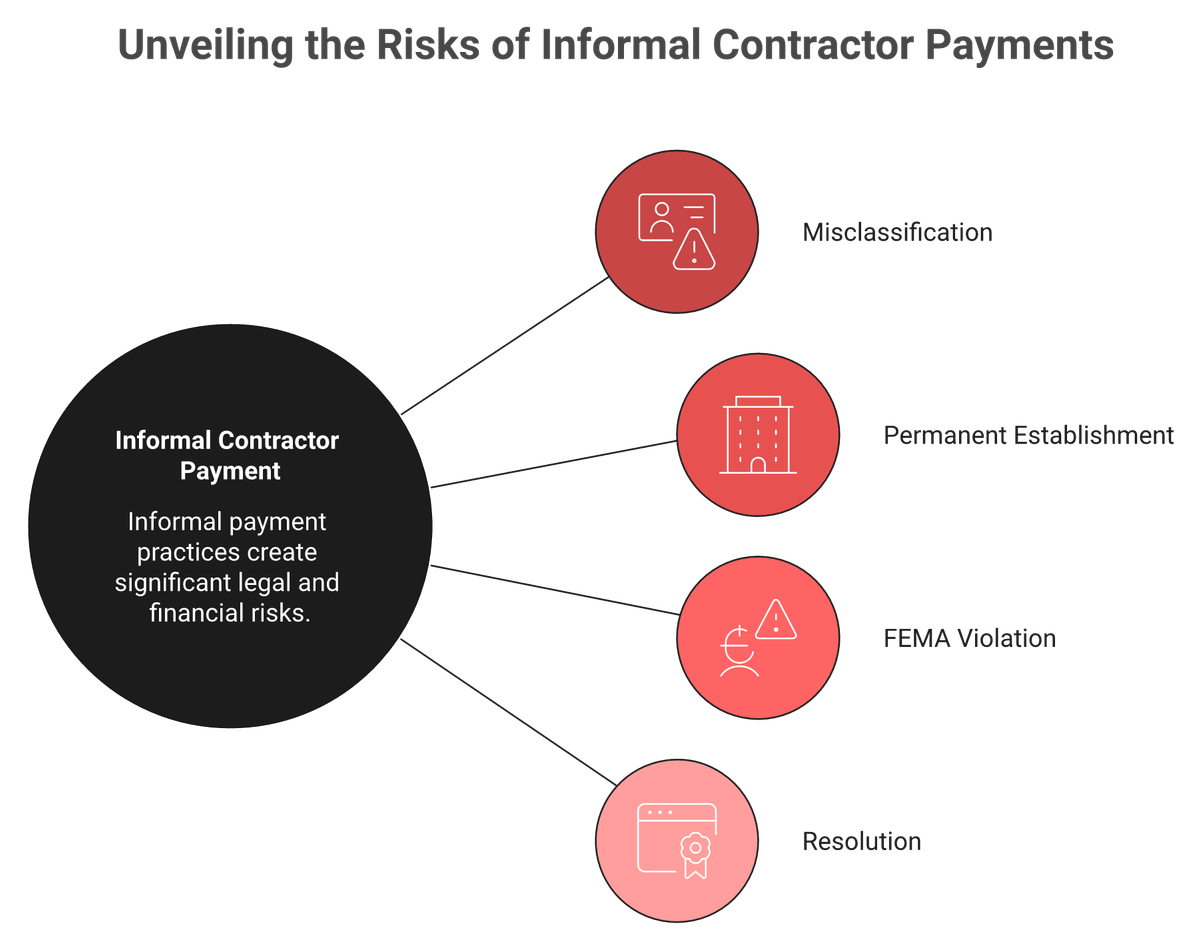
Three traps hide in informal contractor payments. Misclassification (paying a full-time worker as a contractor) creates $25,000 to $40,000 in back-pay exposure per head. Permanent Establishment (PE, a taxable business presence) risk means a de facto team can create a taxable Indian footprint for your foreign entity. FEMA violations (India's foreign-exchange law) arise when you pay USD directly instead of compliant INR by the statutory pay date. An EOR neutralizes all three by legally employing the worker.
🚩 The situation: a signal most founders miss
Let me tell you about a moment that says everything. An American manager told me that her offshore India colleague asked her, over instant message, for permission every time he wanted to take his dinner break.
She said it was not necessary. He insisted, "because I'm your subordinate."
That is not just culture. On a contractor-only payment rail, that master-and-servant relationship is a legal misclassification tell. It signals employment, not contracting, which is exactly the line we unpack in independent contractor vs EOR.
⚠️ The complication: three exposures compound
Once a "contractor" behaves like an employee, three risks stack up fast.
Misclassification: Reclassification can trigger $25,000 to $40,000 in back-pay, PF, and penalty exposure per head.
PE risk: A functioning India team can create a Permanent Establishment, pulling your foreign company into Indian corporate tax.
FEMA: Salaries must land in INR through compliant channels by the pay date. Wiring USD to a personal account directly can breach FEMA.
Any one of these surfaces in due diligence. Together, they can freeze a funding round.
✅ The resolution: one structure closes all three
Here is the standard read, backwards. Founders treat these as three separate problems to patch. They are one problem with one fix.
Employing the worker through a compliant Indian entity closes all three gaps at once. The person is a real employee, so there is no misclassification. The entity, not your foreign company, is the employer, so PE risk drops. And salary flows in INR by the pay date, so FEMA is satisfied. This is the core reason founders hire employees in India through an EOR.
At Versatile, that entity is ours. When we employ your engineer through our own registered Indian company, misclassification, PE, and FEMA exposure all resolve in a single move, and you get one clean USD invoice instead of three legal headaches. That is the heart of our EOR services.
Q8. Is your payroll provider a DPDP data-security liability?
Your payroll vendor processes your employees' salary, PAN, and UAN data, which makes it a data processor you are accountable for under the DPDP Rules 2025 (notified via G.S.R. 846(E), dated 13 November 2025). That means a 72-hour breach report to the Data Protection Board, a 48-hour pre-erasure notice, and a Data Protection Officer for Significant Data Fiduciaries. Add a DPDP data-processing addendum to every vendor contract.
🔐 Your payroll data is personal data
Here is the governing thought most payroll listicles skip entirely. The moment you outsource payroll, you hand over your employees' most sensitive personal data.
Salary figures, PAN (Permanent Account Number, India's tax ID), bank details, and UAN (Universal Account Number, the PF identifier) all move to your vendor. Under the DPDP Act 2023 and its Rules 2025, that data is protected, and you stay accountable for it.
Your vendor becomes your data processor. If they leak it, the exposure is partly yours, which raises the stakes on your HR outsourcing choice.
📋 The obligations, and the one action to take
The DPDP Rules 2025, notified as G.S.R. 846(E) on 13 November 2025, set concrete duties. Beyond these statutory points, there is no operator anecdote to add here; the rules speak for themselves.
72-hour breach report: A data breach must be reported to the Data Protection Board within 72 hours.
48-hour erasure notice: Individuals get advance notice before their data is deleted.
DPO requirement: A Significant Data Fiduciary (a large-scale data handler) must appoint a Data Protection Officer and run privacy assessments.
So the Monday-morning move is simple. Add a DPDP data-processing addendum to every payroll vendor contract, with a breach-notification SLA written in. You can pressure-test any vendor against our compliance standards.
I could be early on this, but where my head is right now is that DPDP turns vendor selection into a data-governance decision, not just a price decision. A chain of partner shells means your data passes through hands you never vetted. If you want to talk it through, you can book a call with us.
At Versatile, employment and payroll run through our own single registered Indian entity, so there is one accountable data controller, not a relay of third parties. That makes a DPDP-ready processing addendum straightforward to sign, because the data never leaves the entity you contracted with.
Q9. How do you vet a payroll provider before you sign?
Before you sign, demand a sample invoice to expose 3 to 5% FX (foreign exchange) markups, confirm the provider owns its Indian entity rather than renting a partner shell, and ask how they apply the 50% basic-pay rule. Test support speed too. Ask open questions like "Where are we on onboarding?" instead of "Are you on schedule?", and get every commitment recapped in writing.
✅ The six questions that separate real from shallow
I have sat on both sides of these calls for six years. The vendors who pass are boringly consistent; the ones who fail get vague fast. Run this checklist before money moves, and cross-check it against our how it works page.
"Can I see a sample invoice?" This exposes hidden FX markups and per-filing add-ons. A good answer is a real invoice on one line. Hesitation is the tell.
"Do you own your Indian entity, or use a partner?" Owned means direct control over PF (Provident Fund) and TDS (tax deducted at source) filings. A rented shell means your data and compliance pass through hands you never vetted.
"Show me how you apply the 50% basic-pay rule." This checks whether their payroll logic is current with the 2025 Labour Codes. A good provider walks you through a live CTC (cost to company) structure.
"Will you sign a DPDP data-processing addendum?" Under the DPDP Rules 2025, your vendor handles your employees' personal data. A clear yes, with a breach SLA, signals maturity.
"Who do I talk to when payroll breaks at 11pm?" Ask if you reach the founder or a rotating support queue. This one question predicts your next two years.
"What are your setup and exit fees?" Surprise exit fees are common. A good answer is a plain number, ideally zero. Compare against our transparent pricing.
💬 What the reviews reveal
Support quality is where vendors quietly separate. Read the complaints, not the marketing, and weigh them against genuine India EOR services.
"Often the CS doesn't seem to have answers, which leads me to emails back and forth... something I was looking for in 20 minutes becomes a 4 day process."
Verified User in Computer Software Deel G2 Verified Review
Now the other side, when a provider answers as a person, not a ticket.
"Founder is just a call away. Extremely helpful in resolving all our queries. The process is super smooth to setup India EOR."
surbhi m. Versatile Club G2 Verified Review
"Every payroll or PF question gets a real answer from a real person, usually same day."
Verified User in Information Technology and Services Versatile Club G2 Verified Review
⏰ One habit that saves you later
Here is a tactic from years of cross-border calls. Never ask closed yes-or-no questions like "Are we on track?" Ask open ones like "Where are we on onboarding?"
Then recap every commitment in writing right after the call. If a vendor resists a written recap, that is your answer.
At Versatile, we built the company to pass its own checklist. Sample invoice on request, our own registered Indian entity, no setup or exit fees, and the founder reachable directly on WhatsApp, not a CSM rotation. That is the backbone of our EOR services and managed payroll.
Q10. Ready to make your first compliant India hire? Here is the 5-day path.
You can have a compliant India hire onboarded in five business days through an owned-entity EOR (Employer of Record, a company that legally employs your worker for you). No setup fee, no entity to register, statutory filings handled from day one. The path: share the role and salary, review a sample invoice and compliant CTC structure, sign, and your hire is employed and paid in INR while you are invoiced in USD.
🌉 From "I have no entity" to "my engineer is paid"
The gap most founders feel is between wanting an India hire and dreading the setup. Building your own subsidiary costs $50,000-plus and takes 12 to 18 months. That is the Golden Gate when you needed a footbridge, as our EOR vs entity calculator makes clear.
Here is the shorter path we run, start to finish.
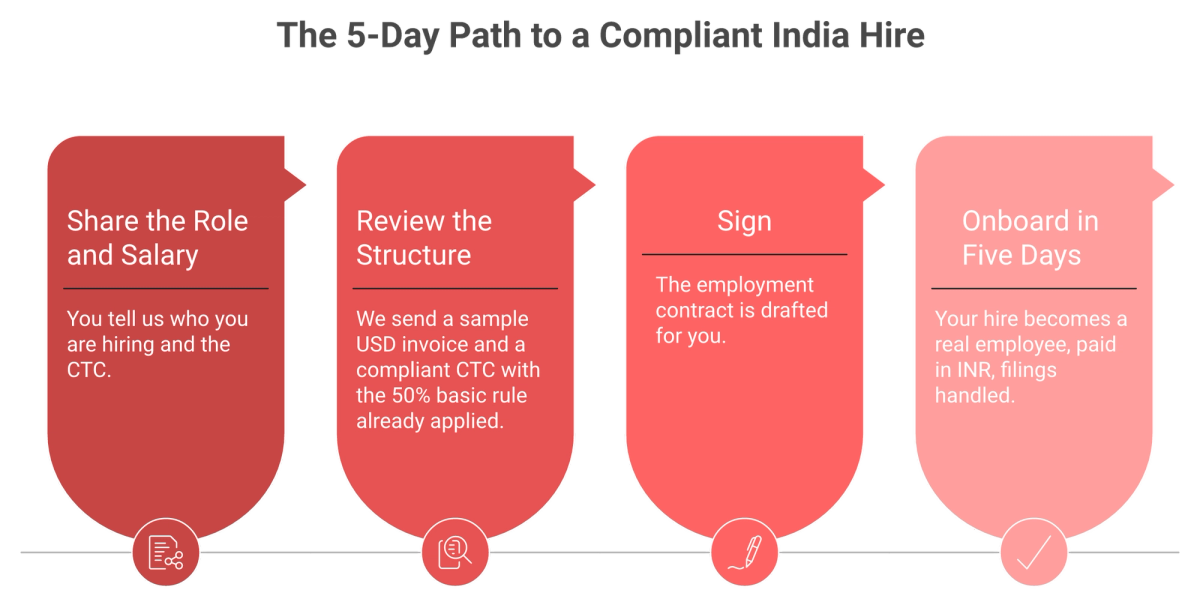
Share the role and salary. You tell us who you are hiring and the CTC.
Review the structure. We send a sample USD invoice and a compliant CTC, with the 50% basic rule already applied.
Sign. The employment contract is drafted for you.
Onboard in five days. Your hire becomes a real employee, paid in INR, filings handled.
✅ The safety net under the speed
Speed only matters if the hire sticks. So the offer carries real risk-reversal, which matters most for startups making a first India bet.
5-day contractual onboarding SLA, not a vague estimate.
90-day Success Coach to bed the hire in.
6-month replacement guarantee on C2H placements.
Culture-fit-first hiring scored on 50 behavioral parameters.
No setup fees, no exit fees, and the first month free.
One honest boundary. We operate only in India by design. If you need five countries, we are not your platform, and I will tell you that on the first call. If India is the focus, our contract to hire model is built for exactly this.
What I keep coming back to is this. Over the next two years, I think India stops being one flag on a 150-country map and becomes a specialist category of its own. So my real question for you is simple: what are you trying to build in India, and who is your first hire? Message me and let us talk it through.
"Versatile was the one that actually made it simple... first payroll ran on time, no scramble."
Angad S. Versatile Club G2 Verified Review
FAQs
How much does it cost to outsource payroll in India in 2026?
Costs in 2026 depend on how much work you hand over and whether you already own an Indian entity.
- Payroll software: roughly 30 to 150 rupees per employee per month, but you need your own entity to run it.
- Managed payroll: roughly 150 to 2,500 rupees per employee per month, with a provider running filings, still on your entity.
- EOR (Employer of Record): $49 to $650 per month, the only legal route if you have no Indian entity.
The sticker price rarely tells the full story. Global platforms often add a 3 to 5% FX markup on USD payouts, and some charge per-filing or per-state add-ons that can lift the effective cost 40 to 60%. Always ask for a sample invoice before you sign.
We invoice in USD directly from our own Indian entity, so there is no FX gap between what you approve and what your engineer receives. You can review our transparent pricing to see the all-in figure with no setup fee, no exit fee, and the first month free.
Do I need an Indian entity to outsource payroll, or can I use an EOR?
The answer hinges on one question: do you own a registered Indian entity?
- If yes: payroll software or managed payroll both work, because your entity is the legal employer.
- If no: an EOR is the only compliant option, because someone must legally employ your people in India, and that requires an entity.
Many US and UK founders search for a PEO (Professional Employer Organization). The honest catch is that US-style co-employment PEO does not legally exist under Indian labour law. If you lack a subsidiary, what you actually need is an EOR, even when your instinct says PEO.
With an EOR, the provider's entity files your team's PF, ESI, TDS, and professional tax under its own registrations. We operate as an India-native EOR through our own registered entity, not a rented partner shell. Explore our India EOR services to see how filings run under registrations we hold across all 28 states and 8 union territories.
What is the difference between payroll software, managed payroll, and an EOR in India?
These three models differ by how much work stays on your plate.
- Payroll software: a SaaS tool (like RazorpayX, Keka, Zoho Payroll, or greytHR) your team runs in-house. You need your own entity.
- Managed payroll: a provider runs the monthly cycle, disbursement, and statutory filings for you, but you still need your entity.
- EOR: the provider's own company legally employs your worker and handles PF, ESI, TDS, and professional tax under its registrations.
Software is cheapest but demands in-house expertise. Managed payroll removes the operational load while keeping you as the employer. An EOR removes the entity requirement entirely, which is why it suits first India hires.
We offer both managed payroll for entity-owners and full EOR for companies with no Indian presence. If you are weighing whether to build an entity or use an EOR, our EOR vs entity calculator makes the trade-off concrete before you commit.
What hidden risks come with paying India contractors directly instead of outsourcing payroll?
Paying India workers on an informal contractor rail hides three legal traps that surface in due diligence.
- Misclassification: paying a full-time worker as a contractor can trigger $25,000 to $40,000 in back-pay, PF, and penalty exposure per head.
- Permanent Establishment (PE) risk: a de facto India team can create a taxable presence for your foreign entity, pulling you into Indian corporate tax.
- FEMA violations: salaries must land in rupees through compliant channels by the pay date, so wiring USD to a personal account directly can breach India's foreign-exchange law.
Any one of these can freeze a funding round. The clean fix is one structure, not three patches.
Employing the worker through a compliant Indian entity closes all three gaps at once. When we employ your engineer through our own registered entity, misclassification, PE, and FEMA exposure resolve together. See how our EOR services insulate your company from risk while you scale your India team.
How do I vet an India payroll outsourcing provider before signing?
Run a short due-diligence checklist before any money moves.
- Demand a sample invoice: this exposes hidden FX markups and per-filing add-ons.
- Confirm entity ownership: an owned Indian entity means direct control over PF and TDS filings, unlike a rented partner shell.
- Test the 50% basic-pay rule: ask them to show how they apply it on a live CTC, which proves their payroll logic is current with the 2025 Labour Codes.
- Ask about DPDP: confirm they will sign a data-processing addendum with a breach SLA.
- Test support: ask who you reach when payroll breaks at 11pm, the founder or a rotating queue.
Get every commitment recapped in writing. If a vendor resists a written recap, that is your answer.
We built the company to pass its own checklist: sample invoice on request, our own registered entity, no setup or exit fees, and the founder reachable directly. Review our compliance standards to pressure-test any provider you are considering.