Table of contents (12)
Deel vs Multiplier for India Hiring (2026): EOR Pricing & Compliance Compared
Q1: Deel vs Multiplier for India: What Does the $200 Price Gap Actually Buy?
Deel lists $599 per employee per month for India EOR. Multiplier lists roughly $400, though its EOR rate is quoted elsewhere at $459 to $499. That gap buys country coverage, platform maturity, and bundled business insurance. It does not buy India depth. Both vendors serve India as a country module, so a statutory question routes through the same global support tier. Prices captured August 2026.
A VP People at a 140-person US company messaged me on WhatsApp three weeks ago. She had two renewal quotes open in separate tabs. Her India headcount had gone from 4 to 26 since the original decision, and nobody had re-run the math.
Her actual question was not "which is cheaper." It was "does the expensive one know something about India that the cheap one doesn't."
⏰ Why your original vendor decision expired
Most India EOR decisions get made at 3 or 4 employees. At that size, almost nothing about India compliance is visible to you. One payroll cycle, one Form 16, no state spread.
At 25 or 30 employees, the picture changes. You now have people in Karnataka, Maharashtra, and Telangana, which means three different professional tax regimes and three filing calendars.
💰 The pricing, dated and disputed
Deel publishes $599 per employee per month for EOR, plus a $500 setup fee and a one-month exit notice. Multiplier publishes roughly $400 with no setup fee and a two-week exit notice.
Here is the part most comparison pages miss. The widely republished $400 figure is contested. At least one India-focused analysis puts Multiplier's actual EOR rate at $459 annual or $499 monthly, and reads $400 as a contractor-adjacent rate.
| Line item (captured Aug 2026) | Deel | Multiplier | Versatile Club |
| EOR per employee per month | $599 | $400 to $499 | $149 flat |
| Setup fee | $500 | $0 | $0 |
| Exit notice | 1 month | 2 weeks | None |
| Stated onboarding | 7 to 14 days | ~7 days | 5 business days, contractual |
⚠️ What the premium is actually paying for
I want to be fair to Deel here, because the premium is not arbitrary. It buys the broadest country coverage in the category, the most mature self-serve platform, and bundled business insurance that no India-only provider carries.
If you will hire in three more countries over the next two years, that premium is defensible. If your entire non-US headcount sits in Bengaluru and Pune, you are paying for optionality you will never exercise.
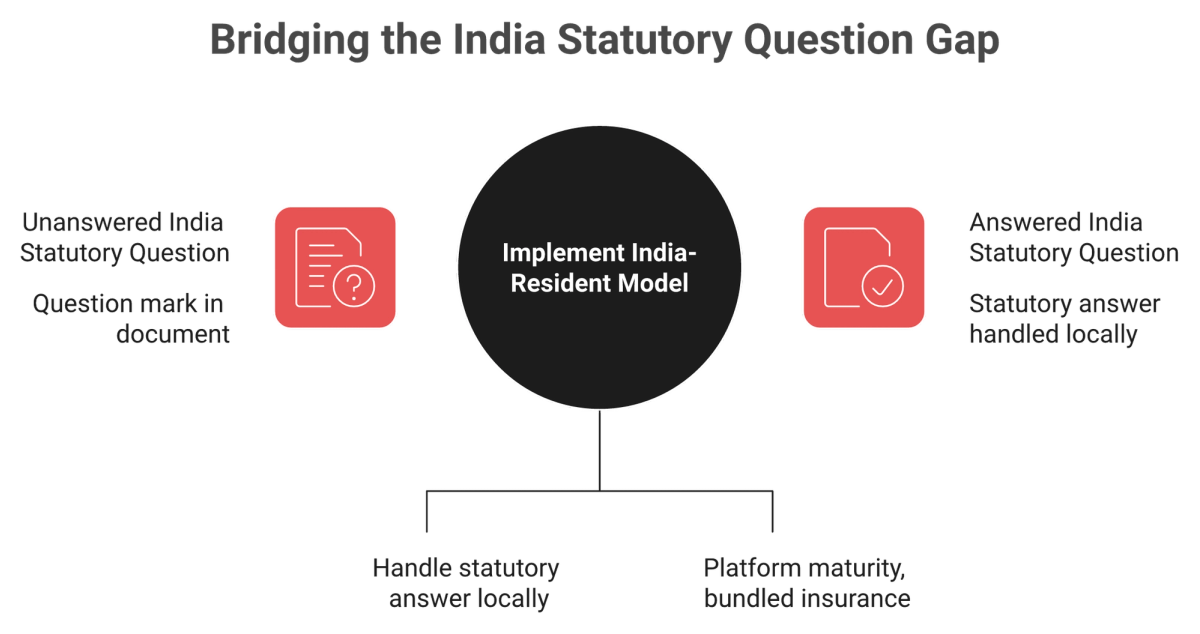
Versatile Club's read is that the standard advice gets this backwards. Buyers treat price as a proxy for compliance quality. Price is a proxy for country count, as the Deel alternative comparison sets out.
✅ The two questions that settle it
Ask both vendors the same two things, in writing, before you sign anything.
Who answers an India statutory question, and are they sitting in India?
In what currency does the invoice arrive, and who performs the conversion?
The founders I work with describe the same three failures every time: slow contracts, mystery FX charges, and compliance surprises that surface months later. All three trace back to those two questions going unasked.
Q2: How Should You Score Two EOR Quotes, and Isn't the Cheaper One Cheaper for a Reason?
Score India EOR quotes on six criteria: coverage breadth, invoice currency and FX treatment, India entity model, statutory filing ownership, support routing, and exit terms. Deel wins breadth. Multiplier wins entry cost and exit flexibility. Part of Deel's premium genuinely buys bundled business insurance, which is separate from India service depth, where the extra spend changes nothing.
Feature-count comparisons are useless here. Both platforms will tick every box on a generic HR feature grid. The differences that cost you money live in the contract, not the product tour.
⭐ The six criteria that actually decide it
| Criterion | What to ask | Where it lands today |
| Coverage breadth | How many countries do you employ in directly? | Deel wins clearly |
| Invoice currency and FX | Which currency, and who converts at what rate? | Verify in writing |
| India entity model | Give me the CIN of the employing entity | Unresolved publicly |
| Statutory filing ownership | Whose PF and ESIC codes carry the filings? | Verify in writing |
| Support routing | Is the person answering me based in India? | Both route globally |
| Exit terms | Notice period, and any unrecoverable fees? | Multiplier is looser |
Versatile Club scores itself on the same six rows, and loses the first one outright, because it employs in India only through its India EOR service.
⚠️ Yes, the cheaper vendor is cheaper for a reason
Let me concede this properly, because it is the objection every procurement lead raises. An unexplained discount reads as a warning, and sometimes it is one.
Deel bundles business insurance that covers you if a compliance issue surfaces years after the fact. That is a real thing you are buying, not a margin story.
💸 But separate the two things you are bundling
You are pricing two different products as one. The first is insurance cover, where the premium buys genuine protection. The second is India service depth, where the premium buys nothing measurable.
Both vendors run India through a country module rather than an India-resident operation. So your India answer quality depends on how the global support tier is staffed, which no pricing page describes.
✅ The test that makes this checkable on Monday
Stop asking vendors to describe their compliance. Ask them to produce it. Request the statutory pack for a live employee: the PF challan, the ESI challan, and the TDS deposit receipt for last month.
One vendor sends them within a day. The other escalates, then asks which partner to route it to. That difference tells you more than any RFP response, and it is the same test our India compliance operations are built to pass.
While you are there, ask each vendor for its band in Everest Group's 2025 EOR PEAK Matrix, which assessed 29 providers. Attach the answer to your procurement file. And treat any vendor-commissioned economic impact study as marketing, not evidence.
There is an old line about running global teams without local advisors that fits: you are running with scissors unless you hire an army of experts to cross every "t" on the arrangement. The statutory pack test is how you skip hiring the army.
Q3: What Is the Real All-In Cost per India Employee, Beyond the Sticker?
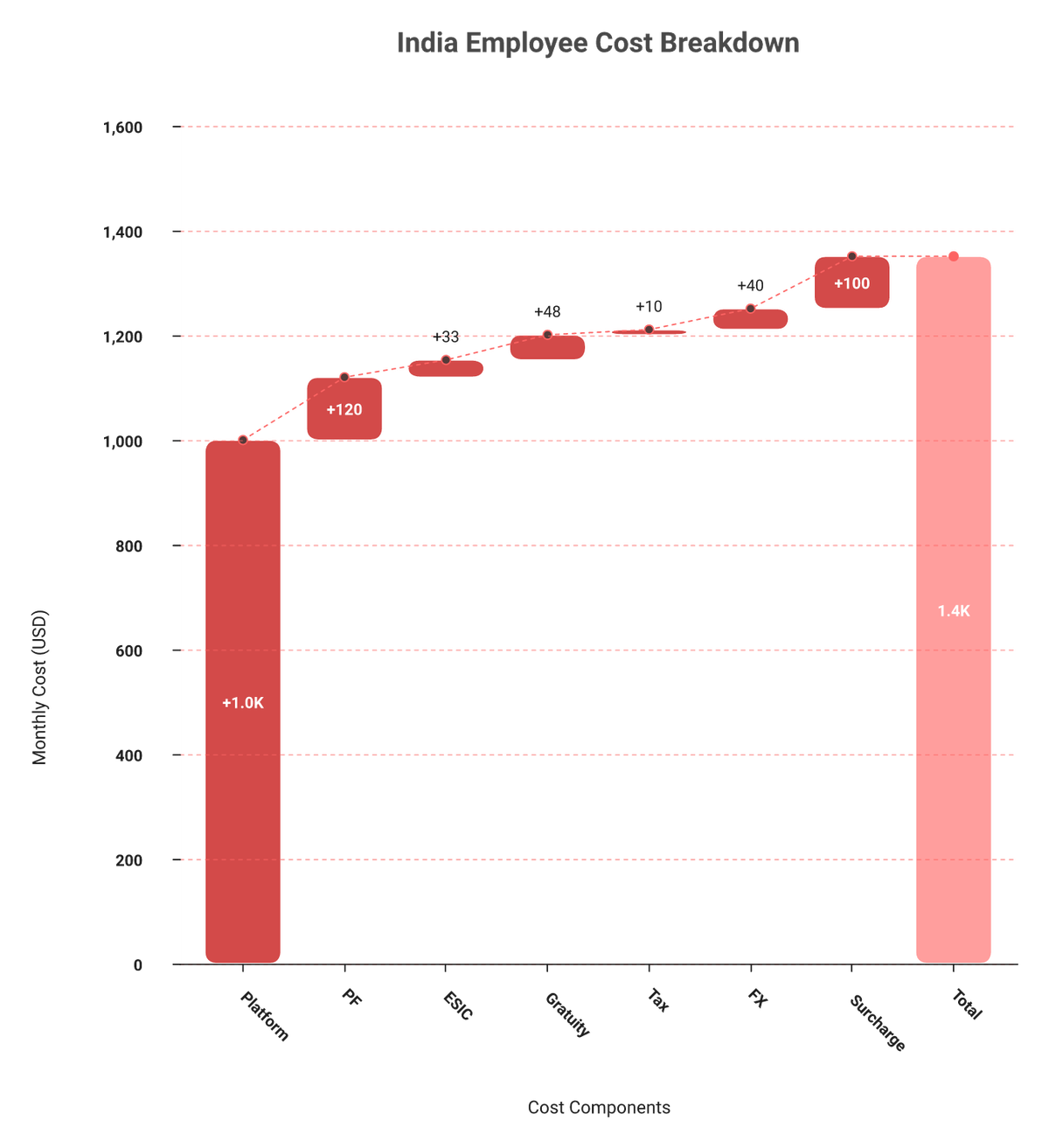
The sticker is not the bill. On top of the platform fee, an India employee carries employer PF and ESIC contributions, gratuity accrual at 4.81% of Basic plus DA, state professional tax, an FX spread of roughly 3% to 5%, and in some quotes an India surcharge of $50 to $150. All-in typically lands 30% to 60% above the advertised rate.
The finance leaders I work with get caught by the same thing. They budget the platform fee, then discover four more lines on the first invoice. None of those lines are hidden, exactly. They are just never on the pricing page.
💰 The five components of an India cost stack
Every India employee has the same five layers underneath the salary. Learn them once and you can audit any vendor quote in ten minutes.
Platform fee. The number on the pricing page, per employee, per month.
Statutory employer load. Provident fund (PF) at 12%, capped at the ₹15,000 wage ceiling, plus ESIC employer share at 3.25%.
Gratuity accrual. 4.81% of Basic plus DA, accruing from month one, not from year five.
Professional tax. State by state. Maharashtra needs both PTRC and PTEC with monthly slab filing. Karnataka is monthly with an S&E renewal. Telangana needs PTRC enrolment.
FX and surcharges. The conversion spread, plus any India-specific add-on.
🔍 The price-accuracy audit nobody runs
Here is where most comparison content falls apart. Contractor pricing and EOR pricing get mixed into the same table.
Deel's contractor rate sits near $49 per active contractor per month, against $599 for EOR. Multiplier's contractor rate is near $40, against a disputed EOR rate. Comparing $400 to $599 without checking which product each figure belongs to is the single most common error on this query, and it is why the India EOR cost breakdown matters more than a sticker.
💸 Platform fees over a year, three headcounts
| Annual platform fee only | 1 hire | 5 hires | 10 hires |
| Deel ($599) | $7,188 | $35,940 | $71,880 |
| Multiplier ($400) | $4,800 | $24,000 | $48,000 |
| Versatile Club ($149 flat) | $1,788 | $8,940 | $17,880 |
At ten employees, the Deel to Multiplier gap is $23,880 a year in platform fees alone. That is before statutory load, which the vendor collects and remits but which still hits your cash. Run your own numbers on the EOR versus entity calculator before you approve either quote.
⚠️ Where the FX spread quietly eats the saving
Whoever holds the currency conversion holds the margin. A 3% to 5% spread on a ₹40 lakh salary is real money, and it never appears as a line item called "FX."
Versatile Club invoices in USD from its own Indian entity at the mid-market rate with no markup, which is the standard I would hold any vendor to, including one that is not us. Our published pricing carries the same flat rate with no salary slabs.
✅ Your Monday morning ask
Send both vendors one email. Ask for a single India quote with four separate lines: platform fee, statutory load, FX spread, and any India surcharge.
A vendor that cannot itemise those four lines is not going to itemise your Form 138 filings either.
Q4: What Does Deel Actually Deliver for an India Team?
Deel's India EOR lists at $599 per employee per month, with a $500 setup fee, a one-month exit notice, and 7 to 14 day onboarding. It is genuinely strongest on country coverage, running contractors and employees in one system, platform maturity, and bundled business insurance. The India trade-offs are support routing and an FX markup that is widely reported but not vendor-confirmed.
⭐ What Deel is genuinely best at
I am not going to pretend Deel is a weak product. It is the most complete platform in this category, and the reasons are structural.
It employs across more countries than anyone else. It runs contractors and full employees in one system, which matters if half your India team started as freelancers. Its self-serve platform is better than anything an India-only provider has built, including ours.
The bundled business insurance is the underrated piece. If an India compliance issue surfaces in 2029 from a 2026 filing, that cover is real protection.
💰 The commercial terms, dated
Deel's published India EOR rate is $599 per employee per month as of August 2026, with a $500 setup fee and one month's exit notice. The setup fee is not recoverable if you leave.
Contractor management sits separately at roughly $49 per active contractor per month. Volume discounts exist, and reported ranges put larger accounts nearer $400 to $500 per employee. Teams weighing the switch usually start with the Deel alternatives for India shortlist.
⚠️ Where the India module gets thin
Deel's India offering is one country module inside a 150-country system. That design choice has consequences you feel only when something breaks.
Support runs chatbot-first, which is efficient for password resets and poor for "why is my Bengaluru engineer's PF challan missing three days before payroll." An FX markup of 3% to 5% is widely reported, though I have not seen it confirmed in Deel's own documentation, so treat it as unverified until you get it in writing.
Onboarding is quoted at 7 to 14 days. In Versatile Club's own placements across Bengaluru, Hyderabad, and Pune, the difference between 5 days and 14 days is usually a candidate accepting a competing offer, which is why our onboarding process is written into the service agreement.
💬 What Deel users actually report
Deel's aggregate G2 rating sits at 4.8 across roughly 5,885 EOR-product reviews, so the critical reviews below are not the consensus. They are the failure pattern worth pressure-testing in your reference calls.
"I find Deel easy to use, which is an important aspect as it enables me to navigate the platform without any hassle. The initial setup was straightforward... I find Deel to be absurdly expensive. They charge a high amount of fees for transferring money to my bank account."
— Juan Camilo O., Verified User Deel Hire - G2 Verified Review
"They consistently failed to meet committed deadlines, had terrible communication, and frequently cancelled meetings at the last minute."
— Verified User in Computer Software Deel Hire - G2 Verified Review
"The initial setup process was also very challenging; it took several days and involved a lot of emails, with issues arising at every step."
— Verified User in Translation and Localization Deel Hire - G2 Verified Review
✅ Who should pick Deel
Pick Deel if you will employ in three or more countries within 24 months. Pick it if a self-serve portal for employees matters more to you than escalation depth. Pick it if your board wants insurance-backed compliance cover.
Do not pick it because $599 feels safer than $400. On India specifically, the extra $200 buys you a wider map, not a deeper one. If neither map fits, the Multiplier alternative and India-resident options are worth a look before you sign a twelve month term.
Q5: What Does Multiplier Deliver for India, and Does It Invoice in INR or USD?
Multiplier lists roughly $400 per employee per month for EOR, with no setup fee, a two week exit notice, and about seven day onboarding. That is materially cheaper entry than Deel. Its EOR rate is disputed elsewhere at $459 to $499. India invoicing currency is the most decision relevant fact for finance, and it must be confirmed in writing before you model FX.
A CFO at a $12M ARR analytics company asked me one question on a call last quarter. Not about features. She asked which currency her India invoice would arrive in, because her month end close breaks when the number moves after approval.
⭐ What Multiplier is genuinely good at
Multiplier's entry economics are the real draw. No setup fee, a two week exit notice, and a stated onboarding window of about seven days beat Deel on all three.
Users who like Multiplier tend to like the same two things: straightforward setup and competitive pricing. That shows up even inside critical reviews, and it is the pattern worth checking against the Multiplier alternatives for India shortlist.
"I appreciate that Multiplier offered competitive pricing for its employer of record services, which played a significant role in my decision to use it. Additionally, the setup process with Multiplier was fairly straightforward."
— Micah P., Verified User Multiplier Employer of Record - G2 Verified Review
💰 The rate, shown with its dispute intact
Multiplier's widely quoted figure is $400 per employee per month. India focused analysis puts its actual EOR rate closer to $459 annual or $499 monthly, and reads $400 as a contractor adjacent number.
I am not going to resolve that for you, because only Multiplier can. Ask for the rate in a quote, with the product name printed next to it, then benchmark it against our flat India EOR pricing.
| Commercial term (Aug 2026) | Multiplier | Deel | Versatile Club |
| EOR per employee per month | $400 to $499 | $599 | $149 flat |
| Setup fee | $0 | $500 | $0 |
| Exit notice | 2 weeks | 1 month | None |
| Invoice currency for India | Confirm in writing | Confirm in writing | USD from its Indian entity |
💸 The invoicing question your CFO should ask first
Internal notes I have seen suggest Multiplier defaults to INR invoicing for India. I cannot verify that against current documentation, so treat it as a question, not a finding.
The consequence matters either way. If the invoice arrives in INR, your side absorbs the conversion, and the spread lands in your bank's margin instead of a line item you can audit. Teams that pay employees in India across two currencies feel this every month end.
⚠️ Where the savings can leak back out
Two reviewers describe contract and fee changes after signing, which is the pattern to pressure test in reference calls.
"They also introduced some new deposits and fees that weren't originally in our contract and ultimately ended up increasing our EOR costs."
— Verified User in Information Technology and Services Multiplier Employer of Record - G2 Verified Review
Multiplier's aggregate G2 rating is 4.7 across roughly 1,403 EOR reviews, so that experience is not the norm. It is still the failure mode a $200 saving can quietly fund.
✅ Who should pick Multiplier
Pick Multiplier if your headcount is India concentrated and entry cost decides the deal. Pick it if the two week exit matters because you plan to internalise your Indian entity within a year.
Versatile Club invoices in USD from its own Indian entity at the mid market rate, and I name that only because it is the standard I would hold any vendor to on this question. Ask Multiplier for the same commitment in writing. If it comes back yes, that is one less variable in your close.
Q6: Who Actually Answers an India Payroll Question at Each Vendor?
G2 rates Deel Hire 4.8 across roughly 5,885 reviews and Multiplier Employer of Record 4.7 across roughly 1,403. Multiplier scores higher on quality of support at 9.5 against 9.3. Deel scores higher on meets requirements at 9.4 against 9.2. Both route India questions through a global support tier, so answer quality depends on how that tier is staffed.
Scores tell you almost nothing about India. A 4.8 built mostly on US and EU contractor payments does not predict what happens when a Karnataka professional tax filing goes wrong.
⭐ The numbers, with counts and capture date
| Signal (captured Aug 2026) | Deel Hire | Multiplier EOR |
| G2 rating | 4.8 | 4.7 |
| Review count | ~5,885 | ~1,403 |
| Quality of support | 9.3 | 9.5 |
| Meets requirements | 9.4 | 9.2 |
Deel also carries roughly 4,252 Capterra reviews at 4.9 and 8,717 Trustpilot reviews at 4.7. Multiplier's base is smaller across every platform, which means individual experiences swing its average harder.
⚠️ What Deel reviewers report when things break
The Deel complaints cluster around implementation and responsiveness, not product quality.
"They consistently failed to meet committed deadlines, had terrible communication, and frequently cancelled meetings at the last minute."
— Verified User in Computer Software Deel Hire - G2 Verified Review
"The initial setup process was also very challenging; it took several days and involved a lot of emails, with issues arising at every step."
— Verified User in Translation and Localization Deel Hire - G2 Verified Review
❌ What Multiplier reviewers report
Multiplier's critical reviews cluster around account management turnover and resolution speed.
"Every issue, no matter how urgent, takes 3 to 10 business days to resolve. Account managers are polite but powerless to actually fix core problems."
— Kenneth P., Verified User Multiplier Employer of Record - G2 Verified Review
"The transition post-setup was problematic with multiple account managers leaving, leading to a loss of context and numerous other issues."
— Micah P., Verified User Multiplier Employer of Record - G2 Verified Review
Both reviewers still credit the platform interface as easy to use. That combination, good product and slow resolution, is the honest read on both vendors.
⏰ Why escalation design beats support headcount
A three to ten business day resolution window is fine for a benefits question. It is not fine three days before payroll, when a PF challan has not landed.
Versatile Club routes client escalation directly to me on WhatsApp, which is a structural choice rather than a service level claim, and it is documented in how our India EOR works. A ticket queue is also a structural choice, and it is the right one at 150 countries of scale.
✅ How to test support before you sign
Do three things this week. Filter G2 reviews to India based reviewers only, because that subset is what predicts your experience.
Then ask each vendor for three references who hired in India in the last twelve months. Finally, send a real statutory question to their support channel during your trial and time the response. If you are already mid-renewal, the notes on switching an India EOR provider cover what to ask before you serve notice.
Q7: Which 2026 India Statutory Changes Must Your EOR Already Handle?
Four changes reset India payroll in 2026. All four Labour Codes commenced on 21 November 2025 under Gazette S.O. 5322(E), which redefined wages. The EPF Scheme 2026 replaced the 1952 scheme, with mandatory contribution capped at the ₹15,000 wage ceiling. Form 16 became Form 130 and Form 24Q became Form 138 from 1 April 2026. DPDP Rules 2025 phase in employee data duties through May 2027.
If your vendor is still issuing a document called Form 16 for this tax year, that is your answer on India depth.
⏰ The four changes, with citations
Labour Codes. All four commenced 21 November 2025 via S.O. 5322(E) and related notifications.
EPF Scheme 2026. Notified June 2026, replacing the 1952 scheme. Mandatory provident fund contribution stays at 12% of the ₹15,000 ceiling, so ₹1,800 monthly. Above that, contributions are voluntary.
New tax forms. From 1 April 2026, Form 16 is Form 130, Form 16A is Form 131, and quarterly salary return Form 24Q is Form 138.
DPDP Rules 2025. Notified 13 November 2025 as G.S.R. 846(E), with substantive duties from May 2027 and penalties up to ₹250 crore.
⚠️ The wages rule everyone gets slightly wrong
You will read that Basic plus DA must be at least 50% of CTC. That framing is close but not exact.
The Code on Wages sets a deeming floor for computation. If excluded allowances exceed half of total remuneration, the excess gets added back into wages for PF and gratuity math. It is a calculation rule, not an instruction to restructure salaries.
💰 The state layer no country module handles well
India is not one payroll jurisdiction. Professional tax (a small state level employment tax) works differently in every state you hire in, which is why our multi-state compliance coverage is built state by state.
| State | What it actually requires |
| Maharashtra | Dual registration (PTRC and PTEC), monthly slab filing, annual return |
| Karnataka | Monthly PT plus S&E renewal, enrolment within 30 days of joining |
| Telangana | PTRC enrolment, monthly remittance deadlines |
| Tamil Nadu | Biannual PT, plus Labour Welfare Fund |
| Delhi | No PT, but strict Shops and Establishments compliance |
Versatile Club holds PF, ESIC, and Shops and Establishments registrations across all 28 states and 8 union territories, which is the coverage question to put to any vendor before you hire outside your first city.
💸 The recurring calendar underneath a payroll cycle
Three dates run every month. TDS is deducted and deposited by the 7th. PF and ESI challans follow their own filing windows. Gratuity accrues at 4.81% of Basic plus DA from month one, not from year five.
Across the multi state placements I have run in Bengaluru, Hyderabad, and Pune, the failures are almost never the big statute. They are a missed Karnataka enrolment window on a single new joiner, which is exactly what the monthly India payroll compliance calendar exists to catch.
✅ Three things to send Monday morning
Send your India CTC template and ask which components each vendor treats as wages after 21 November 2025.
Confirm in the service agreement whether contributions are computed on actual wages or on the ₹15,000 ceiling, and who funds any above ceiling matching.
Request a sample Form 130 and a Form 138 acknowledgement from a live client account.
Q8: Does Either Vendor Employ Your India Staff Through Its Own Entity?
Neither vendor's India entity model can be stated as fact here, because public sources conflict and asserting it wrongly is legal exposure. Verify it in one email. Ask for the CIN of the entity that will employ your staff, its PF establishment code, its ESIC code, and the state Shops and Establishments licence. Whoever holds those registrations holds the liability.
Most comparison pages will tell you confidently which vendor owns an India entity and which uses a partner. I have read four sources on this and they disagree with each other.
❌ Why I am refusing to answer this for you
One widely circulated analysis lists Deel as partner model for India and flags Multiplier as hybrid, then labels its own conclusion as inference. That word matters.
An entity model claim is a legal claim about who employs your people. Publishing an inference as a fact is not a copy error, it is exposure. So I am handing you the verification method instead of a verdict.
⚠️ Why the answer changes your risk profile
Whoever holds the PF and ESIC registrations is the legal employer of your India team. That determines who is liable in an inspection, and who can produce challans without a phone call to a third party.
The practical version is simpler. During an audit or a funding diligence, you need documents in hours, not a chain of forwarded emails through an unnamed local partner. This is the core difference between an owned entity and the routes covered in India expansion options.
✅ The four item request, copy and paste ready
Send this to both vendors. Any India EOR that cannot answer within a day is telling you something.
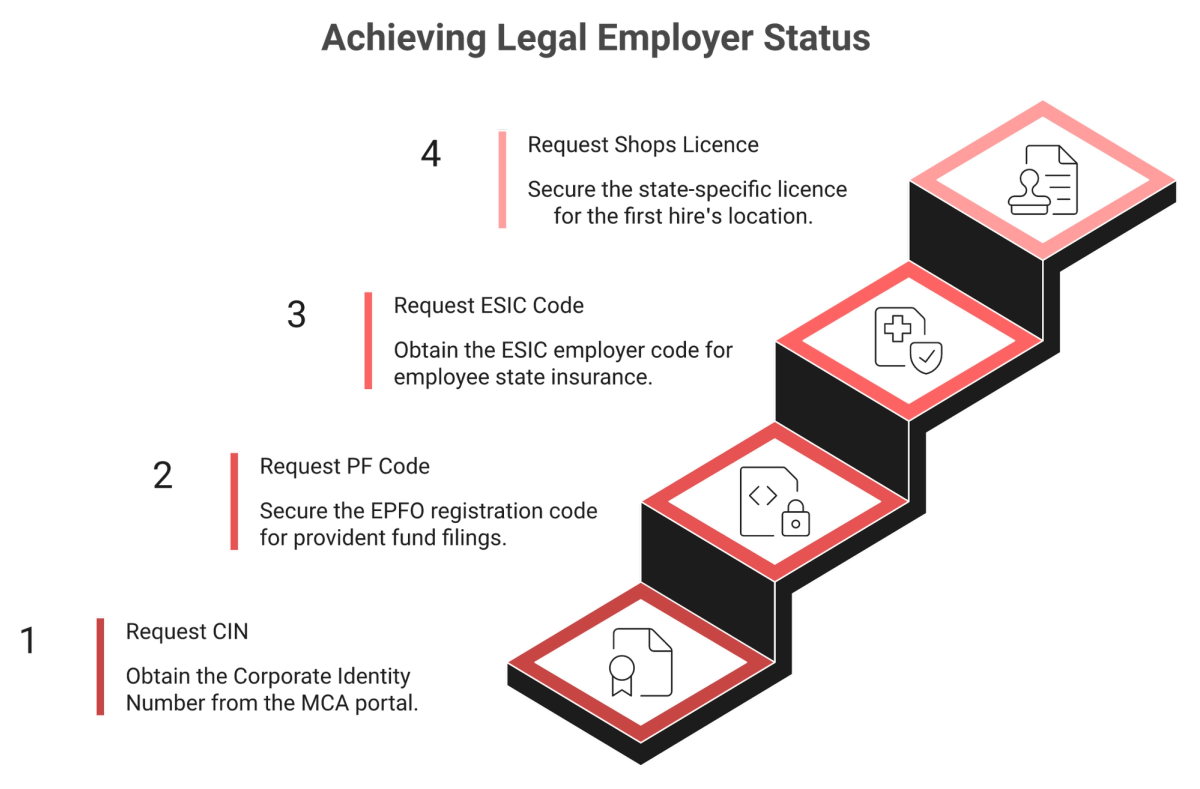
The CIN (Corporate Identity Number, the MCA registration number of an Indian company) of the entity that will appear on my employees' appointment letters.
That entity's PF establishment code under EPFO.
That entity's ESIC employer code.
The Shops and Establishments licence for the state where my first hire sits.
Then verify each one yourself. CIN on the MCA portal, PF code on the EPFO establishment search, ESIC code on the ESIC employer portal. It takes about fifteen minutes.
💰 One structural point on the PEO question
You will see PEO (professional employer organisation, the US co employment model) offered as an India option. Traditional US style co employment does not legally exist under Indian labour law, a point set out in detail in EOR versus PEO.
Without your own Indian entity, EOR is the only valid route. Anyone selling you India PEO is either mislabelling their EOR or has not read the statute.
⭐ What a straight answer looks like
Versatile Club employs India staff through Foo Falcon Technologies Private Limited, its own registered Indian company, with PF, ESIC, and Shops and Establishments registrations held under that entity. I include it here as a worked example of the format, not as a claim about anyone else, and the same detail sits on our India EOR services page.
Ask the same four questions of us, of Deel, of Multiplier, and of Wisemonk. The vendor that answers fastest with document numbers, rather than reassurance, is the one whose audit file will hold up.
Q9: Does Hiring Through an EOR Remove Permanent Establishment Risk in India?
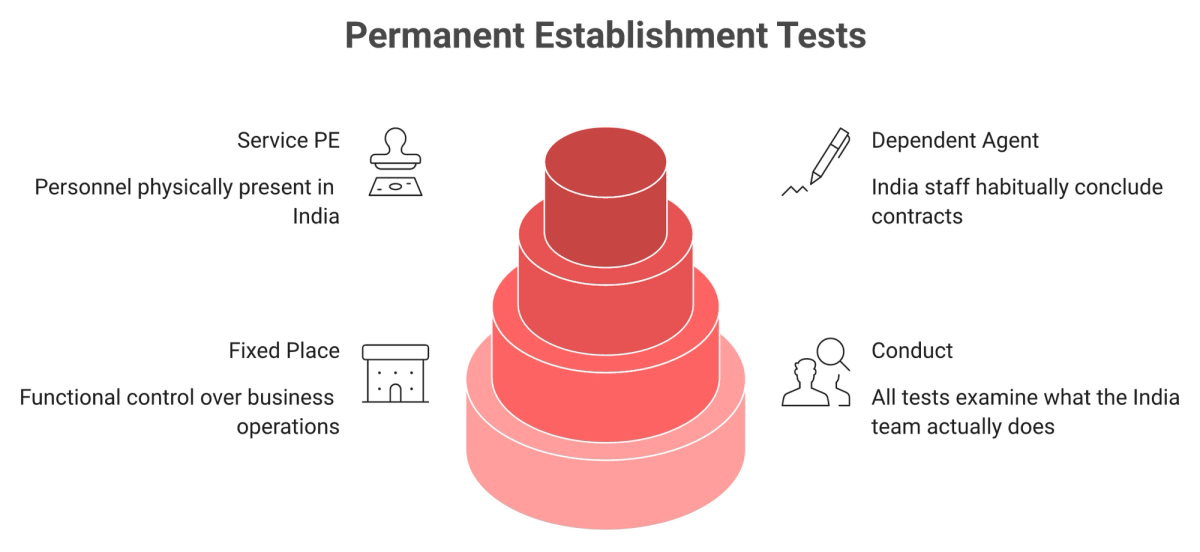
No, not by itself. India applies three permanent establishment (PE) tests: fixed place, dependent agent, and service PE. All three turn on conduct, not on whose payroll your people sit on. If your India based staff habitually conclude contracts or negotiate pricing for the foreign entity, dependent agent exposure arises anyway. Keep contracting authority with the home entity, and document it.
A US founder told me last year that his tax counsel had "cleared" India because everyone was on an EOR. That is the most expensive sentence in cross border hiring.
⚠️ What an EOR actually neutralises
An EOR (employer of record, a company that legally employs staff on your behalf) removes your employment law exposure. It handles the appointment letter, the provident fund filings, and the tax deductions under its own registrations, which is the model behind our EOR services.
What it does not do is change what your people actually do all day. PE risk is a tax question about business activity, and it sits in a different statute from labour compliance.
⏰ The two 2025 rulings that changed the analysis
The Supreme Court settled the fixed place question in July 2025. In Hyatt International Southwest Asia, the Court held that functional control over business operations, not the formal legal arrangement, decides whether a PE exists.
It also confirmed that profits can be attributed to an Indian PE even when the foreign parent is loss making globally. That detail matters for early stage companies who assume losses protect them.
The Delhi High Court then narrowed service PE in December 2025. In CIT v Clifford Chance Pte Ltd, it held that service PE under Article 5(6)(a) requires personnel physically present in India, and rejected the idea of a "virtual service PE" entirely.
The arithmetic in that case is worth knowing. Of 120 employee days in India, the court excluded 36 vacation days, 35 business development days, and 5 overlapping days, leaving 44 qualifying days against a 90 day threshold.
❌ Where India teams create exposure without meaning to
The pattern I see is almost never a filing failure. It is a job scope drifting past what the contract says.
A Bengaluru sales lead who quotes prices and signs order forms.
An engineering manager described externally as "Head of India" with apparent authority.
A country lead who runs client negotiations end to end from Pune.
Each of those looks like normal scaling. Each also looks like a dependent agent to an assessing officer reading your website and your email signatures.
✅ Three guardrails to put in place this month
Strip contracting authority from India job descriptions. Say plainly that India roles do not negotiate or conclude contracts.
Hold the signature matrix offshore. Every customer contract gets signed by a named officer of the US or UK entity.
Write a scope document per India role. One page, describing what the role does and does not do, kept with your tax file.
Versatile Club runs a written scope review before onboarding an India employee, and I flag PE risk on those calls even when the client has not asked. I could be reading the risk too strongly for very small teams, but the cost of being wrong is a multi year assessment. The India compliance framework we work to treats scope as a document, not a conversation.
⭐ The uncomfortable part nobody sells you
No EOR can insulate you from PE risk, and any vendor that claims otherwise has not read Hyatt. What an EOR does is remove the employment law layer so you can focus on the tax layer, which is the distinction drawn in the India EOR playbook.
What I keep coming back to is this. Compliance surprises that surface months later are almost always about conduct, not paperwork. So write down what your India team does before someone else decides for you.
Q10: What Does It Cost to Leave, Switch Providers, or Move to Your Own Entity?
Exit terms differ more than headline prices. Deel requires one month's notice against Multiplier's two weeks, and Deel's $500 setup fee is not recoverable. Moving to your own Indian entity means fresh PF and ESIC registrations, state Shops and Establishments licences, service continuity for gratuity, and re-issued appointment letters. Plan two to three months, not two weeks.
Nobody reads the exit clause during a vendor evaluation. Everybody reads it eighteen months later, usually in a hurry.
💰 The exit terms side by side
| Exit term (Aug 2026) | Deel | Multiplier | Versatile Club |
| Notice period | 1 month | 2 weeks | None |
| Setup fee recoverable? | No ($500 sunk) | No fee charged | No fee charged |
| Exit fee | Per contract | Per contract | None |
Versatile Club charges no setup fee and no exit fee, which I mention because zero on both lines is the standard I would ask any vendor to match before you sign.
⏰ What your employees actually experience
This is the part that decides whether a transfer feels routine or frightening to your India team. Three things must carry over cleanly.
UAN continuity. The Universal Account Number is the employee's permanent provident fund ID. It transfers to the new employer, so their PF corpus follows them.
Gratuity service continuity. Gratuity accrues at 4.81% of Basic plus DA. A break in recorded service can reset the five year vesting clock, so the handover documentation matters.
No payroll gap. The switch should land on a month boundary, with the outgoing provider issuing a full and final settlement.
✅ The six step transfer sequence
Serve notice in writing on the outgoing provider, on the date the contract specifies.
Register your own entity for PF and ESIC, or confirm the incoming provider's codes.
Obtain the Shops and Establishments licence for each state where employees sit.
Issue new appointment letters, with a service continuity clause referencing the original joining date.
Run one parallel payroll cycle, then reconcile TDS deposits and PF challans against both providers.
Collect the full and final settlement, Form 130, and closing challans from the outgoing provider.
The full version of this runbook, including what to tell employees in week one, sits in our guide on switching an India EOR provider.
⚠️ When to move to your own entity, honestly
I am not going to give you a clean headcount number, because the honest answer is contested. Some operators incorporate at 10 to 12 employees. Others hold EOR past 30.
Headcount is the wrong trigger anyway. The real triggers are needing Indian intellectual property ownership, needing local banking and vendor contracts, or needing to run an India P&L for a board. The trade-offs are laid out in EOR versus entity in India.
An EOR is a suspension bridge, not a permanent home. Versatile Club's C2H work over six years has converted plenty of placements to client entities, and the transitions that went badly were always the ones planned in three weeks instead of three months.
💸 The cost nobody budgets
Incorporation in India is not the expensive part. The expensive part is 12 to 18 months of a finance person's attention, plus a compliance calendar you now own forever.
Where my head is right now is that most Series A companies internalise too early, for status reasons rather than cash reasons. Run the calculation on your own numbers with the EOR versus entity calculator before you take the advice of whoever raised most recently.
Q11: Deel vs Multiplier Head-to-Head: The Table and the Verdict
Deel wins coverage breadth, platform maturity, and bundled business insurance. Multiplier wins entry price, setup fee, and exit notice. The two tie on India service depth, because both run India as a country module. Pick Deel if you will hire in three or more countries. Pick Multiplier if your headcount is India concentrated and entry cost decides the deal.
Every row below carries a capture date. Where a figure is disputed or unverifiable, it says so instead of pretending.
⭐ The full comparison, captured August 2026
| Row | Deel | Multiplier | Versatile Club |
| EOR per employee per month | $599 | $400 to $499 (disputed) | $149 flat |
| Contractor per month | ~$49 | ~$40 | Not offered |
| Setup fee | $500 | $0 | $0 |
| Exit notice | 1 month | 2 weeks | None |
| Stated onboarding | 7 to 14 days | ~7 days | 5 business days, contractual |
| Country coverage | Broadest in category | Broad, APAC strong | India only |
| Support model | Chatbot first, then tier | CSM by email | Founder on WhatsApp |
| India invoice currency | Confirm in writing | Confirm in writing | USD from its Indian entity |
| India entity model | Verify by CIN | Verify by CIN | Foo Falcon Technologies Pvt Ltd |
| G2 rating and count | 4.8, ~5,885 | 4.7, ~1,403 | No review base yet |
| Bundled business insurance | Yes | Not emphasised | No |
| India state coverage | Country module | Country module | 28 states, 8 UTs |
Sources: both vendors' published pricing and G2's product comparison, accessed August 2026.
💬 What users say on either side of the price gap
"I find Deel easy to use... I find Deel to be absurdly expensive. They charge a high amount of fees for transferring money to my bank account."
— Juan Camilo O., Verified User Deel Hire - G2 Verified Review
"The product user interface is relatively easy to navigate and use, and meets basic EOR workflow needs... they aren't very respectful of our employees when troubleshooting issues."
— Verified User in Information Technology and Services Multiplier Employer of Record - G2 Verified Review
"Every issue, no matter how urgent, takes 3 to 10 business days to resolve."
— Kenneth P., Verified User Multiplier Employer of Record - G2 Verified Review
Both aggregate ratings sit above 4.7, so these are failure modes to test, not verdicts.
✅ Pick Deel if three things are true
Your roadmap includes hiring in three or more countries within two years. Your employees will use a self serve portal daily. Your board wants insurance backed compliance cover behind the EOR.
At that profile, $599 is not expensive. It is the price of not running four vendor relationships. If it is only the India line you are unhappy with, the Deel alternative for India comparison covers the narrower swap.
⚠️ Pick Multiplier if two things are true
Your non US headcount is essentially all in India, and entry cost is what your CFO is optimising. The two week exit notice also helps if you plan to incorporate within a year.
What the price gap does not buy either way is an India resident operation. That is a different category of vendor, and it is worth a look at the best EOR providers in India before you sign a twelve month term.
Q12: What Does an India-Resident Provider Price Differently?
Versatile Club prices India as the whole business rather than one country module: a flat per employee monthly rate with no salary slabs, zero setup fee, zero exit fee, one USD invoice issued from its own registered Indian entity, and a five business day onboarding SLA written into the service agreement. It has no self serve platform, no security certification, and no review base, because its EOR launched in 2026.
Here is the observation that earns this section a place after the verdict. Both named vendors price India as one of 150 line items. An India resident provider prices it as the entire company.
💰 What the mechanics actually look like
Versatile Club charges $149 per employee per month, flat, with no percentage of salary and no slab that moves when you hire someone senior. The first month is free, and there is no setup or exit fee, as set out on our India EOR pricing page.
That structure exists because India is the only country in the model. There is no global platform cost to amortise across a country map.
⏰ How the operating layer is built
The compliance infrastructure came first, through six years of contract to hire work for US and UK companies. Placements ran across Bengaluru, Hyderabad, and Pune, which is where the multi state muscle was built.
Versatile Club employs India staff through Foo Falcon Technologies Private Limited, its own registered Indian company, with PF, ESIC, and Shops and Establishments registrations under that entity across 28 states and 8 union territories. Provident fund, ESI, TDS, and professional tax filings sit under our own registrations, not a partner's.
Escalation runs to me on WhatsApp. Not a CSM rotation, not a ticket queue.
❌ The concessions, stated plainly
I am not going to pretend this is a clean win on every row. Four things are genuinely better elsewhere.
Platform. Both Deel and Multiplier have a self serve portal that Versatile Club does not have. Their employee experience is better on a normal Tuesday.
Scale. Both operate at far greater volume, with the process maturity that brings.
Insurance. Deel bundles business insurance that no India native provider carries, including us.
Entry price. Wisemonk's published entry sits at $99, below $149. And Versatile Club's EOR has no review base and no SOC 2 or ISO 27001 certification yet, which rules us out of procurement processes that require it.
⚠️ Who should not pick an India-only provider
If you need five or more countries, buy a global platform. If your procurement gate requires a security certification today, we fail it. If you are hiring 100 plus in India with a formal RFP process, the enterprise vendors will handle your paperwork better, and our notes for enterprise India teams say the same thing.
✅ Where I think this category goes next
The decision rule for this article stays simple. Stop treating the price gap as a proxy for India quality, and ask both vendors who answers an India statutory question, and in what currency the invoice arrives.
Pick Deel for multi country breadth. Pick Multiplier for India concentrated cost efficiency. What I think shifts over the next two years is that India stops being a country on a global map and becomes a specialist category, with owned entity providers taking the India revenue the generalists treat as a rounding error. If you are running that comparison right now, message me and tell me which vendor answered the two questions faster.
FAQs
How much does Deel charge for India EOR, and why is it more expensive than Multiplier?
Deel's published India EOR rate is 599 dollars per employee per month as of August 2026, with a 500 dollar setup fee and a one month exit notice. Multiplier publishes roughly 400 dollars with no setup fee and a two week exit.
The premium is not arbitrary. It buys three things we think are genuinely valuable:
- The broadest country coverage in the category, which matters if you will employ in several markets.
- The most mature self-serve platform, including contractors and employees in one system.
- Bundled business insurance that covers you if a compliance issue surfaces years later.
What the premium does not buy is India depth. Both vendors run India as one country module inside a global platform, so an India statutory question routes through the same global support tier either way.
Versatile Club charges 149 dollars per employee per month flat, with no salary slabs, no setup fee, and no exit fee, and we publish that number openly on our India EOR pricing page. Before you sign either contract, ask both vendors for one India quote showing platform fee, statutory load, FX spread, and any India surcharge as separate lines.
Does Multiplier invoice in INR or USD for India, and why does invoice currency matter?
Multiplier's India invoicing currency must be confirmed in writing against its current documentation. Internal notes we have seen suggest an INR default, but we cannot verify that, so treat it as a question rather than a finding.
The reason it matters is cash predictability, not principle. If the invoice arrives in INR:
- Your side absorbs the currency conversion, so the amount you approve is not the amount that clears.
- The spread lands in your bank's margin instead of a line item you can audit.
- Month end close gets harder, because the India number moves after approval.
A CFO at a 12 million dollar ARR analytics company asked us exactly this on a call last quarter, ahead of any feature question. It was the right first question.
Versatile Club issues one USD invoice from its own registered Indian entity at the mid market rate with no markup, which is the standard we would ask any vendor to match. If you want the mechanics of cross-border India payroll before you negotiate, our guide on how to pay employees in India walks through the flow end to end.
What is the real all-in cost per India employee beyond the platform fee?
The sticker is not the bill. Every India employee carries five cost layers, and only the first one appears on a vendor pricing page.
- Platform fee. 599 dollars for Deel, roughly 400 to 499 for Multiplier, 149 flat for Versatile Club.
- Statutory employer load. Provident fund at 12 percent capped at the 15,000 rupee wage ceiling, plus ESIC employer share at 3.25 percent.
- Gratuity accrual. 4.81 percent of Basic plus DA, accruing from month one, not from year five.
- Professional tax. State by state, with Maharashtra needing dual PTRC and PTEC registration and Karnataka filing monthly.
- FX and surcharges. A conversion spread of roughly 3 to 5 percent, plus any India-specific add-on of 50 to 150 dollars.
Stacked together, all-in cost typically lands 30 to 60 percent above the advertised rate. At ten employees, the Deel to Multiplier gap alone is 23,880 dollars a year in platform fees before any statutory load.
Run your own numbers rather than trusting a blog table. Our India EOR cost breakdown itemises each layer with current rates.
Does Deel or Multiplier own an India entity, or do they use a local partner?
Neither vendor's India entity model can be stated as fact, because public sources contradict each other. An entity model claim is a legal claim about who employs your people, so we are not willing to publish an inference as a finding.
What you can do is verify it yourself in one email. Ask each vendor for four items:
- The CIN, the Corporate Identity Number of the Indian company that will appear on your employees' appointment letters.
- That entity's PF establishment code under EPFO.
- That entity's ESIC employer code.
- The Shops and Establishments licence for the state where your first hire sits.
Then check each one on the MCA portal, the EPFO establishment search, and the ESIC employer portal. It takes about fifteen minutes, and it tells you who is liable during an inspection and who can produce challans without calling a third party.
Versatile Club employs India staff through Foo Falcon Technologies Private Limited, its own registered Indian company, with PF, ESIC, and Shops and Establishments registrations held under that entity. Details sit on our India EOR services page, and we expect you to run the same four checks on us.
Does hiring through an EOR in India remove permanent establishment risk?
No, not by itself. An EOR removes your employment law exposure, because it holds the appointment letter and files PF, ESI, and TDS under its own registrations. Permanent establishment is a separate tax question about business activity.
India applies three PE tests, and all three turn on conduct rather than payroll location:
- Fixed place PE. The Supreme Court held in Hyatt International in July 2025 that functional control over operations decides this, not the formal arrangement.
- Dependent agent PE. Exposure arises if India-based staff habitually conclude contracts or negotiate pricing for the foreign entity.
- Service PE. The Delhi High Court held in Clifford Chance in December 2025 that this requires personnel physically present in India, rejecting a virtual service PE.
Three guardrails help. Strip contracting authority from India job descriptions, keep the signature matrix with the home entity, and write a one page scope document per India role for your tax file.
Versatile Club runs a written scope review before onboarding an India employee, and we raise PE risk on those calls even when nobody asks. Our India compliance approach treats scope as a document rather than a conversation.