Table of contents (12)
Multiplier India Pricing: EOR Fee, Deposit, Complexity Surcharge, Contractors
Q1. What does Multiplier actually cost per employee in India, and why do you see three different numbers?
As of 24 August 2026, Multiplier's pricing page shows Employer of Record starting at $400 per employee per month, and contractors at $40 per active contract per month, with no setup, onboarding, or offboarding fees. The search index for that same page, plus August 2026 reviews, describe Core at $459 annually and $499 monthly, with Growth at $519 and $559. India-specific pricing is published nowhere.
A CFO at a $12M ARR SaaS company sent me her Multiplier quote last quarter. She had budgeted $400 per head for four Bengaluru engineers. The number on the order form was not $400, and nobody had told her which page was current.
💰 The two prices Multiplier actually publishes
Only two of the five product cards on Multiplier's pricing page render a price at all. Global Payroll and Immigration show no figure. Enterprise routes to a sales conversation.
The FAQ is the only place the billing units appear. It reads: "Our pricing starts from $400 per month per employee," and "For contractors, you'll pay just $40 per active contract per month." Versatile Club quotes India at $149 per employee per month flat, which is a published rate rather than a starting point.
⚠️ Why the same URL returns $400 and $459
The rendered page and the indexed version of that page disagree. Treat $400 as possibly legacy or cached. Treat $459 annual and $499 monthly as the tier structure multiple 2026 reviews describe.
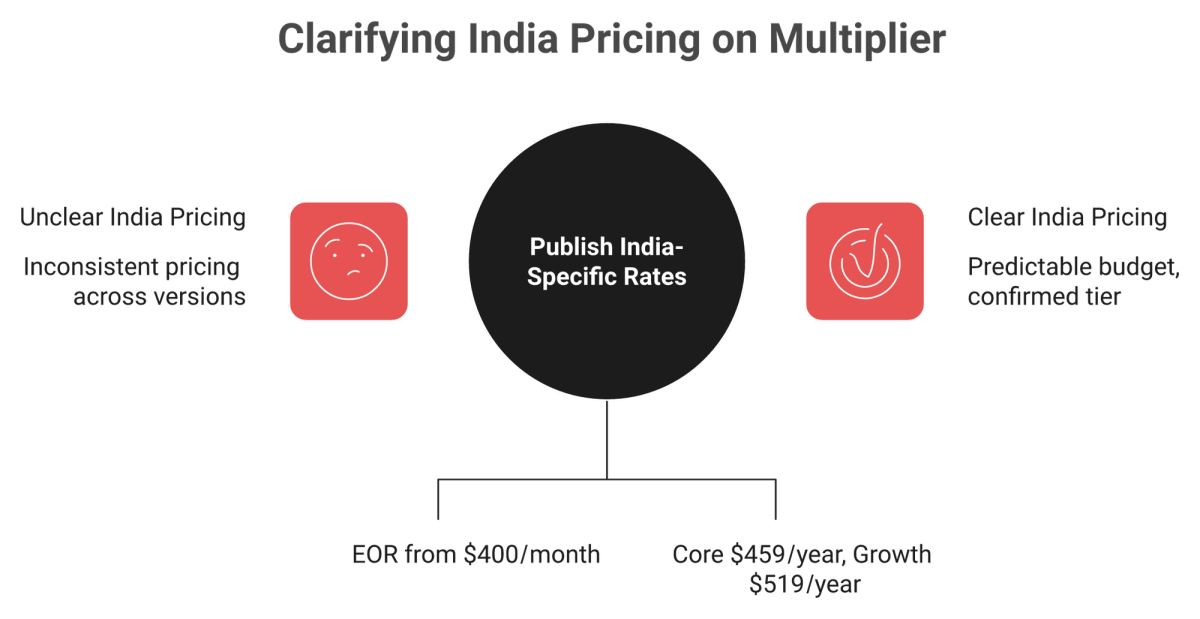
That $99 monthly spread is not academic. On ten India hires, it is $11,880 a year of budget you cannot forecast. One buyer describes a pricing-model change arriving by automated email:
"A critical issue arose when an uncommunicated change in their pricing model clashed with our existing master service agreement. This change, communicated via an automated email, left insufficient time for me to consider my options, effectively locking me into an annual billing cycle."
— Micah P., Buyer, Multiplier - G2 Verified Review
The same reviewer is fair about what drew him in: "Multiplier offered competitive pricing for its employer of record services, which played a significant role in my decision." If you are weighing that trade-off, our Multiplier alternative for India page sets the two models side by side.
📄 What the fee says it covers
Multiplier's FAQ lists seven inclusions: employment contract management, payroll management, local-law compliance, benefits and insurance administration, visas and work permits, legal termination, and HRMS modules. Note the fourth item. Visas sit inside the fee, even though Immigration is sold as a separate card.
Insurance is priced separately, from $20 per employee per month. Neither the fee nor the page covers candidate sourcing. Versatile Club also charges the EOR fee for India only, with no markup applied to the employee's salary cost.
🧾 The five layers your India quote will really contain
| Cost layer | Multiplier position (24 Aug 2026) | Where this article answers it |
| Platform fee | $400 starting, or Core $459/$499 | This section |
| Security deposit | Not published; third parties report a holdback | Q2 |
| Complexity surcharge | Not published; tiers reported at $450 to $500+ | Q3 |
| Statutory employer cost | Excluded from every EOR fee | Q5 |
| FX spread | Not disclosed | Q6 |
Versatile Club invoices in USD from its own Indian entity, so layers two and five do not appear on the invoice at all. The full breakdown of what US and UK buyers actually pay sits in our guide to employer of record cost in India.
🗣️ What buyers say when the number moves
"They also introduced some new deposits and fees that weren't originally in our contract and ultimately ended up increasing our EOR costs."
— Verified User in Information Technology and Services, Buyer, Multiplier - G2 Verified Review
Ask Versatile Club for the sample invoice before signing anything, because a rate you cannot reconcile against an invoice is not a rate.
Versatile Club charges $149 per employee per month flat, with $0 setup, $0 exit, and the first month free. One number, regardless of salary band, Indian state, or plan tier.
Q2. Does Multiplier charge a security deposit on India hires?
Multiplier's page states no setup, onboarding, or offboarding fees, and no minimum headcount, and it publishes no deposit. One 2026 India EOR comparison lists its upfront deposit as "not stated." Another reports a refundable holdback of roughly one month's gross salary per employee. Because it is undisclosed, treat it as a contract term.
💸 The line item that shows up on invoice one
A deposit is not a fee. It is your cash, sitting in someone else's account, until an exit event releases it. That distinction matters because it never appears in a pricing comparison.
Two G2 reviewers describe the deposit as a live cost, not a footnote. One writes that Multiplier "generally seem to only be focused on receiving payments and deposits from us." Versatile Club holds no security deposit, so there is no holdback to model.
📚 Deposit, prefunding, and float, defined plainly
Three different things get called a deposit. Getting the vocabulary right is how you negotiate it.
Security deposit: a refundable holdback, usually one month of gross salary per employee, released on exit.
Prefunding: the payroll cash you wire before the run date, which is consumed, not returned.
Float: the gap between your wire and the employee's credit date, where your money is in transit.
⏰ The reviews suggest prefunding is where the friction lands. One reviewer reports being "charged incorrect and extremely high pre-payment invoices, on top of the already large deposit required."
💰 What a five-person Bengaluru team actually locks up
Take five engineers at Rs 1,80,000 gross per month each. That is Rs 9,00,000 of monthly payroll, roughly $10,300 at 87 to the dollar.
A one-month deposit on that team locks up about $10,300 of working capital. It sits there for the life of the engagement. Versatile Club's structure removes that line, because the invoice covers the month you are paying for and nothing beyond it. You can model the same numbers against your own team using the EOR versus entity calculator.
At a 15% cost of capital, $10,300 idle for two years costs you roughly $3,300 in opportunity terms. That is more than two months of platform fees on the same team.
⚠️ The refund question nobody asks early enough
Refund timing is the part that hurts. An employee exits in March, full and final settlement completes in April, and gratuity and PF reconciliation can run later still.
I have watched a deposit refund take three billing cycles because the exit paperwork sat with a partner entity, not the vendor. Versatile Club runs full and final settlement on exit from its own registrations, which is why the reconciliation chain is shorter. Our India compliance coverage page lists which filings sit under those registrations.
✅ Three questions to get answered in writing
Send these before signature, not after.
What is the deposit quantum per employee, expressed as a formula, not a range?
What event triggers the refund, and how many days after that event does it land?
Is prefunding separate from the deposit, and what is the wire deadline each month?
❌ A verbal answer to any of these is not a term. One reviewer's account of support is the reason: "Every issue, no matter how urgent, takes 3 to 10 business days to resolve."
Versatile Club takes no security deposit and charges no exit fee, so nothing of yours sits with us beyond the month you are paying for.
Q3. What is the complexity surcharge, and does India trigger it?
Multiplier publishes no complexity pricing. Third-party analysis maps three tiers: standard countries at the $400 base, high-complexity markets such as France, Germany, and the UAE at $450 to $500 or more, and very-high-complexity markets such as China and Japan by quote. Reported India quotes reach $450 to $800. India is unnamed in the public tiering.
⚠️ The gap between the sticker and the order form
A complexity surcharge is a repricing of the same product for a harder jurisdiction. It is normal. What is not normal is discovering it at quote stage.
Multiplier's own page holds the tension in one block. It promises "flat rates to manage your global employees, regardless of status or salary," and two lines later offers "country-specific pricing that's customized to your needs." Both claims cannot be fully true at once.
📊 The tier map, and what it does not say
| Tier | Reported rate | India named? |
| Standard countries | $400 base | No |
| High complexity (France, Germany, UAE) | $450 to $500+ | No |
| Very high complexity (China, Japan) | Quote only | No |
| India, as quoted in practice | $450 to $800 | Reported, not published |
None of this appears on the pricing page. Versatile Club prices India at one flat rate across all 28 states and 8 union territories, so there is no tier for a buyer to discover.
📜 Four India triggers that create real work
Here is what actually makes India expensive to run, in the order it hits a payroll cycle.
The wage definition. Under the labour codes, allowances above 50% of total remuneration get added back to wages, which means Basic plus DA must effectively reach half of CTC. That lifts PF and gratuity bases.
EPF mechanics. Mandatory contribution is capped at 12% of the Rs 15,000 wage ceiling, which is Rs 1,800, with anything above it voluntary under the 2026 scheme.
Maharashtra. Dual registration under PTRC and PTEC, with monthly slab filing and annual returns.
Karnataka and Tamil Nadu. Karnataka runs monthly professional tax with Shops and Establishments enrolment inside 30 days of joining. Tamil Nadu files professional tax twice a year, in June and December, with labour welfare fund contributions.
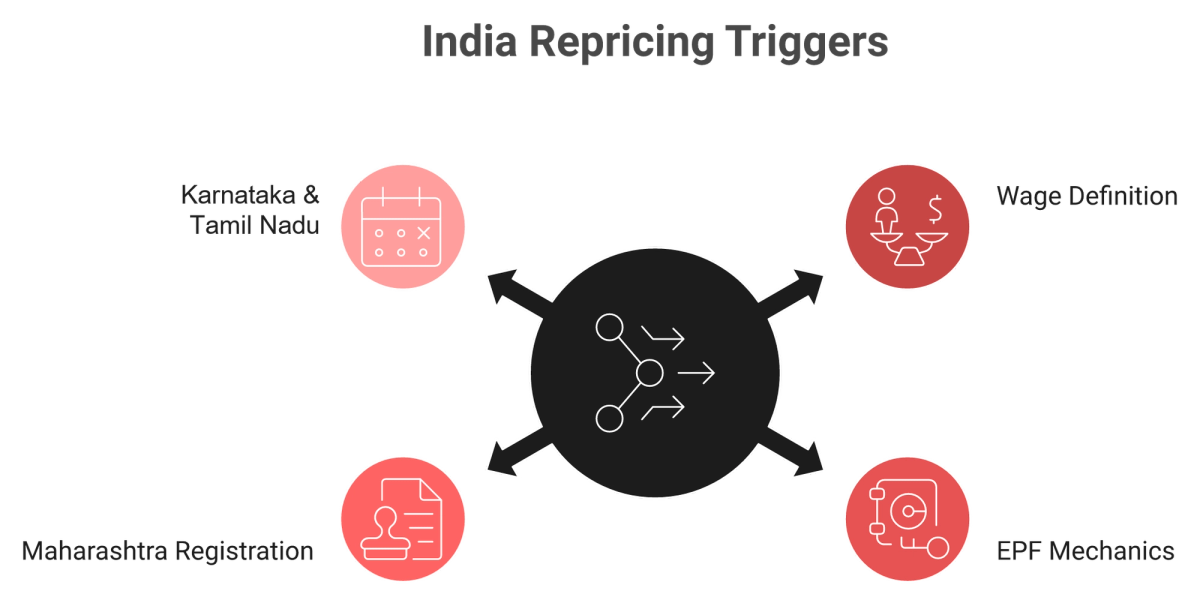
Four statutory triggers explain most India repricing, which is why the surcharge schedule belongs in the master service agreement.
🧮 What that means for your CTC structure
Restructure the offer before you request a quote. If your India offer letter carries 30% Basic and a stack of allowances, the add-back rule moves money into the wage base. The mechanics of each filing cycle are set out in our guide to payroll compliance in India.
That single change raises PF at 12% of Basic plus DA and gratuity accruing at 4.81%. Versatile Club builds offers so Basic plus DA clears the 50% line at draft stage, which keeps the statutory number stable from month one.
I could be reading the surcharge logic too strongly. What I am sure of is that state work is absorbed in our model, not surcharged.
✅ Get the trigger list into the MSA
Ask for the surcharge triggers as a written schedule in the master service agreement. Not in the deck, not in an email thread with an account manager.
⭐ The right shape of answer names the condition and the rate. Anything vaguer than that is a repricing right the vendor keeps and you fund.
Versatile Club holds registrations across all 28 states and 8 union territories, so Maharashtra's dual PTRC and PTEC filing, or Karnataka's monthly professional tax cycle, changes our filing calendar and never your price.
Q4. What does Multiplier charge for India contractors, and where is the misclassification line?
Multiplier lists contractors at $40 per active contract per month, billed only on active contracts, covering compliant agreements, payments in 120+ currencies, invoice and timesheet management, and an optional classification assessment. Some directories list $20. Versatile Club converts India contractors into employees on its own registered Indian entity as a standard Contract-to-Hire workflow.
💰 Why $40 and $400 get confused
The two numbers sit on adjacent cards on the same page. I have seen founders forecast a whole India team at contractor rates by accident.
That is a 10x error in either direction. Versatile Club prices employment at $149 per employee per month, which is the employment number, not a payments-rail number.
📄 What the $40 buys, and what it does not
The contractor product covers agreement generation, cross-border payment, invoices, timesheets, and expense reimbursement. It is a payments and paperwork layer, which is the same job a contractor of record arrangement performs.
What it does not buy is legal employment. No PF account, no ESI code, no gratuity accrual, no Form 16. Ask Versatile Club to run the classification review before you sign a second contractor in the same team.
⚠️ The four tests that decide the answer in India
A contractor who behaves like an employee is an employee, whatever the agreement says. These are the practical markers I look at first.
Control. Do you set working hours, tools, and daily task order?
Exclusivity. Is this person effectively full-time on you, with no other clients?
Integration. Do they sit in your standups, your Slack, your performance cycle?
Tenure. Has the arrangement run past 12 months with renewals?
❌ Note what does not apply here. US-style co-employment PEO has no standing under Indian labour law, so a "PEO India" framing is the wrong mental model for a foreign company without a subsidiary.
🧾 Contractor and employee routes compared
| Dimension | Multiplier contractor | Multiplier EOR | Versatile Club EOR |
| Published rate | $40 per active contract | $400, or Core $459/$499 | $149 flat |
| Statutory filings | None | Handled in-country | PF, ESI, TDS, PT under own registrations |
| India entity | Partner network reported | Partner network reported | Owned entity |
| Setup and exit | $0 / $0 | $0 setup, 2-week exit notice | $0 / $0, first month free |
🗣️ What operators report about the paperwork layer
"The product user interface is relatively easy to navigate and use, and meets basic EOR workflow needs."
— Verified User in Information Technology and Services, Buyer, Multiplier - G2 Verified Review
"I experienced several invoice errors, which added confusion to management and required my initiation for them to be addressed, eroding my confidence in their system."
— Micah P., Buyer, Multiplier - G2 Verified Review
✅ The three-question conversion screen
Run this at month nine, not at audit. The step-by-step mechanics are covered in our walkthrough on how to convert a contractor to an employee in India.
Does this person fail any of the four tests above?
Would losing them cost more than a month of hiring time?
Do you need them to hold company IP or sign customer contracts?
Two yes answers means convert. Versatile Club's read is that the standard advice gets this backwards by treating conversion as a compliance event, when it is a retention decision that happens to have compliance consequences.
Versatile Club was built on Contract-to-Hire, so moving an India contractor onto our own entity as a compliant employee is a documented workflow rather than an exception path.
Q5. What does the fee not cover, statutory costs, insurance, and recruitment?
No EOR fee includes statutory employer cost. In India, that means Provident Fund at 12% of Basic plus DA, ESI at 3.25% employer and 0.75% employee below threshold, gratuity accruing at 4.81% from month one, professional tax by state slab up to Rs 2,500 a year, and TDS deposited by the 7th. Multiplier prices insurance separately from $20 per employee per month. Versatile Club charges the India EOR fee only, with no markup on salary cost.
💰 The model that breaks at month-end close
Most first India budgets have two lines: salary and platform fee. That model survives until the first invoice arrives.
A CFO I work with had modelled $58,000 for a Bengaluru engineer, plus the fee. The statutory layer added roughly 13% on top of the wage base, and none of it was in her spreadsheet.
📊 The India statutory rate card
Here is the full employer-side load, with the deadline that governs each one.
| Item | Rate | Timing |
| Provident Fund | 12% of Basic plus DA (employer match) | Monthly challan |
| ESI | 3.25% employer, 0.75% employee, below threshold | Monthly |
| Gratuity | 4.81% of Basic plus DA, accrued from month one | Accrual, paid on exit |
| Professional tax | State slabs, up to Rs 2,500 per year | Monthly or biannual by state |
| TDS | Per income tax slab | Deposited by the 7th |
Versatile Club files every line above under its own PF code, ESIC code, and state registrations. The filing calendar behind each of those lines is set out in our guide to payroll compliance in India.
⚠️ Two 2026 rules that move the number
The wage definition changed what counts as Basic. Under the labour codes, allowances above 50% of total remuneration get added back into wages, which lifts PF and gratuity bases.
The second change cuts the other way. Under the EPF Scheme 2026, mandatory contribution is capped at 12% of the Rs 15,000 ceiling, which is Rs 1,800 per side, with anything above it voluntary. Ask Versatile Club to state, in the offer letter, whether you match voluntary top-ups above that ceiling.
💸 What no EOR fee buys
Three costs sit outside every published rate in this category.
Insurance. Multiplier lists employee insurance from $20 per employee per month, priced apart from the EOR fee.
Sourcing. The fee covers employing a candidate you already found. Finding them is a separate recruitment engagement.
Equipment and onboarding logistics. Laptops, shipping, and asset recovery on exit are your cost unless named in the agreement.
In Versatile Club's C2H work, placement is priced at 20% to 30% of annual salary, and only after the hire completes day 90. The full mechanics sit on our Contract to Hire page.
✅ Rebuild the budget in this order
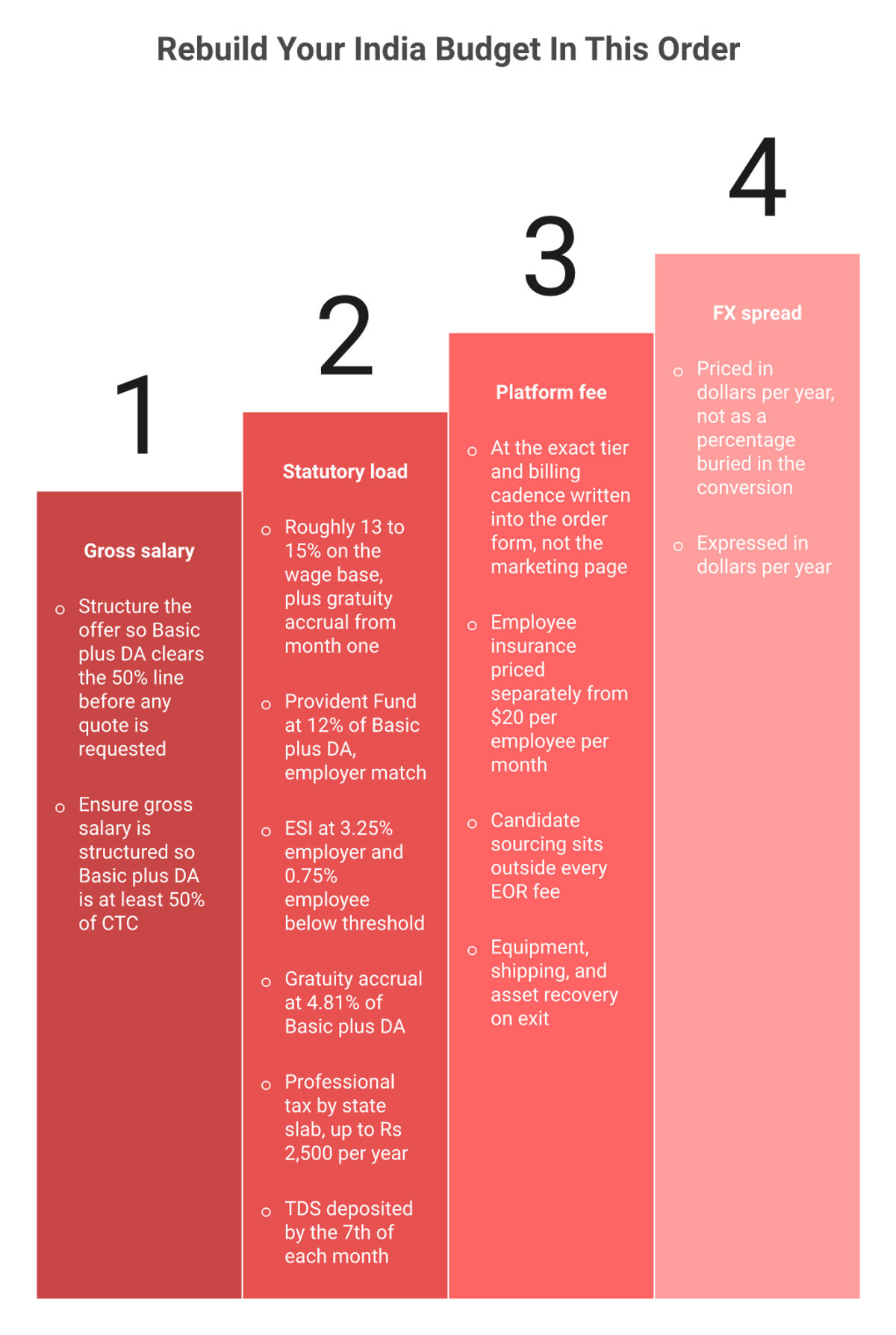
Do it in four lines, in this sequence, before you take any vendor call.
Gross salary, structured so Basic plus DA clears the 50% line.
Statutory load, at roughly 13% on the wage base, plus gratuity accrual.
Platform fee, at the tier and billing cadence written in the order form.
FX spread, which Q6 prices out.
⚠️ Where my head is right now is that the statutory line is the one buyers under-model most. Versatile Club measures it by rebuilding each offer from Basic upward rather than from CTC downward, which surfaces the PF impact before signature. If you want the same arithmetic on your own numbers, run them through our India salary calculator.
Versatile Club sends one monthly USD invoice with a per-employee breakdown, PF and ESI challan confirmations, and TDS deposit receipts attached. An auditor's question gets answered from the file, not from a follow-up email thread.
Q6. Where does the FX markup hide in a Multiplier India invoice?
Multiplier promises "no hidden/extra costs for onboarding and offboarding" and detailed invoicing, but publishes no FX policy. India EOR comparisons list its FX markup as not disclosed, with customer reports around 2% to 3%. Industry markups run 2% to 10%, and Deel has been reported at 3% to 5%. Versatile Club invoices in USD from its own Indian entity, so no conversion spread applies.
💸 The cost that reconciles perfectly and still hurts
FX markup is the difference between the mid-market rate and the rate your vendor uses. It never appears as a line item. Your invoice adds up correctly, and you still paid more than your model said.
That is what makes it the most expensive undisclosed cost in this category. It compounds monthly, on the salary base, not on the fee.
📊 What each source actually says
Three things are true at once, and the gap between them is the whole point.
Multiplier's page claims detailed invoicing with a clear breakdown of charges, including country-specific employee costs.
One 2026 India EOR comparison records Multiplier's FX markup as not disclosed.
A separate 2026 startup EOR analysis reports 2% to 3% based on customer accounts.
Versatile Club states its FX position as structural, because USD invoicing from a single Indian entity removes the second conversion event. The same logic drives how we pay employees in India without a second currency hop.
💰 The arithmetic on a five-person Bengaluru team
Take five engineers at $58,000 all-in each, so $290,000 a year of India spend.
| Spread | Annual cost | Equivalent |
| 0% | $0 | Baseline |
| 2% | $5,800 | 3.2 months of Versatile Club fees for 5 people |
| 3% | $8,700 | About 4.8 months of the same |
| 5% | $14,500 | Roughly 8 months of the same |
At 3%, a single $58,000 role costs about $1,740 a year in spread. That is more than four months of platform fee on that head. Our published pricing is the flat figure those months are counted against.
🗣️ What buyers report about billing visibility
"Customer Account Managers seem unable to resolve billing or payroll problems, forcing everything through a slow ticketing process."
— Kenneth P., Buyer, Multiplier - G2 Verified Review
"The lack of direct access or communication with their accounting department is frustrating."
— Micah P., Buyer, Multiplier - G2 Verified Review
The same reviewer credits the setup: "the setup process with Multiplier was fairly straightforward, making the initial integration into our operations smooth."
✅ The clause to insist on
Ask for two specifics in the master service agreement, not in an email.
The reference rate, named. RBI reference rates or a stated mid-market source, with the publication time.
The spread, in basis points, applied on top of that rate.
❌ "Mid-market rate" with no reference source and no spread figure is not a term. It is a claim.
Versatile Club's read is that the category gets this backwards by arguing about platform fees while the spread quietly runs larger than the fee. Buyers weighing that trade-off usually land on our Multiplier alternative page next.
Versatile Club invoices in USD from its own Indian entity, Foo Falcon Technologies Pvt Ltd. There is no FX markup line on your side of the transaction to audit, because there is no second conversion to price.
Q7. Does Multiplier employ your India hire on its own entity or a partner's?
Multiplier markets legal employment in 150+ countries via 100+ owned entities, meaning roughly a third of that coverage is not owned. Reporting places India in its local-partner network, and owned versus partner status is checkable in the GLEIF register. Versatile Club employs India hires on Foo Falcon Technologies Pvt Ltd, its own registered Indian entity.
⭐ Why 150 countries reads as strength
Coverage breadth is the number every global EOR leads with. It looks like capability, and for a company hiring in twelve countries, it partly is.
The problem is that coverage and ownership are different numbers. 150+ countries against 100+ owned entities leaves a gap of roughly 50 markets served through someone else.
⚠️ What breaks when India sits in the gap
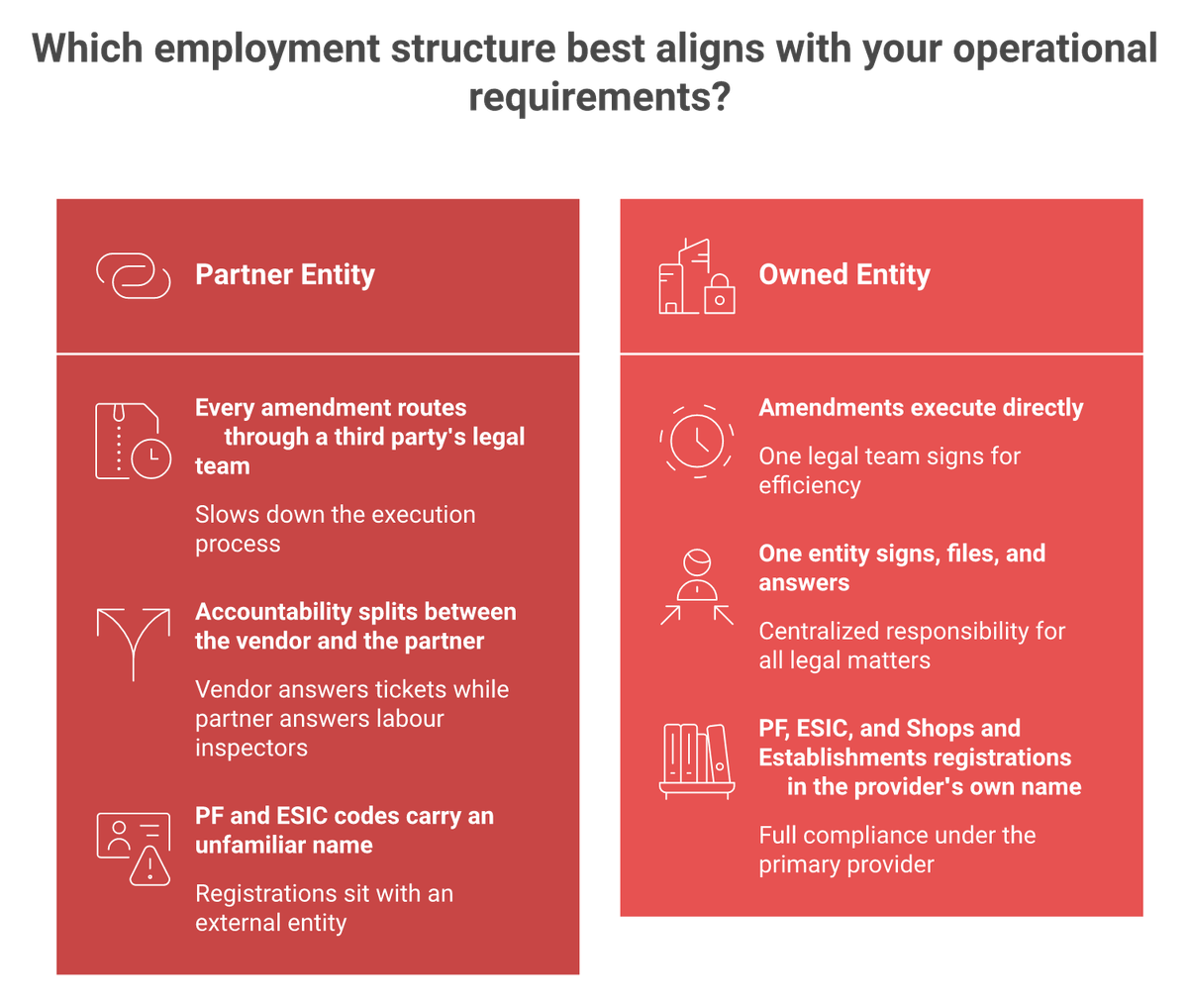
Three things change when a partner entity employs your hire instead of your vendor.
Contract execution slows. Every amendment routes through a third party's legal team.
Accountability splits. Your vendor answers your ticket. The partner answers the labour inspector.
Registrations sit elsewhere. The PF code and ESIC code that hold your employee's money carry a name you never signed with.
Versatile Club holds PF, ESIC, and Shops and Establishments registrations in its own name across all 28 states and 8 union territories. The full registration footprint is listed on our compliance page.
🗣️ What operators notice about layered delivery
"It seems their services are heavily outsourced, leading to disjointed systems where no one has a clear understanding of ongoing matters."
— Micah P., Buyer, Multiplier - G2 Verified Review
"We've found them very difficult to work with as a partner, their communications are inconsistent."
— Verified User in Information Technology and Services, Buyer, Multiplier - G2 Verified Review
That same reviewer is even-handed on the product: the interface "is relatively easy to navigate and use, and meets basic EOR workflow needs."
✅ The one question that settles it
Ask any provider this, in writing: whose CIN appears on the employment agreement?
A Corporate Identity Number is the 21-character code the Ministry of Corporate Affairs assigns to every registered Indian company. If the CIN is not the vendor's own, you are buying a partner arrangement. Ask Versatile Club for its CIN and cross-check it on the MCA portal before you sign.
📊 Ownership compared, factually
| Provider | India entity model | Countries |
| Multiplier | Local-partner network reported for India | 150+ |
| Deel, Remote, G-P | Partner or mixed models reported in India | 90 to 185 |
| Versatile Club | Owned Indian entity, own PF, ESIC, S&E registrations | 1, India only |
❌ Name the trade-off honestly. Versatile Club operates only in India by design, so a buyer hiring across five countries needs a second vendor. If you are weighing the wider set, our roundup of the best EOR providers in India covers who fits which case.
What surfaces in Versatile Club's client engagements is that the "I want to talk to the person who owns the entity" question arrives early, usually from the CFO, not from People Ops.
Versatile Club employs your India hire on Foo Falcon Technologies Pvt Ltd, with the PF code, ESIC code, and Shops and Establishments licences in our name. One entity signs, files, and answers.
Q8. What compliance exposure does a low headline fee quietly leave with you?
Four 2026 items sit outside every published EOR price. DPDP Rules 2025 obligations phase in from 13 May 2027 and need a data-processing addendum. The Income-tax Act 2025 replaces Form 16 and 16A with Forms 130 and 131. GST e-invoicing at the Rs 5 crore threshold requires IRN reporting inside 30 days, or you forfeit input tax credit on the platform fee. Permanent establishment risk stays yours.
⚠️ Cheap fee, retained liability
A platform fee buys execution. It does not transfer statutory liability that Indian law places on the principal.
Versatile Club writes each of the four items below into the service agreement as named obligations. My reason is simple. These land on your audit file, not the vendor's.
📜 DPDP Rules 2025, what to insert
MeitY notified the Digital Personal Data Protection Rules, 2025 through G.S.R. 846(E) on 13 November 2025, with staggered commencement. Rules 1, 2, and 17 to 21 took effect immediately. The core obligations on notice, security, breach reporting, and erasure begin 13 May 2027.
Payroll data is personal data. Add three clauses now: purpose-limited processing of payroll and bank details, breach notification within a fixed hour count, and erasure timelines after exit. Ask Versatile Club to sign that addendum against its own entity rather than a partner's.
🧾 Income-tax Act 2025, the forms changed
Section 395 governs withholding certificates under the new Act. Form 131 is now the TDS certificate a deductor issues to a deductee, replacing the old Form 16A pattern. Form 128 is the application route for a lower or nil withholding certificate.
⏰ Two checks belong in your vendor call. Confirm the EOR issues Forms 130 and 131 on schedule. Confirm it can support Form 128 applications for contractor payouts. Versatile Club deposits TDS by the 7th each month and issues Form 16 by 30 May, which is the same discipline behind our managed payroll service.
💸 GST, where your input tax credit leaks
E-invoicing applies at Rs 5 crore aggregate annual turnover for FY 2026-27. For larger filers, every B2B invoice must reach the invoice registration portal within 30 days of its date.
Miss that window and the IRN never generates. No IRN means no valid invoice, which means no input tax credit on the platform fee you already paid. In Versatile Club's monthly pack, the USD invoice and the GST documentation move together, so the 30-day clock is not a surprise.
❌ PE risk, what an EOR does not shield
Permanent establishment risk is the chance that Indian tax authorities treat your India activity as a taxable business presence. An EOR reduces the employment-law surface. It does not erase PE exposure.
Two behaviours create most of the risk I see. Your India hire signs customer contracts. Or your India hire is functionally your local sales head, closing revenue in-country. Teams weighing that boundary usually start with our comparison of EOR versus entity in India.
✅ The four clauses to send this week
DPDP addendum covering payroll data, breach notice, and erasure.
Confirmation of Forms 130 and 131 issuance, plus Form 128 support.
Invoice delivery inside the 30-day IRN window.
A named limitation on contract-signing authority for India staff.
Versatile Club files PF, ESI, TDS, and professional tax under its own registrations and issues Form 16 by 30 May. That single-entity structure is what makes these four clauses enforceable against one named Indian company.
Q9. How does Multiplier's India price compare with Versatile Club, Wisemonk, Deel, and Remote?
For an India-only team, Versatile Club charges $149 flat with $0 setup, $0 exit, and the first month free on its own Indian entity. Wisemonk runs $99 to $399 by salary slab. Multiplier lists $400, or Core at $459 annual and $499 monthly per its indexed tiers. Deel is $599 plus $500 setup. Remote is $599 plus $299 setup.
💰 The seven criteria that actually decide this
Price alone ranks vendors wrongly. Score them on seven lines instead.
Monthly fee, setup fee, exit notice, entity ownership, FX policy, onboarding SLA, and support model. Versatile Club is the only provider in this set that puts its onboarding SLA inside the service agreement rather than the marketing copy.
📊 The tier map behind the numbers
Three price bands exist in India, and each buys something different.
India specialists, from $99. Deep local compliance, single-country focus, lighter certification stacks.
Generalist mid, $400 to $600. Broad country coverage, no published volume discount, India often served through partners.
Premium global, $599 plus. Bundled business insurance and enterprise procurement support, which is a real reason to pay more.
🧾 India pricing, side by side
| Provider | Monthly per employee | Setup | Exit | India entity | Onboarding |
| Versatile Club | $149 flat | $0 | None | Owned | 5 days, contractual |
| Wisemonk | $99 to $399 by slab | $0 | None | India-native | 24 to 72 hours, not contractual |
| Multiplier | $400, or $459/$499 | $0 | 2 weeks' notice | Partner network reported | About 7 days |
| Deel | $599 | $500 | 1 month notice | Partner | 7 to 14 days |
| Remote | $599 | $299 | 1 month notice | Mixed | 10 to 14 days |
Buyers running this shortlist usually pair it with our roundup of the best EOR services in India and the head-to-head on our Wisemonk alternative page.
🗣️ What buyers say about the mid and India-native tiers
"Multiplier has fairly competitive EOR pricing, although it's also a bit of a 'you get what you pay for' where some of the savings translate to less transparency and customer support on the backend."
— Verified User in Information Technology and Services, Buyer, Multiplier - G2 Verified Review
"The initial documentation and paperwork felt quite detailed and time-consuming at the beginning. However, as we progressed, it became clear that this thoroughness is what ensures proper legal and compliance coverage."
— Verified User in Marketing and Advertising, Buyer, Wisemonk - G2 Verified Review
✅ Which row fits which situation
Match the scenario, not the sticker.
First one to three India hires. Flat pricing and a contractual onboarding date matter most. Ask Versatile Club for the sample invoice and the SLA clause together.
10 to 30 India employees. Slab pricing starts biting, so model the blended rate across salary bands before comparing stickers.
India plus four other countries. A generalist earns its fee here, and a split-vendor setup is a legitimate answer.
❌ Where Versatile Club is the wrong choice
I will say the uncomfortable part plainly. $149 is not the lowest sticker in this market, and Wisemonk's $99 entry sits below it.
Versatile Club does not carry bundled business insurance, and it holds neither SOC 2 Type II nor ISO 27001 today. A board that mandates either should buy the $599 player. We also operate only in India, so five-country buyers need a second vendor.
Versatile Club is the only row above where the price stays flat regardless of salary, the entity is owned, the invoice is USD from India, and the 5-day onboarding SLA is written into the agreement.
Q10. What does a year of Multiplier actually cost for five India employees?
A 2026 analysis models an employee on $3,000 monthly gross reaching roughly $4,500 to $5,200 all-in once the platform fee, about 15% statutory contributions, and FX markups are added. The modelled team scenario lands near $12,220 monthly, or $146,640 a year. Multiplier's fee sits roughly 33% below Deel's and Remote's $599, about $199 less per head monthly. Versatile Club charges $149 flat with the first month free.
📊 The assumptions, stated first
A total cost model is only useful when you can argue with its inputs. Here are mine.
Five India employees, $3,000 gross monthly each. Statutory load at roughly 13% to 15% of the wage base. FX spread at 3%, which sits inside the reported 2% to 3% range. Deposit at one month of gross per head.
💰 Twelve months, five heads, layer by layer
| Layer | Multiplier at $400 | Versatile Club at $149 |
| Platform fee | $24,000 | $8,940, less one free month |
| Statutory (approx 14%) | $25,200 | $25,200 |
| Gross salary | $180,000 | $180,000 |
| FX spread at 3% | About $6,150 | $0, USD invoicing |
| Deposit locked | About $15,000 | $0 |
The fee gap is $15,060 over the year. The FX and deposit lines are where the rest of the difference sits. Our breakdown of the full cost of hiring in India walks the same layers at other salary bands.
⚠️ Why the fee line is the least interesting one
Note the proportions. The platform fee is roughly 11% of Multiplier's modelled spend in this scenario.
The two lines nobody quotes, spread and deposit, together reach about $21,000. Versatile Club's structure removes both, which is arithmetic rather than a discount.
🗣️ What operators report about the billing layer
"I experienced several invoice errors, which added confusion to management and required my initiation for them to be addressed."
— Micah P., Buyer, Multiplier - G2 Verified Review
"Some features feel a bit limited and could use more flexibility. In particular, I'd like to see better options for customization and more detailed reporting."
— Vinay M., Buyer, Wisemonk - G2 Verified Review
⏰ Reporting depth is not a soft feature for a CFO. It is what closes month-end without a Slack thread, and it is the reason our managed payroll pack ships with challans attached.
💸 The arbitrage, and the line I will not cross
A senior engineer costs roughly $220,000 all-in in San Francisco, against about $58,000 in Bengaluru. That is a $162,000 delta per role per year, using industry-standard benchmarks rather than my own dataset.
Versatile Club does not sell India as cheap labour, and I will not pretend otherwise. If price is your only driver, we are the wrong partner, because that thinking ends badly for the person you hire.
✅ Run your own model in four inputs
Do this before any vendor call, in a single spreadsheet tab.
Gross salary, structured so Basic plus DA clears 50%.
Statutory load at 14% of the wage base.
Fee, at the tier and cadence in the order form.
Spread and deposit, in dollars, not percentages.
Versatile Club's first month free, $0 setup, and $0 exit remove three lines from that model before the arithmetic starts. What remains is salary, statutory cost, and one flat fee.
Q11. At what headcount does Multiplier stop making sense for India?
Two defensible answers exist, and the field genuinely splits. One camp exits EOR at roughly 10 to 12 India hires and migrates staff onto a newly registered entity. The other runs a hybrid path, hiring the first engineer in days while standing up a captive centre by around month six. Versatile Club writes a documented exit path into its agreement with no exit fee.
⏰ The question that arrives at hire eight
Nobody asks this at hire two. It shows up when the India team stops being an experiment and starts being a function.
The usual framing is a break-even calculation. Fee times headcount versus the cost of your own Indian subsidiary. That framing is incomplete, and I will get to why. Our EOR versus entity calculator runs the naive version of that maths in about a minute.
💰 The tipping-point case
I have watched this threshold hold at roughly 10 to 12 hires across the clients I work with. Past twelve, the monthly fee stack starts to rival entity running costs.
The migration itself is mechanical. New offer letters, PF account transfers, gratuity continuity, and full and final settlement on the old entity, all landing on one date. Ask Versatile Club to sequence that calendar before you incorporate, not after.
🏗️ The hybrid captive case
The other camp keeps the EOR and builds in parallel. First engineer live in days, entity registered while the team grows, full capability centre by roughly month six. The sequencing is covered in our guide to GCC setup in India.
This works because incorporation is slow and hiring is not. Versatile Club runs payroll on its own entity during that window, which keeps the team paid while the new company gets its registrations.
⚠️ The variable that actually decides it
Here is the twist. Headcount is a proxy, not the reason.
The real question is whether your India roadmap needs an owned balance sheet. Three things force that answer.
Permanent establishment exposure. If India staff sign customer contracts or close revenue, an entity is cleaner than an EOR.
FEMA compliance. Capitalising an Indian subsidiary triggers FC-GPR filing with the RBI on share allotment.
MCA lead time. Incorporation, PAN, TAN, PF, ESIC, and state registrations take months, not weeks.
✅ What I would do at 6, 12, and 30 hires
Three decisions, stated plainly.
At six hires, stay on EOR. An entity at this stage buys compliance overhead you cannot staff.
At twelve hires, register the entity and keep the EOR running payroll through the transition.
At thirty hires, you should already be migrated, with an India finance hire owning the filings.
❌ I could be wrong on the twelve mark. Versatile Club's client pattern points there, though the sample is small enough that I would not treat it as a law. If you are somewhere in the middle, our comparison of India expansion options lays out each route.
🗣️ The exit clause to read before you sign
Check three things in any agreement, today rather than at migration.
Exit notice period, exit fee, and whether the vendor will support employee transfer to your entity. Multiplier's published terms carry a two-week exit notice with no offboarding fee.
Versatile Club charges no exit fee and documents the migration path in the agreement. A client who outgrows us and leaves cleanly still sends the next three referrals, which is the whole economic argument for doing it properly. The mechanics of moving vendors sit in our guide on how to switch EOR provider in India.
Q12. How do you pressure-test an India EOR quote before you sign?
Ask for eleven items in writing: plan name and India per-employee rate, billing cadence, deposit quantum and refund trigger, complexity-surcharge triggers, FX reference rate and spread in basis points, insurance pricing, exit notice, the employing entity's CIN, onboarding SLA with a penalty, support channel and hours, and a sample invoice. Versatile Club answers all eleven before signature, including the sample invoice.
📄 Why written terms beat a good sales call
Everything this article found undisclosed was disclosed somewhere else. Deposits appear in third-party comparisons, not on the pricing page. Surcharge tiers appear in analyst write-ups, not in the product cards.
That is not dishonesty. It is a documentation gap, and it becomes your problem at invoice time. Versatile Club publishes the sample invoice precisely because a rate you cannot reconcile is not a rate, which is why our pricing page carries one number.
✅ The eleven questions, and what a good answer looks like
Send these in one email. Numbered, so nothing gets skipped.
Plan name and India rate. A tier name and a figure, not a range.
Billing cadence. Annual or monthly, with the renewal date named.
Deposit. A formula per employee, plus the refund trigger.
Surcharge triggers. A written schedule of conditions and rates.
FX. Named reference rate, plus spread in basis points.
Insurance. Included or priced separately, with the figure.
Exit. Notice period and any offboarding charge.
Employing entity CIN. The 21-character Ministry of Corporate Affairs code for the company that signs.
Onboarding SLA. Days, plus what happens if they miss it.
Support. Channel, hours, and named owner.
Sample invoice. A real one, redacted.
⚠️ Two red flags worth walking away over
First, a quoted rate that differs from the public page with no explanation. Multiplier's own page shows $400 while its indexed version shows $459 and $499. Teams at that decision point tend to read our Multiplier alternatives in India comparison next.
Second, internal contradictions in vendor collateral. That same page states 24/5 support in one block and 24x7 in another. Versatile Club puts its 5-day onboarding SLA in the service agreement instead of the marketing copy, which is the only version that survives a dispute.
🗣️ What support actually feels like, per reviewers
"Communication must go through account managers instead of direct engagement with accounting, increasing the time I spend resolving issues rather than reducing it."
— Micah P., Buyer, Multiplier - G2 Verified Review
"I've noticed that their support/query responses can occasionally take a bit longer sometimes, likely due to a relatively small team."
— Verified User in Financial Services, Buyer, Wisemonk - G2 Verified Review
That second review is fair, and it applies to us too. Versatile Club's answer is founder-direct access rather than a larger queue, which works at our current scale and would not at 500 clients.
⭐ Where I think this market goes next
My read is that India stops being one country on a global EOR map and becomes its own category. Owned-entity operators in one country take the India revenue that generalists treat as a rounding line.
I could be early on that. If you have a Multiplier or Deel quote in your inbox right now, send it to me on WhatsApp and I will mark up the three lines that cost you money later, or just tell us what you are building in India. Sagar Chainani, founder, not a ticket queue.
FAQs
How much does Multiplier cost per employee per month in India?
Multiplier's pricing page lists Employer of Record from $400 per employee per month and contractors at $40 per active contract per month, with no setup, onboarding, or offboarding fees and no minimum headcount, as rendered on 24 August 2026.
Two things complicate that figure:
- The indexed version of the same URL, plus multiple August 2026 reviews, describe a tiered structure at Core $459 annual and $499 monthly, with Growth at $519 and $559.
- Multiplier publishes no India-specific rate anywhere, so the country you are hiring in never appears next to a number.
Only two of the five product cards on that page carry a price at all. Global Payroll and Immigration render with no figure, and Enterprise routes to sales.
Versatile Club prices India EOR at $149 per employee per month flat, with $0 setup, $0 exit, and the first month free, published rather than quoted. We built that flat structure precisely because salary slabs and plan tiers are where India budgets drift. If you want the wider market context before choosing, our breakdown of employer of record cost in India lays out every band from $99 upward.
Does Multiplier charge a security deposit for India employees?
Multiplier's public page states no setup, onboarding, or offboarding fees and no minimum headcount, and it publishes no deposit at all. Third-party sources disagree on what happens next.
- One 2026 India EOR cost comparison records Multiplier's upfront deposit as not stated.
- Another 2026 analysis reports a refundable holdback of roughly one month's gross salary per employee.
- A G2 reviewer describes deposits and fees appearing that were not in the original contract.
Because the term is undisclosed, treat it as a contract question rather than a pricing question. Ask for the deposit quantum as a formula per employee, the exact event that triggers the refund, and the number of days between that event and the money landing.
The cash impact is real. Five engineers at Rs 1,80,000 gross each means roughly $10,300 of working capital sitting idle for the life of the engagement, which at a 15% cost of capital costs about $3,300 over two years.
Versatile Club holds no security deposit and charges no exit fee, so nothing of yours sits with us beyond the month being invoiced. You can see the flat structure on our pricing page.
What is Multiplier's complexity surcharge, and does India trigger it?
Multiplier publishes no complexity pricing, but third-party 2026 analyses map three tiers: standard countries at the $400 base, high-complexity markets such as France, Germany, and the UAE at $450 to $500 or more, and very-high-complexity markets such as China and Japan by quote. Reported India quotes reach $450 to $800.
India is not named in any public tiering, which is exactly why you should ask where it sits before signing. Note the tension on Multiplier's own page, which promises flat rates regardless of status or salary while also offering country-specific pricing customised to your needs.
Four India realities genuinely create extra work, and any of them can justify a repricing:
- The labour-code wage definition, which adds allowances above 50% of total remuneration back into wages.
- Maharashtra's dual PTRC and PTEC registration with monthly slab filing.
- Karnataka's monthly professional tax plus Shops and Establishments enrolment inside 30 days of joining.
- Tamil Nadu's biannual professional tax with labour welfare fund contributions.
Versatile Club holds registrations across all 28 states and 8 union territories, so state-level work changes our filing calendar and never your price. The full scope sits on our compliance page.
What does Multiplier charge for India contractors, and how is that different from the EOR fee?
Multiplier lists contractors at $40 per active contract per month, billed only on active contracts. Some directories list $20. That fee covers compliant agreements, cross-border payments in 120+ currencies, invoice and timesheet management, expense reimbursement, and an optional classification assessment.
The $40 contractor rate and the $400 EOR rate sit on adjacent cards on the same page, which produces a 10x forecasting error in both directions. The distinction is not cosmetic.
- The contractor fee buys a payments and paperwork layer.
- It does not buy legal employment, so there is no PF account, no ESI code, no gratuity accrual, and no Form 16.
- Under Indian law, a contractor who works fixed hours on your tools, exclusively, inside your performance cycle, for more than a year, starts to look like an employee whatever the agreement says.
US-style co-employment PEO has no standing under Indian labour law, so that framing is the wrong mental model for a foreign company without a subsidiary.
Versatile Club was built on Contract-to-Hire, so converting an India contractor onto our own entity is a documented workflow. The step-by-step version sits in our guide on how to convert a contractor to an employee in India.
What does an India EOR fee not cover, and what is the real twelve-month cost?
No EOR fee anywhere includes statutory employer cost. In India that means Provident Fund at 12% of Basic plus DA, ESI at 3.25% employer and 0.75% employee below threshold, gratuity accruing at 4.81% from month one, professional tax by state slab up to Rs 2,500 a year, and TDS deposited by the 7th.
Three further costs sit outside every published rate:
- Employee insurance, which Multiplier prices separately from $20 per employee per month.
- Candidate sourcing, since the fee covers employing someone you already found.
- Equipment, shipping, and asset recovery on exit, unless named in the agreement.
A 2026 analysis models an employee on $3,000 monthly gross reaching roughly $4,500 to $5,200 all-in once the fee, about 15% statutory load, and FX markups are added, with a modelled team reaching about $146,640 a year.
Build your model in four lines: gross salary structured so Basic plus DA clears 50%, statutory load at roughly 14%, the platform fee at the tier in your order form, and the FX spread in dollars.
Versatile Club sends one monthly USD invoice with per-employee breakdown, PF and ESI challan confirmations, and TDS receipts attached. Run your own numbers first with our EOR versus entity calculator.