Table of contents (15)
- Gloroots India Prices
- The Price Dispute
- What The Fee Covers
- Contractor Rate Tiers
- Hidden Fee Audit
- Real All-In Cost
- Volume Pricing Trap
- Hidden Fee Audit
- Real All-In Cost
- Volume Pricing Trap
- India EOR Price Comparison
- 2026 Compliance Repricing
- Entity Ownership, PE Risk
- EOR Vs Entity Breakeven
- Verdict By Buyer Type
Gloroots India Pricing: EOR Fee, Contractor Rate, FX, Setup
Q1. What does Gloroots charge for India, the full price card
As of 24 August 2026, Gloroots publishes Employer of Record at $199 per employee per month, contractor payments at $29, Contractor of Record at $99, and Direct Hire recruitment at 10% of annual salary. Billing runs monthly per active worker, with no minimum headcount, no default lock-in, and billing stopping from the next cycle after offboarding. Gig Pay is custom-quoted.
💰 The four published prices, and the one that is not
Gloroots prices every product tier except one. That is rarer than it should be in this category.
The pricing page carries five cards. Four show a number, and each number sits behind a "starting from" qualifier.
| Product | Price | Unit | Period |
| Pay Contractors | $29 | per contractor | month |
| Contractor of Record | $99 | per contractor | month |
| Employer of Record | $199 | per employee | month |
| Direct Hire (Recruitment) | 10% | of annual salary | one-time |
| Gig Pay | Custom | not published | not published |
Gig Pay is the only unpriced card. Its own feature list promises "transparent pricing, no hidden fees" while withholding the price.
⏰ The commercial terms buried in the FAQ
The FAQ is where the useful detail lives, and most buyers never scroll that far. Four terms matter for an India hire.
Billing is monthly, per active worker, with no long-term lock-in by default.
There is no minimum headcount. The FAQ names $29 and $199 again, which independently corroborates the cards.
If you offboard someone, billing stops from the next cycle, and termination compliance is included.
Staff augmentation appears only in FAQ text, custom-quoted by scope and duration, with no card and no price.
That last one is worth flagging. A fifth service line that exists only inside an FAQ answer is a line you will discover on a call, not on a page. Anyone comparing published rates should read our India EOR pricing page the same way, line by line.
⚠️ What the "Most Popular" badge quietly tells you
The badge sits on the $29 contractor product, not on EOR. Read that as a signal about where the volume actually is.
For an India buyer, that matters. A platform whose centre of gravity is contractor payouts is not automatically the platform whose centre of gravity is Indian statutory employment.
Versatile Club sees the opposite mix in its own book, where full-time EOR services in India on an owned entity are the primary line, and contractor work feeds into it. I could be reading the badge too strongly, though the placement is deliberate.
⭐ How the price card compares on structure
Structure matters as much as the number. Here is the honest row-by-row.
| Line item | Versatile Club | Gloroots | Deel |
| Monthly EOR fee | $149 | $199 | $599 |
| Setup fee | $0 | $0 | $500 |
| Exit fee | None | None (billing stops next cycle) | 1 month notice |
| First month free | Yes | Not published | No |
| Price qualifier | Flat | "Starting from" | Published |
Versatile Club publishes $149 per employee per month flat, with $0 setup and $0 exit, so the price card is the whole quote. Buyers weighing the higher-priced generalists usually start with our Deel alternative for India breakdown.
Q2. Is Gloroots' India EOR fee $199, $299, or $599?
Three numbers circulate. Gloroots' pricing page and FAQ both state $199. Several 2026 review trackers still publish $299, and one reviewer calls $199 a cut "down from the $299 rate still quoted in parts of Gloroots' own documentation". Gloroots' India country page separately frames a $599 monthly EOR fee inside its own cost illustration. Treat $199 as current, and get it in writing.
💸 Four tabs, three prices, one signature deadline
Six years quoting India C2H taught me something blunt. A price that moves between the pricing page and the sales call is not a price. It is an opening bid.
I have watched a founder find a $100 monthly delta at contract stage. On five hires, across two years, that is $12,000 she had not modelled.
📊 The audit, with dates and publishers
Here is every rate I could trace, with who published it and when.
| Rate | Source | Date |
| $199/employee/month | Gloroots pricing card and FAQ | 24 Aug 2026 |
| $199 (confirmed from vendor site) | employerrecords.com | Jun 2026 |
| $299/employee/month | peoplemanagingpeople.com | Aug 2026 |
| $299/employee/month | compareor.com | May 2026 |
| $199 or $299, flagged as disputed | hr.software | May 2026 |
| $599 monthly EOR fee in cost illustration | Gloroots India country page | Jul 2026 |
One reviewer resolves it as a price cut, with older collateral still carrying $299. The $599 figure appears to be illustrative rather than a rate card, which is exactly why it leaks into buyer spreadsheets.
✅ The two sentences to send before you sign
Copy these into your next email. They have closed the gap for me every time.
"Please confirm the India EOR fee per employee per month, in writing, valid for 12 months from signature."
"Please confirm whether that fee changes by salary band, headcount, or state, and list every add-on that is billed separately."
Versatile Club's read is that the standard advice here gets it backwards. Buyers audit the compliance stack and trust the price. The compliance stack is usually fine, and the price is where the variance hides, which is why our India EOR cost guide models the loaded number rather than the sticker.
⚠️ What buyers say about discovering the real number
"We're a small team at Moonshot and we needed to bring someone on in India, and every option I looked at first was either 'set up your own entity' (no thanks, not for one hire) or some platform that quotes you a great price and then you find out about all the add-ons later."
— Angad S., Founder Versatile Club G2 - Verified Review (5 stars)
"First USD invoice landed clean: no FX markup, no setup fee, no surprises."
— Verified User in Information Technology and Services Versatile Club G2 - Verified Review (5 stars)
"The initial documentation and paperwork felt quite detailed and time-consuming at the beginning. However, as we progressed, it became clear that this thoroughness is what ensures proper legal and compliance coverage."
— Verified User in Marketing and Advertising Wisemonk - G2 Verified Review (3.5 stars)
Versatile Club's $149 is flat across every salary band, so there is no second number to discover on a call. If you are already quoted by an India specialist, the Wisemonk alternative comparison sets the two side by side.
Q3. What does the EOR fee include, and what sits outside it?
The $199 covers localized agreements, payroll with all taxes and deductions, compliance document collection, leaves, expenses, and bonuses, 24x7 support for employer and employee, IP and invention rights protection, and crypto pay-ins. Custom benefits, relocation, visa and immigration support, and specialized compliance sit outside the fee. Per Gloroots' FAQ, those are "discussed and approved in advance".
❌ "Included" is the most abused word in EOR pricing
Every provider says compliance is included. Almost none say which filings, on which dates, under whose registration.
The test I use is simple. Ask who signs the PF challan, and ask to see one.
✅ What the eleven bundled features actually mean monthly
Two lines on this card are genuinely unusual at $199, and both are worth naming.
| Included in the $199 | Priced separately |
| Localized employment agreements | Custom benefits packages |
| Payroll, all taxes and deductions | Relocation support |
| Compliance document collection | Visa and immigration services |
| Leaves, expenses, bonuses | Specialized compliance support |
| 24x7 support (employer and employee) | Strategic hiring support |
| IP and invention rights protection | Gig Pay and staff augmentation |
| Crypto pay-ins | - |
Bundled IP and invention rights assignment is the line I would actually pay for. Skuad, by contrast, asks the client to execute IP agreements directly with the employee.
I have seen US founders discover during diligence that their India contractor never assigned IP. That discovery arrives at the worst possible moment, usually mid data room.
⏰ The India filings that "payroll" has to mean
In an Indian payroll cycle, "all taxes and deductions" is not one task. It is a calendar.
Provident Fund at 12% of Basic plus dearness allowance, with mandatory contribution capped at ₹1,800 under the EPF Scheme, 2026.
ESI at 3.25% employer and 0.75% employee, where the wage threshold applies.
TDS (tax deducted at source) deposited by the 7th of each month.
Gratuity accruing at 4.81% of Basic plus DA from month one.
Professional tax, which differs by state, including Maharashtra's dual PTRC and PTEC registration.
Versatile Club measures inclusion by artefact, not assertion. Each month a client receives the payroll summary, the PF and ESI challan confirmations, and the TDS deposit receipts, and the full scope sits on our India compliance coverage page.
💰 The four add-ons to price before you sign
Ask for a written number on all four, because approval "in advance" still means a bill.
Benefits top-ups, relocation, visa work, and anything labelled specialized compliance. For India specifically, ask whether POSH Internal Committee setup and DPDP data-processing terms sit inside the base fee or outside it.
Versatile Club sends one USD invoice monthly with a per-employee breakdown, payroll summary, PF and ESI challan confirmations, and TDS deposit receipts, so inclusions are auditable rather than asserted. Teams that already hold an India entity can route the same work through managed payroll instead.
Q4. What do India contractors cost, $29, $99, or 10%?
Gloroots prices contractors three ways. It charges $29 per active contractor per month for payments and management, $99 for Contractor of Record where Gloroots becomes the legal contracting entity and absorbs classification risk, and 10% of annual salary as a one-time Direct Hire fee. The $29 tier lists more tooling. The $99 tier buys liability transfer, not features.
⚠️ Most buyers pick $29 and keep the risk
The default choice is the cheap one, and the cheap one leaves the liability with you.
At $29, you remain the legal contracting party. Gloroots handles payments, invoicing, perks, time off, and expenses.
In India, that line is not a preference. It is a Provident Fund exposure.
📋 What the $70 step actually transfers
Here is the delta, read straight off both cards.
| Criterion | Pay Contractors ($29) | Contractor of Record ($99) |
| Legal contracting entity | You | Gloroots |
| Classification ownership | You | Gloroots |
| Misclassification risk | Your liability | "Reduce misclassification risk entirely" |
| Localized agreements | Compliance docs only | Full localized agreements |
| Perks, time off, expenses | Listed | Not listed |
Note the inversion. The cheaper tier lists more operational features, and the pricier tier lists fewer.
That is because you are not buying tooling at $99. You are buying someone else's name on the contract, which is the same liability transfer our contractor of record service performs in India.
❌ Why the Indian PF test ignores your MSA
Fixed hours, your systems, your supervision, and your equipment. An EPFO officer reads that pattern as employment, whatever the master services agreement says.
The Code on Wages, 2019 commenced on 21 November 2025, and the wage definition now pulls allowances above 50% of remuneration back into wages. That reshapes PF and gratuity maths for anyone converting a contractor to an employee in India.
US-style co-employment PEO does not legally exist under Indian labour law. So "PEO India" is not a middle path between contractor and employee.
Versatile Club came to EOR from Contract-to-Hire, placing engineers, designers, and ops professionals across Bengaluru, Hyderabad, and Pune. Ask Versatile Club to model the conversion date before you sign a contractor, not after, through our contract-to-hire model.
💸 When 10% for Direct Hire is actually cheap
Indian recruitment agencies typically charge 8.33% to 16.67% of annual CTC, plus 18% GST. At 10%, a $60,000 hire costs $6,000 once.
Compare that to a contractor you keep for 18 months at $29 monthly, then convert anyway. The fee is not the risk. The classification is.
"What I dislike about Wisemonk is that some features feel a bit limited and could use more flexibility. In particular, I'd like to see better options for customization and more detailed reporting."
— Vinay M. Wisemonk - G2 Verified Review (4 stars)
"Local India compliance, FD setup, all of this is complicated to understand to hire a single person. Makes my life as a lean founder extremely easy."
— surbhi m., Founder Versatile Club G2 - Verified Review (5 stars)
Versatile Club charges C2H at 20% to 30% of annual salary, billed only after the hire completes day 90, with a 6-month replacement guarantee attached. If you want the number for a specific role before you commit, tell us what you are building.
Q5. Does Gloroots charge FX markup, setup fees, or a security deposit?
Reported answer: none of them. Gloroots shows no setup fee, no offboarding fee, no FX markup, no minimum headcount, and no reported security deposit, with billing per active worker ceasing the cycle after offboarding. The FX position is the material one. Deel is reported at a 3% to 5% spread, and other platforms sit in a 2% to 10% band.
💸 The quietest profit centre in the category
FX markup means the gap between the real exchange rate and the rate your provider uses. It never appears as a line item.
Ask one question of any vendor. What rate do you convert at, and who keeps the difference?
A provider who answers "mid-market, and nobody" in writing has told you more than any pricing page.
✅ The five-line fee audit
Here is every cost line that turns a low sticker into a high invoice, with what the sources show.
| Cost line | Gloroots (reported) | Where it shows |
| Setup fee | $0 | Third-party audit, 2026 |
| Offboarding fee | $0, termination compliance included | Pricing FAQ |
| FX markup | None reported | Third-party audit, 2026 |
| Minimum headcount | None | Pricing FAQ |
| Security deposit | Not reported as required | Third-party audit, 2026 |
That is a clean sheet, and it is worth saying plainly. Skuad, Papaya, and Remote all apply undisclosed or roughly 0.5%-plus spreads by comparison, which is the gap our Skuad alternative breakdown covers in detail.
💰 What a spread actually costs on Indian payroll
Run the arithmetic, because the percentages sound small until they meet a payroll number.
Take five India hires on a combined ₹30,00,000 annual payroll. At ₹88 to the dollar, that is roughly $34,000.
A 2% spread costs about $680 per year.
A 5% spread costs about $1,700 per year.
The platform fee at $199 per employee per month costs $11,940 per year.
So the spread is smaller than the fee, but it is invisible, and it scales with salary rather than headcount. Senior hires make it worse.
Versatile Club removes the conversion step entirely by invoicing in USD from its own Indian entity, so there is no FX leg to mark up. The mechanics sit on our how it works page.
⚠️ The MSA clause to demand before signature
Put this in the master services agreement, not the email thread.
"Disbursements to India will be converted at the interbank mid-market rate on the value date."
"No conversion margin, spread, or handling fee will be applied or retained by the provider or its banking partner."
"The applied rate and source will be disclosed on each monthly invoice."
Versatile Club's read is that the standard advice gets this backwards. Buyers negotiate the headline fee hard and accept the FX clause as boilerplate, when the clause is where the silent margin lives. Anyone already mid-contract should read our guide on switching EOR providers in India first.
⭐ What buyers notice on the first invoice
"Invoicing in USD meant zero exchange rate surprises. The compliance rigour is genuinely impressive, every statutory filing reviewed before submission."
— Vedant T., Founder, digital marketing agency Versatile Club G2 - Verified Review (5 stars)
"The initial process took a little getting used to, but the team was quick to guide us through and it became very straightforward."
— Verified User in Venture Capital & Private Equity Versatile Club G2 - Verified Review (4.5 stars)
Versatile Club invoices in USD from a single Indian entity, with $0 setup, $0 exit, and the first month free. That structure removes the conversion step instead of promising not to mark it up.
Q6. What will an India hire actually cost you per month, all in?
The platform fee is the smallest line. Budget gross salary plus roughly 13% to 15.25% statutory employer load, meaning Provident Fund at 12% of Basic plus dearness allowance, ESI at 3.25% where applicable, and gratuity accruing at 4.81% from month one. Then add the $199 fee. On an ₹18 lakh CTC, the EOR fee is about 10% of total cost.
📊 The assumptions, stated up front
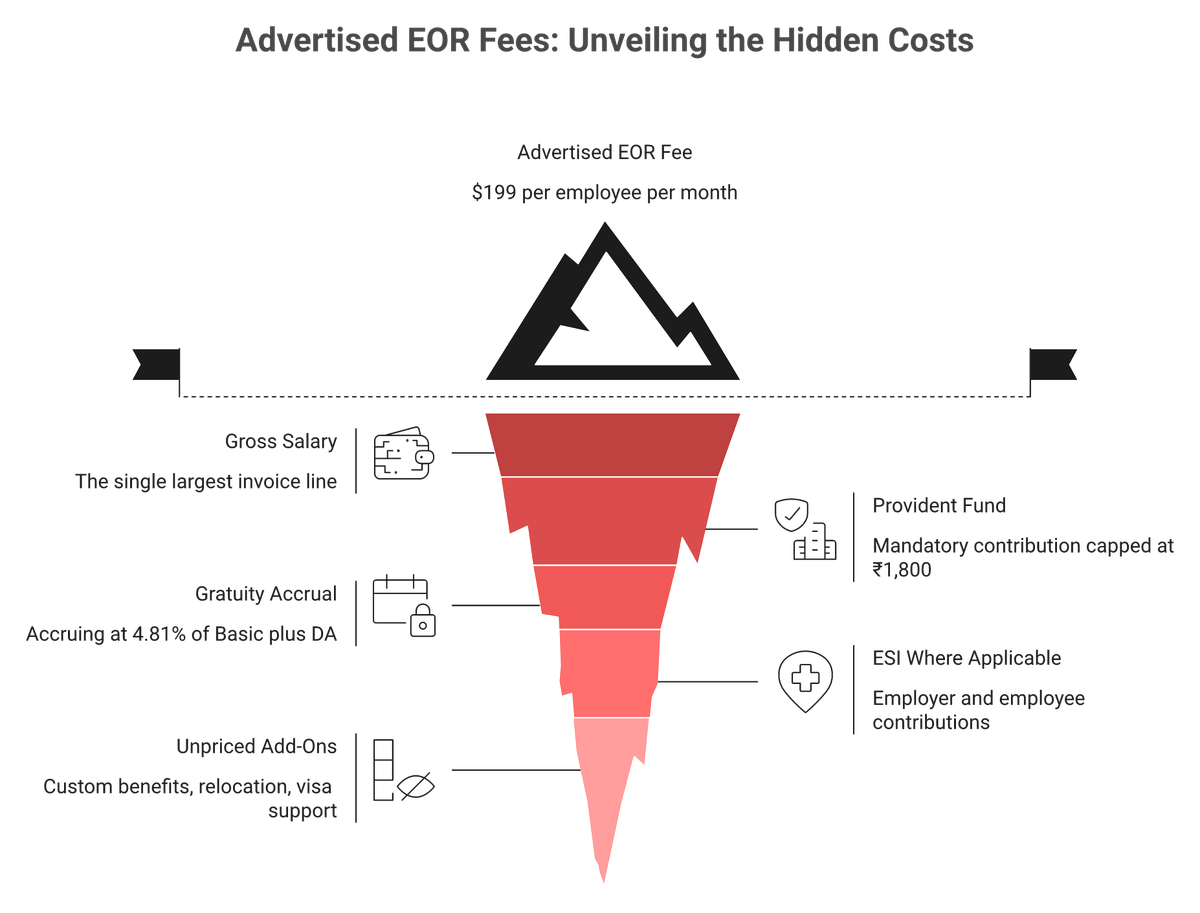
Any all-in number is only as good as its inputs. Here are mine.
One senior engineer in Bengaluru, ₹18,00,000 annual CTC (cost to company).
Basic plus DA set at 50% of CTC, per the wage definition in force since 21 November 2025.
ESI excluded, because the monthly wage sits above the ₹21,000 coverage threshold.
PF capped at the ₹15,000 wage ceiling, giving ₹1,800 per month under the EPF Scheme, 2026.
USD converted at ₹88, and TDS (tax deducted at source) deposited by the 7th monthly.
💰 One hire, one month, line by line
| Line | Monthly (INR) | Notes |
| Gross salary | 1,50,000 | ₹18 lakh CTC / 12 |
| Employer PF | 1,800 | Ceiling-capped |
| Gratuity accrual | 3,608 | 4.81% of Basic plus DA |
| ESI | 0 | Above threshold |
| EOR platform fee | ~17,500 | $199 at ₹88 |
| Total | ~1,72,908 | Fee is 10.1% of total |
Annualised, that is about ₹20.7 lakh, of which roughly ₹2.1 lakh is the platform fee. Gloroots' own India page puts EOR at about ₹6,16,012 per employee per year in its illustration, which tells you how much its assumed salary and inclusions differ from mine. Run your own role through our India salary calculator before accepting any vendor model.
⚠️ The PF question almost nobody asks
Whether a provider caps PF at the ₹15,000 ceiling or applies 12% on full Basic is a real rupee difference. On this hire, it is ₹7,200 per month.
That is ₹86,400 a year, on one engineer. It dwarfs any negotiation you will win on the platform fee.
Versatile Club measures this by showing the challan, so the client sees which base was used before the money moves. The filing calendar behind it is documented under payroll compliance in India.
📋 Five hires, rolled up
| Line | Monthly (INR) | Annual (INR) |
| Gross salaries | 7,50,000 | 90,00,000 |
| PF (ceiling basis) | 9,000 | 1,08,000 |
| Gratuity accrual | 18,040 | 2,16,480 |
| Platform fees | 87,500 | 10,50,000 |
| Total | ~8,64,540 | ~1,03,74,480 |
For context on why US companies run this maths at all, industry benchmarks put a senior engineer at about $220,000 all-in in San Francisco against roughly $58,000 in Bengaluru. That is a $162,000 annual gap per role, and it is not a Versatile Club figure. The wider breakdown sits in our guide to the cost of hiring in India.
✅ The three inputs to change before you compare vendors
Vendor quotes are only comparable once these three match.
PF base: ceiling-capped or full Basic.
Gratuity treatment: accrued monthly on your books, or funded later.
Whether the quoted fee includes benefits administration and equipment, or bills them separately.
Versatile Club charges the EOR fee only and never marks up the employee's salary cost, so every statutory line stays pass-through and checkable against PF and TDS challans.
Q7. Is "starting from" pricing a trap when you're making 1 to 3 India hires?
Every Gloroots price carries a "starting from" qualifier, which makes $199 a floor rather than a quote. Gloroots' own published research places India EOR costs at $250 to $450 per employee per month, above its headline rate. For a founder making one or two hires, that gap is the risk. Volume-tiered models price the first hire highest.
⭐ The common view: "starting from" reads generous
Most buyers see a low floor and assume goodwill. The floor looks like an invitation to start small.
Gloroots reinforces that reading. Its FAQ says there are no minimums, and pricing is "shared before onboarding begins".
Taken alone, that is a fair and buyer-friendly position. I want to give it credit before pulling it apart.
❌ The flaw: a floor plus a gate
A floor is only a price if you also know the ceiling. Here, the ceiling arrives on a call.
Look at what the same company publishes elsewhere. Its India band starts $51 above its own headline and runs to more than double it.
That asymmetry lands hardest on the smallest buyer. One hire brings no leverage, no volume commitment, and no reason for a rep to quote the floor. If you are at that stage, our India hiring plans for startups are priced for exactly one or two hires.
💸 Why hire one is the expensive hire
Volume pricing is designed to reward scale, which is rational for the vendor. The founder making a first India hire is on the wrong side of that design.
Consider the practical gap on a single engineer over 24 months.
| Scenario | Monthly fee | 24-month platform cost |
| Quoted at the floor | $199 | $4,776 |
| Quoted mid-band | $350 | $8,400 |
| Quoted at band top | $450 | $10,800 |
| Versatile Club flat rate | $149 | $3,576 |
The spread between floor and band top is $6,024 on one hire. That is a real hiring budget line for a Seed company.
✅ The better view: predictability is the product
Flat pricing is not generosity. It is a forecasting product.
A Seed founder cannot put an asterisk in a spreadsheet cell. Boards do not accept "starting from" in a runway model.
Versatile Club's data points one way here, which is that founders in the first three India hires optimise for certainty over the lowest sticker, though I might be reading that too strongly across a small book. Our full rate card is published on the Versatile Club pricing page.
⏰ What I would do on a Monday morning
Two moves, both cheap, both fast.
First, ask for the quote in writing with a 12-month validity, tied to your actual salary bands. Second, ask what the price becomes at hire five and h
Q5. Does Gloroots charge FX markup, setup fees, or a security deposit?
Reported answer: none of them. Gloroots shows no setup fee, no offboarding fee, no FX markup, no minimum headcount, and no reported security deposit, with billing per active worker ceasing the cycle after offboarding. The FX position is the material one. Deel is reported at a 3% to 5% spread, and other platforms sit in a 2% to 10% band.
💸 The quietest profit centre in the category
FX markup means the gap between the real exchange rate and the rate your provider uses. It never appears as a line item.
Ask one question of any vendor. What rate do you convert at, and who keeps the difference?
A provider who answers "mid-market, and nobody" in writing has told you more than any pricing page.
✅ The five-line fee audit
Here is every cost line that turns a low sticker into a high invoice, with what the sources show.
| Cost line | Gloroots (reported) | Where it shows |
| Setup fee | $0 | Third-party audit, 2026 |
| Offboarding fee | $0, termination compliance included | Pricing FAQ |
| FX markup | None reported | Third-party audit, 2026 |
| Minimum headcount | None | Pricing FAQ |
| Security deposit | Not reported as required | Third-party audit, 2026 |
That is a clean sheet, and it is worth saying plainly. Skuad, Papaya, and Remote all apply undisclosed or roughly 0.5%-plus spreads by comparison, which is the pattern our Skuad alternative breakdown tracks line by line.
💰 What a spread actually costs on Indian payroll
Run the arithmetic, because the percentages sound small until they meet a payroll number.
Take five India hires on a combined ₹30,00,000 annual payroll. At ₹88 to the dollar, that is roughly $34,000.
A 2% spread costs about $680 per year.
A 5% spread costs about $1,700 per year.
The platform fee at $199 per employee per month costs $11,940 per year.
So the spread is smaller than the fee, but it is invisible, and it scales with salary rather than headcount. Senior hires make it worse.
Versatile Club removes the conversion step entirely by invoicing in USD from its own Indian entity, so there is no FX leg to mark up. The same structure carries through how we pay employees in India every cycle.
⚠️ The MSA clause to demand before signature
Put this in the master services agreement, not the email thread.
"Disbursements to India will be converted at the interbank mid-market rate on the value date."
"No conversion margin, spread, or handling fee will be applied or retained by the provider or its banking partner."
"The applied rate and source will be disclosed on each monthly invoice."
Versatile Club's read is that the standard advice gets this backwards. Buyers negotiate the headline fee hard and accept the FX clause as boilerplate, when the clause is where the silent margin lives.
⭐ What buyers notice on the first invoice
"Invoicing in USD meant zero exchange rate surprises. The compliance rigour is genuinely impressive, every statutory filing reviewed before submission."
— Vedant T., Founder, digital marketing agency Versatile Club G2 - Verified Review (5 stars)
"The initial process took a little getting used to, but the team was quick to guide us through and it became very straightforward."
— Verified User in Venture Capital & Private Equity Versatile Club G2 - Verified Review (4.5 stars)
Versatile Club invoices in USD from a single Indian entity, with $0 setup, $0 exit, and the first month free. That structure removes the conversion step instead of promising not to mark it up, and the terms sit openly on our India EOR pricing page.
Q6. What will an India hire actually cost you per month, all in?
The platform fee is the smallest line. Budget gross salary plus roughly 13% to 15.25% statutory employer load, meaning Provident Fund at 12% of Basic plus dearness allowance, ESI at 3.25% where applicable, and gratuity accruing at 4.81% from month one. Then add the $199 fee. On an ₹18 lakh CTC, the EOR fee is about 10% of total cost.
📊 The assumptions, stated up front
Any all-in number is only as good as its inputs. Here are mine.
One senior engineer in Bengaluru, ₹18,00,000 annual CTC (cost to company).
Basic plus DA set at 50% of CTC, per the wage definition in force since 21 November 2025.
ESI excluded, because the monthly wage sits above the ₹21,000 coverage threshold.
PF capped at the ₹15,000 wage ceiling, giving ₹1,800 per month under the EPF Scheme, 2026.
USD converted at ₹88, and TDS (tax deducted at source) deposited by the 7th monthly.
💰 One hire, one month, line by line
| Line | Monthly (INR) | Notes |
| Gross salary | 1,50,000 | ₹18 lakh CTC / 12 |
| Employer PF | 1,800 | Ceiling-capped |
| Gratuity accrual | 3,608 | 4.81% of Basic plus DA |
| ESI | 0 | Above threshold |
| EOR platform fee | ~17,500 | $199 at ₹88 |
| Total | ~1,72,908 | Fee is 10.1% of total |
Annualised, that is about ₹20.7 lakh, of which roughly ₹2.1 lakh is the platform fee. Gloroots' own India page puts EOR at about ₹6,16,012 per employee per year in its illustration, which tells you how much its assumed salary and inclusions differ from mine. Our own cost of hiring in India model shows every input instead.
⚠️ The PF question almost nobody asks
Whether a provider caps PF at the ₹15,000 ceiling or applies 12% on full Basic is a real rupee difference. On this hire, it is ₹7,200 per month.
That is ₹86,400 a year, on one engineer. It dwarfs any negotiation you will win on the platform fee.
Versatile Club measures this by showing the challan, so the client sees which base was used before the money moves, which is the same discipline behind India payroll compliance month to month.
📋 Five hires, rolled up
| Line | Monthly (INR) | Annual (INR) |
| Gross salaries | 7,50,000 | 90,00,000 |
| PF (ceiling basis) | 9,000 | 1,08,000 |
| Gratuity accrual | 18,040 | 2,16,480 |
| Platform fees | 87,500 | 10,50,000 |
| Total | ~8,64,540 | ~1,03,74,480 |
For context on why US companies run this maths at all, industry benchmarks put a senior engineer at about $220,000 all-in in San Francisco against roughly $58,000 in Bengaluru. That is a $162,000 annual gap per role, and it is not a Versatile Club figure.
✅ The three inputs to change before you compare vendors
Vendor quotes are only comparable once these three match.
PF base: ceiling-capped or full Basic.
Gratuity treatment: accrued monthly on your books, or funded later.
Whether the quoted fee includes benefits administration and equipment, or bills them separately.
Versatile Club charges the EOR fee only and never marks up the employee's salary cost, so every statutory line stays pass-through and checkable against PF and TDS challans. Run your own numbers first with the India salary calculator.
Q7. Is "starting from" pricing a trap when you're making 1 to 3 India hires?
Every Gloroots price carries a "starting from" qualifier, which makes $199 a floor rather than a quote. Gloroots' own published research places India EOR costs at $250 to $450 per employee per month, above its headline rate. For a founder making one or two hires, that gap is the risk. Volume-tiered models price the first hire highest.
⭐ The common view: "starting from" reads generous
Most buyers see a low floor and assume goodwill. The floor looks like an invitation to start small.
Gloroots reinforces that reading. Its FAQ says there are no minimums, and pricing is "shared before onboarding begins".
Taken alone, that is a fair and buyer-friendly position. I want to give it credit before pulling it apart.
❌ The flaw: a floor plus a gate
A floor is only a price if you also know the ceiling. Here, the ceiling arrives on a call.
Look at what the same company publishes elsewhere. Its India band starts $51 above its own headline and runs to more than double it.
That asymmetry lands hardest on the smallest buyer. One hire brings no leverage, no volume commitment, and no reason for a rep to quote the floor, which is why early-stage founders hiring in India should ask for the ceiling in writing.
💸 Why hire one is the expensive hire
Volume pricing is designed to reward scale, which is rational for the vendor. The founder making a first India hire is on the wrong side of that design.
Consider the practical gap on a single engineer over 24 months.
| Scenario | Monthly fee | 24-month platform cost |
| Quoted at the floor | $199 | $4,776 |
| Quoted mid-band | $350 | $8,400 |
| Quoted at band top | $450 | $10,800 |
| Versatile Club flat rate | $149 | $3,576 |
The spread between floor and band top is $6,024 on one hire. That is a real hiring budget line for a Seed company.
✅ The better view: predictability is the product
Flat pricing is not generosity. It is a forecasting product.
A Seed founder cannot put an asterisk in a spreadsheet cell. Boards do not accept "starting from" in a runway model.
Versatile Club's data points one way here, which is that founders in the first three India hires optimise for certainty over the lowest sticker, though I might be reading that too strongly across a small book.
⏰ What I would do on a Monday morning
Two moves, both cheap, both fast.
First, ask for the quote in writing with a 12-month validity, tied to your actual salary bands. Second, ask what the price becomes at hire five and hire twenty, in the same email.
If the answers differ from the pricing page, you now know the page was marketing. That is useful, and it is not an accusation.
Versatile Club's $149 is flat with no slabs and no volume tiers, so the unit cost on hire one equals the unit cost on hire thirty. The mechanics of that are set out in how it works.
Q8. How does Gloroots compare with Versatile Club, Wisemonk, Deel, Remote, G-P, Multiplier, and Skuad?
At $199 with no annual commitment, Gloroots is among the cheapest genuinely month-to-month multi-country EOR options. Skuad's $199 requires a 12-month term, and month-to-month costs $299. India specialists price lower and deeper, with Versatile Club at $149 flat and Wisemonk from $99. Global generalists sit higher: Multiplier $400, Deel and Remote around $599, and G-P reported above $699.
💰 The master comparison
Versatile Club sits in row one as the India-only specialist. Read the entity column as carefully as the price column.
| Provider | EOR / month | Contractor | Setup | Exit | India entity | Invoice currency |
| Versatile Club | $149 | C2H 20-30% of salary | $0 | None | Own entity | USD |
| Gloroots | $199 | $29 / $99 CoR | $0 | None | Owned in ~100 countries | USD |
| Wisemonk | $99-$399 | $19 | $0 | Not published | Own entity | USD |
| Skuad | $199 annual, $299 monthly | $19 | Not published | Not published | Partner | USD |
| Multiplier | $400 | $40 | $0 | 2 weeks | Local partner | INR default |
| Deel | $599 | $49 | $500 | 1 month notice | Local partner | USD |
| Remote | $599-$699 | $29 | $299 | 1 month notice | Local partner | USD |
| G-P | $699-plus | Not published | Substantial | Not published | Owned | USD |
⚠️ The caveat these tables always omit
The $599 players bundle business insurance. That cover protects you if a compliance issue surfaces three years later.
VC-backed buyers are often effectively required to carry it. Indian specialists, Versatile Club included, generally do not, and that is a real part of why we cost a quarter as much.
✅ Pick Gloroots if
You need several countries at once, on month-to-month terms, with contractor volume as the main workload.
Bundled IP and invention rights, plus crypto pay-ins inside the base fee, are genuinely unusual at $199. If India is the only market you actually need, weigh the Gloroots alternatives in India before you sign.
❌ Pick a global generalist if
Procurement mandates SOC 2 or ISO 27001, or bundled employment insurance, as a condition of signing.
That is a fair reason to pay $599. It is also, honestly, the case against Versatile Club at enterprise scale.
⭐ Pick an India-only specialist if
India is your only hiring country, and multi-state depth matters more than country count.
That means Maharashtra's dual PTRC and PTEC registration, Karnataka's monthly professional tax, and Tamil Nadu's biannual filing. Ask Versatile Club to show the state registration for the city you are hiring in, and compare the shortlist against the best EOR providers in India.
"I would recommend Versatile to anyone looking for EOR India services, Employer of Record India solutions, or a trusted partner to hire employees in India efficiently and compliantly."
— Mukul S. Versatile Club G2 - Verified Review (5 stars)
"The team is really competent, but there were a few time zone misunderstandings that caused slight delays in the initial phase."
— Setu C. Versatile Club G2 - Verified Review (5 stars)
"We worked with Versatile to hire in India and support our design staffing needs without getting pulled into the complexity of contracts, payroll, compliance, and HR operations."
— Ibrahim A. Versatile Club G2 - Verified Review (4.5 stars)
Versatile Club is India-only at $149 flat, with USD invoicing from its own entity, Foo Falcon Technologies Pvt Ltd, which holds its own PF registration, ESIC code, and Shops and Establishments licences. The full service scope sits on our EOR services in India page.
Q9. Which 2026 rule changes reprice your India EOR invoice, and what should you demand with the quote?
Five changes move the statutory half of your invoice. The four Labour Codes took effect on 21 November 2025, and where allowances exceed 50% of remuneration the excess is added back to "wages" for PF and gratuity. The EPF Scheme, 2026 caps mandatory PF at ₹1,800. DPDP Rules were notified on 13 November 2025. Forms 130, 131, and 138 replace the Form 16 series. E-invoicing applies above ₹5 crore turnover.
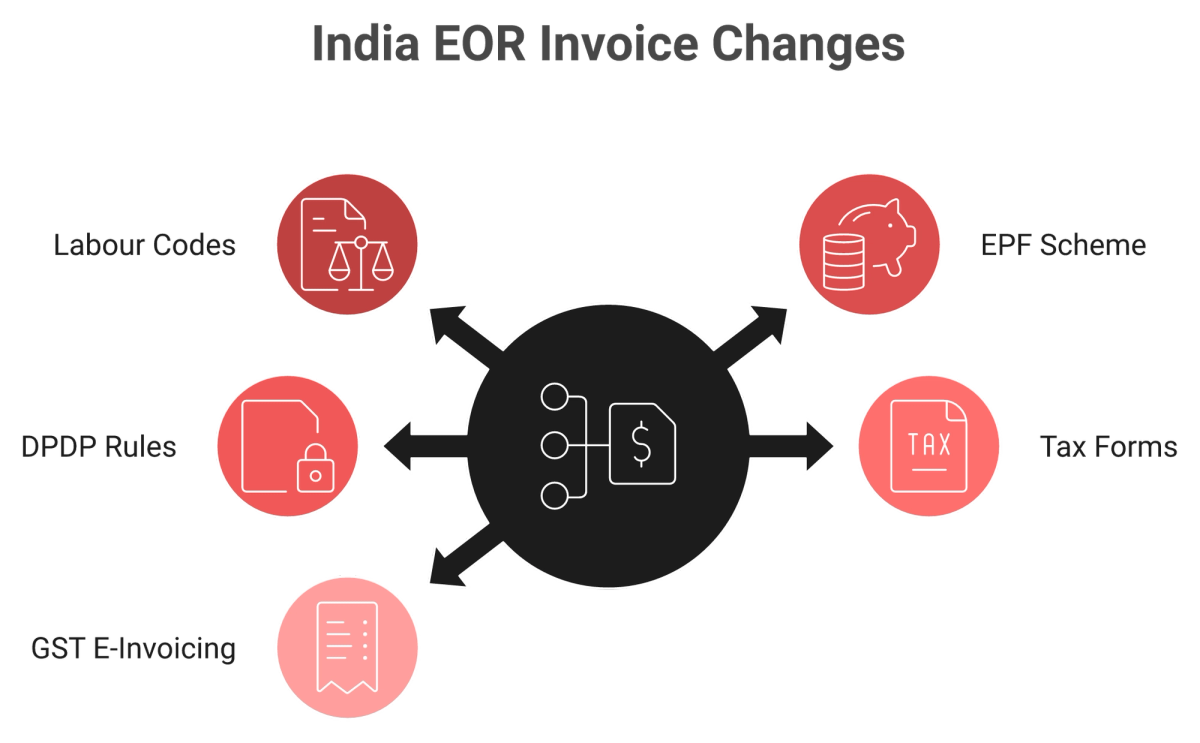
⚠️ Labour Codes: the wage definition that reprices PF
Rule: the Code on Wages, 2019 commenced on 21 November 2025, under gazette notification S.O. 5322(E). Allowances above 50% of total remuneration now count as wages.
Impact: PF and gratuity are computed on a larger base. The Ministry's own worked example adds ₹2,000 back on ₹76,000 of remuneration.
Monday action: ask your provider for a restated PF and gratuity computation on post-Code wages, for each existing hire. Our India payroll compliance guide walks through the same recomputation.
💰 EPF Scheme 2026: a cost lever nobody discusses
Rule: the Employees' Provident Funds Scheme, 2026 was notified on 29 June 2026 as G.S.R. 525(E). Mandatory contribution stays capped at ₹1,800 each side, on the ₹15,000 wage ceiling.
Impact: contributions above the ceiling are now explicitly voluntary. On an ₹18 lakh CTC hire, that choice is worth about ₹7,200 monthly.
Versatile Club files PF, ESI, professional tax, and TDS under its own registrations, so the ceiling decision is documented on the challan the client receives.
⏰ DPDP Rules: your EOR is handling employee data
Rule: MeitY notified the Digital Personal Data Protection Rules, 2025 on 13 November 2025 as G.S.R. 846(E), with substantive duties phased to 2027. DPDP is India's data protection law.
Impact: your provider processes salary, PAN, and Aadhaar-linked payroll data. Penalties reach ₹250 crore.
Monday action: add a DPDP processing addendum with breach notification timelines before the first payroll run. The scope we carry is listed on our India compliance page.
✅ New tax forms and GST e-invoicing
Rule: under the Income-tax Act, 2025, Forms 130 and 131 replace Form 16 and 16A, and Form 138 is due by 15 June after the tax year. Separately, GST e-invoicing is mandatory above ₹5 crore aggregate turnover, with a 30-day reporting window for larger filers.
Impact: an invoice without a valid IRN (Invoice Reference Number) puts your input tax credit at risk.
Monday action: request a sample Form 130 and confirm your EOR invoice carries an IRN.
📋 The five artefacts to demand with any quote
Ask for these in writing, before signature. Each one takes a provider minutes if the work is genuinely in-house.
Restated PF and gratuity computation on post-Code wages.
Written confirmation of PF ceiling treatment, capped or full Basic.
DPDP processing and breach-notification addendum.
Sample Form 130 plus the quarterly statement schedule.
A GST e-invoice showing a valid IRN.
Versatile Club's compliance knowledge comes from running C2H payroll across states, including Maharashtra's dual PTRC and PTEC registration, Karnataka's monthly professional tax with enrolment inside 30 days of joining, Tamil Nadu's biannual June and December filing, and West Bengal's rule churn. A global playbook does not carry that texture, in my experience.
Versatile Club holds registrations across all 28 states and 8 union territories, so a Labour Code recomputation happens in-house rather than through a partner entity. Teams that already hold an entity can hand the same filings to managed payroll instead.
Q10. Who legally employs your India hire, and what does that do to your PE risk?
Gloroots reports owned entities in roughly 100 countries including India, with GCC enablement covering PF, ESIC, TDS, and gratuity, while claiming 140 to 150-plus countries of total reach. That gap matters. Where an EOR subcontracts to a local partner, your employment contract sits with a company you never diligenced, and your permanent establishment analysis gains a layer.
📊 Owned entity versus partner entity, defined
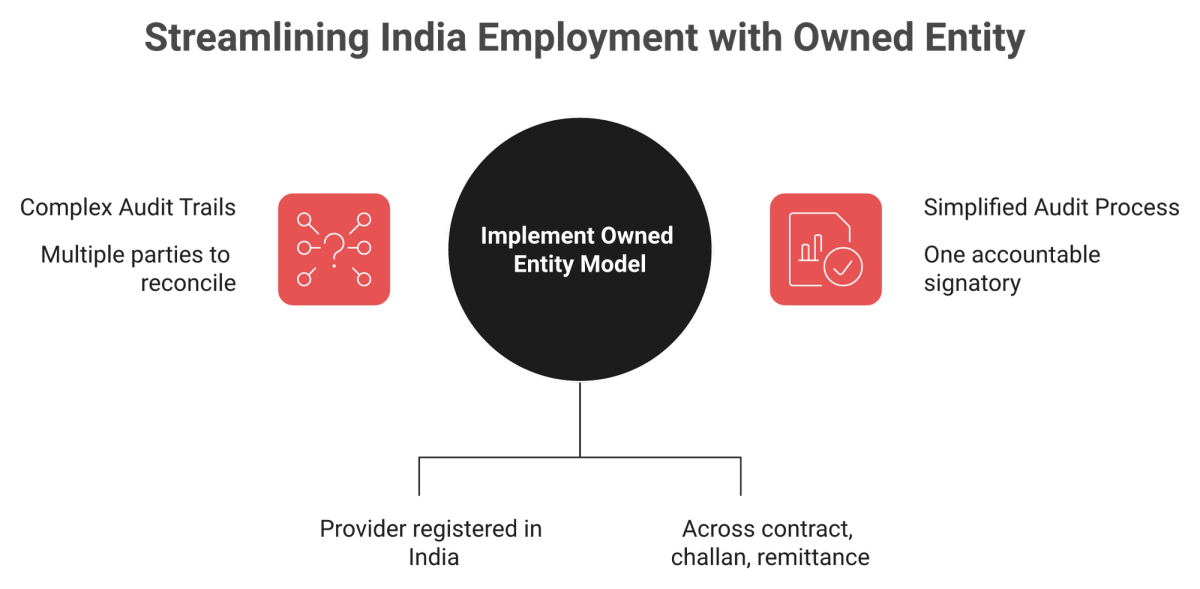
An owned entity means the EOR itself is registered in India and employs the person directly. A partner entity means the EOR resells a third party's registration.
The invoice looks identical either way. That is the whole problem.
Deel, Remote, G-P, and most global providers use local partner entities in India. Versatile Club employs India hires through Foo Falcon Technologies Pvt Ltd, its own registered Indian company, which is the structural difference behind our EOR services in India.
⚠️ The country-count gap, side by side
| Claim | Where it appears |
| 150-plus countries | Gloroots pricing page, stated three times |
| 140-plus countries | Third-party trackers, 2026 |
| 100-plus countries with owned entities | Gloroots blog and review audit |
None of these is dishonest. Total reach and owned footprint are different metrics.
For an India buyer, only one number matters. India is listed among the verified owned-entity markets, which is the answer you want.
❌ Where PE risk actually enters
PE (permanent establishment) risk means a tax authority treats your foreign company as having a taxable presence in India. An EOR is meant to insulate you from that.
Insulation depends on who signs. If the contract, the PF challan, and the FEMA remittance trail point to three different companies, you have three parties to reconcile during an audit.
Versatile Club's read is that the standard advice gets this backwards. Buyers audit the platform's software and accept the entity chain on trust, when the entity chain is the thing that carries the liability.
✅ Three documents to request in five minutes
Ask for these before signature, and verify them yourself.
The CIN (Corporate Identity Number), checkable free on the MCA portal.
The PF establishment code, checkable on the EPFO employer search.
The ESIC code and the state Shops and Establishments licence for your hiring city.
Hesitation on any of the three tells you the entity is not theirs. That is not a gotcha, it is basic diligence.
Ask Versatile Club for all three at the first call, because those registrations sit under the company's own name. The sequence is set out in how it works.
⭐ What buyers say about skipping the entity route
"The core problem was simple: we needed to hire engineers in India but had zero legal entity there. We looked at setting up a subsidiary and quickly realized it would take 6+ months, cost tens of thousands in legal and registration fees."
— Verified User in Information Technology and Services Versatile Club G2 - Verified Review (5 stars)
"WiseMonk's EOR service solved our biggest challenge, which was hiring employees in India without setting up a local entity. This reduced legal risk and saved months of setup time and cost."
— Verified User in Marketing and Advertising Wisemonk - G2 Verified Review (3.5 stars)
Versatile Club's employees are employed by Foo Falcon Technologies Pvt Ltd, whose PF registration, ESIC code, and state licences you can verify on the MCA and EPFO portals before signing anything. That is the same route founders take to hire in India without an entity.
Q11. At what headcount does your own India entity beat paying EOR fees?
The switch point is arithmetic. Gloroots' own India figures put EOR at roughly ₹6,16,012 per employee per year, against ₹35,03,416 in annual recurring entity cost plus ₹32,49,316 in setup. It separately cites entity-setup savings of $20,000 to $150,000-plus. On those inputs, most teams cross over somewhere between 25 and 40 India employees.
💰 Step 1: build the formula, including the hidden inputs
Compare annual EOR fees against annual entity cost. The trap is that most people forget half the entity side.
The recurring lines people skip are the expensive ones.
MCA annual filings and a statutory audit.
A company secretary retainer and a tax consultant.
Premises or a registered address, needed for Shops and Establishments registration.
An India payroll stack such as Keka, greytHR, or Zoho Payroll.
One India HR or finance hire to actually run it.
📊 Step 2: run the crossover in rupees
Annual platform fees at ₹88 to the dollar, against a steady-state entity at ₹35,03,416 per year.
| India headcount | Versatile Club at $149 | Gloroots at $199 | Own entity (steady state) |
| 5 | ₹7.87 lakh | ₹10.51 lakh | ₹35.03 lakh |
| 15 | ₹23.60 lakh | ₹31.52 lakh | ₹35.03 lakh |
| 30 | ₹47.20 lakh | ₹63.04 lakh | ₹35.03 lakh |
| 50 | ₹78.67 lakh | ₹1.05 crore | ₹35.03 lakh |
Crossover lands near 17 heads at $199, and near 22 heads at $149. Amortise the ₹32.49 lakh setup over three years, and both push out by roughly 6 to 8 heads. Run your own inputs through the EOR versus entity calculator.
⚠️ Step 3: the honest "it depends"
That table assumes a lean entity. It breaks in three directions.
Multi-state hiring raises the compliance load faster than headcount. A single-city team of 30 is cheaper to run than 15 people spread across Maharashtra, Karnataka, and Tamil Nadu.
Versatile Club's data points toward the higher end of the band for distributed teams, though the sample here is small, and I would not bet a board deck on it alone.
⏰ Step 4: the hybrid path most teams actually take
Nobody selling EOR wants to tell you when to leave. I would rather say it plainly.
Run EOR for speed while the entity is built in parallel. India hosts roughly 3,000 Global Capability Centres, so the GCC setup path in India is well worn.
Then migrate employees without re-hiring them, which keeps tenure, gratuity accrual, and PF continuity intact. Ask Versatile Club to sequence that transfer against your PF and gratuity records.
✅ Step 5: check the exit terms before you commit
Exit friction decides whether the crossover is real or theoretical.
| Provider | Exit terms |
| Versatile Club | No exit fee, no notice penalty |
| Gloroots | Billing stops next cycle, termination compliance included |
| Deel | One month notice |
| Remote | One month notice |
A client who outgrows us and migrates cleanly refers three more. A client trapped at 60 heads writes a review about it.
Versatile Club charges no exit fee and imposes no notice-period penalty, so migrating to your own entity costs nothing beyond the transition itself. The full trade-off sits in our EOR versus entity in India analysis.
Q12. Is Gloroots the right choice for your India hire?
Choose Gloroots for multi-country coverage on month-to-month terms, bundled IP protection, or genuine crypto payout needs. It reports paying 21 India contractors from crypto treasury in under four hours. Choose an India-only specialist if India is your only hiring country and you want state-level depth, flat pricing, and a named human. Choose a generalist if bundled business insurance is a procurement mandate.
⭐ Founder making hire one
You need one engineer in Bengaluru, and certainty matters more than country count. Gloroots works here, with no minimum and no lock-in.
The risk is the "starting from" gap. A floor of $199 against a published India band of $250 to $450 is a $3,000 swing over two years.
Versatile Club's $149 is flat across salary bands, which removes the negotiation from the model entirely. The same terms apply to early-stage startups hiring in India.
📋 VP People at Series A or B
You have 10 to 40 India staff, spread across states, and payroll accuracy is the escalation you keep getting. Depth beats breadth at this stage.
Ask any shortlisted provider to name the professional tax cycle in each state you hire in. Maharashtra, Karnataka, and Tamil Nadu all differ, and the answer separates operators from platforms.
Versatile Club holds registrations across all 28 states and 8 union territories, so that question has a documented answer rather than an escalation path. If you are already mid-contract elsewhere, read how to switch EOR provider in India.
💸 CFO at $20M ARR
Your test is month-end close, not the sticker. You want one invoice, in dollars, with challans attached.
Gloroots reports 22 months with zero compliance incidents on India payroll, though those customer statements are unattributed on its page, so treat them as directional.
Versatile Club measures this by artefact, sending PF and ESI challan confirmations plus TDS receipts with every monthly USD invoice. The published rate sits on our pricing page.
❌ Where Versatile Club is the wrong call
I will not pitch past the honest limits. Three cases where you should pick someone else.
You need five-plus countries. India is the only country Versatile Club operates in, by design.
Procurement requires SOC 2 or ISO 27001 at signature. Wisemonk holds both.
You need bundled employment insurance for a mandated VC compliance policy. Indian specialists generally do not carry it.
EOR is also the newer line for Versatile Club, launched in 2026 on a C2H entity that has run multi-state payroll for years. I would rather you hear that from me than find it in diligence, and the Wisemonk alternative page states the same trade openly.
✅ What buyers actually said
"If you're a founder trying to figure out India EOR and you don't want it to become a second job, this is the one I'd point you to."
— Angad S., Founder Versatile Club G2 - Verified Review (5 stars)
"What I like best about Wisemonk is that it combines employee, time, and payroll management into one simple and efficient system."
— Vinay M. Wisemonk - G2 Verified Review (4 stars)
Where my head is right now is this. Over the next two years, I think India stops being one row on a global EOR map and becomes its own category, where owned-entity specialists take the India line off the generalists.
I could be wrong about the timeline. If you are pricing an India hire this quarter, send me your CTC band and hiring city, and I will send back the loaded number with the challan lines shown.
Versatile Club is honest about the trade. The Indian entity and multi-state payroll are battle-tested through years of C2H, EOR is the newer line, and Sagar Chainani is on WhatsApp to say so directly.
FAQs
How much does Gloroots cost per employee per month in India?
As of 24 August 2026, Gloroots publishes four prices on its pricing page, and its own FAQ repeats two of them verbatim.
- Employer of Record: $199 per employee per month
- Pay Contractors: $29 per active contractor per month
- Contractor of Record: $99 per contractor per month
- Direct Hire recruitment: 10% of annual salary, charged once
- Gig Pay: custom quoted, the only unpriced tier
Billing runs monthly per active worker. There is no minimum headcount, no default lock-in, and billing stops from the next cycle after offboarding, with termination compliance included.
Read every one of those numbers with the starting from qualifier attached, because that is how the page presents them. Gloroots' own published research places India EOR costs at $250 to $450 per employee per month, which sits above its headline rate.
Versatile Club publishes $149 per employee per month flat across every salary band, with $0 setup, $0 exit, and the first month free, and the terms sit openly on our India EOR pricing page. We built it that way because a founder modelling 24 months of runway cannot put an asterisk in a spreadsheet cell.
Why do some sources say Gloroots costs $299 or $599 instead of $199?
Three numbers circulate across Gloroots' own properties and third-party trackers, which is why buyer spreadsheets disagree.
- $199: stated on the pricing card and repeated in the pricing FAQ, extracted 24 August 2026
- $299: still published by several 2026 review trackers, including profiles dated May and August 2026
- $599: appears inside the cost illustration on Gloroots' own India country page
One reviewer resolves the first two as a price cut, describing $199 as down from the $299 rate still quoted in parts of Gloroots' own documentation. The $599 figure reads as illustrative rather than a rate card, which is exactly why it leaks into board decks.
Treat $199 as current, then lock it. Ask for the India EOR fee per employee per month in writing, valid for 12 months from signature, and ask whether it changes by salary band, headcount, or state.
Versatile Club quotes one flat figure with no salary slabs, so there is no second number to discover on a sales call, and buyers comparing India specialists can see the structural difference on our Wisemonk alternative page. A price that moves between the pricing page and the call is an opening bid, not a price.
Does Gloroots charge setup fees, FX markup, or a security deposit for India?
On the reported evidence, no on all counts. Third-party audits and the pricing FAQ together show a clean sheet for Gloroots.
- Setup fee: $0
- Offboarding fee: $0, with termination compliance included
- FX markup: none reported
- Minimum headcount: none
- Security deposit: not reported as required
The FX line is the one worth pressure-testing, because it never appears as an invoice item. Deel is reported at a 3% to 5% spread, and other platforms sit in a 2% to 10% band. On five India hires at a combined ₹30,00,000 annual payroll, a 5% spread costs roughly $1,700 a year, and it scales with salary rather than headcount.
Ask any provider one question. What rate do you convert at, and who keeps the difference? Then put the answer in the master services agreement: mid-market rate on the value date, no retained margin, applied rate disclosed on each invoice.
Versatile Club invoices in USD directly from its own Indian entity, which removes the conversion step rather than promising not to mark it up, and the mechanics are described in our guide on how to pay employees in India.
What is the real all-in cost of one India hire once statutory contributions are added?
The platform fee is the smallest line on the invoice. Budget gross salary, then roughly 13% to 15.25% statutory employer load, then the EOR fee.
- Provident Fund: 12% of Basic plus dearness allowance, with mandatory contribution capped at ₹1,800 under the EPF Scheme, 2026
- ESI: 3.25% employer and 0.75% employee, where the wage threshold applies
- Gratuity: 4.81% of Basic plus DA, accruing from month one
- TDS: deducted monthly and deposited by the 7th
- Professional tax: state-specific, including Maharashtra's dual PTRC and PTEC registration
On a ₹18,00,000 CTC engineer in Bengaluru, with PF capped at the ceiling and ESI not applicable, the monthly total lands near ₹1,72,908. The $199 platform fee is about 10% of that.
One question almost nobody asks moves more money than any fee negotiation. Does the provider cap PF at the ₹15,000 wage ceiling, or apply 12% on full Basic? On that hire, the difference is ₹7,200 monthly.
Versatile Club charges the EOR fee only and never marks up the employee's salary cost, so every statutory line stays pass-through and checkable against PF and TDS challans. Model your own role first with our India salary calculator.
At what headcount should you stop paying India EOR fees and open your own entity?
The switch point is arithmetic, not ambition. Gloroots' own India figures put EOR at roughly ₹6,16,012 per employee per year, against ₹35,03,416 in annual recurring entity cost plus ₹32,49,316 in setup.
Against a steady-state entity, crossover lands near 17 heads at a $199 fee and near 22 heads at $149. Amortise the setup over three years, and both push out by roughly 6 to 8 heads, which puts most teams in a 25 to 40 headcount band.
The trap is forgetting half the entity side. Budget these recurring lines before you commit:
- MCA annual filings and a statutory audit
- A company secretary retainer and a tax consultant
- Premises or a registered address for Shops and Establishments registration
- An India payroll stack such as Keka, greytHR, or Zoho Payroll
- One India HR or finance hire to actually run it
Multi-state hiring raises the load faster than headcount, so 15 people across three states can cost more to administer than 30 in one city.
Versatile Club charges no exit fee and no notice-period penalty, so migrating costs nothing beyond the transition, and you can run your own inputs through the EOR versus entity calculator.