Table of contents (12)
Wisemonk vs Deel for Hiring in India (2026): Pricing, Compliance & Support
Q1. Wisemonk vs Deel for India: which should you actually pick?
A founder in Austin messaged me on WhatsApp last quarter with one line: "We already run Deel. Someone told me to use an India specialist instead." Her India headcount plan was three engineers in Bengaluru. Her global headcount plan was three engineers in Bengaluru.
Pick Wisemonk if India will hold most of your international headcount. Wisemonk offers India-only depth at $99 to $399 per employee monthly on salary slabs, with no setup or exit fee. Pick Deel if India is one of four or more countries, or if your investors expect its bundled business insurance, at roughly $599 per employee monthly plus setup. Concentration decides this, not price. Pricing verified August 2026.
⭐ The real trade-off is consolidation against country depth
Most comparisons frame this as cheap versus expensive. That framing is wrong, and it costs buyers money in both directions.
One platform for everything has compounding value. One contract, one invoice, one data processing agreement, one integration into your HRIS. That value is real on day one.
⚠️ Depth only pays out when something breaks
Country depth works the other way around. It sits unused for months, then earns its whole fee in a single week when a state professional tax registration stalls or a termination goes sideways.
Buyers systematically underweight depth at the decision point. They overweight it six months later. I have watched that flip happen enough times to expect it, across six years of India EOR services.
💰 What each vendor is actually selling
Wisemonk sells one country done properly. India-native, founded 2020, Bengaluru based, holding SOC 2 Type II and ISO 27001, rated 4.8 on G2.
Deel sells coverage and platform maturity. The broadest country list in the category, the most polished self-serve product, contractors and employees in one system, plus business insurance that protects you if a compliance issue surfaces years later. No India-native provider carries that insurance. It is the single strongest argument for paying four times more.
✅ The 18-month concentration test
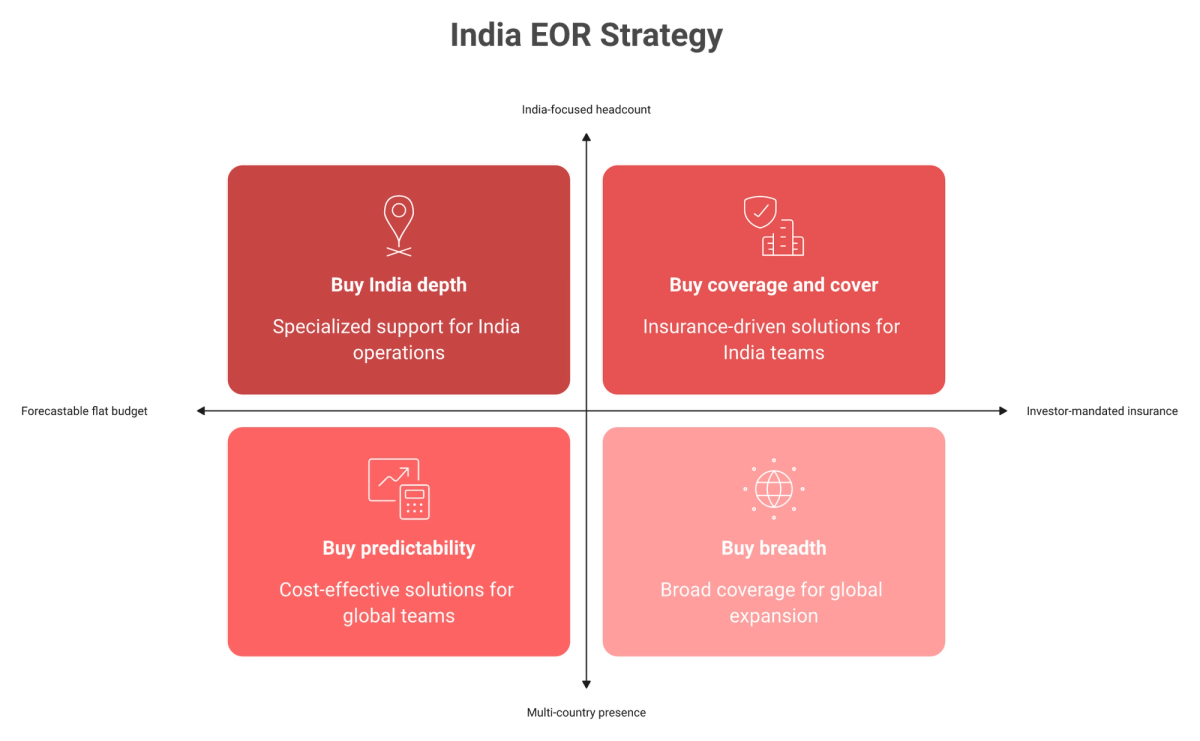
Here is the decision rule I give founders on calls, and it takes about ninety seconds to run.
Sketch your international headcount 18 months out, by country.
If India holds more than half of it, buy depth.
If India is one of four or more countries, buy coverage.
If your board expects bundled insurance cover, buy coverage regardless of price.
If you cannot forecast the split yet, stay on the platform you already have and revisit at three India hires.
Four India hires out of five internationals is a different decision from four out of forty. Same headcount, opposite answer.
❌ Where the popular playbook falls apart
The "just buy Deel for everything global" playbook quietly drags total cost past the sticker, which the next section unpacks line by line. The opposite playbook, "set up your own Indian subsidiary," costs real money and months before your first hire lands, which the EOR vs entity calculator prices out.
Both playbooks skip the actual question. That question is where your headcount concentrates, and it is answerable today.
I could be reading the flip too strongly, since my vantage point is India only. What I keep seeing is that the founders who regret their choice regretted the concentration math, not the price.
Q2. What does a Deel India hire really cost once you add setup, surcharge, FX, and the deposit?
Deel publishes about $599 per employee per month for India EOR. Independent 2026 analyses report an India surcharge of $50 to $150 disclosed on sales calls, taking the effective fee to roughly $649 to $749. Add a setup fee, one month's notice to exit, a deposit of one month's gross held per employee, and a reported FX markup of 3 to 5 percent.
💰 Start with the published number, dated
Price pages change. The $599 figure here was captured on 14 August 2026 from Deel's India hiring page.
Write the capture date into your own model too. Every EOR in this category iterates pricing faster than the blogs comparing them, which is why our employer of record India cost breakdown carries a capture date on every figure.
💸 The lines that get added after the demo
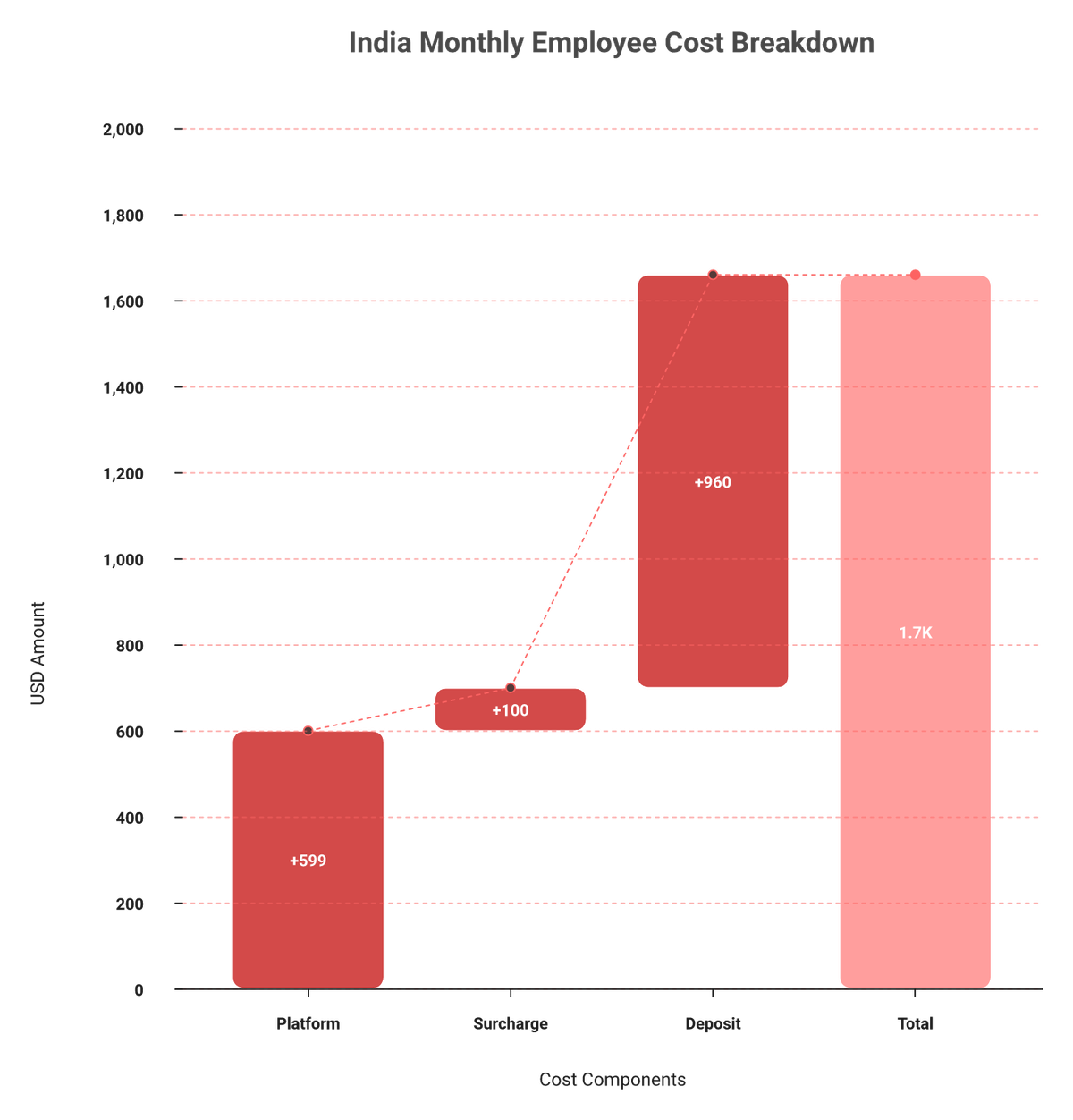
The sticker is the platform fee. The bill is the stack.
Platform fee: about $599 per employee monthly, annual commitment.
India surcharge: $50 to $150 monthly, reported by third-party analyses rather than published.
Setup fee: charged per the client's 2026 quote context, so ask for it in writing.
Notice to exit: one month, billed.
FX handling: a reported 3 to 5 percent markup on INR funding.
Treat the surcharge and the FX figure as reported, not verified. Ask both questions directly and get the answer by email.
⏰ The deposit nobody models as working capital
The deposit is the line CFOs care about and blogs footnote. It is typically 100 percent of one month's gross salary per employee, held for the life of the engagement.
Run the arithmetic. Ten India employees at an average monthly gross of $960 locks roughly $9,600 of your cash for as long as the team exists. That is not a fee, but it is money you cannot deploy.
⚠️ What reviewers say the fees feel like from inside
"I find Deel to be absurdly expensive. They charge a high amount of fees for transferring money to my bank account. Additionally, using their card incurs fees for purchases in another currency, which impacts me personally."
— Juan Camilo O., Verified User Deel Hire - G2 Verified Review
"I find the pricing of Deel to be quite terrible for me. Previously, I was paid directly by my employer without any additional costs. Now, I'm required to pay a monthly fee, which I don't like at all. The initial setup process was also very challenging."
— Verified User in Translation and Localization Deel Hire - G2 Verified Review
Both reviewers are on the employee or contractor side, which matters when you read the score. Payout-side reviewers rate fees. Buyer-side reviewers rate escalations.
✅ What the premium genuinely buys
None of this makes Deel a bad choice. The premium buys things a specialist cannot match.
The broadest country coverage in the category, which is the whole point if you are hiring across four continents.
The most mature self-serve platform, genuinely better than what any India-only operator ships.
Contractors and full-time employees managed in one system, with one audit trail.
Bundled business insurance covering compliance issues that surface years after the hire.
That insurance line is the honest counter-argument to every cheaper option, including mine. If your investors expect that cover, pay the premium and stop comparing. If you are only weighing the fee, the Deel alternative comparison sets out the India-side math.
My six years of cross-border invoicing has taught me which line items surprise a US founder in month two. It is never the platform fee. It is the FX spread, the notice-period billing, and the deposit sitting on their balance sheet.
Q3. Is Wisemonk's $99 the real price, or does it hide salary slabs?
$99 is the entry tier, not the price. Wisemonk's India EOR runs $99 to $399 per employee monthly on salary slabs, with contractor management at $19, managed payroll at $49, no setup or termination fee, and mid-market FX. Per-tier inclusions are not published, so the number for a senior engineer surfaces only on a sales call. Ask for the slab table in writing.
💰 The published ladder, and what "from" means
A slab price means the fee moves with the employee's salary band. Higher CTC, higher monthly fee, on a table the vendor holds.
Wisemonk's public product ladder is clear enough at the top. Contractor management at $19, managed payroll at $49, payroll with an HR business partner at $250 for up to five employees, EOR from $99.
⚠️ A worked example of what you cannot compute
Say you are hiring two engineers in Bengaluru. One at 20 lakh CTC, one at 50 lakh CTC.
The $99 tier plausibly covers the first. The second sits somewhere between $99 and $399, and you cannot tell where from any public page. Third-party analyses put the upper end at $450 or more once tiers are included.
That gap is $300 per employee per month, or $3,600 a year on one hire. It is not a rounding error in a budget you present to a board, and the salary calculator will show you which band each offer lands in.
✅ What Wisemonk is genuinely best at
Fair is fair, and this vendor is good at the thing it claims.
India-only focus, which shows up in how payroll structure conversations go.
Mid-market FX with no stated markup, which is better than the generalist norm.
No setup fee and no termination fee, so exit is cheap.
SOC 2 Type II and ISO 27001, plus 4.8 on G2 across 261 or more reviews.
"After evaluating several options, we chose Wisemonk because they specialize in India. Their focus made discussions about payroll structure and compliance clearer."
— r/smeSingapore Reddit Thread.
❌ Where the transparency gap actually bites
"WiseMonk's EOR service solved our biggest challenge, which was hiring employees in India without setting up a local entity. The initial documentation and paperwork felt quite detailed and time-consuming at the beginning."
— Verified User in Marketing and Advertising Wisemonk - G2 Verified Review
"What I dislike about Wisemonk is that some features feel a bit limited and could use more flexibility. In particular, I'd like to see better options for customization and more detailed reporting."
— Vinay M., Verified User Wisemonk - G2 Verified Review
Neither review is about price. That is the point. The pricing opacity does not show up in reviews because buyers only notice it once, during the sales call.
⏰ The three questions that close the gap in one email
Send this before your second call, and you will have a comparable number the same week.
Send the full salary slab table with the CTC band for each tier.
Confirm which services sit inside the $99 tier and which are priced separately.
State the FX rate source and any spread applied to INR funding.
My position here is a principle, not a criticism of service quality. Any pricing model a buyer cannot compute from a public page is a model that requires a sales call, and that call is a cost too. Buyers who want the band-free version can read the Wisemonk alternative breakdown.
Q4. Wisemonk vs Deel side by side: the dated price table and the cost at 10 and 20 hires
On published fees the gap is wide. At 10 India employees the annual difference runs roughly $54,000 before FX, and at 20 it approaches $120,000 to $160,000. But Wisemonk's upper slabs reach $399 to $450, and Deel's figure carries setup, surcharge, and deposit. Versatile Club prices India EOR at a flat $149 per employee monthly with no salary slabs. Figures captured August 2026.
💰 The comparison table, captured 14 August 2026
| Criterion | Wisemonk | Deel | Versatile Club |
| Monthly EOR fee | $99 to $399 | About $599 | $149 flat |
| Salary slabs | Yes, tiers not published | No | No |
| Setup fee | None | Charged, confirm in writing | None |
| Exit fee | None | One month notice, billed | None |
| Deposit | Not stated | One month gross per employee | None |
| FX handling | Mid-market, no stated markup | Reported 3 to 5 percent markup | USD invoice from India |
| Onboarding time | 24 to 72 hours claimed, not contractual | 7 to 14 days | 5 business days, contractual |
| Country coverage | India only | 150 plus | India only |
| Contractor management | $19 monthly | $49 monthly | Not a standalone product |
| Support model | Small team, email and portal | Chatbot first, tiered | Founder on WhatsApp |
| Certifications | SOC 2 Type II, ISO 27001 | Extensive | None yet |
| Business insurance | Not carried | Bundled | Not carried |
⏰ Two rows decide most purchases
Buyers stare at the fee row and then choose on two others. Country coverage and deposit.
Coverage is binary. If you need five countries, the India specialists are out of the conversation before price matters.
💸 Running the headcount math on your own bands
Do not use anyone's published delta, including the one in my nugget above. Build the number from your own salary bands.
List each planned India hire with its CTC band.
Assign the vendor fee tier that band lands in, using the slab table you requested in writing.
Multiply by 12, then add setup, surcharge, and notice-period billing.
Add the deposit separately as locked cash, not as expense.
Compare the totals, not the headline fees.
Versatile Club charges the same $149 for a 20 lakh hire and a 50 lakh hire, which is why our clients can forecast month 13 in month one on a single India EOR pricing line.
⚠️ Where a flat rate is the wrong answer
A flat rate loses on two fronts, and pretending otherwise would be useless to you.
At the very bottom of the market, Wisemonk's $99 entry tier is cheaper than $149, full stop. And a flat India rate is irrelevant if your hiring is spread across countries, where Deel's coverage wins outright.
Versatile Club also holds no SOC 2 or ISO 27001, and carries no bundled insurance. Buyers whose procurement requires certification should choose one of the other two.
Versatile Club invoices in USD from its own Indian entity, Foo Falcon Technologies Private Limited, at a flat $149 per employee monthly, with no setup fee, no exit fee, first month free, and a five business day onboarding SLA written into the agreement. The how it works page sets out each step of that cycle.
Q5. How do the 2026 Labour Codes and EPFS 2026 change what both vendors quote you?
The Labour Codes commenced on 21 November 2025, with final central rules notified on 8 May 2026. Wages now include Basic plus dearness allowance plus retaining allowance, with a 50 percent add-back rule, widening the provident fund and gratuity base by roughly 3.2 percent of gross CTC. Under the Employees' Provident Funds Scheme 2026, notified 29 June 2026, mandatory PF stays capped at Rs 1,800 on the Rs 15,000 wage ceiling.
⏰ What commenced, and on what date
Four Codes replaced 29 central labour laws. The commencement date is 21 November 2025, and the central rules were finalised on 8 May 2026.
Any vendor quote built before those dates is stale. Ask when their India CTC template was last rebuilt, and check it against the current payroll compliance in India calendar.
💰 What the 50 percent wage rule does to a CTC
CTC means cost to company, the full annual package. The Code says allowances cannot exceed half of it. Anything above that gets added back into "wages" for statutory maths.
Take a 24 lakh package with Basic set at 30 percent. The excess allowance gets pulled back into wages, so PF and gratuity are calculated on a larger base. Total employer cost rises even though the offer letter number never changed, which is why the cost of hiring in India moves before your budget does.
⚠️ The audit that EPFS 2026 makes possible
Here is the check almost nobody runs on a vendor quote. Mandatory PF sits at Rs 1,800 monthly, computed on the Rs 15,000 ceiling, and contributions above that are voluntary.
If a quote shows employer PF at 12 percent of full salary as mandatory, it is wrong or it is a deliberate choice. Either way, you deserve to know which. Ask Versatile Club, or any provider you are testing, to mark each line as statutory or voluntary.
✅ Gratuity and TDS, the two lines that surprise people
Gratuity accrues from month one at 4.81 percent of Basic plus DA. It is not a five-year event on your books, whatever the payout rule says.
TDS, which is tax deducted at source from salary, must be deposited by the 7th of the following month. Miss it and interest starts running.
💸 The three numbers to ask both vendors for
Send this on the same email thread, and compare answers side by side.
The Basic plus DA percentage in their standard CTC template, post-Code.
Employer PF shown as mandatory versus voluntary, with the ceiling stated.
Gratuity accrual method, monthly or annual, at 4.81 percent of Basic plus DA.
"Initially the problem I faced while working as a contractor for an international company was the money transfer problems but from when my company started using wisemonk I receive my salary in INR in my bank account."
— Bulbul G., Verified User Wisemonk - G2 Verified Review
That review is from the employee side, and it captures what the employee actually notices. Nobody on the receiving end sees the wage-definition maths. Your finance team does.
I could be reading the cost impact slightly high, since my sample is India-only placements. What I keep seeing is that the structure gets fixed at offer stage, and payroll inherits whatever was signed.
Versatile Club issues a post-Code CTC breakup showing Basic plus DA at or above 50 percent before an offer goes out, because that structure is set at offer stage, not at payroll stage. Our managed payroll team runs the same template every cycle.
Q6. Which vendor produces the compliance artefacts, PF, ESI, professional tax, and Form 130 or 138?
Score depth on artefacts, not claims. Ask both vendors for a sample Form 130, the Income-tax Act 2025 replacement for Form 16, plus Form 138 filing confirmation for the quarter ended 30 June 2026. Add monthly PF and ESI challans, labour welfare fund remittance proof, and professional tax registration in your hire's state. Whoever produces documents wins.
📄 The forms were renumbered, and most pages still say Form 16
Under section 395(4)(a) of the Income-tax Act 2025, Form 16 became Form 130, Form 16A became Form 131, and quarterly return 24Q became Form 138. These apply from the first quarter of FY 2026-27.
A challan is the receipt proving a statutory payment was deposited. Ask for the actual PDF, not a dashboard screenshot.
🗺️ The state layer is where global templates break
Professional tax, or PT, is a state tax on salaried income. It works differently in every state, and that is the part a global playbook flattens.
Maharashtra: dual registration, PTRC and PTEC, with monthly slab filing and annual returns.
Karnataka: monthly PT plus Shops and Establishments renewal, with enrolment inside 30 days of joining.
Tamil Nadu: biannual PT, plus labour welfare fund.
Telangana: PTRC enrolment, with monthly remittance deadlines.
Delhi: no PT at all, but strict Shops and Establishments rules.
Versatile Club holds PF, ESI, TDS, and professional tax registrations in its own name, which is why the challan set arrives from one filer rather than a partner chain. The compliance page lists each registration we file under.
✅ The artefact checklist to send before you sign
Run this as a document request, not a conversation. It takes one email and settles the question in a week.
Sample Form 130 issued to an employee, name redacted.
Form 138 filing acknowledgement for the quarter ended 30 June 2026.
Last three monthly PF challans, with the establishment code visible.
Last three ESI challans, showing the 3.25 percent employer and 0.75 percent employee split.
PT registration certificate for the state your hire sits in.
LWF remittance proof, where the state requires it.
POSH Internal Committee constitution document, since it is mandatory once you cross ten employees.
⚠️ The PEO trap worth naming out loud
PEO means professional employer organisation, the US co-employment model. That model does not legally exist under Indian labour law.
So if a provider pitches you India PEO without you owning an entity, ask what the employment contract actually says. EOR is the pathway that works here, and the EOR vs PEO comparison sets out why.
💬 What buyers notice about paperwork depth
"The initial documentation and paperwork felt quite detailed and time-consuming at the beginning. However, as we progressed, it became clear that this thoroughness is what ensures proper legal and compliance coverage."
— Verified User in Marketing and Advertising Wisemonk - G2 Verified Review
"Their platform and support team guide you step by step, and you never feel lost during onboarding or employee setup. Communication is clear, documentation is organized, and timelines are generally well-maintained."
— Verified User in Marketing and Advertising Wisemonk - G2 Verified Review
Heavy paperwork upfront is usually a good sign. Light paperwork means someone downstream is improvising.
Versatile Club's read is that the standard advice gets this backwards. Buyers grade compliance on marketing pages, and I think the only honest grade comes from the document set.
Q7. Does either vendor own its Indian entity, and what does that mean for PE risk?
Do not take either answer from a blog, including this one. Ask each vendor for the employing entity's legal name and CIN, then check it on the MCA portal. Confirm the PF code, ESIC code, and Shops and Establishments licence belong to that same entity. Ownership determines who is legally the employer, who signs the IP assignment, and how permanent establishment exposure gets argued.
⚖️ Why the employing entity is the whole question
An EOR works by employing your hire through an Indian company. That company signs the contract, files the taxes, and carries the liability.
If the vendor uses a local partner, your employment chain has an extra link. That is not automatically bad, but it changes who answers a labour inspector. The employer of record India playbook walks through the structure end to end.
🔍 The four-step verification, done in 20 minutes
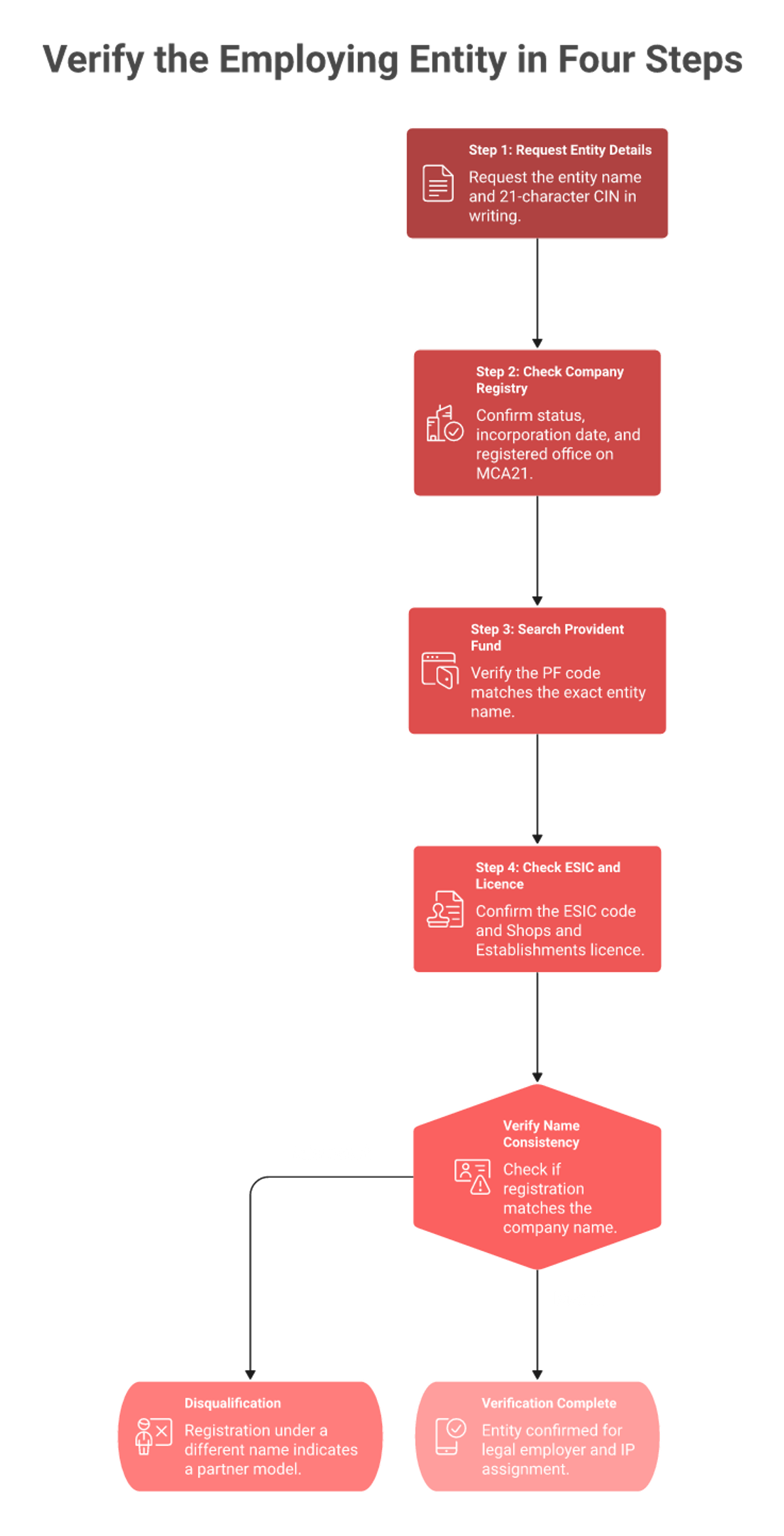
CIN means Corporate Identity Number, the 21-character ID every Indian company carries. It is public.
Ask for the employing entity's legal name and CIN in writing.
Look it up on MCA21 company master data and check status, incorporation date, and registered office.
Search the EPFO establishment database for the PF code under that exact name.
Check the ESIC employer portal and ask for the state Shops and Establishments licence.
If any registration sits under a different company name, you have a partner model. Ask them to say so plainly.
⚠️ What PE risk actually means for a US parent
PE means permanent establishment, a tax concept. If a foreign company is treated as having a taxable presence in India, Indian corporate tax can attach to attributed profits.
A properly structured EOR arrangement is designed to sit outside that. What raises the temperature is a foreign company directing work, signing local deals, or holding contracts in its own name. If you are weighing the alternative, the EOR vs entity in India analysis prices both routes.
✅ The IP assignment chain nobody checks
Intellectual property assignment means the employee's work product transfers to you contractually. That clause has to travel through every entity in the chain.
Ask to see it. One clause, in the employment agreement, naming your company as the assignee.
❌ The misclassification exposure sitting behind all of this
Most founders arrive at EOR because a contractor arrangement stopped being defensible. The back-pay exposure per misclassified employee runs roughly $25,000 to $40,000 once statutory dues, interest, and gratuity are added.
An operator I spoke with described the moment well: the realisation lands that someone "should really not have that person as a contractor, they should be an employee." Then the scramble starts. Twelve people get migrated across in one go, and nobody enjoys that week. The convert contractor to employee in India guide covers that transition step by step.
💬 What an employee sees from inside the entity
"I was employed by a Singapore entity that is yet to established in India. So, Wisemonk is the legal entity which I'm currently working under. It removes barriers and helps us work for companies without which it won't be possible."
— Verified User in Financial Services Wisemonk - G2 Verified Review
That review is the model working as intended. The employee knows exactly which company employs them.
I will not publish either vendor's entity structure as fact here, because the public sources conflict and this is a legal question, not a copy question. Ask them, verify on MCA21, and keep the email.
Q8. Whose data protection, certifications, and insurance actually cover you?
DPDP Rules 2025 were notified on 13 November 2025 as G.S.R. 846(E). Consent Manager registration opens from 13 November 2026, substantive data fiduciary duties apply from 13 May 2027, and penalties reach Rs 250 crore. Wisemonk holds SOC 2 Type II and ISO 27001. Deel bundles business insurance covering compliance issues that surface years later, which India-native providers generally do not carry.
🔐 Your EOR is a data dependency, not just a payroll vendor
DPDP means the Digital Personal Data Protection Act, India's privacy law. Your EOR holds PAN numbers, Aadhaar references, bank details, and salary history for every India hire.
That makes them part of your compliance perimeter. The 13 May 2027 date is when the substantive obligations bite.
📋 The three asks that belong in your contract annexure
Do not accept a security page as an answer. Ask for terms.
Their role: data fiduciary, or processor acting on your instructions, stated in writing.
Retention schedule: how long employee records are held after exit, and in which jurisdiction.
Breach notification: a stated window in hours, with a named contact.
Versatile Club stores India employee records under its own Indian entity's registrations, which keeps the processing chain to one company rather than several.
⭐ Certification status, stated plainly and dated
This is where the honest comparison hurts the cheaper options, including mine.
| Assurance layer | Wisemonk | Deel | Versatile Club |
| SOC 2 Type II | Held | Held | Not held |
| ISO 27001 | Held | Held | Not held |
| Bundled business insurance | Not carried | Bundled | Not carried |
| Data processing under own India entity | Yes | Verify per contract | Yes |
Status captured 14 August 2026. Re-verify on each vendor's trust page before your procurement review, because certifications lapse and get renewed.
💰 The insurance argument, made against my own interest
Deel's bundled insurance is the strongest single reason to pay four times more. It covers you if a compliance issue surfaces two or three years after the hire.
If your investors expect that cover, buy it. I would rather lose the deal than watch a Series B company discover the gap during diligence. Teams that still want an India-native option can compare the EOR services scope line by line.
⚠️ What privacy friction looks like in practice
"I was required to provide personal identity documents (like a passport), despite offering full corporate documentation for my U.S.-based LLC. This is not standard in B2B cooperation and raises serious privacy concerns."
— Verified User in Translation and Localization Deel Hire - G2 Verified Review
"There is no flexibility, no option for company-level onboarding without exposing personal data, and no way to continue working with a client if you don't comply."
— Verified User in Translation and Localization Deel Hire - G2 Verified Review
Certifications and day-to-day data practice are different things. A certified vendor can still run a rigid identity flow that your contractors resent, which is one reason the contractor of record route gets structured differently.
Versatile Club holds no SOC 2 Type II and no ISO 27001, and carries no bundled business insurance. Buyers whose procurement treats certification as a prerequisite should choose Wisemonk or Deel, and I say that on sales calls too.
Q9. How fast does each get someone live, and what happens when something breaks?
Deel quotes 7 to 14 day India onboarding, with chatbot-first tiered support, and reviewers report chasing follow-ups on time-sensitive matters. Wisemonk's 24 to 72 hour claim is not contractual, background verification runs 7 to 15 days, and reviewers flag email replies delayed a day or two from a small team. Versatile Club writes a five business day onboarding SLA into its service agreement. Neither named vendor publishes a contractual response window.
⏰ The week that actually tests a support model
Support looks identical on every website. It stops looking identical on the Tuesday you need a professional tax registration completed before a filing deadline.
Same for a termination. Full and final settlement in India has statutory steps, and a 48 hour ticket reply turns a two-day job into a two-week one. The how it works page maps each of those steps to a day on the calendar.
💬 What Deel buyers report about implementation
"From the start, they provided awful service: they consistently failed to meet committed deadlines, had terrible communication, and frequently cancelled meetings at the last minute."
— Verified User in Computer Software Deel Hire - G2 Verified Review
"The initial setup process was also very challenging; it took several days and involved a lot of emails, with issues arising at every step."
— Verified User in Translation and Localization Deel Hire - G2 Verified Review
Deel's platform is genuinely the most mature in the category. The friction shows up in human escalation, not in the product.
⚠️ What Wisemonk buyers report about response time
"I've noticed that their support/query responses can occasionally take a bit longer sometimes, likely due to a relatively small team. Increasing the team size could help ensure quicker turnaround times for queries."
— Verified User in Financial Services Wisemonk - G2 Verified Review
"Sometimes the email communication from the wisemonk team is delayed by a day or 2. But overall they seem to be the best for India."
— Bulbul G., Verified User Wisemonk - G2 Verified Review
A day or two is survivable for most questions. It is not survivable three days before payroll.
✅ Two asks that turn support into a contract term
Stop grading support pages. Grade contract language.
Name the person. Ask for a named HR business partner on the account, with an email address, not a shared inbox.
Write the window. Ask for a stated response time in hours for payroll and termination matters, inside the agreement.
Ask Versatile Club to show you where the five business day onboarding SLA sits in the service agreement, then ask the other two vendors the same question. Our EOR services in India page states the SLA in the same language the contract uses.
💸 Why the onboarding clock is longer than anyone quotes
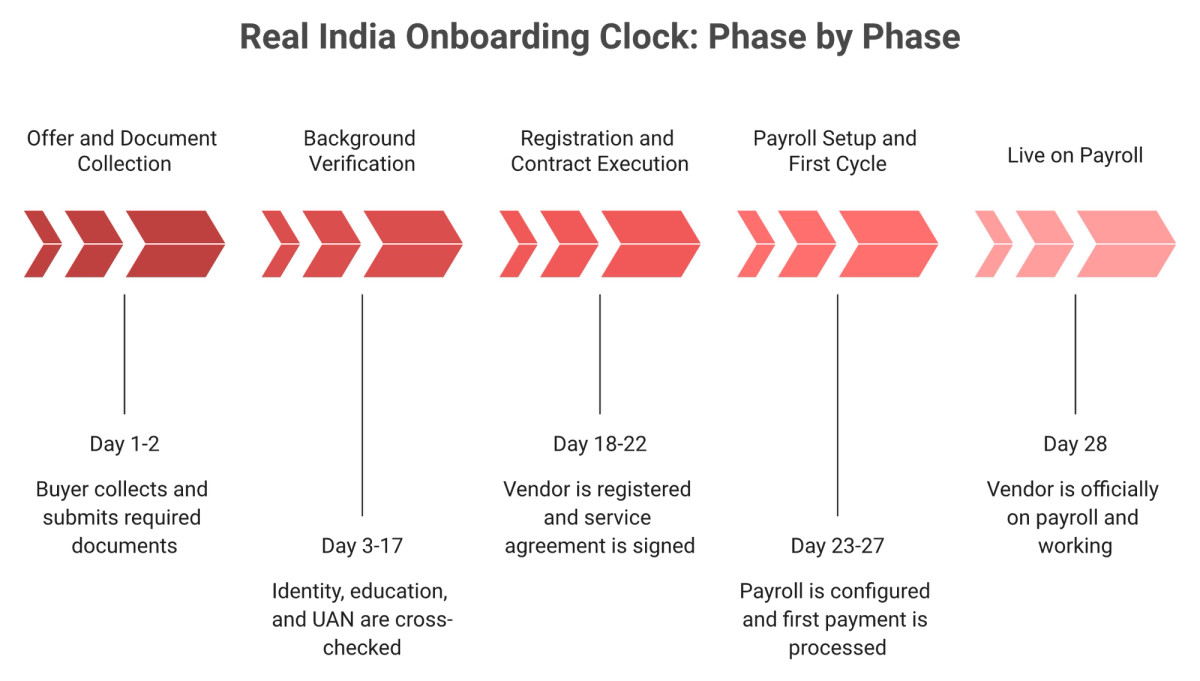
Background verification is the hidden segment. Roughly 30 percent of IT sector resumes in India contain discrepancies, so identity, education, and UAN database checks are not optional.
UAN means Universal Account Number, the portable PF ID that follows an employee across jobs. Cross-checking it catches overlapping employment fast, which is one reason our recruitment process front-loads it.
A US founder once messaged me at 11pm her time, three days before payroll, asking why her Bengaluru engineer's PF challan had not landed. I answered in nine minutes. That is not a feature; it is just what a founder-run account looks like.
Versatile Club puts the founder on WhatsApp and the SLA in the contract, which is exactly what this section tells you to demand from any vendor you shortlist.
Q10. What do buyers and analysts actually say about each one?
Both score 4.8 on G2 as of 2026, but the volume is not comparable. Deel carries thousands of reviews against Wisemonk's 211 to 261 depending on the snapshot, with Capterra at 5.0. Read the one-star tail, not the average. Deel's critics name cost, FX fees, and implementation chaos. Wisemonk's critics name response latency and a small team.
📊 The sampling method, stated up front
Every number here was captured on 14 August 2026. Review counts move monthly, so a rating without a date is not evidence.
The two review bases differ by an order of magnitude. A 4.8 across thousands of reviews and a 4.8 across 240 are not the same claim.
⚠️ Deel's complaint cluster: cost and coordination
"I have not seen anything best about Deel. I believe those platforms have two major tasks to do: contracts and payments. Both lacks at Deel."
— İbrahim, Verified User Deel Hire - G2 Verified Review
Harsh, and worth reading against the volume. When a base is that large, the tail contains everything, including outliers. Buyers weighing that tail against price often land on the Deel alternatives in India shortlist.
⭐ Wisemonk's complaint cluster: depth of the product surface
"What I dislike about Wisemonk is that some features feel a bit limited and could use more flexibility. In particular, I'd like to see better options for customization and more detailed reporting."
— Vinay M., Verified User Wisemonk - G2 Verified Review
"The Talent acquisition team was very friendly providing assistance as and when needed. Right from the start of the interview process, till getting the offer they provided ample information throughout."
— Verified User in Financial Services Wisemonk - G2 Verified Review
Reporting depth is the recurring ask. That is a normal gap for a specialist competing against a platform company, and the Wisemonk alternative page sets out how we handle reporting.
🔍 The analyst check most comparisons skip
Everest Group assessed 29 employer of record providers in its EoR Solutions PEAK Matrix 2025. Assessment is not the same as recognition, and recognition is not the same as being a Leader.
Before you repeat any analyst claim from a vendor deck, confirm the vendor was actually assessed in the named report. Ask for the report reference number.
Versatile Club does not appear in the 2025 PEAK Matrix assessment, which is a fair point against a 2026 EOR launch.
✅ How to read an asymmetric review base
This is the part six years of reading these pages taught me, and it changes the score you should trust.
Employee-side reviewers rate the payout experience: transfer fees, app usability, salary landing on time.
Buyer-side reviewers rate the escalation experience: implementation, terminations, compliance answers.
Vendor-hosted testimonials are marketing, and should be labelled as such when quoted.
Vendor-commissioned economic impact studies are not neutral evidence, whoever published them.
Sort by lowest rating first, then filter to the last twelve months. Two minutes of that beats an hour of reading five-star summaries.
I might be over-indexing on the negative tail, since my read comes from a competitor's chair. What holds up either way is that a 240-review base cannot tell you much about edge cases, and a 5,000-review base can.
Q11. Do I need a second vendor for India if I already run Deel everywhere else?
Below roughly three India employees, consolidation usually wins. One contract, one invoice, one data processing agreement, one relationship. Above it, depth usually wins, because India's statutory calendar is monthly and state-specific. The test is concentration, not total. Four India hires out of five internationals is a different decision from four out of forty. Analysis of India EOR economics puts the model ahead of an entity for teams under 15 people, even over three years.
✅ The concession, made properly
A second vendor is real work, and pretending otherwise would waste your time.
A second contract to negotiate and renew.
A second invoice reconciled in your month-end close.
A second data processing agreement, which now matters under India's privacy rules.
A second relationship to maintain, with a second set of people to onboard.
For two India hires, that overhead usually costs more than the depth returns.
⏰ What depth actually buys, quantified
India's compliance calendar is not annual. It runs monthly, and it runs by state.
TDS deposited by the 7th. PF and ESI challans monthly. Professional tax on a state-specific cycle. Every one of those has a date, and every date has a penalty behind it, as the outsource payroll India breakdown lays out month by month.
The measurable difference is not "better service." It is whether your question gets answered inside business hours in the same country, or escalated to a partner and returned tomorrow.
⚠️ The three-employee threshold, and why it moves
Below three India hires, keep it consolidated. Above three, or above 50 percent concentration, the depth argument starts winning on cost as well as risk.
The threshold moves earlier if you are hiring across multiple states. Two hires in Bengaluru and Mumbai already means two professional tax regimes, and the EOR vs entity calculator shows where that tips.
💸 What migration actually costs you later
The pattern I see most often is a pilot team parked on contractor agreements "just for now." An operator described the endgame plainly: once the entity work was finally sorted, they "simply migrated those 12 people over."
That migration is a week nobody planned for. New contracts, fresh PF registrations, gratuity continuity questions, and twelve people wondering if their salary lands on time. The switch EOR provider in India guide sequences that week properly.
Versatile Club runs India-only, so the migration work is the job rather than an exception, and we quote it as five business days per employee.
⭐ The hybrid stack is a legitimate answer
Keeping Deel globally and running India on a specialist is not a compromise. It is the arrangement that matches how most Series A and B companies actually hire.
You keep one platform for the countries with one or two people. You buy depth for the country with the engineering team.
Deel for the long tail of countries and contractor payments.
An India-native EOR for the concentrated headcount.
One shared cost model so your CFO can compare per-hire totals.
Where my head is right now is that this stops being a hybrid inside two years. India becomes its own procurement line, the way US payroll already is.
Versatile Club sits in exactly this slot for US and UK teams, employing India headcount on its own entity while the global platform keeps the rest, with one USD invoice arriving from India each month.
Q12. If neither fits: the India-only flat-rate option, and how to run your next two vendor calls
Versatile Club is an India-only EOR operating on its own entity, Foo Falcon Technologies Private Limited, with PF, ESIC, and Shops and Establishments registrations in its own name, verifiable by CIN on the MCA portal. Pricing is one flat per-employee monthly rate with no salary slabs, no setup fee, no exit fee, and the first month free. USD invoicing comes from that single Indian entity, with a five business day onboarding SLA in the agreement.
⭐ Why a third option belongs in this comparison at all
Wisemonk and Deel sit at opposite ends of one spectrum. Maximum coverage at $599, or India-only at slab pricing that starts at $99.
A buyer who wants India depth at a rate they can forecast is not served by either end. That is the whole reason this section exists.
✅ The five things you can verify without a sales call
Verification beats positioning, so here is what to check.
The employing entity is Foo Falcon Technologies Private Limited, checkable on MCA21 by CIN.
PF, ESIC, and state Shops and Establishments registrations sit under that same entity, not a partner's.
Pricing is flat per employee, with no salary-band tiers, published on the pricing page.
Onboarding is a contractual five business days, written into the service agreement.
Invoicing is a single USD invoice from India, with PF and ESI challans plus TDS deposit receipts attached monthly.
Versatile Club also runs contract to hire at 20 to 30 percent of annual salary, charged only after the hire completes day 90, with a six-month replacement guarantee on those placements.
❌ The honest concessions, all of them
This is where I would rather lose the deal than oversell.
No SOC 2 Type II, no ISO 27001. Wisemonk holds both.
No bundled business insurance. Deel bundles it, and that matters to venture-backed boards.
No review base yet, because the EOR line launched in 2026.
No self-serve platform that competes with Deel's, which is genuinely better software.
Not the cheapest. Wisemonk's $99 entry tier sits below our flat rate.
India only, by design. If you need five countries, this is the wrong shortlist.
The compliance muscle came from six years of contract-to-hire operations across Bengaluru, Hyderabad, and Pune, not from an EOR launch plan. Versatile Club's read is that entity ownership and state registrations were the hard part, and those were already in place, which the about us page sets out in full.
💰 The six questions to ask on your next two calls
Send these by email after each call, with a recap. Written answers are the whole point.
What is the employing entity's legal name and CIN?
Send the full salary slab table, with the CTC band for each tier.
What are the setup fee, exit notice, and deposit terms?
What FX rate source is used, and what spread is applied?
Is the onboarding timeline contractual, and where does it appear in the agreement?
Show a sample Form 130 and a Form 138 filing acknowledgement.
So the rule stands. India-concentrated headcount, buy depth from Wisemonk. Distributed headcount or investor-mandated insurance, buy coverage from Deel. Predictable flat pricing on an owned India entity, and Versatile Club's employer of record India cost breakdown has the number on it.
What I think shifts by 2028 is that India stops being one row on a global EOR map and becomes its own procurement decision. If you are running that decision this quarter, message me and tell me what your 18-month headcount split looks like.
FAQs
Is Wisemonk cheaper than Deel for hiring employees in India?
Yes on the headline fee, but the gap narrows once you model the full bill.
- Wisemonk lists India EOR from $99 to $399 per employee monthly, priced on salary slabs, with no setup or termination fee.
- Deel publishes about $599 per employee monthly, and third-party 2026 analyses report an India surcharge of $50 to $150 disclosed during sales calls.
- At ten India employees, the published annual difference runs roughly $54,000 before foreign exchange costs.
The catch sits inside the slab structure. Wisemonk's per-tier inclusions are not published, so a senior engineer at 50 lakh CTC may land anywhere between $99 and $399, and you cannot compute that from a public page.
Deel's number carries additions the pricing page does not lead with: a setup fee, one month's notice billed on exit, a deposit of one month's gross held per employee, and a reported 3 to 5 percent markup on rupee funding.
Versatile Club prices India EOR as one flat per-employee monthly rate with no salary bands, no setup fee, no exit fee, and the first month free, which is why a CFO can forecast month 13 in month one. Compare the structures on our India EOR pricing page before you accept either headline figure.
What does Deel actually cost for an India hire once you add setup, FX, and the deposit?
The sticker is the platform fee. The bill is the stack, and the difference matters at month-end close.
- Platform fee: about $599 per employee monthly on an annual commitment, captured August 2026.
- India surcharge: $50 to $150 monthly, reported by independent analyses rather than published, taking the effective fee to roughly $649 to $749.
- Setup fee: charged per 2026 quote context, so request it in writing.
- Exit: one month's notice, billed.
- FX: a reported 3 to 5 percent markup on rupee payroll funding.
- Deposit: typically 100 percent of one month's gross per employee, held for the life of the engagement.
Treat the surcharge and the FX figure as reported rather than verified, and get both answered by email.
The deposit is the line finance teams care about and comparison blogs footnote. Ten employees at an average monthly gross of $960 locks roughly $9,600 of working capital you cannot deploy.
Versatile Club issues one USD invoice from its own Indian entity with no deposit and no exit fee, which removes three of those six lines entirely. Our employer of record India cost breakdown models each line with a capture date.
Does Deel own an India entity, or does it use a local partner?
Do not take that answer from a comparison blog, including ours. Public sources conflict on which global providers own their Indian entity and which rely on partners, and this is a legal question rather than a copy question.
Verify it yourself in about twenty minutes.
- Ask each vendor for the employing entity's legal name and CIN in writing. CIN is the 21-character Corporate Identity Number every Indian company carries.
- Look the entity up on MCA21 company master data and check status, incorporation date, and registered office.
- Search the EPFO establishment database for the provident fund code under that exact name.
- Check the ESIC employer portal, then ask for the state Shops and Establishments licence.
If any registration sits under a different company name, you are looking at a partner model. That is not automatically wrong, but it adds a link to your employment chain, changes who responds to a labour inspector, and affects how the intellectual property assignment clause travels back to you.
Versatile Club employs India hires through Foo Falcon Technologies Private Limited, with provident fund, ESIC, and Shops and Establishments registrations in that same entity's name, verifiable by CIN. The compliance page lists every registration we file under.
Do I need a separate India EOR if we already use Deel for every other country?
Below roughly three India employees, consolidation usually wins. Above that, depth usually wins.
The overhead of a second vendor is real, and worth naming honestly:
- A second contract to negotiate and renew.
- A second invoice reconciled in month-end close.
- A second data processing agreement, which now matters under India's privacy rules.
- A second relationship to maintain.
What depth buys is measurable against India's calendar. Tax deducted at source is deposited by the 7th monthly, provident fund and ESI challans run monthly, and professional tax runs on state-specific cycles. Every date carries a penalty behind it.
The real test is concentration, not total headcount. Four India hires out of five internationals is a different decision from four out of forty. The threshold also moves earlier when you hire across states, because two hires in Bengaluru and Mumbai already means two professional tax regimes.
A hybrid stack is a legitimate answer: keep the global platform for the long tail of countries, and run India on a specialist. Versatile Club sits in exactly that slot for US and UK teams, employing India headcount on its own entity while the global platform keeps the rest. Model the crossover on our EOR vs entity calculator.
How fast can each provider get an India employee live on payroll, and is the timeline contractual?
Published timelines and contractual timelines are different things, and only one of them is enforceable.
- Deel: quotes 7 to 14 days for India onboarding, with chatbot-first tiered support.
- Wisemonk: claims 24 to 72 hours, though that claim is not contractual, and background verification alone runs 7 to 15 days.
- Versatile Club: writes a five business day onboarding SLA into the service agreement.
Background verification is the segment nobody prices into the quote. Roughly 30 percent of Indian IT sector resumes contain discrepancies, so identity, education, and Universal Account Number cross-checks are not optional steps you can skip to hit a 48-hour promise.
Neither named vendor publishes a contractual response window for live issues. Two asks fix that during procurement:
- Ask for a named HR business partner with a direct email address, not a shared inbox.
- Ask for a stated response time in hours for payroll and termination matters, written inside the agreement.
Support quality only becomes visible on the Tuesday a state professional tax registration blocks a filing deadline, or when a full and final settlement needs statutory steps completed the same week. See how the cycle runs day by day on our how it works page.