Table of contents (12)
Wisemonk vs Remote for India (2026): India-First EOR vs Global Coverage
Q1. Wisemonk or Remote for India in 2026, which should you actually pick?
Wisemonk is cheaper for India at every published tier: $99 to roughly $399 per employee per month on salary slabs, against Remote's $699 monthly or $599 on annual billing. But price is not the criterion. If your team spans three or more countries and one Indian city, stay on Remote. If India is becoming your largest overseas team across two or more states, a specialist earns the second contract.
A People Ops lead messaged me last quarter with one line and a screenshot. The screenshot was a headcount tab: 4 in Bengaluru, 3 in Pune, 2 more offers out in Hyderabad. Her line was simple. "Remote is fine. Is it still the right call?"
💰 The price gap is real, and it is not the decision
Remote lists India EOR at $699 per employee per month, or $599 on annual billing, checked August 2026. Vendor comparisons also record a $299 setup fee on India quotes, so ask for it in writing. Wisemonk publishes India EOR from $99 per employee per month with salary slabs running to about $399, plus contractor of record management near $19.
At ten India employees, that spread is six figures a year in fees alone. Most buyers stop reading there. That is the mistake.
⚠️ What actually breaks is the filing calendar, not the invoice
India runs central and state payroll law at the same time. Provident fund and employee state insurance are central. Professional tax is not, and it changes shape by state.
Across six years of contract-to-hire placements in Bengaluru, Hyderabad, and Pune, I have watched support load track state count, not headcount. Two people in one city is one filing calendar. Fifteen people across four states is four calendars, four registration regimes, and four sets of deadlines.
✅ The conditional verdict
Here is how I would call it, plainly.
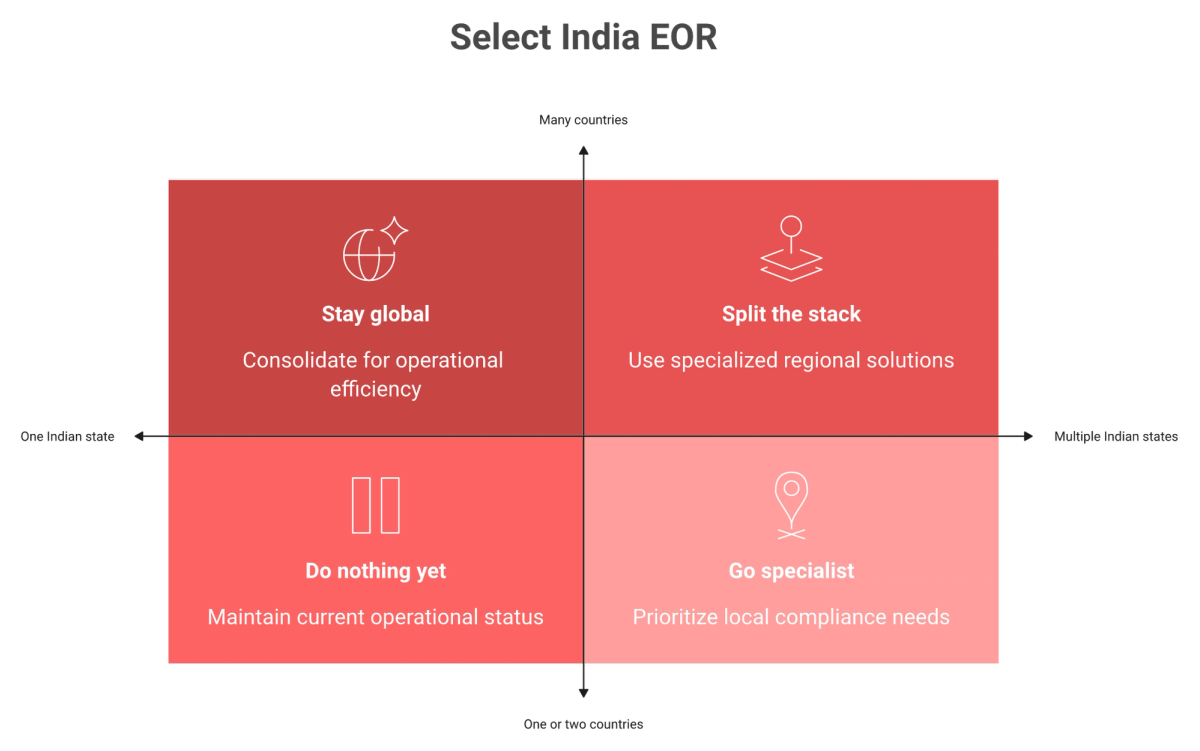
Stay with Remote if your team spans three or more countries and your India team sits in one city. Consolidation under one contract, one platform, and one data-processing posture is worth more than depth you will rarely use.
Move to an India specialist if India is becoming your largest non-domestic population and spans two or more states. The volume of India-specific statutory events crosses what a global ticket queue was built to absorb. A structured Remote alternative comparison is the right next step here.
Do nothing yet if you have fewer than about five India employees. The disruption of a move outweighs the depth you gain. Come back at ten.
Remote's own users describe the support model that shapes this call.
"They were dishonest about the level of support provided. We specifically explained we required phone-level support for urgent matters, but that is not available. Instead they have email support with a 3-day SLA."
— Juliette D., Verified User Remote - G2 Verified Review
⏰ Read this before you request a quote
The rest of this article is built to be used in order, not skimmed. Q3 gives you the two-number test that decides your answer. Q4 and Q5 price both vendors honestly. Q6 models the landed cost per hire, which is where the fee stops mattering.
One thing I want to be careful about. I could be reading the state-spread signal too strongly, because that is the variable my own operations feel most. If your India team is fifteen people in one Bengaluru office, the case for switching is much weaker than this section makes it sound.
Q2. What changed since you chose Remote, and is a second India contract worth it?
Nothing about Remote broke. Volume changed. When India goes from two people to ten-plus, the count of India-specific statutory events crosses what a global ticket queue was built to absorb. India now hosts 2,117 global capability centres across 3,728 units employing about 2.36 million professionals, so the concentration you are feeling is structural, not local.
❌ First, the honest cost of adding a vendor
A second EOR for one country means a second contract. It also means a second data-processing agreement, a second invoice line, and a second relationship to manage.
You consolidated on purpose. That value is real, and switching partly gives it back. Any article that skips this is arguing past you.
⭐ What changed is the volume of India events, not the quality of your vendor
India's four labour codes took effect on 21 November 2025. The wage definition changed with them, which quietly re-prices allowance-heavy Indian salary structures.
Then the tax forms were renumbered. Form 16 became Form 130, Form 16A became 131, and the quarterly Form 24Q became Form 138, effective 1 April 2026. Every one of those lands on whoever runs your India payroll compliance calendar.
📈 The market context behind your headcount curve
Your India growth is not an outlier. nasscom's Strategic Review 2026 puts the Indian technology sector at $315 billion in FY26, with a workforce of about 5.95 million and a net addition of roughly 135,000 people. The GCC segment alone crossed 2,100 centres.
That matters for one practical reason. Vendors price and staff for the average client, and the average client's India team is still small. Yours is not going to be.
✅ Split-vendor architecture is a pattern, not a workaround
Running one specialist for India alongside a global EOR for everywhere else is common in this category. It is not vendor sprawl if the boundary is clean.
Here is the boundary I would draw:
India sits with the specialist: employment contracts, provident fund, employee state insurance, professional tax, gratuity accrual, and the internal committee required under the POSH Act. This is what an India-only EOR service is built to carry.
Every other country stays with your incumbent global platform. You keep the single contract where breadth is the actual requirement.
Your data map gets one addition, not a rewrite. Under the DPDP Rules 2025, notified 13 November 2025 with phased commencement, employee data needs a named processor either way.
One India operator put the mechanism more cleanly than most vendor pages do.
"India runs central and state payroll laws at the same time."
— Community comment, r/IndiaEOR Reddit Thread
⚠️ Where I would push back on myself
Fundraising diligence is the quiet driver here. Clean India payroll records, challan confirmations, and consistent employment contracts get looked at during a Series B data room review.
I do think that pressure is real. I am less sure it justifies a switch at eight employees in one state, and I would rather tell you that than sell you urgency.
Q3. How do you run the country-spread and state-spread threshold test?
Score two numbers before requesting a quote. How many countries your whole team spans, where Remote covers 186 and Wisemonk covers seven (India, the United States, the United Kingdom, Canada, China, Japan, and the UAE). And how many Indian states your India team spans. Three countries plus one Indian city means consolidation still wins. One or two countries plus two-plus Indian states means specialist depth wins.
✅ Step 1: count your countries, using published coverage
Pull your headcount by country from your HRIS. Then compare it against what each vendor actually covers.
Remote publishes coverage across 186 countries. Wisemonk publishes seven. If your roadmap includes Brazil and Poland next year, that gap is your answer, and no India argument overrides it.
✅ Step 2: count your Indian states, not your Indian cities
This is the number nobody scores. Professional tax, meaning a state-levied tax on salaried income, is administered state by state.
A few examples of what "one more state" actually adds:
Maharashtra: dual registration, PTRC for the employer's deduction and PTEC for the entity itself, with monthly slab-based filing.
Karnataka: monthly professional tax remittance, plus Shops and Establishments renewal and employee enrolment within 30 days of joining.
Telangana: PTRC enrolment with its own monthly remittance deadline.
Tamil Nadu: biannual professional tax, on a completely different rhythm, plus labour welfare fund.
Delhi: no professional tax at all, but strict Shops and Establishments obligations.
💸 Step 3: a worked example, eight engineers, three states
Take eight engineers: four in Karnataka, three in Maharashtra, one in Telangana. That is one company, one payroll, and three separate professional tax regimes.
Karnataka wants a monthly filing. Maharashtra wants two registrations and a monthly slab return. Telangana wants its own enrolment and remittance. Miss one and the penalty is small, but the audit trail gap is not. This is the point where teams start hiring employees in India across states faster than their filing setup can follow.
⏰ Step 4: score it, then decide what you ask vendors
Write both numbers on one line: countries, then Indian states. Then read the result.
| Your score | What it means | The honest call |
| 3+ countries, 1 Indian state | Breadth is your real requirement | Stay with your global platform |
| 3+ countries, 3+ Indian states | Both requirements are live | Split: global for the rest, specialist for India |
| 1 to 2 countries, 2+ Indian states | India is the business | An India specialist earns the contract |
| Any spread, under 5 India employees | Depth gain is smaller than the disruption | Wait, and re-score at ten |
⚠️ What the score changes about your vendor call
If your score says stay, your questions are about price and platform. If it says specialist, your questions change entirely.
Ask which Indian entity employs your people, and for its corporate identity number. Ask which states it holds professional tax and Shops and Establishments registrations in, which is exactly what a statutory compliance posture should document. Ask who signs Form 130 by 30 May, and who filed Form 138 for the June 2026 quarter.
I will name my own bias here. I built my operating instinct inside multi-state contract-to-hire work, so state count is the lens I reach for first. If your India team will stay in one city for two years, weight it lower than I do.
Q4. Is Wisemonk's $99 the real price, or does it hide salary slabs and fees?
$99 is the entry rate, not the typical rate. Wisemonk slabs India EOR from $99 to about $399 per employee per month, with contractor management near $19, foreign exchange at mid-market, and no setup, platform, or termination fee. Third-party estimates put roughly $149 to $199 at ₹20L CTC and $399 to $499 at ₹50L. The tier table itself requires a sales call.
💰 What the published price includes
Wisemonk's India EOR entry rate is $99 per employee per month, checked August 2026. Contractor management sits near $19, and managed payroll around $49.
There is no setup fee, no platform fee, and no termination fee published. There is also no minimum headcount, which genuinely matters at your first two hires.
⭐ What Wisemonk is straightforwardly good at
Wisemonk has been India-native since 2020, which is longer than most of the specialist field. It holds SOC 2 Type II and ISO 27001, and carries 4.8 out of 5 on G2 across 261 or more reviews, plus 5.0 on Capterra.
Buyers say the India focus itself is the value.
"After evaluating several options, we chose Wisemonk because they specialize in India. Their focus made discussions about payroll structure and compliance clearer."
— Community comment, r/smeSingapore Reddit Thread
❌ Where the pricing gets opaque
The slab table is not published. You get "from $99" and a sales conversation, which means you cannot model your own cost before a call.
Third-party analysis estimates roughly $149 to $199 at a ₹20L CTC hire, and $399 to $499 at ₹50L. If those bands are close to accurate, the price gap against a $599 to $699 global platform narrows sharply at senior salaries, which is why an EOR versus entity calculator belongs in this conversation early.
⚠️ The three fair weaknesses, and only these
Wisemonk's service quality is genuinely well regarded, so I am not going to attack it. These are the structural gaps.
Onboarding speed is a claim, not a contract. The 24 to 72 hour figure is marketing language, not a service-level term you can enforce.
Background verification runs 7 to 15 days, which sits outside the onboarding promise and surprises people.
The team is small, and users notice it in response times.
"I've noticed that their support/query responses can occasionally take a bit longer sometimes, likely due to a relatively small team. Increasing the team size could help ensure quicker turnaround times."
— Verified User in Financial Services Wisemonk - G2 Verified Review
"The initial documentation and paperwork felt quite detailed and time-consuming at the beginning. However, as we progressed, it became clear that this thoroughness is what ensures proper legal and compliance coverage."
— Verified User in Marketing and Advertising Wisemonk - G2 Verified Review
💸 How the three pricing structures compare
| Provider | India EOR price structure | Setup / exit fee | Price at a senior hire |
| Wisemonk | From $99, salary slabs to about $399, tiers unpublished | None published | Rises with CTC band |
| Remote | $699 monthly, $599 annual billing, flat | $299 setup reported in vendor comparisons | Flat regardless of CTC |
| Versatile Club | $149 per employee per month, flat, no salary slabs | No setup fee, no exit fee | Flat regardless of CTC |
⏰ Three questions to ask on the pricing call
Ask these before anything else, and get the answers in email.
What is the exact monthly fee at a ₹45L CTC hire, in writing, for a 24-month term?
Which slab boundary sits closest to my current senior band, and what triggers a move up?
Is the onboarding timeline a contractual service level, or a target?
Versatile Club prices India EOR at $149 per employee per month flat with no salary slabs, no setup fee, and no exit fee, which is the row that changes least between a ₹20L and a ₹50L hire. You can check the current rate on the India EOR pricing page, and compare the specialist field on the Wisemonk alternative breakdown. That is a structural difference, not a discount claim, and Wisemonk's $99 entry rate still sits below it.
Q5. What does Remote actually cost for India once setup, FX, and notice are counted?
Remote lists $699 per employee monthly or $599 on annual billing, plus a $299 setup fee and one-month notice in the client's context, with a 1 to 3% FX markup and a risk-based deposit. Onboarding runs 10 to 14 days through a ticket queue, and India payroll cut-off complexity clusters around the 16th. Compliant, but structurally shallow on state-level nuance.
⭐ What Remote genuinely does well
Remote covers 186 countries under a single contract, which is the whole point of buying it. One agreement, one platform, one data-processing posture across every market you operate in.
It also carries a mature product and bundled business insurance, and it scores 77 out of 100 on the EOR Select index, above most India specialists. If breadth is your requirement, none of what follows should move you.
💰 The full India cost stack, not the headline
The list price is $699 per employee per month, or $599 with annual billing, checked August 2026. Vendor comparisons also record a $299 setup fee and one-month notice on India contracts, which is worth reading alongside a full Remote pricing breakdown.
Then come the two lines buyers forget. There is a foreign exchange markup of roughly 1 to 3% on funding, and a risk-based deposit that varies by client.
❌ Where the cost stops being the problem
Support is the friction point in Remote's own review corpus. The pattern is email-first, with a stated multi-day service level and no phone escalation path.
"They were dishonest about the level of support provided. We specifically explained we required phone-level support for urgent matters, but that is not available. Instead they have email support with a 3-day SLA."
— Juliette D., Verified User Remote - G2 Verified Review
Set against that, the same reviewer named the real benefit plainly.
"I like the all-in-one structure of Remote because it allows me to get rid of standalone products that confused my employee population and required multiple logins for HR work."
— Juliette D., Verified User Remote - G2 Verified Review
⚠️ One quote is not a rating, so read the distribution
Remote's Trustpilot corpus runs to roughly 3,100 reviews, and many describe fast response times. A single angry review is not the consensus, and I am not going to pretend it is.
Setup friction does show up repeatedly, though, including from the employee side.
"The initial setup was not easy at all; it was a very long process with no help and too many requests."
— Alice T., Verified User Remote - G2 Verified Review
💸 Why the India shallowness is structural, not sloppy
A global platform optimises for breadth of jurisdiction. That is a rational design choice when you serve 186 countries.
India punishes that choice for one reason. Central and state payroll law run at the same time, so depth cannot be abstracted into a single country module, which is the case for an India-only EOR service.
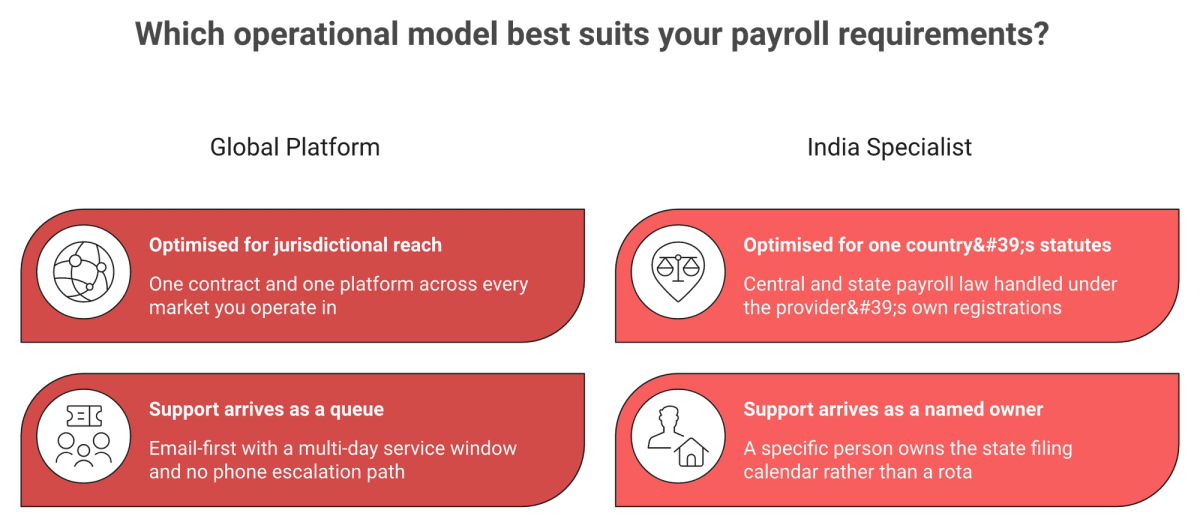
What I have watched happen, across six years of running multi-state payroll for US clients, is not vendor failure. It is a queue that answers a Karnataka professional tax question with a generic India article, three days later.
✅ When Remote stays the right call
Keep Remote if any of these is true.
You operate in three or more countries and India sits in one city.
Your procurement requires a mature platform with bundled insurance.
Your India headcount is under five, where a switch costs more than it saves.
I will hedge one thing. The FX markup and deposit numbers move by contract, and mine come from third-party comparisons rather than your quote. Ask Remote to confirm both in writing before you model anything, and if you are already scoping the move, start with the Remote alternatives in India shortlist.
Q6. What is the landed cost per India hire at ₹20L, ₹30L, and ₹50L CTC?
The vendor fee is the smallest variable. Statutory load adds roughly 6 to 13% on top of a stated cost-to-company once provident fund, gratuity at 4.81% of Basic plus DA, and professional tax are counted. At ₹20L CTC the Wisemonk versus Remote fee gap is wide. At ₹50L, with Wisemonk near $399 to $499, it narrows sharply.
⏰ Method, stated up front
Every number below assumes Basic plus dearness allowance at 50% of cost-to-company, which the Labour Codes wage definition now pushes employers toward. Gratuity, a statutory end-of-service payment, accrues from month one at 4.81% of Basic plus DA.
Provident fund is modelled at the ceiling-limited rate of ₹1,800 per month from the employer. Employee state insurance does not apply, because it stops at ₹21,000 in monthly wages. Professional tax is modelled at ₹2,400 a year, which is the Karnataka and Maharashtra pattern.
💰 The three bands, priced
Fees below are annual, at published August 2026 rates.
| Annual CTC | Statutory add-on (INR) | Wisemonk est. fee | Remote fee (annual billing) | Versatile Club fee |
| ₹20,00,000 | ₹72,100 | $1,788 to $2,388 | $7,188 plus $299 setup | $1,788 |
| ₹30,00,000 | ₹96,150 | Slab-dependent, unpublished | $7,188 plus $299 setup | $1,788 |
| ₹50,00,000 | ₹1,44,250 | $4,788 to $5,988 | $7,188 plus $299 setup | $1,788 |
Wisemonk estimates come from third-party CTC-band analysis, not a published tier table. Versatile Club prices India EOR at $149 per employee per month flat with no salary slabs, which is why its row does not move across the three bands, and you can sanity-check your own numbers with the India salary calculator.
💸 Read the table the way a CFO reads it
At ₹20L, the fee gap between a specialist and Remote is the loudest number on the page. At ₹50L, Wisemonk's upper slab lands within a few thousand dollars of Remote's flat rate.
That is the whole argument against picking on the entry price. The $99 headline describes a hire you probably are not making. If you want the fuller picture of what an India hire actually costs, the cost of hiring in India breakdown carries the same method.
⚠️ The provident fund lever nobody models
Here is the change most 2026 comparisons missed. The Employees' Provident Funds Scheme 2026, notified 29 June 2026, made employer contributions above the ₹15,000 wage ceiling voluntary.
That single line is the statutory basis behind any "higher take-home" claim you see on a vendor page. If a provider says it lifts net pay by 5 to 8%, ask whether the mechanism is this election, and who documents the employee's consent.
✅ What to do with this before your next quote
Three moves, in order.
Ask each vendor for the exact monthly fee at your actual senior band, in writing, not the entry rate.
Recompute gratuity and provident fund on the deemed-wage base for your last three India offers.
Decide, deliberately, whether you default new hires to ceiling-limited or full-wage provident fund.
Versatile Club's own client work points toward flat pricing mattering most at senior salaries, though I might be reading that too strongly, because senior engineering hires are simply where our placements cluster. If your India roadmap is mostly junior, a slab structure may cost you less than a flat rate.
Q7. What did India's 2026 statutory changes do to your India payroll?
Four changes matter. The Labour Codes took effect 21 November 2025 with a single wage definition that adds back allowances above 50% of remuneration. Form 16 became Form 130, Form 16A became 131, and Form 24Q became 138 from 1 April 2026. DPDP Rules 2025 phase in from 13 November 2026. Professional tax still runs state by state.
⚠️ Step 1: fix your salary structure, because the wage definition changed
The four labour codes commenced on 21 November 2025. They replaced multiple wage definitions with one.
The mechanic is simple. If allowances exceed 50% of total remuneration, the excess is added back into wages for statutory purposes. The Ministry's own example takes wages of ₹20,000 with ₹4,000 in excess allowances, and treats ₹22,000 as the wage base.
❌ Why US-drafted offer letters break here
American salary templates load allowances because they are administratively easy. In India, that structure now inflates the base for provident fund and gratuity.
The result is a quiet cost increase nobody approved. Your payroll is correct, your budget model is not, and this is exactly where HR consulting support earns its fee.
✅ Step 2: score your state exposure, again
Professional tax, a state tax on salaried income, has no national timetable. Three states, three rhythms.
Maharashtra: two registrations (PTRC and PTEC) with monthly slab-based filing.
Karnataka: monthly remittance, plus employee enrolment within 30 days of joining.
Tamil Nadu: biannual filing, plus labour welfare fund contributions.
⏰ Step 3: relearn your form numbers
The Income-tax Act 2025 and the Income-tax Rules 2026 renumbered the entire deduction-at-source stack from 1 April 2026. The certificate you have chased every year for a decade has a new name.
| What you knew | What it is now | When it is due |
| Form 16 | Form 130 | Annually, by 30 May |
| Form 16A | Form 131 | Quarterly, after each return |
| Form 24Q | Form 138 | Quarterly, Q1 FY27 due 31 July 2026 |
| Form 13 | Form 128 | On application |
| Monthly TDS deposit | Unchanged mechanic | By the 7th, monthly |
💸 Step 4: put employee data under a named processor
The Digital Personal Data Protection Rules 2025 were notified on 13 November 2025 through G.S.R. 846(E). Commencement is staggered rather than immediate.
Rule 4 bites from 13 November 2026, with the larger obligations following on 13 May 2027. Your India employee records sit inside that scope, and your EOR is a processor of them.
⭐ The two questions this generates for any vendor
Ask both, in email, and keep the reply.
Show me a redacted Form 130 you issued this cycle, and confirm the Q1 FY27 Form 138 filing date.
Which entity's provident fund and professional tax registrations do my employees sit under, and in which states?
Compliance is the floor, not the ceiling. The trouble is that in India the floor is 28 states and 8 union territories wide, and the wage rule re-prices every offer letter written on a US template. The month-by-month view sits in this India payroll compliance guide.
Q8. Who signs each India compliance artifact, you or your EOR?
Ask for names, not assurances. Someone must sign Form 130 by 30 May, file Form 138 quarterly, constitute the POSH Internal Committee, issue IRN-backed GST e-invoices above the ₹5 crore turnover floor, and hold the DPDP processor addendum for employee data before 13 November 2026. On a global platform, several of these default back to you.
✅ Why this question beats a feature checklist
Feature lists tell you what a platform can display. They do not tell you whose signature appears on a statutory filing.
I have sat on calls where a client assumed their EOR had constituted the internal committee required under the POSH Act. Nobody had. The obligation had simply never been assigned.
⏰ The artifact ownership scorecard
Run this grid against any vendor, global or specialist. The India specialist column reflects what an owned-entity provider should be doing, not what all of them do.
| Artifact | Deadline | Global platform | India specialist |
| Employment contract, India-law compliant | At offer | Provider, partner-drafted | Provider, own entity |
| PF and ESI monthly challan | 15th monthly | Provider, confirmation on request | Provider, confirmation attached to invoice |
| TDS deposit | 7th monthly | Provider | Provider |
| Form 130 (was Form 16) | 30 May annually | Provider | Provider |
| Form 138 (was Form 24Q) | Quarterly, Q1 due 31 July 2026 | Provider | Provider |
| Professional tax registration per state | On first hire in state | Often client-triggered | Provider, own registration |
| Shops and Establishments licence | Per state, renewals vary | Partner entity | Provider, own licence |
| Gratuity accrual at 4.81% of Basic plus DA | From month one | Provider | Provider |
| POSH Internal Committee | On tenth employee | Frequently unassigned | Provider, named members |
| GST e-invoice with IRN | Per invoice | Depends on billing entity | Provider, India-billed |
| DPDP processor addendum | Before 13 November 2026 | Client must request | Provider, in base contract |
| FC-GPR filing under FEMA | On share allotment | Client, always | Client, always |
| Full and final settlement on exit | Within statutory window | Provider | Provider |
💸 The e-invoice line that costs real money
Goods and services tax e-invoicing is mandatory once aggregate turnover crosses ₹5 crore, a floor reaffirmed for FY 2026 to 2027 under CBIC Notification 10/2023. Each invoice needs an invoice reference number, or IRN.
If your EOR bills you from India without a valid IRN, your input tax credit can be disallowed. That is a cash consequence, not a paperwork one, and it is one of the checks documented on the statutory compliance page.
⚠️ The two rows that are always yours
Two lines never move to a vendor, and any provider claiming otherwise is overselling.
FC-GPR under FEMA sits with your Indian subsidiary, if you have one. An EOR does not file it for you.
Permanent establishment risk is a tax position, not a service. An EOR reduces exposure; it does not indemnify your corporate structure. The trade-offs sit side by side in this EOR versus entity comparison for India.
⭐ How I would use the grid on Monday
Send the table to both vendors and ask them to fill the fourth column with names, not roles. A named payroll manager and a named compliance lead beat "our team handles it" every time.
Where my head is right now is that this grid, not price, is what separates the field. The vendors that answer it in a day are the ones that already run the filings themselves, which is the standard set out in how the EOR process works.
Q9. Which vendor's India entity and assurance posture can you actually verify?
Do not accept either vendor's entity claim from a comparison page, including this one. Public sources contradict each other, and the difference is legal exposure. Ask for the Indian entity name and CIN, the PF establishment code, the ESIC code, and state Shops and Establishments licences, then verify on MCA, EPFO, and ESIC. On third-party assurance, Wisemonk holds SOC 2 Type II and ISO 27001.
⭐ What "owned entity" actually means
An employer of record needs a legal employer in India. That employer is either a company the provider owns, or a local partner company the provider contracts with.
Owned means the provider's own registrations carry your employee. Partner means a third company you never signed with holds the employment relationship, and the administrative risk that comes with it. That distinction is the first thing to check when you hire in India without an entity.
⚠️ The claim I am not going to resolve for you
Here is the honest state of the public record. Some provider material states that most global platforms route India through local partner entities. Wisemonk's own competitive matrix lists Remote's India entity as owned.
Those two positions cannot both be fully right. I am publishing the contradiction rather than picking a side, because getting this wrong in print is a legal problem, not a marketing one.
✅ The ten-minute verification you can run yourself
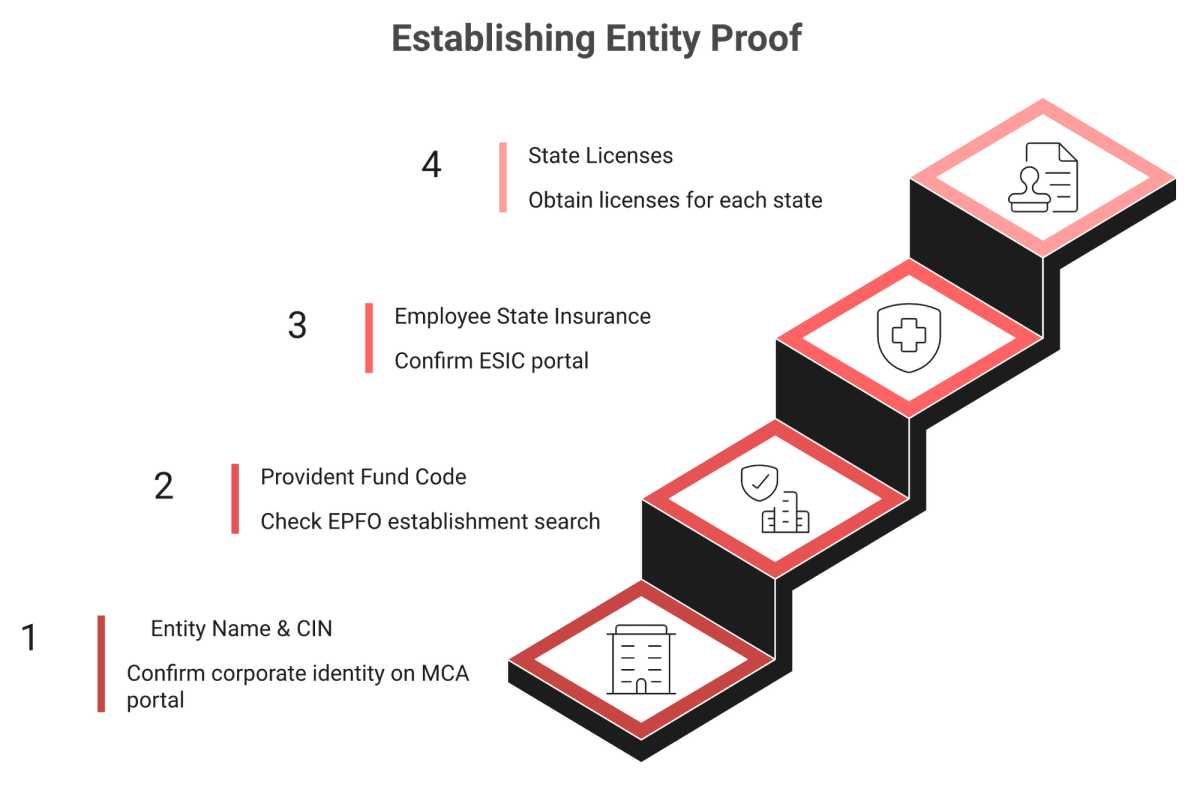
Ask for four artifacts, then check each one at its source. This takes about ten minutes.
Entity name and CIN, the corporate identity number, verified on the MCA portal.
PF establishment code, checked through the EPFO establishment search.
ESIC code, confirmed on the ESIC portal.
State Shops and Establishments licences, for every state your team sits in.
A provider that cannot produce all four in a day is telling you something. Employees notice the structure too, and the artifacts we publish sit on the India compliance page.
"I was employed by a Singapore entity that is yet to established in India. So, Wisemonk is the legal entity which I'm currently working under."
— Verified User in Financial Services Wisemonk - G2 Verified Review
💸 What third-party scores measure, and what they miss
Wisemonk carries 4.8 out of 5 on G2 across 261 or more reviews, plus 5.0 on Capterra. It scores 62 out of 100 on the EOR Select index, against 76 to 77 for Remote.
Read those two signals differently. G2 measures how customers feel about service, while the index rewards country coverage, platform maturity, and certification breadth.
❌ Where certification stops helping you
SOC 2 Type II and ISO 27001 are information security assurances. They say nothing about whether a Maharashtra PTEC registration exists.
The data-handling question is separate again, and buyers do feel it during onboarding.
"It asks for way too much personal information, doesn't explain why I need to share it, and makes it really challenging to register."
— Alice T., Verified User Remote - G2 Verified Review
Under the DPDP Rules 2025, notice and purpose limitation stop being optional courtesies. Ask both vendors which lawful purpose each data field serves.
⏰ The thing I would check first
If I had one hour, I would spend it on the PF establishment code, not the certification page. A code either exists in EPFO's records with your provider's entity name against it, or it does not.
Across six years of running India payroll for US clients, that single lookup has told me more than any vendor security page. I could be biased here, because registrations are the part of the work I touch daily, and they are what an owned-entity EOR service stands on.
Q10. Wisemonk vs Remote: the head-to-head criteria table
Wisemonk: from $99 slabbed to about $399, contractor $19, seven countries, a 24 to 72 hour onboarding claim, a named HR business partner, SOC 2 and ISO certified. Remote: $699 monthly or $599 annual plus a $299 setup fee, contractor $29, 186 countries, 10 to 14 day onboarding, ticket queue, bundled insurance. Neither publishes a contractual onboarding SLA.
💰 How I weighted the criteria
Most comparison tables rank features. I rank by how much monthly work a row generates for your team.
Filing cycles and support ownership sit at the top. Country count matters only if your roadmap actually needs it. Platform polish sits last, because nobody has ever been fined for a plain dashboard.
⏰ The grid, at August 2026 published rates
| Criterion | Wisemonk | Remote | Versatile Club |
| India EOR price | From $99, slabs to about $399 | $699 monthly, $599 annual | $149 flat, no slabs |
| Setup fee | None published | $299 reported | None |
| Exit fee | None published | Not published | None |
| Contractor management | About $19 | About $29 | Not the core product |
| Countries covered | 7 | 186 | India only |
| Stated onboarding | 24 to 72 hours, not contractual | 10 to 14 days | 5 business days, in the service agreement |
| Support model | Named HR business partner | Email and ticket queue | Founder on WhatsApp |
| Certifications | SOC 2 Type II, ISO 27001 | Enterprise-grade, mature | None |
| Third-party rating | G2 4.8, 261+ reviews | Trustpilot corpus of about 3,100 | No review base yet |
| Index score | 62 out of 100 | 76 to 77 out of 100 | Not rated |
Versatile Club writes a five-business-day onboarding commitment into the service agreement, which is the row that changes the conversation from marketing timeline to contract term. The sequence behind that commitment is documented in how the onboarding process works.
✅ The two rows that actually decide it
Ignore eight rows for a moment. Look at country count and stated onboarding.
Country count is a hard constraint, not a preference. If you need Brazil next quarter, seven countries ends the discussion regardless of price.
❌ Why the onboarding row is the sharpest one
A 24 to 72 hour claim and a 10 to 14 day range are both marketing numbers. Neither is enforceable, and neither carries a remedy if missed.
Users describe the gap between the promise and the week.
"Sometimes the email communication from the wisemonk team is delayed by a day or 2. But overall they seem to be the best for India."
— Bulbul G., Verified User Wisemonk - G2 Verified Review
"I like the all-in-one structure of Remote because it allows me to get rid of standalone products that confused my employee population."
— Juliette D., Verified User Remote - G2 Verified Review
💸 Read the price rows together, not separately
At a junior hire, Wisemonk's entry rate wins by a wide margin. At a senior hire, its upper slab lands close to Remote's flat annual rate.
That is why I put the slab structure and the flat rates in the same table. One number moves with your salary band, two do not.
Versatile Club's flat $149 per employee per month, with no setup fee and no exit fee, sits in this grid as a structural third option rather than a cheaper one, since Wisemonk's $99 entry rate is still lower. The current rate card sits on the India EOR pricing page.
Q11. If you switch India providers, what breaks for your employees?
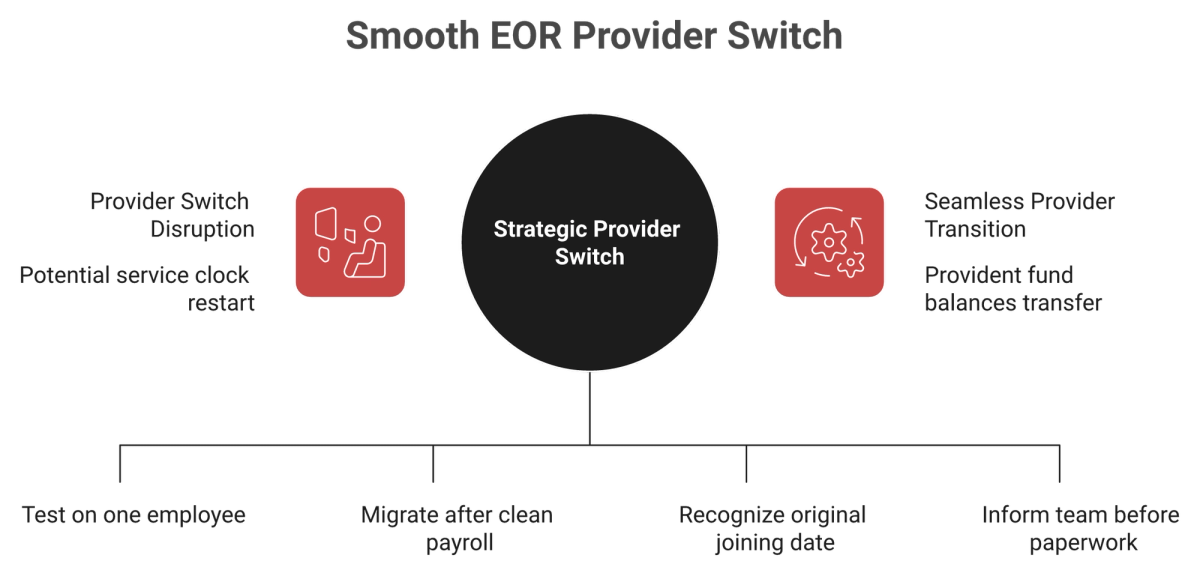
Two mechanisms decide it. Provident fund and UAN continuity carries across employers when handled correctly, so the retirement record survives a move. Accrued gratuity is the real risk, so get written confirmation that the new employer recognises the original joining date. Even handled perfectly, a novated contract lands as instability, so tell the team before the paperwork.
⚠️ The fear, said out loud
The sentence I hear most is not about money. It is "my India team is already on the platform, and moving them resets everything."
That fear is reasonable. It is also mostly wrong on the mechanics, and mostly right on the emotion. The full sequence sits in this guide to switching EOR providers in India.
✅ Mechanism one: UAN and provident fund continuity
Every Indian employee has a universal account number, or UAN, that follows them across employers. Provident fund balances transfer against that number.
Handled properly, a provider change does not reset the retirement record. Ask the incoming provider to confirm, in writing, that it will file the transfer and share the acknowledgement.
❌ Mechanism two: the gratuity date, which is the actual risk
Gratuity is a statutory payment tied to continuous service under the Payment of Gratuity Act. It accrues at 4.81% of Basic plus dearness allowance.
This is where a switch can genuinely cost an employee. If the new employment contract records a fresh joining date, the service clock restarts on paper.
Demand one clause, worded plainly: the new employer recognises the original date of joining for gratuity and leave accrual. Get it before signature, not after.
⏰ What the paperwork feels like from the employee's chair
Documentation load is real during any transition, and reviewers say so about both vendors.
"The initial documentation and paperwork felt quite detailed and time-consuming at the beginning. However, as we progressed, it became clear that this thoroughness is what ensures proper legal and compliance coverage."
— Verified User in Marketing and Advertising Wisemonk - G2 Verified Review
"Slow and laborious initial setup. We are still waiting on answers to key questions for implementation."
— Juliette D., Verified User Remote - G2 Verified Review
💸 A migration that actually worked, and why
One client came to us convinced a senior hire was London-based. At interview three, they discovered he was in Greece.
Versatile Club employed that person first, on its own entity, while the client watched the structure run for a cycle. Once payroll, challans, and documents landed cleanly, we migrated twelve people across, which is the same pattern used in contract-to-hire conversions.
That sequence is the lesson. Prove the structure on one person, then move the group, never the reverse.
⭐ The honest floor, before you start
Under about five India employees, the disruption outweighs the depth you gain. Tell your team before the paperwork, not after, because trust breaks faster than records do.
At ten or more across two states, the maths flips. Come back then, and run the switch in the order above.
Q12. If the test says specialist, who else is in the field, and when does an entity beat an EOR?
Concluding specialist means concluding a category, not a vendor. The India-only field includes Versatile Club, which employs through its own Indian entity, Foo Falcon Technologies Private Limited, verifiable by CIN, with its own PF registration, ESIC code, and state Shops and Establishments licences, one USD invoice from that entity, and a five-business-day onboarding SLA in the contract, alongside Wisemonk and other India natives.
✅ The category, not the vendor
If your threshold test said specialist, you did not pick a company. You picked a structure: one country, owned registrations, and named humans.
Wisemonk is the largest name in that structure. It is not the only one, and the field now includes several owned-entity operators, which you can compare on the Wisemonk alternative page.
⭐ What the mechanics look like, checkably
Versatile Club prices India EOR at $149 per employee per month flat, with no salary slabs, no setup fee, and no exit fee. We attach monthly PF and ESI challan confirmations and TDS deposit receipts to a single USD invoice raised from the Indian entity.
The registrations sit across all 28 states and 8 union territories, so adding a Pune hire to a Bengaluru team does not require a new vendor conversation. Sagar Chainani handles EOR communication directly on WhatsApp, which is a deliberate structural choice rather than a support tier, and the fastest way to start is a direct conversation with the team.
❌ The concession, stated without hedging
Versatile Club launched its EOR product in 2026, holds no SOC 2 Type II or ISO 27001 certification, has no public review base, and runs no self-serve platform. Wisemonk holds both certifications and 4.8 on G2 across 261 or more reviews.
If your procurement process requires third-party assurance, Wisemonk is the correct specialist and we are not. If you need five or more countries, neither of us is, and Remote is.
⚠️ When your own entity beats any EOR
This threshold is genuinely contested, and anyone quoting one number is selling something.
One line of analysis puts the tipping point at 10 to 12 hires, where fixed entity costs start amortising.
Other operating data keeps an EOR economical to 30 to 50 employees, before the capital and 12 to 18 month timeline of a captive centre are justified.
India's GCC base now runs to 2,117 centres, so entity formation is well-trodden ground once you are genuinely at scale. Model your own crossover with the EOR versus entity calculator.
💸 One option that does not legally exist
American buyers often ask about co-employment PEO for India. Traditional US-style co-employment does not exist under Indian labour law.
Without your own Indian subsidiary, an EOR is the legal bridge. That is not a preference; it is the structure the statute leaves you, and the distinction is laid out in this EOR versus PEO comparison.
⏰ Where this lands
Score the two numbers. Three countries and one Indian city, stay with Remote. India concentrated across two or more states, move to a specialist, and remember the field has more than one entrant.
What I think shifts over the next two years is that India stops being one row on a global EOR map and becomes its own category. Owned-entity operators in one country start taking the generalists' India revenue, and certification becomes the gap specialists have to close.
I could be early on that call. If you have run this switch, or decided against it, message me and tell me what the deciding factor actually was, or walk through the numbers with the India EOR team.
FAQs
Is Wisemonk cheaper than Remote for hiring in India?
Yes, at every published tier, but the gap narrows sharply at senior salaries.
- Wisemonk: India EOR from $99 per employee per month, priced on salary slabs running to about $399, with contractor management near $19 and no published setup or termination fee.
- Remote: $699 per employee per month, or $599 on annual billing, plus a $299 setup fee reported in vendor comparisons, a 1 to 3% foreign exchange markup, and a risk-based deposit.
The catch is that $99 is an entry rate, not a typical rate. Third-party analysis estimates roughly $149 to $199 at a ₹20L cost-to-company hire, and $399 to $499 at ₹50L. At the senior end, a slabbed specialist can land within a few thousand dollars a year of Remote's flat price.
We tell buyers to price the hire they are actually making, not the entry tier. Versatile Club prices India EOR at $149 per employee per month flat with no salary slabs, which is why our number does not move between a ₹20L and a ₹50L hire. You can compare the published rates on our India EOR pricing page before you request a single quote.
Is Wisemonk's $99 price real, or does it hide salary slabs?
The $99 figure is real as an entry rate. It is not the rate most buyers pay, because Wisemonk prices India EOR on salary slabs and does not publish the tier table.
What is published and verifiable:
- Entry rate of $99 per employee per month, with contractor management near $19 and managed payroll around $49.
- No setup fee, no platform fee, no termination fee, and no minimum headcount.
- Foreign exchange at mid-market rates.
What is not published is where each slab boundary sits. That means you cannot model your own cost before a sales call, which is the single most common complaint third-party reviewers raise about the pricing page.
Ask three questions in writing before you commit. What is the exact monthly fee at a ₹45L cost-to-company hire on a 24-month term? Which slab boundary sits closest to my current senior band? Is the onboarding timeline a contractual service level, or a target?
Versatile Club publishes a single flat rate with no slabs, so the answer to question one never changes as your salary bands rise. If you want the structural comparison in one place, our Wisemonk alternative breakdown sets the two pricing models side by side.
Is Remote good enough for India compliance in 2026?
Remote is compliant. It is not deep on India, and that distinction matters once your India team spans more than one state.
India runs central and state payroll law at the same time. Provident fund and employee state insurance are central. Professional tax is not, and it changes shape by state: Maharashtra requires dual PTRC and PTEC registration with monthly slab filing, Karnataka requires monthly remittance and enrolment within 30 days of joining, and Tamil Nadu files biannually.
Layer on the 2026 changes. The Labour Codes took effect on 21 November 2025 with a single wage definition. Form 16 became Form 130, Form 16A became 131, and Form 24Q became Form 138 from 1 April 2026. The DPDP Rules 2025 phase in from 13 November 2026.
On a global platform serving 186 countries, those events land in a ticket queue with a stated multi-day response window rather than with a named India owner. That is a design trade-off, not negligence.
Versatile Club runs those filings under its own Indian registrations across all 28 states and 8 union territories, and we attach challan confirmations and deposit receipts to the invoice. The month-by-month view sits in our India payroll compliance guide.
Does Wisemonk own its India entity, and how do I verify any provider's claim?
Do not take an entity claim from a comparison page, including ours. Public sources contradict each other on which providers own India entities and which use local partner companies, and the difference is legal exposure rather than marketing.
Verify it yourself in about ten minutes. Ask any shortlisted provider for four artifacts, then check each at source:
- Entity name and CIN, the corporate identity number, confirmed on the MCA portal.
- PF establishment code, checked through the EPFO establishment search.
- ESIC code, confirmed on the ESIC portal.
- State Shops and Establishments licences, for every state your team sits in.
A provider that cannot produce all four within a day has told you something useful. Note also that certifications answer a different question: SOC 2 Type II and ISO 27001 are information security assurances, and Wisemonk holds both, but neither confirms that a Maharashtra PTEC registration exists.
Versatile Club employs through its own Indian entity, Foo Falcon Technologies Private Limited, verifiable by CIN, with its own provident fund registration and ESIC code. The registrations and artifacts we hold are listed on our India compliance page so you can run the same checks on us.
If I switch India EOR providers, do my employees lose provident fund or gratuity tenure?
Provident fund records survive a switch. Gratuity tenure is the line that can genuinely break, and it breaks on paper rather than in law.
Two mechanics decide the outcome:
- UAN and provident fund continuity. Every Indian employee holds a universal account number that follows them across employers, and balances transfer against it. Ask the incoming provider to file the transfer and share the acknowledgement.
- Gratuity date recognition. Gratuity accrues at 4.81% of Basic plus dearness allowance under the Payment of Gratuity Act. If the new employment contract records a fresh joining date, the service clock restarts. Demand a clause recognising the original date of joining for gratuity and leave accrual, before signature.
Even handled perfectly, a novated contract lands with employees as instability. Tell your team before the paperwork, never after.
Versatile Club has migrated existing India teams onto its own entity by employing one person first, letting the client watch a full payroll cycle run, and then moving the group. Below about five India employees, we would tell you the disruption outweighs the gain. The full sequence is documented in our guide to switching EOR providers in India.