Table of contents (12)
Wisemonk India Pricing: EOR Fee, Contractor Rate, Payroll, Equipment
Q1. What does Wisemonk actually charge for India EOR in 2026?
A CFO at a Boston analytics company sent me a screenshot at 11pm her time last quarter. It was the Wisemonk pricing page. Two cards, one number, one word: "Custom." Her question was three words long: "Is this real?"
Wisemonk's India EOR starts at $99 per employee per month. Around it sit contractor management at $19 per contractor per month, Contractor of Record at 6% per payment, managed payroll at $49 per employee per month, a Payroll plus HRBP bundle at $250 per month for up to five employees, and background checks from $20. Setup, onboarding, and platform fees are $0.
💰 Every published Wisemonk price in one place
The pricing page itself publishes exactly one number. Everything else lives on service pages, comparison pages, and review desks. Here is the full set, with Versatile Club in the last row for reference.
| Module | Published price | Where it is published |
| India EOR (entry) | $99 per employee/month | Pricing page |
| India EOR (band ceiling) | up to $399 per employee/month | EOR service page |
| Contractor management | $19 per contractor/month | EOR page |
| Contractor of Record | 6% per payment | EOR page |
| Managed payroll (you own the entity) | $49 per employee/month | Payroll page |
| Payroll plus HRBP | $250/month, up to 5 employees | Pricing page |
| Background verification | from $20 per candidate | BGV page |
| Enterprise | Custom | Pricing page |
| Versatile Club India EOR | $149 per employee/month, $0 setup, $0 exit | Versatile Club pricing |
Versatile Club prices at one flat number across every salary band, which makes the twelve month model a single multiplication rather than a slab lookup. You can check the published rate on the Versatile Club pricing page.
⚠️ What the page does not tell you
The $399 ceiling appears on Wisemonk's own comparison pages, but never on the pricing page. That gap matters most for senior hires.
Recruitment carries no published rate anywhere and is quoted per role. Equipment cost sits inside "onboarding" as a line item with no number attached.
✅ Which module you actually need
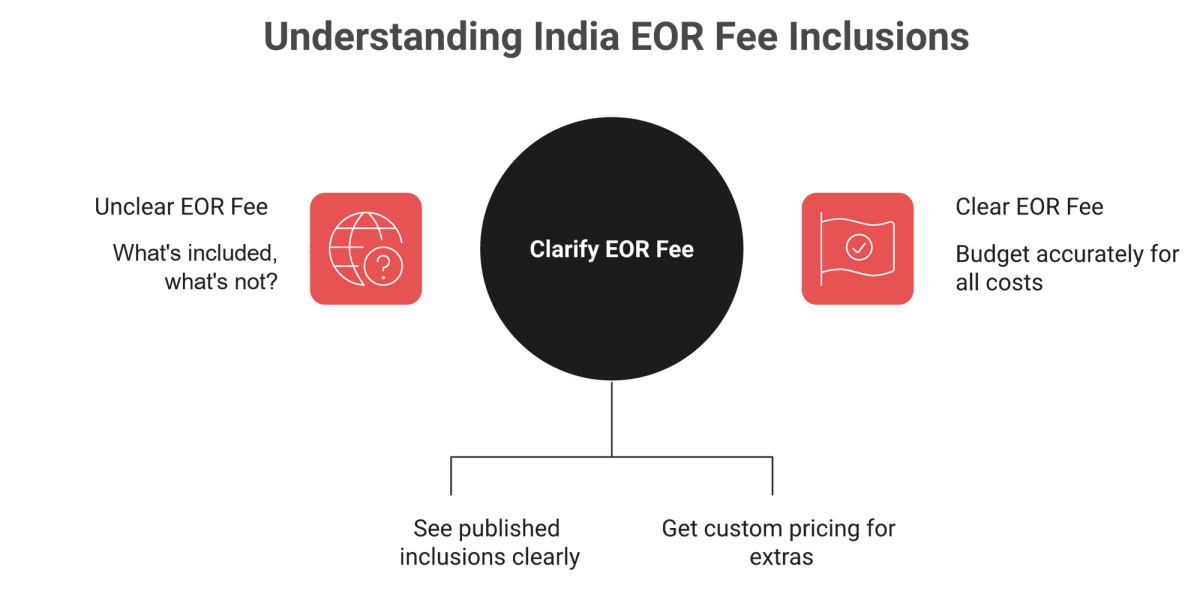
Pick by whether you own an Indian entity. No entity means EOR services in India. An entity you already own means managed payroll at $49, or the $250 HRBP bundle if you want HR judgment attached to the filings.
Versatile Club measures scope the same way, which is why our quote asks about your entity status before it asks about headcount.
⭐ What buyers say about the experience behind the price
"What I like most about WiseMonk is how they convert a complex international hiring process into a structured and easy workflow... The initial documentation and paperwork felt quite detailed and time-consuming at the beginning."
— Verified User in Marketing and Advertising, Wisemonk G2 Verified Review (3.5/5)
"Some features feel a bit limited and could use more flexibility. In particular, I'd like to see better options for customization and more detailed reporting."
— Vinay M., Wisemonk G2 Verified Review (4/5)
Wisemonk holds a 4.8 out of 5 average on G2, so these are texture, not indictment. If you are weighing the two providers side by side, the Wisemonk alternative breakdown covers the same ground.
🧾 My honest read on one-number pricing
I priced Versatile Club at one flat rate because in six years of Contract-to-Hire placements, the hire's salary never once changed my cost to run PF, ESI, professional tax, and TDS filings. The work is identical at ₹8 lakh and ₹80 lakh. I could be reading the market too strongly here, but banded pricing looks to me like a margin decision dressed as a cost decision.
Versatile Club publishes one number for every salary band, $149 per employee per month, with $0 setup, $0 exit, and the first month free, so the quote you model in month one is the invoice you pay in month twelve.
Q2. Is Wisemonk's $99 flat, or does it climb with salary?
It steps, and it does not float. Wisemonk's service page bands the fee by employee CTC (cost to company, the full annual package): roughly $99 up to ₹12 lakh, $199 from ₹12 lakh to ₹75 lakh, and $249 above ₹75 lakh. Its comparison pages publish $99 to $399, and independent review desks report $450 to $500 at high CTC. Flat inside a band, stepped between bands.
📊 The five figures that do not agree
Both claims can only be true if you read "flat" as "flat within a band." Here is the spread, source by source.
| Source | Figure published | What it implies |
| Wisemonk EOR service page | $99 / $199 / $249 by CTC slab | Three explicit steps |
| Wisemonk comparison pages | $99 to $399 | A fourth step exists |
| Wisemonk marketing copy | "flat fee, no percentage of salary" | No salary linkage at all |
| hr.software analyst review | up to $450 | Vendor list price understates |
| PEOrient review | up to roughly $500 | High-CTC quotes run higher |
| SynkPay comparison | $99 is real below about ₹15 LPA | Entry rate is genuine, narrow |
| Versatile Club | $149 at any CTC | One step, no lookup |
Versatile Club appears in that table with one figure because there is only one figure to publish.
💸 Why this lands on your best hire
The band structure is invisible until you hire senior. Your ₹80 lakh staff engineer is the one whose fee moves.
At three hires, one junior and two senior, the difference between a modelled $99 and an actual $249 is roughly $3,600 a year. That is not fatal. It is just not what you budgeted. Run your own bands through the India salary calculator before you commit to a model.
⏰ The sentence to put in your quote request
Ask for it in writing, in one line: "Please confirm the per employee per month fee at ₹15 lakh, ₹45 lakh, and ₹85 lakh CTC, and confirm the ceiling."
A vendor that answers with a range instead of three numbers is telling you the ceiling is negotiable. Versatile Club answers that question with the same number three times, which is a shorter email but a more useful one.
🧭 Where my head is on the $99 anchor
Versatile Club's read is that the standard advice gets this backwards. The category treats the entry rate as the comparison point, when the comparison point is your actual salary mix.
I have watched founders anchor on $99, model twelve months, then discover the number applied to one of their four hires. That is not a hidden fee. It is a disclosed fee that was published somewhere other than the page they read.
Versatile Club charges $149 per employee per month whether the hire earns ₹8 lakh or ₹80 lakh, because the filing work behind a senior engineer is identical to the work behind a junior one.
Q3. What do contractors, freelancers, and payroll-only cost?
A UK founder told me she had five people in India: two on employment contracts, three on invoices, and no idea which arrangement was cheaper. She was right to be confused. The two models are priced on different axes.
Wisemonk charges $19 per contractor per month for contractor management, 6% per payment for Contractor of Record, roughly 0.5% for freelancer payments with T+2 payouts, and $49 per employee per month for managed payroll if you already own an Indian entity. At $19 it undercuts Deel at $49, Multiplier at $40, and Remote at $29.
🧮 Where the per-seat model beats the percentage model
Run the crossover before you choose. The 6% Contractor of Record rate only wins at very small billings.
| Monthly contractor billing | $19 flat model | 6% per payment model | Cheaper option |
| ₹25,000 (about $290) | $19 | about $17 | 6% model |
| ₹50,000 (about $580) | $19 | about $35 | $19 flat |
| ₹1,50,000 (about $1,740) | $19 | about $104 | $19 flat |
| ₹4,00,000 (about $4,650) | $19 | about $279 | $19 flat |
The crossover sits near ₹27,000 a month. Above that, percentage pricing is a tax on your contractor's success. Versatile Club prices the same scope through its Contractor of Record service.
⚠️ The cost nobody quotes you
Here is the part that does not appear on any pricing page. US-style co-employment PEO has no legal basis under Indian labour law, so there is no compliant middle path between contractor and employee.
Every conversion Versatile Club has run started the same way: a contractor paid by bank wire, with no GST invoice and no TDS certificate on file. Cleaning that up costs more than a year of either fee.
Misclassification exposure sits under the Employees' Provident Funds and Miscellaneous Provisions Act, 1952, where a person who works like an employee is treated as one regardless of the contract heading. The mechanics of a clean switch are covered in this guide to converting a contractor to an employee in India.
✅ The four questions before you pick a model
Does the person have fixed hours, a company laptop, and a manager? That is employment, whatever the invoice says.
Are they raising a GST invoice, or sending a PDF?
Is TDS being deducted and a certificate issued?
Will you want to convert them inside twelve months?
Ask Versatile Club to run that four-question test on your current roster before you price anything. It usually reorders the list.
💬 What contractors themselves report
"Initially the problem I faced while working as a contractor for an international company was the money transfer problems but from when my company started using wisemonk I receive my salary in INR in my bank account."
— Bulbul G., Wisemonk G2 Verified Review (4/5)
"I find the pricing of Deel to be quite terrible for me. Previously, I was paid directly by my employer without any additional costs. Now, I'm required to pay a monthly fee."
— Verified User in Translation and Localization, Deel G2 Verified Review (0.5/5)
That second review is the quiet risk in contractor pricing. Push the fee onto the contractor and you have created a retention problem, not saved money. Teams comparing the generalist option often start with the Deel alternative comparison.
Versatile Club began as a Contract-to-Hire business, so contractor-to-employee conversion is our default motion rather than an upsell, and the same $149 covers the person on either side of that line.
Q4. Does the fee cover laptops, shipping, and asset recovery?
Equipment is in scope, not in price. Wisemonk's EOR card includes "end-to-end onboarding, equipment setup and welcome call," and the company claims zero markup on procurement and shipping. Hardware cost itself is quoted per case and never published. Versatile Club buys equipment on its own Indian GST registration, so the input tax credit and the asset trail sit with the same entity that files the payroll.
📦 What "included" actually means
Included means coordinated. Somebody sources the laptop, buys it, and ships it to a home address in Whitefield or Kondapur. That coordination is bundled.
The device is not free. A MacBook Pro in India lands between ₹1.6 lakh and ₹2.6 lakh, and that cost passes through to you. The logistics side is broken down in this guide to equipping remote employees in India.
✅ Proof that the workflow runs
Wisemonk's own customer testimonials describe the operational detail better than the price card does. One names equipment purchasing and shipping to Indian addresses across an 18-month engagement, alongside fair exchange rates and transparent pricing. A Canadian CFO describes equipment procurement running with payroll and benefits enrolment over six months.
I take those at face value. The procurement motion clearly works. What none of it settles is who owns the machine.
⚠️ The four questions the price card skips
Who holds title to the device, you or the EOR entity?
Who claims the GST input tax credit under section 16 of the CGST Act, 2017?
Who physically recovers the laptop on the resignation date?
What customs and lead-time buffer applies to an imported unit?
That third question is the quiet failure mode. A laptop still sitting in a Hyderabad flat six weeks after an exit is an accounting problem, not a courier problem.
Versatile Club measures asset recovery inside the full-and-final settlement window, which is the only point where you still have leverage. Our India compliance coverage documents where that sits in the exit process.
💰 Why the GST credit is worth naming
If the buying entity cannot claim input credit, you are paying roughly 18% more for the same laptop. On four machines that is real money sitting in the wrong column.
Ask your provider one question: whose GSTIN appears on the purchase invoice? Versatile Club answers with its own, which keeps the credit claimable and the audit trail single-threaded.
⭐ What buyers say about invoice cleanliness
"First USD invoice landed clean: no FX markup, no setup fee, no surprises."
— Verified User in Information Technology and Services, Versatile Club G2 Verified Review (5/5)
"Invoicing in USD meant zero exchange rate surprises. The compliance rigour is genuinely impressive, every statutory filing reviewed before submission."
— Vedant T., Versatile Club G2 Verified Review (5/5)
I will hedge one thing honestly. Versatile Club's asset recovery rate looks strong across our placements, though the sample is six years of India-only work, not a market-wide dataset.
Versatile Club buys equipment on its own Indian entity's GST registration, so the input credit and the asset-recovery trail sit with the same company that files your PF and professional tax returns. If you want that walked through against your own numbers, the how it works page maps each step of the onboarding cycle.
Q5. What is not in the $99, the full cost of employing someone in India?
The EOR fee is the smallest line on the invoice. On top of gross salary you carry 12% of Basic plus DA to provident fund, 3.25% employer ESI below the wage threshold, 4.81% gratuity accrual from month one, state professional tax up to ₹2,500 a year, and TDS deposited by the 7th monthly. Total employer cost in India runs 110% to 125% of gross before any EOR fee. Versatile Club files each of those lines under its own registrations.
💰 The statutory stack, line by line
Basic plus DA means basic salary plus dearness allowance, the wage base that most Indian contributions are calculated on. Under the Labour Codes in force since 21 November 2025, that base must be at least 50% of total remuneration.
| Line | Rate | Base | Timing |
| Provident fund (employer) | 12% | Basic plus DA | Monthly, by the 15th |
| ESI (employer) | 3.25% | Gross, below threshold | Monthly, by the 15th |
| ESI (employee) | 0.75% | Gross, below threshold | Deducted monthly |
| Gratuity accrual | 4.81% | Basic plus DA | Accrues from month one |
| Professional tax | up to ₹2,500/year | State slab | Karnataka monthly, Tamil Nadu twice yearly |
| TDS | per slab | Total income | Deposited by the 7th |
Versatile Club measures employer cost off the 50% wage base by default, because a lower base quietly understates PF and gratuity. The full statutory calendar sits inside our India payroll compliance guide.
🧮 A ₹35 lakh engineer, all in
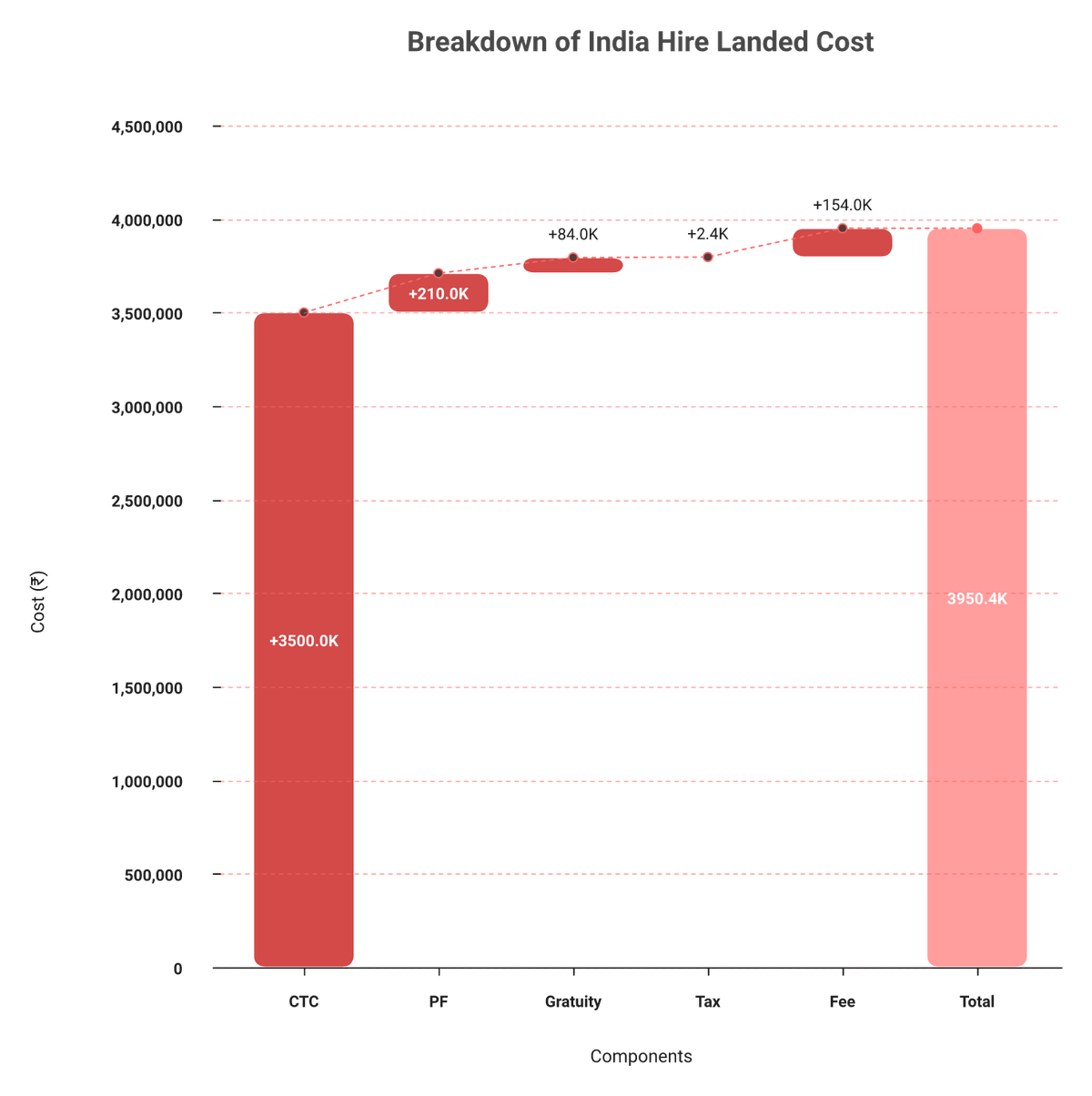
Take a ₹35 lakh CTC engineer in Bengaluru. Basic plus DA at 50% is ₹17.5 lakh.
PF at 12% is ₹2.1 lakh a year. Gratuity accrual at 4.81% is about ₹84,000. Professional tax in Karnataka is ₹2,400. ESI does not apply at this salary level.
That is roughly ₹2.96 lakh of statutory load, about 8.5% on top of CTC. Add the EOR fee at $149 a month and you are near ₹4.5 lakh above the package. You can rebuild that same stack for your own band using the India salary calculator.
⏰ The dates that actually break payroll
Rates are easy. Dates are where things go wrong.
TDS deposited after the 7th attracts interest. PF filed after the 15th shows up as a challan mismatch in the employee's passbook. Professional tax in Maharashtra needs two registrations, PTRC and PTEC, and the slab filing is monthly.
Across the multi-state placements Versatile Club runs in Bengaluru, Hyderabad, and Pune, the calendar causes more client escalations than the arithmetic ever has. Teams that want the filing work off their plate usually start with managed payroll.
✅ The one number for your model
Use 112% of gross as your planning figure for a mid-senior India hire, then add the EOR fee separately. Below the ESI threshold, push it toward 118%.
That still lands well under a US equivalent. A senior engineering role at roughly $58,000 all in against $220,000 in San Francisco is a $162,000 annual gap. The line-item breakdown behind that gap is covered in our guide to the cost of hiring in India.
🧭 Where I think the category gets this wrong
Compliance is the floor, not the ceiling. Every credible EOR clears the floor. They differ in what happens in week three, when a PF challan has not landed and payroll is four days out.
I could be reading my own inbox too heavily here. Versatile Club's escalation log points that way, though six years of India-only data is not the whole market.
Versatile Club files PF, ESI, TDS, and professional tax under its own registrations across all 28 states and 8 union territories, so every statutory line on your invoice traces to a challan in Versatile Club's own name.
Q6. Which Wisemonk fees are still unpublished?
Wisemonk's FAQ states no hidden fees, no minimum term, and no minimum headcount, and confirms $0 setup. An independent transparency audit still logs FX markup, security deposit, offboarding fee, and minimum term as "not published," scoring Wisemonk 62 out of 100. Recruitment carries no published rate anywhere and is quoted per role.
⚠️ "No hidden fees" is a sentence, not a schedule
I believe the intent behind that FAQ line. I have no reason to think Wisemonk is sandbagging anyone.
The problem is structural. A claim you cannot check is not a commercial term. It is a promise, and promises get renegotiated at renewal.
💸 The eight-line audit
Here is the checklist I hand founders, with what is publicly verifiable as of August 2026.
| Fee line | Wisemonk | Versatile Club |
| Setup fee | $0, published | $0, published |
| Platform fee | $0, published | $0, published |
| Minimum term | none, published | none, published |
| Minimum headcount | none, published | none, published |
| Security deposit | not published | none, published |
| Offboarding fee | not published | $0, published |
| FX markup | claimed nil, not published as policy | none, USD invoiced from India |
| First month | not offered | free, published |
Versatile Club sits in that table with eight published lines because a fee schedule you can screenshot is the only kind that survives a renewal conversation. The same eight lines appear on our India EOR pricing page.
📊 The FX benchmark nobody prints
FX markup is the quiet one. Global platforms have historically taken 2% to 10% on currency conversion, with Deel commonly cited in the 3% to 5% range.
On a $200,000 annual India payroll, a 3% spread is $6,000. That is a hire's worth of laptops.
Ask your provider for the mid-market rate they applied last month, in writing. Versatile Club invoices in USD directly from its Indian entity, which removes the conversion step from your side entirely.
⭐ What buyers actually watch for
"Every option I looked at first was either 'set up your own entity' (no thanks, not for one hire) or some platform that quotes you a great price and then you find out about all the add-ons later."
— Angad S., Founder, Versatile Club G2 Verified Review (5/5)
"I've noticed that their support/query responses can occasionally take a bit longer sometimes, likely due to a relatively small team."
— Verified User in Financial Services, Wisemonk G2 Verified Review (4/5)
That second review is fair and worth naming. Small India-native teams trade response speed for depth, and Versatile Club carries the same structural trade-off, which is why the founder sits on WhatsApp rather than behind a queue.
✅ Two documents to request before the MSA
Ask for a redacted sample invoice from a live client, and a signed fee schedule annexed to the master service agreement.
If a fee cannot be printed on a public page, it is not a policy. It is a negotiation, and you are on the weaker side of it once your hire has started. Buyers already mid-contract elsewhere should read how to switch EOR provider in India before renewal lands.
Versatile Club publishes the whole schedule up front: $149 per employee per month, no setup fee, no exit fee, no security deposit, no FX markup, and the first month free.
Q7. How does Wisemonk's price compare with Versatile Club, Deel, Remote, and Multiplier?
For one India hire, Versatile Club charges $149 per employee per month with $0 setup and $0 exit. Wisemonk starts at $99 and rises to $399 by salary band. Multiplier lists $400 with $0 setup and two weeks' notice. Deel lists $599 with a $500 setup fee. Remote lists $699, or $599 on annual billing, with a $299 setup fee. Contractor rates run $19 to $49.
📊 The like-for-like matrix
List prices are not comparable until setup and exit amortise. Here is the same India hire across five providers.
| Provider | Per employee/month | Setup fee | Exit terms | Owns India entity |
| Versatile Club | $149 flat | $0 | none, no fee | Yes |
| Wisemonk | $99 to $399 by band | $0 | contract notice | Yes |
| Multiplier | $400 | $0 | 2 weeks | Partner-led |
| Deel | $599 | $500 | 1 month notice | Partner-led |
| Remote | $599 to $699 | $299 | 1 month notice | Partner-led |
Versatile Club is the only row with zero on both ends, which matters more than the headline once you model a full year. Provider-by-provider detail sits in our roundup of the best EOR services in India.
💰 Twelve months, three hires
Model three India hires for one year, one at ₹10 lakh and two at ₹45 lakh CTC.
Versatile Club lands at $5,364 in fees, minus the first month free. Wisemonk lands near $4,752 if both senior hires sit in the $199 band, or $6,552 if they sit at $249. Deel lands at $21,564 plus $1,500 in setup fees.
The India specialists sit within a few hundred dollars of each other. The generalists sit four times higher. If Remote is your current benchmark, the Remote alternative comparison runs the same twelve-month math.
⏰ When the cheapest sticker is not the cheapest year
Amortise a $500 setup fee and a one-month exit notice over a 14-month tenure. That is roughly $78 a month of hidden carry before you compare anything else.
Onboarding speed belongs in the same calculation. Versatile Club commits to a 5-day contractual onboarding SLA, against 7 to 14 days commonly quoted by the global platforms.
⭐ Two reviews worth reading side by side
"Their team was highly responsive, professional, and easy to work with throughout the process. The best part was their ability to simplify hiring in India."
— Mukul S., Versatile Club G2 Verified Review (5/5)
"Deel treats all users as if they were individual freelancers, even when you're clearly operating as a registered company... There is no flexibility, no option for company-level onboarding."
— Verified User in Translation and Localization, Deel G2 Verified Review (0.5/5)
❌ When this comparison should not decide it
If you need five or more countries, buy the generalist. Versatile Club operates only in India by design, and that is a real limit for a multi-country roadmap.
Enterprise buyers who gate procurement on SOC 2 or ISO 27001 should also look at Wisemonk, which holds both. I would rather say that plainly than watch a bad fit sign. Larger India teams comparing structures can start with our enterprise India hiring page.
Versatile Club is the only row in that table with zero on both ends, no setup fee and no exit fee, which is exactly why a twelve-month total-cost comparison is worth running before you sign anything.
Q8. Does your provider own the Indian entity, and how does that shape the price?
Most global EORs, including Deel, Remote, G-P, and Omnipresent, employ your India hire through a local partner entity. That adds a margin layer, a contract-execution delay, and a compliance party you never signed with. India-native providers including Wisemonk and Versatile Club employ on their own registrations, and Wisemonk's $99 is the lowest published rate from any provider that owns its Indian entity.
🧩 Two quotes, one country, different architecture
A partner-led EOR is a reseller. Your master service agreement is with a Delaware or Dutch company, and the employment agreement is with an Indian firm you have never met.
An owned-entity EOR signs both. The company you pay is the company on the PF challan.
Versatile Club holds its own PF, ESIC, and Shops and Establishments registrations, so the paper chain has one link instead of three. That structure is documented on our India compliance page.
⚠️ What actually breaks in the middle layer
Four things go wrong, and none of them show on a pricing page.
Onboarding slows down, because two entities must both approve the contract.
Indemnity gets murky, since the party carrying statutory risk is not the party you sued.
IP assignment can sit with the partner entity rather than flow to you.
Permanent establishment exposure rises, because PE risk means a tax authority treating your foreign company as trading in India through a fixed presence.
I have seen the indemnity gap surface only during diligence, which is the worst possible time. The structural options are compared in our guide to hiring in India without an entity.
✅ Two documents that settle it in ten minutes
Ask for the CIN, the corporate identity number issued by the Ministry of Corporate Affairs, and look it up on the MCA portal. Then ask for the PF establishment code and check it on the EPFO establishment search.
Compare both against the entity name on your draft employment agreement. If the names do not match your MSA counterparty, you are leasing a shell.
Ask Versatile Club for both numbers on the first call, before pricing comes up. Our how it works page shows where each document lands in the onboarding sequence.
⭐ What employees and buyers report
"I was employed by a Singapore entity that is yet to established in India. So, Wisemonk is the legal entity which I'm currently working under. It removes barriers."
— Verified User in Financial Services, Wisemonk G2 Verified Review (4/5)
"They contradicted themselves regarding the employer structure, leading to an automatic rejection."
— Verified User in Computer Software, Deel G2 Verified Review (0/5)
"Setting up in a new country can get messy fast, but their India EOR made onboarding feel easy... there were a few time zone misunderstandings that caused slight delays in the initial phase."
— Setu C., Versatile Club G2 Verified Review (5/5)
🧭 My call on where this goes
What I think shifts in the next two years is that India stops being one country on a global EOR map. It becomes its own category, and owned-entity specialists take the India line item from the generalists.
Versatile Club owns its Indian entity and invoices in USD directly from India, so no partner shell sits between your employment agreement and your PF challan, and no FX layer sits between your bank and ours.
Q9. How do the 2026 statutory changes reprice each India hire?
Three changes move the number. The four Labour Codes in force from 21 November 2025 require Basic plus DA to be at least 50% of remuneration, which lifts provident fund and gratuity accruals at unchanged CTC. Under the Employees' Provident Funds Scheme 2026, contributions above the ₹15,000 wage ceiling are voluntary. DPDP Rules 2025 were notified on 13 November 2025 with staggered enforcement. Versatile Club repriced every client payroll in the month each rule took effect.
💰 The 50% wage rule, in payroll terms
The wage definition is the change with the biggest cash effect. If Basic plus DA sat at 35% of CTC, it must now sit at 50%.
On a ₹30 lakh package, that moves the contribution base from ₹10.5 lakh to ₹15 lakh. PF at 12% rises by about ₹54,000 a year. Gratuity accrual at 4.81% rises by about ₹21,600.
Nothing about the offer letter changed. Only the split did, and your cost went up by roughly 2.5% of CTC. The revised base flows through every line in our India EOR cost breakdown.
⚠️ Why two identical CTCs now cost differently
The EPF Scheme 2026 made contributions above the ₹15,000 statutory wage ceiling voluntary, so anything beyond ₹1,800 a month is now an election.
Two engineers on the same package can therefore carry different employer costs. One opts in above the ceiling. One does not.
Versatile Club captures that election in writing at onboarding, because an undocumented opt-out becomes an audit question two years later.
⏰ DPDP, and what your EOR must accept in writing
DPDP means the Digital Personal Data Protection Act, India's data law. The Rules were notified on 13 November 2025 under G.S.R. 846(E), with substantive duties phased in over roughly 18 months.
Your EOR processes payroll data, PAN, Aadhaar, and bank details on your behalf. That makes it a processor, and processor duties belong in the contract, not in a trust page.
Ask for a processing addendum covering breach notification, retention limits, and deletion on exit. Our India compliance page sets out where those clauses sit in the agreement.
📍 The state layer nobody prices
Central rules are uniform. State rules are not, and this is where a global playbook thins out.
Maharashtra needs two registrations, PTRC and PTEC, with monthly slab filing.
Karnataka runs monthly professional tax plus Shops and Establishments renewal.
Tamil Nadu files professional tax twice a year, plus labour welfare fund.
West Bengal changes its rules more often than any other state I track.
Across the Bengaluru, Hyderabad, and Pune placements Versatile Club runs, the state calendar drives more corrections than the central rates ever do. City-level detail sits in our guides to payroll outsourcing in Bengaluru and payroll outsourcing in Hyderabad.
✅ What to do this week
Re-model every open India offer on a 50% Basic plus DA base before you compare any EOR quote. The fee difference between providers is usually smaller than this restructure.
Then ask your provider for two cost sheets per hire, one with voluntary above-ceiling PF and one without. If they can only produce one, their payroll engine has not caught up.
🧭 My honest read on regulatory lag
India is the only country Versatile Club operates in, so a gazette notification is not a newsletter item for us. It is a repricing exercise across every client payroll in the same month.
I could be reading the generalist platforms too harshly. What I keep seeing, though, is India rule changes landing in their product a quarter late, because India is one line on a 150-country roadmap.
Versatile Club operates in India only, which is why the 50% wage rule was repriced across every client payroll in the month it took effect rather than the quarter after.
Q10. Which documents prove your EOR is actually current?
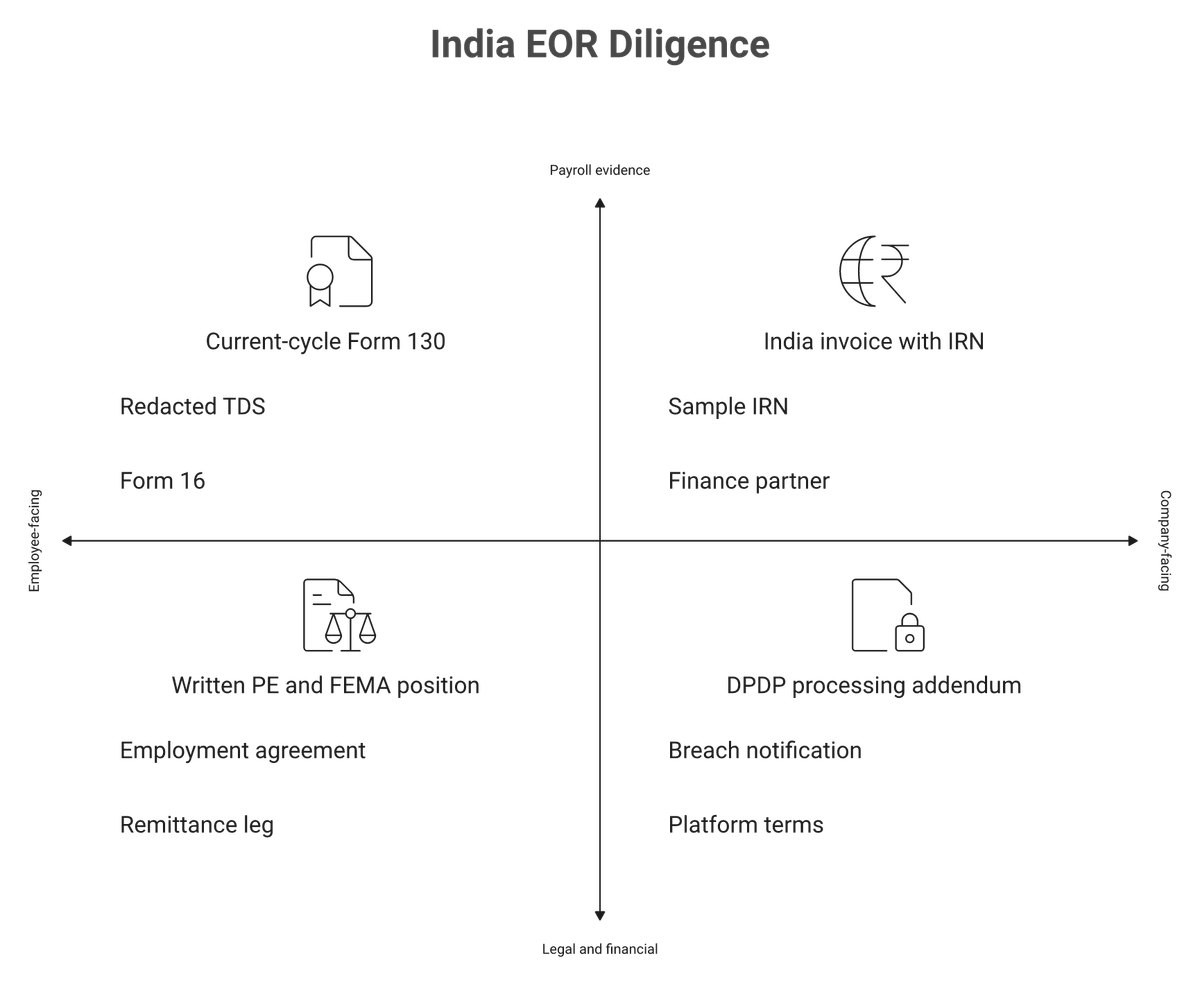
Ask for four artifacts before you sign. A redacted Form 130 from the current cycle, since Form 16 became Form 130 and Form 24Q became Form 138 from 1 April 2026. An India invoice carrying a valid IRN, mandatory above ₹5 crore turnover under CBIC Notification 10/2023. A DPDP-aligned processing addendum. And a written PE and FEMA position. Versatile Club issues Form 130 and Form 138 documentation on the current cycle.
📄 Artifact one: the current-cycle Form 130
Form 130 is the annual salary TDS certificate under the Income-tax Act, 2025. It replaced Form 16 with effect from 1 April 2026, and Form 131 replaced Form 16A under section 395(4)(a).
Ask for one, redacted, from this cycle. A provider still shipping documents labelled Form 16 is running a payroll stack that has not been updated. The filing calendar behind those forms is mapped in our India payroll compliance guide.
🧾 Artifact two: an invoice with a valid IRN
IRN means invoice reference number, the identifier generated when a GST e-invoice is registered. It is mandatory for businesses above ₹5 crore aggregate turnover under CBIC Notification 10/2023.
Check that the IRN and QR code actually appear on the India invoice. Versatile Club invoices in USD directly from its Indian entity, which keeps one document doing both jobs for your auditor.
🔐 Artifact three: the DPDP processing addendum
Your EOR holds PAN, Aadhaar, bank details, and salary history for every hire. Under the DPDP Rules 2025, processor obligations need to be contractual.
Three clauses matter: breach notification timelines, retention limits, and deletion on exit. Ask Versatile Club to attach that addendum to the master service agreement rather than reference a policy page.
⚠️ Artifact four: the PE and FEMA position, in writing
PE risk means permanent establishment risk, where a tax authority treats your foreign company as trading in India through a fixed presence. FEMA is the Foreign Exchange Management Act, which governs cross-border money movement.
Ask two questions. Who signs the employment agreement, and how does money reach the employee?
If the answer involves a partner entity and a second remittance leg, your exposure is wider than the pricing page suggests. The mechanics of paying people compliantly are covered in our guide on how to pay employees in India.
❌ What a weak answer sounds like
I have heard all three of these in live calls.
"We will share Form 16 after the financial year." Wrong form name for 2026.
"Invoicing is handled by our finance partner." That usually means no India IRN.
"Compliance is covered under our platform terms." That is not a processor addendum.
None of these prove bad intent. They prove the operating layer has not caught up with the marketing layer.
✅ The email to send tomorrow
Keep it to four lines and one deadline. Request a redacted current-cycle Form 130, a sample India invoice showing the IRN, the DPDP addendum, and the entity name on the employment agreement.
Versatile Club answers those four with attachments rather than assurances, which is the only version an auditor accepts. If you want the four documents walked through live, get in touch with our India team.
🧭 Why documents beat pricing pages
A price is a claim. A challan is evidence.
Versatile Club's read is that the standard advice gets this backwards. Buyers spend three weeks comparing fees and ten minutes on artifacts, when the artifacts are what fail during diligence.
Versatile Club issues Form 130 and Form 138 documentation on the current cycle and invoices from India with a valid IRN, so your auditor gets a clean trail without a follow-up request.
Q11. At what headcount does EOR stop being cheaper than your own entity?
The practical tipping point sits around 10 to 12 India hires. Below that, entity setup and ongoing compliance overhead exceed EOR fees. Above it, per-head fees start to outrun a subsidiary's fixed cost. FC-GPR filings under FEMA, PE exposure, and a three to six month registration window push many teams onto a hybrid path instead. Versatile Club charges no exit fee when a client migrates onto its own entity.
💰 The crossover model, plainly
An Indian subsidiary is a fixed cost. An EOR is a variable one.
Entity setup runs $15,000 to $50,000 all in, including SPICe+ incorporation, registered office, and professional fees. Ongoing compliance, a company secretary, an auditor, and payroll software add roughly $1,500 to $3,000 a month.
At $149 per employee per month, twelve hires cost about $21,500 a year in EOR fees. That is where the two curves meet.
| Headcount | EOR at $149/month | Entity, year one | Cheaper path |
| 3 hires | $5,364 | $40,000 plus | EOR |
| 8 hires | $14,304 | $40,000 plus | EOR |
| 12 hires | $21,456 | $40,000 plus | EOR in year one |
| 12 hires | $21,456 | $24,000 steady state | Entity from year two |
| 25 hires | $44,700 | $30,000 steady state | Entity |
Versatile Club sits in that table without a thumb on the scale, because past roughly a dozen hires the honest answer stops being us. Run your own numbers through the EOR versus entity calculator before you decide.
⏰ The case for staying on EOR longer
Timing changes the answer. Entity registration takes three to six months before your first hire is legal.
Teams building a GCC, a global capability centre, often run a hybrid. First engineers onboard through an EOR inside a week, and the captive entity comes up in parallel by month six.
Ask Versatile Club to run that overlap, since the same registrations carry both the EOR employees and the transfer window. The sequencing is documented in our guide to GCC setup in India.
⚠️ Where migrations actually lose money
The math is the easy part. The migration is where I have watched teams bleed.
PF transfers need Form 13 and correct establishment codes, or the passbook breaks.
Gratuity continuity resets if the transfer is treated as a resignation.
A mid-year switch produces two Form 130s, and employees file wrong.
FC-GPR must be filed with RBI within 30 days of share allotment when you fund the new entity.
That last one catches people. A missed FC-GPR filing is a FEMA compounding application, not a clerical fix. The trade-offs on both sides are laid out in our EOR versus entity in India comparison.
✅ The five-item migration checklist
Run these in order, and start eight weeks before payroll switches.
Confirm the new entity's PF and ESIC establishment codes are live.
File Form 13 transfers for every employee, not a bulk request.
Document gratuity service continuity in each transfer letter.
Align the switch to 1 April so one Form 130 covers the year.
File FC-GPR within 30 days of the share allotment.
Versatile Club measures a clean migration by whether any employee's PF passbook shows a service gap afterwards.
🧭 What I am still unsure about
I do not think the tipping point is a number. I think it is a support question.
The teams I have seen stay on EOR past twelve hires did so because nobody internally wanted to own month-end close in India. That is a rational choice, and I would not argue them out of it.
Versatile Club charges no exit fee, so migrating your team onto your own Indian entity costs you the transfer paperwork and nothing else.
Q12. Which India EOR fits your stage?
Decide on entity ownership, support model, and twelve-month total cost rather than sticker price. Founders making one to three hires should optimise for onboarding SLA and a named human. People Ops teams at 10 to 100 hires should test state-level professional tax and PF depth. CFOs should demand a sample invoice and a published fee schedule. Versatile Club commits to a five-day contractual onboarding SLA on every hire.
🎯 What each buyer should actually weight
The right answer changes by stage, not by feature list.
| Your stage | Weight most | Weight least | Reasonable picks |
| First 1 to 3 India hires | Onboarding SLA, named contact | Platform depth | Versatile Club, Wisemonk |
| 10 to 100 India employees | Multi-state PT and PF depth | Country count | Versatile Club, Wisemonk |
| CFO, $5M to $50M ARR | Invoice cleanliness, fee schedule | Dashboard polish | Versatile Club, Wisemonk |
| 5 or more countries | Country coverage | India depth | Deel, Remote, Multiplier |
Versatile Club appears in three of those four rows and is genuinely absent from the fourth. Early-stage teams can start with our India EOR for startups track.
✅ The nine questions to ask on the first call
Send these before pricing comes up.
What is the CIN of the entity that will employ my hire?
What is the PF establishment code?
Show me the fee at ₹15 lakh, ₹45 lakh, and ₹85 lakh CTC.
Is there a setup fee, deposit, or exit fee?
What FX rate was applied last month?
Can I see a redacted current-cycle Form 130?
Does the India invoice carry an IRN?
What is the contractual onboarding SLA, in days?
Who replies when payroll is wrong on a Saturday?
Ask Versatile Club all nine, then ask the next vendor the same nine and compare the silences. The same nine questions are answered on our EOR services in India page.
⏰ What five days actually looks like
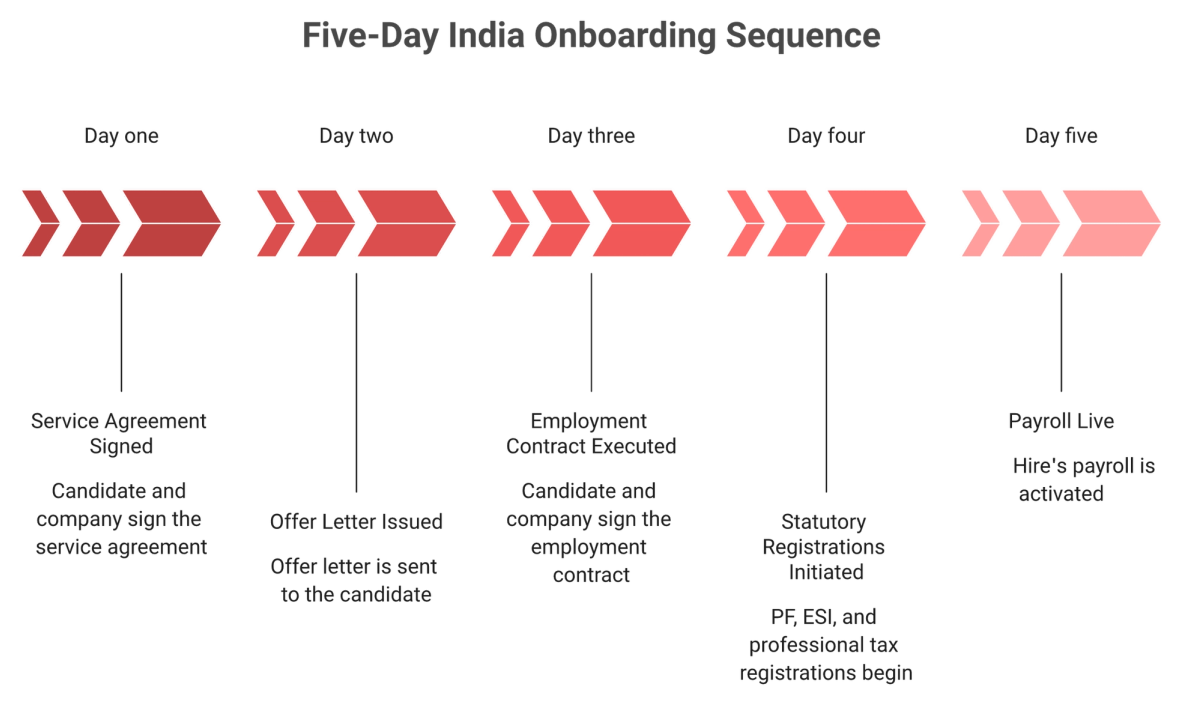
Versatile Club runs a fixed sequence: agreement signed on day one, offer letter out on day two, contract executed on day three, PF, ESI, and professional tax registrations initiated on day four, and payroll live on day five.
I publish that because a range like "24 to 72 hours" is a marketing number. A five-day contractual SLA is a number you can hold me to. The step-by-step version sits on our how it works page.
⭐ What buyers say
"Founder is just a call away. Extremely helpful in resolving all our queries. The process is super smooth to setup India EOR."
— surbhi m., Versatile Club G2 Verified Review (5/5)
"Their team helped us move quickly, stay compliant, and focus on the actual work instead of the backend admin."
— Ibrahim A., Versatile Club G2 Verified Review (4.5/5)
"The initial documentation and paperwork felt quite detailed and time-consuming at the beginning."
— Verified User in Marketing and Advertising, Wisemonk G2 Verified Review (3.5/5)
❌ When we are the wrong call
Three buyers should look elsewhere, and I would rather say it here than on a discovery call.
If you need five or more countries, buy a generalist. If your procurement gates on SOC 2 or ISO 27001, Wisemonk holds both and Versatile Club does not. If you are hiring high-volume B2C roles, our culture-fit screen on 50 behavioural parameters slows you down rather than helps. Buyers weighing us directly against the India specialist can read the Wisemonk alternative breakdown.
🧭 The thing I keep coming back to
Compliance is the floor. A wrong hire costs more than every EOR fee you will pay that year.
If your only reason for hiring in India is that it is cheaper, I would gently suggest not doing it. The engineers worth hiring in Bengaluru have options, and they can smell an under-market offer from the first call.
What I think shifts in the next two years is that India stops being one line on a global EOR map and becomes its own category. If you are modelling your first India hire right now, message me on WhatsApp with the CTC and the city, and I will send back the all-in number before you talk to anyone's sales team.
Versatile Club screens on 50 behavioural parameters, assigns a 90-day Success Coach, guarantees a replacement for six months, commits to a five-day contractual onboarding SLA, and puts the founder on WhatsApp instead of a ticket queue.
FAQs
How much does Wisemonk cost per employee per month in India?
Wisemonk's India EOR starts at $99 per employee per month. That is the only number printed on its pricing page, alongside a second card marked Custom.
The rest of the catalogue lives on service and comparison pages:
- EOR band ceiling: up to $399 per employee per month
- Contractor management: $19 per contractor per month
- Contractor of Record: 6% per payment
- Managed payroll (you already own an Indian entity): $49 per employee per month
- Payroll plus HRBP bundle: $250 per month for up to five employees
- Background verification: from $20 per candidate
Setup, onboarding, and platform fees are stated as $0, with no minimum term and no minimum headcount.
Where buyers get caught is the gap between the entry rate and the band ceiling. We have watched founders model twelve months at $99 and then discover the number applied to one hire out of four.
Versatile Club charges $149 per employee per month at any CTC, with $0 setup and $0 exit, and publishes the full schedule on our India EOR pricing page. Ask any provider for the fee at three specific salary levels in writing before you compare anything.
Is Wisemonk's $99 a flat fee, or does it increase with salary?
It steps, and it does not float. Wisemonk markets the fee as flat with no percentage-of-salary component, yet its own service page bands the rate by employee CTC.
The published slabs run roughly:
- $99 for annual CTC up to ₹12 lakh
- $199 from ₹12 lakh to ₹75 lakh
- $249 above ₹75 lakh
Its comparison pages publish a wider $99 to $399 range, and independent review desks report $450 to $500 quotes at high CTC. Both framings are true only if you read flat as flat within a band.
The practical effect is that the band structure lands on your best hire. A ₹80 lakh staff engineer, the one you fought hardest to close, is the person whose fee doubles or triples against the headline.
Versatile Club charges the same $149 whether the hire earns ₹8 lakh or ₹80 lakh, because the filing work behind a senior engineer is identical to the work behind a junior one. If you want the two models side by side at your own bands, our Wisemonk alternative comparison runs the twelve-month math. Put the ceiling request in your quote email.
What does Wisemonk charge for contractors and payroll-only services?
Wisemonk prices its non-EOR modules separately from the headline EOR fee.
- Contractor management and payments: $19 per contractor per month
- Contractor of Record: 6% per payment
- Freelancer payments: roughly 0.5% per payment, with T plus two business day payouts
- Managed payroll: $49 per employee per month if you already hold an Indian entity
At $19 the per-seat rate undercuts Deel at $49, Multiplier at $40, and Remote at $29. The 6% model only wins below roughly ₹27,000 in monthly billings; above that, percentage pricing becomes a tax on your contractor's success.
One structural point matters more than either rate. US-style co-employment PEO has no legal basis under Indian labour law, so there is no compliant middle path between contractor and employee. Misclassification exposure sits under the Employees' Provident Funds and Miscellaneous Provisions Act, 1952, where substance beats the contract heading.
Every conversion Versatile Club has run began the same way, with a contractor paid by bank wire, no GST invoice, and no TDS certificate on file. Our Contractor of Record service covers the same scope, and conversion is our default motion rather than an upsell.
Does the Wisemonk fee include laptops, equipment, and shipping in India?
Equipment is in scope, not in price. Wisemonk's EOR card includes end-to-end onboarding, equipment setup, and a welcome call, and the company claims zero markup on procurement and shipping.
Included means coordinated. Somebody sources the laptop, buys it, and ships it to a home address in Bengaluru or Hyderabad. The hardware cost itself is quoted per case and never published, and a MacBook Pro in India lands between ₹1.6 lakh and ₹2.6 lakh.
Four questions decide whether equipment costs you more than the invoice shows:
- Who holds title to the device, you or the EOR entity?
- Who claims the GST input tax credit under section 16 of the CGST Act, 2017?
- Who physically recovers the laptop on the resignation date?
- What customs and lead-time buffer applies to an imported unit?
If the buying entity cannot claim input credit, you pay roughly 18% more for the same machine. Asset recovery is the quieter failure: a laptop still sitting in a flat six weeks after an exit is an accounting problem, not a courier problem.
Versatile Club buys equipment on its own Indian GST registration, and the logistics detail sits in our guide to equipping remote employees in India.
What is the total cost of an India hire once the EOR fee is added?
The EOR fee is the smallest line on the invoice. Total employer cost in India runs 110% to 125% of gross salary before any provider fee.
The statutory stack sits on top of the package:
- Provident fund: 12% of Basic plus DA, filed monthly by the 15th
- ESI: 3.25% employer and 0.75% employee below the wage threshold
- Gratuity: accrual commonly provisioned at 4.81% of Basic plus DA from month one
- Professional tax: state slabs up to ₹2,500 a year, monthly in Karnataka and half-yearly in Tamil Nadu
- TDS: deposited by the 7th of the following month
Since the four Labour Codes took effect on 21 November 2025, Basic plus DA must be at least 50% of remuneration, which lifts PF and gratuity accruals even when CTC is unchanged. On a ₹30 lakh package that adds roughly 2.5% of CTC.
Use 112% of gross as a planning figure for a mid-senior hire, then add the fee separately. Versatile Club files PF, ESI, TDS, and professional tax under its own registrations across all 28 states, and the full line-item model sits in our cost of hiring in India guide.