Table of contents (11)
Deel Features: The Standouts, the Gaps, and the Extras
Q1. What does Deel actually ship, and which modules genuinely lead?
Deel ships seven product modules plus a white-label reseller programme: Employer of Record hiring in 150+ countries, Global Payroll for entities you already own, contractor management, Contractor of Record, Deel HR (a free HRIS for up to 200 employees), Deel IT for device logistics, and Deel Engage for performance and onboarding. Payouts run in 120+ currencies, including stablecoins. Three modules genuinely lead the category: self-serve contracting, the free HRIS, and the payout rails. Buyers comparing that stack against an India-native EOR service are really comparing breadth against depth.
⭐ One founder, one demo, one hire in Bengaluru
Last year a Seed-stage founder in Austin shared her screen with me on a WhatsApp video call. She had a Deel demo open in one tab and a Bengaluru offer letter in the other. Her question was simple. "Which of these 40 features do I actually need for one engineer?"
Feature pages are built to answer a different question. They answer "what can this platform do," not "what does my situation require." So here is the map, stripped of brochure language.
🧩 The module map, in plain terms
| Module | What it actually does | Who it is for |
| EOR | Deel or a local partner becomes the legal employer in-country | No local entity |
| Global Payroll | Runs payroll inside an entity you already own | You have an Indian subsidiary |
| Contractor management | Contracts, invoices, and payouts for freelancers | Short projects, no employment |
| Contractor of Record | Deel takes on classification screening and liability | Long-running contractors |
| Deel HR (HRIS) | Org chart, time off, documents, free up to 200 people | Any size team |
| Deel IT | Buys, ships, and tracks laptops | Distributed teams |
| Deel Engage | Onboarding flows, goals, reviews | People Ops at 50+ |
HRIS means a human resources information system, the employee record of truth.
✅ Where Deel's engineering is genuinely ahead
Three things are hard to beat. Self-serve contracting gets a contractor signed in minutes. The free HRIS for up to 200 employees is real value, not a trial. The payout rails move money in 120+ currencies without you touching a bank, as set out on Deel's own EOR product documentation.
If you are hiring one person each in eight countries, no India specialist can match that. Versatile Club does not try to. India is the only country we operate in, and that is a deliberate boundary, not a roadmap gap, which is why our onboarding process is built around one jurisdiction.
💬 What reviewers say about the breadth
"I like that we can use Deel for multiple things. Contractors, EORs, employees, PTO, compliance etc. For the most part it is fairly straightforward."
— Verified User in Computer Software, Multi Use Case User, 3/5, 16 September 2024, Deel - G2 Verified Review
"I appreciate the ease of setup with Deel; it took me only a few minutes, making the process straightforward. I love the instant transfer feature."
— Maria M., Freelancer, 3/5, 26 September 2025, Deel - G2 Verified Review
Both reviewers praise the same thing: breadth and speed of self-service. Neither mentions India statutory depth, because that is not what the module list is built to deliver.
Versatile Club runs one country, not 150. The entity is ours, Foo Falcon Technologies Pvt Ltd, and the PF, ESIC, and Shops and Establishments registrations sit under our own numbers rather than a partner's, which is the structural point behind our India compliance coverage.
Q2. What does each Deel module actually cost for an India hire?
Deel EOR lists at $599 per employee per month, plus a $500 setup fee and one month's exit notice. Contractor management runs about $49 per contractor per month, Contractor of Record about $325 per month, and Global Payroll about $29 per employee plus a $1,000 one-time entity setup, with a refundable one-to-three-month salary security deposit, per Deel's published pricing. Add the 3% to 5% FX markup reported by buyers, and a $60,000 India salary carries $1,800 to $3,000 of extra annual cost.
💰 The four cost lines nobody demos
Sticker price is the easy part. Four lines sit underneath it.
- Setup fee, charged before anyone is hired.
- Security deposit, one to three months of salary held upfront.
- FX conversion spread, applied on every remittance.
- Exit notice, one month of fees after you leave.
💸 Twelve months, three India hires, all in
Here is the arithmetic I run for founders on the call. Three engineers, $60,000 each. If you want to run your own numbers first, our EOR versus entity calculator does the same maths.
| Provider | Year-one platform fees | Setup | FX cost on $180,000 | Total |
| Versatile Club | $4,917 (first month free) | $0 | $0, USD invoiced from India | $4,917 |
| Wisemonk | $3,564 to $14,364 (salary slabs) | $0 published | Varies by rail | $3,564+ |
| Deel | $21,564 | $1,500 | $5,400 to $9,000 | $28,464 to $32,064 |
The gap is not the monthly fee. It is the fee plus the spread plus the deposit sitting in someone else's account.
⚠️ Why the FX line matters more than the invoice line
FX markup means the difference between the interbank rate and the rate applied to your payment. It rarely appears as a line item. It appears as a slightly smaller number landing in the employee's account.
Versatile Club invoices in USD from a single Indian entity, so there is no conversion spread to reconcile at month end. Finance receives one invoice with a per-employee breakdown, and the full structure sits on our pricing page.
💬 What users say about the fees
"I find Deel to be absurdly expensive. They charge a high amount of fees for transferring money to my bank account."
— Juan Camilo O., Contractor, 1/5, 27 November 2025, Deel - G2 Verified Review
"There are hidden fees. Of course, again, also here. Even your contract says payment processing will be paid by your client, they do not care. You'll never get your net-agreed salary through Deel."
— İbrahim, Contractor, 1/5, 1 November 2024, Deel - G2 Verified Review
"I dislike how expensive Deel's transaction fees are. It's not one of the cheapest services available, and while it's convenient, I might not choose to use it voluntarily in the future."
— Maria M., Freelancer, 3/5, 26 September 2025, Deel - G2 Verified Review
⏰ The one thing to do before you sign anything
Ask for a live sample invoice, not a quote. A quote shows the monthly fee. An invoice shows setup, deposit, FX spread, benefits markup, and exit lines. If a provider will not send one, that is your answer.
Versatile Club charges $149 per employee per month flat across salary bands, with $0 setup, $0 exit, the first month free, and no markup on the employee's salary. The sample invoice goes out before the agreement, not after, and buyers running a head-to-head usually start with our Deel alternative comparison.
Q3. Which Deel features do reviewers say fall short?
Four limitations recur across independent audits of Deel: benefits packages stay close to standard in-country offerings with limited customisation, reporting and mobile functionality lag the core product, pricing sits at a premium, and India users report rigid predefined HR workflows. Deel carries roughly 20,610 reviews averaging 4.7 across G2, Trustpilot, and Capterra. Versatile Club's read is that a 4.7 blended average is exactly what hides a country-specific problem.
❌ The four gaps, named plainly
Benefits customisation is the first. If you want a non-standard health plan or a specific insurer for a Bengaluru team, you are working inside a menu.
Reporting and mobile are the second and third. Finance teams rebuild payroll reports in a spreadsheet. Employees hit a web view that was not built phone-first.
📊 Why the 4.7 rating tells you almost nothing
I ran my own study across G2 profiles for Teamlease, Wisemonk, and roughly 5,000 Deel reviews. Two things stood out. Nobody segments ratings by country, and no India EOR positions itself as a legal expert.
A 4.7 average built mostly from contractors in Europe and Latin America cannot tell a CFO whether Maharashtra PTRC filings landed on time. Versatile Club measures this differently, by tracking challan confirmations per employee per month rather than sentiment, which is the discipline behind our India payroll compliance work.
💬 The India-shaped complaints inside a good rating
"Deel treats all users as if they were individual freelancers, even when you're clearly operating as a registered company. There is no flexibility, no option for company-level onboarding."
— Verified User in Translation and Localization, Vendor, 0.5/5, 5 May 2025, Deel - G2 Verified Review
"Wisemonk platform is really simple and easy to use. Sometimes the email communication from the wisemonk team is delayed by a day or 2. But overall they seem to be the best for India."
— Bulbul G., Employee, 4/5, 19 February 2025, Wisemonk - G2 Verified Review
"Some features feel a bit limited and could use more flexibility. In particular, I'd like to see better options for customization and more detailed reporting."
— Vinay M., Payroll User, 4/5, 18 February 2026, Wisemonk - G2 Verified Review
The second and third quotes matter because they are about an India specialist, not Deel. Customisation and reporting are hard for everyone. The difference is who answers when you ask, and that gap is why buyers compare us on the Wisemonk alternative page.
⚠️ What each gap costs an India-only team
Rigid workflows collide with state-level variance. Maharashtra needs dual PTRC and PTEC registration. Karnataka needs monthly professional tax plus an annual Shops and Establishments renewal. A predefined global flow does not model that.
Versatile Club holds registrations across all 28 states and 8 union territories, and the monthly client pack ships PF and ESI challan confirmations with TDS deposit receipts. Our honest gap: Versatile Club has no G2 review volume yet, and I would rather say that than imply otherwise.
Q4. What happens to Deel's features when payroll breaks at 11pm?
Deel routes support chatbot-first, then through support tiers. Reviewers describe being redirected repeatedly, repeating the same information to different representatives, and a 20-minute question turning into a four-day thread. One reviewer's onboarding ran 28 days because a hidden contract status went unresolved. Versatile Club treats escalation as a product feature, because support is the recovery path for a missed PF challan or a late salary credit, not a soft extra.
⏰ The message that starts every bad week
A US founder once messaged me at 11pm her time, three days before payroll. Her Bengaluru engineer's PF challan had not landed in her inbox. She was not angry. She was calculating whether she had a compliance problem or a filing delay.
That distinction takes about four minutes to resolve if you can reach someone who knows the EPFO portal. It takes four days if your first contact is a chatbot.
💬 What the review record shows
"Customer support and issue ownership need serious improvement. I was redirected multiple times, asked to repeat the same information to different representatives, and spent a considerable amount of time in meetings without reaching a clear resolution."
— Güneş A., Contractor, 1.5/5, 2 October 2025, Deel - G2 Verified Review
"Poor communication on issues and complete ignorance of deadlines set by Deel themselves. On top of that, my salary was not paid on time this month."
— Daryna R., EOR Employee, 0/5, 6 May 2024, Deel - G2 Verified Review
"Often the CS doesn't seem to have answers, which leads to emails back and forth. Something I was looking for the answer to in 20 minutes becomes a 4 day process."
— Verified User in Computer Software, Multi Use Case User, 3/5, 16 September 2024, Deel - G2 Verified Review
⚠️ Why tiered support fails Indian deadlines
Indian statutory dates do not negotiate. TDS is deposited by the 7th of the following month, per the Income Tax Department. PF and ESI filings follow their own monthly cycle. Form 16 is issued by 30 May.
A four-day support loop can cross a statutory date. Then you are not fixing a ticket. You are managing interest, a penalty, and an employee who checked their account and found nothing. Teams that have lived through this once usually move to managed payroll in India with a named owner.
✅ The honest limit of founder-direct support
Versatile Club's escalation path is me on WhatsApp. No ticket queue, no CSM rotation, no chatbot triage. What surfaces in Versatile Club's client engagements is that most payroll panics need a person with portal access, not a workflow.
I will also name the ceiling. This works at our current scale. At some point it has to change, and I would rather tell you that now than discover it with you during a payroll week. If you want to test it, message us directly and see how fast a real person answers.
Q5. Does Deel employ your India hire on an entity it owns?
In India, most global EOR platforms, including Deel, Remote, G-P, and Omnipresent, employ your hire through local partner entities rather than one they own outright. The dashboard looks identical either way, which is the point. It matters in an audit or a dispute, because the employment contract, the PF and ESI filings, and the statutory liability sit with a third party you never signed with. Versatile Club employs India hires on its own registered entity, Foo Falcon Technologies Pvt Ltd, with PF, ESIC, and Shops and Establishments registrations held under its own numbers, which is the backbone of our EOR services.
⭐ The one slide that never appears in the demo
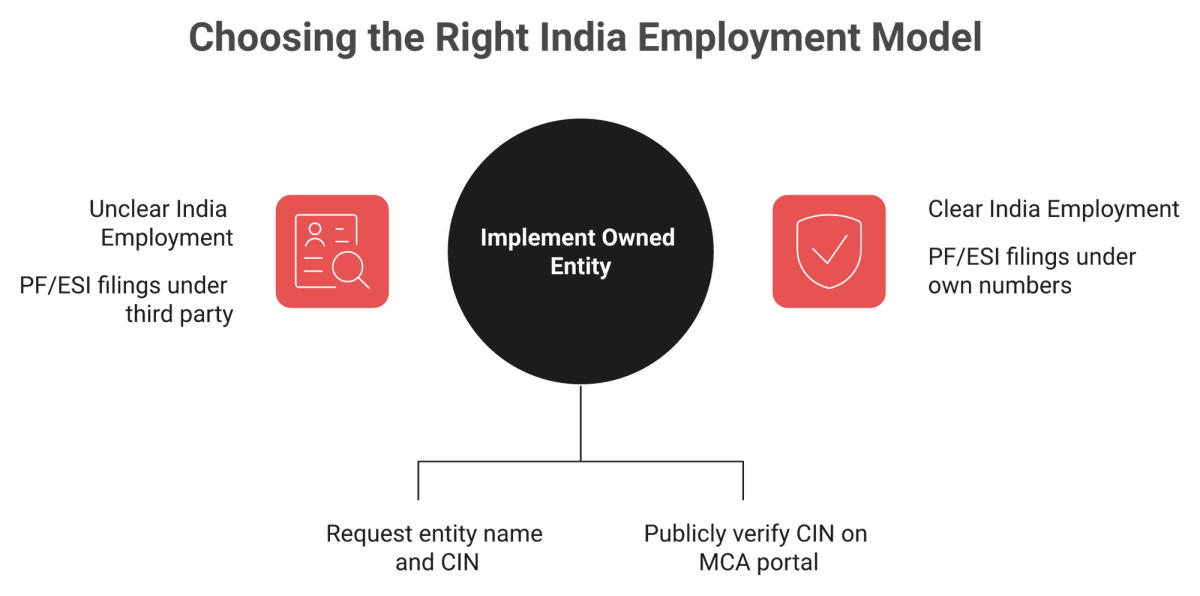
Every EOR demo shows you the same thing. A clean dashboard, a contract template, and a payroll calendar. None of them show you the corporate structure sitting behind the login.
Ask who signs the employment contract. In India, the answer is often a local aggregator or partner firm, not the platform whose logo is on your invoice. Deel's own EOR documentation states that it owns entities and its payroll engine in 130+ countries, which leaves the remainder covered another way.
🧩 Why the global platforms chose it
This is not a scandal. It is an engineering trade-off, and a rational one.
Incorporating in a country takes months. Getting a PF code with the EPFO, an ESIC registration, and state Shops and Establishments licences takes longer. To reach 150 countries in a few years, you rent entities instead of building them. Versatile Club made the opposite trade, one country and one owned entity, which is why we cannot sell you Brazil, and why buyers weighing the two models read our EOR versus entity in India breakdown.
❌ What breaks when the chain has three links
Nothing breaks on a good month. Salary lands, the challan files, everyone moves on.
Problems show up in three situations. A PF inspection asks whose registration covered the employee. An employee disputes a full and final settlement. Or you exit the platform and need three years of filings handed over, which is the exact scenario covered in our guide to switching EOR providers in India.
In each case, you are not talking to one company. You are talking to a platform, which talks to a partner, which talks to a portal. In Versatile Club's client engagements, that second hop is where most of the waiting happens.
✅ The CIN test, which takes one email
CIN means Corporate Identity Number, the 21-character registration number the Ministry of Corporate Affairs issues to every Indian company. It is public. You can look it up on the MCA portal in under a minute.
Send one line to any provider you are evaluating: "Please share the name and CIN of the legal entity that will appear on the employment contract." Ask Versatile Club the same question and you get Foo Falcon Technologies Pvt Ltd, one name, no partner in between. Our company background names the entity openly.
⚠️ Where I might be reading this too strongly
Versatile Club's read is that owned entity beats rented entity for a concentrated India team, though I will admit the difference is invisible for maybe ten months of the year. If you are hiring one person in India and nine elsewhere, the partner model is a reasonable price to pay for breadth.
What I think shifts over the next two years is that India stops being one country on a global map. It becomes a specialist category, and buyers start asking for the CIN before the pricing.
Versatile Club owns Foo Falcon Technologies Pvt Ltd. Your engineer's PF, ESI, TDS, and professional tax filings run under our registrations, and the person who signs the contract is the person you WhatsApp at 11pm.
Q6. Do Deel's compliance features cover the 50% wage rule, state PT, and DPDP?
Deel files India payroll returns, but the unified wage definition effective 21 November 2025 requires Basic plus Dearness Allowance to be at least 50% of remuneration, with the excess allowance added back into the wage base for PF, gratuity, bonus, and ESI, per the Ministry of Labour and Employment FAQs on the Labour Codes. Platform payroll engines generally process the salary split you upload rather than recomputing it. Maharashtra requires dual PTRC and PTEC registration, Karnataka requires monthly professional tax, and DPDP Rules 2025 obligations phase in from 14 November 2026. Versatile Club runs these filings under its own registrations across all 28 states and 8 union territories.
💰 The 50% rule, with real numbers
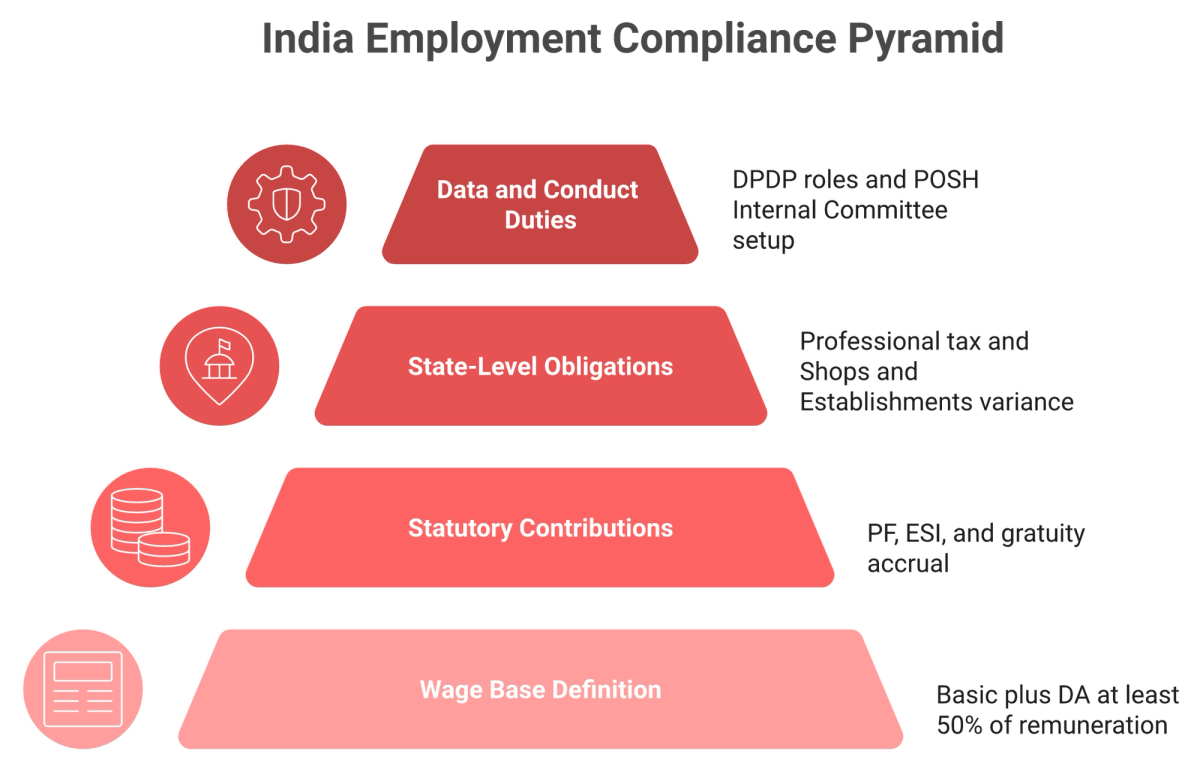
Say a Bengaluru engineer has monthly remuneration of ₹40,000. Basic plus DA is set at ₹16,000, and allowances make up the other ₹24,000. Allowances are 60% of the total, so they breach the cap.
Under the wage definition, anything above 50% gets added back. That is ₹4,000 added to the wage base, taking it from ₹16,000 to ₹20,000. PF at 12% moves from ₹1,920 to ₹2,400 per month, per employee. Gratuity accrues on the higher base too, at 4.81%. Our India salary calculator runs this split before you issue the offer.
⚠️ What a platform recomputes, and what it just accepts
This is the question to put in writing. Does the payroll engine recalculate the statutory base, or does it process the CTC split your HR team typed in?
Most global platforms do the second thing. That is not negligence, it is architecture. Versatile Club recomputes the base before the first payroll cycle runs, because we are filing under our own PF code and the liability is ours, which is how our managed payroll service is built.
🧩 Professional tax is not one tax
Professional tax, or PT, is a state levy on employment income. It is not a single national rule. Here is the part global playbooks flatten.
| State | What it actually needs |
| Maharashtra | PTRC plus PTEC registration, monthly slab filing, annual return |
| Karnataka | Monthly PT, plus Shops and Establishments renewal |
| Tamil Nadu | Half-yearly PT, plus Labour Welfare Fund |
| Telangana | PTRC enrolment, monthly remittance deadlines |
| Delhi | No PT, but strict Shops and Establishments enforcement |
Versatile Club maintains registrations in all 28 states and 8 UTs, so a Pune hire and a Chennai hire follow different calendars without a new vendor conversation. The full scope sits on our compliance page.
⏰ The dates that do not move
Three deadlines drive every India payroll month. TDS, which is tax deducted at source, is deposited by the 7th, per the Income Tax Department. Form 16, the annual tax certificate for the employee, is issued by 30 May. ESI splits 3.25% employer and 0.75% employee.
Versatile Club ships challan confirmations and TDS deposit receipts with the monthly USD invoice, so the audit answer exists before an auditor asks for it. Teams inheriting a messy filing history usually start with our India payroll compliance guide.
✅ DPDP, and who is actually responsible
The Digital Personal Data Protection Rules were notified on 13 November 2025, with obligations phasing in through 14 November 2026 and 14 May 2027. Employee data sits inside this.
Ask your provider one question. Who is the Data Fiduciary, meaning the party that decides how the data is used, and who is the Processor? Get the answer in the agreement, with breach notification timelines.
Versatile Club accrues gratuity at 4.81% of Basic plus DA from month one, runs POSH Internal Committee setup, and holds the DPDP roles in writing. Compliance is the floor here, not the selling point.
Q7. Can Deel's contractor features protect you from misclassification and GST exposure?
Deel standardises contracts, invoices, and payouts well, but tooling is not classification. In India, US-style co-employment PEO does not legally exist, so the compliant structures are a genuine contractor relationship or employment through an EOR's entity. Misclassification exposure runs roughly $25,000 to $40,000 per person in back pay, taxes, and penalties. Contractors above ₹5 crore annual turnover owe GST e-invoicing, with 30-day reporting of the Invoice Reference Number for businesses above ₹10 crore from 1 April 2026. Versatile Club converts contractors to employees on its own entity under a 5-day contractual onboarding SLA.
⚠️ The conversation that starts every conversion
The pattern is always the same. A company hires its first real People Ops lead. She reads the existing India arrangements. Then she goes quiet.
Ten contractors on rolling monthly agreements, working fixed hours, using company laptops, and reporting to a manager. That is not a contractor relationship in substance. Backdated taxes and penalties follow if anyone looks closely, which is why we wrote the playbook on converting a contractor to an employee in India.
❌ Kill the PEO idea before it costs you money
PEO means Professional Employer Organisation, the US co-employment model where two entities share employer duties. That structure has no basis in Indian labour law.
So ignore any vendor selling "PEO India." Your real options are two. A genuine contractor, invoicing for outcomes with control over their own work. Or an employee, employed by an entity, with PF, ESI, gratuity, and TDS running. Versatile Club only does the second one, on its own registrations, and the distinction is set out in our EOR versus PEO comparison.
💸 What the exposure actually looks like
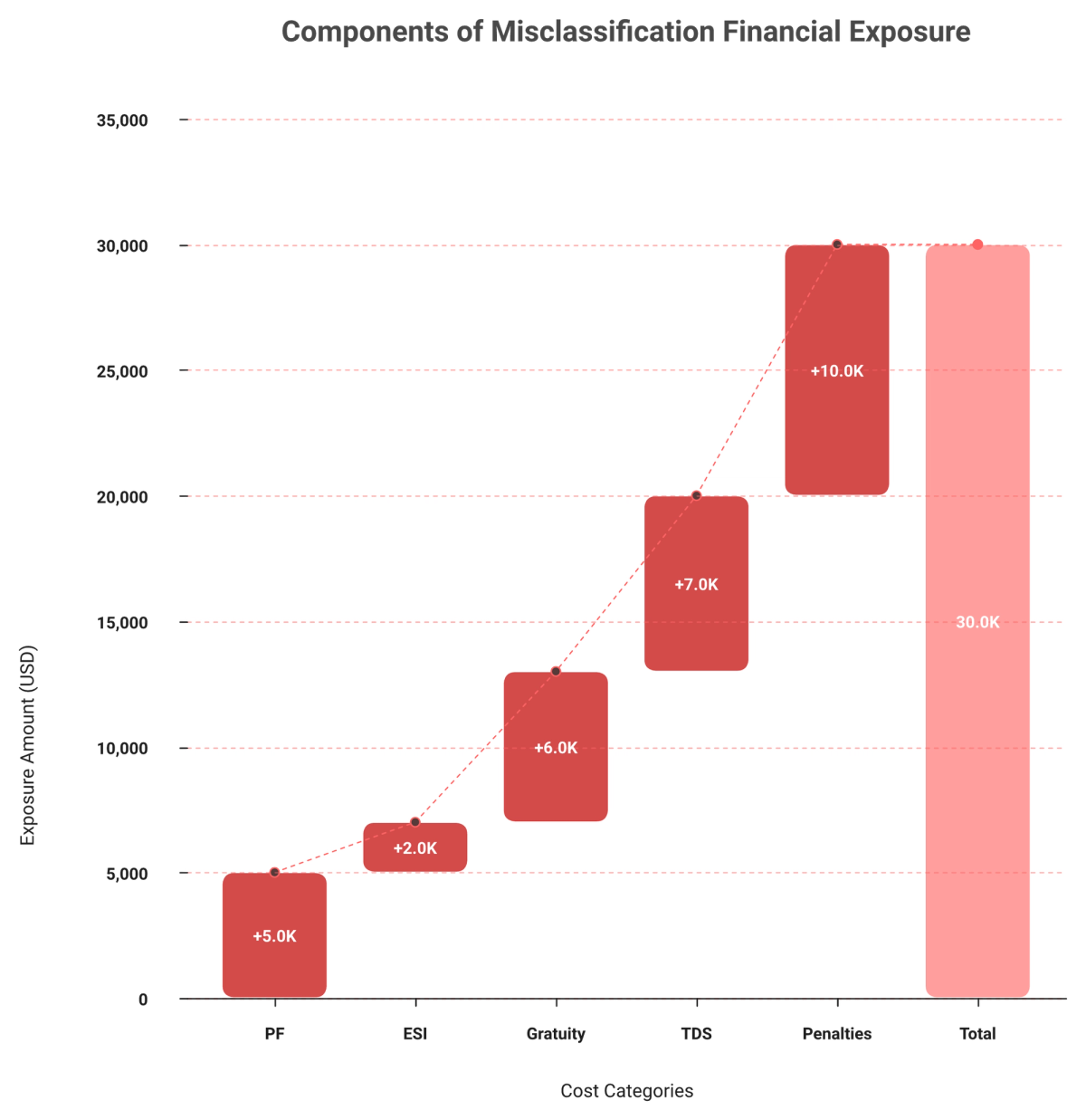
The number moves by salary and tenure, but the components are predictable.
- Unpaid PF at 12% of Basic plus DA, plus employer interest.
- Unpaid ESI at 3.25% employer share, where applicable.
- Gratuity accrued at 4.81%, payable on completion of the qualifying period.
- TDS shortfall, plus interest for late deposit.
- Penalties, which scale with how long the arrangement ran.
Stack those across two years and you reach the $25,000 to $40,000 range per person. Versatile Club prices a clean employment relationship at $149 per employee per month, which is the part that makes the maths uncomfortable for the contractor route. The trade-offs are laid out in our independent contractor versus EOR analysis.
⏰ The GST piece nobody mentions on the demo
Your Indian contractor is a business. If their turnover crosses ₹5 crore, they must issue GST e-invoices. Above ₹10 crore, the Invoice Reference Number must be reported within 30 days from 1 April 2026, with penalties under Section 122 of the CGST Act, as published on the GST e-invoice portal.
A platform generating a clean PDF invoice does not make it a compliant e-invoice. Ask Versatile Club or any provider how contractor invoices are raised, and whether an IRN is generated. Our Contractor of Record service answers that in writing.
✅ What actually transfers risk
Contractor of Record products shift some liability to the provider. That is real and useful. It still does not make a contractor an employee.
Versatile Club's read is that most teams overthink the tooling and underthink the substance. Control, hours, exclusivity, and equipment decide classification, not the contract template.
Versatile Club converts contractors to employees on our own entity in five days, and that SLA sits inside the service agreement rather than in a sales email. Conversions run with no setup fee and no exit fee.
Q8. How do the extras, BGV, equipment, immigration, IT, and Engage, hold up?
Background verification is a paid add-on rather than a bundled feature. Equipment logistics and Deel IT work well for distributed teams. Immigration is where the platform model strains hardest, and one G2 reviewer documented an O-1A visa denial in November 2025 after Deel omitted required evidence from the petition. Versatile Club bundles health insurance management and equipment logistics into a single India scope, some of it through named partners, and reconciles everything on one monthly USD invoice.
💰 Included, or on the invoice
Buyers assume the extras come with the seat. Most do not. Background verification, or BGV, which is the pre-employment check on identity, education, and past employment, is quoted separately.
Deel IT and equipment shipping are genuinely strong. If you are sending laptops to four continents, that module earns its fee. Versatile Club does not compete there, because our shipping radius is one country, and the India-only workflow is documented in our guide to equipping remote employees in India.
⚠️ Where the extras stop being software
Device logistics is a solved problem. Immigration is not. It needs a named human tracking a filing deadline, and platform workflows do not absorb that well.
"The USCIS denial letter explicitly stated that Deel forgot to attach critical evidence to the application. I strongly warn other founders against trusting Deel with sensitive immigration processes."
— Verified User in Computer Software, Founder, 0/5, 13 December 2025, Deel - G2 Verified Review
"They didn't seem to be able to navigate Visas or variations to employment contracts and this constantly created issues. It took three months to onboard our first 3 individuals."
— Verified User in Information Technology and Services, People Ops, 0/5, 13 December 2024, Deel - G2 Verified Review
✅ What good looks like on the extras
For contrast, here is what buyers say when an India specialist handles the surrounding work directly.
"Everything from scheduling the interviews to the final onboarding was handled smoothly and professionally. They consistently provided timely updates after each round."
— Verified User in Financial Services, Candidate, 4/5, 14 June 2025, Wisemonk - G2 Verified Review
The difference is not software quality. It is whether a person owns the outcome. Versatile Club runs a 90-day Success Coach on every placement for exactly this reason, because the first quarter is when onboarding gaps surface, and that layer is built into our contract-to-hire model.
🧩 The all-in-one question, answered honestly
People Ops buyers want one vendor. That preference is rational, because managing four Indian vendors means four invoices and four escalation paths.
Versatile Club's read is that all-in-one only helps if the same company is accountable when the extra fails. Some of our adjacent services run through named partners, and I would rather say that plainly than imply we do everything in-house.
Versatile Club bundles health insurance management and equipment and onboarding logistics into one India scope, so finance reconciles a single USD invoice with a per-employee breakdown instead of chasing four Indian vendors at month end. If you want to see how that scope is set up for a first India hire, start with how it works.
Q9. What are you paying for in 150 countries when you only hire in one?
Breadth carries a price. A $599 monthly fee, a $500 setup charge, a refundable one-to-three-month salary deposit, and a 3% to 5% FX spread all fund infrastructure across 150 countries that a single-country employer never touches, as set out on Deel's published pricing. India's tech workforce reached roughly 5.95 million people in FY26, and about 2,117 Global Capability Centres employ close to 2.36 million professionals. Versatile Club prices from a single-country cost base at $149 per employee per month, flat across salary bands.
💰 The four lines that fund the map
A global EOR has to carry cost you will never use. Entity maintenance in dozens of jurisdictions, local counsel on retainer, and compliance staff for currencies you do not pay in.
That shows up in four places on your invoice. The monthly fee, the setup charge, the salary deposit held upfront, and the conversion spread on every remittance. Versatile Club carries none of the 150-country cost base, because our registrations cover one country, and the full fee structure sits on our pricing page.
📊 Where India hiring actually happens now
The data does not describe dispersion. It describes concentration.
- India's direct tech employment reached about 5.95 million in FY26, up 2.3% with roughly 135,000 net additions, per the NASSCOM Strategic Review 2026.
- Around 2,117 GCCs operate across about 3,728 units, employing close to 2.36 million people, per the NASSCOM and Zinnov GCC Landscape Report 2026.
- GCC means Global Capability Centre, an offshore team owned by a foreign parent rather than outsourced.
So the common pattern is not one hire in twelve countries. It is five to thirty hires in Bengaluru, Hyderabad, Pune, or Chennai. In Versatile Club's C2H placements over six years, that concentration held almost every time, which is why we publish separate guides for payroll outsourcing in Bengaluru and payroll outsourcing in Hyderabad.
⚠️ The discount framing gets this backwards
Founders sometimes open the call with cost savings. I push back on that, gently.
You go to India for engineers with strong fundamentals and a deep talent pool, not for a cheaper line item. Savings are a byproduct. If price is the only reason, retention usually punishes you by month nine. Versatile Club's read is that a cheap hire who leaves at month four costs more than a fair hire who stays, and the real arithmetic is in our cost of hiring in India breakdown.
✅ The split-vendor approach, which I actually recommend
This is where I will argue against my own interest. If your hiring is genuinely scattered, use both.
- Keep a global platform for one or two hires in Portugal, Poland, or Brazil.
- Use an India-native EOR for the concentrated engineering hub.
- Compare the India line on both invoices after 90 days.
That third step is the useful one. Ask Versatile Club for a side-by-side of the India line only, and the arithmetic settles itself. Our India EOR service is scoped for exactly that comparison.
💸 What the breadth tax costs three engineers
Three India hires at $60,000 each, over twelve months.
| Cost line | Global generalist | Versatile Club |
| Platform fees | $21,564 | $4,917 (first month free) |
| Setup | $1,500 | $0 |
| FX spread on $180,000 | $5,400 to $9,000 | $0, USD invoiced from India |
| Deposit held | 1 to 3 months of salary | None |
Versatile Club charges for one country because we operate in one country, with no 150-country infrastructure priced into the $149. That is also the honest limit: if you need Brazil next quarter, we are not your vendor.
Q10. Deel or an India-native EOR: which features actually decide it?
Six features decide this, and none appear on either pricing page: entity ownership, FX handling, onboarding SLA enforceability, state coverage depth, support escalation, and retention guarantees. Deel provides global breadth, self-serve speed, and equipment logistics at $599 per employee per month plus a $500 setup fee, per its EOR product documentation. Versatile Club provides a directly owned Indian entity, USD invoicing from India with no conversion spread, registrations across all 28 states and 8 union territories, and founder-level escalation at $149 flat.
⭐ The six criteria that actually move the decision
Feature checklists compare dashboards. Buyers get burned on the things underneath.
SLA means service level agreement, a committed timeline. The question is not what the sales deck claims. It is whether the timeline is written into the contract you sign, which is the point our Deel alternative page is built around.
📊 The honest comparison
| Criterion | Versatile Club | Wisemonk | Deel and global generalists |
| India entity | ✅ Owned, Foo Falcon Technologies Pvt Ltd | ✅ India-native operator | ❌ Typically local partner entities |
| Pricing | ✅ $149 flat, $0 setup, $0 exit, first month free | ✅ $99 to $399 by salary slab | ❌ $599 plus $500 setup plus deposit |
| Country coverage | ❌ India only | ❌ India focused | ✅ 150+ countries |
| Onboarding | ✅ 5-day SLA inside the agreement | ✅ 24 to 72 hours claimed, not contractual | ❌ 7 to 14 days typical |
| Support | ✅ Founder on WhatsApp | ✅ Named team, small team latency reported | ❌ Chatbot-first, tiered |
| Retention | ✅ 90-day Success Coach, 6-month replacement guarantee | ❌ No published guarantee | ❌ Not offered |
| Certifications | ❌ SOC 2 and ISO 27001 not yet held | ✅ SOC 2 and ISO 27001 | ✅ Both held |
💬 What buyers report on each side
"They didn't seem to be able to navigate Visas or variations to employment contracts. It took three months to onboard our first 3 individuals."
— Verified User in Information Technology and Services, People Ops, 0/5, 13 December 2024, Deel - G2 Verified Review
"The initial documentation and paperwork felt quite detailed and time-consuming at the beginning. However, this thoroughness is what ensures proper legal and compliance coverage."
— Verified User in Marketing and Advertising, EOR Client, 3.5/5, 12 February 2026, Wisemonk - G2 Verified Review
"I was employed by a Singapore entity that is yet to be established in India. So, Wisemonk is the legal entity which I'm currently working under."
— Verified User in Financial Services, EOR Employee, 4/5, 16 June 2025, Wisemonk - G2 Verified Review
✅ Choose by concentration, not by brand
Three scenarios cover almost everyone I speak to.
- One hire each in six countries: use a global platform. Versatile Club is the wrong fit.
- Three to thirty hires in India, nothing else: use an India-native EOR.
- A mixed footprint with an India hub: split the vendors and compare the India line.
If you are still deciding between models rather than vendors, our India expansion options guide maps all four routes.
❌ When Versatile Club is not the answer
Versatile Club does not operate outside India, and we do not hold SOC 2 or ISO 27001 yet. If your procurement team requires either certificate before signature, that is a hard stop today. Enterprise teams above 100 India employees with heavy custom procurement workflows will also move slower than our 5-day SLA, and our enterprise page says so plainly.
Versatile Club sits in the gap this table exposes: India-native compliance depth with US-grade financial operations. USD invoicing from a single Indian entity, $149 flat, $0 setup, $0 exit, first month free, 50-parameter culture-fit screening, a 90-day Success Coach, and a 6-month replacement guarantee.
Q11. Which Deel features should you stress-test before signing?
Five tests separate a working India setup from an expensive surprise. Ask for the name and CIN of the entity on the India employment contract. Ask for a live sample invoice showing setup, deposit, FX spread, benefits markup, and exit lines. Ask for a test payslip where allowances exceed 50% of remuneration, to see whether the PF base auto-corrects under the wage definition effective 21 November 2025, as set out in the Ministry of Labour and Employment FAQs on the Labour Codes. Ask which of the 28 states the provider holds registrations in. Ask who answers at 11pm IST. Versatile Club answers all five in writing before the agreement is signed.
⏰ Why demos never surface these
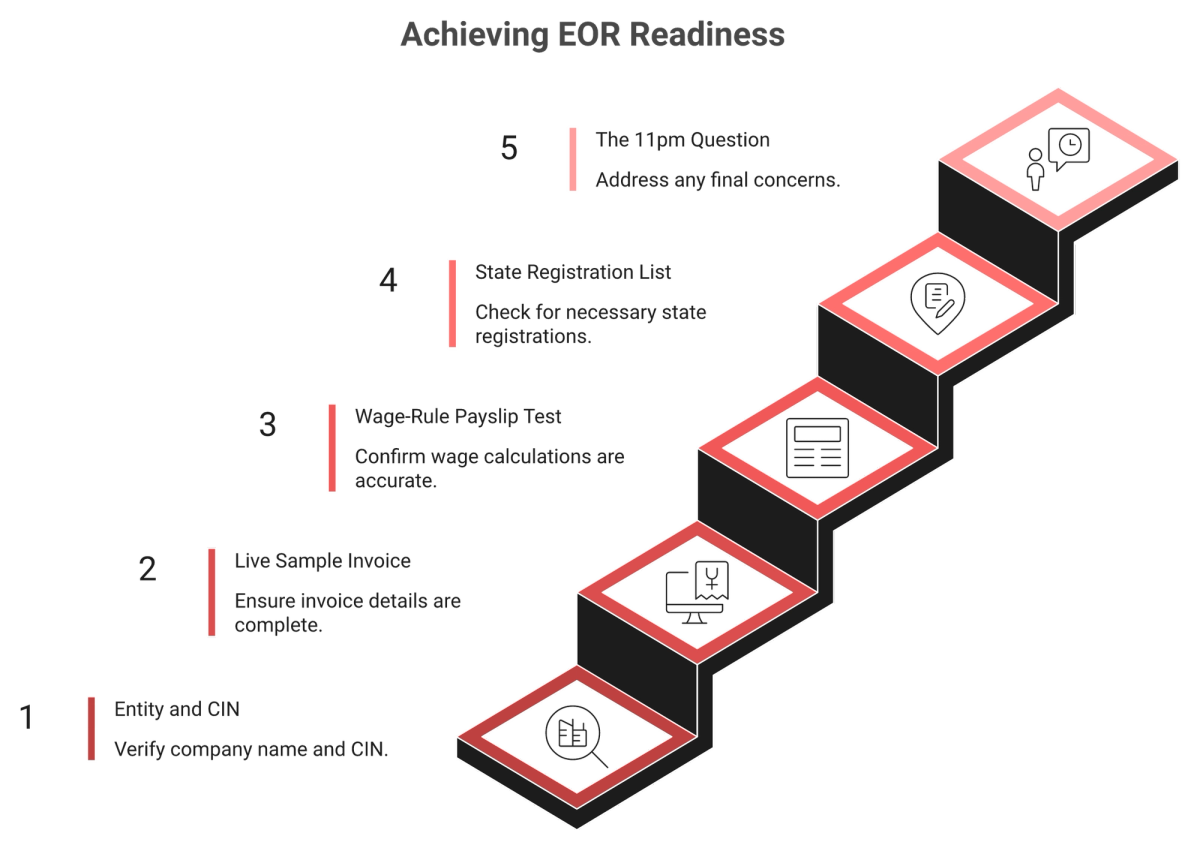
A demo is built around the interface. Every one of these five questions lives outside the interface.
Nobody is hiding anything maliciously. Sales engineers show what they can click. Corporate structure, conversion spreads, and statutory recomputation are not clickable, which is why we published our onboarding process day by day instead of demoing it.
✅ The five tests, and the answers that should worry you
- Entity and CIN. A good answer is one company name and one 21-character number, verifiable on the MCA portal. A worrying answer is "our local partner in India."
- Sample invoice. A good answer arrives as a PDF within a day. A worrying answer is a quote with one monthly figure.
- The 50% payslip test. Give them a ₹40,000 case with ₹16,000 Basic plus DA. A good answer recomputes the wage base to ₹20,000 and shows PF at ₹2,400. A worrying answer processes your split without comment.
- State list. A good answer names the states, including Maharashtra PTRC and PTEC. A worrying answer says "all of India" without detail.
- The 11pm question. A good answer is a person's name. A worrying answer is a support tier.
Versatile Club runs these five as a standard pre-signature pack, because every one of them came from a client who got burned before they found us. The statutory scope behind test three and test four sits on our compliance page.
⚠️ One more item for 2026
The EPFO coverage wage ceiling has been widely reported as moving from ₹15,000 to ₹25,000 per month. I have not yet matched that to a gazette notification I can cite with confidence, so treat it as pending verification against the EPFO circulars page.
Ask your provider to restate employer PF cost projections at the confirmed ceiling. Versatile Club reprices these projections when a circular lands, not when a blog post appears, and our India EOR cost guide is updated on the same rule.
🧩 Ask open questions, not yes or no questions
This is a habit worth stealing from cross-cultural management work. "Are you on schedule?" invites a yes. "Where are we on the schedule?" invites the truth.
Apply it to vendor check-ins. Ask what is still outstanding on the PF registration, not whether it is done. In Versatile Club's client engagements, that single change surfaces problems about a week earlier.
⭐ Where my head is on all of this
Versatile Club's data points toward owned entity and founder escalation mattering more than feature count, though I might be reading our own sample too strongly. Six years is enough to see patterns, not enough to be certain.
Versatile Club answers all five tests in writing before you sign: entity CIN, a sample invoice with no FX line, a test payslip under the 50% wage rule, the full state registration list, and a 5-day onboarding SLA inside the agreement. If you want to run those five questions past me directly, message me on WhatsApp and tell me what you are building in India.
FAQs
What features does Deel actually include, and which ones cost extra?
Deel ships seven product modules plus a white-label reseller programme. The core set covers Employer of Record hiring across 150+ countries, Global Payroll for entities you already own, contractor management, Contractor of Record, Deel HR (its HRIS), Deel IT for device logistics, and Deel Engage for onboarding and performance.
What is genuinely bundled versus billed separately matters more than the list:
- Included at no cost: Deel HR for up to 200 employees, which independent reviewers treat as real value rather than a trial.
- Billed per worker: EOR, Global Payroll, contractor management, and Contractor of Record.
- Quoted separately: background verification (BGV), and equipment purchases inside Deel IT.
Versatile Club runs a deliberately narrower scope, because India is the only country we operate in. That trade means no 150-country breadth and no global equipment rails, but it also means the compliance work sits on our own registrations rather than a partner's.
If you are comparing feature depth for a single country instead of feature count across many, our India EOR service page sets out exactly what is in scope, including health-insurance management and onboarding logistics.
How much does Deel cost per employee once setup, deposits, and FX are included?
Deel EOR lists at $599 per employee per month. That is the visible number. Four more lines sit underneath it.
- Setup fee: $500 upfront, charged before anyone starts.
- Security deposit: one to three months of salary, refundable but held.
- FX spread: a reported 3% to 5% conversion markup, rarely shown as a line item.
- Exit notice: one month of fees after you decide to leave.
On three India engineers at $60,000 each, twelve months of Deel works out to roughly $21,564 in platform fees, $1,500 in setup, and $5,400 to $9,000 in FX spread. Contractor management runs about $49 per contractor, Contractor of Record about $325 per month, and Global Payroll about $29 per employee plus a $1,000 one-time entity setup.
Versatile Club charges $149 per employee per month flat across salary bands, with $0 setup, $0 exit, the first month free, and no markup on the employee's salary. The whole structure is published on our pricing page.
The practical test for any provider, including us, is simple: ask for a live sample invoice rather than a quote.
Does Deel employ your India hire on an entity it owns?
In India, most global EOR platforms, including Deel, Remote, G-P, and Omnipresent, employ hires through local partner entities rather than one they own outright. This is a rational engineering trade-off. Reaching 150 countries quickly means renting entity infrastructure instead of spending years incorporating and registering in each jurisdiction.
The dashboard looks identical either way. The difference surfaces in three situations:
- A PF inspection asks whose registration covered the employee.
- An employee disputes a full and final settlement.
- You exit the platform and need several years of filings handed over.
In each case you are dealing with a platform, which deals with a partner, which deals with a government portal. That second hop is where the waiting happens.
Versatile Club employs India hires on its own registered entity, Foo Falcon Technologies Pvt Ltd, with PF, ESIC, and Shops and Establishments registrations held under its own numbers. The test takes one email: ask any provider for the name and Corporate Identity Number (CIN) of the entity that will appear on the employment contract, then verify it publicly.
Buyers weighing owned entity against other structures usually start with our EOR versus entity in India comparison.
Do Deel's compliance features cover India's 2025-26 Labour Code wage rule and state professional tax?
Deel processes India payroll and files statutory returns. The harder question is whether its payroll engine recomputes the statutory base or simply processes the salary split your HR team uploads. Most global platform engines do the second thing, which is architecture rather than negligence.
That matters because the unified wage definition effective 21 November 2025 requires Basic plus Dearness Allowance to be at least 50 percent of remuneration. Anything above that threshold gets added back into the wage base for PF, gratuity, bonus, and ESI.
A worked example: on ₹40,000 monthly remuneration with ₹16,000 Basic plus DA, ₹4,000 is added back. The wage base becomes ₹20,000, and PF at 12 percent moves from ₹1,920 to ₹2,400 per employee per month.
State professional tax adds another layer. Maharashtra needs dual PTRC and PTEC registration, Karnataka needs monthly PT plus an S&E renewal, Tamil Nadu is half-yearly with Labour Welfare Fund, and Delhi has no PT but strict S&E enforcement.
Versatile Club holds registrations across all 28 states and 8 union territories, accrues gratuity at 4.81 percent from month one, and ships challan confirmations with each invoice. Our compliance scope lists every filing by name.
What should you stress-test before signing with Deel or any India EOR?
Five tests separate a working India setup from an expensive surprise. Every one of them lives outside the product demo, which is why sales engineers rarely surface them.
- Entity and CIN. A good answer is one company name and one 21-character number. A worrying answer is "our local partner in India."
- Live sample invoice. It should show setup, deposit, FX spread, benefits markup, and exit lines. A single monthly figure is not an invoice.
- The wage-rule payslip test. Hand over a ₹40,000 case with ₹16,000 Basic plus DA and check whether the PF base auto-corrects to ₹20,000.
- State registration list. Ask for named states, including Maharashtra PTRC and PTEC, not "all of India."
- The 11pm question. A good answer is a person's name. A worrying answer is a support tier.
Versatile Club answers all five in writing before the agreement is signed, including a 5-day onboarding SLA written into the service agreement rather than promised on a call.
If you would rather run these questions with a person than a form, talk to us directly and tell us what you are building in India.