Table of contents (11)
Leave Policy in Jharkhand: Statutory Rules and Employee Entitlements
Q1. Which law governs leave for your employee in Jharkhand, and does it cover managers?
A People Ops lead in Austin once sent me five browser tabs at 11pm her time. Each tab gave a different Jharkhand leave number. Her Ranchi engineer had already asked twice. She was not confused about arithmetic. She was confused about which law applied to him.
Jharkhand has no leave statute of its own. Commercial and office staff fall under the Bihar Shops and Establishments Act, 1953 as adopted by Jharkhand. Factory workers fall under the Factories Act, 1948. Industrial establishments also sit under the Bihar Industrial Establishments (National and Festival Holidays and Casual Leave) Act, 1976.The Act's definition of 'employee' excludes only a member of the employer's family; it has no managerial or salary carve-out and expressly includes factory staff who are not 'workers' under the Factories Act. So Sections 16 and 16A apply to managers and senior staff the same as anyone else.
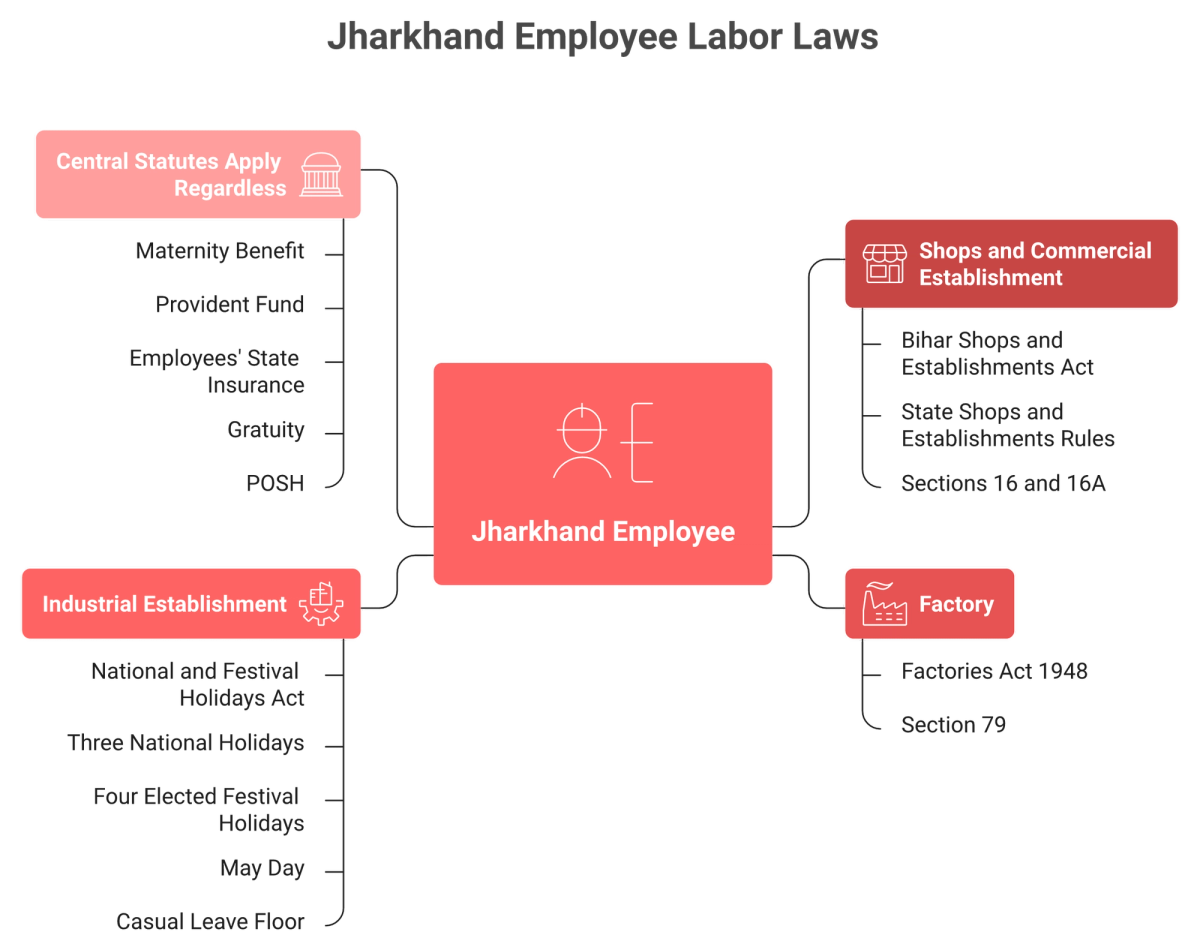
🗂️ The three regimes that actually apply
Start with the workplace, not the job title. A software office in Ranchi or Jamshedpur is a commercial establishment. That puts your hire under the state Shops Act and the Jharkhand Shops and Establishments Rules.
A manufacturing unit is a factory. Leave there runs on Section 79 of the Factories Act. The 1976 Act adds national and festival holidays plus a casual leave floor for industrial establishments. If you are still deciding how to employ that person at all, our EOR services in India page sets out the employer-of-record route in plain terms.
⚠️ Why "manager" is not a designation, it is a function
The Act's definition of 'employee' has only one carve-out — a member of the employer's family — and it expressly includes factory staff who are not 'workers' under the Factories Act. There is no managerial-capacity exclusion in the Bihar/Jharkhand Act, unlike the Shops Acts of Karnataka, Maharashtra or Delhi, which do exclude persons in a managerial or confidential position. The Patna and Jharkhand courts have read this narrowly, looking at what the person actually does.
So a "Manager, Customer Success" who handles tickets is probably still an employee. In six years of multi-state placements, the messes I cleaned up were classification mistakes, not calculation mistakes. Versatile Club treats designation as evidence, not proof, and tests the actual reporting and decision rights instead, which is the same test we apply on every contract to hire engagement.
🇮🇳 The central layer that ignores your job titles
Central statutes sit on top and do not care about the state Act's exclusions. Maternity benefit, provident fund, employees' state insurance, gratuity, and POSH each have their own thresholds. A senior engineer is covered by Section 16 in the first place, and also gets 26 weeks of maternity leave and gratuity accrual under central law.
One more warning for US founders. Co-employment in the US sense does not exist under Indian labour law, so importing a PEO mental model leads you to the wrong statute. Versatile Club sees this specific error most often in first India hires, where the US instinct is to treat the vendor as a co-employer, and our PEO services in India explainer walks through why that framing breaks.
✅ A three-question test for your own hire
Answer these three about the person you are hiring.
Is the workplace a shop or commercial establishment, a factory, or an industrial establishment?
Answer two and you know whether Sections 16 and 16A bind you."
Replace item 2 with: "Is this person a member of the employer's family? That is the only status that puts them outside the state Act.Which central statutes are triggered by headcount, wages, and gender at your current size?
Answer one and you know your state regime. Answer two and you know whether Sections 16 and 16A bind you. Answer three and you know what applies regardless.
For senior hires I write the contract above the statutory floor anyway. The statute stops protecting people exactly where retention risk starts.
Versatile Club holds Shops and Establishments registrations across all 28 Indian states and 8 union territories, so the classification call on a Ranchi hire is made against our own registration rather than a local partner's shell. Our compliance page lists the registrations we hold.
Q2. What leave is a Jharkhand employee entitled to, and at what rate of pay?
Section 16 gives an employee who works 240 days or more in a calendar year leave with wages in the following year. It accrues at one day for every 20 days worked, commonly published as roughly 18 days. Section 16A adds 12 days of casual leave on full pay and 12 days of sick leave on half pay against a medical certificate. Neither accumulates. Earned leave carries forward, capped at 45 days.
📋 The entitlement table with section numbers
| Leave type | Entitlement | Pay treatment | Carry forward | Section |
| Earned leave with wages | 1 day per 20 days worked, after 240 qualifying days | Full wages | Yes, capped at 45 days | Sec 16 |
| Casual leave | 12 days per calendar year | Full pay | No, not accumulative | Sec 16A(a) |
| Sick leave | 12 days per calendar year, medical certificate required | Half pay | No, not accumulative | Sec 16A(b) |
| National and festival holidays | 3 national plus up to 5 declared festivals | Full pay | Not applicable | Sec 12A |
| Weekly holiday | 1 whole day each week | No wage deduction | Not applicable | Sec 12 |
⚠️ Where the HR databases go backwards
The statute is blunt. It grants "Casual leave with full pay for 12 days in a Calendar year" and "Sick leave on half pay for 12 days in a Calendar year on production of a medical certificate".
Most published tables invert that. Simpliance lists casual leave at half pay and sick leave at full pay. Keka publishes 15 earned, 7 casual, and 7 sick. Versatile Club configures Jharkhand leave from the Act and Rules text, which is why our Section 16A pay treatment differs from what the popular compliance wikis show, and the same statute-first method drives our payroll compliance in India guide.
💬 What buyers say about India compliance paperwork
Depth in documentation is what makes these numbers hold up in an inspection. Buyers notice the trade off.
"The initial documentation and paperwork felt quite detailed and time-consuming at the beginning. However, as we progressed, it became clear that this thoroughness is what ensures proper legal and compliance coverage, so while it feels heavy upfront, it pays off later."
— Verified User in Marketing and Advertising, Wisemonk Wisemonk - G2 Verified Review, 12 February 2026
"What I dislike about Wisemonk is that some features feel a bit limited and could use more flexibility. In particular, I'd like to see better options for customization and more detailed reporting."
— Vinay M., Wisemonk Wisemonk - G2 Verified Review, 18 February 2026
"Sometimes the email communication from the wisemonk team is delayed by a day or 2. But overall they seem to be the best for India"
— Verified User in Financial Services, Wisemonk Wisemonk - G2 Verified Review, 14 June 2025
I read the second one as the real gap. Reporting flexibility is exactly what you need when a state pay rate differs from your global template, and it is one reason buyers land on our Wisemonk alternative page.
✅ Two offer-letter lines to fix this week
Two edits close most of the exposure. First, state the pay rate next to each leave type, not just the day count. Second, name the section, so a future audit sees your basis.
Three more details from Section 16 that policies usually miss. Leave excludes holidays falling during or at either end of the leave period. It may be taken in no more than three instalments. Employees must apply at least 15 days before the start date.
Versatile Club sets the accrual rate, the pay treatment, and the 45 day ceiling inside payroll at onboarding, which is why our Jharkhand offer letters carry the section reference on the leave clause. The mechanics sit inside our managed payroll service.
Q3. How do you calculate the 240-day threshold and pro-rata leave for a mid-year joiner?
Versatile Club runs the two-thirds test and the 240:365 ratio test at onboarding, so a mid-year Jharkhand hire's opening balance is set on day one. Count lay-off days, lock-out days, maternity leave, and prior-year earned leave toward the 240 days, though no leave accrues for them. A joiner who starts mid-year qualifies by working two-thirds of the remaining days. Anyone employed 120 days or more qualifies if their days-employed ratio matches 240:365. Round half days up and drop anything less.
🧮 The four-step count
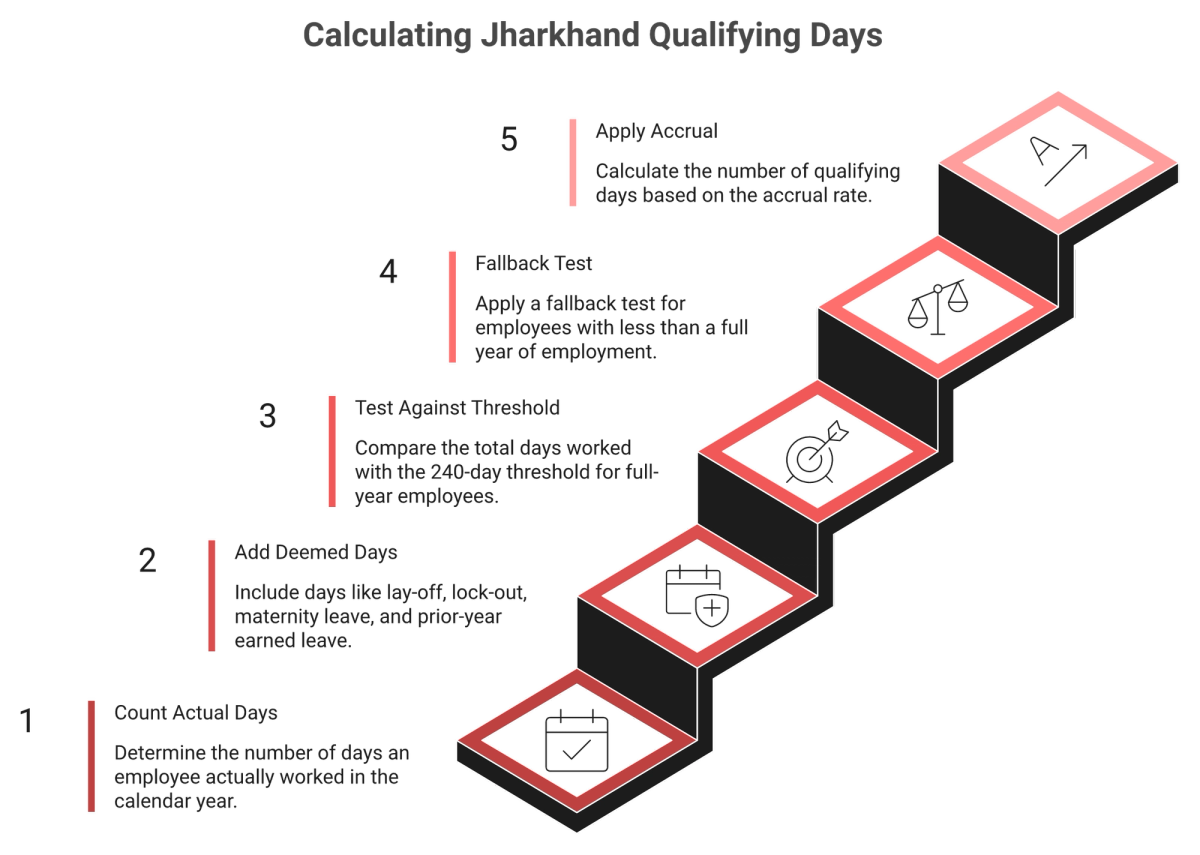
Work through it in this order.
Count actual days worked in the calendar year.
Add the deemed days: lay-off by agreement or standing orders, lock-out days, maternity leave, and leave earned in the prior year.
Test against 240. If the person joined after 1 January, test whether they worked two-thirds of the remaining days instead.
If employment ran 120 days or more, apply the 240:365 ratio test as the fallback route to entitlement.
Then apply the accrual rate of one day per 20 days worked, as set out in Section 16(1) and 16(4). Fractions of half a day or more become a full day. Anything less is ignored.
⏰ The same test, run on a 1 September Ranchi start
Say your engineer joins on 1 September. There are 122 days left in the year. Two-thirds of that is about 81 days.
Work 81 or more of those days and Section 16 entitlement kicks in for the next calendar year. Accrual on 105 worked days gives 5.25 days, which rounds to 5. Versatile Club logs that opening figure in the leave register at hire, so nobody argues about it in January, and the same step runs for every hire in India we onboard.
⚠️ The amendment older templates miss
The Jharkhand amendment of 2013 substituted "fourteen" for "twelve" in the maternity inclusion inside Section 16. Templates copied from pre-2013 sources undercount the qualifying period by two weeks.
That is small on paper and large in practice. Two weeks can be the difference between qualifying at 240 days and missing it. Versatile Club rechecks this inclusion on every female employee's first anniversary, because the miss shows up only when the balance is questioned.
✅ The one field to set at onboarding
Add a single field to the employee record: qualifying days counted this calendar year, with deemed days listed separately. Update it monthly, not annually.
That one field answers three separate questions. It tells you whether entitlement has vested. It gives the accrual base. It gives an inspector a number with a method behind it. Versatile Club maintains that count per state, because a Bengaluru hire and a Ranchi hire do not share the same qualifying rule, which is also why our outsourced payroll in India setup is keyed by state.
I could be reading this too strongly, but the mid-year joiner is where I see most India leave disputes begin. Nobody sets the opening balance, so the first January conversation becomes a negotiation instead of a lookup.
Q4. How many holidays must you give, and what happens if someone works one?
Versatile Club loads each employee's elected festival holidays into the payroll calendar before the year opens, so double-wage claims do not surface at year end. Section 12A gives shop-establishment employees full-pay holidays on Republic Day, Independence Day, and Gandhi Jayanti, plus up to five state-declared festival holidays, and one full weekly holiday. Industrial establishments follow the 1976 Act: three national holidays, four festival holidays chosen by the employee, 1 May, and at least seven days of casual leave. Working a holiday means double wages, or wages plus a substituted day within three days.
🗓️ Two regimes, side by side
| Item | Shops and commercial establishments | Industrial establishments |
| Governing law | Sec 12, 12A, Bihar Shops and Establishments Act (Jharkhand) | Bihar Industrial Establishments Act, 1976 |
| National holidays | 26 January, 15 August, 2 October | 26 January, 15 August, 2 October |
| Festival holidays | Up to 5, declared by the state | 4, elected by the employee from a schedule |
| May Day | Not separately mandated | 1 May, mandatory |
| Casual leave floor | 12 days under Sec 16A | At least 7 days under Sec 4 |
| Working a holiday | Double the normal hourly rate | Double wages, or substituted day within 3 days |
| Weekly off | One whole day each week | Per applicable standing orders |
📌 The election mechanism almost nobody runs
Under Rule 3 of the 1979 Rules, the employer displays a notice at the start of the year. Employees then indicate their choice of four festival holidays from the schedule.
Management can require work on a chosen festival day, but only with reasons notified three days in advance. National holiday working needs 48 hours advance notice served on the worker, with a copy on the notice board. Registers in Form 1 and Form 2 record who worked and what they got instead. Versatile Club runs this election in the first 60 days of the year, because the notice window is tied to the start of work, not to convenience.
🇮🇳 The Jharkhand 2026 dates that matter
The state list carries festivals a global calendar will never surface.
| Date | Day | Holiday |
| 12 January | Monday | Sohrai |
| 26 January | Monday | Republic Day |
| 4 March | Wednesday | Holi |
| 21 March | Saturday | Eid-ul-Fitr / Sarhul |
| 1 May | Friday | Buddha Purnima / Raghunath Murmu Jayanti / Labour Day |
| 30 June | Tuesday | Hul Diwas |
| 15 August | Saturday | Independence Day |
| 22 September | Tuesday | Karma Puja |
| 2 October | Friday | Gandhi Jayanti |
| 20 October | Tuesday | Vijaya Dashami |
| 9 November | Monday | Govardhan Puja |
Sarhul and Hul Diwas are Jharkhand specific. If your sprint planning ignores them, your Ranchi team quietly takes the day anyway.
✅ Publishing one calendar that satisfies both regimes
Publish the three national holidays as fixed. Publish the festival slots as elected, with the employee's choice recorded against their name. Keep the substitution and double-wage rule visible in the policy, not buried in an annexure.
Versatile Club maintains the holiday and substitution records under its own Jharkhand registration, so the register an inspector asks for already exists. If you want to see how that sits inside a full employment stack, our how it works page walks through the sequence, and you can book a call to review your own state annexures.
Q5. What maternity leave and working-hour limits apply alongside statutory leave?
Versatile Club administers maternity benefit under its own Indian registrations, so the statutory benefit and the leave balance stay separate lines. Maternity leave is 26 weeks of paid leave under the Maternity Benefit Act, 1961 as amended in 2017, for women with fewer than two surviving children, and six weeks in case of miscarriage. It does not consume earned, casual, or sick leave. Working hours in Jharkhand establishments are capped at 9 hours a day and 48 a week, with at least half an hour of rest after five continuous hours.
🤰 Maternity sits outside the leave ledger
This is the single most common configuration error I see. Someone books 26 weeks of maternity against the earned leave balance. The balance goes negative, and the employee gets a payslip that looks like a punishment.
Keep three buckets separate: statutory leave under Section 16 and 16A, national and festival holidays, and central benefits like maternity. Versatile Club keeps maternity benefit on its own payroll code, so the Section 16 balance is untouched when an employee returns, and the same separation runs through our managed payroll service.
⏰ The daily and weekly caps, with the overtime ceiling
Section 9 of the state Act sets 9 hours a day and 48 hours a week, excluding rest and meal intervals of not less than one hour a day. Overtime is possible, but bounded.
The limits are strict.
Total hours including overtime cannot exceed 10 in a day and 54 in a week.
Aggregate overtime cannot exceed 150 hours in a year.
Overtime wages are payable at the rate fixed under Section 21.
At least three days advance intimation must go to the Chief Inspector.
Versatile Club tracks the annual 150 hour overtime pool per employee, because that number is the one nobody watches until an inspection. Our payroll compliance in India guide covers how that tracking is set up.
⚠️ Spread-over is what actually breaks a support rota
Here is the rule most founders miss. Section 11 caps the spread-over, meaning the gap between start and finish of work, at 12 hours a day for an adult employee.
So a Ranchi engineer on a US-hours rota can work 8 hours. If those 8 hours start at 2pm and a handover call lands at 3am, the spread-over is breached even though the hours are legal. Versatile Club flags spread-over risk during onboarding when a client's shift plan crosses a 12 hour window, since that is where the state Act bites before the 48 hour cap does. Teams building US-aligned shifts usually work this out with us during EOR services in India setup.
💬 What buyers report on leave and parental-leave admin
Platform handling of leave records is a live complaint, not a theoretical one.
"The way annual leave is recorded is strange, it automatically logs weekend days, so this has incorrectly logged my leave. There is no way to edit so I have had to reach out to support for the leave to be deleted."
— Verified User in Non-Profit Organization Management, Pebl (formerly Velocity Global) Pebl (formerly Velocity Global) - G2 Verified Review, 30 April 2026
"requesting HR documents via form didn't work, and I can't request vacations because it doesn't work either with partial parental leave."
— Daryna R., Deel Deel - G2 Verified Review, 6 May 2024
Read those two together. Both are records problems, not policy problems, and records are what an inspector asks for. Buyers comparing the two usually land on our Velocity Global alternatives in India comparison next.
✅ Three clauses to check in your policy
Check these three lines today. First, does maternity sit outside the EL, CL, and SL balance in writing? Second, does the policy state the 9 hour and 48 hour caps with the spread-over limit named? Third, does it record the overtime rate and the 150 hour annual pool?
Versatile Club runs maternity, overtime, and spread-over as three separate checks at onboarding, so a shift plan that breaks Section 11 is caught before the first payroll cycle.
Q6. What does Jharkhand leave actually cost on your balance sheet?
Versatile Club issues one consolidated USD invoice from its own Indian entity, so accrued Jharkhand leave shows as a reconcilable line. Three triggers create cash cost. Refuse leave to someone already holding 45 days of credit and you owe wages for the refused period on top of normal wages. On exit, untaken leave must be paid before the end of the second working day after termination. Leave wages equal the daily average of full-time earnings including dearness allowance, excluding overtime and bonus.
💰 The three triggers, in order of surprise
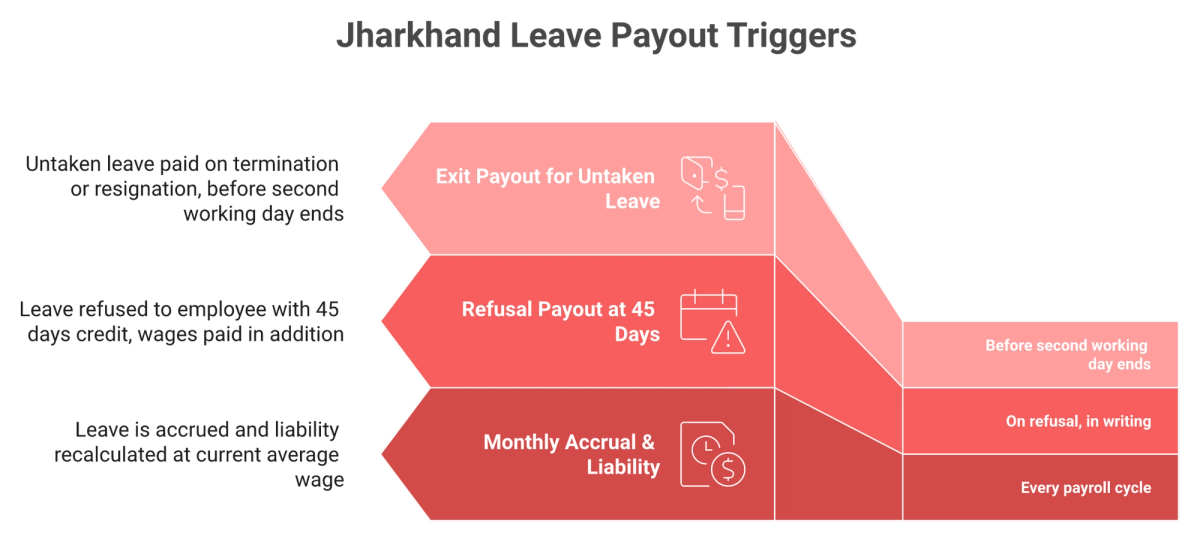
Trigger one is refusal. Section 16(8) says that when earned leave is refused to an employee holding 45 days credit, they get the wages for that period anyway, in addition to normal wages. The credit then reduces by those days.
Trigger two is exit. Section 16(9) requires payment for untaken leave before the expiry of the second working day after termination, and on or before the next pay day for a resignation. Versatile Club builds that two day clock into its full and final settlement workflow, because it is far shorter than the 30 to 45 day cycles most US finance teams assume.
🧮 The average-wage formula, shown
The rate is not the monthly salary divided by 30. It is the daily average of total full time earnings for days actually worked in the month immediately preceding the leave, as set out in Section 80(1) of the Factories Act, 1948.
The formula includes dearness allowance and the cash equivalent of concessional supplies. It excludes overtime wages and bonus. If the employee worked no day in that preceding month, you fall back to the last calendar month in which they did work. Versatile Club recalculates this rate monthly rather than at exit, since the preceding-month rule makes an exit-time calculation guesswork. Finance leads pressure-testing the number often start with our cost of hiring in India breakdown.
💸 Why the 50 percent wage rule raises your payout
Here is the part that lands on the balance sheet. Under the new labour codes, basic plus dearness allowance must be at least 50 percent of total remuneration.
Nobody gains a single day of leave from that change. The per day encashment rate simply rises, because the wage base it is calculated on gets bigger. Versatile Club's read is that the standard advice gets this backwards, treating the 50 percent rule as a provident fund story when it is equally a leave liability story.
💬 What CFOs already complain about
The reconciliation pain in this category is documented.
"I dislike how expensive Deel's transaction fees are, especially when moving money from the Deel account to my bank or wherever else it needs to go."
— Maria M., Deel Deel - G2 Verified Review, 26 September 2025
"The PF transfer for employees after terminating their employment with Velocity was very poor. There was limited help, delayed responses and you can't get them to talk to you on phone."
— Verified User in Computer Software, Pebl (formerly Velocity Global) Pebl (formerly Velocity Global) - G2 Verified Review, 27 May 2025
That second review is the exit moment exactly. Statutory obligations at termination are where the service model gets tested, and it is the most common reason teams read our guide to switching EOR provider in India.
✅ The accrual entry to open this month
Ask your accountant for one new line: accrued leave encashment liability by state, calculated at the current average-wage rate. Update it monthly.
Then add a second column for the wage base after the 50 percent restructure. Versatile Club shows accrued leave on the same USD invoice as the monthly fee, and since we bill from our own Indian entity there is no separate FX leg to reconcile. Our pricing page shows what that single invoice contains.
Q7. What changed for Jharkhand leave under the Labour Codes from 21 November 2025?
Versatile Club reran every Jharkhand accrual rule against the new qualifying test at commencement, and clients saw revised balances before their next payroll cycle. The four labour codes took effect on 21 November 2025. Section 32 of the Occupational Safety, Health and Working Conditions Code cuts the annual leave qualifying period from 240 days to 180, keeps accrual at one day per 20 days worked, caps carry-forward at 30 days, and makes encashment of the excess an annual right instead of an exit event.
📅 What changed, and on what date
The codes consolidated 29 central labour laws into four. Commencement was 21 November 2025, which is the date that matters for your accrual settings, per the Ministry of Labour and Employment.
For leave, the substance sits in Section 32. The quantum of leave is unchanged from the Factories Act position. The qualifying period is what moved.
⚖️ State Act versus Code, side by side
| Item | State Shops Act position | Section 32, OSH Code |
| Qualifying period | 240 days in a calendar year | 180 days in a calendar year |
| Accrual rate | 1 day per 20 days worked | 1 day per 20 days worked |
| When leave is usable | Following calendar year | Year in which it is earned |
| Carry-forward ceiling | 45 days | 30 days |
| Encashment | On refusal at 45 days, or at exit | Annual right for the excess above 30 days |
State Shops Act rules continue to operate until aligned state rules are notified. So the practical answer for a Ranchi hire right now is to run the employee-favourable number on each line. Versatile Club applies the 180 day test for eligibility and the 30 day ceiling for carry-forward, which is the combination that survives either reading.
💸 The wage-definition knock-on
The codes also standardise the definition of wages. Basic plus dearness allowance must be at least 50 percent of total remuneration.
That single rule touches provident fund, gratuity, and leave encashment together. A salary restructure done for provident fund reasons quietly raises your leave payout per day. Versatile Club models both effects in the same sheet before a restructure goes live, since finance teams usually see only the first one. Our salary calculator shows how the split moves the numbers.
⚠️ What the ranking articles still get wrong
Almost every Jharkhand leave guide online still prints 240 days with no reference to November 2025. Some publish a 30 day accumulation cap while keeping the 240 day gate, which is the wrong half of each regime.
I could be reading the transition too strictly, given that aligned state rules are still awaited. Versatile Club's position is that a compliance team should not be the one discovering a two year old commencement date during an audit.
✅ Three settings to change now
Three changes, in this order.
Set eligibility at 180 qualifying days for new joiners, and recheck anyone hired in the last two years.
Cap carry-forward at 30 days and stop letting the excess lapse silently.
Add an annual encashment run, rather than holding everything to exit.
Versatile Club made these three changes across its India payroll at commencement, and the visible effect was smaller exit payouts and a predictable annual encashment line instead.
Q8. Which registers and records will a Jharkhand labour inspector ask for?
Versatile Club maintains Form IX, Form X, and service cards under its own Jharkhand registration, so an inspection request is answered from our records. Expect four things. The Leave with Wages Register in Form IX, preserved three years after the last entry and produced on demand. The attendance and wages register in Form X. A service card in Form XXI in triplicate. For industrial establishments, holiday registers in Forms 1 and 2, the casual leave register in Form 3, and a bound inspection book.
📁 The record set, form by form
| Record | Form | Rule | Retention or handling |
| Leave with Wages Register | Form IX | Rule 14 | Preserved 3 years after last entry, produced on demand |
| Attendance and wages register | Form X | Rule 17 | Maintained by every employer |
| Service card | Form XXI | Rule 12A | Triplicate: employee, Inspecting Officer within a week, employer copy |
| Register of fines and deductions | Form XI | Rule 19 | All fines and deductions recorded |
| National holiday working register | Form 1 | 1979 Rules | Reasons, substituted date, benefit given |
| Festival holiday working register | Form 2 | 1979 Rules | Same fields, per festival |
| Casual leave register | Form 3 | 1979 Rules | Open to employees and Inspector |
| Inspection book | Bound book | 1979 Rules | Produced when required |
The state forms sit in the Jharkhand Shops and Establishments Rules, and the holiday registers sit in the Bihar Industrial Establishments Holidays and Casual Leave Rules, 1979.
⚖️ What enforcement actually looks like
Refusal of leave is not just a policy dispute. Under Rule 15, an employee appeals within 30 days to the Superintendent of Labour or the Sub-divisional Magistrate.
The authority can hear the matter ex parte if the employer fails to appear. Compensation awarded is recoverable as if it were a fine imposed by a Magistrate. Labour courts at Ranchi, Bokaro Steel City, and Jamshedpur hold jurisdiction across Chotanagpur division. Versatile Club keeps the refusal reasons in writing at the time of refusal, because Section 16(7) requires the cause to be recorded before the appeal exists.
💬 Where fragmented vendor stacks fail
Records are where a split vendor stack shows its seams.
"their payroll is still supported by manual processes, and twice we've had near catastrophic errors. Slow and laborious initial setup."
— Juliette D., Remote Remote - G2 Verified Review, 22 April 2026
"It did not handle multi-state taxes well at all. We are a non-profit and it was constantly making mistakes."
— Liz J., Rippling Rippling - G2 Verified Review
"The initial documentation and paperwork felt quite detailed and time-consuming at the beginning. However, as we progressed, it became clear that this thoroughness is what ensures proper legal and compliance coverage."
— Verified User in Marketing and Advertising, Wisemonk Wisemonk - G2 Verified Review, 12 February 2026
That third one is the honest trade-off. Heavy paperwork upfront is what a register-based regime actually requires, which is why teams comparing options read our Rippling alternatives for India and Remote alternatives in India pages before deciding.
✅ How to organise this before an inspection
Keep one folder per establishment, not one per country. Inside it, hold the registers in form order, with the last three years of Form IX first.
Add the notices too: weekly closure in Form VI, weekly holiday in Form VII, and the period of work notice. Each has a two day delivery requirement to the Inspecting Officer's office. Versatile Club files those notices at registration and refiles on change, since the two day window closes long before most clients hear about it. If you want your own records checked against this list, talk to our team.
Q9. Can you run unlimited PTO for a team in Ranchi?
Not as a replacement for statutory leave. Jharkhand law requires accrual tracking, a 45 day carry-forward ceiling, recorded reasons for refusal, and a Leave with Wages Register in Form IX kept three years after the last entry. Unlimited paid time off, meaning a policy with no fixed allotment, can sit on top of the statutory floor. It cannot sit instead of it. In hierarchical Indian teams, it usually reduces the leave people take.
🌴 The common view, stated fairly
The Netflix era made the argument well. Tracking days off is bureaucratic theatre. Treat adults like adults and they will take what they need.
I like the instinct. It respects people. The problem is what happens when you export it to a Ranchi payroll without changing anything underneath. Founders working through that question usually start with our guide to hiring employees in India.
❌ Why no allotment means less rest, not more
Remove the allotment and you remove the deadline. Nobody fears losing what was never granted, so nobody books the fortnight.
Reed Hastings wrote about a marketing manager who had not taken a non-working holiday in four years. She spent her Thanksgiving break working in the laundry room. That is the failure mode, and the paperwork looked fine the whole time.
⚠️ The India-specific flaw nobody plans for
Add hierarchy and it gets sharper. An American manager once described an engineer in Delhi who messaged her for permission every time he wanted his dinner break. His reason was simple: you are the manager, I am the subordinate.
If somebody asks permission for dinner, they will not self-authorise two weeks off. Versatile Club sees this in placement conversations across Bengaluru, Hyderabad, and Pune, where the leave question is asked sideways rather than directly. It is one of the behaviours we screen for in our culture fit assessment.
📋 The compliance gap dressed as a perk
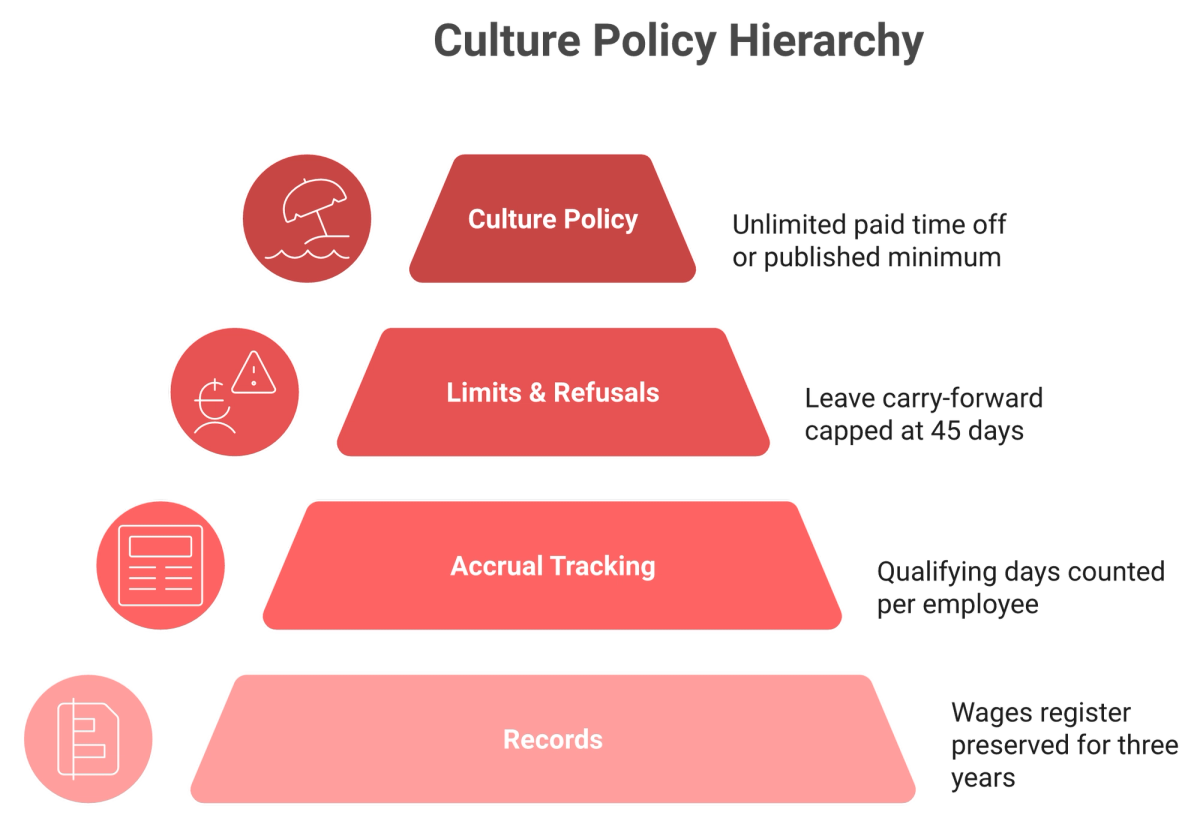
Here is the part the category avoids saying. An unlimited policy over an untracked Indian payroll is a records failure waiting for an inspection.
The state Act needs a number. It needs qualifying days counted, earned leave carry-forward capped at forty-five days, refusals recorded in writing, and payout for untaken leave at exit. "We do not track leave" is not an answer to any of those. Versatile Club keeps that ledger under its own Jharkhand registration even for clients whose internal policy says unlimited, because the register and the culture policy answer to different audiences. Our compliance page lists what we hold and file.
✅ The better version, in three moves
The fix is not to abandon generosity. It is to give it a floor and a shape.
Keep the statutory ledger exactly as the Act requires, with accrual, carry-forward, and refusal records intact.
Publish a stated minimum, such as fifteen days everyone is expected to take, instead of an unlimited maximum nobody uses.
Have the founder or country lead visibly take leave first, because modelling moves behaviour faster than policy text.
Greg, an American manager, got a Japanese office taking European style holidays without a single new rule. He just did it himself and said so out loud.
There is a simpler test I like for remote teams. At the end of the day, ask whether you did a good day's work. That question closes a laptop better than any policy paragraph.
Versatile Club maintains the statutory leave register under its own registrations while clients run whatever culture policy they prefer on top, so generosity does not turn into an inspection finding. The mechanics sit inside our EOR services in India.
Q10. How do you run one leave policy across Jharkhand and the rest of India?
Versatile Club holds Shops and Establishments registrations across all 28 Indian states and 8 union territories, so state annexures sit under one employer of record. Write one company policy at the highest common denominator across the states you employ in, then hold a state annexure for each. Jharkhand's binding constraints are the 240 day qualifying gate, the 45 day earned leave ceiling, casual leave at full pay, sick leave at half pay, and the second working day exit payout. Track accrual by state, never by company average.
🗺️ The pain: five annexures, one HRMS
A People Ops lead at Series B usually has one leave module and five state realities. The module holds a single number. The states do not agree with it.
So the annexures live in a Drive folder, and the HRMS quietly pays everyone the same. That gap is invisible until somebody exits or an inspector asks. Teams consolidating that mess often move it into managed payroll first.
📊 The same worker, four states
| State | Qualifying gate | Earned leave carry-forward | Casual and sick leave | Professional tax cycle |
| Jharkhand | 240 days | 45 days | CL 12 full pay, SL 12 half pay | Slab based, state filing |
| Karnataka | 240 days | 30 days typical | CL and SL per state Act | Monthly PT filing |
| Maharashtra | 240 days | 45 days typical | CL and SL per state Act | Dual PTRC and PTEC registration |
| Tamil Nadu | 240 days | 45 days typical | CL and SL per state Act | Biannual PT filing, plus labour welfare fund |
Versatile Club runs all four calendars off one payroll engine, and the differences we watch most are Maharashtra's dual registration and Tamil Nadu's biannual filing date. Our payroll outsourcing services in India overview explains how the state keying works.
⚠️ The rule that keeps this manageable
Set the company floor at the most generous binding rule across your states. Then let each annexure add only what its state demands beyond that.
That way your HRMS never underpays anyone. The annexure exists for the inspector and the exit calculation, not for daily operations. I could be oversimplifying for teams above 200 people, but under 50 this holds up well.
💬 What multi-state failure sounds like
Multi-state handling is a documented weak spot for platform-first vendors.
"It did not handle multi-state taxes well at all. We are a non-profit and it was constantly making mistakes."
— Liz J., Rippling Rippling - G2 Verified Review
"What I dislike about Wisemonk is that some features feel a bit limited and could use more flexibility. In particular, I'd like to see better options for customization and more detailed reporting."
— Vinay M., Wisemonk Wisemonk - G2 Verified Review, 18 February 2026
"I've noticed that their support/query responses can occasionally take a bit longer sometimes, likely due to a relatively small team."
— Verified User in Financial Services, Wisemonk Wisemonk - G2 Verified Review, 14 June 2025
State level reporting flexibility is exactly what breaks first. That second review names the gap honestly, and it is the reason buyers compare our Rippling alternatives for India before renewing.
✅ The one field that makes it work
Add a state field to every employee record, and attach the leave rule set to it rather than to the country. Then every accrual, ceiling, and exit calculation reads from the right annexure automatically.
Versatile Club keys leave rules to the state of employment rather than to a global default, so a Ranchi hire and a Bengaluru hire accrue on their own statutory clocks under one invoice. You can see the sequence on our how it works page.
Q11. Should you hire in Jharkhand through an EOR, a contractor, or your own entity?
Versatile Club employs Jharkhand hires under its own registered Indian entity at $149 per employee per month, with a five day contractual onboarding SLA. Below roughly 15 India employees, an employer of record is usually cheaper and lower risk even across three years. The leave register, the festival holiday election under the 1976 Act, and exit payouts all sit with the legal employer. A contractor arrangement avoids none of these obligations if the relationship looks like employment, and it adds permanent establishment exposure, meaning tax presence risk in India.
🧭 Three routes, and who each suits
Own entity suits companies past 25 to 30 India employees with local finance support. Setup runs into tens of thousands of dollars and 12 to 18 months before a first hire in many cases.
Contractor suits genuinely project based work with real independence. EOR suits the first hire through roughly the fifteenth, which is where most readers of this article sit. Versatile Club's read is that the crossover happens later than founders expect, because entity costs are recurring compliance costs, not one time setup costs. Our EOR versus entity calculator runs your own numbers, and the EOR versus entity in India write-up explains the assumptions.
✂️ Misclassification, plainly
Jason Fried put it well. You are running with scissors if you paper an employment relationship as a contract without expert help.
In Jharkhand the test is not the contract title. It is control, working hours, exclusivity, and integration into the team. Get it wrong and the leave, provident fund, and gratuity obligations arrive retrospectively. Our independent contractor versus EOR comparison sets out the tests, and converting a contractor to an employee in India covers the fix.
📊 Honest comparison on India depth
| Provider | India entity model | India state coverage | Published price | Onboarding |
| Versatile Club | Own registered Indian entity | All 28 states and 8 UTs | $149 per employee per month, no setup or exit fee | 5 day contractual SLA |
| Wisemonk | India native, SOC 2 and ISO 27001 certified | Broad India coverage | $99 to $399 per employee per month | 24 to 72 hours claimed |
| Deel | Local partner entities in India | Primarily top metro states | Around $599 per employee per month | 7 to 14 days |
| Remote | Local partner entities in India | Primarily top metro states | Around $599 per employee per month | 10 to 14 days |
| Multiplier | Partner entity model | Metro focused | Around $400 per employee per month | 1 to 2 weeks |
Wisemonk holds certifications Versatile Club does not yet hold, and that matters if your procurement team requires SOC 2 before signature. Side by side detail sits on our Wisemonk alternative and Deel alternative pages.
💬 What buyers report about the generalist route
"It took three months to onboard our first 3 individuals. They didn't seem to be able to navigate Visas or variations to employment contracts and this constantly created issues so we had to make a decision to change providers."
— Verified User in Information Technology and Services, Deel Deel - G2 Verified Review, 13 December 2024
"They were dishonest about the level of support provided. We specifically explained we required phone-level support for urgent matters, but that is not available."
— Juliette D., Remote Remote - G2 Verified Review, 22 April 2026
"WiseMonk's EOR service solved our biggest challenge, which was hiring employees in India without setting up a local entity."
— Verified User in Marketing and Advertising, Wisemonk Wisemonk - G2 Verified Review, 12 February 2026
That last quote is the real category benefit, and it is fair to give a competitor credit for it.
⚠️ Where we are not the answer
Versatile Club operates only in India, so buyers hiring across five or more countries need a generalist. Enterprise procurement requiring SOC 2 or ISO 27001 as a gate should look elsewhere for now. Our EOR line is newer than our contract to hire operation, though the multi-state payroll infrastructure behind it is not.
Versatile Club runs Jharkhand employment through its own entity with the founder reachable on WhatsApp, so the person answering a Section 16 question is the person who signed the registration. If you want your own Jharkhand setup reviewed, book a 30 minute call.
FAQs
How many days of leave is an employee in Jharkhand legally entitled to?
Jharkhand runs on the Bihar Shops and Establishments Act as adopted by the state, and the entitlement is a formula rather than a flat number.
- Earned leave with wages: available after 240 qualifying days in a calendar year, accruing at one day for every 20 days worked, which most sources publish as roughly 18 days.
- Casual leave: 12 days per calendar year on full pay, not accumulative.
- Sick leave: 12 days per calendar year on half pay against a medical certificate, not accumulative.
- Carry-forward: earned leave only, capped at 45 days.
Three details usually get missed. Leave excludes holidays falling during or at either end of the leave period. It can be taken in no more than three instalments. Employees must apply at least 15 days before the start date.
Versatile Club sets the accrual rate, the pay treatment, and the 45 day ceiling inside payroll at onboarding rather than at the first leave request. We also print the governing section on the leave clause of the offer letter, so an audit sees the basis. You can review how the employment stack fits together on our India EOR services page.
Is casual leave in Jharkhand paid at full pay or half pay?
Casual leave in Jharkhand is paid at full pay, and sick leave is the entitlement paid at half pay. Section 16A of the state Act grants casual leave with full pay for 12 days in a calendar year, and sick leave on half pay for 12 days on production of a medical certificate.
This matters because several widely used compliance databases publish the reverse. One popular state table lists casual leave at half pay and sick leave at full pay. Another publishes 15 earned, 7 casual, and 7 sick days with no section reference at all.
The practical consequences of copying the wrong version are real.
- Paying sick leave at full pay overpays against the statutory floor, which is legal but inflates cost.
- Paying casual leave at half pay underpays against the floor, which creates an arrears claim.
- Neither error is visible until an exit calculation or an inspection.
Versatile Club configures Jharkhand leave from the Act and Rules text, which is why our Section 16A pay treatment differs from the popular compliance wikis. If your provider cannot show you the section behind each number, our India payroll compliance guide sets out what to ask for.
Did the labour codes change leave eligibility in Jharkhand from 240 days to 180 days?
Yes for the central position, and the state rules have not yet been aligned. The four labour codes commenced on 21 November 2025. Section 32 of the Occupational Safety, Health and Working Conditions Code changes four things at once.
- The qualifying period drops from 240 days to 180 days in a calendar year.
- Accrual stays at one day for every 20 days worked.
- Carry-forward is capped at 30 days rather than the state Act's 45.
- Encashment of the excess becomes an annual right instead of an exit event.
Almost every Jharkhand leave article still prints 240 days with no reference to the commencement date. Some publish a 30 day accumulation cap while keeping the 240 day gate, which mixes the wrong half of each regime.
Versatile Club applies the 180 day test for eligibility and the 30 day ceiling for carry-forward, which is the combination that survives either reading until aligned state rules are notified. The knock-on runs further than leave, because basic plus dearness allowance must now be at least 50 percent of total remuneration, which raises the per day encashment rate. Our India salary calculator shows how that split moves the numbers.
What does unused leave cost when an employee in Jharkhand exits?
Three statutory triggers create cash cost, and the exit clock is far shorter than most US finance teams expect.
- Refusal payout: refuse earned leave to an employee already holding 45 days of credit, and the wages for that period are payable in addition to normal wages.
- Exit payout: untaken leave must be paid before the expiry of the second working day after termination, and on or before the next pay day where the employee resigns.
- Rate: leave wages equal the daily average of total full time earnings for days actually worked in the month immediately preceding the leave, including dearness allowance, excluding overtime and bonus.
If the employee worked no day in that preceding month, the rate falls back to the last calendar month in which they did work. That preceding month rule is why an exit-time calculation is guesswork unless you already track the rate.
Versatile Club recalculates the average wage rate monthly and shows accrued leave on the same consolidated USD invoice as the monthly fee, so a CFO reconciles one line instead of chasing a vendor after termination. Finance leads pressure-testing the number usually start with our cost of hiring in India breakdown.
Can we offer unlimited PTO to our team in Ranchi instead of tracking leave?
Not as a replacement for statutory leave. An unlimited policy can sit on top of the statutory floor, never instead of it, because the state Act requires numbers a policy without allotments cannot produce.
- Qualifying days counted per employee per calendar year.
- Earned leave carry-forward capped and tracked, with the 45 day ceiling enforced.
- Reasons for any refusal recorded in writing at the time of refusal.
- A Leave with Wages Register in Form IX preserved three years after the last entry.
- Payout of untaken leave at exit, which requires a balance to pay out.
There is a cultural reason too. In hierarchical Indian teams, removing the allotment usually reduces the leave people take, because nobody fears losing what was never granted. We have watched engineers ask permission for a dinner break, so they will not self-authorise a fortnight.
Versatile Club maintains the statutory ledger under its own Jharkhand registration even for clients whose internal policy says unlimited, so generosity does not become an inspection finding. A better shape is a statutory floor plus a published minimum, such as fifteen days everyone is expected to take. Our how it works page shows where that ledger sits.