Table of contents (12)
Leave Policy in Madhya Pradesh: Statutory Rules Explained Simply
Q1. Which employees does Madhya Pradesh leave law cover, and which statutes bind them?
A People Ops lead at a US Series A company pinged me on WhatsApp last March. She had one engineer in Indore, an offer letter copied from a Bengaluru template, and an auditor asking which Act her leave accrual came from. She had the entitlement table. She did not have the section number. That gap is where most India leave policies break.
Your obligation in Madhya Pradesh follows the employee's category, not the job title. Under the Madhya Pradesh Shops and Establishments Act, 1958, "employee" means a person wholly or principally employed in an establishment, including an apprentice, excluding a family member of the employer (s.2(6)). Section 3(a) exempts declared management and confidential roles, capped at 10% of headcount or three people, whichever is less. Section 62 sends factory workers to the Factories Act, 1948 instead.
The four categories that decide everything
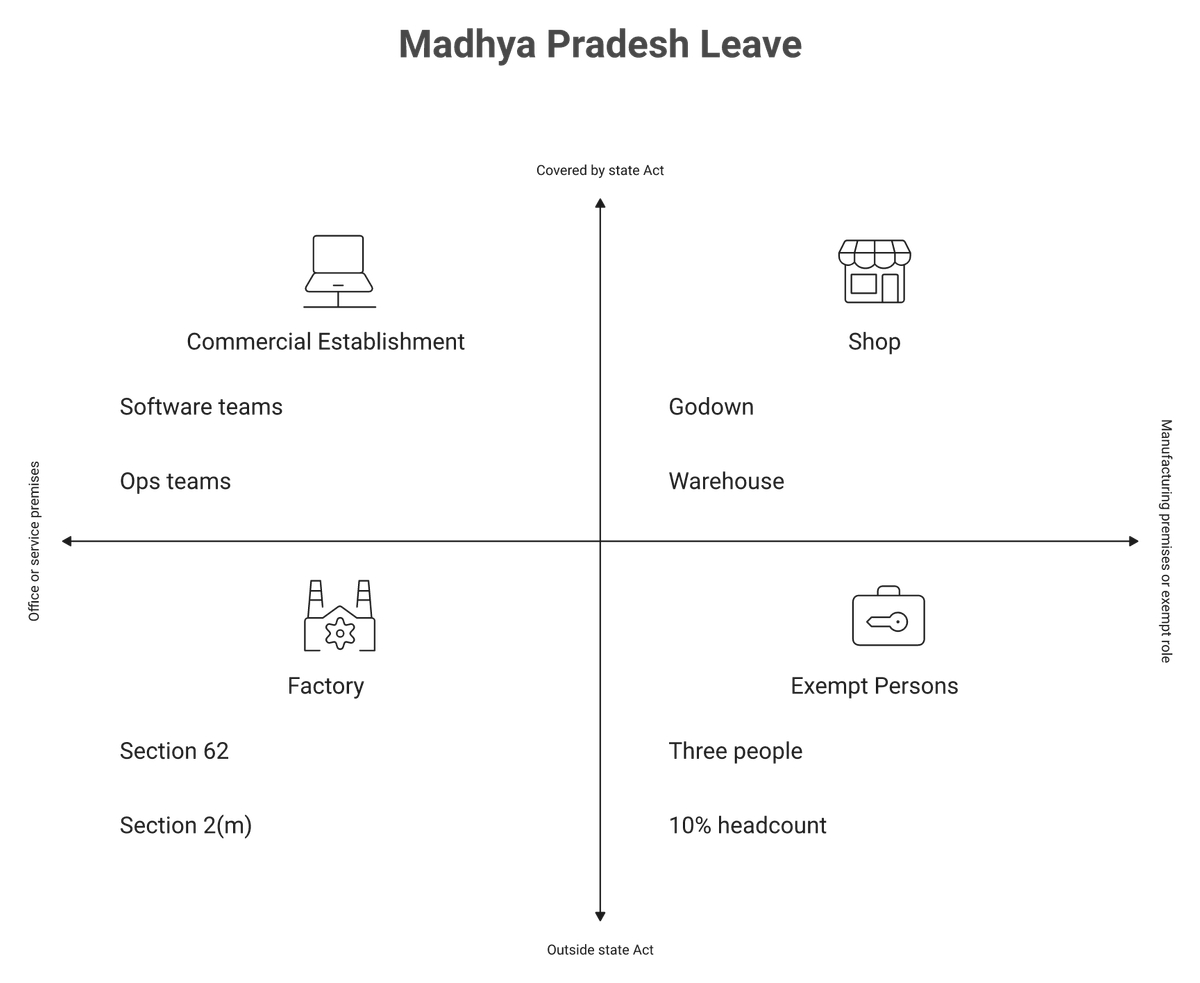
Before anyone quotes you a leave number, you need to know which bucket your hire sits in. Madhya Pradesh defines each one in statute, not in practice.
- Commercial establishment. Any business, trade, or profession, including a joint stock company, bank, or the clerical department of a factory (s.2(4)). Most software and ops teams in Indore or Bhopal land here.
- Shop. Premises where goods are sold or services are rendered to customers, including an office or warehouse used for that trade (s.2(24)).
- Factory. Premises that qualify under s.2(m) of the Factories Act, 1948 (s.2(9)). Section 62 then removes these workers from the state Act entirely.
- Exempt persons. Management, confidential capacity, inherently intermittent roles such as watchmen, and messengers (s.3).
🧾 The exemption clause founders misread
The section 3(a) exemption is narrow. It applies only to persons declared as management under s.6(2)(a), and only up to three people or 10% of staff.
I have seen US templates mark every senior engineer "exempt." That is a US wage and hour idea. It has no Madhya Pradesh equivalent, and an inspector reads the cap literally. Before you copy a template, read how EOR services in India classify an employee against the governing state Act.
Which laws stack on top
Labour sits on India's Concurrent List, so state and central rules apply together. Versatile Club runs both layers in the same monthly filing cycle for client employees in Madhya Pradesh, and documents the stack on its India compliance coverage page.
| Layer | Instrument | What it governs |
| State baseline | MP Shops and Establishments Act, 1958, Chapter VII | Privilege leave, casual leave, leave pay |
| State rules | MP Shops and Establishment Rules, 1959, Rule 13 | Leave register, Leave Book, refusal register |
| State holidays | MP Industrial Employment (Standing Orders) Rules, 1963, Rule 8-A | National and festival holidays |
| Central, factories | Factories Act, 1948, s.78 to s.80 | Annual leave with wages, leave wage rate |
| Central, all | Maternity Benefit Act, 1961; PoSH Act, 2013 | Maternity leave, workplace safety duties |
⚠️ Where one law beats another
Section 61 preserves rights and privileges available under other law, so a more favourable term wins. You cannot use the state Act to reduce a central entitlement.
Section 64 also keeps provident fund obligations intact. So PF sits outside your leave clause, but it shares the same wage base, which is why payroll compliance in India and leave design have to be solved together.
✅ What to do with this on Monday
Pull every Madhya Pradesh offer letter. Tag each person as shop, commercial establishment, factory, or exempt. Then check the leave clause against that tag, not against your global handbook.
If your count of "exempt" people exceeds three, you have a live compliance issue in Madhya Pradesh.
Versatile Club classifies each Madhya Pradesh hire against the Act's own categories before the employment contract is issued, and holds the registrations that the classification attaches to. Our read is that category, not entitlement, is the part buyers get wrong first.
Q2. How many leave days does Madhya Pradesh actually mandate, and why do HR sites disagree?
Section 26 of the Madhya Pradesh Shops and Establishments Act, 1958 grants privilege leave after every 12 months of continuous employment, plus casual leave during each year of employment. There is no separate statutory sick leave in the Act. The statutory "year" runs from 1 April under s.2(29), not January. Casual leave cannot be combined with privilege leave.
The baseline table
Published compliance tables for Madhya Pradesh converge on one month of privilege leave and 14 days of casual leave, with accumulation capped by the section 26 proviso.
| Leave type | Entitlement | Eligibility | Carry forward |
| Privilege leave | One month (commonly read as 30 days) | After 12 months continuous employment | Capped by the s.26 proviso; sources differ |
| Casual leave | 14 days per year | During the year of employment | Not carried forward |
| Sick leave | No statutory provision | Contractual only | Employer policy |
| National and festival holidays | 3 plus 5, full wages | All covered employees | Not applicable |
📌 Why the numbers on Google conflict
Two large HR platforms publish different figures for the same state. One shows earned leave 15, casual 7, and sick 7. Another shows 30 earned and 14 casual with a 90 day carry forward cap.
The bare Act is the tiebreaker. Read s.26 first, then configure payroll.
⚠️ The carry forward number nobody agrees on
The accumulation limit appears as three months in the gazette compilation and as six months in an amended consolidation, while HR wikis quote 90 days. Versatile Club treats this as an unresolved conflict and provisions against the higher figure until the Labour Commissioner clarifies.
I might be reading the conservative route too strongly here. It is the route that survives diligence.
What this costs you when it is wrong
A misconfigured leave year is not a cosmetic bug. It misstates accrued liability on every India line of your close.
💸 The 1 April problem
Your HRIS probably runs a January to December leave year. Madhya Pradesh runs April to March. The mismatch quietly moves accrual between two reporting periods.
Buyers already feel this pain with platform vendors, which is why reporting depth shows up in reviews, and why finance teams reviewing payroll outsourcing in India ask about the leave year before the price.
"What I dislike about Wisemonk is that some features feel a bit limited and could use more flexibility. In particular, I'd like to see better options for customization and more detailed reporting."
— Vinay M., Verified User, Wisemonk - G2 Verified Review, 18 February 2026
"Poor communication on issues and complete ignorance of deadlines set by Deel themselves. Extremely slow speed in resolving HR and payroll issues."
— Daryna R., Verified User, Deel - G2 Verified Review, 6 May 2024
✅ Fix it in one pass
Set the leave year to 1 April. Split the entitlement into privilege and casual lines with the section number in the field label. Block the combination of the two in your approval flow.
Then restate last year's accrual under the corrected year. Your auditor will ask for that anyway.
Versatile Club configures Madhya Pradesh leave from the section 26 text and the 1 April statutory year, and shows the accrual as a line item on the client's managed payroll invoice. We would rather publish the conflict than pick a convenient number.
Q3. Factory or commercial establishment: which accrual math applies to your hire?
Madhya Pradesh runs two different leave formulas at once. Establishment staff earn privilege leave after 12 months of continuous employment under s.26 of the MP Shops and Establishments Act, 1958. Factory workers earn leave under s.79 of the Factories Act, 1948, which requires 240 days of work in a calendar year and then grants one day for every 20 days worked. Section 62 decides which track applies.
The two tracks side by side
| Element | Establishment track | Factory track |
| Governing provision | MP S&E Act, s.26 | Factories Act, s.79 |
| Qualifying period | 12 months continuous employment | 240 days in the calendar year |
| Accrual method | Block entitlement after qualification | One day per 20 days worked |
| Leave wage rate | Pay during leave under s.27 | Daily average of full time earnings, s.80(1) |
| Register | Form I and Leave Book Form J | Factory leave records |
🧮 How the 240 days are counted
The 240 day threshold is not pure attendance. Days of lay off permitted under standing orders count. So does maternity leave up to 12 weeks for women workers. So does leave earned in the prior year and enjoyed in the current one.
Fractions round in the worker's favour. Half a day or more counts as a full day, and less than half a day is ignored.
⚠️ Where hybrid teams get caught
A single client can sit on both tracks in the same payroll month. An engineering team in a commercial establishment accrues under s.26. A plant operations team accrues under s.79.
Versatile Club runs both accrual tracks in parallel where a client's India footprint spans an office and a factory unit. Averaging the two into one policy number is the error I see most often in inherited handbooks, and it is the first thing we check when a company decides to switch EOR provider in India.
Hours and days sit inside the same chapter
Leave is not the only thing the establishment track fixes. Chapter III of the state Act also governs opening hours, hours of work, spread over, and the weekly holiday for shops and commercial establishments.
⏰ Why hours change your leave math
Overtime limits are defined by reference to nine hours a day and 48 hours a week for other establishments under Rule 21 of the MP Shops and Establishment Rules, 1959. The same Form N register carries attendance, wages, overtime, and deductions.
Attendance feeds accrual. If your attendance record is thin, your leave balance is unprovable.
✅ The decision tree to run once
Ask three questions per employee. Is the workplace a factory under s.2(m) of the Factories Act? If yes, use s.79. If no, is the person exempt under s.3? If no, use s.26.
Write the answer into the employee record as a field, not a footnote. Then your payroll rules follow the field.
Versatile Club holds Shops and Establishments registrations across all 28 states and 8 union territories, and assigns each client employee to the statutory track that their workplace category triggers. We keep that assignment visible in the employee record so the accrual is auditable later.
Q4. What leave types does a white-collar Madhya Pradesh policy need beyond the minimum?
Versatile Club builds Madhya Pradesh policies on six lines: privilege leave and casual leave from s.26 of the MP Shops and Establishments Act, 1958, maternity leave under the Maternity Benefit Act, 1961, contractual sick leave, paid voting time off, and discretionary bereavement or work from home days. Each line is labelled statutory or company policy in the contract. Sick leave is not mandated by the Madhya Pradesh Act.
Is sick leave mandatory in Madhya Pradesh?
No. The state Act provides only privilege leave and casual leave in Chapter VII. Any paid sick leave you offer in Indore or Bhopal is contractual. ESIC sickness benefit applies separately, and only to employees within the wage ceiling.
🩺 What that means for an engineer's offer letter
Your white-collar hire expects seven to twelve sick days. That is market practice, not statute.
Say so in the document. A benefit that looks statutory and then changes reads as a withdrawal, which is the same trust problem founders hit when they hire in India without an entity using a borrowed template.
The six-line policy skeleton
| Line | Basis | Label |
| Privilege leave | MP S&E Act, s.26 | Statutory |
| Casual leave | MP S&E Act, s.26 | Statutory |
| Maternity leave, 26 weeks | Maternity Benefit Act, 1961 | Statutory |
| Sick leave | Contract, ESIC benefit where covered | Company policy |
| Paid voting time off | Election Commission of India guidance | Statutory practice |
| Bereavement, work from home | Contract | Company policy |
⭐ The two clauses that prevent disputes
Write the carry forward cap and the rule that casual leave cannot be combined with privilege leave. Both trace to section 26, so neither reads as employer discretion.
Then display the leave rules in the establishment, which Rule 20 of the MP Shops and Establishment Rules, 1959 requires in English or the language of the majority of employees.
Why the policy document is a retention artifact
Compliance is the floor. Retention is what the policy actually buys you.
💬 What buyers report about leave workflows
Broken time-off workflows surface in reviews more often than missing entitlements.
"Platform functionality is broken and not working as it was supposed to. For example, requesting HR documents via form didn't work, and I can't request vacations because it doesn't work either with partial parental leave."
— Daryna R., Verified User, Deel - G2 Verified Review, 6 May 2024
"So far, I haven't encountered any major issues. However, I've noticed that their support/query responses can occasionally take a bit longer sometimes, likely due to a relatively small team."
— Verified User in Financial Services, Wisemonk - G2 Verified Review, 14 June 2025
"It took three months to onboard our first 3 individuals. They didn't seem to be able to navigate Visas or variations to employment contracts."
— Verified User in Information Technology and Services, Deel - G2 Verified Review, 13 December 2024
✅ Ship the policy in one sitting
Draft the six lines. Mark each one. Attach the Madhya Pradesh annexure to the offer letter, and put the leave rules on the notice board.
Tell the employee which lines are law. That single sentence removes most first-year friction, and it is the step most teams skip when they convert a contractor to an employee in India.
Versatile Club issues Madhya Pradesh employment contracts with statutory and discretionary leave marked separately, and pairs the first quarter with a 90-day Success Coach. Written terms for the coach and the replacement guarantee are confirmed per client before they appear in a contract. If you want the entitlement modelled against your own salary structure, the India salary calculator is the fastest starting point.
Q5. How is leave pay and encashment calculated in Madhya Pradesh?
Leave in Madhya Pradesh is paid on wages, not on notional CTC. Chapter VII of the Madhya Pradesh Shops and Establishments Act, 1958 is titled "Leave with pay and payment of wages", and sets pay during leave (s.27) and when payment must be made (s.28). Section 30 applies the Payment of Wages Act, 1936 to these payments. For factory workers, s.80(1) of the Factories Act, 1948 fixes the rate at the daily average of total full time earnings. Versatile Club shows this accrual as a line item on one monthly USD invoice from its own Indian entity.
What counts inside the leave wage
The factory formula is the more precisely drafted of the two, and finance teams borrow its logic.
- Included: total full time earnings for days actually worked in the preceding month, dearness allowance, and the cash equivalent of concessional supplies.
- Excluded: overtime wages and bonus.
- Fallback: if the worker did not work any day in the preceding month, the last month in which they did work is used.
🧮 A worked number
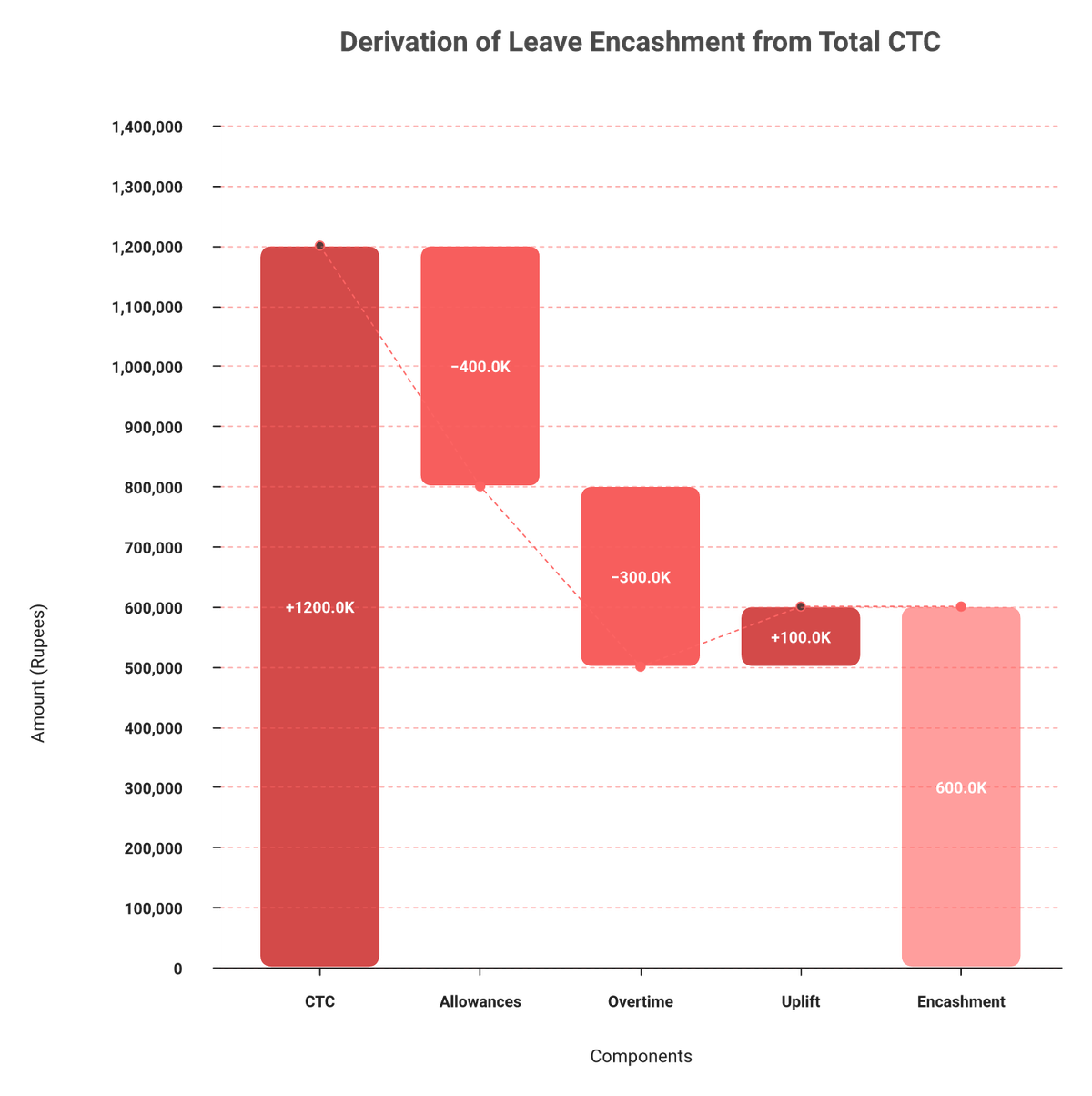
Take a Bhopal engineer on 12,00,000 rupees CTC with Basic plus DA at 5,00,000. Leave encashment tracks Basic plus DA, so 30 accrued days cost roughly 41,000 rupees, not 98,000.
Versatile Club calculates accrual on the wage base, then restates it if the salary structure changes mid year. I have seen the second step skipped more often than the first, which is why the India salary structure calculator is worth running before the offer goes out.
💸 The wage split that quietly raises your liability
The 2025-26 labour codes require Basic plus dearness allowance to be at least 50% of total remuneration. Most India salary structures in US-owned companies sit well below that.
Raise the Basic to comply, and every future encashment payout rises with it. That is the same restructuring memo a CFO signs for provident fund compliance, and it changes the real cost of hiring in India.
Where buyers feel this in practice
Payroll math errors and opaque fees are the two complaints that dominate EOR review pages.
"I find Deel to be absurdly expensive. They charge a high amount of fees for transferring money to my bank account."
— Juan Camilo O., Verified User, Deel - G2 Verified Review, 27 November 2025
"A 401(k) contribution issue was resolved by support copy-pasting generic instructions without ever opening the account. Those instructions led to incorrect fixes being applied to an employee's pay."
— Erika D., Verified User, Rippling - G2 Verified Review, 22 May 2026
"Initially the problem I faced while working as a contractor for an international company was the money transfer problems but from when my company started using wisemonk I receive my salary in INR in my bank account."
— Bulbul G., Verified User, Wisemonk - G2 Verified Review, 19 February 2025
✅ The quarterly routine that keeps audits short
Run four steps every quarter. Recompute accrued days per employee. Multiply by the current Basic plus DA daily rate. Book the provision. Note any wage restructuring that changed the rate.
Do the same on exit, because full and final settlement is where the number gets tested. Teams running this in-house usually end up comparing it against payroll outsourcing services in India.
⚠️ Where I am still unsure
Versatile Club provisions encashment on Basic plus DA because that is how Indian practice reads the wage definition. Madhya Pradesh has not notified its own Code on Wages rules yet, so the final wage base for the state could shift.
My read is that provisioning high now costs less than restating later.
Versatile Club bills one consolidated USD invoice from its own registered Indian entity, with statutory leave accrual itemised for the client's month-end close. That removes the reconciliation call, which is the part CFOs actually complain about. The full fee structure sits on the EOR pricing page.
Q6. Which holidays are compulsory for a Madhya Pradesh employer in 2026?
Employees in Madhya Pradesh are entitled to three national holidays, namely Republic Day, Independence Day, and Gandhi Jayanti, plus five festival holidays with full wages, under Rule 8-A of the M.P. Industrial Employment (Standing Orders) Rules, 1963. The state Act separately governs the weekly closed day and weekly holiday for shops and commercial establishments (s.13). The long state gazetted list is government office practice, not a blanket private sector mandate.
The three buckets people confuse
Holiday obligations in Madhya Pradesh come from three different places, and they are often merged into one spreadsheet.
| Obligation | Source | What it fixes |
| 3 national plus 5 festival holidays | Standing Orders Rules, 1963, Rule 8-A | Paid holidays, employer selects the five festivals |
| Weekly holiday and closed day | MP S&E Act, 1958, s.13 | One day a week, notified in advance |
| State gazetted list | State government calendar | Reference for banks and offices |
⏰ The notices nobody files
Rule 20 of the M.P. Shops and Establishment Rules, 1959 requires a notice in Form O specifying the holiday days, displayed before the relevant week begins. A substituted festival day needs notice to the Inspector in Form R.
Versatile Club files these notices for client employees in the first week of employment. Skipping them is the cheapest compliance failure to fix and the easiest one to forget, which is why the filing calendar sits inside our onboarding workflow.
💰 What holiday working actually costs
Work on a national or festival holiday attracts holiday wages plus wages for the work done, per Rule 8-B. So a holiday shift is materially more expensive than an ordinary overtime hour.
Price that into your on-call rota before you promise US-hours coverage from Indore.
Picking the five festival days
The five festival holidays are chosen by the employer, not handed down. That choice is a culture decision dressed as a compliance task.
⭐ How I pick them with clients
Ask the India team, then publish. For most Madhya Pradesh teams the list lands on Holi, Diwali, Raksha Bandhan or Rakhi, Dussehra, and one regional day.
Versatile Club records the selected five in the employment documentation, so the list is auditable rather than informal. A US manager scheduling a sprint review on Diwali is a retention problem, not a legal one.
✅ Put the calendar where the work happens
Do three things this week. Confirm your five festival days. Display Form O. Push the full India holiday calendar into the shared work calendar your US team actually reads.
Then set the weekly closed day, and notify any change in Form Q. Founders building their first distributed team usually pair this with the employer of record India playbook.
Versatile Club maintains the statutory holiday notices and the client-facing India calendar on the same entity that employs the worker. Our view is that the calendar belongs in the client's planning tool, not in a PDF nobody opens.
Q7. What leave records must you keep to survive a Madhya Pradesh inspection?
Rule 13 of the M.P. Shops and Establishment Rules, 1959 requires a leave register in Form I for each employee, a Leave Book in Form J that is the employee's property, and a register in Form K for refusals of leave under s.26(3). Rule 20 adds a register of employees in Form N covering attendance, wages, overtime, fines, and deductions. Versatile Club maintains these registers for client employees under its own registrations across all 28 states and 8 union territories.
The forms an inspector will ask for
Your HRIS dashboard is not a statutory register. These documents are.
| Form | Purpose | Rule |
| Form I | Leave register, one page per employee | Rule 13(1), Rule 20(4) |
| Form J | Leave Book held by the employee | Rule 13(2) |
| Form K | Register of refused leave | Rule 13(4) |
| Form N | Attendance, wages, overtime, deductions | Rule 20(1), Rule 21(2) |
| Form O, Form P | Holiday notice, working hours notice | Rule 20(2), Rule 20(3) |
🧾 The custody rule global platforms miss
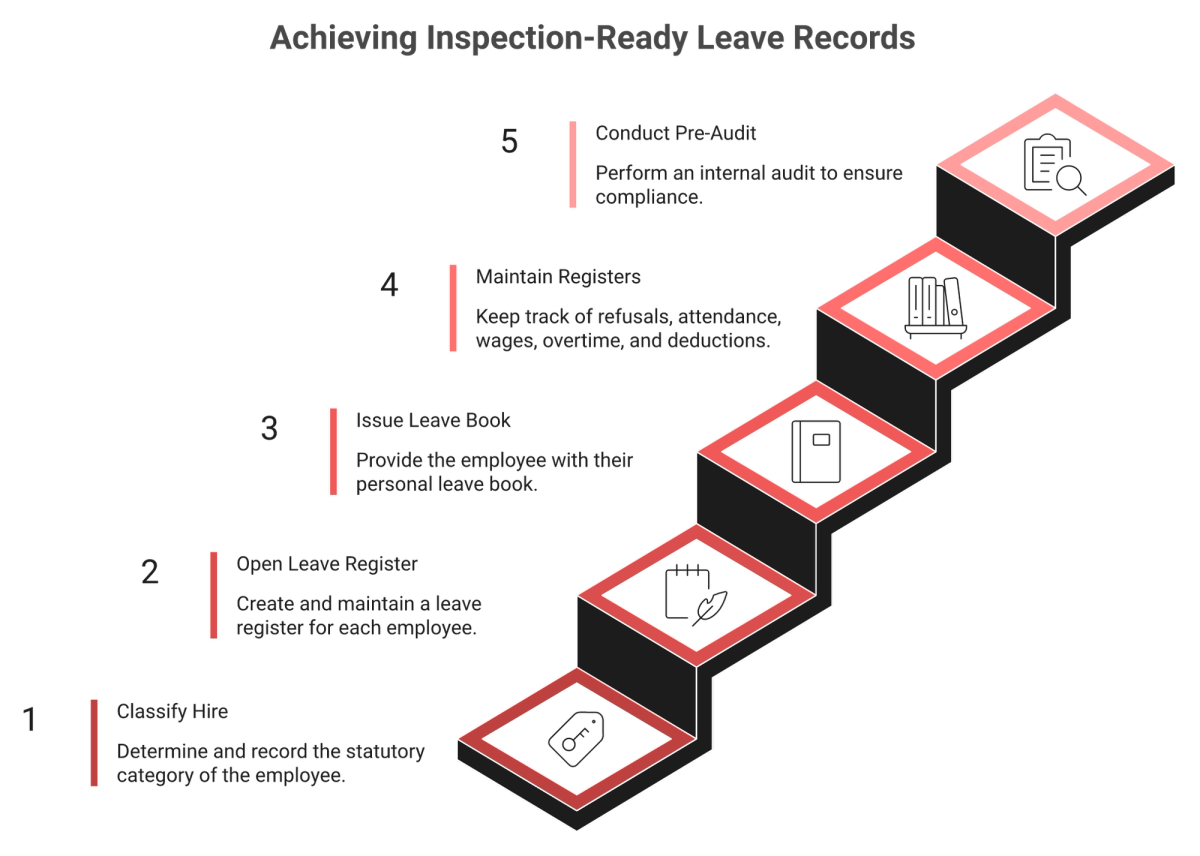
The Leave Book belongs to the employee. The employer cannot demand it back except to make entries, and only an employee earning above the prescribed wage may consent in writing to the employer holding it.
Versatile Club treats that consent as a documented step rather than an assumption. A dashboard-only vendor has no equivalent artifact to show, which is the gap buyers find when they audit the best EOR services in India.
✅ Use the inspector's own checklist
Rule 18 lists what the Inspector verifies, including registration, renewal, registers and notices, holidays granted, limits of work and spread over, and leave provisions observed.
That is a ready-made internal audit. Versatile Club runs it as a pre-inspection check before a client's diligence window, because reconstructing a year of entries is the expensive option.
What reviews tell you about vendor record quality
Buyers do not usually discover weak documentation during onboarding. They discover it during an audit or a visa filing.
"The USCIS denial letter explicitly stated that Deel forgot to attach critical evidence to the application."
— Verified User in Computer Software, Deel - G2 Verified Review, 13 December 2025
"We had to carefully manage our agreement and had to constantly remind them of the fees agreed so that we weren't over charged. Everything was VERY time consuming."
— Verified User in Information Technology and Services, Deel - G2 Verified Review, 13 December 2024
"You will spend more time auditing Rippling than doing your actual job."
— Erika D., Verified User, Rippling - G2 Verified Review, 22 May 2026
⚠️ Retention and language rules
Entries relating to any day must be made on that day. Registers and notices for a calendar year are preserved until the end of the next calendar year, and must be in English or the language of the majority of employees.
Same-day entry is the rule that fails first in a distributed team.
Versatile Club holds Form I, Form J, and Form K for every Madhya Pradesh employee it employs, so a diligence request becomes a file transfer. I would rather hand over a register than explain why one does not exist. If you are mid-migration, the guide to switching EOR provider in India covers what records to demand from the outgoing vendor.
Q8. What did Madhya Pradesh change in 2025-26 on night shifts, rest, and digital compliance?
Two state level changes matter for Madhya Pradesh employers. On 27 June 2025, the Labour Department issued notifications under s.3(2) of the MP Shops and Establishments Act, 1958 permitting women to work 9 pm to 7 am in shops and establishments, with a parallel Factories Act notification permitting 8 pm to 6 am. Both carry conditions, including written consent and minimum batch sizes. A December 2025 amendment moved registration and inspection processes onto the state portal.
The conditions attached to the permission
The permission is not unconditional. Reported conditions across both notifications include the following.
- Written consent from the woman employee before night work.
- A minimum of five women working together on the shift.
- CCTV coverage and women security personnel at the workplace.
- At least one third of supervisors on the shift being women.
- A 12 hour gap between the end of one shift and the start of the next.
- Compliance with the Sexual Harassment of Women at Workplace Act, 2013.
⏰ Why the 12 hour gap is a leave question
A 12 hour inter shift rest gap is a rostering constraint, not a safety footnote. It changes how many consecutive nights you can staff, and how leave requests ripple through a small team.
Versatile Club models the rest gap into the shift plan before a client commits to US overnight coverage from Indore or Bhopal. Founders usually read the permission and stop before the conditions.
⚠️ The consent record is the weak point
Section 25 of the Act historically fixed 7 am to 9 pm as the working window for young persons and women. The 2025 notifications supersede that window for women, subject to the stated safeguards.
Versatile Club keeps the consent form in the employee file rather than in an email thread. My read is that an inspector asks for consent first and CCTV second.
The digital compliance shift
Madhya Pradesh amended its Shops and Establishments framework in December 2025, with the Labour Commissioner notifying the change on 15 December 2025. The practical effect is procedural.
✅ What changes in your workflow
Registration, renewal, and inspection responses move to the state labour portal. The underlying duties under Rule 3 to Rule 5, including Form A statements and renewal every five calendar years, still come from the 1959 Rules.
Versatile Club files these through the state portal on its own registrations for client employees. Nothing about the amendment reduces the register duties in Rule 13, a point worth checking against any PEO services in India proposal you are reviewing.
📌 What to verify before you act
I would not build a night shift rota off a blog summary, including this one. Pull the gazette copy of the 27 June 2025 notifications and the December 2025 amendment from the Labour Commissioner's notification register before you change a roster.
Versatile Club tracks that register monthly as part of its filing calendar. The exact gazette URLs for these two notifications were not part of the source set supplied for this article, so treat these as named references to verify at source.
Versatile Club holds the Madhya Pradesh Shops and Establishments registration that these notifications attach to, and collects night shift consent at the point of onboarding. That is the difference between a policy statement and a compliance artifact. If you want that checked against your current setup, talk to our India compliance team.
Q9. What changes for Madhya Pradesh leave once the labour codes are notified?
The four labour codes took effect on 21 November 2025. Under the Occupational Safety, Health and Working Conditions Code, 2020, annual leave eligibility falls from 240 days to 180 days worked in a calendar year, accrual stays at one day per 20 days worked, carry forward is capped at 30 days, and leave above that cap is encashable. Madhya Pradesh has issued only draft rules so far, including the draft MP Code on Wages Rules, 2026. Until those are notified, the 1958 Act and its 1959 Rules still govern leave in the state.
What actually changes, and what does not
The codes replace the statutes, but state rules carry the operating detail. That gap is the whole story right now.
| Item | Today in Madhya Pradesh | After state rules are notified |
| Eligibility for annual leave | 12 months continuous employment (s.26) | 180 days worked in the year |
| Accrual | Block entitlement, or 1 in 20 for factories | 1 day per 20 days worked |
| Carry forward | Capped by the s.26 proviso | 30 days, excess encashable |
| Registers | Form I, Form J, Form K | New forms under state code rules |
⏰ Why the draft status matters
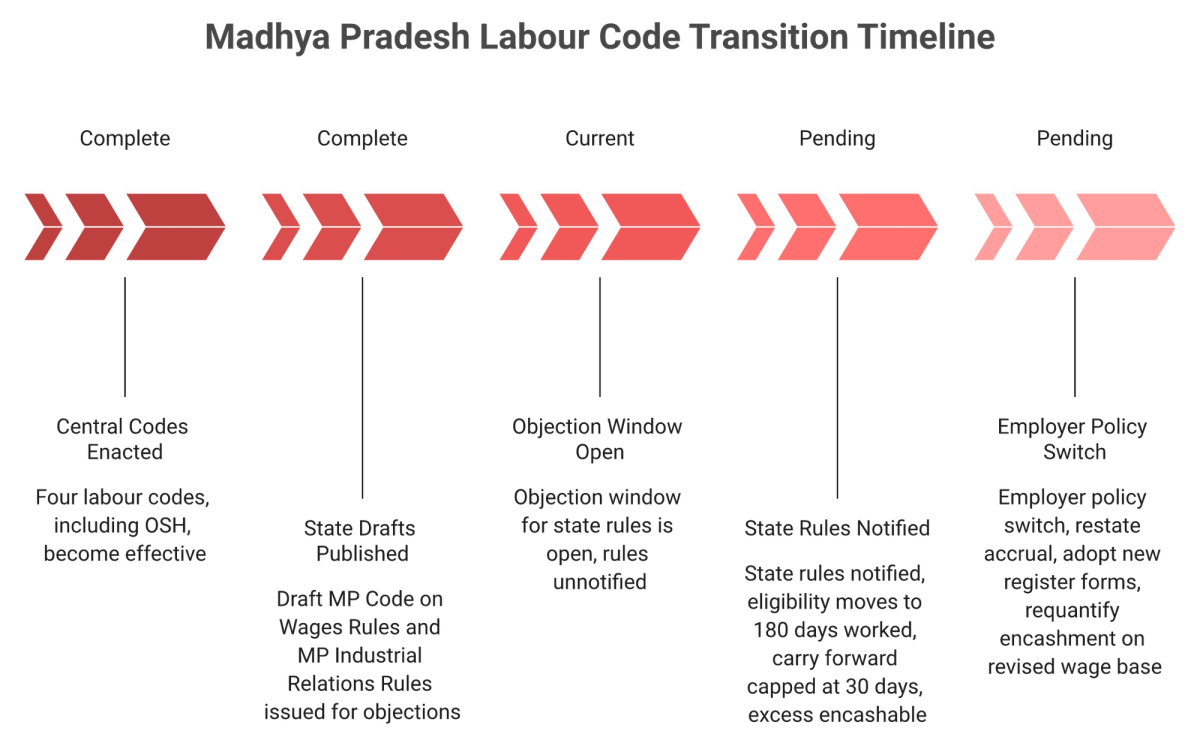
A draft rule is not law. The Madhya Pradesh Labour Department published its Code on Wages draft for objections, and the Industrial Relations draft carries a blank publication date in the gazette copy.
Versatile Club tracks that register monthly as part of its filing calendar. Switching policy before notification creates a mismatch your auditor will flag, which is why the change log sits alongside our India statutory compliance coverage.
💰 The wage definition is the real cost driver
The codes require Basic plus dearness allowance to reach at least 50% of total remuneration. Leave encashment, gratuity, and provident fund all sit on that base.
So the leave change is small. The wage change is not, and it moves the full employer of record India cost for every existing hire.
How to run the transition without rewriting twice
Versatile Club keeps two accrual models per client employee, one under the current Act and one under the code assumptions. That way the restatement is a switch, not a project.
✅ A four-step interim plan
- Keep the live policy on s.26 and the 1 April statutory year.
- Model the 180-day and 30-day carry forward scenario in parallel.
- Quantify the encashment delta if Basic rises to 50% of pay.
- Watch the MP notification register, not news coverage.
⚠️ Where vendors get this wrong
Compliance answers delivered with confidence and no source are the recurring complaint in this category.
"Their support team will give you wrong answers with total confidence. Their internal teams contradict each other in the same email thread."
— Erika D., Verified User, Rippling - G2 Verified Review, 22 May 2026
"The initial documentation and paperwork felt quite detailed and time-consuming at the beginning. However, as we progressed, it became clear that this thoroughness is what ensures proper legal and compliance coverage."
— Verified User in Marketing and Advertising, Wisemonk - G2 Verified Review, 12 February 2026
That second review is the honest trade-off. Thorough paperwork feels slow, then it saves you during a transition like this one. Buyers weighing that trade-off usually end up reading our Wisemonk alternative breakdown.
📌 My own hedge
Versatile Club's read is that most Madhya Pradesh employers will see no leave change in 2026, only a wage restructuring effect. I could be early on that call if the state notifies its rules faster than expected.
Versatile Club models both the current Act and the code scenario for every client employee in Madhya Pradesh, and switches only on notification. That is a slower answer than "the codes are live," and it is the one that holds up in diligence.
Q10. Does unlimited PTO work for an India team in Madhya Pradesh?
Unlimited paid time off does not remove a Madhya Pradesh employer's statutory duties. Rule 13 of the M.P. Shops and Establishment Rules, 1959 requires a leave register in Form I, a Leave Book in Form J, and a refusal register in Form K, whatever your policy language says. Section 26 entitlements continue to accrue underneath a discretionary policy. Versatile Club maintains those registers for client employees even where the client runs an unlimited policy on top.
The popular playbook, and its two flaws
Most US startups treat unlimited PTO as a modern perk. It reads well in a job post. It behaves differently in Indore.
❌ Flaw one, the cultural problem
Indian workplaces are more hierarchical than most US teams expect. Remove the allotment and you remove the permission.
I have watched engineers ask a US manager for approval on a dinner break, not a vacation. If nobody is told how many days they have, most people take fewer, not more.
❌ Flaw two, the statutory problem
The Act does not care what your handbook says. Accrual under s.26 keeps running, and the registers under Rule 13 are still mandatory.
So an "untracked" policy is still a tracked liability. Versatile Club records accrual behind the client's discretionary policy, because the register, not the policy, is what an inspector reads.
The threat is overwork, not slacking
Managers worry that remote people will do too little. With a distributed India team, the failure mode runs the other way.
⚠️ What silent overwork looks like
The signal does not arrive in a one-on-one. It arrives in a resignation email, or in a quiet drop in code review quality three months earlier.
Versatile Club pairs a new hire's first quarter with a 90-day Success Coach for exactly this window. My view is that the coach catches things a leave dashboard never will, and the same screening logic sits behind our culture fit assessment.
✅ The model that actually works
Keep the statutory allotment visible. Layer discretionary days above it. Then make leave-taking normal by doing it yourself.
Three habits do most of the work:
- State the allotment in the contract, with the section number.
- Ask open questions, such as "where are we on the schedule", instead of "are we on track".
- Have the manager book leave first, and say so publicly.
⭐ One boundary line for remote teams
Ask people to judge the day, not the hours. Did I do a good day's work? That question ends the day cleanly.
A use-it-or-lose-it rule sounds restrictive. In practice, it gives people a reason to actually take the break.
📌 Where I am unsure
Versatile Club's experience across Bengaluru, Hyderabad, and Pune placements points to allotted leave getting used more than unlimited leave. That is pattern recognition from placements, not a controlled study, so hold it loosely.
Versatile Club screens candidates on 50 behavioural parameters and assigns a 90-day Success Coach, because the leave a policy permits and the leave a new hire feels safe taking are different numbers. Written terms for the coach are confirmed per client before they enter a contract. Retention mechanics like this are built into our contract to hire model.
Q11. How do you run one leave policy across Madhya Pradesh and every other Indian state?
India has no single leave law for private employers. Each state's Shops and Establishments Act sets its own entitlement, so a pan-India policy needs a company baseline plus a state annexure. Section 61 of the Madhya Pradesh Shops and Establishments Act, 1958 preserves rights and privileges available under other law, so the more favourable term wins. Versatile Club holds Shops and Establishments, provident fund, and ESIC registrations across all 28 states and 8 union territories, and maintains a state annexure per employee.
The architecture in three layers
Build it once, then maintain the deltas. Averaging entitlements across states is the mistake that creates enforceable shortfalls.
- Company baseline. Set at or above the most generous state you hire in.
- State annexure. Entitlement, registers, and filing cadence per state.
- Central overlay. Maternity, provident fund, ESIC, and workplace safety duties.
🗂️ The deltas that actually differ
The leave numbers vary less than the filing rhythm. Versatile Club measures state complexity by cadence, not by entitlement.
| State | Notable operating delta |
| Madhya Pradesh | Statutory year from 1 April; Form I, J, K registers |
| Maharashtra | Dual professional tax registrations, PTRC and PTEC |
| Karnataka | Monthly professional tax cycle, S&E renewal |
| Tamil Nadu | Biannual professional tax filing, labour welfare fund |
| Delhi | No professional tax, stricter S&E enforcement |
⚠️ Why "one India policy" fails audits
A single flat number looks tidy in a handbook. It fails the moment an employee in a more generous state enforces the local Act.
Versatile Club drafts the annexure as a contract attachment, not an internal note. That is the version an inspector or acquirer asks for, and it is the same document we hand over during multi-city payroll transitions.
What buyers say about coverage depth
Global platforms optimise for breadth. India buyers feel the gap in the second-tier cities and in local detail.
"Deel treats all users as if they were individual freelancers, even when you're clearly operating as a registered company. There is no flexibility, no option for company-level onboarding."
— Verified User in Translation and Localization, Deel - G2 Verified Review, 5 May 2025
"The current Health Care insurance is heavily centralized in São Paulo, which represents significant challenges for employees located elsewhere."
— Ana A., Verified User, Pebl (formerly Velocity Global) - G2 Verified Review, 2026
"Sometimes the email communication from the wisemonk team is delayed by a day or 2. But overall they seem to be the best for India."
— Bulbul G., Verified User, Wisemonk - G2 Verified Review, 19 February 2025
The São Paulo comment is the pattern in a different country. Coverage concentrated in one metro leaves your Indore and Bhopal hires on a thinner service tier, which is the recurring theme in Velocity Global alternatives in India.
✅ A quarterly governance cadence
Name one owner for the annexure. Review it every quarter. Trigger an update on any state notification, amendment, or code rule.
Then log what changed, with the date and the source.
Versatile Club runs statutory leave, provident fund, ESIC, tax deduction, and professional tax across all 28 states and 8 union territories on its own registrations. The annexure is maintained by the entity that files the returns, which is the only version I trust.
Q12. Why do global EOR platforms miss Madhya Pradesh leave compliance?
Madhya Pradesh compliance is executed monthly, not documented once. Most global employer of record platforms cover 90 to 185 countries, and India is often served through a local partner entity, so the Form I leave register and the state filings sit with a subcontractor the client never signed with. Versatile Club employs each India hire on its own registered Indian entity, with registrations across all 28 states and 8 union territories, and holds the statutory registers itself.
The honest comparison
Versatile Club appears first here because this is an India-only comparison. The drawbacks are listed alongside the facts.
| Provider | India entity | India EOR price | Onboarding | Support model |
| Versatile Club | Own registered Indian entity | $149 per employee per month, flat, $0 setup, $0 exit | 5 business days, contractual SLA | Founder on WhatsApp |
| Wisemonk | Own India entity | $99 to $399, salary slabs | 24 to 72 hours, marketing claim | Named HR manager |
| Deel | Local partner model reported for India | About $599 plus setup | 7 to 14 days | Chatbot and ticket first |
| Remote | Owned entity | About $599 | 10 to 14 days | Ticket queue |
| Multiplier | Hybrid | About $400 | About 7 days | Email CSM |
✅ Where Versatile Club is genuinely different
✅ Own Indian entity, so the registers and filings sit under our registrations. ✅ Flat pricing with no setup or exit fee, and the first month free. ❌ India only, which is wrong for a buyer needing five or more countries. ✅ Five-day onboarding written into the contract. ❌ No SOC 2 Type II or ISO 27001 yet, so procurement-gated enterprise buyers should choose a certified vendor.
That last line loses deals. Versatile Club publishes it anyway, because a buyer discovering it in security review is worse. The same trade-offs are laid out on our EOR services page.
What the record custody problem looks like
When India runs through a partner shell, your documentation runs through it too.
❌ Evidence from buyer reviews
"It took three months to onboard our first 3 individuals. They didn't seem to be able to navigate Visas or variations to employment contracts and this constantly created issues so we had to make a decision to change providers."
— Verified User in Information Technology and Services, Deel - G2 Verified Review, 13 December 2024
"At times when wisemonk team doesn't have information about what I asked, reaching out to the respective company and then getting the information, was a bit time consuming."
— Verified User in Financial Services, Wisemonk - G2 Verified Review, 16 June 2025
Both quotes describe the same structural issue. Every handoff adds a day, and compliance deadlines do not move. That handoff count is the first thing to check in any Deel alternative evaluation.
⚠️ The India-depth question nobody asks in a demo
Versatile Club gets asked about price far more often than about register custody. My read is that the category has trained buyers to compare the wrong column.
Five diligence questions for any India vendor
Ask these before you sign, and ask for the artifact, not the answer.
- Which legal entity employs my Madhya Pradesh hire, and show me its registration.
- Who holds the Form I leave register and the Form J Leave Book?
- What is your statutory leave year for Madhya Pradesh, and why?
- Is the onboarding timeline in the contract or in the marketing?
- Show me a sample invoice with the statutory lines itemised.
⭐ What I think changes next
India stops being one country on a global map and becomes its own vendor category. Owned-entity specialists take the India line item from the generalists.
Versatile Club employs Madhya Pradesh hires on its own Indian entity, bills one flat USD invoice with no setup or exit fee, and commits to five business days in writing. C2H placements carry a six-month replacement guarantee, with terms confirmed per client before publication. If you want the numbers run against your own India plan, compare EOR against setting up an entity first.
FAQs
How many leave days does the Madhya Pradesh Shops and Establishments Act actually mandate?
Section 26 of the Madhya Pradesh Shops and Establishments Act, 1958 grants privilege leave after every 12 months of continuous employment, plus casual leave during each year of employment. Published compliance tables converge on one month of privilege leave and 14 days of casual leave.
- Privilege leave: one month, commonly read as 30 days, vesting only after 12 months of service.
- Casual leave: 14 days a year, not carried forward, and it cannot be combined with privilege leave.
- Sick leave: no statutory provision in the Act.
- Statutory year: starts 1 April under s.2(29), not January.
Two large HR platforms publish conflicting figures for the same state, one showing 15 earned, 7 casual, and 7 sick days. The bare Act is the tiebreaker, so read the section before configuring payroll. Versatile Club configures Madhya Pradesh leave from the section 26 text and the 1 April statutory year, and itemises the accrual on the client's monthly invoice. If you are setting this up for a first India hire, our India EOR service handles the entitlement, the registers, and the filings on one entity.
Is sick leave mandatory for employees in Madhya Pradesh?
No. Chapter VII of the Madhya Pradesh Shops and Establishments Act, 1958 provides only privilege leave and casual leave. There is no separate statutory sick-leave entitlement for employees in Indore, Bhopal, or anywhere else in the state.
That leaves three practical positions for an employer:
- Contractual sick leave. Anything you offer is company policy, so label it that way in the employment contract.
- ESIC sickness benefit. This applies separately, and only to employees within the wage ceiling covered by the scheme.
- Market expectation. White-collar engineering hires typically expect seven to twelve sick days, which is practice rather than law.
The risk is presentation, not generosity. A benefit that looks statutory in an offer letter and later changes reads to the employee as a withdrawal. Versatile Club issues Madhya Pradesh contracts with statutory and discretionary leave lines marked separately, so nobody has to guess which is which. Teams building their first policy from scratch usually start with our guide to hiring in India without an entity, then layer the state annexure on top.
How is leave encashment calculated for a Madhya Pradesh employee?
Leave is paid on wages, not on notional CTC. Chapter VII of the MP Shops and Establishments Act, 1958 sets pay during leave (s.27) and the timing of payment (s.28), while section 30 applies the Payment of Wages Act, 1936 to those payments. For factory workers, s.80(1) of the Factories Act, 1948 fixes the rate at the daily average of total full-time earnings.
- Included: full-time earnings for days actually worked in the preceding month, plus dearness allowance.
- Excluded: overtime wages and bonus.
- Fallback: if no day was worked in the preceding month, the last worked month is used.
The bigger variable is the wage split. The 2025-26 labour codes require Basic plus dearness allowance to reach at least 50% of total remuneration, and encashment tracks that base. Raise Basic for provident fund compliance, and every future exit payout rises with it. Versatile Club recomputes accrual quarterly and restates it when a salary structure changes mid-year. You can model the effect on your own numbers with our India salary calculator before you sign off the restructuring.
Which leave records must a Madhya Pradesh employer maintain for an inspection?
Rule 13 of the M.P. Shops and Establishment Rules, 1959 requires three documents per employee, and Rule 20 adds a fourth. An HRIS dashboard does not satisfy any of them.
- Form I: leave register, one page per employee.
- Form J: Leave Book, which is the employee's property and cannot be demanded back except to make entries.
- Form K: register of refused leave under s.26(3).
- Form N: attendance, wages, overtime, fines, and deductions.
Two rules catch distributed teams first. Entries for any day must be made on that day, and records for a calendar year are preserved until the end of the next year, in English or the majority employees' language. Rule 18 lists exactly what the Inspector verifies, which makes it a free internal audit checklist. Versatile Club holds Form I, Form J, and Form K for every Madhya Pradesh employee it employs, so a diligence request becomes a file transfer. Our India compliance coverage page sets out which registrations sit behind those registers.
How do you run one leave policy across Madhya Pradesh and other Indian states?
India has no single leave law for private employers, so a pan-India policy needs a company baseline plus a state annexure. Section 61 of the MP Shops and Establishments Act, 1958 preserves rights available under other law, which means the more favourable term always wins. Averaging entitlements across states creates enforceable shortfalls.
Build it in three layers:
- Company baseline set at or above the most generous state you hire in.
- State annexure covering entitlement, registers, and filing cadence per state.
- Central overlay for maternity benefit, provident fund, ESIC, and workplace safety duties.
The deltas that bite are cadence, not headline numbers: Madhya Pradesh runs an April statutory year, Maharashtra needs dual PTRC and PTEC registrations, Karnataka runs a monthly professional tax cycle, and Tamil Nadu files biannually. Versatile Club runs statutory leave, provident fund, ESIC, tax deduction, and professional tax across all 28 states and 8 union territories on its own registrations, and drafts the annexure as a contract attachment rather than an internal note. If you are consolidating vendors, our EOR switching guide covers which records to demand from the outgoing provider.