Table of contents (11)
Skuad India Pricing: EOR Fee, Entity Model, Contractor Rates
Q1. What does Skuad charge for India EOR in 2026, and why do you see $199, $249, and $299?
Skuad, now Payoneer Workforce Management, publishes India EOR from $199 per employee per month, Agent of Record at $99 per contractor per month, and a Contractor Management System at $19 per contractor per month. The $199 rate assumes a 12-month commitment. Month-to-month billing is reported at $299, and Skuad's India page has shown $249. Gross salary, statutory costs, and a refundable deposit sit on top.
In August 2026, a Series A People Ops lead sent Versatile Club's founder WhatsApp line a screenshot of Skuad's pricing card. Her question was blunt. Is $199 the number I put in the model?
I pulled the page the same day and screenshotted all three plan cards. Every price carries the qualifier "Starting from", which is doing more work than most buyers notice.
💰 The three published rates, exactly as they appear
The page shows one rate per product, with no India-specific slab and no billing toggle.
| Plan | Published rate | Unit |
| Employer of Record | From $199 | per employee/month |
| Agent of Record | From $99 | per contractor/month |
| Contractor Management System | From $19 | per contractor/month |
Nothing on that page states which entity employs your India hire. Nothing states the commitment term either. If you are comparing published rates across the category, our Skuad alternatives for India breakdown lists them side by side.
⚠️ Why four different numbers circulate
The spread is a billing-term artefact, not a contradiction. Independent teardowns report $199 on an annual commitment and $299 month to month, a 50% uplift a buyer cannot see on the page. Skuad's India page has separately shown $249 for monthly billing. Review sites list tiers up to $599 for complex geographies.
Then there is the footnote that is not there. The EOR card reads "Unlock bigger discounts", and the matching footnote text never appears anywhere on the page. Volume tiers are unpublished, and are generally negotiated from around ten employees.
⭐ What buyers say about the quoted rate holding
Balanced evidence matters here, so both sides are below.
"Straightforward multi-country onboarding, competitive pricing, dedicated account manager."
— Elena D., Mid-Market Payoneer Workforce Management (formerly Skuad) - G2 review reproduced on the vendor pricing page
"We agreed to pay 200 USD per person, but they wanted us to pay 400 USD. They delayed last invoices and almost made us pay more because of a wrong exchange rate. 9 Months later, thay said they couldn't continue working with us, because the price of 200 USD was too low."
— Verified User in Information Technology and Services, Payoneer Workforce Management (Formerly Skuad) - G2 Verified Review
That second review is the sharpest reason to get the rate, the term, and the renewal condition in writing before you model anything.
✅ The dated comparison, including our own number
Versatile Club publishes $149 per employee per month for India, with $0 setup, $0 exit, and the first month free. All figures below are as of 24 August 2026.
| Item | Skuad (Payoneer WFM) | Wisemonk | Versatile Club |
| Published India EOR rate | From $199 | $99 to $399 | $149 |
| Monthly-billing rate | $299 reported | Not published | $149 |
| Setup fee | $0 reported | Not published | $0 |
| Onboarding commitment | Not day-committed | 1 to 2 weeks | 5 days, contractual |
Ask three things in writing before budgeting: the India rate on monthly versus annual billing, the discount threshold, and the renewal escalation clause. A rate without a term and a deposit line is a headline, not a price.
Versatile Club publishes one India rate, $149 per employee per month, with no annual-commitment condition attached to the number and no setup or exit fee.
Q2. What sits outside the seat fee, from deposits and pre-funding to FX and unpriced add-ons?
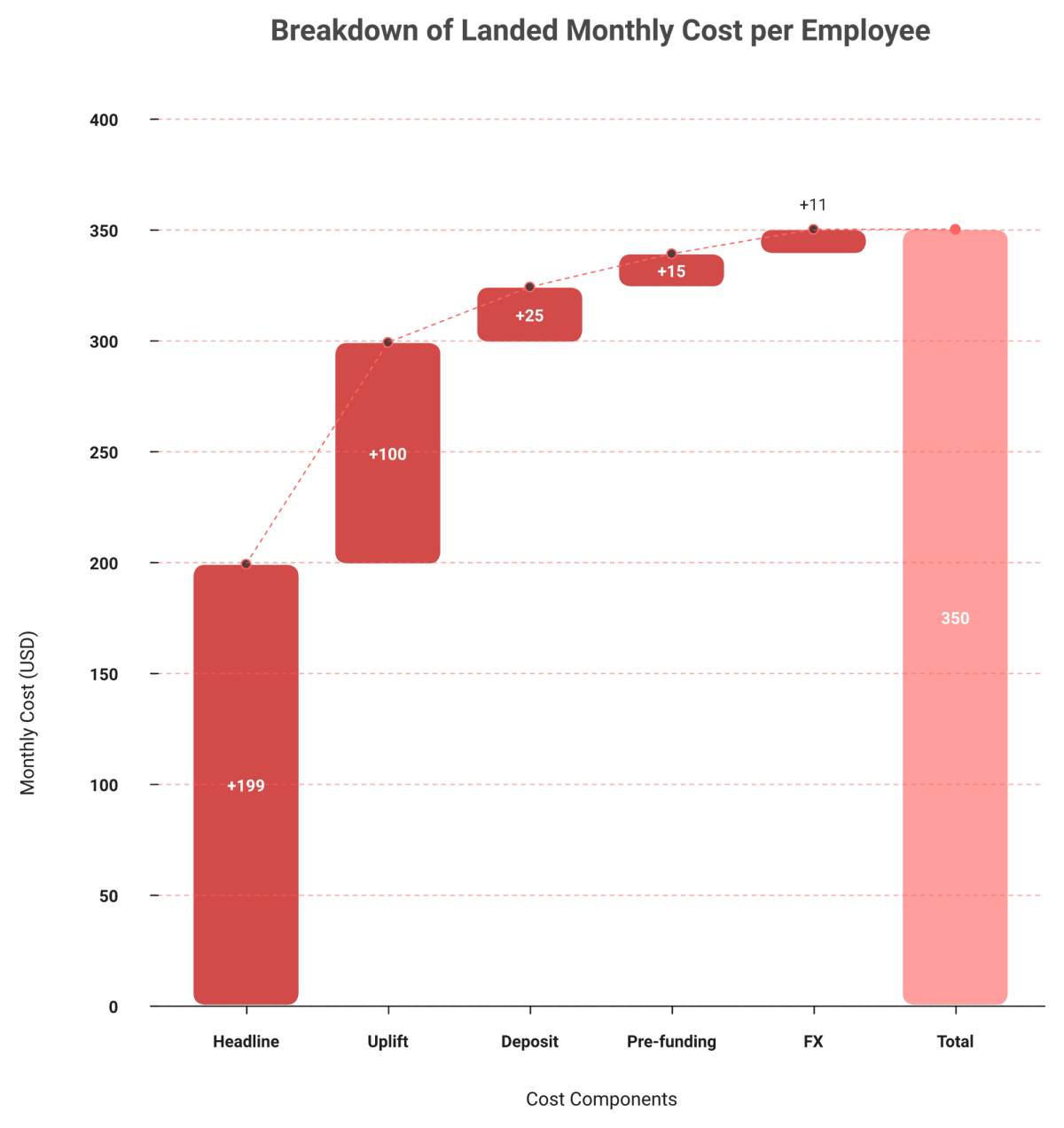
Four costs sit outside any published EOR seat fee: a refundable security deposit of roughly one month of gross salary, payroll pre-funding that ties up working capital, an FX markup reported at 1.5% to 3% on payment rails, and add-on services with no published prices. Versatile Club removes three of the four by billing one USD invoice from its own Indian entity, with no deposit and no FX spread.
💸 The deposit is the line nobody models
A security deposit exists because the EOR carries severance and final-pay exposure for an employee it legally employs. Reported practice for Skuad is roughly one month of gross salary per head, refundable, and it is not mentioned on the pricing page.
For five engineers at ₹30 lakh CTC each, that is real cash parked with a vendor. Versatile Club holds no security deposit, which is why our clients' first invoice equals their first month of cost.
⏰ Pre-funding is a cash-flow event, not a fee
Pre-funding means you wire payroll before it runs. It never appears in a per-employee comparison, yet it moves your month-end close by days.
Ask Versatile Club to show the invoice-to-payout sequence for a live client month, because the timing question decides whether your controller signs off. That sequence is one monthly USD invoice with gross, deductions, and net per employee, plus PF and ESI challan confirmations.
⚠️ FX is where undisclosed margin lives
Skuad's FX policy is not published, and payments route through Payoneer's rails. One 2026 teardown models a $50,000 India transfer landing near $54,007, close to 8% total leakage once spread and fees stack.
Reviews describe the same pattern in practice, from both sides of the invoice.
"They delayed last invoices and almost made us pay more because of a wrong exchange rate."
— Verified User in Information Technology and Services, Payoneer Workforce Management (Formerly Skuad) - G2 Verified Review
"I find Deel to be absurdly expensive. They charge a high amount of fees for transferring money to my bank account."
— Juan Camilo O., Deel Hire - G2 Verified Review
Versatile Club invoices in USD directly from its Indian entity, so no conversion step exists to price. The same structure applies when you pay employees in India through a single monthly cycle.
❌ Six add-on services with no published price
The page's "Beyond the basics" block lists talent discovery, background checks, work permits, visa processing, office space, and device facilitation. Its verbatim disclaimer reads: "Service availibility and pricing may vary based on location, role and local requirements."
The typo is in the source. The pricing gap matters more, because equipment and background checks are standard for a first India engineer.
✅ The same salary, costed both ways
Here is one hire, ₹30 lakh CTC in Bengaluru, platform-side costs only. Statutory heads are covered in the next section.
| Platform-side line | Skuad (Payoneer WFM) | Versatile Club |
| Seat fee, monthly billing | $299 reported | $149 |
| Security deposit | About 1 month gross, reported | None |
| FX spread on payroll | Not disclosed | None, USD invoiced from India |
| Setup and exit | $0 reported | $0, first month free |
| Add-on services | Six items, unpriced | Quoted before signature |
Versatile Club's read is that the standard advice gets this backwards. The seat fee is the smallest variable, and it is the only one buyers negotiate hard, though I might be leaning on that too strongly for teams under three hires.
Versatile Club bills one USD invoice from its own Indian entity, with no FX spread, no security deposit, and no setup or exit fee, which is the whole basis of our India EOR service.
Q3. What does the India statutory layer add on top of any EOR fee?
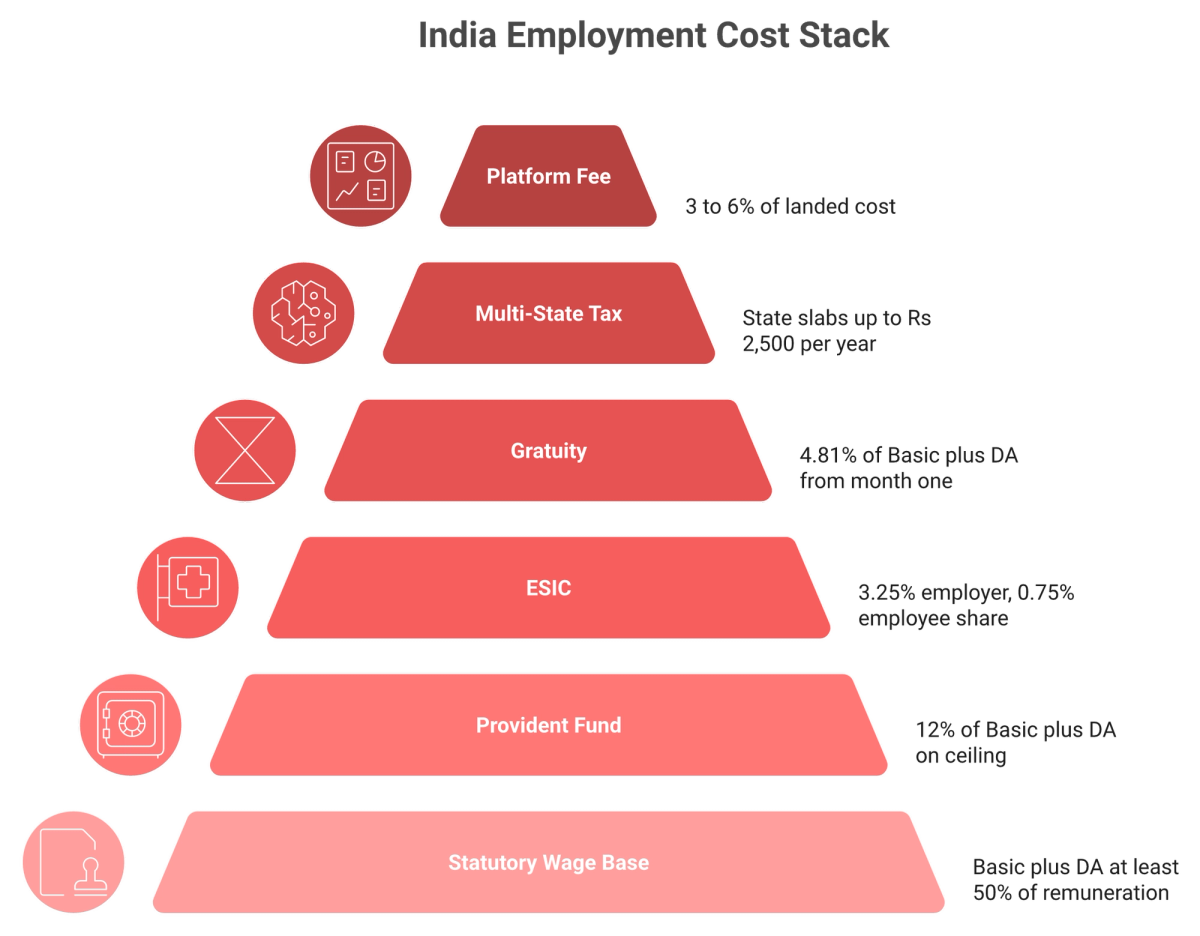
On top of any seat fee sit employer PF computed on the ₹15,000 wage ceiling fixed by gazette S.O. 2702(E), ESIC where applicable, gratuity accruing at 4.81% of Basic plus DA from month one, state professional tax, and Form 16 issuance. Versatile Club files all of these under its own PF, ESIC, and professional tax registrations across all 28 states, so a client can audit the challans.
💰 The employer-side heads, and what each is calculated on
Every India EOR bills these through. The bases differ, which is where quotes diverge.
| Head | Rate | Base |
| Provident Fund | 12% | Basic plus DA, ceiling ₹15,000 |
| ESI | 3.25% employer, 0.75% employee | Gross, below threshold |
| Gratuity accrual | 4.81% | Basic plus DA, from month one |
| Professional tax | State slabs, up to ₹2,500 a year | State rules |
| TDS | Per income tax slab | Monthly salary |
Versatile Club measures compliance by challan, not by assertion, so each month's PF and ESI receipts and TDS deposit proofs go to the client. Our full statutory compliance scope lists every filing by head.
⚠️ Professional tax is where global playbooks thin out
India has 28 states and 8 union territories, each with its own professional tax and Shops and Establishments rules.
Maharashtra needs dual registration (PTRC plus PTEC) with monthly slab filing. Karnataka runs monthly PT with enrolment inside 30 days of joining. Tamil Nadu files biannually in June and December, plus labour welfare fund. West Bengal changes rules often, and Delhi has no PT but strict S and E compliance. The state-by-state detail sits in our guide to payroll compliance in India.
⏰ Two deadlines that decide whether your quote is honest
TDS is deducted and deposited by the 7th of each month. Form 16 goes to each employee by 30 May.
What surfaces in Versatile Club's client engagements is that late challans, not wrong rates, cause the audit scramble. A vendor that cannot show last month's receipts on request is a vendor you cannot accrue against.
✅ How to read a bundled quote versus an itemised one
A bundled India quote hides which head absorbed a rate change. An itemised one lets your controller book the liability correctly.
Three questions settle it. Which wage ceiling is PF computed on, is gratuity accrued monthly or funded at exit, and which states are registered today rather than "supported".
I could be off on how much this matters below three hires. Versatile Club's data points to it mattering from the first hire, because gratuity accrual and PT enrolment start immediately, not at scale.
❌ The mistake I see most often
Founders compare $149 against $199 and treat statutory cost as identical across vendors. It is not identical, because CTC structuring changes the PF and gratuity base. If you want the full landed number, our breakdown of employer of record cost in India models it head by head.
That structuring decision is covered next, since a 2025 notification now governs it.
Versatile Club files PF, ESI, TDS, and professional tax under its own registrations across all 28 states and 8 union territories, and issues Form 16 directly to each employee.
Q4. Which 2025 to 2026 notifications change what you pay and what your EOR contract must say?
Four dated instruments matter. The Labour Codes' revised wages definition took effect 21 November 2025, requiring Basic plus DA of at least 50% of remuneration and lifting gratuity. Gazette S.O. 2702(E) fixed the EPF ceiling at ₹15,000. The EPF Scheme 2026 made contributions above ₹1,800 voluntary. Versatile Club restructures every India offer to clear the 50% wage test before payroll goes live.
⚠️ The wage definition, and the CTC restructuring it forces
MoLE's Labour Code FAQs confirm the revised wages definition applies from 21 November 2025. Allowances above 50% of total remuneration are added back to wages, and gratuity is computed on that revised base.
Legacy India contracts were often built with a low Basic to suppress PF cost. Those structures are now non-compliant, and the liability lands on the client, not the platform.
💰 Two EPF changes to test any quote against
Gazette S.O. 2702(E), dated 29 May 2026, fixed the EPF wage ceiling at ₹15,000 under the Code on Social Security, 2020. No hike to ₹21,000 has been notified.
The EPF Scheme, 2026, notified 29 June 2026, made contributions above ₹1,800 a month voluntary. Ask your provider to show, in the payroll annexure, whether PF is capped or voluntarily topped up. Reject any cost model that assumes ₹21,000.
⏰ DPDP moves employee data into your contract
MeitY notified the DPDP Rules, 2025 under G.S.R. 846(E) on 13 November 2025, with a phased timeline. Consent-manager provisions bite from 14 November 2026, and substantive obligations from mid-May 2027.
Your EOR holds payroll, PAN, bank, and health data. Ask Versatile Club, or any provider, for a data-processing addendum with a 72-hour breach notification clause, and get it signed now rather than in 2027.
❌ The invoice detail your CFO will care about
E-invoicing is mandatory above ₹5 crore aggregate annual turnover under CBIC Notification 10/2023 Central Tax, and businesses crossing that in FY 2025 to 2026 became liable from 1 April 2026.
An India vendor invoice without a valid IRN and QR code is not valid for GST input credit. Versatile Club issues IRN-valid USD invoices from its Indian entity, which is the difference between a booked credit and a denied one.
✅ What to do this week
Five actions, in order of exposure.
Re-run every India offer letter against the 50% wage test, then reprice gratuity accrual.
Confirm PF is computed on the ₹15,000 ceiling, in writing.
Ask whether employee PF is capped at ₹1,800 or topped up voluntarily.
Add a DPDP addendum with 72-hour breach notice to the EOR contract.
Check last month's vendor invoice for a valid IRN.
Compliance is the floor, not the ceiling. Versatile Club's read is that most India EOR quotes still price the pre-2025 statutory world, and buyers discover the gap at diligence. Teams weighing a subsidiary instead should run the EOR versus entity calculator before committing capital.
Versatile Club restructures every India offer so Basic plus DA clears the 50% wage test, and issues IRN-valid USD invoices from its own Indian entity. If you want those clauses reviewed against your current contract, send them across and I will mark up what is missing.
Q5. Does Skuad own its India entity, or are you leasing a partner shell?
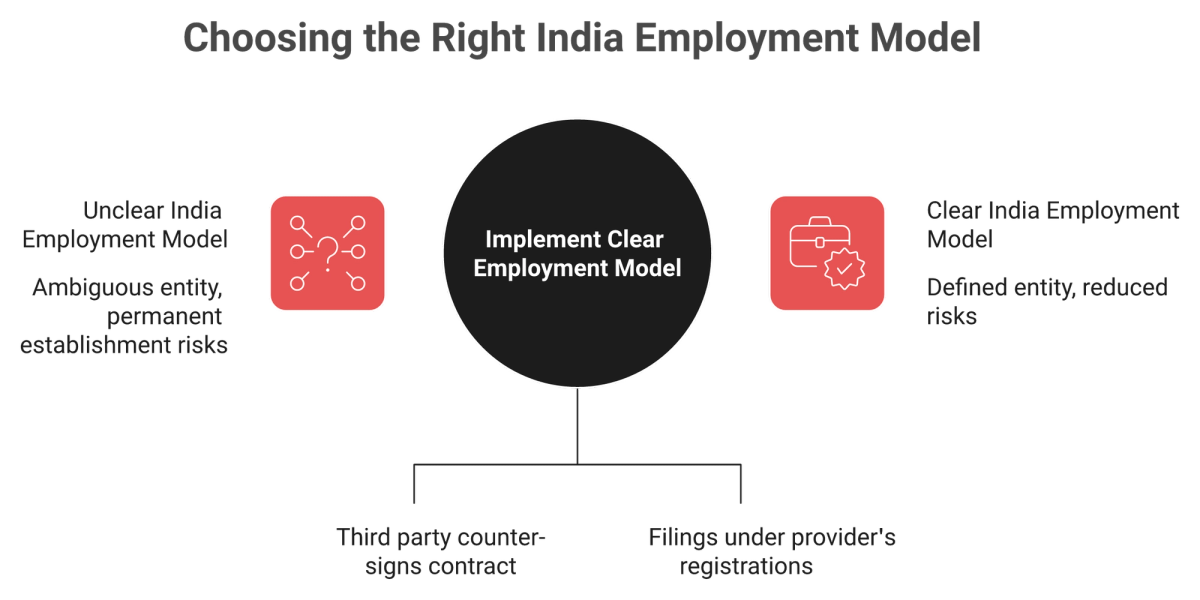
Skuad's own FAQ states it uses "own and partner entities in 160+ countries" without naming which markets are owned, so India buyers cannot confirm the employing entity from public information. Partner routing adds a third party to contract execution, statutory filings, and audit trails. Versatile Club employs every India hire on its own registered Indian entity, with PF, ESIC, and Shops and Establishments licences held directly.
⚠️ The sentence that answers the question, and what it leaves out
Read that FAQ line again. It confirms coverage, and it confirms legal-employer status. It does not confirm which of the 160-plus countries sit on owned registrations.
India is the country you care about, and India is not named. That silence is the finding, not an oversight I can interpret for you.
❌ Seventy-two country pages against a 160-plus claim
The footer of Skuad's site enumerates 72 named "Employ in country" landing pages, while the stats band claims 160-plus countries covered. The arithmetic suggests the remaining markets run through partners without dedicated pages.
That is inference, not proof, and I will label it as inference. The direct question still gets a direct answer only in writing from their team. Our Skuad alternative page sets out the same question against an owned-entity model.
⏰ What actually breaks with a partner in the middle
Three operational things change when a third entity employs your engineer.
Who counter-signs. A partner entity signs the employment contract, which adds a review loop to your start date.
Whose PF code appears. The employee's Universal Account Number links to the partner's establishment code, not the platform's brand.
Who holds the records. Challans, Form 16, and full and final settlements live with whoever filed them.
Versatile Club measures this by challan ownership. Each month the client receives PF and ESI challan confirmations issued under our own registrations, so there is nothing to chase from a third party.
One more detail worth flagging. Skuad's FAQ says you may execute the IP agreement directly with the employee, which means IP assignment is your paperwork, not theirs.
💰 Why the CFO and in-house counsel care
Permanent establishment (PE) risk means a tax authority treats your foreign company as having a taxable presence in India. Clean EOR structures reduce that risk. Opaque ones make it harder to argue.
What surfaces in Versatile Club's client engagements is that diligence questions arrive at the worst time, usually mid-fundraise. Buyers who cannot name their India employing entity spend two weeks reconstructing it. Teams weighing the structural options should read our comparison of EOR versus entity in India.
I could be reading the pattern too strongly from a small base, so treat it as a caution rather than a rule.
✅ The three-document test you can run today
This takes under a day, and settles the question without a sales call.
Ask for the entity name and CIN. Then look it up on the MCA portal yourself.
Ask for the PF establishment code. Verify it on the EPFO establishment search.
Ask to see a sample offer letter. Whichever company name appears on it is your real employer.
Ask Versatile Club for the same three items, and the answer is one entity, Foo Falcon Technologies Pvt Ltd, with registrations across all 28 states and 8 union territories.
Any provider that hesitates on document two has answered the question. Deel, Remote, G-P, and Omnipresent typically route India through local partner entities, which is a structural fact rather than a failing.
Versatile Club employs every India hire on its own Indian entity, with no partner shell between the client and the employment contract, and every statutory filing made under its own India compliance registrations.
Q6. Is AOR at $99 or CMS at $19 the right contractor tier for Indian contractors?
Skuad's $19 Contractor Management System is payment execution only, covering invoices, expenses, and payment history. The $99 Agent of Record adds contract support, misclassification-risk support, and a dedicated account manager. Versatile Club converts contractors to full-time employees on the same owned Indian entity, so the PF code and the invoice never change hands.
💰 Exactly what the extra $80 buys
The two plan cards differ by three features, and all three are liability features rather than software features.
| Feature | CMS at $19 | AOR at $99 |
| Contractor payments in 70-plus currencies | Yes | Yes |
| Invoice creation and tracking | Yes | Yes |
| Support with contracts | No | Yes |
| Support mitigating misclassification risks | No | Yes |
| Dedicated account manager | No | Yes |
Read that table as a risk-transfer question, not a feature comparison. The $19 tier leaves classification liability sitting with you. Our guide to the agent of record model in India explains where each tier stops.
⚠️ Why misclassification is the real India question
India has no US-style co-employment PEO structure. A contractor is either genuinely independent, or is, in substance, an employee.
Indian authorities look at control, not at paperwork. Fixed hours, your tools, your reporting line, and exclusivity all point one way.
❌ What retrospective exposure looks like
If a contractor is reclassified, the arrears are not theoretical.
Employer PF at 12% of Basic plus DA, backdated for the engagement period.
ESI at 3.25% employer share where the wage threshold applied.
Gratuity accrual at 4.81% of Basic plus DA once five years of continuous service is established.
A contractor agreement is evidence, not a defence. Versatile Club's read is that the category gets this backwards by selling contractor tooling as a compliance product when it is a payments product. The trade-offs are laid out in our piece on independent contractor versus EOR.
⏰ The switch rule I use with founders
Six years of India placements gave me one reliable signal. Strong engineers rarely stay contractors for long.
Ask three questions before choosing a tier.
Do you set their working hours? If yes, treat the engagement as employment.
Will they stay past six months? If yes, price the EOR seat now.
Do they hold IP that matters? If yes, you need an employment contract, not an invoice trail.
Versatile Club runs the conversion inside the 5-day onboarding SLA written into the service agreement, so the contractor becomes an employee without a new entity in the middle. The step-by-step sequence sits in our guide to converting a contractor to an employee in India.
✅ Where each tier honestly fits
Skuad's $19 CMS is genuinely well priced for what it does. Paying independent agencies or one-off design contractors in 70-plus currencies is a real job, and $19 per contractor per month is cheap for it.
The $99 AOR is the applicable tier the moment your Indian contractor looks like a team member. Anything past that belongs on an EOR seat, whoever provides it.
Versatile Club converts contractors to employees on the same owned Indian entity, so the employment contract, the PF establishment code, and the monthly USD invoice all stay with one accountable party.
Q7. What is the real annual cost of hiring five India engineers through Skuad?
At $199 per employee per month on annual commitment, five India seats cost $11,940 a year in platform fees. On month-to-month billing at $299, the same five seats cost $17,940. Versatile Club prices five seats at $8,940 a year, dropping to about $8,195 with the first month free per hire. Deposits, statutory costs, and FX sit on top.
💰 Stated assumptions, so you can argue with the model
Assumptions matter more than totals, so here are mine.
Five mid-to-senior engineers in Bengaluru, ₹30 lakh CTC each (about $36,000).
Platform fees only in the first table, statutory costs shown separately.
Rates as published on 24 August 2026.
Versatile Club measures cost this way in client conversations, because a bundled monthly number hides which layer moved when a rate changes. If you want the underlying salary benchmarks, run our India salary calculator first.
⏰ The two billing-term scenarios, side by side
Per-seat annual platform fee is the honest unit. One seat at $199 is $2,388 a year, and one seat at $299 is $3,588.
| Line | Skuad at $199 annual | Skuad at $299 monthly | Versatile Club at $149 |
| Per seat, per year | $2,388 | $3,588 | $1,788 |
| Five seats, per year | $11,940 | $17,940 | $8,940 |
| First month free | Not offered | Not offered | Yes, about $745 saved |
| Setup and exit | $0 reported | $0 reported | $0 |
One widely cited India EOR listicle projects $23,880 a year against Skuad's $199 rate, which works out to a ten-seat team rather than one employee. Check the seat count before reusing that figure.
💸 The layer that changes the answer
Platform fees are the smallest line. The deposit and statutory stack move real money.
Security deposit of roughly one month of gross salary per head, so about $14,500 parked for five engineers.
Employer PF at 12% on the ₹15,000 ceiling fixed by gazette S.O. 2702(E).
Gratuity accrual at 4.81% of Basic plus DA from month one.
State professional tax, which differs across Maharashtra, Karnataka, and Tamil Nadu.
FX spread of 1.5% to 3% on payroll rails, not published by Skuad.
Ask Versatile Club to show one live client month end to end, since USD invoicing from an Indian entity removes the FX line and the deposit entirely. For the full landed picture, our breakdown of the cost of hiring in India adds every statutory head.
✅ What the delta actually buys you
Five seats at $149 versus $199 saves $3,000 a year. Versus $299 monthly billing, the gap is $9,000.
Set that against the arbitrage. A senior engineer at $220,000 all-in in San Francisco costs about $58,000 all-in in Bengaluru, a difference near $162,000 a year per role.
Six years in, I have never seen a client renegotiate a deposit after signing. The seat fee is negotiable before signature, and almost never after, which is why I push founders to fix the term first.
Versatile Club prices those five engineers at $8,940 a year with the first month free, which lands $3,000 to $9,000 below the two Skuad scenarios before deposits and FX are counted.
Q8. How does Skuad's India pricing compare with India-native EORs and global generalists?
India-native EORs price lowest: Versatile Club at $149 flat, Wisemonk at $99 to $399, and Asanify from $99. Skuad's $199 is the lowest published multi-country rate, below Multiplier at $400, Papaya at $499 to $770, Deel at $599, and Remote at $699. Entity ownership, FX policy, and India depth separate them, not the seat fee.
💰 The six criteria this table scores
Comparing headline rates alone produces the wrong shortlist. Six columns decide the real cost.
Published rate, billing term, entity model in India, FX policy, onboarding commitment, and states covered. Versatile Club publishes all six, which is the only reason our row can sit beside the others honestly.
⭐ India-native providers first
These vendors run India as their only market, or their primary one.
| Provider | Published India rate | India entity | Onboarding commitment |
| Versatile Club | $149 | Own entity, 28 states | 5 days, contractual |
| Wisemonk | $99 to $399 | Own entity | 1 to 2 weeks |
| Asanify | From $99 | Own entity | Not published |
Wisemonk is the established India specialist here, with a 4.85 G2 average across 241-plus reviews and 300-plus clients. Versatile Club's claim is a flat rate, a contractual SLA, and founder access, not seniority in the category. The head-to-head detail sits on our Wisemonk alternative page.
❌ Global generalists, and the trade-off they carry
Breadth is real, and it costs something.
| Provider | Published EOR rate | Contractor rate | India entity |
| Skuad (Payoneer WFM) | From $199 | $19 CMS, $99 AOR | Own and partner |
| Multiplier | $400 | $40 | Local partner |
| Deel | $599 | $49 | Local partner |
| Remote | $699, $599 annual | $29 | Local partner |
Buyer experience tracks the support model more than the price. If you are shortlisting across the whole India market, our ranking of the best EOR services in India scores each on the same six criteria.
"I appreciate the ease of setup with Deel; it took me only a few minutes. I dislike how expensive Deel's transaction fees are."
— Maria M., Deel Hire - G2 Verified Review
"The interface is easy to use, and that is about it. The customer support, it takes forever and most of the times doesn't actually solve anything."
— Ricardo V., Payoneer Workforce Management (Formerly Skuad) - G2 Verified Review
"Straightforward multi-country onboarding, competitive pricing, dedicated account manager."
— Elena D., Mid-Market, Payoneer Workforce Management (formerly Skuad) - G2 review reproduced on the vendor pricing page
✅ Where Skuad genuinely wins
Two honest points in Skuad's favour, both verifiable on the page.
Its $199 EOR is the cheapest published multi-country rate among major vendors. Its $19 CMS and $99 AOR contractor stack, running on Payoneer's payment rails, is among the best-priced contractor tooling in the category.
If you need five or more countries on one contract, an India-only provider is the wrong tool. Versatile Club operates only in India by design, which is a fit question rather than a capability gap.
Versatile Club leads the India-native row at $149 per employee per month, with its own entity, all 28 states, a 5-day contractual onboarding SLA, and no setup or exit fee.
Q9. What does review and delivery evidence say about Skuad in practice?
Reviewers consistently praise Skuad's account managers, onboarding speed, and "competitive pricing", and it holds G2 Spring 2026 Leader status across the Americas, Europe, MEA, and APAC. Support is 24x5, not 24x7, and the pricing page carousel repeats four reviewers with typo variants. Versatile Club carries no G2 listing yet, so it must be judged on its contractual 5-day onboarding SLA instead.
⭐ What buyers reliably praise
The pattern in positive reviews is a person, not a product. Account managers and onboarding staff get named repeatedly.
"Easy, Fast, International Hiring! My Account Manager is Super helpful and always on call."
— Jorge M., Chief Executive Officer, Payoneer Workforce Management (formerly Skuad) - G2 review reproduced on the vendor pricing page
That maps to a real capability. Skuad's stats band claims 24x5 dedicated support with employer and employee account managers.
❌ What the critical reviews say, in their own words
The negative reviews cluster around timelines, communication, and local law rather than software quality.
"Platform is really easy to use between employee and employer. They do not comply with laws of the country and they refuse legal rights of employees. Communication is very difficult."
— Andrei C., Payoneer Workforce Management (Formerly Skuad) - G2 Verified Review
That review is one voice about one country, so I will not stretch it into an India claim. It is still the pattern buyers should probe in reference calls. Teams already mid-contract can read our guide to switching an EOR provider in India.
⚠️ The structural silence in every public review
Read fifty reviews, and you will find almost nothing on the commercial terms that decide cost.
No public review states the security deposit amount or its refund trigger.
No public review quantifies the FX spread on payroll.
No public review mentions the 12-month commitment behind the $199 rate.
Versatile Club's read is that review platforms measure experience well, and contract terms not at all. That gap is where India EOR buyers actually get surprised. Our published India EOR pricing states the term alongside the rate for that reason.
⏰ What 24x5 means on a Saturday
India payroll runs on IST, and month-end problems do not respect a Monday-to-Friday window. A 24x5 model means Saturday and Sunday escalations wait.
Deel and Papaya both claim 24/7 support, which is a genuine difference worth pricing. Ask Versatile Club how a Saturday escalation is handled, and the answer is a WhatsApp message to the founder, which works at our current scale and will need to change as we grow. The escalation path is mapped on our how it works page.
✅ How to read vendor-hosted testimonials
Two checks separate real signal from decoration. First, look for a link back to the source platform. Second, look for duplicates.
Skuad's own page repeats Elena D., Gina A., Michael E., and Nicholas S. across the carousel, with punctuation and typo variants between copies. That is a page defect, not a trust verdict, though it tells you the block was not curated closely.
Versatile Club has no G2 or Capterra profile yet, and listing both is on our 2026 plan. Judge us on the 6-month replacement guarantee, the 90-day Success Coach, and the SLA written into the service agreement rather than on a star rating that does not exist. Our company background sets out how the C2H base was built first.
Versatile Club is not yet listed on G2, so the verifiable proof points are the contractual 5-day onboarding SLA, the 6-month replacement guarantee on C2H placements, and founder-direct WhatsApp support.
Q10. When is Skuad the right call for India, and when is an India-only EOR better?
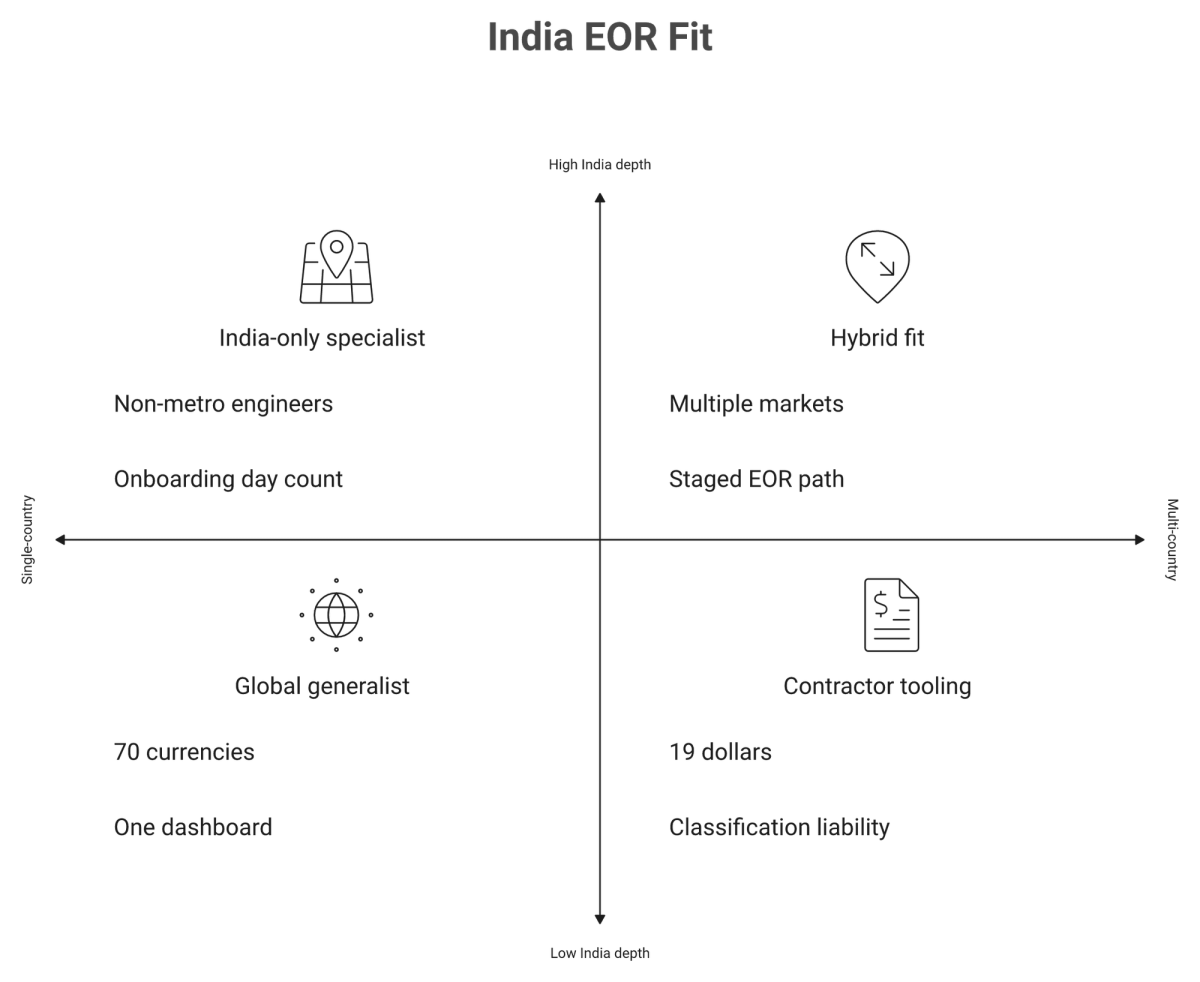
Choose Skuad when you hire across several countries at once, need payouts in 70 currencies, and India is one market among many. Choose an India-only EOR when India is your build market and you need owned-entity employment, multi-state depth, a committed onboarding date, and a single USD invoice with no FX spread. Versatile Club operates only in India, holding registrations across all 28 states and 8 union territories.
✅ Choose Skuad if this is your situation
Breadth is a real product, and Skuad sells it well.
You are hiring in three or more countries inside the same quarter.
You want one dashboard and one bulk payment funding many currencies.
You need contractor tooling cheap, at $19 per contractor per month.
You are already inside Payoneer's payment rails for other flows.
One reviewer stated the buying reason plainly, then flagged the cost of it.
"We chose them as they offer world wide coverage. Everything is super complicated and takes weeks to complete. Looks like way too many outsourcing chains in the process."
— Verified User in Computer Software, Payoneer Workforce Management (Formerly Skuad) - G2 Verified Review
⭐ Choose an India-only EOR if this is your situation
The trade runs the other way once India is the plan rather than a line on a map.
You need the employing entity named, with a CIN and PF code you can verify.
Your engineers sit in Pune, Kochi, or Kolkata, not only in the top four metros.
Your CFO needs one USD invoice with no conversion step for month-end close.
You need a start date you can commit to a candidate.
Versatile Club commits to 5 business days from signed agreement to live payroll, written into the service agreement rather than quoted as a target. Founders making a first hire usually start with our guide to hiring in India without an entity.
Support quality drives more switches than price does, which the generalist reviews keep showing.
"They were dishonest about the level of support provided. We specifically explained we required phone-level support for urgent matters, but that is not available. Instead they have email support with a 3-day SLA."
— Juliette D., Remote - G2 Verified Review
⏰ The hybrid path most teams actually take
EOR first, entity later. That sequence is normal, and I recommend it often.
Hire your first two engineers on an EOR seat inside a week. Revisit an owned Indian subsidiary only when headcount justifies $50,000-plus and 12 to 18 months of setup. The staged options are compared in our overview of India expansion options.
I do not pitch India on cheap labour. If price alone is your driver, it shows up in retention within two quarters, and India's strongest engineers have plenty of other options.
❌ Where Versatile Club is the wrong choice
Naming the misfits saves everyone a discovery call.
Multi-country EOR. Five countries on one contract needs a generalist, not an India-only provider.
B2C consumer hiring. Not our segment.
Enterprise 100-plus India teams where SOC 2 or ISO 27001 certification is a procurement prerequisite.
Versatile Club operates only in India by design, and full enterprise procurement customisation takes longer than the 5-day SLA. That is a fit boundary, not a hedge. Larger India programmes are handled through our enterprise engagement track.
Versatile Club fits when India is the whole plan, with its own entity, all 28 states covered, culture-fit screening across 50 behavioural parameters, a 90-day Success Coach, and a 6-month replacement guarantee.
Q11. How do you pressure-test a Skuad India quote before signing?
Ask nine questions in writing: the India rate on monthly versus annual billing, the volume-discount threshold, the deposit amount and refund trigger, pre-funding requirements, the FX spread versus mid-market, the employing entity name with CIN and PF code, prices for the six unpriced add-on services, the committed onboarding day count, and notice and exit terms. Versatile Club answers all nine in writing before a contract is sent.
💰 Why written answers beat call notes
Call notes lose arguments at renewal. Email answers do not.
A CFO filter I borrow often: before spending, imagine explaining that exact purchase out loud to your board. If the answer sits in an email thread, the explanation writes itself.
✅ The nine questions, and why each exists
Send these as one message. Every question maps to something the pricing page does not state.
What is the India rate on monthly billing versus a 12-month commitment? The reported gap is $199 against $299.
At what headcount does the volume discount start? The page's discount footnote text never appears.
What is the security deposit, and what triggers its refund? Reported practice is about one month of gross salary.
Do you require payroll pre-funding, and how many days ahead? This is cash flow, not a fee.
What is your FX spread against the mid-market rate? Skuad's FX policy is not published.
Which entity employs my hire, with CIN and PF establishment code? The FAQ says "own and partner entities" without naming India.
What do the six add-on services cost? Talent discovery, background checks, work permits, visas, office space, and devices are all unpriced.
What onboarding day count will you commit to contractually? Skuad commits to "a short timeframe", not a number.
What are the notice, exit, and renewal escalation terms? One G2 reviewer described a mid-term price push from $200 to $400 per head.
Ask Versatile Club the same nine, and the replies are fixed: $149 flat, no deposit, no pre-funding, USD invoiced from our own Indian entity, $0 setup, $0 exit, and 5 business days to live payroll. The same terms appear on our EOR services page.
⏰ What I would do with the answers
Compare landed cost, not seat fees. Add the deposit, the FX spread, and the add-ons you actually need to each quote.
Then check the reference nobody checks. Ask each vendor for one client whose India employee sits outside Bengaluru, Mumbai, Delhi, and Hyderabad. Our note on payroll outsourcing in Bengaluru shows how city-level detail changes filings.
⚠️ Where my head is right now
What I think shifts over the next two years is that India stops being one country on a global EOR map. Owned-entity specialists take the India revenue, because multi-state compliance does not abstract well.
Versatile Club's data points that way, though our sample is small, and I might be reading it too strongly. Send me your nine answers on WhatsApp. If another provider's answers are better for your situation, I will tell you to sign with them, because the deals I regret are the ones I talked someone into.
Versatile Club puts all nine answers in writing before any contract is sent, including the $149 rate, zero setup and exit fees, and the 5-day onboarding SLA written into the service agreement. Send the quote across through our contact page, and I will mark up what is missing.
FAQs
How much does Skuad cost per employee in India in 2026?
Skuad, now branded Payoneer Workforce Management, publishes three rates: Employer of Record from $199 per employee per month, Agent of Record at $99 per contractor per month, and a Contractor Management System at $19 per contractor per month.
The number that trips up budgets is the billing term. Independent teardowns report the $199 rate against a 12-month commitment, with month-to-month billing near $299, and Skuad's India page has separately shown $249. Review sites list tiers up to $599 in complex geographies.
- Annual commitment: $199 per seat, per month
- Month to month: $299 reported per seat
- India page variant: $249 per seat on monthly billing
- Volume discounts: available, thresholds unpublished
None of those figures include gross salary, employer statutory costs, or the refundable security deposit. For a like-for-like comparison, Versatile Club publishes a single flat rate of $149 per employee per month with no commitment condition attached, which you can check on our India EOR pricing page. We recommend asking any vendor to confirm the rate, the term, and the renewal escalation clause in writing before it enters your model.
What hidden costs sit outside Skuad's published India EOR fee?
The seat fee covers platform access, the employment agreement, and statutory filings. Four cost layers sit outside it, and the pricing page does not state any of them.
- Security deposit: reported at roughly one month of gross salary per employee, refundable, held against severance and final-pay exposure.
- Payroll pre-funding: you wire payroll before it runs, which is a working-capital event rather than a fee.
- FX spread: Skuad's FX policy is unpublished; spreads of 1.5 to 3 percent are commonly reported on payment rails.
- Add-on services: talent discovery, background checks, work permits, visa processing, office space, and device facilitation carry no published prices.
One published teardown models a $50,000 India transfer landing near $54,007, close to 8 percent total leakage once spread and fees stack. Versatile Club removes three of these four layers by issuing one USD invoice from its own Indian entity, with no deposit and no conversion step. If you want the full landed picture including statutory heads, our breakdown of employer of record cost in India itemises every line a controller has to accrue.
Does Skuad own its India entity, or does it use a partner?
Skuad's own FAQ states it operates through "own and partner entities in 160+ countries" without naming which markets are owned. India is not named, so buyers cannot confirm the employing entity from public information alone.
The distinction matters operationally, not just legally:
- A partner entity counter-signs the employment contract, which adds a review loop to your candidate start date.
- The employee's Universal Account Number links to whichever establishment code filed the PF, not to the platform brand.
- Challans, Form 16, and full and final settlements stay with whoever filed them.
- Opaque structures make permanent establishment questions harder to answer during investor diligence.
Run a three-document test in a single day. Ask for the entity name and CIN, verify it on the MCA portal, ask for the PF establishment code, check it on the EPFO establishment search, then read a sample offer letter and see whose name appears. Versatile Club employs every India hire on its own registered Indian entity, with PF, ESIC, and Shops and Establishments licences held directly and verifiable on those same portals. Our India compliance scope lists the filings made under those registrations.
Should Indian contractors go on Skuad's $19 CMS plan or the $99 AOR plan?
The two plans differ by three features, and all three are liability features rather than software features. The $19 Contractor Management System handles payments in 70-plus currencies, invoice creation, expenses, and payment history. The $99 Agent of Record adds contract support, misclassification-risk support, and a dedicated account manager.
India has no US-style co-employment PEO structure, so a worker is either genuinely independent or, in substance, an employee. Authorities weigh control rather than paperwork.
- You set their hours and reporting line: treat the engagement as employment.
- They will stay past six months: price an EOR seat now.
- They hold IP that matters: you need an employment contract, not an invoice trail.
If a contractor is reclassified, arrears include employer PF at 12 percent of Basic plus DA, ESI at 3.25 percent where the threshold applied, and gratuity accrual at 4.81 percent. The $19 tier leaves that exposure entirely with you. Versatile Club converts contractors to employees on the same owned Indian entity, so the contract, PF code, and invoice never change hands. The sequence is documented in our guide to converting a contractor to an employee in India.
Which India EOR providers are cheaper than Skuad, and when is switching worth it?
India-native providers sit below Skuad's published rate. Versatile Club prices India EOR at $149 per employee per month, Wisemonk publishes $99 to $399, and Asanify starts from $99. Skuad's $199 remains the lowest published multi-country rate, ahead of Multiplier at $400, Papaya at $499 to $770, Deel at $599, and Remote at $699.
Price alone should not decide it. Score six criteria instead:
- Published rate and the billing term behind it
- Entity model in India, owned or partner
- FX policy, mid-market or undisclosed spread
- Contractual onboarding day count
- States and union territories actually registered
- Support model and escalation window
Switching is worth it when India is your build market, your engineers sit outside the top four metros, or your CFO needs one USD invoice with no conversion step. Staying with Skuad makes sense when you hire across several countries at once and need 70-currency payouts. Versatile Club covers all 28 states and 8 union territories with a five-day contractual onboarding SLA, and the full side-by-side sits on our Skuad alternative page.