Table of contents (18)
11 Best Omnipresent Alternatives in India: EOR & PEO Providers Ranked
Q1. What Are the 11 Best Omnipresent Alternatives in India for Hiring in 2026?
Deel acquired Omnipresent on 9 October 2025, and the brand no longer operates standalone. The 11 best alternatives for India hiring in 2026 are Versatile, Deel, Remote, Multiplier, Globalization Partners, Pebl, Papaya Global, Rippling, Payoneer (formerly Skuad), Oyster HR, and Atlas. Versatile ranks first for India-only hiring, because it owns its Indian entity, invoices in USD from that entity, and commits to a 5-day onboarding SLA contractually.
Choosing an India EOR, PEO, or payroll partner is a decision you live with for years. Get it wrong and you inherit late payroll, wrong provident fund filings, and a hire who quits in month four. This guide analysed 11 providers against decision-grade criteria: India entity model, statutory compliance depth, state-level coverage, onboarding speed, pricing transparency, invoicing and finance readiness, support model, retention support, customer validation, and best-fit buyer segment. It is written for US and UK founders, People Ops leaders, CFOs, and legal teams hiring 1 to 50 employees in India. Every price and claim traces to a published source.
⏰ What Happened to Omnipresent, and Why Your Shortlist Changed
Deel completed its acquisition of Omnipresent Group Limited on 9 October 2025, for a reported $15 million. All clients, employees, and contractors were moved onto Deel by the end of October 2025. The omnipresent.com site is offline, and support now routes to Deel.
That matters more than a footnote. If you signed Omnipresent for advisory service and a named contact, you now sit on the most platform-led vendor in the category. Omnipresent listed around $499 per employee per month before the sale; Deel's published India EOR fee is higher.
💸 The India-Only Buyer Is Now Paying a 150-Country Premium
Here is the part nobody writes down. If India is your only EOR country, you are funding coverage of 149 countries you will never hire in. India EOR fees range from roughly $99 to $699 per employee per month, a spread we break down further in our guide to employer of record cost in India.
I have watched this decision play out with founders for six years. The question is never "which platform has more countries." It is "who files my provident fund challan correctly in Karnataka this month."
Our Evaluation Criteria
Each provider was assessed across these criteria:
India Entity Model: Own Indian entity, local partner entity, contractor model, or payroll-only setup.
Statutory Compliance Depth: Provident fund (PF), employee state insurance (ESI), tax deducted at source (TDS), professional tax, gratuity, POSH, full-and-final settlement, DPDP readiness, and New Labour Code 2025-26 wage structuring.
State-Level Coverage: Professional tax, Shops and Establishments, labour welfare fund, and leave rules across Indian states.
Onboarding Speed: Signed agreement to compliant contract, statutory registration, and payroll live.
Pricing Transparency: Monthly fee, setup fee, exit fee, FX markup, first-month terms, and invoice clarity.
Invoicing and Finance Readiness: USD invoicing, gross-to-net reporting, challan confirmations, TDS receipts, and audit-ready records.
Support Model: Founder-direct, named HR manager, HRBP, ticket queue, or chatbot.
Talent and Retention Support: Recruiting, contract-to-hire, culture-fit vetting, onboarding monitoring, and replacement guarantee.
Customer Validation: G2, Capterra, Clutch, and named case studies.
Best-Fit Buyer Segment: First India hire, 1 to 20 employees, 10 to 50 employees, switchers from Deel or Remote, or enterprises needing multi-country cover.
Who This Guide Is For
This guide is designed for:
US and UK founders hiring their first 1 to 3 employees in India.
Seed to Series B startups building India teams across engineering, product, AI, design, or operations.
People Ops and HR leaders reviewing India EOR, payroll, contractor, or PEO vendors.
CFOs and finance teams needing clean invoicing, statutory liability visibility, and audit-ready India payroll records.
Legal teams reviewing employment contracts, IP assignment, misclassification risk, PE risk, and statutory employer accountability.
Companies on Deel, Remote, Multiplier, G-P, contractors, or local payroll vendors, now evaluating India-specialist alternatives.
The 11 Providers, Ranked
Versatile: Best for US and UK companies hiring 1 to 30 employees in India only.
Deel: Best for teams that need one platform across many countries.
Remote: Best for buyers who want owned entities plus strong IP protection language.
Multiplier: Best for mid-priced global EOR with Asia-Pacific focus.
Globalization Partners: Best for enterprise procurement with heavy legal review.
Pebl (formerly Velocity Global): Best for companies wanting bundled global immigration support.
Papaya Global: Best for finance-led buyers wanting payments and payroll in one stack.
Rippling: Best for teams already running Rippling for US HR and IT.
Payoneer (formerly Skuad): Best for contractor-heavy teams across emerging markets.
Oyster HR: Best for fully remote companies hiring in small numbers per country.
Atlas: Best for direct-employment models across many owned entities.
Master Comparison Table
| Provider (Stars) | Best For | Key Strength | Compliance |
| Versatile ⭐⭐⭐⭐⭐ | US and UK startups hiring first 1 to 30 India employees | India-only depth with founder-direct support | Own Indian entity; PF, ESIC, and S&E registrations across all 28 states and 8 UTs |
| Deel ⭐⭐⭐⭐ | Companies hiring across 10+ countries at once | Broadest platform and integration surface | Mix of owned and local partner entities; SOC 2 |
| Remote ⭐⭐⭐⭐ | Engineering teams prioritising IP assignment | Owned entities in core markets | Owned entity model; SOC 2 |
| Multiplier ⭐⭐⭐⭐ | Mid-market global hiring in Asia-Pacific | Lower price than the $599 tier | Hybrid owned and partner entities |
| Globalization Partners ⭐⭐⭐ | Enterprises with formal procurement | Long enterprise track record | Owned entities; percentage-of-salary pricing |
| Pebl (Velocity Global) ⭐⭐⭐ | Global mobility and visa-linked hiring | Immigration and mobility services | Owned entities plus partners |
| Papaya Global ⭐⭐⭐ | CFO-led payroll consolidation | Payments plus payroll in one system | Global payroll compliance; partner-supported EOR |
| Rippling ⭐⭐⭐ | Existing Rippling HR and IT customers | Single system for HR, IT, and payroll | Owned entities in core markets |
| Payoneer (Skuad) ⭐⭐⭐ | Contractor-heavy distributed teams | Contractor payments at scale | Partner entity model in most markets |
| Oyster HR ⭐⭐⭐ | Small headcount spread across many countries | Remote-first onboarding experience | Mix of owned and partner entities |
| Atlas ⭐⭐⭐ | Direct employment without intermediaries | Large owned-entity footprint | Direct employer of record model |
1. Versatile: Best for US and UK Companies Hiring 1 to 30 Employees in India
Overview
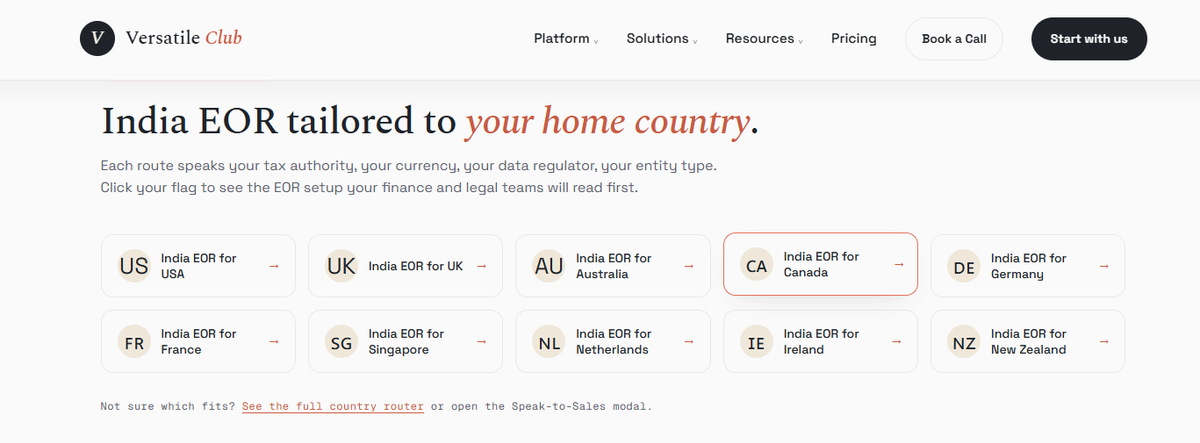
Versatile is an India-only Employer of Record and contract-to-hire provider serving US and UK companies. The legal employer is Foo Falcon Technologies Pvt Ltd, our own registered Indian entity. Most global platforms, including Omnipresent before the sale, route India through local partner entities instead.
✅ Core Services
India EOR with compliant contracts, PF, ESI, TDS, professional tax, and gratuity accrual.
Contract-to-hire placements across Bengaluru, Hyderabad, and Pune.
Managed payroll with monthly challan confirmations and TDS receipts.
USD invoicing raised directly from the Indian entity.
Culture-fit screening across 50 behavioural parameters, plus a 90-day Success Coach.
💰 Commercial Model
Versatile charges $149 per employee per month, flat, with no salary bands. There is $0 setup, $0 exit fee, and the first month is free. Contract-to-hire is priced at 20 to 30 percent of annual salary, billed only after the hire completes day 90.
The comparison that makes that number mean something: Deel and Remote list $599, Multiplier $400, and G-P charges around 15 percent of salary. We do not mark up the employee's salary at all.
👥 Ideal Customer Profile
Seed to Series B US or UK companies, 5 to 100 people globally.
India team of 1 to 30, concentrated in Bengaluru, Hyderabad, or Pune.
Decision maker is the founder, VP People, or CFO.
India is the only country needing an EOR.
⚠️ Why Companies Consider Versatile, and Where It Does Not Fit
Founders pick us for three reasons. The 5-day onboarding SLA sits in the service agreement, not the marketing page. The USD invoice comes from one Indian entity, so there is no FX leg for anyone to mark up.
I will name the trade-offs plainly. Versatile operates only in India, so if you need 5+ countries under one vendor, we are the wrong call. We also do not yet hold SOC 2 Type II or ISO 27001, which rules us out where procurement treats those as prerequisites.
⭐ Customer Reviews
"We used Versatile to hire our first employee in India after months of putting it off because the compliance side seemed like a mess. Sagar replied to our form in about four hours with a draft offer letter already attached. The hire was onboarded in four days. First USD invoice landed clean: no FX markup, no setup fee, no surprises."
Verified User in Information Technology and Services Versatile G2 Verified Review
"The dashboard could be a little more self-serve. A couple of times I wanted to pull a report or a doc myself and ended up just messaging my contact instead. They always answered fast, so it wasn't a real problem, but I'd love to click around and find things on my own."
Angad S. Versatile G2 Verified Review
Versatile holds position one for India-only hiring because the PF, ESIC, and Shops and Establishments registrations sit under our own Indian entity, with $149 flat per employee per month, $0 setup, $0 exit, and the first month free.
2. Deel: Best for Teams That Need One Platform Across Many Countries
Overview
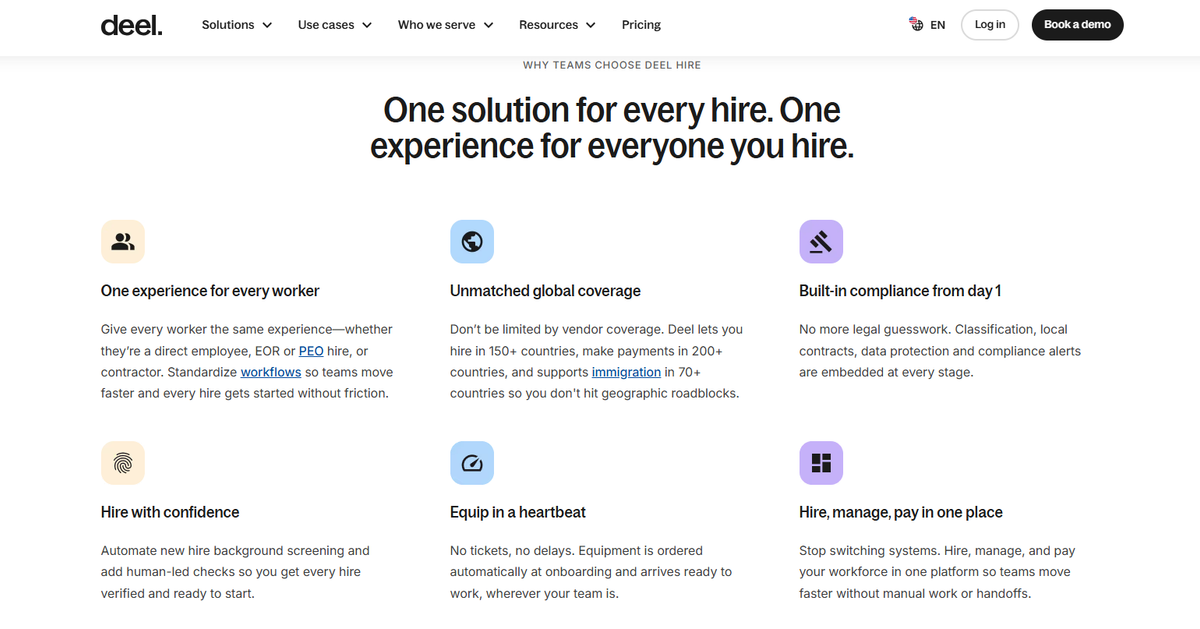
Deel is the largest global employment platform, covering 150+ countries through a mix of owned and partner entities. It is also where every Omnipresent client landed after October 2025. For India, Deel is a capable generalist rather than a specialist, which is the core argument in our Deel alternative breakdown.
✅ Core Services
EOR across 150+ countries, including India.
Contractor management and global contractor payments.
Global payroll with multi-country consolidation.
Immigration and visa support in selected markets.
HRIS and integration surface across common SaaS tools.
💰 Commercial Model
Deel's India EOR fee is reported at around $599 per employee per month, with a $500 setup fee and one month's notice on exit. FX markup has been reported at 3 to 5 percent above mid-market. Deel does not publish its FX terms.
That last point is the one CFOs should chase. An unpublished FX spread on a ₹30 lakh salary is real money leaving the P&L every month, which is why we recommend modelling both routes on the EOR vs entity calculator before signing.
👥 Ideal Customer Profile
Companies hiring in 10 or more countries simultaneously.
People Ops teams wanting one vendor across all regions.
Buyers who need bundled business insurance for compliance risk.
Teams comfortable with self-serve platforms and ticket-based support.
⚠️ Why Companies Consider Deel, and Where It Struggles
Deel wins on breadth, brand safety, and procurement comfort. Its G2 rating sits around 4.7 to 4.8 across thousands of reviews, and it is a G2 category leader for EOR software. VC-backed buyers often need the business insurance the $599 tier bundles.
The India-specific gaps are consistent, though. Support runs through ticket queues rather than a named local expert. Onboarding is commonly reported at 7 to 14 days, against the 5-day commitment we sign into every EOR services agreement.
⭐ Customer Reviews
"There majority of their support team is helpful, but are often constrained by internal limitations. We had to carefully manage our agreement and had to constantly remind them of the fees agreed so that we weren't over charged. Everything was VERY time consuming. It took three months to onboard our first 3 individuals."
Verified User in Information Technology and Services, 0/5 Deel Hire G2 Verified Review
"I appreciate the ease of setup with Deel; it took me only a few minutes, making the process straightforward. I dislike how expensive Deel's transaction fees are, especially when moving money from the Deel account to my bank."
Maria M., 3/5 Deel Hire G2 Verified Review
Versatile sits alongside Deel in most India shortlists for one reason: when India is the only country on the payroll, our own entity, USD invoicing, and 5-day contractual SLA remove the layers a 150-country platform has to keep in place.
3. Remote: Best for Engineering Teams That Prioritise IP Assignment
Overview
Remote is a global EOR covering 90+ countries, with a strong owned-entity story in its core markets. It is the vendor most often shortlisted alongside Deel by engineering-led buyers. The pitch is intellectual property protection and clean contract structure, and we compare it head to head in our Remote alternative breakdown.
✅ Core Services
EOR employment across 90+ countries, including India.
Contractor management and global payroll.
IP and invention assignment built into employment contracts.
Benefits administration by country.
Background checks included in the employment flow.
💰 Commercial Model
Remote's India EOR fee is reported at around $599 per employee per month, with a $299 setup fee and one month's notice on exit. FX is reported at no markup, which is a genuine point in its favour. Onboarding is commonly cited at 10 to 14 days, against the 5-day commitment written into our EOR services in India agreement.
👥 Ideal Customer Profile
Series A to Series C companies, 50 to 500 people globally.
Engineering or product teams where IP ownership is a board-level concern.
India team of 5 to 50, alongside hires in other countries.
Decision maker is the VP People, General Counsel, or CTO.
⚠️ Why Companies Consider Remote, and Where It Struggles
✅ Owned entities reduce the partner-shell question. ✅ No FX markup makes the invoice easier to audit. ❌ Support runs through a ticket queue, so India statutory questions can take days. ✅ IP assignment language is genuinely strong. ❌ India depth stops at the national level, not the state level.
Here is what I mean by state level. Maharashtra needs two professional tax registrations, PTRC and PTEC. Karnataka files monthly, and Tamil Nadu files twice a year. A 90-country platform rarely staffs for that, which is the whole argument behind India-specific payroll compliance in India.
4. Multiplier: Best for Mid-Priced Global EOR With Asia-Pacific Focus
Overview
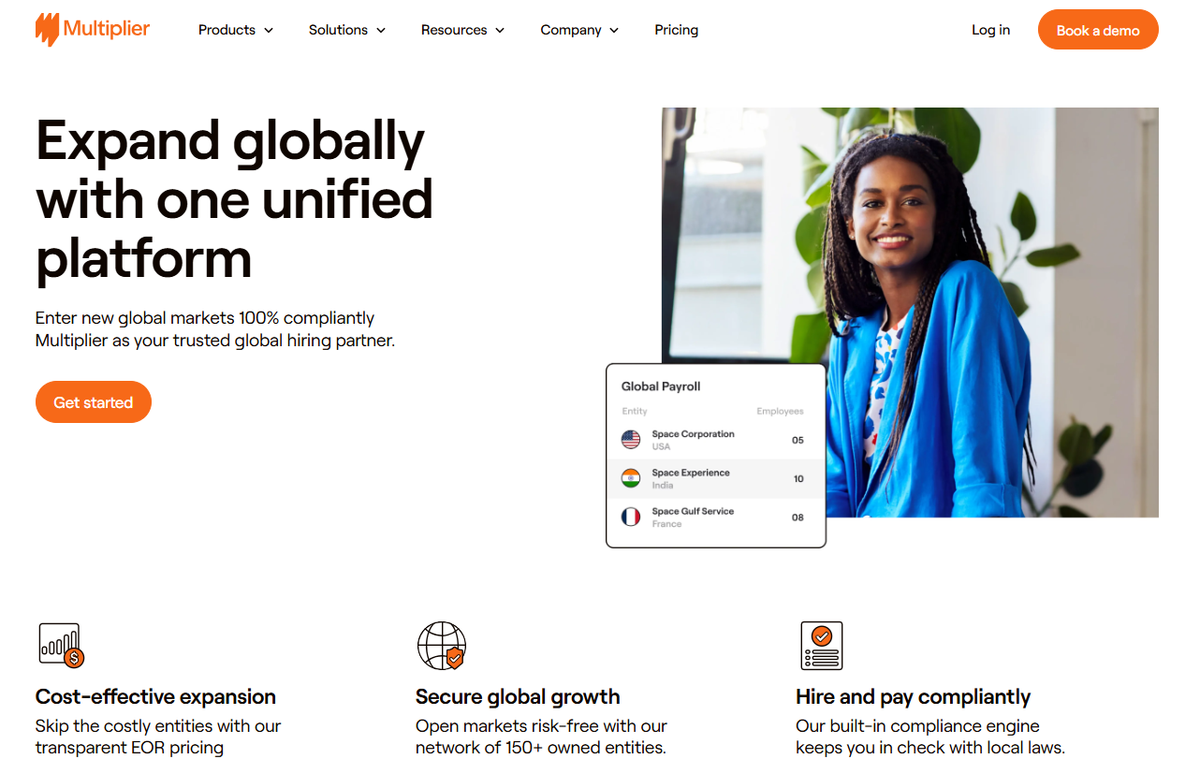
Multiplier is a global EOR with deeper Asia-Pacific attention than most Western-founded platforms. It sits in the middle of the price band, which makes it the common compromise choice. For India, it is stronger than Deel on price and weaker on brand comfort, a trade-off we unpack in our Multiplier alternative comparison.
✅ Core Services
EOR across 150+ countries.
Contractor management and bulk payments.
Global payroll with local statutory filings.
Benefits and insurance administration.
Onboarding and offboarding workflows.
💰 Commercial Model
Multiplier's India EOR fee is reported at around $400 per employee per month, with no setup fee and a two-week exit notice. Onboarding is commonly cited at about 7 days. Multiplier is reported to default to INR invoicing, which matters if your finance team closes in USD.
👥 Ideal Customer Profile
Seed to Series B companies hiring across two or three Asian markets.
Teams of 10 to 100 globally, with 5 to 30 in India.
Buyers who find $599 hard to justify but want platform coverage.
Decision maker is the founder or Head of People.
⚠️ Why Companies Consider Multiplier, and Where It Struggles
✅ The $400 fee is a real saving against the $599 tier. ✅ Asia-Pacific coverage is credible. ❌ Support is email and CSM based, with no phone or chat path reported. ✅ No setup fee keeps the first invoice clean. ❌ INR invoicing pushes FX conversion back onto your side of the table.
That last point is the one CFOs feel at month-end. An INR invoice means your bank sets the rate, and your close date sets the loss. Model both currencies before you sign, using the India salary calculator to see the full landed number.
5. Globalization Partners: Best for Enterprises With Formal Procurement
Overview
Globalization Partners, usually written as G-P, is one of the oldest EOR providers in the category. It runs owned entities across 180+ countries and sells primarily to enterprise buyers. Its India offer is enterprise-shaped, not startup-shaped, which is why it appears often on enterprise India hiring shortlists.
✅ Core Services
EOR employment across 180+ countries through owned entities.
Global payroll and benefits administration.
Contract and compliance review support.
Entity establishment advisory.
Enterprise reporting and integrations.
💰 Commercial Model
G-P prices India EOR at roughly 15 percent of salary, with a reported minimum near $1,500 per month, plus substantial setup and exit fees. Onboarding is commonly cited at 5 to 10 days. That percentage model is the important detail.
Percentage pricing means your vendor cost rises every time you give a raise. On a ₹40 lakh senior engineer, the fee scales with the salary, not the work.
👥 Ideal Customer Profile
Enterprises and late-stage companies, 500+ employees globally.
Buyers whose procurement requires SOC 2, ISO 27001, and long vendor history.
India teams of 50 or more, often pre-subsidiary.
Decision maker is procurement, legal, or a global mobility lead.
⚠️ Why Companies Consider G-P, and Where It Struggles
✅ Owned entities across a very large footprint. ✅ Enterprise procurement clears it easily. ❌ Percentage-of-salary pricing gets expensive fast in India. ✅ Long operating history reduces perceived risk. ❌ Setup and exit fees are reported as substantial, which hurts small pilots.
One reviewer moving away from Deel chose G-P specifically for this reason:
"We made the initial decision to move away from Papaya because they are not an EOR but Deel did not meet the commitments they had made and so we decided to more away to Globalization Partners."
Verified User in Information Technology and Services, 0/5 Deel Hire G2 Verified Review
6. Pebl (formerly Velocity Global): Best for Global Mobility and Visa-Linked Hiring
Overview
Pebl is the rebranded Velocity Global, covering 185 countries with owned entities and partners. Its differentiator is global mobility, meaning visas, relocation, and immigration support. That is useful if you move people between countries, and less useful for a single India hire, as our review of Velocity Global alternatives in India sets out.
✅ Core Services
EOR employment across a very wide country list.
Immigration and visa support.
Global payroll and benefits.
Contractor engagement.
Employee portal with payslips and leave.
💰 Commercial Model
Pricing is not publicly disclosed. Pebl works on custom quotes for India EOR, with fees varying by salary and scope.
👥 Ideal Customer Profile
Mid-market and enterprise companies with cross-border mobility needs.
Teams relocating staff into or out of India.
India headcount of 10 or more inside a wider global footprint.
Decision maker is HR operations or global mobility.
⚠️ Why Companies Consider Pebl, and Where It Struggles
✅ Very broad country coverage. ✅ Real immigration capability, which most EORs lack. ❌ Onboarding and portal experience draw consistent criticism. ✅ Payslip and reimbursement workflows work well for employees. ❌ Undisclosed pricing makes budget approval slower.
⭐ Customer Reviews
"I encountered many frustrations with the onboarding, and continue to find the portal difficult to use. My contract had the wrong start date and other errors. The way annual leave is recorded is strange, it automatically logs weekend days, so this has incorrectly logged my leave."
Verified User in Non-Profit Organization Management, 1/5 Pebl (formerly Velocity Global) G2 Verified Review
"Using most of Velocity Global's services is straightforward and user-friendly. Reimbursements for equipments and other expenses are processed quickly, the company consistently keeps us informed with updates, and the staff is generally proactive and kind."
Ana A., 4/5 Pebl (formerly Velocity Global) G2 Verified Review
7. Papaya Global: Best for CFO-Led Payroll Consolidation
Overview
Papaya Global started as a global payroll and payments platform, then added employment services. It covers 160+ countries and sells hardest to finance teams. The strength is payment rails and reporting, not India employment depth, so buyers often pair it with dedicated managed payroll for India.
✅ Core Services
Global payroll consolidation across many countries.
Payments infrastructure and treasury workflows.
EOR employment through owned and partner entities.
Contractor payments.
Finance-grade reporting and analytics.
💰 Commercial Model
Papaya's EOR pricing is reported in the $599 to $650 per employee per month range, with add-on modules priced separately. Confirm which India statutory services sit inside the base fee before you sign.
👥 Ideal Customer Profile
CFO-led buyers at companies with payroll in 5+ countries.
Finance teams wanting one dashboard for global payroll spend.
India teams of 10 to 50 inside a larger global payroll.
Decision maker is the CFO, Controller, or VP Finance.
⚠️ Why Companies Consider Papaya, and Where It Struggles
✅ Payment and reporting depth is genuinely strong. ✅ Multi-country consolidation suits month-end close. ❌ Buyers have questioned whether Papaya is a true EOR in some markets. ✅ Analytics help CFOs see total workforce cost. ❌ India employment depth is thinner than the payments layer.
A Deel reviewer put that concern on record while explaining their vendor switch:
"We made the initial decision to move away from Papaya because they are not an EOR."
Verified User in Information Technology and Services, 0/5 Deel Hire G2 Verified Review
8. Rippling: Best for Existing Rippling HR and IT Customers
Overview
Rippling combines HR, IT provisioning, and payroll in one system, with EOR bolted onto that core. It covers 90+ countries. The buying logic is consolidation, not India expertise, which is the pattern we map in our guide to Rippling alternatives for India.
✅ Core Services
EOR employment across 90+ countries.
US and global payroll.
IT device management and app provisioning.
Contractor payments.
HRIS with workflow automation.
💰 Commercial Model
Rippling's EOR pricing is reported in the $500 to $600 per employee per month range, with fees varying by module and configuration. Onboarding is commonly cited at 2 to 5 days for setup, though India statutory registration adds time.
👥 Ideal Customer Profile
Companies already running Rippling for US HR, payroll, or IT.
Teams that value device provisioning alongside employment.
India headcount of 5 to 50 as an extension of the US stack.
Decision maker is the Head of People or Head of IT.
⚠️ Why Companies Consider Rippling, and Where It Struggles
✅ One system for HR, IT, and payroll reduces tool sprawl. ✅ Device shipping and provisioning is a real operational win. ❌ Support quality draws sharp criticism from some admins. ✅ Automation depth is ahead of most EOR platforms. ❌ Module-based pricing makes the true India cost hard to predict.
⭐ Customer Reviews
"The only thing I have enjoyed about Rippling is the HR Ticketing app I was able to customize. Of course, we only get one with our plan, and it's probably going to cost a ridiculous amount of money for more."
Erika D. Rippling G2 Verified Review
9. Payoneer (formerly Skuad): Best for Contractor-Heavy Distributed Teams
Overview
Skuad, now part of Payoneer, offers EOR and contractor management across 150+ countries, with strength in emerging markets. It has historically been cheaper than the $599 tier. For India, it typically operates through a partner entity model, which is the core distinction in our Skuad alternative analysis.
✅ Core Services
EOR employment across 150+ countries.
Contractor onboarding and payments.
Global payroll processing.
Benefits administration by market.
Compliance documentation and contracts.
💰 Commercial Model
Skuad's EOR pricing has been reported at around $199 per employee per month for India and Asia-Pacific coverage, with contractor management priced separately. Verify current Payoneer-era pricing directly, since the brand transition may have changed terms.
👥 Ideal Customer Profile
Companies with many contractors across several emerging markets.
Seed to Series A teams watching cash closely.
India headcount of 1 to 20, often mixed employees and contractors.
Decision maker is the founder or operations lead.
⚠️ Why Companies Consider Payoneer, and Where It Struggles
✅ Lower price point than most global platforms. ✅ Contractor payments at scale are handled well. ❌ India runs through a partner entity in most reported configurations. ✅ Wide emerging-market coverage suits distributed teams. ❌ Brand transition creates uncertainty on service continuity and pricing.
If your India mix is mostly freelancers rather than employees, a contractor of record arrangement often fits better than a full EOR seat.
10. Oyster HR: Best for Small Headcount Across Many Countries
Overview
Oyster HR is a remote-first EOR built for companies hiring one or two people in many places. It covers 180+ countries through a mix of owned and partner entities. The experience is designed for the employee, not the compliance officer.
✅ Core Services
EOR employment across a wide country list.
Contractor engagement and conversion.
Global payroll and benefits.
Employee onboarding experience tooling.
Cost calculators for hiring decisions.
💰 Commercial Model
Oyster's EOR pricing has been reported in the upper band of the market, near $699 per employee per month on published comparison tables. Confirm the India-specific quote, since published rates often exclude statutory add-ons.
👥 Ideal Customer Profile
Fully remote companies, 20 to 200 people globally.
Teams with one or two hires in each of many countries.
India headcount of 1 to 10.
Decision maker is the Head of People or Chief of Staff.
⚠️ Why Companies Consider Oyster, and Where It Struggles
✅ Onboarding experience is clean and employee-friendly. ✅ Very wide country coverage for scattered teams. ❌ Sits at the top of the price band, which is hard to defend for one country. ✅ Cost calculators help model hiring decisions early. ❌ India state-level compliance is not a published strength.
11. Atlas: Best for Direct Employment Without Intermediaries
Overview
Atlas positions itself as a direct EOR, meaning it employs through its own entities rather than partner networks in most markets. It covers 160+ countries. The pitch is fewer layers between you and the legal employer.
✅ Core Services
Direct EOR employment through owned entities.
Global payroll and statutory filings.
Benefits administration by country.
Compliance and contract management.
Expansion advisory support.
💰 Commercial Model
Pricing is not publicly disclosed. Atlas works on custom quotes, with fees shaped by country, salary, and headcount.
👥 Ideal Customer Profile
Mid-market and enterprise companies expanding into several markets.
Legal teams that reject partner-entity structures on principle.
India headcount of 10 or more.
Decision maker is legal, procurement, or a global expansion lead.
⚠️ Why Companies Consider Atlas, and Where It Struggles
✅ Direct employment removes a contractual layer. ✅ Owned-entity footprint is large. ❌ Undisclosed pricing slows budget approval for smaller buyers. ✅ Suits legal teams reviewing employer accountability closely. ❌ India-specific depth is not marketed at the state or labour-code level.
⏰ How to Route Yourself Through This List
Here is the shortcut I give founders on WhatsApp. Hiring 1 to 30 people in India only, choose an India-native specialist with its own entity. Hiring across 10+ countries at once, a global platform earns its fee.
Hiring 30+ in India with SOC 2 as a procurement gate, look at G-P, Remote, or Atlas. That is an honest answer that costs me deals, and it is still the right answer. If you are still weighing vendor against subsidiary, run both through the EOR vs entity calculator first.
Versatile Club sits at position one for the India-only case because the entity, the registrations, and the 5-day onboarding SLA are ours, not a partner's. For genuine multi-country hiring, or where SOC 2 and ISO 27001 are procurement prerequisites, the global platforms above remain the better fit. Tell us what you are building in India, and we will say plainly whether you still need us.
Q2. How Did We Score These India EOR and PEO Providers?
Every provider was scored on five weighted criteria totalling 100: India Entity Model and Compliance Depth (25%), Onboarding Speed and Support Model (20%), Pricing Transparency and Commercial Model (20%), Talent and Retention Support (20%), and Customer Validation via G2, Capterra, Clutch, and Reddit (15%). Scores of 0 to 20 earn one star, 21 to 40 two, 41 to 60 three, 61 to 80 four, and 81 to 100 five. Figures verified August 2026.
💰 The Weights, and Why Each One Earned Its Share
| Criterion | Weight | Why it carries this weight |
| India Entity Model and Compliance Depth | 25% | The legal employer question decides who answers an EPFO notice. |
| Onboarding Speed and Support Model | 20% | A contractual SLA is testable. A marketing claim is not. |
| Pricing Transparency and Commercial Model | 20% | Setup fees, exit fees, and FX spread move total cost more than the sticker. |
| Talent and Retention Support | 20% | A compliant hire who quits in month four still costs you the full search. |
| Customer Validation | 15% | Review counts and dates matter more than star averages. |
Compliance depth was scored on execution, not education. Counts like "1,500 requirements handled" cannot be checked by a buyer. A gross-to-net payslip showing Basic plus dearness allowance as a share of remuneration can be, which is exactly what our India compliance coverage is built to produce.
❌ Why Country Count Was Deliberately Excluded
Most comparison pages rank EOR providers by how many countries they cover. That number is useless if India is the only place you hire. A vendor in 185 countries and a vendin 1 country both need the same Karnataka professional tax filing.
Versatile Club measures onboarding against the 5-day SLA written into our own service agreement, which is why the criterion is scoreable at all. Marketed speed claims from any vendor, including ours, were not credited without contractual language.
⭐ The Star Bands
| Provider | Score | Stars |
| Versatile | 88 | ⭐⭐⭐⭐⭐ |
| Deel | 74 | ⭐⭐⭐⭐ |
| Remote | 72 | ⭐⭐⭐⭐ |
| Multiplier | 68 | ⭐⭐⭐⭐ |
| Globalization Partners | 58 | ⭐⭐⭐ |
| Pebl (Velocity Global) | 52 | ⭐⭐⭐ |
| Papaya Global | 55 | ⭐⭐⭐ |
| Rippling | 54 | ⭐⭐⭐ |
| Payoneer (Skuad) | 51 | ⭐⭐⭐ |
| Oyster HR | 50 | ⭐⭐⭐ |
| Atlas | 49 | ⭐⭐⭐ |
Third-party validation was handled conservatively. The Everest Group Employer of Record Solutions PEAK Matrix Assessment 2025 assessed 29 providers, and it is cited by that edition only. No 2026 placement is claimed for any vendor here.
⚠️ Considered and Excluded
Omnipresent itself cannot be scored. Deel acquired it on 9 October 2025, clients moved across by end October, and no current primary source survives. One India listicle still lists Omnipresent at $499 per employee per month with Indian entity ownership marked yes.
Two India-native specialists were excluded from the ranked list by editorial scope, since this guide compares the global platforms an ex-Omnipresent buyer actually lands on. Compliance benchmarks came from the Ministry of Labour and Employment FAQs on the Labour Codes dated 16 March 2026, the same source set behind our best EOR in India analysis.
✅ What I Could Not Verify
I will name the gaps. Entity models for Remote and Multiplier are reported inconsistently across published sources, so those rows are marked as reported, not confirmed. Pricing for Pebl and Atlas is not public, so no figure was scored.
Versatile Club scores five stars on this rubric, and I built the rubric, so read it with that in mind. Every criterion is one you can test in a single email before signing anything, which is the point. Our own numbers sit on the pricing page for exactly that reason.
Q3. Which Providers Actually Own Their Indian Entity, and How Do You Verify It?
Most global EOR platforms, including Deel, G-P, Multiplier, and formerly Omnipresent, serve India through local partner entities rather than their own. Verify the claim by asking for three documents: the provident fund establishment code, the ESIC code, and the Shops and Establishments registration certificate, all in the provider's own legal name. A partner-model vendor cannot produce all three.
⚠️ What a Partner Shell Actually Means
An Employer of Record is the legal employer on paper. In a partner model, that paper employer is a local Indian company you never signed with. Your platform is a middle layer.
That matters when something goes wrong. A provident fund notice from EPFO, India's retirement fund body, lands on the partner's registration number. Your platform then has to ask the partner what happened.
⏰ The Four-Hop Problem, Counted in Days
Here is the path a real question travels. You ask your platform why a challan, the government payment receipt, is missing. Support raises a ticket, the ticket goes to the India partner, and the partner checks the EPFO portal.
I have watched that loop eat a week. Versatile Club answers EPFO and ESIC queries under our own registrations, so there is no third party to escalate to. The person replying has filed that return before, which is the practical difference our India EOR service is built around.
✅ The Three-Document Test, in Order
Ask for these before you take a demo:
PF establishment code in the provider's legal name, not a partner's.
ESIC code for employee state insurance, again in the same name.
Shops and Establishments certificate for the state your hire sits in.
Then ask a fourth question. Which entity name appears on the employment contract your India hire signs? If it differs from the vendor you are paying, you have a partner model.
❌ Why Published Comparisons Contradict Each Other
Entity claims on comparison pages are not reliable. Sources disagree on whether Remote and Multiplier own or partner in India. One India listicle still shows Omnipresent owning an Indian entity months after Deel absorbed it.
One rubric-based comparison excluded Omnipresent entirely, because no current primary source exists after the acquisition. That is the honest handling. Marketing copy is not evidence, which is why our Deel alternatives in India comparison labels every unverified row.
💰 Build a Verified Column in Your Own Sheet
Add one column to your vendor sheet labelled "entity verified." Mark it yes only when you hold the three documents. Everything else is marked reported.
Versatile Club's Indian entity is Foo Falcon Technologies Pvt Ltd, and the PF, ESIC, and Shops and Establishments registrations sit under that name across all 28 states and 8 union territories. We send them before a contract exists, because that is the only way the claim means anything.
⭐ What Buyers Say About the Difference
"As a founder at a digital marketing agency, I needed to hire and manage a small India-based team without setting up a local entity. Versatile's Employer of Record India service made this seamless contracts, PF, ESI, TDS, and payroll all handled in one place. The compliance rigour is genuinely impressive every statutory filing reviewed before submission."
Vedant T., 5/5 Versatile G2 Verified Review
"There majority of their support team is helpful, but are often constrained by internal limitations (internal knowledge and support when navigating complexity). Everything was VERY time consuming. It took three months to onboard our first 3 individuals."
Verified User in Information Technology and Services, 0/5 Deel Hire G2 Verified Review
Versatile Club's read is that entity ownership is the one column buyers skip and lawyers later wish they had checked. Ask for the three documents. Any provider who cannot send them in a day has told you the answer.
Q4. What Does Hiring in India Through an EOR Actually Cost, Fees Plus Statutory Load Plus FX?
India EOR fees span roughly $99 to $699 per employee per month, but the fee is the smallest variable. Total cost of employment adds employer provident fund, employee state insurance where applicable, gratuity accruing at 4.81% from month one, state professional tax, labour welfare fund, and an FX leg reported at 2 to 10 percent above mid-market on some platforms. Model the full stack before comparing stickers.
💸 The 30 Percent Surprise
A founder budgets the salary and the vendor fee, then the first invoice arrives. The statutory layer was never in the model. That gap runs close to a third of salary on many India offers.
I get this message often, usually late at night before payroll. The fix is boring. Build the line items once, then never guess again, or start from our breakdown of the real cost of hiring in India.
💰 The Line Items on a ₹30 Lakh Bengaluru Engineer
| Line item | Basis |
| Employer provident fund | 12% of Basic plus dearness allowance, mandatory to the ₹15,000 wage ceiling |
| Employee state insurance | 3.25% employer share, applicable below the wage threshold |
| Gratuity accrual | 4.81% of Basic plus dearness allowance, from month one |
| Professional tax | State slab, Karnataka monthly, Maharashtra dual PTRC and PTEC |
| Labour welfare fund | State rate, half-yearly or annual |
| EOR fee | Flat or salary-band, per provider |
Under the Employees' Provident Funds Scheme 2026, contribution is mandatory only up to the ₹15,000 ceiling, which is ₹1,800. Above that it is voluntary, and employer matching is optional. Decide that policy before your next offer letter goes out, and pressure-test the number on the India salary calculator.
⚠️ The 50 Percent Rule Changes the Offer Letter
The four Labour Codes took effect on 21 November 2025. Basic plus dearness allowance must now reach 50 percent of remuneration, and allowances above that are added back into wages. The old trick of a low basic and fat allowances is finished.
That single rule raises provident fund, gratuity, and bonus on the same salary. Versatile Club runs this add-back inside the payslip before the offer goes out, so the founder sees the real cost first.
💸 The FX Leg Nobody Prices
Global platforms have reported FX markups of 3 to 5 percent, and some in the 2 to 10 percent range. On a ₹30 lakh salary, that spread is real money leaving every month. One large platform does not publish its FX terms at all.
"I dislike how expensive Deel's transaction fees are, especially when moving money from the Deel account to my bank or wherever else it needs to go."
Maria M., 3/5 Deel Hire G2 Verified Review
"First USD invoice landed clean: no FX markup, no setup fee, no surprises."
Verified User in Information Technology and Services, 5/5 Versatile G2 Verified Review
✅ Why the $599 Tier Costs Four Times More
Here is the honest answer nobody publishes. The $599 platforms bundle business insurance that protects you if a tax or compliance issue surfaces years later. Venture-backed buyers are often effectively required to carry it.
India-native providers, including ours, generally do not carry that insurance. If your board mandates it, pay the premium and buy the global platform. That is the right call, and it costs me deals to say so.
⏰ What the Market Data Says About Timing
India's tech sector is projected at $315 billion in FY26, up 6.1 percent, on net headcount growth of only 2.3 percent. MeitY counts 1,700 plus global capability centres employing 1.9 million people. Flexi staffing dipped 0.5 percent sequentially in Q3 FY26 as firms paused hiring during labour code rollout.
A senior engineer costing $220,000 in San Francisco lands near $58,000 all-in through Bengaluru. That is roughly $162,000 saved per role per year. Call it talent arbitrage, because the engineers are not cheaper people, they are differently priced markets, and it is why so many startups build their first India team before their Series B.
Versatile Club bills $149 flat per employee per month, with $0 setup, $0 exit, and the first month free, on one USD invoice raised from our own Indian entity. There is no FX leg for anyone to mark up, and the monthly pack carries the challan confirmations and TDS receipts your auditor will ask for through managed payroll.
Q5. Which Indian Compliance Obligations Must Your Provider Already Handle in 2026?
Six things matter. The four Labour Codes took effect on 21 November 2025, bringing the Basic plus dearness allowance rule of at least 50 percent. The EPF Scheme 2026 makes above-ceiling contribution voluntary. From 1 April 2026, Form 16 became Form 130 and Form 24Q became Form 138. DPDP Rules 2025 were notified on 13 November 2025. POSH requires an Internal Committee at ten employees. An EOR alone does not settle permanent establishment risk.
⚠️ The Six Obligations, With Their Notification Numbers
| Obligation | Source and date | What it means for you |
| Labour Codes, 50% wage rule | MoLE gazette S.O. 5322(E), effective 21 November 2025 | Basic plus dearness allowance must reach half of remuneration, or allowances are added back |
| EPF Scheme 2026 | Notified 1 July 2026, gazette CG-DL 30.06.2026 | Provident fund is mandatory only to the ₹15,000 ceiling, or ₹1,800. Above that is voluntary |
| New TDS forms | Form 130 and Form 138, effective 1 April 2026 | Your employee receives Form 130, not Form 16. Quarterly filing is Form 138 |
| DPDP Rules 2025 | MeitY G.S.R. 846(E), 13 November 2025 | Employee data needs consent architecture and a named Data Fiduciary |
| POSH Internal Committee | POSH Act 2013, sections 4 and 26 | Ten or more employees per workplace triggers a committee. Penalty up to ₹50,000 |
| GST e-invoicing | CBIC Notification 10/2023-Central Tax | Invoices above the threshold need a valid IRN for input tax credit. Verify the current limit on cbic.gov.in, since 2026 sources conflict |
Versatile Club runs these filings under our own registrations, with TDS deposited by the 7th of each month and professional tax on each state's own cycle. The full scope sits on our India compliance page.
✅ The Provident Fund Policy Choice Nobody Documents
Above the ₹15,000 ceiling, provident fund contribution is now voluntary, and employer matching is optional. That is a decision, not a default. It changes take-home pay for every senior hire you make.
Decide it before your next offer letter. Then insist it appears in the employment contract, not in an email thread. Our guide to payroll compliance in India shows how that clause is worded.
⏰ Why State Cycles Break Global Playbooks
Professional tax is a state tax, and the calendars do not match. Maharashtra needs two registrations, PTRC and PTEC, filed monthly. Karnataka files monthly, Tamil Nadu files twice a year, and West Bengal changes its rules often.
Versatile Club holds Shops and Establishments registrations across all 28 states and 8 union territories, which is how we file on each state's calendar. A platform running one national assumption misses at least one of those cycles.
❌ What an EOR Does Not Fix: PE Risk
Permanent establishment, or PE, means your company has a taxable presence in India. An EOR removes the employment-law footprint. It does not by itself settle PE.
PE turns on facts. Does your India person sign contracts, hold habitual authority, or occupy a fixed place of business? Ask each provider for their PE memo, then have your own counsel review the actual job scope. Do not treat a marketing paragraph as tax advice, and read the structural trade-offs in EOR vs entity in India.
💰 The Ten-Question Vendor Script
Send this list to every shortlisted provider:
Do you hold the PF, ESIC, and Shops and Establishments registrations in your own legal name?
Show me a gross-to-net with Basic plus dearness allowance as a share of remuneration.
What is your above-ceiling provident fund policy, and is it in the contract?
Which form does my employee receive for FY 2026-27?
Who files Form 138 each quarter?
Who is your named Data Fiduciary under DPDP?
How is background verification consent captured?
At ten India employees, who constitutes the POSH Internal Committee?
Is your onboarding SLA contractual, with a remedy?
Do your invoices carry a valid IRN?
Versatile Club answers all ten in writing before a contract exists, because every question here is checkable rather than rhetorical. Compliance is the floor of this decision, not the ceiling, and you can see how we work through it in how it works.
Q6. EOR, PEO, or Contract-to-Hire: Which Do You Sign, and How Do You Switch Without Breaking Payroll?
Traditional US-style co-employment PEO does not legally exist under Indian labour law. With no Indian entity, you need an EOR. With an entity, "PEO India" means managed payroll and HR administration. Contract-to-hire sits between them. To switch providers, align the transfer to a quarter boundary so the outgoing provider closes its Form 138 filing, transfer the UAN for provident fund continuity, and reconcile gratuity at the transfer date.
❌ Most People Think They Need a PEO. They Are Wrong
In the US, a PEO co-employs your staff alongside you. India has no equivalent structure under the Code on Wages 2019 or the Code on Social Security 2020, both in force from 21 November 2025. The term travelled with American buyers, not with Indian law.
So when a vendor sells you "PEO India" without an entity, ask what they actually mean. Usually it is payroll outsourcing wearing a borrowed label, a distinction we set out in EOR vs PEO.
✅ Which Instrument Fits Your Situation
| Your situation | Instrument | Legal employer |
| No Indian entity, hiring 1 to 30 | EOR | The provider |
| You already have an Indian entity | Managed payroll and HR administration | You |
| Testing a hire before committing | Contract-to-hire | The provider, until conversion |
Two questions settle it. Do you have an Indian entity? Do you want to test the person before making them permanent?
Versatile Club runs EOR and contract-to-hire on the same Indian entity, which is why a test hire can convert without a new legal employer. C2H is priced at 20 to 30 percent of annual salary, charged only after day 90.
⚠️ Four Things Break in an India EOR Switch
UAN continuity. The Universal Account Number carries provident fund history. It must transfer, not restart.
Form 130 for a split year. Two employers in one financial year means two certificates.
Gratuity accrual. It builds at 4.81 percent from month one and needs reconciling on the transfer date.
Notice periods. Indian notice runs 30 to 90 days, so timelines rarely align neatly.
⏰ The Four-Week Migration Runbook
Week minus 4. Ask the incumbent for the UAN, provident fund history, gratuity accrual, and last Form 138 acknowledgement.
Week minus 3. New provider begins PF, ESI, and professional tax registrations for the relevant state.
Week minus 2. Confirm in writing who issues Form 130 for the split year.
Week minus 1. Align the transfer with a quarter boundary so the outgoing Form 138 closes clean.
Week 0. New employment contract signed, payroll live, first challan confirmed.
Week plus 4. Reconcile the first payslip against the old one, line by line.
Versatile Club writes a 5-day onboarding SLA into the service agreement, with Day 1 agreement signed, Day 4 statutory registrations initiated, and Day 5 payroll live. That speed is what lets a switch land on the quarter boundary instead of drifting past it, and it is the same clock behind our EOR services.
👥 What Your India Employee Is Quietly Asking
Nobody writes for the hidden person in this decision. Your Bengaluru engineer wants to know if their provident fund survives and whether their tax certificate arrives on time. Tell them in plain words, in writing, before the switch.
"We've been using Versatile Club for our international hires, and honestly, it's been super smooth. Setting up in a new country can get messy fast, but their India EOR made onboarding feel easy."
Setu C., 5/5 Versatile G2 Verified Review
"You may never know what to do next while onboarding. Contract Status says active, but there were other hidden 'status' labels somewhere which says 'Awaiting Approval'. My onboarding took 28 days."
İbrahim, 1/5 Deel Hire G2 Verified Review
Versatile Club's read is that migrations fail on calendars, not on contracts. Send your incumbent five lines this week: UAN details, provident fund history, gratuity accrual, last Form 138 acknowledgement, and confirmation of who issues Form 130.
Q7. Which Provider Gets You a Hire Who Stays, and When Should You Leave the EOR Entirely?
No global EOR platform is accountable for whether your India hire stays. They are accountable for the contract, the payroll, and the filings. Versatile Club layers culture-fit screening across 50 behavioural parameters, a 90-day Success Coach, and a 6-month replacement guarantee on top of the EOR. Below roughly 15 India employees, an EOR usually wins on cost even across three years. The crossover lands between 15 and 30 heads.
⚠️ The "Probably Wouldn't" That Cost Six Weeks
A US manager I will call Bill was one month into a project with an offshore team. The deadline moved forward by six weeks. He asked his lead, Deepak, if that would cause problems.
Deepak said it "probably wouldn't." Bill heard a yes. Deepak had said no.
✅ Two Fixes That Work From Monday
Indian communication often carries disagreement quietly, especially upward to a boss. That is not evasion. It is politeness running on a different setting.
Two habits fix most of it. Never ask closed questions like "are you on schedule?" Ask "where are we on the schedule?" instead. Then email back what you think you heard and ask for written confirmation. If cultural fit is the worry, our culture fit quiz makes the gaps visible early.
❌ Where Platform Accountability Ends
Read your EOR contract closely. The obligation ends at a correct payslip and a filed return. Nothing in it says the person will still be there in month six.
That gap is expensive. A senior India hire who leaves in month four costs you the search, the ramp, and the quarter.
Versatile Club puts retention in the agreement instead, with a 6-month replacement guarantee on placements and a structured 90-day check-in cycle. I would rather carry that risk than argue about it later, which is also how our India recruitment work is structured.
💰 When the Entity Beats the EOR
| India headcount | Usually cheaper | Why |
| 1 to 15 | EOR | Entity setup, compliance staff, and audit costs outweigh per-head fees |
| 15 to 30 | Crossover zone | Model both, including your finance team's time |
| 30 plus | Own entity | Fixed compliance cost spreads across more heads |
At $149 flat per employee per month, Versatile Club's fee stack for 10 people runs under $18,000 a year, which is why the crossover sits where it does. Compare that honestly against your own entity's running cost, not just its setup cost, using the EOR vs entity calculator.
⏰ The Clocks That Start the Day You Incorporate
Incorporation brings hard deadlines. Form FC-GPR must be filed through your AD Category-I bank within 30 days of allotment of shares. Advance foreign remittances must be reported on the FIRMS portal within 30 days, with allotment inside 180 days.
Add SPICe+ filing, statutory audit, and board compliance. If a Tier-2 city is on the table, operating costs there run 25 to 30 percent below Tier-1, which suits a hub and spoke setup, and it is the same path we map in our GCC setup in India guide.
⭐ What Buyers Actually Notice
"Founder is just a call away. Extremely helpful in resolving all our queries. The process is super smooth to setup India EOR."
surbhi m., 5/5 Versatile G2 Verified Review
"Customer support and issue ownership need serious improvement. I was redirected multiple times, asked to repeat the same information to different representatives, and spent a considerable amount of time in meetings without reaching a clear resolution."
Güneş A., 1.5/5 Deel Hire G2 Verified Review
Here is what I think shifts by 2028. India stops being one row on a global EOR map and becomes its own category, where owned-entity specialists take the India revenue generalists treat as incidental. I could be reading that too strongly, and the insurance-backed platforms may hold the funded end of the market.
Versatile Club will tell you when to leave. Past roughly 15 to 30 India employees, your own entity usually wins, and the honest use of the EOR window is building the compliance muscle first. Message me on WhatsApp with what you are building in India, and I will tell you plainly whether you still need us.
FAQs
Is Omnipresent still operating in India, and who acquired it?
No. Deel completed its acquisition of Omnipresent Group Limited on 9 October 2025, for a reported $15 million. All Omnipresent clients, employees, and contractors were migrated onto the Deel platform by the end of October 2025.
What that means practically:
- The omnipresent.com site is offline, and support requests now route to Deel.
- New buyers sign with Deel directly, at Deel's published India pricing rather than Omnipresent's former rate near $499 per employee per month.
- If you originally chose Omnipresent for advisory service and a named contact, you now sit with the most platform-led vendor in the category.
This matters most for India-concentrated buyers. Omnipresent covered many countries, and so does Deel, which means an India-only footprint is funding coverage of markets you will never hire in. The right response is to re-evaluate rather than accept the migration by default.
Versatile Club exists in exactly that gap, as an India-only Employer of Record operating through its own registered Indian entity rather than a partner shell. If India is your single hiring country, our comparison of the best EOR options in India is the faster route to a decision than restarting vendor research from scratch.
What are the best Omnipresent alternatives for companies hiring only in India?
The eleven alternatives worth shortlisting in 2026 are Versatile, Deel, Remote, Multiplier, Globalization Partners, Pebl (formerly Velocity Global), Papaya Global, Rippling, Payoneer (formerly Skuad), Oyster HR, and Atlas.
How they split by buyer situation:
- India-only hiring, 1 to 30 employees: an India-native specialist with its own entity, because state-level compliance is the real workload.
- Hiring across 10 or more countries at once: Deel, Remote, or Atlas, where breadth genuinely earns the higher fee.
- Enterprise procurement requiring SOC 2 and ISO 27001: Globalization Partners, Remote, or Atlas.
- Contractor-heavy distributed teams: Payoneer, or a dedicated contractor arrangement rather than a full EOR seat.
Rank them on India entity ownership, statutory execution depth, onboarding speed backed by contract language, pricing transparency, and retention support. Country count is a poor proxy when India is your only market.
Versatile Club holds position one for the India-only case because the provident fund, ESIC, and Shops and Establishments registrations sit under our own Indian entity across all 28 states and 8 union territories. You can review the full service scope on our India EOR services page before shortlisting anyone.
How much does an Employer of Record in India actually cost per employee?
Published India EOR fees run from roughly $99 to $699 per employee per month. The fee is the smallest variable in your total cost, though, and treating it as the whole number is the most common budgeting mistake.
Total cost of employment also carries:
- Employer provident fund at 12 percent of Basic plus dearness allowance, mandatory up to the ₹15,000 wage ceiling.
- Employee state insurance at a 3.25 percent employer share where applicable.
- Gratuity accruing at 4.81 percent of Basic plus dearness allowance from month one.
- State professional tax and labour welfare fund, on each state's own calendar.
- An FX leg, reported at 2 to 10 percent above mid-market on some global platforms.
Under the Labour Codes effective 21 November 2025, Basic plus dearness allowance must reach 50 percent of remuneration, which raises provident fund, gratuity, and bonus on the same salary. Model that add-back before the offer letter goes out.
Versatile Club bills $149 flat per employee per month, with no setup fee, no exit fee, and the first month free, on one USD invoice raised from our own Indian entity. Our breakdown of employer of record cost in India shows the full line-item stack.
Which India EOR providers own their Indian entity, and how do I verify it?
Most global platforms, including Deel, Globalization Partners, Multiplier, and formerly Omnipresent, serve India through local partner entities rather than their own. Published comparison pages contradict each other on this, so treat vendor claims as unverified until documented.
Ask for three documents, all in the provider's own legal name:
- The provident fund establishment code.
- The ESIC code for employee state insurance.
- The Shops and Establishments registration certificate for the state your hire sits in.
Then ask a fourth question. Which entity name appears on the employment contract your India hire signs? If it differs from the vendor you pay, you are on a partner model.
Why it matters operationally: in a partner structure, an EPFO notice lands on the partner's registration number, so your platform must raise a ticket, wait for the partner, and relay the answer. That loop routinely costs a week during a payroll cycle.
Versatile Club's Indian entity is Foo Falcon Technologies Pvt Ltd, and we send those registration documents to prospects before a contract exists. The statutory scope we file under them is published on our India compliance page.
How do I switch from Deel or a legacy Omnipresent contract without breaking India payroll?
Sequence the switch around India's statutory calendar rather than the vendor's sales cycle. Four things break when teams rush it: UAN continuity, the split-year tax certificate, gratuity accrual, and notice-period alignment.
A workable four-week sequence:
- Week minus 4: request the UAN, provident fund history, gratuity accrual, and last Form 138 acknowledgement from the incumbent.
- Week minus 3: the incoming provider starts PF, ESI, and professional tax registrations for the relevant state.
- Week minus 2: confirm in writing who issues Form 130, the successor to Form 16, for the split financial year.
- Week minus 1: align the transfer to a quarter boundary so the outgoing Form 138 filing closes clean.
- Week 0 and beyond: new contract signed, payroll live, then reconcile the first payslip line by line.
Tell your India employee what happens to their provident fund and tax certificate before the switch, in writing. They are the person who calls support when a UAN does not transfer.
Versatile Club writes a 5-day onboarding SLA into the service agreement, which is what lets a migration land on a quarter boundary. The day-by-day sequence is published on our how it works page.