Table of contents (15)
Remote.com Reviews 2026: Pros, Cons, Pricing, and Real User Feedback
Q1. What is Remote.com, and what does it actually sell in 2026?
Last month a Seed-stage founder in Austin messaged me at 11pm her time. She had a signed offer letter for a backend engineer in Hyderabad, a board meeting in six days, and one question: "Which PEO should I use in India?" Her spreadsheet already had Remote, Deel, and G-P in it. The question itself was the problem.
Remote.com is a global employment platform selling four things: Employer of Record, global payroll, contractor management at roughly $29 per contractor per month, and lightweight HR tooling, per its own published pricing and plans. Under EOR, Remote becomes the legal employer of your hire, runs local payroll and statutory contributions, and assigns intellectual property back to you. It is not a PEO. US-style co-employment does not legally exist under Indian labour law, so in India the only compliant structure for a company without an entity is EOR services in India.
⭐ The four things you are actually buying
Think of Remote as four products sold from one dashboard, not one product with four features. Each carries a different price and a different level of legal responsibility.
- EOR: Remote employs your hire through a local entity. Highest price, highest liability transfer.
- Global payroll: you already own the local entity. Remote just runs the pay cycle.
- Contractor management: contracts and payments only, near $29 per person per month, per Remote's pricing page. No employment relationship.
- HR tooling: time off, documents, onboarding flows. Useful, but not a full HRIS.
The distinction matters because buyers often price EOR and then quietly use contractor management, which leaves misclassification exposure sitting on their own balance sheet. If that is your situation, the mechanics of converting a contractor to an employee in India are worth reading before renewal.
⚠️ Why "PEO India" is a category error
A Professional Employer Organisation works through co-employment, where two companies share employer duties for the same worker. Indian statute has no such concept. The Code on Social Security, 2020 recognises a single principal employer for provident fund and insurance obligations.
So if a vendor sells you "PEO services in India" without holding an entity, ask which company's Employees' Provident Fund registration number appears on the employee's monthly challan. There is only ever one correct answer, and it belongs to one company. The distinction is unpacked further in this breakdown of EOR versus PEO.
💰 EOR versus building your own Indian entity
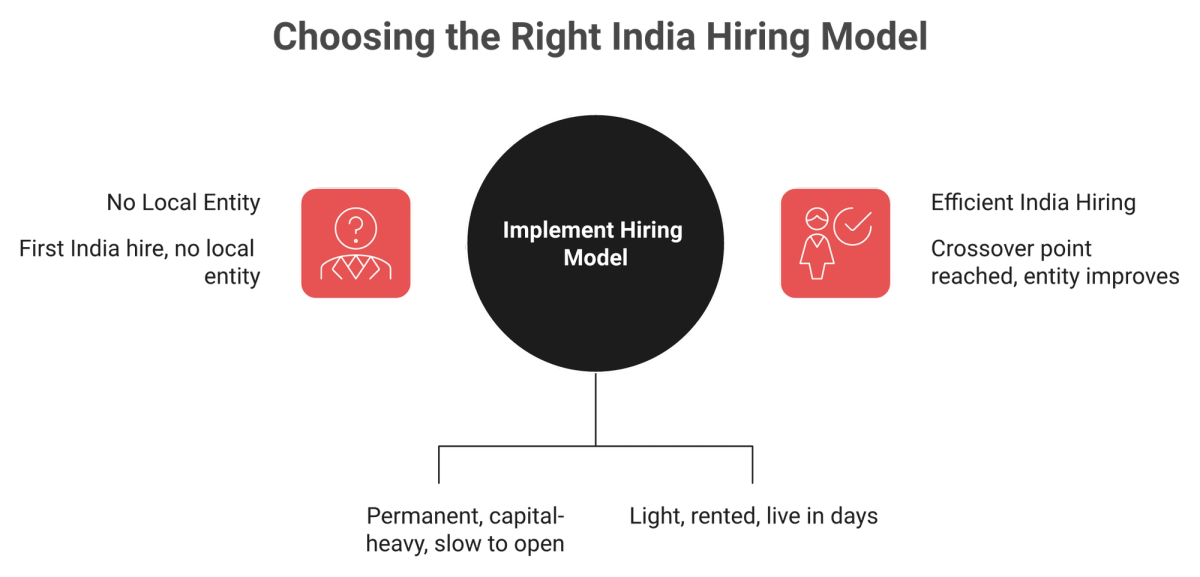
I use a bridge comparison with founders. A private limited subsidiary is the Golden Gate: permanent, expensive, and worth it once traffic justifies it. Budget $15,000 to $100,000 and three to six months before your first hire, plus ongoing Registrar of Companies filings.
EOR is the suspension bridge. It is lighter, faster, and rented. You cross in days instead of quarters, and you pay per person per month for as long as you need the crossing. Most US companies I work with cross this way until the India team passes roughly 15 to 20 people, at which point the maths starts favouring an entity, which you can test yourself with the EOR vs entity calculator.
✅ Where an India-only operator sits in this picture
Versatile Club is an India-only EOR, so the provident fund registration, ESIC code, and Shops and Establishments licences used to employ your hire sit under its own Indian entity, Foo Falcon Technologies Pvt Ltd. Registrations cover all 28 states and 8 union territories, as set out on our compliance page. One entity signs the employment contract, files the challans, and issues Form 16.
Q2. Is Remote.com legit, and what do real users praise and complain about?
Yes, Remote is a legitimate operator. It averages 4.5 out of 5 across 5,139 G2 reviews and 4.5 on Capterra, with 4.4 specifically on value for money. Legitimacy is not the same as satisfaction. Complaints cluster tightly and repeat across platforms and years: slow support on complex cases, payment and termination delays, missing features, and benefits handling that varies sharply by country. Praise concentrates on the consolidated all-in-one interface and the owned-entity model. Versatile Club, by contrast, holds no G2 profile as of September 2026 and publishes its 5-day onboarding service level agreement inside the signed service agreement instead.
⭐ What reviewers genuinely like
The consolidation story is real. Buyers who were running three logins for contracts, payroll, and time off do report relief.
"I like the all-in-one structure of Remote because it allows me to get rid of standalone products that confused my employee population and required multiple logins for HR work."
— Juliette D., HR buyer, Remote - G2 Verified Review, 22 April 2026
Onboarding and the platform itself also score well from employees, even in mixed reviews. That is worth noting honestly, because the interface is not where Remote gets into trouble.
❌ Where the complaints concentrate
Four themes repeat. Support latency, payroll accuracy, document quality, and country-specific statutory handling.
"As an employee, I'm giving 3 stars because the product and service itself is fine, but they got some critical things wrong... Cons: Sloppy document generation, Missing tax documents, Documents with the wrong year in the title, Payslips without names."
— Andreas, employee, Remote - Trustpilot Verified Review, 2 December 2025
"We had significant issues with having our employee paid accurately. First she was underpaid and we had to catch and report the error(s)... it took nearly 6 months to resolve all concerns. I am happy to report that the Remote team was respectful and resolved all issues to my satisfaction in the end."
— Tiffany, employer, Remote - Trustpilot Verified Review, 23 September 2025
Read that second one twice. The vendor did fix it. The client found the error first, and the fix took two quarters.
⏰ The pattern nobody puts in the star rating
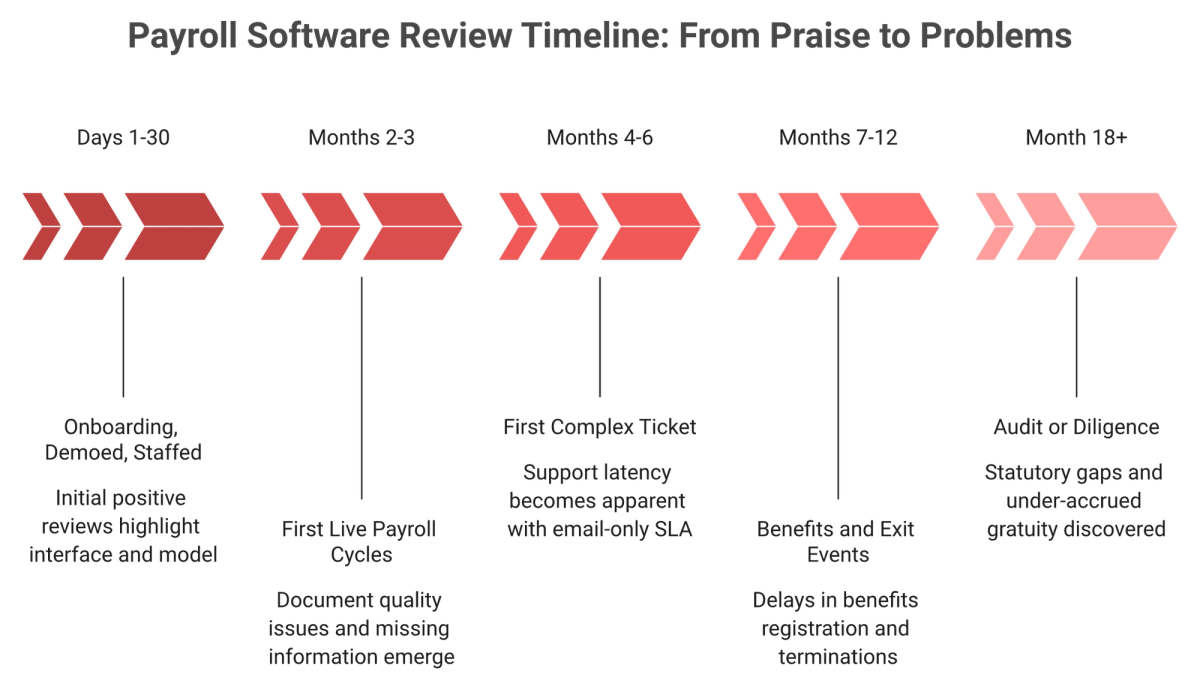
Here is what I have learned from reading competitor reviews for six years. Praise describes the first 30 days. Complaints describe months three through twelve.
Onboarding is demoed, scripted, and staffed. Month nine is a health insurance dependent registration, a wrong payslip year, or a leave encashment calculation at exit. Ask every reference customer about month nine specifically, and if the answers worry you, read how teams handle switching EOR provider in India.
⚠️ The honest reading of a 4.5
A 4.5 across 5,139 G2 reviews tells you the median experience is good. It does not tell you what the tail looks like, and EOR risk lives entirely in the tail. Versatile Club's own read is that review averages are a poor proxy for statutory reliability, though I might be leaning on that too hard given our own absence from G2.
✅ What a new entrant owes you instead of review volume
Versatile Club has no review history to point at, and I will not dress that up. What exists instead is a contractual 5-day onboarding SLA, a first month free, and six years of contract-to-hire payroll operations across Bengaluru, Hyderabad, and Pune under the same entity.
Q3. What does Remote.com cost once setup, exit, and billing terms are added?
Remote's EOR list price is quoted at $599 per employee per month on annual billing and $699 on monthly billing, with contractor management near $29 per person per month. Published sources disagree on setup: Remote's own pricing page states no platform, onboarding, or setup fees, while vendor comparison documentation records a $299 upfront setup charge and one month's exit notice. On annual billing, one engineer costs roughly $7,188 in year one in platform fees alone, before salary or statutory contributions. The line buyers miss is exit notice, because leaving mid-quarter still bills a full month.
💰 The fee stack, laid out
| Fee | Amount | When charged | Negotiable |
| EOR, annual billing | $599 per employee per month | Monthly, 12-month commitment | Rarely below list at under 10 seats |
| EOR, monthly billing | $699 per employee per month | Monthly | No |
| Setup | $0 per Remote's page, $299 per vendor comparisons | At onboarding | Ask in writing |
| Contractor management | approx. $29 per contractor per month | Monthly | No |
| Exit notice | 1 month of fees | At termination | Sometimes, pre-signature only |
| Deposits, FX spread, benefits markup | Not published | Varies | Ask for the line item |
Versatile Club charges $149 per employee per month flat, with $0 setup, $0 exit fee, and the first month free, as listed on our pricing page.
💸 What it looks like at 1, 5, and 20 people
Run the arithmetic before the demo, not after. At Remote's $599 annual rate, one hire is $7,188 a year, five hires are $35,940, and twenty hires are $143,760. At Versatile Club's $149 flat rate, the same headcount costs $1,788, $8,940, and $35,760, with the first month free on each.
For a five-person Bengaluru engineering pod, that gap is roughly $27,000 a year. For a CFO at a $5M to $50M ARR SMB, that is a hire. The full build-up sits in this guide to employer of record cost in India.
⚠️ Where the sticker price stops being the price
"I dislike everything about Remote... It's expensive, it doesn't integrate with anything that I need, it doesn't have basic US payroll functionality."
— Verified User in Accounting, Remote - G2 Verified Review, 15 April 2026
"The price per Remote employee can be expensive for smaller teams. If you're only hiring one or two employees, the price represents a significant percentage of the outgoing salaries."
— Verified reviewer, small business, Remote - Capterra Verified Review, 2026
That second quote is the real objection. A $599 monthly fee on a $2,000 monthly Indian salary is a 30% overhead. Buyers comparing that against an India-native rate card usually start with a Remote alternative shortlist.
✅ My procurement rule: audit the live invoice
Ask for a live sample invoice during procurement, with a real employee's numbers redacted. Setup fees, security deposits, FX markup, benefits markup, and exit fees live below the fold, not on the pricing page.
Versatile Club issues one USD invoice per month from its own Indian entity, with a per-employee breakdown, no salary markup, and no FX conversion sitting between the client and payroll. A CFO reconciles one line, in one currency, from one vendor, and our how it works page shows the sequence.
Q4. Does a 4.5-star rating prove statutory compliance depth?
No. Review scores measure what users can see, which is interface, onboarding, and invoicing clarity, and almost nothing a compliance failure would surface. A payroll user cannot rate whether a Karnataka professional tax return was filed on the correct monthly cycle, whether gratuity accrued at 4.81% of Basic plus dearness allowance from month one, or whether both Maharashtra PTRC and PTEC registrations exist. Compliance defects usually surface when an auditor finds them, long after the review was posted. Versatile Club sends clients monthly provident fund and ESI challan confirmations plus TDS deposit receipts, which is the artefact class a rating cannot substitute for.
⚠️ What a reviewer can and cannot see
Most people think a high rating means low risk. The standard advice gets this backwards.
A reviewer can see a late reply, a wrong payslip title, a clunky onboarding flow. A reviewer cannot see a professional tax slab applied at the wrong state rate, or an allowance structure that quietly breaches the revised wages definition in force from 21 November 2025, under which allowances above 50% of remuneration get added back to wages for provident fund and gratuity purposes, per the Ministry of Labour and Employment's Additional FAQs on Labour Codes.
⏰ The 18-month lag that ruins the average
Here is the mechanic that makes ratings misleading. Statutory errors compound silently, then arrive all at once at audit or diligence.
I have seen a Series B diligence surface gratuity that had not been accrued for eighteen months. Nobody had filed a bad review in that window, because nothing looked broken. The employer's own deadline calendar is unforgiving in the other direction: TDS deposited by the 7th, Form 16 by 30 May, and from 17 September 2026 provident fund coverage computed against a raised wage ceiling of ₹25,000 per month, per the Cabinet decision on the EPFO wage ceiling. The month-by-month view sits in this guide to payroll compliance in India.
❌ Reviewers do catch this, sometimes
"Although the platform is very useful and easy to follow guidebooks at many cases, specific country cases may be problematic (e.g., Japan) where the AI chat, Support cases and Support agents are not helpful in such specific cases and at times legal compliance failures may be the case."
— MatchaSamurai, employee, Remote - Trustpilot Verified Review, 6 August 2026
"Japan EOR service is the worst one I've ever seen. They don't amend a wrong salary calculation and just rely on the tax adjustment at December. At separation, paid leave removal by prorated is illegal in Japan but they did it."
— Japan user, employee, Remote - Trustpilot Verified Review, 30 July 2026
Both reviewers rate the platform fine and the statutory handling poorly. That gap is the whole point of this section.
✅ Five artefacts that actually prove compliance
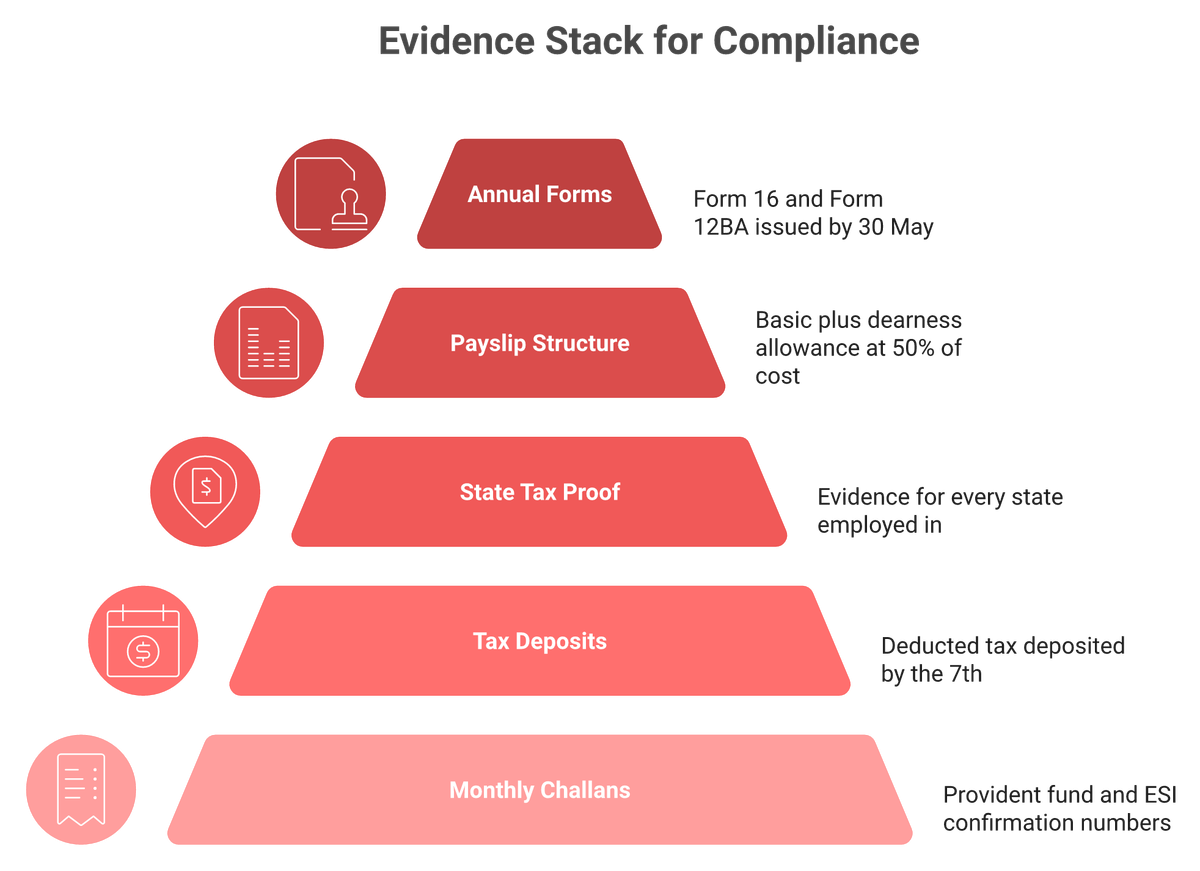
Swap the star rating for evidence you can file.
- Provident fund and ESI challan confirmation numbers, monthly, via the EPFO electronic challan cum return.
- TDS deposit receipts, dated by the 7th.
- Form 16 issued by 30 May, with Form 12BA where perquisites apply.
- State-wise professional tax proof, per state you employ in.
- A payslip showing Basic plus dearness allowance at or above 50% of CTC, per the Labour Codes FAQ.
Versatile Club sends one monthly client pack containing the single USD invoice, payroll summary, compliance status, PF and ESI challan confirmations, and TDS deposit receipts, as part of our managed payroll service. CFOs are not asking whether we are pleasant to deal with. They are asking what they hand an auditor in March.
Q5. Does Remote own its India entity, and how many countries does it really cover?
Treat the contradiction as the finding. Remote markets owned entities across 90+ countries, and some competitive matrices record its India entity as owned. Other vendor comparisons record India as served through a local partner, with coverage concentrated in the top four states and a 10 to 14 day onboarding cycle. Published country counts range from 60+ to 186 depending on the source, against the coverage stated on Remote's own pricing and plans page. Resolve it yourself. Ask for the Corporate Identity Number (CIN) of the employing entity that will appear on your employee's payslip, then verify it on the Ministry of Corporate Affairs company master data portal. Versatile Club employs through Foo Falcon Technologies Pvt Ltd, with provident fund, ESIC, and Shops and Establishments registrations in all 28 states and 8 union territories.
⚠️ Two sources, two answers, neither settled
I am not going to pretend I can close this from the outside. A competitive matrix in my own research folder lists Remote's India entity as owned. A separate vendor comparison lists it as a local partner, covering the top four states.
Both cannot be right. Independent reviewers add their own spread on coverage, quoting anywhere from 60+ to 186 countries. Versatile Club's read is that coverage counts get published as marketing totals, not as entity registries, which is why the number moves. If you are weighing that spread against an India-only option, the shortlist logic sits in this guide to Remote alternatives in India.
⭐ Why this is not a trivia question
Whoever holds the employing entity holds the paperwork. That single company's provident fund registration number appears on every monthly challan. That company signs the employment contract, issues Form 16, and stands in front of a state labour inspector.
Add a partner layer and each of those steps gains a handoff. Handoffs are fine in February. They are expensive in the week a Karnataka professional tax return is due, which is why entity ownership sits at the centre of our EOR services.
❌ Reviewers keep flagging the country-specific layer
The pattern in public reviews is consistent. The platform works. The local statutory layer is where things wobble.
"Although the platform is very useful and easy to follow guidebooks at many cases, specific country cases may be problematic (e.g., Japan) where the AI chat, Support cases and Support agents are not helpful in such specific cases and at times legal compliance failures may be the case."
— MatchaSamurai, employee, Remote - Trustpilot Verified Review, 6 August 2026
"Because I didn't have a BSN during onboarding, my first salary was taxed at the 52% anonymous employee rate... Remote never notified me that I still needed to upload my BSN or submit a Wage Tax Credit form. The platform never requested either of these documents."
— Elina Fazletdinova, employee, Remote - Trustpilot Verified Review, 25 June 2026
That second one is a local-registration gap, not a software bug. India has a dozen equivalents, starting with the Universal Account Number for provident fund.
✅ The verification script I would run on Monday
Versatile Club sends prospective clients the CIN before it is requested, so the same script should work on any vendor. Five questions, all answerable in writing.
- What is the CIN of the entity that will employ my hire?
- Which company's name appears on the employment agreement?
- Which company's provident fund registration number appears on the challan?
- In which states do you hold Shops and Establishments registrations?
- Who signs Form 16 for this employee?
If the answer to question one names a company you have never heard of, you are on a partner shell. That is not automatically wrong. It is just something you should know before signing, not during an audit, and the same test applies when you hire in India without an entity.
💰 Where state coverage actually bites
Outside the top four metros the rules stop being uniform. Maharashtra requires both PTRC and PTEC professional tax registrations. Karnataka files professional tax monthly and renews Shops and Establishments. Tamil Nadu files biannually and adds Labour Welfare Fund. Delhi has no professional tax but enforces Shops and Establishments strictly.
Versatile Club holds registrations across all 28 states and 8 union territories, and I will send the CIN before you ask, alongside the detail on our compliance page. That matters the first time you hire in Indore or Coimbatore instead of Bengaluru.
Q6. What does an India hire really cost after the 2026 statutory changes?
Every India cost estimate published before September 2026 is stale. The provident fund wage ceiling rose from ₹15,000 to ₹25,000 per month effective 17 September 2026, bringing roughly 51 lakh additional employees into mandatory coverage, per the Cabinet decision announced by the Press Information Bureau. Separately, the revised definition of wages in force from 21 November 2025 adds back allowances above 50% of remuneration, which lifts provident fund and gratuity bases for allowance-heavy salary structures, per the Ministry of Labour and Employment's Additional FAQs on Labour Codes. Versatile Club holds Basic plus dearness allowance at or above 50% of cost to company from the first payslip, and accrues gratuity at 4.81% of that figure from month one. Your platform fee is the visible cost. These are the numbers that move your accrual line.
⏰ What changed, and exactly when
Two notifications, two dates. Both are already in force.
- 17 September 2026: Notification S.O. 5109(E) raised the provident fund wage ceiling to ₹25,000 per month, superseding S.O. 2702(E) dated 29 May 2026, as confirmed in the Ministry of Labour and Employment's press release archive.
- 21 November 2025: the single definition of wages under the labour codes took effect. Allowances above 50% of remuneration are added back for wage computation, including gratuity.
Neither change touches what your EOR charges you. Both change what the employee legally costs, and the full build-up sits in this breakdown of the cost of hiring in India.
💰 One Bengaluru engineer, before and after
Take a ₹18,00,000 annual cost to company, so ₹1,50,000 a month, with Basic plus dearness allowance structured at 50%, which is ₹75,000.
| Line item | Basis | Before 17 Sep 2026 | From 17 Sep 2026 |
| Employer provident fund | 12% of wages up to the ceiling | ₹1,800 per month | ₹3,000 per month |
| Gratuity accrual | 4.81% of Basic plus DA | ₹3,608 per month | ₹3,608 per month |
| Employee state insurance | Wages up to ₹21,000 only | Not applicable | Not applicable |
| Annual employer delta | - | - | plus ₹14,400 |
The provident fund line moves by ₹1,200 a month per employee at this band. Across twenty engineers that is ₹2,88,000 a year you did not budget. Versatile Club publishes these rates rather than describing them, because a CFO cannot accrue an adjective, and you can model your own numbers with the India salary calculator.
⚠️ The structuring mistake that compounds
Here is where allowance-heavy salary design gets expensive. If Basic plus dearness allowance sits at 30% of cost to company, the 50% add-back rule pulls the rest back into wages. Provident fund and gratuity then recompute upward.
Retrofitting is the painful part. I have watched a diligence process surface eighteen months of under-accrued gratuity. Fixing it meant back-computing every completed month, then funding the gap in one quarter. Versatile Club structures for the 50% threshold from the first payslip precisely to avoid that catch-up, which is the discipline behind our payroll compliance in India guide.
✅ Three things to do this week
Pull these before your next vendor call, not after.
- Re-run your FY27 India cost model against the ₹25,000 ceiling.
- Ask your current provider, in writing, for a re-quote reflecting S.O. 5109(E).
- Open one India payslip and check whether Basic plus dearness allowance clears 50% of cost to company.
That third test takes four minutes and tells you more than any compliance page.
💸 What a published scope looks like
Versatile Club states its statutory scope as numbers: provident fund at 12% of Basic plus dearness allowance, employee state insurance at 3.25% employer and 0.75% employee, gratuity accrued at 4.81% from month one, tax deducted at source deposited by the 7th, and Form 16 issued by 30 May. POSH internal committee and multi-state GSTIN are included, and the same scope runs through our managed payroll service.
Q7. Where does Remote store your employees' personal data under India's DPDP Rules?
No top-ranking Remote review answers this, and the rules are now live. The Digital Personal Data Protection Rules, 2025 were notified via G.S.R. 846(E) on 13 November 2025, with an 18-month phased compliance timeline and Rule 4 commencing one year after publication. Under the Digital Personal Data Protection Act, 2023, your company is the data fiduciary and the Employer of Record acts as a processor, so the obligation follows you. Versatile Club processes employee data inside India, from a single Indian entity, and lists DPDP readiness in its published compliance scope. Request the data-processing addendum before onboarding, not after.
⚠️ Two roles, one liability
Two terms decide this section. A data fiduciary is the entity that decides why and how personal data gets processed. A data processor handles that data on the fiduciary's instructions.
Your company is usually the fiduciary. The Employer of Record is usually the processor. That means a processor's breach still lands on your desk, which is why the contract matters more than the vendor's marketing page. Buyers weighing that liability split often start by reading how it works before they read a feature list.
💰 What an EOR actually holds about your India hire
The file is larger than most buyers realise. Versatile Club handles the same categories, so this is not a competitor-specific criticism.
- Permanent Account Number and tax declarations
- Universal Account Number linked to provident fund records
- Bank account and salary history
- Address, dependents, and medical or insurance enrolment
- Proof-of-identity documents uploaded at onboarding
That data sits wherever the platform's payroll stack sits. If that is a partner entity plus a global cloud region, the storage question has more than one answer.
❌ Collection practice is already a friction point
Public reviews show the consent and collection layer creating real friction, not just paperwork.
"It asks for way too much personal information, doesn't explain why I need to share it, and makes it really challenging to register. When I provided valid documents, they got rejected for no reason, then I was asked for more and more. In the end, I have given much more information than I ever intended."
— Alice T., employee, Remote - G2 Verified Review, 20 March 2026
"extraordinary bad. you cannot get through to them, they use a useless IE bot, rather than answering the question, they give you general information about countries you have nothing to do with."
— HJ, employee, Remote - Trustpilot Verified Review, 16 April 2026
Purpose limitation is the exact principle that first quote describes failing. Under the DPDP framework, notice must state why each data point is collected.
✅ Four clauses to demand in the addendum
Versatile Club supplies these on request, and any serious vendor should. Ask for all four in one document.
- Storage location: which country and which entity holds the data at rest.
- Purpose limitation: the specific processing purposes, itemised.
- Breach notification: a stated timeline for informing you, so you can meet your own reporting duty.
- Deletion on exit: what gets erased when an employee leaves, and when.
⏰ Why the phased timeline is not a reason to wait
The rules give an 18-month runway, with Rule 4 starting one year after publication, as summarised in the Press Information Bureau release on the DPDP Rules. Procurement cycles at Series A to C companies run six to nine months. So the addendum you sign in 2026 is the one that has to be compliant in 2027.
Versatile Club's read is that most India EOR buyers are underweighting this, though I could be over-indexing on it because our own entity makes the answer simple. One jurisdiction, one entity, one storage answer, and you can raise the specifics directly through contact us.
Q8. How does Remote's support hold up when payroll breaks on the 30th?
Remote runs email-based ticket support, with named customer success managers on higher tiers. One April 2026 G2 reviewer records a three-day email service level agreement, no phone-level option, and two near-catastrophic payroll errors traced to manual processes. That architecture works for routine requests. It sits badly against Indian compliance windows, where tax deducted at source is due by the 7th and provident fund filings are date-bound, per EPFO electronic challan cum return documentation. Versatile Club routes client escalations to the founder directly on WhatsApp, with a 5-day onboarding service level agreement written into the signed service agreement. Judge support on escalation latency during a filing week, not on average response time.
❌ What reviewers describe when it goes wrong
The complaints are specific, dated, and repeat across platforms.
"They were dishonest about the level of support provided. We specifically explained we required phone-level support for urgent matters, but that is not available. Instead they have email support with a 3-day SLA. Responses are unacceptably slow. Separately, their payroll is still supported by manual processes, and twice we've had near catastrophic errors."
— Juliette D., HR buyer, Remote - G2 Verified Review, 22 April 2026
"A simple clarification question I sent in early March went completely unanswered for six days, until I had to escalate via Slack... One agent attempted to close the ticket before the registration was actually completed... the response I received cited being 'super super busy' as the reason for the delay."
— KS, employee, Remote - Trustpilot Verified Review, 18 April 2026
Read the second quote as a process description, not a rant. A ticket got closed on document upload rather than on outcome.
⏰ The deadline calendar support has to beat
India does not grade on average response time. It grades on dates.
- Tax deducted at source: deposited by the 7th of the following month.
- Provident fund electronic challan: filed monthly, date-bound.
- Professional tax: monthly in Karnataka, biannual in Tamil Nadu.
- Form 16: issued by 30 May.
A three-day first response consumes most of the window before the 7th. Versatile Club measures support by whether the challan number lands before the deadline, not by ticket volume closed, which is the same standard we apply across EOR services in India.
⚠️ How a ticket turns into a penalty
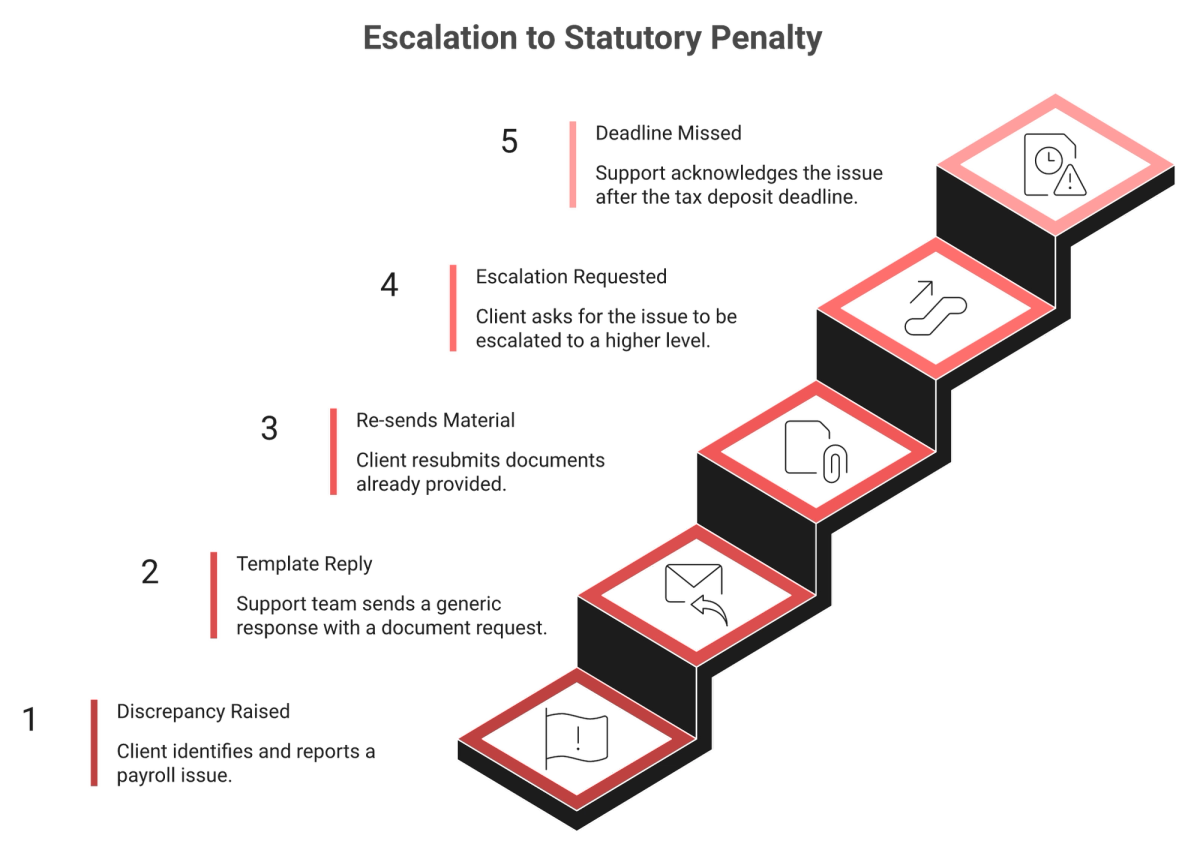
The failure sequence is boringly predictable, and I have watched it from the other side while cleaning up after a switch.
- Client raises a payroll discrepancy on the 3rd.
- Tier-one replies on the 5th with a template and a request for documents.
- Client re-sends what was already attached.
- Escalation is requested on the 6th and acknowledged on the 8th.
- The deposit deadline has passed. Interest and penalty now attach.
Nobody in that chain behaved badly. The architecture just had more steps than the calendar allowed. Teams that decide to move usually work through this guide to switching EOR provider in India first.
✅ Two questions for the vendor call
Ask both, and ask for written answers.
- Who is the named person who owns an escalation, and what is their committed response time in hours?
- Does that commitment appear in the service agreement, or only in the sales deck?
If the answer to the second question is the deck, treat the number as aspiration rather than obligation.
💸 The honest limit of founder-direct support
Versatile Club's escalation path has exactly one step, because clients message me directly. That is sustainable at current scale, and it will have to change as we grow. I would rather name that limit now than discover it with you at twenty clients, which is a conversation worth having on a 30-minute call.
Q9. Who is Remote.com genuinely right for, and who should not buy it?
Remote fits companies placing scattered single hires across many countries, where one vendor, consistent intellectual property assignment paperwork, and a broad owned-entity footprint justify a premium per head. It fits poorly for teams concentrating five or more hires in one hub, for founders making a first or second hire where the fee is a large share of salary, and for anyone needing sub-metro state coverage or same-day escalation. Capterra reviewers raise the small-team cost objection directly. Versatile Club serves only India, so it is the wrong vendor for a buyer who needs one contract covering twelve countries.
⭐ Four situations where Remote is the right call
Versatile Club recommends Remote out loud in these cases, and I have done it on live calls.
- One hire each in Poland, Brazil, Portugal, and Vietnam, with no single country concentrating.
- Intellectual property assignment paperwork that must look identical across every jurisdiction for an acquirer.
- A People Ops team that wants one dashboard and can absorb a three-day support cycle.
- Contractor-heavy teams converting a few people at a time, using the roughly $29 per contractor per month tier listed on Remote's pricing page.
The common thread is spread. When headcount is scattered, breadth is worth paying for. When it is not, the honest comparison set is the one in this guide to best EOR services in India.
❌ Four situations where it works against you
Concentration flips the maths. A $599 monthly fee on a $2,000 monthly Indian salary is roughly 30% overhead.
"The price per Remote employee can be expensive for smaller teams. If you're only hiring one or two employees, the price represents a significant percentage of the outgoing salaries."
— Verified reviewer, small business, Remote - Capterra Verified Review, 2026
"As an employee, I'm giving 3 stars because the product and service itself is fine, but they got some critical things wrong... Cons: Sloppy document generation, Missing tax documents, Documents with the wrong year in the title, Payslips without names."
— Andreas, employee, Remote - Trustpilot Verified Review, 2 December 2025
Payslips without names is a small defect in Berlin. In an Indian provident fund audit it is the document you need, which is why document quality sits inside our compliance scope rather than beside it.
✅ The fit table, three vendors side by side
| Scenario | Remote | Wisemonk | Versatile Club |
| Single hires across 10+ countries | Strong fit | Not applicable | Not applicable |
| 5 to 30 hires concentrated in India | Workable, costly | Strong fit | Strong fit |
| First India hire, cost sensitive | Weak fit | Strong fit | Strong fit |
| Hiring outside the top metros | Verify state coverage | Broad India coverage | All 28 states and 8 UTs |
| SOC 2 Type II required at procurement | Available | Available | Not yet held |
| Same-day escalation to a decision maker | Ticket based | Account managed | Founder direct |
Versatile Club appears in that last row honestly. No SOC 2 Type II, no ISO 27001, as of September 2026, and the current scope is stated on our about us page.
💰 The split-vendor strategy, said plainly
Here is the approach I actually recommend. Use a broad platform for the scattered long tail. Use an India specialist for the concentrated core.
I think of it the way a Series B engineering team thinks about cloud regions. You use one provider globally, then you go deep where your traffic actually lives. Versatile Club's read is that most buyers are paying global pricing for a headcount distribution that is 70% one country, though I hold that view from an India-only vantage point. The structural options are laid out in this comparison of India expansion options.
⚠️ Where I would tell you not to hire us
Versatile Club is the specialist half of that split and only that half. India is the one country we operate in. If you need a single vendor across twelve countries, or procurement requires SOC 2 Type II and ISO 27001 today, we are the wrong call, and I will say so on the first call, including on our startups track.
Q10. Which Remote.com alternatives work better for an India-concentrated team?
For India-concentrated hiring, the strongest alternatives are India-native Employer of Record providers that hold their own Indian entity. Versatile Club charges $149 per employee per month flat, with a 5-day onboarding service level agreement written into the service agreement, $0 setup and exit fees, the first month free, and a 6-month replacement guarantee on placements, as published on our pricing page. Wisemonk follows on salary-slab pricing from $99 to $399, with SOC 2 and ISO 27001 certification, per Wisemonk's published pricing. Deel at $599 plus a $500 setup fee, per Deel's pricing page, Multiplier near $400, per Multiplier's pricing page, and G-P at roughly 15% of salary remain sensible only where multi-country coverage is the binding requirement. Match vendor footprint to where your headcount actually concentrates.
💰 The comparison that decides India deals
Rows are ordered by what buyers actually sign for, not by feature count.
| Criterion | Versatile Club | Wisemonk | Remote | Deel | Multiplier |
| Onboarding SLA | 5 days, contractual | 24 to 72 hrs, not contractual | 10 to 14 days | 7 to 14 days | approx. 7 days |
| Setup and exit fees | $0 and $0, first month free | No setup fee published | Disputed, $0 or $299 | $500 setup | Not published |
| Invoicing | USD from own Indian entity | USD | USD | USD | USD |
| India entity | Owned | Owned | Disputed, owned or partner | Partner | Partner |
| State coverage | All 28 states, 8 UTs | Broad India | Top 4 states reported | Metro focused | Metro focused |
| Support | Founder direct | Account managed | Email ticket, 3-day SLA | Chat first | Named CSR |
| Monthly fee | $149 flat | $99 to $399 slabs | $599 to $699 | $599 | approx. $400 |
| Replacement guarantee | 6 months | None published | None | None | None |
1. Versatile Club
Versatile Club employs through its own Indian entity, invoices in USD from that single entity, and holds provident fund, ESIC, and Shops and Establishments registrations across all 28 states and 8 union territories. Pricing is $149 flat regardless of salary band. Culture-fit screening runs 50 behavioural parameters, followed by a 90-day Success Coach and a 6-month replacement guarantee, which sit inside our EOR services in India offering. The honest gaps: no G2 review history and no SOC 2 Type II yet.
2. Wisemonk
Wisemonk is the closest structural comparison, also India-native with an owned entity, six years operating, SOC 2 and ISO 27001 in place, and 4.8 out of 5 across 261+ G2 reviews. At the entry slab its sticker price is lower than ours. The gaps are retention side: no published replacement guarantee and no structured post-hire coaching, which is the contrast drawn out on our Wisemonk alternative page.
"What I like most about WiseMonk is how they convert a complex international hiring process into a structured and easy workflow... The initial documentation and paperwork felt quite detailed and time-consuming at the beginning."
— Verified User in Marketing and Advertising, Wisemonk - G2 Verified Review, 12 February 2026
3. Deel
Deel gives you the broadest country list and the most investor-recognisable name. It also charges $599 per employee per month plus a $500 setup fee, and routes India through a partner entity. Support is the recurring complaint, and the India-specific trade-offs are set out in this guide to Deel alternatives in India.
"Customer support and issue ownership need serious improvement... I was redirected multiple times, asked to repeat the same information to different representatives."
— Güneş A., contractor, Deel - G2 Verified Review, 2 October 2025
4. Remote, and 5. Multiplier
Remote suits scattered hiring, with strong intellectual property framing and a consolidated interface, at $599 to $699 per employee per month. Multiplier sits near $400 with partner-based India delivery. Both cost more per India head than either India-native option, and both carry the ticket-queue escalation pattern documented in their G2 reviews. Buyers narrowing this pair usually read Multiplier alternatives in India alongside the Remote comparison.
💸 What choosing wrong actually costs
Misclassifying one Indian contractor carries back-pay and penalty exposure in the $25,000 to $40,000 range. That single number outweighs the annual fee difference between any two vendors on this table. Versatile Club's view is that buyers over-optimise the monthly rate and under-price the classification risk sitting underneath it, which is the whole argument in independent contractor versus EOR.
Q11. What should you ask Remote before you sign?
Ask for eight things in writing: the Corporate Identity Number of the employing entity, a live sample invoice with every line item, the states where registrations exist, the named escalation owner with a committed response time, the onboarding service level agreement as a contract clause, the exit notice and exit fee terms, a sample provident fund and ESI challan confirmation, and the data-processing addendum naming storage location and breach process. Versatile Club supplies all eight during procurement without being asked. If a vendor cannot produce a live sample invoice before signature, assume there are line items you have not seen.
✅ The eight artefacts, and the red flag for each
Each item has a document attached to it. Ask for the document, not the reassurance.
- CIN of the employing entity. Verify it on the Ministry of Corporate Affairs portal. Red flag: a company name you have not heard before.
- Live sample invoice. Redacted is fine. Red flag: only a pricing page, never an invoice.
- State registration list. Red flag: "we cover all of India" with no state names.
- Named escalation owner plus response time in hours. Red flag: a shared support inbox.
- Onboarding SLA as a contract clause. Red flag: the number lives in the deck, not the agreement.
- Exit notice and exit fee terms. Red flag: exit terms discussed only after signature.
- Sample PF and ESI challan confirmation. Red flag: "we file everything on time" with no challan number, which the EPFO electronic challan cum return record settles in one screenshot.
- Data-processing addendum. Red flag: no storage location named, against the requirements in G.S.R. 846(E), the DPDP Rules, 2025.
⏰ Ask open questions, not yes or no questions
A habit worth borrowing from cross-cultural management practice. Never ask "are we on schedule?" because the answer is almost always yes.
Ask "where are we on the schedule?" instead. Ask "can you show me what is still pending?" Versatile Club runs its own client check-ins this way, because a closed question invites a comfortable answer and an open one produces a status. The sequence those check-ins follow sits on our how it works page.
⚠️ What a good answer sounds like versus a deflection
A good answer has a number, a date, or a document attached. A deflection has an adjective.
"Our compliance team handles all state filings" is a deflection. "We hold PTRC and PTEC in Maharashtra, file Karnataka professional tax monthly, and here is last month's challan" is an answer. I have watched procurement teams accept the first kind because it arrived confidently, and the filing calendar behind the second kind is documented in payroll compliance in India.
💸 Run the same checklist on us
Versatile Club publishes a day-by-day onboarding sequence, which runs agreement, offer, contract, registrations, then payroll live, and writes the 5-day service level agreement into the signed service agreement. Run these eight questions on us. I would rather you find a gap in procurement than in an audit, so bring the list to a 30-minute call.
FAQs
How much does Remote.com actually cost per employee in 2026?
Remote's published Employer of Record list price sits at $599 per employee per month on annual billing and $699 on monthly billing. Contractor management runs near $29 per person per month. Sources disagree on setup: Remote's own pricing page states no platform, onboarding, or setup fees, while vendor comparison documentation records a $299 upfront charge plus one month's exit notice.
On annual billing, one engineer costs roughly $7,188 in platform fees in year one, before any salary or statutory contribution. The line most buyers miss is exit notice, because leaving mid-quarter still bills a full month of employment you no longer need.
- One hire: approximately $7,188 per year
- Five hires: approximately $35,940 per year
- Twenty hires: approximately $143,760 per year
Versatile Club charges $149 per employee per month flat, with no salary slabs, $0 setup, $0 exit fee, and the first month free, which is published openly on our pricing page. For a five-person Bengaluru pod, the gap against Remote's annual rate is roughly $27,000 a year. Before any demo, we tell buyers to request a live sample invoice, because deposits, FX markup, benefits markup, and exit fees rarely appear on a pricing page.
Is Remote.com legit, and what do reviewers complain about most?
Yes, Remote is a legitimate operator. It averages 4.5 out of 5 across 5,139 G2 reviews, holds 4.5 on Capterra with 4.4 on value for money, and employs through legal entities in its covered markets. Legitimacy and satisfaction are different questions though.
The complaints repeat across platforms and across years, which is what makes them worth reading:
- Support latency on complex cases, including reports of a three-day email service level agreement with no phone-level option
- Payroll and termination delays, sometimes taking months to resolve fully
- Document quality issues, such as missing tax documents, wrong years in file titles, and payslips without names
- Country-specific statutory handling, where local registration steps were never requested from the employee
The pattern we have noticed after six years of reading competitor reviews is that praise describes the first 30 days and complaints describe months three through twelve. Versatile Club holds no G2 profile as of September 2026, and we will not dress that up; what exists instead is a 5-day onboarding SLA written into the signed service agreement, detailed in how it works. If month-nine answers worry you during reference calls, that is the right time to evaluate alternatives.
Does Remote.com own its India entity or work through a local partner?
The sources conflict, and we think that contradiction is itself the finding. Remote markets owned entities across 90 plus countries, and some competitive matrices record its India entity as owned. Other vendor comparisons record India as served through a local partner, with coverage concentrated in the top four states and a 10 to 14 day onboarding cycle. Published country counts range from 60 plus to 186 depending on which reviewer you read.
Rather than settle it from the outside, verify it yourself with five written questions:
- What is the Corporate Identity Number of the entity that will employ my hire?
- Which company's name appears on the employment agreement?
- Which company's provident fund registration number appears on the monthly challan?
- In which states do you hold Shops and Establishments registrations?
- Who signs Form 16 for this employee?
If the first answer names a company you have never heard of, you are on a partner shell. That is not automatically wrong, but you should know before signing rather than during an audit. Versatile Club employs through its own Indian entity, Foo Falcon Technologies Pvt Ltd, and holds provident fund, ESIC, and Shops and Establishments registrations across all 28 states and 8 union territories, as set out on our compliance page.
What are the best Remote.com alternatives for hiring in India?
For India-concentrated hiring, the strongest alternatives are India-native Employer of Record providers that hold their own Indian entity rather than routing through a partner.
- Versatile Club: $149 per employee per month flat, contractual 5-day onboarding SLA, $0 setup and exit fees, first month free, all 28 states and 8 union territories, 50-parameter culture-fit screening, 90-day Success Coach, and a 6-month replacement guarantee
- Wisemonk: India-native with an owned entity, salary-slab pricing from $99 to $399, SOC 2 and ISO 27001 in place, though with no published replacement guarantee
- Deel: broadest country list, $599 per employee monthly plus a $500 setup fee, India delivered through a partner entity
- Multiplier: near $400 per employee monthly, partner-based India delivery
The decision rule is simple: match vendor footprint to where your headcount actually concentrates. Global platforms earn their premium on scattered single hires across many countries. They rarely earn it on a five-person Bengaluru engineering pod. Versatile Club is the specialist half of that split and only that half, since India is the one country we operate in, and the full shortlist logic sits in our guide to Remote alternatives in India. We also flag our own gaps: no SOC 2 Type II and no G2 review volume yet.
Do high review scores prove an EOR handles Indian statutory compliance correctly?
No, and this is the most expensive assumption in EOR procurement. Review scores measure what a user can actually see, which is the interface, onboarding flow, and invoice clarity. They measure almost nothing a compliance failure would surface.
A payroll user cannot rate whether a Karnataka professional tax return was filed on the correct monthly cycle, whether gratuity accrued at 4.81% of Basic plus dearness allowance from month one, or whether both Maharashtra PTRC and PTEC registrations exist. Statutory defects compound silently, then arrive together at audit or diligence, often 18 months later. Nobody posts a bad review in that window because nothing looks broken.
Swap the star rating for artefacts you can file:
- Provident fund and ESI challan confirmation numbers, monthly
- Tax deducted at source receipts, dated by the 7th
- Form 16 issued by 30 May, with Form 12BA where perquisites apply
- State-wise professional tax proof for every state you employ in
- A payslip showing Basic plus dearness allowance at or above 50% of cost to company
Versatile Club sends one monthly client pack containing the single USD invoice, payroll summary, compliance status, challan confirmations, and TDS receipts as part of our managed payroll service. CFOs are not asking whether a vendor is pleasant to deal with. They are asking what they hand an auditor in March.