How to Hire Employees in India: Legal Routes, Employer Duties and Every Step to Payday
Checked against 17 government sources. Last verified 29 October 2026.
Versatile Club is an India-only Employer of Record (EOR). Its EOR service employs your India team on its own registered Indian company, so you don't need one. These docs show what happens at each step: onboarding, the contract, payroll, PF and ESI, tax and billing.
Onboarding, in five business daysWritten into the service agreement
Every part of employing someone in India
What lands in your inbox each month
Verify Versatile Club before you sign
Recent changes to India's employment law
Your US company is hiring employees in India, and you have no Indian company to employ them. How to hire employees in India comes down to one rule: an Indian company has to be the legal employer. That is true for any US company hiring there. The Indian company signs the contract, runs payroll and files the statutory contributions. You can hire contractors, use an Employer of Record (EOR) that owns an Indian company, or set up your own. Versatile Club is an India-only Employer of Record (EOR) that employs teams on its own registered Indian company. These pages cover every step from the first offer to an exit.
At a glance
| Can a US company hire employees in India? | Yes. It needs an Indian company to employ them: its own, or an Employer of Record's |
| The three legal routes | Independent contractors, an Employer of Record (EOR), or your own Indian private company |
| Who employs your team under Versatile Club's EOR service | Foo Falcon Technologies Pvt Ltd, its own registered Indian company in Bengaluru |
| Time from signature to payroll | Five business days, written into the service agreement |
| What the law asks of the employer | An appointment letter, wages paid on time with a wage slip, Provident Fund, ESI where it applies, income tax deducted from salary and state professional tax |
| What you receive each month | One USD invoice, a payroll summary, a compliance status report, PF and ESI challan confirmations and TDS deposit receipts |
| What it costs | A flat monthly fee per employee, no setup fee, no exit fee, first month free. Figures are on the pricing page |
Can a US company hire employees in India?
Yes, and many do. Before you make an offer, know that you can't put an Indian resident on your US payroll and treat that as Indian employment. Indian employment law places its duties on an employer in India: PF registration, salary tax deduction, state professional tax and the Labour Codes. Your job is to pick which Indian company will carry those duties.
A foreign company from anywhere faces the same choice, whether it sits in Delaware, London or Singapore. If you don't want to build an Indian company yet, an Employer of Record carries the employer's duties on its own registrations. You still choose the person, set the work and manage them every day.
Three legal ways to hire in India from the US
Every lawful India hire runs through one of three structures. They differ in who the employer is, what you have to set up and which risks stay with you.
| Route | Who is the legal employer | What you set up | What stays with you |
|---|---|---|---|
| Independent contractor | Nobody. The person runs their own business and invoices you | A contractor agreement and a way to pay in India | The risk that a long-running, full-time contractor is really an employee |
| Employer of Record | The EOR's Indian company, which runs payroll and files contributions | A service agreement with the EOR | Choosing the person and directing their work |
| Your own Indian company | Your Indian private company | Incorporation, a board of directors, and every employer registration | Every filing, every month, in every state where staff work |
Hiring independent contractors in India
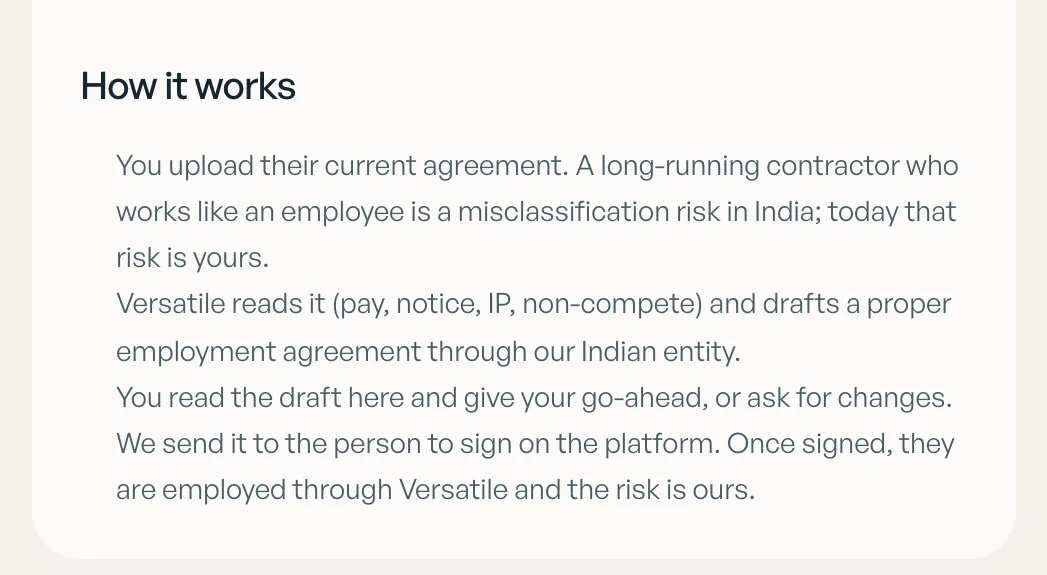
A contractor is the fastest way to start. You sign an agreement, the person invoices you and you pay them. There is no PF, no salary tax deduction and no appointment letter, because there is no employment.
The catch is time and control. A contractor who works full time for one company, on that company's hours and tools, starts to look like an employee. The India contractor misclassification quiz walks through the signs. Code is the other risk, because copyright rules treat employees and contractors differently.
Hiring through an Employer of Record
An Employer of Record is an Indian company that employs your hire on its own payroll. It issues the offer and the contract, registers the person for PF and ESI, deducts tax and pays the salary. You pay the EOR one invoice and direct the person's work.
This route suits a first hire, a small team, or a team you want to test before committing to an entity. Versatile Club's Employer of Record (EOR) service employs your team on its own Indian company, Foo Falcon Technologies Pvt Ltd. As your Employer of Record, it files PF, ESI, TDS and professional tax under its own registrations.
PEO in India: why an EOR is used instead
A professional employer organization (PEO) is a co-employment model common in the US. Your company stays the employer, and the PEO shares payroll and HR administration with you. That only works where your company is already an employer in that country.
In India, the employer's duties sit with an employer in India: PF registration, salary tax deduction and the Labour Codes. A foreign company with no Indian company has no Indian employer to share them with. So a search for a PEO in India usually ends at an EOR, which is the whole employer rather than a co-employer. If you already have an Indian entity, the nearest match to a PEO is managed payroll, where your entity stays the employer.
Setting up your own Indian company
Your own private company gives you full control, and every employer duty with it. Company law sets board rules before you hire anyone, including a director who lives in India for part of each year. The details are under what the law says, below.
After incorporation come the employer registrations and a monthly filing cycle. If you are weighing this against an EOR, the EOR vs entity break-even analysis compares the two by headcount.
Which route fits your stage
- One to a few hires, no Indian company yet. An EOR lets you employ properly from the first person, without a board or registrations.
- You already pay contractors in India. Converting them to employees on an EOR removes the misclassification risk without changing the person or the work.
- You plan a large India centre later. Run the first team on an EOR, then move it into your own entity. The GCC test plan covers this path.
- You already have an Indian entity. You need payroll run, not an employer. Versatile Club's managed payroll serves companies with an existing India entity.
How to hire employees in India, step by step
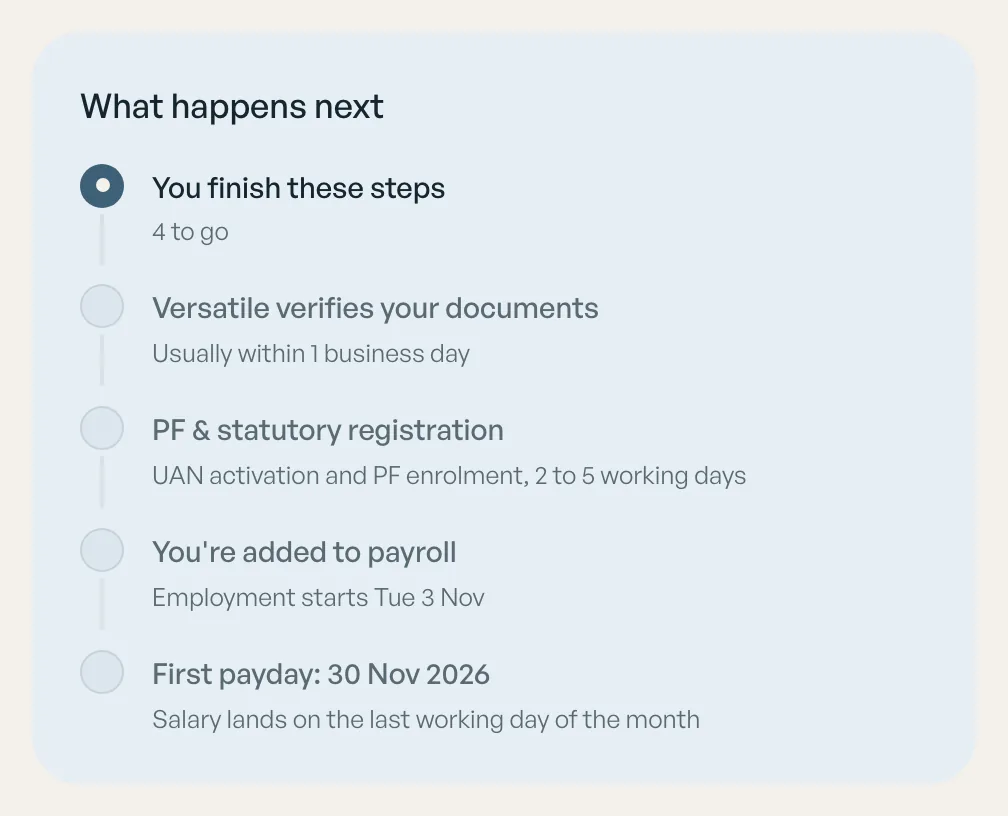
With Versatile Club as your Employer of Record, hiring takes five business days from signature to payroll. After that, the work runs monthly. Here is the whole path, with the page that covers each step.
- Choose your route. Contractors, an Employer of Record or your own Indian company each ask different things of you. The three ways to hire in India are compared side by side.
- Check who will employ your team. With an EOR, a named Indian company becomes the employer. Learn how to verify an EOR's entity, then compare it with the numbers we publish on our About page.
- Sign the service agreement. This is day one. Our five-day onboarding is a commitment written into that agreement.
- Send the offer and sign the contract. On day two the candidate gets an India-compliant offer letter. On day three the employment contract is signed and documents are collected.
- Register the employee. On day four, PF, ESI and professional tax are initiated. The employer PF contribution page explains a main statutory cost on top of salary.
- Pay every month. On day five the employee is active on payroll. The monthly payroll run covers deductions, tax and the payroll summary you get.
- Keep the proof. Each month brings one USD invoice with a per-employee breakdown and a status report on what's filed and what's due. PF and ESI challan confirmations and TDS deposit receipts come with it.
- Close the year and any exit. We commit to issuing each employee Form 130 (formerly Form 16) by 30 May. When someone leaves, the Full and Final settlement covers notice, leave encashment, gratuity, PF and the relieving letter.
From offer to first payday: the legal anchor for each step
| When | What happens | Why the law needs it |
|---|---|---|
| Day 1 | Service agreement signed between your company and Versatile Club | Sets who the employer is before any offer goes out |
| Day 2 | India-compliant offer letter sent to the candidate | The OSH Code requires a letter of appointment for every employee |
| Day 3 | Employment contract signed, documents collected | PAN and bank details are needed for salary tax and payment |
| Day 4 | PF, ESI and professional tax initiated | The EPF Scheme sets employer PF at 12% of wages |
| Day 5 | Employee active on payroll | Salary tax is deducted at payment under section 392 of the Income-tax Act, 2025 |
| Each month | Salary paid with a wage slip | Monthly wages are due before the seventh day of the next month |
Start here
Find what you need by role
| You are | Your first question | Start with |
|---|---|---|
| A founder making a first India hire | Can we employ someone there without our own Indian company? | Hiring in India without an entity and India EOR for founders |
| A CFO or finance lead | What does a hire really cost, and what proof comes back? | Provident Fund for employers and the monthly payroll and compliance reports |
| A People Ops or HR lead | How fast can someone start, and who runs payroll? | Documents you and your employees receive |
| A legal or compliance reviewer | Which company employs our people, and can we check it? | Versatile Club's registrations |
| Planning your own India centre later | Can we start small and move the team over in time? | Proving India before a GCC and building a GCC in India |
Who employs your team
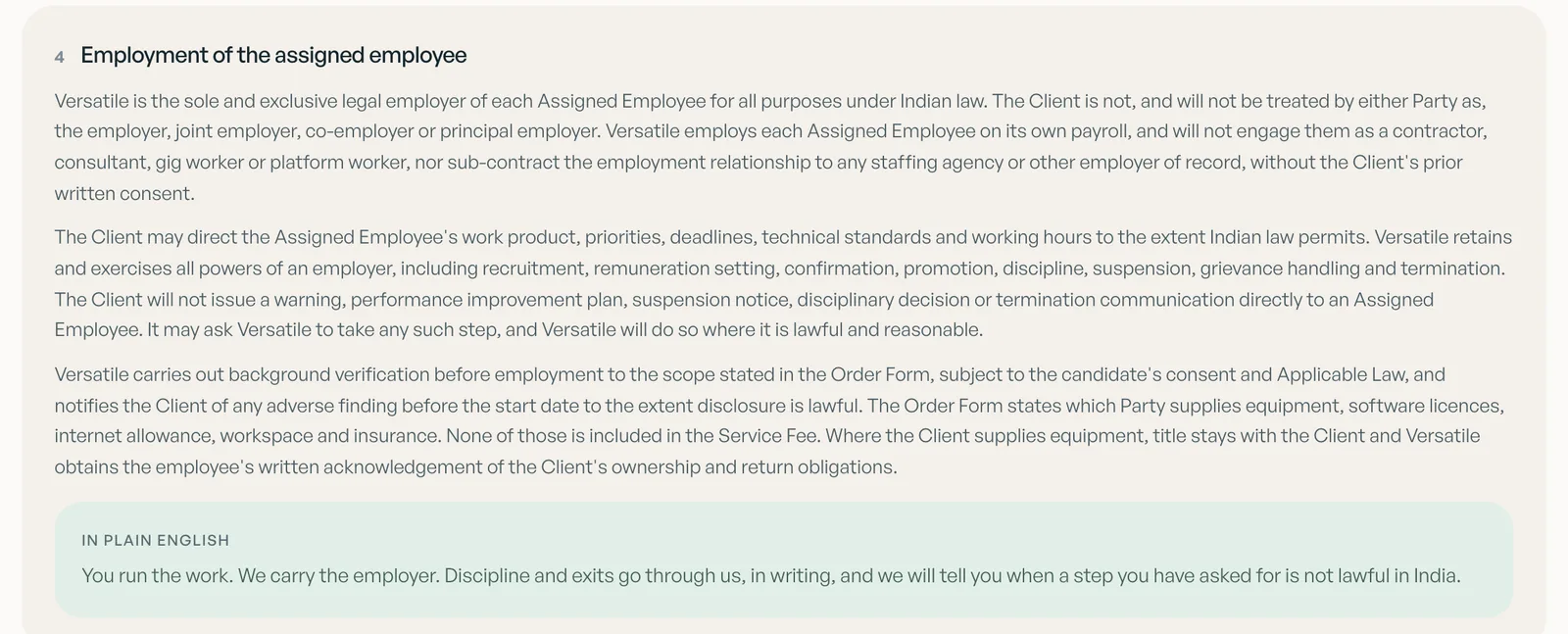
Versatile Club's Employer of Record (EOR) service employs your team on its own Indian company, Foo Falcon Technologies Pvt Ltd, registered in Bengaluru. As your Employer of Record, we file each employee's PF, ESI, TDS and professional tax under our own registrations, not yours.
We are an India-only EOR, working across all 28 states and 8 union territories with registrations in every state. EOR is a new service for us. The entity and the compliance work behind it were built and tested through our Contract-to-Hire business, which places people with US and UK companies.

The agreement also settles the question your lawyers will ask first. Versatile Club is the sole legal employer, and your company directs the work.
Primary hiring cities
The primary hiring cities, from the Contract-to-Hire record, are Bengaluru, Hyderabad and Pune. Versatile Club serves companies hiring from the US and hiring from the UK, and invoices in USD from its Indian entity.
What the law says
India's four Labour Codes now set the rules for wages, social security, workplace conditions and industrial relations. Tax on salary sits under the Income-tax Act, 2025, and professional tax under each state's law. Each duty below falls on the legal employer. These were checked against the original documents on 29 October 2026.
The Labour Codes now apply
The Code on Wages took effect on 21 November 2025, under notification S.O. 5322(E). The government appointed "the 21st day of November, 2025 as the date on which the following provisions of the said Code, shall come into force". The Code on Wages (Central) Rules, 2026, G.S.R. 343(E), took effect on publication on 8 May 2026.
For the Code on Social Security, the Labour Ministry records that "all the provisions of the said Code have been brought into the force". That appears in the recital to the draft central rules. Its definition of wages applies with effect from 21 November 2025, according to the Ministry's FAQ.
What to check: make sure your salary structure and payroll rules follow the Codes from the dates above.
Government sourcelabour.gov.inGive every employee an appointment letter
Every employer covered by the Occupational Safety, Health and Working Conditions Code must put the job in writing. Section 6 of the OSH Code, 2020 tells the employer to "issue a letter of appointment to every employee on his appointment in the establishment". With an EOR, the EOR issues it, because it is the employer.
What to check: under an EOR, confirm the letter has been issued. On your own entity, issue it yourself on appointment.
Government sourceegazette.gov.inPay on time and issue a wage slip
Under section 17 of the Code on Wages, 2019, monthly wages are due "before the expiry of the seventh day of the succeeding month". Section 50 adds that "every employer shall issue wage slips to the employees". So a September salary has to reach the employee by 7 October, with a slip showing how it was worked out.
What to check: each month, confirm the salary and the wage slip both reach the employee by the seventh.
Government sourceindiacode.nic.inKeep at least half of pay as wages
India's new definition of wages stops employers from shrinking Basic pay to cut contributions. If allowances such as HRA and conveyance exceed one-half of total pay, the excess counts as wages. The Code on Wages applies this where excluded payments "exceeds one-half, or such other per cent. as may be notified by the Central Government".
This matters because PF and gratuity are worked out on wages. The salary structure guide shows how Basic, allowances and deductions fit together under the rule.
What to check: before the offer, add up the allowances and see whether they exceed half of total pay.
Government sourceindiacode.nic.inPay into the Provident Fund
The Employees' Provident Fund Scheme, 2026 sets the employer's share "at the rate of twelve per cent of the wages payable to the employee". The employee pays an equal share from salary. Where monthly wages exceed the wage ceiling, both shares are "limited to the contribution payable on the wage ceiling".
That ceiling is ₹25,000 a month from 17 September 2026, under S.O. 5109(E). The notification sets the figure "as the wage ceiling for the purposes of Chapter III of the said Code". The India payroll compliance calendar shows when each monthly PF payment falls due.
What to check: compare each employee's monthly wages with the wage ceiling above, because both shares are limited to it.
Government sourceegazette.gov.inCover lower-paid staff under ESI
Employees' State Insurance is India's statutory health and income cover. ESIC states that employees "drawing wages up to 21000/- a month, are entitled to social security cover", on its coverage page. The current contribution rates are 0.75% of wages from the employee and 3.25% from the employer.
What to check: compare each employee's wages with the ESI coverage limit above to see whether ESI applies.
Government sourceromaharashtra.esic.gov.inDeduct income tax from salary
Salary tax in India is deducted by the employer, not paid by the employee alone. Section 392 of the Income-tax Act, 2025, in force from 1 April 2026, says the payer of salary "shall deduct income-tax on the amount payable". The TDS on salary page covers deposits and the annual certificate.
What to do: make sure tax is deducted each time salary is paid.
Government sourceegazette.gov.inDeduct professional tax where the state levies it
Professional tax is a state tax, so the rules change with the state where your employee works. In Karnataka, the official employer FAQ exempts "salaried individuals with a monthly gross income of less than Rs. 25,000/- per month". Employers there must "make the payment within 20th of succeeding month". The statutory compliance pages cover other states.
What to check: confirm the state where each employee works, because the threshold and payment date change by state.
Government sourceptax.karnataka.gov.inFixed-term contracts carry equal terms
Fixed-term employment is lawful in India, but it can't be a cheaper class of job. Section 2(o) of the Industrial Relations Code, 2020 requires a written contract for the fixed period. Hours, wages and benefits "shall not be less than that of a permanent worker doing the same work or work of similar nature".
The same clause gives fixed-term staff statutory benefits in proportion to their service. It also says "he shall be eligible for gratuity if he renders service under the contract for a period of one year".
What to check: compare the fixed-term contract's hours, wages and benefits with those of a permanent worker doing the same work.
Government sourceindiacode.nic.inPay gratuity after five years
Gratuity is a lump sum paid when employment ends. Section 53 of the Code on Social Security, 2020 makes it payable "after he has rendered continuous service for not less than five years". The rate is fifteen days' wages for each completed year of service.
For a monthly-paid employee, the Code works out fifteen days' wages by "dividing the monthly rate of wages last drawn by him by twenty-six and multiplying the quotient by fifteen".
What to check: budget for gratuity as an employee approaches five years of service.
Government sourceindiacode.nic.inSettle final wages within two working days
Exits have a hard deadline. Under section 17(2) of the Code on Wages, wages due on removal, dismissal, retrenchment or resignation "shall be paid within two working days". That is why the Full and Final settlement has to be ready before the last day.
What to do: ask for the settlement figures before the last day, so the wages go out within two working days.
Government sourceindiacode.nic.inWho owns the code your team writes
Section 17 of the Copyright Act, 1957 treats employees and contractors differently. For work made under a contract of service, "the employer shall, in the absence of any agreement to the contrary, be the first owner of the copyright therein". A contractor is not under a contract of service, so you need a written assignment. The intellectual property page explains how ownership passes to your company through an EOR.
What to do: if you hire a contractor, get a written assignment signed.
Government sourceindiacode.nic.inIf you set up your own Indian company
Section 149 of the Companies Act, 2013 requires a board of "two directors in the case of a private company". At least one director must stay "in India for a total period of not less than one hundred and eighty-two days during the financial year". A newly incorporated company applies this test proportionately in its first financial year.
What to check: before you hire, confirm the board has two directors and that one will stay in India for 182 days.
Government sourcemca.gov.inRates and deadlines for India employers
These are the figures a US company meets when it employs in India, each with the instrument that sets it. The India statutory rates and thresholds reference holds the full set.
| Obligation | Figure or deadline | Source |
|---|---|---|
| Monthly salary | Paid before the seventh day of the following month | Code on Wages, 2019, s.17 (Gazette) |
| Final wages on exit | Within two working days of leaving | Code on Wages, 2019, s.17(2) (Gazette) |
| Employer PF | 12% of wages, with an equal employee share | EPF Scheme, 2026, para 18 |
| PF wage ceiling | ₹25,000 a month from 17 September 2026 | S.O. 5109(E) |
| ESI coverage | Wages up to ₹21,000 a month | ESIC coverage note |
| ESI contributions | 3.25% employer, 0.75% employee | ESIC contribution guidance |
| Salary tax | Deducted when salary is paid | Income-tax Act, 2025, s.392 |
| Karnataka professional tax | Payable by the 20th of the following month; monthly gross below ₹25,000 exempt | Karnataka PT employer FAQ |
| Gratuity | After five years; fifteen days' wages per year, at monthly wages ÷ 26 × 15 | Code on Social Security, 2020, s.53 |
| Fixed-term gratuity | After one year of service under the contract | Industrial Relations Code, 2020, s.2(o) |
| Appointment letter | Issued to every employee on appointment | OSH Code, 2020, s.6 |
Worked example: one engineer in Bengaluru
Here is how the rules play out for one hire. The salary is a round sample figure, not a quote or a benchmark.
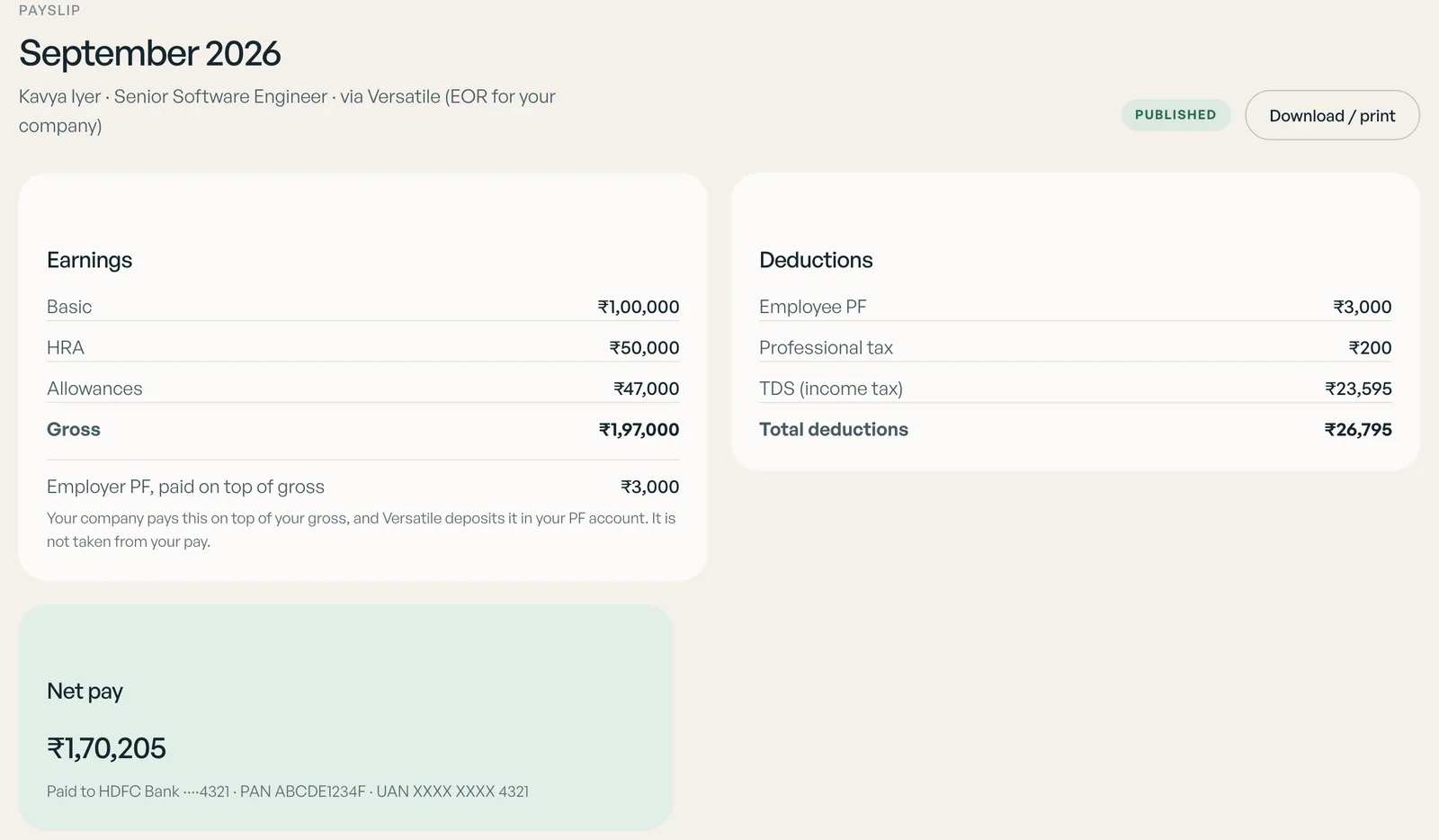
Say you employ a software engineer in Bengaluru at a monthly gross of ₹50,000. Basic is ₹25,000, and HRA plus allowances make up the other ₹25,000. The allowances are exactly one-half of pay, so nothing is added back under the 50% wage rule, and wages stay at ₹25,000.
- Provident Fund. Wages of ₹25,000 sit at the ₹25,000 ceiling. At 12%, the employer pays ₹3,000 on top of gross, and ₹3,000 comes out of the engineer's salary.
- ESI. A gross of ₹50,000 is above the ₹21,000 coverage limit, so ESI doesn't apply to this hire.
- Professional tax. A monthly gross of ₹50,000 is above Karnataka's ₹25,000 exemption threshold, so professional tax is deducted.
- Gratuity, if they stay five years. Fifteen days' wages is ₹25,000 ÷ 26 × 15 = ₹14,423 per year under section 53. After five years, that is ₹72,115.
Salary tax depends on the engineer's own tax position, so it isn't computed here. To estimate the full employer cost for a salary you have in mind, use the India employee cost calculator.
How to hire Indian developers and programmers
Most US founders who look to hire Indian developers want React and Flutter developers, app developers, ML engineers or full-stack programmers. Hiring Indian coders follows the same legal path whatever the stack. A developer is an employee like any other, with the same PF, tax and contract duties.
Contractor developer or employee
Many first India developers start as contractors found through a marketplace or a referral. That works for a short project. Once the developer works full time, only for you and inside your team, the arrangement starts to look like employment. Moving them onto an EOR payroll keeps the person and the work, and changes the legal employer.
Versatile Club's Contract-to-Hire service follows that pattern: start as a contractor, convert to a full-time employee when ready. The contractor conversion planner maps the switch for an existing team.
Who owns the code
For a software company, code ownership decides whether your product is really yours. An employee's code made in the course of employment belongs to the employer under the Copyright Act, unless an agreement says otherwise. With an EOR, the employment contract and the service agreement pass that ownership on to your company.
What to settle before the offer goes out
- Salary structure. Basic should be at least half of total pay, so the PF and gratuity figures in your budget hold.
- Start date. Developers often serve notice with a current employer, so agree the date before day one of onboarding.
- Where they will work. Professional tax follows the state where the person works, so a Pune hire and a Bengaluru hire differ.
- Fixed term or open-ended. A fixed-term contract is lawful, on equal terms with permanent staff.
- Code and confidentiality. Confirm the IP terms in the employment contract before signature.
Our primary hiring cities are Bengaluru, Hyderabad and Pune. The EOR guide for AI companies covers ML and research engineering hires.
What it costs
Versatile Club charges a flat monthly fee per employee, with no setup fee and no exit fee, and the first month is free for new hires. The figures are on the pricing page.
The employer's statutory costs come on top of salary. The largest is usually the employer's PF share, shown in the worked example above.
What goes wrong and what to check
- Salary reaches the employee after the seventh day. The wage slip is late or missing, and a September salary arrives after 7 October. Check the monthly compliance status report for what is filed and what is due.
- A full-time contractor starts to look like an employee. The risk shows when one person works full time for one company, on its hours and tools. Take the misclassification quiz, or convert the person to an employee through an EOR.
- Allowances run above half of total pay. The excess counts as wages, so PF and gratuity come out higher than your budget assumed. Check the salary structure before the offer goes out.
- Professional tax follows the wrong state. Thresholds and payment dates differ by state, and Karnataka's is the 20th of the following month. Confirm where the employee works before onboarding.
- Final wages go out late. Wages due on resignation or removal must be paid within two working days. Ask for the Full and Final settlement before the last day.
Common questions
Can a US company hire employees in India without an Indian entity?
Yes, through an Employer of Record. The EOR's Indian company employs your team and files their statutory contributions. Versatile Club's EOR service employs your team on Foo Falcon Technologies Pvt Ltd.
Can a foreign company hire employees in India directly?
Only through an Indian company that acts as the employer. That can be the foreign company's own Indian subsidiary or an Employer of Record. A UK, Singapore or US parent faces the same choice.
Who is the legal employer under Versatile Club's EOR service?
Foo Falcon Technologies Pvt Ltd, the registered Indian company that operates Versatile Club. As your Employer of Record, it files your employees' PF, ESI, TDS and professional tax under its own registrations.
How long until a new hire is on payroll?
Five business days from signing the service agreement. That timeline is written into the agreement as a commitment, and the employee is active on payroll on day five.
Can we hire independent contractors in India instead?
Yes, for genuine project work. A contractor who works full time for you alone, inside your team, carries misclassification risk. Converting them to employees through an EOR keeps the same person and removes that risk.
Are fixed-term employment contracts allowed in India?
Yes. The Industrial Relations Code allows written fixed-term contracts, but hours, wages and benefits can't fall below those of comparable permanent staff. Fixed-term staff qualify for gratuity after one year.
When must salaries be paid in India?
For monthly pay, before the seventh day of the following month, under the Code on Wages. Each payment comes with a wage slip.
Who owns code written by a developer we employ in India?
The employer owns code made in the course of employment, unless an agreement says otherwise. Through an EOR, the contracts pass that ownership to your company. A contractor needs a written assignment.
What do we receive each month?
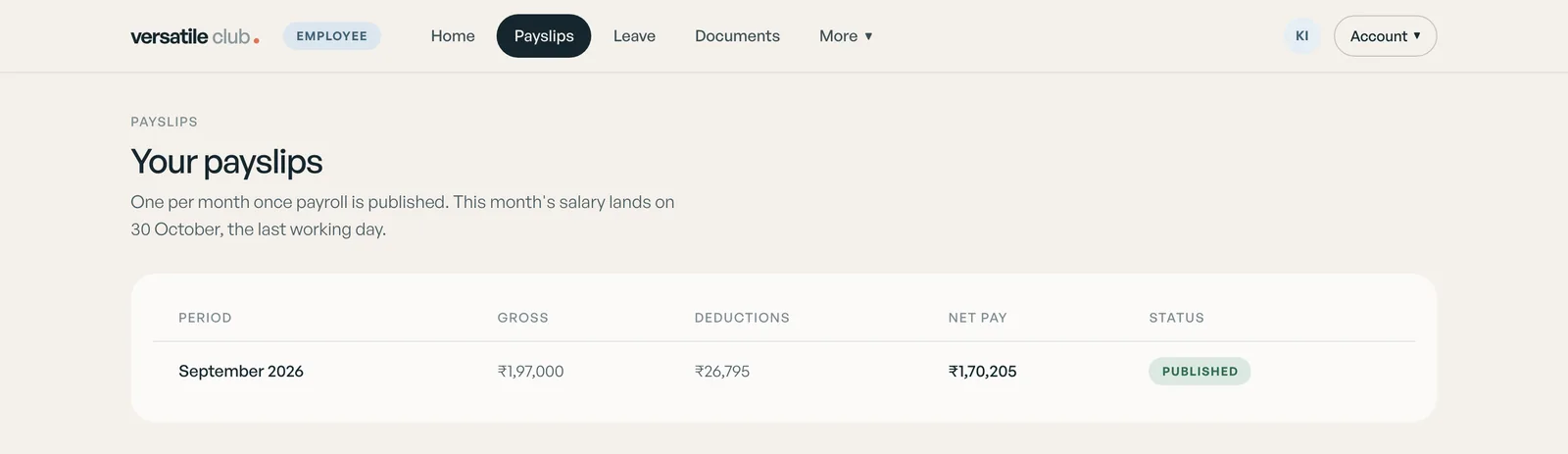
One USD invoice with a cost breakdown per employee, a payroll summary showing gross, deductions and net pay, and a compliance status report. PF and ESI challan confirmations and TDS deposit receipts come with it.
Which parts of India does Versatile Club cover?
All 28 states and 8 union territories, with registrations in every state. It is an India-only EOR and works nowhere else.
What does Versatile Club charge?
A flat monthly fee per employee, with no setup fee, no exit fee and the first month free for new hires. The figures are on the pricing page linked under what it costs, above.
How do I hire Indian workers from abroad?
Choose a legal route first: a contractor agreement, an Employer of Record or your own Indian company. With an EOR, you pick the person, and the EOR issues the offer and contract, registers them for PF and pays them monthly.
Is a PEO the same as an EOR in India?
No. A PEO shares employer duties with a company that is already the employer. A foreign company with no Indian entity can't be that employer in India, so an EOR takes on the whole role.
How do we reach the Versatile Club team?
Write through the contact page. Tell the team how many people you plan to hire, and where in India.
About this documentation
Each page shows who it applies to, its status and the date it was last checked. Statutory figures link to the original government document they come from. Versatile Club is a service, so these pages describe what the team does and what you receive. Terms you don't know are in the India EOR and payroll glossary.