Employment Contract in India: Template Terms, Notice Period Rules and the Law Behind Them
Checked against 14 government sources. Last verified 29 October 2026.
You're checking an EOR's contract before an India hire signs, and you want the actual terms and proof that they comply. An employment contract in India gives your hire the terms Indian law expects, and it names a real Indian employer behind them.
Versatile Club is an India-only Employer of Record (EOR). Its EOR service employs your hire on its own Indian company, Foo Falcon Technologies Pvt Ltd, and Indian law sets much of the contract. This page walks through the template term by term, including what you can ask to change: probation, notice, non-competes, fixed-term work, leave, termination and POSH, each with the law behind it.
At a glance
| Who the employer is | Foo Falcon Technologies Pvt Ltd, the registered Indian company that operates Versatile Club |
| Who signs it | Your new hire, with the EOR countersigning. Your company signs a separate service agreement with Versatile Club |
| What it states | Designation, place of work, wages and wage structure, hours, leave, notice period and statutory benefits |
| Probation and notice | Set for each hire from your company's standard terms, and changeable for one person |
| Law it follows | Indian law, with the Republic of India as the contract's territory |
| Clause to read closely | The restrictive covenants, because Indian contract law voids restraints of trade to the extent they restrain |
| On exit | A Full and Final settlement covering notice, leave encashment, gratuity, PF and the relieving letter |
| Fees | A flat monthly fee, no setup fee, no exit fee, first month free (plans and pricing) |
What an employment contract in India is
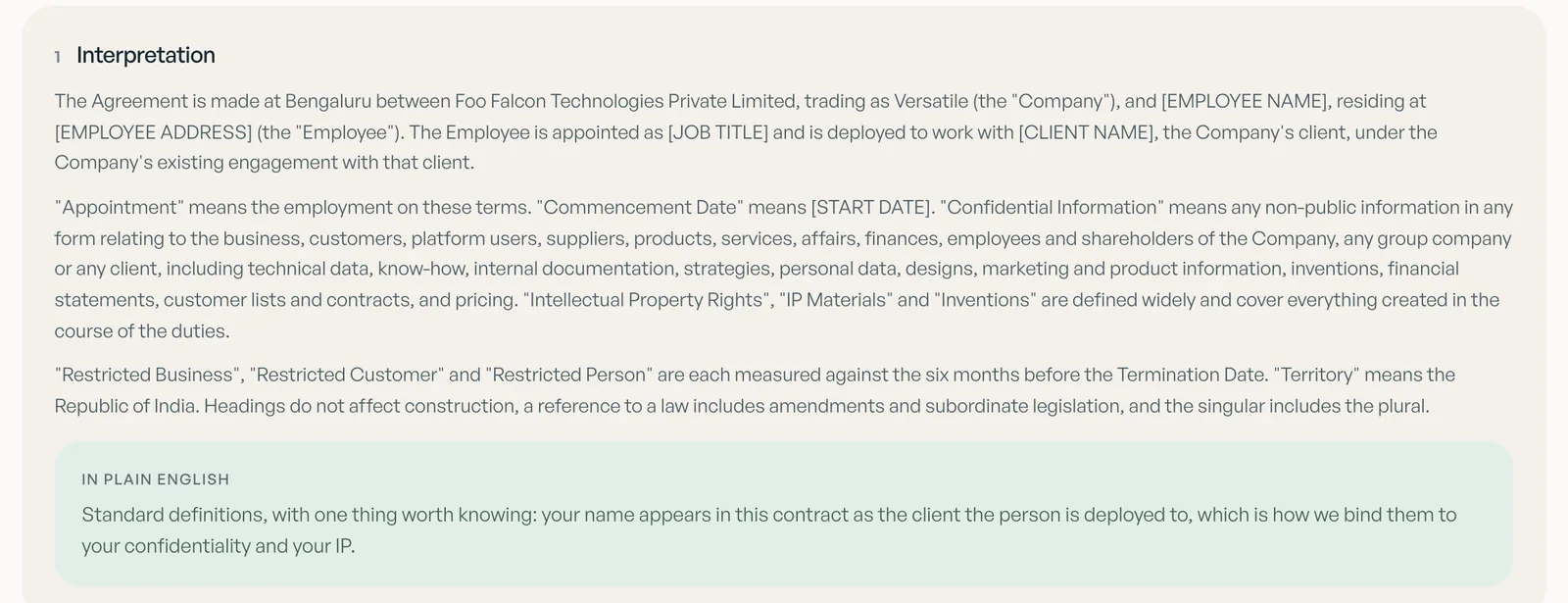
When you review the contract, the first thing to settle is who the employer is. The employment contract is the agreement between your hire and the company that employs them in India. With an Employer of Record, that company is the EOR, not you. Versatile Club owns its entity outright, so it isn't a shell or a partnership arrangement. Your hire's PF, ESI, TDS and professional tax filings sit under that company's registrations, listed on the Indian entity and registrations page.
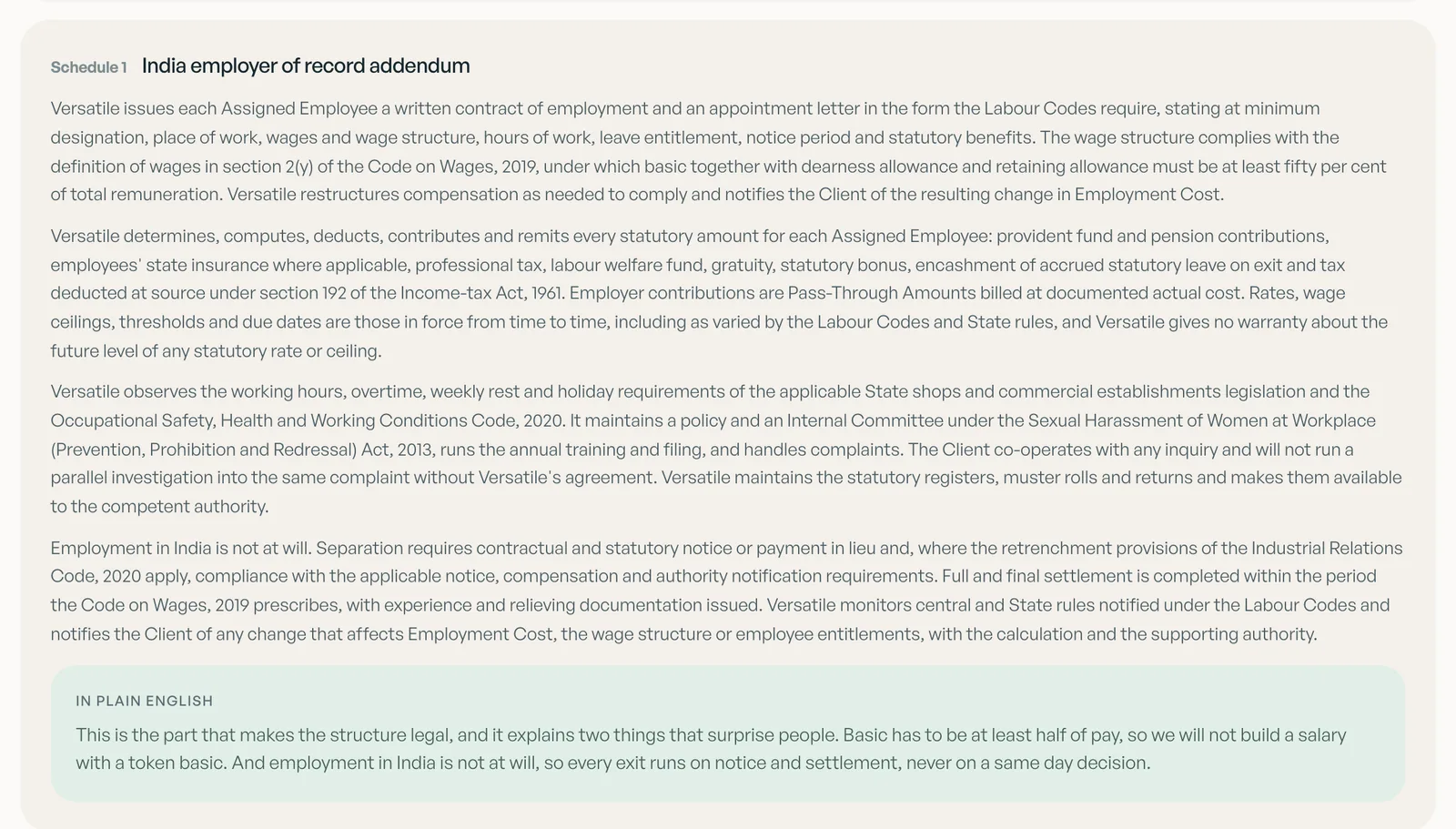
The EOR's India addendum commits it to issue each employee a written contract of employment and an appointment letter in the form the Labour Codes require. Both state, at minimum, the designation, place of work, wages and wage structure, hours of work, leave entitlement, notice period and statutory benefits. So the template your reviewer reads already carries the fields the law asks for.
Two contracts sit side by side. Your company signs a service agreement with Versatile Club on Day 1, and your hire signs the employment contract on Day 3. Day-to-day reporting, work schedules and task assignment can come from your team, while the employee remains the EOR's employee throughout. The India employment contract and leave guide covers the wider rules.
Why the employment contract matters
The job you need done
Before anyone signs, you need to show two things. The terms your hire works under must fit Indian law. One named company must be legally responsible for them. An employment contract in India is the document that shows both.
What it lets you do
- Name the employer. The contract identifies the Indian company that holds the employer's duties.
- Check the terms against current law. Hours, leave and the wage base follow the labour codes, not a foreign template.
- Plan the exit. Notice, leave encashment, gratuity and PF are settled in one Full and Final settlement.
- Fit your review to a known day. The contract is signed on Day 3, so your review fits a known window.
What goes wrong if it's missed
Without a written contract that fits Indian law, the terms are open to dispute. Clauses copied from another country may not hold, and statutory entitlements can be missed. The gap can show at a bad moment. That might be an exit, a claim or an investor's diligence request.
Where you'll run into it
If you work in legal or compliance at a US or UK company, you meet it first. You sign off before the offer goes out, and you answer for the terms later. It matters most on a first India hire, when there's no local contract to compare against.
The Versatile Club approach to the employment contract
The head of People at a London healthtech company is hiring a product analyst in Chennai. Her general counsel wants the India contract on his desk before the offer goes out. He has read UK contracts for years, but never one governed by Indian law.
A common shortcut is to send the home template with a few edits. It may carry an at-will exit, a broad non-compete and pay clauses written for another tax system. Some of that may not hold in India. The gaps tend to surface at an exit or in a dispute, long after signing.
The rules have also moved. India's four labour codes now shape working hours, leave, the wage base and notice for many employees. So the contract has to start from current Indian rules, and it needs an Indian employer able to carry them.
As an India-only Employer of Record, Versatile Club is that employer, on its own Indian company. It sends the candidate an India-compliant offer on Day 2, and the EOR and the hire sign the employment contract on Day 3. The wage base follows the Labour Code rule on Basic plus DA. When the job ends, the EOR runs the Full and Final settlement, relieving letter included.
The general counsel can check the employer before he reads a single clause. The contract names Foo Falcon Technologies Pvt Ltd, whose CIN and tax numbers are published on Versatile Club's site. How that stacks up against other providers is covered in How Versatile Club compares for employment contracts in India, below.
What the law says
India has no single statute that writes an employment contract for you. Instead, four labour codes and the Indian Contract Act fix certain terms and void others. The Industrial Relations Code came into force on the 21st day of November, 2025. Each obligation below quotes the instrument itself, so your reviewer can read the source.
The appointment letter
Under the OSH Code, an employer in a covered establishment must "issue a letter of appointment to every employee on his appointment in the establishment." The government prescribes the information and form. For a reviewer, this means the written terms are a statutory duty, not a courtesy. As the employer, Versatile Club issues the appointment letter and the employment contract. What to check: read the appointment letter and the contract together against the fields the law requires.
Government sourcelabour.gov.inProbation
No code sets one probation period for every job. The Model Standing Orders define a probationer as someone "provisionally employed to fill a permanent vacancy in a post and has not completed six months service therein." The same orders allow an extension, after assessing performance, for a further period not exceeding three months. Standing orders apply to an industrial establishment with "three hundred or more than three hundred workers." Smaller employers set probation in the contract. What to check: confirm the contract says how long probation lasts, whether it can be extended and what notice applies.
Government sourcelabour.gov.inNotice and retrenchment
Under the IR Code, a worker with a year's service can't be retrenched without "one month's notice in writing indicating the reasons for retrenchment," or wages in lieu, plus compensation. The code's definition of worker leaves out anyone "employed mainly in a managerial or administrative capacity." For many professional hires, then, the notice period in both directions is a contract term. What to check: read the notice clause for both sides before the hire signs.
Government sourcelabour.gov.inNon-competes and restraint of trade
Section 27 of the Contract Act reads: "every agreement by which any one is restrained from exercising a lawful profession, trade or business of any kind, is to that extent void." Its one written exception covers a seller of goodwill who agrees not to carry on a similar business. Nothing in the section creates an exception for employees. A US-style post-employment non-compete therefore needs Indian counsel before anyone relies on it. What to check: read every restraint clause in the draft against section 27 before you accept it.
Government sourceindiacode.nic.inFixed-term employment
The IR Code defines fixed-term employment as "the engagement of a worker on the basis of a written contract of employment for a fixed period." The same definition requires equal hours, wages, allowances and benefits with a comparable permanent worker. Statutory benefits accrue in proportion to service, and gratuity becomes due after one year under the contract. What to check: confirm a fixed-term hire gets the same hours, wages and benefits as a comparable permanent worker.
Government sourceindiacode.nic.inAnnual leave
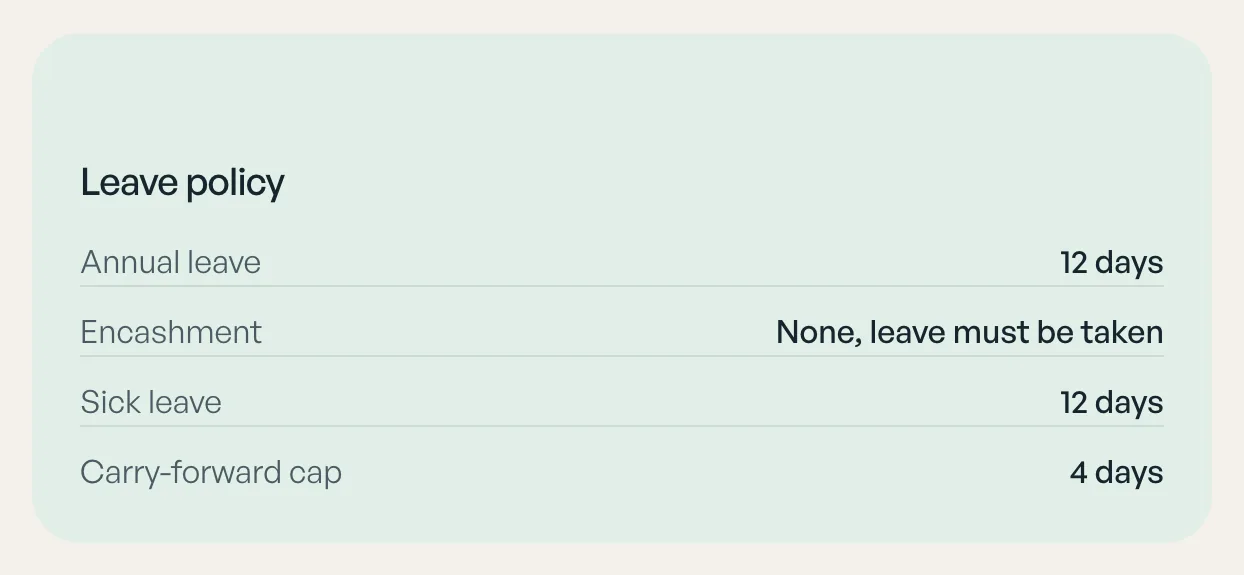
The OSH Code gives a worker who has worked 180 days in a calendar year "one-day leave for every twenty days of his work." Unused leave can carry forward up to the code's cap, and leave is paid out when employment ends. State Shops and Establishments rules add their own entitlements, so the contract follows the state where your hire works. What to check: confirm which state's leave rules the contract follows.
Government sourceegazette.gov.inWages and the wage base
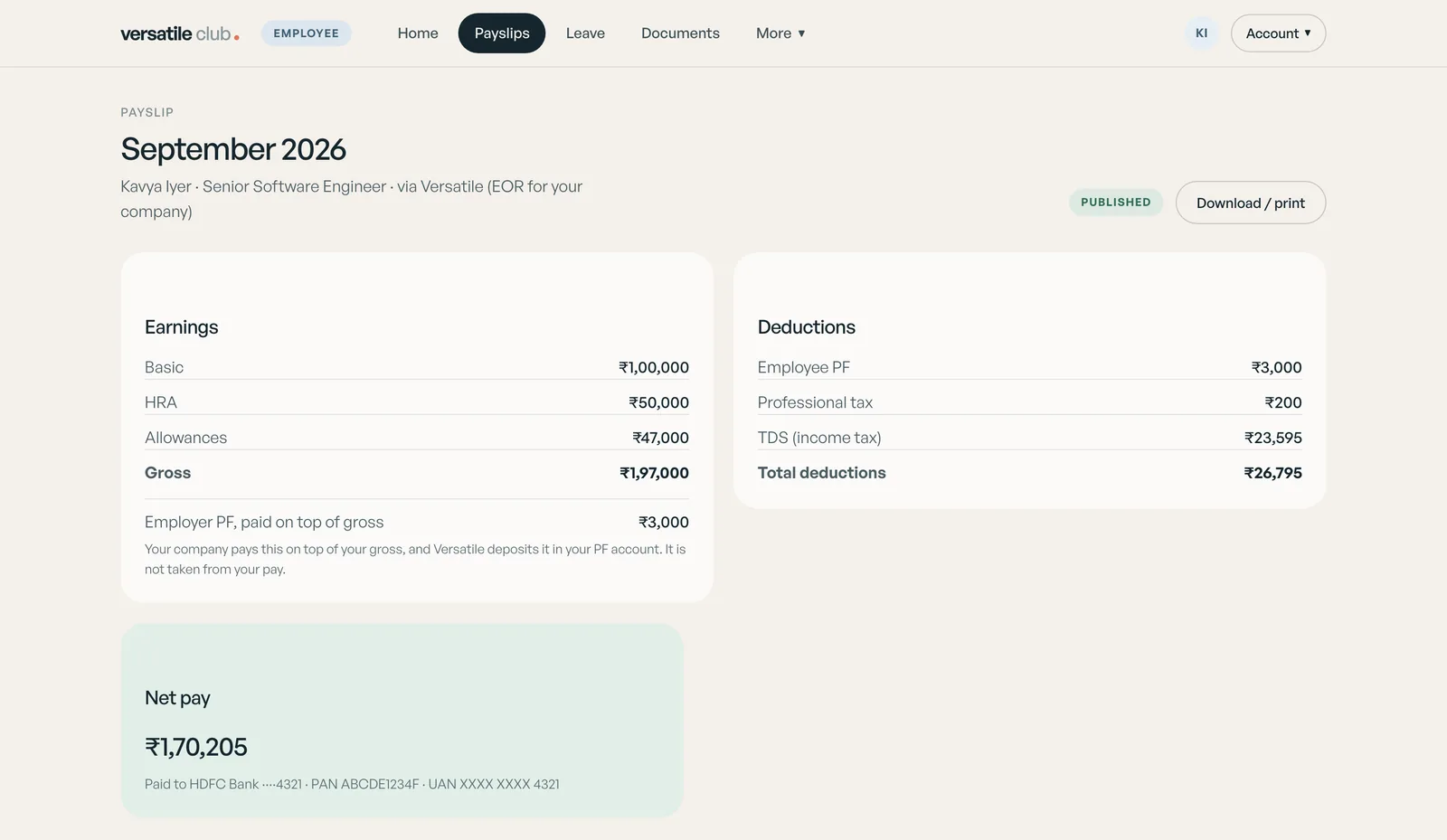
The Code on Wages counts most pay as wages, but excludes items such as HRA and conveyance. If those exclusions pass one-half of total pay, the excess "shall be accordingly added in wages." Monthly wages must be paid "before the expiry of the seventh day of the succeeding month." Contracts that load pay into allowances to shrink PF no longer work. What to check: compare the excluded allowances with one-half of total pay, because any excess is added back to wages.
Government sourceindiacode.nic.inDues when employment ends
When an employee resigns, is dismissed or is retrenched, the wages due "shall be paid within two working days." Leave pay on quitting or discharge is due "before the expiry of the second working day." Gratuity is due "after he has rendered continuous service for not less than five years." Death, disablement and the end of a fixed term are exceptions. What to check: ask for the settlement statement and compare its dates with these deadlines.
Government sourcelabour.gov.inPOSH and the Internal Committee
The Sexual Harassment of Women at Workplace (Prevention, Prohibition and Redressal) Act, 2013 sets the complaint process. The Ministry's handbook explains that "the Act provides for two kinds of complaints mechanisms," an Internal Committee and a Local Committee. The Model Standing Orders add that "the constitution of Internal Complaints Committee shall be in accordance with the provisions" of that Act. What to check: confirm that the EOR's compliance coverage includes POSH and Internal Committee setup.
Government sourceindiacode.nic.inWhat an India employment contract template has to cover
Here is how each of those rules shows up in the contract your hire signs. Versatile Club's India addendum keeps the wage structure inside the Code on Wages definition. It restructures pay where needed and tells you of any change in employment cost. Read each part below against the law above.
Is there a standard employment contract template for India?
No single Indian statute writes the contract for you, though the government prescribes what the appointment letter holds. A sound template states designation, place of work, wages, hours, leave, notice and statutory benefits. The EOR's template carries those fields, and you can ask for changes before signature, as the common questions below explain.
Working hours and leave
The OSH Code sets ordinary limits of eight hours in a day and no more than six working days a week. The EOR's labour-law coverage includes Shops and Establishments rules, leave and state rules in all 28 states. The holiday and leave policy tool helps you draft a policy by state.
A quick example shows how statutory annual leave builds up. A hire who works 240 days in a calendar year earns 12 days of annual leave under the twenty-day rule. Your company's own policy can give more, such as a set number of sick days on top. State leave rules, such as Tamil Nadu's, can add more again.
Wages and pay day
The contract states the wage structure, and the Labour Code rule on Basic plus DA shapes it. Here is a worked example with round sample figures. Take monthly pay of ₹1,00,000, made up of ₹40,000 Basic plus DA and ₹60,000 in excluded allowances such as HRA. One-half of pay is ₹50,000, so the allowances run ₹10,000 over, and that ₹10,000 is added back to wages. PF and other wage-linked dues are then worked out on ₹50,000, not ₹40,000.
Every employer must also issue wage slips to the employees. The EOR's compliance coverage includes the Basic plus DA rule. The CTC offer optimizer lets you test a salary structure before the Day 2 offer.
Probation
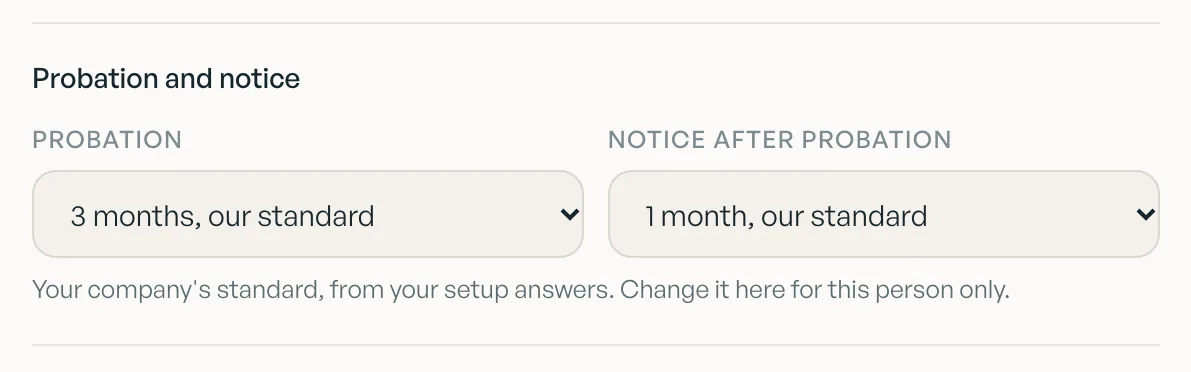
Probation and the notice period after probation are set for each hire from your company's standard terms. You can change either one for a single person before the offer goes out. A common pattern is three months' probation and one month's notice once confirmed, which sits inside the six-month benchmark in the Model Standing Orders.
Write the probation terms plainly. Say how long it lasts, whether it can be extended and for how long, and what notice applies during probation and after confirmation. Indian employees read these lines closely, because confirmation often decides notice, leave and bonus terms.
Notice and exit
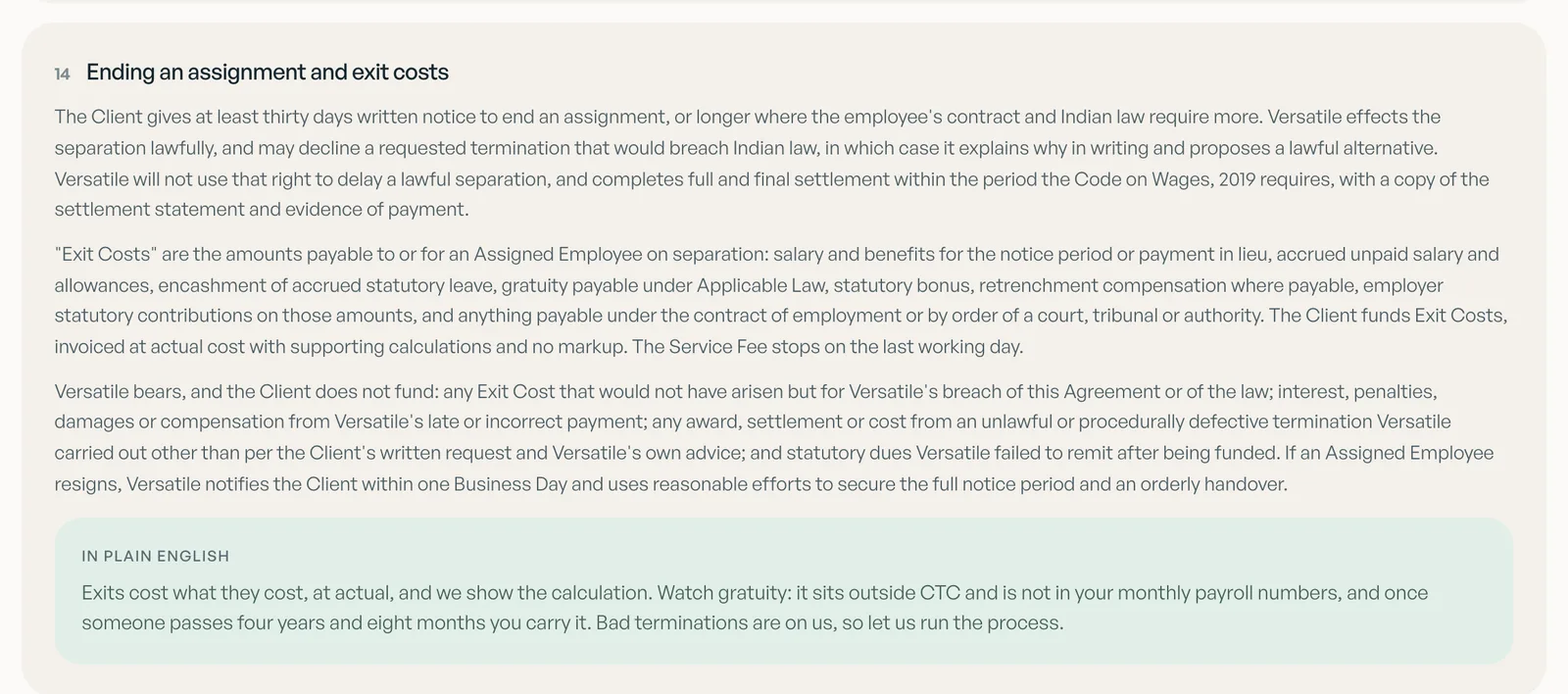
Notice is where a foreign template can go wrong, because employment in India does not end at will. To end an assignment, your company gives Versatile Club at least thirty days' written notice, or longer where the employee's contract and Indian law require more. The EOR may decline a requested termination that would breach Indian law, and then explains why in writing and proposes a lawful route.
Where retrenchment rules apply, compensation adds to the notice. Here is a worked example with a round sample figure. Take a worker with four completed years and average pay of ₹2,000 a day. At 15 days per year, that is 60 days, or ₹1,20,000, under section 70 of the IR Code. Run your own case with the actual years and average pay.
Your company funds the exit costs, invoiced at actual cost with the calculation and no markup. The EOR then runs the Full and Final settlement: notice, leave encashment, gratuity, PF and the relieving letter. The India offboarding planner and the gratuity calculator help you size an exit ahead of time.
How to calculate a notice period in India
Start from the contract, because it usually sets the notice period for both sides. Then count calendar days from the day notice is given. Suppose your hire is confirmed, has one month's notice, and resigns on 10 March. The last working day is 9 April, unless you agree to an earlier release with pay in lieu.
After the last working day, the statutory clock runs on the final dues:
| After the exit | What is due | Instrument |
|---|---|---|
| Within two working days | Final wages | Code on Wages |
| By the second working day | Pay for unused annual leave | OSH Code |
| Within ten days | A service certificate, in establishments under the Model Standing Orders | Model Standing Orders |
| Within thirty days of becoming payable | Gratuity, where the service condition is met | Code on Social Security |
The EOR completes the Full and Final settlement within the period the Code on Wages requires, with a copy of the settlement statement.
Clauses Indian law limits
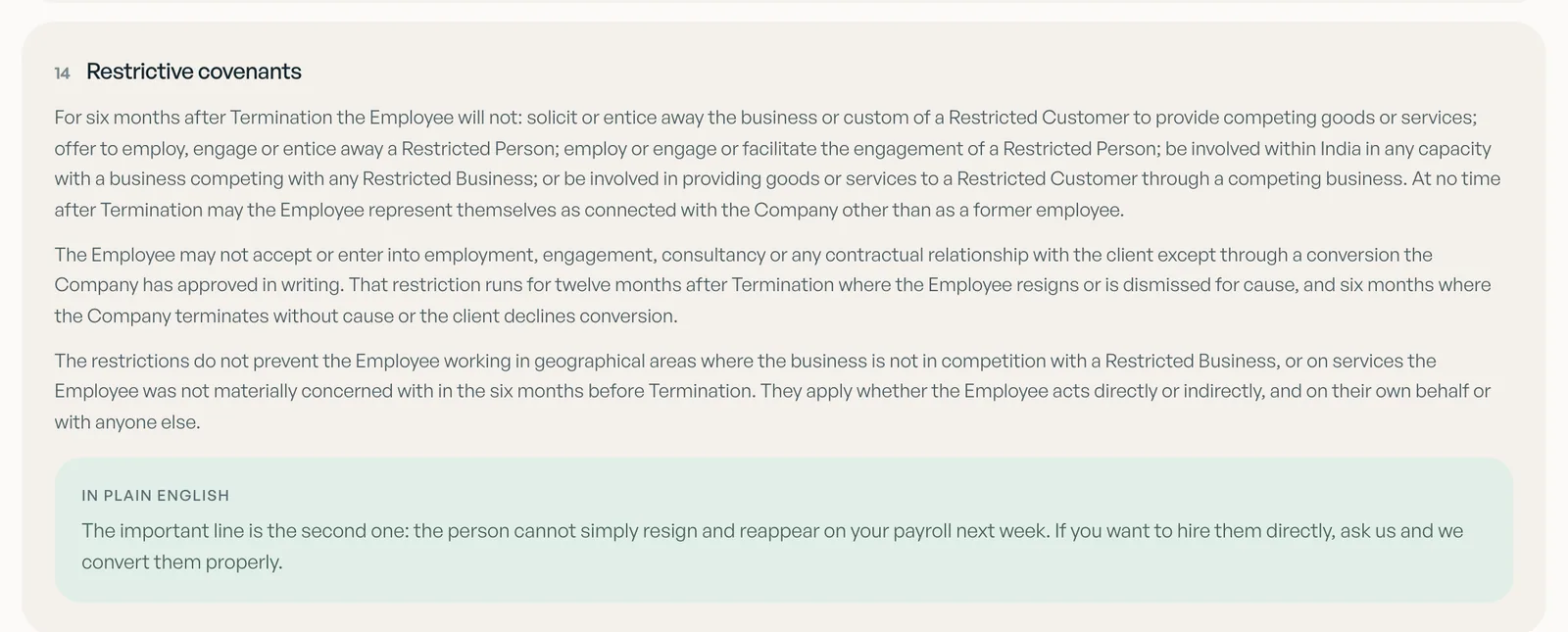
Restrictive covenants need the most care. Versatile Club's employment agreement restricts soliciting customers and staff, and competing work within India, for six months after the job ends. It does not stop work in areas that don't compete, or on services the employee wasn't materially involved in. Read every restraint against section 27 of the Indian Contract Act, and take local advice on the wording.
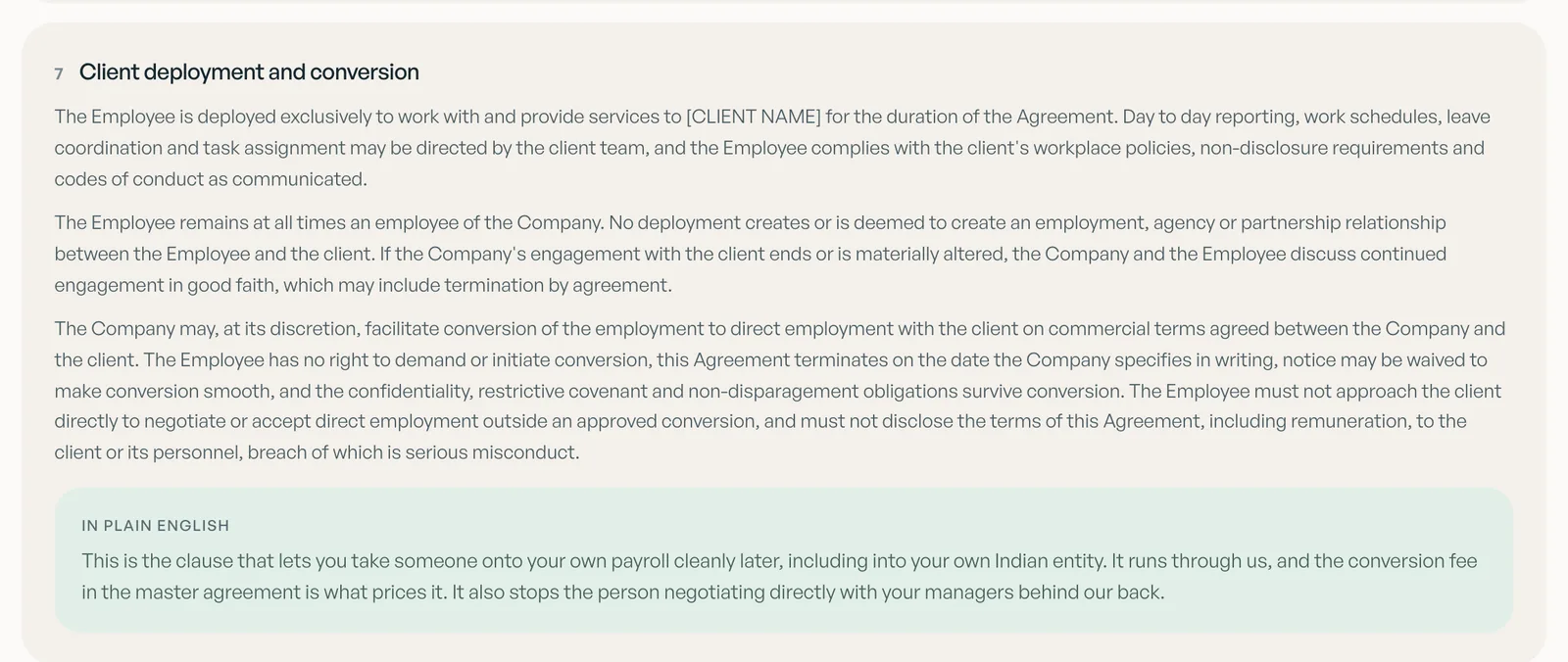
One restriction matters most to your company. The employee can't simply resign and join your payroll directly, except through a conversion the EOR approves in writing. That restriction runs twelve months after a resignation or dismissal for cause, and six months in other cases.
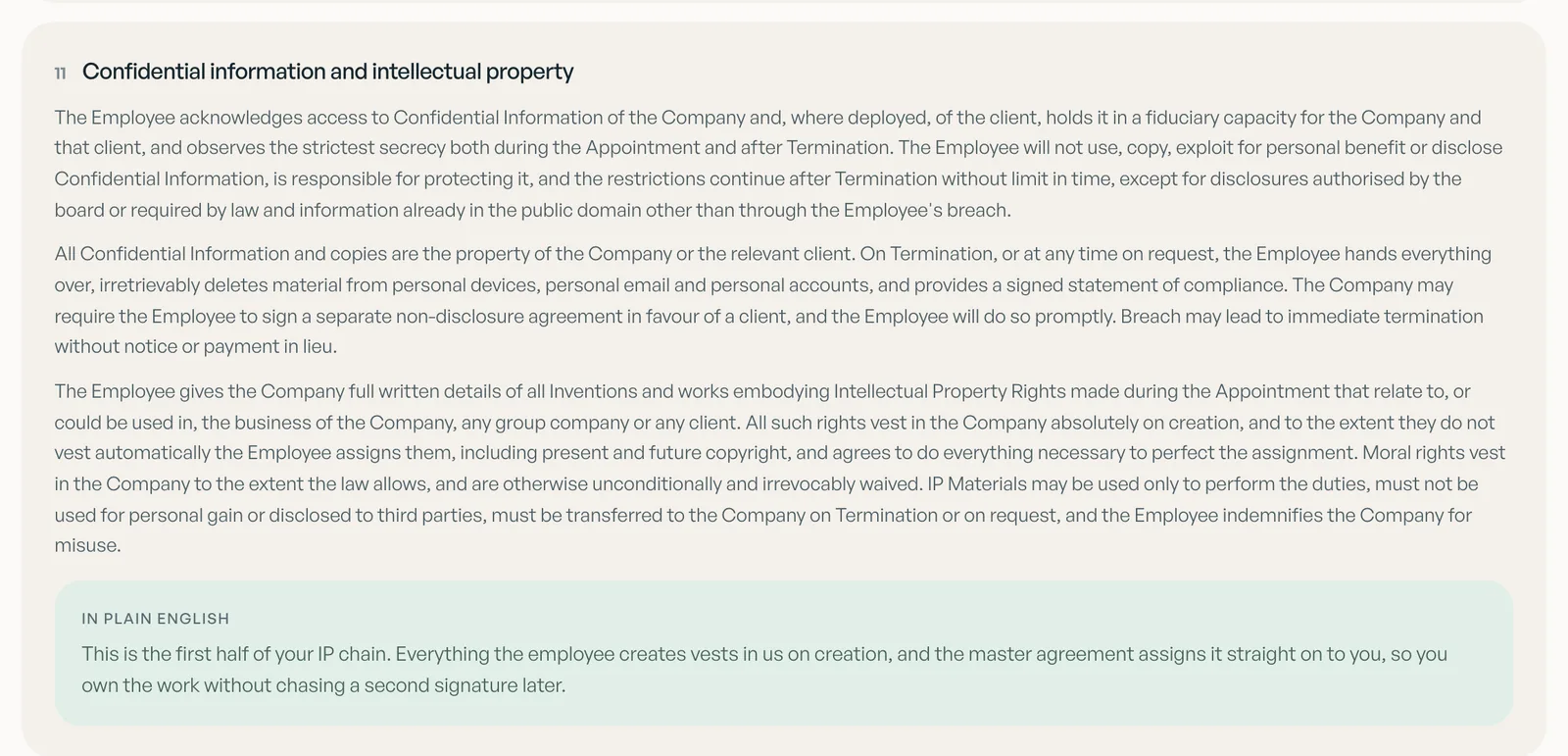
Confidentiality has no end date. The secrecy duty continues after the job ends, without limit in time. The employee may also be asked to sign a separate NDA in your company's favour. Inventions need written paperwork too. Under section 68 of the Patents Act, assignments are not valid unless in writing and duly executed. The contract has the employee disclose inventions in writing.
Fixed-term employment
Fixed-term employment is allowed in India, but on equal terms. A fixed-term employee gets the same hours, wages and benefits as a comparable permanent worker. They are also eligible for gratuity "if he renders service under the contract for a period of one year." The Code on Social Security lists termination of a fixed-term contract among the cases where the usual five-year condition doesn't apply.
The end of a fixed term is not a retrenchment under the IR Code, so retrenchment compensation doesn't apply when the term simply runs out. A short contract still doesn't cut statutory benefits.
Workplace conduct, POSH and employee data
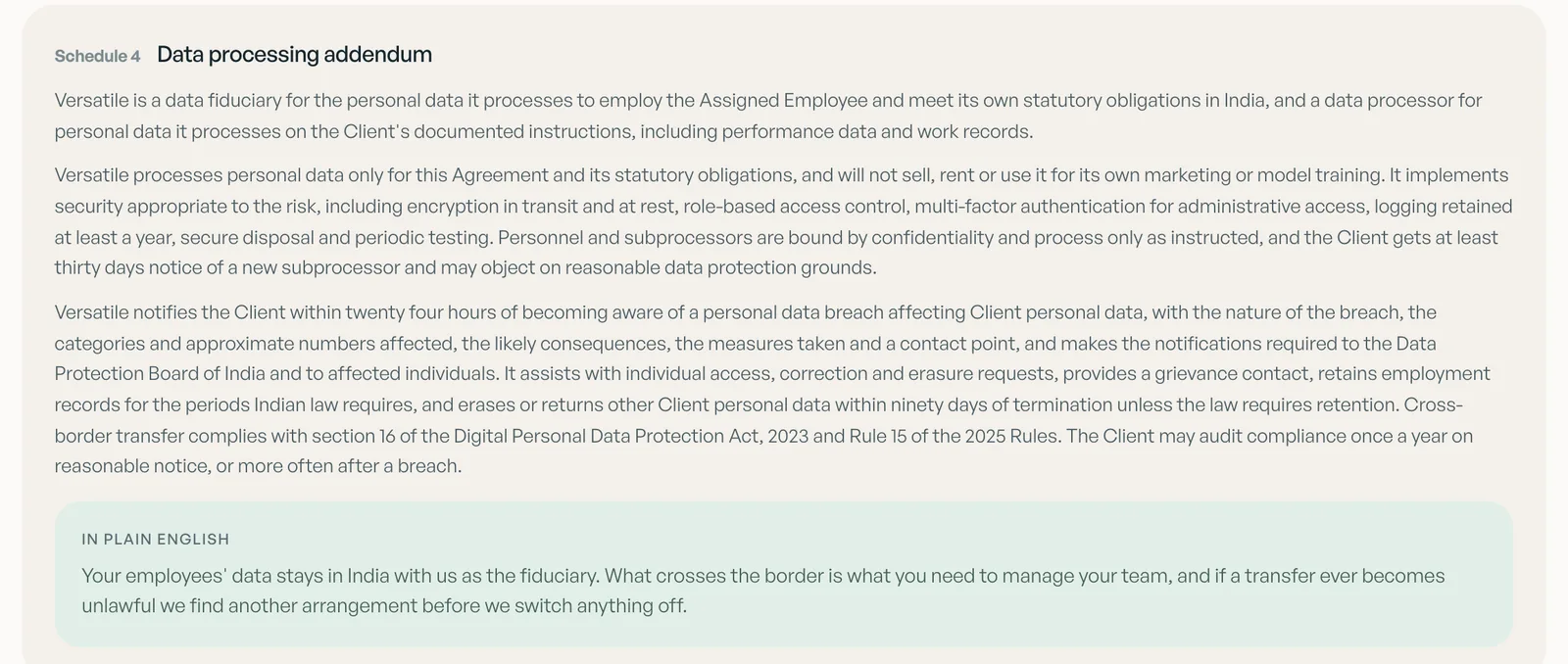
Versatile Club's compliance areas include POSH, with Internal Committee setup, and DPDP Act readiness for employee data. Under the master agreement, the EOR is solely responsible for the employment, labour, workplace harassment and related laws that apply to each employee. For data, it acts as data fiduciary for the personal data it processes to employ your hire.
How the contract gets signed
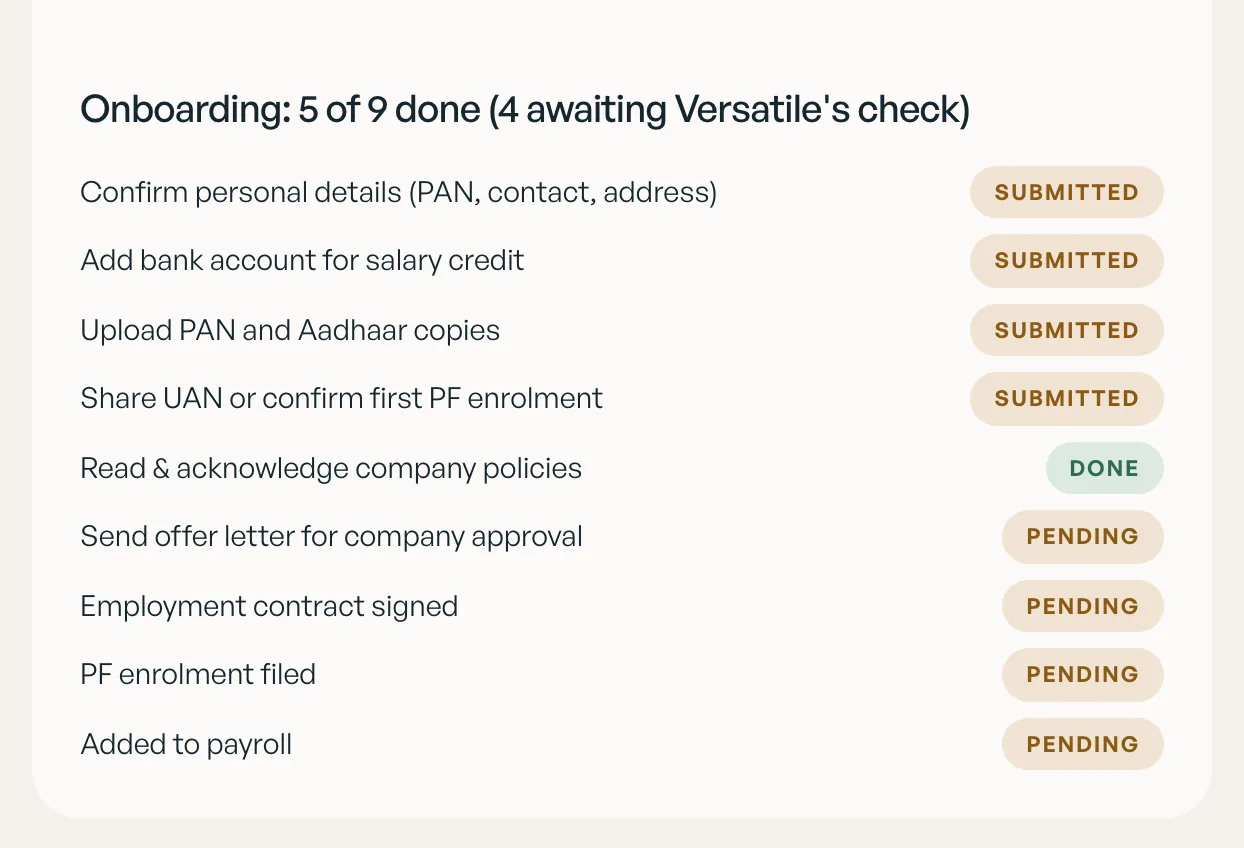
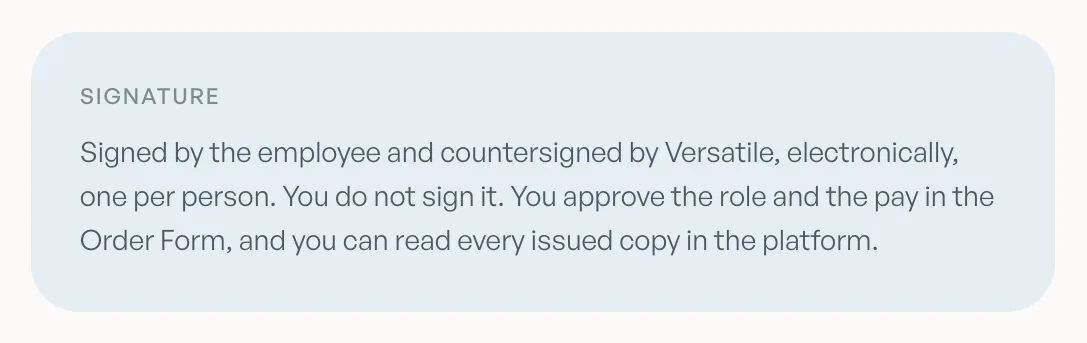
- Day 1: service agreement. Your company and Versatile Club sign the service agreement, which carries the five-day onboarding commitment.
- Day 2: offer letter. The EOR sends your candidate an India-compliant employment offer, after your company approves it.
- Day 3: employment contract. Your hire signs electronically, and the EOR countersigns and collects the onboarding documents.
- Day 4: registrations. PF, ESI and professional tax start under the EOR's registrations.
- Day 5: payroll. Your hire is active on payroll, and the monthly payroll cycle begins.
The guide to onboarding in five business days covers each day in detail.
Works with
- Five-day onboarding. The employment contract is the Day 3 milestone of the same process.
- Monthly payroll. Salary and deductions run each month on the terms the contract sets.
- Provident Fund. PF starts on Day 4 and is settled in the Full and Final on exit.
- Intellectual property ownership. How rights in your hire's work move to your company in writing.
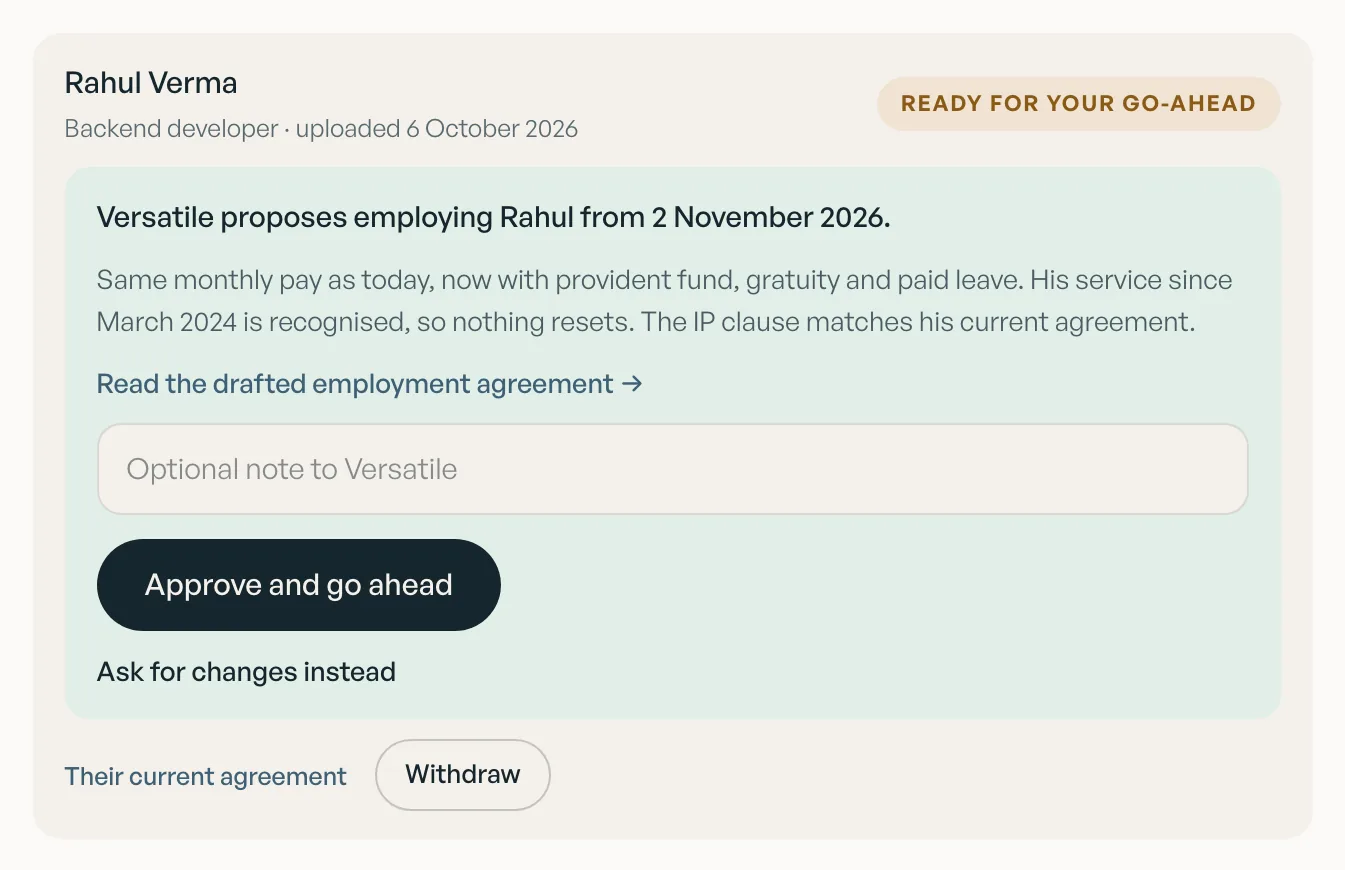
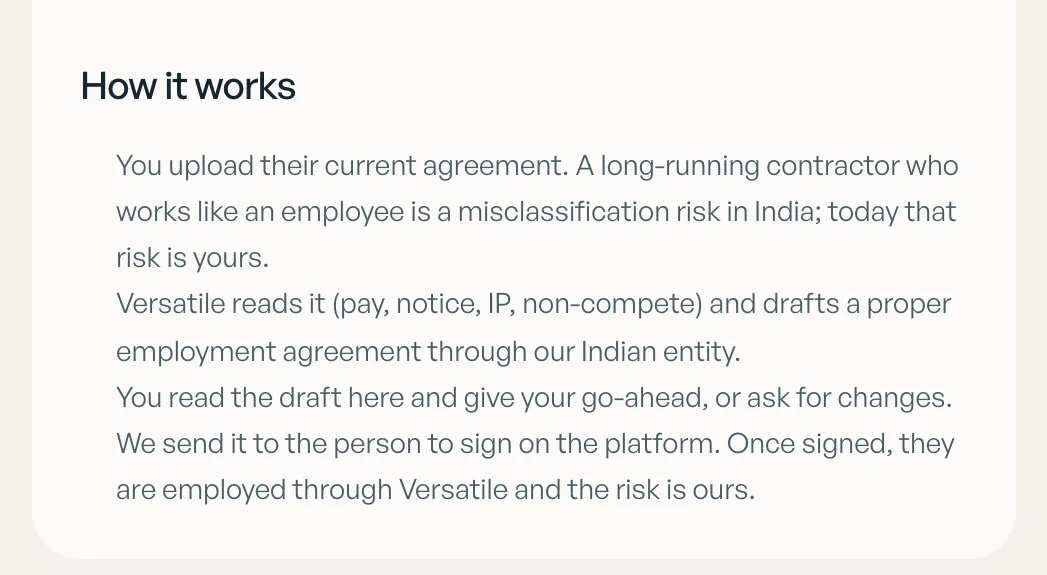
- Contractor conversion. Versatile Club reads a contractor's current agreement for pay, notice, IP and non-compete terms, then drafts an employment agreement on its entity.
Who uses it
Outside counsel for a US startup
Counsel gets the vendor file a week before the first India hire. She checks three things first: the employing company, the law the contract follows and the restrictive covenants. The Indian entity page answers the first one.
A head of People converting a contractor
A long-term contractor in Pune is moving onto payroll. The head of People runs the misclassification risk quiz, then plans the switch with the contractor conversion planner.
An HR lead writing the India policy set
An HR lead lines up the contract with leave, working hours and exit rules for India staff. The page for HR leaders hiring in India covers how the employer role is split.
A COO testing India before a GCC
A COO wants a small team under Indian contracts before committing capital to a captive centre. Versatile Club's EOR service employs the team on its own Indian company while the plan proves itself, as set out in testing India before a GCC.
How Versatile Club compares for employment contracts in India
Versatile Club signs your hire's employment contract on its own Indian company, on a set day of onboarding. Its exit settlement includes the relieving letter. Every provider below documents a written employment contract. It is the only platform in this table that does all four.
Employment contract features for India hires, from each platform's public documentation:
| Platform | Written employment contract from the provider | Contract with the provider's own Indian entity | Contract signed on a set onboarding day | Relieving letter in the exit settlement |
|---|---|---|---|---|
| Versatile Club | Yes | Yes | Yes | Yes |
| Deel | Yes (signs the contract under Indian law) | Yes (owns its Indian entity) | Not in docs | Not in docs |
| Remote | Yes (Employment Agreement after enrolment) | Yes (contract with Remote's local entity) | Not in docs | Not in docs |
| Oyster | Yes (issues a compliant employment agreement) | Partly (own entity in some countries) | Not in docs | Not in docs |
| RemoFirst | Yes (drafts a localized employment contract) | Partly (partners with local providers) | Not in docs | Not in docs |
Yes: documented and built in. Partly: documented with a limit, shown in brackets. Not in docs: not found in the vendor's public documentation.
Why Versatile Club is the stronger choice for employment contracts in India
- The employer is the company you checked. Versatile Club's EOR service employs your hire on its own Indian company, Foo Falcon Technologies Pvt Ltd. RemoFirst says it doesn't run its own legal entities and partners with experienced local providers. See RemoFirst alternatives in India.
- A signing day you can plan around. The EOR signs the contract on Day 3 of five business days. Remote's help center says employees receive the Employment Agreement after self enrolment and a right-to-work check. Compare Versatile Club vs Remote.
- A service, not a form. Versatile Club issues the offer and the contract itself, as the employer. Deel's help center explains how clients create an EOR contract from the People section. Compare Versatile Club vs Deel.
- The entity is named before you sign. The EOR names its employing company and publishes its registration numbers. Oyster's help center says the hiring entity is indicated in the employment agreement. See Oyster alternatives in India.
Competitor details checked against each vendor's public documentation on 23 October 2026. Features and plans change, so confirm with the vendor before you decide.
Limits, what goes wrong and what to check
- India only. The contract covers employment in India. Versatile Club is an India-only Employer of Record.
- Versatile Club is the employer. The contract is between your hire and its Indian company, so your company isn't a party to it. Your own terms with the EOR sit in the service agreement.
- Indian law applies. The contract follows Indian law and the rules of the state where your hire works.
- Signed during onboarding. The contract is signed on Day 3, after the Day 2 offer letter.
- Lawful exits only. The EOR can decline a termination that would breach Indian law, and proposes a lawful alternative instead.
- EOR is a new service. Versatile Club's employer operation comes from running Contract-to-Hire across several Indian states. It doesn't claim years of EOR-specific track record.
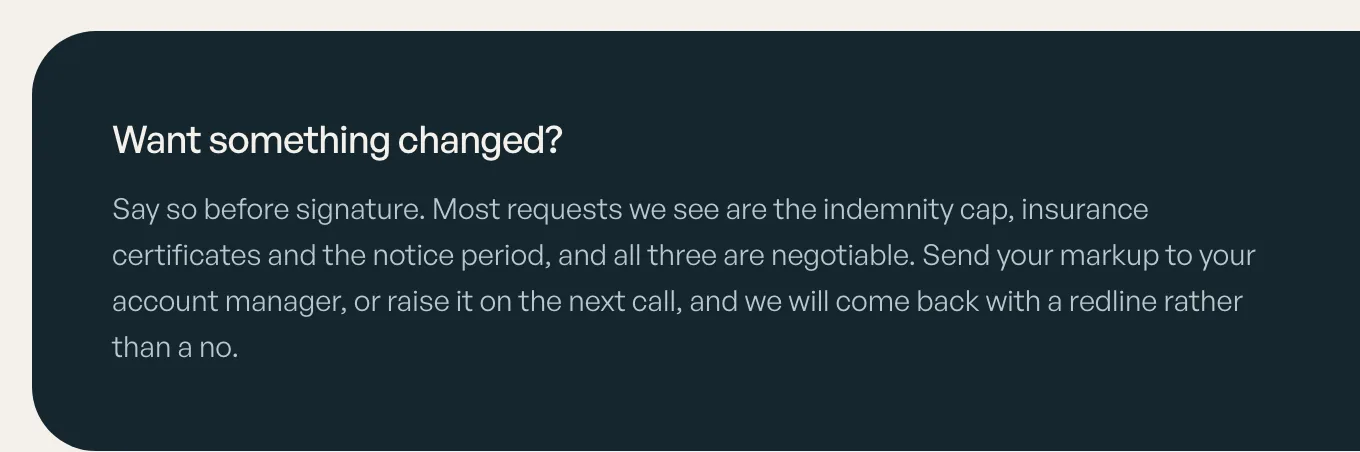
- The notice period is assumed, not read. No statute sets one notice period for every employee, so a figure copied from a home contract may not match the draft. Read the probation and notice settings before the offer goes out, and change them for one hire if the role needs it.
- A home-country non-compete is copied in. A post-employment restraint of this kind may not hold under Indian law. Take local advice on the wording before anyone relies on it.
- Allowances run past half of pay. The excess is added back to wages, so PF and wage-linked dues are worked out on a higher base than you expected. Test the salary structure before the Day 2 offer, and ask the EOR about any change in employment cost.
- A clause request comes after signature. Versatile Club can redline a draft but cannot amend a signed contract. Send change requests before signature through the contact page.
- Final dues run late. Final wages are due within two working days of exit, and leave pay by the second working day. Ask for the settlement statement and check each date against the table above.
Common questions
What must an employment contract in India include?
In a covered establishment, the employer must issue a letter of appointment to every employee. Versatile Club's contract states the designation, place of work, wages and structure, hours, leave, notice period and statutory benefits.
Who is the employer on the contract?
Foo Falcon Technologies Pvt Ltd, the registered Indian company behind Versatile Club's Employer of Record service. That company employs your hire, not yours.
When is the employment contract signed?
On Day 3 of onboarding, electronically. The service agreement comes on Day 1 and the offer letter on Day 2, and payroll goes live on Day 5.
Does our company sign the employment contract?
No. Your company signs a service agreement with Versatile Club and approves the role and pay. The employment contract is between your hire and the EOR's Indian company.
What is the notice period in India as per labour law?
There is no single statutory notice period for every employee. A covered worker facing retrenchment gets one month's written notice or pay in lieu, but managerial and administrative staff fall outside that rule. For most professional hires, the contract sets notice, often one month after probation.
How long can probation last in India?
No code sets one limit for every employer. The Model Standing Orders use six months, extendable by up to three months after a performance assessment. Under Versatile Club's EOR service, probation is set per hire from your company's standard terms.
Are non-compete clauses enforceable in India?
Treat them with care. Section 27 of the Indian Contract Act makes an agreement void to the extent it restrains a lawful profession, trade or business. Take local advice before relying on a post-employment non-compete.
Can we hire someone on a fixed-term contract?
Yes. The contract must be in writing for a fixed period, and the employee gets the same pay and benefits as a comparable permanent worker. Gratuity becomes due after one year of service under the contract.
Can we add a clause from our US contract?
Raise it before signature through Versatile Club's contact page. The EOR comes back with a redline rather than a no, and the notice period is among the terms open to discussion. The contract still follows Indian law.
How is the wage base set?
On Basic plus DA. The EOR keeps Basic plus DA at half of pay or more, and restructures pay where needed, telling you of any change in employment cost.
What happens under the contract when someone leaves?
Versatile Club runs the Full and Final settlement. It covers notice, leave encashment, gratuity, PF and the relieving letter, with exit costs invoiced at actual cost.
Does the contract cover POSH?
The EOR's compliance areas include POSH, with Internal Committee setup under the POSH Act, alongside DPDP Act readiness for employee data.
Can we check Versatile Club's entity before we sign?
Yes. The EOR publishes its CIN, GSTIN, PAN, TAN and ESIC registration on Versatile Club's About page, so you can check the employer before Day 1.
What does the employment contract cost us?
The contract comes with the service. Versatile Club charges a flat monthly fee per employee, with no setup fee and no exit fee, and the first month is free. See EOR pricing.