Payroll Process in India: The Monthly Timeline, Inputs, Deadlines and a Worked Payslip
Checked against 13 government sources. Last verified 29 October 2026.
Your first India payroll month is close and you need to know what to send, when, and how to treat joiners, leavers and unpaid leave.
The payroll process in India runs to a fixed legal clock: salaries are due within seven days of the month's end, and the tax and PF deposits follow.
Versatile Club is an India-only Employer of Record (EOR). As your Employer of Record, it runs this payroll process on its own Indian company for every employee on its EOR service. This page follows the month from your inputs to the deposit proof you get back, with a worked payslip.
At a glance
| Pay cycle | Monthly, run by Versatile Club on its own Indian company, Foo Falcon Technologies Pvt Ltd |
| Salaries due | Before the seventh day of the following month ends |
| What to have ready | Start dates for joiners, last working days for leavers, and any unpaid leave days in the month |
| Your cut-off | Agree the input date with the EOR before your first run, so salaries still go out inside the legal window |
| New joiners | PF, ESI and professional tax start on day four of onboarding, and the employee is live on payroll on day five |
| Unpaid leave | Absence is one of the deductions the Code on Wages authorises, and all deductions in a month can't exceed 50% of wages |
| Leavers | A Full and Final settlement covers notice, leave encashment, gratuity, PF and the relieving letter. Wages owed are due within two working days |
| Deposits | Salary TDS by the 7th, inside the seven-day legal limit. EPF within fifteen days of month-end |
| What comes back | One USD invoice, a payroll summary per employee, PF and ESI challans, TDS receipts and a filing status report |
| Fee | A flat monthly fee, with no setup fee and no exit fee; see Versatile Club's EOR pricing |
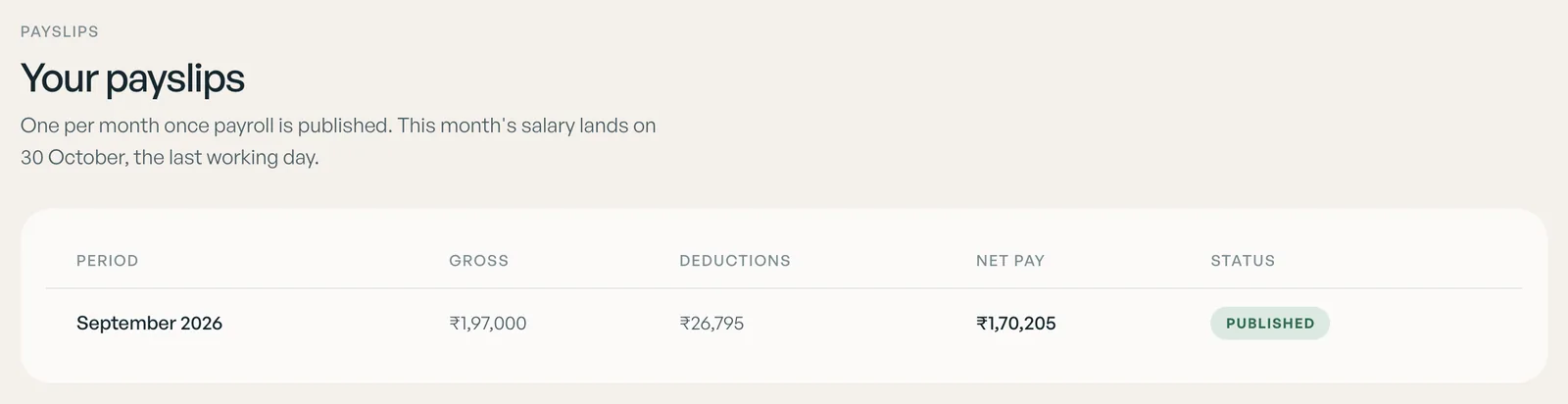
What monthly payroll covers
When you need to know what a payroll run actually covers, start with the Employer of Record service. Monthly payroll is the part of it that turns an agreed salary into a correct payment and a filed set of deductions. Versatile Club is the legal employer: its EOR service employs your India team on its own Indian company. As your Employer of Record, it files their PF, ESI, TDS and professional tax under its own registrations, not yours.
Each run covers five statutory items:
- Provident Fund. The EOR deducts the employee's share and adds the employer match. The PF contribution rules cover rates, the wage ceiling and deposits.
- ESI. Contributions for employees under the coverage threshold.
- Professional tax. State-specific slabs. Maharashtra uses dual PTRC and PTEC registration, Karnataka runs a monthly cycle and Tamil Nadu files twice a year.
- TDS. Income tax deducted from salary and deposited by the 7th of the next month, under the EOR's TAN.
- Gratuity. Accrued from the first month of employment.
The run uses the entity and payroll operations Versatile Club built for its Contract-to-Hire business. Every identifier it files under is listed with the employing company's registrations. For the wider picture of how India payroll works, start from the India payroll overview.
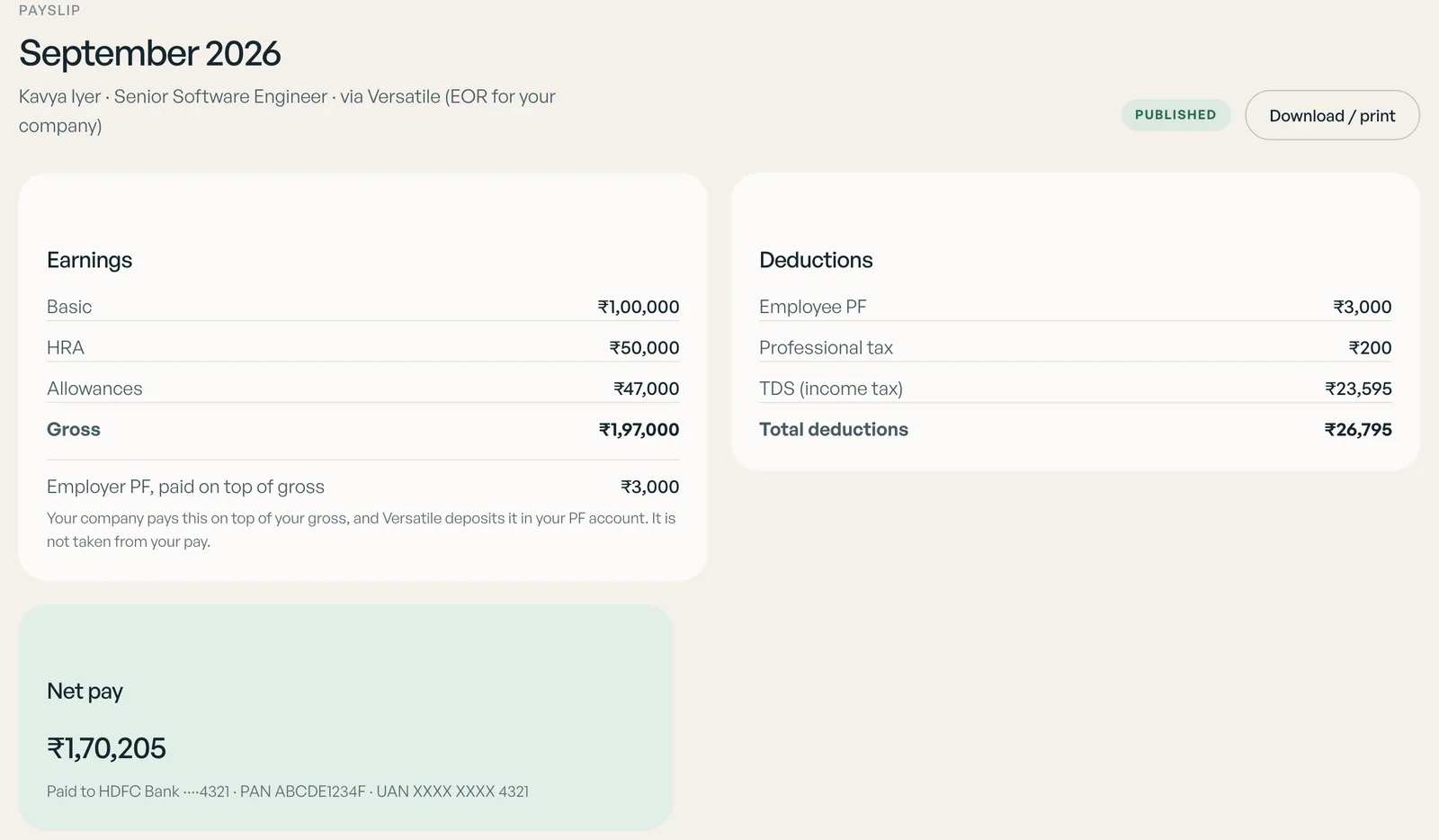
Why the monthly payroll timeline matters
The job you need done
You need every India salary and deposit to land on time, and the one thing you control is the inputs. The monthly payroll timeline turns joiners, leavers and unpaid leave into correct pay and deposits before each legal deadline.
What it lets you do
- Plan the month. The legal dates are fixed, so you can work the input deadline back from them.
- Start joiners on time. Statutory registrations are done before the employee goes live on payroll.
- Settle leavers fast. Exit pay runs through one settlement with a short legal deadline.
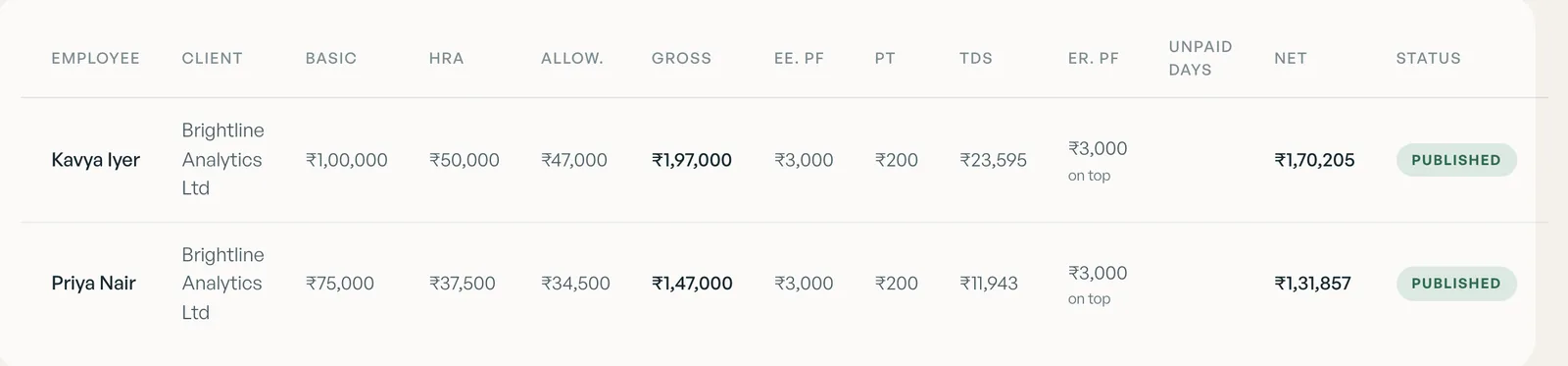
- Trace each deduction. The payroll summary shows gross pay, deductions and net pay per employee.
What goes wrong if it's missed
Without a set timeline, a late joiner date or a missed leave day lands in the wrong month. Pay goes out wrong, and the correction waits for the next cycle. Salary tax that is deducted but deposited late draws interest of 1.5% for every month or part of a month.
Where you'll run into it
You run into this in the weeks before your first India payroll. New hires ask when they will be paid and what will be deducted. You need firm answers, plus a clear sense of what to send each month and when.
The Versatile Club approach to the monthly payroll process
A People Ops lead at an Austin software company has two engineers starting in Pune this month. One joins on the 18th, and the other has already asked for two days of unpaid leave. Her US payroll runs twice a month, and she has never run a payroll month in India.
The common move is to reuse the US calendar and send changes whenever they come up. That may work for a while. But a US cut-off rarely lines up with India's dates, so a leave day or a start date can slip into the wrong month. Each slip then means a correction, an awkward note to the employee and some lost trust.
India's payroll month is built around fixed legal dates. Salaries are due before the seventh day of the next month ends, and salary tax must be deposited within the same seven days. So the useful question isn't which calendar a team already has. It's what the employer needs, by when, to meet those dates every month.
Versatile Club runs the month on its own Indian company. It starts a new hire's PF, ESI and professional tax on day four of onboarding and starts payroll on day five. It handles exits through a Full and Final settlement. Each month, the EOR sends you a payroll summary showing gross pay, deductions and net pay for every employee.
That per-employee summary is where the lead checks the joiner's first month and the leave deduction against what she sent. It arrives with challans and TDS receipts, covered in How Versatile Club compares for running payroll in India, below.
What the law says
Running payroll in India rests on a short list of statutory duties. Each one sits with the employer, which for your India team is Versatile Club's Indian company. Here is what each duty requires, in the words of the instrument, so you can check any payroll against it.
Fix a wage period of no more than a month
The employer chooses a daily, weekly, fortnightly or monthly wage period, on one condition: "no wage period in respect of any employee shall be more than a month." The EOR pays monthly, so each calendar month is one wage period. The rule is section 16 of the Code on Wages, 2019.
Government sourcelabour.gov.inPay monthly wages within seven days
For monthly-paid staff, wages are paid "before the expiry of the seventh day of the succeeding month." For a September wage period, that means by the end of 7 October. The deadline is section 17(1)(iv) of the Code on Wages, and it applies however small the team is. What to check: work back from the end of the 7th to the input cut-off you agree with the EOR.
Government sourceindiacode.nic.inPay a leaver within two working days
When an employee resigns, or is removed, dismissed or retrenched, the wages owed "shall be paid within two working days." That is far shorter than a normal pay cycle, so a last working day sent late can push the employer past the limit. The rule is in section 17(2) of the Code on Wages. What to do: send each leaver's last working day as soon as you know it.
Government sourceindiacode.nic.inDeduct only what the Code authorises, and only pro rata for absence
The Code allows "no deductions from the wages of the employee, except those as are authorised under this Code." Absence from duty is one authorised ground, and section 20(2) caps it. An absence deduction can't take a larger share of the month's wages than the days missed are of the days the employee had to work. Both rules are in sections 18 and 20 of the Code on Wages as published in the Gazette. What to check: when a payslip shows a leave deduction, compare the days deducted with the days missed out of the days required.
Government sourceegazette.gov.inKeep total deductions under half of wages
All deductions in one wage period together "shall not exceed fifty per cent. of such wages." Where authorised deductions add up to more, the Code lets the excess be recovered in later wage periods. Both points are in section 18(3) and (4) of the Code on Wages, 2019 (Gazette text). What to check: confirm that total deductions in a month stay under half of that month's wages.
Government sourceegazette.gov.inBasic salary in India: count allowances above half of pay as wages
This rule answers a common salary-structure question: how much of an India salary must be basic pay? The Code's definition of wages leaves out items such as HRA and conveyance. But if the excluded items come to more than half of total pay, "the amount which exceeds such one-half" is added back to wages. That is the first proviso to section 2(y) of the Code on Wages. Keeping basic pay and dearness allowance at half of pay or more keeps the wage base where you planned it.
Government sourceindiacode.nic.inMinimum salary in India: pay at least the state minimum wage
There is no single minimum salary for all of India. The appropriate Government fixes minimum rates of wages for employees in its jurisdiction, which for a private company is generally the state. Those rates "shall not be less than the floor wage" set by the Central Government, under section 9(2) of the Code on Wages. Check the state's current notification for the role before you set a low offer.
Government sourceegazette.gov.inIssue a wage slip on or before payday
Section 50(3) of the Code says "Every employer shall issue wage slips to the employees." The Ministry's compliance handbook for the Labour Codes puts the timing plainly: on or before payment of wages. The central rules prescribe Form V, which may be issued "electronically or in physical form", under rule 52 of the Code on Wages (Central) Rules, 2026. What to check: confirm each employee's wage slip is issued on or before the day salaries are paid.
Government sourcelabour.gov.inDeposit salary TDS by the 7th, or by 30 April for March
Tax deducted from salary goes to the government "on or before seven days from the end of the month" in which it was deducted. Tax deducted in March has until 30 April. Both dates are in rule 218(2) of the Income-tax Rules, 2026, in force since 1 April 2026. What to check: ask for the TDS deposit receipt each month, and expect March's deposit to be dated by 30 April.
Government sourceincometax.gov.inPay EPF within fifteen days
EPF contributions are paid "within fifteen days of the close of every month." The employer contributes 12% of wages and the employee an equal share, under paragraphs 18 and 20 of the EPF Scheme, 2026. The EPF wage ceiling has been ₹25,000 a month since S.O. 5109(E) of 17 September 2026. What to check: match the PF challan confirmation you receive to that month's payroll summary.
Government sourceegazette.gov.inThe payroll process in India, step by step
- Send the month's changes. Joiner start dates, leavers' last working days and unpaid leave days. Agree the cut-off with the EOR before your first run.
- Employees declare tax claims. Rent, investments and similar claims go to the employer with evidence in Form No. 124, so salary TDS reflects them.
- The wage period closes. Under the Code on Wages, no wage period can run longer than a month.
- Pay is worked out. The EOR calculates gross pay, the statutory deductions and net pay for each employee.
- Salaries are paid. The legal limit is the end of the seventh day of the next month, and every employer must issue wage slips.
- Deductions are deposited. The EOR deposits salary TDS by the 7th. EPF contributions follow within fifteen days of month-end.
- Your pack arrives. You receive the invoice, the payroll summary and the proof of each deposit.
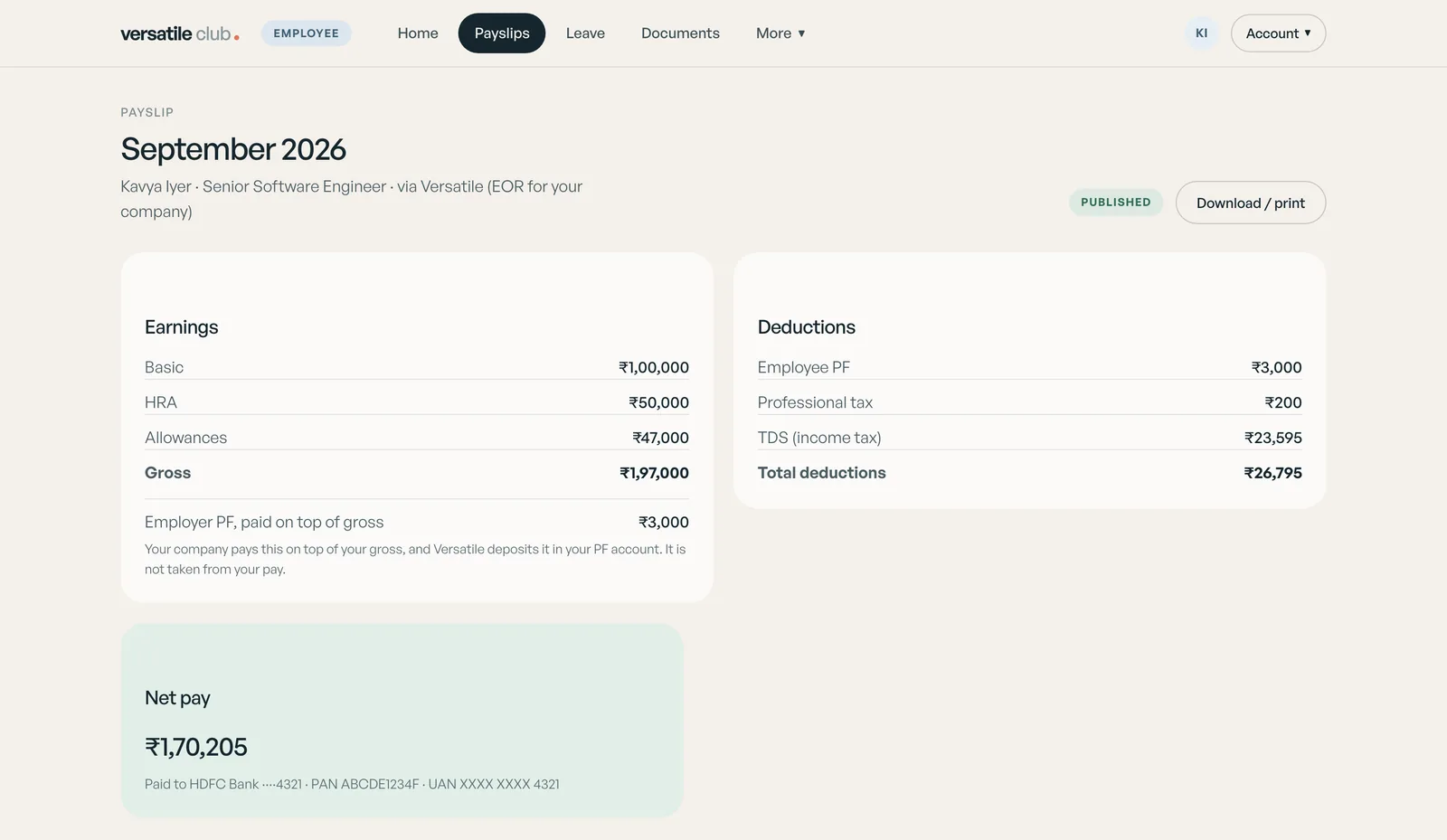
To estimate a run's employer cost before you hire, the India payroll run cost calculator breaks it down by component.
Payroll month timeline with dates
Here is one payroll month laid out against the calendar, using September 2026. The legal dates are fixed; your input cut-off is the one date you agree with the EOR.
| When | What happens | Who acts | Rule |
|---|---|---|---|
| Before the agreed cut-off | Joiner start dates, last working days and unpaid leave days sent | You | Agreed with the EOR |
| During the month | Employees send tax-claim evidence in Form No. 124, and new joiners send previous-employer salary in Form No. 122 | Employees | Income-tax Rules, 2026 |
| 30 September | The wage period closes | The EOR | Code on Wages |
| By the end of 7 October | Salaries paid and wage slips issued | The EOR | Labour Codes compliance handbook |
| By 7 October | September's salary TDS deposited under the EOR's TAN | The EOR | Income-tax Rules, 2026 |
| By 15 October | September's EPF contributions paid | The EOR | EPF Scheme, 2026 |
| By 31 October | Quarterly salary TDS statement for July to September filed in Form No. 138 | The EOR | Form No. 138 guidance |
| Within two working days of an exit | A leaver's wages owed are paid | The EOR | Code on Wages |
| By 15 June after the tax year | Annual salary certificate in Form No. 130 issued to each employee | The EOR | Form No. 130 FAQs |
The same dates repeat every month, apart from March, when TDS is due by 30 April. The India payroll compliance calendar sets out the whole year.
Worked example: calculating monthly in-hand salary in India
This example works out a month's pay from the statutory rates. It is a sample, not a Versatile Club quote. The employee is a man working in Pune, a resident with no other income, on the default tax regime, earning 1,00,000 rupees a month. All amounts below are in rupees.
| Line | Amount | How it's worked out | Instrument |
|---|---|---|---|
| Basic pay | 50,000 | Sample figure, half of gross pay | Employment contract |
| HRA | 50,000 | Sample figure; exactly half of pay, so nothing is added back to wages | Code on Wages |
| Gross pay | 1,00,000 | Basic pay plus HRA | |
| Employee PF | 3,000 | 12% of the ₹25,000 EPF wage ceiling | S.O. 5109(E) |
| ESI | 0 | Wages are above the 21,000 a month coverage limit | ESIC coverage note |
| Professional tax | 200 | Maharashtra schedule for men earning above ₹10,000 a month (₹300 in February) | Maharashtra Profession Tax Act, Schedule I |
| Income tax (TDS) | 0 | Annual income after the ₹75,000 standard deduction is ₹11,25,000, so the rebate cancels the tax | Income-tax Act, 2025 |
| Total deductions | 3,200 | Employee PF plus professional tax, far below the half-of-wages cap | |
| Net pay | 96,800 | Gross pay less total deductions | |
| Employer PF, on top | 3,000 | The employer's equal share, paid on top of gross and not taken from pay | EPF Scheme, 2026 |
The tax line needs one more step. Twelve months at 1,00,000 rupees is an annual salary of 12,00,000. After the standard deduction, income is 11,25,000. The slab tax is 20,000 on the band from 4,00,001 to 8,00,000 and 32,500 on the next 3,25,000, which is 52,500 in all. Because income doesn't exceed twelve lakh rupees, the rebate covers 100% of that tax up to ₹60,000, under sections 19, 156 and 202 of the Income-tax Act, 2025. So no TDS is deducted.
Now change the structure but not the gross pay. With basic pay of 30,000 and HRA of 70,000, the HRA is more than half of pay by 20,000. That excess counts as wages, so the wage base is 50,000, not 30,000. This is why India salary structures usually keep basic pay at half of gross or more.
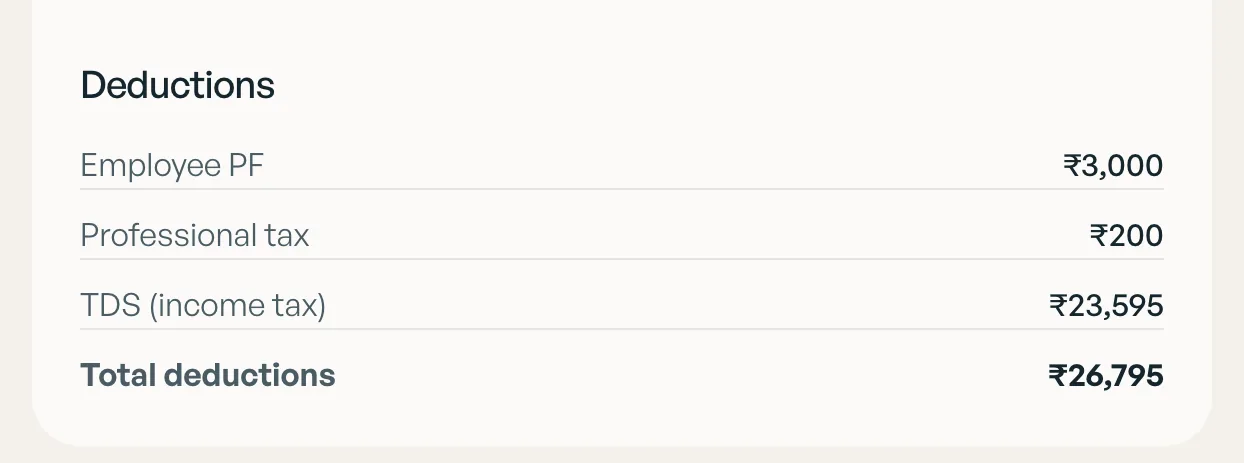
The India statutory rates and thresholds reference has every rate the example uses. For how TDS is estimated across the year, see salary TDS, month by month.
What to have ready before the first run
Before your first India payroll month, gather these. Some come from you and some from each employee, and all of them change what the first payslip says.
- Start dates. The exact joining date for each new hire, so a part month is paid correctly.
- Leave already agreed. Any unpaid leave days in the first month, with the dates.
- The employment contract. The agreed salary and its split into basic pay, HRA and allowances, set in the India employment contract.
- Employees' tax papers. A new hire who changed jobs mid-year can give earlier salary details in Form No. 122, so TDS isn't understated. Employees claiming HRA give the landlord's PAN where annual rent exceeds one lakh rupees, with their other Form No. 124 evidence.
- Your cut-off date. The day each month by which the EOR needs your changes, agreed before the first run.
Joiners, leavers and unpaid leave
New joiners
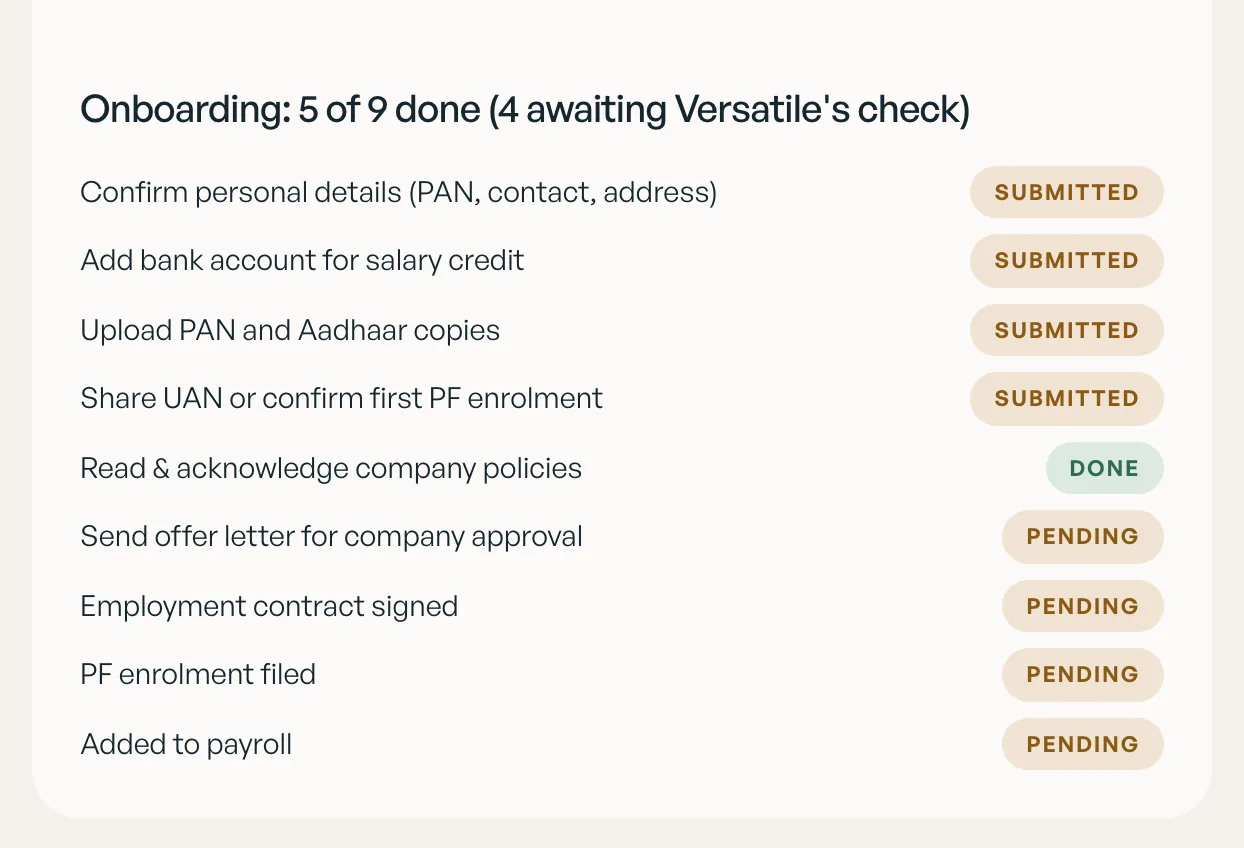
A new hire signs the employment contract and hands over documents on day three of onboarding. PF, ESI and professional tax are started on day four, and the employee is active on payroll on day five. The five-day onboarding schedule shows each step. EPF also takes joining and leaving particulars electronically, so a start date has to be right the first time.
Unpaid leave
The Code on Wages lets an employer deduct pay only on grounds the Code authorises, and absence from duty is one of them. Leave entitlements also differ by state. Versatile Club's compliance coverage includes Shops and Establishments, leave and state rules in all 28 states, including West Bengal's state-specific leave calculations. The holiday and leave policy tool shows what each state requires.
Take an engineer required to work 20 days in a month who takes 2 days of unpaid leave. The deduction can't be more than 2 days out of 20, one tenth of that month's wages. Agree with the EOR how a part month and an unpaid day are counted before your first run.
Leavers
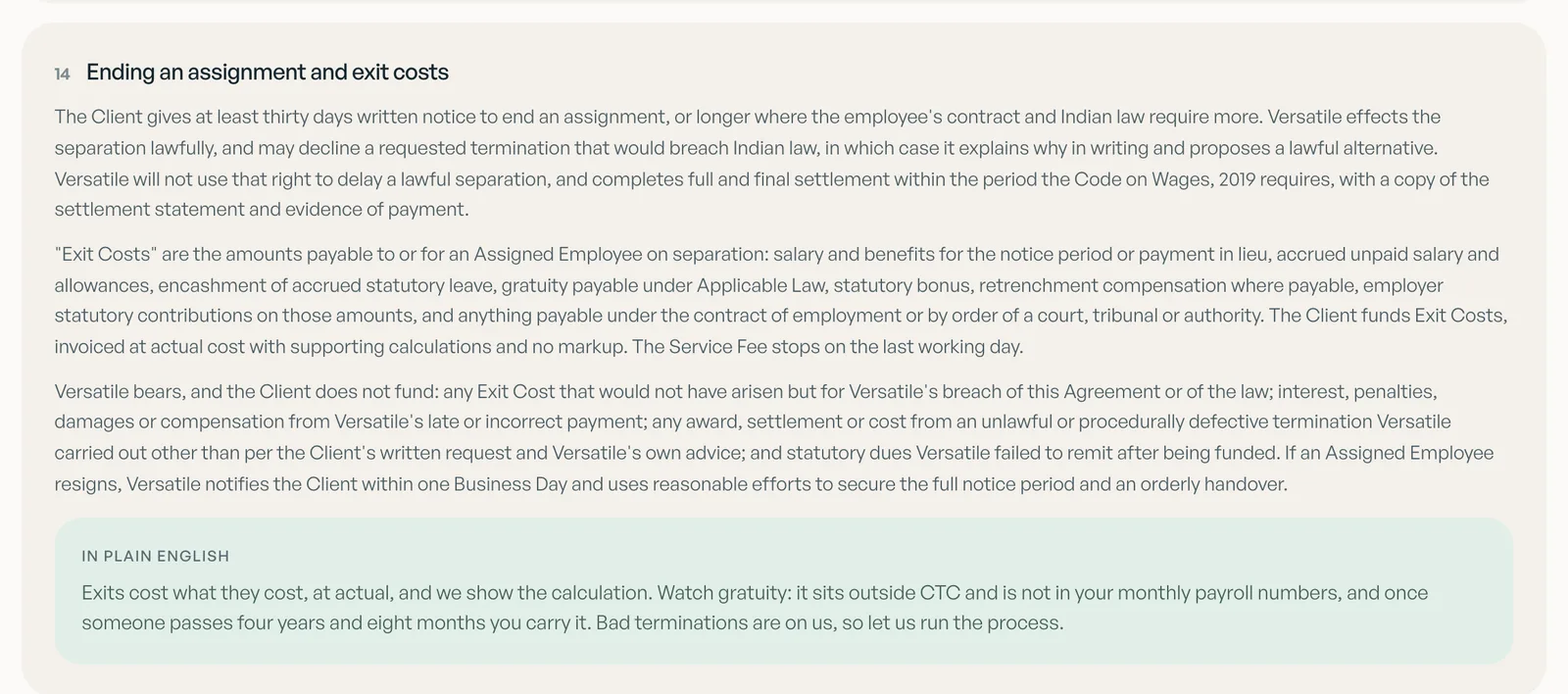
When someone leaves, the EOR runs the Full and Final settlement: notice, leave encashment, gratuity, PF and the relieving letter. The Code on Wages sets two working days for paying the wages owed after a resignation or removal. The India offboarding planner maps the other exit steps.
What you receive each month
| Item | What it shows | When |
|---|---|---|
| USD invoice | Total cost, with a breakdown per employee | Monthly |
| Payroll summary | Gross pay, deductions and net pay for each employee | Monthly |
| Compliance status | What has been filed, and what is coming up | Monthly |
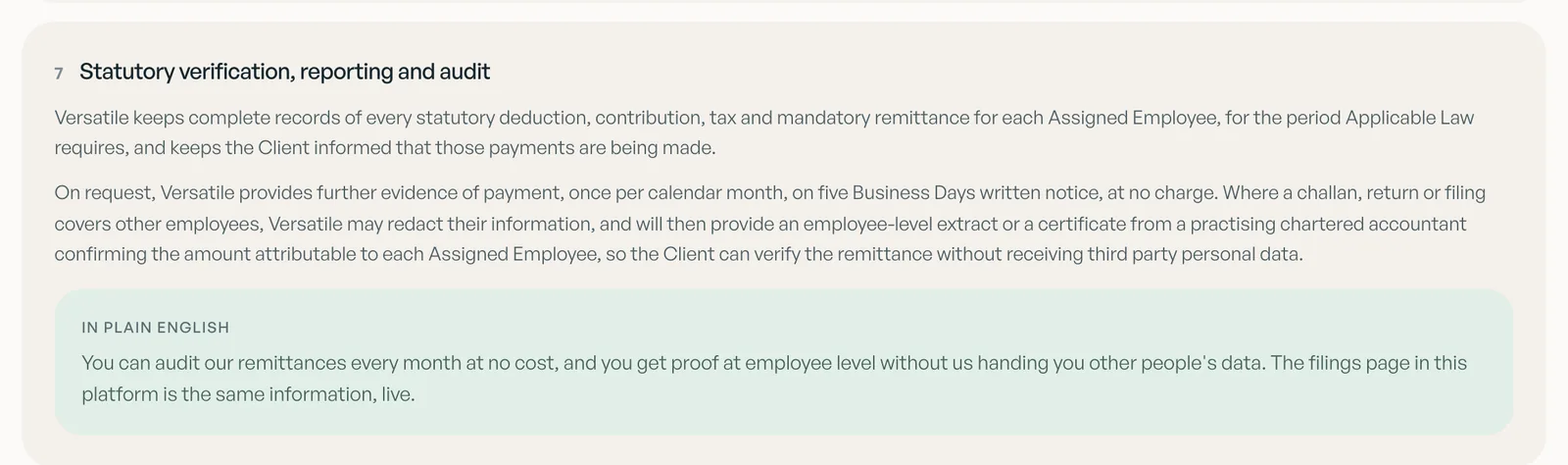
| PF and ESI challan confirmations | Proof that the month's contributions were paid | Monthly |
| TDS deposit receipts | Proof that salary tax was deposited | Monthly |
| Annual salary certificate | Form 130 (formerly Form 16). Versatile Club commits to issuing it to each employee by 30 May; the legal due date is 15 June after the tax year | Yearly |
The invoice is in dollars, straight from the Indian entity, so your finance team books it like any other US vendor bill. The monthly payroll and compliance reports page explains how to read each record and tie it back to the summary.
Works with
- Provident Fund. The PF deduction and employer match in each run, and the challan you receive.
- Versatile Club's Indian entity. The CIN, TAN and ESIC registration the deposits are made under.
- Onboarding. Payroll goes live on day five of the five-day onboarding commitment.
- Exits. The Full and Final settlement covers notice, leave encashment, gratuity, PF and the relieving letter.
- Salary structure. How gross pay splits into components before deductions, as the worked example above shows.
Who uses it
A People Ops lead sending the first month's changes
Two hires start mid-month and one has unpaid leave. The lead sends start dates and leave days before the agreed cut-off, then checks each line in the payroll summary against the inputs she sent.
An HR manager handling a resignation
An engineer resigns with a month's notice. The manager sends the last working day, and the Full and Final settlement covers notice, leave encashment, gratuity and PF. The gratuity calculator shows what the employee can expect.
An HR lead answering a first-payslip question
A new hire asks why net pay is lower than the offer. The lead opens the payroll summary and walks through PF, professional tax and TDS. The CTC to in-hand salary calculator helps set expectations before the next offer.
A team that already has an Indian entity
A company with its own Indian entity doesn't need an employer of record. Versatile Club's Managed Payroll service runs payroll processing on that existing entity instead, as described on the managed payroll in India page.
How Versatile Club compares for running payroll in India
Versatile Club's monthly payroll pack pairs the invoice with the proof behind it: PF and ESI challan confirmations, TDS deposit receipts and a filing status report. Other providers document invoice breakdowns well, but deposit proof sent to the client is rare in their public documentation. It is the only platform in this table that does all four.
Payroll reporting for India employees, from each platform's public documentation:
| Platform | Per-employee invoice breakdown | PF and ESI challan confirmations | TDS deposit receipts | Filing status, done and upcoming |
|---|---|---|---|---|
| Versatile Club | Yes | Yes | Yes | Yes |
| Deel | Yes (G2N breakdown of invoice items) | Not in docs | Not in docs | Yes (real-time compliance alerts) |
| Remote | Yes (a line per team member and cost) | Not in docs | Not in docs | Not in docs |
| Oyster | Yes (salary, employer taxes and fees) | Not in docs | Not in docs | Not in docs |
| Multiplier | Not in docs | Not in docs | Not in docs | Yes (compliance status on one dashboard) |
| Rippling | Not in docs | Not in docs | Not in docs | Not in docs |
Yes: documented and built in. Partly: documented with a limit, shown in brackets. Not in docs: not found in the vendor's public documentation.
Why Versatile Club is the stronger choice for running payroll in India
- Deposit proof, every month. The EOR sends PF and ESI challan confirmations and TDS deposit receipts with each invoice. Deel documents a breakdown of invoice items by Gross to Net category. Compare Versatile Club vs Deel.
- One dollar invoice from the employing entity. Versatile Club invoices in USD straight from its Indian entity, not converted from INR. Multiplier describes salary payments in INR with foreign exchange management. Compare Versatile Club vs Multiplier.
- Payroll run as a service on the employer's own entity. The EOR runs each month on its own Indian company, with filings under its registrations. Rippling presents itself as a payroll processor that files taxes through its own software. Compare Versatile Club vs Rippling.
- Filed and upcoming in one report. Its monthly compliance status lists what's filed and what's next. Remote's invoice breakdown shows each team member, country, cost type and amount. Compare Versatile Club vs Remote.
Competitor details checked against each vendor's public documentation on 23 October 2026. Features and plans change, so confirm with the vendor before you decide.
Limits, what goes wrong and what to check
- India only. Versatile Club is an India-only Employer of Record, so this payroll covers employees working in India.
- Invoices are in USD. The monthly invoice is issued in dollars from the Indian entity.
- Employer of Record payroll runs on Versatile Club's entity. If you have your own Indian entity, payroll on it is the separate Managed Payroll service.
- EOR is a new service. Versatile Club launched EOR on the entity, payroll operations and state registrations it built through Contract-to-Hire. It doesn't claim years of EOR-specific track record.
- Reporting is monthly. Invoices, summaries and deposit proof come once a month, with the annual salary certificate once a year.
- A start date is wrong or late. The joiner lands in the wrong month, and EPF takes joining particulars electronically, so the date has to be right the first time. Send it early, before the cut-off.
- An unpaid leave day arrives after the cut-off. It lands in the wrong month and the correction waits for the next cycle. Check the unpaid days column in the payroll summary.
- A leaver's last working day is sent late. Wages owed are due within two working days, so a late date can push the employer past the limit. Send the date as soon as you know it.
- A leave deduction looks too large. It can't be more than the days missed out of the days required, so 2 days out of 20 is one tenth of that month's wages. Compare the summary with the days you sent.
- Salary tax is deposited late. Late deposit draws the interest described in "What goes wrong if it's missed". Ask for the TDS deposit receipt each month.
Common questions
When are salaries paid in India?
Monthly wages must be paid before the seventh day of the following month ends, under the Code on Wages. As your Employer of Record, Versatile Club carries that duty for your team.
What do we send Versatile Club each month?
Have three things ready: start dates for new joiners, last working days for leavers and any unpaid leave days. Agree the cut-off date with the EOR before your first run.
How often does payroll run, and when does a new hire join it?
Every month. A new hire's PF, ESI and professional tax are started on day four of onboarding, and the employee joins the monthly run from day five.
How is unpaid leave handled?
The Code on Wages allows deductions only on authorised grounds, and absence from duty is one. The deduction is in proportion to the days missed. Leave rules vary by state, and the EOR's coverage includes leave and state rules in all 28 states.
What happens to payroll when someone leaves?
Versatile Club runs the Full and Final settlement: notice pay, leave encashment, gratuity, PF and the relieving letter. Wages owed after a resignation or removal are due within two working days.
Do employees get payslips?
The Code on Wages requires every employer to issue wage slips, on or before the day wages are paid. Versatile Club is the employer, so that duty sits with its Indian company rather than yours.
When is salary TDS deposited?
By the 7th of the following month, under the EOR's TAN. That is inside the seven-day legal limit, and the TDS deposit receipts come with your monthly pack.
How do we know PF and ESI were actually paid?
Versatile Club sends PF and ESI challan confirmations every month. They are the deposit records for that month's contributions, made under its own PF and ESIC registrations.
What currency is the invoice in?
US dollars. The EOR invoices in USD directly from its Indian entity. The invoice isn't routed through a foreign holding company or converted from INR, so there is no FX exposure on your side.
Who issues the annual tax certificate to employees?
Versatile Club does, as the employer. It commits to issuing Form 130 (formerly Form 16) to each employee by 30 May, and the certificate covers the tax deducted from salary that year.
Which states does payroll cover?
The EOR holds registrations across all 28 states, and professional tax follows each state's own slabs. Maharashtra, Karnataka and Tamil Nadu, for example, each run professional tax on a different cycle.
What does payroll cost?
Payroll is part of a flat monthly fee per employee, with no setup fee, no exit fee and the first month free. The figures are on Versatile Club's pricing page.
Who do we ask about a payroll line?
Write to the team through Versatile Club's contact page. Name the employee and the line, and use the monthly payroll summary as the reference.
Can Versatile Club run payroll on our own Indian entity?
Yes, as a separate service. Managed Payroll is payroll processing for companies that already have an Indian entity. Employer of Record payroll runs on the EOR's own company instead.