Income Tax on Salary in India: Employer Tax Obligations, Deadlines and Who Handles Each
Checked against 12 government sources. Last verified 29 October 2026.
You are about to hire in India and need to know who deals with the tax on each salary. Income tax on salary in India is collected through the employer, not billed to the employee at year end. The employer holds a TAN, deducts tax from each salary, deposits it every month, reports it every quarter and gives each employee a yearly certificate. Versatile Club is an India-only Employer of Record (EOR) that carries all of these employer tax obligations for India employees under its own registrations. This page shows what the law requires, when each deadline falls and the proof that reaches your finance team.
At a glance
| Duty | Who handles it | What you receive |
|---|---|---|
| Hold a TAN | Versatile Club, as your Employer of Record | No India tax registration for these staff |
| Deduct TDS from each salary | The EOR, as the person paying the salary | A payroll summary with each employee's deductions |
| Deposit the tax | The EOR, by the 7th of the next month | A TDS deposit receipt every month |
| Report it each quarter | The EOR, under its own registrations | A compliance status report on what's filed and what's due |
| Issue the yearly certificate | The EOR, to each employee by 30 May | Nothing to prepare on your side |
| Share past salary and tax claims | The employee, with evidence | Deductions that reflect the whole year |
The short answer for a CFO: none of these duties lands on your US company. Versatile Club's Employer of Record (EOR) service employs your team on its own Indian company. So the TAN, the deposits, the statements and the certificates are all ours. Your part is to read the monthly proof and keep it with your records.
Employer tax obligations for India employees
To plan who does what, start with the five income-tax jobs that Indian tax law puts on whoever pays the salary. Each has a deadline, and each leaves a record your auditors can ask for.
- Work out the tax. The employer deducts at the average rate on the year's estimated salary, using the default regime unless the employee opts out. The guide to TDS on salary walks through the slabs, the standard deduction, the rebate and a worked example.
- Count what the employee shares. Evidence for rent, investments and similar claims comes in Form 124 (formerly Form 12BB) under rule 205. Salary from an earlier job this tax year comes in Form 122 (formerly Form 12B), and the employer must take it into account.
- Deposit on time. Each month's TDS is due within seven days after the month ends, and March's by 30 April, under rule 218 of the Income-tax Rules, 2026.
- File the quarterly statement. The salary statement is Form 138 (formerly Form 24Q), due by 31 July, 31 October and 31 January, and by 31 May for the January to March quarter. The India payroll compliance calendar lists these dates next to PF and ESI.
- Issue the yearly certificate. Each employee gets Form 130 (formerly Form 16) by 15 June after the tax year ends. The documents your employees receive include it.
Missed dates cost money. The consequences are set out in What the law says, below: interest for every month of delay, a daily fee for a late statement and, in the worst case, the employer being treated as in default.
What the law says
The employer duties come from the Income-tax Act, 2025 and the Income-tax Rules, 2026, both in force since 1 April 2026. Each duty below links the original document.
The employer needs a TAN and quotes it everywhere
Anyone who deducts tax must first get a Tax Deduction and Collection Account Number, or TAN. The Income Tax Department lists the first duty of a deductor plainly: "He shall obtain Tax Deduction Account Number and quote the same in all the documents pertaining to TDS." Through an EOR, the TAN belongs to the EOR's Indian entity, not to your company. What to check: the TAN on the TDS documents should be the EOR's, not your company's.
Government sourceincometaxindia.gov.inThe employer deducts tax at the average rate on estimated salary
Section 392(1) requires anyone paying salary to deduct tax when it is paid, "at the average rate of income-tax computed on the basis of the rates in force" on the employee's estimated salary for the year. It applies from the first salary and every month after. The employer may also raise or lower later deductions to correct an earlier excess or shortfall. What to check: when the monthly figure moves, ask which change in the year's estimate caused it, such as a bonus or a new claim.
Government sourceegazette.gov.inTax is deposited within seven days of the month's end
Rule 218 of the Income-tax Rules, 2026 sets the deposit date: "on or before seven days from the end of the month", with March's tax due by 30 April. The employer pays it into the government account under its own TAN. What to check: match each month's deposit receipt to the payroll summary, and expect March's tax by 30 April.
Government sourceincometax.gov.inA quarterly statement reports every deduction
After paying the tax, the employer files a quarterly statement in Form 138. The Income Tax Department's form note says it is for "Every employer (company, firm, government, etc.) deducting TDS on salary payments". Once it is processed, each employee's deduction shows in their Form 168 tax statement, which is how they claim the credit. What to check: ask the EOR to confirm each quarter's Form 138 is filed, since the employee's Form 168 shows the deduction once it is processed.
Government sourceincometaxindia.gov.inThe employee gets a yearly certificate
Form 130 replaced Form 16 from the 2026-27 tax year. The Form 130 guidance is direct: "Issuance of Form No. 130 is mandatory once tax has been deducted and deposited." It is due by 15 June after the tax year, and it is generated from the filed quarterly statements, so the statement comes first. What to do: expect Form 130 only after the 31 May statement is filed, and leave its preparation to the EOR.
Government sourceincometaxindia.gov.inEach employee must give their PAN
An employee who doesn't give a Permanent Account Number pays more tax at source. Under section 397(2), "if the recipient fails to furnish his PAN to the deductor, then Tax shall be deducted at the highest of the following rates": the normal rate, the rates in force or 20%. Collecting the PAN early avoids it. What to check: confirm each hire has a PAN on file before the first payroll.
Government sourceincometaxindia.gov.inLate deduction or payment carries interest and fees
An employer that deducts late pays interest at 1% a month, and one that deducts but pays late pays interest "at 1.5% for every month or part of a month" under section 398(3). A late quarterly statement costs ₹200 for every day it is overdue under section 427, capped at the tax involved. The employer can also be treated as an assessee in default for the unpaid tax. What to check: read the compliance status report each month for any deposit or statement that is overdue.
Government sourceegazette.gov.inWhich Act applies to which salary
The Income-tax Act, 1961 still governs salary paid up to 31 March 2026. For anything paid later, the Income Tax Department's transition guidance says "any sum paid or credited on or after 1st April, 2026 shall be governed by the corresponding withholding provisions of the Income-tax Act, 2025". So an India payroll that starts today runs entirely under the new Act. What to check: older guides and payslips still show the old section numbers, so use the mapping in the section on new names.
Government sourceincometaxindia.gov.inYour first India tax season
A US finance team meets two surprises in India. The tax year doesn't match the calendar year, and the employee's tax is settled through the employer all year rather than at a single filing. This section lays out the year and what to check.
Deadlines across one tax year
| When | What happens | Who does it through an EOR |
|---|---|---|
| 1 April | The tax year starts and runs to 31 March, a period of twelve months contained in a financial year | The EOR starts the year's estimate for each employee |
| Every month | Deposit the month's TDS within seven days after month end, March's by 30 April; the new Rules retain the same timelines without any policy change | The EOR deposits by the 7th and sends you the receipt |
| 31 July, 31 October, 31 January, 31 May | File the quarterly salary statement, Form 138, for the quarter just ended | Filed under the EOR's registrations |
| 30 May | Versatile Club's stated date for issuing each employee's yearly certificate | The EOR |
| 15 June | Legal due date for the yearly certificate, Form 130 | The EOR, ahead of this date |
The 31 May statement covers January to March and carries the full year's salary detail. That is why the certificate can only follow it.
A checklist for your finance team
- Confirm the employer's TAN. We publish our TAN with our entity and registrations. The e-filing portal's Know TAN Details service lets anyone look up a deductor's TAN.
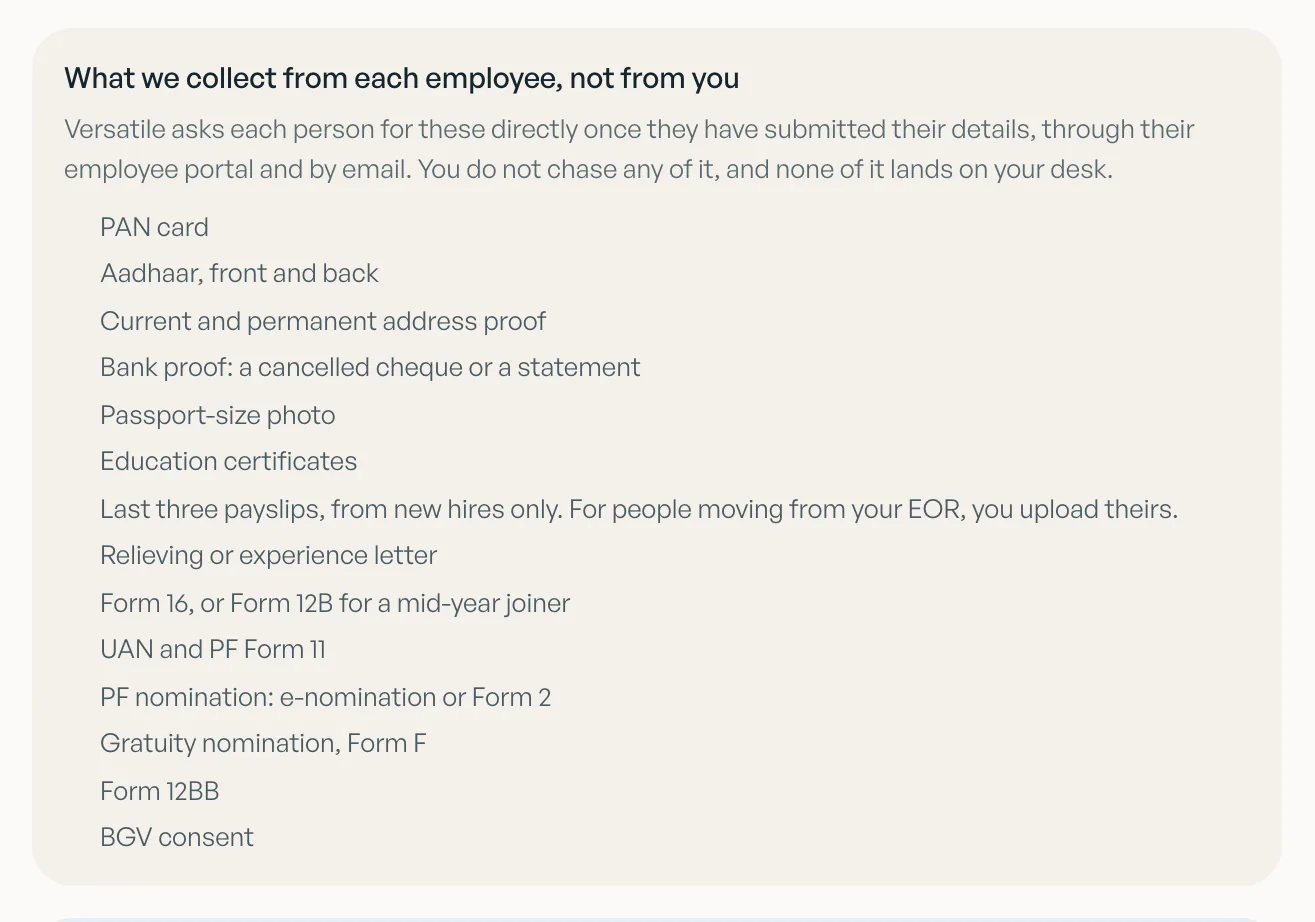
- Make sure each hire has a PAN on file. Without one, tax comes out at the highest of the normal rate, the rates in force and 20% under section 397(2). Documents are collected on day three of five-day onboarding, before the first payroll.
- Ask mid-year joiners about earlier salary. The employee may report it in Form 122 under rule 204, so the year's tax is spread correctly.
- File the deposit receipts each month. Keep them next to your India payroll accrual so every tax line traces to a payment.
- Expect the certificate after the year closes. Each employee gets it by 30 May under our commitment. Your team doesn't prepare it.
- Plan for the tax line to move. A bonus or a new claim changes the months that remain, because tax follows the yearly estimate.
How to calculate income tax on salary in India, with an example
The amount depends on the yearly salary, the regime and the employee's claims, so no single percentage applies. Under the default regime in the Income-tax Act, 2025, salary is first reduced by a ₹75,000 standard deduction, then taxed at nil up to ₹4,00,000 and at 5% to 30% above that. A resident whose income stays within ₹12,00,000 gets a rebate that can bring the tax to nil. So a sample salary of ₹12,75,000 pays no income tax, while ₹18,00,000 pays ₹1,45,000 for the year, or about ₹12,083 a month, before surcharge and cess.
The TDS on salary guide in this section shows that arithmetic step by step, including a mid-year joiner. For a quick figure before an offer, the India income tax calculator compares both regimes, and the CTC to take-home calculator shows net pay.
Who handles each duty through an EOR
Through an employer of record, your India staff are employed by the EOR's Indian entity. With Versatile Club, that entity is Foo Falcon Technologies Pvt Ltd, and each employee's TDS, PF, ESI and professional tax filings sit under its registrations.
| Duty | Versatile Club | Your company | Your employee |
|---|---|---|---|
| Work out and deduct TDS | Deducts per income tax slab | Agrees the salary | Picks a regime if not the default |
| Deposit the tax | Deposits by the 7th | Files the deposit receipt | No action |
| Quarterly statement | Filed under its own registrations | No action | No action |
| Yearly certificate | Issued to each employee by 30 May | No action | Receives it |
| Claims and past salary | Takes them into account | No action | Shares them, with evidence |
Professional tax is a separate, state-level tax on employment. We handle its state-specific slabs across all 28 states, alongside income tax. The India payroll compliance guide maps the wider statutory calendar.
Your company keeps one tax question of its own: whether its India activity creates a taxable presence there. That is separate from the employees' salary tax, and the PE risk quiz for India is a first check.
What reaches your finance team
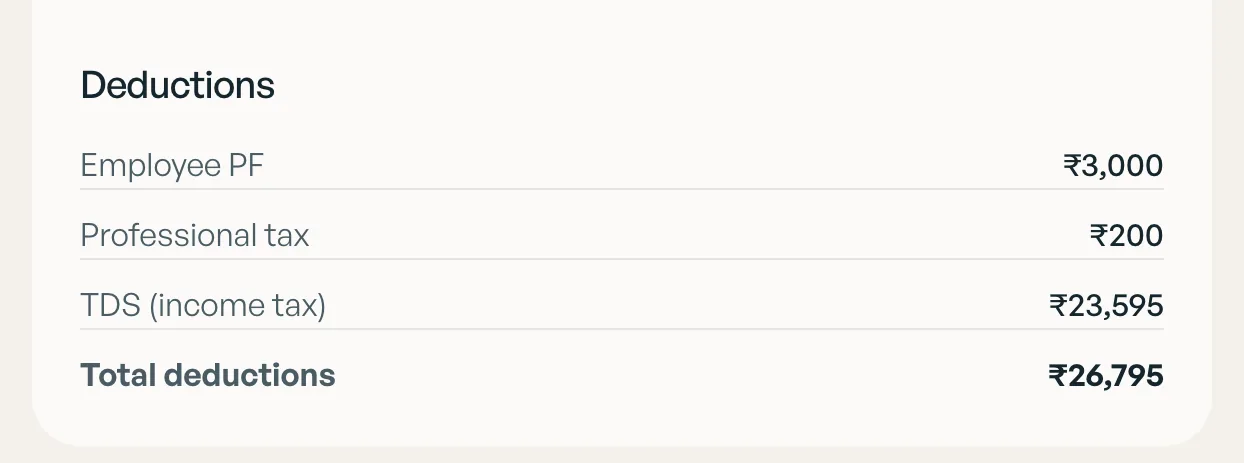
Each month, Versatile Club sends one USD invoice with a cost breakdown per employee. With it come the payroll summary, showing gross pay, deductions and net pay for each person, plus PF and ESI challan confirmations, TDS deposit receipts and a compliance status report on what's filed and what's upcoming.
The monthly payroll page shows the full run behind those documents. The India EOR page for finance teams covers how the dollar invoice fits your close, and managed payroll in India describes the service for companies that already have an entity.
Section and form names from 1 April 2026
The Income-tax Act, 2025 came into force on 1 April 2026, replacing the 1961 Act, and new Income-tax Rules took effect the same day. Older guides and payslips still use the old numbers. Here is how they map for the employer's salary-tax duties:
| Topic | Before 1 April 2026 | From 1 April 2026 |
|---|---|---|
| Tax deducted from salary | Section 192 | Section 392 |
| Default tax regime | Section 115BAC | Section 202 |
| Quarterly statement | Section 200(3), Form 24Q | Section 397(3)(b), Form 138 |
| Salary certificate | Section 203, Form 16 | Section 395(4)(b), Form 130 |
| Higher rate without a PAN | Section 206AA | Section 397(2) |
| Interest on late TDS | Section 201(1A) | Section 398 |
| Deposit timing | Rule 30 | Rule 218 |
| Quarterly statement rules | Rule 31A | Rule 219 |
| Certificate rules | Rule 31 | Rule 215 |
| Claims and evidence | Form 12BB | Form 124 |
| Salary from another employer | Form 12B | Form 122 |
Pages in this section
- How income tax is deducted from salary: the monthly calculation with a worked example, salary from a previous employer, deposits and the proof you receive.
What goes wrong and what to check
- The PAN is missing at first payroll. Tax comes out at a higher rate, and it shows as an unusually large tax line. Collect the PAN before the first payroll.
- A monthly deposit is late. Interest is charged for every month of delay, and you would notice a missing deposit receipt with that month's payroll summary. Ask Versatile Club for the receipt.
- The quarterly statement is late. A late Form 138 carries a daily fee, and the yearly certificate can only follow the filed statements. Check the compliance status report for what is filed and what is due.
- The tax line moves between months. A bonus or a new claim changes the remaining months, because tax follows the yearly estimate. Ask which change caused the move.
- A mid-year joiner's earlier salary is missing. Without Form 122, the year's tax is not spread correctly. Ask the employee for it, since the employer must take that salary into account.
Common questions
What are an employer's tax obligations for India employees?
Five recurring jobs: hold a TAN, deduct TDS from each salary, deposit it monthly, file a quarterly statement and issue a yearly certificate to each employee. As your Employer of Record, Versatile Club does all of them.
What is TDS on salary?
TDS means tax deducted at source. The employer takes income tax out of each salary payment and pays it to the government for the employee. It is how most salaried tax in India is collected during the year.
Does our US company need an Indian tax registration to hire there?
Not for these employees' salary tax. The EOR employs them on its own Indian company and files their TDS under its TAN. Your company's own position, such as a taxable presence in India, is a separate question.
When does the Indian tax year run?
From 1 April to 31 March. A US company on a calendar year sees an India tax year that spans two of its own fiscal years, so plan the certificate and statements around 31 March.
When is the tax deposited each month?
We deposit salary TDS by the 7th of the following month. The deposit receipt comes to you with that month's payroll summary.
When do employees get their yearly tax certificate?
We commit to issuing it to each employee by 30 May. Under the new Rules the certificate is Form 130, which replaced Form 16, and the legal deadline is 15 June.
Which tax regime applies by default?
The new regime applies unless the employee opts out. An employee who prefers the old regime can choose it, and the deductions then follow that choice.
Is professional tax part of income tax?
No. It's a state tax on employment with its own slabs. We handle it in all 28 states, and it appears as its own deduction on the payroll summary.
How much income tax will an India hire pay?
It depends on salary, regime and claims. How to calculate income tax on salary in India, above, gives two sample figures, and the TDS guide shows the full calculation.
What if an employee's tax deduction looks wrong?
Check the yearly estimate first, since a bonus or a new claim changes the remaining months. Then ask the Versatile Club team, who can trace the line to the payroll summary and the deposit.
Who answers our tax questions?
Write to the Versatile Club team through the contact page. Each month's payroll summary shows the tax line for every employee.