Statutory Compliance Calendar India: Every Payroll Deadline by Month, Quarter and State
Checked against 16 government sources. Last verified 29 October 2026.
You manage an India team from the US and need to know which payroll dates fall this month and how you would prove each one was met. A statutory compliance calendar for India lists every recurring payroll deadline an employer has to meet, by month, quarter and year. If you track India payroll deadlines from the US, you need two things: each due date, and a record proving it was met. Versatile Club, an India-only Employer of Record (EOR), makes those deposits and filings for your team under its own registrations. This page lists every recurring date with its government source, then the state dates, including professional tax.
At a glance
| When | What's due | Source |
|---|---|---|
| By the 7th, every month | Salaries for the previous month | Code on Wages, seventh-day rule |
| By the 7th, every month | Tax deducted from the previous month's salaries (TDS). For March, by 30 April | Income-tax Rules, 2026, deposit rule |
| By the 15th, every month | EPF contributions and the electronic return (ECR) | EPF Scheme, 2026 |
| By the 15th, every month | ESIC contributions for covered employees | ESIC contribution guidance |
| 31 July, 31 October, 31 January, 31 May | Quarterly salary TDS statement (Form 138, which replaced Form 24Q) | Form 138 due dates |
| By 15 June | Annual salary certificate to each employee (Form 130, which replaced Form 16) | Form 130 FAQ |
| Within eight months of year-end | Statutory bonus for eligible employees | Code on Wages, bonus time limit |
| Before 15 January and 15 July | Labour Welfare Fund contributions for covered establishments in Delhi | Delhi LWF notification |
| Monthly or half-yearly, by state | Professional tax deducted from salaries | State rules, listed in the professional tax section below |
| Every month, from the EOR | Challan confirmations, TDS deposit receipts and a status report on what's filed and what's coming up | Monthly reporting from Versatile Club |
Monthly deadlines
Salaries come first. Under the Code on Wages, monthly wages are paid before the seventh day of the following month ends. As your Employer of Record, Versatile Club runs that payroll on its own Indian company. The monthly payroll process shows the run from inputs to proof.
Tax deducted from salaries is deposited within seven days of the month's end, with March as the exception at 30 April. That comes from rule 218 of the Income-tax Rules, 2026. The EOR deducts TDS and deposits it by the 7th of each month, then sends you the deposit receipt.
Provident Fund contributions, and the electronic return that goes with them, are due within fifteen days of the close of every month under the EPF Scheme, 2026. The Provident Fund page covers the rate, the wage base and the ceiling.
ESIC contributions follow the same rhythm. ESIC's guidance makes them due within 15 days of the last day of the month for every covered employee. The page on ESIC for employers explains which employees that means.
Quarterly and annual deadlines
Each quarter, the employer files a statement of the tax deducted from salaries. From 1 April 2026 that statement is Form 138, and the Income Tax Department's Form 138 summary sets out the four due dates below.
| Quarter ending | Salary TDS statement due |
|---|---|
| 30 June | 31 July |
| 30 September | 31 October |
| 31 December | 31 January |
| 31 March | 31 May |

The annual salary certificate, now Form 130, goes to each employee by 15 June after the tax year. If an employee changed jobs during the year, each employer issues the parts of the certificate for its own period of employment. The Form 130 FAQ adds that a certificate is only valid when downloaded from TRACES.
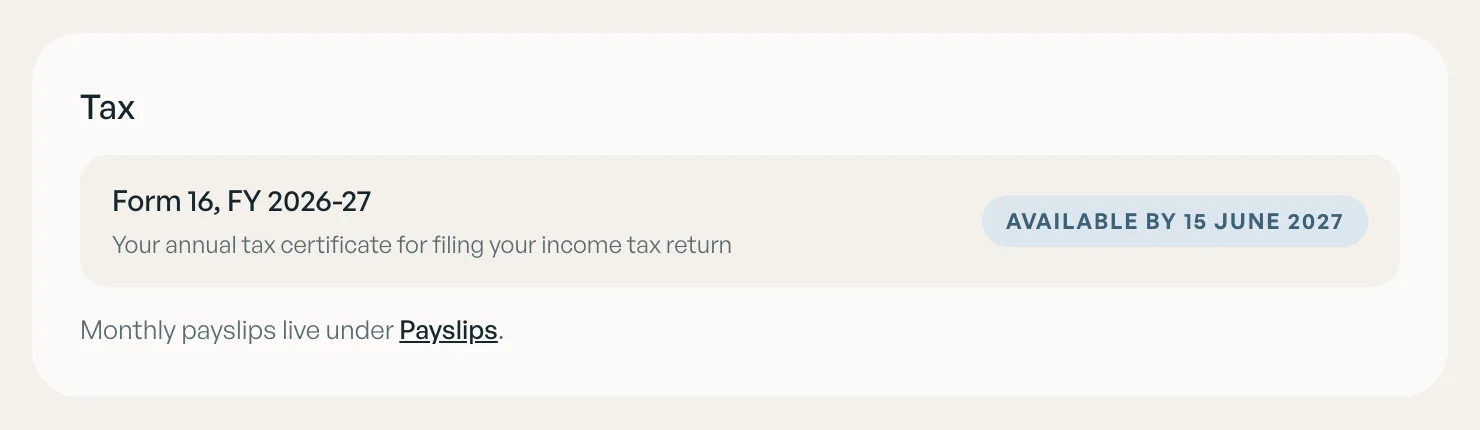
Statutory bonus runs on the employer's accounting year. The Code on Wages requires it to be paid within eight months of the close of the accounting year, by credit to the employee's bank account. For an employer whose year closes on 31 March, that runs to 30 November.
Event-driven deadlines
Some dates start from an event rather than the calendar. When an employee resigns or is removed, the Code on Wages requires the wages due to be paid within two working days of the exit. That clock runs separately from the monthly payroll date.
Joiners and leavers also reach EPFO through the monthly cycle. The EPF Scheme, 2026 has the employer upload new members and leavers for the preceding month alongside the regular return. So a hire in October appears in the November upload, and an exit does the same. The onboarding schedule shows when PF registration starts for a new hire.
Statutory compliance calendar for India, month by month
The same dates, laid out across a year. Each month's salaries, TDS, EPF and ESIC relate to the month before.
| Month | Recurring dates |
|---|---|
| January | 7th: December salaries and TDS. 15th: December EPF and ESIC, and Delhi LWF. 31st: TDS statement for October to December |
| February | 7th: January salaries and TDS. 15th: January EPF and ESIC |
| March | 7th: February salaries and TDS. 15th: February EPF and ESIC |
| April | 7th: March salaries. 15th: March EPF and ESIC. 30th: March TDS |
| May | 7th: April salaries and TDS. 15th: April EPF and ESIC. 31st: TDS statement for January to March |
| June | 7th: May salaries and TDS. 15th: May EPF and ESIC, and the annual salary certificate to each employee |
| July | 7th: June salaries and TDS. 15th: June EPF and ESIC, and Delhi LWF. 31st: TDS statement for April to June |
| August | 7th: July salaries and TDS. 15th: July EPF and ESIC |
| September | 7th: August salaries and TDS. 15th: August EPF and ESIC. 30th: Chennai professional tax on August salaries (2026) |
| October | 7th: September salaries and TDS. 15th: September EPF and ESIC. 31st: TDS statement for July to September |
| November | 7th: October salaries and TDS. 15th: October EPF and ESIC |
| December | 7th: November salaries and TDS. 15th: November EPF and ESIC |
State professional tax dates sit on top of this grid where your employees work. The statutory rates and thresholds reference gives the amounts behind each line.
What the law says
Each date above comes from a specific instrument. Here is what each one requires, in plain English, with the words of the original.
Wages: the seventh-day rule
Section 17 of the Code on Wages, 2019 sets the pay date for monthly-rated staff: "before the expiry of the seventh day of the succeeding month". The same section sets the two-working-day rule for wages due on resignation or removal. It applies to every employer paying monthly wages, so it fixes the first date in each month.
What to check: compare the monthly payroll summary with the 7th, and start a separate two-working-day clock for any exit.
Government sourcelabour.gov.inSalary TDS: deposit within seven days
Rule 218 of the Income-tax Rules, 2026 has a private employer deposit tax deducted "on or before seven days from the end of the month" of deduction. Tax deducted in March has until 30 April. The rules took effect on 1 April 2026, replacing the 1962 Rules.
What to check: look for the TDS deposit receipt every month, dated by the 7th, or by 30 April for March.
Government sourceincometax.gov.inThe quarterly statement and the annual certificate
Form 138 is filed under rule 219, and the Income Tax Department lists its first due date as "31st July of the Financial Year" for April to June. Form 130 is issued under rule 215 "by the 15th June of the Financial Year immediately following the Tax Year" in which tax was deducted.
What to check: match the challans listed in the quarterly Form 138 to your TDS receipts, and confirm each certificate came from TRACES.
Government sourceincometaxindia.gov.inEPF contributions and the ECR
The Employees' Provident Fund Scheme, 2026 requires contributions and charges "within fifteen days of the close of every month". The same scheme has the employer upload, within the same fifteen days, the details of new members and of employees leaving service in the preceding month.
What to check: ask for the PF challan confirmation each month, and look for new joiners and leavers in the same upload.
Government sourceegazette.gov.inESIC contributions and contribution periods
ESIC's guidance has the employer pay both shares "within 15 days of the last day of the Calendar month" in which they fall due. ESIC also runs two six-month contribution periods, 1 April to 30 September and 1 October to 31 March. Each feeds a matching cash benefit period for the employee.
What to check: ask for the ESI challan confirmation each month, then test it on ESIC's e-Challan screen.
Government sourceroap.esic.gov.inStatutory bonus
Section 39 of the Code on Wages requires bonus to be credited "within a period of eight months from the close of the accounting year". The appropriate government may extend that period on the employer's application, for sufficient reasons.
What to do: find the employer's accounting year-end first. For a year ending 31 March, credit the bonus by 30 November.
Government sourceegazette.gov.inInterest when a date is missed
Under section 398(3) of the Income-tax Act, 2025, tax deducted but deposited late carries interest "at 1.5% for every month or part of a month". Under S.O. 2698(E), amounts due under the Social Security Code carry "simple interest at the rate of twelve per cent per annum" until paid.
What to check: compare each deposit receipt with its due date, because interest runs for every month or part of a month.
Government sourceegazette.gov.inState-level dates and professional tax
State rules add their own deadlines, and they differ from state to state. The two that reach most India payroll teams are the Labour Welfare Fund and professional tax.
Labour Welfare Fund
In Delhi, covered establishments pay Labour Welfare Fund contributions before 15 July and 15 January each year, based on the June and December registers. The notification sets ₹0.75 from each employee and ₹2.25 from the employer every six months. The guide to payroll in Delhi covers the rest of the city's rules.
What is professional tax?
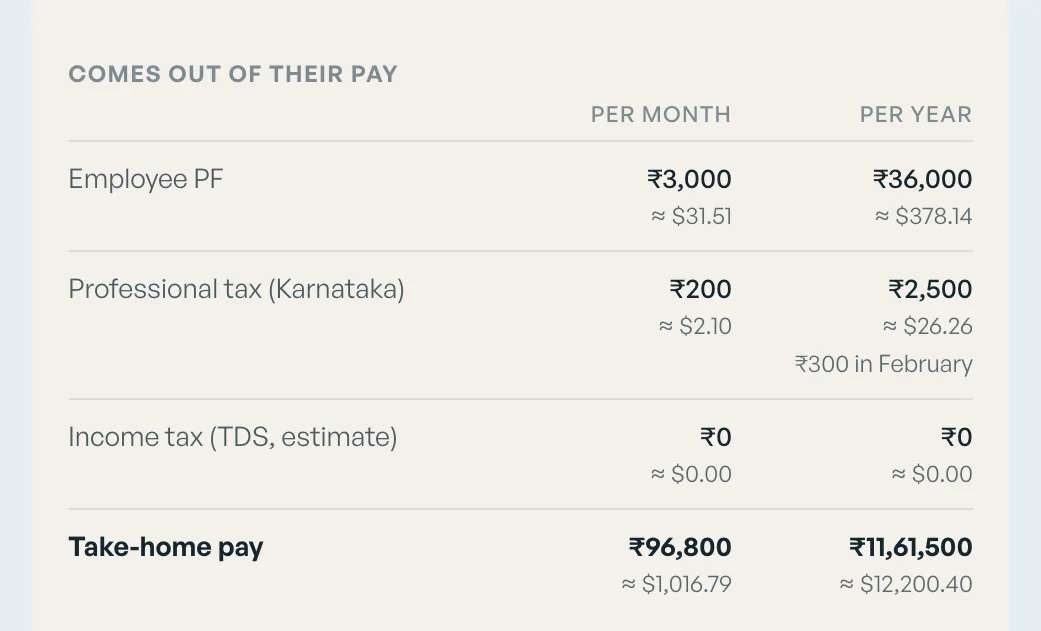
Professional tax is a state tax on employment, deducted from salary by the employer and paid to the state. It follows the employee, not the payroll office. Karnataka's employer FAQ says it "needs to be deposited to the state where employees are working", wherever salary is paid from. Rates, thresholds and dates are set by each state, and some local bodies, like Chennai's, assess it half-yearly.
In salary terms, professional tax is a small fixed deduction on the payslip, sitting beside employee PF and TDS. Versatile Club holds registrations across all 28 states and handles the state-specific professional tax slabs in each one.
How professional tax is calculated on salary
Each state sets slabs by salary, so the calculation is a lookup, not a percentage. Maharashtra's Act charges men nothing on monthly salaries up to ₹7,500 and ₹175 a month up to ₹10,000. Above ₹10,000, it is ₹2,500 a year, collected as ₹200 a month and ₹300 in February.
Chennai works on half-yearly income instead. The corporation's table runs from nil up to ₹21,000 to ₹1,250 for ₹75,001 and above per half-year. The middle bands are ₹180, ₹425, ₹930 and ₹1,025.
Here is a worked example with a round sample salary of ₹1,00,000 a month. In Maharashtra, eleven months at ₹200 plus ₹300 in February gives ₹2,500 a year. In Chennai, half-yearly income of ₹6,00,000 falls in the top band, so ₹1,250 is due twice, again ₹2,500 a year.
Professional tax due dates by state
| State | When the employer pays | Source |
|---|---|---|
| Karnataka | By the 20th of the following month, even with a single employee. Monthly gross income below ₹25,000 is exempt | Karnataka PT employer FAQ |
| Telangana | Monthly return with full payment by the 10th of the following month | Telangana PT payment guidance |
| Gujarat | Within fifteen days after each month ends, per the employer declaration | Gujarat Professions Tax Act compilation |
| Tamil Nadu (Chennai) | Deducted from August and January salaries; August 2026 tax remitted by 30 September 2026 | Greater Chennai Corporation notice |
Other states' dates are left out until a government source confirms them. The page on payroll in Chennai follows Tamil Nadu's calendar in more depth.
How professional tax is paid online
State portals follow the same pattern: register as an employer, file the month's return and pay electronically. In Karnataka, the employer registers with its PAN or TAN, picks the month, files the return and then makes e-payment by net banking, card or UPI. Telangana's guidance accepts a challan, cheque or e-payment with the return.
For employees on Versatile Club's Employer of Record (EOR) service, none of this sits with you. The EOR deducts and pays professional tax under its own registrations, and the monthly status report shows it. The overview of India labour law compliance explains which state rules reach an India team.
How you confirm each deadline was met
A calendar only helps if you can check it against evidence. Each month, Versatile Club sends records you can match to the dates above. Several of them can also be tested in a government system, without relying on the provider.
| Deadline | Record you receive | Government cross-check |
|---|---|---|
| Salaries paid | A payroll summary with gross pay, deductions and net pay for each employee | Each employee's bank credit and payslip |
| TDS deposited | TDS deposit receipts | The challans listed in the quarterly Form 138, and each employee's Form 168 |
| EPF deposited | PF challan confirmations | EPFO's TRRN query and each member's e-Passbook |
| ESIC deposited | ESI challan confirmations | ESIC's e-Challan screen, which runs on the employer code |
| Everything else | A compliance status report on what's filed and what's upcoming | The due dates on this page |
| Your cost for the month | One USD invoice with a per-employee cost breakdown | Not applicable |
A controller can file these next to each month's close. The page on India EOR for finance teams shows how the invoice and the proof fit together.
Why India payroll compliance deadlines matter
Missed India payroll compliance deadlines cost money, and the cost grows each month. Tax deducted but deposited late carries interest at 1.5% for every month or part of a month. Late EPF dues carry simple interest at twelve per cent a year.
The harder cost is finding out late. A missed deposit can surface in an audit, a funding round or an employee's tax return. The India employer compliance scorecard lets you test where a setup is exposed.
What goes wrong and what to check
- The TDS deposit slips past the 7th. Interest then runs from the date of deduction to the date of payment, as the interest section above sets out. You would see a receipt dated after the 7th, or after 30 April for March. Ask Versatile Club for the deposit receipt each month and compare its date.
- A PF or ESIC contribution misses the 15th. Late EPF dues carry simple interest at twelve per cent a year. You would see a missing challan confirmation. Ask for the PF and ESI confirmations, then test them on EPFO's TRRN query and ESIC's e-Challan screen.
- The quarterly statement doesn't match the deposits. Form 138 lists the challans behind each quarter's TDS. If a challan on it is not in your receipts, ask which deposit it refers to. Check each employee's Form 168 as well.
- An exit's wages wait for the next payroll. The Code on Wages requires wages due within two working days of the exit, and that clock runs apart from the monthly date. Start it on the day the employee leaves.
- Professional tax follows the wrong state. It is paid to the state where the employee works, not where salary is paid from. Karnataka's date is the 20th and Telangana's is the 10th, so check the state before the date.
Common questions
What is a statutory compliance calendar in India?
It is the list of recurring dates an Indian employer must meet for wages, TDS, PF, ESIC, bonus and state levies. Central law sets most dates, and each state adds its own.
What are the monthly India payroll deadlines?
Salaries and salary TDS by the 7th of the following month, then EPF and ESIC contributions by the 15th. March TDS is due by 30 April.
When are the quarterly TDS statements due?
31 July, 31 October, 31 January and 31 May, for the quarters ending June, September, December and March. The statement is now Form 138.
What replaced Form 16?
From 1 April 2026, the annual salary certificate is Form 130, issued to each employee by 15 June after the tax year.
What happens if TDS is deposited late?
Interest runs at 1.5% a month or part of a month from the date of deduction to the date of payment. Versatile Club deposits TDS by the 7th and sends you the receipt.
What is professional tax?
A state tax on employment that the employer deducts from salary and pays to the state where the employee works. Each state sets its own slabs and due dates.
How do you calculate professional tax on salary?
Find the employee's monthly or half-yearly salary in the state's slab table and read off the amount. It is a fixed amount per slab, not a percentage of pay.
How do you pay professional tax online?
The employer registers on the state's professional tax portal, files the monthly return and pays electronically. For your team on Versatile Club's EOR service, the EOR does this under its own registrations.
When is statutory bonus due?
Within eight months of the close of the employer's accounting year, credited to the employee's bank account. For a year ending 31 March, that means by 30 November.
How do we know each deadline was met?
Versatile Club sends PF and ESI challan confirmations, TDS deposit receipts and a status report on what's filed and what's coming up. Each record maps to a date in this calendar.
Do state deadlines apply to our employees?
They depend on where each employee works. Delhi's welfare fund dates fall in January and July, while professional tax dates vary by state. Versatile Club holds registrations across all 28 states.
Do we file anything ourselves?
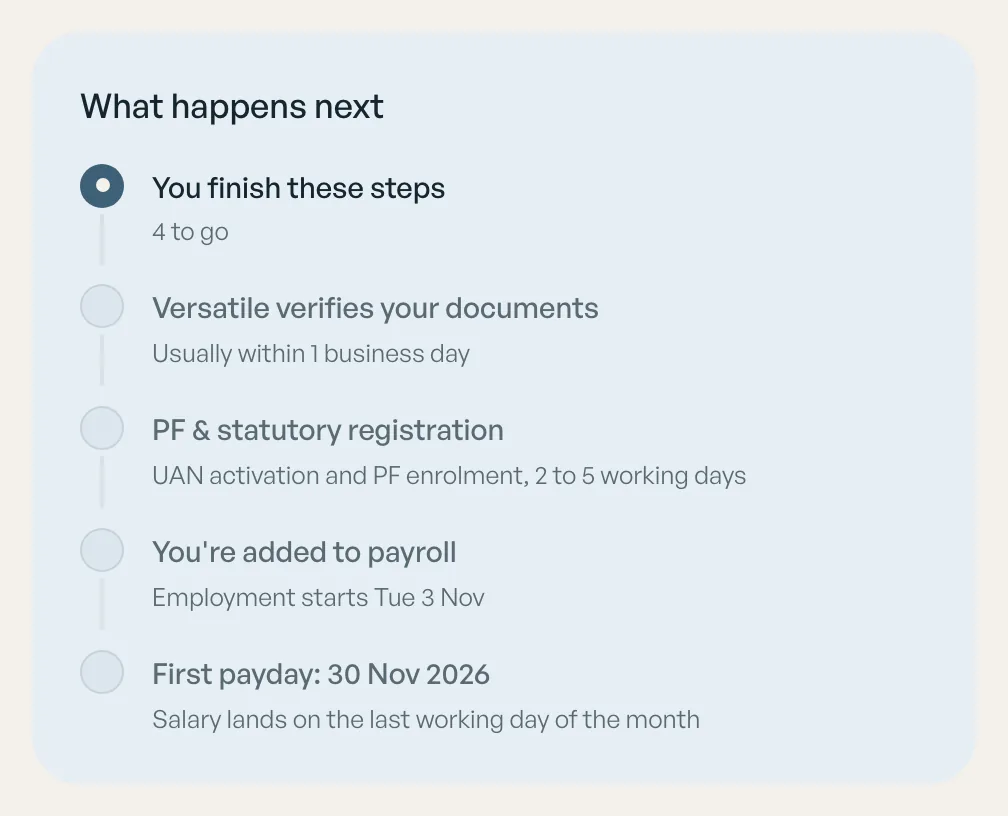
No India filings sit with your company for employees on Versatile Club's Employer of Record (EOR) service. The EOR files their PF, ESI, TDS and professional tax under its own registrations. The page on the EOR's Indian entity lists those registrations.
When does a new hire first appear in these deadlines?
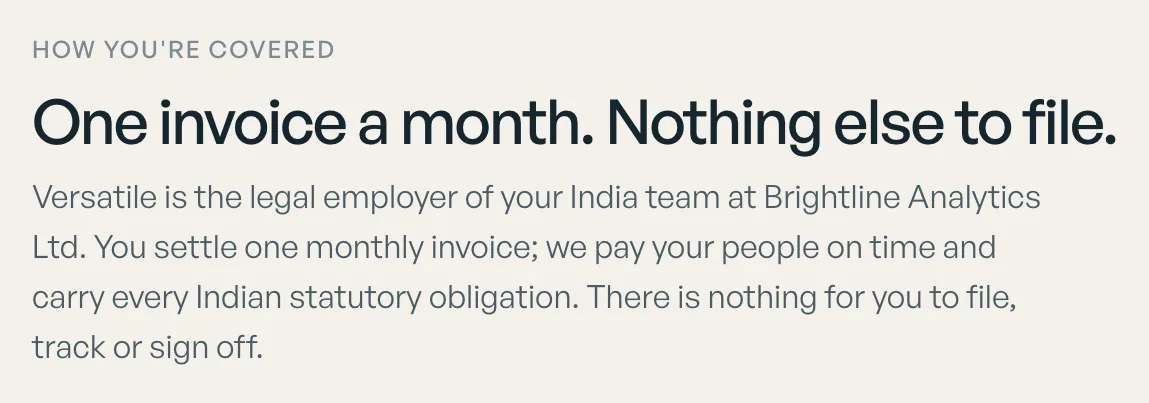
PF, ESI and professional tax start on day four of onboarding, and payroll goes live on day five. The new hire's first month then follows this calendar, as set out in the onboarding steps.
Who answers questions about a deadline?
Write to the Versatile Club team through the contact page. The monthly status report shows what's filed and what's due next.